
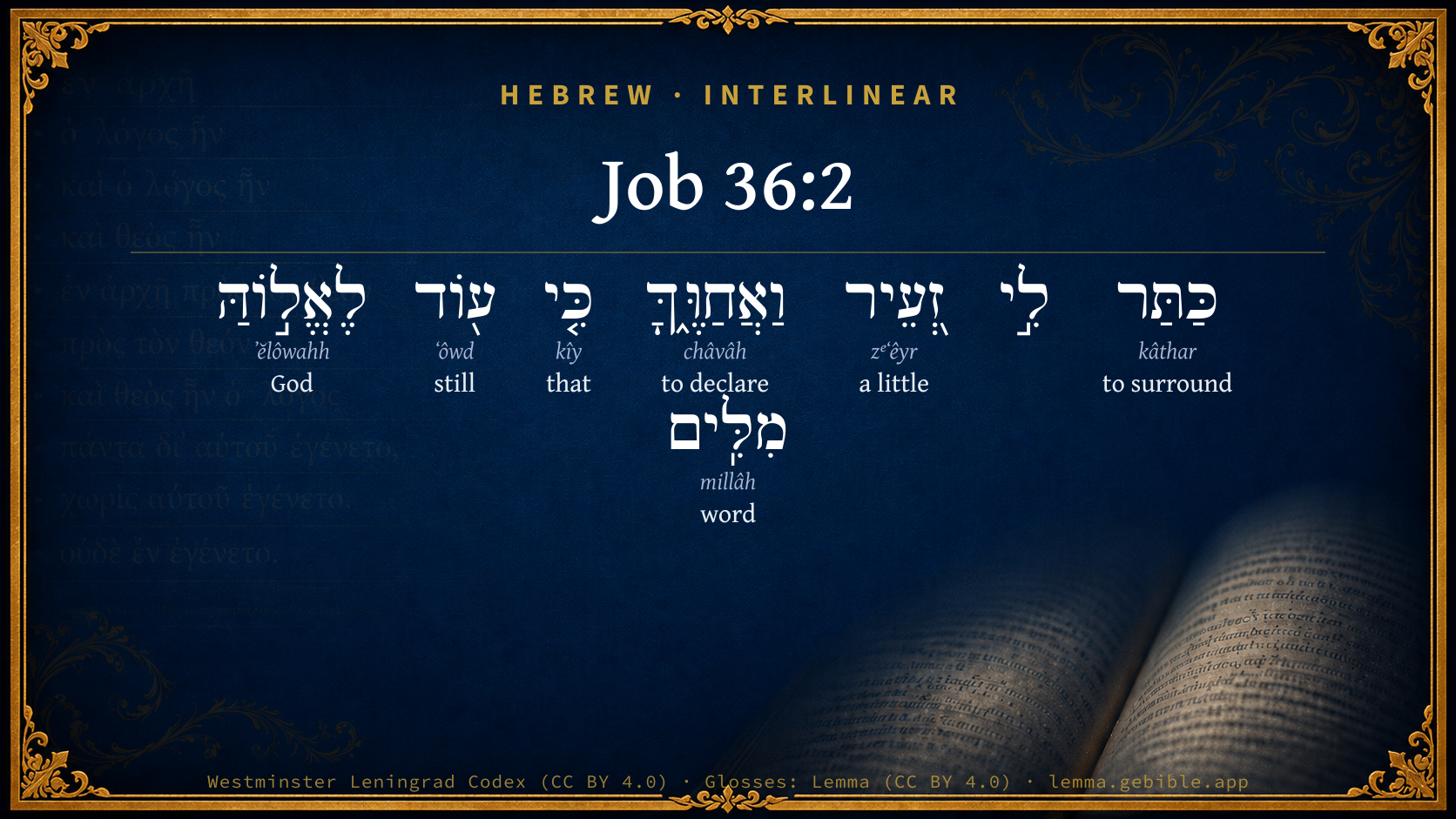
Job 36:2

Hebrew (Westminster Leningrad Codex) Job 36:2 appears in the Hebrew Old Testament. The text above is from the Westminster Leningrad Codex. Each word links to its Strong’s number, a concise gloss, and parsing drawn from the Open Scriptures Hebrew Bible morphology. Click any word for its full Brown-Driver-Briggs (BDB) entry.
Download image
Cite this verse

Job 36:2 (World English Bible). Public Domain. Lemma interlinear Bible study tool, https://lemma.gebible.app/v/job/36/2.

Show BibTeX & RIS
BibTeX
RIS
English Translation
"Bear with me a little, and I will show you; For I still have something to say on God's behalf.
World English Bible · Public Domain
Highlights
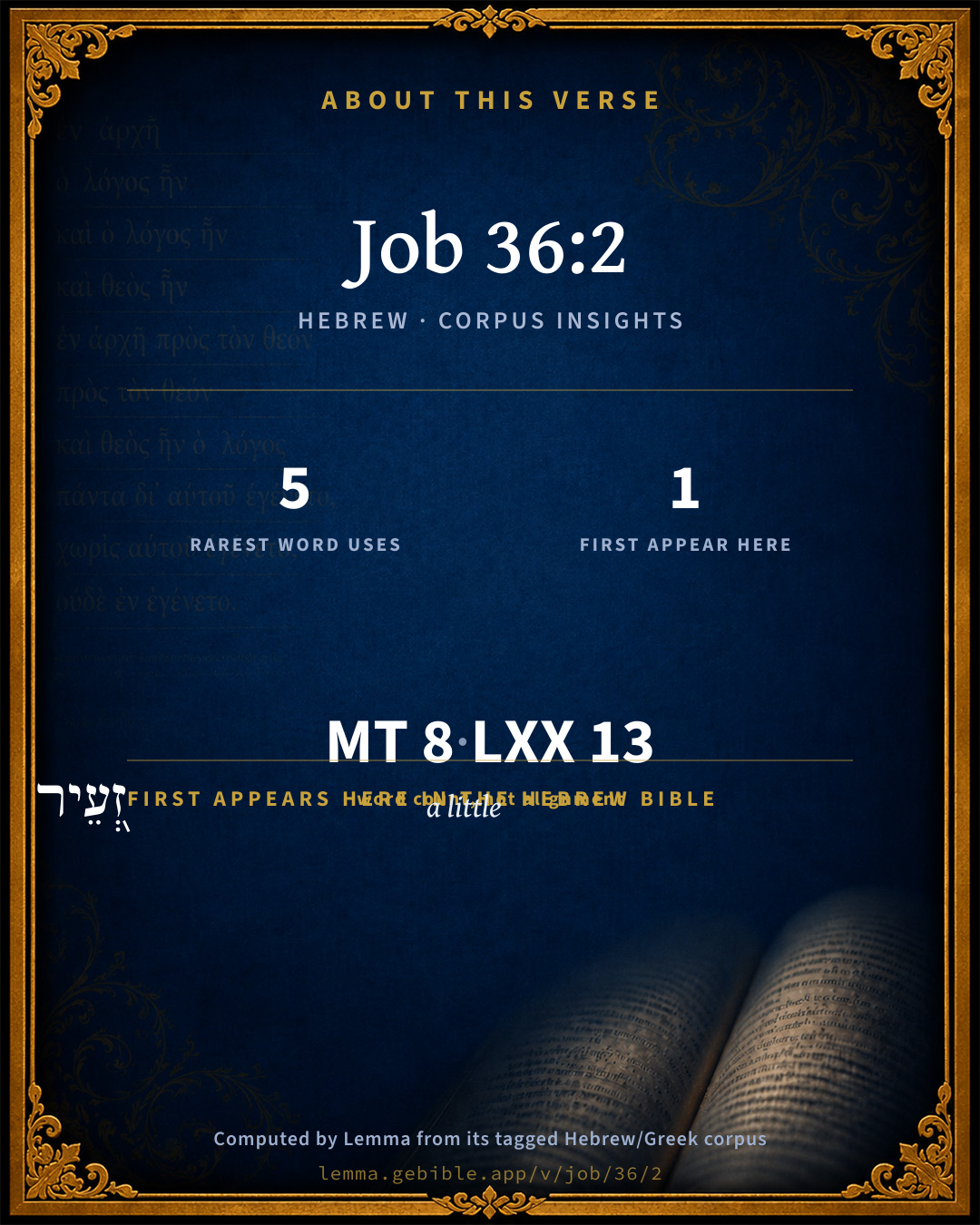
  • 1 first appearance in the Hebrew Bible
Full analysis ↓
Download a study sheet

One document with this verse’s original text, its word-by-word gloss line, the meaning frame, cross-references with their text, attributed commentary, and full source and license credits — printable, and it pastes into notes with its structure intact.

This verse Autodidact and up

Study sheet (.html) Plain text (.txt)

A passage Seminary Student

Up to 50 verses in one chapter. A passage sheet keeps up to 6 commentary sources and 12 cross-references per verse, in the order this page ranks them, and says so on the sheet whenever that leaves anything out. Ask for a single verse and you get the Autodidact verse sheet above.

Everything on this page stays free to read, with no account — the sheet is a download of what is already on screen, not access to it.

Want to remove ads? Support Godless Engineer
Compare translations 3

The same verse in 3 English versions, stacked beneath the original-language interlinear above. Click any original word for its lexicon entry.

Each is an independent rendering of the whole verse — the interlinear is not word-aligned to these translations.

Highlighted words mark where these versions differ — a whole-verse word diff, not a word-by-word alignment.

  • World English Bible Public Domain
    "Bear with me a little, and I will show you; For I still have something to say on God's behalf.
  • King James Version Public Domain
    Suffer me a little, and I will shew thee that I have yet to speak on God's behalf.
  • unfoldingWord Literal Text CC BY-SA 4.0
    “Be patient with me a little and I will show you, for yet words to God.

unfoldingWord Literal Text — © unfoldingWord, licensed CC BY-SA 4.0. Word-aligned USFM3 via Door43 (git.door43.org/unfoldingWord/en_ult).

Versions to compare (up to 4)

3 of 4 selected

Show all 18 translations

Every available English version of this verse, each an independent rendering of the whole verse.

  • World English Bible Public Domain
    "Bear with me a little, and I will show you; For I still have something to say on God's behalf.
  • Berean Standard Bible Public Domain
    “Bear with me a little longer, and I will show you that there is more to be said on God’s behalf.
  • Majority Standard Bible Public Domain
    “Bear with me a little longer, and I will show you that there is more to be said on God’s behalf.
  • King James Version Public Domain
    Suffer me a little, and I will shew thee that I have yet to speak on God's behalf.
  • American Standard Version (1901) Public Domain
    Suffer me a little, and I will show thee; For I have yet somewhat to say on God's behalf.
  • Revised Version (1885) Public Domain
    Suffer me a little, and I will shew thee: for I have yet somewhat to say on God’s behalf.
  • Geneva Bible (1599) Public Domain
    Suffer me a litle, and I will instruct thee: for I haue yet to speake on Gods behalfe.
  • Douay-Rheims (1899) Public Domain
    Suffer me a little, and I will shew thee: for I have yet somewhat to speak in God's behalf.
  • Young's Literal Translation Public Domain
    Honour me a little, and I shew thee, That yet for God `are' words.
  • Literal Standard Version CC BY-SA 4.0
    “Honor me a little, and I show you, || That yet for God [are] words.
  • Unlocked Literal Bible CC BY-SA 4.0
    “Permit me to speak a little longer, and I will show you some things because I have a little more to say in defense of God.
  • unfoldingWord Literal Text CC BY-SA 4.0
    “Be patient with me a little and I will show you, for yet words to God.
  • Darby Bible Public Domain
    Suffer me a little, and I will shew thee that I have yet words for +God.
  • World Messianic Bible Public Domain
    “Bear with me a little, and I will show you; for I still have something to say on God’s behalf.
  • Webster's Bible Public Domain
    Suffer me a little, and I will show thee that I have yet to speak on God's behalf.
  • Free Bible Version CC BY-SA 4.0
    “Be patient with me just a little while longer and let me explain. I still have something to say on God's behalf.
  • Bible in Basic English Public Domain
    Give me a little more time, and I will make it clear to you; for I have still something to say for God.
  • JPS Tanakh (1917) Public Domain
    Suffer me a little, and I will tell thee; for there are yet words on God's behalf.

Literal Standard Version (2020), Covenant Press — licensed CC BY-SA 4.0. Text via the HelloAO Bible API (eBible.org). Unlocked Literal Bible (unfoldingWord) — licensed CC BY-SA 4.0. Text via the HelloAO Bible API (eBible.org). unfoldingWord Literal Text — © unfoldingWord, licensed CC BY-SA 4.0. Word-aligned USFM3 via Door43 (git.door43.org/unfoldingWord/en_ult). Free Bible Version, Dr. Jonathan Gallagher — licensed CC BY-SA 4.0. Text via the HelloAO Bible API (eBible.org).

Word by word

More ways to search: Search by grammar → Find every occurrence → Compare this word →

Practice this passage: Drill this verse → Learn its vocabulary →

About this verse

These counts appear in no published source. They are computed here, from the morphology-tagged text and Lemma’s own curated glosses. What Lemma adds →

8
words
7
distinct lemmas
Wisdom
section

Notable vocabulary

The rarest word here is זְ֭עֵיר a little H2191 — appearing just 5 times in the whole Hebrew Bible.

First appearance in Scripture

This word makes its first canonical appearance in the Hebrew Bible here:

  • זְ֭עֵיר a little H2191

Shared distinctive vocabulary

זְ֭עֵיר a little H2191 occurs in 3 verses of the Hebrew Bible. Also found in:

Grammatical profile

  • 2 verbs
  • 3 nouns
  • 1 preposition
  • 1 conjunction
  • 1 adverb

Verb forms

  • כַּתַּר Piel · Imperative
  • וַאֲחַוֶּ֑ךָּ Piel · Imperfect

Hebrew & Septuagint length

In English translation the verse runs 20 words from the Hebrew and 19 from the Septuagint (LXX English) — closely comparable.

A rough comparison of the two English renderings, which tokenize alike — not a word-level alignment.

Word counts can differ between the Hebrew and the Greek without any difference in meaning — e.g. the Hebrew direct-object marker אֵת has no separate Greek word, and Greek often adds the article ὁ.

In the original languages it is 8 Hebrew tokens and 13 Greek tokens — but the two are counted differently (Hebrew bundles its prefixes and suffixes into one token; the Greek is in lemma form), so that isn’t a like-for-like length.

Cross-references

9

Topical passages linked to Job 36:2 in the Treasury of Scripture Knowledge — connected by theme and wording, ordered by reader-vote popularity; previews shown in the World English Bible.

  • Job 21:3 Allow me, and I also will speak; After I have spoken, mock on.
  • Job 13:7–8 Will you speak unrighteously for God, And talk deceitfully for him?
  • 2 Corinthians 5:20 We are therefore ambassadors on behalf of Christ, as though God were entreating by us. We beg you on behalf of Christ, be reconciled to God.
  • Job 33:6 Behold, I am toward God even as you are: I am also formed out of the clay.
  • Job 33:31–33 Mark well, Job, and listen to me: Hold your peace, and I will speak.
  • Jeremiah 15:19 Therefore thus says Yahweh, If you return, then will I bring you again, that you may stand before me; and if you take forth the precious from the vile, you shall be as my mouth: they shall return to you, but you shall not return to them.
  • Ezekiel 2:7 You shall speak my words to them, whether they will hear, or whether they will forbear; for they are most rebellious.
  • Hebrews 13:22 But I exhort you, brothers, endure the word of exhortation, for I have written to you in few words.
  • Exodus 4:16 He will be your spokesman to the people; and it will happen, that he will be to you a mouth, and you will be to him as God.

Cross-references courtesy of OpenBible.info (CC BY 4.0).

Hebrew and Greek witnesses Masoretic Hebrew ↔ Greek Septuagint

The same verse in the two great witnesses to the Old Testament, shown verse-for-verse.

These are two independent witnesses, not word-aligned to each other, and the Septuagint is shown in lemma (dictionary) form.

Hebrew Job 36:2 Masoretic · Westminster Leningrad Codex

כַּתַּר לִ֣י זְ֭עֵיר וַאֲחַוֶּ֑ךָּ כִּ֤י ע֖וֹד לֶאֱל֣וֹהַּ מִלִּֽים

"Bear with me a little, and I will show you; For I still have something to say on God's behalf.

World English Bible · Public Domain

Greek LXX Job 36:2 Septuagint · lemma form

μένω ἐγώ μικρός ἔτι ἵνα διδάσκω σύ ἔτι γάρ ἐν ἐγώ εἰμί λέξις

Wait for me yet a little while, that I may teach you: for there is yet speech in me.

LXX2012 (modern English Septuagint) · Public Domain

Hebrew: Westminster Leningrad Codex (CC BY 4.0). Greek: Septuagint (public domain); English from LXX2012 (modern English Septuagint) (Public Domain). How the Septuagint differs from the Hebrew →

Commentary

Notes on Job 36:2 from classic Christian and Jewish commentators (each source and its license shown beneath its notes). The classic Christian expositions comment on the surrounding passage and are grouped to its opening verse, so a note may address several verses; the Jewish commentaries on the Tanakh (Rashi and others) are per-verse, so they appear only where the commentator wrote on this verse.

Lemma curates 59 commentaries, every one of them public domain or Creative Commons licensed, each selected and text-cleaned for this edition rather than reprinted as found. About our sources →

Trapp's Complete Commentary

John Trapp

Job 36:2 Suffer me a little, and I will shew thee that [I have] yet to speak on God’s behalf.

Ver. 2. Suffer me a little, and I will show thee] He promiseth brevity and thereby wooeth attention: brevity and perspicuity are two great graces of speech, and do very much win upon intelligent hearers, who love to hear much in few, and cannot away with tedious prolixities. When a great trifler had made an empty discourse in the presence of Aristotle, and then cried him mercy for troubling him so long: You have not troubled me at all, said he, for I scarce hearkened to any one word you said all this while.

That I have yet to speak on God’s behalf] Heb. That there are yet words for God. His zeal for God’s glory drew from him this following speech, wherein insignis est Elihu et magnificus. Elihu excelleth himself, and appeareth to be no worse an orator than was M. Crassus among the Romans, who had this commendation given him, Quod cum aliquid accuratius dixisset, semper fere contigit ut nunquam dixisse melius putaretur, That whenever he spoke it was judged to be the very best that ever he spake. (Cir. de Orat. 1. 1).

John Trapp, A Commentary or Exposition upon All the Books of the Old and New Testament (1647–1656) — public domain. Text from a community e-Sword module.

Joseph Benson's Commentary

Job 36:2-4. Suffer me a little — Give me thy patient attention but a little longer, and I have done. I will show I have yet to speak on God’s behalf — That I have not yet said all that can be said to justify God’s dispensations toward thee. I will fetch my knowledge from afar — From remote times, and places, and things. I will not confine my discourse to any particular case, but will justify God by declaring his great and glorious works of creation and providence, both in the heaven and the earth, and the manner of his dealings with men in other parts and ages of the world. These are the chief heads of the following discourse, and therefore the best comment upon this general expression. And will ascribe righteousness to my Maker — I will prove and maintain this truth, that God is righteous in all his ways. My words shall not be false — Neither contrary to truth, nor to my views and apprehensions of it. I will admit into my discourse no kind or degree of flattery, calumny, or sophistry; he that is perfect in knowledge is with thee — He that is sincere and upright in his use of his knowledge, who will deliver his opinion honestly and truly, unbiased by fear or favour, passion or prejudice; and who believes that, as he has accurately considered, so he fully understands the matters about which he will speak. Bishop Patrick’s paraphrase on the verse is, “Assure thyself I will not seek to baffle thee with sophistical arguments: he that discourses with thee is none of those subtle disputers, but loves sincere and solid reason.” The latter clause, however, may be considered as connected with what follows, and understood as spoken of God. The meaning then will be, Thou hast to do with a God of perfect knowledge, by whom all thy words and actions are weighed.

Joseph Benson's Commentary on the Old and New Testaments (1811–1818) — public domain. Text from a community e-Sword module.

Adam Clarke's Commentary

Verse 2. That I have yet to speak on God's behalf.] I have other proofs to allege in behalf of God's justice and providence.

Adam Clarke's Commentary on the Bible (1810–1826) — public domain. Text from a community e-Sword/MySword module.

The Cambridge Bible for Schools and Colleges

gen. ed. J. J. S. Perowne

2. The verse reads,

Suffer me a little and I will shew thee;

For I have somewhat still to say on God’s behalf.

The first words are lit. wait for me a little.

The Cambridge Bible for Schools and Colleges (gen. ed. J. J. S. Perowne; Cambridge University Press, 1878–1918) — public domain. Text from a community e-Sword module.

John Gill's Exposition

Suffer me a little,.... Bear with me a little longer, and allow me to say a few words more. I have but little more to say, and it will take but a little time to say it in; thus, proposing brevity, he hoped to be heard with patience, since he should not long trespass upon it. The word used has the signification of a crown; but not to be understood in the sense of surrounding, as a crown surrounds the head, as some, who interpret it, stand about me, surround me, in order to hear; for this cannot with propriety be said to a single person; but rather in the sense of doing honour, as Aben Ezra; and so the meaning may be, do me the honour of giving; me thy presence a little longer, and hearing me out patiently;

and I will show thee: make things clear, manifest, and plain to thee: clearness of expression, with brevity, recommends a discourse. Something may be here supplied; for a greater stop is here to be made than in our version, as either "my opinion", as in Job 32:10; his sentiment concerning God and his righteousness in his dealings with the sons of men; or "truth", as Ben Gersom; truth in general, plain naked truth, without any colouring, just as it is, cordially, sincerely, in love, and by clear manifestations of it; and particularly the truth of the righteousness of God in all his ways and works. He proposed to make it clear to him that God did all things well and right, and to lay before him in the plainest manner what were the ends God had in view in dealing thus with Job, and what was his duty to do in his present circumstances;

that I have yet to speak in God's behalf: or "for I have yet to speak" (g), &c. Elihu had said much for God already, in vindication of his sovereignty, purity, holiness, and justice, and he had yet more to say; out of the abundance of his heart his mouth spake for God; he set out with this, that he was full of matter, and wanted to vent himself, that he might be eased, Job 32:18; and he had vented much, but he had yet more to deliver; and since it was not for himself, in his own behalf, nor of any other but God, he hoped he should be heard: it may be rendered, "for yet God has words" (h), to put into my mouth, and speak by me; signifying, that he had spoken by him already, and had still more to say by him; and since it was not so much he that spoke, as God that spoke in him and by him, it might be expected he would be heard.

(g) "quia", Pagninus, Montanus; "nam", Junius & Tremellius, Piscator. (h) "adhue Deo sermones", Montanus; "habit enim Deus adhue quod dicet", Castalio; so some in Michaelis.

John Gill's Exposition of the Whole Bible (1746–1763) — public domain (CC PDM 1.0). Text via the HelloAO Bible API.

Albert Barnes' Notes on the Bible

Suffer me a little - Even beyond the regular order of speaking; or, allow me to go on though I have fully occupied my place in the “number” of speeches. Jarchi remarks that this verse is “Chaldaic,” and it is worthy of observation that the principal words in it are not those ordinarily used in Hebrew to express the same thought, but are such as occur in the Chaldee. The word rendered “suffer” (כתר kâthar) has here a signification which occurs only an Syriac and Chaldee. It properly means in Hebrew: to “surround,” in a hostile sense; Jdg 20:43; Psa 22:12; then in the Hiphil to crown oneself. In Syriac and Chaldee, it means “to wait” - perhaps from the idea of going round and round - and this is the meaning here. He wished them not to remit their attention, but to have patience with what he would yet say.

And I will show thee that - Margin, “there are yet words for God.” The Hebrew is, “And I will show you that there are yet words for God;” that is, that there were yet many. considerations which could be urged in vindication of his government. The idea of Elihu is not so much that “he” had much to say, as that in fact there was much that “could be” said for him. He regarded his character and government as having been attacked, and he believed that there were ample considerations which could be urged in its defense. The word which is here rendered “I will show thee” (אחוך 'achâvekā), is also Chaldee in its signification. It is from חוה châvâh (Chaldee) not used in the Qal, but it occurs in other forms in the Chaldee portion of the Scriptures; see Dan 2:11, Dan 2:16, Dan 2:24, Dan 2:27. The use of these Chaldee words is somewhat remarkable, and perhaps may throw some light on the question about the time and place of the composition of the book.

Albert Barnes' Notes on the Bible (1834–1885) — public domain. Text from a community e-Sword/MySword module.

Matthew Poole's English Annotations

Suffer me a little; give me thy patient attention but a little longer; and I

will show thee that I have not said all that can be said to justify God’s proceedings against thee.

Matthew Poole's English Annotations on the Holy Bible (1683–1685) — public domain. Text from a community e-Sword/MySword module.

The Pulpit Commentary

HOMILIES BY W.F. ADENEY Ver. 2. Speaking on God"s behalf.

Elihu is not a little held in roundly asserting that he is speaking on God"s behalf. He may be fight, but his assertion needs testing. Not all who claim to speak for God can be accredited as his ambassadors. We must examine the credentials of those who say that they speak on behalf of God.

I THE FALSE CLAIM TO SPEAK ON GOD"S BEHALF. This claim is put forth repeatedly.

1. By officialism. Because certain people hold a high office, they assume that they have a fight to represent God. But they may be true in their work and in discharging the proper functions of their office, and yet quite false in pretending to speak for God. God does not confine his heavenly communications to official channels.

2. By authoritative orthodoxy. No one can read the sad records of ecclesiastical history without seeing what ungodly passions have been engaged in the battles of theology. Dare we say that the issue of these miserable conflicts has always been a triumph for truth?

3. By personal dogmatism. Young men, such as Elihu, declare that they are speaking for God. They are very positive. But are they infallible? Would it not be well to see that God is not absolutely dependent on our advocacy? Vast mischief has accrued through bungling and even unrighteous attempts to vindicate God"s truth and God"s action. Can he not take care of his own cause? Shall we, like Uzzah, interfere at every crisis to save the ark of God from destruction? Much unbelief is simply due to unwise advocacy and defence of religion. Sometimes it is best to say nothing, but to trust God"s cause to himself. "Be still, and know that I am God.

II THE NECESSARY DUTY OF SPEAKING ON GOD"S BEHALF. There are times when God requires his people to speak for him, and we dare not be silent under all circumstances. Wrong must be denounced, error corrected, truth maintained, the gospel made known. How, then, can this advocacy be saved from the mischievous effects which follow from a wrong way of speaking for God?

1. By a Divine commission. They who speak for God must be called by God. Whatever be their human mission, they certainly need a Divine vocation. Let a man be well assured in his heart that God has called him before he opens his lips. The assurance may not come by any mystic voices, but by clear indications of providence, the prompting of conscience, the faculty to speak, the open door.

2. By a hold of truth. The teacher must be taught. The, advocate must have his brief; the envoy his dispatch. The Christian missionary must be clear in his own grasp of Christian truth. We have the best guide to truth in the Bible. If any one would speak for God, let him follow the teachings of this book.

3. By sympathy with the Spirit of God. We cannot even speak the truth we know wisely and well, unless we are guided by the present influence of the Holy Spirit. It is not enough to study our Bibles. We must be much in prayer, we must live near to God, so that we may speak in the strength and spirit of God. W.F.A.

The Pulpit Commentary (1880–1919), ed. H.D.M. Spence-Jones & Joseph S. Exell — public domain. Text from a community e-Sword module.

Rashi

Rabbi Shlomo Yitzchaki (Rashi)

Wait awhile for me and I will tell you This is completely Aramaic: Wait for me a little and I will tell you. [The word] כַּתַּר is an expression of waiting, as Jonathan rendered (Isa. 42:4): “and for his instruction, islands shall long (יכתרון).”

God has Those representing Him have.

Rashi on the Tanakh — English translations: “The Judaica Press complete Tanach with Rashi, translated by A. J. Rosenberg” (CC BY 4.0); “Pentateuch with Rashi's commentary by M. Rosenbaum and A.M. Silbermann, 1929-1934” (public domain); “The Metsudah Tanach series, Lakewood, N.J” (CC BY 4.0); and “The Book of Joshua, Metsudah Publications, 1997” (CC BY 4.0). Text via Sefaria.

Lesson kit

Teaching starters — assembled from the data on this page, not authored interpretation. Every prompt links to the verse data it draws on. Edit before teaching.

Job, in the Wisdom, opens this verse with 8 words (7 distinct Hebrew lemmas). Its most distinctive word is zᵉʻêyr (“a little”). A historical commentator’s framing appears above. Read the whole chapter for the surrounding context.

Discussion questions

  1. The word zᵉʻêyr carries the sense “a little.” How does it shape the verse?
  2. The word “a little” first appears here in Scripture. What is being introduced at this debut?
  3. Isaiah 28:10 shares the word «a little» with this verse. How do the two illuminate each other?
  4. These translations render this verse differently; the difference is in the English rendering, not the original. What questions does that raise?
  5. The verb «כַּתַּר» is Piel Imperative. How does its form color the action?
  6. Reading how Trapp's Complete Commentary and Joseph Benson's Commentary read this verse, where do the two commentators agree and where do they part?

Things to notice

Reading settings

Reading text

Shown beneath each verse's original-language words.

Old Testament
Old Testament edition

Read the OT as the Masoretic Hebrew (MT) or the Greek Septuagint (LXX).

English shown for the Greek Septuagint (in the Hebrew ↔ Greek comparison).

Comparing translations? Open the Compare panel on any verse page to stack up to four side by side.