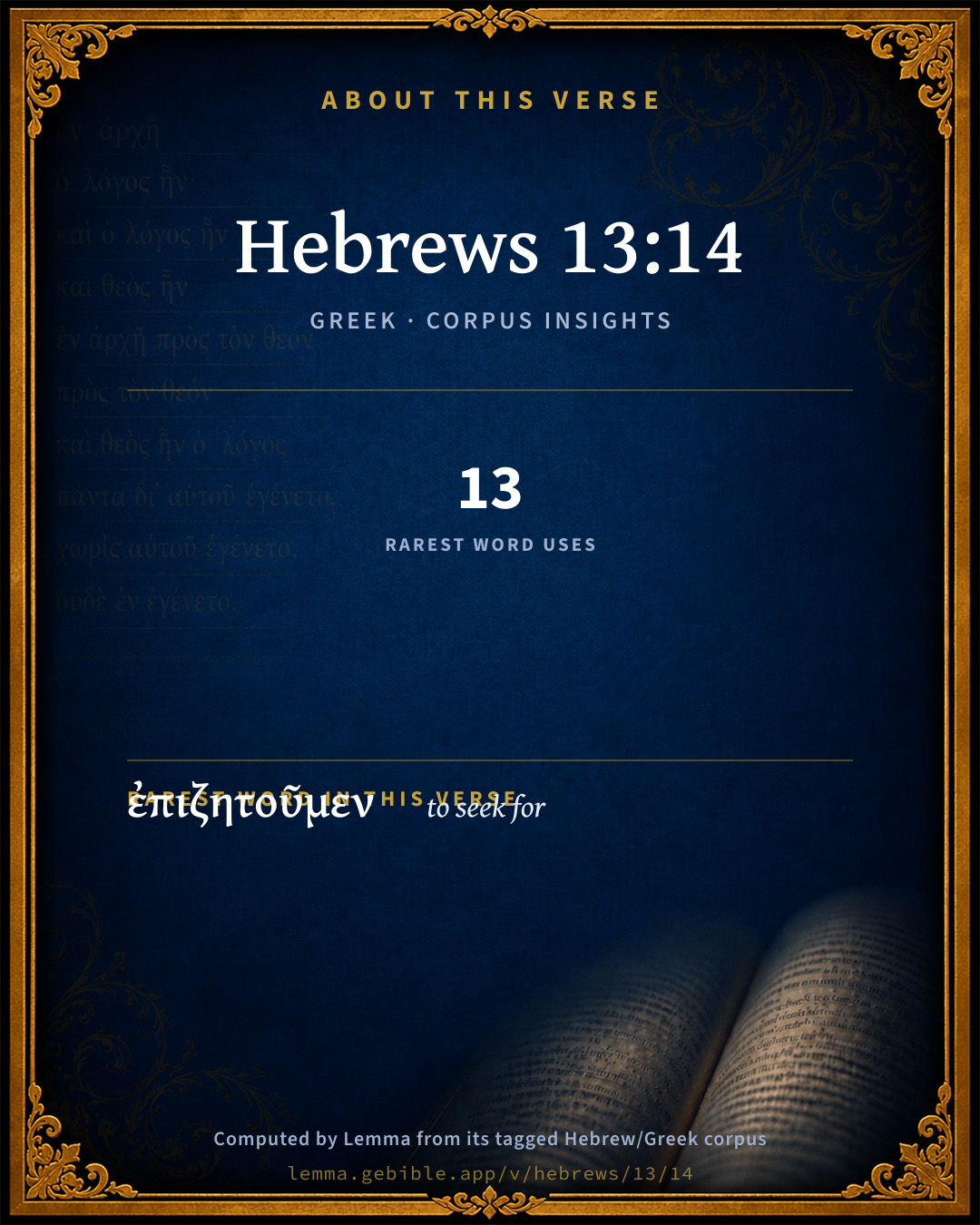
Hebrews 13:14

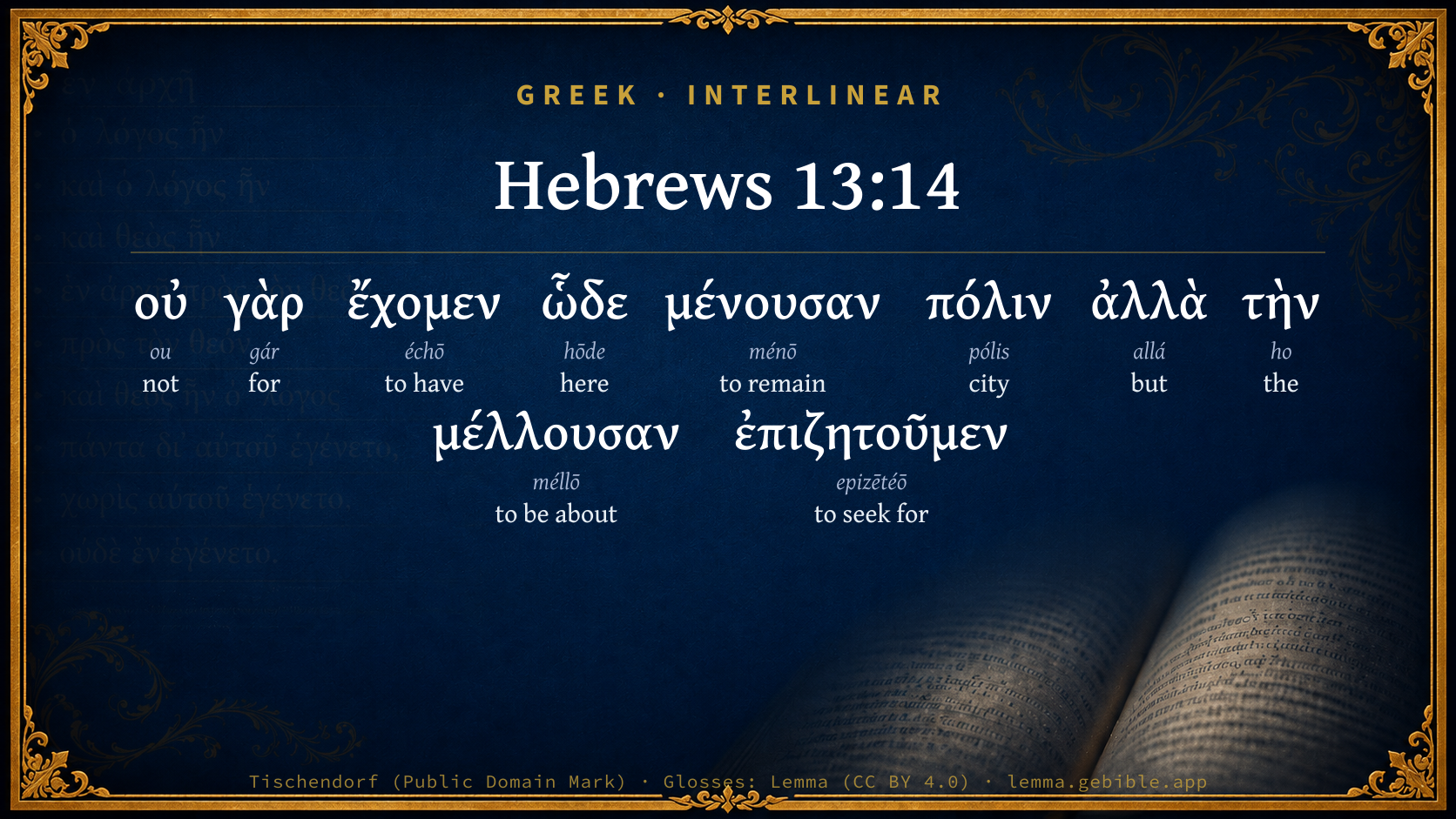
Greek (Tischendorf 8th ed.) Hebrews 13:14 appears in the Greek New Testament. The text above is from the Tischendorf 8th edition. Each word links to its Strong’s number and a concise gloss. Click any word for its full Thayer’s Greek Lexicon entry.
Download image
Cite this verse

Hebrews 13:14 (World English Bible). Public Domain. Lemma interlinear Bible study tool, https://lemma.gebible.app/v/hebrews/13/14.

Show BibTeX & RIS
BibTeX
RIS
English Translation
For we don't have here an enduring city, but we seek that which is to come.
World English Bible · Public Domain
Download a study sheet

One document with this verse’s original text, its word-by-word gloss line, the meaning frame, cross-references with their text, attributed commentary, and full source and license credits — printable, and it pastes into notes with its structure intact.

This verse Autodidact and up

Study sheet (.html) Plain text (.txt)

A passage Seminary Student

Up to 50 verses in one chapter. A passage sheet keeps up to 6 commentary sources and 12 cross-references per verse, in the order this page ranks them, and says so on the sheet whenever that leaves anything out. Ask for a single verse and you get the Autodidact verse sheet above.

Everything on this page stays free to read, with no account — the sheet is a download of what is already on screen, not access to it.

Want to remove ads? Support Godless Engineer
Compare translations 3

The same verse in 3 English versions, stacked beneath the original-language interlinear above. Click any original word for its lexicon entry.

Each is an independent rendering of the whole verse — the interlinear is not word-aligned to these translations.

Highlighted words mark where these versions differ — a whole-verse word diff, not a word-by-word alignment.

  • World English Bible Public Domain
    For we don't have here an enduring city, but we seek that which is to come.
  • King James Version Public Domain
    For here have we no continuing city, but we seek one to come.
  • unfoldingWord Literal Text CC BY-SA 4.0
    For we do not have a lasting city here, but we are seeking the one coming.

unfoldingWord Literal Text — © unfoldingWord, licensed CC BY-SA 4.0. Word-aligned USFM3 via Door43 (git.door43.org/unfoldingWord/en_ult).

Versions to compare (up to 4)

3 of 4 selected

Show all 19 translations

Every available English version of this verse, each an independent rendering of the whole verse.

  • World English Bible Public Domain
    For we don't have here an enduring city, but we seek that which is to come.
  • Berean Standard Bible Public Domain
    For here we do not have a permanent city, but we are looking for the city that is to come.
  • Majority Standard Bible Public Domain
    For here we do not have a permanent city, but we are looking for the city that is to come.
  • King James Version Public Domain
    For here have we no continuing city, but we seek one to come.
  • American Standard Version (1901) Public Domain
    For we have not here an abiding city, but we seek after `the city' which is to come.
  • Revised Version (1885) Public Domain
    For we have not here an abiding city, but we seek after the city which is to come.
  • Geneva Bible (1599) Public Domain
    For here haue we no continuing citie: but we seeke one to come.
  • Douay-Rheims (1899) Public Domain
    For we have not here a lasting city, but we seek one that is to come.
  • Young's Literal Translation Public Domain
    for we have not here an abiding city, but the coming one we seek;
  • Literal Standard Version CC BY-SA 4.0
    for we have no abiding city here, but we seek the coming one.
  • Unlocked Literal Bible CC BY-SA 4.0
    For we do not have any permanent city here. Instead, we are looking for one that is to come.
  • unfoldingWord Literal Text CC BY-SA 4.0
    For we do not have a lasting city here, but we are seeking the one coming.
  • Darby Bible Public Domain
    for we have not here an abiding city, but we seek the coming one.
  • World Messianic Bible Public Domain
    For we don’t have here an enduring city, but we seek that which is to come.
  • Webster's Bible Public Domain
    For here we have no continuing city, but we seek one to come.
  • Free Bible Version CC BY-SA 4.0
    For we don't have a permanent city to live in here; we're looking for the home that is still to come.
  • Bible in Basic English Public Domain
    For here we have no fixed resting-place, but our search is for the one which is to come.
  • Text-Critical English NT CC BY 4.0
    For here we do not have a lasting city, but we seek the city that is to come.
  • Tyndale New Testament (1534) Public Domain
    For here have we no continuynge citie: but we seke one to come.

Literal Standard Version (2020), Covenant Press — licensed CC BY-SA 4.0. Text via the HelloAO Bible API (eBible.org). Unlocked Literal Bible (unfoldingWord) — licensed CC BY-SA 4.0. Text via the HelloAO Bible API (eBible.org). unfoldingWord Literal Text — © unfoldingWord, licensed CC BY-SA 4.0. Word-aligned USFM3 via Door43 (git.door43.org/unfoldingWord/en_ult). Free Bible Version, Dr. Jonathan Gallagher — licensed CC BY-SA 4.0. Text via the HelloAO Bible API (eBible.org).

Word by word

More ways to search: Search by grammar → Find every occurrence → Compare this word →

Practice this passage: Drill this verse → Learn its vocabulary →

About this verse

These counts appear in no published source. They are computed here, from the morphology-tagged text and Lemma’s own curated glosses. What Lemma adds →

10
words
10
distinct lemmas
General Epistles
section

Notable vocabulary

The rarest word here is ἐπιζητοῦμεν to seek for G1934 — appearing just 13 times in the whole Greek New Testament.

Shared distinctive vocabulary

ἐπιζητοῦμεν to seek for G1934 occurs in 12 verses of the Greek New Testament. Also found in:

Cross-references

12

Topical passages linked to Hebrews 13:14 in the Treasury of Scripture Knowledge — connected by theme and wording, ordered by reader-vote popularity; previews shown in the World English Bible.

  • Philippians 3:20 For our citizenship is in heaven, from where we also wait for a Savior, the Lord Jesus Christ;
  • Colossians 3:1–3 If then you were raised together with Christ, seek the things that are above, where Christ is, seated on the right hand of God.
  • Hebrews 11:12–16 Therefore as many as the stars of the sky in multitude, and as innumerable as the sand which is by the sea shore, were fathered by one man, and him as good as dead.
  • Hebrews 12:22 But you have come to Mount Zion, and to the city of the living God, the heavenly Jerusalem, and to innumerable hosts of angels,
  • 2 Peter 3:13–14 But, according to his promise, we look for new heavens and a new earth, in which dwells righteousness.
  • Ephesians 2:19 So then you are no longer strangers and foreigners, but you are fellow citizens with the saints, and of the household of God,
  • 2 Corinthians 4:17–5:8 For our light affliction, which is for the moment, works for us more and more exceedingly an eternal weight of glory;
  • Micah 2:10 Arise, and depart! For this is not your resting place, Because of uncleanness that destroys, Even with a grievous destruction.
  • Hebrews 11:9–10 By faith, he lived as an alien in the land of promise, as in a land not his own, dwelling in tents, with Isaac and Jacob, the heirs with him of the same promise.
  • 1 Corinthians 7:29 But I say this, brothers: the time is short, that from now on, both those who have wives may be as though they had none;
  • Hebrews 4:9 There remains therefore a Sabbath rest for the people of God.
  • 1 Peter 4:7 But the end of all things is near. Therefore be of sound mind, self-controlled, and sober in prayer.

Cross-references courtesy of OpenBible.info (CC BY 4.0).

Commentary

Notes on Hebrews 13:14 from classic Christian and Jewish commentators (each source and its license shown beneath its notes). The classic Christian expositions comment on the surrounding passage and are grouped to its opening verse, so a note may address several verses; the Jewish commentaries on the Tanakh (Rashi and others) are per-verse, so they appear only where the commentator wrote on this verse.

Lemma curates 59 commentaries, every one of them public domain or Creative Commons licensed, each selected and text-cleaned for this edition rather than reprinted as found. About our sources →

The Biblical Illustrator

Joseph S. Exell

Heb_13:14

Here have we no continuing city

An ever-changing scene:

These words sum up what was certainly the apostolic mind as to the position of Christians in the world.

They were members, as we are, of a vast and complex association which we call human society; but, with all its great attributes, it wants permanence. The world passes away as we work and speak. Here we have no continuing city. We have, indeed, a city; we have a wonderful and beneficent citizenship; we could not live without it; we owe it debts beyond repayment, duties of the most sacred kind; but society is with us and about us to-day, and to-morrow we and it are to be so much farther on in our round of successive changes, by which it becomes something quite different from what it is now, something, perhaps, which now we cannot imagine, and we disappear from life and from the visible world. But though here we have no continuing city, we do seek one to come. Born amid change, knowing nothing by experience but change, the human heart yet obstinately clings to its longing for the unchangeable and eternal. Christian souls not only long for it, but look for it. We seek that which is to come--seek it, believing that we shall one day reach it. We do not need Scripture to teach us that we have no continuing city, that the fashion of this world passeth away, that nothing continueth in one stay. But only Scripture can teach us to seek with hope for that which is to come. I need not remind you how, throughout the Psalms, we meet the impressive recognition of this aspect of life and of the world. They are full of the presence, of the greatness, of the eventfulness Of change--change going on for good and evil, for joy and sorrow, in Outward circumstances, in the inward life--changes visible, material, political, moral, and vicissitudes in the fortunes of men and nations; and there are recorded the most rapid alternations and successions of feeling in the soul within, in its outlook towards God and things outside it. The idea of the sovereignty of God is the counterpart throughout the Psalms set over against all that is unsatisfying, disastrous, transitory, untrustworthy, not only in mans condition, but in the best that be can do. The psalmists realised that they had no continuing city in a way that is far beyond our experience. They knew a state of society which could rely on nothing settled. It was liable at any moment to be tormented by insolent and lawless wickedness, to be shaken to its foundations by the fever and passion of false religions, to be crushed down into utter ruin by some alien conqueror. They believed that they were the people of God; they believed that they had His promises; and yet what they saw was these promises still unfulfilled, recalled, apparently passing away to nothingness; they, the people of Gods holiness, saw in the midst of them, trampling on all light and purity, the bloodthirsty and deceitful man; they, the elect of the Lord of Hosts, saw the enemy master among the ruins of Gods holy place, and for generation after generation felt themselves the slaves and spoil of the heathen. What wonder, then, that the voice of grief and humiliation sounds with such tragic repetition in the Book of Psalms? Hath God indeed forgotten to be gracious, and wilt He shut up His loving-kindness in displeasure? But what is the other side of all this? It is that perhaps with one, and that only an apparent exception, the voice of unalloyed and uncomforted despair is never heard there. At the very moment that the heart is rent with shame and agony comes the remembrance of the Eternal King of Mercy and Righteousness, whose kingdom endured from end to end, while empires rose and fell, and whose ear heard with equal certainty the cry of the poor, and the blasphemer, and the cruel. In spite of the daily evidence of experience, the wicked flourishing like a green bay-tree, the power of the oppressor, the mocking tongue of the blasphemer--in spite of all, the foundations stand sure and unshaken by any accidents of mortal condition. Thou art set in the throne that judgest right. The Lord shall endure for ever; He hath also prepared His seat for judgment. The Lord also will be a defence for the oppressed, &c. And so with the transitoriness of the lives and generations of men. Nowhere is a keener sense shown of it than in the Psalms. For man walketh in a vain shadow, and disquieteth himself in vain. As soon as Thou scatterest them they are even as a sleep, and fade away suddenly like the grass. For, when Thou art angry, all our days are gone; we bring our years to an end as a tale that is told. What is there to comfort and compensate for this dreary prospect? Nothing but unlimited trust in Gods power and goodness and ever-watchful care. My days have gone like a shadow, and I am withered like grass. There is the consciousness which must come to all men sooner or later--a consciousness in the Psalmists case that these great changes in his lot were not undeserved by a sinner. And that because of Thy indignation and wrath; for Thou hast taken me up, and cast me down. The great revelation of forgiveness and immortality was yet to come, but the Psalmists faith in the Eternal King of the world never wavered. The days of man are bat as grass, for lie flourisheth as a flower of the field. For as soon, etc. But the merciful goodness, &c. When the breath of man goeth forth, &c. The waste, the throwing away of human souls, of human affection--is there anything more strangely perplexing in the ruin of death? But the answer is at hand: Blessed is he that hath the God of Jacob for his help, &c. Men died and were buried, and their children after them; they knew that they must die and be as though they had never been. They walked like shadows in the midst of shadows. They felt to the full the shortness of life, how soon it was over, how awful its inevitable changes; yet they did not faint. They knew that over them was the ever-continuous rule of Him who made heaven and earth and all things. They doubted not that He keepeth His promise for ever; and so, with change and mortality in them and around them, written on the solid earth and on the distant heaven, they broke into the exulting song (Psa_102:25-28): Here we have no continuing city; but we know, with a distinctness which all men have not, of the city that hath foundations, whose builder and maker is God. But where is that passionate, delighted, triumphant faith of those men of old? What have we got of their joy and gladness at the very thought of God? (Dean Church.)

Mutability of mans present condition

I. HERE WE HAVE NO CONTINUING CITY.

1. We may be said to have here no continuing city, by reason of the changes to which our circumstances are liable.

2. The same truth will appear evident if we consider the dissatisfaction with which every condition in life is attended.

3. The truth of the apostles declaration will appear still more manifest when we consider the change to which we ourselves are liable. Every step that we take, while it may bring us nearer to some object of pursuit, at the same time brings us nearer to that misty ocean upon which we must all embark, and bid adieu to all upon its shore.

II. BUT WE SEEK ONE TO COME.

1. This presupposes, on the part of Christians, an idea of the existence of another city yet to be discovered.

2. The language of the apostle implies not only a conviction of the existence of heaven, but of its excellence, its decided superiority to the place of mans present habitation.

3. The language here employed implies a belief that this city may be gained.

4. It implies, more particularly, that Christians have abandoned the world.

5. It implies an actual entrance upon the way to heaven by an engagement in Christian duty. (James Clason.)

The final home of the Christian not on earth, but in heaven

I. MAN HAS NO PERMANENT HOME ON EARTH.

1. The inconstancy of human life.

2. The inevitable event of death.

3. The doom which awaits the earth.

II. THE PERMANENT HOME OF THE CHRISTIAN IS IN HEAVEN.

1. Heaven is a place.

2. Heaven is a permanent place.

3. Heaven is sure to the faithful believer.

III. To ATTAIN HEAVEN IS THE CHRISTIANS SUPREME CONCERN.

1. Heaven is secured to the believer conditionally.

2. That condition must be fulfilled on earth.

3. Its fulfilment requires the vigorous application of the whole mind.

4. The hope of heaven inspires Christian courage. (Homilist.)

Men sojourners upon earth

I. No sooner are we capable of looking round us, and considering the frame of our nature, and the condition of our being, than we may observe THAT, DERIVED FROM DUST, WE NATURALLY HASTEN TO DUST AGAIN; that none can claim the privilege of an exemption from the common necessity; that the human, like the vegetable race, have their periods of growth and declension, and are either cut down by the hand of violence, or soon fade and drop of themselves. Strangers and sojourners here, as were all our fathers, we soon pass away, and are gone.

II. I proceed to deduce SOME REFLECTIONS AND INFERENCES FROM THE SHORT DURATION AND TRANSITORY: CONDITION OF HUMAN LIFE.

1. Melancholy indeed would be the reflection that we pass away as a shadow if this life were the whole of our existence, and we had no hope beyond it, But, setting aside other considerations, the short term of our existence here may give us grounds to hope that it will be renewed and prolonged hereafter. For can we think that man was not designed by his Maker to attain that perfection in wisdom, and virtue, and happiness of which his nature is susceptive?

2. Meditation on our short and uncertain state in this world may wean us from an over-fondness for anything in it.

3. The consideration of the shortness of life may assist us in supporting us under its afflictions.

4. If the time of our sojourning in this world be but short, let the great and habitual object of our attention be that state which may soon begin but can never end. If we have here no continuing city, let us seek one to come. (G. CarT, B. A.)

Present change and future continuance:

Changeableness is one characteristic of all that is earthly. What is history? Largely the record of a succession of vapours which have appeared for a little time, and then have vanished away. What is philosophy but knowledge of the rise and progress, the extent and duration of shadows? What is poetry but the expression of the deep emotions awakened by earthly vicissitudes? And what is this world as we now all see it but a system of globes having a double revolution? Nothing abides in the same place, or exhibits two days together the same aspect. Changeableness is one feature of all that is earthly; human nature being no exception. Personally, relatively, in body, in spirit, within, without, there is no continuance. Some of the changes to which men are subject are manifestly good in themselves, good in all respects, and in the case of those who love God, and who are the called according to His purpose, all things work together for good. Here have we no continuing city. In what position are we left? Are we never to have continuance? Yes, we are to look upon things abiding, for while here we have no continuing city, we, Christians, seek one to come.

I. Look at THIS CHANGEABLENESS HERE FELT AND ACKNOWLEDGED. Here have we no continuing city. This seems discordant with the closing verse of the former chapter, where it is said--We receiving a kingdom which cannot be moved, let us have grace whereby we may serve God acceptably with reverence and godly fear. But you remember, that kingdom is within us; and that kingdom is continued. The apostle is speaking in the text rather of that which is outside of us. Here, too, have we no fixed temporal condition. The rich often become poor; the elevated are brought low; and the men of many friends are made desolate. Here, too, have we no ultimate stage of existence. We begin with babyhood, rise into childhood, and oh, how soon do we get through manhood! And here have we no permanent visible Church. The persons constituting the Churches of Christ die; the members of particular congregations change; they pass from one community to another; and our Church forms and modes alter. Here, too, have we no fixed and unalterable demand upon our resources and powers. Duties and responsibilities, they all vary. Here, too, have we no fixed state of the emotions. To-day we are in joy; to-morrow in sorrow. Here, too, have we not the consummation of redemption. There are some things in our salvation now complete. Our pardon is complete; our justification is complete; but the inner salvation is being wrought out. There is no continuance in the experience of a true Christian. Here, too, have we not the everlasting Jerusalem. So that we may say, looking at all these facts, Here have we no continuing city.

II. WE CHRISTIANS SEEK ONE TO COME. We desire that which is unchangeable, and we seek it. One to come--a higher and a settled dwelling-place--a final home. It is love that makes a home. To love, and to be loved, though it be in the peasants cot, is to be at home; and often you find homes in the rudest dwellings, and none in the most splendid palaces. But where love is likely to be disturbed--where some rude hand can take the threads that love is ever spinning and tying and fastening, and cut them and sever them, the home feeling must of course be partial. And we long for a place and a state where we shall abide eternally in the presence of those who love us. We seek one to come. A higher and a settled dwelling-place, a final home, a permanent state of being--not a stereotyped state of being, but still a permanent state of being, as distinguished from a mere probational state. And we long for, we seek a permanent state of being, and an undisturbed condition. Society, for example, just to take two or three illustrations--society without interruption or separation. Now, as soon as we know one another, we are taken away from each other. Occupation pursued for ever. The man who looks at this world as he should look at it almost trembles to undertake anything great or anything grand. But think of immortality as the day of your work. What broad foundations of enterprises may you lay, when you shall feel that you have the for-ever before you in which to execute those enterprises! One to come--not only occupations to be pursued for ever, but pleasure to be enjoyed for ever, and honours to be worn for ever, and worship to be continued for ever, and communion to be unbroken for ever, and the Church to be glorious and perfect for ever. Now, we Christians desire this for comforts sake, for progress sake, and above all for righteousness sake. Acknowledge, then, that here have we no continuing city; acknowledge it. Acknowledge it by expecting change. Do not busy yourself in trying to fix permanently all the arrangements of your households, and to say, as I sometimes hear some of you say, and hear you say occasionally with trembling, Now we are settled. Settled? Settled this side of the grave? Settled--where change is the very law of life? Settled? Oh, never say with the spirit that we are now condemning, Now we are settled. When God requires you to make changes, make them, and be ready for them, and then they will not hurt you. Here have we no continuing city. Acknowledge this fully and cordially. Then seek one to come--by union with Jesus Christ, and by spiritual preparedness. There is a city to come--a collection of the saved children of Adam in one place--a holy place, a city. It is beautiful for situation, like Jerusalem of old,but built upon everlasting hills which shall never bow, and upon mountains which shall never be moved. It is a holy city, into which shall not enter anything that defileth or worketh abomination, or maketh a lie. (S. Martin.)

No continuing city here

I. THE AFFECTING VIEW WHICH THE TEXT PRESENTS OF THE PRESENT WORLD.

1. Our earthly possessions do not continue.

(1) Our life--the chief of them--is not permanent. We know not what a day may bring forth.

(2) Our connections are not permanent. We may flatter ourselves in the hope that they will remain, and avail us, all along the journey of life; that we shall never want a relative to feel an identity of interests with us; but, probably, amidst all these self-gratulations, events may arise to dissolve our pleasing reverie, and to compel us to mourn over lost relations, never to be regained.

(3) Our health, property, respectability, do not always continue. What reverses of this kind does the page of history record! We read of constitutions broken, estates lost, fortunes ruined--of thrones subverted.

2. Our opportunities do not continue. There is a tide in our affairs, both temporal and spiritual.

3. Our religious peace and joy do not continue. There are disturbing forces in the kingdom of grace, as well as in that of nature: there are alternations in the affections of the soul, as well as in the seasons and the elements; and it would be strange if our minds were liable to no fluctuations, since there are different states in the health of our bodies.

II. THE CONDUCT WHICH THE APOSTLE DESCRIBES IN REFERENCE TO ANOTHER WORLD--but we seek one to come.

1. Observe the figure under which the place of the future abode of godly persons is represented--it is a city. A city means a place of concourse, in which is intelligent and agreeable society; a place of protection, a place of entertainment, where there is much to delight the eye, the ear, the taste--a place of refinement, where the minds, and manners of the inhabitants are removed from what is coarse--a place of wealth and comfort, affording a confluence of the supplies and enjoyments of life.

2. This peerless place is yet to come. That is, it is yet to appear, to be enjoyed--it is future. Hannibals soldiers had no adequate idea of the

Italian plains, before they descried them from the Alpine heights. The Israelites must have had a very imperfect notion of the Land of Promise, before they had crossed the Jordan, and traversed its mountains and valleys, entered its cities, walked amongst its vineyards, and partook of its milk and honey. And our highest attainments of grace upon earth leave us painfully ignorant of the perfect realisations of glory which await us in heaven.

3. Real Christians are now seeking this city which is to come. Seeking it implies earnest desire, assiduous diligence, and progressive advancement. (J. Davies.)

No continuing city:

In Chili, where the ground is subject to frequent shocks of earthquake, the houses are built of lowly height and of unenduring structure; it is of little use to dig deep foundations, and pile up high walls, when the very earth is unstable; it would be foolish to build as for ages when the whole edifice may be in ruins in a week. Herein we read a lesson as to our worldly schemes and possessions; this poor fleeting world deserves not that we should build our hopes and joys upon it as though they could last us long. We must treat it as a treacherous soil, and build but lightly on it, and we shall be wise. (C. H. Spurgeon.)

A frail habitation:

Mr. Ruskin speaks in his Loves Meinie of the Little Crake, a bird which lays her eggs on an inartificially constructed platform of decayed leaves or stalks of marsh plants, slightly elevated above the water. How elevated I cannot find proper account, that is to say, whether it is hung to the stems of growing reeds, or built on hillocks of soil, but the bird is always liable to have its nest overflown by floods (H. O.Mackey.)

We seek one to come

The abiding city of Gods people

I. I shall trace in these words THE OBJECT YEARNED AFTER BY EVERY MANS HEART, VIZ., A SETTLED AND SECURE CONDITION. Fully to enter into the beauty and force of this expression, it is necessary to imagine ourselves transported to a country exposed to the frequent devastation of war. Imagine yourselves in a land where the broken framework of the law cannot restrain each castle and town from pouring forth its band of marauding ruffians; or, suppose an enemys host landed and spreading fire and ruin far and wide--you will then partly estimate the desirableness of dwelling in a continuing city.

II. Therefore, secondly, GOD CONDESCENDS TO GIVE MAN A WARNING RESPECTING IT, drawing at one stroke a picture of this world, by saying that no such permanent security is to be found here--here we have no continuing city. Are riches secure? Your city has no bolts and bars to confine them. Friends, the nearest and dearest--what risk of their becoming estranged and chilled by misunderstanding. Earthquake, and hurricane, and plague, and war, are not necessary to brand instability on our comforts of this life. In the form of a slight cold Death lays its imperceptible touch upon the frame, and ere long comes to claim his own. Yet men will seek for these things, as if they were to endure, and will confide in their continuance to the last hour. It is necessary, then, that ye be warned by no less than the voice of God Himself, that here ye have no continuing city.

III. But, thirdly, GOD ASSURES US THAT THERE IS SUCH A STATE TO BE ATTAINED UNTO ELSEWHERE--there is one to come. The original is more explicit, for the existence of such a state is expressly affirmed. It is spoken of not as a hope, an imagination, like those which man sets before his own eyes, but as a reality. The true force of the expressions, the one to come, is, the city that is to come. Yes, revelation sets before us a place of security beyond the utmost dream of human hope--a continuing city, more complete than it hath entered into the heart of man to conceive, hath God prepared for them that love Him. It is figured forth as a city Heb_11:16): God is not ashamed to be called their God, for He hath prepared for them a city. It hath walls and gates: Thou shalt call thy walls salvation, and thy gates praise. It is set forth specially under the figure of the holy city, the New Jerusalem: the city had no need of the sun, nor of the moon. The majesty of God is security for the peace and safety of that place.

IV. But, fourthly, THE APOSTLE LETS FALL BY THE WAY A SHORT CHARACTERISTIC DESCRIPTION OF EVERY TRUE CHRISTIAN, VIZ., THAT HE IS A SEEKER OF THAT HEAVENLY CONDITION: We seek one to come. Recognise in this description that earnestness is an implied characteristic of the people of God. As an exile seeks his fathers land, or his native city, where the great majority of his kindred dwell, so the Christian soul feels towards heaven. He need not affect stoic indifference to the stations and duties on earth. St. Paul said, I am of Tarsus in Cilicia, a citizen of no mean city. But let earthly things clash with heavenly, and you will see where his heart is, that he is earnestly seeking his native city, into whose privileges he was new born, though at a distance, precisely as Paul was born into the privileges of Rome, though his native place was in Cilicia. The earnestness of a Christian will show itself in all he does; and in proportion as he is earnest, is the development of his Christianity. Another remark to which this characteristic description of a Christian gives rise, is an encouraging one to those Christians who, though earnest, are cast down. A Christians character is evidently that of an expectant, not a possessor. Ye are not yet come into the place which the Lord hath said He will give unto you. Be not therefore discouraged at being only an expectant of coming blessings. I would now fain bind this subject yet closer upon your individual hearts, by addressing three classes of persons. First, those that have suffered much from the mutability of earthly things; secondly, those that have been prosperous hitherto; and, thirdly, those that are entering on the trials of life. (G. Hebert, M. A.)

Only one Paradise for man

It is said that Mahomet approached Damascus, and when he stood to view the dazzling spectacle of that royal city, amid the beautiful plain, he turned aside and left the prospect, saying, It is given to man to enjoy Paradise but once. If I possess Damascus I lose heaven.

The Biblical Illustrator, edited by Joseph S. Exell (c. 1880s–1900s) — public domain. Text from a community e-Sword module.

Tyndale Open Study Notes

Tyndale Open Resources

13:14 Like Abraham’s family (11:9-16), we are not ultimately invested in the world, for it is not our permanent home. We are looking for a home yet to come, the heavenly city of Jerusalem (12:22).

Tyndale Open Study Notes — © Tyndale Open Resources, licensed CC BY-SA 4.0. Text via the HelloAO Bible API.

Bengel's Gnomon

Johann Albrecht Bengel

Heb 13:14. Γὰρ, for) The reason why he uses the expression, the camp, not the city, Heb 13:13. Faith considers Jerusalem itself as a camp [not a city].—μένουσαν, μέλλουσαν) A Paranomasia. At the same time not continuing is an allusion to the devastation of Jerusalem, which was then at hand. He does not condescend to name the city, which does not continue. We do not continue here; nor does the city itself continue at all.—πόλιν, a city) ch. Heb 11:10, note. In like manner Paul, Php 3:20.—αέλλουσαν, one to come) ch. Heb 2:5, note.

Bengel's Gnomon of the New Testament — English translation (T&T Clark, Edinburgh, 1860) — public domain. Text from a community e-Sword module.

Meyer's Critical & Exegetical Commentary

Heinrich August Wilhelm Meyer

Heb_13:14. Ground of encouragement to the φέρειν τὸν ὀνειδισμὸν τοῦ Χριστοῦ, Heb_13:13.

ἔχομεν] namely: we Christians. Not: we men in general.

ὧδε] here upon earth. Erroneously Heinrichs: in the earthly Jerusalem.

τὴν μέλλουσαν] sc. πόλιν: the city to come, which, namely, is an abiding one. Comp. Heb_12:22 : Ἱερουσαλὴμ ἐπουράνιος, and Heb_11:10 : ἡ τοὺς θεμελίους ἔχουσα πόλις, ἧς τεχνίτης καὶ δημιουργὸς ὁ Θεός. Rightly, for the rest, does Schlichting observe: Futuram autem civitatem hanc vocat, quia nobis futura est. Nam Deo, Christo, angelis jam praesens est.

Meyer — Critical and Exegetical Commentary on the New Testament — English translation by Peter Christie, edited by Frederick Crombie (T&T Clark, 1880) — public domain. Text from a community e-Sword module.

Jamieson, Fausset & Brown

Robert Jamieson, A. R. Fausset & David Brown

here--on earth. Those Hebrews who clung to the earthly sanctuary are representatives of all who cling to this earth. The earthly Jerusalem proved to be no "abiding city," having been destroyed shortly after this Epistle was written, and with it fell the Jewish civil and religious polity; a type of the whole of our present earthly order of things soon to perish.

one to come-- (Heb 2:5; Heb 11:10, Heb 11:14, Heb 11:16; Heb 12:22; Phi 3:20).

Jamieson, Fausset & Brown — Commentary Critical and Explanatory on the Whole Bible (1871) — public domain (CC PDM 1.0). Text via the HelloAO Bible API.

Adam Clarke's Commentary

Verse 14. For here have we no continuing city] Here is an elegant and forcible allusion to the approaching destruction of Jerusalem. The Jerusalem that was below was about to be burnt with fire, and erased to the ground; the Jerusalem that was from above was that alone which could be considered to be μενουσαν, permanent. The words seem to say: "Arise, and depart; for this is not your rest: it is polluted:" About seven or eight years after this, Jerusalem was wholly destroyed.

Adam Clarke's Commentary on the Bible (1810–1826) — public domain. Text from a community e-Sword/MySword module.

John Calvin's Commentaries

14. For here we have no continuing city, etc. He extends still further the going forth which he had mentioned, even that as strangers and wanderers in this world we should consider that we have no fixed residence but in heaven. Whenever, therefore, we are driven from place to place, or whenever any change happens to us, let us think of what the Apostle teaches us here, that we have no certain shade on earth, for heaven is our inheritance; and when more and more tried, let us ever prepare ourselves for our last end; for they who enjoy a very quiet life commonly imagine that they have a rest in this world: it is hence profitable for us, who are prone to this kind of sloth, to be often tossed here and there, that we who are too much inclined to look on things below, may learn to turn our eyes up to heaven.

John Calvin's Commentaries (1540-1563) — public domain. Text from the Calvin Translation Society English edition (1840s-50s) via the Christian Classics Ethereal Library (ccel.org). Calvin's coverage is partial (roughly two-thirds of the Bible); uncommented books and verses are honest gaps, never fabricated. The 19th-century editor's footnotes and remarks are omitted so the notes are faithfully Calvin's own voice.

Ellicott's Commentary for English Readers

(14) In this verse there seems to be a union of two thoughts: (1) We are free to go forth from the city so long held sacred, for our hopes are bound up with no abiding earthly sanctuary. (2) We may not shrink from the reproach of Christ because it will sever us from kindred and friends; for by the very profession of our faith we are “strangers and sojourners” (Heb_11:13), seeking after the heavenly Jerusalem (Heb_11:10; Heb_12:22). How impressive are these words when read in the light of the events then unlooked for, yet so near at hand, issuing in the destruction of both Temple and city!

We seek one to come.—Rather, we seek after that (city) which is to come.

A Bible Commentary for English Readers, edited by Charles John Ellicott (1878–1897) — public domain. Text from a community e-Sword module.

The Cambridge Bible for Schools and Colleges

gen. ed. J. J. S. Perowne

14. one to come] Rather, “the city which is to be” (Heb_11:10; Heb_11:16). Our earthly city here may be destroyed, and we may be driven from it, or leave it of our own accord; this is nothing,—for our real citizenship is in heaven (Php_3:20).

The Cambridge Bible for Schools and Colleges (gen. ed. J. J. S. Perowne; Cambridge University Press, 1878–1918) — public domain. Text from a community e-Sword module.

John Gill's Exposition

For here have we no continuing city,.... Neither for religious worship, the city of Jerusalem being quickly to be destroyed, nor for civil life to dwell in; and so may have a peculiar regard to the Hebrews, whose temple and city would, in a short time, become desolate; though it was the general case of the saints, in those times, to be obliged to flee from one city to another, having no certain dwelling place: and it may respect the common instability of this world, and of the state of the saints in it: this world, and all things in it, are unstable and transitory, the riches, honours, pleasures, and profits of it, and the persons in it, and even the world itself; the fashion of it passes away: the saints have no settlement and abiding here; they are not of it, though in it; and though they are in it, it is but for a time; and, when they have done the will of God, they are taken out of it; another place is prepared for them: they are but sojourners, and strangers, and pilgrims; and this they are sensible of, and own, and acknowledge: and it is their mercy, that they are not to continue here; since, while in it, they are exposed to a great many sorrows and afflictions, both of soul and body; are often disturbed with Satan's temptations; and are liable to the snares, insults, and reproaches of the world; and, seeing they have no continuance here, they will be the sooner at home: and they have that to support them, under the instability of worldly things, which others have not; they are interested in an unchangeable God, and in his love; and in an unchangeable Saviour; and in an unchangeable covenant; and have a right to eternal glory and happiness, a city which has foundations, as follows:

but we seek one to come; heaven; which is compared to a city; is future, yet to come; though certain, being built and prepared by God; and is continuing, will abide, being well founded: hence the saints seek for it; See Gill on Heb 11:10.

John Gill's Exposition of the Whole Bible (1746–1763) — public domain (CC PDM 1.0). Text via the HelloAO Bible API.

Trapp's Complete Commentary

John Trapp

14 For here have we no continuing city, but we seek one to come.

Ver. 14. For here we have none] Improve this argument for the working our hearts off from the things of this world; the beauty of all which is but as a fair picture drawn upon the ice, that melts away with it.

But we seek one to come] And here we must all turn seekers. "Seek ye first the kingdom of God," &c., Mat 6:33. {See Trapp on "Mat 6:33"}

John Trapp, A Commentary or Exposition upon All the Books of the Old and New Testament (1647–1656) — public domain. Text from a community e-Sword module.

Albert Barnes' Notes on the Bible

For here we have no continuing city ... - We do not regard this as our final home, or our fixed abode, and we should be willing to bear reproaches during the little time that we are to remain here; compare notes, Heb 11:10, Heb 11:13-14. If, therefore, in consequence of our professed attachment to the Saviour, we should be driven away from our habitations, and compelled to wander, we should be willing to submit to it, for our permanent home is not here, but in heaven. The object of the writer seems to be to comfort the Hebrew Christians on the supposition that they would be driven by persecution from the city of Jerusalem, and doomed to wander as exiles. He tells them that their Lord was led from that city to be put to death, and they should be willing to go forth also; that their permanent home was not Jerusalem, but heaven, and they should be willing in view of that blessed abode to be exiled from the city where they dwelt, and made wanderers in the earth.

Albert Barnes' Notes on the Bible (1834–1885) — public domain. Text from a community e-Sword/MySword module.

Haydock's Catholic Bible Commentary

We have not a permanent city in this world, but are like pilgrims or banished men, seeking for our happy country of heaven; but in the mean time must offer to God a sacrifice of praise and thanksgiving, which is done chiefly in the holy sacrifice of the Eucharist, also by confessing his name, and praying to him with our lips and hearts; and by a kind of sacrifice of charity, by doing good to every one, and of communication to others; literally, of communion, or union with our neighbours. (Witham) --- When we read in the psalms, and in the old Scripture, of a sacrifice of praise, we may look upon it as a prophecy of the Christian Eucharist or sacrifice of praise, of which St. Augustine says: "What is a more holy sacrifice of praise, than that which consisteth in thanksgiving, which the faithful offer now in the sacrifice of the Church." (lib. 1. cont. Advers. leg. and proph. chap. xviii.) And again chap. xx. "The Church from the time of the apostles, by an uninterrupted succession of prelates, offers to God in the body of Christ the sacrifice of praise."

George Leo Haydock (1774–1849), Haydock's Catholic Family Bible and Commentary, 1859 edition — public domain. Excludes Psalms (Douay-Rheims chapter numbering differs from Protestant) and Deuterocanonical books (Catholic canon only).

Matthew Poole's English Annotations

This is an enforcement of the foregoing duty, as the particle for cleareth; That they have no reason to be discouraged from going forth from Judaism, and those erroneous doctrines, and the world, to him, though it should cost them their lives for it; for at the best this world is not a place fit for us, nor can our state in it be desirable, since it is imperfect, fleeting, and vanishing, and we must die out of it; we may well then go forth, and die with him, and for him. And we have reason to go forth and suffer with him, since it will instantly bring us to that heavenly city, which we profess that we only live to fit ourselves for, and then to enter in and possess it, Heb 11:10,16; 12:22; Phi 3:20,21.

Matthew Poole's English Annotations on the Holy Bible (1683–1685) — public domain. Text from a community e-Sword/MySword module.

Whedon's Commentary on the Bible

Daniel D. Whedon

14. Here—In Judaism, the mystic old Jerusalem. The words have, we think, no reference to our transitory abode on earth.

One to come— Christianity, the mystic new Jerusalem below, the earthly counterpart and preparatory for the New Jerusalem above. Though the localities outside the city of Jerusalem, where the victim was sacrificed, look bare and desolate, yet mystically, outside the old Judaism, there is the future evangelic city to come. There is the mystic temple, the true Church; within it is the true altar, the “table of the Lord,” the banquet of his atoning grace. From the old and past, let us go to the new and future. This symbolism of the mystical earthly Jerusalem must not be confounded with that of the celebrated new Jerusalem of Revelation xxi, though merging often in thought and in reality into it.

Daniel D. Whedon (gen. ed.), Commentary on the Old and New Testaments (1874–1909) — public domain. Text from a community e-Sword module.

The Pulpit Commentary

For here we have no abiding city, but we seek that which is to come; i.e. not Jerusalem, representing the transitory dispensation of the Law; but the "city of the living God," which is eternal.

The continuing city. The two previous verses express, in a thoroughly Hebraistic way, an invitation to be crucified together with Christ. At the same time, these Hebrew Christians are reminded of the wilderness and tent life which their forefathers led for forty years. What they experienced in the outward reality let us experience by the inward spirit. We belong to the future more than to the present.

I OUR VIEW OF PRESENT SURROUNDINGS. We have cities, but not continuing ones. It would be very foolish in us, knowing all we do and hoping for all we do, to look upon the states and governments of this world as do those in whom nationality is the very strongest feeling. We must pray to be preserved from that narrow and one-sided idealism which so glorifies fatherland as to make it the chief object of one"s enthusiasm and effort. Our hearts must not be deceived by the outward splendors of capital cities. And yet, while the pilgrim spirit is in us, let it not be a restless and a carping one. No one should be more interested in the life, prosperity, and good government of a state than the Christian.

II OUR OUTLOOK TOWARDS THE FUTURE. An abiding city, a city where there is true stability and true glory, is no dream. We have it not yet, but we shall have it if we seek for it. What an interest the Christian is exhorted to have in abiding, continuing things! Faith, hope, and love are to abide; all abiding things will be manifested after the great shaking; and they will cohere into the true dignity of the heavenly state. Never has the human imagination been more nobly employed than in bodying forth the conditions and appearances of a perfect state. But those indulging such imaginations had no definite way of reducing them to fact. Here, however, the Christian is spoken of as seeking for the coming city in a very definite way. True, our present life is as it were a camp-life, but not for all that like the life of savage or gipsy. Our camping-places are all stages in the journey to the new Jerusalem. Y.

The Pulpit Commentary (1880–1919), ed. H.D.M. Spence-Jones & Joseph S. Exell — public domain. Text from a community e-Sword module.

John Wesley's Explanatory Notes

For we have here - On earth No continuing city - All things here are but for a moment; and Jerusalem itself was just then on the point of being destroyed.

John Wesley, Explanatory Notes Upon the Whole Bible (1754–1765) — public domain. Text via the GEBible commentary corpus.

Burkitt's Expository Notes on the New Testament

William Burkitt

These words may be considered either relatively or absolutely: consider them with relation to the context, and their sense is this: "How cheerfully ought believers, according to the advice in the foregoing verse, to go forth to Christ without the camp, bearing his reproach, when they consider their present state and condition, that they have no city here below, that was now the seat of divine worship whereunto it was confined, as the Jews had at Jerusalem before the abolishment of their ceremonial worship; but they seek one to come, even the heavenly Jerusalem, where they shall worship God in his temple day and night?"

Consider the words absolutely in themselves, and two things seem to be intended and designed by them:

1. That our condition in this world is very uncertain and unsettled, We have no continuing city here.

2. It implies a tendency to a future settling, and the hopes and expectations we have of a happier condition, into which we shall enter when we go out of this world.

Learn hence, 1. That the world never did, nor ever will, give a state of satisfactory rest unto believers; it will not afford them a city of rest, hardly a place of refuge; they must therefore arise and depart, for this is not their rest.

Learn, 2. That as God has prepared a city of rest for believers, so it is their duty to seek and secure it, and continually endeavour the attainment of it, in the way of his own appointmen: We have not, but we seek.

William Burkitt's Expository Notes on the New Testament (1700–1703) — public domain. Text from a community e-Sword module.

The People's New Testament

B. W. Johnson

14. For here have we no continuing city. The temple itself, and Jerusalem the city of their race, were about to be destroyed. They were all pilgrims seeking a city as their fathers did (11:13–16). They should then go forth like their fathers.

B. W. Johnson's The People's New Testament with Notes (1889–1891) — public domain. Electronic text from the Christian Classics Ethereal Library (CCEL) ThML edition.

Cambridge Greek Testament for Schools and Colleges

14. τὴν μέλλουσαν. “The city which is to be” (Heb 11:10; Heb 11:16). Our earthly city here may be destroyed, and we may be driven from it, or leave it of our own accord; this is nothing,—for our real citizenship is in heaven (Php 3:20).

Cambridge Greek Testament for Schools and Colleges (Cambridge University Press, 1896; 21 vols, various authors incl. Carr, Maclear, Plummer, Farrar, Lumby, Moule, M. R. James, Simcox) — public domain. Text from a community e-Sword module.

Alford’s Greek Testament

Henry Alford

14.] For (reason why such going forth is agreeable to our whole profession: not, as Bengel, al., why the word παρεμβολή, and not πόλις, is used above) we have not here (on earth: not, as Heinrichs, in the earthly Jerusalem. ὧδε in a local sense is said by Böhme, after Aristarchus, to be hardly Greek: but it is a mistake; the sense being found in the classics from Homer downwards. Palm and Rost, sub voce, maintain the correctness of Aristarchus’s view: but it seems beyond question that in such expressions as Ἡφαῖστε προμόλʼ ὧδε, the local meaning must be recognized) an abiding city, but we seek for (ἐπιζητεῖν, see on ref.) that (abiding city) which is to come (“Futuram civitatem hanc vocat, quia nobis futura est. Nam Deo, Christo, Augelis jam præsens est.” Schlichting. Yet this is not altogether true. The heavenly Jerusalem, in all her glory, is not yet existing, nor shall be until the number of the elect is accomplished. Then she shall come down out of heaven as a bride prepared for her husband, Rev 21:2. This verse certainly comes with a solemn tone on the reader, considering how short a time the μένουσα πόλις did actually remain, and how soon the destruction of Jerusalem put an end to the Jewish polity which was supposed to be so enduring).

Henry Alford, The Greek Testament (1849–1861) — public domain. Text from a community e-Sword module.

Vincent's Word Studies in the New Testament

Marvin R. Vincent

For here have we no continuing city [ου γαρ εχομεν ωδε μενουσαν πολιν] . Here, on earth. Continuing city. Let us go forth without the gate to Jesus; for the system which has its center in Jerusalem, the Holy City, is no more ours. We are excluded from its religious fellowship by embracing the faith of him who suffered without the gate. The city itself is not abiding. As a holy city, it is the center and representative of a system of shadows and figures (ch. Heb 8:5; Heb 9:9, 23, 24; Heb 10:1), which is to be shaken and removed, even as is the city itself (xii. 27); Heb 8:13; Heb 9:10; Heb 10:9, 18. If the epistle had been written after the destruction of Jerusalem a reference to that event could hardly have been avoided here. One to come [την μελλουσαν] . Rend. "that which is to come." The heavenly Jerusalem. Comp. ch. Heb 11:10, 13 - 16.

The course of thought in vers. 9 - 14 is as follows : Be not carried away with divers and strange teachings, for example, those concerning meats and drinks and sacrificial feasts. It is good that the heart be established, rather than that the body should be ceremonially pure; and that the heart be established by the grace of God in Christ, which alone can give inward peace, a pure conscience, an established rest and security - rather than by the consciousness of having partaken of meats ceremonially clean : for those whose religious life was under the regimen of this ceremonial system derived no permanent profit from it. Not only so, the two systems exclude each other. You cannot hold by the Levitical system and enjoy the blessings of Christian salvation. It is the sacrifice of Christ through which you become partakers of grace. It is impossible to obtain grace through meats; for meats represent the economy which denies Christ; and, by seeking establishment through meats, you exclude yourselves from the economy which is the only vehicle of grace.

Accordingly, we have an altar and a sacrifice from which the votary of Leviticalism is excluded. By the Levitical law it was forbidden to eat the flesh of the victim offered on the Great Day of Atonement; so that, if the Levitical law still holds for you, you cannot partake of the Christian 's atoning victim. The law under which you are prohibits you. According to that law, there is nothing to eat of in an atoning sacrifice, since the body of the victim is burned. Neither priest nor people have anything more to do with it, and, therefore, it is carried outside of the camp or city, outside of the region of O. T. covenant - fellowship. Similarly, so long as you hold by Judaism, participation in Christ 's atoning sacrifice is impossible for you. It is outside your religious sphere, like the body of the victim outside the gate. You cannot eat of our altar.

The blood of the Levitical victim was carried into the holy of holies and remained there. If you seek the benefit of that blood, it must be within the camp, at the Levitical tabernacle or temple. And you cannot have the benefit of Christ 's blood, for that compels you to go outside the gate, where he suffered. According to the O. T. law, you could partake of the benefit of the blood, but you could not eat of the body. Christ 's sacrifice gives you both body and blood as spiritual food; but these you must seek outside of Judaism. Thus, by means of the O. T. ritual itself, it is shown that the Jewish and the Christian systems exclude each other. Christ must be sought outside of the Jewish pale.

Marvin R. Vincent, Word Studies in the New Testament (1887–1900) — public domain. Text from a community e-Sword/MySword module.

Westcott on Hebrews & the Epistles of John

Brooke Foss Westcott

14. ov yap ἔχομεν ὧδε) The necessity for the abandonment of the old, however dear, lies in the general fact that we have no abiding system, no unchanging organisation, in the present transitory order (ὧδε Aere on earth). That which ‘abides’ belongs to the spiritual and eternal ordor. And such an ‘abiding city’ lies before us. For we are socking, not with a vague search for ‘one to come,’ but ‘ that which ἐδ to come,’ ‘that which hath the foundations,’ of which the organisation and the stability are already clearly realised.

xii. 27; 1 Pot. i. 23.

The inadequate and misleading translation ‘one (a city) to come’ is due to the Latin ficturaminguirimus.

ΧΠῚ, 15]

( placetur Deo Aug.), is found in late Greck, but not again in N. T. or uxx.

(ὁ) Theobligation to loyal obedience.

The section began witha reference to leaders of the Church, and so it closes. The Hebrews have been charged to remember and imitate those who have passed away (v. 7); now they are charged to obey and yield themselves to those who are still over them. This duty rests upon the most solemn nature of the relation in which they stand to them.

Brooke Foss Westcott (1825–1901), The Epistle to the Hebrews (1889) and The Epistles of St John (1883) — public domain (pre-1929). Text recovered from Internet Archive / Google Books OCR scans. Westcott’s Gospel of John commentary is not included (its OCR lost the chapter running-heads required for reliable verse-keying). Some Greek quoted in the Hebrews volume is imperfectly rendered by the OCR.

Lesson kit

Teaching starters — assembled from the data on this page, not authored interpretation. Every prompt links to the verse data it draws on. Edit before teaching.

Hebrews, in the General Epistles, opens this verse with 10 words (10 distinct Greek lemmas). Its most distinctive word is epizētéō (“to seek for”). A historical commentator’s framing appears above. Read the whole chapter for the surrounding context.

Discussion questions

  1. How does “to seek for” (epizētéō) shape what this verse is saying?
  2. How does Matthew 6:32, which shares the word «to seek for», read alongside this verse?
  3. These translations render this verse differently. What is at stake in choosing one wording over another?
  4. Compare how The Biblical Illustrator and Tyndale Open Study Notes read this verse. Where do they agree or differ?

Things to notice

Reading settings

Reading text

Shown beneath each verse's original-language words.

Old Testament
Old Testament edition

Read the OT as the Masoretic Hebrew (MT) or the Greek Septuagint (LXX).

English shown for the Greek Septuagint (in the Hebrew ↔ Greek comparison).

Comparing translations? Open the Compare panel on any verse page to stack up to four side by side.