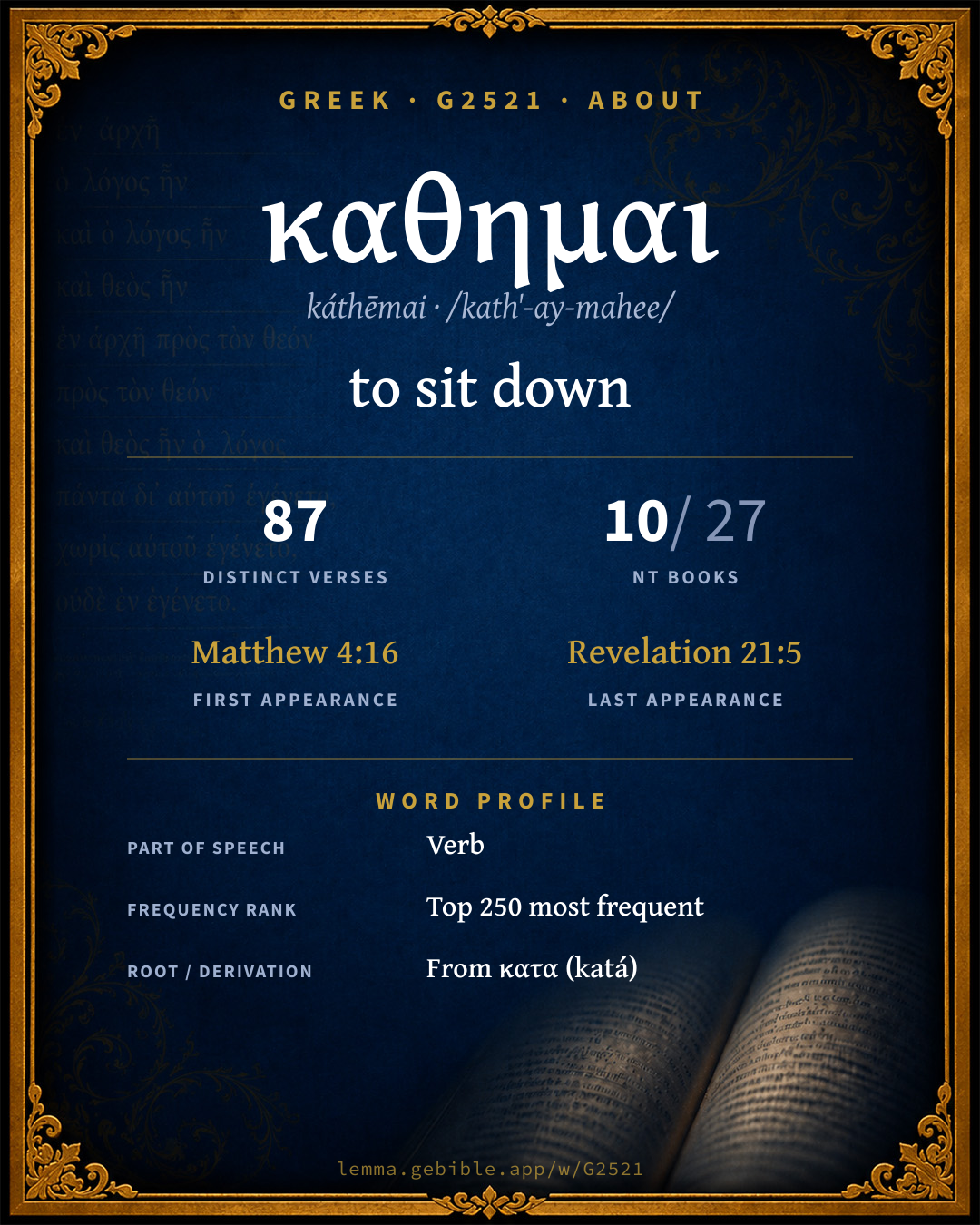
κάθημαι
to sit down
‘to sit down’ is one of 2 main senses fuller range ↓
Full lexicon entry — Thayer's Greek Lexicon
From Thayer's Greek Lexicon
Where this word appears
See every Present-tense verb in the Greek New Testament →
Grammar key — what these labels mean
Part of speech
- Verb
- An action or state-of-being word.
Tense
- Present
- Ongoing or general action in present time (imperfective aspect).
- Imperfect
- Continuous or repeated action in past time (“was writing”).
- Future
- Action expected in future time.
Voice
- Middle or Passive deponent
- Middle/passive in form but active in meaning.
- Middle deponent
- Middle in form but active in meaning.
Mood
- Participle
- A verbal adjective (“writing,” “having written”).
- Indicative
- States a fact or asks a factual question (the mood of reality).
- Imperative
- Expresses a command or request.
- Infinitive
- A verbal noun (“to write”), unmarked for person or number.
Case
- Nominative
- The case of the subject (and the predicate nominative).
- Accusative
- The case of the direct object and of extent.
- Genitive
- The case of source, possession, or “of” — answers “whose / from what.”
- Dative
- The case of the indirect object, means, or location — “to / for / with / in.”
Person
- 3rd person
- The one spoken about (“he / she / it / they”).
- 2nd person
- The one addressed (“you”).
- 1st person
- The speaker (“I / we”).
Gender
- Masculine
- Grammatically masculine.
- Neuter
- Grammatically neuter.
- Feminine
- Grammatically feminine.
Number
- Singular
- One.
- Plural
- More than one.
Grammatical forms 20 distinct
- Verb, Present, Middle or Passive deponent, Participle, Nominative, Singular, Masculine 16 times (18%)
- Verb, Present, Middle or Passive deponent, Participle, Accusative, Singular, Masculine 11 times (12%)
- Verb, Imperfect, Middle or Passive deponent, Indicative, 3rd person, Singular 10 times (11%)
- Verb, Present, Middle or Passive deponent, Participle, Genitive, Singular, Masculine 9 times (10%)
- Verb, Present, Middle or Passive deponent, Participle, Dative, Singular, Masculine 8 times (9%)
- Verb, Present, Middle or Passive deponent, Imperative, 2nd person, Singular 7 times (8%)
- Verb, Present, Middle or Passive deponent, Participle, Accusative, Plural, Masculine 6 times (7%)
- Verb, Present, Middle or Passive deponent, Participle, Nominative, Plural, Masculine 6 times (7%)
+12 more forms (16 occurrences)
Parsed forms decoded from the imported morphology (Robinson–Tischendorf, public domain), counted across 89 parsed occurrences — not distinct verses.
Every verse where G2521 appears — 87 distinct verses across 10 books. Click any verse to open its interlinear word-by-word view. Verse text shown in the World English Bible for context — . Each verse’s Greek form is shown with its reference; the English is not keyword-highlighted, since the data carries no word-level English alignment. Use “Compare translations” on any verse to read it across multiple English versions. This concordance covers the Greek New Testament; Septuagint (Greek Old Testament) occurrences of this word are not indexed here.
Matthew 17 verses
- Matthew 4:16 καθήμενος καθημένοις pres mid/pass.dep ptcp nom sg masc pres mid/pass.dep ptcp dat pl masc The people who sat in darkness saw a great light, To those who sat in the region and shadow of death, To them light has dawned."
- Matthew 9:9 καθήμενον pres mid/pass.dep ptcp acc sg masc As Jesus passed by from there, he saw a man called Matthew sitting at the tax collection office. He said to him, "Follow me." He got up and followed him.
- Matthew 11:16 καθημένοις pres mid/pass.dep ptcp dat pl neut "But to what shall I compare this generation? It is like children sitting in the marketplaces, who call to their companions
- Matthew 13:1 ἐκάθητο impf mid/pass.dep ind 3sg On that day Jesus went out of the house, and sat by the seaside.
- Matthew 13:2 καθῆσθαι pres mid/pass.dep inf Great multitudes gathered to him, so that he entered into a boat, and sat, and all the multitude stood on the beach.
- Matthew 15:29 ἐκάθητο impf mid/pass.dep ind 3sg Jesus departed there, and came near to the sea of Galilee; and he went up into the mountain, and sat there.
- Matthew 20:30 καθήμενοι pres mid/pass.dep ptcp nom pl masc Behold, two blind men sitting by the road, when they heard that Jesus was passing by, cried out, "Lord, have mercy on us, you son of David!"
- Matthew 22:44 κάθου pres mid/pass.dep impv 2sg 'The Lord said to my Lord, Sit on my right hand, Until I make your enemies a footstool for your feet?'
- Matthew 23:22 καθημένῳ pres mid/pass.dep ptcp dat sg masc He who swears by heaven, swears by the throne of God, and by him who sits on it.
- Matthew 24:3 καθημένου pres mid/pass.dep ptcp gen sg masc As he sat on the Mount of Olives, the disciples came to him privately, saying, "Tell us, when will these things be? What is the sign of your coming, and of the end of the age?"
- Matthew 26:58 ἐκάθητο impf mid/pass.dep ind 3sg But Peter followed him from a distance, to the court of the high priest, and entered in and sat with the officers, to see the end.
- Matthew 26:64 καθήμενον pres mid/pass.dep ptcp acc sg masc Jesus said to him, "You have said it. Nevertheless, I tell you, henceforth you will see the Son of Man sitting at the right hand of Power, and coming on the clouds of the sky."
- Matthew 26:69 ἐκάθητο impf mid/pass.dep ind 3sg Now Peter was sitting outside in the court, and a maid came to him, saying, "You were also with Jesus, the Galilean!"
- Matthew 27:19 καθημένου pres mid/pass.dep ptcp gen sg masc While he was sitting on the judgment seat, his wife sent to him, saying, "Have nothing to do with that righteous man, for I have suffered many things this day in a dream because of him."
- Matthew 27:36 καθήμενοι pres mid/pass.dep ptcp nom pl masc and they sat and watched him there.
- Matthew 27:61 καθήμεναι pres mid/pass.dep ptcp nom pl fem Mary Magdalene was there, and the other Mary, sitting opposite the tomb.
- Matthew 28:2 ἐκάθητο impf mid/pass.dep ind 3sg Behold, there was a great earthquake, for an angel of the Lord descended from the sky, and came and rolled away the stone from the door, and sat on it.
Mark 11 verses
- Mark 2:6 καθήμενοι pres mid/pass.dep ptcp nom pl masc But there were some of the scribes sitting there, and reasoning in their hearts,
- Mark 2:14 καθήμενον pres mid/pass.dep ptcp acc sg masc As he passed by, he saw Levi, the son of Alphaeus, sitting at the tax office, and he said to him, "Follow me." And he arose and followed him.
- Mark 3:32 ἐκάθητο impf mid/pass.dep ind 3sg A multitude was sitting around him, and they told him, "Behold, your mother, your brothers, and your sisters are outside looking for you."
- Mark 3:34 καθημένους pres mid/pass.dep ptcp acc pl masc Looking around at those who sat around him, he said, "Behold, my mother and my brothers!
- Mark 4:1 καθῆσθαι pres mid/pass.dep inf Again he began to teach by the seaside. A great multitude was gathered to him, so that he entered into a boat in the sea, and sat down. All the multitude were on the land by the sea.
- Mark 5:15 καθήμενον pres mid/pass.dep ptcp acc sg masc They came to Jesus, and saw him who had been possessed by demons sitting, clothed, and in his right mind, even him who had the legion; and they were afraid.
- Mark 10:46 ἐκάθητο impf mid/pass.dep ind 3sg They came to Jericho. As he went out from Jericho, with his disciples and a great multitude, the son of Timaeus, Bartimaeus, a blind beggar, was sitting by the road.
- Mark 12:36 κάθου pres mid/pass.dep impv 2sg For David himself said in the Holy Spirit, 'The Lord said to my Lord, Sit at my right hand, Until I make your enemies the footstool of your feet.'
- Mark 13:3 καθημένου pres mid/pass.dep ptcp gen sg masc As he sat on the Mount of Olives opposite the temple, Peter, James, John, and Andrew asked him privately,
- Mark 14:62 καθήμενον pres mid/pass.dep ptcp acc sg masc Jesus said, "I AM. You will see the Son of Man sitting at the right hand of Power, and coming with the clouds of the sky."
- Mark 16:5 καθήμενον pres mid/pass.dep ptcp acc sg masc Entering into the tomb, they saw a young man sitting on the right side, dressed in a white robe, and they were amazed.
Luke 13 verses
- Luke 1:79 καθημένοις pres mid/pass.dep ptcp dat pl masc To shine on those who sit in darkness and the shadow of death; To guide our feet into the way of peace."
- Luke 5:17 καθήμενοι pres mid/pass.dep ptcp nom pl masc It happened on one of those days, that he was teaching; and there were Pharisees and teachers of the law sitting by, who had come out of every village of Galilee, Judea, and Jerusalem. The power of the Lord was with him to heal them.
- Luke 5:27 καθήμενον pres mid/pass.dep ptcp acc sg masc After these things he went out, and saw a tax collector named Levi sitting at the tax office, and said to him, "Follow me!"
- Luke 7:32 καθημένοις pres mid/pass.dep ptcp dat pl neut They are like children who sit in the marketplace, and call one to another, saying, 'We piped to you, and you didn't dance. We mourned, and you didn't weep.'
- Luke 8:35 καθήμενον pres mid/pass.dep ptcp acc sg masc People went out to see what had happened. They came to Jesus, and found the man from whom the demons had gone out, sitting at Jesus' feet, clothed and in his right mind; and they were afraid.
- Luke 10:13 καθήμενοι pres mid/pass.dep ptcp nom pl masc "Woe to you, Chorazin! Woe to you, Bethsaida! For if the mighty works had been done in Tyre and Sidon which were done in you, they would have repented long ago, sitting in sackcloth and ashes.
- Luke 18:35 ἐκάθητο impf mid/pass.dep ind 3sg It happened, as he came near Jericho, a certain blind man sat by the road, begging.
- Luke 20:42 κάθου pres mid/pass.dep impv 2sg David himself says in the book of Psalms, 'The Lord said to my Lord, "Sit at my right hand,
- Luke 21:35 καθημένους pres mid/pass.dep ptcp acc pl masc For it will come like a snare on all those who dwell on the surface of all the earth.
- Luke 22:30 καθήσεσθε fut mid.dep ind 2pl that you may eat and drink at my table in my Kingdom. You will sit on thrones, judging the twelve tribes of Israel."
- Luke 22:55 ἐκάθητο impf mid/pass.dep ind 3sg When they had kindled a fire in the middle of the courtyard, and had sat down together, Peter sat among them.
- Luke 22:56 καθήμενον pres mid/pass.dep ptcp acc sg masc A certain servant girl saw him as he sat in the light, and looking intently at him, said, "This man also was with him."
- Luke 22:69 καθήμενος pres mid/pass.dep ptcp nom sg masc From now on, the Son of Man will be seated at the right hand of the power of God."
John 3 verses
- John 2:14 καθημένους pres mid/pass.dep ptcp acc pl masc He found in the temple those who sold oxen, sheep, and doves, and the changers of money sitting.
- John 9:8 καθήμενος pres mid/pass.dep ptcp nom sg masc The neighbors therefore, and those who saw that he was blind before, said, "Isn't this he who sat and begged?"
- John 12:15 καθήμενος pres mid/pass.dep ptcp nom sg masc "Don't be afraid, daughter of Zion. Behold, your King comes, sitting on a donkey's colt."
Acts 6 verses
- Acts 2:2 καθήμενοι pres mid/pass.dep ptcp nom pl masc Suddenly there came from the sky a sound like the rushing of a mighty wind, and it filled all the house where they were sitting.
- Acts 2:34 κάθου pres mid/pass.dep impv 2sg For David didn't ascend into the heavens, but he says himself, 'The Lord said to my Lord, "Sit by my right hand,
- Acts 3:10 καθήμενος pres mid/pass.dep ptcp nom sg masc They recognized him, that it was he who used to sit begging for gifts for the needy at the Beautiful Gate of the temple. They were filled with wonder and amazement at what had happened to him.
- Acts 8:28 καθήμενος pres mid/pass.dep ptcp nom sg masc He was returning and sitting in his chariot, and was reading the prophet Isaiah.
- Acts 14:8 ἐκάθητο impf mid/pass.dep ind 3sg At Lystra a certain man sat, impotent in his feet, a cripple from his mother's womb, who never had walked.
- Acts 23:3 κάθῃ pres mid/pass.dep ind 2sg attic Then Paul said to him, "God will strike you, you whitewashed wall! Do you sit to judge me according to the law, and command me to be struck contrary to the law?"
1 Corinthians 1 verse
Colossians 1 verse
Hebrews 1 verse
James 1 verse
Revelation 33 verses
- Revelation 4:2 καθήμενος pres mid/pass.dep ptcp nom sg masc Immediately I was in the Spirit. Behold, there was a throne set in heaven, and one sitting on the throne
- Revelation 4:3 καθήμενος pres mid/pass.dep ptcp nom sg masc that looked like a jasper stone and a sardius. There was a rainbow around the throne, like an emerald to look at.
- Revelation 4:4 καθημένους pres mid/pass.dep ptcp acc pl masc Around the throne were twenty-four thrones. On the thrones were twenty-four elders sitting, dressed in white garments, with crowns of gold on their heads.
- Revelation 4:9 καθημένῳ pres mid/pass.dep ptcp dat sg masc When the living creatures give glory, honor, and thanks to him who sits on the throne, to him who lives forever and ever,
- Revelation 4:10 καθημένου pres mid/pass.dep ptcp gen sg masc the twenty-four elders fall down before him who sits on the throne, and worship him who lives forever and ever, and throw their crowns before the throne, saying,
- Revelation 5:1 καθημένου pres mid/pass.dep ptcp gen sg masc I saw, in the right hand of him who sat on the throne, a book written inside and outside, sealed shut with seven seals.
- Revelation 5:7 καθημένου pres mid/pass.dep ptcp gen sg masc Then he came, and he took it out of the right hand of him who sat on the throne.
- Revelation 5:13 καθημένῳ pres mid/pass.dep ptcp dat sg masc I heard every created thing which is in heaven, on the earth, under the earth, on the sea, and everything in them, saying, "To him who sits on the throne, and to the Lamb be the blessing, the honor, the glory, and the dominion, forever and ever! Amen!"
- Revelation 6:2 καθήμενος pres mid/pass.dep ptcp nom sg masc And behold, a white horse, and he who sat on it had a bow. A crown was given to him, and he came forth conquering, and to conquer.
- Revelation 6:4 καθημένῳ pres mid/pass.dep ptcp dat sg masc Another came forth, a red horse. To him who sat on it was given power to take peace from the earth, and that they should kill one another. There was given to him a great sword.
- Revelation 6:5 καθήμενος pres mid/pass.dep ptcp nom sg masc When he opened the third seal, I heard the third living creature saying, "Come and see!" And behold, a black horse, and he who sat on it had a balance in his hand.
- Revelation 6:8 καθήμενος pres mid/pass.dep ptcp nom sg masc And behold, a pale horse, and he who sat on it, his name was Death. Hades followed with him. Authority over one fourth of the earth, to kill with the sword, with famine, with death, and by the wild animals of the earth was given to him.
- Revelation 6:16 καθημένου pres mid/pass.dep ptcp gen sg masc They told the mountains and the rocks, "Fall on us, and hide us from the face of him who sits on the throne, and from the wrath of the Lamb,
- Revelation 7:10 καθημένῳ pres mid/pass.dep ptcp dat sg masc They cried with a loud voice, saying, "Salvation be to our God, who sits on the throne, and to the Lamb!"
- Revelation 7:15 καθήμενος pres mid/pass.dep ptcp nom sg masc Therefore they are before the throne of God, they serve him day and night in his temple. He who sits on the throne will spread his tent over them.
- Revelation 9:17 καθημένους pres mid/pass.dep ptcp acc pl masc Thus I saw the horses in the vision, and those who sat on them, having breastplates of fiery red, hyacinth blue, and sulfur yellow; and the heads of lions. Out of their mouths proceed fire, smoke, and sulfur.
- Revelation 11:16 κάθηνται pres mid/pass.dep ind 2sg The twenty-four elders, who sit on their thrones before God's throne, fell on their faces and worshiped God,
- Revelation 14:6 καθημένους pres mid/pass.dep ptcp acc pl masc I saw an angel flying in mid heaven, having an eternal Gospel to proclaim to those who dwell on the earth, and to every nation, tribe, language, and people.
- Revelation 14:14 καθήμενον pres mid/pass.dep ptcp acc sg masc I looked, and behold, a white cloud; and on the cloud one sitting like a son of man, having on his head a golden crown, and in his hand a sharp sickle.
- Revelation 14:15 καθημένῳ pres mid/pass.dep ptcp dat sg masc Another angel came out from the temple, crying with a loud voice to him who sat on the cloud, "Send forth your sickle, and reap; for the hour to reap has come; for the harvest of the earth is ripe!"
- Revelation 14:16 καθήμενος pres mid/pass.dep ptcp nom sg masc He who sat on the cloud thrust his sickle on the earth, and the earth was reaped.
- Revelation 17:1 καθημένης pres mid/pass.dep ptcp gen sg fem One of the seven angels who had the seven bowls came and spoke with me, saying, "Come here. I will show you the judgment of the great prostitute who sits on many waters,
- Revelation 17:3 καθημένην pres mid/pass.dep ptcp acc sg fem He carried me away in the Spirit into a wilderness. I saw a woman sitting on a scarlet-colored animal, full of blasphemous names, having seven heads and ten horns.
- Revelation 17:9 κάθηται pres mid/pass.dep ind 3sg Here is the mind that has wisdom. The seven heads are seven mountains, on which the woman sits.
- Revelation 17:15 κάθηται pres mid/pass.dep ind 3sg He said to me, "The waters which you saw, where the prostitute sits, are peoples, multitudes, nations, and languages.
- Revelation 18:7 κάθημαι pres mid/pass.dep ind 1sg However much she glorified herself, and grew wanton, so much give her of torment and mourning. For she says in her heart, 'I sit a queen, and am no widow, and will in no way see mourning.'
- Revelation 19:4 καθημένῳ pres mid/pass.dep ptcp dat sg masc The twenty-four elders and the four living creatures fell down and worshiped God who sits on the throne, saying, "Amen! Hallelujah!"
- Revelation 19:11 καθήμενος pres mid/pass.dep ptcp nom sg masc I saw the heaven opened, and behold, a white horse, and he who sat on it is called Faithful and True. In righteousness he judges and makes war.
- Revelation 19:18 καθημένων pres mid/pass.dep ptcp gen pl masc that you may eat the flesh of kings, the flesh of captains, the flesh of mighty men, and the flesh of horses and of those who sit on them, and the flesh of all men, both free and slave, and small and great."
- Revelation 19:19 καθημένου pres mid/pass.dep ptcp gen sg masc I saw the beast, and the kings of the earth, and their armies, gathered together to make war against him who sat on the horse, and against his army.
- Revelation 19:21 καθημένου pres mid/pass.dep ptcp gen sg masc The rest were killed with the sword of him who sat on the horse, the sword which came forth out of his mouth. All the birds were filled with their flesh.
- Revelation 20:11 καθήμενον pres mid/pass.dep ptcp acc sg masc I saw a great white throne, and him who sat on it, from whose face the earth and the heaven fled away. There was found no place for them.
- Revelation 21:5 καθήμενος pres mid/pass.dep ptcp nom sg masc He who sits on the throne said, "Behold, I am making all things new." He said, "Write, for these words of God are faithful and true."
About this entry
At a glance — auto-summarized from this page’s data, not written by a person. Every figure links to its source below. This summary describes the numbers; it doesn’t interpret them.
καθημαι (káthēmai) is a Greek verb most often rendered “to sit down.” Its English rendering has broadened — “sat” classically, “seated” (Berean Standard Bible) in modern versions; see the renderings breakdown. Spanning 87 verses in 10 books, it ranks among the moderately common words of the Greek New Testament. Revelation dominates its distribution — 33 of 87 verses. Its lexical range runs to 2 senses. For the data behind this summary, explore the sense tree and the renderings breakdown below.
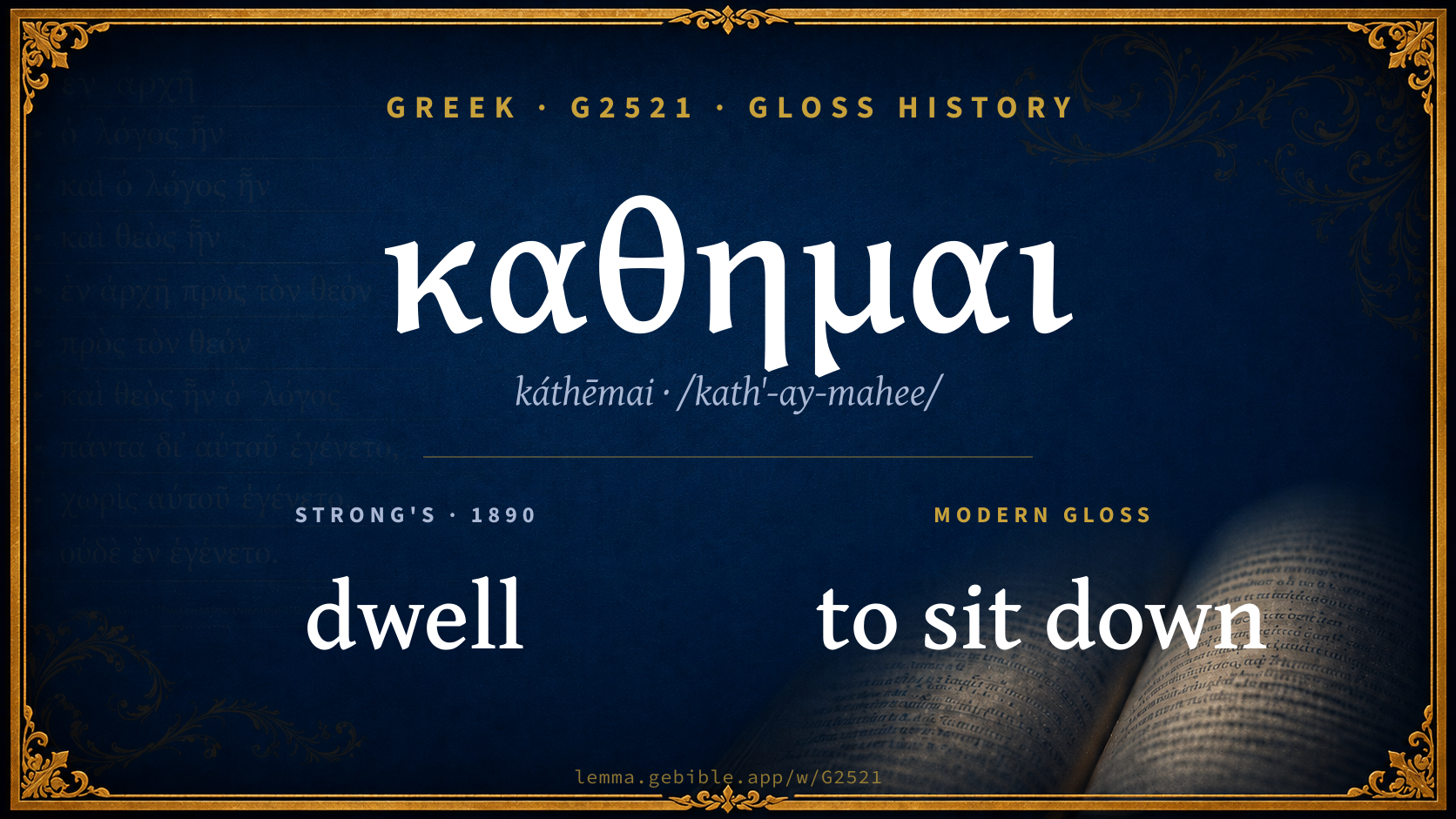
Gloss history
Strong's 1890 vs modern scholarship
About this word
Strong's G2521 catalogs a Greek word from the Greek New Testament.
These counts are not copied from any lexicon or concordance. They are computed here, from the morphology-tagged Greek New Testament. What Lemma adds →
- 87
- distinct verses
- The word appears in 87 distinct verses.
- 10 / 27
- NT books
- The word appears in 10 of 27 New Testament books.
- #195
- by frequency
- Top 250 most frequent Greek words (rank 195 of 5,347 Greek words by occurrence).
View all 87 occurrences in the concordance →
Most concentrated in
- Revelation 33 verses 38%
- Matthew 17 verses 20%
- Luke 13 verses 15%
By section of the New Testament
By traditional corpus
Conventional, traditional groupings — biblical authorship is debated, so this is a traditional corpus grouping, not an authorship claim. Some books belong to more than one corpus (Luke is in both the Gospels and the Lukan corpus, and so on), so these shares overlap and need not total 100%. Each figure is a share of the word’s 87 distinct verses.
- Gospels 44 verses · 51%
- Johannine 36 verses · 41%
- Revelation 33 verses · 38%
- Lukan (Luke–Acts) 19 verses · 22%
- Pauline corpus 2 verses · 2%
- Hebrews 1 verse · 1%
- General (Catholic) Epistles 1 verse · 1%
How translations render this word
Counts come from each version’s own published word-to-Strong’s tagging or interlinear alignment — an approximate guide to how each version renders this word, not a word-level alignment the data otherwise carries. Because each total is that version’s own tagged count, the per-version totals vary from one another and need not match the appearance or distinct-verse counts above. These counts may also differ from a printed concordance because Lemma counts each distinctly tagged rendering and does not collapse phrase taggings into a single head-word total. This is a fixed set of word-tagged versions (KJV, ASV, BSB, ULT) and does not change with the reading translation you choose elsewhere. Each version’s license is shown beside its name below (and on Sources).
- King James Version: Sat 30×, Sitting 19×, He that sat 7×
- American Standard Version: Sat 27×, Sitting 19×, Sitteth 12×
- Berean Standard Bible: Seated 20×, Sitting 18×, Sit 9×
- unfoldingWord Literal Text: Sitting 35×, One sitting 21×, Sit 9×
King James Version Public Domain
Renders G2521 across 88 tagged occurrences — most commonly:
Plus 9 renderings that appear only once — usually multi-word phrases or single function words the recovered tagging swept in, not distinct renderings. Not rendered by a distinct English word in 1 further occurrence.
American Standard Version Public Domain
Renders G2521 across 87 tagged occurrences — most commonly:
Plus 9 renderings that appear only once — usually multi-word phrases or single function words the recovered tagging swept in, not distinct renderings. Not rendered by a distinct English word in 1 further occurrence.
Berean Standard Bible Public Domain
Renders G2521 across 84 tagged occurrences — most commonly:
Plus 8 renderings that appear only once — usually multi-word phrases or single function words the recovered tagging swept in, not distinct renderings. Not rendered by a distinct English word in 7 further occurrences.
unfoldingWord Literal Text CC BY-SA 4.0
Renders G2521 across 93 tagged occurrences — most commonly:
Plus 14 renderings that appear only once — usually multi-word phrases or single function words the recovered tagging swept in, not distinct renderings.
Senses in Thayer's
The 2 senses Thayer's distinguishes for this word, in lexicon order (not ranked by frequency or importance). The full entry — with sub-senses — is in the Lexicon Entry tab.
- to sit down, seat one's self
- to sit, be seated, of a place occupied
Word origin
Derived from κατα (katá) (G2596) — down.
Forms in the corpus
The 19 distinct written forms G2521 takes in the Greek New Testament, most frequent first — each parse links to that tense’s occurrences in the concordance.
Same root — word family
Other Thayer's entries built from the same root as G2521, grouped by Strong’s listed origin. These share a root / origin per the lexicon — not necessarily a shared meaning. Each links to that word’s own entry.
Derives from
Shares the same root
- καθα kathá G2505 according as
- καθαιρεω kathairéō G2507 to tear down
- καθαπτω katháptō G2510 to fasten down
- καθεδρα kathédra G2515 seat
- καθεζομαι kathézomai G2516 to sit down
- καθεξης kathexēs G2517 in order
- καθευδω katheúdō G2518 to fall asleep
- καθηγητης kathēgētḗs G2519 guide
- καθηκω kathḗkō G2520 to come down
- καθημερινος kathēmerinós G2522 daily
- καθιημι kathíēmi G2524 to send down
- καθιστημι kathístēmi G2525 to place
- καθο kathó G2526 according to what
- καθολου kathólou G2527 wholly
- καθοπλιζω kathoplízō G2528 to arm
- καθοραω kathoráō G2529 to see clearly
- καθοτι kathóti G2530 according to what
- καθως kathṓs G2531 according as
- καμμυω kammýō G2576 to close eyes
- καταβαινω katabaínō G2597 to descend
- καταβαλλω katabállō G2598 to cast down
- καταβαρεω katabaréō G2599 to weigh down
- καταβιβαζω katabibázō G2601 to bring down
- καταβραβευω katabrabeúō G2603 to defraud
+103 more words share this root (not shown).
Compare all same-root words → Showing 4 of 129 — not the complete family. They share a root, not necessarily a meaning.
Septuagint usage
The same Greek word καθημαι appears 175 times in the Greek Old Testament (Septuagint), across 171 verses in 28 books.
- 175
- LXX occurrences
- Tagged occurrences of this Greek word in the Septuagint.
- 171
- verses
- Distinct Septuagint verses containing this word.
- 28 / 39
- OT books
- The word appears in 28 of the 39 Old Testament books.
Sample Septuagint occurrences
- Genesis 18:1 καταἧμαι
- Exodus 11:5 καταἧμαι
- Leviticus 8:35 καταἧμαι
- Numbers 13:18 καταἧμαι
- Deuteronomy 6:7 καταἧμαι
- Joshua 5:8 καταἧμαι
- Judges 2:2 καταἧμαι
- Ruth 3:18 καταἧμαι
- 1 Samuel 1:9 κάθημαι
- 2 Samuel 6:2 καταἧμαι
- 1 Kings 1:48 καταἧμαι
- 2 Kings 1:9 καταἧμαι
Septuagint occurrences (same lexeme)
Every verse where the same Strong’s number (G2521) appears in the Greek Septuagint — showing the first 50 of 171. Verse text shown in the World English Bible for context; the Greek form is the matched word — the English is not keyword-highlighted.
- Genesis 18:1 καταἧμαι Yahweh appeared to him by the oaks of Mamre, as he sat in the tent door in the heat of the day.
- Genesis 19:1 κάθημαι The two angels came to Sodom at evening. Lot sat in the gate of Sodom. Lot saw them, and rose up to meet them. He bowed himself with his face to the earth,
- Genesis 19:30 κάθημαι Lot went up out of Zoar, and lived in the mountain, and his two daughters with him; for he was afraid to live in Zoar. He lived in a cave with his two daughters.
- Genesis 21:16 κάθημαι She went and sat down opposite him, a good way off, about a bow shot away. For she said, "Don't let me see the death of the child." She sat over against him, and lifted up her voice, and wept.
- Genesis 23:10 κάθημαι Now Ephron was sitting in the midst of the children of Heth. Ephron the Hittite answered Abraham in the hearing of the children of Heth, even of all who went in at the gate of his city, saying,
- Genesis 38:11 καταἧμαικάθημαι Then Judah said to Tamar, his daughter-in-law, "Remain a widow in your father's house, until Shelah, my son, is grown up;" for he said, "Lest he also die, like his brothers." Tamar went and lived in her father's house.
- Genesis 49:17 καταἧμαι Dan will be a serpent in the way, An adder in the path, That bites the horse's heels, So that his rider falls backward.
- Exodus 11:5 καταἧμαι and all the firstborn in the land of Egypt shall die, from the firstborn of Pharaoh who sits on his throne, even to the firstborn of the maid-servant who is behind the mill; and all the firstborn of cattle.
- Exodus 12:29 καταἧμαι It happened at midnight, that Yahweh struck all the firstborn in the land of Egypt, from the firstborn of Pharaoh who sat on his throne to the firstborn of the captive who was in the dungeon; and all the firstborn of cattle.
- Exodus 16:29 καταἧμαι Behold, because Yahweh has given you the Sabbath, therefore he gives you on the sixth day the bread of two days. Everyone stay in his place. Let no one go out of his place on the seventh day."
- Exodus 17:12 καταἧμαι But Moses' hands were heavy; and they took a stone, and put it under him, and he sat on it. Aaron and Hur held up his hands, the one on the one side, and the other on the other side. His hands were steady until sunset.
- Exodus 18:14 καταἧμαι When Moses' father-in-law saw all that he did to the people, he said, "What is this thing that you do for the people? Why do you sit alone, and all the people stand around you from morning to evening?"
- Exodus 23:31 καταἧμαι I will set your border from the Red Sea even to the sea of the Philistines, and from the wilderness to the River; for I will deliver the inhabitants of the land into your hand, and you shall drive them out before you.
- Exodus 34:12 καταἧμαι Be careful, lest you make a covenant with the inhabitants of the land where you are going, lest it be for a snare in the midst of you:
- Exodus 34:15 καταἧμαι Don't make a covenant with the inhabitants of the land, lest they play the prostitute after their gods, and sacrifice to their gods, and one call you and you eat of his sacrifice;
- Leviticus 8:35 καταἧμαι At the door of the Tent of Meeting you shall stay day and night seven days, and keep the charge of Yahweh, that you don't die: for so I am commanded."
- Leviticus 12:4 καταἧμαι She shall continue in the blood of purification thirty-three days. She shall not touch any holy thing, nor come into the sanctuary, until the days of her purifying are completed.
- Leviticus 13:46 καταἧμαι All the days in which the plague is in him he shall be unclean. He is unclean. He shall dwell alone. Outside of the camp shall be his dwelling.
- Leviticus 15:6 καταἧμαι He who sits on anything whereon the man who has the discharge sat shall wash his clothes, and bathe himself in water, and be unclean until the evening.
- Leviticus 15:33 καταἧμαι and of her who has her period, and of a man or woman who has a discharge, and of him who lies with her who is unclean.
- Leviticus 18:25 καταἧμαι The land was defiled: therefore I punished its iniquity, and the land vomitted out her inhabitants.
- Leviticus 20:18 καταἧμαι "'If a man lies with a woman having her monthly period, and uncovers her nakedness; he has made naked her fountain, and she has uncovered the fountain of her blood: and both of them shall be cut off from among their people.
- Numbers 13:18 καταἧμαι and see the land, what it is; and the people who dwell therein, whether they are strong or weak, whether they are few or many;
- Numbers 13:19 καταἧμαι and what the land is that they dwell in, whether it is good or bad; and what cities they are that they dwell in, whether in camps, or in strongholds;
- Numbers 14:45 καταἧμαι Then the Amalekite came down, and the Canaanite who lived in that mountain, and struck them and beat them down, even to Hormah.
- Numbers 22:5 καταἧμαι He sent messengers to Balaam the son of Beor, to Pethor, which is by the River, to the land of the children of his people, to call him, saying, Behold, there is a people come out from Egypt: behold, they cover the surface of the earth, and they abide over against me.
- Numbers 22:11 καταἧμαι Behold, the people that is come out of Egypt, it covers the surface of the earth: now, come curse me them; peradventure I shall be able to fight against them, and shall drive them out.
- Deuteronomy 6:7 καταἧμαι and you shall teach them diligently to your children, and shall talk of them when you sit in your house, and when you walk by the way, and when you lie down, and when you rise up.
- Deuteronomy 11:19 καταἧμαι You shall teach them your children, talking of them, when you sit in your house, and when you walk by the way, and when you lie down, and when you rise up.
- Joshua 5:8 καταἧμαι It happened, when they had done circumcising all the nation, that they abode in their places in the camp, until they were whole.
- Judges 2:2 καταἧμαι and you shall make no covenant with the inhabitants of this land; you shall break down their altars. But you have not listened to my voice: why have you done this?
- Judges 3:20 καταἧμαι Ehud came to him; and he was sitting by himself alone in the cool upper room. Ehud said, I have a message from God to you. He arose out of his seat.
- Judges 4:5 καταἧμαι She lived under the palm tree of Deborah between Ramah and Bethel in the hill-country of Ephraim: and the children of Israel came up to her for judgment.
- Judges 5:10 καταἧμαι Tell [of it], you who ride on white donkeys, You who sit on rich carpets, You who walk by the way.
- Judges 9:31 καταἧμαι He sent messengers to Abimelech craftily, saying, Behold, Gaal the son of Ebed and his brothers are come to Shechem; and, behold, they constrain the city [to take part] against you.
- Judges 13:9 καταἧμαι God listened to the voice of Manoah; and the angel of God came again to the woman as she sat in the field: but Manoah, her husband, wasn't with her.
- Judges 16:9 καταἧμαι Now she had liers-in-wait abiding in the inner chamber. She said to him, The Philistines are on you, Samson. He broke the cords, as a string of tow is broken when it touches the fire. So his strength was not known.
- Judges 17:10 καταἧμαι Micah said to him, Dwell with me, and be to me a father and a priest, and I will give you ten [pieces] of silver by the year, and a suit of clothing, and your food. So the Levite went in.
- Judges 18:7 καταἧμαι Then the five men departed, and came to Laish, and saw the people who were therein, how they lived in security, after the manner of the Sidonians, quiet and secure; for there was none in the land, possessing authority, that might put [them] to shame in anything, and they were far from the Sidonians, and had no dealings with any man.
- Judges 18:8 καταἧμαι They came to their brothers to Zorah and Eshtaol: and their brothers said to them, What [say] you?
- Ruth 3:18 καταἧμαι Then said she, "Sit still, my daughter, until you know how the matter will fall; for the man will not rest, until he has finished the thing this day."
- Ruth 4:4 καταἧμαι I thought to disclose it to you, saying, Buy it before those who sit here, and before the elders of my people. If you will redeem it, redeem it: but if you will not redeem it, then tell me, that I may know; for there is none to redeem it besides you; and I am after you. He said, I will redeem it.
- 1 Samuel 1:9 κάθημαι So Hannah rose up after they had eaten in Shiloh, and after they had drunk. Now Eli the priest was sitting on his seat by the door-post of the temple of Yahweh.
- 1 Samuel 1:23 καταἧμαι Elkanah her husband said to her, Do what seems you good; wait until you have weaned him; only Yahweh establish his word. So the woman waited and nursed her son, until she weaned him.
- 1 Samuel 4:4 καταἧμαι So the people sent to Shiloh; and they brought from there the ark of the covenant of Yahweh of Hosts, who sits [above] the cherubim: and the two sons of Eli, Hophni and Phinehas, were there with the ark of the covenant of God.
- 1 Samuel 4:13 κάθημαι When he came, behold, Eli was sitting on his seat by the road watching; for his heart trembled for the ark of God. When the man came into the city, and told it, all the city cried out.
- 1 Samuel 14:2 καταἧμαι Saul abode in the uttermost part of Gibeah under the pomegranate tree which is in Migron: and the people who were with him were about six hundred men;
- 1 Samuel 20:5 καταἧμαι David said to Jonathan, Behold, tomorrow is the new moon, and I should not fail to sit with the king at meat: but let me go, that I may hide myself in the field to the third day at evening.
- 1 Samuel 20:19 καταἧμαι When you have stayed three days, you shall go down quickly, and come to the place where you did hide yourself when the business was in hand, and shall remain by the stone Ezel.
- 1 Samuel 22:5 καταἧμαι The prophet Gad said to David, Don't stay in the stronghold; depart, and get you into the land of Judah. Then David departed, and came into the forest of Hereth.
These are occurrences of the same Greek lexeme (G2521) in the Septuagint — not a translation of any one Hebrew word. The store carries no word-level Hebrew↔Greek alignment, so no Hebrew original is asserted here. Counts come from the recovered LXX Strong's tagging — high-frequency vocabulary is well covered, while rare or late forms may be untagged — so they reflect tagged occurrences and may slightly undercount.