
Revelation 5:7

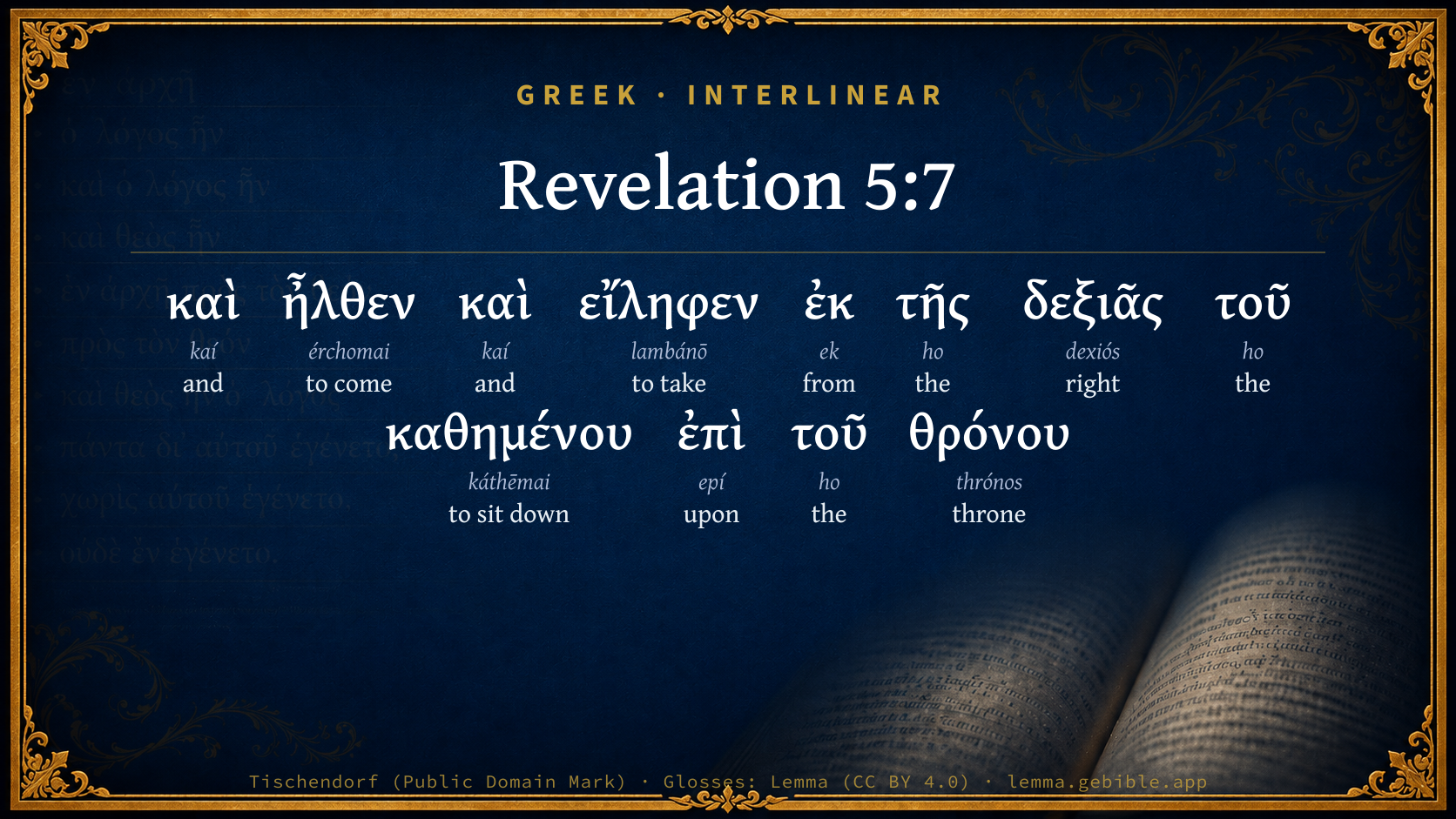
Greek (Tischendorf 8th ed.) Revelation 5:7 appears in the Greek New Testament. The text above is from the Tischendorf 8th edition. Each word links to its Strong’s number and a concise gloss. Click any word for its full Thayer’s Greek Lexicon entry.
Download image
Cite this verse

Revelation 5:7 (World English Bible). Public Domain. Lemma interlinear Bible study tool, https://lemma.gebible.app/v/revelation/5/7.

Show BibTeX & RIS
BibTeX
RIS
English Translation
Then he came, and he took it out of the right hand of him who sat on the throne.
World English Bible · Public Domain
Download a study sheet

One document with this verse’s original text, its word-by-word gloss line, the meaning frame, cross-references with their text, attributed commentary, and full source and license credits — printable, and it pastes into notes with its structure intact.

This verse Autodidact and up

Study sheet (.html) Plain text (.txt)

A passage Seminary Student

Up to 50 verses in one chapter. A passage sheet keeps up to 6 commentary sources and 12 cross-references per verse, in the order this page ranks them, and says so on the sheet whenever that leaves anything out. Ask for a single verse and you get the Autodidact verse sheet above.

Everything on this page stays free to read, with no account — the sheet is a download of what is already on screen, not access to it.

Want to remove ads? Support Godless Engineer
Compare translations 3

The same verse in 3 English versions, stacked beneath the original-language interlinear above. Click any original word for its lexicon entry.

Each is an independent rendering of the whole verse — the interlinear is not word-aligned to these translations.

Highlighted words mark where these versions differ — a whole-verse word diff, not a word-by-word alignment.

  • World English Bible Public Domain
    Then he came, and he took it out of the right hand of him who sat on the throne.
  • King James Version Public Domain
    And he came and took the book out of the right hand of him that sat upon the throne.
  • unfoldingWord Literal Text CC BY-SA 4.0
    And he came and took from the right hand of the one sitting on the throne.

unfoldingWord Literal Text — © unfoldingWord, licensed CC BY-SA 4.0. Word-aligned USFM3 via Door43 (git.door43.org/unfoldingWord/en_ult).

Versions to compare (up to 4)

3 of 4 selected

Show all 19 translations

Every available English version of this verse, each an independent rendering of the whole verse.

  • World English Bible Public Domain
    Then he came, and he took it out of the right hand of him who sat on the throne.
  • Berean Standard Bible Public Domain
    And He came and took the scroll from the right hand of the One seated on the throne.
  • Majority Standard Bible Public Domain
    And He came and took the scroll from the right hand of the One seated on the throne.
  • King James Version Public Domain
    And he came and took the book out of the right hand of him that sat upon the throne.
  • American Standard Version (1901) Public Domain
    And he came, and he taketh `it' out of the right hand of him that sat on the throne.
  • Revised Version (1885) Public Domain
    And he came, and he taketh it out of the right hand of him that sat on the throne.
  • Geneva Bible (1599) Public Domain
    And hee came, and tooke the Booke out of the right hand of him that sate vpon the throne.
  • Douay-Rheims (1899) Public Domain
    And he came and took the book out of the right hand of him that sat on the throne.
  • Young's Literal Translation Public Domain
    and he came and took the scroll out of the right hand of Him who is sitting upon the throne.
  • Literal Standard Version CC BY-SA 4.0
    and He came and took the scroll out of the right hand of Him who is sitting on the throne.
  • Unlocked Literal Bible CC BY-SA 4.0
    He went and took hold of the scroll out of the right hand of the one who was seated on the throne.
  • unfoldingWord Literal Text CC BY-SA 4.0
    And he came and took from the right hand of the one sitting on the throne.
  • Darby Bible Public Domain
    and it came and took [it] out of the right hand of him that sat upon the throne.
  • World Messianic Bible Public Domain
    Then he came, and he took it out of the right hand of him who sat on the throne.
  • Webster's Bible Public Domain
    And he came and took the book out of the right hand of him that sat upon the throne.
  • Free Bible Version CC BY-SA 4.0
    He went and took the scroll from the right hand of the one that sat on the throne.
  • Bible in Basic English Public Domain
    And he came and took it out of the right hand of him who was seated on the high seat.
  • Text-Critical English NT CC BY 4.0
    He went and took the scroll out of the right hand of him who was sitting on the throne.
  • Tyndale New Testament (1534) Public Domain
    And he cam and toke the boke oute of the right honde of him that sate apon the seate.

Literal Standard Version (2020), Covenant Press — licensed CC BY-SA 4.0. Text via the HelloAO Bible API (eBible.org). Unlocked Literal Bible (unfoldingWord) — licensed CC BY-SA 4.0. Text via the HelloAO Bible API (eBible.org). unfoldingWord Literal Text — © unfoldingWord, licensed CC BY-SA 4.0. Word-aligned USFM3 via Door43 (git.door43.org/unfoldingWord/en_ult). Free Bible Version, Dr. Jonathan Gallagher — licensed CC BY-SA 4.0. Text via the HelloAO Bible API (eBible.org).

Word by word

More ways to search: Search by grammar → Find every occurrence → Compare this word →

Practice this passage: Drill this verse → Learn its vocabulary →

About this verse

These counts appear in no published source. They are computed here, from the morphology-tagged text and Lemma’s own curated glosses. What Lemma adds →

12
words
9
distinct lemmas
Revelation
section

Shared distinctive vocabulary

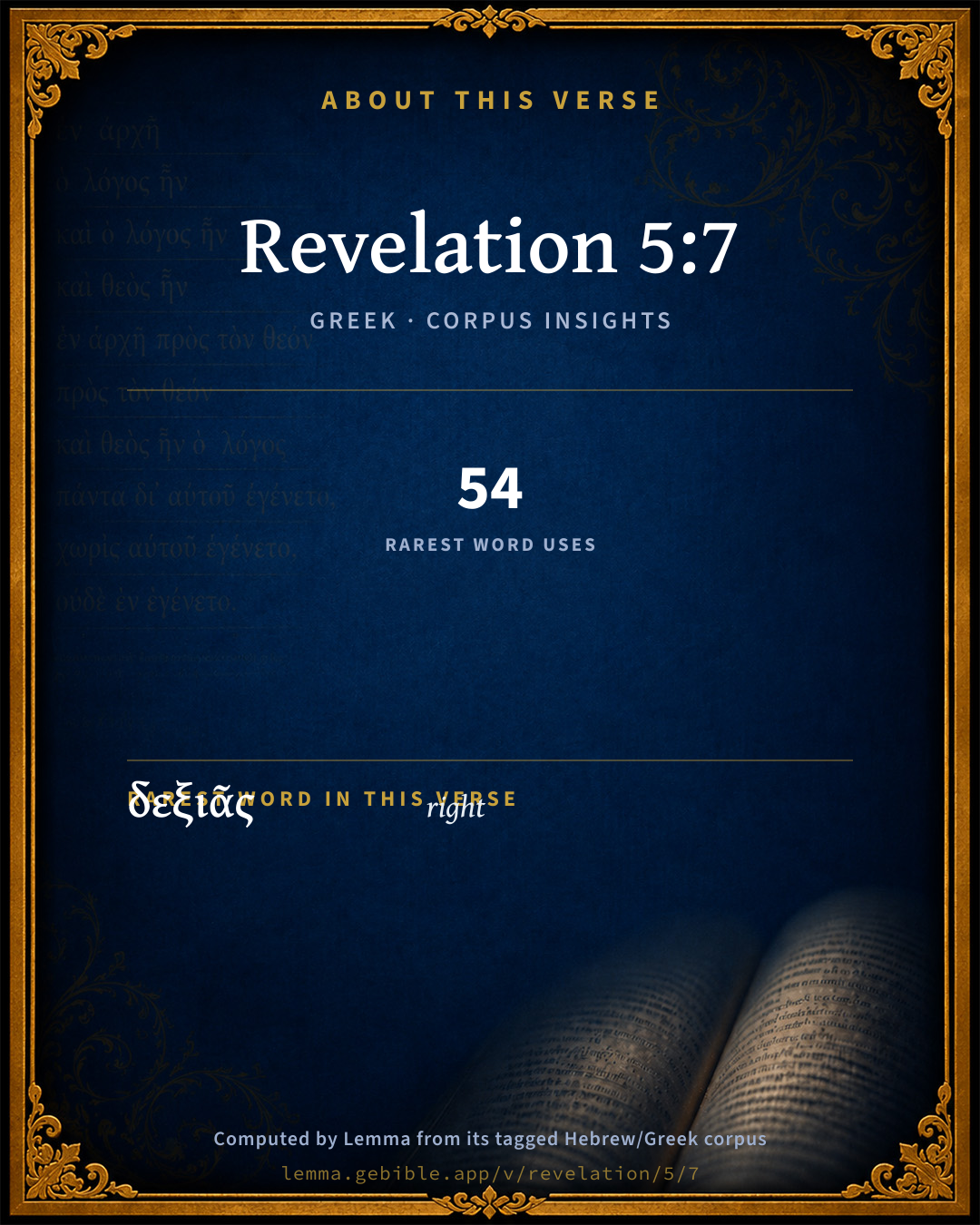
δεξιᾶς right G1188 occurs in 54 verses of the Greek New Testament. Also found in:
Repetition

Words recur within this verse:

Cross-references

2

Topical passages linked to Revelation 5:7 in the Treasury of Scripture Knowledge — connected by theme and wording, ordered by reader-vote popularity; previews shown in the World English Bible.

  • Revelation 5:1 I saw, in the right hand of him who sat on the throne, a book written inside and outside, sealed shut with seven seals.
  • Revelation 4:2–3 Immediately I was in the Spirit. Behold, there was a throne set in heaven, and one sitting on the throne

Cross-references courtesy of OpenBible.info (CC BY 4.0).

Where the printed editions differ

1 variant

Places in this verse where the major printed Greek editions disagree on the wording in a way that affects the translation — a comparison of editions, not a manuscript-by-manuscript collation. The editions are the modern critical texts (Nestlé-Aland 28/27, SBL, Westcott-Hort, Tregelles, Tyndale House) and the traditional texts behind the KJV (the Textus Receptus and the Byzantine/Majority text). It is not a claim about which reading is original.

  1. Extra text
    βιβλίον

    “scroll”

    In TR Not in NA28NA27TynSBLWHTregByz

    βιβλίον (biblion) 'scroll' is only in traditional manuscripts (TR)

Textual data: Translators Amalgamated Greek New Testament (STEPBible TAGNT) · CC BY 4.0.

Commentary

Notes on Revelation 5:7 from classic Christian and Jewish commentators (each source and its license shown beneath its notes). The classic Christian expositions comment on the surrounding passage and are grouped to its opening verse, so a note may address several verses; the Jewish commentaries on the Tanakh (Rashi and others) are per-verse, so they appear only where the commentator wrote on this verse.

Lemma curates 59 commentaries, every one of them public domain or Creative Commons licensed, each selected and text-cleaned for this edition rather than reprinted as found. About our sources →

Meyer's Critical & Exegetical Commentary

Heinrich August Wilhelm Meyer

Rev_5:7. Καὶ ἦλθε καὶ εἴληφε. The perf. has,[1919] as also elsewhere among those later,[1920] the sense of the aor.,which is the easier here because an aor. precedes.

The Lamb took it (the book) out of the hand of God offering it.[1921] Ebrard wishes to translate it received, because the active taking does not suit the Sons position with respect to the Father. But while of course it is self-evident that no one, not even the Lamb, can take the book if God do not give it, yet the idea of the active taking on the part of the Lamb lies more in the course of the entire connection, as it presents the glory of the Lamb eminent above all creatures, and not the possible subordination of the same to God. The Lamb can take the book for the reason indicated already in Rev_5:5,[1922] but in no way because of having meanwhile received from God permission which had been previously asked.[1923] To consider with Vitr. as to whether the Lamb also had hands, etc., is unnecessary and without point.

[1919] Cf. Rev_8:5.

[1920] Winer, p. 255.

[1921] Cf. Rev_5:1.

[1922] Cf. Rev_5:9.

[1923] Ew. i.

Meyer — Critical and Exegetical Commentary on the New Testament — English translation by Peter Christie, edited by Frederick Crombie (T&T Clark, 1880) — public domain. Text from a community e-Sword module.

Expositor's Greek Testament

ed. W. Robertson Nicoll

Rev 5:7 . A realistic symbol of the idea conveyed in Joh 3:35 ; Joh 12:49 , etc.

The Expositor's Greek Testament, edited by W. Robertson Nicoll (1897–1910) — public domain. Text from a community e-Sword module.

Geneva Bible (1599)

Geneva Bible translators

The fact of Christ the Mediator, that he cometh unto the throne of the Father, of which Rev. 4, and taketh the book out of his hand to open it. For that he opened it, it is first expressed, Rev. 6:1, etc.

Geneva Bible (1599) marginal notes — public domain. Text via Bolls.life.

Jamieson, Fausset & Brown

Robert Jamieson, A. R. Fausset & David Brown

The book lay on the open hand of Him that sat on the throne for any to take who was found worthy [ALFORD]. The Lamb takes it from the Father in token of formal investiture into His universal and everlasting dominion as Son of man. This introductory vision thus presents before us, in summary, the consummation to which all the events in the seals, trumpets, and vials converge, namely, the setting up of Christ's kingdom visibly. Prophecy ever hurries to the grand crisis or end, and dwells on intermediate events only in their typical relation to, and representation of, the end.

Jamieson, Fausset & Brown — Commentary Critical and Explanatory on the Whole Bible (1871) — public domain (CC PDM 1.0). Text via the HelloAO Bible API.

Adam Clarke's Commentary

Verse 7. He came and took the book] This verse may be properly explained by John, Joh 1:18. No man hath seen God at any time; the only-begotten Son, which is in the bosom of the Father, he hath DECLARED him. With Jesus alone are all the counsels and mysteries of God.

Adam Clarke's Commentary on the Bible (1810–1826) — public domain. Text from a community e-Sword/MySword module.

Ellicott's Commentary for English Readers

(7) And he came . . .—Better, And He came, and He has taken (omit the words “the book,” and supply) it (i.e., the roll) out of the right hand of Him that sitteth upon the throne. There is a change of tense (“came,” “has taken”), which seems to be due to the rapt attention of the seer, whose narrative trembles with his own intensity of feeling. He wept awhile ago; now he need not weep. The Lamb conquered; He came; He has taken the roll. He is the wisdom of the Church; among all pre-eminent; all things will be reconciled in Him; the purpose and meaning of all life’s mysteries and sorrows will be made plain in Him. (Comp. 1Co_1:24; Eph_1:9-10; Col_1:18.)

A Bible Commentary for English Readers, edited by Charles John Ellicott (1878–1897) — public domain. Text from a community e-Sword module.

John Gill's Exposition

And he came,.... He drew nigh to the throne of God, he engaged his heart to approach unto him, and came up even to his seat, which a mere creature, without a Mediator, cannot do:

and took the book out of the right hand of him that sat upon the throne; See Gill on Rev 5:1; it being given unto him, as in Rev 1:1; and a commission and authority to open it, and make it manifest to others, and to accomplish the several events, in the several periods of time, it points unto.

John Gill's Exposition of the Whole Bible (1746–1763) — public domain (CC PDM 1.0). Text via the HelloAO Bible API.

Trapp's Complete Commentary

John Trapp

7 And he came and took the book out of the right hand of him that sat upon the throne.

Ver. 7. And he came and took] As Mediator he took it, as God he gave it. All things are delivered unto him of the Father; and no man knoweth the Father but the Son, and he to whom the Son revealeth him, Mat 11:27. {See Trapp on "Mat 11:27"}

John Trapp, A Commentary or Exposition upon All the Books of the Old and New Testament (1647–1656) — public domain. Text from a community e-Sword module.

Albert Barnes' Notes on the Bible

And he came and took the book out of the right hand ... - As if it pertained to him by virtue of rank or office. There is a difficulty here, arising from the incongruity of what is said of a lamb, which it is not easy to solve. The difficulty is in conceiving how a lamb could take the book from the hand of Him who held it. To meet this several solutions have been proposed:

(1) Vitringa supposes that the Messiah appeared as a lamb only in some such sense as the four living beings Rev 4:7 resembled a lion, a calf, and an eagle; that is, that they bore this resemblance only in respect to the head, while the body was that of a man. He thus supposes, that though in respect to the upper part the Saviour resembled a lamb, yet that to the front part of the body hands were attached by which he could take the book. But there are great difficulties in this supposition. Besides that nothing of this kind is intimated by John, it is contrary to every appearance of probability that the Redeemer would be represented as a monster. In his being represented as a lamb there is nothing that strikes the mind as inappropriate or unpleasant, for he is often spoken of in this manner, and the image is one that is agreeable to the mind. But all this beauty and fitness of representation is destroyed, if we think of him as having human hands proceeding from his breast or sides, or as blending the form of a man and an animal together. The representation of having an unusual number of horns and eyes does not strike us as being incongruous in the same sense; for though the number is increased, they are such as pertain properly to the animal to which they are attached.

(2) Another supposition is that suggested by Prof. Stuart, that the form was changed, and a human form resumed when the Saviour advanced to take the book and open it. This would relieve the whole difficulty, and the only objection to it is, that John has not given any express notice of such a change in the form; and the only question can be whether it is right to suppose it in order to meet the difficulty in the case. In support of this it is said that all is symbol; that the Saviour is represented in the book in various forms; that as his appearing as a lamb was designed to represent in a striking manner the fact that he was slain, and that all that he did was based on the atonement, so there would be no impropriety in supposing that when an action was attributed to him he assumed the form in which that act would be naturally or is usually done. And as in taking a book from the hand of another it is wholly incongruous to think of its being done by a lamb, is it not most natural to suppose that the usual form in which the Saviour is represented as appearing would be resumed, and that he would appear again as a man?

But is it absolutely certain that he appeared in the form of a lamb at all? May not all that is meant be, that John saw him near the throne, and among the elders, and was struck at once with his appearance of meekness and innocence, and with the marks of his having been slain as a sacrifice, and spoke of him in strong figurative language as a lamb? And where his “seven horns” and “seven eyes” are spoken of, is it necessary to suppose that there was any real assumption of such horns and eyes? May not all that is meant be that John was struck with that in the appearance of the Redeemer of which these would be the appropriate symbols, and described him as if these had been visible? When John the Baptist saw the Lord Jesus on the banks of the Jordan, and said, “Behold the Lamb of God which taketh away the sin of the world” Joh 1:29, is it necessary to suppose that he actually appeared in the form of a lamb?

Do not all at once understand him as referring to traits in his character, and to the work which he was to accomplish, which made it proper to speak of him as a lamb? And why, therefore, may we not suppose that John in the Apocalypse designed to use language in the same way, and that he did not intend to present so incongruous a description as that of a lamb approaching a throne and taking a book from the hand of Him that sat on it, and a lamb, too, with many horns and eyes? If this supposition is correct, then all that is meant in this passage would be expressed in some such language as the following: “And I looked, and lo there was one in the midst of the space occupied by the throne, by the living creatures, and by the elders, who, in aspect, and in the emblems that represented his work on the earth, was spotless, meek, and innocent as a lamb; one with marks on his person which brought to remembrance the fact that he had been slain for the sins of the world, and yet one who had most striking symbols of power and intelligence, and who was therefore worthy to approach and take the book from the hand of Him that sat on the throne.” It may do something to confirm this view to recollect that when we use the term “Lamb of God” how, as is often done in preaching and in prayer, it never suggests to the mind the idea of a lamb. We think of the Redeemer as resembling a lamb in his moral attributes and in his sacrifice, but never as to form. This supposition relieves the passage of all that is incongruous and unpleasant, and may be all that John meant.

Albert Barnes' Notes on the Bible (1834–1885) — public domain. Text from a community e-Sword/MySword module.

Haydock's Catholic Bible Commentary

He....took the book,[3]...and when he had opened it, or was about to open it, (in the Greek is only, he took it: which was a sign that he would open it)...the four and twenty ancients fell down before the Lamb, to adore him, as appears by what follows, ver. 13. --- Having every one of them harps to celebrate his praise, and golden vials full of odours, which are the prayers of the saints: which shews that the saints in heaven offer up before the throne of the Divine Majesty the prayers of the faithful. (Witham) --- Harps, &c. These harps are symbols of the praise which good men render to God; and the vials full of odours represent the prayers of the saints. In conformity with this idea, St. John wishes to represent these four and twenty ancients as so many senators, who present to the Almighty the prayers and homages of good men on earth. (Estius; Clement of Alexandria) --- This also is an imitation of what was practised in the temple, in which were always around the altar, in times of sacrifice, Levites with musical instruments, priests with vials to contain the wine and blood, and censers to hold the incense (Calmet) --- The prayers of the saints. Here we see that the saints in heaven offer up to Christ the prayers of the faithful upon earth. (Challoner)

===============================

[BIBLIOGRAPHY]

Cum aperuisset: in the present Greek only, Greek: ote elabe; and in one or two manuscripts of the Marquis de Velez, Greek: enoixe.

George Leo Haydock (1774–1849), Haydock's Catholic Family Bible and Commentary, 1859 edition — public domain. Excludes Psalms (Douay-Rheims chapter numbering differs from Protestant) and Deuterocanonical books (Catholic canon only).

Matthew Poole's English Annotations

This Lamb with seven horns and seven eyes, having been slain, and having prevailed with his Father to open this book, mentioned Rev 5:1, of all the secrets, counsels, and purposes of God relating to his church, he came and took it of his Father, in whose right hand it was, as Rev 5:1.

From hence to the end of this chapter, are nothing but songs sang by the living creatures which John saw, and the twenty-four elders which he saw, and an innumerable company of angels, to the honour and glory of Jesus Christ, as the Redeemer of man, and the Head of the church, upon this taking of the book from the right hand of his Father.

Matthew Poole's English Annotations on the Holy Bible (1683–1685) — public domain. Text from a community e-Sword/MySword module.

Whedon's Commentary on the Bible

Daniel D. Whedon

7. Took the book—Stuart, after Vitringa, and more persistently, raises the question, How could the Lamb take the roll without hands? And this question, Dusterdieck rejects as “unnothig und geschmacklos,” needless and tasteless. But Ezekiel did not think it geschmacklos to tell us that his cherubim “had the hands of a man,” Eze_1:8. And the query of Stuart raises the question, What was the real form of the Lamb? and that is quite as legitimate as the question, What were the forms of the cherubim? which is much discussed by these critics. Alford argues that the cherubim were in human form, because they fall down in worship; and it seems as legitimate for us to argue that the Lamb could not have held a quadruped form in sitting on his “throne.” Stuart well discusses this perfectly necessary and aesthetic question. He rather favours the idea that the Lamb, at the first view of the seer, wore the quadruped form, but with the transformability of a dream-image, gradually changed to the form of the “Son of man,” as he approached to take the roll. Or, we may suppose that with visional liberty the two forms of lamb and man transparently enfolded and enclosed one the other, (as amber may enclose a diamond,) so as both to be recognisable by the seer’s eye. Nevertheless we rather prefer Stuart’s view; and holding the form of the Lamb with seven horns to be a transient symbol to the seer’s eye, we do not think it in connexion with the word Lamb as used in the rest of John’s twenty-seven instances.

Daniel D. Whedon (gen. ed.), Commentary on the Old and New Testaments (1874–1909) — public domain. Text from a community e-Sword module.

The Pulpit Commentary

And he came and took the book; or, and he came and he hath taken it. "Hath taken" is perfect (eilhfe), while "came" is the aorist (hlye). If the differ-once is intentionally significant, it renders the description somewhat more vivid. (For the consideration of the question how the Lamb could do this, see on ver. 6) Wordsworth contrasts the spontaneous act of the Lamb in taking the book of his own accord as his right, with the call to St. John to take the little book. (Rev_10:8) Out of the right hand. The position of power and honour. He to whom all power was given in heaven and in earth (Mt 28) is the only One who can penetrate the mysteries and dispense the power of God"s right hand. Of him that sat upon the throne; of him that sitteth. That is, the Triune God. (see on Rev_4:2) The Son in his human capacity, as indicated by his sacrificial form of the Lamb, can take and reveal the mysteries of the eternal Godhead in which he, as God, has part.

The Pulpit Commentary (1880–1919), ed. H.D.M. Spence-Jones & Joseph S. Exell — public domain. Text from a community e-Sword module.

John Wesley's Explanatory Notes

And he came - Here was "Ask of me," Psalm ii, 8, fulfilled in the most glorious manner. And took - it is one state of exaltation that reaches from our Lord's ascension to his coming in glory. Yet this state admits of various degrees. At his ascension, "angels, and principalities, and powers were subjected to him." Ten days after, he received from the Father and sent the Holy Ghost. And now he took the book out of the right hand of him that sat upon the throne - who gave it him as a signal of his delivering to him all power in heaven and earth. He received it, in token of his being both able and willing to fulfil all that was written therein.

John Wesley, Explanatory Notes Upon the Whole Bible (1754–1765) — public domain. Text via the GEBible commentary corpus.

Scofield Reference Notes

C. I. Scofield

came

Cf. Dan 7:13; Dan 7:14. The two visions are identical; the Revelation adding that which was hidden from Daniel, that the kings and priests of the church-age are to be associated with the "Son of Man," the "Lamb as it had been slain," in His reign "on the earth" Rev 2:9; Rev 2:10.

The Scofield Reference Bible (1917 edition), notes by C. I. Scofield — public domain. Text from a community e-Sword module.

Cambridge Greek Testament for Schools and Colleges

7. εἴληφεν. B2 adds τὴν; Text. Rec[199] τὸ βιβλίον with 1 and all Latin authorities.

[199] Rec. Textus Receptus as printed by Scrivener.

7. καὶ ἦλθεν καὶ εἴληφεν. The absence of an object for εἴληφεν is very strange: and the difficulties of this book are due rather as a rule to redundancies than to ellipses: the perfect after the aorist is very strange also; cf. however Ev. Petri ἐχάρησαν δὲ οἱ Ἰουδαῖοι καὶ δεδώκασι τῷ Ἰωσὴφ τὸ σῶμα αὐτοῦ. Winer’s reference p. 340 to the custom of scholiasts, who explain an aorist verb in the text by a verb in the perfect, is irrelevant; the aorist is far commoner than the perfect in the language of the New Testament, whatever it may be in the language of scholiasts, and probably scholiasts use the perfect in explaining the matter of a book for the same reason as ancient and modern commentators use the present in discussing a writer who lived long ago: we say, “he says, he means, he sees, &c.” Cf. note on πῶς εἴληφας καὶ ἤκουσας (Rev 3:3).

Cambridge Greek Testament for Schools and Colleges (Cambridge University Press, 1896; 21 vols, various authors incl. Carr, Maclear, Plummer, Farrar, Lumby, Moule, M. R. James, Simcox) — public domain. Text from a community e-Sword module.

Alford’s Greek Testament

Henry Alford

7.] The Lamb takes the Book. And he (or, it) came and took (not, ‘received,’ as Ebrard. The book lay on the open hand of Him that sat on the throne, for any to take who was found worthy. That “das Buch userreichen” which Ebrard insists on, is found not here, but in the previous description: and to introduce it here, confuses the distinctness of the symbolism.

The perfect εἴληφεν apparently cannot be pressed: see reff.) it (i. e. the Book; cf. next verse) out of the right hand of Him that sat upon the throne (Vitringa’s enquiry, whether we are to imagine the Lamb to have had partly a human form and hands, is rightly dismissed by Düsterd. as “unnöthig und geschmacklos”).

Henry Alford, The Greek Testament (1849–1861) — public domain. Text from a community e-Sword module.

Vincent's Word Studies in the New Testament

Marvin R. Vincent

Took [ειληφεν] . Lit., hath taken. The perfect, alternating with the aorist, is graphic.

Marvin R. Vincent, Word Studies in the New Testament (1887–1900) — public domain. Text from a community e-Sword/MySword module.

Lesson kit

Teaching starters — assembled from the data on this page, not authored interpretation. Every prompt links to the verse data it draws on. Edit before teaching.

Revelation, in the Revelation, opens this verse with 12 words (9 distinct Greek lemmas). Its most distinctive word is dexiós (“right”). A historical commentator’s framing appears above. Read the whole chapter for the surrounding context.

Discussion questions

  1. The word dexiós carries the sense “right.” How does it shape the verse?
  2. How does Matthew 5:29, which shares the word «right», read alongside this verse?
  3. What does the repetition of “the” (3× in this one verse) do in this verse?
  4. The translations on this page render this verse differently — a whole-verse word diff, not a word-by-word alignment. What might account for the different wordings?
  5. Compare how Meyer's Critical & Exegetical Commentary and Expositor's Greek Testament read this verse. Where do they agree or differ?

Things to notice

  • These translations choose different wording for 8 words in this verse.
  • “the” occurs 3× in this single verse.
  • 9 distinct Greek lemmas span 12 words in this verse.

Reading settings

Reading text

Shown beneath each verse's original-language words.

Old Testament
Old Testament edition

Read the OT as the Masoretic Hebrew (MT) or the Greek Septuagint (LXX).

English shown for the Greek Septuagint (in the Hebrew ↔ Greek comparison).

Comparing translations? Open the Compare panel on any verse page to stack up to four side by side.