Numbers 14:45

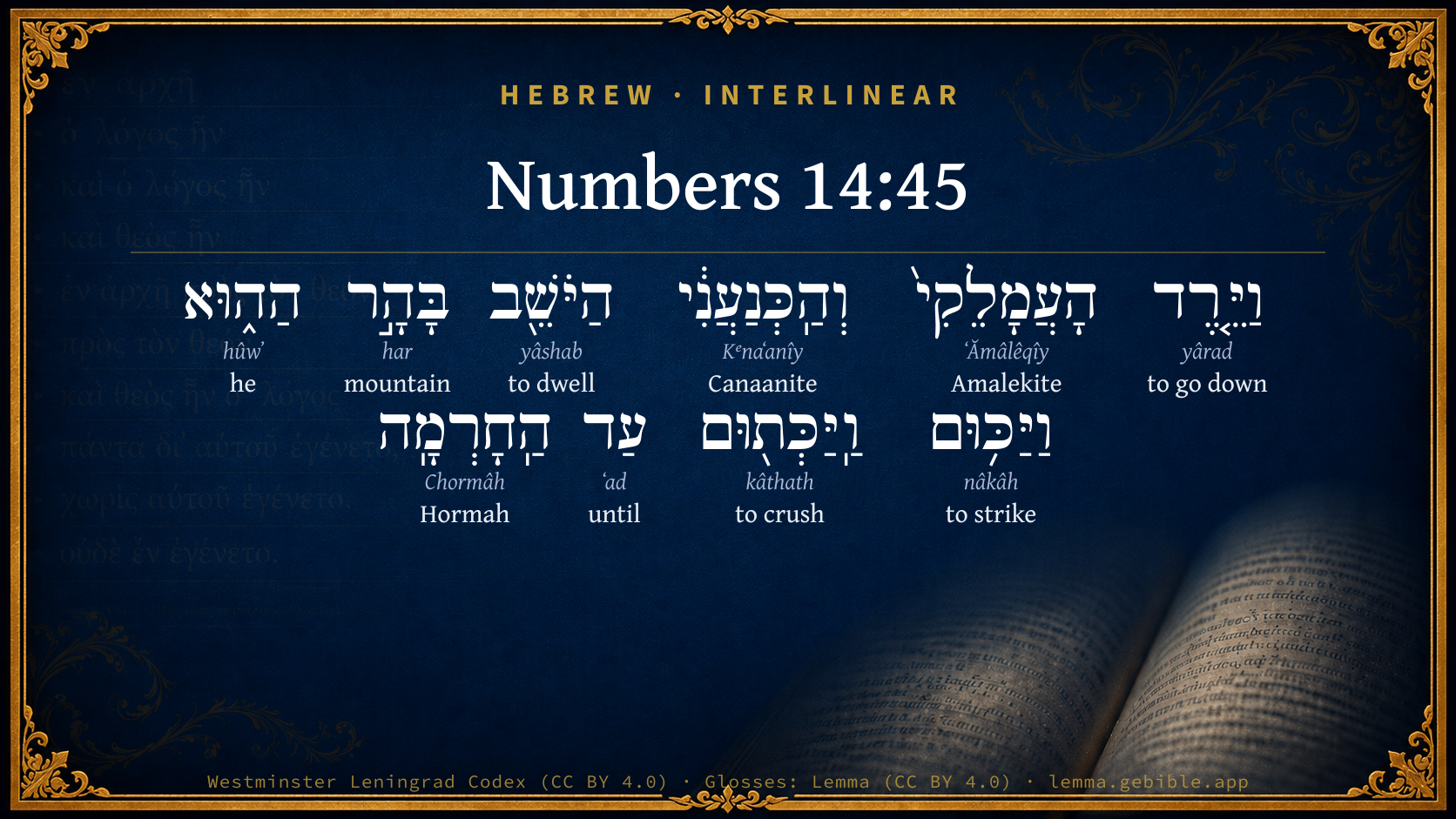
Hebrew (Westminster Leningrad Codex) Numbers 14:45 appears in the Hebrew Old Testament. The text above is from the Westminster Leningrad Codex. Each word links to its Strong’s number, a concise gloss, and parsing drawn from the Open Scriptures Hebrew Bible morphology. Click any word for its full Brown-Driver-Briggs (BDB) entry.
Download image
Cite this verse

Numbers 14:45 (World English Bible). Public Domain. Lemma interlinear Bible study tool, https://lemma.gebible.app/v/numbers/14/45.

Show BibTeX & RIS
BibTeX
RIS
English Translation
Then the Amalekite came down, and the Canaanite who lived in that mountain, and struck them and beat them down, even to Hormah.
World English Bible · Public Domain
Highlights
  • 1 first appearance in the Hebrew Bible
Full analysis ↓
Download a study sheet

One document with this verse’s original text, its word-by-word gloss line, the meaning frame, cross-references with their text, attributed commentary, and full source and license credits — printable, and it pastes into notes with its structure intact.

This verse Autodidact and up

Study sheet (.html) Plain text (.txt)

A passage Seminary Student

Up to 50 verses in one chapter. A passage sheet keeps up to 6 commentary sources and 12 cross-references per verse, in the order this page ranks them, and says so on the sheet whenever that leaves anything out. Ask for a single verse and you get the Autodidact verse sheet above.

Everything on this page stays free to read, with no account — the sheet is a download of what is already on screen, not access to it.

Want to remove ads? Support Godless Engineer
Compare translations 3

The same verse in 3 English versions, stacked beneath the original-language interlinear above. Click any original word for its lexicon entry.

Each is an independent rendering of the whole verse — the interlinear is not word-aligned to these translations.

Highlighted words mark where these versions differ — a whole-verse word diff, not a word-by-word alignment.

  • World English Bible Public Domain
    Then the Amalekite came down, and the Canaanite who lived in that mountain, and struck them and beat them down, even to Hormah.
  • King James Version Public Domain
    Then the Amalekites came down, and the Canaanites which dwelt in that hill, and smote them, and discomfited them, even unto Hormah.
  • unfoldingWord Literal Text CC BY-SA 4.0
    And the Amalekite and the Canaanite, the one dwelling in that hill country, came down. And they struck them and beat them to pieces as far as the Hormah.

unfoldingWord Literal Text — © unfoldingWord, licensed CC BY-SA 4.0. Word-aligned USFM3 via Door43 (git.door43.org/unfoldingWord/en_ult).

Versions to compare (up to 4)

3 of 4 selected

Show all 18 translations

Every available English version of this verse, each an independent rendering of the whole verse.

  • World English Bible Public Domain
    Then the Amalekite came down, and the Canaanite who lived in that mountain, and struck them and beat them down, even to Hormah.
  • Berean Standard Bible Public Domain
    Then the Amalekites and Canaanites who lived in that part of the hill country came down, attacked them, and routed them all the way to Hormah.
  • Majority Standard Bible Public Domain
    Then the Amalekites and Canaanites who lived in that part of the hill country came down, attacked them, and routed them all the way to Hormah.
  • King James Version Public Domain
    Then the Amalekites came down, and the Canaanites which dwelt in that hill, and smote them, and discomfited them, even unto Hormah.
  • American Standard Version (1901) Public Domain
    Then the Amalekite came down, and the Canaanite who dwelt in that mountain, and smote them and beat them down, even unto Hormah.
  • Revised Version (1885) Public Domain
    Then the Amalekite came down, and the Canaanite which dwelt in that mountain, and smote them and beat them down, even unto Hormah.
  • Geneva Bible (1599) Public Domain
    Then the Amalekites and the Canaanites, which dwelt in that mountaine, came downe and smote them, and consumed them vnto Hormah.
  • Douay-Rheims (1899) Public Domain
    And the Amalecite came down, and the Chanaanite that dwelt in the mountain: and smiting and slaying them pursued them as far as Horma.
  • Young's Literal Translation Public Domain
    And the Amalekite and the Canaanite who are dwelling in that mountain come down and smite them, and beat them down -- unto Hormah.
  • Literal Standard Version CC BY-SA 4.0
    And the Amalekite and the Canaanite who are dwelling in that mountain come down and strike them, and beat them down to Hormah.
  • Unlocked Literal Bible CC BY-SA 4.0
    Then the Amalekites came down, and also the Canaanites who lived on those hills. They attacked the Israelites and defeated them all the way to Hormah.
  • unfoldingWord Literal Text CC BY-SA 4.0
    And the Amalekite and the Canaanite, the one dwelling in that hill country, came down. And they struck them and beat them to pieces as far as the Hormah.
  • Darby Bible Public Domain
    And the Amalekites and the Canaanites who dwelt on that hill, came down and smote them, and cut them to pieces, as far as Hormah.
  • World Messianic Bible Public Domain
    Then the Amalekites came down, and the Canaanites who lived in that mountain, and struck them and beat them down even to Hormah.
  • Webster's Bible Public Domain
    Then the Amalekites came down, and the Canaanites which dwelt in that hill, and smote them, and discomfited them, even to Hormah.
  • Free Bible Version CC BY-SA 4.0
    The Amalekites and Canaanites who lived there in the hill country came down and attacked the Israelites and defeated them, and chased them all the way to Hormah.
  • Bible in Basic English Public Domain
    Then the Amalekites came down, and the Canaanites who were living in the hill-country, and overcame them completely, driving them back as far as Hormah.
  • JPS Tanakh (1917) Public Domain
    Then the Amalekite and the Canaanite, who dwelt in that hill-country, came down, and smote them and beat them down, even unto Hormah.

Literal Standard Version (2020), Covenant Press — licensed CC BY-SA 4.0. Text via the HelloAO Bible API (eBible.org). Unlocked Literal Bible (unfoldingWord) — licensed CC BY-SA 4.0. Text via the HelloAO Bible API (eBible.org). unfoldingWord Literal Text — © unfoldingWord, licensed CC BY-SA 4.0. Word-aligned USFM3 via Door43 (git.door43.org/unfoldingWord/en_ult). Free Bible Version, Dr. Jonathan Gallagher — licensed CC BY-SA 4.0. Text via the HelloAO Bible API (eBible.org).

Word by word

More ways to search: Search by grammar → Find every occurrence → Compare this word →

Practice this passage: Drill this verse → Learn its vocabulary →

הַֽחָרְמָֽה
Chormâh
H2767
“the · Hormah”
Particle, Definite Article + Noun, Proper
Part of Speech
Particle + Noun
Type
Proper
Full BDB Definition

Origin: from H2763

TWOT: None

Hormah = "devotion" - a town of the Canaanites, conquered by Joshua, allotted to Judah, and located in the south of Judah
  1. וַיֵּ֤רֶד yârad H3381 “and · to go down” Conjunction + Verb, Qal, Sequential Imperfect, 3rd Person, Masculine, Singular
  2. הָעֲמָלֵקִי֙ ʻĂmâlêqîy H6003 “the · Amalekite” Particle, Definite Article + Noun, Gentilic, Masculine, Singular, Absolute
  3. וְהַֽכְּנַעֲנִ֔י Kᵉnaʻanîy H3669 “and · the · Canaanite” Conjunction + Particle, Definite Article + Noun, Gentilic, Masculine, Singular, Absolute
  4. הַיֹּשֵׁ֖ב yâshab H3427 “the · dwelling” Particle, Definite Article + Verb, Qal, Participle Active, Masculine, Singular, Absolute
  5. בָּהָ֣ר har H2022 “in/at the · mountain” Preposition, Determined + Noun, Common, Masculine, Singular, Absolute
  6. הַה֑וּא hûwʼ H1931 “the · he” Particle, Definite Article + Pronoun, Personal, 3rd Person, Masculine, Singular
  7. וַיַּכּ֥וּם nâkâh H5221 “and · to strike · them” Conjunction + Verb, Hiphil, Sequential Imperfect, 3rd Person, Masculine, Plural + Suffix, Personal, 3rd Person, Masculine, Plural
  8. וַֽיַּכְּת֖וּם kâthath H3807 “and · to crush · them” Conjunction + Verb, Hiphil, Sequential Imperfect, 3rd Person, Masculine, Plural + Suffix, Personal, 3rd Person, Masculine, Plural
  9. עַד ʻad H5704 “until” Preposition

About this verse

These counts appear in no published source. They are computed here, from the morphology-tagged text and Lemma’s own curated glosses. What Lemma adds →

10
words
10
distinct lemmas
Pentateuch
section

Notable vocabulary

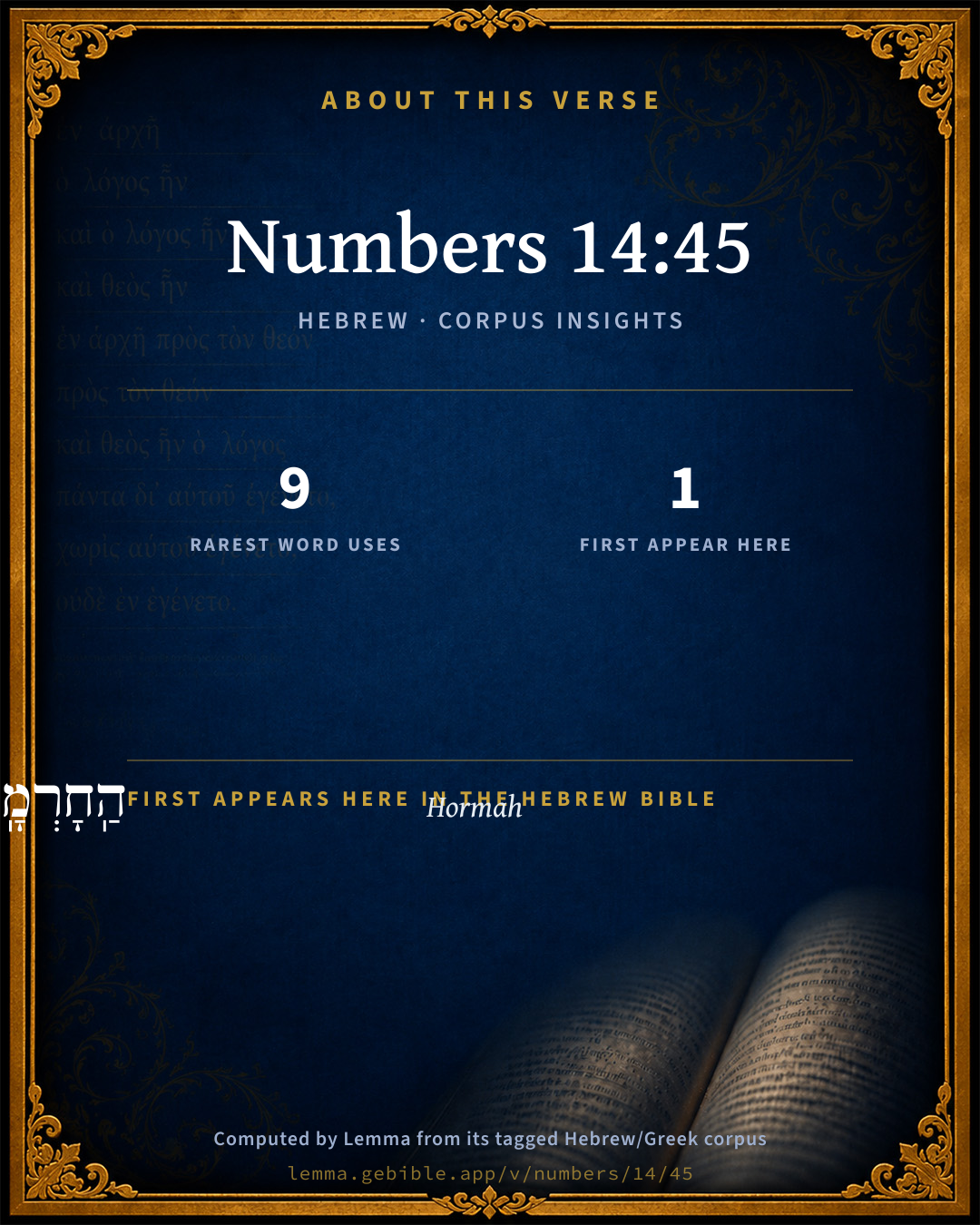
The rarest word here is הַֽחָרְמָֽה Hormah H2767 — appearing just 9 times in the whole Hebrew Bible.

First appearance in Scripture

This word makes its first canonical appearance in the Hebrew Bible here:

  • הַֽחָרְמָֽה Hormah H2767

Shared distinctive vocabulary

הַֽחָרְמָֽה Hormah H2767 occurs in 9 verses of the Hebrew Bible. Also found in:

Grammatical profile

  • 4 verbs
  • 4 nouns
  • 1 pronoun
  • 1 preposition

Verb forms

  • וַיֵּ֤רֶד Qal · Sequential Imperfect
  • הַיֹּשֵׁ֖ב Qal · Participle Active
  • וַיַּכּ֥וּם Hiphil · Sequential Imperfect
  • וַֽיַּכְּת֖וּם Hiphil · Sequential Imperfect

Hebrew & Septuagint length

In English translation the verse runs 23 words from the Hebrew and 26 from the Septuagint (LXX English) — closely comparable.

A rough comparison of the two English renderings, which tokenize alike — not a word-level alignment.

Word counts can differ between the Hebrew and the Greek without any difference in meaning — e.g. the Hebrew direct-object marker אֵת has no separate Greek word, and Greek often adds the article ὁ.

Cross-references

8

Topical passages linked to Numbers 14:45 in the Treasury of Scripture Knowledge — connected by theme and wording, ordered by reader-vote popularity; previews shown in the World English Bible.

  • Numbers 21:3 Yahweh listened to the voice of Israel, and delivered up the Canaanites; and they utterly destroyed them and their cities: and the name of the place was called Hormah.
  • Deuteronomy 1:44 The Amorites, who lived in that hill-country, came out against you, and chased you, as bees do, and beat you down in Seir, even to Hormah.
  • Judges 1:17 Judah went with Simeon his brother, and they struck the Canaanites who inhabited Zephath, and utterly destroyed it. The name of the city was called Hormah.
  • Numbers 14:43 For there the Amalekite and the Canaanite are before you, and you shall fall by the sword: because you are turned back from following Yahweh, therefore Yahweh will not be with you.
  • Exodus 17:16 He said, "Yah has sworn: 'Yahweh will have war with Amalek from generation to generation.'"
  • Deuteronomy 32:30 How should one chase a thousand, Two put ten thousand to flight, Except their Rock had sold them, Yahweh had delivered them up?
  • Joshua 7:5 The men of Ai struck of them about thirty-six men; and they chased them [from] before the gate even to Shebarim, and struck them at the descent; and the hearts of the people melted, and became as water.
  • Joshua 7:11–12 Israel has sinned; yes, they have even transgressed my covenant which I commanded them: yes, they have even taken of the devoted thing, and have also stolen, and dissembled also; and they have even put it among their own stuff.

Cross-references courtesy of OpenBible.info (CC BY 4.0).

Hebrew and Greek witnesses Masoretic Hebrew ↔ Greek Septuagint

The same verse in the two great witnesses to the Old Testament, shown verse-for-verse.

These are two independent witnesses, not word-aligned to each other, and the Septuagint is shown in lemma (dictionary) form.

Hebrew Numbers 14:45 Masoretic · Westminster Leningrad Codex

וַיֵּ֤רֶד הָעֲמָלֵקִי֙ וְהַֽכְּנַעֲנִ֔י הַיֹּשֵׁ֖ב בָּהָ֣ר הַה֑וּא וַיַּכּ֥וּם וַֽיַּכְּת֖וּם עַד הַֽחָרְמָֽה

Then the Amalekite came down, and the Canaanite who lived in that mountain, and struck them and beat them down, even to Hormah.

World English Bible · Public Domain

Greek LXX Numbers 14:45 Septuagint · lemma form

καί καταβαίνω ὁ αμαληκ καί ὁ χαναναῖος ὁ ἐν καταἧμαι ἐν ὁ ὄρος ἐκεῖνος καί τρέπω αὐτός καί κατακόπτω αὐτός ἕως ερμαν καί ἀποστρέφω εἰς ὁ παρεμβολή

And Amalec and the Chananite that lived in that mountain came down, and routed them, and destroyed them to Herman; and they returned to the camp.

LXX2012 (modern English Septuagint) · Public Domain

On this verse, The Pulpit Commentary discusses the Septuagint’s reading. Read the note in Commentary ↓

Hebrew: Westminster Leningrad Codex (CC BY 4.0). Greek: Septuagint (public domain); English from LXX2012 (modern English Septuagint) (Public Domain). How the Septuagint differs from the Hebrew →

Targum (Aramaic paraphrase)

2

The Targum is the ancient Jewish Aramaic paraphrase of the Hebrew Scriptures — an interpretive translation, not the Hebrew text itself. Onkelos (literal) and Pseudo-Jonathan (expansive) render the Torah, and Jonathan the Prophets. Coverage is partial: where no permissively-licensed English translation exists for a verse, only the Aramaic is shown. This is verse-level text, not a word-by-word alignment to the Hebrew.

  1. Targum Onkelos Torah (Genesis–Deuteronomy)
    וּנְחַת עֲמַלְקָאָה וּכְנַעֲנָאָה דְיָתֵב בְּטוּרָא הַהוּא וּמְחֻנוּן וּטְרָדֻנוּן עַד חָרְמָה

    (no public-domain English translation for this verse)

    Targum Onkelos — Aramaic: “Onkelos Genesis” (public domain); “Onkelos Exodus” (public domain); “Onkelos Leviticus” (public domain); “Onkelos Numbers” (public domain); “Onkelos Deuteronomy” (public domain). English: “Sefaria Community Translation” (CC0 1.0 (public-domain dedication)); “J.W. Etheridge. The Targums of Onkelos and Jonathan Ben Uzziel on the Pentateuch. London: Longmans, Green, 1862” (public domain). Text via Sefaria.

  2. Targum Pseudo-Jonathan Torah (Genesis–Deuteronomy)
    וּנְחַת עֲמַלְקָאָה וּכְנַעֲנָאָה דְיָתֵיב בְּטַוְורָא הַהוּא וּקְטִילוּ יַתְהוֹן וְשֵׁיצֵיאוּנוּן וּטְרָדוּנוּן עַד שֵׁיצָיוּ

    And the Amalekites and Kenaanites who dwelt in that mountain came down and slaughtered and destroyed them, and drave them hard to destruction.

    Targum Pseudo-Jonathan — Aramaic: “Targum Jonathan on Genesis” (public domain); “Targum Jonathan on Exodus” (public domain); “Targum Jonathan on Leviticus” (public domain); “Targum Jonathan on Numbers” (public domain); “Targum Jonathan on Deuteronomy” (public domain). English: “The Targum of Jonathan ben Uzziel, trans. J. W. Etheridge, London, 1862” (public domain). Text via Sefaria.

Commentary

Notes on Numbers 14:45 from classic Christian and Jewish commentators (each source and its license shown beneath its notes). The classic Christian expositions comment on the surrounding passage and are grouped to its opening verse, so a note may address several verses; the Jewish commentaries on the Tanakh (Rashi and others) are per-verse, so they appear only where the commentator wrote on this verse.

Lemma curates 59 commentaries, every one of them public domain or Creative Commons licensed, each selected and text-cleaned for this edition rather than reprinted as found. About our sources →

Trapp's Complete Commentary

John Trapp

Num 14:45 Then the Amalekites came down, and the Canaanites which dwelt in that hill, and smote them, and discomfited them, [even] unto Hormah.

Ver. 45. And smote them.] To be out of God’s precincts, is to be out of his protection.

John Trapp, A Commentary or Exposition upon All the Books of the Old and New Testament (1647–1656) — public domain. Text from a community e-Sword module.

Joseph Benson's Commentary

Num 14:45. The Canaanites — Largely so called, but strictly the Amorites. Hormah — A place so called afterward, (Num 21:3,) from the slaughter or destruction of the Israelites at this time.

Joseph Benson's Commentary on the Old and New Testaments (1811–1818) — public domain. Text from a community e-Sword module.

Tyndale Open Study Notes

Tyndale Open Resources

14:45 Hormah means “destruction” in Hebrew (see 21:1-3).

Tyndale Open Study Notes — © Tyndale Open Resources, licensed CC BY-SA 4.0. Text via the HelloAO Bible API.

Jamieson, Fausset & Brown

Robert Jamieson, A. R. Fausset & David Brown

even unto Hormah--The name was afterwards given to that place in memory of the immense slaughter of the Israelites on this occasion.

Next: Numbers Chapter 15

Jamieson, Fausset & Brown — Commentary Critical and Explanatory on the Whole Bible (1871) — public domain (CC PDM 1.0). Text via the HelloAO Bible API.

Ellicott's Commentary for English Readers

(45) Then the Amalekites came down . . . —The words “which dwelt in that hill” may refer to the Canaanites only, or to the Amalekites and the Canaanites, and may denote either permanent residence or temporary occupation. If the reference is, as seems most natural, to a permanent abode, it will follow Num_14:25, for the latter verse cannot be intended to describe the geographical position of the Canaanites.

Even unto Horman.—Or, the place of the ban. The definite article is used in this place, the Hormah. If the Hormah which is here mentioned is identical with the Hormah of Num_21:3, where the definite article is not used, and with the Hormah of Jdg_1:17, we must conclude that the name is used proleptically, as is not unfrequently the case in Scripture. It is probable, however, that in each case a different place is denoted by a common name. The cognate verb is employed in Deu_20:17, where the command is given to devote the Canaanitish nations to utter destruction, i.e., to a state of hormah.

A Bible Commentary for English Readers, edited by Charles John Ellicott (1878–1897) — public domain. Text from a community e-Sword module.

The Cambridge Bible for Schools and Colleges

gen. ed. J. J. S. Perowne

45. which dwelt in that hill country] See on Num_14:25.

Hormah] lit. ‘the Hormah’; but it occurs here only with the article. A town or district in the south of Palestine whose site is unknown. In Num_21:3 an explanation of the name is given: see notes there.

The Cambridge Bible for Schools and Colleges (gen. ed. J. J. S. Perowne; Cambridge University Press, 1878–1918) — public domain. Text from a community e-Sword module.

Albert Barnes' Notes on the Bible

Unto Hormah - literally, “the Hormah:” i. e. “the banning,” or “ban-place.” Compare Num 21:3; Jos 12:14. According to the view taken of Kadesh (see Num 13:26), Hormah is identified, through its earlier name, Zephath Jdg 1:17, with es-Safah on the southeastern frontier of Canaan, by which the Israelites quitted the Arabah for the higher ground, (or with Sebaita, which lies further to the west, about 25 miles north of Ain Gadis).

Albert Barnes' Notes on the Bible (1834–1885) — public domain. Text from a community e-Sword/MySword module.

Matthew Poole's English Annotations

The Canaanite; largely so called, but strictly the Arnorite, as appears from Deu 1:44.

Which dwelt; so they were a part and branch of those that dwelt in the valley, Num 14:25. Or, sat, i.e. placed themselves, lay in ambush, expecting your coming.

Hormah; a place so called afterwards Num 21:3, from the great slaughter or destruction of the Israelites at this time.

Matthew Poole's English Annotations on the Holy Bible (1683–1685) — public domain. Text from a community e-Sword/MySword module.

Whedon's Commentary on the Bible

Daniel D. Whedon

45. Discomfited — Literally, pounded into pieces. “Chased you, as bees do,” Deu_1:44, that is, with great ferocity when exasperated.

Hormah — This was the key point from which the roads across the desert, after having been all united, again diverge toward Gaza and Hebron; and its site is still marked by the ruins of a square tower of hewn stones, on the top of a hill which rises a thousand feet above the wady on the edge of which it stands. See Num_21:3, note.

Daniel D. Whedon (gen. ed.), Commentary on the Old and New Testaments (1874–1909) — public domain. Text from a community e-Sword module.

The Pulpit Commentary

The Amalekites came down, and the Canaanites. See on Deu_1:44. They came down from the summit of the mountain country, and drove the Israelites off the saddle, or lower level, to which they had ascended. Discomfited them. Septuagint, katekoqan autouv , "cut them up." Unto Hormah. This mention of Hormah is extremely perplexing, especially when we find from Deu_1:44 that it was "in Serf" (ryiceB), which is the ordinary name for the territory of the Edomites. The name Hormah meets us again in Num_21:3 (see the notes there), as having been bestowed by the Israelites upon the place where they destroyed the people of King Arad. If this be the same Hormah, it must be so named here by anticipation. It is, however, quite possible that it is another place altogether. Again, if the Seir of Deu_1:44 be the country usually so called, we must suppose that the Edomites had at this time occupied a part of the Azazimeh, contiguous to the Wady Murreh, and westwards of the Arabah. We should then represent the Israelites to ourselves as being driven off the mountain, and across the Wady Murreh, and cut down in the mountains beyond, as far as a place called Hormah, perhaps from this very slaughter. Others have found Hormah (or Zephath, Jud_1:17) and Seir among the multitudinous names of past or present habitation in the south of Palestine; the perplexing resemblances of which, coupled with the vagueness of the sacred narrative, lead to the rise of as many different theories as there are commentators. It must, however, be erroneous to represent this hasty incursion of the Israelites, without their leaders, and without their daily food from heaven, as a campaign in which they advanced for a considerable distance, and were only partially expelled at last. It is clear from this passage, and still more from the parallel passage in Deuteronomy 1, that the expedition was swiftly and ignominiously repelled and avenged. Compare the expression, "chased you as bees do."

The Pulpit Commentary (1880–1919), ed. H.D.M. Spence-Jones & Joseph S. Exell — public domain. Text from a community e-Sword module.

John Wesley's Explanatory Notes

The Canaanites - Largely so called, but strictly the Amorites. Hormah - A place so called afterwards, ver. 3, from the slaughter or destruction of the lsraelites at this time.

John Wesley, Explanatory Notes Upon the Whole Bible (1754–1765) — public domain. Text via the GEBible commentary corpus.

Rashi

Rabbi Shlomo Yitzchaki (Rashi)

ויכתום AND COMPLETELY DISCOMFITED THEM — This word is the same in meaning as (Deuteronomy 9:21) “and I pounded it (ואכות) and ground it very thin”. The text implies: blow upon blow.

ער החרמה EVEN UNTO HORMAH — The place was so called (חרמה doom, destruction) on account of what happened there.

Rashi on the Tanakh — English translations: “The Judaica Press complete Tanach with Rashi, translated by A. J. Rosenberg” (CC BY 4.0); “Pentateuch with Rashi's commentary by M. Rosenbaum and A.M. Silbermann, 1929-1934” (public domain); “The Metsudah Tanach series, Lakewood, N.J” (CC BY 4.0); and “The Book of Joshua, Metsudah Publications, 1997” (CC BY 4.0). Text via Sefaria.

Lesson kit

Teaching starters — assembled from the data on this page, not authored interpretation. Every prompt links to the verse data it draws on. Edit before teaching.

Numbers, in the Pentateuch, opens this verse with 10 words (10 distinct Hebrew lemmas). Its most distinctive word is Chormâh (“Hormah”). A historical commentator’s framing appears above. Read the whole chapter for the surrounding context.

Discussion questions

  1. How does “Hormah” (Chormâh) shape what this verse is saying?
  2. The word “Hormah” first appears here in Scripture. What is being introduced at this debut?
  3. Numbers 21:3 shares the word «Hormah» with this verse. How do the two illuminate each other?
  4. These translations render this verse differently. What is at stake in choosing one wording over another?
  5. The verb «וַיֵּ֤רֶד» is Qal Sequential Imperfect. How does its form color the action?
  6. Reading how Trapp's Complete Commentary and Joseph Benson's Commentary read this verse, where do the two commentators agree and where do they part?

Things to notice

Reading settings

Reading text

Shown beneath each verse's original-language words.

Old Testament
Old Testament edition

Read the OT as the Masoretic Hebrew (MT) or the Greek Septuagint (LXX).

English shown for the Greek Septuagint (in the Hebrew ↔ Greek comparison).

Comparing translations? Open the Compare panel on any verse page to stack up to four side by side.