
Revelation 6:2

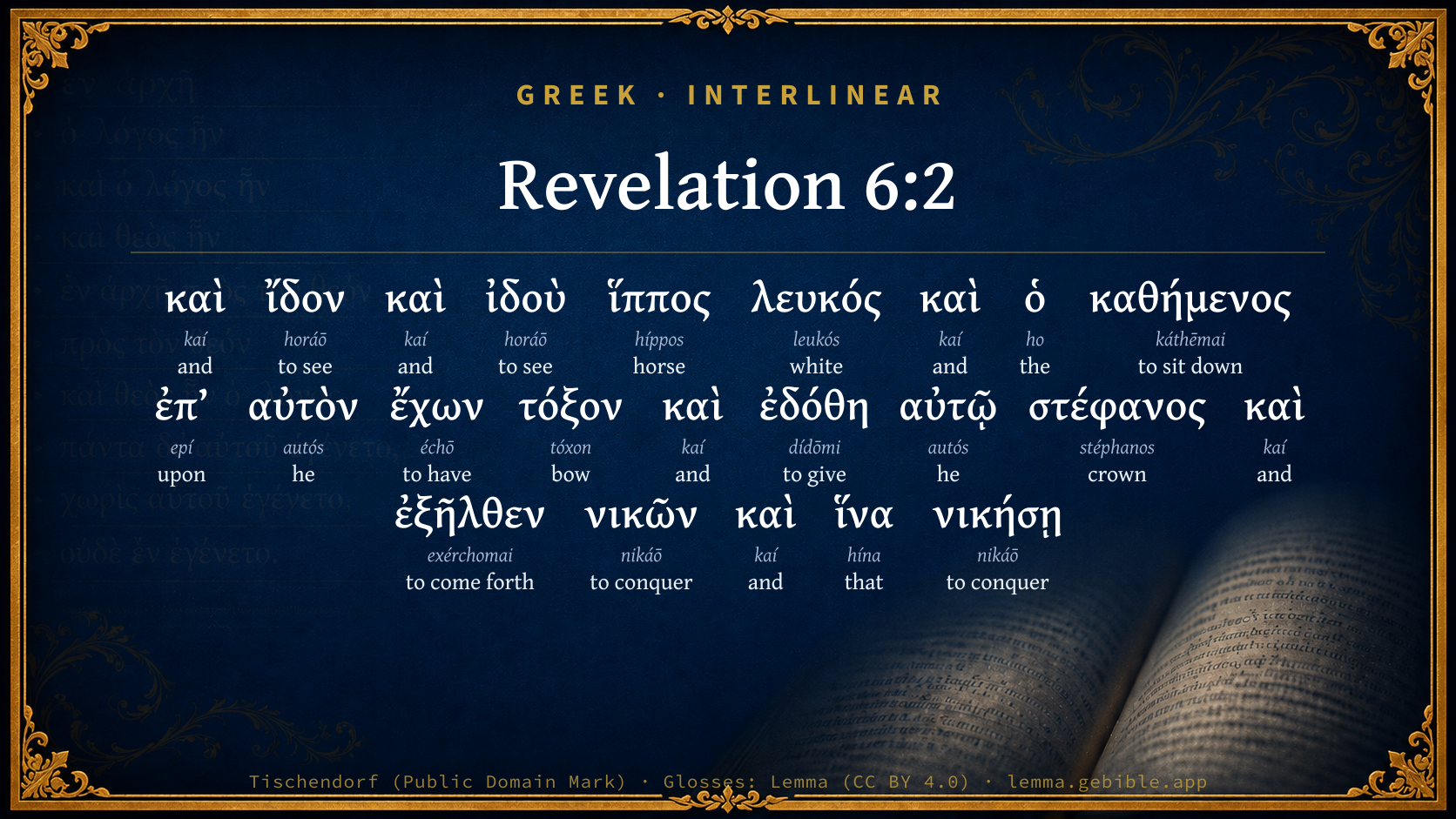
Greek (Tischendorf 8th ed.) Revelation 6:2 appears in the Greek New Testament. The text above is from the Tischendorf 8th edition. Each word links to its Strong’s number and a concise gloss. Click any word for its full Thayer’s Greek Lexicon entry.
Download image
Cite this verse

Revelation 6:2 (World English Bible). Public Domain. Lemma interlinear Bible study tool, https://lemma.gebible.app/v/revelation/6/2.

Show BibTeX & RIS
BibTeX
RIS
English Translation
And behold, a white horse, and he who sat on it had a bow. A crown was given to him, and he came forth conquering, and to conquer.
World English Bible · Public Domain
Highlights
  • 1 hapax legomenon — only here in the Greek New Testament
  • 1 first appearance in the Greek New Testament
Full analysis ↓
Download a study sheet

One document with this verse’s original text, its word-by-word gloss line, the meaning frame, cross-references with their text, attributed commentary, and full source and license credits — printable, and it pastes into notes with its structure intact.

This verse Autodidact and up

Study sheet (.html) Plain text (.txt)

A passage Seminary Student

Up to 50 verses in one chapter. A passage sheet keeps up to 6 commentary sources and 12 cross-references per verse, in the order this page ranks them, and says so on the sheet whenever that leaves anything out. Ask for a single verse and you get the Autodidact verse sheet above.

Everything on this page stays free to read, with no account — the sheet is a download of what is already on screen, not access to it.

Want to remove ads? Support Godless Engineer
Compare translations 3

The same verse in 3 English versions, stacked beneath the original-language interlinear above. Click any original word for its lexicon entry.

Each is an independent rendering of the whole verse — the interlinear is not word-aligned to these translations.

Highlighted words mark where these versions differ — a whole-verse word diff, not a word-by-word alignment.

  • World English Bible Public Domain
    And behold, a white horse, and he who sat on it had a bow. A crown was given to him, and he came forth conquering, and to conquer.
  • King James Version Public Domain
    And I saw, and behold a white horse: and he that sat on him had a bow; and a crown was given unto him: and he went forth conquering, and to conquer.
  • unfoldingWord Literal Text CC BY-SA 4.0
    And I looked and behold, a white horse, and the one sitting on it having a bow! And a crown was given to him, and he went out conquering and that he might conquer.

unfoldingWord Literal Text — © unfoldingWord, licensed CC BY-SA 4.0. Word-aligned USFM3 via Door43 (git.door43.org/unfoldingWord/en_ult).

Versions to compare (up to 4)

3 of 4 selected

Show all 19 translations

Every available English version of this verse, each an independent rendering of the whole verse.

  • World English Bible Public Domain
    And behold, a white horse, and he who sat on it had a bow. A crown was given to him, and he came forth conquering, and to conquer.
  • Berean Standard Bible Public Domain
    So I looked and saw a white horse, and its rider held a bow. And he was given a crown, and he rode out to overcome and conquer.
  • Majority Standard Bible Public Domain
    So I saw a white horse, and its rider held a bow. And he was given a crown, and he rode out to overcome and conquer.
  • King James Version Public Domain
    And I saw, and behold a white horse: and he that sat on him had a bow; and a crown was given unto him: and he went forth conquering, and to conquer.
  • American Standard Version (1901) Public Domain
    And I saw, and behold, a white horse, and he that sat thereon had a bow; and there was given unto him a crown: and he came forth conquering, and to conquer.
  • Revised Version (1885) Public Domain
    And I saw, and behold, a white horse, and he that sat thereon had a bow; and there was given unto him a crown: and he came forth conquering, and to conquer.
  • Geneva Bible (1599) Public Domain
    Therefore I behelde, and loe, there was a white horse, and hee that sate on him, had a bowe, and a crowne was giuen vnto him, and he went forth conquering that he might ouercome.
  • Douay-Rheims (1899) Public Domain
    And I saw: and behold a white horse, and he that sat on him had a bow, and there was a crown given him, and he went forth conquering that he might conquer.
  • Young's Literal Translation Public Domain
    and I saw, and lo, a white horse, and he who is sitting upon it is having a bow, and there was given to him a crown, and he went forth overcoming, and that he may overcome.
  • Literal Standard Version CC BY-SA 4.0
    And I saw, and behold, a white horse, and he who is sitting on it is having a bow, and there was given to him a garland, and he went forth overcoming, and that he may overcome.
  • Unlocked Literal Bible CC BY-SA 4.0
    I looked and there was a white horse. Its rider held a bow, and he was given a crown. He came out as a conqueror in order to conquer.
  • unfoldingWord Literal Text CC BY-SA 4.0
    And I looked and behold, a white horse, and the one sitting on it having a bow! And a crown was given to him, and he went out conquering and that he might conquer.
  • Darby Bible Public Domain
    And I saw: and behold, a white horse, and he that sat upon it having a bow; and a crown was given to him, and he went forth conquering and that he might conquer.
  • World Messianic Bible Public Domain
    Then a white horse appeared, and he who sat on it had a bow. A crown was given to him, and he came out conquering, and to conquer.
  • Webster's Bible Public Domain
    And I saw, and behold, a white horse: and he that sat on him had a bow; and a crown was given to him: and he went forth conquering, and to conquer.
  • Free Bible Version CC BY-SA 4.0
    I looked and saw a white horse. Its rider was holding a bow. He was given a crown, and he rode out conquering so that he would be victorious.
  • Bible in Basic English Public Domain
    And I saw a white horse, and he who was seated on it had a bow; and there was given to him a crown: and he went out with power to overcome.
  • Text-Critical English NT CC BY 4.0
    And behold, there was a white horse! Its rider had a bow, and he was given a crown and went out conquering and to conquer.
  • Tyndale New Testament (1534) Public Domain
    And I sawe and beholde there was a whyte horsse and he that sat on him had a bowe and a croune was gevyn vnto him and he went forth conqueringe and forto overcome.

Literal Standard Version (2020), Covenant Press — licensed CC BY-SA 4.0. Text via the HelloAO Bible API (eBible.org). Unlocked Literal Bible (unfoldingWord) — licensed CC BY-SA 4.0. Text via the HelloAO Bible API (eBible.org). unfoldingWord Literal Text — © unfoldingWord, licensed CC BY-SA 4.0. Word-aligned USFM3 via Door43 (git.door43.org/unfoldingWord/en_ult). Free Bible Version, Dr. Jonathan Gallagher — licensed CC BY-SA 4.0. Text via the HelloAO Bible API (eBible.org).

Word by word

More ways to search: Search by grammar → Find every occurrence → Compare this word →

Practice this passage: Drill this verse → Learn its vocabulary →

τόξον
tóxon
G5115
“bow”
Noun, Accusative, Singular, Neuter
Part of Speech
Noun
Case
Accusative
Number
Singular
Gender
Neuter
Full Thayer's Definition

Origin: from the base of G5088

TDNT: None

1. a bow
  1. καὶ kaí G2532 “and” Conjunction
  2. ἴδον horáō G3708 “to see” Verb, Aorist, Active, Indicative, 1st person, Singular
  3. καὶ kaí G2532 “and” Conjunction
  4. ἰδοὺ horáō G3708 “to see” Verb, Aorist, Middle, Imperative, 2nd person, Singular
  5. ἵππος híppos G2462 “horse” Noun, Nominative, Singular, Masculine
  6. λευκός leukós G3022 “white” Adjective, Nominative, Singular, Masculine
  7. καὶ kaí G2532 “and” Conjunction
  8. ὁ ho G3588 “the” Article, Nominative, Singular, Masculine
  9. καθήμενος káthēmai G2521 “to sit down” Verb, Present, Middle or Passive deponent, Participle, Nominative, Singular, Masculine
  10. ἐπ’ epí G1909 “upon” Preposition
  11. αὐτὸν autós G846 “he” Personal pronoun, Accusative, Singular, Masculine
  12. ἔχων échō G2192 “to have” Verb, Present, Active, Participle, Nominative, Singular, Masculine
  13. καὶ kaí G2532 “and” Conjunction
  14. ἐδόθη dídōmi G1325 “to give” Verb, Aorist, Passive, Indicative, 3rd person, Singular
  15. αὐτῷ autós G846 “he” Personal pronoun, Dative, Singular, Masculine
  16. στέφανος stéphanos G4735 “crown” Noun, Nominative, Singular, Masculine
  17. καὶ kaí G2532 “and” Conjunction
  18. ἐξῆλθεν exérchomai G1831 “to come forth” Verb, Aorist, Active, Indicative, 3rd person, Singular
  19. νικῶν nikáō G3528 “to conquer” Verb, Present, Active, Participle, Nominative, Singular, Masculine
  20. καὶ kaí G2532 “and” Conjunction
  21. ἵνα hína G2443 “that” Conjunction
  22. νικήσῃ nikáō G3528 “to conquer” Verb, Aorist, Active, Subjunctive, 3rd person, Singular

About this verse

These counts appear in no published source. They are computed here, from the morphology-tagged text and Lemma’s own curated glosses. What Lemma adds →

23
words
15
distinct lemmas
Revelation
section

Notable vocabulary

1 hapax legomenon — a word that appears only here in the entire Greek New Testament:

First appearance in Scripture

This word makes its first canonical appearance in the Greek New Testament here:

Shared distinctive vocabulary

ἵππος horse G2462 occurs in 16 verses of the Greek New Testament. Also found in:
Repetition

Words recur within this verse:

  • ἴδον to see G3708 ×2
  • νικῶν to conquer G3528 ×2
  • καὶ and G2532 ×6
  • αὐτὸν he G846 ×2

Cross-references

6

Topical passages linked to Revelation 6:2 in the Treasury of Scripture Knowledge — connected by theme and wording, ordered by reader-vote popularity; previews shown in the World English Bible.

  • Zechariah 6:3–8 in the third chariot white horses; and in the fourth chariot dappled horses, all of them powerful.
  • Zechariah 1:8 "I had a vision in the night, and, behold, a man riding on a red horse, and he stood among the myrtle trees that were in a ravine; and behind him there were red, brown, and white horses.
  • Psalms 45:3–5 Gird your sword on your thigh, mighty one: Your splendor and your majesty.
  • Revelation 19:11–12 I saw the heaven opened, and behold, a white horse, and he who sat on it is called Faithful and True. In righteousness he judges and makes war.
  • Revelation 3:21 He who overcomes, I will give to him to sit down with me on my throne, as I also overcame, and sat down with my Father on his throne.
  • Revelation 14:14 I looked, and behold, a white cloud; and on the cloud one sitting like a son of man, having on his head a golden crown, and in his hand a sharp sickle.

Cross-references courtesy of OpenBible.info (CC BY 4.0).

Commentary

Notes on Revelation 6:2 from classic Christian and Jewish commentators (each source and its license shown beneath its notes). The classic Christian expositions comment on the surrounding passage and are grouped to its opening verse, so a note may address several verses; the Jewish commentaries on the Tanakh (Rashi and others) are per-verse, so they appear only where the commentator wrote on this verse.

Lemma curates 59 commentaries, every one of them public domain or Creative Commons licensed, each selected and text-cleaned for this edition rather than reprinted as found. About our sources →

Tyndale Open Study Notes

Tyndale Open Resources

6:2 While some have understood the rider on a white horse to be Christ, as in 19:11, the only similarity between these two images is the horse. The four riders represent the destructive, senseless world and show no redeeming qualities. • The bow was typical Greco-Roman military hardware; here it is a symbol of war. • win many battles . . . gain the victory: The double use of the Greek word nikaō (conquer) confirms that this rider is powerful. The focus on war and conquest illustrates human depravity.

Tyndale Open Study Notes — © Tyndale Open Resources, licensed CC BY-SA 4.0. Text via the HelloAO Bible API.

Bengel's Gnomon

Johann Albrecht Bengel

Rev 6:2. Ἵππος λευκὸς, a white horse) D. Lange altogether applies these seals to the future, Comm. Apoc. f. 73, where he uses five arguments:

I. From the figures of the seals. I reply, The Past, when rightly explained, agrees with them.

II. From the failure of the reasons on which Vitringa, together with others, relies. I reply, Better reasons both exist in abundance and are brought forward. See on ch. Rev 4:1.

III. From the parallelism of Mat 24:6 and following verses with the second, third, fourth, and fifth seal. See fol. 83, 257. I reply, That the end, in Mat 24:14, denotes the destruction of Jerusalem, is proved by the whole connection of the discourse, and especially by the particle οὖν, therefore, Rev 6:15, and the question of the disciples, as Mark and Luke represent it. A similarity in the plagues inflicted in each text does not imply that the plagues themselves are the same. See above, p. 135 and next.

IV. From the parallelism of Zechariah 6 with the same seals. See fol. 84. I reply, In Zechariah there is not one horse only of each colour, but there are more, and they too joined to chariots: nor are the colours entirely the same (D. Lange undoubtedly puts paleness for whiteness); nor is there the same order of the colours; nor is there the same road to the four quarters of the world, nor the same expedition. In the first seal he applies the white horse to the conqueror, Christ; in the third, the black to the dearness of corn: in what manner this is parallel with Zec 6:6; Zec 6:8, cannot be shown.

V. From the connection [of the seals] with the trumpets and vials. I reply, As this celebrated interpreter too much extends the epistles, so he also too much compresses the seals, trumpets, etc. The vials almost exhaust the whole of that space, which he supposes to be represented also in the seals and trumpets. There are four distinct spheres, each of which has its own subject-matter agreeing with the titles, churches, seals, trumpets, and vials; and where they are explained distinctly [as distinct from one another], they obtain an amplitude worthy of this prophecy. In such a manner the true explanation preserves the natural ARRANGEMENT of the book; but if this is once laid aside, there is nothing which the ingenuity of man cannot divide and put together, and congratulate itself on the discovery of the truth. As far as relates to the system of the venerable D. Lange, the little season under the fifth seal, the 42 months and 1260 days in ch. 11, the 1260 days and the short time, and the (1) time, (2) times and half a time, in ch. 12, the 42 months in ch. 13, and the short space in ch. 17, which are periods of times, differing both in every kind of way, and widely and elegantly, are not only regarded by that system as equal, but are also put for one [period], and that a period of three years and a half, and the seals and trumpets are arranged in accordance with that hypothesis: Comm. Apoc. f. 16, 115, etc.: they who shall duly weigh the same, f. 15, 88, 95, 133, 143, etc., will perceive how many things are moved from their place and disarranged by this view. In his Epicrisis, for instance, p. 390, he has not sufficiently weighed my arguments, from a reliance on those things, which he had before written.[74]

[74] νικῶν, conquering) Shortly after the publication of the prophecy, the Roman Empire breathed nothing but victories.—V. g.

Bengel's Gnomon of the New Testament — English translation (T&T Clark, Edinburgh, 1860) — public domain. Text from a community e-Sword module.

Meyer's Critical & Exegetical Commentary

Heinrich August Wilhelm Meyer

Rev_6:2. John saw a white horse, and he that sat on it had a bow; and a crown was given unto him, and he went forth conquering and to conquer. The entire form is that of a warrior, and that, too, of one victorious, and triumphing in the certainty of victory. All the individual features of the image harmoniously express this. The horses of the Roman triumphers were white.[2017] On white horses, therefore,[2018] appear not only Christ himself, but also his hosts triumphing with him.

That the weapon of the horseman is a bow, not a sword, has scarcely a symbolical significance. The symbol would be distorted if Wetst. were correct in saying that by the bow, with which work is done at a distance, the intention is to indicate that the reference is properly to a victory, occurring at a distance from Judaea, of the Parthian king Artabanus II.,[2019] who made war upon the Jews in Babylon; but if this were the meaning, the entire form of the horseman, which, in the manner proposed, is to represent that king, must have appeared at a greater distance. Arbitrary is also the explanation of Vitr.: A bow, not a sword, in order to withdraw our thought from Roman emperors to Christ. If, as by Vitr., importance be laid upon the fact that the bow is pre-eminently peculiar to Parthian and Asiatic warriors in general, and not to the Roman, we dare not find in the bow an emblem of Christ; in order, then, to explain not so much the bow mentioned as rather the supplied darts of the numerous apostles and evangelists through whose forcible preaching Christ won his victory.[2020] Instead of the bow, in Psa_45:6, the darts are mentioned, and that, too, beside the sword (Rev_6:4), in a description which may have floated before John.[2021] In this passage, what is ascribed to the bow can indicate nothing further than that the warrior equipped therewith may meet his foes also at a distance.

ἐδύθη αὐτῷ στέφανος. The crownwhose meaning, in connection with what immediately follows, is indubitable[2022]is given the warrior, because it is to be marked in the beginning directly, by this going forth, that he already goes forth as a νικῶν, and, therefore, that the goal of his going forth καὶ ἵνα νικήσῃ is undoubtedly reached. א has even the interpretation: καὶ ἐνίκησεν.

The true meaning of this passage is suggested by the statement: κ. ἐξῆλθεν νικῶν καὶ ἳνα νικήσῃ, especially in connection with the succeeding forms of horsemen, but also still further in connection with the fundamental idea of the entire Apoc., particularly the parallel passages Rev_19:11 sqq., where, in perfect correspondence with the harmonious plan of the book, the form of a horseman comes forth still more gloriously, and at the same time is expressly explained. If we regard only the forms of horsemen proceeding from the three following seals, which, according to the unambiguous hints in the text, are the very personifications of the shedding of blood (Rev_6:4), famine (Rev_6:6), and death (Rev_6:8), nothing is nearer than the opinion that even the first horseman is a personification, yet not of Christianity,[2023]to which not a single feature of the picture leads, even apart from the fact that, except in the person of Christ, a personification of Christianity is scarcely conceivable,but of victory, or of war on the side of victory;[2024] with which it would well agree, that, in Rev_6:3 sqq., war should be represented in its other sides and consequences. So, already, Bengel,[2025] Herder, Eichh., Ew. ii., of whom the latter, like Wetst., limits the idea of the horseman to Judaea. According to this conception, De Wette[2026] judges, with entire consistency, that the similar image of a horseman, referring to Christ,[2027] is intended to be antithetical in its relation to the present; there at the end, Christ with his spiritual victory, in opposition to the vain boast of victory of the warrior here at the beginning. But in the text there is no trace whatever of such contrast; that the victor here represented had, and wished to win, only a vain worldly victory, has as little foundation as it is unsatisfactory for Christs victory to be called only a spiritual one, as even the external ruin of Babylon belongs essentially thereto. With correctness, most expositors[2028] regard the horseman of the first, identical with that of Rev_19:11 sqq. The characteristic attributes are essentially synonymous. Yet in the one case we stand, of course, at the glorious end of the entire development of the kingdom of Christ, while here the Lord first goes forth to bring about that end; but just because only he can go forth to conquer, who is already a victor (νικῶν),[2029] even here the form of the Lord is essentially the same as at the end. Since the very appearance of Christ reveals all the visions which proceed from the unsealed book of fate, it is indicated that he guides and determines the course and end of all the events portrayed in the succeeding visions; in the prophetic figures, also, which John beholds, as well as in the things portrayed, the Lord is the beginning and end, the First and Last, who will triumph over all enemies (ἵνα νικήσῃ), as he is already properly victor (νικῶν) over them. To any special victory of Christ, as possibly the results of the preaching at Pentecost,[2030] the νικῶν, even because of the present form, cannot refer; in the sense of the Apoc., as also of the whole N. T., Christ is absolute victor over all that is hostile, just because he is Christ, i.e., the Son of God, who has suffered in the flesh, and arisen and ascended into heaven, or because he is the Lamb of God who possesses Gods throne. The νικῶν presupposing the ἐνίκησα, Rev_3:21 (Rev_5:5), and including in itself already the ἳνα νικήσῃ, designates also the true ground upon which believers in Christ are to conquer, and can conquer, and have to expect from the Lord a victors reward.[2031] Thus the triumphing image of Christ at the beginning of all the visions, proceeding from the book of fate, is in harmony with the fundamental idea and paracletic tendency of the entire Apoc.

[2017] Cf. in general Virg., Aen. iii. 537 sqq.: Quattuor hic, primum omen, equos in gramine vidicandore nivali (Here, as the first omen, I saw four horses on the grassof snowy brightness). Beside this, Servius: This pertains to the omen of victory. More of the same kind in Wetst.

[2018] Rev_19:11 sqq.

[2019] Joseph., Ant. xviii. 2, 9.

[2020] Against Vitr.; also against Victorin., Beda, N. de Lyra, Calov., etc.

[2021] Inapplicable is the comparison usual with the expositors, of the horsemen of Rev_6:2-8, with the horsemen and horses of Zec_1:8 sqq., and the chariots, Zec_6:1 sqq., where neither the forms beheld, in themselves, nor the attached signification, agrees with the vision in our passage. Even the colors of the horses are not the same, much less their meaning (cf. Zec_6:6).

[2022] Cf. 1Co_9:25. Incorrectly Züll., Hengstenb.: regal crowns.

[2023] Stern.

[2024] De Wette.

[2025] Whose opinion, as a rule inaccurate, here is given, that he regards the first horseman as the Emperor Trajan. Beng. says expressly: But Trajan is far too small to be such an horseman. Yet Beng. finds, even in Trajan, one and that too the first of the conquerors, whose dominion and victory are represented by the first horseman: By the horseman himself is represented a certain kind of worldly career, as throughout all time in government and the state, it is constantly attended by (1) a flourishing condition; (2), the shedding of blood.

[2026] Cf., already, Beng.

[2027] Rev_19:11 sqq.

[2028] Victorin., Beda, N. de Lyra, Zeger, Grot., Vitr., Calov., Hengstenb., Ebrard, Böhmer, Klief., etc.

[2029] Cf. Rev_5:5, Rev_3:21.

[2030] Grot., etc.

[2031] Rev_2:7; Rev_2:11, etc.; cf. Rev_21:7.

As little as the emblem of the bow, does the horse in itself or its white color have any special significance; any exposition that in such matters seeks any thing more than such emblems whereby the entire form of the horseman is characterized as that of a victorious warrior, and which proceeds to a special interpretation of the individual characteristic features, instead of regarding the unity of significance in the entire image, must result in what is arbitrary and frivolous. This is contrary to all the expositors, who understand by the white horse the Church,[2032] and that, too, the apostolic primitive Church, in its purity and peaceful condition prior to persecutions, which are found in the second seal,[2033] as Beda, Andr., Areth., N. de Lyra, C. a Lap., Calov., etc. [See Note XLVIII., p. 234.]

[2032] Over the church, made white by his grace beyond snow, the Lord presides (Beda).

[2033] Cf., e.g., Vitr.: The white color designates that by his providence God will take care, that, at the time indicated by this seal, the Church shall have peace.

NOTES BY THE AMERICAN EDITOR

XLVIII. Rev_6:2. ἰππος λευκός

Luthardt: That is, the Word of God, which was the first in the history of N. T. times to pass victoriously through the world, and whose words flew far like arrows, and penetrated the heart (Psa_45:6). Alford: The νικῶν might be said of any victorious earthly power whose victories should endure for the time then present, and afterwards pass away; but the ἳνα νικήσῃ can only be said of a power whose victories are to last forever.… We must not, on the one hand, too hastily introduce the person of our Lord himself; or, on the other, be startled at the objection that we shall be paralleling him, or one closely resembling him, with the far different forms which follow. Doubtless, the resemblance to the rider in Rev_19:11 is very close, and is intended to be very close. The difference, however, is considerable. There he is set forth as present in his triumph, followed by the hosts of heaven: here he is working in bodily absence, and the rider is not himself, but only a symbol of his victorious power, the embodiment of his advancing kingdom as regards that side of its progress where it breaks down earthly power, and makes the kingdom of the world to be the kingdom of our Lord and his Christ. Further, it would not be wise, nor, indeed, according to the analogy of these visions, to specify. In all cases but the last, these riders are left in the vagueness of their symbolic offices. If we attempt, in this case, to specify further, e.g., as Victorinus: The white horse is the word of preaching sent with the Holy Spirit into the world. For the Lord says, This gospel shall be preached in all the world for a witness unto all nations, and then shall the end come,while we are sure that we are thus far right, we are but partially right, seeing that there are other aspects and instruments of victory of the kingdom of Christ besides the preaching of the word. If the word preaching be limited to public discourses, or even to the public reading and private study of the word, Alford is quite right. But just as the sacraments are only the visible word, and are efficacious because of the word of God joined with them, so every agency for the diffusion of Christs kingdom may be reduced to the word of God under some form. Gebhardt (p. 238) regards the rider on the white horse as a personification of victorious war. His objection to the view adopted by Düsterdieck, that the Lamb could not have opened the seals, and at the same time have been represented in what the seal portrays, is not very formidable, and, at most, would not interfere with the conception above proposed of the Word as rider.

NOTES BY THE AMERICAN EDITOR

XLIX. Rev_6:2-8

Alford regards the four seals, in their fulness, as contemporaneous, the ἵνα νικήσῃ not being accomplished until the entire earth is subjugated, although they may receive continually recurring, or even ultimate, fulfilments, as the ages of the world go on, in distinct periods of time, and by distinctly assignable events. So far, we may derive benefit from the commentaries of those who imagine that they have discovered their fulfilment in successive periods of history, that, from the very variety and discrepancy of the periods assigned by them, we may verify the facts of the prevalence of these announced judgments hitherto, throughout the whole lifetime of the Church.

Meyer — Critical and Exegetical Commentary on the New Testament — English translation by Peter Christie, edited by Frederick Crombie (T&T Clark, 1880) — public domain. Text from a community e-Sword module.

Expositor's Greek Testament

ed. W. Robertson Nicoll

Rev 6:2 . White = royal and victorious colour, cf. the white horse of the Persian kings (Philostr. Vit. Ap. i.). The triumphant figure of the mounted bowman is by no means to be identified with that of the Christian messiah or of the gospel. It would be extremely harsh and confusing to represent the messiah as at once the Lamb opening the seal and a figure independently at work. The initial period of the gospel was not one of irresistible triumph, and matters have become too acute for John to share the belief voiced in Mar 13:10 . Besides, the messiah could hardly be described as preceding the signs of his own advent, nor would he be on the same plane as the following figures. The vision is a tacit antithesis, not an anticipation, of Rev 19:11 f.; the triumph of the world which opens the drama is rounded off by an infinitely grander triumph won by Christ. νικῶν κ . κ . τ . λ . John was too open-eyed to ignore the fact that other forces, besides the Christian gospel, had a success of their own on earth. What is this force? Not the Roman Empire, as if the four steeds represented the first four emperors (so, variously, Renan, Spitta, Weizsäcker), but a raid of the Parthians (so most edd. from Vitringa to Erbes, Völter, Holtzm., Bousset, Bruston, Ramsay, Scott), which represented war in its most dreaded form for inhabitants of the Eastern provinces. There is no need to find any definite reference to the raid of Vonones (Wetstein) or of Vologesus who invaded Syria in 61 63 A.D. The simple point of the vision is that the Parthians would be commissioned to make a successful foray, carrying all before them. The bow was the famous and dreaded weapon of these oriental cavalry; Νικήτωρ was a title of Seleucus, and νικητής of the Persian satrap. One plausible hypothesis (developed by Erbes) refers the basis of the seal-visions to ( a ) the triumphs of Augustus and Tiberius, ( b ) the bloody feuds in Palestine under Caligula, ( c ) the famine in Syria under Claudius (Act 11 ), ( d ) the subsequent pestilence, ( e ) the Neronic martyrs, and ( f ) the agitations of the empire under Galba, etc. (for portents cf. Plin. Ep. vi. 16, 20; Tacit. Hist. i. 4). But a similar collocation of portents is found in the reign of Titus; and apart from the misinterpretation of the first seal, it is arbitrary and jejune to suppose that this prophet’s splendid, free reading of providence was laboriously spelt out from details of more or less recent history.

The Expositor's Greek Testament, edited by W. Robertson Nicoll (1897–1910) — public domain. Text from a community e-Sword module.

Geneva Bible (1599)

Geneva Bible translators

The first sign joined with declaration, is that God for the sins, and horrible rebellion of the world, will invade the same: and first of all as afar off, with his darts of pestilence most suddenly, mightily, and gloriously, bear down the same as judge, and triumph over it as conqueror.

Geneva Bible (1599) marginal notes — public domain. Text via Bolls.life.

Jamieson, Fausset & Brown

Robert Jamieson, A. R. Fausset & David Brown

Evidently Christ, whether in person, or by His angel, preparatory to His coming again, as appears from Rev 19:11-12.

bow-- (Psa 45:4-5).

crown--Greek, "stephanos," the garland or wreath of a conqueror, which is also implied by His white horse, white being the emblem of victory. In Rev 19:11-12 the last step in His victorious progress is represented; accordingly there He wears many diadems (Greek, "diademata"; not merely Greek, "stephanoi," "crowns" or "wreaths"), and is personally attended by the hosts of heaven. Compare Zac 1:7-17; Zac 6:1-8; especially Rev 6:10 below, with Zac 1:12; also compare the colors of the four horses.

and to conquer--that is, so as to gain a lasting victory. All four seals usher in judgments on the earth, as the power which opposes the reign of Himself and His Church. This, rather than the work of conversion and conviction, is primarily meant, though doubtless, secondarily, the elect will be gathered out through His word and His judgments.

Jamieson, Fausset & Brown — Commentary Critical and Explanatory on the Whole Bible (1871) — public domain (CC PDM 1.0). Text via the HelloAO Bible API.

Adam Clarke's Commentary

Verse 2. A white horse] Supposed to represent the Gospel system, and pointing out its excellence, swiftness, and purity.

He that sat on him] Supposed to represent Jesus Christ.

A bow] The preaching of the Gospel, darting conviction into the hearts of sinners.

A crown] The emblem of the kingdom which Christ is to establish on earth.

Conquering, and to conquer.] Overcoming and confounding the Jews first, and then the Gentiles; spreading more and more the doctrine and influence of the cross over the face of the earth.

Adam Clarke's Commentary on the Bible (1810–1826) — public domain. Text from a community e-Sword/MySword module.

Ellicott's Commentary for English Readers

(2) Conquering, and to conquer.—Better, conquering, and that he might conquer. One version has, “and he conquered.” All commentators seem to be agreed that this rider represents victory. The emblems —the crown and white horse—are obviously those of victory. The crown (stephanos) is the crown of triumph. The horses used in Roman triumphs were white. On the white horse of triumph the crowned rider goes forth conquering, and that he might conquer. But who or what is here represented? Some take it to be a mere emblem of conquest, or victory, as the next rider represents war. There is then a harmony of interpretation: the horsemen reveal to the seer that the after-history will be marked by conquests, wars, famines, pestilences. The description, however, seems to demand something more: the expression, “that he might conquer,” carries our thoughts beyond a mere transient conqueror. The vision, moreover, was surely designed to convey an assured happy feeling to the mind of the seer. No picture of mere Roman conquests or world-victory would have conveyed this. Is not the vision the reflex of the hopes of early Christian thought? It is the symbol of Christian victory. It was thus their hopes saw Christ: though ascended He went forth in spiritual power conquering. They were right in their faith, and wrong in their expectation. Right in their faith: He went forth conquering, and He would conquer. Wrong in their expectation: the visions of war, famine, death must intervene. It was through these that the conqueror would be proved more than conqueror. It is, perhaps, significant of this intervening period of trouble and suffering that the rider is armed with a bow. The arrows of His judgments (war, famine) would be sharp among those who refused the sword of His word. For those who will not turn He hath bent His bow and made it ready. His arrows are ordained against the persecutors.

A Bible Commentary for English Readers, edited by Charles John Ellicott (1878–1897) — public domain. Text from a community e-Sword module.

The Cambridge Bible for Schools and Colleges

gen. ed. J. J. S. Perowne

2. behold a white horse] The image of these four horses is certainly suggested by the vision of four chariots (with perhaps four horses in each, and so related to this exactly as Ezekiel’s vision of the living creatures to that in ch. 4) in Zec_6:1-8 : cf. ibid. Rev_1:8. But that passage throws little light on this: it is in fact the obscurer of the two. Here, the colours of the four horses plainly symbolise triumph, slaughter, mourning, and death; we are told expressly who the fourth Rider is: and hardly anyone doubts that the second and third represent War and Scarcity respectively. But about the first there is controversy. His white horse and golden crown resemble His Who appears in Rev_19:11, Whose Name is called the Word of God: and hence many think that this Rider is Christ, or at least the representative of Christ’s Kingdom. But is it possible that when He has come, the plagues that follow should come after him? or why should the living creatures continue to cry to Him to come, if He be come already? It would be more credible, that the first Rider is a false Christ, just as Mat_24:5 precedes Rev_6:6-7. But on the whole it seems more reasonable to suppose that all four riders symbolise the woes before Christ’s coming foretold in the two latter verses: and that the first is the spirit of Conquest:—the description is like that in ch. 19, because there Christ is described as a Conqueror, and here we have a Conqueror who is nothing more. Then what is the difference between the first and the second Rider? Conquest is necessarily painful—it may be unjust and cruel, but it may be beneficent even to the conquered: at least it is not necessarily demoralising to the conquerors, as war becomes, when it sinks from conquest into mere mutual slaughter. This Rider has a bow, that a sword: the first is prepared to fight, and slay if necessary, but he will do so without passion or cruelty—just as it is commonly observed, that fire-arms have tended to make war less brutal, by removing the soldiers from the excitement of a personal struggle.

was given unto him] Apparently he comes into view armed with the bow, but his crown (either that of an honoured soldier or of a king, see on Rev_4:4) is given to him afterwards perhaps as his title to the dominion he is to conquer. But the phrase “was given” is from Dan_7:4; Dan_7:6; Dan_7:14 : which proves that it is not necessary to suppose that the Seer actually saw some one crown him.

he went forth] Apparently out of the field of vision—perhaps out of Heaven to carry his conquests over the earth.

conquering, and to conquer] He makes war successfully, but his purpose is the securing the victory, not the excitement of the battle and carnage.

The Cambridge Bible for Schools and Colleges (gen. ed. J. J. S. Perowne; Cambridge University Press, 1878–1918) — public domain. Text from a community e-Sword module.

John Gill's Exposition

And I saw, and behold a white horse,.... Representing the ministration of the Gospel in the times of the apostles, which were just now finishing, John being the last of them, who saw this vision; and the "horse" being a swift, majestic, and warlike creature, and fearless of opposition and war, may design the swift progress of the Gospel in the world, the majesty, power, and authority with which it came, and opposition it met with, and which was bore down before it; and its "white" colour may denote the purity of Gospel truths, the peace it proclaims, the joy brings, and the triumph that attends it, on account of victories obtained by it, and which is afterwards suggested: white horses were used in triumphs, in token of victory (n); a white horse, in a dream, is a good sign with the Jews (o); and Astrampsychus says (p), a vision of white horses is an apparition of angels; and so one of those angels which the Jews suppose to have the care of men, and the preservation of them, is said (q) to ride by him, and at his right hand, upon a white horse; but the rider here is not an angel, but the head of all principality and power:

and he that sat on him had a bow; with arrows; the bow is the word of the Gospel, and the arrows the doctrines of it; see Hab 3:9; so called for their swift motion, sudden and secret striking, piercing, and penetrating nature, reaching to the very hearts of men; laying open the secret thoughts and iniquity thereof; wounding, and causing them to fall, and submit themselves to the sceptre of Christ's kingdom:

and a crown was given unto him; by God the Father; expressive of Christ's regal power and authority, of his honour and dignity, and of his victories and conquests:

and he went forth, conquering and to conquer; in the ministration of the Gospel, which went forth, as did all the first ministers of it, from Jerusalem, to the several parts of the world; from the east, on which side of the throne was the first living creature, who called upon John to come and see this sight, as the standard of the tribe of Judah, which had a lion upon it, was on the east side of the camp of Israel; and out of Zion went forth the word of the Lord, which was very victorious, both among Jews and Gentiles, to the conversion of thousands of them, and to the planting of a multitude of churches among them, and to the setting up and advancing the kingdom of Christ; but inasmuch as yet all things are not made subject to him, he is represented as going forth in the Gospel, still conquering, and to conquer, what remain to be conquered: that Christ is designed by him that sat on the white horse, and is thus described, is evident from Rev 19:11; with which compare Psa 45:3, though as this emblem may respect the Roman empire, the white horse may be an emblem of the strong, warlike, and conquering state of it; and the rider which a bow and crown may design Vespasian, whom Christ made use of as an instrument to conquer his enemies the Jews, and who, in consequence thereof, had the imperial crown put upon him; and it may be further observed, that though his conquest of them was a very great one, yet they afterwards rose up in the empire, in great numbers, rebelled, and did much mischief, when they were entirely conquered by Trajan and Hadrian, who seem to be intended in the next seal.

(n) Victor Aurel. de Viris Illustr. in Fur Camill. (o) T. Bab. Sanhedrin, fol. 93. 1. (p) In Oneiro Criticis, apud Mede. (q) Shaare Zion, fol. 102. 2.

John Gill's Exposition of the Whole Bible (1746–1763) — public domain (CC PDM 1.0). Text via the HelloAO Bible API.

Trapp's Complete Commentary

John Trapp

2 And I saw, and behold a white horse: and he that sat on him had a bow; and a crown was given unto him: and he went forth conquering, and to conquer.

Ver. 2. And behold a white horse] The apostles and apostolic preachers of the primitive times, white for their purity of doctrine, discipline, and conversation; horses for their nimble and swift spreading the gospel, which ran αθροως οια τις ηλιου βολη, through the world like a sunbeam (as Eusebius hath it), and was carried as on eagles’ or on angels’ wings. A horse hath his name in Hebrew from devouring the ground by his swiftness, and was therefore by the heathens dedicated to the sun, whose "going forth is from the end of the heaven, and his circuit unto the ends of it," Psa 19:6. Cranzius tells us that the Saxon princes, before they became Christians, gave a black horse for their arms; but being once baptized, a white horse; with reference haply to this text.

He that sat on him] Christ, Rev 19:11; Psa 65:5. The conquerors entered into Rome carried on a white horse.

Had a bow] The doctrine of the gospel, whereby the people fall under him, Psa 45:4.

Conquering, and to conquer] Britannorum inaccessa Romanis loca, Christo tamen patuerunt, saith Tertullian. {Advers. Jdg 7:1-25} Christ came and conquered this kingdom, which the Romans with all their power could not do. A Christo vinci, summa victoria est; vinciri, summa libertas, saith another. There is no such conquest as to be conquered by Christ; no such liberty as to be bound by him.

John Trapp, A Commentary or Exposition upon All the Books of the Old and New Testament (1647–1656) — public domain. Text from a community e-Sword module.

Albert Barnes' Notes on the Bible

And I saw, and behold - A question has arisen as to the mode of representation here: whether what John saw in these visions was a series of pictures, drawn on successive portions of the volume as one seal was broken after another; or whether the description of the horses and of the events was written on the volume, so that John read it himself, or heard it read by another; or whether the opening of the seal was merely the occasion of a scenic representation, in which a succession of horses was introduced, with a written statement of the events which are referred to. Nothing is indeed said by which this can be determined with certainty; but the most probable supposition would seem to be that there was some pictorial representation in form and appearance, such as he describes in the opening of the six seals. In favor of this it may be observed:

(1)That, according to the interpretation of Rev 6:1, it was something in or on the volume - since he was invited to draw nearer, in order that he might contemplate it.

(2)Each one of the things under the first five seals, where John uses the word “saw,” is capable of being represented by a picture or painting.

(3)The language used is not such as would have been employed if he had merely read the description, or had heard it read.

(4)The supposition that the pictorial representation was not in the volume, but that the opening of the seal was the occasion merely of causing a scenic representation to pass before his mind, is unnatural and forced.

What would be the use of a sealed volume in that case? What the use of the writing within and without? On this supposition the representation would be that, as the successive seals were broken, nothing was disclosed in the volume but a succession of blank portions, and that the mystery or the difficulty was not in anything in the volume, but in the want of ability to summon forth these successive scenic representations. The most obvious interpretation is, undoubtedly, that what John proceeds to describe was in some way represented in the volume; and the idea of a succession of pictures or drawings better accords with the whole representation, than the idea that it was a mere written description. In fact, these successive scenes could be well represented now in a pictorial form on a scroll.

And behold a white horse - In order to any definite understanding of what was denoted by these symbols, it is proper to form in our minds, in the first place, a clear conception of what the symbol properly represents, or an idea of what it would naturally convey. It may be assumed that the symbol was significant, and that there was some reason why that was used rather than another; why, for instance, a horse was employed rather than an eagle or a lion; why a white horse was employed in one case, and a red one, a black one, a pale one in the others; why in this case a bow was in the hand of the rider, and a crown was placed on his head. Each one of these particulars enters into the constitution of the symbol; and we must find something in the event which fairly corresponds with each - for the symbol is made up of all these things grouped together. It may be further observed, that where the general symbol is the same - as in the opening of the first four seals - it may be assumed that the same object or class of objects is referred to; and the particular things denoted, or the diversity in the general application, is to be found in the variety in the representation - the color, etc., of the horse, and the arms, apparel, etc., of the rider. The specifications under the first seal are four:

(1)The general symbol of the horse - common to the first four seals;

(2)The color of the horse;

(3)The fact that he that sat on him had a bow; and,

(4)That a crown was given him by someone, as indicative of victory.

The question now is, what these symbols would naturally denote:

(1) The horse. The meaning of this symbol must be drawn from the natural use to which the symbol is applied, or the characteristics which it is known to have; and it may be added, that there might have been something for which that was best known in the time of the writer who uses it, which would not be so prominent at another period of the world, or in another country, and that it is necessary to have that before the mind in order to obtain a correct understanding of the symbol. The use of the horse, for instance, may have varied at different times to some degree; at one time the prevailing use of the horse may have been for battle; at another for rapid marches - as of cavalry; at another for draught; at another for races; at another for conveying messages by the establishment of posts or the appointment of couriers. To an ancient Roman the horse might suggest prominently one idea; to a modern Arab another; to a teamster in Holland another. The things which would be most naturally suggested by the horse as a symbol, as distinguished, for instance, from an eagle, a lion, a serpent, etc., would be the following:

(a) War, as this was probably one of the first uses to which the horse was applied. So, in the magnificent description of the horse in Job 39:19-25, no notice is taken of any of his qualities but those which pertain to war. See, for a full illustration of this passage, and of the frequent reference in the classic writers to the horse as connected with war, Bochart, Hieroz. lib. ii, c. viii., particularly p. 149. Compare Virgil, Geor. 3:83, 84:

“Si qua sonum procul arma dedere,

Stare loco nescit, micat auribus, et tremit artus.”

Ovid, Metam. iii:

“Ut fremit acer equus, cum bellicus, aere canoro.

Signa dedit tubicen, pugnaeque assumit amorem.”

Silius, lib. xiii:

“Is trepido alituum tinnitu, et stare neganti,

Imperitans violenter equo.”

So Solomon says Pro 21:31, “The horse is prepared against the day of battle.” So in Zec 10:3, the prophet says, God had made the house of Judah “as his goodly horse in the battle”; that is, he had made them like the victorious war-horse.

(b) As a consequence of this, and of the conquests achieved by the horse in war, he became the symbol of conquest - of a people that could not be overcome. Compare the above reference in Zech. Thus, in Carthage the horse was an image of victorious war, in contradistinction to the ox, which was an emblem of the arts of peaceful agriculture. This was based on a tradition respecting the foundation of the city, referred to by Virgil, Aeneas i. 442-445:

“Quo primum jactati undis et turbine Poeni.

Effodere loco signum, quod regia Juno.

Monstrarat, caput acris equi: sic nam fore bello.

Egregiam, et facilem victu per Secula gentem.”

In reference to this circumstance Justin (lib. xviii. 5) remarks, that “in laying the foundations of the city the head of an ox was found, which was regarded as an emblem of a fruitful land, but of the necessity of labor and of dependence; on which account the city was transferred to another place. Then the head of a horse was found, and this was regarded as a happy omen that the city would be warlike and prosperous.” Compare Creuzer, Symbolik, vol. ii. p. 456.

(c) The horse was an emblem of fleetness, and, consequently, of the rapidity of conquest. Compare Joe 2:4; “The appearance of them is as the appearance of horses; and as horsemen, so shall they run.” Jer 4:13; “behold, he shall come up as clouds, and his chariots shall be as the whirlwind; his horses are swifter than eagles.” Compare Job 39:18.

(d) The horse is an emblem of strength, and consequently of safety. Psa 147:10; “he delighteth not in the strength of the horse.” In general, then, the horse would properly symbolize war, conquest, or the rapidity with which a message is conveyed. The particular character or complexion of the event - as peaceful or warlike, prosperous or adverse - is denoted by the color of the horse, and by the character of the rider.

(2) The color of the horse: “a white horse.” It is evident that this is designed to be significant, because it is distinguished from the red, the black, and the pale horse, referred to in the following verses. In general, it may be observed that white is the emblem of innocence, purity, prosperity - as the opposite is of sickness, sin, calamity. If the significance of the emblem turned alone on the color, we should look to something cheerful, prosperous, happy as the thing that was symbolized. But the significance in the case is to be found not only in the color - white - but in the horse that was white; and the inquiry is, what would a horse of that color properly denote; that is, on what occasions, and with reference to what ends, was such a horse used? Now, the general notion attached to the mention of a white horse, according to ancient usage, would be that of state and triumph, derived from the fact that white horses were rode by conquerors on the days of their triumph; that they were used in the marriage cavalcade; that they were employed on coronation occasions, etc. In the triumphs granted by the Romans to their victorious generals, after a procession composed of musicians, captured princes, spoils of battle, etc., came the conqueror himself, seated on a high chariot drawn by four white horses, robed in purple, and wearing a wreath of laurel (Eschenburg, “Man. of Class.” Literature, p. 283. Compare Ovid de Arte Amandi, lib. v. 214). The name of λευκιππος leukippos - leucippos - was given to Proserpine, because she was borne from Hades to Olympus in a chariot drawn by white horses (Scol. Pind. Ol. vi. 161. See Creuzer’s Symbol. iv. 253). White horses are supposed, also, to excel others in fleetness. So Horace, Sat. lib. i. vii. 8:

“Sisennas, Barrosque ut equis praecurreret albis.”

So Plaut. Asin. ii. 2, 12. So Homer, Iliad K. 437:

Λευκότεροι χιονος, θείειν δ ̓ ἀνέμοισιν ὁμοῖοι

Leukoteroi chionos, theiein d' anemoisin homoioi”Whiter than the snow, and swifter than the winds.”

And in the Aeneid, where Turnus was about to contend with Aeneas, he demanded horses:

“Qui candore nives anteirent cursibus auras.”

“Which would surpass the snow in whiteness, and the wind in fleetness” (Aeneas xii. 84).

So the poets everywhere describe the chariot of the sun as drawn by while horses (Bochart, ut supra). So conquerors and princes are everywhere represented as borne on white horses. Thus, Propertius, lib. iv. eleg. i.:

“Quatuor huic albos Romulus egit equos.”

So Claudian, lib. ii., de Laudibus Stilichonis:

“Deposits mitis clypeo, candentibus urbem.

Ingreditur trabeatus equis.”

And thus Ovid (lib. i. de Arte) addresses Augustus, auguring that he would return a victor:

“Ergo erit illa dies, qua tu, Pulcherrime rerum,

Quatuor in niveis aureus ibis equis.”

The preference of “white” to denote triumph or victory was early referred to among the Hebrews. Thus, Jdg 5:10, in the Song of Deborah:

“Speak, ye that ride on white asses,

Ye that sit in judgment,

And walk by the way.”

The expression, then, in the passage before us, would properly refer to some kind of triumph; to some joyous occasion; to something where there was success or victory; and, so far as this expression is concerned, would refer to any kind of triumph, whether of the gospel or of victory in war.

(3) The bow: “and he that sat on him had a bow.” The bow would be a natural emblem of war - as it was used in war; or of hunting - as it was used for that purpose. It was a common instrument of attack or defense, and seems to have been early invented, for it is found in all rude nations. Compare Gen 27:3; Gen 48:22; Gen 49:24; Jos 24:12; 1Sa 18:4; Psa 37:15; Isa 7:24. The bow would be naturally emblematic of the following things:

War. See the passages above. Hunting. Tires it was one of the emblems of Apollo as the god of hunting. The effect of truth - as what secured conquest, or overcame opposition in the heart.

So far as this emblem is concerned, it might denote a warrior, a hunter, a preacher, a ruler - anyone who exerted power over others, or who achieved any kind of conquest over them.

(4) The crown: “and a crown was given unto him.” The word used here - στέφανος stephanos - means a circlet, chaplet, or crown - usually such as was given to a victor, 1Co 9:25. It would properly be emblematic of victory or conquest - as it was given to victors in war, or to the victors at the Grecian games, and as it is given to the saints in heaven regarded as victors, Rev 4:4, Rev 4:10; 2Ti 4:8. The crown or chaplet here was “given” to the rider as significant that he would be victorious, not that he had been; and the proper reference of the emblem was to some conquest yet to be made, not to any which had been made. It is not said by whom this was given to the rider; the material fact being only that such a diadem was conferred on him.

(5) The going forth to conquest: “and he went forth, conquering and to conquer.” He went forth as a conqueror, and that he might conquer. That is, he went forth with the spirit, life, energy, determined purpose of one who was confident that he would conquer, and who had the port and bearing of a conqueror. John saw in him two things: one, that he had the aspect or port of a conqueror - that is, of one who had been accustomed to conquest, and who was confident that he could conquer; the ether was, that this was clearly the design for which he went forth, and this would be the result of his going forth.

Having thus inquired into the natural meaning of the emblems used, perhaps the proper work of an expositor is done, and the subject might be left here. But the mind naturally asks what was this designed to signify, and to what events are these things to be applied? On this point it is scarcely necessary to say, that the opinions of expositors have been almost as numerous as the expositors themselves, and that it would be a hopeless task, and as useless as hopeless, to attempt to enumerate all the opinions entertained. They who are desirous of examining those opinions must be referred to the various books on the Apocalypse where they may be found. Perhaps all the opinions entertained, though presented by their authors under a great variety of forms, might be referred to three:

(1) That the whole passage in Rev. 6–11 refers to the destruction of Jerusalem and the wasting of Judaea, principally by the Romans - and particularly the humiliation and prostration of the Jewish persecuting enemies of the church: on the supposition that the book was written before the destruction of Jerusalem. This is the opinion of Prof. Stuart, and of those generally who hold that the book was written at that time.

(2) The opinion of those who suppose that the book was written in the time of Domitian, about 95 or 96 a.d., and that the symbols refer to the Roman affairs subsequent to that time. This is the opinion of Mede, Elliott, and others.

(3) The opinions of those who suppose that the different horses and horsemen refer to the Saviour, to ministers of the gospel, and to the various results of the ministry. This is the opinion of Mr. David C. Lord and others. My purpose does not require me to examine these opinions in detail. Justice could not be done to them in the limited compass which I have; and it is better to institute a direct inquiry whether any events are known which can be regarded as corresponding with the symbols here employed. In regard to this, then, the following things may be referred to:

(a) It will be assumed here, as elsewhere in these notes, that the Apocalypse was written in the time of Domitian, about 95 a.d. or 96 a.d. For the reasons for this opinion, see the Introduction, 2. Compare an article by Dr. Geo. Duffield in the Biblical Repository, July, 1847, pp. 385-411. It will also be assumed that the book is inspired, and that it is not to be regarded and treated as a work of mere human origin. These suppositions will preclude the necessity of any reference in the opening of the seals to the time of Nero, or to the events pertaining to the destruction of Jerusalem and the over throw of the Jewish persecuting enemies of the church - for the opinion that those events are referred to can be held only on one of two suppositions: either that the work was written in the time of Nero, and before the Jewish wars, as held by Prof. Stuart and others; or that it was penned after the events referred to had occurred, and is such a description of the past as could have been made by one who was uninspired.

(b) It is to be presumed that the events referred to, in the opening of the first seal, would occur soon after the time when the vision appeared to John in Patmos. This is clear, not only because that would be the most natural supposition, but because it is fairly implied in Rev 1:1; “The Revelation of Jesus Christ, which God gave unto him to show unto his servants things which must shortly come to pass.” See the notes on that verse. Whatever may be said of some of those events - those lying most remotely in the series - it would not accord with the fair interpretation of the language to suppose that the beginning of the series would be far distant, and we therefore naturally look for that beginning in the age succeeding the time of the apostle, or the reign of Domitian.

(c) The inquiry then occurs whether there were any such events in that age as would properly be symbolized by the circumstances before us - the horse; the color of the horse; the how in the hand of the rider; the crown given him; the state and hearing of the conqueror.

(d) Before proceeding to notice what seems to me to be the interpretation which best accords with all the circumstances of the symbol, it may be proper to refer to the only other one which has any plausibility, and which is adopted by Grotius, by the author of Hyponoia, by Dr. Keith (Signs of the Times, 1:181ff), by Mr. Lord, and others, that this refers to Christ and his church - to Christ and his ministers in spreading the gospel. The objections to this class of interpretations seem to me to be insuperable:

(1) The whole description, so far as it is a representation of triumph, is a representation of the triumph of war, not of the gospel of peace. All the symbols in the opening of the first four seals are warlike; all the consequences in the opening of each of the seals where the horseman appears, are such as are usually connected with war. It is the march of empire, the movement of military power.

(2) A horseman thus armed is not the usual representation of Christ, much less of his ministers or of his church. Once indeed Rev 19:14-16 Christ himself is thus represented; but the ordinary representation of the Saviour in this book is either that of a man - majestic and glorious, holding the stars in his right hand - or of a lamb. Besides, if it were the design of the emblem to refer to Christ, it must be a representation of him personally and literally going forth in this manner; for it would be incongruous to suppose that this relates to him, and then to give it a metaphorical application, referring it not to himself, but to his truth, his gospel, his ministers.

(3) If there is little probability that this refers to Christ, there is still less that it refers to ministers of the gospel - as held by Lord and others - for such a symbol is employed nowhere else to represent an order of ministers, nor do the circumstances find a fulfillment in them. The minister of the gospel is a herald of peace, and is employed in the service of the Prince of Peace. He cannot well be represented by a warrior, nor is he in the Scriptures. In itself considered, there is nothing more unlike or incongruous than a warrior going forth to conquest with hostile arms, and a minister of Christ.

(4) Besides, this representation of a horse and his rider, when applied in the following verses, on this principle becomes most forced and unnatural. If the warrior on the white horse denotes the ministry, then the warrior on the red horse, the black horse, the pale horse, must denote the ministry also, and nothing is more fanciful and arbitrary than to attempt to apply these to teachers of various kinds of error - error denoted by the red, black, and pale color - as must be done on that supposition. It seems plain, therefore, to me, that the representation was not designed to symbolize the ministry, or the state of the church considered with reference to its extension, or the various forms of belief which prevailed. But if so, it only remains to inquire whether a state of things existed in the Roman world of which these would be appropriate symbols. We have, then, the following facts, which are of such a nature as would properly be symbolized by the horse of the first seal; that is, they are such facts that if one were to undertake to devise an appropriate symbol of them since they occurred, they would be well represented by the image here employed:

(1) It was in general a period of prosperity, of triumph, of conquest - well represented by the horseman on the white horse going forth to conquest. I refer now to the period immediately succeeding the time of John’s banishment, embracing some ninety years, anti extending through the successive reigns of Nerva, Trajan, Adrian, and the two Antonines, from the death of Domitian, 96 a.d., to the accession of Commodus, and the peace made by him with the Germans, 180 a.d. As an illustration of this period, and of the pertinency of the symbol, I will first copy from an historical chart drawn up with no reference to the symbol here, and in the mind of whose author the application to this symbol never occurred. The chart, distinguished for accuracy, is that of A.S. Lyman, published 1845 a.d. The following is the account of this period, beginning at the death of Domitian: “Domitian, a cruel tyrant, the last of the twelve Caesars.” (His death, therefore, was an important epoch.) “96 a.d. Nerva, noted for his virtues, but enfeebled by age.” “98 a.d. Trajan, a great general, and popular emperor; under him the empire attains its greatest extent.” “117 a.d. Adrian, an able sovereign; spends thirteen years traveling through the empire, reforming abuses and rebuilding cities.” “138 a.d. Antonions Pius, celebrated for his wisdom, virtue, and humanity.” “161 a.d. Marcus Aurelius Antoninus, the Stoic Philosopher, noted for his virtues.”

Then begins a new era - a series of wicked princes and of great calamities. The next entry in the series is, “180 a.d. Commodus, profligate and cruel.” Then follows a succession of princes of the same general description. Their character will be appropriately considered under the succeeding seals. But in regard to the period now supposed to be represented by the opening of the first seal, anti the general applicability of the description here to that period, we have the fullest testimony in Mr. Gibbon, in his Decline and Fall of the Roman Empire: a writer who, sceptic as he was, seems to have been raised up by Divine Providence to search deeply into historic records, and to furnish an inexhaustible supply of materials in confirmation of the fulfillment of the pro phecies, and of the truth of revelation. For:

(1) He was eminently endowed by talent, and learning, and patience, and general candor, and accuracy, to prepare a history of that period of th world, and to place his name in the very first rank of historians.

(2) His history commences at about the period supposed in this interpretation to be referred to by these symbols, and extends over a very considerable portion of the time embraced in the book of Revelation.

(3) It cannot be alleged that he was biassed in his statements of facts by a desire to favor revelation; nor can it be charged on him that he perverted facts with a view to overthrow the authority of the volume of inspired truth. He was, indeed, thoroughly skeptical as to the truth of Christianity, and he lost no opportunity to express his feelings toward it by a sneer - for it seems to have been an unfortunate characteristic of his mind to sneer at everything - but there is no evidence that he ever designedly perverted a fact in history to press it into the service of infidelity, or that he designedly falsified a statement for the purpose of making it bear against Christianity. It cannot be suspected that he had any design, by the statements which he makes, to confirm the truth of Scripture prophecies. Infidels, at least, are bound to admit his testimony as impartial.

(4) Not a few of the most clear and decisive proofs of the fulfillment of prophecies are to be found in his history. They are frequently such statements as would be expected to occur in the writings of a partial friend of Christianity who was endeavoring to make the records of history speak out in favor of his religion; and if they had been found in such a writer, they would be suspected of having been shaped with a view to the confirmation of the prophecies, and it may be added also with an intention to defend some favorite interpretation of the Apocalypse. In regard to the passage before us - the opening of the first seal and the general explanation of the meaning of that seal, above given, there is a striking resemblance between that representation and the state of the Roman empire as given by Mr. Gibbon at the period under consideration - from the end of the reign of Domitian to the accession of Commodes. By a singular coincidence Mr. Gibbon begins his history at about the period supposed to be referred to by the opening of the seal - the period following the death of Domitian, 96 a.d. Thus, in the opening sentences of his work he says: “In the second century of the Christian era the empire of Rome comprehended the fairest part of the earth, and the most civilized portion of mankind. During a happy period of more than fourscore years the public administration was conducted by the virtue and abilities of Nerva, Trajan, Adrian, and the two Antenines. It is the design of this and the two succeeding chapters to describe the prosperous condition of their empire; and afterward, from the death of Marcus Antoninus, to deduce the most important circumstances of its decline and fall; a revolution which will ever be remembered, and is still felt by the nations of the earth,” vol. i. 1.

Before Mr. Gibbon proceeds to give the history of the fall of the empire, he pauses to describe the happy condition of the Roman world during the period now referred to - for this is substantially his object in the first three chapters of his history. The titles of these chapters will show their object. They are respectively the following: Ch. i., “The Extent and Military Force of the Empire, in the Age of the Antonines”; ch. ii., “Of the Union and Internal Prosperity of the Roman Empire, in the Age of the Antonines”; ch. iii., “Of the Constitution of the Roman Empire, in the Age of the Antonines.” In the language of another, this is “the bright ground of his historic picture, from which afterward more effectively to throw out in deep coloring the successive traits of the empire’s corruption and decline” (Elliott). The introductory remarks of Mr. Gibbon, indeed, professedly refer to “the age of the Antenines” (138-180 a.d.); but that he designed to describe, under this general title, the actual condition of the Roman world during the period which I suppose to be embraced under the first seal, as a time of prosperity, triumph, and happiness - from Domitian to Commodes - is apparent from a remarkable statement which there will be occasion again to quote, in which he expressly designates this period in these words: “If a man were called to fix the period in the history of the world during which the condition of the human race was most happy and prosperous, he would, without hesitation, name what elapsed from the death of Domitian to the accession of Commodus,” i. 47.

The same thing is apparent also from a remark of Mr. Gibbon in the general summary which he makes of the Roman affairs, showing that this period constituted, in his view, properly an era in the condition of the world. Thus, he says (i. 4): “Such was the state of the Roman frontiers, and such the maxims of imperial policy, from the death of Augustus to the accession of Trajan.” This was 98 a.d. The question now is, whether, during this period, the events in the Roman empire were such as accord with the representation in the first seal. There was nothing in the first century that could accord with this; and if John wrote the Apocalypse at the time supposed (95 or 96 a.d.), of course it does not refer to that. Respecting that century Mr. Gibbon remarks: “The only accession which the Roman empire received, during the first century of the Christian era, was the province of Britain. In this single instance the successors of Caesar and Augustus were persuaded to follow the example of the former rather than the precept of the latter. After a war of about forty years, undertaken by the most stupid, maintained by the most dissolute, and terminated by the most timid of all the emperors, the far greater part of the island submitted to the Roman yoke,” i. 2, 3.

Of course the representation in the first seal could not be applied to such a period as this. In the second century, however, and especially in the early part of it - the beginning of the period supposed to be embraced in the opening of the first seal - a different policy began to prevail, and though the main characteristic of the period, as a whole, was comparatively peaceful, yet it began with a career of conquests, and its general state might be characterized as triumph and prosperity. Thus, Mr. Gibbon speaks of Trajan on his accession after the death of Nerva: “That virtuous and active prince had received the education of a soldier, and possessed the talents of a general. The peaceful system of his predecessors was interrupted by scenes of war and conquest; and the legions, after a long interval, beheld a military emperor at their head. The first exploits of Trajan were against the Dacians, the most warlike of men, who dwelt beyond the Danube, and who, during the reign of Domitian, had insulted the majesty of Rome. This memorable war, with a very short suspension of hostilities, lasted five years; and as the emperor could exert, without control, the whole force of the state, it was terminated by an absolute submission of the barbarians. The new province of Dacia, which formed a second exception to the precept of Augustus, was about thirteen hundred miles in circumference,” i. 4.

Speaking of Trajan (p. 4), he says further: “The praises of Alexander, transmitted by a succession of poets and historians, had kindled a dangerous emulation in the mind of Trajan. Like him, the Roman emperor undertook an expedition against the nations of the East; but he lamented with a sigh that his advanced age scarcely left him any hopes of equalling the renown of the son of Phil Yet the success of Trajan, however transient, was rapid and specious. The degenerate Parthians, broken by intestine discord, fled before his arms. He descended the river Tigris, in triumph, from the mountains of Armenia to the Persian Gulf. He enjoyed the honor of being the first, as he was the last, of the Roman generals who ever navigated that remote sea. His fleets ravaged the coasts of Arabia; and Trajan vainly flattered himself that he was approaching toward the confines of India. Every day the astonished senate received the intelligence of new names and new nations that acknowledged his sway.

They were informed that the kings of Bosphorus, Colchis, lberia, Albania, Osrhoene, and even the Parthian monarch himself, had accepted their diadems from the hand of the emperor; that the independent tribes of the Median and Carduchian hills had implored his protection; and that the rich countries of Armenia, Mesopotamia, and Assyria were reduced into the state of provinces.” Of such a reign what more appropriate symbol could there be than the horse and the rider of the first seal? If Mr. Gibbon had been writing a designed commentary on this, what more appropriate language could he have used in illustration of it? The reign of Hadrian, the successor of Trajan (117-138 a.d.), was comparatively a reign of peace - though one of his first acts was to lead an expedition into Britain: but though comparatively a time of peace, it was a reign of prosperity and triumph. Mr. Gibbon, in the following language, gives a general characteristic of that reign: “The life of Hadrian was almost a perpetual journey; and as he possessed the various talents of the soldier, the statesman, and the scholar, he gratified his curiosity in the discharge of his duty. careless of the difference of seasons and of climates, he marched on foot, and bareheaded, over the snows of Caledonia and the sultry plains of Upper Egypt; nor was there a province of the empire which, in the course of his reign, was not honored with the presence of the monarch,” p. 5.

On p. 6, Mr. Gibbon remarks of this period: “The Roman name was revered among the remote nations of the earth. The fiercest barbarians frequently submitted their differences to the arbitration of the emperor; and we are informed by a contemporary historian that he had seen ambassadors who were refused the honor which they came to solicit, of being admitted into the rank of subjects.” And again, speaking of the reign of Hadrian, Mr. Gibbon remarks (i. 45): “Under his reign, as has been already mentioned, the empire flourished in peace and prosperity. He encouraged the arts, reformed the laws, asserted military discipline, and visited all the provinces in person.” Hadrian was succeeded by the Antonines, Antoninus Pins and Marcus Aurelius (the former from 138 a.d. to 161 a.d.; the latter from 161 a.d. to the accession of Commodus, 180 a.d.). The general character of their reigns is well known.

It is thus stated by Mr. Gibbon: “The two Antenines governed the world for 42 years with the same invariable spirit of wisdom and virtue. Their united reigns are possibly the only period of history in which the happiness of a great people was the sole object of government,” i. 46. And after describing the state of the empire in respect to its military and naval character, its roads, and architecture, and constitution, and laws, Mr. Gibbon sums up the whole description of this period in the following remarkable words (vol. i. p. 47): “If a man were called to fix the period in the history of the world during which the condition of the human race was most happy and prosperous, he would, without hesitation, name what elapsed from the death of Domitian to the accession of Commodus. The vast extent of the Roman empire was governed by absolute power, under the guidance of virtue and wisdom. The armies were restrained by the firm but gentle hands of four successive emperors, whose characters and authority commanded involuntary respect. The forms of the civil administration were carefully preserved by Nerva, Trajan, Hadrian, and the Antonines, who delighted in the image of liberty, and were pleased with considering themselves as the accountable ministers of the laws. Such princes deserved the honor of restoring the republic, had the Romans of their days been capable of enjoying a rational freedom.” If it be supposed now that John designed to represent this period of the world, could he have chosen a more expressive and significant emblem of it than occurs in the horseman of the first seal? If Mr. Gibbon had intended to prepare a commentary on it, could he have shaped the facts of history so as better to furnish an illustration?

(2) The particular things represented in the symbol:

(a) The bow - a symbol of war. Mr. Elliott has endeavored to show that the bow at that period was especially the badge of the Cretians, and that Nerva, who succeeded Domitian, was a Cretian by birth. The argument is too long to be abridged here, but, if well founded, the fulfillment is remarkable; for although the sword or the javelin was usually the badge of the Roman emperor, if this were so, there would be a special propriety in making the bow the badge during this period. See Elliott, vol. 1, pp. 133-140. But whatever may be said of this, the bow was so generally the badge of a warrior, that there would be no impropriety in using it as a symbol of Roman victory.

(b) The crown - στέφανος stephanos - was, up to the time of Aurelian, 270 a.d. (see Spanheim, p. 60), the distinguishing badge of the Roman emperor; after that, the diadem, set with pearls and other jewels, was adopted and worn. The crown, composed usually of laurel, was properly the badge of the emperor considered as a military leader or commander. See Elliott, 1:130. At the period now under consideration the proper badge of the Roman emperor would be the crown; after the time of Aurelian, it would have been the diadem. In illustration of this, two engravings have been introduced, the first representing the emperor Nerva with the crown, or στέφανος stephanos, the second the emperor Valentinian, with the diadem.

(c) The fact that the crown was given to the rider. It was common among the Romans to represent an emperor in this manner; either on medals, bas-reliefs, or triumphal arches. The emperor appears going forth on horseback, and with Victory represented as either crowning him, or as preceding him with a crown in her hand to present to him. The engraving below, copied from one of the basreliefs on a triumphal arch erected to Claudius Drusus on occasion of his victories over the Germans, will furnish a good illustration of this, and, indeed, is so similar to the symbol described by John, that the one seems almost a copy of the other. Except that the bow is missing, nothing could have a closer resemblance; and the fact that such symbols were employed, and were well understood by the Romans, may be admitted to be a confirmation of the view above taken of the meaning of the first seal. Indeed, so many things combine to confirm this, that it seems impossible to be mistaken in regard to it: for if it should be supposed that John lived after this time, and that he meant to furnish a striking emblem of this period of Roman history, he could not have employed a more significant and appropriate symbol than he has done.

Albert Barnes' Notes on the Bible (1834–1885) — public domain. Text from a community e-Sword/MySword module.

Haydock's Catholic Bible Commentary

A white horse, such as conquerors used to ride upon at a solemn triumph. This is commonly understood of our Saviour, Christ, who, by himself and his apostles, preachers, martyrs, and other saints, triumphed over all the adversaries of his Church. He had a bow in his hand, the doctrine of his gospel, piercing like an arrow the hearts of the hearers; and the crown given him, was a token of the victory of him who went forth conquering, that he might conquer. (Witham) --- He that sitteth on the white horse is Christ, going forth to subdue the world by his gospel. The other horses that follow represent the judgments and punishment, that were to fall on the enemies of Christ and his Church: the red horse signifies war; the black horse famine; and the pale horse (which has death for its rider) plagues or pestilence. (Challoner) --- White horse; viz. Jesus Christ, who came to subdue all nations to the faith. The bow signifies the gospel, and the word of God, those powerful arms, of which St. Paul so often speaks, as being so necessary for all who are engaged in bringing souls to the faith of Christ. The crown marks the sovereign power of Jesus Christ, and the assurance of conquest. (Cornelius; Bossuet; Du Pin)

George Leo Haydock (1774–1849), Haydock's Catholic Family Bible and Commentary, 1859 edition — public domain. Excludes Psalms (Douay-Rheims chapter numbering differs from Protestant) and Deuterocanonical books (Catholic canon only).

Matthew Poole's English Annotations

Some, by this white horse, understand the gospel; others, the Roman empire. And by him that sat thereon with a bow, some understand Christ going forth with power to convert the nations; others (and in my opinion more probably) the Roman emperors, armed with power, and having the imperial crown, carrying all before them. So as that which God intended by this to reveal to St. John, was, that the Roman emperors should yet continue, and use their power against his church. Those that understand by the white horse, the gospel, or God’s dispensations to his church under the first period, and by the rider, Christ, (amongst whom is our famous Mede), think, that hereby all the time is signified from Christ’s ascension, which was in the thirty-fourth year after his incarnation, till the time that all the apostles were dead, that is, the first hundred years after Christ (for so long histories tell us John lived). It was the age then current, and so may take up part of the vision of things that were to come. The history of all but forty of those years we have in the Acts, till Paul was carried prisoner to Rome. In this period ruled Augustus Caesar, (in whose time Christ was born, Luk 2:1), Tiberius, Claudius, and Nero, Galba, Otho, F. Vespasianus, Titus, and Domitian, Nerva, and Trajan, ten or eleven in all. They went on

conquering, and to conquer the world. But till Nero’s time, about the year 66, they did not begin to persecute the Christians; nor did Vespasian and Titus much rage, nor Domitian, till he had reigned eight years: so as I leave it indifferent to the reader, whether to understand by the white horse and his rider, God’s dispensations of providence to his church these first years, causing his gospel to prevail much, and conquering many to the profession of it, or the Roman empire, with those that ruled it: what is said is true of both.

Matthew Poole's English Annotations on the Holy Bible (1683–1685) — public domain. Text from a community e-Sword/MySword module.

Whedon's Commentary on the Bible

Daniel D. Whedon

2. Behold—As each seal is opened, the symbol does not remain as a picture on the visible page, but with a visional freedom springs forth a living, moving object, or series of objects.

A white horse—The white horse was, in antiquity, a symbol of victory. The conqueror, in triumphal processions, rode on a white horse. And hence the Messiah, in Rev_19:11, rides a “white horse.” From this fact many commentators identify the two, and interpret this symbol as the going forth of a conquering gospel. Such a meaning would not allow it to coordinate with the rest of the four, which are all symbols of earthly woe. It would stand alone among all the first four symbols of the entire three serial sevens. Hengstenberg, indeed, replies, that Christ’s going forth would coordinate, because it is a judgment on the profane. But, 1. Hengstenberg emphasizes too strongly the phase of judgment, both in the theophany and this first four seals; and, 2. It would be equally true of the three spiritual seals that they are adverse, and even judgment, for the wicked.

Crown— Not so much the diadem of royalty as the chaplet of victory.

Was given unto him—By the force of events under divine permission. Similarly to the red horse of Rev_6:4, and the pale horse of Rev_6:8, power was given.

Conquering—Now.

And to conquer—In the future. Present success is stimulant and surety for a full career of success. This well describes the progress of a Charlemagne or a Napoleon.

Daniel D. Whedon (gen. ed.), Commentary on the Old and New Testaments (1874–1909) — public domain. Text from a community e-Sword module.

The Pulpit Commentary

And I saw. The usual introduction to a new vision, or a special feature of a vision. (see on Rev_4:1) And behold a white horse. The whole vision appears to be founded on that of Zec_1:8-12. White is always typical in the Revelation of heavenly things, (cf. Rev_1:14, "His hairs were white;" Rev_2:17, "a white stone;" Rev_3:4, Rev_3:5, 18 4:4 6:11, and Rev_7:9, Rev_7:13, "white garments;" Rev_14:14, "white cloud;" Rev_19:11, Rev_19:14, "white horses;" Rev_20:11, "white throne and indeed in the whole of the New Testament, (cf. Mat_17:2 Mat 28:3Jo Mat_20:12 Act_1:10) the only exceptions being Mat_5:36 and Joh_4:35. The horse, throughout the Old Testament, is emblematic of war. Among the Romans a white horse was the symbol of victory. And he that sat on him. On a consideration of the whole of the visions attending the opening of the seals, it seems best to interpret this vision as a symbolic representation of the abstract idea of the Church as a victorious body. In a similar way the following appearances are typical of war, famine, and death. Some interpret the rider to mean Christ himself a sense not materially different from that given above, since by the victory of Christ the Church collectively and Christians individually are enabled to triumph; and in his body, the Church, Christ triumphs. This appearance is repeated, with additions, at Rev_19:11. The revelation thus begins and closes with an assurance of victory. God"s end is attained in a mysterious way. Many trials and afflictions are to trouble the earth, but through all God is working to bring his Church triumphantly through the struggle. And what is true of the Church as a whole is true of each individual soul. Those to whom St. John wrote could not understand, as many now do not understand, for what purpose God permitted them to suffer. For such St. John"s message is intended to be a support; not, indeed, by removing present troubles, but by declaring the final victory of those who endure to the end. Thus, then, as a preparation for the woes to be revealed, and as an encouragement after disclosing the prospect of prolonged trial, the vision of the Church triumphant is vouchsafed, both at the beginning and the end of the Revelation. Bisping and others understand the vision ass personification of war; Bengel and Reuss consider that it means conquest, or a particular conqueror (Vespasian and Trajan being denominated), just as in Jer_21:7 and Jer_32:36 the King of Babylon is connected with war, famine, and pestilence. Elliott, with others, interpret the rider as meaning the Roman empire, just as the ram (Dan_8:3) signified the Persian, and the goat (Dan_8:5) the Grecian empires. Todd sees in this appearance a particular aspect of Christ"s second coming. Victorinus, following Matthew 24 in his exposition of the seals, sees in the first seal the Word of the Lord, which is like an arrow. (cf. Heb_4:12) Andreas sees in the first seal a vision of the Church"s triumph over Satan in apostolic times; and similarly, in the second, the martyrdom of Christians in the age immediately following. Bode believes the seals to foreshadow the future history of the Church. Wordsworth, after St. Augustine, expounds the first seal as the advent of Christ and the Gospel, and the following ones as depicting subsequent troubles of the Church, which are specified. Had a bow. The bow and arrows are used as signs of power by Old Testament writers. In Zec_9:13 we have, "When I have bent Judah for me, filled the bow with Ephraim;" in Heb_3:8, Heb_3:9, "Thou didst ride upon thine horses and thy chariots of salvation; thy bow was made quite naked;" in Psa_45:5, "Thine arrows are sharp in the heart of the king"s enemies." The general idea of the vision is perhaps taken from Zec_1:7-12 and 6. And a crown was given unto him, In Zec_6:11, quoted above, we have a parallel passage, "Make crowns, and set them upon the head of Joshua the son of Josedech, the high priest; and speak unto him, saying, Thus speaketh the Lord of hosts, saying, Behold the Man whose name is The Branch." The crown is stefanov , as in Rev_2:10 the crown of life, the crown of victory. And he went forth conquering, and to conquer; came forth conquering, and that he may conquer. This is the key to the whole vision. Only of Christ and his kingdom can it be said that it is to conquer. All earthly empires are more or less temporary in character; only of Christ"s kingdom shall there be no end. A strife there must be between the powers of earth and the powers of heaven; the gospel did not inaugurate a reign of earthly peace, but the end is not doubtful; Christ and his Church came forth conquering, and that they may conquer finally, whatever earthly trials may intervene.

The Pulpit Commentary (1880–1919), ed. H.D.M. Spence-Jones & Joseph S. Exell — public domain. Text from a community e-Sword module.

John Wesley's Explanatory Notes

And I saw, and behold a white horse, and he that sat on him had a bow - This colour, and the bow shooting arrows afar off, betoken victory, triumph, prosperity, enlargement of empire, and dominion over many people. Another horseman, indeed, and of quite another kind, appears on a white horse, chap. xix, 11. But he that is spoken of under the first seal must be so understood as to bear a proportion to the horsemen in the second, third, and fourth seal. Nerva succeeded the emperor Domitian at the very time when the Revelation was written, in the year of our Lord 96. He reigned scarce a year alone; and three months before his death he named Trajan for his colleague and successor, and died in the year 98. Trajan's accession to the empire seems to be the dawning of the seven seals. And a crown was given him - This, considering his descent, Trajan could have no hope of attaining. But God gave it him by the hand of Nerva; and then the east soon felt his power. And he went forth conquering and to conquer - That is, from one victory to another. In the year 108 the already victorious Trajan went forth toward the east, to conquer not only Armenia, Assyria, and Mesopotamia, but also the countries beyond the Tigris, carrying the bounds of the Roman empire to a far greater extent than ever. We find no emperor like him for making conquests. He aimed at nothing else; he lived only to conquer. Meantime, in him was eminently fulfilled what had been prophesied of the fourth empire, Dan. ii, 40, vii, 23, that he should "devour, tread down, and break in pieces the whole earth."

John Wesley, Explanatory Notes Upon the Whole Bible (1754–1765) — public domain. Text via the GEBible commentary corpus.

Scofield Reference Notes

C. I. Scofield

a white horse

See, Zec 6:3, cf. Christ in Rev 19:11 whom the Beast imitates.

The Scofield Reference Bible (1917 edition), notes by C. I. Scofield — public domain. Text from a community e-Sword module.

The People's New Testament

B. W. Johnson

2. And I saw, and behold, a white horse. Let the reader note particularly what John saw, and then remember that it is symbolical, and that instead of looking for a literal fulfillment, we are to ask the meaning of the symbols. There are several features of the vision that fix our attention: 1. The horse. 2. His white color. 3. The armed warrior. 4. His crown. 5. His bow. 6. His mission. It is certain that none of these features would have been named if they did not possess a significance. What do each of these symbols mean? I will consider them in order: (1) The horse. He was never used by the Jews or Orientals as a beast of burden. The ox and the ass were devoted to that office, and the horse was reserved for war. Whenever the horse is mentioned by the prophets it will be found in connection with war-like employments. That the horse is always associated with war can be seen by consulting Job 29:25; Ps. 76:6; Prov. 21:31; Jer. 8:6; Ezek. 26:10. Hence this symbol points to a period of war, though it alone does not declare whether the conflict is carnal or spiritual, is triumphant or disastrous. (2) The white color. As there are three more horses in succession under the three following seals, each of different colors, the color must have a meaning. White must have a different significance from red, or black, or pale. What is indicated by the color of the first horse? White is the color of prosperity, of happiness, and triumph. Whenever a Roman General was given a triumph his chariot was drawn by milk white horses. In Rev. chapter 19, the Mighty Conqueror who wears many crowns is seen riding on a white horse. Commentators are agreed that the white horse signifies prosperous, victorious wars. (3) The rider. His significance is due to his arms, his crown, and the white horse he rides. It is enough to state here that he represents either some conqueror, or a conquering age. (4) The crown. “There was a crown given to him.” This crown is not “the diadem” (diadema) but the “garland crown” (stephanos). The last was the crown given as a reward for victory in battle, for great achievements or for victory in games. The Hero of chapter 19 wears many diadems, kingly crowns, but this rider wears the garland crown, the stephanos. It is important to note this distinction. (5) The bow. He is armed with a usual weapon of war in that age. The bow may simply signify that the rider is a great, warlike figure, or there may be a special significance in the fact that he is armed with a bow instead of a sword or spear.

The Meaning of the First Seal. —In ascertaining the meaning of a series of prophetic symbols, portraying events which follow successively, it is of great importance to interpret the first aright. A wrong start will lead astray along the whole line of interpretation. Before giving my own views I will indicate briefly those of leading commentaries concerning the significance of the White Horse and His Rider. “A symbol of Christ's victorious power.”—Godet. “A symbol of the conquering Gospel.”—Alford. “The Rider is Christ.”—Archdeacon Lee in “Speaker's Commentary.” “It is our Lord riding prosperously.”—Dr. Wm. Milligan of Aberdeen. “Christ is going forth to judgment.”—Hengstenberg. “The Rider is Christ.”—Lange. “The Roman Empire. The Persian Empire was symbolized by a ram (Dan. 8:3); the Macedonian Empire by a goat (Dan. 8:5), and here the Roman Empire by a white horse and his rider.”—Elliott. “The prosperous period of the Roman Empire extending from the Emperor Nerva to the end of the Antonines.”—Barnes.

The preponderance of interpretation is in favor of the view that the symbol signifies the conquests of Christ, either in person or through the gospel. It is with some hesitation that I dissent from the view that spiritual conflicts and victories are signified. (1) Four horses in succession follow. The latter three cannot refer to spiritual changes. If the first horseman represents a spiritual power the others cannot represent carnal powers. If they refer to events in the secular world, the meaning of the first must also be sought there. (2) It has been urged that the Rider upon the white horse in chapter 19 is the same as that of the first seal. There is nothing common but the white horse. The Rider of chapter 19 is clothed, armed and crowned differently. He wears garments sprinkled with blood, has upon his head many diadems (kingly crowns) and out of his mouth proceeds the sword of the Word of God. This warrior holds a bow and wears a garland instead of a diadem. (3) Christ appears often in Revelation, and there is always something symbolical about the manner in which he is represented. In the fifth chapter he appears under the symbol of a Lamb; and again, in chapter 14, it is the Lamb who stands in Mt. Zion. In the fourteenth verse of the same chapter, one “like the Son of Man” is seen upon a white cloud, with a sharp sickle in his hand, to indicate that the harvest time has come, when the earth shall be reaped. In chapter 1, the Son of Man is seen, radiant as the sun, with a two-edged sword proceeding out of his mouth. In chapter 19 one sat upon a white horse, who was called Faithful and True, wearing upon his head many crowns, clothed in a vesture sprinkled with blood, and out of his mouth proceeded a sharp sword, emblematic of the sword of the Spirit, which is the word of God. The sword is constantly used as a symbol of the Word, which is Christ's instrumentality for reducing the world to his sway. The conquering Savior is constantly pictured forth with the sword proceeding out of his mouth, but never appears with a bow.

For these reasons I accept, in part at least, the view of Elliot and Barnes, and believe that a series of events affecting the fortunes of the church but immediately connected with the vast empire which embraced the whole church within its boundaries is signified. The first four seals, all kindred in their imagery, can only be satisfactorily explained by referring them to events in the history of that empire. The Decline and Fall of the Roman Empire, by the skeptical Gibbon, is the best commentary on the seals. Nor do I think that the Horsemen are to be sought in individuals, but are representative of great epochs. The First Seal must refer to the period of prosperity and triumphant war closely following John's exile to Patmos. As it has an earthly signification, it is probable that we must look for an epoch in the history of the Roman Empire, beginning near the opening of the second century. An age which meets every characteristic wonderfully is the age of prosperity and conquest beginning with the reign of Nerva, embracing that of Trajan, Adrian, and the two Antonines. This glorious period has been called The Age of the Antonines. John was an exile on Patmos in the last year of the reign of Domitian, a.d. 96. In that year the tyrant was slain. The human Nerva succeeded him upon the Roman throne. With his reign begins a new epoch, at once the most brilliant and the most prosperous in Roman history. He was the founder of a new family of Cæsars. He adopted as his son and successor, the war-like Trajan. His incessant wars were uniformly triumphant, and during his reign the Roman Empire reached its greatest dimensions. Vast as were the limits of the empire under Julius and Augustus Cæsar, the empire ruled by Trajan was much more vast. In order to show that it was an age of conquest I quote Gibbon, vol. 1, page 7: “The degenerate Parthians, broken by intestine discord, fled before his arms. He descended the river Tigris in triumph, from the mountains of Armenia to the Persian Gulf. He enjoyed the honor of being the first, as he was the last, of the Roman generals who ever navigated that remote sea. His fleets ravaged the coasts of Arabia; and Trajan vainly flattered himself that he was approaching the confines of India. Every day the astonished senate received the intelligence of new names and new nations that acknowledged his sway. They were informed that the kings of Bosphorus, Colchos, Iberia, Albania, Osrhoene, and even the Parthian monarch himself had accepted their diadems from the hands of the Emperor, etc.” This age of conquest, when the Empire reached its greatest limits both in Asia and Europe, was also an age of prosperity. Gibbon (Vol. I., page 95) declares that “If a man was called upon to fix the period in history of the world, during which the condition of the human race was most prosperous and happy, he would without hesitation name that which elapsed from the death of Domitian to the accession of Commodus.”

We have found that the symbols are strikingly fulfilled in the epoch of Roman history, known as the age of Trajan, or of the Antonines, beginning with the reign of Nerva. 1. It began immediately after John wrote. 2. It was a period of prosperity. 3. It was the period of the mightiest extent of Roman power. 4. It furnished one of the mightiest conquerors of the Roman name. 5. He was entitled to wear the garland of victory. 6. This fulfillment is within the scope of prophecy, which embraces the Roman Empire. 7. I might add also that the bow itself may have a special significance. Before this age the emperors were all of Roman stock, and until the death of Nero were of the line of Julius Cæsar. Nerva, the founder of a new line of six Cæsars, was of Greek descent, and is said to have been of Cretan stock. The Cretans were a race of bowmen, the most famous of the ancient world. Some have seen this pointed out in the bow.

THE SECOND SEAL.

B. W. Johnson's The People's New Testament with Notes (1889–1891) — public domain. Electronic text from the Christian Classics Ethereal Library (CCEL) ThML edition.

Cambridge Greek Testament for Schools and Colleges

2. νικῶν. A arm[231] read ὁ νικῶν (arm[232] omitting the following καί).

[231] Armenian.

[232] Armenian.

καὶ ἵνα νικήσῃ. א reads καὶ ἐνίκησεν; Primas[233] Et exiit ut vinceret et victor exiit.

[233] Primasius, edited by Haussleiter.

2. ἰδοὺ ἵππος λευκός. The image of these four horses is certainly suggested by the vision of four chariots (with perhaps four horses in each, and so related to this exactly as Ezekiel’s vision of the living creatures to that in ch. 4) in Zec 6:1-8; cf. ibid. Rev 1:8. But that passage throws little light on this: it is in fact the obscurer of the two. Here, the colours of the four horses plainly symbolise triumph, slaughter, mourning, and death; we are told expressly who the fourth Rider is: and hardly anyone doubts that the second and third represent War and Scarcity respectively. But about the first there is controversy. His white horse and golden crown resemble His Who appears in Rev 19:11, Whose Name is called the Word of God: and hence many think that this Rider is Christ, or at least the representative of Christ’s Kingdom. But is it possible that when He has come, the plagues that follow should come after Him? or why should the living creatures continue to cry to Him to come, if He be come already? It would be more credible, that the first Rider is a false Christ, just as Mat 24:5 precedes Rev 6:6-7. But on the whole it seems more reasonable to suppose that all four Riders symbolise the woes before Christ’s coming foretold in the two latter verses: and that the first is the spirit of Conquest:—the description is like that in ch. 19, because there Christ is described as a Conqueror, and here we have a Conqueror who is nothing more. Then what is the difference between the first and the second Rider? Conquest is necessarily painful—it may be unjust and cruel, but it may be beneficent even to the conquered: at least it is not necessarily demoralising to the conquerors, as war becomes when it sinks from conquest into mere mutual slaughter. This Rider has a bow, that a sword, which may mean more than a contrast between the national weapons of the East and the West: the first is prepared to fight, and slay if necessary, but he will do so without passion or cruelty—just as it is commonly observed, that fire-arms have tended to make war less brutal, by removing the soldiers from the excitement of a personal struggle.

ἔχων is a predicate, though λευκός is an epithet.

ἐδόθη αὐτῷ. Here, as in Rev 6:4, we may ask, does the Rider receive the gift for the first time after his appearance to the Seer? This is not necessary here or in Dan 7:4; Dan 7:6; Dan 7:14; Dan 7:27, which no doubt suggested the phrase: it is safer to say that the gift is an event of the Vision than that the Seer actually sees it given; in Dan 7:4 this would be impossible. Any way, the crown, see on Rev 2:10, Rev 3:11, is rather an earnest of future dominion than a guerdon of past achievements.

ἐξῆλθεν. If this stood alone we should suppose that the Rider departed out of the field of vision—perhaps out of Heaven—to carry his conquests over the earth. Most commentators assume that ἐξῆλθεν changes its sense with its place: if not, both Riders come forth from a secret place behind the Throne.

νικῶν, καὶ ἵνα νικήσῃ. He makes war successfully, but his purpose is the securing the victory, not the excitement of battle and carnage.

Cambridge Greek Testament for Schools and Colleges (Cambridge University Press, 1896; 21 vols, various authors incl. Carr, Maclear, Plummer, Farrar, Lumby, Moule, M. R. James, Simcox) — public domain. Text from a community e-Sword module.

Alford’s Greek Testament

Henry Alford

2.] And I saw when the Lamb opened one from among the seven seals, and I heard one from among the four living-beings saying, as the voice (a pendent nominative; the regular construction would be dative) of thunder (which is to be taken not as peculiarly belonging to this first as resembling a lion, but as belonging to all alike, and accounted for by their mysterious and exalted nature: cf. ch. 1:10, 10:3), Come (to whom, and with what meaning is this ἔρχου spoken? The great majority of Commentators have taken the rec. reading, which fixes it by adding καὶ βλέπε, as an address to the Seer, to approach nearer and look at the coming vision. And even those who have rejected this addition have yet regarded it as a true gloss, and the “Come” as addressed to the Seer. But whither was he to come? Separated as he was by the glassy sea from the throne, was he to cross it? And where shall we find the simple verb ἔρχεσθαι used absolutely in such a sense, “Draw near,” without ὧδε or some such particle? Compare also the place where the Seer is to go and take the little book (ch. 10:8), and see how different is the whole form of expression. In interpreting so unusual a term of address, surely we should rather begin by enquiring whether we have not the key to it in the book itself. And in this enquiry, are we justified in leaving out of consideration such a verse as ch. 22:17, τὸ πνεῦμα καὶ ἡ γὐμφη λέγουσιν Ἔρχου· καὶ ὁ ἀκούων εἰπάτω Ἔρχου, and the following ἀμὴν ἔρχου, κύριε Ἰησοῦ, ib. ver. 20? This seems to shew, in my mind, beyond a doubt, what, in the mind of the Seer, the remarkable and insulated exclamation ἔρχου imported. It was a cry addressed, not to himself, but to the Lord Jesus: and as each of these four first seals is accompanied by a similar cry from one of the four living-beings, I see represented in this fourfold ἔρχου the groaning and travailing together of creation for the manifestation of the sons of God, expressed in each case in a prayer for Christ’s coming: and in the things revealed when the seals are opened, His fourfold preparation for His coming on earth. Then at the opening of the fifth seal the longing of the martyred saints for the same great consummation is expressed, and at that of the sixth it actually arrives). And I saw, and behold a white horse, and he that sat on him having a bow, and a crown was given to him, and he went forth conquering, and in order that he may conquer (in the first place, the figure of the horses and their riders at once brings to mind the similar vision in Zec 1:7-11, 6:1-8, where the men on the horses are they whom the Lord hath sent to walk to and fro through the whole earth. In Zec_1, as here, that part of the vision is followed, ver. 12, by the cry of the ἕως τίνος. Here the horses and their riders are the various aspects of the divine dispensations which should come upon the earth preparatory to the great day of the Lord’s coming. As regards this first, the whole imagery speaks of victory. The horses of the Roman commanders in their triumphs were white. Wetst. quotes Virg. Æn. iii. 537, where Æneas says, “Quatuor hic primum omen equos in gramine vidi, Tondentes campum late, candore nivali;” where Servius’s comment is “Hoc ad victoriæ omen pertinet.” The bow serves to identify the imagery here with that in Hab 3:9, where God goes forth for the salvation of His people: see also Isa 41:2; Zec 9:13: and even more strikingly with that in Psa 45:4, Psa 45:5, “In thy majesty ride prosperously, because of truth and meekness and righteousness: and thy right hand shall teach thee terrible things. Thine arrows are sharp in the heart of the king’s enemies; whereby the people fall under thee.” It is hardly possible that one whose mind was full of such imagery, should have had any other meaning in his thoughts, than that to which these prophecies point. The crown finds its parallel in the vision of Zec_6, where, ver. 11, it is said, “take silver and gold, and make crowns (στεφάνους, LXX), and set them upon the head of Joshua the son of Josedech, the high-priest.” The going forth conquering and in order to conquer can only, it seems to me, point to one interpretation. The νικῶν might be said of any victorious earthly power whose victories should endure for the time then present, and afterwards pass away: but the ἵνα νικήσῃ can only be said of a power whose victories should last for ever. Final and permanent victory then is here imported. Victory, we may safely say, on the part of that kingdom against which the gates of hell shall not prevail: whose fortunes and whose trials are the great subject of this revelation. Such is the first vision, the opening of the first seal in the mystery of the divine purposes: victory for God’s church and people: the great key-note, so to speak, of all the apocalyptic harmonies. And notice, that in this interpretation, there is no lack of correspondence with the three visions which follow. All four are judgments upon the earth: the beating down of earthly power, the breaking up of earthly peace, the exhausting of earthly wealth, the destruction of earthly life. Nor is this analogy disturbed, when we come to enquire, who is the rider on this white horse. We must not, in reply, on the one hand, too hastily introduce the Person of our Lord Himself, or on the other, be startled at the objection that we shall be paralleling Him, or one closely resembling Him, with the far different forms which follow. Doubtless, the resemblance to the rider in ch. 19:11 ff. is very close, and is intended to be very close. The difference however is considerable. There, He is set forth as present in his triumph, followed by the hosts of heaven: here, He is working, in bodily absence, and the rider is not Himself, but only a symbol of His victorious power, the embodiment of His advancing kingdom as regards that side of its progress where it breaks down earthly power, and makes the kingdom of the world to be the kingdom of our Lord and His Christ. Further it would not be wise, nor indeed according to the analogy of these visions, to specify. In all cases but the last, these riders are left in the vagueness of their symbolic offices. If we attempt in this case to specify further, e. g. as Victorinus, “Equus albus verbum est prædicationis cum Spiritu sancto missum in orbem. Ait enim Dominus, Prædicabitur hoc Evangelium per totum orbem terrarum in testimonium coram gentibus, et tunc veniet finis,”—while we are sure that we are thus far right, we are but partially right: we do not cover the extent of the symbol, seeing that there are other aspects and instruments of victory of the kingdom of Christ, besides the preaching of the Word. The same might be said of any other of the partial interpretations which have been given by those who have taken this view. And it was taken, with divergences of separate detail, by all expositors from the earliest times down to the year 1500).

3,

Henry Alford, The Greek Testament (1849–1861) — public domain. Text from a community e-Sword module.

Vincent's Word Studies in the New Testament

Marvin R. Vincent

White horse. For white, see on Luk 19:29. Horse, see Zec 1:7 - 11; Zec 6:1 - 8. All the figures of this verse are those of victory. The horse in the Old Testament is the emblem of war. See Job 39:25; Psa 76:6; Pro 21:31; Eze 26:10. So Virgil :

" But I beheld upon the grass four horses, snowy white, Grazing the meadows far and wide, first omen of my sight.

Father Anchises seeth, and saith : 'New land and bear'st thou war ? For war are horses dight; so these war - threatening herd - beasts are. ' "" Aeneid," 3, 537.

So Turnus, going forth to battle :

"He spake, and to the roofed place now swiftly wending home, Called for his steeds, and merrily stood there before their foam E'en those that Orithyia gave Pilumnus, gift most fair, Whose whiteness overpassed the snow, whose speed the winged air." " Aeneid, " 12, 81 - 83.

Homer pictures the horses of Rhesus as whiter than snow, and swift as the winds (" Iliad, "10, 436, 437); and Herodotus, describing the battle of Plataea says :" The fight went most against the Greeks where Mardonius, mounted on a white horse, and surrounded by the bravest of all the Persians, the thousand picked men, fought in person " (ix., 63). The horses of the Roman generals in their triumphs were white.

Bow [τοξον] . See Psa 45:4, 5; Heb 3:8, 9; Isa 41:2; Zec 9:13, 14, in which last passage the figure is that of a great bow which is drawn only by a great exertion of strength, and by placing the foot upon it. Compare Homer's picture of Telemachus' attempt to draw Ulysses' bow :

"And then he took his place Upon the threshold, and essayed the bow; And thrice he made the attempt and thrice gave o'er." " Odyssey, " 21, 12425.

The suitors propose to anoint the bow with fat in order to soften it.

"Bring us from within An ample roll of fat, that we young men By warming and anointing may make soft The bow, and draw the cord and end the strife." " Odyssey, " 21, 178 - 80.

A crown [στεφανος] . See on chapter Rev 4:4.

Marvin R. Vincent, Word Studies in the New Testament (1887–1900) — public domain. Text from a community e-Sword/MySword module.

Lesson kit

Teaching starters — assembled from the data on this page, not authored interpretation. Every prompt links to the verse data it draws on. Edit before teaching.

Revelation, in the Revelation, opens this verse with 23 words (15 distinct Greek lemmas). Its most distinctive word is tóxon (“bow”). A historical commentator’s framing appears above. Read the whole chapter for the surrounding context.

Discussion questions

  1. How does “bow” (tóxon) shape what this verse is saying?
  2. 1 word here appears nowhere else in the Greek New Testament. Why might the author reach for such rare wording?
  3. This is the first place “bow” appears in Scripture (first appears here). What does its debut here establish?
  4. How does James 3:3, which shares the word «horse», read alongside this verse?
  5. What does the repetition of “to see” (2× in this one verse) do in this verse?
  6. The translations on this page render this verse differently — a whole-verse word diff, not a word-by-word alignment. What might account for the different wordings?
  7. Compare how Tyndale Open Study Notes and Bengel's Gnomon read this verse. Where do they agree or differ?

Things to notice

  • 1 word in this verse appears nowhere else in the Greek New Testament.
  • 1 word makes its first canonical appearance in Scripture here.
  • These translations choose different wording for 14 words in this verse.
  • “to see” occurs 2× in this single verse.
  • 15 distinct Greek lemmas span 23 words in this verse.

Reading settings

Reading text

Shown beneath each verse's original-language words.

Old Testament
Old Testament edition

Read the OT as the Masoretic Hebrew (MT) or the Greek Septuagint (LXX).

English shown for the Greek Septuagint (in the Hebrew ↔ Greek comparison).

Comparing translations? Open the Compare panel on any verse page to stack up to four side by side.