
Revelation 4:3

Greek (Tischendorf 8th ed.) Revelation 4:3 appears in the Greek New Testament. The text above is from the Tischendorf 8th edition. Each word links to its Strong’s number and a concise gloss. Click any word for its full Thayer’s Greek Lexicon entry.
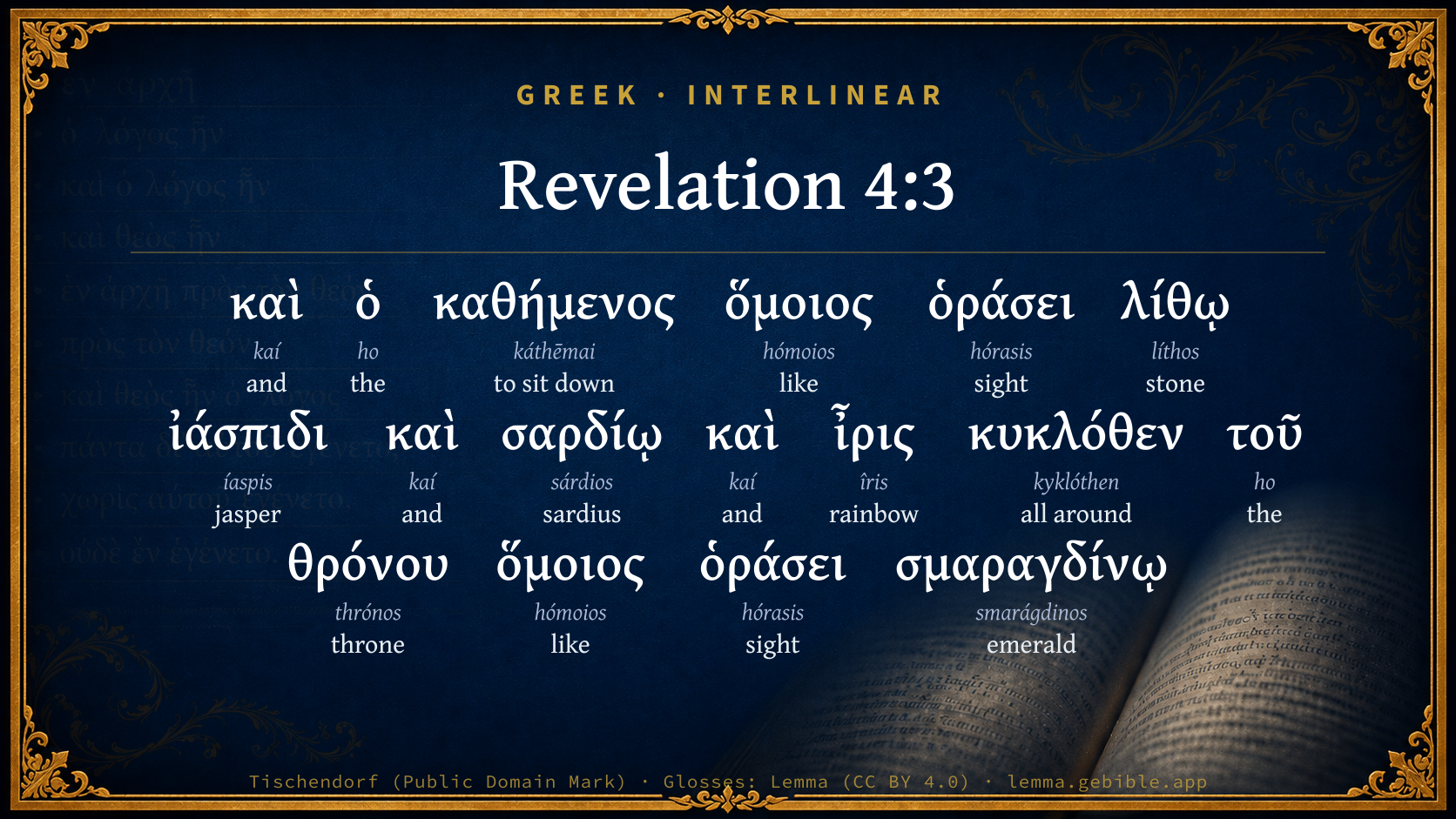
Download image
Cite this verse

Revelation 4:3 (World English Bible). Public Domain. Lemma interlinear Bible study tool, https://lemma.gebible.app/v/revelation/4/3.

Show BibTeX & RIS
BibTeX
RIS
English Translation
that looked like a jasper stone and a sardius. There was a rainbow around the throne, like an emerald to look at.
World English Bible · Public Domain
Highlights
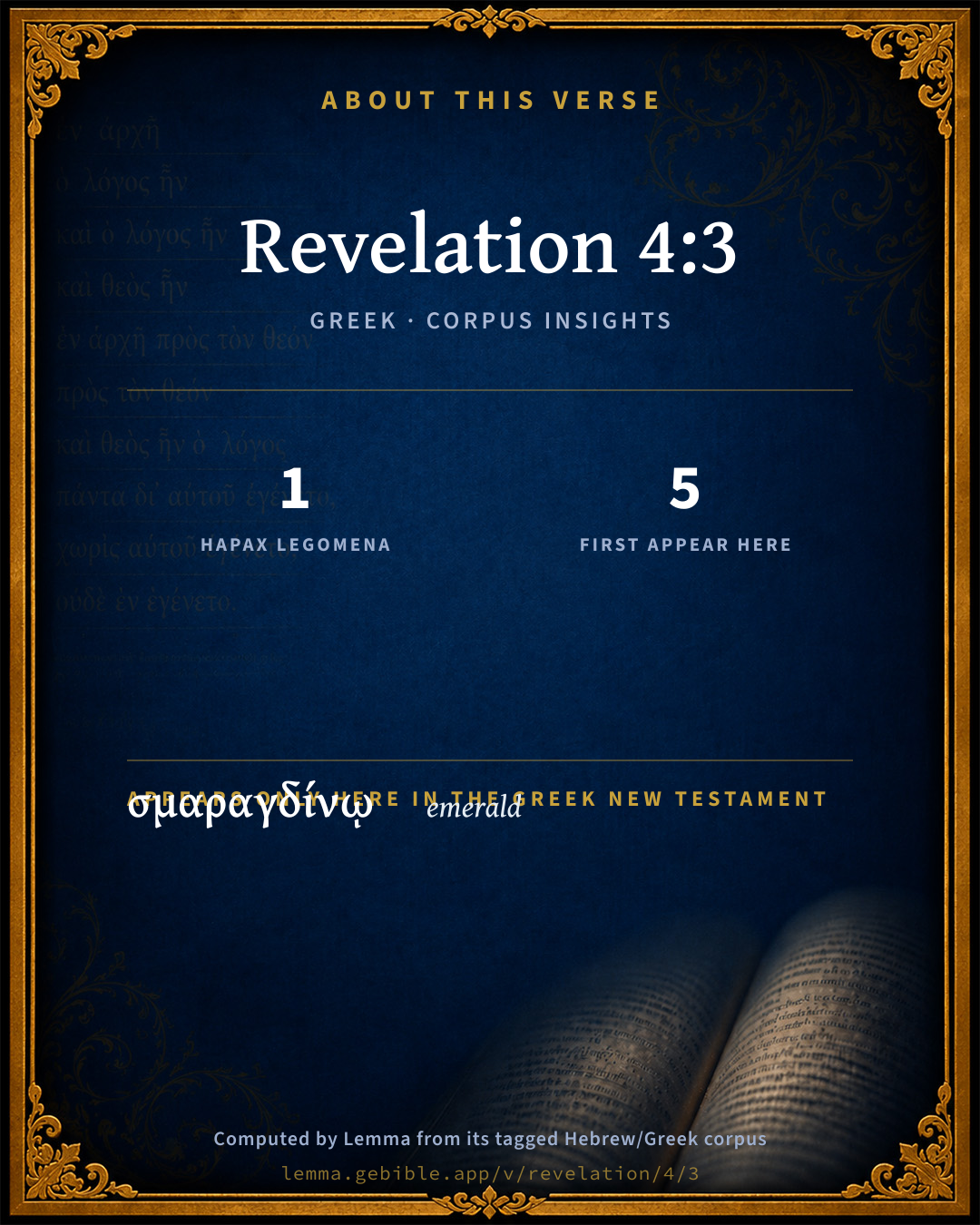
  • 1 hapax legomenon — only here in the Greek New Testament
  • 5 first appearances in the Greek New Testament
Full analysis ↓
Download a study sheet

One document with this verse’s original text, its word-by-word gloss line, the meaning frame, cross-references with their text, attributed commentary, and full source and license credits — printable, and it pastes into notes with its structure intact.

This verse Autodidact and up

Study sheet (.html) Plain text (.txt)

A passage Seminary Student

Up to 50 verses in one chapter. A passage sheet keeps up to 6 commentary sources and 12 cross-references per verse, in the order this page ranks them, and says so on the sheet whenever that leaves anything out. Ask for a single verse and you get the Autodidact verse sheet above.

Everything on this page stays free to read, with no account — the sheet is a download of what is already on screen, not access to it.

Want to remove ads? Support Godless Engineer
Compare translations 3

The same verse in 3 English versions, stacked beneath the original-language interlinear above. Click any original word for its lexicon entry.

Each is an independent rendering of the whole verse — the interlinear is not word-aligned to these translations.

Highlighted words mark where these versions differ — a whole-verse word diff, not a word-by-word alignment.

  • World English Bible Public Domain
    that looked like a jasper stone and a sardius. There was a rainbow around the throne, like an emerald to look at.
  • King James Version Public Domain
    And he that sat was to look upon like a jasper and a sardine stone: and there was a rainbow round about the throne, in sight like unto an emerald.
  • unfoldingWord Literal Text CC BY-SA 4.0
    And the one sitting like in appearance to a jasper stone and to a carnelian, and a rainbow around the throne, like in appearance to an emerald.

unfoldingWord Literal Text — © unfoldingWord, licensed CC BY-SA 4.0. Word-aligned USFM3 via Door43 (git.door43.org/unfoldingWord/en_ult).

Versions to compare (up to 4)

3 of 4 selected

Show all 19 translations

Every available English version of this verse, each an independent rendering of the whole verse.

  • World English Bible Public Domain
    that looked like a jasper stone and a sardius. There was a rainbow around the throne, like an emerald to look at.
  • Berean Standard Bible Public Domain
    The One seated there looked like jasper and carnelian, and a rainbow that gleamed like an emerald encircled the throne.
  • Majority Standard Bible Public Domain
    He looked like jasper and carnelian, and a rainbow that gleamed like an emerald encircled the throne.
  • King James Version Public Domain
    And he that sat was to look upon like a jasper and a sardine stone: and there was a rainbow round about the throne, in sight like unto an emerald.
  • American Standard Version (1901) Public Domain
    and he that sat `was' to look upon like a jasper stone and a sardius: and `there was' a rainbow round about the throne, like an emerald to look upon.
  • Revised Version (1885) Public Domain
    and he that sat was to look upon like a jasper stone and a sardius: and there was a rainbow round about the throne, like an emerald to look upon.
  • Geneva Bible (1599) Public Domain
    And he that sate, was to looke vpon, like vnto a iasper stone, and a sardine, and there was a rainbowe rounde about the throne, in sight like to an emeraude.
  • Douay-Rheims (1899) Public Domain
    And he that sat, was to the sight like the jasper and the sardine stone; and there was a rainbow round about the throne, in sight like unto an emerald.
  • Young's Literal Translation Public Domain
    and He who is sitting was in sight like a stone, jasper and sardine: and a rainbow was round the throne in sight like an emerald.
  • Literal Standard Version CC BY-SA 4.0
    and He who is sitting was in appearance like a stone, jasper and sardine: and a rainbow was around the throne in appearance like an emerald.
  • Unlocked Literal Bible CC BY-SA 4.0
    The one who was sitting on it looked like jasper and carnelian. There was a rainbow around the throne. The rainbow looked like an emerald.
  • unfoldingWord Literal Text CC BY-SA 4.0
    And the one sitting like in appearance to a jasper stone and to a carnelian, and a rainbow around the throne, like in appearance to an emerald.
  • Darby Bible Public Domain
    and he [that was] sitting like in appearance to a stone [of] jasper and a sardius, and a rainbow round the throne like in appearance to an emerald.
  • World Messianic Bible Public Domain
    that looked like a jasper stone and a sardius. There was a rainbow around the throne, like an emerald to look at.
  • Webster's Bible Public Domain
    And he that sat was in appearance like a jasper and a sardine stone: and there was a rainbow around the throne in sight like an emerald.
  • Free Bible Version CC BY-SA 4.0
    The one sitting there shone like jewels, like jasper and carnelian, and there was a rainbow that circled the throne, shining like an emerald.
  • Bible in Basic English Public Domain
    And to my eyes he was like a jasper and a sardius stone: and there was an arch of light round the high seat, like an emerald.
  • Text-Critical English NT CC BY 4.0
    like jasper and carnelian in appearance. And around the throne was a rainbow that looked like an emerald.
  • Tyndale New Testament (1534) Public Domain
    And he that sat was to loke apon like vnto a iaspar stone and a sardyne stone: And there was a rayne bowe aboute the seate in syght lyke to an Emeralde.

Literal Standard Version (2020), Covenant Press — licensed CC BY-SA 4.0. Text via the HelloAO Bible API (eBible.org). Unlocked Literal Bible (unfoldingWord) — licensed CC BY-SA 4.0. Text via the HelloAO Bible API (eBible.org). unfoldingWord Literal Text — © unfoldingWord, licensed CC BY-SA 4.0. Word-aligned USFM3 via Door43 (git.door43.org/unfoldingWord/en_ult). Free Bible Version, Dr. Jonathan Gallagher — licensed CC BY-SA 4.0. Text via the HelloAO Bible API (eBible.org).

Word by word

More ways to search: Search by grammar → Find every occurrence → Compare this word →

Practice this passage: Drill this verse → Learn its vocabulary →

σμαραγδίνῳ
smarágdinos
G4664
“emerald”
Adjective, Dative, Singular, Masculine
Part of Speech
Adjective
Case
Dative
Number
Singular
Gender
Masculine
Full Thayer's Definition

Origin: from G4665

TDNT: None

1. of emerald, made of emerald
  1. καὶ kaí G2532 “and” Conjunction
  2. ὁ ho G3588 “the” Article, Nominative, Singular, Masculine
  3. καθήμενος káthēmai G2521 “to sit down” Verb, Present, Middle or Passive deponent, Participle, Nominative, Singular, Masculine
  4. ὅμοιος hómoios G3664 “like” Adjective, Nominative, Singular, Masculine
  5. ὁράσει hórasis G3706 “sight” Noun, Dative, Singular, Feminine
  6. λίθῳ líthos G3037 “stone” Noun, Dative, Singular, Masculine
  7. ἰάσπιδι íaspis G2393 “jasper” Noun, Dative, Singular, Feminine
  8. καὶ kaí G2532 “and” Conjunction
  9. σαρδίῳ sárdios G4556 “sardius” Noun, Dative, Singular, Neuter
  10. καὶ kaí G2532 “and” Conjunction
  11. ἶρις îris G2463 “rainbow” Noun, Nominative, Singular, Feminine
  12. κυκλόθεν kyklóthen G2943 “all around” Adverb
  13. τοῦ ho G3588 “the” Article, Genitive, Singular, Masculine
  14. θρόνου thrónos G2362 “throne” Noun, Genitive, Singular, Masculine
  15. ὅμοιος hómoios G3664 “like” Adjective, Nominative, Singular, Masculine
  16. ὁράσει hórasis G3706 “sight” Noun, Dative, Singular, Feminine

About this verse

These counts appear in no published source. They are computed here, from the morphology-tagged text and Lemma’s own curated glosses. What Lemma adds →

17
words
12
distinct lemmas
Revelation
section

Notable vocabulary

1 hapax legomenon — a word that appears only here in the entire Greek New Testament:

  • σμαραγδίνῳ emerald G4664

First appearance in Scripture

These words make their first canonical appearance in the Greek New Testament here:

  • ἰάσπιδι jasper G2393
  • σαρδίῳ sardius G4556
  • ἶρις rainbow G2463
  • κυκλόθεν all around G2943
  • σμαραγδίνῳ emerald G4664

Shared distinctive vocabulary

σαρδίῳ sardius G4556 occurs in 2 verses of the Greek New Testament. Also found in:
Repetition

Words recur within this verse:

  • ὅμοιος like G3664 ×2
  • ὁράσει sight G3706 ×2
  • καὶ and G2532 ×3
  • ὁ the G3588 ×2

Cross-references

11

Topical passages linked to Revelation 4:3 in the Treasury of Scripture Knowledge — connected by theme and wording, ordered by reader-vote popularity; previews shown in the World English Bible.

  • Ezekiel 1:28 As the appearance of the bow that is in the cloud in the day of rain, so was the appearance of the brightness round about. This was the appearance of the likeness of the glory of Yahweh. When I saw it, I fell on my face, and I heard a voice of one that spoke.
  • Genesis 9:13–16 I set my rainbow in the cloud, and it will be for a sign of a covenant between me and the earth.
  • Revelation 21:11 having the glory of God. Her light was like a most precious stone, as if it was a jasper stone, clear as crystal;
  • Revelation 10:1 I saw a mighty angel coming down out of the sky, clothed with a cloud. A rainbow was on his head. His face was like the sun, and his feet like pillars of fire.
  • Ezekiel 28:13 You were in Eden, the garden of God; every precious stone adorned you: ruby, topaz, emerald, chrysolite, onx, jasper, sapphire, turquoise, and beryl. Gold work of tambourines and of pipes was in you. In the day that you were created they were prepared.
  • Ezekiel 1:26 Above the expanse that was over their heads was the likeness of a throne, as the appearance of a sapphire stone; and on the likeness of the throne was a likeness as the appearance of a man on it above.
  • Revelation 21:19–20 The foundations of the city's wall were adorned with all kinds of precious stones. The first foundation was jasper; the second, sapphire; the third, chalcedony; the fourth, emerald;
  • Exodus 24:10 They saw the God of Israel. Under his feet was like a paved work of sapphire stone, like the skies for clearness.
  • Exodus 39:11 and the second row, a turquoise, a sapphire, and an emerald;
  • Exodus 28:18 and the second row a turquoise, a sapphire, and an emerald;
  • Isaiah 54:9–10 For this is [as] the waters of Noah to me; for as I have sworn that the waters of Noah shall no more go over the earth, so have I sworn that I will not be angry with you, nor rebuke you.

Cross-references courtesy of OpenBible.info (CC BY 4.0).

Commentary

Notes on Revelation 4:3 from classic Christian and Jewish commentators (each source and its license shown beneath its notes). The classic Christian expositions comment on the surrounding passage and are grouped to its opening verse, so a note may address several verses; the Jewish commentaries on the Tanakh (Rashi and others) are per-verse, so they appear only where the commentator wrote on this verse.

Lemma curates 59 commentaries, every one of them public domain or Creative Commons licensed, each selected and text-cleaned for this edition rather than reprinted as found. About our sources →

Joseph Benson's Commentary

Rev 4:3. He that sat was to look upon like a jasper — Shone with a visible lustre, like that of sparkling precious stones, such as those which were of old on the high-priest’s breast-plate, and those placed as the foundations of the New Jerusalem, Rev 21:19-20. If there be any thing emblematical in the colours of these stones, possibly the jasper (one species, at least, of which, according to Pliny, is milky white, and according to Daubuz, of a white and bright shining colour) might be a symbol of God’s purity, with various other perfections which shine in all his dispensations. The sardine-stone, of a blood-red colour, or with white and red strata, may be an emblem of his justice, and of the vengeance he was about to execute on his enemies. An emerald, being green, may betoken favour to the penitent and pious; and the rainbow, of an emerald colour, was undoubtedly intended to express the everlasting covenant of grace and peace, of which the rainbow was to Noah an appointed token. And this rainbow, being round about the whole breadth of the throne, fixed the distance of those who stood or sat round it.

Joseph Benson's Commentary on the Old and New Testaments (1811–1818) — public domain. Text from a community e-Sword module.

Tyndale Open Study Notes

Tyndale Open Resources

4:3 Rather than painting a visual picture of God (Exod 20:4; Deut 4:15-19), John uses gemstones and the rainbow (Gen 9:8-17; Ezek 1:28) to suggest God’s qualities. The rainbow speaks of God’s grace as it recalls God’s covenant with Noah (Gen 9:13-17) that he would never again destroy the earth with water. In Revelation, however, we see the earth destroyed by fire (cp. Gen 19:24-29).

Tyndale Open Study Notes — © Tyndale Open Resources, licensed CC BY-SA 4.0. Text via the HelloAO Bible API.

Bengel's Gnomon

Johann Albrecht Bengel

Rev 4:3. Ἰάσπιδι, a jasper) While the Sardine stone is of a fiery colour, and resembles the appearance of blood, the Jasper expresses a WHITISH red.—Lampe on this passage.—σαρδίῳ) Erasmus, with the inferior Latin editions, have σαρδίνῳ: the others correctly, σαρδίῳ. Λίθῳ ἰάσπιδι καὶ σαρδίῳ are substantives: comp. ch. Rev 21:20; but σμαραγδίνῳ (ὁράσει) is an adjective, and of the feminine gender also, from which, in consequence of the rhythm, that word σαρδίνῳ was interpolated unawares by the copyist, although Wolf thinks that the termination σαρδίνῳ is confirmed by the word σμαραγδίνῳ.[57]

[57] AB read σαρδίῳ: Rec. Text, without good authority, σαρδίνῳ—E.

Bengel's Gnomon of the New Testament — English translation (T&T Clark, Edinburgh, 1860) — public domain. Text from a community e-Sword module.

Meyer's Critical & Exegetical Commentary

Heinrich August Wilhelm Meyer

Rev_4:3. ὁράσει. Dative of manner:[1686] in appearance, cf. Ἡ ὌΨΙς, Κ.Τ.Λ., Rev_1:16, and the Ὡς ὍΡΑΣΙς with the following gen. of the object compared in the LXX. Eze_1:4; Eze_1:26 sqq., Rev_8:2.

ΛΊΘῼ ἸΆΣΠΙΔΙ ΚΑῚ ΣΑΡΔΊΩ. The ΣΆΡΔΙΟς[1687] is, as the Heb. name indicates, a red,[1688] particularly flesh-colored gem, our carnelian. Ebrard understands by it the dazzling ruby.

More difficult is the determination of the ἴασπις. The LXX. thus render the Heb. יָֽשְׁפֶה;[1689] yet in this passage, as well as also in Rev_21:11, where the ἴασπις is designated as λίθος τιμιώτατος, and κρυσταλλίζων, it is scarcely possible to think of the not very costly and not transparent, sometimes greenish, sometimes reddish gem, which the Romans called, as we also call it, jasper. Cf. Pliny:[1690] A gem, which, although surpassed by many, yet retains the glory of antiquity. Nevertheless, the most of the expositors adhere firmly to the simple expression. Andr., Areth., N. de Lyra, Aretius, etc., think of the green jasper, and understand it, just as the emerald mentioned immediately afterwards, as a symbol of divine consolation, since green is agreeable to the eye.[1691] A symbolical reference has been discovered even to baptism,[1692] and the judgment of the flood;[1693] for the red sardius denotes the final judgment in fire. Others think of the red jasper, as they either regard it, like the sardius, a symbol of the divine anger,[1694] or, without any such significance,[1695] as only a description of the dazzling appearance of God. Beng., Stern., Hengstenb.,[1696] presuppose a white, crystal-clear species of jasper, and find in this color the image of the divine holiness and unclouded glory. This sense of the brightness of color is indicated partly by emblematic descriptions, as Eze_1:4; Eze_8:2; Dan_7:9 sq.; and partly by parallels, as Rev_1:14 sqq., Rev_10:1.[1697] The brilliancy of light and fire is, in Ezekiel; the appearance of God. In Daniel, also, the bright white raiment and the dazzling white hair of the Ancient of days belong with the fire of his throne; for both the holy glory and the consuming anger of God[1698] must be represented. Upon the same view depends the description of the Lord,[1699] and of the angel, who in Rev_10:1 appears invested with divine attributes, while, e.g., Rev_4:4, Rev_7:9, the heavenly beings, because they have attained to a holiness and glory like that of God, appear indeed in white garments, yet not also with the fiery signs of divine judgment, but with crowns and palms. If now the red appearance of the σάρδιος recalls the ardor of the divine wrathful judgment, we expect the ἴασπις to represent the bright light, which elsewhere is displayed along with the divine glimmering of fire, in a different way. But now the very bright or crystal-clear jasper, stated by Beng. and Hengstenb., does not actually exist. Hence we must believe, either that John imagined an ideal kind of jasper,[1700] or, as is more probable, because of Rev_21:11, that by the ἴασπις he wished to designate the diamond.[1701] The LXX., in whose vocabulary John was instructed, do not have the term ἀδάμας.[1702] The Heb. שָׁמִיר, which probably designates the diamond, is not accurately translated by the LXX. in Zec_7:12; Eze_3:9.[1703] It is, besides, to be observed, that the LXX. render not only יָֽשְׂפֵה, but also כַדְכֹּד, Isa_54:12,[1704] by ἼΑΣΠΙς. But if the description (Rev_4:3) depends upon Eze_8:2 and similar passages, it yet in no way follows that here, as there,[1705] the brilliancy of the two gems is to be regarded as different parts of the form of God,the bright light of the jasper above, the red appearance of the sardius beneath:[1706] rather, the double brilliancy of the two stones shining through one another[1707] is to be regarded a profound designation of the essential unity of the holiness and righteousness of God. The free treatment of the ancient prophetic view expresses, as to the subject itself portrayed, a deepening of the thought; while the beauty of the likeness gains rather than loses, as the divine appearance to John maintains a pictorial unity. The entire form of the enthroned one appears in the twofold, yet united, brilliancy of the jasper and the sardius, just as the entire form of the Lord was in appearance like intense light of the sun.[1708]

ΚΑῚ ἾΡΙς ΚΥΚΛΌΘΕΝ ΤΟῦ ΘΡΌΝΟΥ ὍΜΟΙΟς ὈΡΆΣΕΙ ΣΜΑΡΑΓΔΊΝῼ. Concerning ὍΜΟΙΟς as an adjective of two terminations, cf. Winer, p. 66.

Against the wording (ΚΥΚΛ. Τ. ΘΡΌΝΟΥ) is the idea of Vitr., that the ἸΡΙς surrounded the head of the one enthroned like a crown;[1709] Beng. and Hengstenb. unnaturally and unfairly regard the ἿΡΙς as surrounding the throne in breadth horizontally.

Hengstenb. infers, besides, from the formula ΚΥΚΛ. Τ. ΘΡ. recurring from Rev_4:4, that also the thrones of the elders appear within the ἹΡΙς; but it is the only natural and, in a pictorial respect, conceivable way, to regard the ἾΡΙς as surrounding the shining form upon the throne on high.[1710]

Without any basis is the controversy as to whether the ἾΡΙς were a rainbow,[1711] or a bow;[1712] nor does it in any way correspond to the poetical character of the description, if, in order to explain the rainbow, mention is made of Gods appearing, Psa_18:12; Psa_104:3, surrounded by darkness of rain and thick clouds,[1713] or that the green color here named is only the principal color,[1714] as the hues of the jasper and sardius are regarded as combined with the brilliancy of the emerald, attributed to the ἸΡΙς, in order to bring out the three chief colors of one common rainbow. What John saw about the throne had the form of a rainbow,hence he says ἸΡΙς,although not the seven colors of an actual rainbow are represented, but only the emerald green. Yet this ἿΡΙς in itself, and the emerald appearance especially,[1715] are not without symbolical significance, possibly in a mere optical contrast with the blending brilliancy of the jasper and sardius;[1716] but in symmetry with the symbolical significance of this twofold brilliancy, the mild emerald-green of the bow, which is already in itself the clear sign of divine grace,[1717] notes the gentle and quickening nature of this grace.[1718] But it follows neither from the gen., nor from the pragmatism of this passage, that the grace recurring after the divine punishments[1719] is described; it would be more correctly interpreted with Grot.: God in his judgments is always mindful of his covenant. Yet we dare not precipitately limit the description here presented, in its particular connections, to the judgments of God in their relation to divine grace which are to be beheld only later: it is sufficient that here where the eternal and personal foundation of all that follows is portrayed, the holy glory and righteousness of God appear in most intimate union with his immutable and kind grace, so that thus the entire impending development of the kingdom of God and the world unto its last end, as it is determined by that wonderful, indivisible nature of the holy, just, and gracious God, as well in its course as in its goal, must correspond to this threefold glory of the living God. Consequently this fundamental vision contains every thing that serves the terror of enemies, and the consolation of friends, of the one enthroned.

[1686] Erasm.

[1687] Rev_21:20. Cf. Eze_28:17; Eze_39:10; LXX. for אדֶס.

[1688] πυρωπὸς τῷ εἴδει καὶ αἰματοειδής (fiery in appearance, and blood-red), Epiphanius in Vitr.

[1689] Exo_28:20; Exo_39:13; Eze_28:13.

[1690] N. H., xxxvii. 37.

[1691] N. de Lyra, etc.

[1692] Aret.

[1693] Victorin, Ticon., Primas, Beda.

[1694] Vitr.

[1695] Ew., De Wette, Ebrard.

[1696] Cf. also Ew. ii.

[1697] Cf. Hengstenb.

[1698] Cf. also Deu_4:24.

[1699] Rev_1:14 sqq.

[1700] Cf. Rev_21:21.

[1701] Ebrard.

[1702] Yet, at the time of John, the ἀδάμας was not unknown. Cf. Plin., H. N., xxxvii. Revelation 15 : Among human things, not only among gems, the adamas, known only to kings, and these very few, had the greatest value.Now six kinds of it are known: That of India, of a resemblance to crystal, since, also, it does not differ in translucency; the Cyprian, verging to the color of brass.

[1703] Jer_17:1 is lacking in the LXX.

[1704] i.e., the probable ruby,

[1705] Cf. also Rev_10:1.

[1706] Züll., Hengstenb.

[1707] Ebrard.

[1708] Rev_1:16.

[1709] Cf. Rev_10:1.

[1710] Ebrard, and my exp.

[1711] So translated by most.

[1712] Ebrard.

[1713] De Wette.

[1714] Grot., Eichh., Stern, Hengstenb., etc.

[1715] Cf. Plin., N. H., xxxvii. Revelation 5 : Nay, even from another intention, the dimmed sight is refreshed by the sight of the emerald; and, to those cutting gems, there is no more grateful treat to the eyes, than thus to soothe their weariness by its green mildness.

[1716] Ebrard. Cf. Ew., De Wette.

[1717] Gen_9:12 sqq.

[1718] Cf. N. de Lyra, Aret., Grot., Calov., Beng., Herd., Hengstenb., etc. [On the spiritual significance of the rainbow, see the beautiful poem of Carl Gerock, In his Die Symphonie der Farben of his Der letzte Strauss, 1885.]

[1719] Stern, Hengstenb.

Meyer — Critical and Exegetical Commentary on the New Testament — English translation by Peter Christie, edited by Frederick Crombie (T&T Clark, 1880) — public domain. Text from a community e-Sword module.

Expositor's Greek Testament

ed. W. Robertson Nicoll

Rev 4:3 . The sources of the general conception lie far back in passages like Isa 6:1 f., Eze 1:26 f., Dan 7:9 f., Enoch xxxix., xl., xlvi., mediated by rabbinical interpretations. But it should be noted that in the palace-temple of Hatra, the Parthian capital, one well-known frieze contained a row of figures including the griffin, the eagle, the human face, the head of an ox, and an emblem on the cornice apparently representing the sun. With a sublime restraint, the author leaves the royal presence undefined, though he is more definite and explicit on the whole than (say) Ezekiel. The latter’s advance in this respect upon his predecessors was explained by the rabbis ( cf. Streane’s Chagiga , p. 73) as a needful counteractive to the Jewish belief that visions were impossible outside Canaan, and as a help to men of the captivity who needed “special details to support them in their trials” ( cf. above, Rev 1:9 f.). The σάρδιον , a flesh-coloures, semi-transparent, often golden or ruddy gem, answers to our red jasper or cornelian, so-called perhaps from Sardis, whence the stone was originally exported, ὅμοιος , adj. only here with two terminations. “The striking simile ὅμ . ὁρ . λ . ἰ . κ . σ . recalls the portrait statues of Roman emperors and others, in which the raiment is worked out in hard-coloures stones a fashion introduced in the last years of the republic from Ptolemaic Egypt” (Myres, E. Bi. , 4812). ἶρις . The nimbus or halo round the throne is green, σμ . ( cf. Deissm. 267) being malachite or more probably an emerald (Rev 21:19 ), to which the ancients attributed a talismanic power of warding off evil spirits. “Thou hast made heaven and earth bright with thy rays of pure emerald light” (hymn to Ra, E. B. D. 8). The. rabbis ( Chagiga , 16 a ) discouraged any study of the rainbow, as it symbolised the glory of God. As the symbol of God’s covenant, it may be here a foil to the forbidding awe of Rev 4:5 a (which develops 3 a , as 5 b develops 3 b 4); “Deus in judiciis semper meminit foederis sui” (Grotius.) But, like the parabolic details of Jesus, these traits are mainly descriptive. The association of jasper, sardius, and emerald is a genuinely Hellenic touch: cf. Phaedo , 110, where Plato describes the real earth under the heavens of paradise as a place where in perfection lie such things as exist here but in fragmentary beauty for example, the pebbles esteemed here, σάρδιά τε καὶ ἰάσπιδας καὶ σμαράγδους . Flinders Petrie, taking σμ . as rock-crystal, argues that the rainbow here is of the prismatic colour which a hexagonal prism of that colourless stone would throw (Hastings, D. B. iv. 620).

The Expositor's Greek Testament, edited by W. Robertson Nicoll (1897–1910) — public domain. Text from a community e-Sword module.

Geneva Bible (1599)

Geneva Bible translators

By his nature, in that he is the Father, most glorious in his own person, and with his glory overshining all other things.

Geneva Bible (1599) marginal notes — public domain. Text via Bolls.life.

Jamieson, Fausset & Brown

Robert Jamieson, A. R. Fausset & David Brown

was--omitted in the two oldest manuscripts but supported by Vulgate and Coptic.

to look upon--Greek, "in sight," or "appearance."

jasper--From Rev 21:11, where it is called most precious, which the jasper was not, EBRARD infers it was a diamond. Ordinarily, the jasper is a stone of various wavy colors, somewhat transparent: in Rev 21:11 it represents watery crystalline brightness. The sardine, our cornelian, or else a fiery red. As the watery brightness represents God's holiness, so the fiery red His justice executing fiery wrath. The same union of white or watery brightness and fiery redness appears in Rev 1:14; Rev 10:1; Eze 1:4; Eze 8:2; Dan 7:9.

rainbow round about the throne--forming a complete circle (type of God's perfection and eternity: not a half circle as the earthly rainbow) surrounding the throne vertically. Its various colors, which combined form one pure solar ray, symbolize the varied aspects of God's providential dealings uniting in one harmonious whole. Here, however, the predominating color among the prismatic colors is green, the most refreshing of colors to look upon, and so symbolizing God's consolatory promises in Christ to His people amidst judgments on His foes. Moreover, the rainbow was the appointed token of God's covenant with all flesh, and His people in particular. Hereby God in type renewed to man the grant originally made to the first Adam. The antitype will be the "new heavens and the new earth" restored to redeemed man, just as the earth, after the destruction by the flood, was restored to Noah. As the rainbow was first reflected on the waters of the world's ruin, and continues to be seen only when a cloud is brought over the earth, so another deluge, namely, of fire, shall precede the new heavens and earth: the Lord, as here, on His throne, whence (Rev 4:5) proceed "lightnings and thunderings," shall issue the commission to rid the earth of its oppressors: but then, amidst judgment, when other men's hearts fail them for fear, the believer shall be reassured by the rainbow, the covenant token, round the throne (compare DE BURGH, Exposition of Revelation). The heavenly bow speaks of the shipwreck of the world through sin: it speaks also of calm and sunshine after the storm. The cloud is the regular token of God's and Christ's presence, for example, in the tabernacle's holiest place; on Mount Sinai at the giving of the law; at the ascension (Act 1:9); at His coming again (Rev 4:7).

Jamieson, Fausset & Brown — Commentary Critical and Explanatory on the Whole Bible (1871) — public domain (CC PDM 1.0). Text via the HelloAO Bible API.

Adam Clarke's Commentary

Verse 3. And he that sat] There is here no description of the Divine Being, so as to point out any similitude, shape, or dimensions. The description rather aims to point out the surrounding glory and effulgence than the person of the almighty King. See a similar description Nu 24:10, &c., and the notes there.

Adam Clarke's Commentary on the Bible (1810–1826) — public domain. Text from a community e-Sword/MySword module.

Ellicott's Commentary for English Readers

(3) And he that sat was to look upon like a jasper and a sardine stone.—In determining the significance of these emblems we must be guided partly by the analogy of Bible imagery elsewhere, and partly by our knowledge of precious stones. The sardian, or sardine, is admitted to be a stone of fiery red colour; the emerald, to which the bow round the throne is compared, is almost certainly a bright green; the hue of the jasper is the difficulty. The jasper—the last stone in the high-priest’s breastplate, and first of the twelve foundations of the New Jerusalem (Exo_28:20, and Rev_21:19)—is described by the best authorities as a dark, opaque green. Such a colour is quite in harmony with the colours of the other stones in the breastplate, and particularly with the foundation stones, which seem to be arranged in shades of colour (see Notes on Rev_21:19 et seq.); but the dark opaque green would be an ill combination with the red sardius and the green emerald in the vision of the present chapter. Is there no further light? We have a jasper stone spoken of in Rev_21:11; Rev_21:18, with the descriptive phrase, “clear as crystal!” Does not this point to a stone somewhat different in appearance from that spoken of simply as jasper? Such a clear crystal stone would be the most natural companion to the sardine, and the combination of the sparkling brightness and fiery red suits the union of brightness and flame which appears elsewhere in the Bible (comp, Rev_1:14; Rev_11:1; Eze_1:4; Eze_8:2; Dan_7:9), and is best understood of the holiness and righteousness of God. The latter half of this verse shows us these surrounded by the emerald-coloured bow, the evident symbol of the divine mercy. The allusion to the bow in the cloud (Gen_9:12-16) is obvious; the bow completely encircled the throne, as mercy encompassing judgment. It was a covenant token, bearing witness to God’s faithfulness in dark times, God’s care for the ark of His Church, and His mercy shining forth after storm.

A Bible Commentary for English Readers, edited by Charles John Ellicott (1878–1897) — public domain. Text from a community e-Sword module.

The Cambridge Bible for Schools and Colleges

gen. ed. J. J. S. Perowne

3. a jasper and a sardine stone] Our jasper, a stone the colour of which varies between red, green and yellow, does not seem very appropriate to the image here, nor to answer to the description in Rev_21:11, as it is not sparkling nor transparent. But it seems proved that the jasper of the ancients (the word is substantially the same in Hebrew, in Greek and Latin, and in modern languages) was the translucent stone now known as Chalcedony—especially the green variety. The sardius (so we should read) is certainly the choicest kind of red carnelian, translucent and fiery in colour, but not exactly sparkling.

round about the throne] i.e. forming an arch over it.

in sight] The word is the same as “to look upon” just before, though the construction is somewhat varied.

like unto an emerald] Here there is no doubt what stone is meant: we have only the question whether the rainbow was all green, or only produced the same effect on the eye as an emerald—brilliant yet not dazzling. The ancients felt very strongly the relief given to the eye by looking at it. The rainbow in any case no doubt represents God’s revelation by a covenant of grace, Gen_9:13 sqq.

The Cambridge Bible for Schools and Colleges (gen. ed. J. J. S. Perowne; Cambridge University Press, 1878–1918) — public domain. Text from a community e-Sword module.

John Gill's Exposition

And he that sat was to look upon like a jasper,.... For the brightness, glory, and majesty of his countenance, and for his being light itself, clothed with it, and dwelling in it; see Rev 21:11; and for the various perfections of his nature, as eternity, infinity, immutability, omniscience, omnipotence, omnipresence, wisdom, power, goodness, truth, love, grace, and mercy; for the jasper, at least one sort of them, is of various colours, and spotted with divers spots; that which is most valued is the green, spotted with red or purple (h): hence this stone, which is the twelfth in the high priest's breastplate, and on which the name of "Benjamin" was written, is called, by the Chaldee paraphrase of Onkelos on Exo 28:20, "Pantere", and of ben Uzziel, on the same place, "Apanturin", and on Sol 5:14, "Apantor", because some are variegated and spotted like panthers.

And a sardine stone; the same with the "Sardius": and so read here the Alexandrian copy, the Syriac and Arabic versions, as in Rev 21:20, and in Exo 28:17 on which Reuben's name was written; this is of a red, or blood colour as its name in Hebrew, shows, and the same that is called a cornelian; and is expressive of the fiery indignation of God whose fury is poured out like fire, and who nakedly and absolutely considered, is a consuming fire to the wicked, his enemies, and the enemies of his church and people. Some jaspers being white and sky coloured and the white colour being most agreeable to deity, as Cicero says (i), and the sardine being red, and a gem of the ruby kind make up the description of the church's beloved; Sol 5:10; and may denote in general his purity, glory, and excellency, and in particular good will to his people, and wrath to his enemies. And to the comfort of the former it is added,

and there was a rainbow round about the throne; which signifies the covenant of grace; see Gen 9:12. The rainbow is a reverberation, or a reflection of the beams of the sun upon a thin watery cloud; and the covenant of grace is owing to Jesus Christ, the sun of righteousness; it is he that has formed it, and filled it with blessings and promises; he is the Mediator, surety, and messenger of it, and who in Rev 10:1 is represented as clothed with a cloud, and a rainbow on his head: the rainbow is of, various colours and fitly expresses the various promises and blessings, in the covenant of grace, and the various providences, both prosperous and adverse, with respect to soul and body; and as the rainbow was an emblem of mercy, peace, and reconciliation in God to man, after he had destroyed the world by a flood, so the covenant is a covenant of grace and mercy; it springs from it, and is full of it, and provides for the peace and reconciliation of the people of God, by the blood of Christ; whence it is called a covenant of peace: and as the rainbow is a security to the world, and the inhabitants of it, from a destruction by a flood any more, so the covenant is a security to those who are interested in it, from eternal destruction, and wrath to come; herein lies all their salvation, and this is the security of it: to which may be added, that God calls it my bow, as he often calls the covenant of grace my covenant, in distinction from man's; see Gen 9:12; and this being round about the throne of God, shows that the covenant of grace does, as it were, include and enclose God in his persons, and in his perfections; all the three divine Persons have a concern in it, and all the divine perfections are glorified by it; and it being around it, it is always in his view; he is ever mindful of it, and constantly remembers it for the good of his people, and faithfully keeps it; and it being in this form denotes, that in whatsoever way he comes forth unto his people, it is always in a covenant way, whether it be in things temporal or spiritual, in adversity or prosperity, with regard to the things of time and eternity; nor is there any coming to him with comfort, but as he is encompassed with the rainbow of the covenant; stripped of this, he is like the jasper and sardine stones, full of sparkling majesty, dread and terror, so that there is no coming nigh him; but being encircled with the rainbow, he may be approached as a covenant God, as the God of all grace, seated on a throne of grace, whither believers may come with boldness, freedom, and cheerfulness: and this rainbow was

in sight like unto an emerald; the stone on which Judah's name was written, in the high priest's breastplate; this is of a green colour, which colour is the prevailing one in the rainbow; it is of an exceeding fine green, very delightful to the eye, and gives pleasure to the mind to look upon it: and what a lovely and delightful sight is the covenant of grace to a believer! to see God as a covenant God, Christ as the Mediator of it, the exceeding great and precious promises and blessings, both of grace and glory, which are in it, yields an unspeakable pleasure to such persons; the covenant of grace, like the emerald, is ever green, it is always new; its promises and blessings are always fresh, and, like that, it is durable; it is sure, and cannot be broken, and is more immovable than rocks and mountains: the emerald is very bright, clear, and transparent; it is reported of Nero (k), that he could see in his emerald the combat of the gladiators in the theatre; in the covenant of grace, as in a glass, may be seen the glory of all the three Persons in the Godhead, for it is ordered in all things for the glory of each Person; as also all the perfections of the divine nature; here God appears abundant in goodness and truth; here mercy and truth meet together; and righteousness and peace kiss each other: to which may be added, that the emerald is said (l) to help and refresh the memory; now though God stands in no need of any thing to bring things to his remembrance, yet such is his condescension to men, that he sets the rainbow in the cloud, to look at, that he might remember his everlasting covenant; and so he allows his people to put him in remembrance, by making mention of the covenant of grace, and pleading the promises of it. The Alexandrian copy and the Ethiopic version, instead of "a rainbow", read "priests".

(h) Albert. Magn. de Reb. Metall. l. 2. c. 8. Ruaeus de Gemmis, l. 2. c. 1. (i) De Legibus, l. 2. (k) Ruaeus de Gemmis, l. 2. c. 4. (l) Ruaeus, ib. & Albert. Magn. de Reb. Metall. l. 2. c. 17.

John Gill's Exposition of the Whole Bible (1746–1763) — public domain (CC PDM 1.0). Text via the HelloAO Bible API.

Trapp's Complete Commentary

John Trapp

3 And he that sat was to look upon like a jasper and a sardine stone: and there was a rainbow round about the throne, in sight like unto an emerald.

Ver. 3. Like a jasper and a sardine] God is here resembled (saith Mr Cotton) by three precious stones, holding forth the three persons in Trinity. A jasper having (as they say) a white circle round about it, representing the eternity of the Father. A sardine stone of a fleshy colour representing Jesus Christ, who took our flesh upon him. An emerald, being of a green colour, refreshing the eyes of them that look upon it, representing the Spirit, who is (as the rainbow) a token of fair weather, and is a comfortable refresher, wheresoever he cometh.

And there was a rainbow] Which is signum gratiae et foederis, a sign of grace and of the covenant of mercy, which is always fresh and green about Christ’s throne of grace.

John Trapp, A Commentary or Exposition upon All the Books of the Old and New Testament (1647–1656) — public domain. Text from a community e-Sword module.

Albert Barnes' Notes on the Bible

And he that sat was to look upon - Was in appearance; or, as I looked upon him, this seemed to be his appearance. He does not describe his form, but his splendor.

Like a jasper - ἰάσπιδι iaspidi The jasper, properly, is “an opaque, impure variety of quartz, of red, yellow, and also of some dull colors, breaking with a smooth surface. It admits of a high polish, and is used for vases, seals, snuff-boxes, etc. When the colors are in stripes or bands, it is called striped jasper” (Dana, in Webster’s Dictionary). The color here is not designated, whether red or yellow. As the red was, however, the common color worn by princes, it is probable that that was the color that appeared, and that John means to say that he appeared like a prince in his royal robes. Compare Isa 6:1.

And a sardine stone - σαρδίῳ sardiō This denotes a precious stone of a bloodred, or sometimes of a flesh-color, more commonly known by the name of carnelian (Robinson’s Lexicon). Thus, it corresponds with the jasper, and this is only an additional circumstance to convey the exact idea in the mind of John, that the appearance of him who sat on the throne was that of a prince in his scarlet robes. This is all the description which he gives of his appearance; and this is:

(a)Entirely appropriate, as it suggests the idea of a prince or a monarch; and,

(b)It is well adapted to impress the mind with a sense of the majesty of Him who cannot be described, and of whom no image should be attempted. Compare Deu 4:12; “Ye heard the voice of the words, but saw no similitude.”

And there was a rainbow round about the throne - This is a beautiful image, and was probably designed to be emblematical as well as beautiful. The previous representation is that of majesty and splendor; this is adapted to temper the majesty of the representation. The rainbow has always, from its own nature, and from its associations, been an emblem of peace. It appears on the cloud as the storm passes away. It contrasts beautifully with the tempest that has just been raging. It is seen as the rays of the sun again appear clothing all things with beauty - the more beautiful from the fact that the storm has come, and that the rain has fallen. If the rain has been gentle, nature smiles serenely, and the leaves and flowers refreshed appear clothed with new beauty: if the storm has raged violently, the appearance of the rainbow is a pledge that the war of the elements has ceased, and that God smiles again upon the earth. It reminds us, too, of the “covenant” when God did “set his bow in the cloud,” and solemnly promised that the earth should no more be destroyed by a flood, Gen 9:9-16. The appearance of the rainbow, therefore, around the throne, was a beautiful emblem of the mercy of God, and of the peace that was to pervade the world as the result of the events that were to be disclosed to the vision of John. True, there were lightnings and thunderings and voices, but there the bow abode calmly above them all, assuring him that there was to be mercy and peace.

In sight like unto an emerald - The emerald is green, and this color so predominated in the bow that it seemed to be made of this species of precious stone. The modified and mild color of green appears to everyone to predominate in the rainbow. Ezekiel (Eze 1:28) has introduced the image of the rainbow, also, in his description of the vision that appeared to him, though not as calmly encircling the throne, but as descriptive of the general appearance of the scene. “As is the appearance of the bow that is on the cloud in the day of rain, so was the appearance of the brightness round about.” Milton, also, has introduced it, but it is also as a part of the coloring of the throne:

“Over their heads a crystal firmament,

Whereon a sapphire throne, inlaid with pure.

Amber, and colors of the showery arch.”

- Paradise Lost, b. vii.

Albert Barnes' Notes on the Bible (1834–1885) — public domain. Text from a community e-Sword/MySword module.

Haydock's Catholic Bible Commentary

And he....was to the sight like the jasper,[1] or had the appearance of jaspers, as to the colours with which he appeared, &c. (Witham)

===============================

[BIBLIOGRAPHY]

Similis erat aspectui jaspidis, Greek: omoios orasei iaspidi.

George Leo Haydock (1774–1849), Haydock's Catholic Family Bible and Commentary, 1859 edition — public domain. Excludes Psalms (Douay-Rheims chapter numbering differs from Protestant) and Deuterocanonical books (Catholic canon only).

Matthew Poole's English Annotations

This is all but a description of the glory of God, as he appeared to John in this vision. The

jasper stone is famous for its transparency, and variety of colours it offereth to the eye, and may signify the various and infinite perfections of God. The

sardine stone is red, and of a bloody colour, which may signify the power, justice, and terror of God. The

rainbow was the sign of God’s covenant with Noah, signifying his being so far reconciled to the world, as that he would not again destroy it by water, Gen 9:13. The

emerald is green, and pleasant to the eye. So as this vision of God represents God powerful, just, and good, and of various and infinite perfections.

Matthew Poole's English Annotations on the Holy Bible (1683–1685) — public domain. Text from a community e-Sword/MySword module.

Whedon's Commentary on the Bible

Daniel D. Whedon

3. Like a jasper—Not in solidity, but in picturesque hue. The jasper is a species of quartz, of various colours, and sometimes transparent as crystal, Rev_21:11. Alford says, “It represents a watery crystalline brightness.” The sardine, or carnelian, is, says Epiphanius, “fire-red and blood-red.” Meyer, quoted by Hengstenberg, says: “The red colour is light in its intrinsic unfolding, light in warmth, light in love, or in its opposite, anger.” The crystalline jasper thus represents the purity of the divine nature; the red carnelian its sensibility—its wrath and its love exercised toward sin or holiness in responsible beings. The rainbow—symbol of the covenant—with its seven prismatic hues, yet with the soft green like unto an emerald predominant, represents the divine mercy.

Round about the throne—Horizontally, says Hengstenberg; vertically, says Alford. We think the former clearly right. Around the nebulae of jasper and carnelian hues there circled a horizontal halo of soft green, in which the seven streaks of the rainbow were visible, leaving the throne somewhat visible, but no form of its Occupant. Thus far we have picture of the divine Presence; now for the attendants.

Daniel D. Whedon (gen. ed.), Commentary on the Old and New Testaments (1874–1909) — public domain. Text from a community e-Sword module.

The Pulpit Commentary

And he that sat was to look upon like, etc.; or, he that sat like in appearance (drasei). The word orasiv is found in this verse and in two other places only in the New Testament, viz. in Act_2:17 (where it is part of a quotation from Joel) and in Rev_9:17. In the latter place the expression is en th orasei , and the presence of the preposition, together with the article, seems to justify the rendering "in the vision." In the Septuagint orasiv is frequently used to signify either "vision" or "appearance". (see 1Sa_3:1 Isa_1:1 Lam_2:9 Eze_7:13 Dan_1:17 and Dan_8:1 Oba_1:1 Nah_1:1 Hab_2:2; and many others, where it is "vision." Also Judges Eze_1:5, Eze_1:13, 26-28 Dan_8:15 Nah_2:4 1Sa_16:12; and many others, where it is "appearance In the classics, orama signifies a "vision;" orasiv , "sight," the power of seeing. A jasper and a sardine stone. The jasper was the last, and the sardius the first stone of the high priest"s breastplate. (Exo_28:17) The jasper was the first, and the sardius the sixth of the foundations of the heavenly Jerusalem. (Rev_21:19, Rev_21:20) Much doubt is attached to the whole subject of the precious stones of the Bible. The modern jasper is opaque, while it is evident that the jasper of the Revelation is remarkable for its translucent character. (see Rev_21:11, "jasper stone. clear as crystal;" Rev_21:18, "The building of the wall of it was of jasper; and the city was pure gold, like unto clear glass It is evident that the stone was characterized by purity and brilliancy features which seem to point it out as the modern diamond. The varying colour, which, according to some authorities, the jasper possessed, is not inconsistent with this view. It is curious, too, that in Exo_28:18, the Hebrew which in the Authorized Version is rendered "diamond," is represented in the LXX by iaspiv ; while in ver. 20, hpcy the English "jasper," is onucion . The sardius was the carnelian, always red, though somewhat varying in shade. The name has been variously derived from

(1) the Persian sered, yellowish red;

(2) Sardis, as the first place of its discovery;

(3) while carnelian is connected with carneus, as being of the colour of raw flesh. But

(4) Skeat derives the word from cornu, a horn; the term being thus an allusion to the semitransparent nature of the stone. The pure jasper, together with the red sardius, may fitly typify God"s purity and mercy together with his justice and judgment. And there was a rainbow round about the throne. The Greek iriv , which is used here, is not found in the LXX? where toxon is invariably found, probably to avoid reference to a term which was so pre-eminently heathen. The rainbow is here, as always, (see Gen_9:12, Gen_9:13) a token of God"s faithfulness in keeping his promises. It is, therefore, a fit sign of comfort to those persecuted Christians to whom, and for whose edification, this message was sent. In sight like unto an emerald. The smaragdov is our modern green emerald. It was highly valued in Roman times. It was one of the stones of the high priest"s breastplate, and the fourth foundation of the heavenly Jerusalem. (Rev_21:19) The description in this verse recalls Eze_1:23, "As the appearance of the bow that is in the cloud in the day of rain. so was the appearance of the brightness round about." Some have found a difficulty in the association of a rainbow with its varied colours, and the single green hue of the emerald. But of course it is the form only of the rainbow which is alluded to, not every quality which a rainbow may possess. A circular green appearance was seen round the throne, which perhaps may be described as a green halo. If the purity of the jasper (see above) be allowed to symbolize God"s purity and spirituality, and the sardine, man clothed with flesh, the green emerald may fitly represent God"s goodness displayed in nature.

The Pulpit Commentary (1880–1919), ed. H.D.M. Spence-Jones & Joseph S. Exell — public domain. Text from a community e-Sword module.

John Wesley's Explanatory Notes

And he that sat was in appearance - Shone with a visible lustre, like that of sparkling precious stones, such as those which were of old on the high priest's breastplate, and those placed as the foundations of the new Jerusalem, chap. xxi, 19, 20. If there is anything emblematical in the colours of these stones, possibly the jasper, which is transparent and of a glittering white, with an intermixture of beautiful colours, may be a symbol of God's purity, with various other perfections, which shine in all his dispensations. The sardine stone, of a blood-red colour, may be an emblem of his justice, and the vengeance he was about to execute on his enemies. An emerald, being green, may betoken favour to the good; a rainbow, the everlasting covenant. See Gen. ix, 9. And this being round about the whole breadth of the throne, fixed the distance of those who stood or sat round it.

John Wesley, Explanatory Notes Upon the Whole Bible (1754–1765) — public domain. Text via the GEBible commentary corpus.

The People's New Testament

B. W. Johnson

3. He that sat was to look upon like a jasper stone and a sardius. We learn from 21:11 the qualities of the jasper meant; a stone of dazzling brilliance, a mountain of light, clear as crystal. The two probably symbolize the splendor, holiness and judgments of God. Rainbow round about the throne. The rainbow was a pledge of God's faithfulness to his covenants (Gen. 9:13). God sits upon the throne, splendid, dazzling, terrible, but compassed about by the Covenant of Grace.

B. W. Johnson's The People's New Testament with Notes (1889–1891) — public domain. Electronic text from the Christian Classics Ethereal Library (CCEL) ThML edition.

Cambridge Greek Testament for Schools and Colleges

3. καὶ ὁ καθήμενος. 1 … cop[146] arm[147] æth[148] And[149] Areth[150] Victorin. omit these words.

[146] Coptic.

[147] Armenian.

[148] Aethiopic Version.

[149] Andreas Archbishop of Caesarea.

[150] Arethas, Archbishop of Caesarea.

ἶρις. א*A æth[151] arm[152] read ἱερεις; arm[153] also read ὄμοιοι; in 3, 4 א* omits ὅμ. ὁράσει σμ … θρόνου.

[151] Aethiopic Version.

[152] Armenian.

[153] Armenian.

3. λίθῳ ἰάσπιδι καὶ σαρδίῳ. Though jasper is the same word in Hebrew, Greek, Latin and modern languages, it appears to have changed its application. The most precious jasper was a quite transparent dark green chalcedony. Our opaque jasper, pure red, pure green and black, were all used for engraving, and a rare combination of our opaque red jasper, and the transparent green was known as iasponyx. Apparently our jaspers, including the common sort, with flakes of red, green, and yellow, were all classed as agates: later on that name was limited to transparent moss agates and extended to the ribbon agates known to Theophrastus as ὀνύχιον. The sard is called from the Persian name of its colour, and was certainly the choicest kind of red carnelian, translucent and fiery in colour, but not exactly sparkling. Is the vision, like that in Exo 24:9-14, suggested in any measure by what is seen in gazing up into the depths of an eastern sky? If so, one is taken from the intense light of noon, the other from the suffused glow of evening.

κυκλόθεν τοῦ θρόνου, i.e. forming an arch over it.

ὅμοιος ὁράσει σμαραγδίνῳ. As λίθῳ is not repeated, possibly σμαραγδίνῳ agrees with ὁράσει: so Prim. and Vulgate; the latter translates as if there were genitives in the previous clause. There is no doubt what stone is meant; we have only the question whether the rainbow was all green, or only produced the same effect on the eye as an emerald—brilliant yet not dazzling. The ancients felt very strongly the relief given to the eye by looking at it, and valued it the more because it was the only really precious stone of which they were able to bring out the full lustre. The rainbow in any case represents God’s revelation by a covenant of grace, Gen 9:13 sqq.

Cambridge Greek Testament for Schools and Colleges (Cambridge University Press, 1896; 21 vols, various authors incl. Carr, Maclear, Plummer, Farrar, Lumby, Moule, M. R. James, Simcox) — public domain. Text from a community e-Sword module.

Vincent's Word Studies in the New Testament

Marvin R. Vincent

Jasper stone. The last of the twelve stones in the High Priest 's breastplate (Exo 28:20; Exo 39:13), and the first of the twelve enumerated in the foundation of the New Jerusalem (Rev 21:19). Also the stone employed in the superstructure of the wall of the Heavenly City (chapter Rev 21:18). The stone itself was of different colors, the best being purple. According to chapter Rev 21:11, it represents a crystalline brightness. Sardine. Rev., Sardius. The sixth foundation - stone of the Heavenly Jerusalem in chapter Rev 21:20. A red stone, supposed to answer to our cornelian. Pliny derives its name from Sardis where it was discovered. Others from the Persian sered, yellowish red. The exact meaning of the symbolism must remain uncertain, owing to our ignorance of the precise meaning of "jasper," a name which seems to have covered a variety of stones now known under other classifications. Some interpreters, assuming the jasper to be sparkling white, find in it a representation of the holiness of God, and in the fiery sardius a representation of His wrath. Rainbow [ιρις] . Only here and chapter Rev 10:1. The word is identical, and seems to have had some original connection with Iris, the deity known as the messenger - goddess of Olympus. In Homer the word is used in both senses.

"And if thou wishest now to ask of me, No dream I am, but lovely and divine : Whereof let this be unto thee a sign, That when thou wak'st, the many - colored bow Across the world the morning sun shall throw. But me indeed thine eyes shall not behold. Then he, awaking in the morning cold, A sprinkle of fine rain felt on his face, And leaping to his feet, in that wild place, Looked round, and saw the morning sunlight throw Across the world the many - colored bow; And trembling knew that the high gods indeed Had sent the messenger unto their need." William Morris, "Jason," 11, 190 - 200.

In classical Greek the word is used of any bright halo surrounding another body; of the circle round the eyes of a peacock's tail, and of the iris of the eye.

"And I beheld the flamelets onward go, Leaving behind themselves the air depicted, And they of trailing pennons had the semblance, So that it overhead remained distinct With sevenfold lists, all of them of the colors Whence the sun's bow is made, and Delia's girdle." 80 Dante, "Purgatorio," xxix, 73 - 78.

"Within the deep and luminous subsistence Of the High Light appeared to me three circles, Of threefold color and of one dimension, And by the second seemed the first reflected As Iris is by Iris, and the third Seemed fire that equally from both is breathed." " Paradiso, " 33, 115 - 120.

On this passage, which belongs to the description of Dante's vision of the Eternal Trinity, Dean Plumptre remarks : "One notes, not without satisfaction, that Dante shrinks from the anthropomorphism of Byzantine and early Western art, in which the Ancient of Days was represented in the form of venerable age. For him, as for the more primitive artists, the rainbow reflecting rainbow is the only adequate symbol of the" God of God, Light of Light "of the Nicene Creed, while the fire of love that breathes from both is that of the Holy Spirit," proceeding from the Father and the Son. "

Round about the throne. Compare Eze 1:26, 28.

Emerald [σμαραγδινω] . The stone is first mentioned by Herodotus, who describes a temple of Hercules which he visited at Tyre. He says : "I found it richly adorned with a number of offerings, among which were two pillars, one of pure gold, the other of emerald [σμαραγδου λιθου] , shining with great brilliancy at night" (ii., 44). Also in his story of Polycrates of Samos, the signet - ring which Polycrates cast into the sea, was an emerald set in gold (iii., 41). It is claimed, however, that the real emerald was unknown to the ancients. Rawlinson thinks that the pillar in the Tyrian temple was of glass. The bow was not wanting in the other colors, but the emerald was predominant.

Marvin R. Vincent, Word Studies in the New Testament (1887–1900) — public domain. Text from a community e-Sword/MySword module.

Lesson kit

Teaching starters — assembled from the data on this page, not authored interpretation. Every prompt links to the verse data it draws on. Edit before teaching.

Revelation, in the Revelation, opens this verse with 17 words (12 distinct Greek lemmas). Its most distinctive word is smarágdinos (“emerald”). A historical commentator’s framing appears above. Read the whole chapter for the surrounding context.

Discussion questions

  1. The word smarágdinos carries the sense “emerald.” How does it shape the verse?
  2. This verse holds 1 word here found nowhere else in the Greek New Testament. What might the rare word draw attention to?
  3. 5 words here appear for the first time in Scripture. What is being introduced at this debut?
  4. Revelation 21:20 shares the word «sardius» with this verse. How do the two illuminate each other?
  5. “like” occurs 2× in this one verse. What is the effect of the repetition?
  6. These translations render this verse differently. What is at stake in choosing one wording over another?
  7. Reading how Joseph Benson's Commentary and Tyndale Open Study Notes read this verse, where do the two commentators agree and where do they part?

Things to notice

  • 1 word in this verse appears nowhere else in the Greek New Testament.
  • 5 words make their first canonical appearance in Scripture here.
  • These translations choose different wording for 15 words in this verse.
  • “like” occurs 2× in this single verse.
  • 12 distinct Greek lemmas span 17 words in this verse.

Reading settings

Reading text

Shown beneath each verse's original-language words.

Old Testament
Old Testament edition

Read the OT as the Masoretic Hebrew (MT) or the Greek Septuagint (LXX).

English shown for the Greek Septuagint (in the Hebrew ↔ Greek comparison).

Comparing translations? Open the Compare panel on any verse page to stack up to four side by side.