1 Samuel 14:2

Hebrew (Westminster Leningrad Codex) 1 Samuel 14:2 appears in the Hebrew Old Testament. The text above is from the Westminster Leningrad Codex. Each word links to its Strong’s number, a concise gloss, and parsing drawn from the Open Scriptures Hebrew Bible morphology. Click any word for its full Brown-Driver-Briggs (BDB) entry.
Download image
Cite this verse

1 Samuel 14:2 (World English Bible). Public Domain. Lemma interlinear Bible study tool, https://lemma.gebible.app/v/1-samuel/14/2.

Show BibTeX & RIS
BibTeX
RIS
English Translation
Saul abode in the uttermost part of Gibeah under the pomegranate tree which is in Migron: and the people who were with him were about six hundred men;
World English Bible · Public Domain
Highlights
  • 1 first appearance in the Hebrew Bible
Full analysis ↓
Download a study sheet

One document with this verse’s original text, its word-by-word gloss line, the meaning frame, cross-references with their text, attributed commentary, and full source and license credits — printable, and it pastes into notes with its structure intact.

This verse Autodidact and up

Study sheet (.html) Plain text (.txt)

A passage Seminary Student

Up to 50 verses in one chapter. A passage sheet keeps up to 6 commentary sources and 12 cross-references per verse, in the order this page ranks them, and says so on the sheet whenever that leaves anything out. Ask for a single verse and you get the Autodidact verse sheet above.

Everything on this page stays free to read, with no account — the sheet is a download of what is already on screen, not access to it.

Want to remove ads? Support Godless Engineer
Compare translations 3

The same verse in 3 English versions, stacked beneath the original-language interlinear above. Click any original word for its lexicon entry.

Each is an independent rendering of the whole verse — the interlinear is not word-aligned to these translations.

Highlighted words mark where these versions differ — a whole-verse word diff, not a word-by-word alignment.

  • World English Bible Public Domain
    Saul abode in the uttermost part of Gibeah under the pomegranate tree which is in Migron: and the people who were with him were about six hundred men;
  • King James Version Public Domain
    And Saul tarried in the uttermost part of Gibeah under a pomegranate tree which is in Migron: and the people that were with him were about six hundred men;
  • unfoldingWord Literal Text CC BY-SA 4.0
    Now Saul was staying at the edge of Gibeah under the pomegranate tree that in Migron. And the people who with him about 600 men

unfoldingWord Literal Text — © unfoldingWord, licensed CC BY-SA 4.0. Word-aligned USFM3 via Door43 (git.door43.org/unfoldingWord/en_ult).

Versions to compare (up to 4)

3 of 4 selected

Show all 18 translations

Every available English version of this verse, each an independent rendering of the whole verse.

  • World English Bible Public Domain
    Saul abode in the uttermost part of Gibeah under the pomegranate tree which is in Migron: and the people who were with him were about six hundred men;
  • Berean Standard Bible Public Domain
    Meanwhile, Saul was staying under the pomegranate tree in Migron on the outskirts of Gibeah. And the troops who were with him numbered about six hundred men,
  • Majority Standard Bible Public Domain
    Meanwhile, Saul was staying under the pomegranate tree in Migron on the outskirts of Gibeah. And the troops who were with him numbered about six hundred men,
  • King James Version Public Domain
    And Saul tarried in the uttermost part of Gibeah under a pomegranate tree which is in Migron: and the people that were with him were about six hundred men;
  • American Standard Version (1901) Public Domain
    And Saul abode in the uttermost part of Gibeah under the pomegranate-tree which is in Migron: and the people that were with him were about six hundred men;
  • Revised Version (1885) Public Domain
    And Saul abode in the uttermost part of Gibeah under the pomegranate tree which is in Migron: and the people that were with him were about six hundred men:
  • Geneva Bible (1599) Public Domain
    And Saul taried in the border of Gibeah vnder a pomegranate tree, which was in Migron, and the people that were with him, were about sixe hundreth men.
  • Douay-Rheims (1899) Public Domain
    And Saul abode in the uttermost part of Gabaa under the pomegranate tree, which was in Magron: and the people with him were about six hundred men.
  • Young's Literal Translation Public Domain
    And Saul is abiding at the extremity of Gibeah, under the pomegranate which `is' in Migron, and the people who `are' with him, about six hundred men,
  • Literal Standard Version CC BY-SA 4.0
    And Saul is abiding at the extremity of Gibeah, under the pomegranate which [is] in Migron, and the people who [are] with him [are] about six hundred men,
  • Unlocked Literal Bible CC BY-SA 4.0
    Saul was staying on the outskirts of Gibeah under the pomegranate tree that is in Migron. About six hundred men were with him,
  • unfoldingWord Literal Text CC BY-SA 4.0
    Now Saul was staying at the edge of Gibeah under the pomegranate tree that in Migron. And the people who with him about 600 men
  • Darby Bible Public Domain
    And Saul abode at the extreme end of Gibeah under the pomegranate-tree which [was] in Migron; and the people that were with him were about six hundred men.
  • World Messianic Bible Public Domain
    Saul stayed in the uttermost part of Gibeah under the pomegranate tree which is in Migron; and the people who were with him were about six hundred men,
  • Webster's Bible Public Domain
    And Saul tarried in the uttermost part of Gibeah under a pomegranate tree which is in Migron: and the people that were with him were about six hundred men;
  • Free Bible Version CC BY-SA 4.0
    Saul was staying near Gibeah under a pomegranate tree in Migron. He had about six hundred men with him,
  • Bible in Basic English Public Domain
    And Saul was still waiting in the farthest part of Geba, under the fruit-tree in Migron: there were about six hundred men with him;
  • JPS Tanakh (1917) Public Domain
    And Saul tarried in the uttermost part of Gibeah under the pomegranate-tree which is in Migron; and the people that were with him were about six hundred men,

Literal Standard Version (2020), Covenant Press — licensed CC BY-SA 4.0. Text via the HelloAO Bible API (eBible.org). Unlocked Literal Bible (unfoldingWord) — licensed CC BY-SA 4.0. Text via the HelloAO Bible API (eBible.org). unfoldingWord Literal Text — © unfoldingWord, licensed CC BY-SA 4.0. Word-aligned USFM3 via Door43 (git.door43.org/unfoldingWord/en_ult). Free Bible Version, Dr. Jonathan Gallagher — licensed CC BY-SA 4.0. Text via the HelloAO Bible API (eBible.org).

Word by word

More ways to search: Search by grammar → Find every occurrence → Compare this word →

Practice this passage: Drill this verse → Learn its vocabulary →

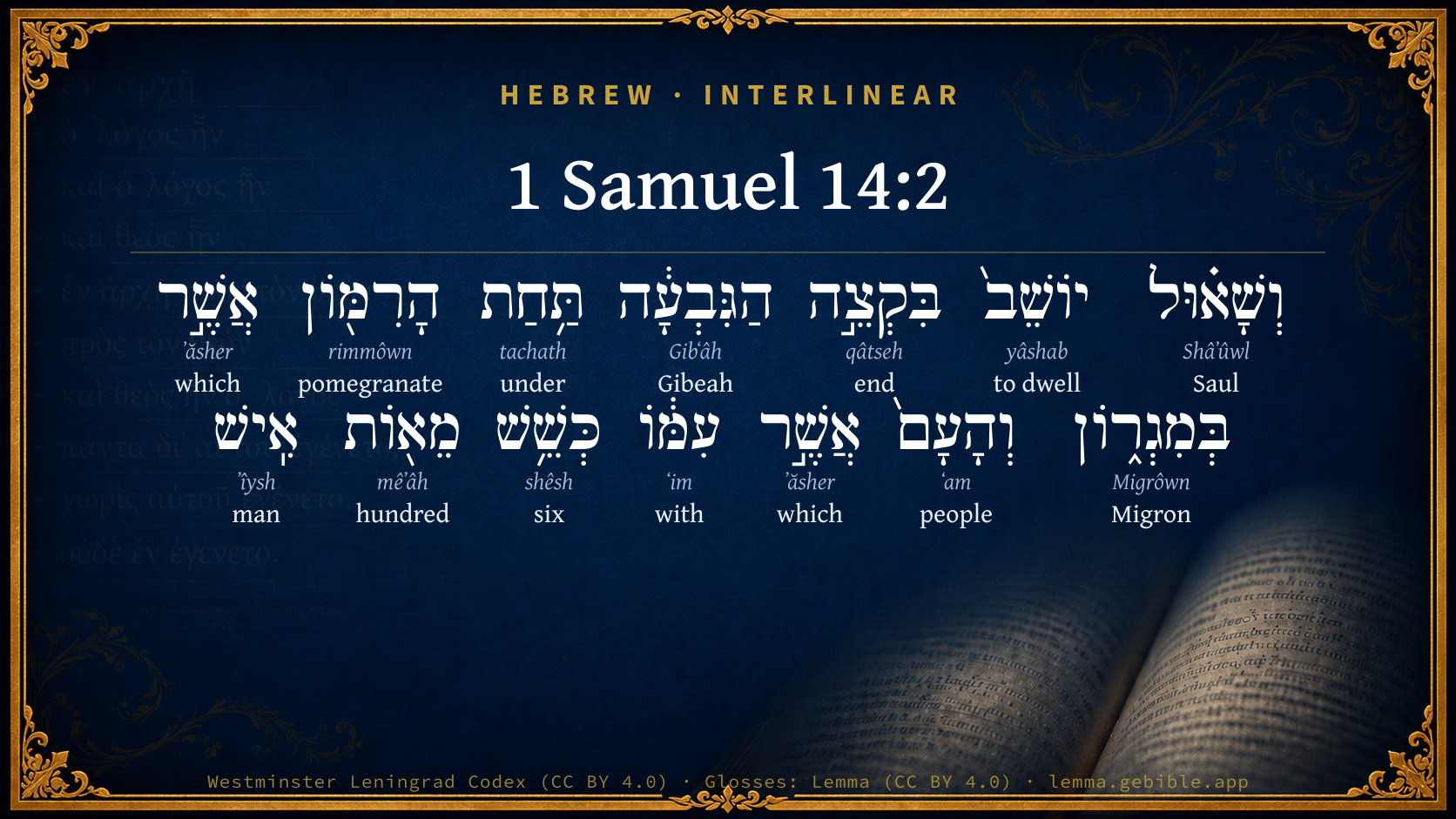
בְּמִגְר֑וֹן
Migrôwn
H4051
“in/at · Migron”
Preposition + Noun, Proper
Part of Speech
Preposition + Noun
Type
Proper
Full BDB Definition

Origin: from H4048

TWOT: None

Migron = "precipice" - a place near Gibeah north of Michmash
  1. וְשָׁא֗וּל Shâʼûwl H7586 “and · Saul” Conjunction + Noun, Proper
  2. יוֹשֵׁב֙ yâshab H3427 “dwelling” Verb, Qal, Participle Active, Masculine, Singular, Absolute
  3. בִּקְצֵ֣ה qâtseh H7097 “in/at · end of” Preposition + Noun, Common, Both, Singular, Construct
  4. הַגִּבְעָ֔ה Gibʻâh H1390 “the · Gibeah” Particle, Definite Article + Noun, Proper
  5. תַּ֥חַת tachath H8478 “under” Preposition
  6. הָרִמּ֖וֹן rimmôwn H7416 “the · pomegranate” Particle, Definite Article + Noun, Common, Masculine, Singular, Absolute
  7. אֲשֶׁ֣ר ʼăsher H834 “which” Particle, Relative
  8. וְהָעָם֙ ʻam H5971 “and · the · people” Conjunction + Particle, Definite Article + Noun, Common, Masculine, Singular, Absolute
  9. אֲשֶׁ֣ר ʼăsher H834 “which” Particle, Relative
  10. עִמּ֔וֹ ʻim H5973 “with · him” Preposition + Suffix, Personal, 3rd Person, Masculine, Singular
  11. כְּשֵׁ֥שׁ shêsh H8337 “like/as · six” Preposition + Adjective, Cardinal number, Feminine, Singular, Absolute
  12. מֵא֖וֹת mêʼâh H3967 “hundred” Adjective, Cardinal number, Both, Plural, Absolute
  13. אִֽישׁ ʼîysh H376 “man” Noun, Common, Masculine, Singular, Absolute

About this verse

These counts appear in no published source. They are computed here, from the morphology-tagged text and Lemma’s own curated glosses. What Lemma adds →

14
words
13
distinct lemmas
Historical
section

Notable vocabulary

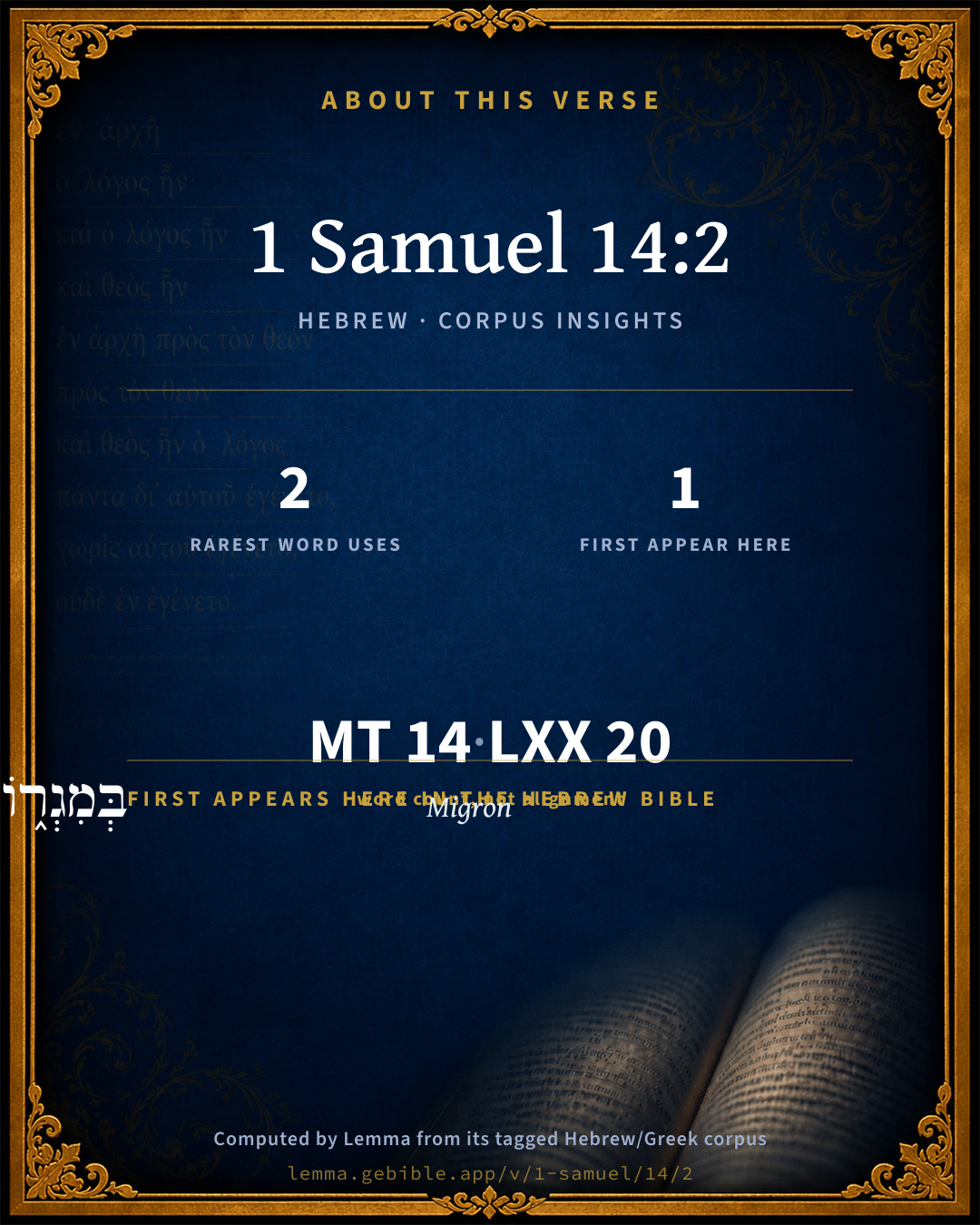
The rarest word here is בְּמִגְר֑וֹן Migron H4051 — appearing just 2 times in the whole Hebrew Bible.

First appearance in Scripture

This word makes its first canonical appearance in the Hebrew Bible here:

  • בְּמִגְר֑וֹן Migron H4051

Shared distinctive vocabulary

בְּמִגְר֑וֹן Migron H4051 occurs in 2 verses of the Hebrew Bible. Also found in:

Grammatical profile

  • 1 verb
  • 7 nouns
  • 2 adjectives
  • 2 prepositions
  • 2 particles

Verb forms

  • יוֹשֵׁב֙ Qal · Participle Active

Repetition

A word recurs within this verse — often emphatic in Hebrew:

  • אֲשֶׁ֣ר which H834 ×2

Hebrew & Septuagint length

In English translation the verse runs 28 words from the Hebrew and 26 from the Septuagint (LXX English) — closely comparable.

A rough comparison of the two English renderings, which tokenize alike — not a word-level alignment.

Word counts can differ between the Hebrew and the Greek without any difference in meaning — e.g. the Hebrew direct-object marker אֵת has no separate Greek word, and Greek often adds the article ὁ.

In the original languages it is 14 Hebrew tokens and 20 Greek tokens — but the two are counted differently (Hebrew bundles its prefixes and suffixes into one token; the Greek is in lemma form), so that isn’t a like-for-like length.

Cross-references

2

Topical passages linked to 1 Samuel 14:2 in the Treasury of Scripture Knowledge — connected by theme and wording, ordered by reader-vote popularity; previews shown in the World English Bible.

  • 1 Samuel 13:15–16 Samuel arose, and got him up from Gilgal to Gibeah of Benjamin. Saul numbered the people who were present with him, about six hundred men.
  • Isaiah 10:28–29 He is come to Aiath, he is passed through Migron; at Michmash he lays up his baggage;

Cross-references courtesy of OpenBible.info (CC BY 4.0).

Hebrew and Greek witnesses Masoretic Hebrew ↔ Greek Septuagint

The same verse in the two great witnesses to the Old Testament, shown verse-for-verse.

These are two independent witnesses, not word-aligned to each other, and the Septuagint is shown in lemma (dictionary) form.

Hebrew 1 Samuel 14:2 Masoretic · Westminster Leningrad Codex

וְשָׁא֗וּל יוֹשֵׁב֙ בִּקְצֵ֣ה הַגִּבְעָ֔ה תַּ֥חַת הָרִמּ֖וֹן אֲשֶׁ֣ר בְּמִגְר֑וֹן וְהָעָם֙ אֲשֶׁ֣ר עִמּ֔וֹ כְּשֵׁ֥שׁ מֵא֖וֹת אִֽישׁ

Saul abode in the uttermost part of Gibeah under the pomegranate tree which is in Migron: and the people who were with him were about six hundred men;

World English Bible · Public Domain

Greek LXX 1 Samuel 14:2 Septuagint · lemma form

καί σαούλ καταἧμαι ἐπί ἄκρος ὁ βουνός ὑπό ὁ ῥόα ὁ ἐν μαγδων καί εἰμί μετά αὐτός ὡς ἑξακόσιοι ἀνήρ

And Saul sat on the top of the hill under the pomegranate tree that is in Magdon, and there were with him about six hundred men.

LXX2012 (modern English Septuagint) · Public Domain

Hebrew: Westminster Leningrad Codex (CC BY 4.0). Greek: Septuagint (public domain); English from LXX2012 (modern English Septuagint) (Public Domain). How the Septuagint differs from the Hebrew →

Targum (Aramaic paraphrase)

1

The Targum is the ancient Jewish Aramaic paraphrase of the Hebrew Scriptures — an interpretive translation, not the Hebrew text itself. Onkelos (literal) and Pseudo-Jonathan (expansive) render the Torah, and Jonathan the Prophets. Coverage is partial: where no permissively-licensed English translation exists for a verse, only the Aramaic is shown. This is verse-level text, not a word-by-word alignment to the Hebrew.

  1. Targum Jonathan Prophets (Joshua–Malachi)
    וְשָׁאוּל יָתֵיב בִּסְיָפֵי גִבְעֲתָא בְּשִׁפּוּלֵי רִמוֹן דִי בְמִגְרוֹן וְעַמָא דְעִמֵיהּ כְּשִׁית מְאָה גַבְרָא:

    (no public-domain English translation for this verse)

    Targum Jonathan — Aramaic: “Mikraot Gedolot” (public domain). English: “Sefaria Community Translation” (CC0 1.0 (public-domain dedication)); “London "Chaldee Paraphrase," 1871” (public domain). Text via Sefaria.

Commentary

Notes on 1 Samuel 14:2 from classic Christian and Jewish commentators (each source and its license shown beneath its notes). The classic Christian expositions comment on the surrounding passage and are grouped to its opening verse, so a note may address several verses; the Jewish commentaries on the Tanakh (Rashi and others) are per-verse, so they appear only where the commentator wrote on this verse.

Lemma curates 59 commentaries, every one of them public domain or Creative Commons licensed, each selected and text-cleaned for this edition rather than reprinted as found. About our sources →

Trapp's Complete Commentary

John Trapp

1Sa 14:2 And Saul tarried in the uttermost part of Gibeah under a pomegranate tree which [is] in Migron: and the people that [were] with him [were] about six hundred men;

Ver. 2. And Saul tarried.] In his fastness; observing the enemies’ motions, but unable to encounter them.

Under a pomegranate tree.] Or, Under Rimmon, a place so called from the store of pomegranates there growing: as Granata, a chief city in Spain, is to this day, a malogranatorum copia vel figura.

John Trapp, A Commentary or Exposition upon All the Books of the Old and New Testament (1647–1656) — public domain. Text from a community e-Sword module.

Joseph Benson's Commentary

1Sa 14:2. Saul tarried in the uttermost part of Gibeah — In the outworks of the city, where he had intrenched himself to observe the motions of the Philistines. Under a pomegranate-tree — A grove of pomegranate-trees. Which is in (or toward) Migron — A place near Gibeah.

Joseph Benson's Commentary on the Old and New Testaments (1811–1818) — public domain. Text from a community e-Sword module.

Tyndale Open Study Notes

Tyndale Open Resources

14:2 camped: Saul’s inactivity contrasts with Jonathan’s initiative (see also 22:6).

Tyndale Open Study Notes — © Tyndale Open Resources, licensed CC BY-SA 4.0. Text via the HelloAO Bible API.

Jamieson, Fausset & Brown

Robert Jamieson, A. R. Fausset & David Brown

Saul tarried in the uttermost part of Gibeah--Hebrew, "Geba"; entrenched, along with Samuel and Ahiah the high priest, on the top of one of the conical or spherical hills which abound in the Benjamite territory, and favorable for an encampment, called Migron ("a precipice").

Jamieson, Fausset & Brown — Commentary Critical and Explanatory on the Whole Bible (1871) — public domain (CC PDM 1.0). Text via the HelloAO Bible API.

Adam Clarke's Commentary

Verse 2. Under a pomegranate tree] Under Rimmon, which not only signifies a pomegranate tree, but also a strong rock, in which six hundred Benjamites took shelter, Jdg 20:45. Probably it was in this very rock that Saul and his six hundred men now lay hidden.

Adam Clarke's Commentary on the Bible (1810–1826) — public domain. Text from a community e-Sword/MySword module.

Ellicott's Commentary for English Readers

(2) Under a pomegranate tree.—The love of Saul for trees, which was so common among the children of Israel, has been noticed. (See again 1 Samuel 22, 1Sa_14:6. The king is spoken of as under the tamarisk of Ramali; Deborah is specially mentioned as judging Israel under the palm-tree in Beth-el.)

A Bible Commentary for English Readers, edited by Charles John Ellicott (1878–1897) — public domain. Text from a community e-Sword module.

The Cambridge Bible for Schools and Colleges

gen. ed. J. J. S. Perowne

2. the uttermost part of Gibeah] Here at any rate Gibeah seems to denote a district. See note on 1Sa_10:5. Saul was stationed probably at the northern extremity of it, under “the pomegranate tree which is in Migron.” So we find him afterwards “under the tamarisk in Gibeah” (1Sa_22:6). Migron cannot be the place mentioned in Isa_10:28, which was north of Michmash. The name means precipice, and probably occurred frequently in this rocky region.

The Cambridge Bible for Schools and Colleges (gen. ed. J. J. S. Perowne; Cambridge University Press, 1878–1918) — public domain. Text from a community e-Sword module.

John Gill's Exposition

And Saul tarried in the uttermost part of Gibeah,.... Not daring to go out against the Philistines, but remained in the furthest part of Gibeah, at the greatest distance from the camp of the Philistines, in the strongest part of the city, or deeply entrenched in the outer, part of it in the field:

under a pomegranate tree; where were his headquarters; his tent or pavilion was erected under a large spreading pomegranate, which protected him from the heat of the sun: or

under Rimmon; the rock Rimmon; under the shelter of that, and in the caverns of it; where a like number of Benjaminites he now had with him formerly hid themselves, Jdg 20:47.

which is in Migron; a part of Gibeah, or rather of the field of Gibeah, so called; for near it it certainly was; and is also mentioned along with Michmash, and as lying in the way of the march of Sennacherib king of Assyria, to Jerusalem, Isa 10:28.

and the people that were with him were about six hundred men; which is observed to show that no addition was made to his little army; it was the same it was when he came thither, the people did not flock to his assistance, being in fear of the army of the Philistines, which was so powerful; see Sa1 13:15.

John Gill's Exposition of the Whole Bible (1746–1763) — public domain (CC PDM 1.0). Text via the HelloAO Bible API.

Albert Barnes' Notes on the Bible

Under a pomegranate - Compare 1Sa 22:6; Jdg 4:5. Saul was at the northern extremity of Gibeah, about an hour’s march from Geba, where Jonathan was.

Migron, if the reading is correct, must be a different place from the Migron of Isa 10:28.

Albert Barnes' Notes on the Bible (1834–1885) — public domain. Text from a community e-Sword/MySword module.

Haydock's Catholic Bible Commentary

Magron, a village between Gabaa and Machmas, Isaias x. 28. Hebrew reads "Remmon," which means "a pomegranate tree," and denotes a famous impregnable rock, with extensive caverns, where an equal number of men had formerly saved themselves, Judges xx. 47. (Calmet) (Tirinus) (Menochius)

George Leo Haydock (1774–1849), Haydock's Catholic Family Bible and Commentary, 1859 edition — public domain. Excludes Psalms (Douay-Rheims chapter numbering differs from Protestant) and Deuterocanonical books (Catholic canon only).

Matthew Poole's English Annotations

In the uttermost part of Gibeah; in the outworks of the city, where he had intrenched himself to observe the motion of the Philistines.

In Migron, or towards (as the Hebrew beth is oft used) Migron, which was another place, but near Gibeah. See Isa 10:28.

Matthew Poole's English Annotations on the Holy Bible (1683–1685) — public domain. Text from a community e-Sword/MySword module.

Whedon's Commentary on the Bible

Daniel D. Whedon

2. The uttermost part of Gibeah — The outskirts of the city, or, as Keil supposes; the extreme northern end.

Migron — This place must have been in the immediate vicinity of Gibeah, but its exact position is unknown. The Migron of Isa_10:28 seems to have been north of the Wady es-Suweinit, and, if so, must have been a different place from this.

Daniel D. Whedon (gen. ed.), Commentary on the Old and New Testaments (1874–1909) — public domain. Text from a community e-Sword module.

The Pulpit Commentary

Saul tarried in the uttermost part of Gibeah. Ie. the part nearest Geba. Under, not a, but the pomegranate tree, the well known tree at Migron. Saul evidently shared to the full in the love of trees common among the Israelites. (see 1Sa_22:6) The Hebrew word for pomegranate is Rimmon, but there is no doubt that the tree is here meant, and not the rock Rimmon, (Jud_1:20:45, 47) so called probably from a fancied resemblance to the fruit. Migron, said to mean a cliff was apparently a common name for localities in this mountainous district, as in Isa_10:28 we read of one lying to the north of Michmash, whereas this is to the south.

The Pulpit Commentary (1880–1919), ed. H.D.M. Spence-Jones & Joseph S. Exell — public domain. Text from a community e-Sword module.

John Wesley's Explanatory Notes

Tarried - In the outworks of the city where he had entrenched himself to observe the motion of the Philistines. In - Or, towards Migron, which was near Gibeah.

John Wesley, Explanatory Notes Upon the Whole Bible (1754–1765) — public domain. Text via the GEBible commentary corpus.

unfoldingWord translationNotes

Door43 World Missions Community

Gibeah

This is the name of a hill north of Jerusalem. (See: How to Translate Names)

under the pomegranate tree

a tree whose fruit is thick skinned, round, red and has many seeds to eat

that is in Migron

"Migron" is the name of a place north of Jerusalem. (See: How to Translate Names)

six hundred men were with him

"600 men were with him" (See: Numbers)

son of Ahitub (Ichabod's brother)

"Ahitub" and "Ichabod" are names of men. (See: How to Translate Names)

Phinehas son of Eli

Phinehas was one of the priests. See how you translated this in 1 Samuel 1:03.

translationWords

Ahijah

Phinehas

priest

Yahweh

Shiloh

ephod

people group

unfoldingWord translationNotes — © Distant Shores Media and the Door43 World Missions Community, licensed CC BY-SA 4.0. Source: git.door43.org/Door43/en_tn.

Rashi

Rabbi Shlomo Yitzchaki (Rashi)

At the edge of Givah. At the end of Givah.

Rashi on the Tanakh — English translations: “The Judaica Press complete Tanach with Rashi, translated by A. J. Rosenberg” (CC BY 4.0); “Pentateuch with Rashi's commentary by M. Rosenbaum and A.M. Silbermann, 1929-1934” (public domain); “The Metsudah Tanach series, Lakewood, N.J” (CC BY 4.0); and “The Book of Joshua, Metsudah Publications, 1997” (CC BY 4.0). Text via Sefaria.

Lesson kit

Teaching starters — assembled from the data on this page, not authored interpretation. Every prompt links to the verse data it draws on. Edit before teaching.

1 Samuel, in the Historical, opens this verse with 14 words (13 distinct Hebrew lemmas). Its most distinctive word is Migrôwn (“Migron”). A historical commentator’s framing appears above. Read the whole chapter for the surrounding context.

Discussion questions

  1. The word Migrôwn carries the sense “Migron.” How does it shape the verse?
  2. This is the first place “Migron” appears in Scripture (first appears here). What does its debut here establish?
  3. How does Isaiah 10:28, which shares the word «Migron», read alongside this verse?
  4. What does the repetition of “which” (2× in this one verse) do in this verse?
  5. These translations render this verse differently; the difference is in the English rendering, not the original. What questions does that raise?
  6. «יוֹשֵׁב֙» is a Qal Participle Active verb. How does that grammatical form shape the action described?
  7. Compare how Trapp's Complete Commentary and Joseph Benson's Commentary read this verse. Where do they agree or differ?

Things to notice

Reading settings

Reading text

Shown beneath each verse's original-language words.

Old Testament
Old Testament edition

Read the OT as the Masoretic Hebrew (MT) or the Greek Septuagint (LXX).

English shown for the Greek Septuagint (in the Hebrew ↔ Greek comparison).

Comparing translations? Open the Compare panel on any verse page to stack up to four side by side.