
Revelation 19:19

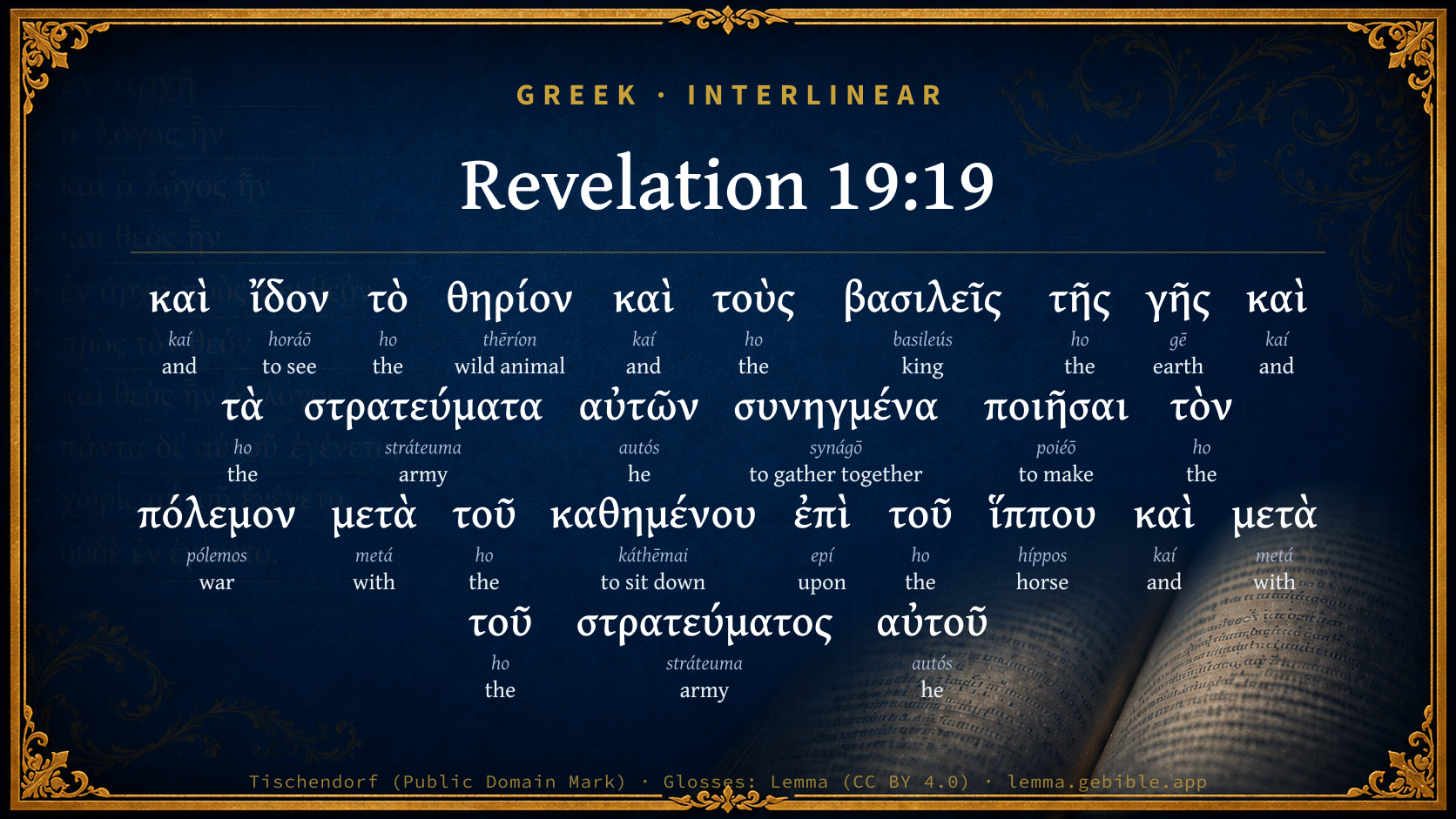
Greek (Tischendorf 8th ed.) Revelation 19:19 appears in the Greek New Testament. The text above is from the Tischendorf 8th edition. Each word links to its Strong’s number and a concise gloss. Click any word for its full Thayer’s Greek Lexicon entry.
Download image
Cite this verse

Revelation 19:19 (World English Bible). Public Domain. Lemma interlinear Bible study tool, https://lemma.gebible.app/v/revelation/19/19.

Show BibTeX & RIS
BibTeX
RIS
English Translation
I saw the beast, and the kings of the earth, and their armies, gathered together to make war against him who sat on the horse, and against his army.
World English Bible · Public Domain
Download a study sheet

One document with this verse’s original text, its word-by-word gloss line, the meaning frame, cross-references with their text, attributed commentary, and full source and license credits — printable, and it pastes into notes with its structure intact.

This verse Autodidact and up

Study sheet (.html) Plain text (.txt)

A passage Seminary Student

Up to 50 verses in one chapter. A passage sheet keeps up to 6 commentary sources and 12 cross-references per verse, in the order this page ranks them, and says so on the sheet whenever that leaves anything out. Ask for a single verse and you get the Autodidact verse sheet above.

Everything on this page stays free to read, with no account — the sheet is a download of what is already on screen, not access to it.

Want to remove ads? Support Godless Engineer
Compare translations 3

The same verse in 3 English versions, stacked beneath the original-language interlinear above. Click any original word for its lexicon entry.

Each is an independent rendering of the whole verse — the interlinear is not word-aligned to these translations.

Highlighted words mark where these versions differ — a whole-verse word diff, not a word-by-word alignment.

  • World English Bible Public Domain
    I saw the beast, and the kings of the earth, and their armies, gathered together to make war against him who sat on the horse, and against his army.
  • King James Version Public Domain
    And I saw the beast, and the kings of the earth, and their armies, gathered together to make war against him that sat on the horse, and against his army.
  • unfoldingWord Literal Text CC BY-SA 4.0
    And I saw the beast and the kings of the earth and their armies having been gathered to make war with the one sitting on the horse and with his army.

unfoldingWord Literal Text — © unfoldingWord, licensed CC BY-SA 4.0. Word-aligned USFM3 via Door43 (git.door43.org/unfoldingWord/en_ult).

Versions to compare (up to 4)

3 of 4 selected

Show all 19 translations

Every available English version of this verse, each an independent rendering of the whole verse.

  • World English Bible Public Domain
    I saw the beast, and the kings of the earth, and their armies, gathered together to make war against him who sat on the horse, and against his army.
  • Berean Standard Bible Public Domain
    Then I saw the beast and the kings of the earth with their armies assembled to wage war against the One seated on the horse, and against His army.
  • Majority Standard Bible Public Domain
    Then I saw the beast and the kings of the earth with their armies assembled to wage war against the One seated on the horse, and against His army.
  • King James Version Public Domain
    And I saw the beast, and the kings of the earth, and their armies, gathered together to make war against him that sat on the horse, and against his army.
  • American Standard Version (1901) Public Domain
    And I saw the beast, and the kings of the earth, and their armies, gathered together to make war against him that sat upon the horse, and against his army.
  • Revised Version (1885) Public Domain
    And I saw the beast, and the kings of the earth, and their armies, gathered together to make war against him that sat upon the horse, and against his army.
  • Geneva Bible (1599) Public Domain
    And I sawe the beast, and the Kings of the earth, and their hostes gathered together to make battell against him that sate on the horse, and against his armie.
  • Douay-Rheims (1899) Public Domain
    And I saw the beast, and the kings of the earth, and their armies gathered together to make war with him that sat upon the horse, and with his army.
  • Young's Literal Translation Public Domain
    And I saw the beast, and the kings of the earth, and their armies, having been gathered together to make war with him who is sitting upon the horse, and with his army;
  • Literal Standard Version CC BY-SA 4.0
    And I saw the beast, and the kings of the earth, and their armies, having been gathered together to make war with Him who is sitting on the horse, and with His army;
  • Unlocked Literal Bible CC BY-SA 4.0
    I saw the beast and the kings of the earth with their armies. They were gathering in order to wage war with the one who rode the horse and with his army.
  • unfoldingWord Literal Text CC BY-SA 4.0
    And I saw the beast and the kings of the earth and their armies having been gathered to make war with the one sitting on the horse and with his army.
  • Darby Bible Public Domain
    And I saw the beast and the kings of the earth and their armies gathered together to make war against him that sat upon the horse, and against his army.
  • World Messianic Bible Public Domain
    I saw the beast, the kings of the earth, and their armies, gathered together to make war against him who sat on the horse and against his army.
  • Webster's Bible Public Domain
    And I saw the beast, and the kings of the earth, and their armies, assembled to make war against him that sat on the horse, and against his army.
  • Free Bible Version CC BY-SA 4.0
    I saw the beast and the kings of the earth gathered together to wage war on the one sitting on the horse and his army.
  • Bible in Basic English Public Domain
    And I saw the beast, and the kings of the earth, and their armies, come together to make war against him who was seated on the horse and against his army.
  • Text-Critical English NT CC BY 4.0
    Then I saw the beast, the kings of the earth, and their armies gathered together to wage war against the rider on the horse and against his army.
  • Tyndale New Testament (1534) Public Domain
    And I sawe the beste and the kynges of the erth and their warriers gaddred to gedder to make battayle agaynste him that satt on the horsse and agaynst his sowdiers.

Literal Standard Version (2020), Covenant Press — licensed CC BY-SA 4.0. Text via the HelloAO Bible API (eBible.org). Unlocked Literal Bible (unfoldingWord) — licensed CC BY-SA 4.0. Text via the HelloAO Bible API (eBible.org). unfoldingWord Literal Text — © unfoldingWord, licensed CC BY-SA 4.0. Word-aligned USFM3 via Door43 (git.door43.org/unfoldingWord/en_ult). Free Bible Version, Dr. Jonathan Gallagher — licensed CC BY-SA 4.0. Text via the HelloAO Bible API (eBible.org).

Word by word

More ways to search: Search by grammar → Find every occurrence → Compare this word →

Practice this passage: Drill this verse → Learn its vocabulary →

στρατεύματα
stráteuma
G4753
“army”
Noun, Accusative, Plural, Neuter
Part of Speech
Noun
Case
Accusative
Number
Plural
Gender
Neuter
Full Thayer's Definition

Origin: from G4754

TDNT: 18:41,1

1. an army 2. a band of soldiers 3. bodyguard, guards men
  1. καὶ kaí G2532 “and” Conjunction
  2. ἴδον horáō G3708 “to see” Verb, Aorist, Active, Indicative, 1st person, Singular
  3. τὸ ho G3588 “the” Article, Accusative, Singular, Neuter
  4. θηρίον thēríon G2342 “wild animal” Noun, Accusative, Singular, Neuter
  5. καὶ kaí G2532 “and” Conjunction
  6. τοὺς ho G3588 “the” Article, Accusative, Plural, Masculine
  7. βασιλεῖς basileús G935 “king” Noun, Accusative, Plural, Masculine
  8. τῆς ho G3588 “the” Article, Genitive, Singular, Feminine
  9. γῆς gē G1093 “earth” Noun, Genitive, Singular, Feminine
  10. καὶ kaí G2532 “and” Conjunction
  11. τὰ ho G3588 “the” Article, Accusative, Plural, Neuter
  12. αὐτῶν autós G846 “he” Personal pronoun, Genitive, Plural, Masculine
  13. συνηγμένα synágō G4863 “to gather together” Verb, Perfect, Passive, Participle, Accusative, Plural, Neuter
  14. ποιῆσαι poiéō G4160 “to make” Verb, Aorist, Active, Infinitive
  15. τὸν ho G3588 “the” Article, Accusative, Singular, Masculine
  16. πόλεμον pólemos G4171 “war” Noun, Accusative, Singular, Masculine
  17. μετὰ metá G3326 “with” Preposition
  18. τοῦ ho G3588 “the” Article, Genitive, Singular, Masculine
  19. καθημένου káthēmai G2521 “to sit down” Verb, Present, Middle or Passive deponent, Participle, Genitive, Singular, Masculine
  20. ἐπὶ epí G1909 “upon” Preposition
  21. τοῦ ho G3588 “the” Article, Genitive, Singular, Masculine
  22. ἵππου híppos G2462 “horse” Noun, Genitive, Singular, Masculine
  23. καὶ kaí G2532 “and” Conjunction
  24. μετὰ metá G3326 “with” Preposition
  25. τοῦ ho G3588 “the” Article, Genitive, Singular, Neuter
  26. στρατεύματος stráteuma G4753 “army” Noun, Genitive, Singular, Neuter
  27. αὐτοῦ autós G846 “he” Personal pronoun, Genitive, Singular, Masculine

About this verse

These counts appear in no published source. They are computed here, from the morphology-tagged text and Lemma’s own curated glosses. What Lemma adds →

28
words
15
distinct lemmas
Revelation
section

Notable vocabulary

The rarest word here is στρατεύματα army G4753 — appearing just 8 times in the whole Greek New Testament.

Shared distinctive vocabulary

στρατεύματα army G4753 occurs in 7 verses of the Greek New Testament. Also found in:

Repetition

Words recur within this verse:

  • στρατεύματα army G4753 ×2
  • τὸ the G3588 ×8
  • καὶ and G2532 ×4
  • αὐτῶν he G846 ×2
  • μετὰ with G3326 ×2

Cross-references

13

Topical passages linked to Revelation 19:19 in the Treasury of Scripture Knowledge — connected by theme and wording, ordered by reader-vote popularity; previews shown in the World English Bible.

  • Revelation 16:16 He gathered them together into the place which is called in Hebrew, Megiddo.
  • Revelation 16:14 for they are spirits of demons, performing signs; which go forth to the kings of the whole inhabited earth, to gather them together for the war of that great day of God, the Almighty.
  • Daniel 8:25 Through his policy he shall cause craft to prosper in his hand; and he shall magnify himself in his heart, and in [their] security shall he destroy many: he shall also stand up against the prince of princes; but he shall be broken without hand.
  • Daniel 7:21–26 I saw, and the same horn made war with the saints, and prevailed against them;
  • Daniel 11:40–45 At the time of the end shall the king of the south contend with him; and the king of the north shall come against him like a whirlwind, with chariots, and with horsemen, and with many ships; and he shall enter into the countries, and shall overflow and pass through.
  • Revelation 17:12–14 The ten horns that you saw are ten kings who have received no kingdom as yet, but they receive authority as kings, with the beast, for one hour.
  • Revelation 18:9 The kings of the earth, who committed sexual immorality and lived wantonly with her, will weep and wail over her, when they look at the smoke of her burning,
  • Ezekiel 38:8–18 After many days you shall be visited: in the latter years you shall come into the land that is brought back from the sword, that is gathered out of many peoples, on the mountains of Israel, which have been a continual waste; but it is brought forth out of the peoples, and they shall dwell securely, all of them.
  • Revelation 19:11–14 I saw the heaven opened, and behold, a white horse, and he who sat on it is called Faithful and True. In righteousness he judges and makes war.
  • Joel 3:9–14 Proclaim this among the nations: Prepare war. Stir up the mighty men. Let all the warriors draw near. Let them come up.
  • Revelation 11:7 When they have finished their testimony, the beast that comes up out of the abyss will make war with them, and overcome them, and kill them.
  • Revelation 13:1–10 Then I stood on the sand of the sea. I saw a beast coming up out of the sea, having ten horns and seven heads. On his horns were ten crowns, and on his heads, blasphemous names.
  • Revelation 14:9 Another angel, a third, followed them, saying with a great voice, "If anyone worships the beast and his image, and receives a mark on his forehead, or on his hand,

Cross-references courtesy of OpenBible.info (CC BY 4.0).

Commentary

Notes on Revelation 19:19 from classic Christian and Jewish commentators (each source and its license shown beneath its notes). The classic Christian expositions comment on the surrounding passage and are grouped to its opening verse, so a note may address several verses; the Jewish commentaries on the Tanakh (Rashi and others) are per-verse, so they appear only where the commentator wrote on this verse.

Lemma curates 59 commentaries, every one of them public domain or Creative Commons licensed, each selected and text-cleaned for this edition rather than reprinted as found. About our sources →

Meyer's Critical & Exegetical Commentary

Heinrich August Wilhelm Meyer

Rev_19:19-21. The Lords judgment and war are accomplished. This act of judgment John beholds, as it proceeds not only from the καὶ εἰδον (Rev_19:19), but also from the mode of representation itself (ἐπιάσθη, Rev_19:20; ἐχορτάσθησαν, Rev_19:21). Cf., on the other hand, ch. 18

τὸ θηρίον καὶ τούς βασιλεῖς, κ.τ.λ. With the beast, representing the secular power,[4127] his confederates appear, the kings of the earth,[4128] and their armies, consisting of the entire number of the dwellers on earth,[4129] who now carry into effect the conflict proclaimed already in Rev_16:14;[4130] its result, however, is described in Rev_19:20 sq., in such a way as to correspond to the significant name of Rev_16:16. For the conflict which is to be described is not one that is painful, or as to its issue possibly doubtful, but the result of an unconditional victory over enemies, won by the justice and omnipotence of the Lord.

Κ. ΜΕΤᾺ ΤΟῦ ΣΤΡΑΤΕΎΜΑΤΟς ΑὐΤΟῦ. The sing. is chosen here,[4131] in order to mark the holy unity of the entire army of Christ, in contrast with the rent body of his enemies.[4132] ΚΑῚ Ὁ ΜΕΤʼ ΑὐΤΟῦ ΨΕΥΔΟΠΡΟΦΉΤΗς. The position of the false prophet as the auxiliary of the beast is designated in harmony with the description (Rev_13:11 sqq.). The allusion also to the peculiar function of the false prophet (Ὁ ΠΟΙΉΣΑς, Κ.Τ.Λ.) points back to Rev_13:13 sqq.

The manner in which the judgment is fulfilled is in conformity with the nature of the enemies:[4133] the beast, together with the false prophet, was taken, and both were cast alive into the lake of fire burning with brimstone. Who does this, is not said; but the act dare not be referred to Christ, for the reason that he does not execute his various acts of judgment by his own hand.[4134] It is evident that the victorious result of the war of judgment[4135] is determined by Christs power; but according to the analogy of Rev_12:7 sqq., we must regard the ΣΤΡΑΤΕΎΜΑΤΑ of the Lord, as the executors of the judgment.[4136]

ΖῶΝΤΕς. For only human enemies could suffer bodily death (Rev_19:21) before the eternally condemning judgment of the world.[4137]

ΤῊΝ ΛΊΜΝΗΝ, Κ.Τ.Λ. Cf. Rev_20:10; Rev_20:14 sq., Rev_21:8.

ΟἹ ΛΟΙΠΟῚ. See on Rev_19:17 sq.

ἈΠΕΚΤΆΝΘΗΣΑΝ ἘΝ Τῇ ΡΟΜΦΑΊᾼ, Κ.Τ.Λ. To seize the enemies, and thus to cast them into hell (Rev_19:20), is not befitting the Lord himself; but it is something else, when the sword which proceeds from his mouth slays the enemies. This gives the idea of the victory entirely without laborious effort, and presupposing no proper conflict of Him who, according to the prediction of the ancient prophets, destroys his enemies with the breath of his lips.[4138]

Κ. ΠΆΝΤΑ ΤᾺ ὌΡΝΕΑ, Κ.Τ.Λ. Cf. Rev_19:17 sq.

[4127] Rev_13:1 sqq.

[4128] Rev_16:12 sqq., Rev_17:12 sqq.

[4129] Rev_13:4; Rev_13:8; Rev_13:16.

[4130] Notice the art. τὸν πόλεμ.; also the συνηγμένα here repeated.

[4131] Cf., on the other hand, Rev_19:14.

[4132] Beng., Hengstenb.

[4133] Cf. Beng., De Wette, Hengstenb.

[4134] Cf. Rev_20:2.

[4135] Cf. Rev_19:11.

[4136] Cf. Rev_20:9 sqq., 14 sq.

[4137] Rev_20:14 sqq.

[4138] Cf. Isa_11:4.

The allegorical exposition, when applied with consistency to ch. 19, must be regarded untenable in the degree that it arrays itself against the context. The fowls (Rev_19:17 sq., 21) are, according to Hammond, the Goths and Vandals, who desolated the Roman Empire; according to Coccejus, the Turks, who, after the capture of Constantinople, afflicted the Catholic West; according to Hengstenb., the Huns, who prepared grievous calamities for the Germanic nations, the destroyers of the Roman Empire. Wetst. found the prophecy fulfilled in the assassination of Domitian, the last of the Flavians,[4139] and in the conquest of his soldiers (Rev_19:21). Grot. understands by the ΒΑΣΙΛΕῖς (Rev_19:19), Julian with his nobles, and remarks on Rev_19:20 : Theodosius the Great abolished the public sacrifices of the heathen, and on Rev_19:21 : By the decree of Christ, who used Justinian for this purpose, to punish idolaters with death. Others, as C. a Lap., have thought that the fulfiment of the prophecy could be shown by the horrible death and burial of many heretics. So C. a Lap. cites authors who report of Luther that he committed suicide, and that at his burial not only a multitude of ravens, but also the Devil, who had come from Holland, appeared.

Luther, gloss on Rev_19:11 : The word of God is opposed to the defenders of the Pope, and none of their defence is of any avail.

[4139] Rev_19:20.

Meyer — Critical and Exegetical Commentary on the New Testament — English translation by Peter Christie, edited by Frederick Crombie (T&T Clark, 1880) — public domain. Text from a community e-Sword module.

Geneva Bible (1599)

Geneva Bible translators

The third member (as was said, verse 11) of the victory obtained by Christ. Unto this apppertaineth two things: his bucking with the beast and his forces in this verse: and the event most magnificent, described after the manner of men, in the verses following. All these things are plain.

Geneva Bible (1599) marginal notes — public domain. Text via Bolls.life.

Jamieson, Fausset & Brown

Robert Jamieson, A. R. Fausset & David Brown

gathered together--at Armageddon, under the sixth vial. For "their armies" in B and ANDREAS, there is found "His armies" in A.

war--so ANDREAS. But A and B read, "the war," namely, that foretold, Rev 16:14; Rev 17:4.

Jamieson, Fausset & Brown — Commentary Critical and Explanatory on the Whole Bible (1871) — public domain (CC PDM 1.0). Text via the HelloAO Bible API.

Adam Clarke's Commentary

Verse 19. I saw the beast] See the notes on chapters xii., xiii., and xvii. Rev 12-13; Rev 17:1-18

Adam Clarke's Commentary on the Bible (1810–1826) — public domain. Text from a community e-Sword/MySword module.

The Cambridge Bible for Schools and Colleges

gen. ed. J. J. S. Perowne

19. the beasts and the kings] Their confederacy under his leadership has been already intimated, Rev_16:14; Rev_16:16, Rev_17:12-14. The so-called battle of Armageddon, there foretold, is here described.

The Cambridge Bible for Schools and Colleges (gen. ed. J. J. S. Perowne; Cambridge University Press, 1878–1918) — public domain. Text from a community e-Sword module.

John Gill's Exposition

And l saw the beast,.... Not the devil, for after this he is taken and bound for a thousand years, and then loosed, and laid hold on again, and cast into the lake of fire; not but that this war will be by his instigation, and under his influence, Rev 16:14 not the Roman Pagan empire, which has been destroyed long ago, under the sixth seal, and was the issue of the battle between Michael and his angels, and the dragon and his; but the antichristian civil powers, or antichrist in his civil capacity; and which, though it may chiefly regard the western antichrist, and the remains of the Latin idolatry, yet may take in the eastern antichrist, or the Mahometan powers, which may all join together in this battle; the beast will survive for a while the downfall of his seat, Babylon or Rome.

And the kings of the earth; these, as they stand distinguished from the beast, or the antichristian kings, and civil states, may design as many of the Pagan kings and princes, as the pope and Turk by their emissaries can persuade to assist them in this war; See Gill on Rev 16:14.

And their armies gathered together; at Armageddon, or in the valley of Jehoshaphat, Rev 16:16

to make war against him that sat on the horse; the white horse, Rev 19:11 as the Arabic and Ethiopic versions read, which must be downright folly and madness, since he is the Word of God, the great God, the King of kings, and Lord of lords:

and against his army, Rev 19:14 who, though unarmed, and only clothed in fine linen, have nothing to fear, since Christ, the Captain of their salvation, is at the head of them.

John Gill's Exposition of the Whole Bible (1746–1763) — public domain (CC PDM 1.0). Text via the HelloAO Bible API.

Trapp's Complete Commentary

John Trapp

19 And I saw the beast, and the kings of the earth, and their armies, gathered together to make war against him that sat on the horse, and against his army.

Ver. 19. And I saw the beast] The Church’s enemies are even ambitious of destruction. Judgments need not go to find them out; they run to meet their bane.

John Trapp, A Commentary or Exposition upon All the Books of the Old and New Testament (1647–1656) — public domain. Text from a community e-Sword module.

Albert Barnes' Notes on the Bible

And I saw the beast - notes on Rev 13:1, Rev 13:11. Compare Rev 17:13.

And the kings of the earth, and their armies, gathered together - There is allusion here to the same assembling of hostile forces which is described in Rev 16:13-14, for the great decisive battle that is to determine the destiny of the world - the question whether the Messiah or antichrist shall reign. There can be no doubt that the writer in these passages designed to refer to the same events - the still future scenes that are to occur when the Roman, the pagan, and the Muhammedan powers shall be aroused to make common cause against the true religion, and shall stake all on the issue of the great conflict. See the notes on Rev 16:13-14.

Against him that sat on the horse - The Messiah - the Son of God. notes on Rev 19:11.

And against his army - The hosts that are associated with him - his redeemed people. See the notes on Rev 19:14.

Albert Barnes' Notes on the Bible (1834–1885) — public domain. Text from a community e-Sword/MySword module.

Haydock's Catholic Bible Commentary

We have just now seen the heavenly captain on horseback, at the head of his holy troop, marching to battle; and now we see who are the enemies he comes to encounter. Here is the beast, or antichrist, with prodigious armies gathered from all parts of the earth, and headed by their kings and princes. (Pastorini)

George Leo Haydock (1774–1849), Haydock's Catholic Family Bible and Commentary, 1859 edition — public domain. Excludes Psalms (Douay-Rheims chapter numbering differs from Protestant) and Deuterocanonical books (Catholic canon only).

Matthew Poole's English Annotations

The beast, whether by it be understood the dragon, or the beast with seven heads and ten horns, or the beast with two horns, or all of them, shall before this time be all destroyed, that is, as to their power and dominion; but there will be relics left, both of pagans, and Turks, and papists, of whom it is probable that this is to be understood; viz. that after God, upon the pouring out of the fifth vial, shall have deprived the papacy of their dominion; and by the pouring out of the sixth vial, shall have deprived the Turk of his dominion; that yet such pagans, Turks, and papists, as shall be left, shall be gathered together, and make one or more great armies, with whom the Jews and Gentiles (now united in one church) shall fight under the conduct of Christ, as the Captain general of his church, by whom they shall be overcome; and that this shall be the great battle in Armageddon, mentioned Rev 16:16.

Matthew Poole's English Annotations on the Holy Bible (1683–1685) — public domain. Text from a community e-Sword/MySword module.

Whedon's Commentary on the Bible

Daniel D. Whedon

19. And—Though the adverse armament and array seem to be fearfully great, the battle seems to be no battle.

Make war—Nobody seems to be slain of the armies of heaven.

Daniel D. Whedon (gen. ed.), Commentary on the Old and New Testaments (1874–1909) — public domain. Text from a community e-Sword module.

The Pulpit Commentary

And I saw the beast; viz. that described in Rev_13:1, typical of the hostile world power. And the kings of the earth, and their armies. The kings summoned by the unclean spirits of Rev_16:13, Rev_16:14, typical of the forces which the beast employs in his spiritual warfare with God. The armies are the adherents of the beast, described in Re 13 the ungodly, those who follow the world rather than God. Gathered together to make war against him that sat on the horse, and against his army. Gathered as described in Rev_16:14 and ver. 17 of this chapter. Again (as in ver. 7) a double operation. The gathering is voluntary on the part of the wicked, (Rev_16:14) and yet it is overruled by God, and made to serve his ends. (Rev_19:17) Him that sat on the horse; Christ (see ver. 11). "His army" consists of the faithful followers of Christ. They are here pictured as a heavenly army (ver. 14), because the victory which they achieved is the leading feature here depicted, but their warfare took place while they were on earth. (cf. Rev_14:13) The war (with the article); viz. that war which is perpetually waged between the powers of light and darkness, and which will not be terminated until the great judgment.

The Pulpit Commentary (1880–1919), ed. H.D.M. Spence-Jones & Joseph S. Exell — public domain. Text from a community e-Sword module.

John Wesley's Explanatory Notes

And I saw the kings of the earth - The ten kings mentioned chap. xvii, 12; who had now drawn the other kings of the earth to them, whether Popish, Mahometan, or pagan. Gathered together to make war with him that sat upon the horse - All beings, good and evil, visible and invisible, will be concerned in this grand contest. See Zech. xiv, 1, &c.

John Wesley, Explanatory Notes Upon the Whole Bible (1754–1765) — public domain. Text via the GEBible commentary corpus.

Scofield Reference Notes

C. I. Scofield

make war

The day of Jehovah (called, also, "that day," and "the great day") is that lengthened period of time beginning with the return of the Lord in glory, and ending with the purgation of the heavens and the earth by fire preparatory to the new heavens and the new earth Isa 65:17-19; Isa 66:22; 2Pe 3:13; Rev 21:1. The order of events appears to be:

(1) The return of the Lord in glory Mat 24:29; Mat 24:30

(2) the destruction of the Beast and his host, "the kings of the earth and their armies," and the false prophet, which is the "great and terrible" aspect of the day Rev 19:11-21.

(3) the judgment of the nations Zec 14:1-9; Mat 25:31-46.

(4) the thousand years, i.e, the kingdom-age Rev 20:4-6.

(5) the Satanic revolt and its end Rev 20:7-10.

(6) the second resurrection and final judgment Rev 20:11-15 and

(7) the "day of God," earth purged by fire 2Pe 3:10-13.

The day of the Lord is preceded by seven signs:

(1) The sending of Elijah Mal 4:5; Rev 11:3-6

(2) cosmical disturbances Joe 2:1-12; Mat 24:29; Act 2:19; Act 2:20; Rev 6:12-17

(3) the insensibility of the professing church 1Th 5:1-3

(4) the apostasy of the professing church, then become "Laodicea" 2Th 2:3

(5) the rapture of the true church 1Th 4:17.

(6) the manifestation of the "man of sin," the Beast 2Th 2:1-8

(7) the apocalyptic judgments (Revelation 11-18.).

make war Armageddon (battle of). See note, Rev 16:14; Rev 19:17 (See Scofield "Rev 19:17")

The Scofield Reference Bible (1917 edition), notes by C. I. Scofield — public domain. Text from a community e-Sword module.

Burkitt's Expository Notes on the New Testament

William Burkitt

Observe here, 1. The final issue of this great battle, namely, The total ruin of all the enemies of the church: the beast and false prophet were taken, and cast alive into a lake of fire burning with brimstone. Behold the punishment of idolaters and idolatry; the false prophet had cheated credulous princes and peoples, with his pretended miracles, into idolatry; he had cast others into a bed of fornication, and God casts him into a bed of flames.

Lastly, It is added concerning the remnant, that they were slain with the sword of his mouth: that is, by Christ’s judicial sentence they were righteously adjudged to be slain, and, when they were so, all the fowls were filled with their flesh.

Where note, That these persons were not excused because they followed their leaders, and did what they bade them; Christ commands, for all that, that they also should be slain.

Lord! how vain will the plea of many sinners be at the great day; we followed our guides, we did as we saw others do before us; Remember we, that God has given us a rule to walk by, the infallible and inflexible rule of his word; and neither the example of the most, nor of the best, must influence us to act contrary thereunto; for if we will do as the most do, we must be contented to go where the most go, even into the lake of fire burning with brimstone.

William Burkitt's Expository Notes on the New Testament (1700–1703) — public domain. Text from a community e-Sword module.

The People's New Testament

B. W. Johnson

19–21. I saw the beast. See notes on 13:1–10. This beast represents the world power opposed to Christ under its changing forms. The Roman Pagan Empire, and the Roman Papal secular power, are two forms. But it continues even after these forms pass away. The form in which it will manifest itself in this conflict will be better known when the fulfillment takes place. The beast marshals the kings of the earth as his supporters to oppose the Lamb and his armies.

B. W. Johnson's The People's New Testament with Notes (1889–1891) — public domain. Electronic text from the Christian Classics Ethereal Library (CCEL) ThML edition.

unfoldingWord translationNotes

Door43 World Missions Community

The beast was captured and with him the false prophet

This can be stated in active form. AT: "The rider on the white horse captured the beast and the false prophet" (See: Active or Passive)

the mark of the beast

This was an identifying mark that indicated that the person who received it worshiped the beast. See how you translated this in Revelation 13:17.

The two of them were thrown alive

This can be stated in active form. AT: "God threw the beast and the false prophet alive" (See: Active or Passive)

the fiery lake of burning sulfur

"the lake of fire that burns with sulfur" or "place full of fire that burns with sulfur"

translationWords

beast

king

earth

horse

false prophet

sign

deceive

receive

worship

image

life

hell

unfoldingWord translationNotes — © Distant Shores Media and the Door43 World Missions Community, licensed CC BY-SA 4.0. Source: git.door43.org/Door43/en_tn.

Cambridge Greek Testament for Schools and Colleges

19. τὸ θηρίον, καὶ τοὺς βασιλεῖς τῆς γῆς. Their confederacy under his leadership has been already intimated, Rev 16:14; Rev 16:16, Rev 17:12-14. The so-called battle of Armageddon, there foretold, is here described.

Cambridge Greek Testament for Schools and Colleges (Cambridge University Press, 1896; 21 vols, various authors incl. Carr, Maclear, Plummer, Farrar, Lumby, Moule, M. R. James, Simcox) — public domain. Text from a community e-Sword module.

Lesson kit

Teaching starters — assembled from the data on this page, not authored interpretation. Every prompt links to the verse data it draws on. Edit before teaching.

Revelation, in the Revelation, opens this verse with 28 words (15 distinct Greek lemmas). Its most distinctive word is stráteuma (“army”). A historical commentator’s framing appears above. Read the whole chapter for the surrounding context.

Discussion questions

  1. How does “army” (stráteuma) shape what this verse is saying?
  2. How does Matthew 22:7, which shares the word «army», read alongside this verse?
  3. What does the repetition of “army” (2× in this one verse) do in this verse?
  4. These translations render this verse differently; the difference is in the English rendering, not the original. What questions does that raise?
  5. Compare how Meyer's Critical & Exegetical Commentary and Geneva Bible (1599) read this verse. Where do they agree or differ?

Things to notice

  • These translations choose different wording for 9 words in this verse.
  • “army” occurs 2× in this single verse.
  • 15 distinct Greek lemmas span 28 words in this verse.

Reading settings

Reading text

Shown beneath each verse's original-language words.

Old Testament
Old Testament edition

Read the OT as the Masoretic Hebrew (MT) or the Greek Septuagint (LXX).

English shown for the Greek Septuagint (in the Hebrew ↔ Greek comparison).

Comparing translations? Open the Compare panel on any verse page to stack up to four side by side.