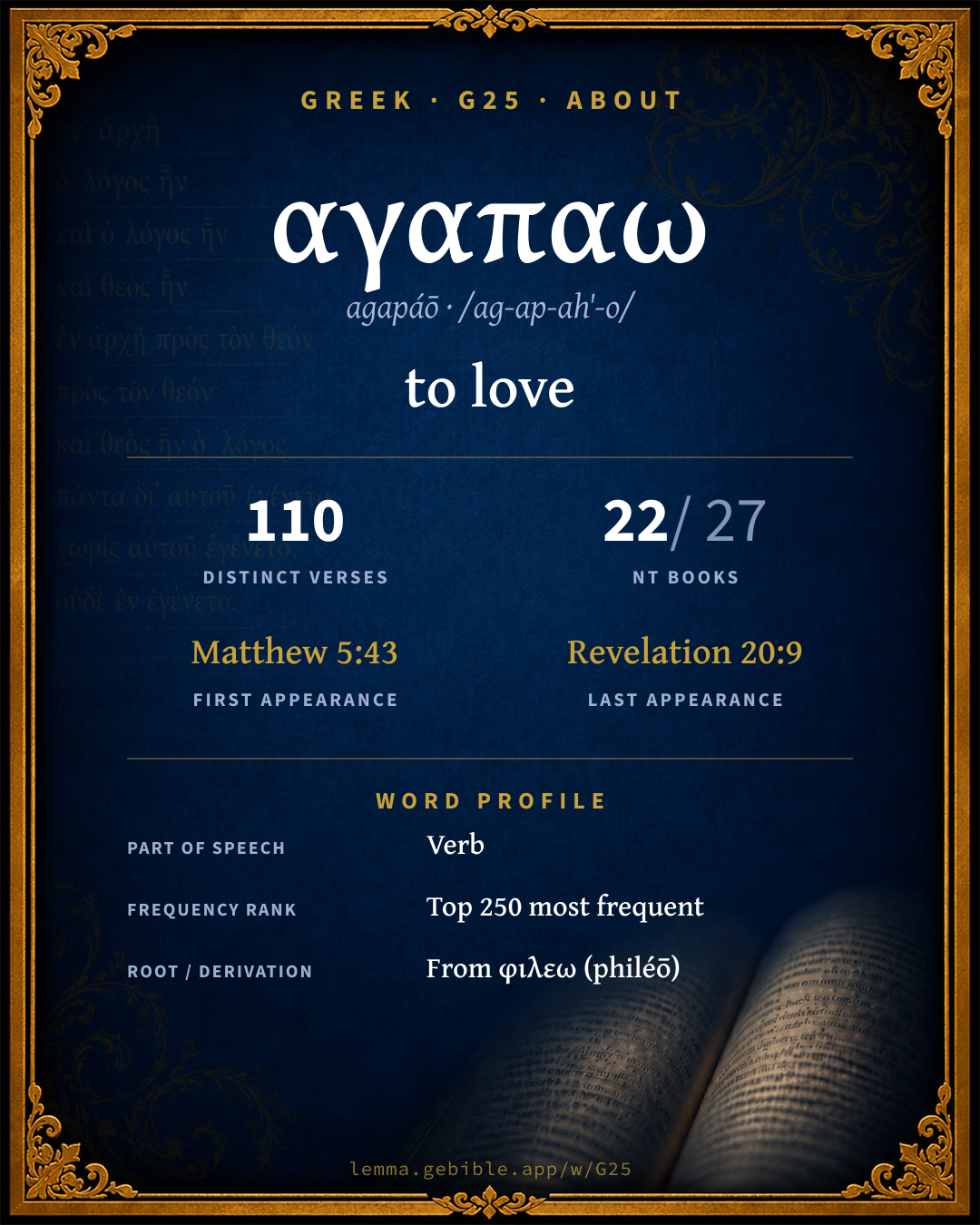
ἀγαπάω
to love
‘to love’ is one of 2 main senses fuller range ↓
Full lexicon entry — Thayer's Greek Lexicon
From Thayer's Greek Lexicon
Where this word appears
See every Present-tense verb in the Greek New Testament →
Grammar key — what these labels mean
Part of speech
- Verb
- An action or state-of-being word.
Tense
- Present
- Ongoing or general action in present time (imperfective aspect).
- Aorist
- Action viewed as a simple whole, without regard to duration — often past (perfective aspect).
- Future
- Action expected in future time.
- Imperfect
- Continuous or repeated action in past time (“was writing”).
- Perfect
- A completed past action with continuing present results.
Voice
- Active
- The subject performs the action.
- Passive
- The subject receives the action.
Mood
- Participle
- A verbal adjective (“writing,” “having written”).
- Indicative
- States a fact or asks a factual question (the mood of reality).
- Infinitive
- A verbal noun (“to write”), unmarked for person or number.
- Imperative
- Expresses a command or request.
- Subjunctive
- Expresses probability, purpose, or possibility (the mood of contingency).
Case
- Nominative
- The case of the subject (and the predicate nominative).
- Dative
- The case of the indirect object, means, or location — “to / for / with / in.”
- Accusative
- The case of the direct object and of extent.
- Genitive
- The case of source, possession, or “of” — answers “whose / from what.”
Person
- 3rd person
- The one spoken about (“he / she / it / they”).
- 2nd person
- The one addressed (“you”).
- 1st person
- The speaker (“I / we”).
Gender
- Masculine
- Grammatically masculine.
- Feminine
- Grammatically feminine.
Number
- Singular
- One.
- Plural
- More than one.
Grammatical forms 38 distinct
- Verb, Present, Active, Participle, Nominative, Singular, Masculine 13 times (9%)
- Verb, Aorist, Active, Indicative, 3rd person, Singular 12 times (8%)
- Verb, Future, Active, Indicative, 2nd person, Singular 10 times (7%)
- Verb, Present, Active, Indicative, 3rd person, Singular 9 times (6%)
- Verb, Present, Active, Infinitive 8 times (6%)
- Verb, Present, Active, Imperative, 2nd person, Plural 7 times (5%)
- Verb, Present, Active, Subjunctive, 1st person, Plural 7 times (5%)
- Verb, Present, Active, Indicative, 1st person, Singular 6 times (4%)
+30 more forms (71 occurrences)
Parsed forms decoded from the imported morphology (Robinson–Tischendorf, public domain), counted across 143 parsed occurrences — not distinct verses.
Every verse where G25 appears — 110 distinct verses across 22 books. Click any verse to open its interlinear word-by-word view. Verse text shown in the World English Bible for context — . Each verse’s Greek form is shown with its reference; the English is not keyword-highlighted, since the data carries no word-level English alignment. Use “Compare translations” on any verse to read it across multiple English versions. This concordance covers the Greek New Testament; Septuagint (Greek Old Testament) occurrences of this word are not indexed here.
Matthew 7 verses
- Matthew 5:43 ἀγαπήσεις fut act ind 2sg "You have heard that it was said, 'You shall love your neighbor, and hate your enemy.'
- Matthew 5:44 ἀγαπᾶτε pres act impv 2pl But I tell you, love your enemies, bless those who curse you, do good to those who hate you, and pray for those who mistreat you and persecute you,
- Matthew 5:46 ἀγαπήσητε ἀγαπῶντας aor act subj 2pl pres act ptcp acc pl masc For if you love those who love you, what reward do you have? Don't even the tax collectors do the same?
- Matthew 6:24 ἀγαπήσει fut act ind 3sg "No one can serve two masters, for either he will hate the one and love the other; or else he will be devoted to one and despise the other. You can't serve both God and Mammon.
- Matthew 19:19 ἀγαπήσεις fut act ind 2sg 'Honor your father and mother.' And, 'You shall love your neighbor as yourself.'"
- Matthew 22:37 ἀγαπήσεις fut act ind 2sg Jesus said to him, "'You shall love the Lord your God with all your heart, and with all your soul, and with all your mind.'
- Matthew 22:39 ἀγαπήσεις fut act ind 2sg A second likewise is this, 'You shall love your neighbor as yourself.'
Mark 4 verses
- Mark 10:21 ἠγάπησεν aor act ind 3sg Jesus looking at him loved him, and said to him, "One thing you lack. Go, sell whatever you have, and give to the poor, and you will have treasure in heaven; and come, follow me, taking up the cross."
- Mark 12:30 ἀγαπήσεις fut act ind 2sg you shall love the Lord your God with all your heart, and with all your soul, and with all your mind, and with all your strength.' This is the first commandment.
- Mark 12:31 ἀγαπήσεις fut act ind 2sg The second is like this, 'You shall love your neighbor as yourself.' There is no other commandment greater than these."
- Mark 12:33 ἀγαπᾶν ἀγαπᾶν pres act inf pres act inf and to love him with all the heart, and with all the understanding, with all the soul, and with all the strength, and to love his neighbor as himself, is more important than all whole burnt offerings and sacrifices."
Luke 9 verses
- Luke 6:27 ἀγαπᾶτε pres act impv 2pl "But I tell you who hear: love your enemies, do good to those who hate you,
- Luke 6:32 ἀγαπᾶτε ἀγαπῶντας ἀγαπῶντας ἀγαπῶσιν pres act ind 2pl pres act ptcp acc pl masc pres act ptcp acc pl masc pres act ind 3pl If you love those who love you, what credit is that to you? For even sinners love those who love them.
- Luke 6:35 ἀγαπᾶτε pres act impv 2pl But love your enemies, and do good, and lend, expecting nothing back; and your reward will be great, and you will be children of the Most High; for he is kind toward the unthankful and evil.
- Luke 7:5 ἀγαπᾷ pres act ind 3sg for he loves our nation, and he built our synagogue for us."
- Luke 7:42 ἀγαπήσει fut act ind 3sg When they couldn't pay, he forgave them both. Which of them therefore will love him most?"
- Luke 7:47 ἠγάπησεν ἀγαπᾷ aor act ind 3sg pres act ind 3sg Therefore I tell you, her sins, which are many, are forgiven, for she loved much. But to whom little is forgiven, the same loves little."
- Luke 10:27 ἀγαπήσεις fut act ind 2sg He answered, "You shall love the Lord your God with all your heart, with all your soul, with all your strength, and with all your mind; and your neighbor as yourself."
- Luke 11:43 ἀγαπᾶτε pres act ind 2pl Woe to you Pharisees! For you love the best seats in the synagogues, and the greetings in the marketplaces.
- Luke 16:13 ἀγαπήσει fut act ind 3sg No servant can serve two masters, for either he will hate the one, and love the other; or else he will hold to one, and despise the other. You aren't able to serve God and mammon."
John 27 verses
- John 3:16 ἠγάπησεν aor act ind 3sg For God so loved the world, that he gave his one and only Son, that whoever believes in him should not perish, but have eternal life.
- John 3:19 ἠγάπησαν aor act ind 3pl This is the judgment, that the light has come into the world, and men loved the darkness rather than the light; for their works were evil.
- John 3:35 ἀγαπᾷ pres act ind 3sg The Father loves the Son, and has given all things into his hand.
- John 8:42 ἠγαπᾶτε impf act ind 2pl Therefore Jesus said to them, "If God were your Father, you would love me, for I came out and have come from God. For I haven't come of myself, but he sent me.
- John 10:17 ἀγαπᾷ pres act ind 3sg Therefore the Father loves me, because I lay down my life, that I may take it again.
- John 11:5 ἠγάπα impf act ind 3sg Now Jesus loved Martha, and her sister, and Lazarus.
- John 12:43 ἠγάπησαν aor act ind 3pl for they loved men's praise more than God's praise.
- John 13:1 ἀγαπήσας ἠγάπησεν aor act ptcp nom sg masc aor act ind 3sg Now before the feast of the Passover, Jesus knowing that his time had come that he would depart from this world to the Father, having loved his own who were in the world, he loved them to the end.
- John 13:23 ἠγάπα impf act ind 3sg One of his disciples, whom Jesus loved, was at the table, leaning against Jesus' breast.
- John 13:34 ἀγαπᾶτε ἠγάπησα ἀγαπᾶτε pres act subj 2pl aor act ind 1sg pres act subj 2pl A new commandment I give to you, that you love one another, just like I have loved you; that you also love one another.
- John 14:15 ἀγαπᾶτέ pres act subj 2pl If you love me, keep my commandments.
- John 14:21 ἀγαπῶν ἀγαπῶν ἀγαπηθήσεται ἀγαπήσω pres act ptcp nom sg masc pres act ptcp nom sg masc fut pass ind 3sg fut act ind 1sg One who has my commandments, and keeps them, that person is one who loves me. One who loves me will be loved by my Father, and I will love him, and will reveal myself to him."
- John 14:23 ἀγαπᾷ ἀγαπήσει pres act subj 3sg fut act ind 3sg Jesus answered him, "If a man loves me, he will keep my word. My Father will love him, and we will come to him, and make our home with him.
- John 14:24 ἀγαπῶν pres act ptcp nom sg masc He who doesn't love me doesn't keep my words. The word which you hear isn't mine, but the Father's who sent me.
- John 14:28 ἠγαπᾶτέ impf act ind 2pl You heard how I told you, 'I go away, and I come to you.' If you loved me, you would have rejoiced, because I said 'I am going to my Father;' for the Father is greater than I.
- John 14:31 ἀγαπῶ pres act ind 1sg But that the world may know that I love the Father, and as the Father commanded me, even so I do. Arise, let us go from here.
- John 15:9 ἠγάπησέν ἠγάπησα aor act ind 3sg aor act ind 1sg Even as the Father has loved me, I also have loved you. Remain in my love.
- John 15:12 ἀγαπᾶτε ἠγάπησα pres act subj 2pl aor act ind 1sg "This is my commandment, that you love one another, even as I have loved you.
- John 15:17 ἀγαπᾶτε pres act subj 2pl "I command these things to you, that you may love one another.
- John 17:23 ἠγάπησας ἠγάπησας aor act ind 2sg aor act ind 2sg I in them, and you in me, that they may be perfected into one; that the world may know that you sent me, and loved them, even as you loved me.
- John 17:24 ἠγάπησάς aor act ind 2sg Father, I desire that they also whom you have given me be with me where I am, that they may see my glory, which you have given me, for you loved me before the foundation of the world.
- John 17:26 ἠγάπησάς aor act ind 2sg I made known to them your name, and will make it known; that the love with which you loved me may be in them, and I in them."
- John 19:26 ἠγάπα impf act ind 3sg Therefore when Jesus saw his mother, and the disciple whom he loved standing there, he said to his mother, "Woman, behold your son!"
- John 21:7 ἠγάπα impf act ind 3sg That disciple therefore whom Jesus loved said to Peter, "It's the Lord!" So when Simon Peter heard that it was the Lord, he wrapped his coat around him (for he was naked), and threw himself into the sea.
- John 21:15 ἀγαπᾷς pres act ind 2sg So when they had eaten their breakfast, Jesus said to Simon Peter, "Simon, son of Jonah, do you love me more than these?" He said to him, "Yes, Lord; you know that I have affection for you." He said to him, "Feed my lambs."
- John 21:16 ἀγαπᾷς pres act ind 2sg He said to him again a second time, "Simon, son of Jonah, do you love me?" He said to him, "Yes, Lord; you know that I have affection for you." He said to him, "Tend my sheep."
- John 21:20 ἠγάπα impf act ind 3sg Then Peter, turning around, saw a disciple following. This was the disciple whom Jesus sincerely loved, the one who had also leaned on Jesus' breast at the supper and asked, "Lord, who is going to betray You?"
Romans 6 verses
- Romans 8:28 ἀγαπῶσιν pres act ptcp dat pl masc We know that all things work together for good for those who love God, to those who are called according to his purpose.
- Romans 8:37 ἀγαπήσαντος aor act ptcp gen sg masc No, in all these things, we are more than conquerors through him who loved us.
- Romans 9:13 ἠγάπησα aor act ind 1sg Even as it is written, "Jacob I loved, but Esau I hated."
- Romans 9:25 ἠγαπημένην ἠγαπημένην perf pass ptcp acc sg fem perf pass ptcp acc sg fem As he says also in Hosea, "I will call them 'my people,' which were not my people; And her 'beloved,' who was not beloved."
- Romans 13:8 ἀγαπᾶν ἀγαπῶν pres act inf pres act ptcp nom sg masc Owe no one anything, except to love one another; for he who loves his neighbor has fulfilled the law.
- Romans 13:9 ἀγαπήσεις fut act ind 2sg For the commandments, "You shall not commit adultery," "You shall not murder," "You shall not steal," "You shall not give false testimony," "You shall not covet," and whatever other commandments there are, are all summed up in this saying, namely, "You shall love your neighbor as yourself."
1 Corinthians 2 verses
- 1 Corinthians 2:9 ἀγαπῶσιν pres act ptcp dat pl masc But as it is written, "Things which an eye didn't see, and an ear didn't hear, Which didn't enter into the heart of man, These God has prepared for those who love him."
- 1 Corinthians 8:3 ἀγαπᾷ pres act ind 3sg But if anyone loves God, the same is known by him.
2 Corinthians 3 verses
- 2 Corinthians 9:7 ἀγαπᾷ pres act ind 3sg Let each man give according as he has determined in his heart; not grudgingly, or under compulsion; for God loves a cheerful giver.
- 2 Corinthians 11:11 ἀγαπῶ pres act ind 1sg Why? Because I don't love you? God knows.
- 2 Corinthians 12:15 ἀγαπῶ ἀγαπῶμαι pres act ind 1sg pres pass ind 1sg I will most gladly spend and be spent for your souls. If I love you more abundantly, am I loved the less?
Galatians 2 verses
- Galatians 2:20 ἀγαπήσαντός aor act ptcp gen sg masc I have been crucified with Christ, and it is no longer I that live, but Christ living in me. That life which I now live in the flesh, I live by faith in the Son of God, who loved me, and gave himself up for me.
- Galatians 5:14 ἀγαπήσεις fut act ind 2sg For the whole law is fulfilled in one word, in this: "You shall love your neighbor as yourself."
Ephesians 7 verses
- Ephesians 1:6 ἠγαπημένῳ perf pass ptcp dat sg masc to the praise of the glory of his grace, by which he freely bestowed favor on us in the Beloved,
- Ephesians 2:4 ἠγάπησεν aor act ind 3sg But God, being rich in mercy, for his great love with which he loved us,
- Ephesians 5:2 ἠγάπησεν aor act ind 3sg Walk in love, even as Christ also loved you, and gave himself up for us, an offering and a sacrifice to God for a sweet-smelling fragrance.
- Ephesians 5:25 ἀγαπᾶτε ἠγάπησεν pres act impv 2pl aor act ind 3sg Husbands, love your wives, even as Christ also loved the assembly, and gave himself up for it;
- Ephesians 5:28 ἀγαπᾶν ἀγαπῶν ἀγαπᾷ pres act inf pres act ptcp nom sg masc pres act ind 3sg Even so ought husbands also to love their own wives as their own bodies. He who loves his own wife loves himself.
- Ephesians 5:33 ἀγαπάτω pres act impv 3sg Nevertheless each of you must also love his own wife even as himself; and let the wife see that she respects her husband.
- Ephesians 6:24 ἀγαπώντων pres act ptcp gen pl masc Grace be with all those who love our Lord Jesus Christ with incorruptible love. Amen.
Colossians 2 verses
1 Thessalonians 2 verses
2 Thessalonians 2 verses
- 2 Thessalonians 2:13 ἠγαπημένοι perf pass ptcp nom pl masc But we are bound to always give thanks to God for you, brothers loved by the Lord, because God chose you from the beginning for salvation through sanctification of the Spirit and belief in the truth;
- 2 Thessalonians 2:16 ἀγαπήσας aor act ptcp nom sg masc Now our Lord Jesus Christ himself, and God our Father, who loved us and gave us eternal comfort and good hope through grace,
2 Timothy 2 verses
- 2 Timothy 4:8 ἠγαπηκόσι perf act ptcp dat pl masc From now on, there is stored up for me the crown of righteousness, which the Lord, the righteous judge, will give to me on that day; and not to me only, but also to all those who have loved his appearing.
- 2 Timothy 4:10 ἀγαπήσας aor act ptcp nom sg masc for Demas left me, having loved this present world, and went to Thessalonica; Crescens to Galatia, and Titus to Dalmatia.
Hebrews 2 verses
James 3 verses
- James 1:12 ἀγαπῶσιν pres act ptcp dat pl masc Blessed is the man who endures temptation, for when he has been approved, he will receive the crown of life, which the Lord promised to those who love him.
- James 2:5 ἀγαπῶσιν pres act ptcp dat pl masc Listen, my beloved brothers. Didn't God choose those who are poor in this world to be rich in faith, and heirs of the Kingdom which he promised to those who love him?
- James 2:8 ἀγαπήσεις fut act ind 2sg However, if you fulfill the royal law, according to the Scripture, "You shall love your neighbor as yourself," you do well.
1 Peter 4 verses
- 1 Peter 1:8 ἀγαπᾶτε pres act ind 2pl whom not having known you love; in whom, though now you don't see him, yet believing, you rejoice greatly with joy unspeakable and full of glory--
- 1 Peter 1:22 ἀγαπήσατε aor act impv 2pl Seeing you have purified your souls in your obedience to the truth through the Spirit in sincere brotherly affection, love one another from the heart fervently:
- 1 Peter 2:17 ἀγαπᾶτε pres act impv 2pl Honor all men. Love the brotherhood. Fear God. Honor the king.
- 1 Peter 3:10 ἀγαπᾶν pres act inf For, "He who would love life, And see good days, Let him keep his tongue from evil, And his lips from speaking deceit.
2 Peter 1 verse
1 John 17 verses
- 1 John 2:10 ἀγαπῶν pres act ptcp nom sg masc He who loves his brother remains in the light, and there is no occasion for stumbling in him.
- 1 John 2:15 ἀγαπᾶτε ἀγαπᾷ pres act impv 2pl pres act subj 3sg Don't love the world, neither the things that are in the world. If anyone loves the world, the Father's love isn't in him.
- 1 John 3:10 ἀγαπῶν pres act ptcp nom sg masc In this the children of God are revealed, and the children of the devil. Whoever doesn't do righteousness is not of God, neither is he who doesn't love his brother.
- 1 John 3:11 ἀγαπῶμεν pres act subj 1pl For this is the message which you heard from the beginning, that we should love one another;
- 1 John 3:14 ἀγαπῶμεν ἀγαπῶν pres act ind 1pl pres act ptcp nom sg masc We know that we have passed out of death into life, because we love the brothers. He who doesn't love his brother remains in death.
- 1 John 3:18 ἀγαπῶμεν pres act subj 1pl My little children, let's not love in word only, neither with the tongue only, but in deed and truth.
- 1 John 3:23 ἀγαπῶμεν pres act subj 1pl This is his commandment, that we should believe in the name of his Son, Jesus Christ, and love one another, even as he commanded.
- 1 John 4:7 ἀγαπῶμεν ἀγαπῶν pres act subj 1pl pres act ptcp nom sg masc Beloved, let us love one another, for love is of God; and everyone who loves is born of God, and knows God.
- 1 John 4:8 ἀγαπῶν pres act ptcp nom sg masc He who doesn't love doesn't know God, for God is love.
- 1 John 4:10 ἠγαπήσαμεν ἠγάπησεν aor act ind 1pl aor act ind 3sg In this is love, not that we loved God, but that he loved us, and sent his Son as the atoning sacrifice for our sins.
- 1 John 4:11 ἠγάπησεν ἀγαπᾶν aor act ind 3sg pres act inf Beloved, if God loved us in this way, we also ought to love one another.
- 1 John 4:12 ἀγαπῶμεν pres act subj 1pl No one has seen God at any time. If we love one another, God remains in us, and his love has been perfected in us.
- 1 John 4:19 ἀγαπῶμεν ἠγάπησεν pres act ind 1pl aor act ind 3sg We love Him, because he first loved us.
- 1 John 4:20 ἀγαπῶ ἀγαπῶν ἀγαπᾶν pres act ind 1sg pres act ptcp nom sg masc pres act inf If a man says, "I love God," and hates his brother, he is a liar; for he who doesn't love his brother whom he has seen, how can he love God whom he has not seen?
- 1 John 4:21 ἀγαπῶν ἀγαπᾷ pres act ptcp nom sg masc pres act subj 3sg This commandment we have from him, that he who loves God should also love his brother.
- 1 John 5:1 ἀγαπῶν ἀγαπᾷ pres act ptcp nom sg masc pres act ind 3sg Whoever believes that Jesus is the Christ is born of God. Whoever loves the father also loves the child who is born of him.
- 1 John 5:2 ἀγαπῶμεν ἀγαπῶμεν pres act ind 1pl pres act subj 1pl By this we know that we love the children of God, when we love God and keep his commandments.
2 John 2 verses
- 2 John 1:1 ἀγαπῶ pres act ind 1sg The elder, to the chosen lady and her children, whom I love in truth; and not I only, but also all those who know the truth;
- 2 John 1:5 ἀγαπῶμεν pres act subj 1pl Now I beg you, dear lady, not as though I wrote to you a new commandment, but that which we had from the beginning, that we love one another.
3 John 1 verse
Jude 1 verse
Revelation 4 verses
- Revelation 1:5 ἀγαπῶντι pres act ptcp dat sg masc and from Jesus Christ, the faithful witness, the firstborn of the dead, and the ruler of the kings of the earth. To him who loves us, and washed us from our sins by his blood;
- Revelation 3:9 ἠγάπησά aor act ind 1sg Behold, I give of the synagogue of Satan, of those who say they are Jews, and they are not, but lie. Behold, I will make them to come and worship before your feet, and to know that I have loved you.
- Revelation 12:11 ἠγάπησαν aor act ind 3pl They overcame him because of the Lamb's blood, and because of the word of their testimony. They didn't love their life, even to death.
- Revelation 20:9 ἠγαπημένην perf pass ptcp acc sg fem They went up over the breadth of the earth, and surrounded the camp of the saints, and the beloved city. Fire came down out of heaven from God, and devoured them.
About this entry
At a glance — auto-summarized from this page’s data, not written by a person. Every figure links to its source below. This summary describes the numbers; it doesn’t interpret them.
“to love” is the headline sense of the Greek verb αγαπαω (agapáō). First canonically at Matthew 5:43, it enters the text early. It appears 110 verses across 22 books of the Greek New Testament, among its common vocabulary. More than a quarter of its appearances fall in John. Lexicons map it across 2 senses. See the sense tree, 110-verse concordance, and the renderings breakdown below.
Gloss history
Strong's 1890 vs modern scholarship

About this word
Strong's G25 catalogs a Greek word from the Greek New Testament.
These counts are not copied from any lexicon or concordance. They are computed here, from the morphology-tagged Greek New Testament. What Lemma adds →
- 110
- distinct verses
- The word appears in 110 distinct verses.
- 22 / 27
- NT books
- The word appears in 22 of 27 New Testament books.
- #115
- by frequency
- Top 250 most frequent Greek words (rank 115 of 5,347 Greek words by occurrence).
View all 110 occurrences in the concordance →
By section of the New Testament
By traditional corpus
Conventional, traditional groupings — biblical authorship is debated, so this is a traditional corpus grouping, not an authorship claim. Some books belong to more than one corpus (Luke is in both the Gospels and the Lukan corpus, and so on), so these shares overlap and need not total 100%. Each figure is a share of the word’s 110 distinct verses.
- Johannine 51 verses · 46%
- Gospels 47 verses · 43%
- General (Catholic) Epistles 29 verses · 26%
- Pauline corpus 28 verses · 25%
- Lukan (Luke–Acts) 9 verses · 8%
- Revelation 4 verses · 4%
- Hebrews 2 verses · 2%
How translations render this word
Counts come from each version’s own published word-to-Strong’s tagging or interlinear alignment — an approximate guide to how each version renders this word, not a word-level alignment the data otherwise carries. Because each total is that version’s own tagged count, the per-version totals vary from one another and need not match the appearance or distinct-verse counts above. These counts may also differ from a printed concordance because Lemma counts each distinctly tagged rendering and does not collapse phrase taggings into a single head-word total. This is a fixed set of word-tagged versions (KJV, ASV, BSB, ULT) and does not change with the reading translation you choose elsewhere. Each version’s license is shown beside its name below (and on Sources).
- King James Version: Love 37×, Loved 17×, Thou shalt love 10×
- American Standard Version: Love 36×, Loved 17×, Loveth 13×
- Berean Standard Bible: Love 43×, Loves 18×, Loved 17×
- unfoldingWord Literal Text: Love 27×, Loving 23×, Loved 19×
King James Version Public Domain
Renders G25 across 147 tagged occurrences — most commonly:
Plus other, less common renderings. Plus 22 renderings that appear only once — usually multi-word phrases or single function words the recovered tagging swept in, not distinct renderings.
American Standard Version Public Domain
Renders G25 across 144 tagged occurrences — most commonly:
Plus other, less common renderings. Plus 20 renderings that appear only once — usually multi-word phrases or single function words the recovered tagging swept in, not distinct renderings.
Berean Standard Bible Public Domain
Renders G25 across 141 tagged occurrences — most commonly:
Plus other, less common renderings. Plus 15 renderings that appear only once — usually multi-word phrases or single function words the recovered tagging swept in, not distinct renderings. Not rendered by a distinct English word in 2 further occurrences.
unfoldingWord Literal Text CC BY-SA 4.0
Renders G25 across 149 tagged occurrences — most commonly:
Plus other, less common renderings. Plus 22 renderings that appear only once — usually multi-word phrases or single function words the recovered tagging swept in, not distinct renderings.
Senses in Thayer's
The 2 senses Thayer's distinguishes for this word, in lexicon order (not ranked by frequency or importance). The full entry — with sub-senses — is in the Lexicon Entry tab.
- to welcome, to entertain, to be fond of, to love dearly
- to be well pleased, to be contented at or with a thing
Word origin
Derived from φιλεω (philéō) (G5368) — to love.
Forms in the corpus
The 39 distinct written forms G25 takes in the Greek New Testament, most frequent first — each parse links to that tense’s occurrences in the concordance.
Same root — word family
Other Thayer's entries built from the same root as G25, grouped by Strong’s listed origin. These share a root / origin per the lexicon — not necessarily a shared meaning. Each links to that word’s own entry.
Derives from
Shares the same root
Derived from this word
Proper names from this root
People and places named from this root — a name, not an additional meaning of the word.
Compare all same-root words → Showing 4 of 7 — not the complete family. 1 of the same-root words is a proper name (a person or place). They share a root, not necessarily a meaning.
Septuagint usage
The same Greek word αγαπαω appears 210 times in the Greek Old Testament (Septuagint), across 198 verses in 29 books.
- 210
- LXX occurrences
- Tagged occurrences of this Greek word in the Septuagint.
- 198
- verses
- Distinct Septuagint verses containing this word.
- 29 / 39
- OT books
- The word appears in 29 of the 39 Old Testament books.
Sample Septuagint occurrences
- Genesis 22:2 ἀγαπάω
- Exodus 20:6 ἀγαπάω
- Leviticus 19:18 ἀγαπάω
- Deuteronomy 4:37 ἀγαπάω
- Joshua 22:5 ἀγαπάω
- Judges 5:31 ἀγαπάω
- Ruth 4:15 ἀγαπάω
- 1 Samuel 1:5 ἀγαπάω
- 2 Samuel 1:23 ἀγαπάω
- 1 Kings 3:3 ἀγαπάω
- 1 Chronicles 17:16 ἀγαπάω
- 2 Chronicles 2:10 ἀγαπάω
Septuagint occurrences (same lexeme)
Every verse where the same Strong’s number (G25) appears in the Greek Septuagint — showing the first 50 of 198. Verse text shown in the World English Bible for context; the Greek form is the matched word — the English is not keyword-highlighted.
- Genesis 22:2 ἀγαπάω He said, "Now take your son, your only son, whom you love, even Isaac, and go into the land of Moriah. Offer him there for a burnt offering on one of the mountains which I will tell you of."
- Genesis 24:67 ἀγαπάω Isaac brought her into his mother Sarah's tent, and took Rebekah, and she became his wife. He loved her. Isaac was comforted after his mother's death.
- Genesis 25:28 ἀγαπάω Now Isaac loved Esau, because he ate his venison. Rebekah loved Jacob.
- Genesis 29:18 ἀγαπάω Jacob loved Rachel. He said, "I will serve you seven years for Rachel, your younger daughter."
- Genesis 29:20 ἀγαπάω Jacob served seven years for Rachel. They seemed to him but a few days, for the love he had for her.
- Genesis 29:30 ἀγαπάω He went in also to Rachel, and he loved also Rachel more than Leah, and served with him yet seven other years.
- Genesis 29:32 ἀγαπάω Leah conceived, and bore a son, and she named him Reuben. For she said, "Because Yahweh has looked at my affliction. For now my husband will love me."
- Genesis 34:3 ἀγαπάω His soul joined to Dinah, the daughter of Jacob, and he loved the young lady, and spoke kindly to the young lady.
- Genesis 37:3 ἀγαπάω Now Israel loved Joseph more than all his children, because he was the son of his old age, and he made him a coat of many colors.
- Genesis 44:20 ἀγαπάω We said to my lord, 'We have a father, an old man, and a child of his old age, a little one; and his brother is dead, and he alone is left of his mother; and his father loves him.'
- Exodus 20:6 ἀγαπάω and showing loving kindness to thousands of those who love me and keep my commandments.
- Leviticus 19:18 ἀγαπάω You shall not take vengeance, nor bear any grudge against the children of your people; but you shall love your neighbor as yourself. I am Yahweh.
- Leviticus 19:34 ἀγαπάω The stranger who lives as a foreigner with you shall be to you as the native-born among you, and you shall love him as yourself; for you lived as foreigners in the land of Egypt. I am Yahweh your God.
- Deuteronomy 4:37 ἀγαπάω Because he loved your fathers, therefore he chose their seed after them, and brought you out with his presence, with his great power, out of Egypt;
- Deuteronomy 5:10 ἀγαπάω and showing loving kindness to thousands of those who love me and keep my commandments.
- Deuteronomy 6:5 ἀγαπάω and you shall love Yahweh your God with all your heart, and with all your soul, and with all your might.
- Deuteronomy 7:8 ἀγαπάω but because Yahweh loves you, and because he would keep the oath which he swore to your fathers, has Yahweh brought you out with a mighty hand, and redeemed you out of the house of bondage, from the hand of Pharaoh king of Egypt.
- Deuteronomy 7:9 ἀγαπάω Know therefore that Yahweh your God, he is God, the faithful God, who keeps covenant and loving kindness with them who love him and keep his commandments to a thousand generations,
- Deuteronomy 7:13 ἀγαπάω and he will love you, and bless you, and multiply you; he will also bless the fruit of your body and the fruit of your ground, your grain and your new wine and your oil, the increase of your cattle and the young of your flock, in the land which he swore to your fathers to give you.
- Deuteronomy 10:12 ἀγαπάω Now, Israel, what does Yahweh your God require of you, but to fear Yahweh your God, to walk in all his ways, and to love him, and to serve Yahweh your God with all your heart and with all your soul,
- Deuteronomy 10:15 ἀγαπάω Only Yahweh had a delight in your fathers to love them, and he chose their seed after them, even you above all peoples, as at this day.
- Deuteronomy 10:18 ἀγαπάω He does execute justice for the fatherless and widow, and loves the foreigner, in giving him food and clothing.
- Deuteronomy 10:19 ἀγαπάω Therefore love the foreigner; for you were foreigners in the land of Egypt.
- Deuteronomy 11:1 ἀγαπάω Therefore you shall love Yahweh your God, and keep his charge, and his statutes, and his ordinances, and his commandments, always.
- Deuteronomy 11:13 ἀγαπάω It shall happen, if you shall listen diligently to my commandments which I command you this day, to love Yahweh your God, and to serve him with all your heart and with all your soul,
- Deuteronomy 11:22 ἀγαπάω For if you shall diligently keep all this commandment which I command you, to do it, to love Yahweh your God, to walk in all his ways, and to cleave to him;
- Deuteronomy 13:4 ἀγαπάω You shall walk after Yahweh your God, and fear him, and keep his commandments, and obey his voice, and you shall serve him, and cleave to him.
- Deuteronomy 15:16 ἀγαπάω It shall be, if he tell you, I will not go out from you; because he loves you and your house, because he is well with you;
- Deuteronomy 19:9 ἀγαπάω if you shall keep all this commandment to do it, which I command you this day, to love Yahweh your God, and to walk ever in his ways; then shall you add three cities more for you, besides these three:
- Deuteronomy 21:15 ἀγαπάω If a man have two wives, the one beloved, and the other hated, and they have borne him children, both the beloved and the hated; and if the firstborn son be hers who was hated;
- Deuteronomy 21:16 ἀγαπάω then it shall be, in the day that he causes his sons to inherit that which he has, that he may not make the son of the beloved the firstborn before the son of the hated, who is the firstborn:
- Deuteronomy 23:6 ἀγαπάω You shall not seek their peace nor their prosperity all your days forever.
- Deuteronomy 30:6 ἀγαπάω Yahweh your God will circumcise your heart, and the heart of your seed, to love Yahweh your God with all your heart, and with all your soul, that you may live.
- Deuteronomy 30:16 ἀγαπάω in that I command you this day to love Yahweh your God, to walk in his ways, and to keep his commandments and his statutes and his ordinances, that you may live and multiply, and that Yahweh your God may bless you in the land where you go in to possess it.
- Deuteronomy 30:20 ἀγαπάω to love Yahweh your God, to obey his voice, and to cleave to him; for he is your life, and the length of your days; that you may dwell in the land which Yahweh swore to your fathers, to Abraham, to Isaac, and to Jacob, to give them.
- Deuteronomy 32:15 ἀγαπάω But Jeshurun grew fat, and kicked: You have grown fat, you are grown thick, you are become sleek; Then he forsook God who made him, Lightly esteemed the Rock of his salvation.
- Deuteronomy 33:5 ἀγαπάω He was king in Jeshurun, When the heads of the people were gathered, All the tribes of Israel together.
- Deuteronomy 33:12 ἀγαπάω Of Benjamin he said, The beloved of Yahweh shall dwell in safety by him; He covers him all the day long, He dwells between his shoulders.
- Deuteronomy 33:26 ἀγαπάω There is none like God, Jeshurun, Who rides on the heavens for your help, In his excellency on the skies.
- Joshua 22:5 ἀγαπάω Only take diligent heed to do the commandment and the law which Moses the servant of Yahweh commanded you, to love Yahweh your God, and to walk in all his ways, and to keep his commandments, and to cleave to him, and to serve him with all your heart and with all your soul.
- Joshua 23:11 ἀγαπάω Take good heed therefore to yourselves, that you love Yahweh your God.
- Judges 5:31 ἀγαπάω So let all your enemies perish, Yahweh: But let those who love him be as the sun when he goes forth in his might. The land had rest forty years.
- Judges 14:16 ἀγαπάω Samson's wife wept before him, and said, You do but hate me, and don't love me: you have put forth a riddle to the children of my people, and haven't told it me. He said to her, Behold, I haven't told it my father nor my mother, and shall I tell you?
- Judges 16:4 ἀγαπάω It came to pass afterward, that he loved a woman in the valley of Sorek, whose name was Delilah.
- Judges 16:15 ἀγαπάω She said to him, How can you say, I love you, when your heart is not with me? you have mocked me these three times, and have not told me in which your great strength lies.
- Ruth 4:15 ἀγαπάω He shall be to you a restorer of life, and sustain you in your old age, for your daughter-in-law, who loves you, who is better to you than seven sons, has borne him.
- 1 Samuel 1:5 ἀγαπάω but to Hannah he gave a double portion; for he loved Hannah, but Yahweh had shut up her womb.
- 1 Samuel 16:21 ἀγαπάω David came to Saul, and stood before him: and he loved him greatly; and he became his armor bearer.
- 1 Samuel 18:9 ἀγαπάω Saul eyed David from that day and forward.
- 1 Samuel 18:10 ἀγαπάω It happened on the next day, that an evil spirit from God came mightily on Saul, and he prophesied in the midst of the house: and David played with his hand, as he did day by day. Saul had his spear in his hand;
These are occurrences of the same Greek lexeme (G25) in the Septuagint — not a translation of any one Hebrew word. The store carries no word-level Hebrew↔Greek alignment, so no Hebrew original is asserted here. Counts come from the recovered LXX Strong's tagging — high-frequency vocabulary is well covered, while rare or late forms may be untagged — so they reflect tagged occurrences and may slightly undercount.