John 21:16

Greek (Tischendorf 8th ed.) John 21:16 appears in the Greek New Testament. The text above is from the Tischendorf 8th edition. Each word links to its Strong’s number and a concise gloss. Click any word for its full Thayer’s Greek Lexicon entry.
Download image
Cite this verse

John 21:16 (World English Bible). Public Domain. Lemma interlinear Bible study tool, https://lemma.gebible.app/v/john/21/16.

Show BibTeX & RIS
BibTeX
RIS
English Translation
He said to him again a second time, "Simon, son of Jonah, do you love me?" He said to him, "Yes, Lord; you know that I have affection for you." He said to him, "Tend my sheep."
World English Bible · Public Domain
Download a study sheet

One document with this verse’s original text, its word-by-word gloss line, the meaning frame, cross-references with their text, attributed commentary, and full source and license credits — printable, and it pastes into notes with its structure intact.

This verse Autodidact and up

Study sheet (.html) Plain text (.txt)

A passage Seminary Student

Up to 50 verses in one chapter. A passage sheet keeps up to 6 commentary sources and 12 cross-references per verse, in the order this page ranks them, and says so on the sheet whenever that leaves anything out. Ask for a single verse and you get the Autodidact verse sheet above.

Everything on this page stays free to read, with no account — the sheet is a download of what is already on screen, not access to it.

Want to remove ads? Support Godless Engineer
Compare translations 3

The same verse in 3 English versions, stacked beneath the original-language interlinear above. Click any original word for its lexicon entry.

Each is an independent rendering of the whole verse — the interlinear is not word-aligned to these translations.

Highlighted words mark where these versions differ — a whole-verse word diff, not a word-by-word alignment.

  • World English Bible Public Domain
    He said to him again a second time, "Simon, son of Jonah, do you love me?" He said to him, "Yes, Lord; you know that I have affection for you." He said to him, "Tend my sheep."
  • King James Version Public Domain
    He saith to him again the second time, Simon, son of Jonas, lovest thou me? He saith unto him, Yea, Lord; thou knowest that I love thee. He saith unto him, Feed my sheep.
  • unfoldingWord Literal Text CC BY-SA 4.0
    He says to him again, a second, “Simon, son of John, do you love me?” He says to him, “Yes, Lord, you know that I love you.” He says to him, “Take care of my sheep.”

unfoldingWord Literal Text — © unfoldingWord, licensed CC BY-SA 4.0. Word-aligned USFM3 via Door43 (git.door43.org/unfoldingWord/en_ult).

Versions to compare (up to 4)

3 of 4 selected

Show all 19 translations

Every available English version of this verse, each an independent rendering of the whole verse.

  • World English Bible Public Domain
    He said to him again a second time, "Simon, son of Jonah, do you love me?" He said to him, "Yes, Lord; you know that I have affection for you." He said to him, "Tend my sheep."
  • Berean Standard Bible Public Domain
    Jesus asked a second time, “Simon son of John, do you love Me?” “Yes, Lord,” he answered, “You know I love You.” Jesus told him, “Shepherd My sheep.”
  • Majority Standard Bible Public Domain
    Jesus asked a second time, “Simon son of Jonah, do you love Me?” “Yes, Lord,” he answered, “You know I love You.” Jesus told him, “Shepherd My sheep.”
  • King James Version Public Domain
    He saith to him again the second time, Simon, son of Jonas, lovest thou me? He saith unto him, Yea, Lord; thou knowest that I love thee. He saith unto him, Feed my sheep.
  • American Standard Version (1901) Public Domain
    He saith to him again a second time, Simon, `son' of John, lovest thou me? He saith unto him, Yea, Lord; thou knowest that I love thee. He saith unto him, Tend my sheep.
  • Revised Version (1885) Public Domain
    He saith to him again a second time, Simon, son of John, lovest thou me? He saith unto him, Yea, Lord; thou knowest that I love thee. He saith unto him, Tend my sheep.
  • Geneva Bible (1599) Public Domain
    He said to him againe the second time, Simon the sonne of Iona, louest thou me? He said vnto him, Yea Lord, thou knowest that I loue thee. He said vnto him, Feede my sheepe.
  • Douay-Rheims (1899) Public Domain
    He saith to him again: Simon, son of John, lovest thou me He saith to him: Yea, Lord, thou knowest that I love thee. He saith to him: Feed my lambs.
  • Young's Literal Translation Public Domain
    He saith to him again, a second time, `Simon, `son' of Jonas, dost thou love me?' he saith to him, `Yes, Lord; thou hast known that I dearly love thee;' he saith to him, `Tend my sheep.'
  • Literal Standard Version CC BY-SA 4.0
    He says to him again, a second time, “Simon, [son] of Jonas, do you love Me?” He says to Him, “Yes, Lord; You have known that I cherish You”; He says to him, “Tend My sheep.”
  • Unlocked Literal Bible CC BY-SA 4.0
    He said to him again a second time, “Simon son of John, do you love me?” Peter said to him, “Yes Lord, you know that I love you.” Jesus said to him, “Take care of my sheep.”
  • unfoldingWord Literal Text CC BY-SA 4.0
    He says to him again, a second, “Simon, son of John, do you love me?” He says to him, “Yes, Lord, you know that I love you.” He says to him, “Take care of my sheep.”
  • Darby Bible Public Domain
    He says to him again a second time, Simon, [son] of Jonas, lovest thou me? He says to him, Yea, Lord; thou knowest that I am attached to thee. He says to him, Shepherd my sheep.
  • World Messianic Bible Public Domain
    He said to him again a second time, “Simon, son of Jonah, do you love me?” He said to him, “Yes, Lord; you know that I have affection for you.” He said to him, “Tend my sheep.”
  • Webster's Bible Public Domain
    He saith to him again the second time, Simon son of Jonas, lovest thou me? He saith to him, Yes, Lord: thou knowest that I love thee. He saith to him, Feed my sheep.
  • Free Bible Version CC BY-SA 4.0
    “Simon, son of John, do you love me?” he asked for the second time. “Yes, Lord,” he answered, “you know I love you.” “Look after my sheep,” Jesus said to him.
  • Bible in Basic English Public Domain
    Again, a second time, he said to him, Simon, son of John, have you any love for me? Yes, Lord, he said, you are certain of my love for you. Then take care of my sheep, said Jesus.
  • Text-Critical English NT CC BY 4.0
    Jesus said to him a second time, “Simon, son of Jonah, do yoʋ love me?” Peter said to him, “Yes, Lord, yoʋ know that I care for yoʋ.” Jesus said to him, “Tend my sheep.”
  • Tyndale New Testament (1534) Public Domain
    He sayde to him agayne the seconde tyme: Simon Ioana lovest thou me? He sayde vnto him: ye lorde thou knowest that I love the. He sayde vnto him: fede my shepe.

Literal Standard Version (2020), Covenant Press — licensed CC BY-SA 4.0. Text via the HelloAO Bible API (eBible.org). Unlocked Literal Bible (unfoldingWord) — licensed CC BY-SA 4.0. Text via the HelloAO Bible API (eBible.org). unfoldingWord Literal Text — © unfoldingWord, licensed CC BY-SA 4.0. Word-aligned USFM3 via Door43 (git.door43.org/unfoldingWord/en_ult). Free Bible Version, Dr. Jonathan Gallagher — licensed CC BY-SA 4.0. Text via the HelloAO Bible API (eBible.org).

Word by word

More ways to search: Search by grammar → Find every occurrence → Compare this word →

Practice this passage: Drill this verse → Learn its vocabulary →

ποίμαινε
poimaínō
G4165
“to shepherd”
Verb, Present, Active, Imperative, 2nd person, Singular
Part of Speech
Verb
Tense
Present
Voice
Active
Mood
Imperative
Person
2nd person
Number
Singular
Full Thayer's Definition

Origin: from G4166

TDNT: 14:05,9

1. to feed, to tend a flock, keep sheep a. to rule, govern 1. of rulers 2. to furnish pasture for food 3. to nourish 4. to cherish one's body, to serve the body 5. to supply the requisites for the soul's need
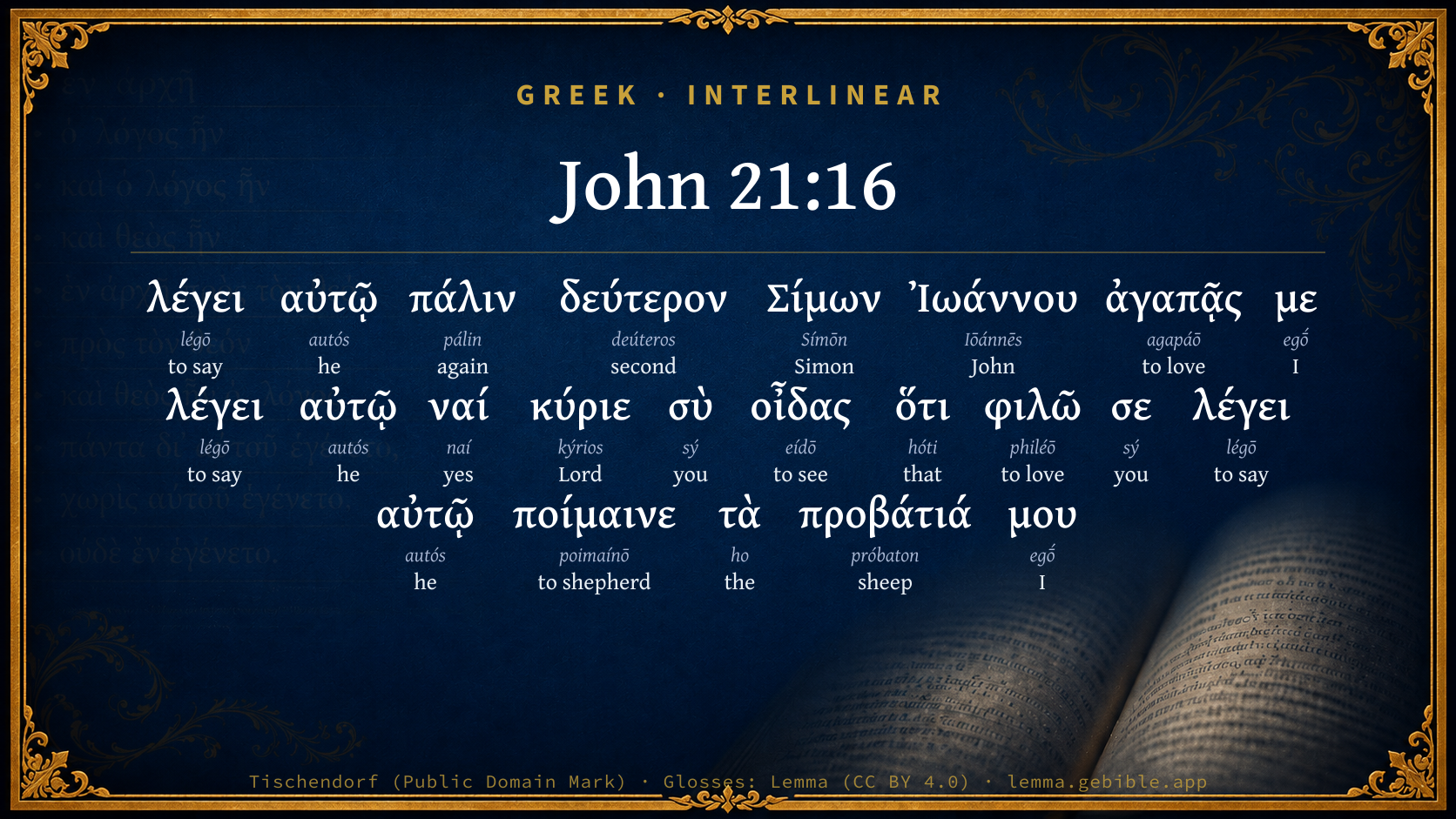
  1. λέγει légō G3004 “to say” Verb, Present, Active, Indicative, 3rd person, Singular
  2. αὐτῷ autós G846 “he” Personal pronoun, Dative, Singular, Masculine
  3. πάλιν pálin G3825 “again” Adverb
  4. δεύτερον deúteros G1208 “second” Adverb
  5. Σίμων Símōn G4613 “Simon” Noun, Vocative, Singular, Masculine
  6. Ἰωάννου Iōánnēs G2491 “John” Noun, Genitive, Singular, Masculine
  7. ἀγαπᾷς agapáō G25 “to love” Verb, Present, Active, Indicative, 2nd person, Singular
  8. με egṓ G1473 “I” Personal pronoun, 1st person, Accusative, Singular
  9. λέγει légō G3004 “to say” Verb, Present, Active, Indicative, 3rd person, Singular
  10. αὐτῷ autós G846 “he” Personal pronoun, Dative, Singular, Masculine
  11. ναί naí G3483 “yes” Particle
  12. κύριε kýrios G2962 “Lord” Noun, Vocative, Singular, Masculine
  13. σὺ sý G4771 “you” Personal pronoun, 2nd person, Nominative, Singular
  14. οἶδας eídō G1492 “to see” Verb, Perfect, Active, Indicative, 2nd person, Singular
  15. ὅτι hóti G3754 “that” Conjunction
  16. φιλῶ philéō G5368 “to love” Verb, Present, Active, Indicative, 1st person, Singular
  17. σε sý G4771 “you” Personal pronoun, 2nd person, Accusative, Singular
  18. λέγει légō G3004 “to say” Verb, Present, Active, Indicative, 3rd person, Singular
  19. αὐτῷ autós G846 “he” Personal pronoun, Dative, Singular, Masculine
  20. τὰ ho G3588 “the” Article, Accusative, Plural, Neuter
  21. προβάτιά próbaton G4263 “sheep” Noun, Accusative, Plural, Neuter
  22. μου egṓ G1473 “I” Personal pronoun, 1st person, Genitive, Singular

About this verse

These counts appear in no published source. They are computed here, from the morphology-tagged text and Lemma’s own curated glosses. What Lemma adds →

23
words
17
distinct lemmas
Gospels
section

Notable vocabulary

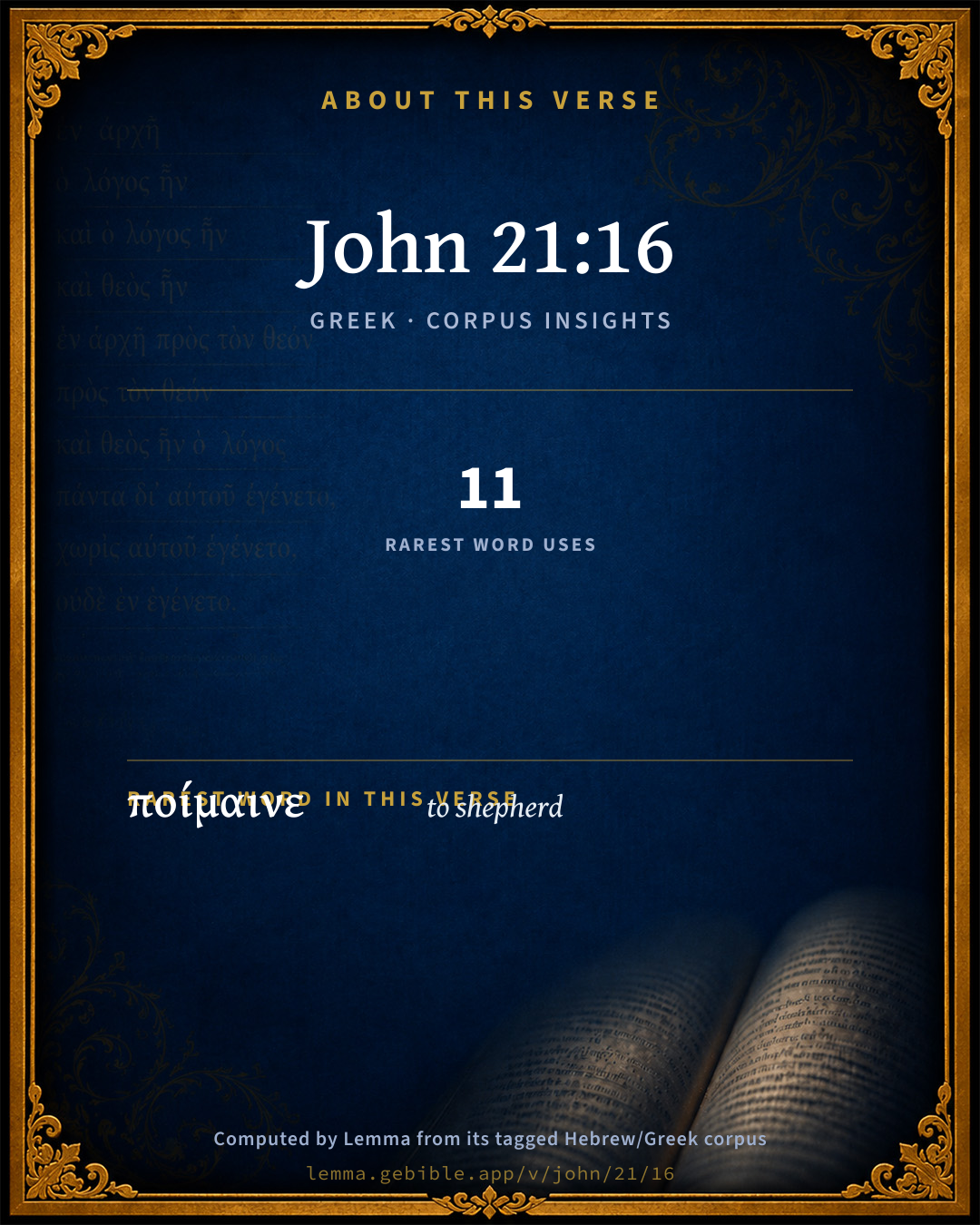
The rarest word here is ποίμαινε to shepherd G4165 — appearing just 11 times in the whole Greek New Testament.

Shared distinctive vocabulary

ποίμαινε to shepherd G4165 occurs in 11 verses of the Greek New Testament. Also found in:

Repetition

Words recur within this verse:

Cross-references

17

Topical passages linked to John 21:16 in the Treasury of Scripture Knowledge — connected by theme and wording, ordered by reader-vote popularity; previews shown in the World English Bible.

  • Acts 20:28 Take heed, therefore, to yourselves, and to all the flock, in which the Holy Spirit has made you overseers, to shepherd the assembly of the Lord and God which he purchased with his own blood.
  • 1 Peter 5:2 Shepherd the flock of God which is among you, exercising the oversight, not under compulsion, but voluntarily, not for dishonest gain, but willingly;
  • 1 Peter 2:25 For you were going astray like sheep; but are now returned to the Shepherd and Overseer of your souls.
  • Psalms 100:3 Know that Yahweh, he is God. It is he who has made us, and we are his. We are his people, and the sheep of his pasture.
  • John 10:11–16 I am the good shepherd. The good shepherd lays down his life for the sheep.
  • Psalms 95:7 For he is our God. We are the people of his pasture, And the sheep in his care. Today, oh that you would hear his voice!
  • Zechariah 13:7 "Awake, sword, against my shepherd, And against the man who is close to me," says Yahweh of Hosts. Strike the shepherd, and the sheep will be scattered; And I will turn my hand against the little ones.
  • Matthew 2:6 'You Bethlehem, land of Judah, Are in no way least among the princes of Judah: For out of you shall come forth a governor, Who shall shepherd my people, Israel.'"
  • Matthew 25:32 Before him all the nations will be gathered, and he will separate them one from another, as a shepherd separates the sheep from the goats.
  • Matthew 26:72 Again he denied it with an oath, "I don't know the man."
  • Luke 15:3–7 He told them this parable.
  • Luke 19:10 For the Son of Man came to seek and to save that which was lost."
  • John 18:17 Then the maid who kept the door said to Peter, "Are you also one of this man's disciples?" He said, "I am not."
  • John 18:25 Now Simon Peter was standing and warming himself. They said therefore to him, "You aren't also one of his disciples, are you?" He denied it, and said, "I am not."
  • Hebrews 13:20 Now may the God of peace, who brought again from the dead the great shepherd of the sheep with the blood of an eternal covenant, our Lord Jesus,
  • John 10:26–27 But you don't believe, because you are not of my sheep, as I told you.
  • Revelation 7:17 for the Lamb who is in the midst of the throne shepherds them, and leads them to springs of waters of life. And God will wipe away every tear from their eyes."

Cross-references courtesy of OpenBible.info (CC BY 4.0).

Where the printed editions differ

1 variant

Places in this verse where the major printed Greek editions disagree on the wording in a way that affects the translation — a comparison of editions, not a manuscript-by-manuscript collation. The editions are the modern critical texts (Nestlé-Aland 28/27, SBL, Westcott-Hort, Tregelles, Tyndale House) and the traditional texts behind the KJV (the Textus Receptus and the Byzantine/Majority text). It is not a claim about which reading is original.

  1. Different wording
    Ἰωάννου,

    “[son] of John,”

    In NA28NA27TynSBLWHTreg Not in TRByz

    Ἰωνᾶ (Iōna) 'of Jonah' occurs in traditional manuscripts (TR+Byz) instead of Ἰωάννου, (Iōannou) '[son] of John,' in older manuscripts (NA28+NA27+Tyn+SBL+WH+Treg)

Textual data: Translators Amalgamated Greek New Testament (STEPBible TAGNT) · CC BY 4.0.

Commentary

Notes on John 21:16 from classic Christian and Jewish commentators (each source and its license shown beneath its notes). The classic Christian expositions comment on the surrounding passage and are grouped to its opening verse, so a note may address several verses; the Jewish commentaries on the Tanakh (Rashi and others) are per-verse, so they appear only where the commentator wrote on this verse.

Lemma curates 59 commentaries, every one of them public domain or Creative Commons licensed, each selected and text-cleaned for this edition rather than reprinted as found. About our sources →

Joseph Benson's Commentary

Joh 21:16-17. He saith unto him again the second (and even the third) time, Simon, &c., lovest thou me? — Doubtless with a view to impress the importance of the question with the greater force on his mind; and perhaps, also, to remind Peter of his having thrice denied him, and thereby given him cause to question the sincerity of his love. But at these two latter times, Christ leaves out the words more than these: because Peter, in his answer, had modestly left them out. Observe, reader, though we cannot say we love Christ more than others do, yet we shall be accepted if we can say we love him indeed. This Peter professes to do again and again, confidently affirming, Yea, or surely, Lord, I love thee. He had a high esteem and value for his Lord; a grateful sense of his kindness; and was entirely devoted to his honour and interest; his desire was toward him, as one he should be undone without; and his delight in him, as one he should be unspeakably happy in. And let it be remembered, those who can truly say that they love the Lord Jesus, may take to themselves the comfort arising from an assurance of their having an interest in him, notwithstanding their daily infirmities. It deserves our notice here, that Peter could appeal to Christ himself for the proof of his love, saying once and again, Thou knowest that I love thee; and the third time, speaking yet more emphatically, Thou knowest all things; thou knowest that I love thee. He doth not vouch his fellow-disciples to witness for him; they might be deceived in him; nor doth he think his own word might be taken; the credit of that was more than shaken already: but he calls Christ himself to witness. Happy they that, on good grounds, can do the same! He saith unto him, Feed my sheep — The word rendered feed in the preceding verse, and in Joh 21:17 th βοσκε, properly means to give food; but the word here used, ποιμαινε, implies more largely to do all the offices of a shepherd, namely, to guide, watch, and defend the sheep, as well as to feed them. “From our Lord’s asking Peter if he loved him, before he gave him commission to feed his lambs and his sheep, it is justly inferred, that to render men duly qualified for the ministerial function, they must prefer the interest and honour of Christ to every other consideration whatever. This is the great qualification by which alone a minister can be animated to go through the labours and difficulties of his office, and be fortified against the dangers which may attend it. Moreover, Christ’s exhortation to Peter to feed his lambs and sheep, being the reply which he made to Peter’s declaration that he loved him, shows us that ministers best testify their love to Christ by their singular care and diligence in feeding his flock. Our Lord’s three-fold repetition of his commission to Peter, was probably in allusion to Peter’s three denials; and as it contains an oblique intimation that his repentance should bear some proportion to his sin, so it seems to have been intended by our Lord to convince the rest of the disciples of the sincerity of Peter’s conversion, and to prevent any slight which he might be exposed to from their suspecting the contrary. However, we are told that Peter was grieved at this repeated application to him: 1st, Because it seemed to him an intimation that Christ doubted the sincerity of his repentance; and to a person of his sanguine temper, nothing could have afforded a more sensible anguish than such a suggestion. 2d, It recalled his crime, with all its aggravating circumstances, into his mind; it renewed his grief for having offended, and it increased that grief from a consideration that he had given sufficient grounds for suspecting his fidelity, even after his conversion. 3d, It put him in fear lest his Master foresaw some further misconduct of his, which would be as great a contradiction to his professions of love to him as the former was. One would wonder that from circumstances so evidently humiliating to the mind of Peter, the Papists could have inferred a grant to him of supreme dominion over the church, clergy as well as laity; as if a charge to serve the sheep, gave a power to lord it over all the shepherds. The passage has doubtless a quite different meaning; for Peter, by his late cowardice and perfidy, having, as it were, abdicated the apostleship, was hereby no more than formally restored to his office, through the indulgence of his kind and merciful Master; and not raised to any new dignity above his brethren.” See Macknight, and Tillotson’s Works.

Joseph Benson's Commentary on the Old and New Testaments (1811–1818) — public domain. Text from a community e-Sword module.

Bengel's Gnomon

Johann Albrecht Bengel

Joh 21:16. Ποίμαινε, feed) This verb Peter has repeated in his first Epistle, ch. Joh 5:2.—πρόβατα, sheep) The Latin Vulg. has, in the second answer, ‘agnos’:[407] although it comes to the same thing, as we shall presently see. By far the most frequent form in which this saying was quoted, was, Feed My sheep. Therefore more modern transcribers have introduced into John the formula which Ancient writers employed; and John seems to have written ἀρνία in this second place. [A different judgment is passed upon this reading in the margin of both Ed. and in Vers. Germ., wherein the word ἈΡΝΊΑ is approved of only in the first place, Joh 21:15: however, the subject itself, exhibiting as it does three periods, equally favours each of the two views.—E. B.]; (and the more recent Greeks seem to have laid hold of πρόβατα); so that thus there are three distinct sentences in Joh 21:15-17, ΒΌΣΚΕ ΤᾺ ἈΡΝΊΑ ΜΟΥ· ΠΟΊΜΑΙΝΕ ΤᾺ ἈΡΝΊΑ ΜΟΥ· ΒΌΣΚΕ ΤᾺ ΠΡΌΒΑΤΆ ΜΟΥ. In these three sentences the flock that is committed to Peter is distributed into three ages; and the flock of the first age comes under the appellation, lambs; that of the third age, under the appellation, sheep (which, however, are never without lambs growing up to maturity); therefore the flock of the second age fall under the appellation of sheep still somewhat tender, or of lambs already become somewhat hardy. The distinction between the nouns, which the Greek language hardly admitted of, is compensated for by the distinction of the verbs, βόσκε and ΠΟΊΜΑΙΝΕ: ΒΌΣΚΕΙΝ is a part of ΠΟΙΜΑΊΝΕΙΝ. And, though the Hebrew language did not admit of these distinctions in the words, it does not follow that John could not have expressed the sense of our Lord by the convenient propriety of distinctions which the Greek words afforded. It is with this meaning that the Syr[408] Version puts, in Joh 21:15-17, after the verb, Feed, three different nouns, to which lambs, little sheep (‘oviculæ’), sheep, correspond. And similarly Ambrosius writes on Luke 24., “In fine, in the third instance Peter is desired to feed, not the lambs, as in the first instance, nor the little sheep (oviculas), as in the second instance, but the sheep; i.e. that having become more perfect himself, he should govern the more perfect.” Maximus says, in his discourse concerning SS. Peter and Paul, that the little sheep were commended to Peter, as also the sheep. Neither of these writers, indeed, reads in Joh 21:16, προβάτια, as Bellarmine contends in his B. I. concerning the Roman Pontiff, ch. 16., whilst seeking to find marvellous classes of sheep, subject to the Pope: but at all events those ancient writers acknowledged the gradation in the three sentences, which most delightfully accords with 1Jn 2:13-14, “Fathers—young men—little children.” Between this discourse and the death of Peter there elapsed thirty-six years: and this discourse itself divides that space of time into almost three equal periods. During the first. Peter fed the tender age of the Christian Church, or in other words the lambs; the appellation of which is in consonance with that appellation which is found in Acts, viz. disciples, to which afterwards the appellation, brethren, succeeded. See on Mat 10:1-2. [The Apostles were often called disciples before Pentecost; after it never, but apostles. In Acts, those who either had learned with, or were learning from the apostles, were called disciples. After Act 6:1; Act 21:16, the term disciples does not occur in the New Testament, but they are called brethren, Christians, believers, saints, etc.] In the second period, he brought to him, ruled, and gathered together, the sheep. In the third, he fed the Church collected out of Jews and Gentiles up to the time of his martyrdom.

[407] b has ‘oviculas.’ But ABacd support πρόβατα.—E. and T.

[408] yr. the Peschito Syriac Version: second cent.: publ. and corrected by Cureton, from MS. of fifth cent.

Bengel's Gnomon of the New Testament — English translation (T&T Clark, Edinburgh, 1860) — public domain. Text from a community e-Sword module.

Expositor's Greek Testament

ed. W. Robertson Nicoll

Joh 21:16 . To this confession, the Lord responds, Βόσκε τὰ ἀρνία μου , “Feed my lambs,” showing that Jesus could again trust him and could leave in his hands those whom He loved. “Lambs” is used instead of “sheep” to bring out more strongly the appeal to care, and the consequent complete confidence shown in Peter. λέγει … μου . The second inquiry is intended to drive Peter back from mere customary or lip-profession to the deep-lying affections of his spirit. But now no comparison is introduced into the question, which might be paraphrased: “Are you sure that love and nothing but love is the bond between you and me?” This test Peter stands. He replies as before; and again is entrusted with the work in which his Lord is chiefly interested, Ποίμαινε τὰ πρόβατά μου . No different function is intended by ποίμαινε : it repeats in another form the commission already given.

The Expositor's Greek Testament, edited by W. Robertson Nicoll (1897–1910) — public domain. Text from a community e-Sword module.

Cambridge Greek Testament for Schools and Colleges

16, 17. προβάτια for πρόβατα: in Joh 21:16 the balance of evidence against πρόβατα is less strong than in Joh 21:17.

16. Jesus drops πλέον τούτων, which the humbled Apostle had shrunk from answering, but retains His own word ἀγαπᾷς. With πάλιν δεύτερον comp. Joh 4:54 and πάλιν ἐκ δευτέρου (Act 10:15), πάλιν ἄνωθεν (Gal 4:9), rursus denuo. Winer, p. 755.

ποίμ. τ. προβάτιά μ. Tend, or shepherd, My sheep. Βόσκειν is ‘to supply with food,’ as of the herd of swine (Mat 8:30; Mat 8:33; Mar 5:11; Mar 5:14; Luk 8:32; Luk 8:34; Luk 15:15; the only other passages where it occurs in N.T.): ποιμαίνειν is ‘to be shepherd to:’ literally Luk 17:7; 1Co 9:7; figuratively Mat 2:6; Act 20:28; 1Pe 5:2. Comp. Jud 1:12; Rev 2:27; Rev 7:17; Rev 12:5; Rev 19:15. It implies more of guidance than βόσκειν does. The lambs, which can go no distance, scarcely require guidance; their chief need is food. The sheep require both.

Cambridge Greek Testament for Schools and Colleges (Cambridge University Press, 1896; 21 vols, various authors incl. Carr, Maclear, Plummer, Farrar, Lumby, Moule, M. R. James, Simcox) — public domain. Text from a community e-Sword module.

Jamieson, Fausset & Brown

Robert Jamieson, A. R. Fausset & David Brown

He saith to him . . . the second time . . . lovest thou me, &c.--In this repetition of the question, though the wound was meant to be reopened, the words "more than these" are not repeated; for Christ is a tender as well as skilful Physician, and Peter's silence on that point was confession enough of his sin and folly. On Peter's repeating his protestation in the same words, our Lord rises higher in the manifestation of His restoring grace.

Feed--keep.

my sheep--It has been observed that the word here is studiously changed, from one signifying simply to feed, to one signifying to tend as a shepherd, denoting the abiding exercise of that vocation, and in its highest functions.

Jamieson, Fausset & Brown — Commentary Critical and Explanatory on the Whole Bible (1871) — public domain (CC PDM 1.0). Text via the HelloAO Bible API.

John Calvin's Commentaries

16. Feed my sheep. Christ does not give to Peter and others the office of feeding all sorts of persons, but only his sheep or his lambs. He elsewhere describes who they are whom he reckons to belong to his flock.

My sheep, says he, hear my voice, and follow me; they hear not the voice of a stranger, (John 10:5, 27.)

True, faithful teachers ought to endeavor to gather all to Christ; and as they cannot distinguish between sheep and wild beasts, they ought to try by all methods if they can tame those who resemble wolves rather than sheep. But after having put forth their utmost efforts, their labor will be of no avail to any but the elect sheep; for docility and faith arise from this, that the heavenly Father delivers to his Son, that they may obey him, those whom he elected before the creation of the world. Again, we are taught by this passage, that none can be fed to salvation by the doctrine of the Gospel but those who are mild and teachable; for it is not without reason that Christ compares his disciples to lambs and sheep; but it must also be observed, that the Spirit of God tames those who by nature were bears or lions.

John Calvin's Commentaries (1540-1563) — public domain. Text from the Calvin Translation Society English edition (1840s-50s) via the Christian Classics Ethereal Library (ccel.org). Calvin's coverage is partial (roughly two-thirds of the Bible); uncommented books and verses are honest gaps, never fabricated. The 19th-century editor's footnotes and remarks are omitted so the notes are faithfully Calvin's own voice.

Ellicott's Commentary for English Readers

(16) He saith to him again the second time.—The question is repeated in exactly the same form, except that our Lord does not continue the comparison “more than these.” He uses the same word for the higher, more intellectual love, and Peter replies by the same declaration of personal attachment, and the same appeal to his Master’s knowledge of him.

Feed my sheep.—Better, be a shepherd of My sheep. The Vatican and Paris MSS. read “little sheep” here, and in the following verse. (See Note there.)

A Bible Commentary for English Readers, edited by Charles John Ellicott (1878–1897) — public domain. Text from a community e-Sword module.

The Cambridge Bible for Schools and Colleges

gen. ed. J. J. S. Perowne

16. lovest thou me?] Jesus drops the ‘more than these,’ which the humbled Apostle had shrunk from answering, but retains His own word for ‘love.’ S. Peter answers exactly as before.

Feed my sheep] Better, Tend, or shepherd, My sheep. The word rendered ‘feed’ in Joh_21:15; Joh_21:17 (boskein) means ‘supply with food.’ Comp. Mat_8:30; Mat_8:33; Mar_5:11; Mar_5:14; Luk_8:32; Luk_8:34; Luk_15:15 (the only other passages where the word occurs in N.T.) of the feeding of the herd of swine. The word used here (poimainein) means rather ‘be shepherd to.’ It is used literally Luk_17:7; 1Co_9:7; and figuratively Mat_2:6; Act_20:28; 1Pe_5:2. Comp. Judges 12; Rev_2:27; Rev_7:17; Rev_12:5; Rev_19:15. Tending implies more of guidance and government than feeding does. The lambs, which can go no distance, scarcely require guidance, their chief need is food. The sheep require both.

The Cambridge Bible for Schools and Colleges (gen. ed. J. J. S. Perowne; Cambridge University Press, 1878–1918) — public domain. Text from a community e-Sword module.

John Gill's Exposition

He saith unto him again the second time,.... Willing to have the expressions of his love repeated and confirmed;

Simon, son of Jonas, lovest thou me? he leaves out the words, "more than these", though Nonnus expresses them; he saw Peter's heart, and observed the modesty of his answer, and would not urge him any more in that comparative way, only required a repetition of his sincere and hearty love to him:

he saith unto him, yea, Lord, thou knowest that I love thee; expressing himself in the same language as before; and it is, as if he should say, Lord, what can I say more? I can say no more than I have done, and by that I abide:

he saith unto him, feed my sheep; both the lost sheep of the house of Israel, and his other sheep among the Gentiles, whom the Father had given him, and he had paid a price for, and must be brought in; these being called, he would have fed with the word and ordinances, with the bread of life, and water of life, not lorded over, and fleeced, and much less worried and destroyed; every instance of care and love shown to these, he takes as a mark of affection and respect to himself.

John Gill's Exposition of the Whole Bible (1746–1763) — public domain (CC PDM 1.0). Text via the HelloAO Bible API.

Trapp's Complete Commentary

John Trapp

16 He saith to him again the second time, Simon, son of Jonas, lovest thou me? He saith unto him, Yea, Lord; thou knowest that I love thee. He saith unto him, Feed my sheep.

Ver. 16. Feed my sheep] That is, Supremum is Ecclesia Dominium tibi assere. Lord it over the Church, saith Baronius. Regio more impera, reign as a king, saith Bellarmine. Christ, on the contrary, saith, The kings of nations exercise dominion over them, but ye shall not do so. And Peter himself saith to his fellow elders, Feed the flock of God, not as lording it over God’s heritage, 1Pe 5:2-3. Indeed ποιμαινω, here used, sometimes signifies to govern (usually to feed), but βοσκω, the other word twice used here in this text, always signifies to feed. But they catch at government, let go feeding. It is as rare a thing to hear a bishop preach among them, said Dr. Bassinet, as to see an ass fly. Fisco potius apud multos consulitur quam Christo; attonsiona potius gregis quam attentioni.

John Trapp, A Commentary or Exposition upon All the Books of the Old and New Testament (1647–1656) — public domain. Text from a community e-Sword module.

Albert Barnes' Notes on the Bible

Feed my sheep - The word here rendered “feed,” as has been remarked, is different from the word in the previous verse. It has the sense of governing, caring for, guiding, protecting - the kind of faithful vigilance which a shepherd uses to guide his flock, and to make provision against their wants and dangers. It may be implied here that the care needed for the young in the church is to instruct them, and for those in advanced years both to instruct and govern them.

My sheep - This term commonly denotes the church in general, without respect to age, John 10.

Albert Barnes' Notes on the Bible (1834–1885) — public domain. Text from a community e-Sword/MySword module.

Haydock's Catholic Bible Commentary

The lambs and the sheep of our Saviour here mean the faithful, who compose his Church, without any distinction of Jew or Gentile. St. Peter, by these words, is appointed to take charge of the whole flock, as being the chief and prince of the apostles. He is, in some manner, the pastor, not of the sheep only, but of the pastors themselves. They have each their own flock to look after; but to him is committed the care of all; he alone is the pastor of all. (Calmet) --- Feed my sheep. Our Lord had promised the spiritual supremacy to St. Peter; (St. Matthew xvi. 19.) and here he fulfils that promise, by charging him with the superintendency of all his sheep, without exception; and consequently of his whole flock, that is, of his whole Church. (Challoner)

George Leo Haydock (1774–1849), Haydock's Catholic Family Bible and Commentary, 1859 edition — public domain. Excludes Psalms (Douay-Rheims chapter numbering differs from Protestant) and Deuterocanonical books (Catholic canon only).

Matthew Poole's English Annotations

Divines here raise a question, why our Saviour propounds this question thrice to Peter. The most of the ancients agree, that it was because Peter had thrice denied him. Some say, it was to show his great love to his church, which he could not commit to Peter but after three inquiries if he truly loved him, who was the Lord of it. Others refer it to the three ways by which good pastors ought to feed the church; prayer, preaching, and a holy life. Others think, that it hath reference to the three flocks that Peter was to feed; the Jews in Judea, the Gentiles, the dispersed amongst the Gentiles.

Matthew Poole's English Annotations on the Holy Bible (1683–1685) — public domain. Text from a community e-Sword/MySword module.

Whedon's Commentary on the Bible

Daniel D. Whedon

16. Lovest thou me?—Jesus still uses the moral term for love, and omits the comparison which Peter had declined to accept. Peter still refers to Jesus’s knowledge, and again uses the affectional term for love. Thus: Prizest thou me? Answer: Thou knowest I love thee.

Feed my sheep— Rather shepherd my sheeplings. Before the word was to feed; now it is to perform the whole shepherd’s office. Before it was lambs; now the Greek word for young and not full-grown sheep is used.

Daniel D. Whedon (gen. ed.), Commentary on the Old and New Testaments (1874–1909) — public domain. Text from a community e-Sword module.

The Pulpit Commentary

He saith to him again the second time, Simon, son of Jonas (John), lovest thou me? Here our Lord omits, as Peter had done, the "more than these," but he again, with perhaps deeper meaning, uses the word agapav . Dost thou render me even more in one sense, though less in another, of thy heart"s reverence? Dost thou treat me with the confidence and esteem, submission and admiration, which are my due? Again Peter, with his heart bursting with personal affection, feels that he can and must say, Yea, Lord; thou knowest that I love thee (filw ere; i.e. love thee dearly). The commission that follows is the second stage of pastoral office. He saith to him, Tend ("act the part of shepherd") my sheep. Christ is the "good Shepherd," and, as Peter puts it in 1Pe_5:4, the "chief Shepherd." He has laid down his life with a view of taking it again, and ever after discharging the functions of the Shepherd. He means to bring all the "sheep" into one flock. They shall all hear his voice, and receive from him everlasting life. Meanwhile the leader of the apostles is made to appreciate that love is the condition of all healthy guidance. Faculty for rule is part of the very nature of the pastoral care. The sheep will need this even more than the "lambs;" the old disciples will require, even more than the young converts, both direction and command In this respect the subsequent career of Peter was more conspicuous than that of the rest of the apostles. (Rev_2:27 Rev_7:17 Act_20:28 1Pe_5:2 for the use of the word) But the shepherding of the sheep is an essentially necessary and integral portion of every pastor"s care. When assailed by the wolf of heresy, by the hostile marauder, by new conditions of any kind, by special danger, unless he can in self-forgetting love pilot and protect his flock, he is no true shepherd.

The Pulpit Commentary (1880–1919), ed. H.D.M. Spence-Jones & Joseph S. Exell — public domain. Text from a community e-Sword module.

Scofield Reference Notes

C. I. Scofield

lovest (Greek - καταφιλέω, deeply love; used of divine love Joh 14:21 and of that love which the law demands Luk 10:27

love (Greek - καταφιλέω, am fond of). It is a lesser degree of love than agapas.

Feed tend; 1Pe 5:1-3

The Scofield Reference Bible (1917 edition), notes by C. I. Scofield — public domain. Text from a community e-Sword module.

The People's New Testament

B. W. Johnson

16. Feed my sheep. A second time the Lord probes Peter with the question. Let it be noted that he does not call him Peter, “the rock,” any longer. So frail a disciple could only be called Simon. The Christ again commissions him to work, “Feed my sheep.” Not only the lambs, but he may look after the sheep of the fold, watch over the disciples of the Lord, young and old. Three times Peter had denied the Master; three times the Master questions his love; three times he gives him charge concerning his work. The questioning was painful, Peter was grieved, but the grief was wholesome, and Peter's whole subsequent life bore proof of the discipline. His rashness was forever gone.

B. W. Johnson's The People's New Testament with Notes (1889–1891) — public domain. Electronic text from the Christian Classics Ethereal Library (CCEL) ThML edition.

Alford’s Greek Testament

Henry Alford

16. πάλιν δεύτερον] The words are found together in Joh 4:54.

Henry Alford, The Greek Testament (1849–1861) — public domain. Text from a community e-Sword module.

International Critical Commentary

16. λέγει αὐτῷ πάλιν δεύτερον. For this tautological phrase, see on 4:54.

Σίμων Ἰωάνου, ἀγαπᾷς με; The “more than these” of v. 15 is now dropped. And Peter’s answer is the same as before: ναί, … φιλῶ σε. The reply ποίμαινε τὰ προβάτιά μου is only to be distinguished from βόσκε τὰ ἀρνία μου (v. 15) or βόσκε τὰ πρόβατά μου (v. 17), in so far as it entrusts a different section of the flock to the pastoral care of Peter. To distinguish ποιμαίνειν from βόσκειν here is a modern subtlety, unknown to Christian antiquity; and it has been shown above to be without support from the LXX use of these verbs, which consistently represent the same Hebrew root.

International Critical Commentary — older volumes (1896–1929), various authors — public domain. Text from a community e-Sword module.

Vincent's Word Studies in the New Testament

Marvin R. Vincent

Lovest [αγαπας] . Again the colder word, but more than these is omitted.

I love [φιλω] . Peter reiterates his former word expressive of personal affection.

Feed [ποιμαινε] . A different word : tend, as Rev. See on 1Pe 5:2. Sheep [προβατα] . Some of the best texts read probatia, diminutive, little sheep.

Marvin R. Vincent, Word Studies in the New Testament (1887–1900) — public domain. Text from a community e-Sword/MySword module.

Godet's Commentaries

Frédéric Louis Godet

Vv. 16, 17. “Jesus says to him again the second time, Simon, son of Jona, lovest thou me? He says to him, Yes, Lord, thou knowest that I love thee. He says to him, Lead my sheep. 17. He says to him the third time, Simon, son of Jona, lovest thou me? Peter was grieved because he had said to him the third time, Lovest thou me? And he said to him, Lord, thou knowest all things, thou knowest that I love thee. Jesus says to him, Feed my sheep.”

Jesus renews His question, “in order,” as Weiss says, “to press Peter to a more severe examination of himself.”

As the: more than these, had attained its end, Jesus now pardons the apostle; but he persists in the use of the more elevated term to designate the love, ἀγαπᾶν . Peter, on his side, does not have the boldness to apply such a term to himself; but he so much the more emphatically affirms his love in the more modest sense of the wordφιλεῖν, and by appealing anew to the scrutinizing glance of the Lord. On this condition, Jesus again confides to him His flock, but with two characteristic differences. For the word βόσκειν, feed, which refers especially to the collective or private teaching by the word, He substitutes the term ποιμαίνειν, to lead, a term which denotes rather the government of the Church as a whole. According to the Vatican and Ephrem MSS., He uses here the termπροβάτια, properly speaking little sheep, beloved sheep, instead of πρόβατα, sheep. And this reading may be the true one; for, while expressing a shade of feebleness, like the word lambs, this word yet denotes a more advanced state, and forms the transition to the term sheep, πρόβατα, in the third phase of the conversation.

Finally, the third question leaves no longer any doubt for Peter respecting the humiliating fact which the Lord wishes to recall to him, and this recollection affects him the more painfully as Jesus this time substitutes for the termἀγαπᾶν, as Peter had himself done from the beginning, the term φιλεῖν, whereby He seems to call in question even the attachment of an inferior order which the apostle had modestly claimed for himself. Peter feels the point of the sword penetrating to the quick. This time he suppresses the yes, the expression of his personal consciousness, and limits himself to making an appeal even more humbly to the penetrating glance of the Lord:

“Thou knowest all things!” It is under this glance of omniscience that he places himself, as if to say: “See for Thyself if I do not love Thee!” This appeal to the higher knowledge of Jesus springs from the painful feeling of the great illusions which he had indulged respecting himself (Weiss). Three ancient manuscripts read here (as two of them do above) προβάτια; but is it not probable that the copyists, not apprehending the shades of meaning, wrongly repeated this diminutive, and that Jesus said this time πρόβατα, my sheep, which denotes again the whole flock, but considered as in the normal condition? Jesus resumes the term feed, whereby He gives Peter to understand that the general government of the Church is not to prevent the shepherd from occupying himself with the individual and collective instruction of the members of his flock. Act 20:31 shows clearly that it was thus that the apostles understood their holy commission. The passage 1Pe 5:1-4 seems to be an echo of these words of Jesus addressed to the author of that epistle.Westcott rightly sets forth with emphasis the thrice repeated pronoun μου (my). The Lord does not give up His right of property in those whom He confides to His servants. “Oves meas pasce,” says Augustine, “sicut meas, non sicut tuas.”

After having restored to Peter his former governing position, Jesus announces to him, Joh 21:18-19 a, what will be the end of his ministry. The connection between this new idea and the preceding dialogue is easy to be apprehended. Peter learns in what way it will be given to him to testify to his Master the love of which he has just made profession, and thus completely to efface his denial.

Frédéric Louis Godet — Commentaries on Luke, John, Romans, and 1 Corinthians — English translation (T&T Clark, Edinburgh, 1870s–1890s) — public domain. Text from a community e-Sword module.

Lesson kit

Teaching starters — assembled from the data on this page, not authored interpretation. Every prompt links to the verse data it draws on. Edit before teaching.

John, in the Gospels, opens this verse with 23 words (17 distinct Greek lemmas). Its most distinctive word is poimaínō (“to shepherd”). A historical commentator’s framing appears above. Read the whole chapter for the surrounding context.

Discussion questions

  1. What does “to shepherd” (poimaínō) contribute to the verse as a whole?
  2. How does Matthew 2:6, which shares the word «to shepherd», read alongside this verse?
  3. What does the repetition of “to say” (3× in this one verse) do in this verse?
  4. The translations on this page render this verse differently — a whole-verse word diff, not a word-by-word alignment. What might account for the different wordings?
  5. Compare how Joseph Benson's Commentary and Bengel's Gnomon read this verse. Where do they agree or differ?

Things to notice

Reading settings

Reading text

Shown beneath each verse's original-language words.

Old Testament
Old Testament edition

Read the OT as the Masoretic Hebrew (MT) or the Greek Septuagint (LXX).

English shown for the Greek Septuagint (in the Hebrew ↔ Greek comparison).

Comparing translations? Open the Compare panel on any verse page to stack up to four side by side.