
Deuteronomy 32:15

Hebrew (Westminster Leningrad Codex) Deuteronomy 32:15 appears in the Hebrew Old Testament. The text above is from the Westminster Leningrad Codex. Each word links to its Strong’s number, a concise gloss, and parsing drawn from the Open Scriptures Hebrew Bible morphology. Click any word for its full Brown-Driver-Briggs (BDB) entry.
Download image
Cite this verse

Deuteronomy 32:15 (World English Bible). Public Domain. Lemma interlinear Bible study tool, https://lemma.gebible.app/v/deuteronomy/32/15.

Show BibTeX & RIS
BibTeX
RIS
English Translation
But Jeshurun grew fat, and kicked: You have grown fat, you are grown thick, you are become sleek; Then he forsook God who made him, Lightly esteemed the Rock of his salvation.
World English Bible · Public Domain
Highlights
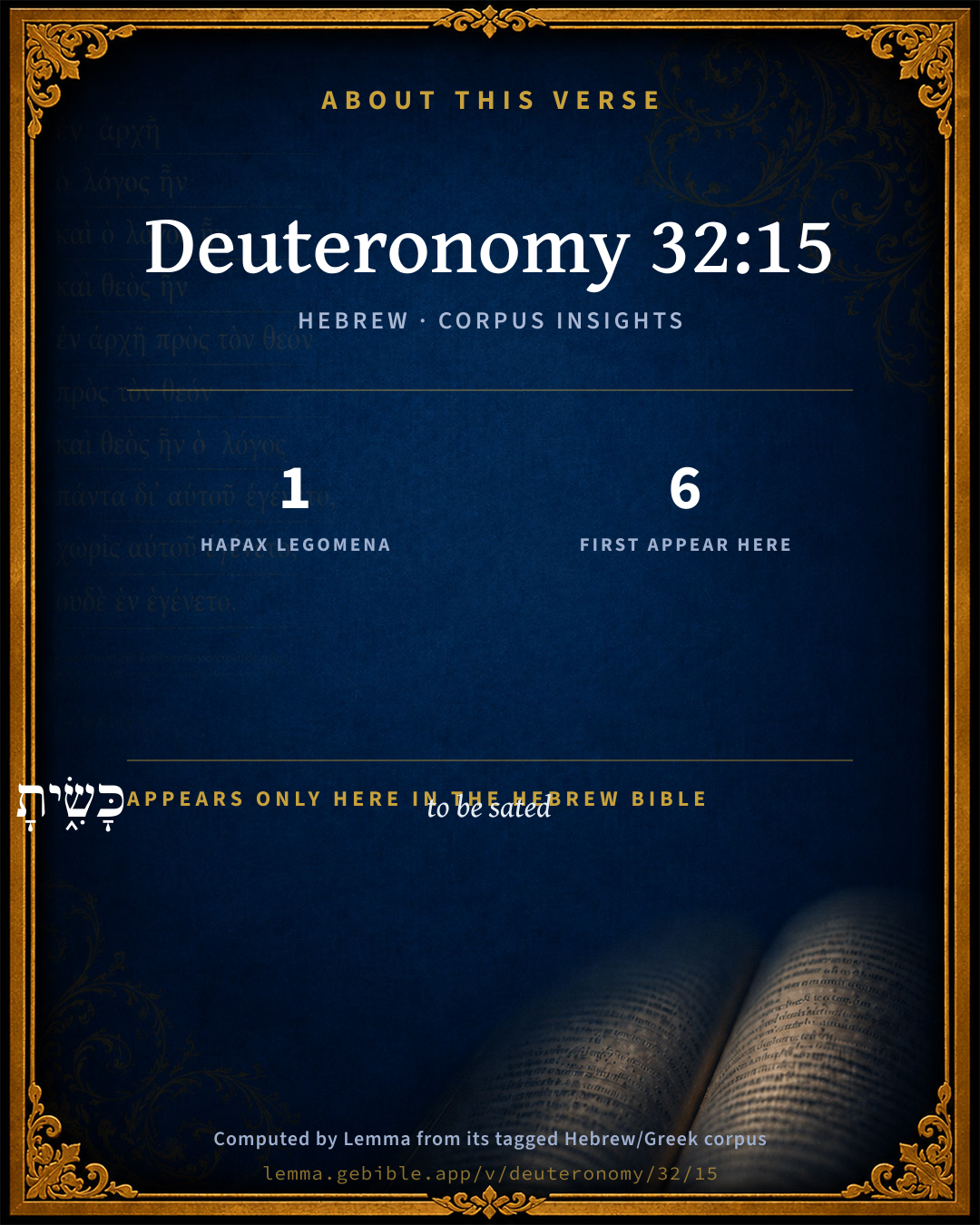
  • 1 hapax legomenon — only here in the Hebrew Bible
  • 6 first appearances in the Hebrew Bible
Full analysis ↓
Download a study sheet

One document with this verse’s original text, its word-by-word gloss line, the meaning frame, cross-references with their text, attributed commentary, and full source and license credits — printable, and it pastes into notes with its structure intact.

This verse Autodidact and up

Study sheet (.html) Plain text (.txt)

A passage Seminary Student

Up to 50 verses in one chapter. A passage sheet keeps up to 6 commentary sources and 12 cross-references per verse, in the order this page ranks them, and says so on the sheet whenever that leaves anything out. Ask for a single verse and you get the Autodidact verse sheet above.

Everything on this page stays free to read, with no account — the sheet is a download of what is already on screen, not access to it.

Want to remove ads? Support Godless Engineer
Compare translations 3

The same verse in 3 English versions, stacked beneath the original-language interlinear above. Click any original word for its lexicon entry.

Each is an independent rendering of the whole verse — the interlinear is not word-aligned to these translations.

Highlighted words mark where these versions differ — a whole-verse word diff, not a word-by-word alignment.

  • World English Bible Public Domain
    But Jeshurun grew fat, and kicked: You have grown fat, you are grown thick, you are become sleek; Then he forsook God who made him, Lightly esteemed the Rock of his salvation.
  • King James Version Public Domain
    But Jeshurun waxed fat, and kicked: thou art waxen fat, thou art grown thick, thou art covered with fatness; then he forsook God which made him, and lightly esteemed the Rock of his salvation.
  • unfoldingWord Literal Text CC BY-SA 4.0
    And Jeshurun fattened and kicked— you were fat, you thickened, you gorged— and he abandoned the God made him, and he rejected the Rock of his salvation.

unfoldingWord Literal Text — © unfoldingWord, licensed CC BY-SA 4.0. Word-aligned USFM3 via Door43 (git.door43.org/unfoldingWord/en_ult).

Versions to compare (up to 4)

3 of 4 selected

Show all 18 translations

Every available English version of this verse, each an independent rendering of the whole verse.

  • World English Bible Public Domain
    But Jeshurun grew fat, and kicked: You have grown fat, you are grown thick, you are become sleek; Then he forsook God who made him, Lightly esteemed the Rock of his salvation.
  • Berean Standard Bible Public Domain
    But Jeshurun grew fat and kicked—becoming fat, bloated, and gorged. He abandoned the God who made him and scorned the Rock of his salvation.
  • Majority Standard Bible Public Domain
    But Jeshurun grew fat and kicked—becoming fat, bloated, and gorged. He abandoned the God who made him and scorned the Rock of his salvation.
  • King James Version Public Domain
    But Jeshurun waxed fat, and kicked: thou art waxen fat, thou art grown thick, thou art covered with fatness; then he forsook God which made him, and lightly esteemed the Rock of his salvation.
  • American Standard Version (1901) Public Domain
    But Jeshurun waxed fat, and kicked: Thou art waxed fat, thou art grown thick, thou art become sleek; Then he forsook God who made him, And lightly esteemed the Rock of his salvation.
  • Revised Version (1885) Public Domain
    But Jeshurun waxed fat, and kicked: Thou art waxen fat, thou art grown thick, thou art become sleek: Then he forsook God which made him, And lightly esteemed the Rock of his salvation.
  • Geneva Bible (1599) Public Domain
    But he that should haue bene vpright, when he waxed fat, spurned with his heele: thou art fat, thou art grosse, thou art laden with fatnes: therefore he forsooke God that made him, and regarded not the strong God of his saluation.
  • Douay-Rheims (1899) Public Domain
    The beloved grew fat, and kicked: he grew fat, and thick and gross, he forsook God who made him, and departed from God his saviour.
  • Young's Literal Translation Public Domain
    And Jeshurun waxeth fat, and doth kick: Thou hast been fat -- thou hast been thick, Thou hast been covered. And he leaveth God who made him, And dishonoureth the Rock of his salvation.
  • Literal Standard Version CC BY-SA 4.0
    And Yeshurun waxes fat, and kicks: You have been fat, you have been thick, || You have been covered. And he leaves God who made him, || And dishonors the Rock of his salvation.
  • Unlocked Literal Bible CC BY-SA 4.0
    But Jeshurun grew fat and kicked— you grew fat, you were too fat, and you had eaten your fill— he abandoned the God who made him, and he rejected the Rock of his salvation.
  • unfoldingWord Literal Text CC BY-SA 4.0
    And Jeshurun fattened and kicked— you were fat, you thickened, you gorged— and he abandoned the God made him, and he rejected the Rock of his salvation.
  • Darby Bible Public Domain
    Then Jeshurun grew fat, and kicked -- Thou art waxen fat, Thou art grown thick, And thou art covered with fatness; -- He gave up +God who made him, And lightly esteemed the Rock of his salvation.
  • World Messianic Bible Public Domain
    But Jeshurun grew fat, and kicked. You have grown fat. You have grown thick. You have become sleek. Then he abandoned God who made him, and rejected the Rock of his salvation.
  • Webster's Bible Public Domain
    But Jeshurun waxed fat, and kicked: thou hast waxed fat, thou art grown thick, thou art covered with fatness; then he forsook God who made him, and lightly esteemed the Rock of his salvation.
  • Free Bible Version CC BY-SA 4.0
    But Israel, you grew fat and rebelled—fat, overweight, and bloated with food. You abandoned the God who made you and despised the Rock of your salvation.
  • Bible in Basic English Public Domain
    But Jeshurun became fat and would not be controlled: you have become fat, you are thick and full of food: then he was untrue to the God who made him, giving no honour to the Rock of his salvation.
  • JPS Tanakh (1917) Public Domain
    But Jeshurun waxed fat, and kicked — thou didst wax fat, thou didst grow thick, thou didst become gross — and he forsook God who made him, and contemned the Rock of his salvation.

Literal Standard Version (2020), Covenant Press — licensed CC BY-SA 4.0. Text via the HelloAO Bible API (eBible.org). Unlocked Literal Bible (unfoldingWord) — licensed CC BY-SA 4.0. Text via the HelloAO Bible API (eBible.org). unfoldingWord Literal Text — © unfoldingWord, licensed CC BY-SA 4.0. Word-aligned USFM3 via Door43 (git.door43.org/unfoldingWord/en_ult). Free Bible Version, Dr. Jonathan Gallagher — licensed CC BY-SA 4.0. Text via the HelloAO Bible API (eBible.org).

Word by word

More ways to search: Search by grammar → Find every occurrence → Compare this word →

Practice this passage: Drill this verse → Learn its vocabulary →

כָּשִׂ֑יתָ
kâsâh
H3780
“to be sated”
Verb, Qal, Perfect, 2nd Person, Masculine, Singular
Part of Speech
Verb
Stem
Qal
Form
Perfect
Person
2nd Person
Gender
Masculine
Number
Singular
Full BDB Definition

Origin: a primitive root

TWOT: 1049

(Qal) to become sated, be gorged with food
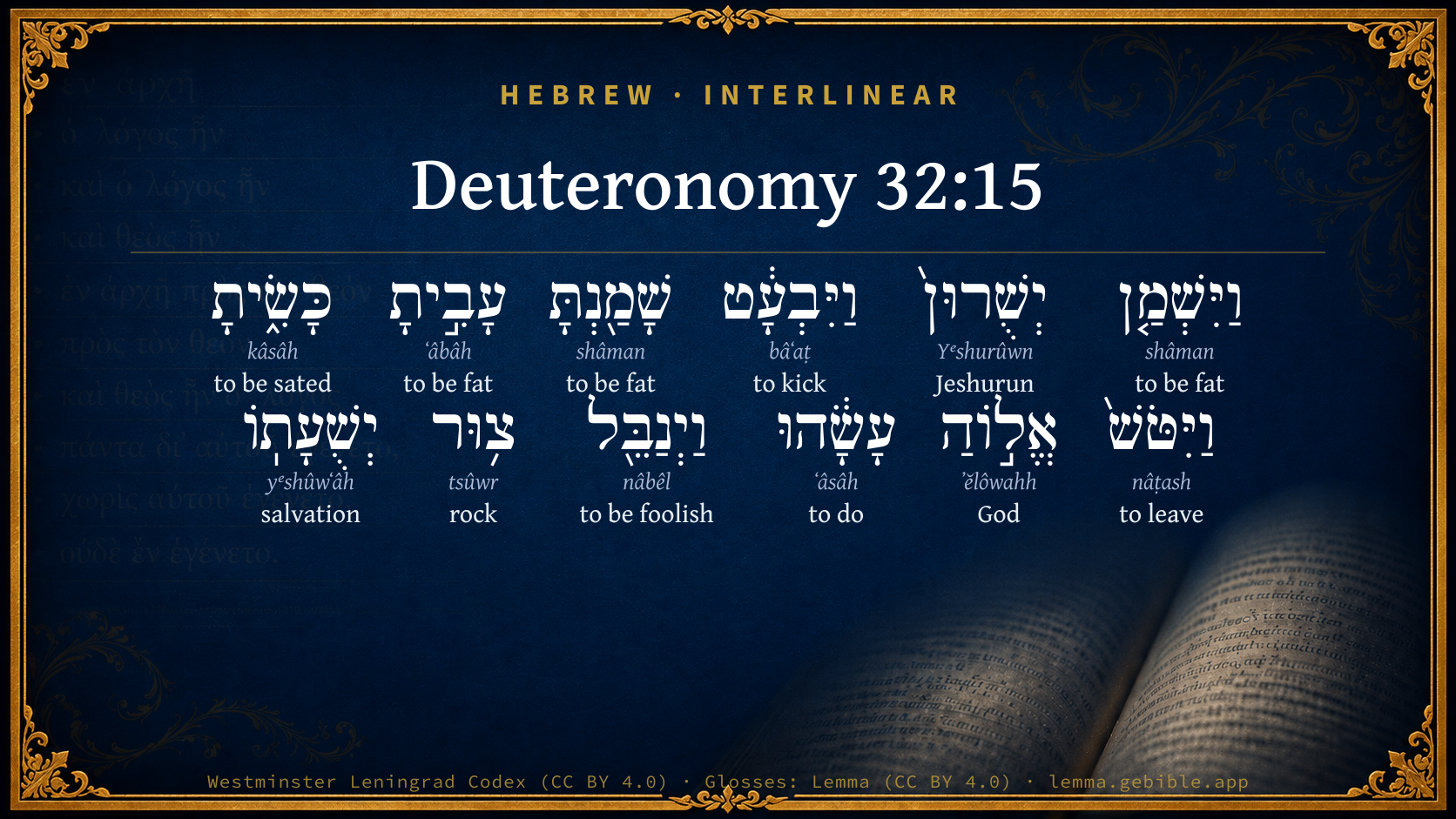
  1. וַיִּשְׁמַ֤ן shâman H8080 “and · to be fat” Conjunction + Verb, Qal, Sequential Imperfect, 3rd Person, Masculine, Singular
  2. יְשֻׁרוּן֙ Yᵉshurûwn H3484 “Jeshurun” Noun, Proper
  3. וַיִּבְעָ֔ט bâʻaṭ H1163 “and · to kick” Conjunction + Verb, Qal, Sequential Imperfect, 3rd Person, Masculine, Singular
  4. שָׁמַ֖נְתָּ shâman H8080 “to be fat” Verb, Qal, Perfect, 2nd Person, Masculine, Singular
  5. עָבִ֣יתָ ʻâbâh H5666 “to be fat” Verb, Qal, Perfect, 2nd Person, Masculine, Singular
  6. וַיִּטֹּשׁ֙ nâṭash H5203 “and · to leave” Conjunction + Verb, Qal, Sequential Imperfect, 3rd Person, Masculine, Singular
  7. אֱל֣וֹהַ ʼĕlôwahh H433 “God” Noun, Common, Masculine, Singular, Absolute
  8. עָשָׂ֔הוּ ʻâsâh H6213 “to do · him” Verb, Qal, Perfect, 3rd Person, Masculine, Singular + Suffix, Personal, 3rd Person, Masculine, Singular
  9. וַיְנַבֵּ֖ל nâbêl H5034 “and · to be foolish” Conjunction + Verb, Piel, Sequential Imperfect, 3rd Person, Masculine, Singular
  10. צ֥וּר tsûwr H6697 “rock of” Noun, Common, Masculine, Singular, Construct
  11. יְשֻׁעָתֽוֹ yᵉshûwʻâh H3444 “salvation · his” Noun, Common, Feminine, Singular, Construct + Suffix, Personal, 3rd Person, Masculine, Singular

About this verse

These counts appear in no published source. They are computed here, from the morphology-tagged text and Lemma’s own curated glosses. What Lemma adds →

12
words
11
distinct lemmas
Pentateuch
section

Notable vocabulary

1 hapax legomenon — a word that appears only here in the entire Hebrew Bible:

  • כָּשִׂ֑יתָ to be sated H3780

First appearance in Scripture

These words make their first canonical appearance in the Hebrew Bible here:

  • וַיִּשְׁמַ֤ן to be fat H8080
  • יְשֻׁרוּן֙ Jeshurun H3484
  • וַיִּבְעָ֔ט to kick H1163
  • עָבִ֣יתָ to be fat H5666
  • כָּשִׂ֑יתָ to be sated H3780
  • אֱל֣וֹהַ God H433

Shared distinctive vocabulary

וַיִּבְעָ֔ט to kick H1163 occurs in 2 verses of the Hebrew Bible. Also found in:

Grammatical profile

  • 8 verbs
  • 4 nouns

Verb forms

  • וַיִּשְׁמַ֤ן Qal · Sequential Imperfect
  • וַיִּבְעָ֔ט Qal · Sequential Imperfect
  • שָׁמַ֖נְתָּ Qal · Perfect
  • עָבִ֣יתָ Qal · Perfect
  • כָּשִׂ֑יתָ Qal · Perfect
  • וַיִּטֹּשׁ֙ Qal · Sequential Imperfect
  • עָשָׂ֔הוּ Qal · Perfect
  • וַיְנַבֵּ֖ל Piel · Sequential Imperfect

Repetition

A word recurs within this verse — often emphatic in Hebrew:

  • וַיִּשְׁמַ֤ן to be fat H8080 ×2

Hebrew & Septuagint length

In English translation the verse runs 32 words from the Hebrew and 33 from the Septuagint (LXX English) — closely comparable.

A rough comparison of the two English renderings, which tokenize alike — not a word-level alignment.

Word counts can differ between the Hebrew and the Greek without any difference in meaning — e.g. the Hebrew direct-object marker אֵת has no separate Greek word, and Greek often adds the article ὁ.

Cross-references

28

Topical passages linked to Deuteronomy 32:15 in the Treasury of Scripture Knowledge — connected by theme and wording, ordered by reader-vote popularity; previews shown in the World English Bible.

  • Deuteronomy 31:20 For when I shall have brought them into the land which I swore to their fathers, flowing with milk and honey, and they shall have eaten and filled themselves, and grown fat; then will they turn to other gods, and serve them, and despise me, and break my covenant.
  • Hosea 13:6 According to their pasture, so were they filled; They were filled, and their heart was exalted. Therefore they have forgotten me.
  • Deuteronomy 33:5 He was king in Jeshurun, When the heads of the people were gathered, All the tribes of Israel together.
  • 1 Samuel 2:29 Why kick you at my sacrifice and at my offering, which I have commanded in [my] habitation, and honor your sons above me, to make yourselves fat with the best of all the offerings of Israel my people?
  • Psalms 89:26 He will call to me, 'You are my Father, My God, and the rock of my salvation!'
  • Acts 28:27 For this people's heart has grown callous. Their ears are dull of hearing. Their eyes they have closed. Lest they should see with their eyes, Hear with their ears, Understand with their heart, And would turn again, And I would heal them.'
  • Jeremiah 5:28 They are grew fat, they shine: yes, they overpass in deeds of wickedness; they don't plead the cause, the cause of the fatherless, that they may prosper; and the right of the needy they don't judge.
  • Deuteronomy 8:10–14 You shall eat and be full, and you shall bless Yahweh your God for the good land which he has given you.
  • Deuteronomy 31:16 Yahweh said to Moses, Behold, you shall sleep with your fathers; and this people will rise up, and play the prostitute after the strange gods of the land, where they go to be among them, and will forsake me, and break my covenant which I have made with them.
  • Deuteronomy 32:4 The Rock, his work is perfect; For all his ways are justice: A God of faithfulness and without iniquity, Just and right is he.
  • Deuteronomy 32:6 Do you thus requite Yahweh, Foolish people and unwise? Isn't he your father who has bought you? He has made you, and established you.
  • Nehemiah 9:25 They took fortified cities, and a fat land, and possessed houses full of all good things, cisterns hewn out, vineyards, and olive groves, and fruit trees in abundance: so they ate, and were filled, and became fat, and delighted themselves in your great goodness.
  • Psalms 73:7 Their eyes bulge with fat. Their minds pass the limits of conceit.
  • Isaiah 1:4 Ah sinful nation, A people loaded with iniquity, A seed of evil-doers, Children who deal corruptly! They have forsaken Yahweh. They have despised the Holy One of Israel. They are estranged and backward.
  • Isaiah 6:10 Make the heart of this people fat; Make their ears heavy, and shut their eyes; Lest they see with their eyes, And hear with their ears, And understand with their heart, And turn again, and be healed."
  • Deuteronomy 6:10–12 It shall be, when Yahweh your God shall bring you into the land which he swore to your fathers, to Abraham, to Isaac, and to Jacob, to give you, great and goodly cities, which you didn't build,
  • Deuteronomy 33:26 There is none like God, Jeshurun, Who rides on the heavens for your help, In his excellency on the skies.
  • 2 Samuel 22:47 Yahweh lives; Blessed be my rock; Exalted be God, the rock of my salvation,
  • Job 15:27 Because he has covered his face with his fatness, And gathered fat on his loins.
  • Psalms 17:10 They close up their callous hearts. With their mouth they speak proudly.
  • Psalms 95:1 Oh come, let's sing to Yahweh. Let's shout aloud to the rock of our salvation!
  • Psalms 119:70 Their heart is as callous as the fat, But I delight in your law.
  • Isaiah 44:2 Thus says Yahweh who made you, and formed you from the womb, who will help you: Don't be afraid, Jacob my servant; and you, Jeshurun, whom I have chosen.
  • Jeremiah 2:5 thus says Yahweh, What unrighteousness have your fathers found in me, that they have gone far from me, and have walked after vanity, and are become vain?
  • Jeremiah 5:7 How can I pardon you? your children have forsaken me, and sworn by them that are no gods: when I had fed them to the full, they committed adultery, and assembled themselves in troops at the prostitutes' houses.
  • Romans 2:4–5 Or do you despise the riches of his goodness, forbearance, and patience, not knowing that the goodness of God leads you to repentance?
  • Psalms 18:46 Yahweh lives; and blessed be my rock. Exalted be the God of my salvation,
  • Acts 9:5 He said, "Who are you, Lord?" The Lord said, "I am Jesus, whom you are persecuting.

Cross-references courtesy of OpenBible.info (CC BY 4.0).

Hebrew and Greek witnesses Masoretic Hebrew ↔ Greek Septuagint

The same verse in the two great witnesses to the Old Testament, shown verse-for-verse.

These are two independent witnesses, not word-aligned to each other, and the Septuagint is shown in lemma (dictionary) form.

Hebrew Deuteronomy 32:15 Masoretic · Westminster Leningrad Codex

וַיִּשְׁמַ֤ן יְשֻׁרוּן֙ וַיִּבְעָ֔ט שָׁמַ֖נְתָּ עָבִ֣יתָ כָּשִׂ֑יתָ וַיִּטֹּשׁ֙ אֱל֣וֹהַ עָשָׂ֔הוּ וַיְנַבֵּ֖ל צ֥וּר יְשֻׁעָתֽוֹ

But Jeshurun grew fat, and kicked: You have grown fat, you are grown thick, you are become sleek; Then he forsook God who made him, Lightly esteemed the Rock of his salvation.

World English Bible · Public Domain

Greek LXX Deuteronomy 32:15 Septuagint · lemma form

καί ἐσθίω ἰακώβ καί ἐνπίμπλημι καί ἀπολακτίζω ὁ ἀγαπάω λιπαίνω παχύνω πλατύνω καί ἐν καταλείπω θεός ὁ ποιέω αὐτός καί ἀποἵστημι ἀπό θεός σωτήρ αὐτός

So Jacob ate and was filled, and the beloved one kicked; he grew fat, he became thick and broad: then he forsook the God that made him, and departed from God his Saviour.

LXX2012 (modern English Septuagint) · Public Domain

On this verse, Ellicott's Commentary for English Readers discusses the Septuagint’s reading. Read the note in Commentary ↓

Hebrew: Westminster Leningrad Codex (CC BY 4.0). Greek: Septuagint (public domain); English from LXX2012 (modern English Septuagint) (Public Domain). How the Septuagint differs from the Hebrew →

Targum (Aramaic paraphrase)

2

The Targum is the ancient Jewish Aramaic paraphrase of the Hebrew Scriptures — an interpretive translation, not the Hebrew text itself. Onkelos (literal) and Pseudo-Jonathan (expansive) render the Torah, and Jonathan the Prophets. Coverage is partial: where no permissively-licensed English translation exists for a verse, only the Aramaic is shown. This is verse-level text, not a word-by-word alignment to the Hebrew.

  1. Targum Onkelos Torah (Genesis–Deuteronomy)
    וְעַתַּר יִשְׂרָאֵל וּבְעַט אַצְלַח תְּקוֹף קְנָא נִכְסִין וּשְׁבַק פָּלְחַן אֱלָהָא דְעָבְדֵהּ וְאַרְגֵז קֳדָם תַּקִיפָא דְפָרְקֵהּ

    (no public-domain English translation for this verse)

    Targum Onkelos — Aramaic: “Onkelos Genesis” (public domain); “Onkelos Exodus” (public domain); “Onkelos Leviticus” (public domain); “Onkelos Numbers” (public domain); “Onkelos Deuteronomy” (public domain). English: “Sefaria Community Translation” (CC0 1.0 (public-domain dedication)); “J.W. Etheridge. The Targums of Onkelos and Jonathan Ben Uzziel on the Pentateuch. London: Longmans, Green, 1862” (public domain). Text via Sefaria.

  2. Targum Pseudo-Jonathan Torah (Genesis–Deuteronomy)
    וְעַתָּרוּ בֵּית יִשְרָאֵל וּפָחֲזוּ אַצְלָחוּ תְּקוֹף קָנִין נִכְסִין וּשְׁבָקוּ פּוּלְחַן אֱלָהָא דִבְרָא יַתְהוֹן וְאַרְגִיזוּ קֳדָם תַּקִיפָא דְפַרְקִינוּן

    But the house of Israel grew rich and wicked; they prospered much and possessed wealth, and forsook the worship of Eloah who created them, and provoked Him to anger who redeemed them.

    Targum Pseudo-Jonathan — Aramaic: “Targum Jonathan on Genesis” (public domain); “Targum Jonathan on Exodus” (public domain); “Targum Jonathan on Leviticus” (public domain); “Targum Jonathan on Numbers” (public domain); “Targum Jonathan on Deuteronomy” (public domain). English: “The Targum of Jonathan ben Uzziel, trans. J. W. Etheridge, London, 1862” (public domain). Text via Sefaria.

Commentary

Notes on Deuteronomy 32:15 from classic Christian and Jewish commentators (each source and its license shown beneath its notes). The classic Christian expositions comment on the surrounding passage and are grouped to its opening verse, so a note may address several verses; the Jewish commentaries on the Tanakh (Rashi and others) are per-verse, so they appear only where the commentator wrote on this verse.

Lemma curates 59 commentaries, every one of them public domain or Creative Commons licensed, each selected and text-cleaned for this edition rather than reprinted as found. About our sources →

Matthew Henry's Commentary

We have here a description of the apostasy of Israel from God, which would shortly come to pass, and to which already they had a disposition. One would have thought that a people under so many obligations to their God, in duty, gratitude, and interest, would never have turned from him; but, alas! they turned aside quickly. Here are two great instances of their wickedness, and each of them amounted to an apostasy from God: -

I. Security and sensuality, pride and insolence, and the other common abuses of plenty and prosperity, Deu 32:15. These people were called Jeshurun - an upright people (so some), a seeing people, so others: but they soon lost the reputation both of their knowledge and of their righteousness; for, being well-fed, 1. They waxed fat, and grew thick, that is, they indulged themselves in all manner of luxury and gratifications of their appetites, as if they had nothing to do but to make provision for the flesh, to fulfil the lusts of it. They grew fat, that is, they grew big and unwieldy, unmindful of business, and unfit for it; dull and stupid, careless and senseless; and this was the effect of their plenty. Thus the prosperity of fools destroys them, Pro 1:32. Yet this was not the worst of it. 2. They kicked; they grew proud and insolent, and lifted up the heel even against God himself. If God rebuked them, either by his prophets or by his providence, they kicked against the goad, as an untamed heifer, or a bullock unaccustomed to the yoke, and in their rage persecuted the prophets, and flew in the face of providence itself. And thus he forsook God that made him (not paying due respect to his creator, nor answering the ends of his creation), and put an intolerable contempt upon the rock of his salvation, as if he were not indebted to him for any past favours, nor had any dependence upon him for the future. Those that make a god of themselves and a god of their bellies, in pride and wantonness, and cannot bear to be told of it, certainly thereby forsake God and show how lightly they esteem him.

II. Idolatry was the great instance of their apostasy, and which the former led them to, as it made them sick of their religion, self-willed, and fond of changes. Observe,

1. What sort of gods they chose and offered sacrifice to, when they forsook the God that made them, Deu 32:16, Deu 32:17. This aggravated their sin that those very services which they should have done to the true God they did, (1.) To strange gods, that could not pretend to have done them any kindness, or laid them under any obligation to them, gods that they had no knowledge of, nor could expect any benefit by, for they were strangers. Or they are called strange gods, because they were other than the one only true God, to whom they were betrothed and ought to have been faithful. (2.) To new gods, that came newly up; for even in religion, the antiquity of which is one of its honours, vain minds have strangely affected novelty, and, in contempt of the Ancient of days, have been fond of new gods. A new god! can there be a more monstrous absurdity? Would we find the right way to rest, we must ask for the good old way, Jer 6:16. It was true their fathers had worshipped other gods (Jos 24:2), and perhaps it had been some little excuse if the children had returned to them; but to serve new gods whom their fathers feared not, and to like them the better for being new, was to open a door to endless idolatries. (3.) They were such as were no gods at all, but mere counterfeits and pretenders; their names the invention of men's fancies, and their images the work of men's hands. Nay, (4.) They were devils. So far from being gods, fathers and benefactors to mankind, they really were destroyers (so the word signifies), such as aimed to do mischief. If there were any spirits or invisible powers that possessed their idol-temples and images, they were evil spirits and malignant powers, whom yet they did not need to worship for fear they should hurt them, as they say the Indians do; for those that faithfully worship God are out of the devil's reach: nay, the devil can destroy those only that sacrifice to him. How mad are idolaters, who forsake the rock of salvation to run themselves upon the rock of perdition!

2. What a great affront this was to Jehovah their God. (1.) It was justly interpreted a forgetting of him (Deu 32:18): Of the Rock that begat thee thou art unmindful. Mindfulness of God would prevent sin, but, when the world is served and the flesh indulged, God is forgotten; and can any thing be more base and unworthy than to forget the God that is the author of our being, by whom we subsist, and in whom we live and move? And see what comes of it, Isa 17:10, Isa 17:11, Because thou hast forgotten the God of thy salvation, and hast not been mindful of the Rock of thy strength, though the strange slips be pleasant plants at first, yet the harvest at last will be a heap in the day of grief and of desperate sorrow. There is nothing got by forgetting God. (2.) It was justly resented as an inexcusable offence: They provoked him to jealousy and to anger (Deu 32:16), for their idols were abominations to him. See here God's displeasure against idols, whether they be set up in the heart or in the sanctuary. [1.] He is jealous of them, as rivals with him for the throne in the heart. [2.] He hates them, as enemies to his crown and government. [3.] He is, and will be, very angry with those that have any respect or affection for them. Those consider not what they do that provoke God; for who knows the power of his anger?

Matthew Henry's Commentary on the Whole Bible (1708–1710) — public domain (CC PDM 1.0). Text via the HelloAO Bible API.

Trapp's Complete Commentary

John Trapp

Deu 32:15 But Jeshurun waxed fat, and kicked: thou art waxen fat, thou art grown thick, thou art covered [with fatness]; then he forsook God [which] made him, and lightly esteemed the Rock of his salvation.

Ver. 15. But Jeshurun waxed fat, and kicked.] Jeshurun, hoc est Integellus, saith one, as Shimshon, or Samson, Solilus, a little sun, but a type of the Sun of Righteousness that hath health in his wings - that is, in his beams. Israel should have been Jeshurun - that is, righteous, or upright before the Lord, Israelites indeed; but were nothing less. If ever they had been better in the time of "their espousals, when they went after God in the wilderness, in a land that was not sown," {Jer 2:2} yet now that they were full fed, they kicked as young mules when they have sucked, matrem calcibus petunt, kick the dams’ dugs. Fulness breeds forgetfulness, and the best are but too prone to surfeit of things of this life, which by our corruption ofttimes prove a snare to our souls. "I will lay a stumbling block." {Eze 3:20} Vatablus’s note there is, Faciam, ut omnia habeant prospera; calamitatibus eum a peccato non revocabo; I will prosper him in all things, and not by affliction restrain him from sin. The most poisonous flies are bred in the sweetest fruit trees. How apt are the holiest to be proud and secure! even as worms and wasps eat the sweetest apples and fruits, Repugnante contra temet ipsam tua faelicitate, saith Salvian: {a} to the Church in his time; thy prosperity is thy bane. And Cum ipsis opibus lascivere coepit ecclesia, saith Platina; {b} The Church began to be rich and wanton at once. Religio peperit divitias, et filia devoravit matrem: Religion brought forth riches, and the daughter soon devoured the mother, saith Augustine. The much wool on the sheep’s back is ofttimes his ruin, he is caught in the thorns and famished. The fatter the ox, the sooner to the slaughter. When the Protestants of France began to grow wanton of their prosperity, and to affect a vain frothy way of preaching, then came the cruel massacre upon them. Should we with the fed hawk forget our master? Or being full with God’s benefits, like the full moon, then get farthest off from the sun, and by an interposition of earthly desires become dark? The cords of love are called "the cords of a man." {Hos 11:4} To sin against mercy is to sin against humanity; it is bestial, nay, it is worse. To render good for evil is divine; to render good for good is humane; to render evil for evil is brutish; but to render evil for good is devilish; as a reverend man hath well observed.

Then he forsook God.] Here Moses, weary of speaking any longer to a gainsaying and disobedient people, turneth his speech to the heaven and earth, whom he had called in to bear witness. {Deu 32:1} So, when a certain people of Italy had commanded the Roman ambassador, Ad quercum dicere, se interim alia acturos, to deliver his embassy to the great oak, for they had somewhat else to do than to give him audience: he answered, Et haec sacrata quercus audiat faedus esse a vobis violatum, {c} I will indeed direct my speech to the oak, and tell it in your hearing, that you have basely broken covenant, and shall dearly answer it.

{a} Salvian, lib. i, /@ad Eccles. Catholic./@

{b} In Benedict. 4.

{c} Livy

John Trapp, A Commentary or Exposition upon All the Books of the Old and New Testament (1647–1656) — public domain. Text from a community e-Sword module.

The Biblical Illustrator

Joseph S. Exell

Deu_32:15

Jeshurun waxed fat, and kicked.

Worldly prosperity

I. A community realising worldly prosperity. Worldly prosperity sometimes comes to a man--

1. Irrespective of his efforts.

2. By his honest efforts.

3. By his dishonest efforts.

II. A community abusing worldly prosperity.

1. In sympathy they withdrew from God.

2. In life they disregarded God.

(1) A great wrong.

(2) A common wrong. (Homilist.)

On the dangers of prosperity

Two main themes run through this song, strongly contrasted, like a cord of bright gold and a black cord twined together. The one which takes the lead is the gracious kindness of the Lord to Israel in the wonderful works wrought for their deliverance and exaltation, and the benefits of all kinds bestowed upon them. Then over against this stands Israels gross misimprovement of these blessings, Israels ingratitude and apostasy, with the judgments which naturally followed their unfaithfulness. The text is the turning point of this wonderful composition. Up to this verse the strain has been (in the main) exultant and cheering, celebrating the lofty distinction to which Israel had been raised; now it becomes sad, threatening, and bewailing an unparalleled declension. How did this come about? It is all contained in these few words, which have a solemn warning for ourselves: Jeshurun waxed fat, and kicked. Jeshurun, the upright one, the people who had been called and set apart to be a holy nation, aiming at righteousness, and who hitherto had been distinguished by a measure of integrity, became corrupted through prosperity.

I. Let us regard men in their social capacity, and with respect to their general worldly interests, and observe how they are commonly affected by abundant prosperity. History is full of instances to show how national character has deteriorated as the wealth and power of a nation have increased. A people, while struggling for existence and contending for liberty, have displayed all the virtues of industry and frugality, of energy and courage, of public spirit and self-denying regard for the common good. Thus they establish their commonwealth and grow strong and powerful. Then riches flow in; luxury follows in their train; the sons soon forget the virtues of their fathers, or despise them; then parties are formed; each class, each individual, is ambitious to cope with or outshine the other. All the petty passions of our nature soon spring up into rank activity. Selfishness reigns, the general good is forgotten, and principles which once were held in honour are derided and spurned.

II. Turn from those aspects of the subject which are national and social to those that concern our churches. Here it is that such an evil is most perilous, and most to be condemned. Nations, societies, even classes of men, undoubtedly have relations to God; they stand indebted to Him for the rich benefits of His providence; and they are verily guilty when they abuse these by self-indulgence and forgetfulness of Him. But their guilt is far less than that of Churches, societies of professing Christians, who decline from the love and allegiance they owe to their Lord. Now, that is the aggravation that is here insisted on by the very use of the title Jeshurun--the Upright. What a base part for those who should be distinguished by this excellence to turn the abundance of the ministries of grace into the occasion of pride, self-confidence, and carelessness! Yet this has happened again and again. In various forms this wanton temper, this self-satisfied, self-indulgent spirit shows itself. Sixty or seventy years ago it came out in Anti-nomianism, which made the Gospel all privilege and no duty, under the pretence of zeal for the freeness of Divine grace. This delusion, which ruined many souls and grievously weakened the energies of the Churches, has vanished to a large extent; but the spirit of it--the spirit of carnal indolence and complacency--lingers still. Self-flattery can assume many shapes, slipping its neck out of the gentle yoke of Christ. But the besetting temptation now is the pride of enlightenment, the conceited notion that we have attained to larger and more liberal views of Christianity; and so the great doctrines of grace are explained away, or so diluted as to be robbed of their strength.

III. Having thus shown the injurious influence of continued prosperity, let me now indicate how this injurious tendency may be corrected.

1. By a constant and grateful recollection of the Source and Giver of our prosperity. This will keep us in our proper place as lowly recipients and debtors, dependents on His bounty.

2. Let us use our resources and advantages as God intends they should be used, and as He Himself sets us an example. God is constantly bestowing. He keeps nothing to Himself.

3. Let us not desire prosperity for itself. (A. Thompson, M. A.)

The danger of being worse by mercies

First, prove it to you, that even the best men are in danger to become the worse for mercies: for outward mercies, even for spiritual mercies. Secondly, give some grounds and reasons to demonstrate the truth thereof, how it comes to pass that there should be so much danger that a people should become the worse for mercies.

I. For the proof, that you may understand the more distinctly, let me lay it down in a double distinction of mercy. Mercies are either privative or positive: privative, that is deliverances, preservations from varieties of evils and dangers, which otherwise we were liable unto; our privative mercies are greater and more than our positive mercies are, though we perceive them not: the dangers that we are delivered from are more than the present mercies we do enjoy. Now let us see whether privative mercies make men the worse; when men are delivered, do they grow the worse for their deliverance? Look to this (Deu_32:26), the Lord speaks of a great privative mercy. What good, now, did this deliverance do this people? In the thirty-second verse. Their vine is the vine of Sodom, and their grapes are the grapes of Gomorrah. Here is the fruit now that these men brought forth of their privative mercies, that the Lord did not give them into their enemies hands, for all that the people grew more wicked under these, and their grapes were, etc. In this manner they improved their corruptions. In Psa_78:38, many a time he turned His wrath away, and would not suffer His whole displeasure to arise. Were the people the better for it afterwards? No, they grew so much the more rebellious. Thus privative mercies may make men grow the worse. And men may be delivered, and a nation delivered, and they growing worse for it, the Lord may reserve them to further plagues. Secondly, there are positive mercies, and they are of two sorts, and men are in danger of growing worse by both of them. Either temporal or spiritual mercies, as if the Lord give men the Scriptures, they are in danger to wrest them to their own destruction (2Pe_3:6); if God give them His Gospel, they are in danger to turn His grace into wantonness (Jud_1:4). Not the word of grace, but the privileges of grace; if God give men the ordinances, they say, The temple of the Lord, the temple of the Lord. And we are delivered to commit all this abomination (Jer_7:8-9), and so in Heb_6:7-8, There is the ground that drinks in the rain of ordinances and influences, and yet brings forth briars and thorns. So if men receive spiritual privileges, they may be the worse for them (Mat_3:9). Nay, spiritual divination, and be in danger to be the worse for it: Paul was so (2Co_3:7). Nay, spiritual motions and operations (Heb_6:5-6).

II. But you will say, What is the reason? are the mercies of God of such a malignant nature that they make men grow the worse? A man would think, if anything would make men the better, mercies would; it is true, had men ingenuous natures as grace brings. But there are four great reasons why it is a dangerous thing for a person or people to enjoy mercy, and not be the worse for mercy.

1. First, is from the corruption that is in the heart of man; it is true, the mercy of God is not a cause why men grow the worse: for it infuses no malignant disposition into the soul of man. But the mercy of God is an occasion, though it be not the cause; as it is said of the law of God (Rom_7:11).

2. Secondly, from the general curse that by reason of sin is come upon all the creatures, and all Gods providential dispensations.

3. Thirdly, from the especial malice of the devil against mercy. It is true, he is an enemy to all the creatures, and he would destroy them all as creatures out of his enmity to God. But in a more especial manner the devil is an enemy to the mercy of God more than to any other creature of God. Why? because the devils sin is direct enmity, and malice and revenge. God looks for most glory from His mercy, and therefore of all other things the devil hath the greatest envy to that, that God may be dishonoured by them.

4. Fourthly, there are some mercies that God hath given to persons and people out of a particular displeasure; you heard of the general curse that came upon all the creatures before. But now I say, there are some mercies that God gives out of peculiar displeasure, and they prove a more peculiar curse. I conceive that will appear plain to you in Zec_5:3. No wonder these men grow the worse for mercies, because it is out of a peculiar displeasure that the Lord gives them, as Austin saith of Gods hearing prayers, He hears wicked mens prayers and gives them things they ask, though not properly as an answer to prayer. God hears prayers with revenge. Gives the things prayed for, but out of a peculiar displeasure. God doth as much rain snares on men in mercy, as in any other of His dispensations whatsoever, and therefore look to it; it is a dangerous thing for a people to receive mercy if they do not improve it.

III. I shall now speak a few words of application; there are two uses that I would make of it. First, of examination. Look back upon all the mercies that you have received from God--temporal and spiritual mercies; privative, positive mercies. Indeed, it is your duty (Psa_68:26). Not only for late mercies received, but look to the Fountain from whence all mercies did first flow (Mic_6:5), it is from the first beginning of mercy to the latter end of them, ask but the question now of your own hearts, look to your own personal mercies everyone in private family mercies, and the public mercies that God hath afforded the nation, and tell me, are you the better or the worse for them, have you brought forth fruit answerable to the mercy? There are six things that are the ordinary ways by which men do appear to be the worse for mercy. And pray let us see whether all these be not to be found amongst us; this is a day wherein you should lay yourselves naked before God. First, the ordinary abuse of mercy is forgetfulness of God (Deu_6:14). Secondly, when they are settled upon them, and satisfied with them. Let them but keep this mercy, and it will be well with them. Let us enjoy this, and all is well. Thirdly, when men grow refractory unto duty, and oppose the things of godliness with a higher hand. Fourthly, when a people do begin to dote upon their own beauty, God sets them in a good condition, and they begin to rest in it, that evil was the fruit of their mercy (Eze_16:15). Fifthly, when men ascribe mercy to themselves, and would take the glory from God (Hab_1:16). Lastly, when men employ all to their own use, when all mens mercies do but serve their lusts; one man saith, we have obtained this mercy, therefore I will be rich; now I must sit at the stern, saith another; the management of all the negotiations of the State is in my hands; as much as to say, God hath given all these mercies to serve me: remember that place in Isa_29:1. There is a second use of caution and admonition; do you take heed seeing it is so dangerous a thing, that the same thing be not justly said of you, and charged on you as was here upon Jeshurun: that they were the worse for their mercies; the mercies they received did but ripen their sins and hasten their ruin; take heed you bring forth fruits worthy of the mercy you receive. First, the proper fruit of mercy is an humble acknowledgment of our own unworthiness. Secondly, the proper fruit of mercy by which a man may be said to be the better for it is when they ascribe all mercy to God. Thirdly, when mercies do bring a mans sins to remembrance, the soul stoops under the apprehension of mercy: what, will God show mercy to me one so rebellious and disobedient as I! and then the soul reads over the guilt of his sin with new remorse. Fourthly, when mercies lay upon the man the stronger obligations, and a man makes this use of it; looks upon himself as more firmly bound to God; that is the use they make of mercy in Ezr_9:13. Fifthly, when the soul studies what he shall return to God for all His mercies: you know that God not only expects returns, but proportionable returns. And I desire you would take notice of it (2Ch_32:26). Lastly, that soul is the better for mercy when it loves God the more for it (Psa_18:1). But how shall I know that I am the better for mercies? Pray observe these four rules. First, thy mercies will never make thee the better, unless they be mercies that proceed from a covenant right and interest. Secondly, when a man, as he receives all from God, doth direct all to God. Thirdly, consider, this is the mercy that doth you good, when it makes thy soul prosperous. Lastly, wherein your prayers to God are drawn forth more for a sanctified use of the mercy than for the mercy itself. (Wm. Strong.)

Unsanctified prosperity

I. That everyone is under the most solemn obligations to love and obey God.

1. He is our Creator and absolute Proprietor.

2. He is the Author of our salvation.

II. That, notwithstanding these obligations, many persons forsake God.

1. By mere forgetfulness.

2. By neglecting the ordinances of religion.

3. By inattention to relative duties.

III. That unsanctified prosperity is very often the cause of these evils. It is quite possible to be very prosperous, and very religious too--but, though possible, it is very difficult (Jer_20:21 Jer_5:7 ?).

Conclusion--

1. One way of preventing these evils is to remember the uncertainty of earthly things.

2. Another way is to be earnest in prayer to God for His upholding grace. (W. G. Barrett.)

Enervated by prosperity

Amid the luxurious ease of the valley men degenerate, but among the mountains we find a brave and hard race, for there the dangers of the crags and the cold of winter brace nerve and muscle till each becomes vigorous, and men are fit for acts of valour and deeds of heroism. It is in battle and service that veteran soldiers are bred. (C. H. Spurgeon.)

The Biblical Illustrator, edited by Joseph S. Exell (c. 1880s–1900s) — public domain. Text from a community e-Sword module.

Joseph Benson's Commentary

Deu 32:15. Jeshurun — Israel is called Jeshurun, both here and chap. Deu 33:5; Deu 33:26; as also Isa 44:2. Some consider the word as being derived from שׁור, shur, to see, and think the appellation was given them because they were so highly favoured with divine manifestations. But it is much more probable that it is derived from ישׁר, jashar, to be right, upright, or righteous, and that they are called Jeshurun, because they were a people professing righteousness, and were governed by righteous laws. Moses might also give them this name by way of instruction, to remind them what they ought to be, and by way of reproof, to show them what a shame it was that they should degenerate so far from their name and profession. Waxed fat and kicked — As well-fed cattle were wont to do: he grew insolent and rebellious against God, and against his word and Spirit. Moses here, transported in his mind to future scenes, speaks in the prophetic style, which often represents future events as actually present, or already past, to denote the certainty of the things foretold. The meaning is, that Israel, in the days of their prosperity, would make a very bad use of the blessings bestowed on them, would spurn at the yoke of God’s law, and become wanton and ungovernable, like pampered horses. And lightly esteemed the Rock of his salvation — That is, his mighty Saviour and Deliverer; as if he had said, I see the time approaching when they shall notoriously abuse the goodness of God, and behave with the utmost ingratitude toward the Author of all their mercies. The Hebrew word ינבלjenabel, which we render, He lightly esteemed, signifies, He rejected with the greatest contempt. Thus the Jews, in after ages, rejected their Messiah, who was in the most eminent sense the Rock of their salvation, and thereby again most awfully fulfilled this prophecy, after they had fulfilled it several times before. But prosperity is but too apt to make men forget and forsake God, and lightly to esteem both him and his salvation.

Joseph Benson's Commentary on the Old and New Testaments (1811–1818) — public domain. Text from a community e-Sword module.

Tyndale Open Study Notes

Tyndale Open Resources

32:15 Israel: Hebrew Jeshurun. This name, which appears to be derived from a verb meaning “to be upright,” demonstrates the Lord’s strong affection for his people (see 33:5, 26; Isa 44:2). • the Rock: This metaphor describes God’s strength and reliability, especially regarding salvation (see Deut 32:4).

Tyndale Open Study Notes — © Tyndale Open Resources, licensed CC BY-SA 4.0. Text via the HelloAO Bible API.

Geneva Bible (1599)

Geneva Bible translators

He showeth what is the principal end of our vocation.

Geneva Bible (1599) marginal notes — public domain. Text via Bolls.life.

Jamieson, Fausset & Brown

Robert Jamieson, A. R. Fausset & David Brown

But Jeshurun waxed fat, and kicked--This is a poetical name for Israel. The metaphor here used is derived from a pampered animal, which, instead of being tame and gentle, becomes mischievous and vicious, in consequence of good living and kind treatment. So did the Israelites conduct themselves by their various acts of rebellion, murmuring, and idolatrous apostasy.

Jamieson, Fausset & Brown — Commentary Critical and Explanatory on the Whole Bible (1871) — public domain (CC PDM 1.0). Text via the HelloAO Bible API.

Adam Clarke's Commentary

Verse 15. Jeshurun] ישרון the upright. This appellative is here put for Israel, and as it comes from ישר yashar, he was right, straight, may be intended to show that the people who once not only promised fair, but were really upright, walking in the paths of righteousness, should, in the time signified by the prophet, not only revolt from God, but actually fight against him; like a full fed horse, who not only will not bear the harness, but breaks away from his master, and endeavours to kick him as he struggles to get loose. All this is spoken prophetically, and is intended as a warning, that the evil might not take place. For were the transgression unavoidable, it must be the effect of some necessitating cause, which would destroy the turpitude of the action, as it referred to Israel; for if the evil were absolutely unavoidable, no blame could attach to the unfortunate agent, who could only consider himself the miserable instrument of a dire necessity. See a case in point, 1Sa 23:11-12, where the prediction appears in the most absolute form, and yet the evil was prevented by the person receiving the prediction as a warning. The case is the following: -

The Philistines attacked Keilah and robbed the threshing-floors; David, being informed of it, asked counsel of God whether he should go and relieve it; he is ordered to go, and is assured of success; he goes, routs the Philistines, and delivers Keilah. Saul, hearing that David was in Keilah, determines to besiege the place. David, finding that Saul meditated his destruction, asked counsel of the Lord, thus: "O Lord God of Israel, thy servant hath certainly heard that Saul seeketh to come to Keilah, to destroy the city for my sake. Will the men of Keilah deliver me up into his hand? Will Saul come down, as thy servant hath heard? And the Lord said, He will come down. Then said David, Will the men of Keilah deliver me and my men into the hand of Saul? And the Lord said, They will deliver thee up. Then David and his men (about six hundred) arose and departed out of Keilah, and went whithersoever they could go: and it was told Saul that David was escaped from Keilah, and he forbore to go forth." Here was the most positive prediction that Saul would come to Keilah, and that the men of Keilah would deliver David into his hands; yet neither of these events took place, because David departed from Keilah. But had he continued there, Saul would have come down, and the men of Keilah would have betrayed their deliverer. Thus the prediction was totally conditional; and so were all these prophecies relative to the apostasy of Israel. They were only fulfilled in those who did not receive them as warnings. See Jer 18:8-10.

The Rock of his salvation.] He ceased to depend on the fountain whence his salvation issued; and thinking highly of himself, he lightly esteemed his God; and having ceased to depend on him, his fall became inevitable. The figure is admirably well supported through the whole verse. We see, first, a miserable, lean steed, taken under the care and into the keeping of a master who provides him with an abundance of provender. We see, secondly, this horse waxing fat under this keeping. We see him, thirdly, breaking away from his master, leaving his rich pasturage, and running to the wilderness, unwilling to bear the yoke or harness, or to make any returns for his master's care and attention. We see, fourthly, whence this conduct proceeds - from a want of consciousness that his strength depends upon his master's care and keeping; and a lack of consideration that leanness and wretchedness must be the consequence of his leaving his master's service, and running off from his master's pasturage. How easy to apply all these points to the case of the Israelites! and how illustrative of their former and latter state! And how powerfully do they apply to the case of many called Christians, who, having increased in riches, forget that God from whose hand alone those mercies flowed!

Adam Clarke's Commentary on the Bible (1810–1826) — public domain. Text from a community e-Sword/MySword module.

Ellicott's Commentary for English Readers

(15) Jeshurun is a diminutive—a term of endearment. Either “the child of the upright,” or “the beloved Israel.” The letters of the diminutive of Israel, if slightly abbreviated, would make “Jeshurun.” It is peculiar to Deuteronomy (here and in Deu_33:5; Deu_33:26) and Isaiah (Isa_44:2). Two of the Targums render the word by “Israel here.” The third retains the word itself. The LXX. translate it “the beloved one.”

Kicked.—Only in 1Sa_2:29 : “Wherefore kick ye at my sacrifice and mine offering . . . to make yourselves fat?"

Grown thick.—As Rehoboam said, “My little finger shall be thicker than my father’s loins.” Both these parallels illustrate the spirit of the verse.

A Bible Commentary for English Readers, edited by Charles John Ellicott (1878–1897) — public domain. Text from a community e-Sword module.

The Cambridge Bible for Schools and Colleges

gen. ed. J. J. S. Perowne

15. The line (And) Jacob ate and was full is added by Sam. to the previous v., but by the LXX to this one to which it is more suitable; cp. Deu_31:20, Neh_9:25.

Jeshurun] Deu_33:5; Deu_33:26, Isa_44:2, a name for the people (cp. Jashar, Jos_10:13, 2Sa_1:18) with a play upon the name Israel; and, as it means honest or upright, it is used here sarcastically of so delinquent and perverse a race.

Thou wast waxen fat … plump … sleek] Note the change to the 2nd pers. and the fact that if the additional line from the Sam. and LXX be prefixed to the v. this line forms an odd one among its couplets; which may be taken as an argument against either its originality or that of the line added by the LXX. Sleek, perhaps we should read the same vb. as in Jer_5:28 (Grätz); the Heb. vb. here means thou art gorged.

God] Heb. ’Eloah, ‘probably only a secondary form obtained inferentially from ‘Elohîm,’ only in late writings, chiefly poetry.

lightly esteemed] Rather held, or treated, as a fool, Mic_7:6. How often in their superstition men act as if God could be tricked, and in their immorality as if He were senseless. Yet God is sensitive, as the next v. declares, and as Isaiah says is wise. On Rock see Deu_32:4.

15–18. The Fulness and Apostasy of Israel

15 Jacob ate and was full,

Fat waxed Jeshurun and kicked,

—Thou wast fat, thou wast plump, thou wast sleek!

He forsook the God who had made him,

And befooled the Rock of his succour.

16 With strangers they moved Him to jealousy,

With abominations provoked Him,

17 They sacrificed to demons not God,

Gods whom they never had known,

New ones, lately come in,

Your sires never trembled at them.

18 Of the Rock that thee bare thou wast mindless,

And forgattest the God that had travailed with thee.

The Cambridge Bible for Schools and Colleges (gen. ed. J. J. S. Perowne; Cambridge University Press, 1878–1918) — public domain. Text from a community e-Sword module.

John Gill's Exposition

They provoked him to jealousy with strange gods,.... Or "with others" (h); the word "gods" is not in the text, nor were the Jews guilty of worshipping strange gods or idols in the times of Christ, nor had they been from the time of their coming out of the Babylonish captivity; but the word, as Cocceius observes, is used for "another", as in Job 19:27; and signifies other saviours, other messiahs, whom the Jews set up when they rejected Christ, the rock of salvation; and it is observable, that before the coming of Christ, they never attempted to set up any; but, after they had rejected him, were ready to embrace everyone that offered, of which one, called Bar Cochab, the son of a star, in allusion to Num 24:17; is a flagrant instance; and whom, when they found themselves deceived, they called Bar Cozba, the son of a lie, or a lying fellow; to whom our Lord may be thought to have respect, Joh 5:43; and where he expressly calls him another. Now, not only to reject Jesus, the true Messiah, but to set up others in his room, false Christs, was highly provoking to God, who is a jealous God, and will not give his glory to another:

with abominations provoked they him to anger; by advancing the traditions of the elders to an equality with, and above the word of God; and by continuing sacrifices, after the great sacrifice was offered up, when they ought to have ceased; for, by continuing them, it was saying Christ was not come in the flesh, nor his sacrifice offered up; it was trampling under foot the Son of God, and treating his blood and sacrifice with contempt; which must be an abomination to God, and highly provoking of his anger, when that sacrifice was of a sweet smelling savour to him; and especially what was abominable to him, and grievously provoked him to anger and wrath, was their setting up the idol of their own righteousness, refusing to submit to the righteousness of Christ, Rom 10:3; and indeed, whenever anything is set up in competition with him, or in opposition to him, be it what it will, it must be an abomination to God; because it opposes his purposes and resolutions of saving men by Christ alone, reflects on his wisdom in the scheme of salvation, flies in the face of his love, grace, and mercy, makes the death of Christ of none effect, advances pride in the creature, gives God the lie, who says there is no other Saviour, and is a total slight and neglect of his Gospel; all which must be abominable, and dreadfully provoking to him; see Isa 65:5;

(h) "per alios", Cocceius.

John Gill's Exposition of the Whole Bible (1746–1763) — public domain (CC PDM 1.0). Text via the HelloAO Bible API.

Haydock's Catholic Bible Commentary

Beloved. Hebrew yeshurun, is supposed to be a diminutive of Israel, chap. xxxii. 5., and 26. (Calmet) --- Protestants, "Jeshurun waxed fat, and kicked; thou art waxen fat, thou art grown thick, thou art covered with fatness; then he forsook God, which made him, and lightly esteemed the rock of his salvation." This sudden change of persons is not found in the Septuagint. "And Jacob eat, and was filled, and the beloved kicked; he grew fat, thick, and broad, and he abandoned God....and revolted from God his Saviour." (Haydock) --- Temporal prosperity occasioned the revolt of the Jews against their benefactor. (Worthington)

George Leo Haydock (1774–1849), Haydock's Catholic Family Bible and Commentary, 1859 edition — public domain. Excludes Psalms (Douay-Rheims chapter numbering differs from Protestant) and Deuterocanonical books (Catholic canon only).

Matthew Poole's English Annotations

Joshurun, i.e. Israel, as is agreed by Christian and Jewish interpreters, whom he calls right, or upright, or righteous, (as the word signifies,) not that they were so indeed, but partly by way of instruction, to mind them what they professed, and promised, and ought to be; and partly by way of exprobration, to show them how unlike they were to the people of God, which they pretended to be, and what a shame it was to them to degenerate so much from their their name and profession.

Waxed fat, and kicked, as well-fed and wanton cattle used to do; he grew insolent and rebellious against God, and against his word and Spirit.

Thou art covered with fatness; which is here rightly understood and supplied, by comparing this place with Job 15:27; Psa 17:10.

Matthew Poole's English Annotations on the Holy Bible (1683–1685) — public domain. Text from a community e-Sword/MySword module.

Whedon's Commentary on the Bible

Daniel D. Whedon

15. Jeshurun — This word is found elsewhere only in Deu_33:5; Deu_33:26, and Isa_44:2. It is considered by some a term of endearment. The Seventy render it “the beloved one.” But from its derivation we infer it was an honourable name given to Israel. This righteous nation becomes prosperous, and in its prosperity rebels against Jehovah. “The epithet righteous nation, as we may render Jeshurun, was intended to remind Israel of its calling, and involved the severest proof of its apostasy.” — Keil.

Daniel D. Whedon (gen. ed.), Commentary on the Old and New Testaments (1874–1909) — public domain. Text from a community e-Sword module.

The Pulpit Commentary

Vers. 15-18. Israel"s ungrateful return for the Lord"s benefits.

Jeshurun. This name, formed from rcy; righteous, designates Israel as chosen to be a righteous nation; and in the use of it here lies the keenest reproach of apostate Israel, as fallen into a state the opposite of that to which it was destined. "By using the name righteous in place of Israel, Moses ironically censures those who had swerved from rectitude; by recalling to memory with what dignity they had been endowed, he the more sharply rebukes the perfidy which was their crime" (Calvin). This name appears also in Deu_33:5, Deu_33:26, and in Isa_44:2; but in these places without any implied censure. By some the word is regarded as a diminutive from rWcy; the same as rc; y; in the sense of rectulus, justulus, the good little people" (Gesenius); others as a diminutive from XXX, Israel, as a sort of term of endearment (Grotius). But the latter of these derivations is impossible; and as to the former, there lacks evidence of the termination un having a diminutive significance in Hebrew. Besides, neither here nor in Deu_33:5 would a term of endearment be suitable. Waxed fat, and kicked (cf. Deu_6:11 Deu_8:10 Deu_31:20) The allusion is to an ox that had grown fat through good feeding, and had become unmanageable in consequence. (cf. 1Sa_2:26; Hos_10:4) Lightly esteemed. The Hebrew is strongly expressive here: Thou hast treated as a fool (lBeni, from lbn to be foolish. (cf. Mic_7:6)

Vers. 15-18God provoked to jealousy by an unfaithful people.

On the whole subject of "anthropomorphism," which is alleged against the Old Testament representations of the Divine Being, see the Homily on vers. 1-4 of this chapter, and also Homily on Deu_4:21-24. This paragraph is a continuation of the same theme as that touched on in preceding verses. It not only sets forth the waywardness of the people retrospectively, but also prospectively. In fact, it is more of a prophetic forecast than otherwise. Moses sees the people in the enjoyment of all the blessings of God"s providence; he looks onward, and, with the seer"s eye, he beholds them in the Promised Land, their wanderings over, and their marches hither and thither exchanged for a settled life in a land of plenty and of delight. There they are prospering abundantly; and if they only used their prosperity aright they would be doubly blessed, even with that blessing which "maketh rich, and he addeth no sorrow therewith." But, alas! how different is the picture here drawn! And how precisely did the after-reality answer thereto! There is in these verses a logical order of thought, in the sketch given, first, of Israel"s downward course; and then, of the effect of that on the relations between them and their God.

I HERE IS A GRIEVOUS PICTURE OF SPIRITUAL DEGENERATION IN THE MIDST OF WORLDLY PROSPERITY. There are four steps in the descent.

1. Prosperity generates willfulness, and a resistance to the Divine claims. If men can have their own way entirely, for a while, and secure precisely their own ends, such success, if not sanctified, will but create a self-will and self-assertion stronger than ever. "Jeshurun waxed fat, and kicked." The restraints of duty, conscience, God, will be irksome, and will provoke to resistance. Men will "kick against the pricks.

2. Another stage will surely follow on. The irritation which was at first felt will subside, and insensibility will steal over the soul. "Thou art waxen fat, thou art grown thick." Stubborn obstinacy without the former stings of conscience. "Past feeling." The terrible symptom of a moral and spiritual paralysis!

3. To this there will follow a third stage. "He forsook God... and lightly esteemed the Rock of his salvation." Here there sets in a thinking lightly of God altogether, and a forsaking of him. How true is the picture here given to the actual progress of sin in the soul everywhere!

4. To this succeeds not only neglect of God, but the substitution of other gods (vers. 16, 17)! This actually came about (see Jer 2, specially ver. 13). The heart of man must have a supreme object of love; and if God be not enthroned in the heart, some rival will be seated there.

Note How very little all possible worldly good can do for a man unless there is a process of spiritual renewal and culture going on, which will enable him to sanctify all to the highest purposes! Yea, more. If worldly prosperity is not sanctified to God and by him, it will be as a dead weight upon the spirit. It will engender, first resistance, then deadness, then estrangement, then idolatry! This is the sure and certain effect of an accumulation of worldly good, when its possessor is not led by Divine grace to use it wisely and piously. It is an evil much to be lamented that so many glory in the accumulation of things, while neglecting the culture and education of their souls. Why, even in common life, there are no more awkward, ungainly, and impracticable beings than those who have grown rich while neglecting to educate themselves. They have acquired a prodigious strength of self-will, without the knowledge of self-government. And of all men in the world, they are of the least use to their generation.

II HERE IS A STRANGE EFFECT OF SUCH DEGENERACY ON THE DIVINE BEING. "They provoked him to jealousy" (see remark in "anthropomorphism," ut supra, and also Homily on Deu_4:24) Of all the attributes or epithets applied to God, there is no one which endears him to us more than this: "jealousy!" What does it mean?

1. That God has a heart of love.

2. That his love yearns to be reciprocated.

3. That the reciprocation of love for which he yearns is the whole undivided love of our hearts.

4. That if such devoted love is not accorded to him, he feels wronged.

5. That if supreme love is bestowed on any other than God, his holy love is outraged; his pure indignation is "jealousy." And consider how great the wrong is which is thus committed against a gracious God. What would an earthly father think if his children, who lived on his bounty, thought only of eating and drinking, and cared not for him? What if the children thought more of their toys than of their father? Ought he not to be jealous? Would he could he be a good father, and not be jealous? Surely not. It is easy to apply this in such a case. Christ teaches us to learn of the heavenly Father by means of earthly ones. Consider, moreover,

1. the wrong done to God,

2. the misplacement of things,

3. the injustice and injury done to ourselves, and

4. the injurious effect of wealth, brought about by such misuse of God"s benefits.

III TWO INQUIRIES CANNOT BUT SUGGEST THEMSELVES.

1. How may such evil be guarded against? This question supposes that the evil has not yet been fallen into. "Prevention is better than cure.

(1) Let us regard ourselves as of infinitely more moment than our possessions. What we are is beyond measure of more concern than what we have. Our culture for eternity is of the first importance.

(2) Let us from the outset of life regard God as the Author of all good, and as therefore having the first claim on our regard.

(3) Let us cultivate the devotional habit of receiving all our temporal comforts as from God. If we have used means to secure them, he it is who has given us the means to use; who has given us the power to use them, and who has made those means a success.

(4) Let us seek wisdom from above to hallow all our good for God, and to "honor the Lord with our substance, and with the firstfruits of all our increase". (see Homily on Deu_14:22)

(5) Conscious of the deceitfulness of the human heart, let us entreat our God to fill us with the power of the Spirit, as well as to give us providential mercies. Then, the first will ensure the sanctification of the second. The larger our possessions, the more we need of the Spirit of God, to ensure their becoming a blessing, and to prevent their becoming a snare.

2. If we have fallen into such evil, how may we be recovered therefrom?

(1) Let the very suggestion that a spiritual paralysis may have stolen over the soul, startle us into the inquiry. Is this the case with us?

(2) Let us inquire solemnly, "What shall it profit a man, if be shall gain the whole world, and forfeit his life?

(3) Let us repent before God of the wrong we have done to him in seeking from creature comforts the joy which he alone can give.

(4) Taught by long and sad experience how a perverted nature may pervert all things, let us implore his renewing and sanctifying grace to enlighten our understandings, to regulate our affections, to mold our will, to empower and transform our life. If God fills us by his grace, then will earthly good be sanctified. Our God will be our richest joy of all, and every worldly comfort will yield us double joy, when hallowed by him and for him.

Vers. 15-18. Jeshurun.

I A GOOD NAME BELIED. Jeshurun, equivalent to righteous. An honorable name, but sadly falsified by the conduct described. How many Jeshuruns have thus forsaken the God of their early vows! Notice, a good name is of no account without the good character. Balaam praised Israel"s righteousness, and wished to "die the death of the righteous"; (Num_23:10, Num_23:21) but it is the being righteous, not the being called so, which makes the happy deathbed.

II As EVIL EFFECT OF PROSPERITY. "Waxed fat kicked." How common! The effect foretold or warned against in earlier chapters. (Deu_8:12-18, etc.) Prosperity, then pride, then stubborn self-willedness. The self willed heart refuses to submit to God"s government; throws off the memory of past obligations, and treats God with ill-concealed indifference and dislike; turns from the true God to gods of its own choosing. Two steps in the great apostasy forsaking the fountain of living waters, and hewing out broken cisterns, etc.. (Jer_2:13) Such conduct is

(1) wicked,

(2) ungrateful,

(3) irrational,

(4) fatal (vers. 22-25).

III RESULT OF AS ITCH FOR NOVELTY. (Ver. 17.) The newness of the gods was a chief attraction. The worship of them was a change, a novelty. It pleased them by variety.

1. When God has been abandoned, men are at the mercy of the most trivial influences. "Itching ears wind of doctrine". (Eph_4:14; 2Ti_4:2)

2. When God has been abandoned, novelty is greedily accepted as a substitute for truth, in theories, in creeds, in styles of worship, in religious nostrums.

3. Apostasy from God means transference of the affections to that which is degrading. In this case to "destroyers," so the word means; devils, malignant deities. But we worship devils, or the devil, (Mat_4:9) when we bow in spirit to the world"s modes and shows; when we serve gold, or fashion, or the opinion of society; when we are slaves to lust of power; when we bow to a false ghosts, etc. J.O.

Vers. 15-18. The damager of worldly success.

Success, when granted, bids for men"s trust. They begin accordingly to insinuate that the reliable Rock who begat them is not the source of all success, and that the rill may be tracked to some nearer source. Hence new gods, novelties of man"s imagination, or demons from the waste, grateful for even a false faith, are worshipped; and the ever-living and true God forgotten. Apostasy and skepticism, we would repeat, are born of luxury and success. Men think, because they are rich, that they can do bravely without God.

I IT IS WELL TO CONSIDER THE DANGER OF WORLDLY SUCCESS. Many a man was more religious when poor than after he became rich. Increase of riches needs increase of grace; and, if men are not watchful, riches only minister to backsliding. It is undesirable independence which proves independence of God. Better to trust God in the absence of wealth than to defy him or ignore him with it. Many a successful worldling would have had more success in a poor station, through increase of faith and of heart. The success was at the price of leanness being sent into his soul.

II THOSE WHO WILL NOT SACRIFICE TO GOD ARE ALWAYS FOUND SACRIFICING TO THEIR FEARS. The credulity of unbelief is one of the most curious questions of the time. When men deny God his due reverence and ignore his existence, their fancy haunts them with new gods, and powers whom they must propitiate the luck and chance that they advance to the throne. The man alone is free from vain fears who trusts in the living God; all others sooner or later prove adepts at new religions, and are devotees at fancy shrines.

III THE DIVINE JEALOUSY IS JUSTLY PROVOKED BY SUCH FORGETFULLNESS. Jealousy is the anger of ill-requited love. It is what has been called, as already observed, "love-pain," and is eminently worthy of him who is love itself. God cannot but feel he deserves man"s love; he cannot but desire it; he longs for it more intensely than ever love-sick one among the children of men has longed; and when he sees the love he deserves made over to another, when he sees his life of love and death of love ignored, is it not eminently reasonable that he should be jealous and have his holy anger stirred?

Herein lies the danger, then, of success. It may decoy the unguarded soul to mean fears and fancy shrines, and lead at length to the encountering of that jealousy which a God of love most justly entertains. Hence the prayer of souls should be that with success may come watchfulness; that with fatness may come faith; that out of goodness may come repentance. Then success may help and not hinder. Successful saints become a blessing to their kind, and make success a stewardship. "It takes a steady hand to carry a full cup;" so says the proverb. Blessed be God, amid many shaky hands, unequal to the task, there is a select few that carry their success in a cool, conscientious fashion! R.M.E.

Vers. 15-25. Sowing and reaping.

The connection between sin and suffering is natural, organic, and universal. Suffering, in some form, is the proper development of sin. Like the plants of nature, sin has its seed within itself.

I WE HAVE A CASE OF AGGRAVATED SIN.

1. It was a wanton abuse of special cloudiness. The splendid gifts of providence, which ought to have bound them by golden ties of obligation to God, were erected into barriers to shut out God from them. An inner principle of selfish perverseness turned all food into poison. Instead of gratitude, there was scoffing; instead of loyalty, there was insolence. So it often happens that earthly wealth is an injury instead of a benefit. It detains a man"s faith and delight on itself. He exalts his riches into a god. Entering a man"s heart, as his professed friends, riches become his secret foes: they sap the foundations of his piety; they degrade and stultify the man.

2. The flagrancy of sin is seen in the perversion of privilege. The Hebrews had been chosen by God to a place of peculiar honor. They had been admitted to a nearer access to his friendship than any other nation. God had called them his sons and daughters. Nothing of good had God withheld from them. For these privileged persons to turn their backs on God, and act as traitors to their Lord, was sin of more than ordinary flagrancy. If such fall from their allegiance, how great must be their fall!

3. The course of sin proceeds by perceptible stages. Sin often begins by culpable omissions. There is first negative good, then positive offence. The people began their downward course by being "unmindful" of their Maker. Their sense of dependence on God declined. Then they quite forgot the God who had so often rescued them. The next stage was openly to forsake God. They avoided his presence, neglected his worship. Soon they "lightly esteemed" their Deliverer. If they thought of him at all, it was only to look down on him yea, to despise him. Yet in a condition of atheism they could not long remain. Their nature demanded that they should worship somewhat. So they set up strange deities; they sacrificed unto demons. They provoked to jealousy, and to just indignation, the God of Israel. Beyond this it was impossible for human rebellion to proceed.

4. Sin leads to a terrible alternative, viz. the worship and service of devils. There is no middle place at which a man can halt. He either grows up into the image of God or into the image of Satan.

II WE HAVE A CASE OF EQUITABLE PUNISHMENT.

1. It was the reversal of former good. He who aforetime had promised them prolific plenty now threatens to "consume the earth with her increase." Instead of the sunlight of his favor, he was about to "hide his face from them." The wheels of providence were to be reversed, and the effect would be to overthrow and to crush them.

2. God"s judgments are tardy. He did not smite at once. His first strokes were comparatively light, and then he patiently waited what the effect might prove. "I will see what their end shall be." The long-suffering of God is an immeasurable store. He "is slow to anger." Attentively he listens, if so be he may catch some sigh of penitence. "I have surely heard Ephraim bemoaning himself.

3. We may observe here the equity of God"s procedure. By making his punishments, in great measure, like the sins, the Hebrews would the readier detect their folly and guilt. They had forsaken God: therefore God will "hide his face from them." They had "lightly esteemed" God: therefore he wilt abhor them. They had "excited his jealousy," by choosing another object of worship: he will excite their jealousy by choosing another nation to fill their place. They had provoked his anger by their choice of vanities: he will provoke their anger by supplanting them with a foolish nation." The emotions which exist in man have their correspondences in the nature of God. Thus, by stupendous condescension, God accommodates his messages to human understanding employs a thousand comparisons by which to impress our hearts.

4. God"s agents to execute his behests are numerous and terrible. A few only are mentioned here, but these may serve as samples of others. Material forces are pressed into service. The atmosphere will be a conveyer of pestilence. Fire is a well-known minister of God. Earthquake and volcano have often been commissioned to fulfill Jehovah"s will. As a skilled warrior aims well his deadly arrows upon his foes, so God sends his lightnings abroad out of his quiver. Famine is decreed: "they shall be burnt with hunger." Sickness and fever shall follow: they shall be "devoured with burning heat." Pestiferous insects shall assail them, and wild beasts shall overrun the land. The sword of the invader shall fall with ruthless violence upon young and old upon babe and veteran. They who escape from one peril shall fall under another. From the hand of God release is impossible. D.

The Pulpit Commentary (1880–1919), ed. H.D.M. Spence-Jones & Joseph S. Exell — public domain. Text from a community e-Sword module.

John Wesley's Explanatory Notes

Jeshurun - Israel whom he calls right or upright, (as the word signifies) partly by way of instruction to mind them what they professed and ought to be; and partly by way of exprobration, to shew them what a shame it was to degenerate so much from their name and profession. Kicked - As well fed cattle use to do: he grew insolent and rebellious against God and against his word and spirit.

John Wesley, Explanatory Notes Upon the Whole Bible (1754–1765) — public domain. Text via the GEBible commentary corpus.

unfoldingWord translationNotes

Door43 World Missions Community

General Information:

Moses continues speaking his poetic song to the people of Israel. (See: Parallelism)

Jeshurun

Moses speaks of the Israelites as if they were a well-fed animal whose owner named it Jeshurun. You may add a footnote that says, "The name 'Jeshurun' means 'upright one.'" If your language cannot speak of the Israelites as Jeshurun, you may refer to the Israelites as many people, as the UDB does. (See: How to Translate Names)

grew fat and kicked

Jeshurun, the well-fed animal who kicks instead of becoming gentle is a metaphor for the Israelites, who rebelled even though God took care of them. (See: Metaphor)

you grew fat, you were too fat, and you had eaten your fill

Moses scolds the Israelites by speaking in the song to Jeshurun. "you became fat, you became fatter, and you became as fat as you could become"

the Rock of his salvation

This means Yahweh is strong like a rock and able to protect his people. (See: Metaphor)

the Rock

This a proper name that Moses gives to Yahweh, who, like a rock, is strong and able to protect his people. See how you translated this in Deuteronomy 32:4. (See: Metaphor)

They made Yahweh jealous

The Israelites made Yahweh jealous.

translationWords

God

reject

save

Yahweh

jealous

false god

detest

false god

abomination

anger

unfoldingWord translationNotes — © Distant Shores Media and the Door43 World Missions Community, licensed CC BY-SA 4.0. Source: git.door43.org/Door43/en_tn.

Rashi

Rabbi Shlomo Yitzchaki (Rashi)

עבית has the meaning of “thickness” (stoutness), it therefore means: “ Thou hast waxed fat”.

כשית is the same as כסית (‎ס and ש interchanging). It has the same meaning as in Job 15:27 “Because he hath covered (כסה) his face with his fatness”— like a person who is full of fat inside and whose flanks therefore lie in folds outside, as it goes on to state, (Job 15:27) “and be made folds of fat on his flanks” (Sifrei Devarim 318:6).

כשית — There exists a Kal form (as is this word) in the sense of covering, as (Proverbs 12:16) “And a prudent man is covered with (וְכֹסָה) shame”. If it had written כִּשִּׂיתָ with a dagesh in the ש. it would imply, “Thou hast covered others (or other things)” (i.e., it would be transitive), as in the text already quoted, “For he hath covered (כִסָּה) his face”.

וינבל צור ישעתו AND HE LIGHTLY ESTEEMED THE ROCK OF HIS SALVATION — This means, He showed contempt for Him and scorned Him, as it is said, (Ezekiel 8:16) “[and, behold, … there were … men] with their buttocks towards the Temple of the Lord” — surely, there can be no greater contempt than this (see Rashi on this verse) (Sifrei Devarim 318:9).

Rashi on the Tanakh — English translations: “The Judaica Press complete Tanach with Rashi, translated by A. J. Rosenberg” (CC BY 4.0); “Pentateuch with Rashi's commentary by M. Rosenbaum and A.M. Silbermann, 1929-1934” (public domain); “The Metsudah Tanach series, Lakewood, N.J” (CC BY 4.0); and “The Book of Joshua, Metsudah Publications, 1997” (CC BY 4.0). Text via Sefaria.

Ramban (Nachmanides)

Rabbi Moshe ben Nachman (Ramban / Nachmanides)

VAYENABEIL’ THE ROCK OF HIS SALVATION — “he showed contempt for Him and disregarded Him, just as it is said, with their backs towards the Temple of the Eternal, and their faces toward the east. There is no greater contempt than this.” This is Rashi’s language. And Rabbi Abraham ibn Ezra commented: “Vayenabeil — that he caused ‘the profaning’ of G-d’s Name so that He would no longer help him.” This interpretation, too, does not appear to me to be correct, for it is not within the context of this place [i.e., this section of the Song], for he is still narrating [here] their sins, and will not state their punishment and vengeance that He would inflict upon them until [further on in the verse], And He said: ‘I will hide My face from them.’ The correct interpretation appears to me to be what I have mentioned above, that the term n’valah is used to describe repaying evil for good. The verse thus states that the people of Israel abandoned the G-d Who created them in favor of strange gods and, in utterance and thought, showed disregard for the Rock Who helped them. [Israel] said “In return for serving Him, there is nothing but repayment of evil. By worshipping the strange gods he shall have plenty of bread; but when worshipping the Rock they will be contemptible and base before all the people.” As our fools said, It is vain to serve G-d; and what profit is it that we have kept His charge, and that we have walked mournfully because of the Eternal of hosts? And now we call the proud happy etc., 3:14-15. and as the accursed women said [to Jeremiah], But since we let off to offer to the queen of heaven etc., we have wanted all things. Similarly [the prophet Jeremiah prayed], Do not abhor us, for Thy Name’s sake, do not dishonor the throne of Thy glory, 14:21. because they will say of Him that He repays His people with evil for good, just as [the prophet] said, Break not Thy covenant with us., 14:21.

Ramban (Nachmanides) on the Tanakh — English translation: “Commentary on the Torah by Ramban (Nachmanides). Translated and annotated by Charles B. Chavel. New York, Shilo Pub. House, 1971-1976” (CC BY 4.0). Text via Sefaria.

Lesson kit

Teaching starters — assembled from the data on this page, not authored interpretation. Every prompt links to the verse data it draws on. Edit before teaching.

Deuteronomy, in the Pentateuch, opens this verse with 12 words (11 distinct Hebrew lemmas). Its most distinctive word is kâsâh (“to be sated”). A historical commentator’s framing appears above. Read the whole chapter for the surrounding context.

Discussion questions

  1. How does “to be sated” (kâsâh) shape what this verse is saying?
  2. This verse holds 1 word here found nowhere else in the Hebrew Bible. What might the rare word draw attention to?
  3. 6 words here appear for the first time in Scripture. What is being introduced at this debut?
  4. 1 Samuel 2:29 shares the word «to kick» with this verse. How do the two illuminate each other?
  5. “to be fat” occurs 2× in this one verse. What is the effect of the repetition?
  6. These translations render this verse differently; the difference is in the English rendering, not the original. What questions does that raise?
  7. The verb «וַיִּשְׁמַ֤ן» is Qal Sequential Imperfect. How does its form color the action?
  8. Reading how Matthew Henry's Commentary and Trapp's Complete Commentary read this verse, where do the two commentators agree and where do they part?

Things to notice

  • 1 word in this verse appears nowhere else in the Hebrew Bible.
  • 6 words make their first canonical appearance in Scripture here.
  • These translations choose different wording for 21 words in this verse.
  • “to be fat” occurs 2× in this single verse.
  • 11 distinct Hebrew lemmas span 12 words in this verse.

Reading settings

Reading text

Shown beneath each verse's original-language words.

Old Testament
Old Testament edition

Read the OT as the Masoretic Hebrew (MT) or the Greek Septuagint (LXX).

English shown for the Greek Septuagint (in the Hebrew ↔ Greek comparison).

Comparing translations? Open the Compare panel on any verse page to stack up to four side by side.