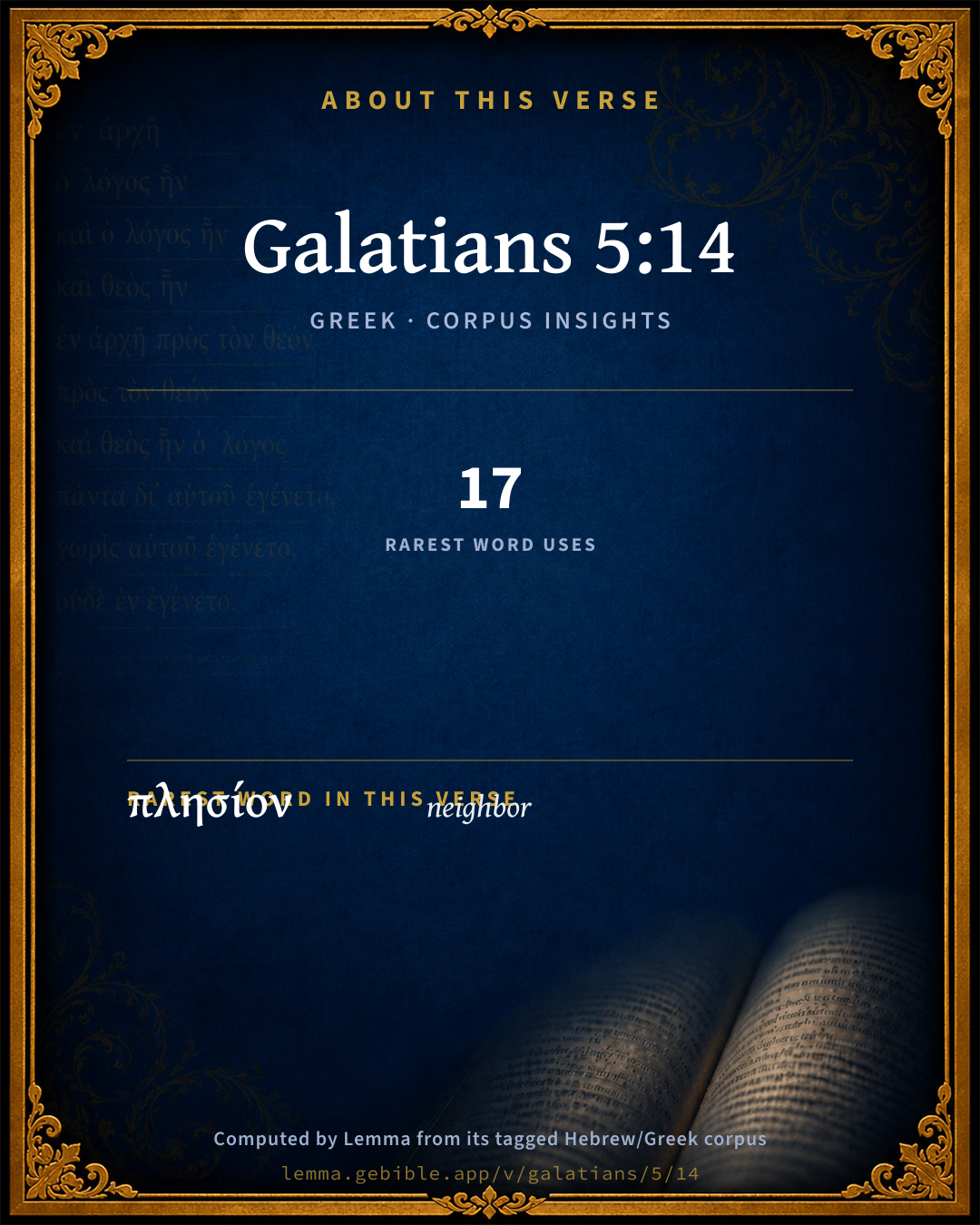
Galatians 5:14

Greek (Tischendorf 8th ed.) Galatians 5:14 appears in the Greek New Testament. The text above is from the Tischendorf 8th edition. Each word links to its Strong’s number and a concise gloss. Click any word for its full Thayer’s Greek Lexicon entry.

Download image
Cite this verse

Galatians 5:14 (World English Bible). Public Domain. Lemma interlinear Bible study tool, https://lemma.gebible.app/v/galatians/5/14.

Show BibTeX & RIS
BibTeX
RIS
English Translation
For the whole law is fulfilled in one word, in this: "You shall love your neighbor as yourself."
World English Bible · Public Domain
Download a study sheet

One document with this verse’s original text, its word-by-word gloss line, the meaning frame, cross-references with their text, attributed commentary, and full source and license credits — printable, and it pastes into notes with its structure intact.

This verse Autodidact and up

Study sheet (.html) Plain text (.txt)

A passage Seminary Student

Up to 50 verses in one chapter. A passage sheet keeps up to 6 commentary sources and 12 cross-references per verse, in the order this page ranks them, and says so on the sheet whenever that leaves anything out. Ask for a single verse and you get the Autodidact verse sheet above.

Everything on this page stays free to read, with no account — the sheet is a download of what is already on screen, not access to it.

Want to remove ads? Support Godless Engineer
Compare translations 3

The same verse in 3 English versions, stacked beneath the original-language interlinear above. Click any original word for its lexicon entry.

Each is an independent rendering of the whole verse — the interlinear is not word-aligned to these translations.

Highlighted words mark where these versions differ — a whole-verse word diff, not a word-by-word alignment.

  • World English Bible Public Domain
    For the whole law is fulfilled in one word, in this: "You shall love your neighbor as yourself."
  • King James Version Public Domain
    For all the law is fulfilled in one word, even in this; Thou shalt love thy neighbour as thyself.
  • unfoldingWord Literal Text CC BY-SA 4.0
    For all the law has been fulfilled in one command, in this, “You will love your neighbor as yourself.”

unfoldingWord Literal Text — © unfoldingWord, licensed CC BY-SA 4.0. Word-aligned USFM3 via Door43 (git.door43.org/unfoldingWord/en_ult).

Versions to compare (up to 4)

3 of 4 selected

Show all 19 translations

Every available English version of this verse, each an independent rendering of the whole verse.

  • World English Bible Public Domain
    For the whole law is fulfilled in one word, in this: "You shall love your neighbor as yourself."
  • Berean Standard Bible Public Domain
    The entire law is fulfilled in a single decree: “Love your neighbor as yourself.”
  • Majority Standard Bible Public Domain
    The entire law is fulfilled in a single decree: “Love your neighbor as yourself.”
  • King James Version Public Domain
    For all the law is fulfilled in one word, even in this; Thou shalt love thy neighbour as thyself.
  • American Standard Version (1901) Public Domain
    For the whole law is fulfilled in one word, `even' in this: Thou shalt love thy neighbor as thyself.
  • Revised Version (1885) Public Domain
    For the whole law is fulfilled in one word, even in this; Thou shalt love thy neighbour as thyself.
  • Geneva Bible (1599) Public Domain
    For all the Lawe is fulfilled in one worde, which is this, Thou shalt loue thy neighbour as thy selfe.
  • Douay-Rheims (1899) Public Domain
    For all the law is fulfilled in one word: Thou shalt love thy neighbour as thyself.
  • Young's Literal Translation Public Domain
    for all the law in one word is fulfilled -- in this: `Thou shalt love thy neighbor as thyself;'
  • Literal Standard Version CC BY-SA 4.0
    for all the Law is fulfilled in one word—in this: “You will love your neighbor as yourself”;
  • Unlocked Literal Bible CC BY-SA 4.0
    For the whole law is fulfilled in one command: “You must love your neighbor as yourself.”
  • unfoldingWord Literal Text CC BY-SA 4.0
    For all the law has been fulfilled in one command, in this, “You will love your neighbor as yourself.”
  • Darby Bible Public Domain
    For the whole law is fulfilled in one word, in Thou shalt love thy neighbour as thyself;
  • World Messianic Bible Public Domain
    For the whole law is fulfilled in one word, in this: “You shall love your neighbor as yourself.”
  • Webster's Bible Public Domain
    For all the law is fulfilled in one word, even in this, Thou shalt love thy neighbor as thyself.
  • Free Bible Version CC BY-SA 4.0
    For the whole law is summed up in this one command, “You shall love your neighbor as yourself.”
  • Bible in Basic English Public Domain
    For all the law is made complete in one word, even in this, Have love for your neighbour as for yourself.
  • Text-Critical English NT CC BY 4.0
    For the entire law is fulfilled in this one commandment: “Yoʋ shall love yoʋr neighbor as yoʋrself.”
  • Tyndale New Testament (1534) Public Domain
    For all the lawe is fulfilled in one worde which is this: thou shalt love thyne neghbour as thy selfe.

Literal Standard Version (2020), Covenant Press — licensed CC BY-SA 4.0. Text via the HelloAO Bible API (eBible.org). Unlocked Literal Bible (unfoldingWord) — licensed CC BY-SA 4.0. Text via the HelloAO Bible API (eBible.org). unfoldingWord Literal Text — © unfoldingWord, licensed CC BY-SA 4.0. Word-aligned USFM3 via Door43 (git.door43.org/unfoldingWord/en_ult). Free Bible Version, Dr. Jonathan Gallagher — licensed CC BY-SA 4.0. Text via the HelloAO Bible API (eBible.org).

Word by word

More ways to search: Search by grammar → Find every occurrence → Compare this word →

Practice this passage: Drill this verse → Learn its vocabulary →

πλησίον
plēsíon
G4139
“neighbor”
Adverb
Part of Speech
Adverb
Full Thayer's Definition

Origin: neuter of a derivative of pelas (near)

TDNT: 11:11,9

1. a neighbour a. a friend b. any other person, and where two are concerned, the other (thy fellow man, thy neighbour), according to the Jews, any member of the Hebrew nation and commonwealth c. according to Christ, any other man irrespective of nation or religion with whom we live or whom we chance to meet
  1. ὁ ho G3588 “the” Article, Nominative, Singular, Masculine
  2. γὰρ gár G1063 “for” Conjunction
  3. πᾶς pâs G3956 “all” Adjective, Nominative, Singular, Masculine
  4. νόμος nómos G3551 “law” Noun, Nominative, Singular, Masculine
  5. ἐν en G1722 “in” Preposition
  6. ἑνὶ heîs G1520 “one” Adjective, Dative, Singular, Masculine
  7. λόγῳ lógos G3056 “word” Noun, Dative, Singular, Masculine
  8. πεπλήρωται plēróō G4137 “to fulfill” Verb, Perfect, Passive, Indicative, 3rd person, Singular
  9. ἐν en G1722 “in” Preposition
  10. τῷ ho G3588 “the” Article, Dative, Singular, Masculine
  11. ἀγαπήσεις agapáō G25 “to love” Verb, Future, Active, Indicative, 2nd person, Singular
  12. τὸν ho G3588 “the” Article, Accusative, Singular, Masculine
  13. σου sý G4771 “you” Personal pronoun, 2nd person, Genitive, Singular
  14. ὡς hōs G5613 “as” Adverb
  15. σεαυτόν seautoû G4572 “yourself” Reflexive pronoun, 2nd person, Accusative, Singular, Masculine

About this verse

These counts appear in no published source. They are computed here, from the morphology-tagged text and Lemma’s own curated glosses. What Lemma adds →

16
words
13
distinct lemmas
Pauline Epistles
section

Notable vocabulary

The rarest word here is πλησίον neighbor G4139 — appearing just 17 times in the whole Greek New Testament.

Shared distinctive vocabulary

πλησίον neighbor G4139 occurs in 17 verses of the Greek New Testament. Also found in:

Repetition

Words recur within this verse:

Cross-references

13

Topical passages linked to Galatians 5:14 in the Treasury of Scripture Knowledge — connected by theme and wording, ordered by reader-vote popularity; previews shown in the World English Bible.

  • Matthew 7:12 Therefore whatever you desire for men to do to you, you shall also do to them; for this is the law and the prophets.
  • Leviticus 19:18 You shall not take vengeance, nor bear any grudge against the children of your people; but you shall love your neighbor as yourself. I am Yahweh.
  • Galatians 6:2 Bear one another's burdens, and so fulfill the law of Christ.
  • Mark 12:31 The second is like this, 'You shall love your neighbor as yourself.' There is no other commandment greater than these."
  • Romans 13:8–10 Owe no one anything, except to love one another; for he who loves his neighbor has fulfilled the law.
  • Matthew 22:39–40 A second likewise is this, 'You shall love your neighbor as yourself.'
  • John 13:34 A new commandment I give to you, that you love one another, just like I have loved you; that you also love one another.
  • Leviticus 19:34 The stranger who lives as a foreigner with you shall be to you as the native-born among you, and you shall love him as yourself; for you lived as foreigners in the land of Egypt. I am Yahweh your God.
  • 1 Timothy 1:5 but the end of the charge is love, out of a pure heart and a good conscience and unfeigned faith;
  • James 2:8–11 However, if you fulfill the royal law, according to the Scripture, "You shall love your neighbor as yourself," you do well.
  • Matthew 19:18–19 He said to him, "Which ones?" Jesus said, "'You shall not murder.' 'You shall not commit adultery.' 'You shall not steal.' 'You shall not offer false testimony.'
  • Mark 12:33 and to love him with all the heart, and with all the understanding, with all the soul, and with all the strength, and to love his neighbor as himself, is more important than all whole burnt offerings and sacrifices."
  • Luke 10:27–37 He answered, "You shall love the Lord your God with all your heart, with all your soul, with all your strength, and with all your mind; and your neighbor as yourself."

Cross-references courtesy of OpenBible.info (CC BY 4.0).

Where the printed editions differ

1 variant

Places in this verse where the major printed Greek editions disagree on the wording in a way that affects the translation — a comparison of editions, not a manuscript-by-manuscript collation. The editions are the modern critical texts (Nestlé-Aland 28/27, SBL, Westcott-Hort, Tregelles, Tyndale House) and the traditional texts behind the KJV (the Textus Receptus and the Byzantine/Majority text). It is not a claim about which reading is original.

  1. Different wording
    σεαυτόν.

    “yourself.”

    In NA28NA27TynSBLWHTregKJV Not in TRByz

    ἑαυτόν (he'auton) 'himself' occurs in a few manuscripts (TR+Byz) instead of σεαυτόν. (seauton) 'yourself.' in older manuscripts (NA28+NA27+Tyn+SBL+WH+Treg+KJV)

Textual data: Translators Amalgamated Greek New Testament (STEPBible TAGNT) · CC BY 4.0.

Commentary

Notes on Galatians 5:14 from classic Christian and Jewish commentators (each source and its license shown beneath its notes). The classic Christian expositions comment on the surrounding passage and are grouped to its opening verse, so a note may address several verses; the Jewish commentaries on the Tanakh (Rashi and others) are per-verse, so they appear only where the commentator wrote on this verse.

Lemma curates 59 commentaries, every one of them public domain or Creative Commons licensed, each selected and text-cleaned for this edition rather than reprinted as found. About our sources →

The Biblical Illustrator

Joseph S. Exell

Gal_5:14

For all the law is fulfilled in one word, even in this; Thou shalt love thy neighbour as thyself.

The fulfilling of the law

I. Love is of perpetual obligation.

II. A true response to the obligation of neighbourly love will ensure the faithful discharge of every other obligation.

III. Therefore love is the fulfilliing of the law. For--

1. The law is the interpretation of love, and the definition and prescription of that which the infinite intelligence knows that love demands. But--

2. There is also the underlying assumption that in the absence of love the law cannot be truly fulfilled. Therefore--

3. When the principle of love, recognizing the authority of the teaching and guiding law, has restrained from every act of injury to its neighbour, and prompted to all sorts of kindly service for that neighbours good, then has the law been truly fulfilled. (W. Tyson.)

Love of our neighbour

I. Love is--

(1) Desire for,

(2) delight in,

(3) endeavour after anothers good.

II. It exists as being--

1. Cherished in the heart.

2. Exhibited in the life.

III. The term neighbour is applicable and includes all men. All are Gods offspring.

IV. The degree of love here necessary.

1. As truly as thyself.

2. With the same love in kind and degree. (T. Robinson.)

I. The duty--Love.

1. The word.

2. The deed.

3. The truth.

II. Its object--Our neighbour.

1. Friend or foe.

2. At home or abroad.

III. Its measure--As thyself; therefore--

1. Sincerely.

2. Constantly.

3. Devotedly.

IV. Its excellence.

1. It fulfils the whole law.

2. Promotes universal happiness and peace. (J. Lyth. , D. D.)

Self-love

Contracted affections, like self-love, may oppose their own end--private good. The supposed contrariety between benevolence and self-love may be only apparent.

I. Self-love as distinguished from other passions.

1. Self-love has an internal, other affections an external, object.

2. Such affections are distinct; from self-love, though part of ourselves.

3. All language recognizes this distinction. Self-love produces interested actions; particular affections, actions which are friendly.

4. Happiness does not consist in self-love, but in the wise gratification of all our affections.

5. Self-love often fails to produce happiness; it often produces anxiety, ands when in excess, misery. Thus self-love is distinct from particular affections, and so far from being our only rule, it often disappoints itself, especially when made one solitary principle.

II. Self-love as distinguished from benevolence. These are distinguished but not necessarily opposed.

1. From the nature of the affections themselves; self-love does not exclude particular affections, nor does benevolence.

2. From the course of action suggested by them.

(1) Affections tend both to private and public good.

(2) Their tendency to one object does not disturb their connection with another.

(3) Benevolence produces as much enjoyment as ambition.

3. From the temper of mind produced by them.

(1) Benevolence gives a pleasure over and above other pleasures, with which it does not interfere.

(2) Has an assurance of special favour from God.

(3) Hence self-love and benevolence are so far from being opposed, that the second may be the easiest way of gratifying the first.

(4) It is true that particular affections may be gratified, so as to interfere with self-love, but benevolence interferes with it less than any other.

(5) The origin of the mistake that they interfere is in the confusion of property and happiness.

4. From Scripture, which inculcates benevolence, and yet recognizes self-love and appeals to it. (Bishop Butler.)

The love of our neighbour

I. The object of this affection. Love of our neighbour or benevolence seeks the good of others, and in its noblest form it is the perfection of God.

II. The proper extent of this affection. As ourselves: which implies--

1. That this love is to be of the same kind.

(1) We have a common interest in others and in ourselves.

(2) This is the proper temper of virtue; love.

2. That our love for others is to bear a certain proportion to our love for ourselves.

(1) A proportion in affections implied in all virtuous characters.

(2) So a due proportion of benevolence and self-love is implied here.

(3) What the proportion is to be not easily decided, for affection is not easily measured; but as to actions, the expression of affection, the more others occupy our thoughts (provided we neglect not ourselves) the better. Even if this imply--

3. That our love for others is equal to our love for ourselves, no ill consequences can ensue, for

(1) men have other affections for themselves not felt for others.

(2) They are specially interested in themselves.

(3) They have a particular perception of their own interests, so that there is no fear of self-neglect.

III. The influence of this affection on our general temper. Its effect is--

1. To produce all charitableness.

2. To fit men for every relation and duty.

3. To moderate party feeling.

4. To prevent; or heal all strife.

IV. This affection includes all virtue.

1. Love prompts men to seek the greatest happiness of all, which is itself a discharge of all obligations.

2. Love even prompts to the practice of personal virtues (temperance, etc.); and certainly the neglect of these virtues implies a deficiency of love to others.

3. Apart from particular natures and circumstances, love includes all goodness; and--

4. Piety itself is the love of God, as an infinitely good Being. (Bishop Butler.)

We may love man because of what he is as man

God has stamped beauty on his material body, and given an higher grandeur to his mysterious mind. But there is a deeper and diviner reason for love. It is this: To love a man because he is a brother in Christ; because he is to some extent like Christ, and reflects His image upon those who come in contact with him. Here the grounds of love are moral, spiritual, and internal. (Thomas Jones.)

.

Neighbourly love

Thomas Samson was a working miner, and working hard for his bread. The captain of the mine said to him on one occasion, Thomas, Ive got an easier berth for you, where there is comparatively little to do, and where you can earn more money: will you accept it? What do you think he said? Captain, theres our poor brother Tregony. He has a sick body, and he is not able to work as hard as I am. I fear his toil will shorten his useful life. Will you let him have the berth? The captain, pleased with his generosity, sent for Tregony, and gave him the berth, which he is now enjoying. Thomas was gratified, and added, I can work a little longer yet. (Sunday Magazine.)

Caring for others

The intensity of maternal affection was illustrated in the observation of a little boy, who, after reading Bunyans Pilgrims Progress, asked his mother which of the characters she liked best. She replied, Christian, of course: he is the hero of the story. The dear child responded, Mother, I like Christiana best, because when Christian set out on his pilgrimage, he went alone; but, when Christiana started, she took the children with her. Great love:--Edward I. of England having received a wound from a poisoned dagger, his wife Eleanor sucked out the poison, venturing her own life to save her husbands.

The Biblical Illustrator, edited by Joseph S. Exell (c. 1880s–1900s) — public domain. Text from a community e-Sword module.

Tyndale Open Study Notes

Tyndale Open Resources

5:14 the whole law can be summed up (or the whole law is fulfilled): Christ’s followers fulfill the law by exercising love toward every neighbor (Lev 19:18; see Matt 7:12; Luke 6:27-36; 10:25-37; John 13:34-35; 15:9-17; Rom 13:8-10).

Tyndale Open Study Notes — © Tyndale Open Resources, licensed CC BY-SA 4.0. Text via the HelloAO Bible API.

Bengel's Gnomon

Johann Albrecht Bengel

Gal 5:14. Πληροῦται, is fulfilled) Rom 13:9, note.

Bengel's Gnomon of the New Testament — English translation (T&T Clark, Edinburgh, 1860) — public domain. Text from a community e-Sword module.

Meyer's Critical & Exegetical Commentary

Heinrich August Wilhelm Meyer

Gal_5:14.[234] Reason assigned for the ΔΙᾺ Τῆς ἈΓΆΠΗς Κ.Τ.Λ. just said: for the whole law is fulfilled in one utterance; that is, compliance with the whole Mosaic law has taken place and exists, if one single commandment of it is complied with, namely, the commandment, Love thy neighbour as thyself. If, therefore, ye through love serve one another, the whole point in dispute is thereby solved; there can no longer be any discussion whether ye are bound to fulfil this or that precept of the law,ye have fulfilled the whole law. Theologia brevissima et longissima; brevissima quod ad verba et sententias attinet, sed usu et re ipsa latior, longior, profundior et sublimior toto mundo, Luther, Ὁ Πᾶς ΝΌΜΟς (comp. 1Ti_1:16; Act_19:7; Act_20:18; Soph. El. 1244; Phil. 13; Thuc. ii. 7. 2, viii. 93. 3; Krüger, § 50. 11. 12) places the totality of the law in contradistinction to its single utterance. The view of Hofmann, that it denotes the law collectively as an unity, the fulfilment of which existing in the readers they have in the love which they are to show, falls to the ground with the erroneous reading, to which it is with arbitrary artifice adapted; and in particular, ὁ πᾶς νόμος means not at all the law as unity, but the whole law:[235] comp. also 2Ma_6:5; 3Ma_6:2 et al.; Herod. i. 111. In point of fact, the phrase does not differ from ὅλος ὁ νόμος, Mat_22:40. Without alteration in the sense, the apostle might also have written πᾶς γὰρ ὁ νόμος, which would only have made the emphasis fall still more strongly on πᾶς.

πεπλήρωται] As to the reading, see the critical notes. The perfect denotes the fulfilment as complete and ready to hand, as in Rom_13:8. Chrysostom, Theodoret, Oecumenius, Theophylact, Estius, Baumgarten, Semler, Morus, Rückert, Matthies, Schott, Baumgarten-Crusius, de Wette, Wieseler, and others, have correctly explained πληροῦσθαι of compliance with the law; for the explanation comprehenditur (Erasmus, Castalio, Luther, Calvin, Rambach, Michaelis, Zachariae, Koppe, Rosenmüller, Winer, Usteri, Olshausen, Reiche, and others), that is, ἀνακεφαλαιοῦται (which, however, in Rom_13:9 is distinguished from πληροῦσθαι), is at variance with the universal usage of πληροῦν τὸν νόμον in the N.T. (comp. ἐκπιμπλάναι τ. νόμον, Herod. i. 199; so also Philo, de Abrah. I. p. 36). See Gal_6:2; Mat_3:15; Rom_8:4; Rom_13:8; Col_4:17. The thought is the same as in Rom_13:8, ὁ ἀγαπῶν τὸν ἕτερον νόμον πεπλήρωκε, and Rom_13:10, πλήρωμα νόμου ἡ ἀγάπη. Grotius interprets πληρ. in the same way as in Mat_5:17 : sicuti rudimenta implentur per doctrinam perfectiorem. This interpretation is incorrect on account of πᾶς, and because a commandment of the Mosaic law itself is adduced.

ἐν τῷ] that is, in the saying of the law; see Winer, p. 103 [E. T. 135].

ἀγάπησεις] Lev_19:18. Respecting the imperative future, see on Mat_1:21; and as to ἑαυτόν used of the second person, see on Rom_13:9; Jacobs, ad Anthol. IX. p. 447. On the idea of the ὡς ἑαυτ., see on Mat_22:39. Comp. Cic. de Legg. i. 12: Nihilo sese plus quam alterum homo diligat. The neighbour is, for the Christian who justly (Mat_5:17) applies to himself this Mosaic commandment, his fellow-Christian (comp. Gal_5:13, ἀλλήλοις, and see Gal_5:14), just as for the Jew it is his fellow-Jew. But how little this is to be taken as excluding any other at all, is shown not only by distinct intimations, such as Gal_6:10, 1Th_3:12, 2Pe_1:7, but also by the whole spirit of Christianity, which, as to this point, finds its most beautiful expression in the example of the Samaritan (Luke 10); and Paul himself was a Samaritan of this kind towards Jews and Gentiles.

The question, how Paul could with justice say of the whole law that it was fulfilled by love towards ones neighbour, is not to be answered, either by making νόμος signify the Christian law (Koppe), or by understanding it only of the moral law (Estius and many others), or of the second table of the Decalogue (Beza and others; also Wieseler; comp. Ewald), or of every divinely revealed law in general (Schott); for, according to the connection of the whole epistle, ὁ πᾶς νόμος cannot mean anything else than the whole Mosaic law. But it is to be answered by placing ourselves at the lofty spiritual standpoint of the apostle, from which he regarded all other commandments of the law as so thoroughly subordinate to the commandment of love, that whosoever has fulfilled this commandment stands in the moral scale and the moral estimation just as if he had fulfilled the whole law. From this lofty and bold standpoint everything, which was not connected with the commandment of love (Rom_13:8-10), fell so completely into the background,[236] that it was no longer considered as aught to be separately and independently fulfilled; on the contrary, the whole law appeared already accomplished in love, that is, in the state of feeling and action produced by the Spirit of God (Gal_5:22 f.; Rom_15:30), in which is contained the culminating point, goal, and consummation of all parts of the law.[237] The idea thus amounts to an impletio totius legis dilectione formata, by which the claim of the law is satisfied (Gal_5:23). The view of Hofmann, that here the law comes into consideration only so far as it is not already fulfilled in faith; that for the believer its requirement consists in the commandment of love, and even the realization of this is already existing in him, so that he has only to show the love wrought in him by Godsimply emanates from the erroneous form of the text and the wrong interpretation of Gal_5:14 adopted by him. That the apostle, moreover, while adducing only the commandment of love towards ones neighbour, does not exclude the commandment of love towards God (comp. Mat_22:37 f.), was obvious of itself to the Christian consciousness from the necessary connection between the love of God and the love of our neighbour (comp. 1Jn_4:20; 1Co_8:1; 1Co_8:3). Paul was induced by the scope of the context to bring forward the latter only (Gal_5:13; Gal_5:15).

[234] Hofmann reads the verse: ὁ γ. πᾶς νόμος ἑν ὑμῖν πεπλήρωται· ἀγαπήσεις κ.τ.λ. A form of the text so destitute of attestation (Tertullian alone has in vobis instead of ἐν ἑνὶ λόγῳ), that it is simply equivalent to a (very strange) conjecture. Also the omission of ἐν τῷ is much too feebly attested. In the text, followed above, A B C א agree.

[235] [This is an approximate rendering of the passage, the meaning of which is not, to me at least, very clear. Hofmann seems to have been conscious of this want of clearness, for in his revised edition just issued he has considerably altered his mode of expression, but still leaves the matter somewhat obscure.ED.]

[236] Especially the precepts as to cultus, in the apostles view, were included among the στοιχεῖα τοῦ κόσμου, Gal_4:3.

[237] Therein lies the essence of the so-called tertius usus of the law, the further development of which is given in the Epistle to the Romans. Comp. Sieffert, in the Jahrb. f. D. Theol. p. 271 f.

Meyer — Critical and Exegetical Commentary on the New Testament — English translation by Peter Christie, edited by Frederick Crombie (T&T Clark, 1880) — public domain. Text from a community e-Sword module.

Expositor's Greek Testament

ed. W. Robertson Nicoll

Gal 5:14 . πεπλήρωται . MS. authority is decisive in favour of this perfect against the present πληροῦται . The perfect is likewise adopted in the parallel passage Rom 13:8 , ὁ ἀγαπῶν νόμον πεπλήρωκεν . For the very existence of love in the heart attests the completion of a previous inward act of the will. ἐν ἑνὶ λόγῳ . The single precept which follows embodies in itself the whole duty to man. τὸν πλησίον . The language of Lev 19:18 is here invested with the comprehensive force which Christ attached to the word neighbour by his teaching.

The Expositor's Greek Testament, edited by W. Robertson Nicoll (1897–1910) — public domain. Text from a community e-Sword module.

Geneva Bible (1599)

Geneva Bible translators

He propoundeth the love of our neighbor, as a mark whereunto all Christians ought to refer all their actions, and thereunto he citeth the testimony of the Law.

This particle (All) must be restrained to the second table.

Geneva Bible (1599) marginal notes — public domain. Text via Bolls.life.

Jamieson, Fausset & Brown

Robert Jamieson, A. R. Fausset & David Brown

all the law--Greek, "the whole law," namely, the Mosaic law. Love to God is presupposed as the root from which love to our neighbor springs; and it is in this tense the latter precept (so "word" means here) is said to be the fulfilling of "all the law" (Lev 19:18). Love is "the law of Christ" (Gal 6:2; Mat 7:12; Mat 22:39-40; Rom 13:9-10).

is fulfilled--Not as received text "is being fulfilled," but as the oldest manuscripts read, "has been fulfilled"; and so "receives its full perfection," as rudimentary teachings are fulfilled by the more perfect doctrine. The law only united Israelites together: the Gospel unites all men, and that in relation to God [GROTIUS].

Jamieson, Fausset & Brown — Commentary Critical and Explanatory on the Whole Bible (1871) — public domain (CC PDM 1.0). Text via the HelloAO Bible API.

Adam Clarke's Commentary

Verse 14. For all the law] Which respects our duty to our fellows, is fulfilled-is comprehended, in one word: Thou shalt love thy neighbour as thyself. See Clarke on Mt 19:19, and "Ro 13:9".

Adam Clarke's Commentary on the Bible (1810–1826) — public domain. Text from a community e-Sword/MySword module.

John Calvin's Commentaries

14. For all the law. There is a contrast in this verse, though not plainly stated, yet evidently to be understood, between Paul’s exhortation and the doctrine of the false apostles. While they insisted on ceremonies alone, Paul takes a passing glance of the actual duties and exercises of Christians. The present commendation of love is intended to inform the Galatians, that love forms the chief part of Christian perfection. But we must inquire in to the reason why all the precepts of the law are included under love. The law consists of two tables, the first of which instructs us concerning the worship of God and the duties of piety, and the second instructs us concerning the love of our neighbor; for it is ridiculous to make a part the same with the whole. Some avoid this difficulty by reminding us that the first table contains nothing more than to love God with our whole heart. But Paul makes express mention of love to our neighbor, and therefore a more satisfactory solution must be sought.

Piety to God, I acknowledge, ranks higher than love of the brethren; and therefore the observance of the first table is more valuable in the sight of God than the observance of the second. But as God himself is invisible, so piety is a thing hidden from the eyes of men; and, though the manifestation of it was the purpose for which ceremonies were appointed, they are not certain proofs of its existence. It frequently happens, that none are more zealous and regular in observing ceremonies than hypocrites. God therefore chooses to make trial of our love to himself by that love of our brother, which he enjoins us to cultivate. This is the reason why, not here only, but in the Epistle to the Romans, (Romans 8:8, 13:10,) love is called “the fulfilling of the law;” not that it excels, but that it proves the worship of God to be real. God, I have said, is invisible; but he represents himself to us in the brethren, and in their persons demands what is due to himself. Love to men springs only from the fear and love of God; and therefore we need not wonder if, by a figure of speech, in which a part is taken for the whole, the effect include under it the cause of which it is the sign. But it would be wrong in any person to attempt to separate our love of God from our love of men.

Thou shalt love thy neighbor. He who loves will render to every man his right, will do injury or harm to no man, will do good, as far as lies in his power, to all; for what else is included in the whole of the second table? This, too, is the argument employed by Paul in his Epistle to the Romans (Romans 13:10.) The word, neighbor, includes all men living; for we are linked together by a common nature, as Isaiah reminds us, “that thou hide not thyself from thine own flesh” (Isaiah 58:7.) The image of God ought to be particularly regarded as a sacred bond of union; but, for that very reason, no distinction is here made between friend and foe, nor can the wickedness of men set aside the right of nature.

“Thou shalt love thy neighbor as thyself”. The love which men naturally cherish toward themselves ought to regulate our love of our neighbor. All the doctors of the Sorbonne are in the habit of arguing that, as the rule is superior to what it directs, the love of ourselves must always hold the first rank. This is not to interpret, but to subvert our Lord’s words. They are asses, and have not even a spark of the love of their neighhour; for if the love of ourselves were the rule, it would follow that it is proper and holy, and is the object of the divine approbation. But we shall never love our neighbors with sincerity, according to our Lord’s intention, till we have corrected the love of ourselves. The two affections are opposite and contradictory; for the love of ourselves leads us to neglect and despise others, — produces cruelty, covetousness, violence, deceit, and all kindred vices, — drives us to impatience, and arms us with the desire of revenge. Our Lord therefore enjoins that it be changed into the love of our neighbor.

John Calvin's Commentaries (1540-1563) — public domain. Text from the Calvin Translation Society English edition (1840s-50s) via the Christian Classics Ethereal Library (ccel.org). Calvin's coverage is partial (roughly two-thirds of the Bible); uncommented books and verses are honest gaps, never fabricated. The 19th-century editor's footnotes and remarks are omitted so the notes are faithfully Calvin's own voice.

Ellicott's Commentary for English Readers

(14) This verse is another of the marked points of contact between this Epistle and that to the Romans. The theme of it is worked out at length in Rom_13:8-10.

Thy neighbour.—In the original command this appears to mean “thy fellow Israelite.” Our Lord, in the parable of the Good Samaritan, had given it a wider signification, and in the same wider sense it is used here.

A Bible Commentary for English Readers, edited by Charles John Ellicott (1878–1897) — public domain. Text from a community e-Sword module.

The Cambridge Bible for Schools and Colleges

gen. ed. J. J. S. Perowne

14. ‘You would go back to bondage; there is a servitude which constitutes liberty. You desire to be under the law; there is a law—the law of love—to which ye will do well to submit yourselves; for all the requirements of the law are met by the fulfilment of one precept—Thou shalt love thy neighbour as thyself.’ Similarly in Rom_13:8-10, ‘He that loveth another hath fulfilled the law … Whatever other commandments there are, all are summed up in this precept, Thou shalt love thy neighbour as thyself … love is the fulfilling of the law.’

thy neighbour] This term in the original precept (Lev_19:18) had reference only to the Jewish people, but our Lord enlarged its scope so as to include everyone whom it is in our power to benefit or injure, i.e. all men. It is so explained in the Church Catechism—‘My duty towards my neighbour is to love him as myself, to do unto all men &c.’

The Cambridge Bible for Schools and Colleges (gen. ed. J. J. S. Perowne; Cambridge University Press, 1878–1918) — public domain. Text from a community e-Sword module.

John Gill's Exposition

But if ye bite and devour one another,.... Another reason inducing to love is taken from the pernicious consequences of a contrary spirit and conduct. The allusion is to beasts of prey falling upon and devouring one another: for wolves or dogs to worry sheep is not strange; but for sheep to distress one another is unnatural. The apostle does not say, if grievous wolves should enter in among you and not spare the flock; but suggests if they themselves should act the part of wolves to one another; having reference to their controversies about the law and circumcision, and the necessity thereof to justification and salvation; which were managed with great heat and bitterness, occasioned great contentions, and threatened them with divisions, parties, and factions; and were attended with envy and malice, with reproachful words, biting sarcasms, scandalous invectives, and injurious actions, which must be of bad consequence: hence he adds,

take heed that ye be not consumed one of another; that is, either beware lest each other's particular peace and comfort be destroyed, which is oftentimes done this way, though a person's state and condition God-ward may be safe; or lest their church state should be destroyed and come to nothing, since love is the cement of it, which being loosened, threatens a dissolution; for as no civil community, either public or private, divided against itself, can stand long, so no religious one; and for want of love the Lord threatens to remove, and sometimes does remove, the candlestick out of its place.

John Gill's Exposition of the Whole Bible (1746–1763) — public domain (CC PDM 1.0). Text via the HelloAO Bible API.

Trapp's Complete Commentary

John Trapp

14 For all the law is fulfilled in one word, even in this; Thou shalt love thy neighbour as thyself.

Ver. 14. For all the law] i.e. All the second table. The Scripture often appropriateth the law to the second table, as Rom 13:8; Eph 6:2, &c. A man must exercise the first table in the second, the duties of his general calling in his particular calling. In the first commandment, saith Luther, the keeping of all the laws is enjoined, Primo praecepto reliquorum omnium observantia praecipitur. Neither can any one love his neighbour as himself, but he that loves God above all.

John Trapp, A Commentary or Exposition upon All the Books of the Old and New Testament (1647–1656) — public domain. Text from a community e-Sword module.

Albert Barnes' Notes on the Bible

For all the law is fulfilled ... - That is, this expresses the substance of the whole law; it embraces and comprises all. The apostle of course here alludes to the Law in regard to our duty to our fellow-men, since that was the point which he particularly enforces. He is saying that this law would counteract all the evil workings of the flesh, and if this were fulfilled, all our duty to others would be discharged. A similar sentiment he has expressed in Rom 13:8-10; see the notes at that passage. The turn here in the discussion is worthy of particular notice. With great skill he changes the subject from a doctrinal argument to a strain of practical remark, and furnishes most important lessons for the right mode of overcoming our corrupt and sensual passions, and discharging our duty to others.

Thou shalt love thy neighbor ... - See this explained in the note at Mat 19:19.

Albert Barnes' Notes on the Bible (1834–1885) — public domain. Text from a community e-Sword/MySword module.

Haydock's Catholic Bible Commentary

All the law, as far as it regards our duty to our neighbour, is contained in this text of the apostle; he says the same in his epistle to the Romans, Chap. xiii. He that loves his neighbour has fulfilled the law.

George Leo Haydock (1774–1849), Haydock's Catholic Family Bible and Commentary, 1859 edition — public domain. Excludes Psalms (Douay-Rheims chapter numbering differs from Protestant) and Deuterocanonical books (Catholic canon only).

Matthew Poole's English Annotations

The whole will of God, containing our duty towards men, is reducible to this one thing, love; for whatsoever God hath commanded us to do towards men, is but a brauch from this root, and must flow from love as its principle. Or, the whole will of God concerning man is fulfilled in this one thing of love; where love to God is not excluded, but supposed, as the root of our love to our neighbour; for our neighbour is to be loved for God. Thus Rom 8:8; He that loveth another hath fulfilled the law: and 1Jo 4:20, the apostle proveth, that a man cannot love God unless he loveth his brother: and 1Ti 1:5; The end of the commandment is charity. Yet what the papists would conclude from hence, (viz. that it is possible for a man to fulfil the law because it is possible for him to love his neighbour), doth by no means follow; for the apostle {1Ti 1:5} telleth us, this love must proceed out of a pure heart, and of a good conscience, and of faith unfeigned. Mr. Calvin observeth well, that the apostle here mentioneth love to men as the fulfilling of the law, in opposition to the false teachers; who made the fulfilling of the law to lie in the observance of the ceremonies of the law, whereas the great thing which the law of God requireth is love, out of a pure heart, good conscience, and faith unfeigned. So that he who believeth with a faith unfeigned, and, out of that principle, with a pure heart and a good conscience, loveth his neighbour as himself, shall be by God accounted to have fulfilled the law; for love is the end of the law.

Matthew Poole's English Annotations on the Holy Bible (1683–1685) — public domain. Text from a community e-Sword/MySword module.

Whedon's Commentary on the Bible

Daniel D. Whedon

14. Law… love—From the law of Moses we are emancipated into the law of love. While that love inspires us to run in the way of the law, there is a perfect unity of love, law, and liberty. We act not from compulsion of law; we are in that sense not under law; because our heart freely and spontaneously runs with the law. Yet if, when our love grows cold, or when temptation appeals to our lower nature, we sin and grow discordant, the law revives and we die. It is when our hearts and will vary from the law, because not springing from love, that we feel first the slavery, and then the condemnation, of law.

Fulfilled—Not summed up, but obeyed and carried out. When Paul says that all the law is fulfilled in love to our neighbour, we think, contrary to most commentators, that he means all the duties of man to man. This is not “arbitrary” limitation, for it is in the sphere of mutual human duties (one another, Gal_5:13; Gal_5:15) that Paul is speaking. So, also, in Rom_13:8-11. Paul there enumerates several commandments, and then adds, that if there is any other commandment, it is briefly comprehended in this saying, namely, Thou shalt love thy neighbour as thyself. Of course in that passage, as in this, we must understand Paul as speaking within the scope of the second table of the Decalogue. It is no doubt true, that the holy love which in a man fulfils one table, will also fulfil the other. But that is what Paul is here neither saying nor assuming.

Love thy neighbour as thyself—From this clause we may assume, 1. That it is right to love thyself. Self-love, not exaggerated into selfishness, is right. Such a renunciation of self as does not desire one’s own safety, happiness, wellbeing, present and eternal, forms no part of religion. 2. We owe duties to ourselves which others do not owe to us. We cannot demand that others should perform for us those duties which we owe to ourselves. Such a demand would, on our part, be selfish and tyrannical. 3. We owe relative duties to wife, husband, parents, children, which we cannot demand others to perform for us and in our stead. We must love our neighbour so well as not to demand that he perform for us those duties that belong to us. We must leave him time and liberty to perform those duties for himself and his which belong to him. 4. Reciprocally, what we do not rightfully, and by this constitution of things demand, of our neighbour, our neighbour cannot demand from us. We do not claim to love him better than ourselves; and if we so love him as to release him from performing these strictly personal duties for us, we may relieve ourselves from performing his for him. If we claim to reduce the scale of duties to be performed by ourselves for others, we must reduce the scale of duties we demand from others. We adopt thereby the rule that is right and fair for all.

This love is a moral principle. It has different degrees of the emotional in different temperaments. And when expressed in intellectual and practical terms it becomes the Golden Rule.

This principle of love needs the blessed Spirit of God to quicken it into a true life. Nevertheless the law of the second table is often, apparently, more completely fulfilled by natural men than the law of the first. There are men who, in practical life, are just, fair, and benevolent to their fellow-man, but who are little reverent, grateful, or devout to God, their true benefactor. Judged by man, they are all that is right; judged by God, what are they?

Daniel D. Whedon (gen. ed.), Commentary on the Old and New Testaments (1874–1909) — public domain. Text from a community e-Sword module.

The Pulpit Commentary

For all the Law is fulfilled in one word, even in this; Thou shalt love thy neighbour as thyself (oJ gamov ejn eJnigw peplhrwtai Receptus, plhroutai, ejn, tw jAgaphseiv toon sou wJv seauton Receptus, eJauton); for the whole Law hath in one word been fulfilled, even in this, Thou shalt love thy neighbour as thyself. Thus is very briefly enunciated what in the Epistle to the Romans, (Rom_13:8-10) written a short while after, the apostle more fully develops thus: "Owe no man anything, save to love one another: for he that loveth his neighbour hath fulfilled (peplhrwke) the Law. For this, Thou shalt not commit adultery, Thou shalt not kill, Thou shalt not steal, Thou shalt not covet, and if there be any other commandment, it is summed up (ajnakefalaioutai) in this word, namely, Thou shalt love thy neighbour as thyself. Love worketh no ill to his neighbour: love therefore is the fulfilment (plhrwma) of the Law." This passage of the Romans may be regarded as a lengthened paraphrase of the one now before us. From the comparison of the two, several things are made clear. We see from it what is meant by the peplhrwtai, "hath been fulfilled." Some have been disposed to regard it as equivalent to ajnakefalaioutai, "it is summed up." Not to urge that it is very doubtful whether the verb admits of this sense, it is enough to observe that in the parallel passage the verb plhroun, both in peplhrwke, hath fulfilled, and the verbal plhrwma, fulfilment, means to fulfil in actual obedience; and that the perfect tense of the peplhrwtai of this passage reappears in the peplhrwke of the other. The sentence in Romans, "He that loveth his neighbour (ton eteron) hath fulfilled the Law," that is, as the context shows, "the whole Law," makes it clear that, by the words before us, "the whole Law hath been fulfilled in one word," is meant that the whole Law hath been fulfilled in the fulfilling of the one word, "Thou shalt love thy neighbour as thyself." The whole Law is regarded as couched in that "one word." In the larger passage the Law, so far as it is explained, is represented as regulating our behaviour to our neighbours, for the apostle cites exclusively commandments of the "second table;" in addition to which, we observe that the immediately preceding context (vers. 1-7) is taken up with the discussion of duties to our fellow-men, sliding into what follows through the words, "Owe no man anything, save to love one another." This suggests the inference that when the apostle says, "He that loveth hath fulfilled the Law;" and at the close of the paragraph, "Love is the fulfilment of the Law," he has in view that part only of the Law which enforces the duties appertaining to human relationships, and not the whole Law as enforcing, together with these, the duties we owe to God; for "love," he says, "his the fulfilment of the Law, because it worketh no evil to his neighbour. " And this might seem further to justify the like inference with reference to the passage before us; and here also the immediate context (ver. 13) points only to relations between man and man, making no reference to our relations towards God. And this inference we seem warranted in accepting. Only, we have to bear in mind that the apostle has already taken account of our spiritual relations to God, in stating (ver. 6) that in Christ Jesus the all-important and only thing is faith working through love. For the faith which he means is plainly the principle which unites the soul to Christ Jesus, and in him to God as our reconciled Father, through the vitalizing and actuating power of the Spirit of adoption. And precisely the same consideration presents itself with respect to the parallel passage in the Romans; for there, too, the apostle has been previously engaged in building up the gospel doctrine of Christ"s redeeming us from the control of a condemning Law, which is also mere "letter," and can give no spiritual life; and of his handing us over to the law of the Spirit of life, whereby the requirement of the Law is fulfilled in them who walk, not after the flesh, but after the Spirit. (Rom_8:1-4) The apostle takes it for granted that it is with these views in their minds that his readers will receive what he here writes. Further, account is to be taken of the spiritual sense in which the apostle uses the terms "law" and "love." Under the term "law" he no longer intends the Law of Moses, either as a ceremonial institute or as a letter-Law regulating moral behaviour; but that higher and spiritual law, of which the precepts of the letter-Law are only incomplete hints or adumbrations the good and acceptable and perfect will of God. (Rom_12:2) Likewise, by the term "love" he designates a very different thing from that principle of kindness, good nature, benevolence, which an Aristotle or Cicero, an Epictetus or Plutarch, could conceive and describe, and in their own practice exemplify; with St. Paul, as with St. John, it is a fruit of the Spirit, an emanation of Christ"s life in the soul, organically and vitally ramifying out of filial love to God. They that were in the flesh could not please God. In order that we may fulfil the Law, the prime and indispensable requisite is that the Spirit of Christ be dwelling in us and leading us.

The spirit of the Law.

Mutual service was only possible through mutual love, and this love was expressly commanded in the Law, which says," Thou shalt love thy neighbour as thyself.

I WHAT IS THE LAW WHICH FINDS ITS FULFILMENT IN LOVE? It is not the law of Christ, nor the law of liberty, nor the law of the Spirit of life, but the very Law of which the apostle has been speaking all through the Epistle. His readers could not have understood him if he had used the term "Law" in a different sense. It follows, therefore, that the Law must still be in force, because its essential commandment, love, remains for perpetual fulfilment. Love was always, even in Old Testament times, the fulfilment of the Law. The sum of the Decalogue is love. (Mat_22:40) The apostle says, "He that loveth another hath fulfilled the Law"; (Rom_13:8, Rom_13:9) but this does not imply, as Antinomians say, that if we have love we have nothing to do with the Law. Believers are exhorted, in the passage quoted, to love one another on the ground of its being a requirement of the Law. It is absurd, then, for the Antinomians to talk of love as being higher than Law, for love is just the fulfilling of the Law, and nothing more. A perfect love would keep the whole Law. It is, therefore, absurd for Roman Catholics to affirm that love justifies as well as faith, because love fulfils the Law. Sin hinders the perfection of our obedience, and therefore love cannot perfectly fulfil the Law.

II HOW LOVING OUR NEIGHBOUR FULFILS THE Law. It is the want of love that leads men to commit murder, adultery, theft, false witness. If we rightly loved our neighbour, these sins would be impossible. But we cannot rightly love our neighbour till we have loved God. "He that loveth not his brother whom he hath seen, how can he love God whom he hath not seen?" "This is the love of God, that (ina) we may keep his commandments." There is a necessary connection between love to God and love to our neighbour. (1Co_8:1-3)

III THERE IS NOTHING HIGHER IN THE SPHERE OF DUTY THAN THIS LOVE, The Positivists assume that they have discovered in "altruism" a principle higher than either Law or gospel ever taught. Whereas we are commanded in Scripture to love our neighbour as ourselves, the Positivists say that we ought to love him better than ourselves. We are to deny ourselves for the sake of others. This is Christ"s idea; but, if there be no future life, it would be the mark of a fool, and not of a hero, to deny myself for anybody. The idea of altruism, however, fails to realize itself in the lives of Positivists. Besides, if one"s own happiness ought not to be a good to himself, there is no reason why he should secure happiness for another. In a few years it will make no difference to me what I have been, whether I have practised altruism or not. The world has not yet discovered a principle for regulating human relationship that can supersede Christianity.

The Pulpit Commentary (1880–1919), ed. H.D.M. Spence-Jones & Joseph S. Exell — public domain. Text from a community e-Sword module.

John Wesley's Explanatory Notes

For all the law is fulfilled in this, Thou shalt love thy neighbour as thyself - inasmuch as none can do this without loving God, 1 John iv, 12; and the love of God and man includes all perfection. Lev. xix, 18.

John Wesley, Explanatory Notes Upon the Whole Bible (1754–1765) — public domain. Text via the GEBible commentary corpus.

Luther on Galatians

Martin Luther

VERSE 14. For all the law is fulfilled in one word, even in this, thou shalt love thy neighbour as thyself.

It is customary with Paul to lay the doctrinal foundation first and then to build on it the gold, silver, and gems of good deeds. Now there is no other foundation than Jesus Christ. Upon this foundation the Apostle erects the structure of good works which he defines in this one sentence: "Thou shalt love thy neighbour as thyself."

In adding such precepts of love the Apostle embarrasses the false apostles very much, as if he were saying to the Galatians: "I have described to you what spiritual life is. Now I will also teach you what truly good works are. I am doing this in order that you may understand that the silly ceremonies of which the false apostles make so much are far inferior to the works of Christian love." This is the hall-mark of all false teachers, that they not only pervert the pure doctrine but also fail in doing good. Their foundation vitiated, they can only build wood, hay, and stubble. Oddly enough, the false apostles who were such earnest champions of good works never required the work of charity, such as Christian love and the practical charity of a helpful tongue, hand, and heart. Their only requirement was that circumcision, days, months, years, and times should be observed. They could not think of any other good works.

The Apostle exhorts all Christians to practice good works after they have embraced the pure doctrine of faith, because even though they have been justified they still have the old flesh to refrain them from doing good. Therefore it becomes necessary that sincere preachers cultivate the doctrine of good works as diligently as the doctrine of faith, for Satan is a deadly enemy of both. Nevertheless faith must come first because without faith it is impossible to know what a God-pleasing deed is.

Let nobody think that he knows all about this commandment, "Thou shalt love thy neighbour as thyself." It sounds short and easy, but show me the man who can teach, learn, and do this commandment perfectly. None of us heed, or urge, or practice this commandment properly. Though the conscience hurts when we fail to fulfill this commandment in every respect we are not overwhelmed by our failure to bear our neighbor sincere and brotherly love.

The words, "for all the law is fulfilled in one word," entail a criticism of the Galatians. "You are so taken up by your superstitions and ceremonies that serve no good purpose, that you neglect the most important thing, love." St. Jerome says: "We wear our bodies out with watching, fasting, and labor and neglect charity, the queen of all good works." Look at the monks, who meticulously fast, watch, etc. To skip the least requirement of their order would be a crime of the first magnitude. At the same time they blithely ignored the duties of charity and hated each other to death. That is no sin, they think.

The Old Testament is replete with examples that indicate how much God prizes charity. When David and his companions had no food with which to still their hunger they ate the showbread which lay-people were forbidden to eat. Christ’s disciples broke the Sabbath law when they plucked the ears of corn. Christ himself broke the Sabbath (as the Jews claimed) by healing the sick on the Sabbath. These incidents indicate that love ought to be given consideration above all laws and ceremonies.

VERSE 14. For all the Law is fulfilled in one word.

We can imagine the Apostle saying to the Galatians: "Why do you get so worked up over ceremonies, meats, days, places, and such things? Leave off this foolishness and listen to me. The whole Law is comprehended in this one sentence, ’Thou shalt love thy neighbour as thyself.’ God is not particularly interested in ceremonies, nor has He any use for them. The one thing He requires of you is that you believe in Christ whom He hath sent. If in addition to faith, which comes first as the most acceptable service unto God, you want to add laws, then you want to know that all laws are comprehended in this short commandment, ’Thou shalt love thy neighbour as thyself.’ "

Paul knows how to explain the law of God. He condenses all the laws of Moses into one brief sentence. Reason takes offense at the brevity with which Paul treats the Law. Therefore reason looks down upon the doctrine of faith and its truly good works. To serve one another in love, i.e., to instruct the erring, to comfort the afflicted, to raise the fallen, to help one’s neighbor in every possible way, to bear with his infirmities, to endure hardships, toil, ingratitude in the Church and in the world, and on the other hand to obey government, to honor one’s parents, to be patient at home with a nagging wife and an unruly family, these things are not at all regarded as good works. The fact is, they are such excellent works that the world cannot possibly estimate them at their true value.

It is tersely spoken: "Love thy neighbour as thyself." But what more needs to be said? You cannot find a better or nearer example than your own. If you want to know how you ought to love your neighbor, ask yourself how much you love yourself. If you were to get into trouble or danger, you would be glad to have the love and help of all men. You do not need any book of instructions to teach you how to love your neighbor. All you have to do is to look into your own heart, and it will tell you how you ought to love your neighbor as yourself.

My neighbor is every person, especially those who need my help, as Christ explained in the tenth chapter of Luke. Even if a person has done me some wrong, or has hurt me in any way, he is still a human being with flesh and blood. As long as a person remains a human being, so long is he to be an object of our love.

Paul therefore urges his Galatians and, incidentally, all believers to serve each other in love. "You Galatians do not have to accept circumcision. If you are so anxious to do good works, I will tell you in one word how you can fulfill all laws. ’By love serve one another.’ You will never lack people to whom you may do good. The world is full of people who need your help."

Martin Luther — Commentary on the Epistle to the Galatians (1535), English translation by Theodore Graebner (Zondervan, 1939) — public domain (U.S. copyright not renewed). Text from a community e-Sword module.

Burkitt's Expository Notes on the New Testament

William Burkitt

Here our apostle enforces the foregoing exhortation to love and serve one another, with a forcible argument or motive, namely, because love is the fulfilling of the law; that is,

1. it is the fulfilling of that part of the law which relates to our neighbour; all the moral law respecting our neighbour is fulfilled in that one word, Thou shalt love thy neighbour as thyself.

Or, 2. Love may be said to be the fulfilling of the law in general; for true and regular love to our neighbour supposeth our love to God, springeth from it, and is an evidence of it; yea, the love of our neighbour is the perfecting and completing of our love to God. If we love one another, God dwelleth in us, and his love is perfected in us. 1Jn 4:12.

Learn, That as love is a very comprehensive duty, comprising the inward affection as well as the outward action, so the word neighbour is of a very extensive consideration, and includes all persons, friend and foe, rich and poor, near and afar off; all that partake of humanity must be sharers in our charity: our inward affection and good-will must extend to all, though the outward expressions of it can reach but a very few. Thus the law is fulfilled in one word, when we love our neighbour as ourselves: not as we do (often) love ourselves, but as we should love ourselves, namely, with a wise and well-guided love.

William Burkitt's Expository Notes on the New Testament (1700–1703) — public domain. Text from a community e-Sword module.

McGarvey & Pendleton's Commentaries

J. W. McGarvey

For the whole law is fulfilled in one word, even in this: Thou shalt love thy neighbor as thyself.

J. W. McGarvey (with Philip Y. Pendleton), Commentaries on the New Testament (The Fourfold Gospel, 1914; Acts; and the epistles) — public domain. Text from a community e-Sword/MySword module.

The People's New Testament

B. W. Johnson

14. For all the law is fulfilled. The essence of the law is comprehended in a single command—that of loving your neighbor. See notes on Rom. 13:8; also compare Matt. 22:39, and Lev. 19:18.

B. W. Johnson's The People's New Testament with Notes (1889–1891) — public domain. Electronic text from the Christian Classics Ethereal Library (CCEL) ThML edition.

Cambridge Greek Testament for Schools and Colleges

14. ἐν ἑνὶ λόγῳ. Marcion read ἐν ὑμῖν instead. Both readings are found in D*G.

14. ὁ γὰρ πᾶς νόμος. γάρ justifies service to one another. This is the real fulfilment of the Law, which you have been wanting to serve. ὁ πᾶς νόμος (cf. Gal 1:2) stands to πᾶς ὁ νόμος in the same relation as “the whole Law” to “all the Law,” i.e. it places somewhat more emphasis on the unity of the Law. Cf. Winer-Schm., § 20. 11 e.

ἐν ἑνὶ λόγῳ. See notes on Textual Criticism, “in one saying,” not “in the performance of one saying.” See next note.

πεπλήρωται. Not (1) “is summed up,” “comprehended” (cf. ἀνακεφαλαιοῦται, Rom 13:9), for which there is no parallel in St Paul’s writings, or, strictly, anywhere in the N.T.; but (2) “has been brought to perfection, has found its completion, in one saying.” So πληρόω frequently in the Gospels; cf. Col 1:25 note. Observe the high ethical purpose that St Paul attributes to the whole Law, ceremonial as well as moral (for he was dealing with the question of circumcision); it finds its truest utterance, its fullest statement, in Thou shalt love etc.

(3) Possibly, however, St Paul means “is summarily fulfilled (i.e. performed) in the observance of one saying.” If so, then in Rom 13:8, written very soon after our Epistle, he makes his meaning clearer by altering the form of his sentence to “he that loveth his neighbour hath fulfilled the Law.” But in our Epistle the perfect passive will then rhetorically represent the future perfect, and it is doubtful if there are any satisfactory parallels to this usage of the perfect passive absolutely (Rom 4:14; Rom 14:23, are the nearest) without an hypothesis (εἰ) preceding. See Winer, § XL. 4 b (p. 341): cf. Gildersleeve, Greek Syntax, § 234.

ἐν τῷ Ἀγαπήσεις κ.τ.λ. Lev 19:18 b. Quoted also in the similar context of Rom 13:9. So also Jas 2:8; cf. Mat 7:12. A Rabbi quoted in Biesenthal’s Hebrew Commentary on Rom 13:9 calls this text “the foot on which the whole Law (the 613 commandments) stands,” referring to the story of Hillel teaching the enquirer while he stood on one foot. Observe that though St Paul quotes only these words, he expects more Rabbinico that his readers will bear in mind the context. For Lev 19:17-18 a warn against cherishing evil in one’s heart, and taking vengeance against one’s neighbour. Originally the passage referred to the treatment of Israelites only; Christian teaching enlarges it to the true Israel and to all men.

Cambridge Greek Testament for Schools and Colleges (Cambridge University Press, 1896; 21 vols, various authors incl. Carr, Maclear, Plummer, Farrar, Lumby, Moule, M. R. James, Simcox) — public domain. Text from a community e-Sword module.

Alford’s Greek Testament

Henry Alford

14.] See Rom 13:8, Rom 13:9. The rec. reading πληροῦται would mean merely ‘is in course of being fulfilled,’ whereas now it is, ‘is fulfilled:’ not ‘comprehended’ (Luth., Calv., Olsh., Winer, al.). “The question, how the Apostle can rightly say of the whole law, that it is fulfilled by loving one’s neighbour, must not be answered by understanding νόμος of the Christian law (Koppe), or of the moral law only (Estius, al.), or of the second table of the decalogue (Beza, al.), or of every divinely revealed law in general (Schött.);—for ὁ πᾶς νόμος cannot from the circumstances of the whole Epistle, mean any thing but ‘the whole law of Moses:’—but by placing ourselves on the lofty spiritual level from which St. Paul looked down, and saw all other commands of the law so far subordinated to the law of love, that whoever had fulfilled this command, must be treated as having fulfilled the whole.” Meyer: who also remarks that τὸν πλησίον σου applies to fellow-Christians; cf. ἀλλήλους below.

Henry Alford, The Greek Testament (1849–1861) — public domain. Text from a community e-Sword module.

International Critical Commentary

14. ὁ γὰρ πᾶς νόμος ἐν ἑνὶ λόγῳ πεπλήρωται, ἐν τῷ “Ἀγαπήσεις τὸν πλησίον σου ὡς σεαυτόν.” “For the whole law is fulfilled in one word, even in this, Thou shalt love thy neighbour as thyself.” A striking paradox. Having devoted practically all his effort up to this point, directly or indirectly, to dissuading the Galatians from coming into bondage to the law by undertaking to obey its statutes, he now gives as the reason for their serving one another that thus they will fulfil the whole law. But the paradox is itself most instructive; for it shows that there was a sense of the word “law” according to which it was essential that its requirements be fully met by the Christian. Cf. Rom 8:4. The explanation of the paradox lies partly in the diverse senses of the word “law,” and the fact that the apostle employs it here not, as heretofore in the epistle, of its legalistic element, or of law legalistically interpreted, but of divine law conceived of as consisting in an ethical principle (see detached note on Νόμος, V 2. (d), p. 458); partly, but to a less extent, in the difference between keeping statutes in slavish obedience and fulfilling law as the result of life by the Spirit. Cf. vv. 6, 16. The apostle’s statements become intelligible and consistent only when it is recognised that he held that from the whole law as statutes, from the obligation to obey any of its statutes as such, men are released through the new revelation in Christ; and that, on the other hand, all that the law as an expression of the will of God really requires, when seen with eyes made discerning by experience, is love, and he who loves therefore fulfils the whole law. Statutes he will incidentally obey in so far as love itself requires it, but only so far, and in no case as statutes of the law. Cf. the apostle’s bold application of this principle even to chastity in 1Co 6:12, showing that in Paul’s view even when things prohibited by the law were also excluded by love, it was on the latter ground, not the former, that they were to be avoided by the Christian.

The precise meaning of this sentence turns in no small part on the meaning of πεπλήρωται, on which diverse interpretations have been put. It has been interpreted above as meaning “is fully obeyed.” This interpretation demands substantiation. πληρόω, a classical word, from Æschylus and Herodotus down, means properly “to fill,” “to make full”; its object is, therefore, a space empty or but partly filled. In this sense it occurs rarely in N. T.: Mat 13:48, Luk 3:5, Joh 12:3. Employed tropically it signifies: 1. “to fill,” “to fulfil,” the object being thought of under the figure of a receptable or empty vessel. It is used (a) with a personal object and means, “to fill,” “to supply abundantly”: Act 13:52, Rom 1:29; (b) with an impersonal object, originally at least pictured to the mind as a receptacle to be filled, an empty form to be filled with reality; thus of a promise, prophecy, or statement of fact, “to satisfy the purport of,” “to fit the terms of”: Mat 1:22 et freq. in Mt. Act 1:16, Act 3:18, etc.; of commands and laws, “to satisfy the requirements of,” “to obey fully”: Rom 8:4, Rom 13:8, probably also Mat 5:17; of needs, “to satisfy”: Php 4:19. When the object is a task or course of action it means “to complete,” “fully to perform”: Mat 3:15, Luk 7:1, Act 12:25, Act 14:26, Col 4:17. Col 4:2. When the object is thought of as something incomplete, and requiring to be filled out to its normal or intended measure, its meaning is “to complete,” “to make perfect”: Mar 1:15, Joh 7:8, Joh 15:11, Joh 16:24. In Rom 8:4, Rom 13:8 Paul uses the word as here with νόμος, and quite unambiguously in the sense, “fully to obey”; this fact creates a strong presumption in favour of that meaning here. The use of the perfect tense, also, which might seem to favour the meaning “to make perfect” (the sentence in that case meaning, “the whole law stands complete, made perfect, in the one word,” etc.) is sufficiently explained by πεπλήρωκεν in Rom 13:8: ὁ γὰρ ἀγαπῶν τὸν ἕτερον νόμον πεπλήρωκεν, “he that loveth his neighbour stands in the position of having fulfilled law, is a fulfiller of law,” the tense in both sentences being a gnomic perfect (BMT 79). The present sentence then means, “The whole law stands fully obeyed in (obedience to) one word,” etc. So Luther’s translation (though freely expressed): “Alle Gesetze werden in einem Worte erfüllet”; Stage’s German version: “Das ganze Gesetz findet seine Erfüllung in dem einen Worte”; so also Ell. Ltft. Sief., et al. The meaning (2) “is completed,” though entirely possible in connection with such a word as νόμος, is practically excluded here (a) by πᾶς in ὁ πᾶς νόμος, indicating that the apostle is speaking, not of the law as incomplete, but as already complete, and (b) by the evidence of Rom 8:4, Rom 13:8 in favour of “fulfil.” The meaning “is summed up” (so Weizs., “geht in ein Wort zusammen,” and Stapfer, “se résume d’un seul mot”) is also appropriate to the context and harmonious with πᾶς, and repeats the thought of Paul in Rom 13:9. But it is opposed by the evidence of Rom 13:8, Rom 13:9, where Paul using both πληρόω and ἀνακεφαλαιόω clearly distinguishes them in meaning, using the latter in the sense “to sum up” and the former to mean “fulfil,” “obey fully,” and by the fact that πληρόω is never used in the sense which this interpretation requires either in N. T., the Lxx, or in any Greek writer so far as observed. Sief. cites thirteen of the older commentators and translators who take πεπλήρωται in the sense of ἀνακεφαλαιοῦται. An examination of nine of the ablest of these authorities shows no lexicographical basis for the position taken. The strongest, though entirely untenable, reason given is a comparison of πεπλήρωται here with ἀνακεφαλαιοῦται in Rom 13:9, whereas the proper comparison is with πεπλήρωκεν in Rom 13:8.

The position of πᾶς between the article and the noun νόμος is unusual; if a distinction is to be drawn between the more usual πᾶς ὁ νόμος and the form here employed, the latter expresses more clearly the idea of totality, without reference to parts. See Butt., p. 120; Bl.-D. 275. 7; Act 19:7, Act 19:20:18, Act 19:27:37; 1Ti 1:16. The context makes it clear that the reference is to the law of God; but clearly also to the law of God as revealed in O. T., since it is this that has been the subject of discussion throughout the epistle. See detached note on Νόμος, V 2. (d), p. 459.

Λόγος, meaning “utterance,” “saying,” “reason,” etc., always has reference not to the outward form or sound, but to the inward content; here it evidently refers to the sentence following. Cf. Mat 26:44, Luk 7:17, etc.

The sentence ἀγαπήσεις … σεαυτόν is quoted from Lev 19:18, following the Lxx. ἀγαπήσεις clearly refers specially to the love of benevolence (see detached note on Ἀγαπάω and Ἀγάπη). In the original passage, וְאָהֲבְָ֥תּ לְרֵֽעֲךָ כָּמ֑וֹךָ, רֵעַ, though in itself capable of being used colourlessly to denote another person without indication of the precise relationship, doubtless derives from the context (“Thou shalt not take vengeance, nor bear any grudge against the children of thy people, but thou shalt love thy neighbour as thyself”) a specific reference to fellow Israelites. This limitation of the command, as, of course, also those passages which enjoin or express a hostile attitude to non-Israelites or to personal enemies (Deu 23:3-6, Deu 25:17-19, Psa 41:10, Psa 69:22-28, Psa 109:6-15), the apostle disregards, as he does the specific statutes of the law, such, e. g., as those requiring circumcision and the observance of days, which he conceived to be no longer valuable and valid. His affirmation is to be taken not as a verdict of mere exegesis, summing up with mathematical exactness the whole teaching of O. T., and giving its precise weight to each phase of it, but as a judgment of insight and broad valuation, which, discriminating what is central, pervasive, controlling, from what is exceptional, affirms the former, not introducing the latter even as a qualification but simply ignoring it. It is improbable that he drew a sharp distinction between portions of the law, and regarded those which were contrary to the spirit of love or not demanded by it as alien elements intruded into what was otherwise good; at least he never intimates such a discrimination between good and bad parts of the law. Rather, it would seem, he looked at the law as a whole, as one might view a building many parts of which taken alone are without form or comeliness, yet which as a whole is wholly beautiful. Its total meaning was to him love; and this was the law of God; the parts as such had for him no authority.

International Critical Commentary — older volumes (1896–1929), various authors — public domain. Text from a community e-Sword module.

Vincent's Word Studies in the New Testament

Marvin R. Vincent

All the law [ο πας νομος] . More correctly, the whole law. Comp. Mt 22:40.

Is fulfilled [πεπληρωται] . Has been fulfilled. Comp. Rom 13:8. The meaning is not embraced in, or summed up in, but complied with. In Rom 13:9, ajnakefalaioutai is summed up, is to be distinguished from plhrwma hath fulfilled (ver. 8) and plhrwma fulfillment (ver. 10). The difference is between statement and accomplishment. See on do the law, ver. 3.

Marvin R. Vincent, Word Studies in the New Testament (1887–1900) — public domain. Text from a community e-Sword/MySword module.

Lesson kit

Teaching starters — assembled from the data on this page, not authored interpretation. Every prompt links to the verse data it draws on. Edit before teaching.

Galatians, in the Pauline Epistles, opens this verse with 16 words (13 distinct Greek lemmas). Its most distinctive word is plēsíon (“neighbor”). A historical commentator’s framing appears above. Read the whole chapter for the surrounding context.

Discussion questions

  1. How does “neighbor” (plēsíon) shape what this verse is saying?
  2. Matthew 5:43 shares the word «neighbor» with this verse. How do the two illuminate each other?
  3. “the” occurs 3× in this one verse. What is the effect of the repetition?
  4. These translations render this verse differently; the difference is in the English rendering, not the original. What questions does that raise?
  5. Reading how The Biblical Illustrator and Tyndale Open Study Notes read this verse, where do the two commentators agree and where do they part?

Things to notice

Reading settings

Reading text

Shown beneath each verse's original-language words.

Old Testament
Old Testament edition

Read the OT as the Masoretic Hebrew (MT) or the Greek Septuagint (LXX).

English shown for the Greek Septuagint (in the Hebrew ↔ Greek comparison).

Comparing translations? Open the Compare panel on any verse page to stack up to four side by side.