
1 Peter 1:8

Greek (Tischendorf 8th ed.) 1 Peter 1:8 appears in the Greek New Testament. The text above is from the Tischendorf 8th edition. Each word links to its Strong’s number and a concise gloss. Click any word for its full Thayer’s Greek Lexicon entry.

Download image
Cite this verse

1 Peter 1:8 (World English Bible). Public Domain. Lemma interlinear Bible study tool, https://lemma.gebible.app/v/1-peter/1/8.

Show BibTeX & RIS
BibTeX
RIS
English Translation
whom not having known you love; in whom, though now you don't see him, yet believing, you rejoice greatly with joy unspeakable and full of glory--
World English Bible · Public Domain
Highlights
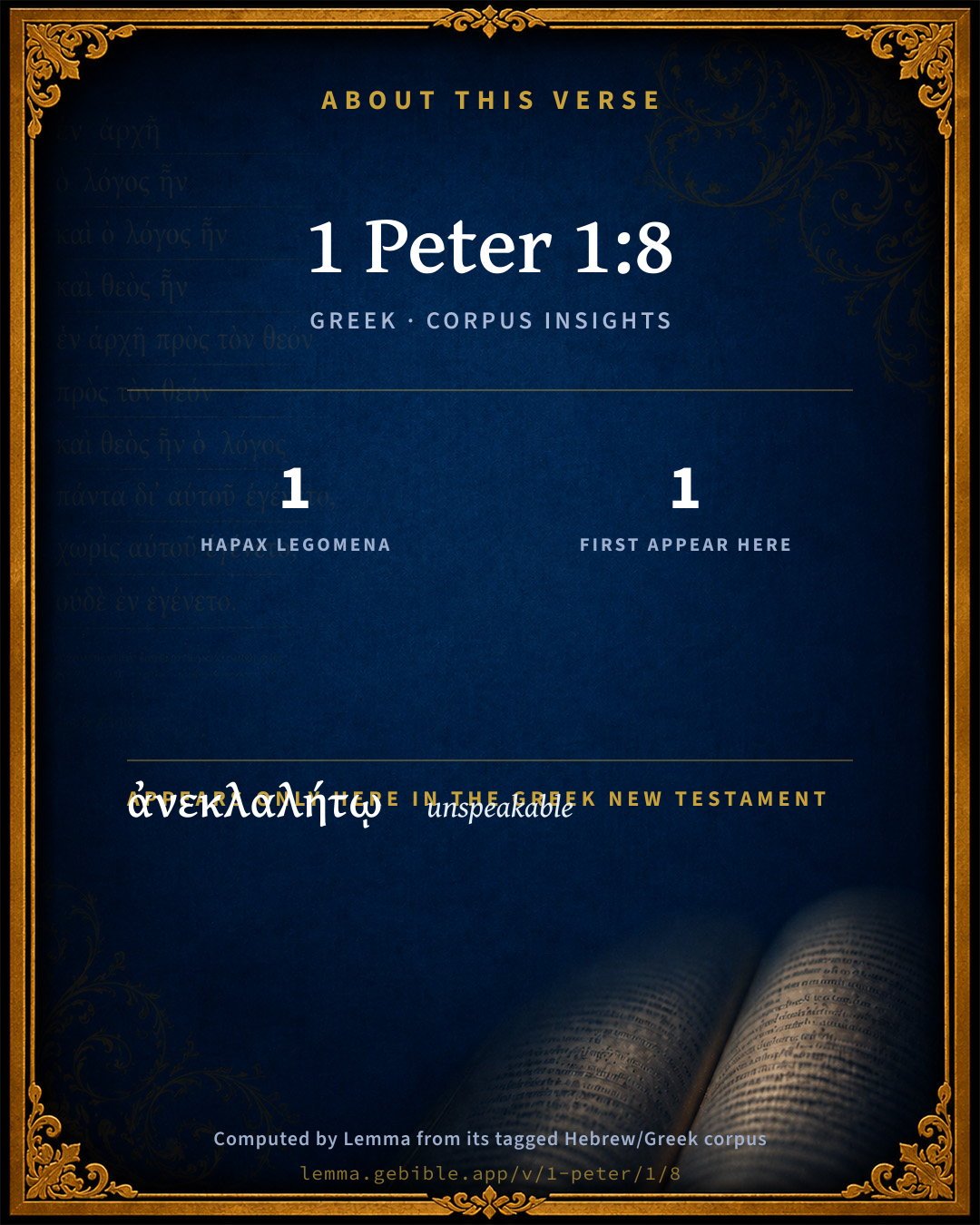
  • 1 hapax legomenon — only here in the Greek New Testament
  • 1 first appearance in the Greek New Testament
Full analysis ↓
Download a study sheet

One document with this verse’s original text, its word-by-word gloss line, the meaning frame, cross-references with their text, attributed commentary, and full source and license credits — printable, and it pastes into notes with its structure intact.

This verse Autodidact and up

Study sheet (.html) Plain text (.txt)

A passage Seminary Student

Up to 50 verses in one chapter. A passage sheet keeps up to 6 commentary sources and 12 cross-references per verse, in the order this page ranks them, and says so on the sheet whenever that leaves anything out. Ask for a single verse and you get the Autodidact verse sheet above.

Everything on this page stays free to read, with no account — the sheet is a download of what is already on screen, not access to it.

Want to remove ads? Support Godless Engineer
Compare translations 3

The same verse in 3 English versions, stacked beneath the original-language interlinear above. Click any original word for its lexicon entry.

Each is an independent rendering of the whole verse — the interlinear is not word-aligned to these translations.

Highlighted words mark where these versions differ — a whole-verse word diff, not a word-by-word alignment.

  • World English Bible Public Domain
    whom not having known you love; in whom, though now you don't see him, yet believing, you rejoice greatly with joy unspeakable and full of glory--
  • King James Version Public Domain
    Whom having not seen, ye love; in whom, though now ye see him not, yet believing, ye rejoice with joy unspeakable and full of glory:
  • unfoldingWord Literal Text CC BY-SA 4.0
    whom, not having seen, you love; in whom, not seeing now, but believing, you exult with joy inexpressible and filled with glory,

unfoldingWord Literal Text — © unfoldingWord, licensed CC BY-SA 4.0. Word-aligned USFM3 via Door43 (git.door43.org/unfoldingWord/en_ult).

Versions to compare (up to 4)

3 of 4 selected

Show all 19 translations

Every available English version of this verse, each an independent rendering of the whole verse.

  • World English Bible Public Domain
    whom not having known you love; in whom, though now you don't see him, yet believing, you rejoice greatly with joy unspeakable and full of glory--
  • Berean Standard Bible Public Domain
    Though you have not seen Him, you love Him; and though you do not see Him now, you believe in Him and rejoice with an inexpressible and glorious joy,
  • Majority Standard Bible Public Domain
    Though you have not known Him, you love Him; and though you do not see Him now, you believe in Him and rejoice with an inexpressible and glorious joy,
  • King James Version Public Domain
    Whom having not seen, ye love; in whom, though now ye see him not, yet believing, ye rejoice with joy unspeakable and full of glory:
  • American Standard Version (1901) Public Domain
    whom not having seen ye love; on whom, though now ye see him not, yet believing, ye rejoice greatly with joy unspeakable and full of glory:
  • Revised Version (1885) Public Domain
    whom not having seen ye love; on whom, though now ye see him not, yet believing, ye rejoice greatly with joy unspeakable and full of glory:
  • Geneva Bible (1599) Public Domain
    Whome yee haue not seene, and yet loue him, in whome nowe, though yee see him not, yet doe you beleeue, and reioyce with ioy vnspeakeable and glorious,
  • Douay-Rheims (1899) Public Domain
    Whom having not seen, you love: in whom also now, though you see him not, you believe: and believing shall rejoice with joy unspeakable and glorified;
  • Young's Literal Translation Public Domain
    whom, not having seen, ye love, in whom, now not seeing and believing, ye are glad with joy unspeakable and glorified,
  • Literal Standard Version CC BY-SA 4.0
    whom, having not seen, you love, in whom, now believing [although] not seeing, you are glad with unspeakable joy and have been filled with glory,
  • Unlocked Literal Bible CC BY-SA 4.0
    You have not seen him, but you love him. You do not see him now, but you believe in him and rejoice with joy that is inexpressible and filled with glory.
  • unfoldingWord Literal Text CC BY-SA 4.0
    whom, not having seen, you love; in whom, not seeing now, but believing, you exult with joy inexpressible and filled with glory,
  • Darby Bible Public Domain
    whom, having not seen, ye love; on whom [though] not now looking, but believing, ye exult with joy unspeakable and filled with [the] glory,
  • World Messianic Bible Public Domain
    whom, not having known, you love. In him, though now you don’t see him, yet believing, you rejoice greatly with joy that is unspeakable and full of glory,
  • Webster's Bible Public Domain
    Whom having not seen, ye love; in whom, though now ye see him not, yet believing, ye rejoice with joy unspeakable, and full of glory:
  • Free Bible Version CC BY-SA 4.0
    You love him even though you have never seen him. Though you cannot see him now, you trust in him and you're filled with wonderful, indescribable happiness.
  • Bible in Basic English Public Domain
    To whom your love is given, though you have not seen him; and the faith which you have in him, though you do not see him now, gives you joy greater than words and full of glory:
  • Text-Critical English NT CC BY 4.0
    Although you once did not know him, you love him; although you do not now see him, you believe in him and rejoice with an unspeakable and glorious joy,
  • Tyndale New Testament (1534) Public Domain
    whom ye have not sene and yet love him in whom even now though ye se him not ye yet beleue and reioyce with ioye vnspeakable and glorious:

Literal Standard Version (2020), Covenant Press — licensed CC BY-SA 4.0. Text via the HelloAO Bible API (eBible.org). Unlocked Literal Bible (unfoldingWord) — licensed CC BY-SA 4.0. Text via the HelloAO Bible API (eBible.org). unfoldingWord Literal Text — © unfoldingWord, licensed CC BY-SA 4.0. Word-aligned USFM3 via Door43 (git.door43.org/unfoldingWord/en_ult). Free Bible Version, Dr. Jonathan Gallagher — licensed CC BY-SA 4.0. Text via the HelloAO Bible API (eBible.org).

Word by word

More ways to search: Search by grammar → Find every occurrence → Compare this word →

Practice this passage: Drill this verse → Learn its vocabulary →

ἀνεκλαλήτῳ
aneklálētos
G412
“unspeakable”
Adjective, Dative, Singular, Feminine
Part of Speech
Adjective
Case
Dative
Number
Singular
Gender
Feminine
Full Thayer's Definition

Origin: from G1 (as a negative particle) and a presumed derivative of G1583

TDNT: None

1. unspeakable
  1. ὃν hós G3739 “who” Relative pronoun, Accusative, Singular, Masculine
  2. οὐκ ou G3756 “not” Particle, Negative
  3. ἰδόντες horáō G3708 “to see” Verb, Aorist, Active, Participle, Nominative, Plural, Masculine
  4. ἀγαπᾶτε agapáō G25 “to love” Verb, Present, Active, Indicative, 2nd person, Plural
  5. εἰς eis G1519 “into” Preposition
  6. ὃν hós G3739 “who” Relative pronoun, Accusative, Singular, Masculine
  7. ἄρτι árti G737 “now” Adverb
  8. μὴ mḗ G3361 “not” Particle, Negative
  9. ὁρῶντες horáō G3708 “to see” Verb, Present, Active, Participle, Nominative, Plural, Masculine
  10. πιστεύοντες pisteúō G4100 “to believe” Verb, Present, Active, Participle, Nominative, Plural, Masculine
  11. δὲ dé G1161 “but” Conjunction
  12. ἀγαλλιᾶσθε agalliáō G21 “to rejoice greatly” Verb, Present, Active, Indicative, 2nd person, Plural
  13. χαρᾷ chará G5479 “joy” Noun, Dative, Singular, Feminine
  14. καὶ kaí G2532 “and” Conjunction
  15. δεδοξασμένῃ doxázō G1392 “to glorify” Verb, Perfect, Passive, Participle, Dative, Singular, Feminine

About this verse

These counts appear in no published source. They are computed here, from the morphology-tagged text and Lemma’s own curated glosses. What Lemma adds →

16
words
14
distinct lemmas
General Epistles
section

Notable vocabulary

1 hapax legomenon — a word that appears only here in the entire Greek New Testament:

  • ἀνεκλαλήτῳ unspeakable G412

First appearance in Scripture

This word makes its first canonical appearance in the Greek New Testament here:

  • ἀνεκλαλήτῳ unspeakable G412

Shared distinctive vocabulary

ἀγαλλιᾶσθε to rejoice greatly G21 occurs in 11 verses of the Greek New Testament. Also found in:
Repetition

Words recur within this verse:

  • ἰδόντες to see G3708 ×2
  • ὃν who G3739 ×2

Cross-references

36

Topical passages linked to 1 Peter 1:8 in the Treasury of Scripture Knowledge — connected by theme and wording, ordered by reader-vote popularity; previews shown in the World English Bible.

  • John 20:29 Jesus said to him, "Because you have seen me, you have believed. Blessed are those who have not seen, and have believed."
  • 2 Corinthians 5:7 for we walk by faith, not by sight.
  • Romans 15:13 Now may the God of hope fill you with all joy and peace in believing, that you may abound in hope, in the power of the Holy Spirit.
  • Hebrews 11:1 Now faith is assurance of things hoped for, proof of things not seen.
  • John 16:22 Therefore you now have sorrow, but I will see you again, and your heart will rejoice, and no one will take your joy away from you.
  • 2 Corinthians 4:18 while we don't look at the things which are seen, but at the things which are not seen. For the things which are seen are temporal, but the things which are not seen are eternal.
  • 1 Peter 1:6 Wherein you greatly rejoice, though now for a little while, if need be, you have been put to grief in various trials,
  • Hebrews 11:27 By faith, he left Egypt, not fearing the wrath of the king; for he endured, as seeing him who is invisible.
  • Ephesians 6:24 Grace be with all those who love our Lord Jesus Christ with incorruptible love. Amen.
  • Philippians 4:4 Rejoice in the Lord always! Again I will say, Rejoice!
  • 1 Peter 5:4 When the chief Shepherd is revealed, you will receive the crown of glory that doesn't fade away.
  • 1 Peter 2:7 For you therefore who believe is the honor, but for such as are disobedient, "The stone which the builders rejected, Has become the chief cornerstone,"
  • Ephesians 1:13–14 in whom you also, having heard the word of the truth, the Gospel of your salvation,--in whom, having also believed, you were sealed with the Holy Spirit of promise,
  • Habakkuk 3:17–18 For though the fig tree doesn't flourish, Nor fruit be in the vines; The labor of the olive fails, The fields yield no food; The flocks are cut off from the fold, And there is no herd in the stalls:
  • Matthew 25:35–40 for I was hungry, and you gave me food to eat; I was thirsty, and you gave me drink; I was a stranger, and you took me in;
  • John 8:42 Therefore Jesus said to them, "If God were your Father, you would love me, for I came out and have come from God. For I haven't come of myself, but he sent me.
  • John 14:24 He who doesn't love me doesn't keep my words. The word which you hear isn't mine, but the Father's who sent me.
  • Romans 14:17 for the Kingdom of God is not eating and drinking, but righteousness, peace, and joy in the Holy Spirit.
  • 2 Corinthians 5:14–15 For the love of Christ constrains us; because we judge thus, that one died for all, therefore all died.
  • Philippians 1:25 Having this confidence, I know that I will remain, yes, and remain with you all, for your progress and joy in the faith,
  • Philippians 3:3 For we are the circumcision, who worship God in the Spirit, and rejoice in Christ Jesus, and have no confidence in the flesh;
  • Song of Solomon 5:16 His mouth is sweetness; Yes, he is altogether lovely. This is my beloved, and this is my friend, Daughters of Jerusalem. Friends
  • Matthew 10:37 He who loves father or mother more than me is not worthy of me; and he who loves son or daughter more than me isn't worthy of me.
  • John 14:15 If you love me, keep my commandments.
  • John 14:21 One who has my commandments, and keeps them, that person is one who loves me. One who loves me will be loved by my Father, and I will love him, and will reveal myself to him."
  • Acts 16:34 He brought them up into his house, and set food before them, and rejoiced greatly, with all his household, having believed in God.
  • 2 Corinthians 1:22 who also sealed us, and gave us the down payment of the Spirit in our hearts.
  • 2 Corinthians 9:15 Now thanks be to God for his unspeakable gift!
  • 2 Corinthians 12:4 how he was caught up into Paradise, and heard unspeakable words, which it is not lawful for a man to utter.
  • Galatians 5:6 For in Christ Jesus neither circumcision amounts to anything, nor uncircumcision, but faith working through love.
  • Galatians 5:22 But the fruit of the Spirit is love, joy, peace, patience, kindness, goodness, faithfulness,
  • 1 John 4:19–20 We love Him, because he first loved us.
  • Song of Solomon 5:9 How is your beloved better than another beloved, You fairest among women? How is your beloved better than another beloved, That you do so adjure us? Beloved
  • John 21:15–17 So when they had eaten their breakfast, Jesus said to Simon Peter, "Simon, son of Jonah, do you love me more than these?" He said to him, "Yes, Lord; you know that I have affection for you." He said to him, "Feed my lambs."
  • 1 Corinthians 16:22 If any man doesn't love the Lord Jesus Christ, let him be accursed. Come, Lord!
  • Song of Solomon 1:7 Tell me, you whom my soul loves, Where you graze your flock, Where you rest them at noon; For why should I be as one who is veiled Beside the flocks of your companions? Lover

Cross-references courtesy of OpenBible.info (CC BY 4.0).

Commentary

Notes on 1 Peter 1:8 from classic Christian and Jewish commentators (each source and its license shown beneath its notes). The classic Christian expositions comment on the surrounding passage and are grouped to its opening verse, so a note may address several verses; the Jewish commentaries on the Tanakh (Rashi and others) are per-verse, so they appear only where the commentator wrote on this verse.

Lemma curates 59 commentaries, every one of them public domain or Creative Commons licensed, each selected and text-cleaned for this edition rather than reprinted as found. About our sources →

Joseph Benson's Commentary

1Pe 1:8-9. Whom having not seen — Ειδοτες, known, that is, personally in the flesh; ye love — Namely, on account of his amiable character, and for the great things he hath done and suffered for you, and the great benefits he hath bestowed on you. It is very possible, as Doddridge observes, that among these dispersed Christians, there might be some who had visited Jerusalem while Christ was there, and might have seen, or even conversed with him; but as the greater part had not, St. Peter speaks, according to the usual apostolic manner, as if they all had not. Thus he speaks of them all as loving Christ, though there might be some among them who were destitute both of this divine principle and of that joy which he here describes as ανεκλαλητω και δεδοξασμενη, unutterable and glorified; that is, such joy as was an anticipation of that of the saints in glory. Receiving — Even now already, with unspeakable delight, as a full equivalent for all your trials; the end of your faith — That which in your faith you aim at, and which is the seal and the reward of it; the salvation of your souls — From the guilt and power of your sins, and all the consequences thereof, into the favour and image of God, and a state of communion with him; implying a qualification for, and earnest of, complete and eternal salvation. The Jews thought that the salvation to be accomplished by the Messiah would be a salvation from the Roman and every foreign yoke; but that would only have been a salvation of their bodies: whereas the salvation which believers expect from Christ is the salvation of their souls from sin and misery, and of their bodies from the grave.

Joseph Benson's Commentary on the Old and New Testaments (1811–1818) — public domain. Text from a community e-Sword module.

Whedon's Commentary on the Bible

Daniel D. Whedon

3. Joy in present blessedness, 1Pe_1:8-9.

8. Ye love—This is the true order: faith in the crucified and risen, but yet unseen, Christ, with the deepest love as its fruit, producing the purest joy. It may be St. Peter’s comment on our Lord’s words to Thomas, “Blessed are they that have not seen, and yet have believed.” Joh_20:29. The American people of the present generation have not seen Washington, yet they profoundly love him. But Christ will soon reveal himself to human sight.

Ye rejoice—The same Greek as greatly rejoice, in 1Pe_1:6, meaning exultation expressing itself. Yet the joy cannot be fully told, for it is even now pervaded with the glory which will be complete in heaven.

Daniel D. Whedon (gen. ed.), Commentary on the Old and New Testaments (1874–1909) — public domain. Text from a community e-Sword module.

MacLaren's Expositions of Holy Scripture

Alexander MacLaren

1 Peter

JOY IN BELIEVING

1Pe 1:8

The Apostle has just previously been speaking about the great and glorious things which are to come to Christians on the appearing of Jesus Christ, and that naturally suggests to him the thought of the condition of believing souls during the period of the Lord’s absence and comparative concealment. Having lifted his readers’ hopes to that great Future, when they would attain to ‘praise and honour and glory’ at Christ’s appearing, he drops to the present and to earth, and recalls the disadvantages and deprivations of the present Christian experience as well as its privileges and blessings. ‘Whom having not seen, ye love,’ that is a very natural thought in the mind of one whose love to Jesus rested on the ever-remembered blessed experience of years of happy companionship, when addressing those who had no such memories. It points to an entirely unique fact. There is nothing else in the world parallel to that strange, deep personal attachment which fills millions of hearts to this Man who died nineteen centuries ago, and which is utterly unlike the feelings that any men have to any other of the great names of the past. To love one unseen is a paradox, which is realised only in the relation of the Christian soul to Jesus Christ.

Then the Apostle goes on with what might at first seem a mere repetition of the preceding thought, but really brings to view another strange anomaly. ‘In Whom, though now ye see Him not, yet believing, ye rejoice with joy unspeakable and full of glory.’ Love longs for the presence of the beloved, and is restless and defrauded of its gladness so long as absence continues. But this strange love, which is kindled by an unseen Man, does not need His visible presence in order to be a fountain of joy unspeakable and full of glory. Thus the Apostle takes it for granted that every one who believes knows what this joy is. It is a large assumption, contradicted, I am afraid, by the average experience of the people that at this day call themselves Christians.

We notice--

I. The All-sufficient Ground or Source of this Glad Emotion.

‘In whom,’ with all the disabilities and pains and absence, ‘yet believing,’ you can put out a long arm of faith across the gulf that lies, not only between to-day and eighteen centuries ago, but the deeper and more impassible gulf that lies between earth and heaven, and clasp Christ with a really firm grasp, which will fill the hand, and which we shall feel has laid hold of something, or rather has laid hold of a living person and a loving heart. That is faith. The Apostle uses a very strong form of expression here, which is only very partially represented by our English version. He does not say only ‘in whom believing,’ but ‘towards whom’; putting emphasis upon the effort and direction of the faith, rather than upon the repose of the heart when it has found its object and rests upon Him. And so the conception of the true Christian attitude is that of a continual outgoing of Trust and its child Love; of Desire and its child Possession; and of Expectation and its child Fruition towards that unseen Christ. It is much to believe Him, it is more to believe in Him; it is--I was going to say--most of all to believe towards Him. For in this region, quite as much as, and I think more than, in the one to which the saying was originally applied, ‘search is better than attainment.’ Our condition must always be that of ‘forgetting the things that are behind’; and however much we may realise the union with the unseen Christ in the act of resting upon Him, that must never be suffered to interfere with the longing for the larger possession of myself, and fuller consequent likeness to Him, which is expressed in that great though simple phrase of my text ‘believing towards Him.’ Such a continual outgoing of effort, as well as the rest and blessedness of reposing on Him, is indispensable for all true gladness. For the intensest activity of our whole being is essential to the real joy of any part of it, and we shall never know the rapture of which humanity, even here and now, is capable until we gather our whole selves, heart, will, and all our practical, as well as our intellectual, powers in the effort to make more of Christ our own, and to minimise the distance between us to a mere vanishing point, ‘Believing towards whom ye rejoice.’

That act of trust, however inadequate the object upon which it rests, and however mistaken may be our conceptions of that on which we lean, always brings a gladness which is real, until disappointment disillusionises and saddens us. There is nothing that so sheds peace over the heart as reliance, absolute and quiet, upon some object worthy of trust. It is blessed to trust one another until, as is too often the case, we find that what we thought to be an oak against which we leaned is but a broken reed that has no pith in it, and no possibility of support. So far as it goes, all trust is blessed, but the most blessed is simple reliance upon, and aspiration after, Jesus Christ. Ever to yearn for Him, not with the yearning of those who have no possession, but with that of those who, having a little, desire to have more, is to bring into our lives the one solid and sufficient good without which there is no gladness, and with which there can be no unmingled sorrow, wrapping the whole man in its ebon folds. For this Christ is enough for all my nature and for the satisfaction of every desire. In Him my mind finds the truth; my will the law; my love the answering love; my hope its object; my fears their dissipation; my sins their forgiveness; my weaknesses their strength; and, to all that I am, what He is answers, as fulness to emptiness, and as supply to need. So, ‘believing towards Him, we rejoice.’

But note that the joy is strictly contemporaneous with the faith. Tear away electric wire from the source of energy, and the light goes out instantly. It is as another Apostle says, ‘in believing’ that we have ‘joy and peace.’ And that is why so many of us know little of it. Yesterday’s faith will not contribute to to-day’s gladness, any more than yesterday’s meals will satisfy to-day’s hunger. Present joy depends upon present faith, and the measure of the one is the measure of the other.

Notice again--

II. The Characteristics of the Christian Gladness.

‘Unspeakable,’ and, as the word ought to be rendered, not ‘full of glory’ but ‘glorified.’ Unspeakable. Still waters run deep. It is poor wealth that can be counted; it is shallow emotion that can be crammed into the narrow limits of any human vocabulary. Fathers and mothers, parents and children, husbands and wives, know that. And the depths of the joy that a believing soul has in Jesus Christ are not to be spoken. Perhaps it is better that it should not be attempted to speak them.

‘Not easily forgiven

Are those, who, setting wide the doors that bar

The secret bridal chambers of the heart,

Let in the day.’

It is in shallow streams that the sunlight gleams on the pebbles at the bottom. The abysses of ocean are dark, and have never been searched by its light. I suspect the depth of the emotion which bubbles over into words, and finds no difficulty in expressing itself. The joy which can be manifested in all its extent has a very small extent. Christian joy is unspeakable, too, because just as you cannot teach a blind man what colour is like, and cannot impart to anybody the blessedness of wedded love, or parental affection, by ever so much talking--and, therefore, the poetry of the world is never exhausted--so there is only one way of conveying to a man what is the actual joy of trusting in Christ, and that is, that he himself should trust Him. We may talk till Doomsday, and then, as the Queen of Sheba said, when she came to Solomon, ‘the half hath not been told.’

‘He must be loved ere that to you

He will seem worthy of your love.’

It is unspeakable gladness springing from the possession of an unspeakable gift.

‘Glorified.’ There is nothing more ignoble than the ordinary joys of men. They are too often like the iridescent scum on a stagnant pond, fruit and proof of corruption. They are fragile and hollow, for all the play of colour on them, like a soap bubble that breaks of its own tenuity, and is only a drop of dirty water. Joy is too often ignoble, and yet, although it is by no means the highest conception of what Christ’s Gospel can do for us, it is blessed to think that it can take that emotion, so often shameful, so often frivolous, so often lowering rather than elevating, and can lift it into loftiness, and transfigure it, and glorify it and make it a power, a power for good and for righteousness, and for ‘whatsoever things are lovely and of good report’ in our lives. And that is what trusting towards Christ will do for our gladnesses.

Lastly, in one word, let me lay upon your consciences, as Christian people

III. The Obligation of Gladness.

Peter takes it for granted that all these brethren to whom he is writing have experience of this deep and ennobled joy. He does not say, ‘You ought to rejoice,’ but he says, ‘You do rejoice.’ And yet a verse or two before he said, ‘Ye are in heaviness through manifold temptations.’ So, then, he was not blinking the hard, painful facts of anybody’s troubled life. He was not away upon the heights serenely contemptuous of the grim possibilities that lurk down in the dark valleys. He took in all the burdens and the pains and the anxieties and the harassments, and the losses, and the bleeding hearts and the cares that can burden any of us. And he said, in spite of them all, ‘Ye rejoice.’

Do you? I am afraid there is no more irrefragable proof of the unreality of an enormous proportion of the Christian profession of this day than the joyless lives--in so far as their religion contributes to their joy--of hosts of us. We have religion enough to make us miserable, we have religion enough to make us uncomfortable about doing things that we would like to do. We are always haunted by the feeling that we are falling so far below our professions, and we are either miserable when we bethink ourselves, or, more frequently, indifferent, accordingly. And the whole reason of such experience lies here, we have not an adequately strong and continued trust in Jesus Christ working righteousness in our lives, nobleness in our characters, and so lifting us above the regions where mists and malaria lie. Let us get high enough up, and we shall find clear sky.

You call yourselves Christians. Does your religion bring any gladness to you? Does it burn brightest in the dark, like the pillar of cloud before the Israelites? ‘Greek fire’ burned below the water, and so was in high repute. Our gladness is a poor affair if it is at the mercy of temperaments or of circumstances. Jesus Christ comes to cure temperaments, and to enable us to resist circumstances. So I venture to say that, whatever may be our condition in regard to externals, or whatever may be our tendencies of disposition, we are bound, as a piece of Christian duty, to try to cultivate this joyful spirit, and to do it in the only right way, by cultivating the increase of our faith in Jesus Christ. ‘Rejoice in the Lord always’; the man who said that was a prisoner, with death looking into his eyeballs. As he said it, he felt that his friends in Philippi might think the exhortation overstrained, and so he repeated it, to show that he recognised the apparent impossibility of obeying it, and yet deliberately enjoined it; ‘and again I say, rejoice.’

Alexander MacLaren, Expositions of Holy Scripture (1904–1910) — public domain. Text from a community e-Sword module.

Bengel's Gnomon

Johann Albrecht Bengel

1Pe 1:8. Οὐκ εἰδότες ἀγαπᾶτε) Ye love, although ye know Him not in person. A paradox: for in other cases it is knowledge which produces love. This is said respecting love: Peter afterwards asserts the same respecting faith. Whom and in whom: the absence of the copula resembles Anaphora.[8]—ΕἸς ὋΝ, in whom) The word in properly belongs to believing, as does also now.—μὴ ὁρῶντες, not seeing) The present: that is, although you see Him not as yet in glory. The apostles, who had seen Him themselves, thought that their faith was not so great as that of others.—ἀνεκλαλήτῳ, unspeakable) even now: 1Co 2:9.—καὶ δεδοξασμένῃ, and glorified) This joy is glorified in itself, and glorified by witnesses. Comp. 1Pe 1:10. In other respects it is unspeakable.

[8] See Append.

Bengel's Gnomon of the New Testament — English translation (T&T Clark, Edinburgh, 1860) — public domain. Text from a community e-Sword module.

Meyer's Critical & Exegetical Commentary

Heinrich August Wilhelm Meyer

1Pe_1:8. The longing of the believers is directed to the ἀποκάλυψις Ἰησ. Χριστοῦ, He being the object of their love and joy. This thought is subjoined to what precedes in two relative clauses, in order that thereby the apostle may advert to the glory of the future salvation.

ὃν οὐκ εἰδότες ἀγαπᾶτε] whom, although ye know Him not (that is, according to the flesh, or in His earthly personality), ye love. The object of εἰδότες is easily supplied from ὅν, according to the usage in Greek. The reading ἰδόντες expresses substantially the same thought.

Since ἀγάπη, properly speaking, presupposes personal acquaintance, the clause οὐκ εἰδότες is significantly added, in order to set forth prominently that the relation to Christ is an higher than any based on a knowledge after the flesh.

In the clause followingco-ordinate with thisthe thought is carried further, the apostles glance being again directed to the future appearance of Christ.

εἰς ὂν ἄρτι μὴ ὁρῶντες πιστεύοντες δὲ ἀγαλλιᾶσθε] As regards the construction, εἰς ὅν can hardly be taken with ἀγαλλιᾶσθε, the participles ὁρῶντες and πιστεύοντες thus standing absolutely (Fronmüller), but, as most interpreters are agreed, must be construed with πιστεύοντες. The more precise determination of the thought must depend on whether ἀγαλλιᾶσθε is, with de Wette, Brückner, Winer, Steinmeyer, Weiss, Schott, to be taken as referring to present, or, with Wiesinger and Hofmann, to future joy. In the first case, ἀγαλλιᾶσθε is joined in the closest manner with πιστεύοντες, and ἄρτι only with μὴ ὁρῶντες (de Wette: and in Him, though now seeing Him not, yet believing ye exult); in the second, εἰς ὂν … πιστεύοντες δέ is to be taken as the condition of the ἀγαλλιᾶσθε, and ἄρτι to be joined with πιστεύοντες (Wiesinger: on whom for the present believing,although without seeing,ye exult). In support of the first view, it may be advanced, that thus ἀγαλλιᾶσθε corresponds more exactly to ἀγαπᾶτε, and that μὴ ὁρῶντες forms a more natural antithesis to ἀγαλλιᾶσθε than to πιστεύοντες; for the second, that it is precisely one of the peculiarities characteristic of this epistle, that it sets forth the present condition of believers as one chiefly of suffering, which only at the ἀποκάλυψις of the Lord will be changed into one of joy; that the more precise definition: χαρᾷ ἀνεκλαλήτῳ καὶ δεδοξασμένῃ, as also the subsequent κομιζόμενοι, have reference to the future; that the ἄρτι seems to involve the thought: now ye see Him not, but then ye see Him, and shall rejoice in beholding Him; and lastly, that the apostle, 1Pe_4:13, expressly ascribes the ἀγαλλιᾶσθαι to the future. On these grounds the second view is preferable to the first. The present ἀγαλλιᾶσθε need excite the less surprise, that the future joy is one not only surely pledged to the Christian, but which its certainty makes already present. It may, indeed, be supposed that ἀγαλλιᾶσθε must be conceived as in the same relation to time with ἀγαπᾶτε; yet, according to the sense, it is not the ἀγαλλιᾶσθαι, but the πιστεύειν, which forms the second characteristic of the Christian life annexed to ἀγαπᾷν. It is not, however, the case, that on account of the present πιστεύοντες, ἀγαλλ. also must be taken with a present signification (Schott), since love and faith are the present ground of the joy beginning indeed now, but perfected only in the future. The particle of time ἄρτι applies not only to μὴ ὁρῶντες, but likewise to πιστεύοντες δέ; the sense of μὴ ὁρῶντες πιστεύοντες δέ is not this, that although they now do not see, yet still believethe not seeing and the believing do not form an antithesis, they belong to each other; but this, that the Christians do not indeed see, but believe. On the distinction between οὐκ εἰδότες and μὴ ὁρῶντες, see Winer, p. 452 [E. T. 609].

χαρᾷ ἀνεκλαλήτῳ καὶ δεδοξασμένῃ] serves to intensify ἀγαλλιᾶσθε. ἀνεκλάλητος, ἅπ. λεγ., unspeakable, is either what cannot be expressed in words (thus ἀλάλητος, Rom_8:26), or what cannot be exhausted by words.[66] ΔΕΔΟΞΑΣΜΈΝΗ, according to Weiss, means: the joy which already bears within it the glory, in which the future glory comes into play even in the Christians earthly life; similarly Steinmeyer: hominis fidelis laetitia jam exstat ΔΕΔΟΞΑΣΜΈΝΗ, quoniam ΔΌΞΑΝ ejus futuram praesentem habet ac sentit; but on this interpretation relations are introduced which in and for itself the word does not possess. ΔΕΔΟΞΑΣΜΈΝΟς means simply glorified; χαρὰ δεδοξασμ. is accordingly the joy which has attained unto perfected glory; but the imperfect joy of the Christian here (Wiesinger, Hofmann), and not the joy of the world, which as of sense and transitory is a joy ἘΝ ἈΤΙΜΊᾼ (Fronmüller), is to be regarded as its antithesis; so that this expression also seems to show that ἈΓΑΛΛΙᾶΣΘΕ is to be understood of the future exultation.

[66] Steinmeyer gives an unjustifiable application to the word, by saying: Meminerimus τῶν ποικίλων πειρασμῶν. Si quidem plurimae illae tentationes totidem laetitiae causas afferumt, sine dubio ἡ χαρά eodem sensu ἀνεκλάλητος exstat, quo πειρασμοί nequeunt enumerari.

Meyer — Critical and Exegetical Commentary on the New Testament — English translation by Peter Christie, edited by Frederick Crombie (T&T Clark, 1880) — public domain. Text from a community e-Sword module.

Cambridge Greek Testament for Schools and Colleges

8. οὐκ ἰδόντες states a historical fact that they had not seen Christ in the flesh as St Peter himself had done (cf. Joh 20:29).

μὴ ὁρῶντες describes their present condition, though (for the present) you cannot see Him. No stress can be laid on the distinction between οὐ and μὴ, though some would explain μὴ as suggesting the mental condition of the readers.

εἰς ὃν must be taken with πιστεύοντες. πιστεύειν εἰς is the commonest construction in the N.T., and almost the only one used by St Peter and St John. It means faith which enters into union with Christ.

ἀνεκλαλήτῳ occurs only here in the N.T., a joy which is too deep for utterance.

δεδοξασμένῃ. The Christian’s joy even in the midst of sorrow is irradiated by the unseen glory of heaven.

Suffering and Glory

δόξα (S. and H. Rom. p. 84). “There are two quite distinct meanings of this word. (1) = opinion (not in N.T.) and thence ‘favourable opinion,’ ‘reputation’ (Joh 12:43; Rom 2:7; Rom 2:10, etc.). (2) As a LXX. translation of כָּבו̇ד it means:

“(1) Visible brightness or splendour (Act 22:11; 1Co 15:40).

(2) The brightness which radiates from the presence of God, e.g. at Sinai (Exo 24:16), the pillar of cloud (Exo 16:10), or in the Tabernacle or Temple (Exo 40:34; 1Ki 8:11), especially on the Mercy Seat (Exo 25:22; so Rom 9:4).

(3) This visible splendour symbolized the divine perfections, the majesty or goodness of God as manifested to men (Lightfoot on Col 1:11; cf. Eph 1:6; Eph 1:12; Eph 1:17; Eph 3:16).

“(4) These perfections are in a measure communicated to man through Christ (2Co 3:18; 2Co 4:6). Both morally and physically a certain transfiguration takes place in the Christian partially here, completely hereafter.”

The incarnate Christ was not only the revelation of God to man, He also revealed man to himself, shewing what God’s ideal for man is. Man was created to be the δόξα and εἰκὼν of God (1Co 11:7), but in his present condition man comes terribly far short of the glory intended for him by God (Rom 3:23).

Although man was intended to be crowned with glory and honour (Psa 8:5) it is only in the person of Christ that this has been attained (Heb 2:9), “In Him little by little under the conditions of human existence the absolute ideal of manhood was revealed.” So it is only “Christ in us” which constitutes “the hope of glory,” the possibility of attaining the divine ideal for man (Col 1:27), Jesus Christ is our glory (Jas 2:1). The revelation of the sons of God (as they were meant to be) for which the created universe waits is the revelation of the glory intended for us (Rom 8:18-21).

But it was only through suffering that manhood in the person of Christ entered into glory. That was the pathway to glory indicated in O.T. prophecy. In such descriptions as that of the Suffering Servant of the Lord the prophets were pointing to (εἰς) Christ, describing sufferings destined for Him (cf. Act 2:25, Δαυῒδ λέγει εἰς αὐτόν; cf. Eph 5:32; Heb 7:14), but those sufferings are straightway followed by corresponding stages in the attainment of glory, τὰς μετὰ ταῦτα δόξας. The plural probably denotes successive manifestations of glory, e.g. in the Betrayal (Joh 13:31) when the ideal of self-sacrifice was revealed, in the Cross (Joh 12:23) when the fruitfulness of such sacrifice was shewn, in the Resurrection as the victory over death (1Pe 1:21), in the Ascension as the enthronement of manhood with God (Joh 7:39), and finally in His triumphant Return completed in all His members (Col 3:4).

The same pathway of suffering is employed by God in bringing His other sons to glory, i.e. to their ideal perfection. It is only by suffering with Christ that we can be glorified with Him (Rom 8:17; cf. 2Ti 2:10-12). The light affliction which is but for a moment worketh for us a far more exceeding weight of glory (2Co 4:17). Present sufferings are not worthy to be compared with the glory that shall be revealed (Rom 8:18). So St Peter regards the trials of Christians as a refining process which will result in glory at the revelation of Jesus Christ (1Pe 1:7).

Fellowship in Christ’s sufferings should be a cause of joy that they may rejoice with exultation at the revelation of His glory (1Pe 4:13). To be reproached in Christ’s name means that a mark or characteristic of the glory which is one day to be theirs (τὸ τῆς δόξης) is already resting upon them (1Pe 4:14).

It is as a μάρτυς of Christ’s sufferings that St Peter is a partaker of the glory which is to be revealed (1Pe 5:1). It is the God of all favour who called them to His eternal glory in Christ after a little suffering (1Pe 5:10). So the joy which Christians should have in the midst of their trials and griefs is δεδοξασμένη, already irradiated with the glory to which such sufferings really belong (1Pe 1:8).

Cambridge Greek Testament for Schools and Colleges (Cambridge University Press, 1896; 21 vols, various authors incl. Carr, Maclear, Plummer, Farrar, Lumby, Moule, M. R. James, Simcox) — public domain. Text from a community e-Sword module.

Jamieson, Fausset & Brown

Robert Jamieson, A. R. Fausset & David Brown

not having seen, ye love--though in other cases it is knowledge of the person that produces love to him. They are more "blessed that have not seen and yet have believed," than they who believed because they have seen. On Peter's own love to Jesus, compare Joh 21:15-17. Though the apostles had seen Him, they now ceased to know Him merely after the flesh.

in whom--connected with "believing": the result of which is "ye rejoice" (Greek, "exult").

now--in the present state, as contrasted with the future state when believers "shall see His face."

unspeakable-- (Co1 2:9).

full of glory--Greek, "glorified." A joy now already encompassed with glory. The "glory" is partly in present possession, through the presence of Christ, "the Lord of glory," in the soul; partly in assured anticipation. "The Christian's joy is bound up with love to Jesus: its ground is faith; it is not therefore either self-seeking or self-sufficient" [STEIGER].

Jamieson, Fausset & Brown — Commentary Critical and Explanatory on the Whole Bible (1871) — public domain (CC PDM 1.0). Text via the HelloAO Bible API.

Adam Clarke's Commentary

Verse 8. Whom having not seen, ye love] Those to whom the apostle wrote had never seen Christ in the flesh; and yet, such is the realizing nature of faith, they loved him as strongly as any of his disciples could, to whom he was personally known. For faith in the Lord Jesus brings him into the heart; and by his indwelling all his virtues are proved, and an excellence discovered beyond even that which his disciples beheld, when conversant with him upon earth. In short, there is an equality between believers in the present time, and those who lived in the time of the incarnation; for Christ, to a believing soul, is the same to-day that he was yesterday and will be for ever.

Ye rejoice with joy unspeakable] Ye have unutterable happiness through believing; and ye have the fullest, clearest, strongest evidence of eternal glory. Though they did not see him on earth, and men could not see him in glory, yet by that faith which is the evidence of things not seen, and the subsistence of things hoped for, they had the very highest persuasion of their acceptance with God, their relation to him as their Father, and their sonship with Christ Jesus.

Adam Clarke's Commentary on the Bible (1810–1826) — public domain. Text from a community e-Sword/MySword module.

John Calvin's Commentaries

8 Whom having not seen, or, Whom though ye have not seen. He lays down two things, that they loved Christ whom they had not seen, and that they believed on him whom they did not then behold. But the first arises from the second; for the cause of love is faith, not only because the knowledge of those blessings which Christ bestows on us, moves us to love him, but because he offers us perfect felicity, and thus draws us up to himself. He then commends the Jews, because they believed in Christ whom they did not see, that they might know that the nature of faith is to acquiesce in those blessings which are hid from our eyes. They had indeed given some proof of this very thing, though he rather directs what was to be done by praising them.

The first clause in order is, that faith is not to be measured by sight. For when the life of Christians is apparently miserable, they would instantly fail, were not their happiness dependent on hope. Faith, indeed, has also its eyes, but they are such as penetrate into the invisible kingdom of God, and are contented with the mirror of the Word; for it is the demonstration of invisible things, as it is said in Hebrews 11:1. Hence true is that saying of Paul, that

we are absent from the Lord while we are in the flesh; for we walk by faith and not by sight. (2 Corinthians 5:6-7.)

The second clause is, that faith is not a cold notion, but that it kindles in our hearts love to Christ. For faith does not (as the sophists prattle) lay hold on God in a confused and implicit manner, (for this would be to wander through devious paths;) but it has Christ as its object. Moreover, it does not lay hold on the bare name of Christ, or his naked essence, but regards what he is to us, and what blessings he brings; for it cannot be but that the affections of man should be led there, where his happiness is, according to that saying,

“Where your treasure is, there is also your heart.” (Matthew 6:21.)

Ye rejoice, or, Ye exult. He again refers to the fruit of faith which he had mentioned, and not without reason; for it is an incomparable benefit, that consciences are not only at peace before God, but confidently exult in the hope of eternal life. And he calls it joy unspeakable, or unutterable, because the peace of God exceeds all comprehension. What is added, full of glory, or glorified, admits of two explanations. It means either what is magnificent and glorious, or what is contrary to that which is empty and fading, of which men will soon be ashamed. Thus “glorified” is the same with what is solid and permanent, beyond the danger of being brought to nothing. Those who are not elevated by this joy above the heavens, so that being content with Christ alone, they despise the world, in vain boast that they have faith.

John Calvin's Commentaries (1540-1563) — public domain. Text from the Calvin Translation Society English edition (1840s-50s) via the Christian Classics Ethereal Library (ccel.org). Calvin's coverage is partial (roughly two-thirds of the Bible); uncommented books and verses are honest gaps, never fabricated. The 19th-century editor's footnotes and remarks are omitted so the notes are faithfully Calvin's own voice.

Ellicott's Commentary for English Readers

(8) Whom, having not seen.—Said in contrast to the word “revelation” in the last verse: “whom you love already, though He is not yet revealed, so that you have not as yet seen Him.” There seems to be a kind of tender pity in the words, as spoken by one who himself had seen so abundantly (Act_4:20; Act_10:41; 2Pe_1:16). In this and the following verse we return again from the sorrow to the joy, and to the true cause of that joy, which is only to be found in the love of Jesus Christ. There is another reading, though not so good either in sense or in authority, “whom, without knowing Him, ye love.” Bengel remarks that this is intended for a paradox, sight and knowledge being the usual parents of love.

Ye love.—The word of calm and divinely-given attachment, in fact the usual word in the New Testament, that which Christ used in questioning the writer (Joh_20:15), not the word of warm human friendship with which St. Peter then answered Him.

In whom.—To be construed, not with “ye rejoice,” but with “believing.” The participles give the grounds of the rejoicing: “because at present without seeing ye believe in Him none the less, therefore ye rejoice.” The word “rejoice” takes us back to 1Pe_1:6 : “ye greatly rejoice, I repeat.” Notice, again, the stress laid on faith: we have already had it three times mentioned. St. Peter, whose own faith gained him his name and prerogative, is, at least, as much the Apostle of faith as St. Paul is, though his conception of it, perhaps, slightly differs from St. Paul’s. The definition given by the writer of the Epistle to the Hebrews (Heb_11:1) might have been, perhaps was, drawn from a study of St. Peter’s writings. Our present verse gives us the leading thought of “faith” as it appears in both of these works addressed to Hebrews, viz., its being the opposite of sight, “the evidence of things not seen,” rather than as the opposite of works. And the main object of both these Epistles is to keep the Hebrews from slipping back from internal to external religion, i.e., to strengthen faith. (Comp. Heb_3:12.) The Apostle is full of admiration for a faith which (unlike his own) was not based on sight. (See Joh_20:29—an incident which may have been in the writer’s mind.)

Unspeakable.—The beautiful Greek word (which means “unable to find expression in words”) seems to have been coined by St. Peter.

Full of glory.—Literally, that hath been glorified; i.e., a joy that has reached its ideal pitch, and feels no further sense of imperfection; a signification of the word found, for instance, in Rom_8:30.

A Bible Commentary for English Readers, edited by Charles John Ellicott (1878–1897) — public domain. Text from a community e-Sword module.

The Cambridge Bible for Schools and Colleges

gen. ed. J. J. S. Perowne

8. whom having not seen, ye love] Some of the better MSS. give whom not knowing ye love, but the reading adopted in the English version rests on sufficient authority and gives a better meaning. The Apostle, in writing the words, could hardly intend to contrast, however real the contrast might be, his own condition as one who had seen with that of these distant disciples. Did there float in his mind the recollection of the words “Blessed are they that have not seen and yet have believed” (Joh_20:29)? In any case he emphasizes the fact that their love for Christ does not depend, as human love almost invariably does, upon outward personal acquaintance. He too, like St Paul, has learnt to know Christ no more after the flesh (2Co_5:16). The next clause, which seems at first almost a tame repetition of the same thought, really points to a new characteristic paradox in the spiritual life. The exulting joy of human affection manifests itself when the lover looks on the face of his beloved (Son_2:14). Here that joy is represented as found in its fulness where the Presence is visible not to the eye of the body, but only to that of faith. Like all deeper emotions it is too deep for words—“unspeakable,” as were the words which St Paul heard in his vision of Paradise (2Co_12:4), as were the groanings of the Spirit making intercession for and with our spirits (Rom_8:26), and it was “full of glory” (literally, glorified) already, in its foretaste of the future, transfigured beyond the brightness of any earthly bliss.

The Cambridge Bible for Schools and Colleges (gen. ed. J. J. S. Perowne; Cambridge University Press, 1878–1918) — public domain. Text from a community e-Sword module.

John Gill's Exposition

Whom having not seen, ye love,.... That is, Jesus Christ, whom they had never seen with their bodily eyes, being Jews, who dwelt not in Judea, when Christ was upon earth, but were scattered about in several parts of the Gentile world; and yet Christ being made known to them, through the preaching of the Gospel, they received and embraced him, and their affections were strongly set upon him: they loved him because of his excellencies and perfections, because of the loveliness of his person, and because he first loved them; they loved him because of the fulness of grace that was in him, because of what he had done for them, and was unto them, and because of the offices he sustained on their account, and the relations he stood in to them; they loved him above all creatures and things, and all of him, and that belong unto him, his people, truths, ordinances, ways, and worship; they loved him with all their hearts, and in the sincerity of their souls, though they had never seen his face in the flesh; whereas sight often begets and increases love: their love was not carnal, but spiritual; it was a fruit of the Spirit of God in their souls; was accompanied with faith in Christ, and proceeded upon the report the Gospel made of him:

in whom, though now ye see him not, yet believing; the Arabic version adds, "in him": that is, in Christ, who was then received up into heaven, and must be retained there until the time of the restitution of all things; and therefore not now to be beheld with corporeal sight: and yet these regenerate ones, and lovers of Christ, believed in him; see Joh 20:29 not with a notional, historical, and temporary faith, believing not merely what he said, or did, or does, or will do; but looking on him, and to him, for life and salvation; going out of themselves to him, embracing of him, leaning upon him as their Saviour and Redeemer; venturing their souls upon him, committing their all unto him, expecting all from him, both grace and glory: and so

rejoice with joy unspeakable and full of glory; with a joy in believing on him, which is better experienced than expressed; a joy that not only strangers intermeddle not with, know nothing of, which entirely passes their understanding, but is such as saints themselves cannot speak out, or give a full and distinct account of; they want words to express it, and convey proper ideas of it to others: and it is a joy that is glorious; there is a rejoicing that is evil and scandalous; but this is honourable, and of which none need be ashamed; it is solid and substantial, and the matter of it always abiding, when the joy of the hypocrite is but for a moment; it is a joy on account of the glory of God, which the believer lives in the hope and faith of; and it is a beginning, a presage and pledge of it; it is a glory begun here; it is the firstfruits, and a part also of it; and by it saints may know a little what heaven itself will be.

John Gill's Exposition of the Whole Bible (1746–1763) — public domain (CC PDM 1.0). Text via the HelloAO Bible API.

Trapp's Complete Commentary

John Trapp

8 Whom having not seen, ye love; in whom, though now ye see him not, yet believing, ye rejoice with joy unspeakable and full of glory:

Ver. 8. Whom having not seen] They had not been, belike, at the feast of the Passover (at which time our Saviour suffered), but came up to the feast of Pentecost, and were converted, Act 2:7-11; Act 2:41.

And full of glory] Gr. δεδοξασμενη, glorified already; a piece of God’s kingdom and heaven’s happiness beforehand. Oh, the joy! the joy! the inexpressible joy that I find in my soul! said a dying saint.

John Trapp, A Commentary or Exposition upon All the Books of the Old and New Testament (1647–1656) — public domain. Text from a community e-Sword module.

Albert Barnes' Notes on the Bible

Whom having not seen, ye love - This Epistle was addressed to those who were “strangers scattered abroad,” (See the notes at 1Pe 1:1) and it is evident that they had not personally seen the Lord Jesus. Yet they had heard of his character, his preaching, his sacrifice for sin, and his resurrection and ascension, and they had learned to love him:

(1) It is possible to love one whom we have not seen. Thus, we may love God, whom no “eye hath seen,” (compare 1Jo 4:20) and thus we may love a benefactor, from whom we have received important benefits, whom we have never beheld.

(2) We may love the character of one whom we have never seen, and from whom we may never have received any particular favors. We may love his uprightness, his patriotism, his benignity, as represented to us. We might love him the more if we should become personally acquainted with him, and if we should receive important favors from him; but it is possible to feel a sense of strong admiration for such a character in itself.

(3) That may be a very pure love which we have for one whom we have never seen. It may be based on simple excellence of character; and in such a case there is the least chance for any intermingling of selfishness, or any improper emotion of any kind.

(4) We may love a friend as really and as strongly when he is absent, as when he is with us. The wide ocean that rolls between us and a child, does not diminish the ardour of our affection for him; and the Christian friend that has gone to heaven, we may love no less than when he sat with us at the fireside.

(5) Millions, even hundreds of millions, have been led to love the Saviour, who have never seen him. They have seen - not with the physical eye, but with the eye of faith - the inimitable beauty of his character, and have been brought to love him with an ardor of affection which they never had for any other one.

(6) There is every reason why we should love him:

His character is infinitely lovely. He has done more for us than any other one who ever lived among men.

He died for us, to redeem our souls. He rose, and brought life and immortality to light. He ever lives to intercede for us in heaven. He is employed in preparing mansions of rest for us in the skies, and he will come and take us to himself, that we may be with him forever. Such a Saviour ought to be loved, is loved, and will be loved. The strongest attachments which have ever existed on earth have been for this unseen Saviour. There has been a love for him stronger than that for a father, or mother, or wife, or sister, or home, or country. It has been so strong, that thousands have been willing, on account of it, to bear the torture of the rack or the stake. It has been so strong, that thousands of youth of the finest minds, and the most flattering prospects of distinction, have been willing to leave the comforts of a civilized land, and to go among the benighted pagans, to tell them the story of a Saviour’s life and death. It has been so strong, that unnumbered multitudes have longed, more than they have for all other things, that they might see him, and be with him, and abide with him forever and ever. Compare the notes at Phi 1:23.

In whom, though now ye see him not, yet believing - He is now in heaven, and to mortal eyes now invisible, like his Father. Faith in him is the source and fountain of our joy. It makes invisible things real, and enables us to feel and act, in view of them, with the same degree of certainty as if we saw them. Indeed, the conviction to the mind of a true believer that there is a Saviour, is as certain and as strong as if he saw him; and the same may be said of his conviction of the existence of heaven, and of eternal realities. If it should be said that faith may deceive us, we may reply:

(1) May not our physical senses also deceive us? Does the eye never deceive? Are there no optical illusions? Does the ear never deceive? Are there no sounds which are mistaken? Do the taste and the smell never deceive? Are we never mistaken in the report which they bring to us? And does the sense of feeling never deceive? Are we never mistaken in the size, the hardness, the figure of objects which we handle? But,

(2) For all the practical purposes of life, the senses are correct guides, and do not in general lead us astray. So,

(3) There are objects of faith about which we are never deceived, and where we do act and must act with the same confidence as if we had personally seen them. Are we deceived about the existence of London, or Paris, or Canton, though we may never have seen either? May not a merchant embark with perfect propriety in a commercial enterprise, on the supposition that there is such a place as London or Canton, though he has never seen them? Would he not be reputed mad, if he should refuse to do it on this ground? And so, may not a man, in believing that there is a heaven, and in forming his plans for it, though he has not yet seen it, act as rationally and as wisely as he who forms his plans on the supposition that there is such a place as Canton?

Ye rejoice - Ye do rejoice; not merely ye ought to rejoice. It may be said of Christians that they do in fact rejoice; they are happy. The people of the world often suppose that religion makes its professors sad and melancholy. That there are those who have not great comfort in their religion, no one indeed can doubt; but this arises from several causes entirely independent of their religion. Some have melancholy temperaments, and are not happy in anything. Some have little evidence that they are Christians, and their sadness arises not from religion, but from the want of it. But that true religion does make its possessors happy, anyone may easily satisfy himself by asking any number of sincere Christians, of any denomination, whom he may meet. With one accord they will say to him that they have a happiness which they never found before; that however much they may have possessed of the wealth, the honors, and the pleasures of the world - and they who are now Christians have not all of them been strangers to these things - they never knew solid and substantial peace until they found it in religion And why should they not be believed? The world would believe them in other things; why will they not when they declare that religion does not make them gloomy, but happy?

With joy unspeakable - A very strong expression, and yet verified in thousands of cases among young converts, and among those in the maturer days of piety. There are thousands who can say that their happiness when they first had evidence that their sins were forgiven, that the burden of guilt was rolled away, and that they were the children of God, was unspeakable. They had no words to express it, it was so full and so new:

“Tongue can never express.

The sweet comfort and peace

Of a soul in its earliest love.”

And so there have been thousands of mature Christians who can adopt the same language, and who could find no words to express the peace and joy which they have found in the love of Christ, and the hope of heaven. And why are not all Christians enabled to say constantly that they “rejoice with joy unspeakable?” Is it not a privilege which they might possess? Is there anything in the nature of religion which forbids it? Why should not one be filled with constant joy who has the hope of dwelling in a world of glory forever? Compare Joh 14:27; Joh 16:22.

And full of glory -

Of anticipated glory - of the prospect of enjoying the glory of heaven.

(2)Of present glory - with a joy even now which is of the same nature as that in heaven; a happiness the same in kind, though not in degree, as that which will be ours in a brighter world.

The saints on earth partake of the same kind of joy which they will have in heaven; for the happiness of heaven will be but an expansion, a prolongation, and a purifying of that which they have here. Compare the notes at Eph 1:14.

Albert Barnes' Notes on the Bible (1834–1885) — public domain. Text from a community e-Sword/MySword module.

Matthew Poole's English Annotations

Whom; which Christ.

Having not seen; with your bodily eyes. Most of these Jews lived out of their own country, and so had not seen Christ in the flesh; and this was the commendation of their love, that they loved him whom they had not seen, though sight doth ordinarily contribute toward the stirring up of affection.

Ye see him not; neither as others have done in the days of his flesh, nor as you yourselves hereafter shall in his glory; ye walk by faith, and not by sight, 2Co 5:7.

Ye rejoice, in hope of seeing and enjoying him.

With joy unspeakable; which cannot be expressed with words. See the like phrase, Rom 8:26; 2Co 9:15.

And full of glory; both in respect of the object about which this joy is conversant, the heavenly glory; the degree, it is the highest here in the world; the duration of it, it is most solid; as likewise in comparison of the joy of this world, which is vain and transitory, and whereof many times men are afterward ashamed.

Matthew Poole's English Annotations on the Holy Bible (1683–1685) — public domain. Text from a community e-Sword/MySword module.

The Pulpit Commentary

Whom having not seen, ye love. Some ancient manuscripts read oujk eijdotev, "although ye know him not:" but the reading ijdontev is best supported, and gives the better sense. The Christians of Asia Minor had not seen the gracious face of the Lord, as St. Peter had. But though they had never known him after the flesh, they knew him by the inner knowledge of spiritual communion, and, having learned to love him, had attained the blessing promised to those who had not seen, but yet had believed. St. Peter may possibly be thinking of his well-remembered interview with the risen Lord. (Joh_21:15-17) He has here the word ajgapan, expressive of reverential love, which Christ had used in his first two questions; not the word of warm human affection (filein) which he himself had employed in his three answers. In whom, though now ye see him not, yet believing, ye rejoice with joy unspeakable and full of glory. The words, "in whom" (eijv on, literally, "on whom now not looking, but believing"), are to be taken with the participles "seeing" and "believing," not with "ye rejoice." St. Peter insists on the necessity and blessedness of faith as earnestly as St. Paul does, though with him the antithesis is rather between faith and sight than between faith and works. As a tact, St. Peter"s readers had never seen the Lord; now, though not seeing him with the outward eye, they realized his presence by faith, and in that presence they rejoiced. The verb is that used in ver. 6 they rejoiced greatly, they exulted, and that though they saw him not. Human love needs the seen presence of the beloved one to complete the fullness of its joy; (2Jn_1:12) but their joy was even amid afflictions unspeakable like all our deepest and holiest feelings, not to be expressed in words; and it was glorified by the unseen presence of Christ. His chosen behold even now, as in a glass, the glory of the Lord, and, beholding, are changed into the same image from glory to glory. Joy in the Lord is a foretaste of the joy of heaven, and is irradiated by glimpses of the glory that shall be revealed. Others, as Huther and Alford, again give to the verb ajgalliasqe, "ye rejoice," a quasi-future sense. The word for "unspeakable" (ajneklalhtov) is found only here.

The unique love to an unseen Savior.

Peter does not include himself among those who loved the Christ whom they had never seen. To him belonged the blessing of those who had believed because they had seen, and who had loved before they had fully believed. But he n ill not think that he and his fellows, who had been Christ"s companions, love him "more than these" who inherit the blessing pronounced by Christ himself on those who have not seen and yet have believed. Perhaps some echo of that benediction may be heard among the antitheses of this verse, blending with some tones caught from the question which, as with triple point, had pierced his heart, "Lovest thou me?

I WE HAVE HERE BROUGHT INTO PROMINENCE A UNIQUE FACT, namely, love to an unseen Christ. Thousands in every age since have cherished a passionate attachment to Jesus, wholly unlike what is evoked by any one else. Time and distance seem to be powerless to diminish it. It is no tepid affection; it is no idle sentiment. Those who cherish it aver that it lies at the foundation of their lives. It rules, guides, stimulates. It is the mother of heroisms and of patience. It sheds light on all dark places. It mates and masters the fear of death. The stake and the gibbet, the dungeon and the rack, are powerless to repel those whom it attracts. It brings peace and hope, holiness and wisdom. It conquers the soul, and makes it conqueror of sin, time, and the universe. And all this passionate ardor of love which transforms the heart it enters is called out by and lavished on a Man who died nineteen centuries ago! There is no other fact the least like that.

II WHAT IS THE EXPLANATION OF THIS UNEXAMPLED PHENOMENON? If Jesus is but one among the great names of the past, however high and pure; if whilst he lived he had no thoughts of us, and now sleeps in the dust and does nothing in the world but by the record of his past, admiration rising to reverence may be his due, but anything worth calling love is impossible. It was not such a Christ who kindled the hearts of these Asiatics, who had never seen Peter"s Master. But if I can believe that Jesus Christ died for me, that I had a place in his Divine-human love when he bore our sins, and that he lives today to love me and to succor and to save, and that he knows when I love him, and delights to accept and to return my love, then I do not need the ordinary helps to love. All other benefactors and mighty names in the past stand in different relation to us. Praise and admiration are their guerdon. But One alone is loved though unseen, because, and only because, One alone died for each of us and lives to bless us. There are some mutilated forms of Christianity which present a Christ without a cross. They result in a Church without love enough to keep it warm. The Christ whom Peter preached was the Christ to whose transcendent love, as manifest in his death, the uttermost fervor of human love was the fitting and yet all-inadequate return. Is there any other conception of him and of his work which really has power to kindle through all the ages and in all hearts the flame of all-conquering love?

III THERE IS NO REAL CHRISTIAN LIFE WITHOUT THIS LOVE. At bottom there is only one bond which unites spirits to spirits, men to men, or men to God. Love is the one uniting force. "Cords of love" must fasten us to Christ, or we are not fastened to him; and that love must flow from the faith which recognizes him for Savior by his cross, and trusts him. Love is second, not first; but so second that wherever and as soon as faith is exercised, love comes to life. Imperfect conceptions of Christ"s work as Teacher, Example, and the like, do not really unite us to him. They may lead on to loftier and truer thoughts of him, but till we are united to him there will he no real love, and therefore no real union. Faint and feeble our love may be, unworthy of him it ever is; but if we have none we are not Christians. We shall have none unless our faith grasps him as our Savior by his incarnation, cross, and resurrection. The question for us all is Do we trust to Christ who died for us? Do we therefore love him because he loved us, and gave himself for us? Confidence and love have always been the bonds of union between men, which alone have made human society better than a den of hyenas. They are the bonds which unite us to God. Christ asks no more of us than that we should transfer to him the emotions and affections which we have lavished on one another, and let the tendrils which we have twined round rotten boughs and dead stumps clasp his cross, that there we may cling and climb, and grow and bear fruit. From his cross, from his throne, he asks of each, "Lovest thou me?" Though our eyes have not seen him, our hearts need not falter in the answer, "Thou knowest that I love thee. A.M.

Vers. 8, 9.

Christian joy.

There are better things than joy. A life framed on purpose to secure it is contemptible, anti foredoomed to failure. Like sleep, it comes most surely unsought, and that angel of God meets us as we travel on the way of duty. It is not a worthy motive to urge for loving Jesus Christ that we shall be happy if we do, and much harm has been done by preaching a kind of gospel which winged its exhortations mainly with such calculations. But, on the other hand, it would be overstrained to take no account of the fact that joy follows faith in Christ as surely as fragrance is breathed from opened flowers. A pure and sober-suited gladness is one of the "virgins following" that queen. If it were not so, if there were no connection between goodness and happiness, there would arise a far greater difficulty in vindicating the ways of God than comes from the apparent absence of connection between goodness and prosperity. The strong words of this text assert that connection in the broadest way.

I THE DEPTH AND HEIGHT OF CHRISTIAN JOY. It is a melancholy testimony to the meager and shallow nature of the ordinary type of Christian life, that, in defiance of plain grammar, the words here have been often taken to refer to the future. They have been felt to be a world too wide for the experience of most of us. They speak of an exuberant joy which might be called a jubilant leaping up of the heart, of a joy far to, great to be shut up in the bounds of speech and which has been glorified, transfigured, as if already clothed upon with the light of heaven. No wonder that men whose highest experience of Christian gladness fell far below this, should escape from the questions which the contrast suggests by throwing this joy into the future. But it is clearly meant to be realized in the present. Such joy is possible, and, if it be not actual in us, we should be wiser to look for the reason than to wrap ourselves in the comfortable excuse that it was never meant to be ours here.

1. The true joy is silent. It is but a shallow heart that can tell its treasures. "He is a poor man who can count his flock," says a proverb. All deep emotions pass beyond speech. The deepest love can but "love and be silent." The great river slides along with equable and noiseless motion,

2. while the brook chatters among its pebbles. The Christian joy is not in need of laughter, nor of words, nor of any outward signs. Mirth is noisy; deep joy is calm, gave, still. It sits at the Master"s feet, and moves not in its deep restfulness; only the light in the eyes and the holy glow on the still face tell the depth of the blessedness. Earth"s joys are the crackling of thorns; Christian joy burns steadily.

3. It is glorified." It already partakes of the glory which is to be revealed, and thereby is elevated and transfigured. Joy may easily become frivolous. Most of our earthly joys are but light-winged and painted butterflies in summer skies. But the emotion may be heightened and ennobled and changed from the short-lived flutterer among flowers to a strong-pinioned son of light, gazing on and rising to God. Instead of the iridescent bubble that bursts at a touch, it may become solid and permanent. Touched by the glory of that on which it is nourished, joy is glorified, even as, infected by the foulness of that on which it gorges, it may be debased. As is its object, so is it varying from dignity to degradation. A man may have his face flushed with wine, or may turn to gaze on the sun, and be irradiated by the light to which he looks, as Stephen"s face glowed like an angel"s from the reflected light of the open heavens. Is our joy lofty and touched with Heaven"s own light, the common emotion being transfigured into likeness to the lofty hopes and visions on which it is nourished?

II THE UNFALLING FOUNTAINS OF THE CHRISTIAN JOY. Two conditions are set forth in the two participial clauses on which our true joy depends. Of the two the former brings about the latter. Believing in, or rather trusting to, the unseen Christ, we receive the consequence of that trust the salvation of our souls. And the exercise of faith and the possession of the resulting salvation pour a flood of joy into the heart, even though it dwell in a waterless land.

1. The exercise of faith in the unseen Christ brings joy. The very attitude of trust breathes calm gladness over the heart. It is always blessed to lean on one whom we love. There is rest in casting the burden on another. Anxiety and care darken the face and sadden the soul, when we have none but ourselves to rely on. But trust, even in human helpers whom we can trust, makes us glad, as a child safe on its mother"s breast, or a wife guarded by her husband"s arms. The more permanent and sufficient the object of our trust, the more joyful we shall be. If Christ be our Trust, we rely on absolute perfection and permanence and power; so our joy may be full, and may abide. To occupy mind and heart with him is joy. A warm

2. thrill of gladness fills loving souls parted from one another, as they think of each other. And a bright light of joy should be kindled at every remembrance of Christ, and will be if we are trusting to him. Faith is self-distrust, and that is joy. Faith is self-surrender, and that is joy. Faith is the yielding of the will, and that is joy. Faith is the consciousness of union with Divine love and power, and that is joy. Faith turns its back on earth"s fever and falseness, and that is joy. Faith rises to walk in heavenly places, and that is joy. Faith unites the soul with Jesus, and that is joy. The Christian joy is cotemporaneous with active exercise of our faith. If that falls asleep, it fades away. It is like the note of a piano, which ceases to sound as soon as the finger is lifted from the key. Therefore is Christian joy so seldom up to the ideal set forth here, because faith is so spasmodic, so intermittent, and so feeble. If we would "rejoice evermore," we must "trust in the Lord forever.

3. The salvation which is the consequence of faith brings joy. The language clearly co-ordinates "believing" and "receiving" as cotemporaneous. Both are regarded as continuous, not single acts, done and done with, but as the standing characteristics of the Christian life. If continuous, they will be progressive; faith will become stronger, and, as it grows, salvation will be more fully possessed. For faith is receptivity, the opening of the door, and its degree, the width of the opening, settles how much "salvation" will enter. Salvation is past, present, and future and in all epochs one in essence, however various in degree and form. Here and now we may possess the beginning "of the end of our faith," even the salvation of our souls, though the full salvation of body, soul, and spirit has to be waited for till the coming of the Lord. Surely that present salvation may well put into our hands a full cup of gladness. The consciousness of forgiveness; the sense of friendship with Christ; the assurance that all the sky is clear, and nowhere in the universe of things present or to come any cloud that can ever break in storm on our heads; the growing possession of holy desires, pure thoughts, and Christ-like character; the refining of the nature; and the hopes full of immortality which spring from present communion with him, and conquer death, and pour a great light of peacefulness into the grave; surely these precious pearls, melted in the draught which the hand of faith receives from Christ, may well make sad hearts forget their misery, and rejoice as they drink, "with joy unspeakable and full of glory. A.M.

HOMILIES BY J.R. THOMSON Ver. 8.

Faith, love, and joy.

Peter had seen Jesus constantly during the course of his ministry, had known him intimately, and had loved him well. But most of these to whom he wrote this Epistle had not been brought into such association with the Son of man. The apostle"s aim in communicating with such professed Christians as those to whom he addressed his letter was to encourage and stimulate their spiritual life. It was his privilege to bear the testimony which it was their privilege to receive and to act upon. They were in a position to experience and enjoy the blessing pronounced upon those who, "not having seen, yet believe.

I IT IS DISTINCTIVE OF THE CHRISTIAN THAT HE HAS FAITH IN THE UNSEEN SAVIOR. This faith has a human side it is prompted and justified by the witness of those who beheld Christ"s glory, and who wrote the things which they had seen and heard in order that others might, by their evidence, be led to believe on Jesus. This faith has a Divine side; for Christ is his own witness to the heart, which finds in him the realization of its loftiest and its purest aspirations. It is the Divine provision and appointment that the life of the Christian should be a life of faith. And this is a wise and merciful arrangement, evidently calling forth the best feelings of our nature, supplying us with the highest motive and aim to a new and better life, and calling us away from absorbing interest in self and in earth.

II THE CHRISTIAN"S FAITH IN CHRIST PRODUCES LOVE TOWARDS CHRIST. Faith in an unseen Being seems more natural than love towards him. The earthly friends whom we love we have seen and known; Christ we have not listened to or looked upon. Yet what surpassing and all-sufficient motives we have to love him!

1. Because he first loved us.

2. Because of our gratitude for his interest in us and his willing sacrifice on our behalf.

3. Because we admire his peerless character, his blameless and benevolent life.

4. Because our fellowship with him develops sympathy and congeniality.

III JOY IS THE PROPER RESULT OF THE CHRISTIAN"S FAITH AND LOVE. This assertion doubtless appears to some minds enthusiastic and ridiculous. Yet it is a reasonable assertion in itself, and it is justified by Christian experience.

1. This joy is altogether different from the pleasures sought and prized by the unspiritual and worldly. These rejoice in the gratification of sense, in the excitement attending the quest of pleasure, in the attainment of favorite objects of desire. But Christians rejoice in quite other delights.

2. This joy is awakened by the Spirit of God in the heart. It is a fountain springing up within, when the rock is smitten by Divine grace and power. For this cause it is largely independent of circumstances.

3. This joy is characterized as unutterable, because it is deep and calm, and not by any means noisy and demonstrative. Its infinite side that towards eternity and heaven and God is inexpressible in human language.

4. This joy is, "full of glory," or glorified, both because of the transcendent character of the Christian s pure delights even in the present, and because of his justifiable anticipations of future and imperishable bliss, Oh that Christian people could appreciate their privileges, shake off the melancholy characteristic of the age in which we live, and enter into the possession of this primeval joy! J.R.T.

Love trust joy.

Here is

I LOVE FOR THE UNSEEN.

1. This appears difficult. Many say," If we could only hear, see, touch Christ, we could love him; but it is now beyond our power." Nevertheless, this is:

2. Very common. What is all love for the absent but love for the unseen?

3. This is possible to all the highest forms of love. We have historic heroes whom we love (such as Melancthon, Howard, Henry Martyn, Frederick Robertson) with a much higher form of love than the self-seeking thing that often goes by that name among men.

4. This is a most blessed reality when, as with Christ, there can be communications with the Beloved, even though he be unseen. The unseen stands calm amid all our rush of life, changeless amidst all our transition and decay. To love him in his bodily presence must ever be to have a love that is limited, partial, accidental, temporary. Not so if we love "Christ in us the Hope of glory.

II TRUST IN THE BELOVED. It is certain there must be some faith before there is any love, but it is equally certain that where there is much love there will be increasing faith. Love is the basis of a new and stronger faith. The vision of the soul rises from its affections. The anchor of faith has the firmest hold on the shores of love; the roots of faith draw their richest nutriment from the soil of love. Love Christ more, and you will believe him more.

III JOY IN THE BELIEVED AND THE BELOVED. The joy that Paul as well as Peter knew, and that multitudes have possessed as they trusted in Christ and cleaved to Christ with their affections, is

(1) the joy of rest;

(2) the joy of intercourse. And it is:

1. A joy that is "unspeakable." Even song cannot utter it.

2. A joy noble now, and destined to perpetual nobleness. "Full of glory." There is no mean, or base, or decaying element in it. The casket, the human heart, is indestructible; and the jewel, this Christly joy, is imperishable. U.R.T.

The Pulpit Commentary (1880–1919), ed. H.D.M. Spence-Jones & Joseph S. Exell — public domain. Text from a community e-Sword module.

John Wesley's Explanatory Notes

Having not seen - In the flesh.

John Wesley, Explanatory Notes Upon the Whole Bible (1754–1765) — public domain. Text via the GEBible commentary corpus.

Burkitt's Expository Notes on the New Testament

William Burkitt

In these words our apostle commendeth the faith and love of those Jews to whom he wrote; that although they had never seen Christ in the flesh as others did, yet they did truly love him, and their faith caused them to triumph and rejoice in him.

Learn hence, That it is the property and practice of a believer to love an unseen Saviour, and to rejoice in him, and in the hopes of eternal life by him.

Inference, If such as never saw Christ but with a believing eye, do yet love him superlatively, and rejoice in him unspeakably, how will they love him and rejoice in him, who shall see him with a glorified eye, and behold him face to face!

William Burkitt's Expository Notes on the New Testament (1700–1703) — public domain. Text from a community e-Sword module.

The People's New Testament

B. W. Johnson

8. Whom. Jesus Christ. Ye love. Though not having seen Christ, they knew him by faith. Ye rejoice. Because they believe upon him whom they have not seen they are filled with the unspeakable joy of a glorious hope.

B. W. Johnson's The People's New Testament with Notes (1889–1891) — public domain. Electronic text from the Christian Classics Ethereal Library (CCEL) ThML edition.

unfoldingWord translationNotes

Door43 World Missions Community

joy that is inexpressible and filled with glory

"wonderful joy that words cannot describe"

the salvation of your souls

Here the word "souls" refers to the whole person. The abstract noun "salvation" can be translated with a verb. AT: "your salvation" or "God saving you" (See: Synecdoche and Abstract Nouns)

salvation ... grace

These words present two ideas as if they were things or objects. In reality, "salvation" refers to the action of God saving us, or to what happens as a result. Similarly, "grace" refers to the kind way in which God deals with believers.

searched and inquired carefully

The words "inquired carefully" mean basically the same thing as "searched." Together these words emphasize how hard the prophets tried to understand this salvation. AT: "examined very carefully" (See: Doublet)

translationWords

love

believe

glory

joy

faith

save

soul

prophet

grace

unfoldingWord translationNotes — © Distant Shores Media and the Door43 World Missions Community, licensed CC BY-SA 4.0. Source: git.door43.org/Door43/en_tn.

Alford’s Greek Testament

Henry Alford

8.] whom (it is in the manner of our Apostle to take up anew and with a fresh line of thought, a person or thing just mentioned: see above on ver. 6) having not seen (so the E. V. with more than usual accuracy: the οὐκ, as distinguished from μή, adhering closely to the verb. If οὐκ εἰδότες be read, the meaning will be the same: the lack of knowledge there predicated being that which arises from absence of personal eye to eye acquaintance) ye love (now, at this present time): in whom though now ye see Him not, yet believing (so E. V. again accurately. With this word the ἄρτι condition of believers ends, and with the next, ἀγαλλιᾶσθε, the then state again begins) ye (then) rejoice (pres. categoric, as before. Some would join εἰς ὅν with ἀγαλλιᾶσθε, taking ὁρῶντες and πιστεύοντες absolutely. So Huther (alt.), and probably E. V. which may be taken either way. The objection to this is, that ἀγαλλιάω is not found with εἰς, as neither are verbs of cognate meaning. Others again, as De Wette, would take εἰς ὅν with πιστεύοντες δὲ ἀγαλλιᾶσθε, leaving an object (αὐτόν) to be supplied after ὑρῶντες. This would confine ἀγαλλιᾶσθε to a strictly present meaning, as (see above) De W. maintains it has) with joy unspeakable (ineffable, which cannot be spoken out = ἀλάλητος, Rom 8:26) and glorified (this word δεδοξασμένῃ is the strongest testimony for the quasi-future sense which we have adopted and maintained for ἀγαλλιᾶσθε, both times. It fixes the reference of the verb to that time when hope shall have passed into enjoyment, and joy shall be crowned with glory. The meaning on the other interpretation is obliged to be weakened down to “joy bearing in itself glory, i. e. the high consciousness of glory:” so De Wette (herrlichkeit, das hochgefuhl derselben in sich tragender Freude), and Steinmeyer, “quia δόξαν futuram præsentem habet et sentit” [the E. V. “full of glory” is quite beside the meaning. It is no quality of the joy which is asserted, but a fact which has happened to it]),

Henry Alford, The Greek Testament (1849–1861) — public domain. Text from a community e-Sword module.

Vincent's Word Studies in the New Testament

Marvin R. Vincent

Full of glory [δεδοξασμενη] . Lit., glorified, as Rev., in margin. Receiving [κομιζομενοι] . The verb originally means to take care of or provide for; thence to receive hospitably or entertain; to bring home with a view to entertaining or taking care of. Hence, to carry away so as to preserve, to save, rescue, and so to carry away as a prize or booty. Generally, to receive or acquire. Paul uses it of receiving the awards of judgment (2Co 5:10; Eph 6:8; Col 3:25). In Heb. it is used of receiving the promise (Heb 10:36; Heb 11:39), and of Abraham receiving back Isaac (xi. 19). Peter uses it thrice, and in each case of receiving the rewards of righteousness or of iniquity. See ch. 1Pe 5:4; 2Pe 2:13.

Marvin R. Vincent, Word Studies in the New Testament (1887–1900) — public domain. Text from a community e-Sword/MySword module.

Lesson kit

Teaching starters — assembled from the data on this page, not authored interpretation. Every prompt links to the verse data it draws on. Edit before teaching.

1 Peter, in the General Epistles, opens this verse with 16 words (14 distinct Greek lemmas). Its most distinctive word is aneklálētos (“unspeakable”). A historical commentator’s framing appears above. Read the whole chapter for the surrounding context.

Discussion questions

  1. What does “unspeakable” (aneklálētos) contribute to the verse as a whole?
  2. This verse holds 1 word here found nowhere else in the Greek New Testament. What might the rare word draw attention to?
  3. The word “unspeakable” first appears here in Scripture. What is being introduced at this debut?
  4. Matthew 5:12 shares the word «to rejoice greatly» with this verse. How do the two illuminate each other?
  5. “to see” occurs 2× in this one verse. What is the effect of the repetition?
  6. These translations render this verse differently; the difference is in the English rendering, not the original. What questions does that raise?
  7. Reading how Joseph Benson's Commentary and Whedon's Commentary on the Bible read this verse, where do the two commentators agree and where do they part?

Things to notice

  • 1 word in this verse appears nowhere else in the Greek New Testament.
  • 1 word makes its first canonical appearance in Scripture here.
  • These translations choose different wording for 15 words in this verse.
  • “to see” occurs 2× in this single verse.
  • 14 distinct Greek lemmas span 16 words in this verse.

Reading settings

Reading text

Shown beneath each verse's original-language words.

Old Testament
Old Testament edition

Read the OT as the Masoretic Hebrew (MT) or the Greek Septuagint (LXX).

English shown for the Greek Septuagint (in the Hebrew ↔ Greek comparison).

Comparing translations? Open the Compare panel on any verse page to stack up to four side by side.