1 Thessalonians 1:4

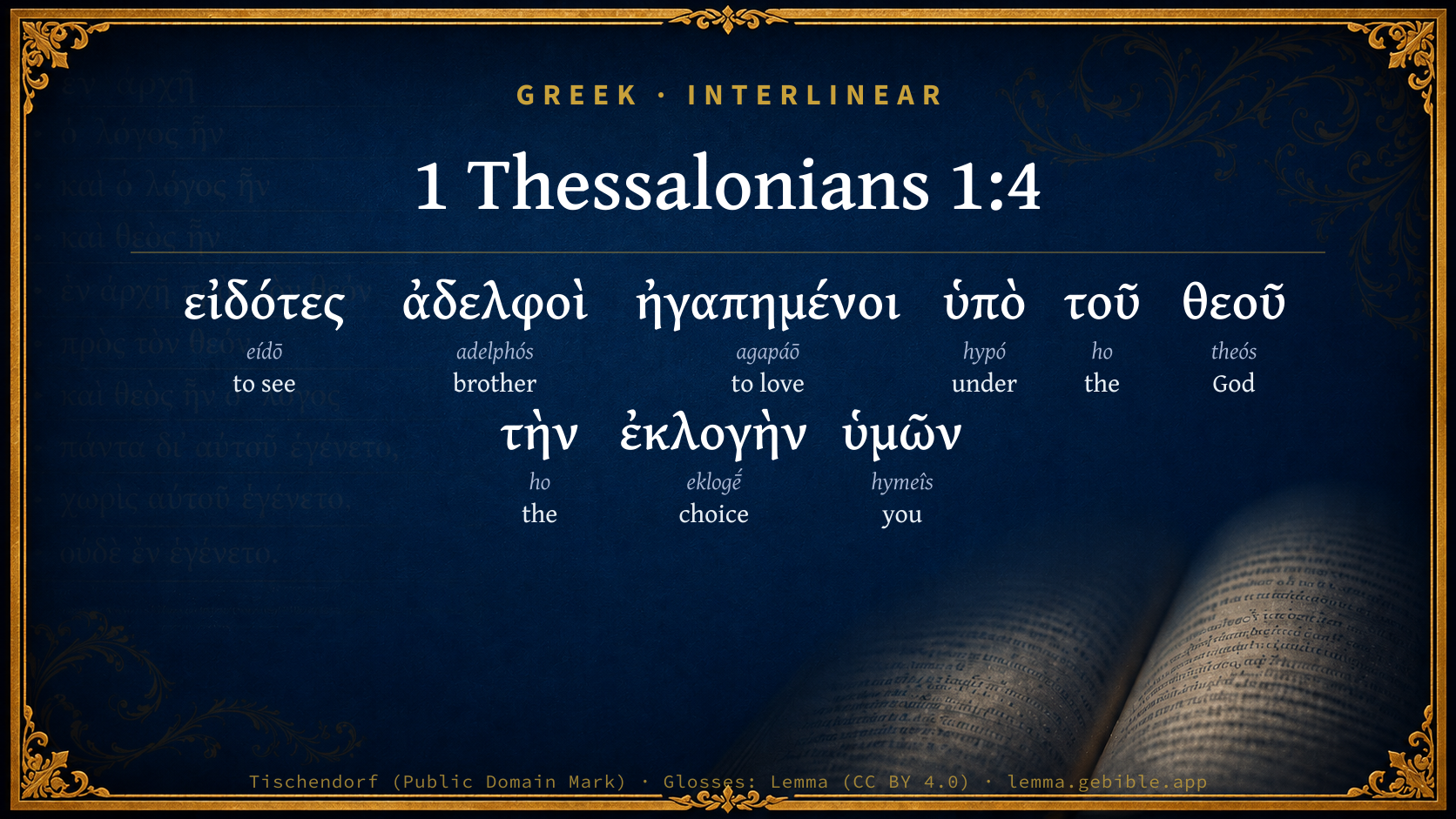
Greek (Tischendorf 8th ed.) 1 Thessalonians 1:4 appears in the Greek New Testament. The text above is from the Tischendorf 8th edition. Each word links to its Strong’s number and a concise gloss. Click any word for its full Thayer’s Greek Lexicon entry.
Download image
Cite this verse

1 Thessalonians 1:4 (World English Bible). Public Domain. Lemma interlinear Bible study tool, https://lemma.gebible.app/v/1-thessalonians/1/4.

Show BibTeX & RIS
BibTeX
RIS
English Translation
We know, brothers loved by God, that you are chosen,
World English Bible · Public Domain
Download a study sheet

One document with this verse’s original text, its word-by-word gloss line, the meaning frame, cross-references with their text, attributed commentary, and full source and license credits — printable, and it pastes into notes with its structure intact.

This verse Autodidact and up

Study sheet (.html) Plain text (.txt)

A passage Seminary Student

Up to 50 verses in one chapter. A passage sheet keeps up to 6 commentary sources and 12 cross-references per verse, in the order this page ranks them, and says so on the sheet whenever that leaves anything out. Ask for a single verse and you get the Autodidact verse sheet above.

Everything on this page stays free to read, with no account — the sheet is a download of what is already on screen, not access to it.

Want to remove ads? Support Godless Engineer
Compare translations 3

The same verse in 3 English versions, stacked beneath the original-language interlinear above. Click any original word for its lexicon entry.

Each is an independent rendering of the whole verse — the interlinear is not word-aligned to these translations.

Highlighted words mark where these versions differ — a whole-verse word diff, not a word-by-word alignment.

  • World English Bible Public Domain
    We know, brothers loved by God, that you are chosen,
  • King James Version Public Domain
    Knowing, brethren beloved, your election of God.
  • unfoldingWord Literal Text CC BY-SA 4.0
    knowing, brothers loved by God, your election,

unfoldingWord Literal Text — © unfoldingWord, licensed CC BY-SA 4.0. Word-aligned USFM3 via Door43 (git.door43.org/unfoldingWord/en_ult).

Versions to compare (up to 4)

3 of 4 selected

Show all 19 translations

Every available English version of this verse, each an independent rendering of the whole verse.

  • World English Bible Public Domain
    We know, brothers loved by God, that you are chosen,
  • Berean Standard Bible Public Domain
    Brothers who are beloved by God, we know that He has chosen you,
  • Majority Standard Bible Public Domain
    Brothers who are beloved by God, we know that He has chosen you,
  • King James Version Public Domain
    Knowing, brethren beloved, your election of God.
  • American Standard Version (1901) Public Domain
    knowing, brethren beloved of God, your election,
  • Revised Version (1885) Public Domain
    knowing, brethren beloved of God, your election,
  • Geneva Bible (1599) Public Domain
    Knowing, beloued brethren, that ye are elect of God.
  • Douay-Rheims (1899) Public Domain
    Knowing, brethren beloved of God, your election:
  • Young's Literal Translation Public Domain
    having known, brethren beloved, by God, your election,
  • Literal Standard Version CC BY-SA 4.0
    having known, beloved brothers, by God, your [divine] selection,
  • Unlocked Literal Bible CC BY-SA 4.0
    Brothers loved by God, we know he has chosen you,
  • unfoldingWord Literal Text CC BY-SA 4.0
    knowing, brothers loved by God, your election,
  • Darby Bible Public Domain
    knowing, brethren beloved by God, your election.
  • World Messianic Bible Public Domain
    We know, brothers loved by God, that you are chosen,
  • Webster's Bible Public Domain
    Knowing, brethren beloved by God, your election.
  • Free Bible Version CC BY-SA 4.0
    Brothers and sisters, we already know that you are loved by God and are very special to him.
  • Bible in Basic English Public Domain
    Being conscious, my brothers, dear to God, that you have been marked out by God's purpose;
  • Text-Critical English NT CC BY 4.0
    For we know, brothers beloved by God, that you have been chosen,
  • Tyndale New Testament (1534) Public Domain
    because we knowe brethren beloved of god how that ye are electe.

Literal Standard Version (2020), Covenant Press — licensed CC BY-SA 4.0. Text via the HelloAO Bible API (eBible.org). Unlocked Literal Bible (unfoldingWord) — licensed CC BY-SA 4.0. Text via the HelloAO Bible API (eBible.org). unfoldingWord Literal Text — © unfoldingWord, licensed CC BY-SA 4.0. Word-aligned USFM3 via Door43 (git.door43.org/unfoldingWord/en_ult). Free Bible Version, Dr. Jonathan Gallagher — licensed CC BY-SA 4.0. Text via the HelloAO Bible API (eBible.org).

Word by word

More ways to search: Search by grammar → Find every occurrence → Compare this word →

Practice this passage: Drill this verse → Learn its vocabulary →

About this verse

These counts appear in no published source. They are computed here, from the morphology-tagged text and Lemma’s own curated glosses. What Lemma adds →

9
words
8
distinct lemmas
Pauline Epistles
section

Notable vocabulary

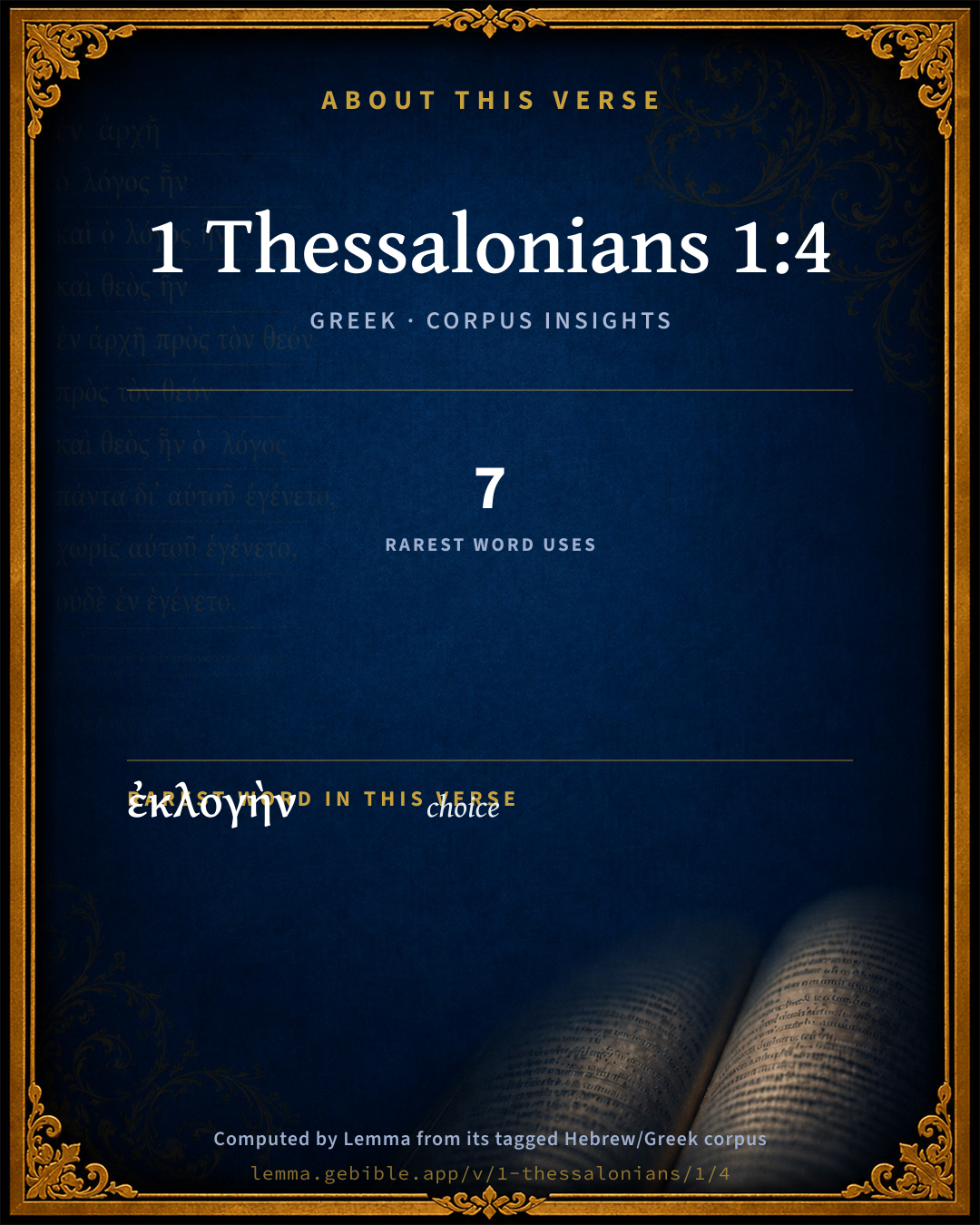
The rarest word here is ἐκλογὴν choice G1589 — appearing just 7 times in the whole Greek New Testament.

Shared distinctive vocabulary

ἐκλογὴν choice G1589 occurs in 7 verses of the Greek New Testament. Also found in:

Repetition

A word recurs within this verse:

Cross-references

14

Topical passages linked to 1 Thessalonians 1:4 in the Treasury of Scripture Knowledge — connected by theme and wording, ordered by reader-vote popularity; previews shown in the World English Bible.

  • 2 Thessalonians 2:13 But we are bound to always give thanks to God for you, brothers loved by the Lord, because God chose you from the beginning for salvation through sanctification of the Spirit and belief in the truth;
  • Titus 3:4–5 But when the kindness of God our Savior and his love toward mankind appeared,
  • 2 Peter 1:10 Therefore, brothers, be more diligent to make your calling and election sure. For if you do these things, you will never stumble.
  • Romans 9:25 As he says also in Hosea, "I will call them 'my people,' which were not my people; And her 'beloved,' who was not beloved."
  • Colossians 3:12 Put on therefore, as God's chosen ones, holy and beloved, a heart of compassion, kindness, lowliness, humility, and perseverance;
  • Ephesians 1:4 even as he chose us in him before the foundation of the world, that we would be holy and without blemish before him in love;
  • Ephesians 2:4–5 But God, being rich in mercy, for his great love with which he loved us,
  • Romans 1:7 to all who are in Rome, beloved of God, called to be saints: Grace to you and peace from God our Father and the Lord Jesus Christ.
  • Romans 8:28–30 We know that all things work together for good for those who love God, to those who are called according to his purpose.
  • Romans 11:5–7 Even so then at this present time also there is a remnant according to the election of grace.
  • Philippians 1:6–7 being confident of this very thing, that he who began a good work in you will complete it until the day of Jesus Christ.
  • 2 Timothy 1:9–10 who saved us and called us with a holy calling, not according to our works, but according to his own purpose and grace, which was given to us in Christ Jesus before times eternal,
  • 1 Peter 1:2 according to the foreknowledge of God the Father, in sanctification of the Spirit, that you may obey Jesus Christ and be sprinkled in his blood: Grace to you and peace be multiplied.
  • 1 Thessalonians 1:3 remembering without ceasing your work of faith and labor of love and patience of hope in our Lord Jesus Christ, before our God and Father.

Cross-references courtesy of OpenBible.info (CC BY 4.0).

Commentary

Notes on 1 Thessalonians 1:4 from classic Christian and Jewish commentators (each source and its license shown beneath its notes). The classic Christian expositions comment on the surrounding passage and are grouped to its opening verse, so a note may address several verses; the Jewish commentaries on the Tanakh (Rashi and others) are per-verse, so they appear only where the commentator wrote on this verse.

Lemma curates 59 commentaries, every one of them public domain or Creative Commons licensed, each selected and text-cleaned for this edition rather than reprinted as found. About our sources →

Ellicott's Commentary for English Readers

(4) “The reason why the sight delights us is because it proves that God loves you, and has set His heart upon you.”

Beloved.—The proper translation is, knowing brethren who have been so beloved of God, your election, as in the margin: the Greek idiom cannot allow of the Authorised rendering. The tense of the word “beloved” represents not only God’s attitude to them in the present, but the long continuance of it in the past, especially as proved by His election of them. (Comp. Rom_8:28-30, and 2Th_2:13.)

Election, in the language of (at any rate) St. Paul and St. Peter, seems primarily to refer to a gracious admission into religious privileges in this life. The word implies nothing as to the final condition of the person thus elected (see 2Pe_1:10, and comp. Eph_1:4 with Eph_5:5-7). God elects us to become members of the Holy Church, and all baptised persons are elect, with heaven in reversion (1Pe_1:2-5); but they may, according as they please, unsettle their election, or make it sure. St. Paul rejoices, because the continued possession of spiritual privileges, used or abused, is an assurance of God’s continued “favour and goodness towards us.” Of course, however, this observation does not much affect the mysterious doctrine of predestination. The question must still remain why God brings some in this life to the knowledge of His truth, and others not; but the observation, at any rate, destroys the notion of an arbitrary damnation and salvation.

A Bible Commentary for English Readers, edited by Charles John Ellicott (1878–1897) — public domain. Text from a community e-Sword module.

The Cambridge Bible for Schools and Colleges

gen. ed. J. J. S. Perowne

4. knowing, brethren beloved, your election of God] Better, following the A. V. margin and R. V., knowing, brethren beloved by God, your election: comp. 2Th_2:13, “brethren beloved by the Lord.”

The Apostle thinks of his readers as brethren, for he has just been carrying them in his thoughts in prayer “before our God and Father.” The knowledge that God their Father loves them and has chosen them for His own, gives confidence to the Apostle’s prayers for them and inexpressible joy to his thanksgivings. Comp. 2Th_2:13 : “We are bound to give thanks always for you, brethren beloved by the Lord, because God from the beginning chose you,” &c.; and Eph_1:3-5, “Blessed be God …, Who blessed us in every spiritual blessing, … according as He chose us in Christ,” &c.

The participle “beloved” is not however present in tense, as though the Thessalonians were simply loved now, in consequence of their newly-acquired Christian worth; it is in the Greek perfect tense, signifying a love existing in the past and realised in the present, the antecedent and foundation of their goodness. So in 1Jn_3:1 : “Behold what manner of love the Father hath given us, that we should be called sons of God!”

The Christian excellence of the Thessalonians, therefore, moved the Apostle and his companions to thanksgiving (1Th_1:2-3), not simply on its own account, but because it marked them out as the objects of God’s loving choice. The word election, here occurring for the first time in St Paul’s Epistles, and expressing one of his most important doctrines, needs to be carefully studied. The N. T. use of the word originates in the O. T. idea of Israel as God’s “peculiar possession,” “the people whom He chose for His inheritance” (see Psa_33:12; Psa_135:4; Deu_14:2; Isa_43:1-7; &c.). Such “election” implies two things—(1) selection out of others, nations or men, who are not thus chosen—“the rest” (ch. 1Th_4:13, 1Th_5:6); and (2) appropriation by God for His own love and service. Since Israel as a people now rejected Christ, St Paul was compelled to distinguish between national Israel and the true “election,” the spiritual kernel of the chosen people, who were the real objects of God’s favour: “the election obtained what Israel seeks after, but the rest were hardened” (Rom_11:7). With this true election, through Christ all believing Gentiles are identified—“wild olive shoots, grafted into the good olive-tree” (Rom_11:17-24). So the national gives place to a spiritual election—the “Israel of God” (Gal_6:16); and the Apostle Paul applies the term, as in this place, to Jewish and Gentile members of the Church indiscriminately. This transference is strikingly expressed in 1Pe_2:9 : “You (who believe in Christ) are a chosen race, a royal priesthood, a holy nation.” God’s election no longer marks out a nation or body of men as such, but it concerns individuals, each believer in Christ being the personal object of this loving choice—the “election of grace” (Rom_11:5). The end for which God in His grace so chooses men, appears in 2Th_2:13, “God chose yon unto salvation,” i.e. final deliverance from death and all evil, to be brought about by the return of Christ from heaven (1Th_1:10): the same end is set forth in the words of 1Th_2:12; 1Th_5:9-10—“God calleth you to His own kingdom and glory;” He “appointed you not to wrath, but to obtain salvation through our Lord Jesus Christ, that whether we wake or sleep, we should live together with Him.” And the means toward this end are stated in 2Th_2:13,—“in sanctification of spirit and faith in the truth” (see note ad loc.). Similarly in Eph_1:4, “He chose us to be holy and without blemish before Him.” In later Epistles (Rom_8:28-30; Eph_1:4-5) St Paul’s teaching on this subject receives two further extensions: (1) it is to sonship toward God that Christian believers are predestined; and (2) their election is carried back to eternity, “before the foundation of the world.” It is questionable whether “from the beginning” in 2Th_2:13 points back so far as this (see note ad loc.) The “election” of Thessalonian believers goes back at any rate as far as the Divine love of which they are the objects—“beloved by God.” But the Apostle’s mind is occupied with the event of the conversion of his readers, when God’s love to them and choice of them were practically manifest.

God’s choice of men for His purposes must, of course, precede their choice of Him and of His salvation; but it in no way precludes human choice and freedom of will—nay rather anticipates and prepares for our free volition (comp. Rom_8:28-30), and invites us to be “workers together” with it for our salvation: “work out your own salvation, … for it is God that worketh in you” (Php_2:12-13). It rests on the Divine foreknowledge of men (“whom He foreknew, He foreordained”), and seeks from their coming into life its destined objects (see Gal_1:15-16). But “Prescience, as prescience, hath in itself no causing efficacy” (Hooker). Observe that Scripture does not speak of any choice of men to believe in Christ, but of the choice of (assumed) believers to receive salvation. The consistency of man’s free-will with God’s sovereignty forms an insoluble mystery, which does not belong to the doctrine of election alone, but runs through the whole of life and religion.

The Apostle writes “knowing your election,” not that he is absolutely sure of the final salvation of every one to whom he writes—ch. 1Th_3:5 speaks otherwise; but from what he knows and remembers of them, he is practically certain that the circle of his readers belongs to God’s elect and that they will attain Christ’s heavenly kingdom (see ch. 1Th_2:12; 1Th_5:8-11; 1Th_5:24).

The evidence of this to his mind was twofold, lying (1) in the power given to himself and his companions in preaching at Thessalonica (1Th_1:5), and (2) in the zeal and devotion with which the Thessalonians had embraced the gospel (1Th_1:6).

The Cambridge Bible for Schools and Colleges (gen. ed. J. J. S. Perowne; Cambridge University Press, 1878–1918) — public domain. Text from a community e-Sword module.

Albert Barnes' Notes on the Bible

Knowing, brethren beloved, your election of God - The margin here reads, “beloved of God, your election.” The difference depends merely on the pointing, and that which would require the marginal reading has been adopted by Hahn, Tittman, Bloomfield, and Griesbach. The sense is not materially varied, and the common version may be regarded as giving the true meaning. There is no great difference between “being beloved of God,” and “being chosen of God.” The sense then is, “knowing that you are chosen by God unto salvation;” compare notes on Eph 1:4-5, Eph 1:11. The word “knowing” here refers to Paul himself, and to Silas and Timothy, who united with him in writing the Epistle, and in rendering thanks for the favors shown to the church at Thessalonica. The meaning is, that they had so strong confidence that they had been chosen of God as a church unto salvation, that they might say they knew it.

The way in which they knew it seems not to have been by direct revelation or by inspiration, but by the evidence which they had furnished, and which constituted such a proof of piety as to leave no doubt of the fact. Calvin. What this evidence was, the apostle states in the following verses. I was shown by the manner in which they embraced the gospel, and by the spirit which they had evinced under its influence The meaning here seems to be, not that all the members of the church at Thessalonica were certainly chosen of God to salvation - for, as in other churches, there might have been those there who were false professors - but that the church, as such, had given evidence that it was a true church - that it was founded on Christian principles - and that, as a church, it had furnished evidence of its “election by God.” Nor can it mean, as Clarke and Bloomfield suppose, that God “had chosen and called the Gentiles to the same privileges to which he chose and called the Jews; and that as they (the Jews) had rejected the gospel, God had now elected the Gentiles in their stead;” for a considerable portion of the church was composed of Jews (see Act 17:4-5), and it cannot, therefore, mean that the Gentiles had been selected in the place of the Jews. Besides, the election of the Gentiles, or any portion of the human family, to the privileges of salvation, to the neglect or exclusion of any other part, would be attended with all the difficulties which occur in the doctrine of personal and individual election. Nothing is gained on this subject in removing the difficulties, by supposing that God chooses masses of people instead of individuals. How can the one be more proper than the other? What difficulty in the doctrine of election is removed by the supposition? Why is it not as right to choose an individual as a nation? Why not as proper to reject an individual as a whole people? If this means that the church at Thessalonica had shown that it was a true church of Christ, chosen by God, then we may learn:

(1) That a true church owes what it has to the “election of God.” It is because God has chosen it; has called it out from the world; and has endowed it in such a manner as to he a true church.

(2) A church may give evidence that it is chosen of God, and is a true church. There are things which it may do, which will show that it is undoubtedly such a church as God has chosen, and such as he approves. There are just principles on which a church should be organized, and there is a spirit which may be manifested by a church which will distinguish it from any other association of people.

(3) It is not improper to speak with strong confidence of such a church as undoubtedly chosen of God. There are churches which, by their zeal, self-denial, and deadness to the world, show beyond question their “election of God,” and the world may see that they are founded on other principles and manifest a different spirit from other organizations of people.

(4) Every church should evince such a spirit that there may be no doubt of its “election of God.” It should be so dead to the world; so pure in doctrine and in practice, and so much engaged in spreading the knowledge of salvation, that the world will see that it is governed by higher principles than any worldly association, and that nothing could produce this but the influence of the Holy Spirit of God.

Albert Barnes' Notes on the Bible (1834–1885) — public domain. Text from a community e-Sword/MySword module.

The Biblical Illustrator

Joseph S. Exell

1Th_1:4-6

Knowing, brethren beloved, your election of God

Election

I.

The election of God is not connected with knowing nor election. The meaning is that the Church was beloved of God, not merely of the missionaries. And the proof of their being the subject of the Divine love is their election. This election was their historical selection out of the Western World to be the earliest European recipients of the gospel. The narrative in Act_16:6-10 is expository of it. The missionaries course was narrowed off from this and that place until the vision of the man of Macedonia. Thessalonica being the chief city of Macedonia, the vision was a declaration of the election of its inhabitants. The term election is a rare one in Scripture, and is absent, except in this case, from all Pauls earlier Epistles. It had been used of Paul to Ananias in reference to his own similar selection: He is a vessel of election unto Me. In both cases it means selection for privilege, and therefore for service. The same election is ceaselessly seen--one nation, city, family, individual, called before another. Many perplexities gather round the subject, and its ultimate solution is to be found in the Divine sovereignty alone. Often, however, the thing is clear. Here, e.g., there was a fitness in the choice of Thessalonica as a centre for Christian influence (1Th_1:8). Thessalonica was a great emporium of commerce by sea. It lay also on the line of one of the great Roman roads. Cicero describes it as placed in the bosom of the Roman Empire.

II. The grounds of the apostles knowledge of this election were--

1. Subjective--on his part.

(1) Our gospel, a phrase implying--

(2) Heart possession of it. I believed, therefore have I spoken. This is the first prerequisite of a faithful ministry. As Melanchthon used to say to his students, It is the all thy house shall be saved. These words were proclaimed by the apostles lips. Human instrumentality is employed in what is in the strictest sense Gods work. But often it is in word only. Even from the lips of Christ the message fell ineffectual, and Paul has his share in this. But it was far different here.

(3) This gospel came in power--not miraculously, but persuasively. It was no cold, formal performance of duty, but in a very exceptional degree heart work.

(4) It was therefore in the Holy Ghost. The presence and energy of the Divine Spirit were recognized by Him. His utterances were more than the struggles of an earnest human spirit; they were the winged words of the Spirit of Truth.

(5) Hence it came in much assurance, i.e., in the firm conviction that his message was from heaven, and that it was not in vain (1Co_2:1-5). So he knew from within himself that they were appointed unto salvation. From this we may gather--

(a) Every minister feels sometimes powerless, unaided by the Spirit, and oppressed with doubt. In such a case he is bound to search for causes in his own heart. But he is also entitled to look without; to trace the cause of his own feebleness in the apathy of the people. He may even, after the example of Paul, conclude in some cases from this ineffective preaching that they are not the chosen people of God. Pulpit and pew react on each other. Like people, like priest.

(b) The apostle appeals to their knowledge of his bearing and conduct as well as his words. Personal influence is far more direct and effective than official. Truth must be taught by example as well as precept. An infidel once said to Fenelon, with whom he had been residing: If I stay here any longer I shall become a Christian in spite of myself.

(c) This bearing was not self-interested, but for their sakes, as every ministers should be.

2. Objective--the eager joyfulness with which the Thessalonians received Pauls preaching. The two grounds cannot be separated. The first could be no safe evidence without the second. Their having been chosen of God is shown by their having chosen Gods gospel (1Th_2:13). It became theirs as well as Pauls. They became followers, i.e., imitators, of Paul and Christ. How? Not in their reception of the truth. In this they might be imitators of Paul, but not of Christ, who was the Truth. The point of imitation is the joyful endurance of suffering. Paul preached the gospel in much affliction with joy of the Holy Ghost, as Christ had wrought it out: Who for the joy that was set before Him endured the cross. In this sphere of trial, and of spiritual joy in the midst of it, Christ and His apostles and people are at one. Embracing Christ entailed suffering; but sorrow from without could not destroy inward joy. Afflictions come from men, but joy from the Holy Ghost. The gospel cannot be received without joy. Paul, then, would encourage them to greater endurance still, by his grateful recognition of this evidence of their election. (J. Hutchison, D. D.)

Evidences of election

I. The Word of God coming home with power. The power of the gospel--

1. Does not lie--

(1) In the preacher, otherwise men would be the converters of souls.

(2) Nor in the preacher s learning, or it would consist in the wisdom of men.

(3) Nor in the preachers adaptation to his work; that is a secondary agency, not the cause.

(4) Nor in the pathos the preacher may employ. People may weep at a theatre. No, there is something more wanted. A half-drunken man said to Rowland Hill, I am one of your converts. Yes, said he, I dare say you are one of mine; but if you were one of Gods, you would not be in that state.

2. It does lie in the power of the Holy Ghost.

(1) Did you ever--never mind where--in listening to the Word, feel a Divine power coming with it? Not an impression--that may be wiped out--but a power convincing of sin, making you tremble under it, and then wooing you to Christ, in whom you believed and then became a changed man?

(2) And since that has the Word rebuked you, filled you with Gods love and light and joy, and desire after holiness? If not, you lack a proof of your election. Not that it will be so every time, for the preacher is not always in a fit frame.

II. Receiving the Word with much assurance--not full assurance; that comes afterwards. There are some people who play fast and loose with principles; put a hymn book in their pockets when they are going to meeting and a song book when they are going somewhere else. They can hold with the hare and run with the hounds. Such people have never much confidence in their religion: and it is very proper that they should not, for their religion is not worth the time they spend in making a profession of it. But the true Christian, when he gets hold of principles, keeps them. His religion is part of himself. He believes the truth, not because he has been taught it, but because it is true to him; like the servant girl who, when she could not answer her infidel master, said, Sir, I cannot answer you, but I have a something in here that would, if it could speak. Now, if you have received the gospel with much assurance, you can say, Christ is mine. I know that Christ is precious, not by Paleys Evidences or Butlers Analogy, but by my hearts inward evidence, the analogy of my souls experience. If you can say that, whether you believe the doctrine of election or not, you are one of the elect.

III. Becoming followers of us and of the Lord; by which the apostle does not mean that they said, I am of Paul, I of Silas, I of Timothy. No, they imitated them so far as they imitated Christ. Are you Christ-like, or do you want to be? Can you forgive your enemy, love him, and do him good? Are you prayerful as Jesus was? If a man follow not Christ, whatever he may say about election he is not the Lords.

IV. Endurance of affliction with joy. (C. H. Spurgeon.)

Conditional election

A man of colour who had received the gospel became a preacher among his black brethren. He was addressed on one occasion by his master in these words: And so I hear that you have become a preacher, Sam, and that you believe in the doctrine of election. Well, yas, sah, I believe dat truth is clearly revealed in the Word of God. And I suppose, Sam, that you think that you are one of the elect. Well, sah, Ise prepared to say dat I gib all diligence to make my calling and election sure, dat is true. But I suppose you dont think that I am one of the elect, said Sams master. The sable preacher gave an answer that is worth quoting. Sam knew his master was given to the pursuit of pleasures, money, and the service of sin. Very quietly he replied, Well, massa, I am not sure about that; dis I know--I nebber knew of an election whet dar was no candidate. (H. Varley.)

Knowledge of election

An Arminian being about to pay a Calvinist a sum of money, asked, Is it decreed that I shall pay thee this money? Put it in my hand, and I will tell thee, was the reply. Is it not to be wished that many professors of religion would infer their election of grace by their actual possession of grace? (New Testament Anecdotes.)

Gods electing providence

Henry IV, King of France, was in every point of view a great man. It is said that on an anniversary of his birthday he made the following reflection: I was born on this day, and, no doubt, taking the world through, thousands were born on the same day with me; yet, out of all those thousands, I am probably the only one whom God hath made a king. How peculiarly am I favoured by the bounty of His providence! But a Christian, reflecting on his second birth, may, with greater reason, adore the free and sovereign grace of God.

Proofs of election

The way by which the apostle knew the election of the Thessalonians must be the method by which we are to know ours. We have known some men who pretended to know their election by their impudence. They had got into their head the presumption that they were elected, and though they lived on in sin, and still did as they liked, they imagined they were Gods chosen. This is what I call presuming upon election by sheer impudence. We know others who have imagined themselves to be elect, because of the visions that they have seen when they have been asleep or when they have been awake--for men have waking dreams--and they have brought these as evidences of their election. They are of as much value as cobwebs would be for a garment, and they will be of as much service to you at the day of judgment as a thiefs convictions would be to him if he were in need of a character to commend him to mercy. You may dream long enough before you dream yourself into heaven, and you may have as many stupid notions in your head as there are romances in your circulating libraries, but because they are in your head they are not therefore in Gods book. We want a more sure word of testimony than this, and if we have it not, God forbid that we should indulge our vain conceits with the dainty thought that we are chosen of God. I have heard of one who said in an ale house that he could say more than the rest, namely, that he was one of Gods children; meanwhile he drank deeper into intoxication than the rest. Surely he might have said he was one of the devils children with an emphasis, and he would have been correct. When immoral men, and men who live constantly in sin, prate about being Gods children, we discern them at once. Just as we know a crab tree when we see the fruit hanging upon it, so we understand what spirit they are of when we see their walk and conversation. Without holiness no man shall see the Lord. If we are Gods elect, we shall have some substantial evidence to attest it. (C. H. Spurgeon.)

The Biblical Illustrator, edited by Joseph S. Exell (c. 1880s–1900s) — public domain. Text from a community e-Sword module.

The Pulpit Commentary

Knowing; that is, not the Thessalonians themselves, but we, Paul and Silvanus and Timotheus; knowing, being well assured of. Brethren beloved, your election of God; or rather, as it is in the margin and in the R.V, Knowing brethren, beloved of God, your election. By election is meant that act of free grace by which God destines individuals to become believers in Christ. Thus the Thessalonian converts were chosen or elected by God from among their heathen countrymen to become Christians. The ultimate reason of their Christianity was their election of God. Vers. 4-6.

Their election and its fruits another ground of thanksgiving.

The apostle, Jew as he was, addresses these Gentiles as his brethren, and represents them as the objects of Divine love. "Knowing, brethren beloved of God, your election.

I THERE IS AN ELECTION ACCORDING: TO GRACE.

1. The election referred to here was not an election to external privilege or ecclesiastical relationship; for that might have had a very uncertain issue, and would not have been the subject of such abounding thankfulness as he expresses in this passage.

2. It was not even the call to obtain glory, which they had received through his gospel; (2Th_2:13, 2Th_2:14) for the election only realized itself in that call, Scripture always distinguishing the order of election and calling. "Whom he did predestinate, them he also called". (Rom_8:30)

1. Much less is the election to be identified with regeneration, conversion, or faith. These were its effects.

1. It was an election to eternal life, involving all the various processes of his grace. (Rom_11:5)

1. It is an election in Christ. (Eph_1:4)

2. It is irrespective of merit. (Rom_9:11)

3. It is through faith and the sanctification of the Spirit. (2Th_2:13)

4. It is to eternal glory. (Rom_9:23)

II THE KNOWLEDGE OF THIS ELECTION IS A POSSIBLE AND AN ACTUAL EXPERIENCE. The apostle"s knowledge was not derived from special revelation, neither was it the mere credulity of a kindly charity, "hoping all things" in the absence of evidence. It had a double ground one subjective and the other objective; one based upon the apostle"s conscious experience in preaching the gospel, the other upon their practical and hearty reception of the truth.

1. The subjective evidence. "For our gospel came not unto you in word only, but also in power, and in the Holy Ghost, and in much assurance.

(1) It did come in word, for it was conveyed to the Thessalonians in human speech, albeit not "in the enticing words of man"s wisdom," but it passed beyond the word. It did not merely sound in the ear nor touch the understanding.

(2) But it came in power on the part of the preachers with an overwhelming force and persuasiveness, so that "the faith of the people should not stand in the wisdom of man, but in the power of God". (1Co_2:5) There was a conscious abounding energy which carried them beyond themselves, with an overmastering conviction that they would prevail.

(3) It came also "in the Holy Ghost," or, as the apostle elsewhere phrases it, in demonstration of the Spirit and of power". (1Co_2:4) The Word would otherwise have been a dead letter and a killing letter, but the Spirit gave it life. The power of the gospel, therefore, was due to the efficient operation of the Spirit.

(4) It came also "in much assurance," not on the part of the Thessalonians, but on the part of the preachers of the gospel, who were fully convinced of its truth, and had thorough confidence in its power.

(5) This subjective evidence was confirmed by their own recollection of the three preachers of the gospel ye know what manner of men we were among you for your sake." The Thessalonians would have a very vivid recollection both of the preaching and the preachers. The three brethren were conspicuous by their holiness, their zeal, and their interest in the welfare of the Thessalonians. This was no self-flattery, for it was confirmed by the knowledge of their converts.

2. The objective evidence of their election. "And ye became imitators of us, and of the Lord, having received the Word in much affliction, with joy of the Holy Ghost." Their ready imitation of the apostle and his colleagues which was, in truth, an imitation of Christ, so far as they wereconnected with him in his life and truth was a practical proof of the sincerity of their conversion. The imitation was manifest in the spirit and circumstances of their reception of the truth.

(1) The truth was received "in much affliction." The history of their conversion confirms this statement. (Act_17:5, Act_17:9) But the persecution continued after the departure of the apostle. The gospel had its drawbacks, but the Thessalonians were steadfast in their allegiance to the truth.

(2) Yet it was received "with joy of the Holy Ghost;" that is, the joy that springs from his presence in the soul. They were thus imitating that apostle who "took pleasure in infirmities, in reproaches, in necessities, in persecutions, in distresses for Christ"s sake". (2Co_12:9, 2Co_12:10) The joy in question is

(a) a fruit of the Spirit; (Gal_5:22)

(b) it is essentially connected with the kingdom of God as part of its blessedness; (Rom_14:17)

(c) it is capable of increase through the very presence of affliction; (Act_5:41)

(d) it is the strength of the believer joy of the Lord shall be your strength"; (Neh_8:10)

(e) its advent marks a distinct change in the world"s history;

(f) it ought to be constant; (Php_4:4)

(g) it is maintained through abiding in Christ. T.C. (Joh_15:10, Joh_15:11)

The Pulpit Commentary (1880–1919), ed. H.D.M. Spence-Jones & Joseph S. Exell — public domain. Text from a community e-Sword module.

Tyndale Open Study Notes

Tyndale Open Resources

1:4 dear brothers and sisters: Greek adelphoi, a generic term that refers to members of the same family, both male and female.

Tyndale Open Study Notes — © Tyndale Open Resources, licensed CC BY-SA 4.0. Text via the HelloAO Bible API.

Bengel's Gnomon

Johann Albrecht Bengel

1Th 1:4. Εἰδότες, [we] knowing) Construed with we give thanks, 1Th 1:2.—ἀδελφοὶ ἠγαπήμενοι ὑπὸ Θεοῦ, brethren beloved by God) Comp. 2Th 2:13.—ἐκλογὴν, election) 1Co 1:27, note.

Bengel's Gnomon of the New Testament — English translation (T&T Clark, Edinburgh, 1860) — public domain. Text from a community e-Sword module.

Meyer's Critical & Exegetical Commentary

Heinrich August Wilhelm Meyer

1Th_1:4. Εἰδότες is incorrectly referred by many (thus Baur) to the Thessalonians, either as the nominative absolute in the sense of οἴδατε γάρ (Erasmus), or εἰδότες ἐστέ (Homberg, Baumgarten-Crusius); or (Grotius) as the beginning of a new sentence which has its tempus finit. in ἐγενήθητε (1Th_1:6), knowing that ye became followers of us. Rather, the subject of 1Th_1:2-3, thus Paul, Silvanus, and Timotheus, is continued in εἰδότες. It is further erroneous to supply καί before εἰδότες (Flatt), as this participle is by no means similar to the two preceding. Lastly, it is erroneous to make εἰδότες dependent on μνείαν ποιούμενοι (Pelt). Εἰδότες is only correctly joined to the principal verb εὐχαριστοῦμεν (1Th_1:2), and adduces the reason of the apostles thanksgiving, whilst the preceding participles state only the mode of εὐχαριστοῦμεν.

ὑπὸ Θεοῦ cannot be conjoined with εἰδότες (scientes a deo, i.e. ex dei revelatione), which Estius thinks possible, against which ὑπό instead of παρά is decisive. Nor does it belong to τὴν ἐκλογὴν ὑμῶν, so that εἶναι would require to be supplied, and ἀδελφοὶ ἠγαπημένοι to be taken by itself (Oecumenius, Theophylact, Calvin, Musculus, Hemming, Zanchius, Justinian, Vorstius, Calixtus, Clericus), but to ἠγαπημένοι. For(1) this union is grammatically the most natural (see 2Th_2:13, the Hebrew יְדִידֵי יְהֹוָה, 2Ch_20:7, and ἀγαπητοὶ Θεοῦ, Rom_1:7). (2) By the union of ὑπὸ Θεοῦ τὴν ἐκλογὴν ὑμῶν, a peculiar stress would be put on ὑπὸ Θεοῦ; but such an emphasis is inadmissible, as another ἐκλογή than by God is in Pauls view a nonentity, and therefore the addition ὑπὸ Θεοῦ would be idle.

Moreover, ἀδελφοὶ ἠγαπημένοι ὑπὸ Θεοῦ is a pure address, and not the statement of the cause of τὴν ἐκλογὴν ὑμῶν (Estius).

ἐκλογή] election or choice, denotes the action of God, according to which He has predetermined from eternity individuals to be believers in Christ. κλῆσις is related to ἐκλογή as the subsequent realization to the preceding determination. Erroneously Pelt: ἐκλογή is electorum illa innovatio, qua per spiritum divinum mutatur interna hominem conditio; and still more arbitrarily Baumgarten-Crusius: ἐκλογή is not choice among others (church election), but out of the world, with Paul equivalent to κλῆσις, and exactly here as in 1Co_1:26; not being elected, but the mode or condition of the election (!), so that the sense would be: Ye know how ye have become Christians (!!).

ὑμῶν] the objective genitive to ἑκλογήν: the election of you.

Meyer — Critical and Exegetical Commentary on the New Testament — English translation by Peter Christie, edited by Frederick Crombie (T&T Clark, 1880) — public domain. Text from a community e-Sword module.

Expositor's Greek Testament

ed. W. Robertson Nicoll

1Th 1:4 . The practical evidence of the Spirit in their lives showed that God had willed to enrol them among His chosen people (note the O.T. associations of beloved by God and election ), just as the same consciousness of possessing the Spirit gave them the sure prospect of final entrance into the Messianic realm an assurance which (1Th 1:6 ) filled them with joy amid all their discomforts. The phenomenon of the Spirit thus threw light backwards on the hidden purpose of God for them, and forwards on their prospect of bliss. Recollections depend on knowledge; to be satisfied about a person implies settled convictions about his character and position. The apostles feel certain that the Thessalonian Christians had been truly chosen and called by God, owing to ( a ) the genuineness and effectiveness of their own ministry at Thessalonica, where they had felt the gospel going home to many of the inhabitants, and ( b ) the genuine evidence of the Thessalonians’ faith; ( a ) comes first in 1Th 1:5 , ( b ) in 1Th 1:6 f. In 1Th 2:1 f. Paul reverts to ( a ), while in 1Th 2:13-16 ( b ) is again before his mind. As the divine ἐκλογή manifested itself in the Christian qualities of 1Th 1:3 , Paul goes back to their historical origin.

The Expositor's Greek Testament, edited by W. Robertson Nicoll (1897–1910) — public domain. Text from a community e-Sword module.

International Critical Commentary

4. εἰδότε = ὅτι οἴδαμε. The causal participle (cf. Php 1:6, Col 1:3, Phm 1:4) introduces the ultimate ground of the thanksgiving, namely, the election of the readers. Of this election Paul is assured both from the fact that (ὅτ v. 5) the gospel which he preached, the gospel through which God calls men unto salvation (II 2:14), came home to them with the power of the Spirit, and from the fact that (sc. ὅτ before ὑμεῖ v. 6) the same Spirit operated in the believers, as could be plainly inferred from the welcome they gave to the Word and its messengers in spite of great persecution. It is significant both that here, as Calvin observes, Paul infers the pretemporal election of the readers from the fruits of the Spirit, and that it is taken for granted that the readers understand what ἐκλογη means, an evidence that this idea formed an integral part of the gospel of God proclaimed in Thessalonica.

ἀδελφοὶ ἠγαπημένοι ὑπὸ τοῦ θεου. The frequency of ἀδελφοι in I is indicative of Paul’s love for his converts. This affectionate address is strengthened by “beloved by God,” a phrase which like “beloved by the Lord” (II 2:13) is unique in the N. T., though equivalent in sense to ἀγαπητοὶ θεου (Rom 1:7). The connection of this phrase with ἐκλογη makes plain that election proceeds from the love of God (cf. Isa 41:8-9 where ἐκλέγεσθα is parallel to ἀγαπᾷ).

Moses in Sir. 45:1 is ἠγαπημένος ὑπὸ θεοῦ καὶ ἀνθρώπω; Israel in Baruch 3:37 is ἠγαπ. ὑπʼ αὐτου (i. e. “our God”); and Solomon in Neh 13:26 is ἀγαπώμενος τῷ θεῷ cf. Ep. to Diogn. 4:4 where ἐκλογη and ἠγαπημένους ὑπὸ θεου appear together and Ign. Trall. init. of the holy church ἠγαπ. θεῷ πατρὶ Ἰ. Χ More frequently we have in this phrase, as in II 2:13, κυρίο; for example, Benjamin in Deu 33:12 and Issachar in Test. xii Iss. 1:1 are ἠγαπ. ὑπὸ κυρίο; and Samuel in Sir. 46:13 is ἠγαπ. ὑπὸ κυρίου αὐτου See further Col 3:12, 1Co 15:58, etc.—ἀδελφοί μο (Rom 7:4, Rom 7:15:14, 1Co 1:11, 1Co 11:33, 1Co 14:39, Php 3:1), ἀδελφοί μου ἀγαπητοι (1Co 15:58, Php 4:1), ἀγαπητοι (Rom 12:19, 2Co 7:1, 2Co 12:19, Php 4:1), ἀγαπητοί μο (1Co 10:14, Php 2:12), do not occur in I, II as forms of address. The simple ἀδελφοι of address occurs about 20 times in 1Cor., 14 in 1 Thess., 10 in Rom., 9 in Gal., 7 in 2 Thess., 6 in Phil., 3 in 2 Cor. and twice in Phile. (ἀδελφε). But no one of these addresses appears in Col. or Eph. On the Christian use of ἀδελφοί cf. Harnack, Mission, 2 I, 340 ff.; on the pagan use, Deiss. BS 82 f. and Witk., 38, note 1. It is doubtful whether του before θεου is to be retained (אACKP) or omitted (BDGL; cf. Weiss., 72).

τὴν ἐκλογὴν ὑμῶ. “The election of you,” that is, “that you have been chosen,” namely, by God, as always in Paul. The eternal choice of God, “the divine purpose which has worked on the principle of selection” (SH ad Rom 9:11), includes, according to II 2:14, not only the salvation of the readers but also the means by which or the state in which salvation is realised.

The words ἐκλέγεσθα (1Co 1:27 ff. Eph 1:4), ἐκλεκτό (Rom. 16:33), ἐκλεκτοὶ θεου (Rom 8:33, Col 3:12), and ἐκλογη (Rom 9:11, Rom 9:11:5, Rom 9:7, Rom 9:28) are rare in Paul. ἐκλογη does not occur in the Lxx For its use in Ps. Sol., see the edition of Ryle and James, 1891, 95 f. κλῆσι (II 1:11), καλεῖ (2:12, 4:7, 5:24) is the historical calling mediated by the preaching of the gospel (II 2:14).

International Critical Commentary — older volumes (1896–1929), various authors — public domain. Text from a community e-Sword module.

Geneva Bible (1599)

Geneva Bible translators

Word for word, that your election is of God.

Geneva Bible (1599) marginal notes — public domain. Text via Bolls.life.

Jamieson, Fausset & Brown

Robert Jamieson, A. R. Fausset & David Brown

Knowing--Forasmuch as we know.

your election of God--The Greek is rather, "beloved by God"; so Rom 1:7; Th2 2:13. "Your election" means that God has elected you as individual believers to eternal life (Rom 11:5, Rom 11:7; Col 3:12; Th2 2:13).

Jamieson, Fausset & Brown — Commentary Critical and Explanatory on the Whole Bible (1871) — public domain (CC PDM 1.0). Text via the HelloAO Bible API.

Adam Clarke's Commentary

Verse 4. Knowing - your election of God.] Being assured, from the doctrine which I have delivered to you, and which God has confirmed by various miracles, and gifts of the Holy Spirit, that he has chosen and called the Gentiles to the same privileges to which he chose and called the Jews; and that, as they have rejected the offers of the Gospel, God has now elected the Gentiles in their stead. This is the election which the Thessalonians knew; and of which the apostle treats at large in his Epistle to the Romans, and also in his Epistles to the Galatians and Ephesians. No irrespective, unconditional, eternal, and personal election to everlasting glory, is meant by the apostle. As God had chosen the Jews, whom, because of their obstinate unbelief, he had now rejected; so he had now chosen or elected the Gentiles. And in neither case was there any thing absolute; all was most specifically conditional, as far as their final salvation was concerned; without any merit on their side, they were chosen and called to those blessings which, if rightly used, would lead them to eternal glory. That these blessings could be abused-become finally useless and forfeited, they had an ample proof in the case of the Jews, who, after having been the elect of God for more than 2000 years, were now become reprobates.

Adam Clarke's Commentary on the Bible (1810–1826) — public domain. Text from a community e-Sword/MySword module.

John Calvin's Commentaries

4 Knowing, brethren beloved. The participle knowing may apply to Paul as well as to the Thessalonians. Erasmus refers it to the Thessalonians. I prefer to follow Chrysostom, who understands it of Paul and his colleagues, for it is (as it appears to me) a more ample confirmation of the foregoing statement. For it tended in no small degree to recommend them — that God himself had testified by many tokens, that they were acceptable and dear to him.

Election of God. I am not altogether dissatisfied with the interpretation given by Chrysostom — that God had made the Thessalonians illustrious, and had established their excellence. Paul, however, had it in view to express something farther; for he touches upon their calling, and as there had appeared in it no common marks of God’s power, he infers from this that they had been specially called with evidences of a sure election. For the reason is immediately added — that it was not a bare preaching that had been brought to them, but such as was conjoined with the efficacy of the Holy Spirit, that it might obtain entire credit among them.

When he says, in power, and in the Holy Spirit, it is, in my opinion, as if he had said — in the power of the Holy Spirit, so that the latter term is added as explanatory of the former. Assurance, to which he assigned the third place, was either in the thing itself, or in the disposition of the Thessalonians. I am rather inclined to think that the meaning is, that Paul’s gospel had been confirmed by solid proofs, as though God had shewn from heaven that he had ratified their calling. When, however, Paul brings forward the proofs by which he had felt assured that the calling of the Thessalonians was altogether from God, he takes occasion at the same time to recommend his ministry, that they may themselves, also, recognize him and his colleagues as having been raised up by God.

By the term power some understand miracles. I extend it farther, as referring to spiritual energy of doctrine. For, as we had occasion to see in the First Epistle to the Corinthians, Paul places it in contrast with speech — the voice of God, as it were, living and conjoined with effect, as opposed to an empty and dead eloquence of men. It is to be observed, however, that the election of God, which is in itself hid, is manifested by its marks—when he gathers to himself the lost sheep and joins them to his flock, and holds out his hand to those that were wandering and estranged from him. Hence a knowledge of our election must be sought from this source. As, however, the secret counsel of God is a labyrinth to those who disregard his calling, so those act perversely who, under pretext of faith and calling, darken this first grace, from which faith itself flows. “By faith,” say they, “we obtain salvation: there is, therefore, no eternal predestination of God that distinguishes between us and reprobates.” It is as though they said — “Salvation is of faith: there is, therefore, no grace of God that illuminates us in faith.” Nay rather, as gratuitous election must be conjoined with calling, as with its effect, so it must necessarily, in the mean time, hold the first place. It matters little as to the sense, whether you connect ὑπὸ with the participle beloved or with the term election

John Calvin's Commentaries (1540-1563) — public domain. Text from the Calvin Translation Society English edition (1840s-50s) via the Christian Classics Ethereal Library (ccel.org). Calvin's coverage is partial (roughly two-thirds of the Bible); uncommented books and verses are honest gaps, never fabricated. The 19th-century editor's footnotes and remarks are omitted so the notes are faithfully Calvin's own voice.

John Gill's Exposition

Knowing, brethren beloved, your election of God. Which intends not an election to an office, for this epistle is written not to the officers of the church only, but to the whole church; nor to the Gospel, the outward means of grace, since this was common to them with others, and might be known without the evidence after given; nor does it design the effectual calling, sometimes so called for this is expressed in the following verse as a fruit, effect, and evidence of the election here spoken of, which is no other than the eternal choice of, them to everlasting life and happiness: this is of God, an act of God the Father, made in Christ Jesus before the world began, and which springs from his sovereign will, and is the effect of his pure love and free favour; and therefore these persons who are the objects of it are said to be "beloved of God"; for so the Vulgate Latin, Syriac, Arabic, and Ethiopic versions read the words, and which agree with Th2 2:13 for this choice does not arise from the merits of men, or any conditions in them, or from the foresight of their faith, holiness, and good works, but from the free grace and good pleasure of God; and is the source and spring of all grace, and the blessings of it, and even of good works; and is a sure, immutable, and irreversible act of God, being founded on his own will, and not on the works of men; the knowledge they had of this was not what the Thessalonians themselves had, though they might have, and doubtless had the knowledge of this grace, and which may be concluded with certainty from the effectual calling; and is a privilege which many particular believers may, and do arrive unto the knowledge of, without any extraordinary revelation made unto them: but here it intends the knowledge which the apostle and his companions had of the election of the members of this church; not by inspiration of the Spirit of God, but by the manner of the Gospel's coming unto them, and the effects it had upon them, as expressed in the following verses; and from their faith, hope, and love, mentioned in the preceding verse; and which was the ground and foundation of their thanksgiving for them;

see on Gill Th2 2:13.

John Gill's Exposition of the Whole Bible (1746–1763) — public domain (CC PDM 1.0). Text via the HelloAO Bible API.

Trapp's Complete Commentary

John Trapp

4 Knowing, brethren beloved, your election of God.

Ver. 4. Knowing, brethren beloved of God] Knowing it by the judgment of charity, not of infallibility. He that believeth hath the witness in himself, 1Jn 5:10. But the white stone, the new name, and the hidden man of the heart are not certainly known to any, but to such as have them. Howbeit, holy men in some degree are known one to another, to make the communion of saints the sweeter. Strong confidence one may have of another’s salvation; but no certainty either of sense or of science, much less of faith, or immediate revelation.

John Trapp, A Commentary or Exposition upon All the Books of the Old and New Testament (1647–1656) — public domain. Text from a community e-Sword module.

Matthew Poole's English Annotations

Another ground of his thanksgiving for them. By the manner of their receiving the gospel, and the evident operation of the graces of God’s Spirit, the apostle knew their election of God. We cannot know election as in God’s secret decree, but as made manifest in the fruits and effects of it. As there is a knowledge of things a priori, when we argue from the cause to the effect, so a posteriori, when we argue from the effects to the cause. And thus the apostle came to know their election. Not, we hope it, or conjecture it, but we know it; and not by extraordinary revelation, but by evident outward tokens. And if the apostle knew this, why should we think they themselves might not know it also; and the words may be read: Ye knowing your election of God. And election imports the choosing of some out of others; for election cannot comprehend all. Some deny all eternal election of particular persons, and make it a temporal separation of persons to God in their conversion; but is not this separation from a pre-existing decree, God doing all things after the counsel of his own will? Eph 1:11. Or, they will yield an eternal election of persons, but only conditional; one condition whereof is perseverance to the end. But the apostle asserts their election at present, before he saw their perseverance.

Matthew Poole's English Annotations on the Holy Bible (1683–1685) — public domain. Text from a community e-Sword/MySword module.

Whedon's Commentary on the Bible

Daniel D. Whedon

4. Election of, or by,

God—Lunemann says, concisely and peremptorily: “Election signifies the action of God by which he predestines from eternity the individual to faith in Christ.” But we have shown, in the first chapter of Ephesians, that this election must have a definite and conditioned object, namely, the actual believer. God chooses him, however, not only from his faith, but also unto still further faith, to a holy life, and to a blessed eternity. The apostle was knowing this, not from any special revelation or inspiration in the case, but from the evidence they furnish both of having met the condition of faith, and having carried out in life the blessed results of faith. In 1Th_1:5, he shows how the gospel came to them in power, offering them that election, and in 1Th_1:6 he shows how they accepted it.

Daniel D. Whedon (gen. ed.), Commentary on the Old and New Testaments (1874–1909) — public domain. Text from a community e-Sword module.

John Wesley's Explanatory Notes

Knowing your election - Which is through faith, by these plain proofs.

John Wesley, Explanatory Notes Upon the Whole Bible (1754–1765) — public domain. Text via the GEBible commentary corpus.

Burkitt's Expository Notes on the New Testament

William Burkitt

Observe here, 1. One special ground and reason assigned, why the apostle’s heart was thus extraordinarily carried out in praise and thanksgivings unto God, on the Thessalonians’ behalf, and that was the knowledge of their election, knowing your election of God; that is, knowing cerainly and infallibly, by your proficiency in the forementioned Christian graces of faith, love, and hope, that God had certainly chosen you out of the Gentile world, to be a church and people to himself, and that it was the good pleasure of God to gather a Christian church at Thessalonica; and also he did know and believe, with a judgement of charity, that Almighty God had chosen them to eternal life also, to be a part of his church truimphant in heaven, as well as of his church militant upon earth; the preaching of the gospel having met with such visible success amongst them. It is our unquestionable duty, and we learn it from St. Paul’s example, in charity to number them amongst God’s chosen, in whom we see, as much as man may see, the fruits and signs of God’s election.

Observe, 2. The ground which St. Paul had to build his confidence upon, that the Thessalonians were a people chosen of God, and that was rational evidence, knowing your election of God; for our gospel came to you not in word only, but in power.

Where note, the piety and prudence of St. Paul’s charity, it was not weakly grounded or credulous, but guided by reasonable evidence; Charity hopeth all things, that is, all things that it hath good ground to hope, but nothing more than what probable evidence may induce it to hope. St. Paul, when he saw the apostasy of Hymenaeus and Alexander into error and vice, without censoriousness and uncharitableness, pronounces that they had made shipwreck of the faith, 1Ti 1:2 . For he had sufficient reason to believe, there could be no faith where there was no holiness. There are a generation of men amongst us, who brand the ministers of God with censoriousness, and rash judging the present state of men, though they judge by their lives and actions; they would have us hope well concerning them, against hope, and judge quite contrary to rational evidence; we must believe them to have faith, when they have no knowledge; that they are right penitents, and sorrowful for their sins, when they make a sport of sin; that their hearts are chaste, when their mouths foam out nothing but filthiness; but let them know, we dare not bring a curse upon ourselves, by calling good evil, and evil good; our charity though not causelessly susupicious, yet neither is it foolishly blind.

Observe, 3. The particular and special evidence which the apostle had of the Thessalonians election, and that was the great and gracious success of this ministry amongst them. Our gospel came - But how our gospel? Not as if he were the author of it, but the dispenser only; not our gospel by original revelation, but by ministerial despensation only.

But how did the gospel come amongst the Thessalonians?

Not in word only, sounding in the ear, or to gaze upon; but in power, that is, accompanied then with the power of miracles, now with a convincing, terrifying, humbling, renewing, and reforming power.

It follows, and in the Holy Ghost; that is, the preaching of the word was at that time attended, as with a mighty power of miracles, so with an extraordinary effusion and pouring out the Holy Ghost upon them that heard it, prevailing upon them to embrace it, and to submit themselves unto it. With this miraculous power of the Holy Ghost was the preaching of the word accompanied then, with an enlightening, quickening, regenerating, and sanctifying power now; the ministry of the word is the great instrument in the hand of the Spirit, for the conversion of sinners, for the edification of saints, and for the salvation of both.

Again, the apostle’s ministration came unto them in much assurance, that is, with a full conviction of the truth of his doctrine; and to him, it was a full persuasion, yea, a firm assurance, that God had chosen them to be a church and special people to himself.

And lastly, as to his own conduct and conversation amongst them, he appeals to them, and to their own knowledge, whether it was not answerable to the doctrine delivered by him; Ye know what manner of men we were amongst you for your sake.

Happy is it when the pious and prudent conversation of a minister amongst his people, is, and has been such, that upon a fit occasion, he can and dare appeal to God and them as witnesses and observers of it; Ye know what we were among you: ye are witnesses, and God also, how holily, and justly, and unblameably we behaved ourselves among you, 1Th 2:10.

An heterodox conversation will carry an orthodox preacher to hell; there is a preaching life, as well as a preaching doctrine; if religion be taught by the first, and irreligion by the latter, we sadly disappoint the end of what is spoken; though, like a cracked bell, we may be instrumental to ring others to heaven, yet for ourselves there is no remedy, but to the fire we must go, either for our refining, or for our condemnation. The throne and the pulpit, above all places, call for holiness; the prince and the preacher, above all persons, are most accountable to God for their example; Ye know what manner of men we were among you.

William Burkitt's Expository Notes on the New Testament (1700–1703) — public domain. Text from a community e-Sword module.

McGarvey & Pendleton's Commentaries

J. W. McGarvey

knowing, brethren beloved of God, your election ,

J. W. McGarvey (with Philip Y. Pendleton), Commentaries on the New Testament (The Fourfold Gospel, 1914; Acts; and the epistles) — public domain. Text from a community e-Sword/MySword module.

The People's New Testament

B. W. Johnson

4. Knowing … your election of God. That you are of the elect, the “chosen nation.” All Christians were the elect, and the expression is another way of saying, “Knowing that you have become Christians.”

B. W. Johnson's The People's New Testament with Notes (1889–1891) — public domain. Electronic text from the Christian Classics Ethereal Library (CCEL) ThML edition.

unfoldingWord translationNotes

Door43 World Missions Community

Connecting Statement:

Paul continues to give thanks for the believers at Thessalonica and praises them for their faith in God.

Brothers

Here this means fellow Christians, including both men and women.

we know

The word "we" refers to Paul, Silvanus, and Timothy but not the Thessalonian believers. (See: Exclusive and Inclusive "We")

not in word only

"not only in what we said"

but also in power, in the Holy Spirit

Possible meanings are 1) the Holy Spirit gave Paul and his companions the ability to preach the gospel powerfully or 2) the Holy Spirit made the preaching of the gospel have a powerful effect among the Thessalonian believers or 3) the Holy Spirit demonstrated the truth of the gospel preaching by means of miracles, signs, and wonders.

in much assurance

The abstract noun "assurance" can be translated as a verb. AT: "God made you sure that it was true" (See: Abstract Nouns)

what kind of men

"how we conducted ourselves when"

translationWords

brother

God

call

good news

power

Holy Spirit

unfoldingWord translationNotes — © Distant Shores Media and the Door43 World Missions Community, licensed CC BY-SA 4.0. Source: git.door43.org/Door43/en_tn.

Cambridge Greek Testament for Schools and Colleges

4. BDG omit, אACKP insert, the article του before θεου: cf. 1Th 2:4. Possibly the art. is an Alexandrian insertion, due to 1Th 1:3 (εμπροσθεν του θεου). See the note next but two; cf. 2Th 2:13; also Heb 6:18, where the same group (א*ACP) insert the article.

Cambridge Greek Testament for Schools and Colleges (Cambridge University Press, 1896; 21 vols, various authors incl. Carr, Maclear, Plummer, Farrar, Lumby, Moule, M. R. James, Simcox) — public domain. Text from a community e-Sword module.

Alford’s Greek Testament

Henry Alford

4.] εἰδότες refers back to μνημονεύοντες; in that we know—or for we know. Thdrt., Erasm., Grot., al., take it for οἴδατε γάρ, or εἰδότες ἐστέ, wrongly referring it to the Thessalonians: Pelt joins it with μνείαν ποιούμενοι: but the construction as above seems the best. ὑπὸ θεοῦ belongs to ἠγαπημένοι, as in 2Th 2:13, see also Rom 1:7: not to εἰδότες, as Est. thinks possible (ὑπό for παρά?), nor to ἐκλογήν—either as E. V., ‘your election of God,’ which is ungrammatical (requiring τὴν ὑπ. θ. ἐκ.), or as Œc., Thl., all., ὑπὸ θ. τὴν ἐκλ. ὑμ. (εἶναι), which would introduce an irrelevant emphasis on ὑπὸ θεοῦ.

ἐκλογή must not be softened down: it is the election unto life of individual believers by God, so commonly adduced by St. Paul (reff.: and 1Co 1:27; 2Th 2:13).

ὑμῶν, objective genitive after ἐκλογήν—knowing that God ἐξελέξατο ὑμᾶς.

Henry Alford, The Greek Testament (1849–1861) — public domain. Text from a community e-Sword module.

Vincent's Word Studies in the New Testament

Marvin R. Vincent

Election of God. Incorrect. Const. of or by [υπο] God with beloved. Eklogh election, in N. T., mostly by Paul. Elsewhere only Act 9:15, and 2Pe 1:10. This, and the kindred words, ejklegein to choose, and ejklektov chosen or elect, are used of God 's selection of men or agencies for special missions or attainments; but neither here nor elsewhere in the N. T. is there any warrant for the revolting doctrine that God has predestined a definite number of mankind to eternal life, and the rest to eternal destruction. 11 The sense in this passage appears to be defined by the succeeding context. The Thessalonians had been chosen to be members of the Christian church, and their conduct had justified the choice. See vv. 5 - 10.

Marvin R. Vincent, Word Studies in the New Testament (1887–1900) — public domain. Text from a community e-Sword/MySword module.

Lesson kit

Teaching starters — assembled from the data on this page, not authored interpretation. Every prompt links to the verse data it draws on. Edit before teaching.

1 Thessalonians, in the Pauline Epistles, opens this verse with 9 words (8 distinct Greek lemmas). Its most distinctive word is eklogḗ (“choice”). A historical commentator’s framing appears above. Read the whole chapter for the surrounding context.

Discussion questions

  1. The word eklogḗ carries the sense “choice.” How does it shape the verse?
  2. Acts 9:15 shares the word «choice» with this verse. How do the two illuminate each other?
  3. “the” occurs 2× in this one verse. What is the effect of the repetition?
  4. These translations render this verse differently. What is at stake in choosing one wording over another?
  5. Reading how Ellicott's Commentary for English Readers and The Cambridge Bible for Schools and Colleges read this verse, where do the two commentators agree and where do they part?

Things to notice

Reading settings

Reading text

Shown beneath each verse's original-language words.

Old Testament
Old Testament edition

Read the OT as the Masoretic Hebrew (MT) or the Greek Septuagint (LXX).

English shown for the Greek Septuagint (in the Hebrew ↔ Greek comparison).

Comparing translations? Open the Compare panel on any verse page to stack up to four side by side.