1 John 3:10

Greek (Tischendorf 8th ed.) 1 John 3:10 appears in the Greek New Testament. The text above is from the Tischendorf 8th edition. Each word links to its Strong’s number and a concise gloss. Click any word for its full Thayer’s Greek Lexicon entry.
Download image
Cite this verse

1 John 3:10 (World English Bible). Public Domain. Lemma interlinear Bible study tool, https://lemma.gebible.app/v/1-john/3/10.

Show BibTeX & RIS
BibTeX
RIS
English Translation
In this the children of God are revealed, and the children of the devil. Whoever doesn't do righteousness is not of God, neither is he who doesn't love his brother.
World English Bible · Public Domain
Download a study sheet

One document with this verse’s original text, its word-by-word gloss line, the meaning frame, cross-references with their text, attributed commentary, and full source and license credits — printable, and it pastes into notes with its structure intact.

This verse Autodidact and up

Study sheet (.html) Plain text (.txt)

A passage Seminary Student

Up to 50 verses in one chapter. A passage sheet keeps up to 6 commentary sources and 12 cross-references per verse, in the order this page ranks them, and says so on the sheet whenever that leaves anything out. Ask for a single verse and you get the Autodidact verse sheet above.

Everything on this page stays free to read, with no account — the sheet is a download of what is already on screen, not access to it.

Want to remove ads? Support Godless Engineer
Compare translations 3

The same verse in 3 English versions, stacked beneath the original-language interlinear above. Click any original word for its lexicon entry.

Each is an independent rendering of the whole verse — the interlinear is not word-aligned to these translations.

Highlighted words mark where these versions differ — a whole-verse word diff, not a word-by-word alignment.

  • World English Bible Public Domain
    In this the children of God are revealed, and the children of the devil. Whoever doesn't do righteousness is not of God, neither is he who doesn't love his brother.
  • King James Version Public Domain
    In this the children of God are manifest, and the children of the devil: whosoever doeth not righteousness is not of God, neither he that loveth not his brother.
  • unfoldingWord Literal Text CC BY-SA 4.0
    In this the children of God and the children of the devil are apparent: Everyone not doing righteousness is not from God, and the one not loving his brother.

unfoldingWord Literal Text — © unfoldingWord, licensed CC BY-SA 4.0. Word-aligned USFM3 via Door43 (git.door43.org/unfoldingWord/en_ult).

Versions to compare (up to 4)

3 of 4 selected

Show all 19 translations

Every available English version of this verse, each an independent rendering of the whole verse.

  • World English Bible Public Domain
    In this the children of God are revealed, and the children of the devil. Whoever doesn't do righteousness is not of God, neither is he who doesn't love his brother.
  • Berean Standard Bible Public Domain
    By this the children of God are distinguished from the children of the devil: Anyone who does not practice righteousness is not of God, nor is anyone who does not love his brother.
  • Majority Standard Bible Public Domain
    By this the children of God are distinguished from the children of the devil: Anyone who does not practice righteousness is not of God, nor is anyone who does not love his brother.
  • King James Version Public Domain
    In this the children of God are manifest, and the children of the devil: whosoever doeth not righteousness is not of God, neither he that loveth not his brother.
  • American Standard Version (1901) Public Domain
    In this the children of God are manifest, and the children of the devil: whosoever doeth not righteousness is not of God, neither he that loveth not his brother.
  • Revised Version (1885) Public Domain
    In this the children of God are manifest, and the children of the devil: whosoever doeth not righteousness is not of God, neither he that loveth not his brother.
  • Geneva Bible (1599) Public Domain
    In this are the children of God knowen, and the children of the deuil: whosoeuer doeth not righteousnesse, is not of God, neither he that loueth not his brother.
  • Douay-Rheims (1899) Public Domain
    In this the children of God are manifest, and the children of the devil. Whosoever is not just, is not of God, nor he that loveth not his brother.
  • Young's Literal Translation Public Domain
    In this manifest are the children of God, and the children of the devil; every one who is not doing righteousness, is not of God, and he who is not loving his brother,
  • Literal Standard Version CC BY-SA 4.0
    In this are revealed the children of God, and the children of the Devil; everyone who is not doing righteousness, is not of God, and he who is not loving his brother,
  • Unlocked Literal Bible CC BY-SA 4.0
    In this the children of God and children of the devil are revealed: Whoever does not do what is righteous is not from God, neither is the one who does not love his brother.
  • unfoldingWord Literal Text CC BY-SA 4.0
    In this the children of God and the children of the devil are apparent: Everyone not doing righteousness is not from God, and the one not loving his brother.
  • Darby Bible Public Domain
    In this are manifest the children of God and the children of the devil. Whoever does not practise righteousness is not of God, and he who does not love his brother.
  • World Messianic Bible Public Domain
    In this the children of God are revealed, and the children of the devil. Whoever doesn’t do righteousness is not of God, neither is he who doesn’t love his brother.
  • Webster's Bible Public Domain
    In this the children of God are manifest, and the children of the devil: whoever doeth not righteousness is not of God, neither he that loveth not his brother.
  • Free Bible Version CC BY-SA 4.0
    This is how God's children and the devil's children can be distinguished: all those who don't do what's right don't belong to God, nor do those who don't love their fellow Christians.
  • Bible in Basic English Public Domain
    In this way it is clear who are the children of God and who are the children of the Evil One; anyone who does not do righteousness or who has no love for his brother, is not a child of God.
  • Text-Critical English NT CC BY 4.0
    By this the children of God and the children of the devil are revealed: Anyone who does not practice righteousness is not of God, nor is anyone who does not love his brother.
  • Tyndale New Testament (1534) Public Domain
    In this are the children of god knowen and the children of the devyll. Whosoever doeth not rightewesnes is not of God nether he that loveth not his brother.

Literal Standard Version (2020), Covenant Press — licensed CC BY-SA 4.0. Text via the HelloAO Bible API (eBible.org). Unlocked Literal Bible (unfoldingWord) — licensed CC BY-SA 4.0. Text via the HelloAO Bible API (eBible.org). unfoldingWord Literal Text — © unfoldingWord, licensed CC BY-SA 4.0. Word-aligned USFM3 via Door43 (git.door43.org/unfoldingWord/en_ult). Free Bible Version, Dr. Jonathan Gallagher — licensed CC BY-SA 4.0. Text via the HelloAO Bible API (eBible.org).

Word by word

More ways to search: Search by grammar → Find every occurrence → Compare this word →

Practice this passage: Drill this verse → Learn its vocabulary →

φανερά
phanerós
G5318
“evident”
Adjective, Nominative, Plural, Neuter
Part of Speech
Adjective
Case
Nominative
Number
Plural
Gender
Neuter
Full Thayer's Definition

Origin: from G5316

TDNT: 09:02,1

1. apparent, manifest, evident, known 2. manifest i.e to be plainly recognised or known
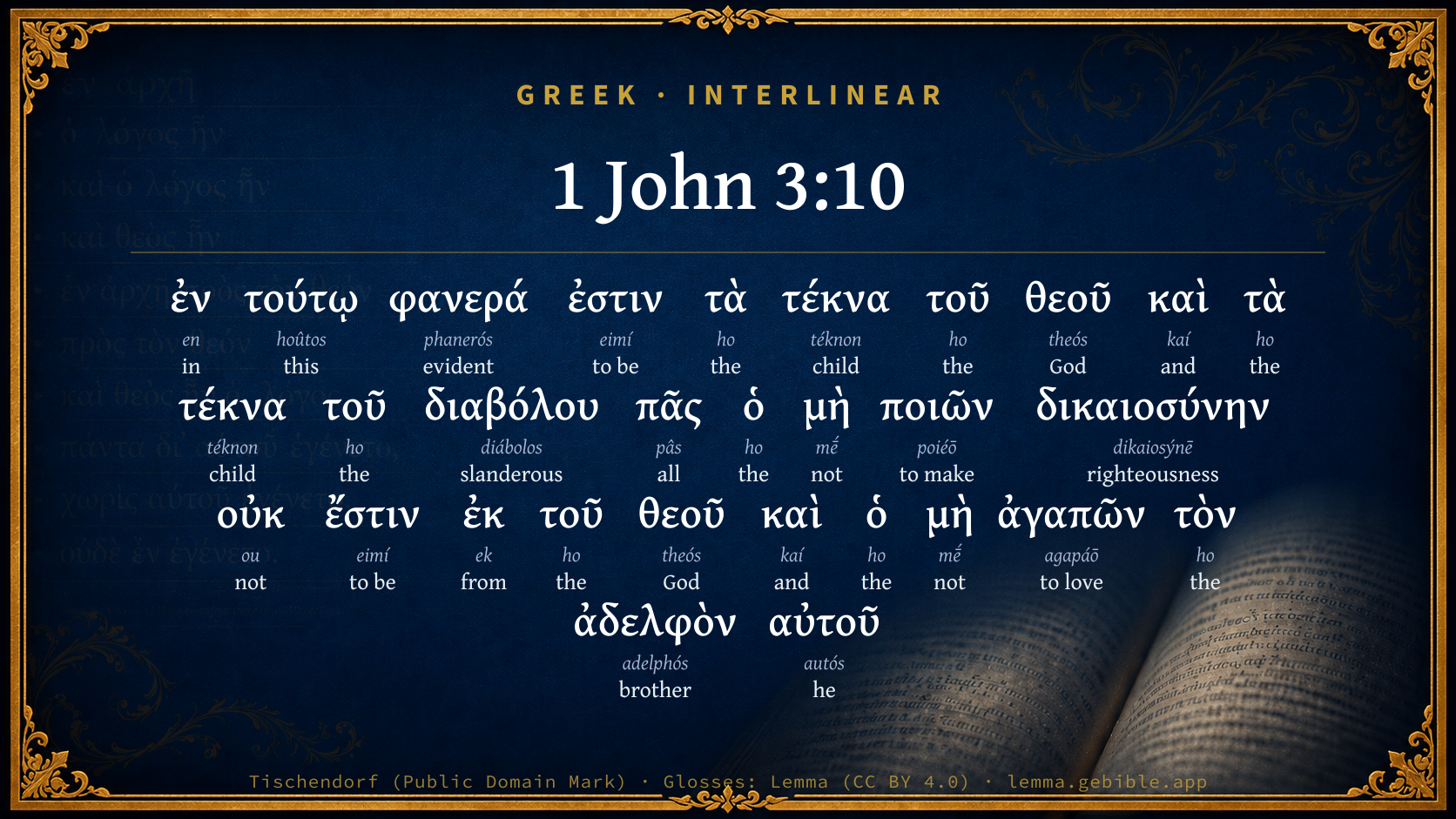
  1. ἐν en G1722 “in” Preposition
  2. τούτῳ hoûtos G3778 “this” Demonstrative pronoun, Dative, Singular, Neuter
  3. ἐστιν eimí G1510 “to be” Verb, Present, Active, Indicative, 3rd person, Singular
  4. τὰ ho G3588 “the” Article, Nominative, Plural, Neuter
  5. τέκνα téknon G5043 “child” Noun, Nominative, Plural, Neuter
  6. τοῦ ho G3588 “the” Article, Genitive, Singular, Masculine
  7. θεοῦ theós G2316 “God” Noun, Genitive, Singular, Masculine
  8. καὶ kaí G2532 “and” Conjunction
  9. τὰ ho G3588 “the” Article, Nominative, Plural, Neuter
  10. τέκνα téknon G5043 “child” Noun, Nominative, Plural, Neuter
  11. τοῦ ho G3588 “the” Article, Genitive, Singular, Masculine
  12. διαβόλου diábolos G1228 “slanderous” Adjective, Genitive, Singular, Masculine
  13. πᾶς pâs G3956 “all” Adjective, Nominative, Singular, Masculine
  14. ὁ ho G3588 “the” Article, Nominative, Singular, Masculine
  15. μὴ mḗ G3361 “not” Particle, Negative
  16. ποιῶν poiéō G4160 “to make” Verb, Present, Active, Participle, Nominative, Singular, Masculine
  17. δικαιοσύνην dikaiosýnē G1343 “righteousness” Noun, Accusative, Singular, Feminine
  18. οὐκ ou G3756 “not” Particle, Negative
  19. ἔστιν eimí G1510 “to be” Verb, Present, Active, Indicative, 3rd person, Singular
  20. ἐκ ek G1537 “from” Preposition
  21. τοῦ ho G3588 “the” Article, Genitive, Singular, Masculine
  22. θεοῦ theós G2316 “God” Noun, Genitive, Singular, Masculine
  23. καὶ kaí G2532 “and” Conjunction
  24. ὁ ho G3588 “the” Article, Nominative, Singular, Masculine
  25. μὴ mḗ G3361 “not” Particle, Negative
  26. ἀγαπῶν agapáō G25 “to love” Verb, Present, Active, Participle, Nominative, Singular, Masculine
  27. τὸν ho G3588 “the” Article, Accusative, Singular, Masculine
  28. ἀδελφὸν adelphós G80 “brother” Noun, Accusative, Singular, Masculine
  29. αὐτοῦ autós G846 “he” Personal pronoun, Genitive, Singular, Masculine

About this verse

These counts appear in no published source. They are computed here, from the morphology-tagged text and Lemma’s own curated glosses. What Lemma adds →

30
words
18
distinct lemmas
General Epistles
section

Notable vocabulary

The rarest word here is φανερά evident G5318 — appearing just 18 times in the whole Greek New Testament.

Shared distinctive vocabulary

φανερά evident G5318 occurs in 16 verses of the Greek New Testament. Also found in:

Repetition

Words recur within this verse:

Cross-references

18

Topical passages linked to 1 John 3:10 in the Treasury of Scripture Knowledge — connected by theme and wording, ordered by reader-vote popularity; previews shown in the World English Bible.

  • 1 John 4:8 He who doesn't love doesn't know God, for God is love.
  • 3 John 1:11 Beloved, don't imitate that which is evil, but that which is good. He who does good is of God. He who does evil hasn't seen God.
  • Matthew 13:38 the field is the world; and the good seed, these are the children of the Kingdom; and the darnel are the children of the evil one.
  • Luke 6:35 But love your enemies, and do good, and lend, expecting nothing back; and your reward will be great, and you will be children of the Most High; for he is kind toward the unthankful and evil.
  • John 8:44 You are of your Father, the devil, and you want to do the desires of your father. He was a murderer from the beginning, and doesn't stand in the truth, because there is no truth in him. When he speaks a lie, he speaks on his own; for he is a liar, and the father of it.
  • 1 John 4:21 This commandment we have from him, that he who loves God should also love his brother.
  • John 8:47 He who is of God hears the words of God. For this cause you don't hear, because you are not of God."
  • 1 John 3:7–8 Little children, let no one lead you astray. He who does righteousness is righteous, even as he is righteous.
  • Ephesians 5:1 Be therefore imitators of God, as beloved children.
  • 1 John 4:3–4 and every spirit who doesn't confess that Jesus Christ has come in the flesh is not of God, and this is the spirit of the antichrist, of whom you have heard that it comes. Now it is in the world already.
  • 1 John 4:6 We are of God. He who knows God listens to us. He who is not of God doesn't listen to us. By this we know the spirit of truth, and the spirit of error.
  • Acts 13:10 and said, "Full of all deceit and all cunning, you son of the devil, you enemy of all righteousness, will you not cease to pervert the right ways of the Lord?
  • Romans 8:16–17 The Spirit himself testifies with our spirit that we are children of God;
  • 1 John 2:9–10 He who says he is in the light and hates his brother, is in the darkness even until now.
  • 1 John 2:29 If you know that he is righteous, you know that everyone who practices righteousness is born of him.
  • 1 John 3:14–15 We know that we have passed out of death into life, because we love the brothers. He who doesn't love his brother remains in death.
  • 1 John 5:2 By this we know that we love the children of God, when we love God and keep his commandments.
  • 1 John 5:19 We know that we are of God, and the whole world lies in the power of the evil one.

Cross-references courtesy of OpenBible.info (CC BY 4.0).

Commentary

Notes on 1 John 3:10 from classic Christian and Jewish commentators (each source and its license shown beneath its notes). The classic Christian expositions comment on the surrounding passage and are grouped to its opening verse, so a note may address several verses; the Jewish commentaries on the Tanakh (Rashi and others) are per-verse, so they appear only where the commentator wrote on this verse.

Lemma curates 59 commentaries, every one of them public domain or Creative Commons licensed, each selected and text-cleaned for this edition rather than reprinted as found. About our sources →

The Cambridge Bible for Schools and Colleges

gen. ed. J. J. S. Perowne

10. In this] These words, like ‘for this cause’ (1Jn_3:1) refer to what precedes rather than to what follows: but here what follows is similar to what precedes, so that in any case ‘in this’ means ‘by doing or not doing righteousness’.

are manifest] A man’s principles are invisible, but their results are visible: ‘By their fruits ye shall know them’ (Mat_7:16-20).

the children of the devil] The expression occurs nowhere else in N. T., but we have ‘son of the devil,’ Act_13:10 : comp. ‘children of wrath’ (Eph_2:3), and ‘ye are of your father the devil’ (Joh_8:44). All mankind are God’s children by creation: as regards this a creature can have no choice. But a creature endowed with free will can choose his own parent in the moral world. The Father offers him the ‘right to become a child of God’ (Joh_1:12); but he can refuse this and become a child of the devil instead. There is no third alternative.

It was for pressing the doctrine that a tree is known by its fruits to an extreme, and maintaining that a world in which evil exists cannot be the work of a good God, that the heretic Marcion was rebuked by S. John’s disciple Polycarp, in words which read like an adaptation of this text, “I know thee for the firstborn of Satan” (Iren. Haer. III. iii. 4). And in his Epistle (VII. 1) Polycarp writes, “Whosoever does not confess the witness of the cross is of the devil”.

neither he that loveth not his brother] Here again note the way in which S. John’s divisions shade off into one another (see on 1Jn_2:28-29). Doing righteousness, the mark of God’s children, suggests the thought of brotherly love, for love is righteousness in relation to others; ‘For the whole law is fulfilled in one word, even in this; Thou shalt love thy neighbour as thyself’ (Gal_5:14). Love suggests its opposite, hate; and these two form the subject of the next paragraph. Some editors would make the new section begin here in the middle of 1Jn_3:10. It is perhaps better to draw the line between 1Jn_3:12-13, considering 1Jn_3:11-12 as transitional.

‘He that loveth not his brother is not of God’, for a child of God will love all whom God loves. This prepares us for the statements in 1Jn_4:7; 1Jn_4:20-21.

The Cambridge Bible for Schools and Colleges (gen. ed. J. J. S. Perowne; Cambridge University Press, 1878–1918) — public domain. Text from a community e-Sword module.

The Biblical Illustrator

Joseph S. Exell

1Jn_3:10

In this the children of God are manifest, and the children of the devil: whosoever doeth not righteousness is not of God, neither he that loveth not his brother

Two classes of men

I.

Men are divided into two classes, the children of God and the children of the devil. This assumption is very contrary to the prevailing views and practices of men. Many make no inquiry to what class they belong. Some who have thought upon it consider it is not possible to obtain satisfaction, and they dismiss it from their minds. They are satisfied to live in entire uncertainty. Or if they do classify men, themselves included, it is a very different summary from that of the apostle. Their reckoning makes many classes. They are as numerous as the phases of human society. Think, then, of this Divine distinction. Some are the children of God. They have been born of Him. This is the one class. But how different is the other? They are the children of the devil. Like him they have fallen from their original righteousness. They have been under his influence ever since they came into the world. These are the only two classes known to God. The Scriptures never recognise any other here. Neither shall any but these be found at the last judgment.

II. This distinction may be manifested. In this the children of God are manifest, and the children of the devil. This statement may be understood with reference to ourselves or others. Contemplate it in both relations.

1. If we are the children of God this ought to be manifest to ourselves.

2. It is, however, its manifestation to others that appears to be specially spoken of in the text. The proofs are such as are cognizable by others. To a large extent the evidence of conversion to ourselves and to others is the same. In our own case, however, there is consciousness, which cannot be had in the case of others. The two states in question are the most contrary to one another that can possibly be conceived. The change from the one to the other is the most marked and decided of which the human mind can be the subject. Might not such a change be expected to be manifest? Its necessary and habitual operation is a constant testimony to its existence. It is like the ointment that betrays itself. The flowing stream is proof of a living fountain. And if the life be holy there must be a cause that lies deeper than any human purpose.

III. The evidences by which they are made manifest. Two are mentioned--He that doeth not righteousness is not of God, neither he that loveth not his brother. It is observable that these evidences are put in the negative form, and an important lesson is suggested by it. The absence of well-doing is sufficient for condemnation. It is not enough that we cease to do evil, we must learn to do well.

1. He that doeth not righteousness is not of God. A man who is not exhibiting righteousness in his deportment gives no proof that he is born of God.

2. With this general deportment a special grace is associated--Neither he that loveth not his brother. (J. Morgan, D. D.)

The distinguishing character of a good and a bad man

I. The character and mark of difference between a good and bad man. Whosoever doeth not righteousness is not of God; which implies, on the contrary, that whosoever doeth righteousness is of God.

1. Who they are that in the apostles sense may be said not to do righteousness.

(1) They that live in the general course of a wicked life, in the practice of great and known sins.

(2) They who live in the habitual practice of any one known sin, or in the neglect of any considerable part of their known duty.

(3) They who are guilty of the single act of a very notorious crime; as a deliberate act of blasphemy, of murder, perjury, fraud, or oppression, or of any other crime of the like enormity.

2. Who they are that in the apostles sense may be said to do righteousness. In short, they who in the general course of their lives do keep the commandments of God. I choose rather to describe a righteous man by the actual conformity of the general course of his actions to the law of God, than by a sincere desire or resolution of obedience. For a desire may be sincere for the time it lasts, and yet vanish before it comes to any real effect. No man believes hunger to be meat, or thirst to be drink; and yet there is no doubt of the truth and sincerity of these natural desires. No man thinks that a greedy desire to be rich is an estate, or that ambition, or an insatiable desire of honour is really advancement; just so, and no otherwise, a desire to be good is righteousness.

II. By this mark every man may, with due care and diligence, arrive at the certain knowledge of his spiritual state and condition.

1. By this character, as I have explained it, he that is a bad man may certainly know himself to be so, if he will but consider his condition and do not wilfully delude himself. For the customary practice of any known sin is utterly inconsistent with sincere resolutions and endeavours against it.

2. By this character, likewise, they that are sincerely good may generally be well assured of their good condition, and that they are the children of God. And there are but two things necessary to evidence this to them--that the general course of their actions be agreeable to the laws of God; and that they be sincere and upright in those actions.

III. Whence it comes to pass, that notwithstanding this, so many persons are at so great uncertainty about their spiritual condition.

1. We will consider the grounds of the false hopes of men really bad concerning their good condition.

(1) Some rely upon the profession of the Christian faith, and their being baptized into it. But this, so far from being any exemption from a good life, is the most solemn obligation to it.

(2) Others trust to their external devotion; they frequent the church and serve God constantly, they pray to Him and hear His Word, and receive the blessed sacrament. But this so far from making amends for the impiety of our lives, spoils all the acceptance of our devotions.

(3) Others, who are sensible they are very bad, depend very much upon their repentance, especially if they set solemn times apart for it. And there is no doubt but that a sincere repentance will put a man into a good condition; but then no repentance is sincere but that which produceth a real reformation in our lives.

(4) Others satisfy themselves with the exercise of some particular graces and virtues, justice, and liberality, and charity. And is it not a thousand pities that thy life is not all of a piece, and that all the other parts of it are not answerable to these?

(5) Some who are very careful of their outward conversation, but yet are conscious to themselves of great secret vices, when they can find no comfort from the testimony of their own consciences, are apt to comfort themselves in the good opinion which perhaps others have of them. But if we know ourselves to be bad, it is not the good opinion of others which can either alter or better our condition. Trust nobody, concerning thyself rather than thyself, because nobody can know thee so well as thou mayest know thyself.

2. The causeless doubts and jealousies of men really good concerning their bad condition.

(1) Some are afraid that they are reprobated from all eternity, and therefore cannot be the children of God. But no man hath reason to think himself rejected of God, either from eternity or in time, that does not find the marks of reprobation in himself--I mean an evil heart and life.

(2) Good men are conscious to themselves of many frailties and imperfections; and, therefore, they are afraid of their condition. But God considers the infirmities of our present state, and expects no other obedience from us, in order to our acceptance with Him, but what this state of imperfection is capable of.

(3) They are afraid their obedience is not sincere, because it proceeds many times from fear, and not always out of pure love to God. For answer to this: it is plain from Scripture that God propounds to men several motives to obedience--some proper to work upon their fear, some upon their hope, others upon their love; from whence it is evident He intended they should all work upon us.

(4) Another case of doubting in good men is, from a sense of their imperfect performance of the duties of religion and of the abatement of their affections towards God at some times. But our comfort is, that God doth not measure mens sincerity by the tides of their affections, but by the constant bent of their resolutions and the general tenor of their actions.

(5) Another cause of these doubts is, that men expect more than ordinary and reasonable assurance of their good condition--some particular revelation from God, an extraordinary impression upon their minds. God may give this when and to whom He pleases, but I do not find He hath anywhere promised it.

(6) As for the case of melancholy, it is not a reasonable case, and therefore doth not fall under any certain rules and directions.

3. There are likewise others, who upon good grounds are doubtful of their condition, and have reason to be afraid of it; those, I mean, who have some beginnings of goodness, which yet are very imperfect. The proper direction to be given them in order to their peace is, by all means to encourage them to go on and fortify their resolutions; to be more vigilant and watchful over themselves, to strive against sin, and to resist it with all their might.

Conclusion:

1. From hence we learn the great danger of sins of omission as well as commission.

2. It is evident from what hath been said, that nothing can be vainer than for men to live in any course of sin and yet to pretend to be the children of God and to hope for eternal life.

3. You see what is the great mark of a mans good or bad condition: whosoever doeth righteousness is of God, and whosoever doeth not righteousness is not of God. (J. Tillotson, D. D.)

The manifestation of character

I. The persons opposed are the children of God and the children of the devil, i.e., good and bad men. It is common in the Scripture to call persons, distinguished by any quality or acquisition, the children of those from whom it was originally derived, or by whom it was preeminently possessed.

1. This division is the most general and universal.

2. It is also a division the most serious and eventful. It overlooks everything adventitious, and considers only character. It passes by the distinctions of speech, complexion, rank; and regards the soul and eternity.

3. Let us consider, farther, what results from these relations. According as you are the children of God, or the children of the devil, you are crowned with honour or covered with disgrace.

4. Upon these connections innumerable privileges or evils depend. Are you the children of God? Heaven is your home. And here you shall want no good thing. But I leave you to fill up the remaining article, and to think of the children of the wicked one. I leave you to reflect upon the miseries they endure, from their perplexities, their fears, their passions, and their pursuits in life. I leave you to look forward to the horrors which will devour mere in a dying hour.

II. The possibility of ascertaining in which of these classes you rank. The children of God and the children of the devil are manifest. Observe, it is not spoken of as a future, but as a present discovery--they are manifest.

1. They are manifest to God. It is impossible to impose upon Him; He is not mocked.

2. They are manifest to others. The tree is known by its fruit.

3. They are manifest to themselves. It will readily be acknowledged that it is not possible for a man to be wicked without knowing it.

(1) Is it not necessary for him to be able to know his character? If promises are made to a religions state, how can he claim these promises unless he can determine that he is in this state?

(2) What is religion? An unintelligible mystery? a charm? an operation which passes upon us and leaves no trace behind? Is it not the most serious concern in which we were ever engaged? Is it not a general and continued course of action? The business of life, to which we endeavour to render everything else subordinate? Our prevailing aim? And is this incapable of being known?

III. The marks of distinction between these characters. In this the children of God are manifest, and the children of the devil. In what? Not in temporal success. This is given or withheld too indiscriminately to allow of our knowing love or hatred. In what? Not in religious profession. Judas and Demas were both visible members of the Church of God. In what? Not in talking--not in controversy--not in a sound creed--not in the pronunciation of the Shibboleths of a particular party. In this the children of God are manifest, and the children of the devil; he that doeth not righteousness is not of God, neither he that loveth not his brother.

1. The manner in which the subject is expressed. It is held forth negatively--nor is this without design. It reminds us that omissions decide the character, even where there is no positive vice.

2. The union of these excellences is worthy of our notice. We commonly see them combined in the Scripture. It is said of a good man, He is gracious, and full of compassion, and righteous.

3. From these arises a criterion by which we are to judge of the reality and genuineness of religion--not that these are the only marks which we are to employ; but all the rest will be delusive, if unaccompanied with this righteousness and love. (W. Jay.)

Self-manifestation

As there is a God, and a devil, a heaven, and a hell, a kingdom of glory, and a kingdom of darkness, so there are several sorts appertaining to both; and at the day of judgment there shall be a final separation made betwixt both. Now the one of these two sorts are in the very text called the children of God; the other, the children of the devil. Now to speak of the difference which is betwixt the children of God and the children of the devil. This difference is twofold, either general or particular. The general is the doing or not doing of righteousness; the negative is here only named, but in it as in all negative rules the affirmative is included. By righteousness is understood that holy and righteous course which God requireth of us, whether in general as we be Christians, or in particular according to our places and callings allotted unto us by God. The rule of righteousness is the Scripture; in it the Lord hath showed what is good, that only deserves to be entertained as our Spiritual Counsellor, that alone is able to make a man wise unto salvation. The doing of righteousness is twofold.

1. Legal, and

2. Evangelical.

The legal doing is the perfection of all duties, both in manner and form, both for the number and measure of them; which kind of doing was never found in any mere man since the fall of Adam. The Evangelical doing is mingled with much weakness, and is good only in acceptation with God by Jesus Christ. Of this doing the Spirit of God speaketh here, and it consists upon the concurrence of these following particulars.

1. A caring and studying to prove what is the good will of God, how He will be served, and wherewith He will be pleased.

2. An inflamed love and affection to that righteousness which is pleasing unto God.

3. A desire, that if it were possible, the whole course of the life and conversation might be suitable thereunto.

4. A firmness of resolution, to frame and set the whole and continual endeavour to the performance of it.

5. A speedy applying of oneself therein.

6. A careful catching of all opportunities to help forward this good purpose.

7. A diligent survey of ones own courses.

8. A bitter bewailing of slips and infirmities, together with a kind of holy indignation at ones own self, that he should so grossly and ordinarily sin against the Lord.

9. An increase of care (after a soil received) and of watchfulness, together with a fear of running afresh into the same or like offence. And as these things cannot be in an unregenerate person, so they cannot but be in those whom the Lord hath chosen to be His. (S. Hieron.)

Connexion of doing righteousness with brotherly love as proving a Divine birth

1. Consider that old message or commandment, heard from the beginning, that we should love one another. On what is it based? It cannot, since the Fall, be based on our joint participation in the ills to which the Fall has made us heirs. It is redemption, and redemption alone, with the regeneration which is involved in it, that makes mutual brotherly love among men, in its true and deep sense, a practicable duty, an attainable grace. It is only one who, being born of God, doeth righteousness as knowing God to be righteous, that is capable of really loving his fellow man as a brother.

2. No such brotherly love is possible for him who, not doing righteousness, is not of God. His frame of mind must be that of Cain; a frame of mind that but too unequivocally identifies him as one of the devils children, and not of Gods. It was not because he was void of natural affection, or because his disposition was one of wanton cruelty and bloodthirstiness; it was not in the heat of sudden passion, or in a quarrel about any earthly good, that Cain slew his brother; but because his own works were evil, and his brothers righteous. It is this which chiefly marks the instigation of the devil; and his fatherhood of Cain, and such as Cain. More than anything else on earth; infinitely more than any remains of remnants of good that the Fall has left in human nature and human society--for these he can turn to his own account and make his own use of--does that wicked one detest the faintest trace of the footsteps, the slightest breathing of the spirit of Him whose goings forth have been from of old; who has been ever in the world, the Wisdom and the Word of God, the light and the life of men. Let the truth and righteousness of God be brought so near to a man, by the Divine Word and Spirit, as to stir and trouble thoroughly his inward moral sense, while his desire and determination to stand his ground and not give in remains unabated, or rather is inflamed and aggravated; let the process go on; and let all attempts towards an accommodation, between the consciences increasing soreness and the hearts increasing self-righteousness and self-will, be one after another frustrated and foiled; you have then the making of a Cain, a very child of the devil, who, if need be and opportunity serve, will not scruple to cut short the terrible debate and end the intolerable strife by slaying his brother Abel; by crucifying the Lord of glory! O my fellow sinner, let us beware! (R. S. Candlish, D. D.)

The Biblical Illustrator, edited by Joseph S. Exell (c. 1880s–1900s) — public domain. Text from a community e-Sword module.

Bengel's Gnomon

Johann Albrecht Bengel

1Jn 3:10. Ἐν τούτῳ, in this) This is to be referred to the preceding words.—καὶ ὁ μὴ ἀγαπῶν, and he who does not love) A transition from the genus, or the whole to a part.

Bengel's Gnomon of the New Testament — English translation (T&T Clark, Edinburgh, 1860) — public domain. Text from a community e-Sword module.

Meyer's Critical & Exegetical Commentary

Heinrich August Wilhelm Meyer

a1Joh_3:10 a concludes the development of the thought with the sharp antithesis of the children of God and the children of the devil.

ἐν τούτῳ is by most commentators justly referred to the preceding, inasmuch as in 1Jn_3:9 the characteristic sign of the τέκνα τοῦ Θεοῦ, and in 1Jn_3:8 that of the τέκνα τοῦ διαβόλου, are stated. Some commentators, however (a Lapide, Grotius, S. Schmidt, Spener, Episcopius, Ebrard, etc.), refer it to what follows; but as in this only the one part of the antithesis is resumed, this reference is found to necessitate an arbitrary supplement; the explanation of a Lapide is clearly quite erroneous: hae sunt duae tesserae et quasi duo symbola filiorum et militum Dei, sc. justitia et caritas.

φανερά ἐστι] The εἶναι ἐκ τοῦ Θεοῦ, and equally the εἶναι ἐκ τοῦ διαβόλου, are in their principle internal, and therefore concealed: it is by the different ποιεῖν that the different nature is disclosed; comp. Mat_7:16.

The expression: τὰ τέκνα τοῦ διαβόλου, nowhere else in the N. T. except in Act_13:10 : υἱὸς διαβόλου, is easily explained from 1Jn_3:8; comp. also Joh_8:44. Sander supposes a distinction between these and the children of wrath, Eph_2:3; while the latter name signifies all who are not born again, the latter only signifies those among them who despise the grace offered to them in Christ, and wantonly set themselves against it. This is, however, incorrect; as the whole conduct of men falls under the contrast of ἁμαρτάνειν and οὐχ ἁμαρτάνειν, so the distinction of τέκνα τοῦ Θεοῦ and τέκνα τοῦ διαβόλου, that is based on it, equally embraces the whole of humanity (see also Braune). Socinus accordingly with justice says: Ex Apostoli verbis satis aperte colligi potest, quod inter filios Dei et filios Diaboli nulli sint homines medii.

1Jn_3:10 b. Transition to the section on brotherly love.

πᾶς ὁ μὴ ποιῶν δικαιοσύνην] refers to 1Jn_3:7, and further to chap. 1Jn_2:29; the meaning of ποιεῖν δικαιοσύνην is here the same as there; only that the idea δικαιοσύνη is indicated by the article as definite and restricted; comp. 1Jn_3:8 : τὴν ἁμαρτίαν; 1Jn_3:9 : ἁμαρτίαν.

οὐκ ἔστιν ἐκ τοῦ Θεοῦ] = οὐκ ἔστιν τέκνον τοῦ Θεοῦ.

καὶ ὁ μὴ ἀγαπῶν τὸν ἀδελφὸν αὑτοῦ] Calvin correctly says: hoc membrum vice expositions additum est. The ἀγάπη is not a part of the δικαιοσύνη (Bengel, Spener, Lange, Neander, Gerlach), still less something different from the δικαιοσύνη, which must be connected with it (Rickli), or even forms an antithesis to it (Socinus[217]); but it is the essence and nature of the δικαιοσύνη (so also Braune[218]), or rather the ΔΙΚΑΙΟΣΎΝΗ itself in reference to the brethren; comp. Rom_13:8-10; Gal_5:14; Col_3:14; 1Ti_1:5; Joh_14:15. Besser: brotherly love is the essence of all righteous life; it is related to ΔΙΚΑΙΟΣΎΝΗ just as to the ΠΕΡΙΠΑΤΕῖΝ ΚΑΘῺς ἘΚΕῖΝΟς ΠΕΡΙΕΠΆΤΗΣΕ, chap. 1Jn_2:6. Ebrard erroneously tries to prove from the ΑὙΤΟῦ which is added that ἈΔΕΛΦΌς = Ὁ ΠΛΗΣΊΟΝ, Luk_10:36, and is therefore used differently from 1Jn_2:9-11, 1Jn_4:20-21, for that John in this relative sentence passes on to the love of Christians towards one another is quite clear from 1Jn_3:11; the ΑὙΤΟῦ only shows that, though in the foregoing the antithesis between the regenerate and the unregenerate is quite generally stated, this is for the special consideration of Christians. It is incomprehensible that the view, according to which John in this section speaks of Christian brotherly love (i.e. the love of Christians towards one another), is in antagonism with Mat_5:44; 1Co_4:12 (according to Ebrard). The coordinating καί is epexegetical = namely; it is unnecessary to supply οὐκ ἔστιν ἐκ τ. Θ.

[217] While Socinus understands by δικαιοσύνην ποιεῖν juste vivere ex praescriptione Mosaicac legis et ipsius humanae rationis, he explains ἀγάπη as the transcendent Christian virtue of sacrifice for the brethren.

[218] Ebrard and Myrberg object to this, that it may be true of love to God only, but not of love to the brethren; but Christian brotherly love is, according to John, certainly identical with love to God, for the Christian loves his brother as one who is born of God.

1Jn_3:10-22. This seetion treats of brotherly love as the substance of δικαιοσύνη, and is therefore most closely connected with the foregoing; it is the commandment of Christ (1Jn_3:11), instead of which hatred reigns in the world (1Jn_3:12-13); with love, life is connected; with hatred, death (1Jn_3:14-15); in Christ we possess the ideal and example of love (1Jn_3:16). True love consists not in word, but in deed (1Jn_3:17-18); it produces firm confidence towards God, and obtains an answer to prayer (1Jn_3:19-22).

Meyer — Critical and Exegetical Commentary on the New Testament — English translation by Peter Christie, edited by Frederick Crombie (T&T Clark, 1880) — public domain. Text from a community e-Sword module.

Expositor's Greek Testament

ed. W. Robertson Nicoll

1Jn 3:10-12 . The Evidence of Divine Sonship, viz. , Human Brotherhood.

1Jn 3:10 . The Apostle reiterates the “old commandment” (1Jn 2:7-11 ) as not only the paramount duty of believers but the evidence of their divine sonship. He has said that the evidence lies in “doing righteousness,” and now he defines ποιεῖν δικαιοσύνην as ἀγαπᾶν τὸν ἀδελφὸν αὐτοῦ . See note on 1Jn 2:9 . The “righteousness” of the Pharisees consisted in ritual observance, that of Jesus in love. δίκαιος had the meaning “kind,” “sweetly reasonable”. See Hatch, Ess. in Bib. Gk. , p. 50 ff. On Mat 1:19 St. Chrysostom remarks: δίκαιον ἐνταῦθα τὸν ἐνάρετον ἐν ἅπασι λέγει . ἔστι μὲν γὰρ δικαιοσύνη καὶ τὸ μὴ πλεονεκτεῖν · ἔστι δὲ καὶ ἡ καθόλου ἀρετή .… δίκαιος οὖν ὢν , τούτεστι χρηστὸς καὶ ἐπιεικής .

The Expositor's Greek Testament, edited by W. Robertson Nicoll (1897–1910) — public domain. Text from a community e-Sword module.

Cambridge Greek Testament for Schools and Colleges

10. ἐν τούτῳ. This phrase, like διὰ τοῦτο (1Jn 3:1) commonly looks back at what has just been stated. In doing or not doing sin lies the test. A man’s principles are invisible, but their results are visible: ‘By their fruits ye shall know them’ (Mat 7:16-20).

τὰ τέκνα τ. διαβόλου. The expression occurs nowhere else in N.T. Act 13:10 we have υἱὲ διαβόλου, and Mat 13:38 οἱ υἱοὶ τοῦ πονηροῦ. Comp. ὑμεῖς ἐκ τοῦ πατρὸς τοῦ διαβόλου ἐστέ (Joh 8:44). All mankind are God’s children by creation: as regards this a creature can have no choice. But a creature endowed with free will can choose his own parent in the moral world. The Father offers him the ‘right to become a child of God’ (Joh 1:12); but he can refuse this and become a child of the devil instead. There is no third alternative.

It was for pressing the doctrine that a tree is known by its fruits to an extreme, and maintaining that a world in which evil exists cannot be the work of a good God, that the heretic Marcion was rebuked by S. John’s disciple Polycarp, in words which read like an adaptation of this passage, Ἐπιγιγνώσκω τὸν πρωτότοκον τοῦ Σατανᾶ (Iren. Haer. III. iii. 4). And Polycarp in his Epistle (vii. 1) writes, ὂς ἂν μὴ ὁμολογῇ τὸ μαρτύριον τοῦ σταυροῦ, ἐκ τοῦ διαβόλου ἐστίν.

καὶ ὁ μὴ ἀγαπῶν. The καί is almost epexegetic: ‘not to love’ is only a special form of ‘not to do righteousness.’ As in 1Jn 2:4 (ὁ λέγων καὶ μὴ τηρῶν), S. John does not say that there is any such person (ὁ οὐκ ἀγαπῶν); but if there be such, this is his condition. Comp. 1Jn 4:8; 1Jn 4:20; 1Jn 5:12; 2Jn 1:7; 2Jn 1:9. Here also we may again note the manner in which S. John’s divisions shade off into one another (see on 1Jn 2:28-29). Doing righteousness, the mark of God’s children, suggests the thought of brotherly love, for love is righteousness in relation to others; ‘For the whole law is fulfilled in one word, even in this; Thou shalt love thy neighbour as thyself’ (Gal 5:14). Love suggests its opposite, hate; and these two form the subject of the next paragraph. Some editors would make the new section begin here in the middle of 1Jn 3:10. It is perhaps better to draw the line between 1Jn 3:12-13, considering 1Jn 3:11-12 as transitional.

‘He that loveth not his brother is not of God,’ for a child of God will love all whom God loves. This prepares us for the statements in 1Jn 4:7; 1Jn 4:20-21.

Cambridge Greek Testament for Schools and Colleges (Cambridge University Press, 1896; 21 vols, various authors incl. Carr, Maclear, Plummer, Farrar, Lumby, Moule, M. R. James, Simcox) — public domain. Text from a community e-Sword module.

Geneva Bible (1599)

Geneva Bible translators

The conclusion, by a wicked life they are known which are governed by the spirit of the Devil, and by a pure life, which are God’s children.

He beginneth to commend charity towards the brethren, as another mark of the Sons of God.

Geneva Bible (1599) marginal notes — public domain. Text via Bolls.life.

Jamieson, Fausset & Brown

Robert Jamieson, A. R. Fausset & David Brown

children of the devil--(See on Jo1 3:8; Act 13:10). There is no middle class between the children of God and the children of the devil.

doeth not righteousness--Contrast Jo1 2:29.

he that loveth not his brother-- (Jo1 4:8); a particular instance of that love which is the sum and fulfilment of all righteousness, and the token (not loud professions, or even seemingly good works) that distinguishes God's children from the devil's.

Jamieson, Fausset & Brown — Commentary Critical and Explanatory on the Whole Bible (1871) — public domain (CC PDM 1.0). Text via the HelloAO Bible API.

Adam Clarke's Commentary

Verse 10. In this the children of God are manifest] Here is a fearful text. Who is a child of the devil? He that commits sin. Who is a child of God? He that works righteousness. By this text we shall stand or fall before God, whatever our particular creed may say to the contrary.

Neither he that loveth not his brother.] No man is of God who is not ready on all emergencies to do any act of kindness for the comfort, relief, and support of any human being. For, as God made of one blood an the nations of men to dwell upon the face of the whole earth, so all are of one family; and consequently all are brethren, and should love as brethren.

Adam Clarke's Commentary on the Bible (1810–1826) — public domain. Text from a community e-Sword/MySword module.

John Calvin's Commentaries

10 In this the children of God are manifest. He shortly draws this conclusion, that those in vain claim a place and a name among the children of God, who do not prove themselves to be such by a pious and holy life, since by this evidence they shew that they differ from the children of the devil. But he does not mean that they are thus manifested, so as to be openly recognized by the whole world; but his meaning is only this, that the fruit and adoption always appear in the life.

John Calvin's Commentaries (1540-1563) — public domain. Text from the Calvin Translation Society English edition (1840s-50s) via the Christian Classics Ethereal Library (ccel.org). Calvin's coverage is partial (roughly two-thirds of the Bible); uncommented books and verses are honest gaps, never fabricated. The 19th-century editor's footnotes and remarks are omitted so the notes are faithfully Calvin's own voice.

John Gill's Exposition

In this the children of God are manifest,.... By regenerating grace, and not sinning, in the sense before explained, in consequence of it: adoption is an act of God's grace and sovereign will; it is secret in his own heart, and is secured in divine predestination, and in the covenant of grace, and is antecedent to regeneration: regeneration and faith do not make men the children of God, but manifest them to be so; adoption makes them the children of God, and entitles them to the inheritance; regeneration gives them the nature of the children of God, and makes them meet for it, and manifests their right unto it; not to the men of the world, but to themselves and other saints:

and the children of the devil; such as imitate him, do his will and his lusts, and are openly under his power and influence; these are distinguishable from regenerate persons, and the children of God, by their lives and conversations; so the people of the nations of the world are called, "the children of Samael", and the serpent, by the Jews (m), which are with them the names of the devil.

Whosoever doth not righteousness is not of God: that is, he does; not appear to be born of God, who does not by faith lay hold on the righteousness of Christ for his justification before God, and acceptance with him; and who does not do works of righteousness in faith from a principle of love, and with a view to the glory of God; for where regenerating grace is, there will be such graces and such practices:

neither he that loveth not his brother; for as he that loveth God, and Christ, and the brethren, appears manifestly to be born again, and to have passed from death to life, so he that does not is in darkness, in a state of unregeneracy, and walks and continues therein; for was he born again, he would be taught of God to love the saints; see Jo1 4:7.

(m) Raya Mehimna in Zohar in Lev. fol. 34. 2.

John Gill's Exposition of the Whole Bible (1746–1763) — public domain (CC PDM 1.0). Text via the HelloAO Bible API.

Trapp's Complete Commentary

John Trapp

10 In this the children of God are manifest, and the children of the devil: whosoever doeth not righteousness is not of God, neither he that loveth not his brother.

Ver. 10. In this the children of God] As David’s daughters were known by their garments of various colours, 2Sa 13:18; so are God’s children by their piety and charity.

John Trapp, A Commentary or Exposition upon All the Books of the Old and New Testament (1647–1656) — public domain. Text from a community e-Sword module.

Albert Barnes' Notes on the Bible

In this the children of God are manifest ... - That is, this furnishes a test of their true character. The test is found in doing righteousness, and in the love of the brethren. The former he had illustrated; the latter he now proceeds to illustrate. The general idea is, that if a person is not truly a righteous person, and does not love the brethren, he cannot be a child of God. Perhaps by the phrase in this, using a pronoun in the singular number, he means to intimate that an important part of righteousness consists in brotherly love.

Whosoever doeth not righteousness, is not of God - In 1Jo 3:7, he had said that “he that doeth righteousness is of God.”

If that is true, then what he here affirms must be true also, that a man who does not righteousness is not of God. The general idea is the same, that no one can be a true Christian who is not in fact a righteous man.

Neither he that loveth not his brother - The illustration of this point continues to 1Jo 3:18. The general sense is, that brotherly love is essential to the Christian character, and that he who does not possess it cannot be a Christian. On the nature and importance of brotherly love as an evidence of piety, see the notes at Joh 13:34-35.

Albert Barnes' Notes on the Bible (1834–1885) — public domain. Text from a community e-Sword/MySword module.

Matthew Poole's English Annotations

Upon what was said, he reduces all men each to their own family and father, concluding it manifest whither they belonged; i.e. he shows, upon the grounds before expressed, who do not belong to God and his family, leaving it thence to be collected, since two fathers and families divide the world, to which they must be reckoned; i.e. they belong not to God, and consequently to that worst of fathers, who first, in the general, do not righteousness; the devil being the first sinner, they are his descendants; and who next, particularly, love not their brethren, which most expressly demonstrates a diabolical nature.

Matthew Poole's English Annotations on the Holy Bible (1683–1685) — public domain. Text from a community e-Sword/MySword module.

Whedon's Commentary on the Bible

Daniel D. Whedon

10. This… manifest—The open, manifest difference between the two is their moral conduct.

Loveth not—Guarding against the idea that it is the action of the body alone that constitutes the test, and including the act of the soul as living.

Daniel D. Whedon (gen. ed.), Commentary on the Old and New Testaments (1874–1909) — public domain. Text from a community e-Sword module.

The Pulpit Commentary

The question whether "in this" ejn toutw refers to what precedes or to what follows is here unimportant, for both are similar in meaning; and "in this" may refer to both. "By their fruits ye shall know them." The children of God do righteousness, and not sin; the children of the devil do sin, and not righteousness. Of course, moral parentage is meant in both cases. Nothing here lends any countenance to the view that the writer is a dualist and inculcates two principles of existence God and the devil. All, whether good or bad, are God"s creatures; (Joh_1:3) but while all are his children by creation, some become his children spiritually also, while others become the children of Satan. St. John"s "teaching about the devil is not at all agreeable to those who dwell exclusively on the sunny aspects of the world and of life, and would shut their eyes to what is dark and terrible. They like to hear of a Being who is all-gracious and loving; the vision of one who is the enemy of all that is gracious and loving shocks them they wish to suppose that it belongs to the world"s infancy, and that it disappears as we know more" (Maurice). The expression, "the children of the devil," must not be confounded with the Hebraistic expressions, "children of perdition, children of darkness," "children of light, son of death," "son of perdition," etc. As so often, St. John not only restates the case in a new form, but adds a new thought to it he that loveth not his brother. This forms the link with the next section (verses 1324), on brotherly love. Of all failures in doing righteousness this is the most conspicuous failing to love one"s brother. And who is my brother? The answer is the same as to the question, "And who is my neighbour?" Mankind at large. The meaning cannot be limited to the children of God. Even touv (verses 14, 16) does not exclude unbelievers, still less does ton ajdelfon aujtou. This is confirmed:

(1) By the fact that the opposite case (verse 13) is the children of the world hating Christians; the true opposite of Christians loving Christians would be the children of the world hating one another.

(2) By the cited example of Christ (verse 16), who died for us when we were aliens from God. Of course, if the Christian must love all men, a fortiori he must love Christians.

The Pulpit Commentary (1880–1919), ed. H.D.M. Spence-Jones & Joseph S. Exell — public domain. Text from a community e-Sword module.

John Wesley's Explanatory Notes

Neither he that loveth not his brother - Here is the transition from the general proposition to one particular.

John Wesley, Explanatory Notes Upon the Whole Bible (1754–1765) — public domain. Text via the GEBible commentary corpus.

Scofield Reference Notes

C. I. Scofield

righteousness

(See Scofield "1Jn 3:7").

The Scofield Reference Bible (1917 edition), notes by C. I. Scofield — public domain. Text from a community e-Sword module.

Burkitt's Expository Notes on the New Testament

William Burkitt

Our apostle in these words give us the distinguishing character of a good and bad man; those who in their dispositions and actions, in the temper of their minds, and in the actions of their lives, do imitate God, are his children; and those who addict themselves to sin and impiety are of another race and descent, they are the children of the devil; they resemble him, and belong unto him. By doing righteousness is meant the practice of universal goodness, and a thorough conformity to the law of God in opposition to sin, which is the transgression of the law.

Learn hence, 1. That every man may come to the certain knowledge of his own condition, whether he be a good or a bad man; By this the children of God are manifested; that is, hereby good and bad men are really distinguished; the Scripture has laid down real marks of difference between them.

Learn, 2. That the love and practice of universal righteousness, and nothing short of it, will denominate a person a child of God, and evidence to his own conscience, that he is brought into a state of grace and favour with him: In this the children of God are manifest, whosoever doth righteousness is of God.

This discovers a farther difference between the children of God and the children of Satan, namely, Brotherly love; he doth not say, he that hateth his brother is a child of the devil, but he that loveth not his brother; intimating, that not only hatred and malice against, but want of brotherly love towards each other, is the mark and sign not of a child of God, but of the devil. He that doth not unfeignedly love men as men, and all Christians as Christians, is no child of God, no lover of God; for he that loveth not God’s image, loveth not God himself.

William Burkitt's Expository Notes on the New Testament (1700–1703) — public domain. Text from a community e-Sword module.

The People's New Testament

B. W. Johnson

10. In this, etc. Thus is the distinction clear between God's children and those of the devil. God's children are full of love and live holy lives. Those of the devil are the opposite.

B. W. Johnson's The People's New Testament with Notes (1889–1891) — public domain. Electronic text from the Christian Classics Ethereal Library (CCEL) ThML edition.

Alford’s Greek Testament

Henry Alford

10.] The contrast taken up again, and from the converse: he that is born of God cannot sin: he that does not righteousness, is not of God: i. e. is a child of the devil. Then we have the usual new particular, to give the transition note to that which is to follow,—including in this last category him that loveth not his brother. Every one that is begotten of God, doeth not sin (the meaning of this declaration has been treated of above, ver. 6. Here we meet it in its barest and plainest form—the two states, being begotten of God, and sin, absolutely excluding one another), because His seed abideth in him (i. e. because that new principle of life from which his new life has unfolded, which was God’s seed deposited in him, abides growing there, and precludes the development of the old sinful nature. So the majority of the better expositors, defining somewhat differently, when they come to explain in detail this germ of spiritual life: Œc.,—ἤτοι (1) τὸ πνεῦμα ὃ διὰ τοῦ χαρίσματος ἐλάβομεν, … ἢ (2) καὶ αὐτὸς ὁ χριστὸς, ὃς ἐνοικῶν ἐν τοῖς πιστοὶς ποιεῖ αὐτοὺς υἱοὺς θεοῦ: Severus in Cramer’s Catena, ἡ τοῦ ἁγίου πνεύματος ἐπιφοίτησις διʼ ἧς ἀνεγεννήθημεν: so (1) Lücke, Düsterd.;—“Spiritus sanctus et virtus ejus” Calvin, Beza; “gratia,” Lyra, Tirinus, Corn.-a-lap.; “nativitas spiritualis,” Estius, Luther; “vires regenerationis quæ a Spiritu sancto fit,” Seb.-Schmidt; “the power of the divine life,” De Wette (= τὸ πν. τοῦ θ.), Baumg.-Crus., Neander, Erdmann, De W.; “the spirit of man new begotten by the Spirit of God, in contrast to the flesh,” Sander. Some of the ancients understood it of the word of God, as in the parable of the sower, Mat 13:3 ff. So Clem. Alex. (but not as exegesis on this passage: at least if the passage in Strom. i. 1. 1, p. 317 P be meant,—ὁ Σαλομῶν (Pro 2:1) … σπειρόμενον τὸν λόγον κρύπτεσθαι μηνύει καθάπερ ἐν γῇ τῇ τοῦ μανθάνοντος ψυχῇ, καὶ αὕτη πνευματικὴ φυτεία), Aug. (Tract. v. § 7, vol. iii. p. 2016, “Semen Dei, id est, verbum Dei: unde dicit apostolus, Per evangelium ego vos genui, 1Co 4:15”), Bede (h. l.), Luther (1), Spener, Grotius, Calov., Bengel, Benson, Whitby, Socinus, Schlichting, Rosenmüller, al. This last interpretation has been impugned by all the moderns, but I cannot see that they have made good their objection: the force of which, as stated by Huther and Düsterd., amounts to this; that the word of God is not so much the Seed, as the means whereby the begetting to the new life takes place (“das Mittel der Erzeugung des neuen Lebens,” Huth.). But whether we regard the generation of plants, or animal procreation, which latter is more in question here, what words can more accurately describe the office of the seed, than these? and what is the word of God but the continually abiding and working seed of the new life, in the child of God? Nay, it seems to be that exactly of which we are in search: not the Holy Spirit, the personal agent; not the power of the new life, the thing begotten; but just that which intervenes between the two, the word, the utterance of God—dropt into the soul of man, taking it up by divine power into itself, and developing the new life continually. This is in the most precise and satisfactory sense the σπέρμα τοῦ θεοῦ: and on this all Scripture symbolism is agreed: cf. 1Pe 1:23, Jas 1:18. In fact the very passage which is the key to this, is Joh 5:38, τὸν λόγον αὐτοῦ οὐκ ἔχετε ἐν ὑμῖν μένοντα. Nor should any exception have been taken by Huther and Düsterd. to the comparison with the parable of the Sower (“wie viele altere Ausleger mit ungeschickter Bergleichung von Mat 13:3Mat 13:3 ff.,” Düsterd.), for though the attendant circumstances of generation are different, the analogy is the same.

There is a novel and extraordinary rendering proposed by Bengel, who, after explaining σπέρμα by “verbum Dei cum sua virtute,” says, “vel potius sic: Semen Dei, i. e. is qui natus est ex Deo, manet in Deo. σπέρμα, natus. Tales sunt vere זֶרַע אֱלֹהִים, semen Dei: Mal 2:15:”—and adopted by Sander,—see above. This hardly needs refutation: we can only say that any one who can persuade himself that σπέρμα αὐτοῦ, anarthrous, and loco subjecti, can mean ὁ ἐκ τοῦ θεοῦ γεγεννημένος, has, both philologically and exegetically, much yet to learn.

The reason of this absence of the article is plain: the seed is thought of not individually, but categorically: q. d., “because seed of His abideth in him”); and he cannot sin (there is no climax in καὶ οὐ: if there is any, it rests entirely with δύναται. No explaining away of this declaration must be attempted, as is done by Corn.-a-lap., who understands it of deadly sin; by Aug. and Bede, who confine the ἁμαρτάνειν to the violation of brotherly love: or as Grot. “res de qua agitur aliena est ab ejusmodi ingenio.” The Apostle is speaking not only of the ideal, but of the real state of those born of God: drawing the strongest possible contrast between the life of God and the life of sin, as excluding one another absolutely. And there is no contradiction between what is here said and ch. 1:8, 9; nay, rather that passage shews, by the strong desire to be cleansed from all sin, which it assumes, the same incompatibility as is here insisted on), because he hath been begotten of God (almost all the expositors, from the first times until now, make this ὅτι more or less represent ἐφʼ ὅσον, in quantum, quam diu, quatenus, and the like. And where τὸ ἐν αὐτῷ μένειν was the matter to be measured, as in ver. 6, no doubt this might be: but τὸ ἐκ τοῦ θεοῦ γεγεννῆσθαι is an absolute fact, to which an ἐφʼ ὅσον refuses to be applied: it either has been, or it has not been: its effect either endures, or does not endure. And in this last consideration lies the true solution of the difficulty. As before in ver. 6, so now, the Greek perfect is especially to be held firm in our exegesis. The Apostle does not say οὐ δύναται ἁμαρτάνειν, ὅτι ἐκ τοῦ θεοῦ ἐγεννήθη: this would testify to a past fact, once for all occurring, without any reference to its present permanence: but he has said ὅτι ἐκ τ. θ. γεγέννηται,—because he has abiding in him that his birth from God. So that the ἐφʼ ὅσον explanation, though falling far short of the real meaning, has at least a feeling after the truth of the Apostle’s assertion in it. The abiding force of this divine generation in a man, excludes sin (“qui eam indolem retinebit, non peccabit,” as Grotius, thus far right): where sin enters, that force does not abide: the γεγεννῆσθαι is in danger of becoming a γεννηθῆναι, a fact in the past instead of a fact in the present: a lost life, instead of a living life. And so all such passages as this, instead of testifying, as Calvin would have this one do (“Johannes non solum docet quam efficaciter agat semel Deus in homine, sed clare affirmat, Spiritum suum gratiam in nobis ad extremum usque persequi, ut ad vitæ novitatem inflexibilis perseverantia accedat”), to the doctrine of final perseverance of the regenerate, do in fact bear witness to the very opposite: viz., that, as the Church of England teaches, we need God’s special grace every day to keep us in the state of salvation, from which every act and thought of sin puts us in peril of falling away. Jerome, advers. Jovin. ii. 1, vol. ii, p. 321, quotes Jovinian as maintaining, from this verse, “eos qui fuerint baptizati a diabolo non posse tentari: quicunque autem tentati fuerint, eos aqua tantum et non spiritu baptizatos;” which view Lücke ascribes to his desire, in a spirit of ethical reform, to bring back men’s minds to the fundamental and ideal contrasts of Scripture itself. But surely in such a case, “a diabolo non posse tentari” was rather beyond the mark.

Before leaving this important passage, I must quote Düsterdieck’s concluding remarks. “The difference between the older and more modern expositors (as Lücke, Rickli, De Wette, and Neander) lies in this, that the former are more anxious to moderate the details of the Apostle’s sentiment, and to tone down his assertion to the actual life of Christians, while the moderns recognize the full precision of the text as it stands, but then remind us that the ideal truth of the principle announced by St. John continually so to speak floats above the actual life of believers as their rule and aim, and that, in so far, the Apostle’s saying finds in such actual life only a relative fulfilment. None however of all the expositors, who in any way has recognized the ideal character of St. John’s view, has overlooked the fact, that even in the actual life of all that are born of God there is something which in full verity answers to the ideal words ‘they cannot sin.’ The children of God, in whom the divine seed of their eternal life abides, have, in reality, a holy privilege, as Steinhofer says,—they sin not, and they cannot sin, just in proportion as the new divine life, unconditionally opposed to all sin, and manifesting itself in godlike righteousness, is present and abides in them. Expositors of all theological tendencies, in all times, e. g. Didymus, Œc., Est., Schlichting, Luther, Hunnius, Seb.-Schmidt, Calov., Bengel, Joachim Lange, Rosenm., Lucke, Neander, &c. point to this, that the new life of believers, veritably begotten by regeneration from God, is simply incompatible with sin (ἀνακόλουθον καὶ ἀνάρμοστον, Didymus);—the life which essentially alienates the spirit from all sin (ἀνεπίδεκτον ἁμαρτίας τὸν νοῦν ἡμῶν ποιεῖ, Œc.), fills it with an irreconcilable hate against every sin, and urges it to an unceasing conflict against all unrighteousness. Luther excellently says, that a child of God in this conflict receives indeed wounds daily, but never throws away his arms or makes peace with his deadly foe. Sin is ever active, but no longer dominant: the normal direction of life’s energies in the believer is against sin, is an absence of sin, a no-will-to-sin and a no-power-to-sin. He that is born of God has become, from being a servant of sin, a servant of righteousness: according to the divine seed remaining in him, or, as St. Paul says, according to the inner man (Rom 7:15 ff.), he will, and he can work only that which is like God,—righteousness, though the flesh, not yet fully mortified, rebels and sins: so that even in and by the power of the new life sin must be ever confessed, forgiveness received (ch. 1:8 ff.), the temptation of the evil one avoided and overcome (ch. 5:18), and self-purification and sanctification carried on”).

10.] “Epilogus superioris argumenti,” as Luther: with the insertion, in the latter half, of the new particular which is to form the argument of the next section. But this latter half belongs not only to that next section, but to this as well: its assertion πᾶς ὁ μὴ κ.τ.λ., is requisite for the carrying out fully of the ἐν τούτῳ, which at the same time looks backward and forward: backward, for the children of God have already been designated by the absence of sin, ver. 9: forward, for the children of the devil are designated below by the presence of sin in the second half of the verse. In this (fact, circumstance: in better than by, which gives the idea that this is the only sign) are manifest (it has been asked, to whom? Lücke, Sander, and Düsterd say, to God’s unerring eye alone. True, in the full and deep truth of the saying: but surely in degree and proportion to those whom the unction from the Holy One enables to know all things: in proportion as sin is manifested, or hatred and avoidance of sin is manifested, in a character. And the especial sign which follows, the sin of hate, is one which is plainly open to men’s eyes, at least in its ordinary manifestations) the children of God and the children of the devil (see these expressions explained and vindicated from the charge of dualism, above, ver. 8. Cf. Joh 8:44, Act 13:10. Socinus remarks well, “Ex Apostoli verbis satis aperte colligi potest, quod inter filios Dei et filios diaboli nulli sint homines medii”): every one that doeth not righteousness (see ch. 2:29: the difference here being that δικαιος. having no art. is more general, whereas it was τὴν δικαιος. there in reference to the δίκαιος which was predicated of God. It is natural that, in a recapitulation, the language should be more general, though the same thing is intended) is not of God (= is not a child of God. It may be observed that , , , al. read ὁ μὴ ὢν δίκαιος, which is edited by Lachmann), and he that loveth not his brother (see below, these words pointing on to the next section).

Henry Alford, The Greek Testament (1849–1861) — public domain. Text from a community e-Sword module.

International Critical Commentary

10. ἐν τούτῳ] This may possibly refer to what has preceded, the not-doing or the doing of sin, which are the distinguishing characteristics of the classes into which the writer divides mankind. But it is more probable, and more in accordance with the writer’s usual custom, that the reference is to what follows, the achievement of, or the failure to achieve, righteousness and love (cf. 2:3). For the construction, cf. the note on 1:4.

φανερά] The writer is striving to give his readers a distinguishing test which can be easily applied. It is, of course, to the judgment of men, not the judgment of God, that the two clues become manifest.

τέκνα τοῦ διαβόλου] cf. Act 13:10, υἱὲ διαβόλου, and Joh_8. The teaching of this section of the Epistle can hardly be understood without reference to the 8th chapter of the Gospel, with which it is intimately connected.

πᾶς] There are no exceptions on the ground of superior knowledge or “pneumatic” nature; cf. notes on vv. 3, 4.

καὶ ὁ μὴ ἀγαπῶν] The doing of righteousness might be too vague and general a test. The writer therefore narrows it down to one special form of righteousness which is in fact the basis of the whole, and in the exercise of which the false teachers had apparently shown themselves particularly lacking. Cf. Rom 13:9, εἴ τις ἑτέρα ἐντολή, ἐν τῷ λόγῳ τούτῳ ἀνακεφαλαιοῦται, ἐν τῷ· ἀγαπήσεις τὸν πλησίον σου ὡς σεαυτόν.τὸν ἀδελφὸν αὐτοῦ] The writer is obviously thinking of members of the Christian Society, not thereby excluding the wider duty on which the Sermon on the Mount and the Parables insist. The object of the Epistle is to suggest practical tests. They must be practical and such as are easily applied. No statement is made to the effect that he who confines his love to his Christian brethren has completely fulfilled the law of Christ. The writer has a special object in what he says, and he writes in view of the failure in this respect of showing love to fellow. Christians, which was conspicuous in the case of the false teachers, in spite of their claims to intellectual and spiritual superiority. There is nothing inconsistent with the teaching of the Christ in laying special stress on the first stage in obeying it. The experience of a lifetime, and especially of his later years, would seem to have taught the writer the necessity of charity beginning at home.

εν τουτω] εκ τουτου Ia 200f (83).

πας] pr. και C* uid aeth.

ποιων δικαιοσυνην א A B C K L P al. omnuid cat. harl. tol. arm. cop. syr. aeth. Did. Thphyl. Oec.] ων δικαιος m vg. (am. fu. demid.) sah. syr. Or. Cyp. Lcif. Aug.: δικαιος ων H δ6 (Ψ). An interesting “Western” variant, which can hardly claim to be original. The context requires the practical test of “doing.”

δικαιοσυνην א B L al. plu. Dam.] pr. την A C K P h. al. fere.20 Dam.

0 2o] om. Ia 382 (231).

αυτου] + ουκ αγαπα τον θν Ia 70 (505).

International Critical Commentary — older volumes (1896–1929), various authors — public domain. Text from a community e-Sword module.

Vincent's Word Studies in the New Testament

Marvin R. Vincent

In this [εν τουτω] . See on 2 3.

Children of the devil [τεκνα του διαβολου] . The only occurrence of the phrase. Compare Act 13:10, and see Joh 8:44.

Righteousness. Here the article is wanting, compare ver. 7. Righteousness is regarded, not in its completeness, but as bearing a particular character. It will be interesting to follow out the same distinction between the following words with and without the article : ajmartia sin; ajgaph love; zwh life; ajlhqeia truth.

Marvin R. Vincent, Word Studies in the New Testament (1887–1900) — public domain. Text from a community e-Sword/MySword module.

Lesson kit

Teaching starters — assembled from the data on this page, not authored interpretation. Every prompt links to the verse data it draws on. Edit before teaching.

1 John, in the General Epistles, opens this verse with 30 words (18 distinct Greek lemmas). Its most distinctive word is phanerós (“evident”). A historical commentator’s framing appears above. Read the whole chapter for the surrounding context.

Discussion questions

  1. How does “evident” (phanerós) shape what this verse is saying?
  2. Matthew 12:16 shares the word «evident» with this verse. How do the two illuminate each other?
  3. “to be” occurs 2× in this one verse. What is the effect of the repetition?
  4. These translations render this verse differently; the difference is in the English rendering, not the original. What questions does that raise?
  5. Reading how The Cambridge Bible for Schools and Colleges and The Biblical Illustrator read this verse, where do the two commentators agree and where do they part?

Things to notice

Reading settings

Reading text

Shown beneath each verse's original-language words.

Old Testament
Old Testament edition

Read the OT as the Masoretic Hebrew (MT) or the Greek Septuagint (LXX).

English shown for the Greek Septuagint (in the Hebrew ↔ Greek comparison).

Comparing translations? Open the Compare panel on any verse page to stack up to four side by side.