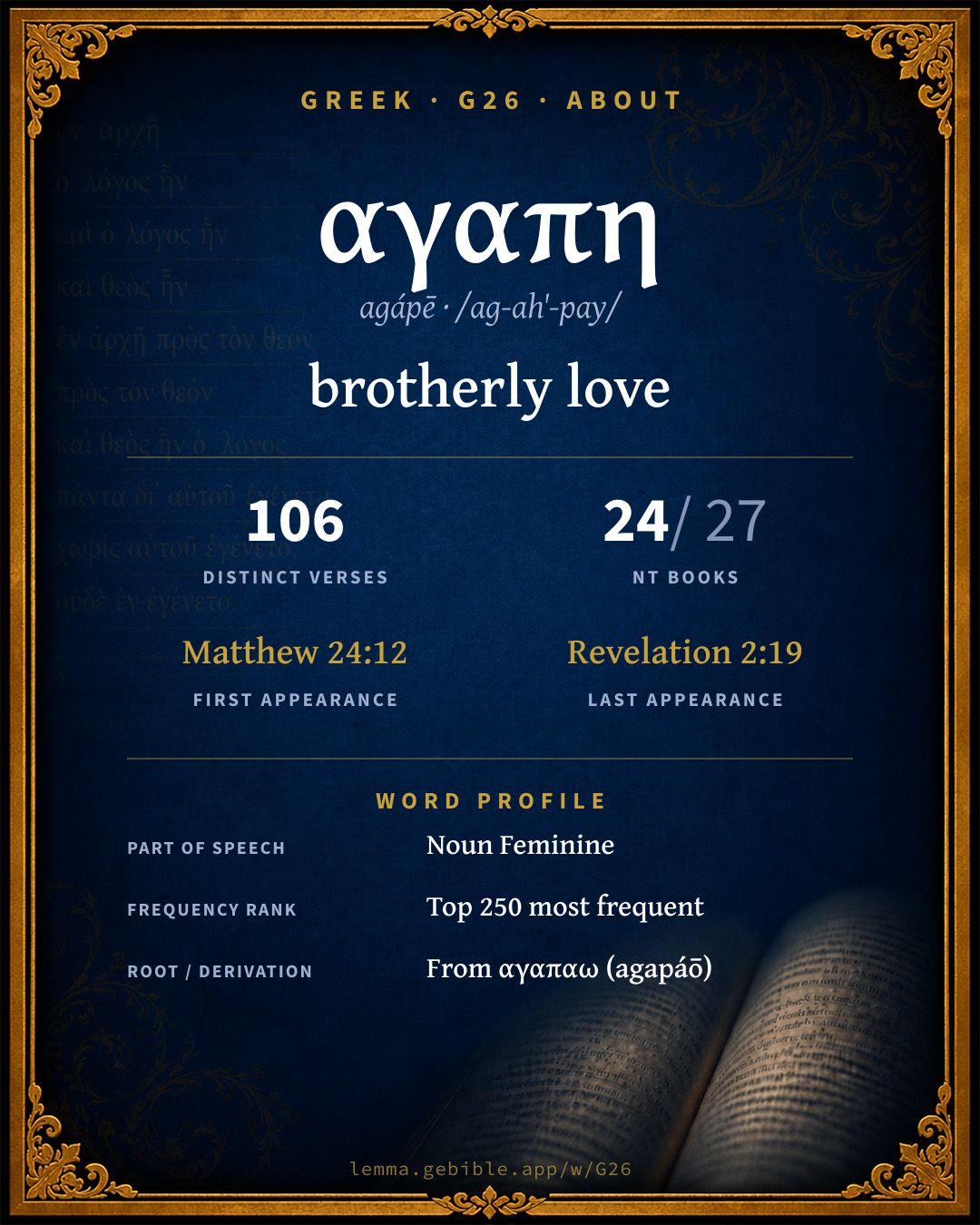
ἀγάπη
love
also: brotherly love, affection, good will, benevolence fuller range ↓
Full lexicon entry — Thayer's Greek Lexicon
From Thayer's Greek Lexicon
Where this word appears
See every Accusative-case word in the Greek New Testament →
Grammar key — what these labels mean
Part of speech
- Noun
- A naming word — a person, place, thing, or idea.
Case
- Nominative
- The case of the subject (and the predicate nominative).
- Accusative
- The case of the direct object and of extent.
- Dative
- The case of the indirect object, means, or location — “to / for / with / in.”
- Genitive
- The case of source, possession, or “of” — answers “whose / from what.”
Gender
- Feminine
- Grammatically feminine.
Number
- Singular
- One.
- Plural
- More than one.
Grammatical forms
- Noun, Nominative, Singular, Feminine 36 times (31%)
- Noun, Accusative, Singular, Feminine 33 times (28%)
- Noun, Dative, Singular, Feminine 28 times (24%)
- Noun, Genitive, Singular, Feminine 18 times (16%)
- Noun, Dative, Plural, Feminine 1 time (1%)
Parsed forms decoded from the imported morphology (Robinson–Tischendorf, public domain), counted across 116 parsed occurrences — not distinct verses.
Every verse where G26 appears — 106 distinct verses across 24 books. Click any verse to open its interlinear word-by-word view. Verse text shown in the World English Bible for context — . Each verse’s Greek form is shown with its reference; the English is not keyword-highlighted, since the data carries no word-level English alignment. Use “Compare translations” on any verse to read it across multiple English versions. This concordance covers the Greek New Testament; Septuagint (Greek Old Testament) occurrences of this word are not indexed here.
Matthew 1 verse
Luke 1 verse
John 6 verses
- John 5:42 ἀγάπην n acc sg fem But I know you, that you don't have God's love in yourselves.
- John 13:35 ἀγάπην n acc sg fem By this everyone will know that you are my disciples, if you have love for one another."
- John 15:9 ἀγάπῃ n dat sg fem Even as the Father has loved me, I also have loved you. Remain in my love.
- John 15:10 ἀγάπῃ ἀγάπῃ n dat sg fem n dat sg fem If you keep my commandments, you will remain in my love; even as I have kept my Father's commandments, and remain in his love.
- John 15:13 ἀγάπην n acc sg fem Greater love has no one than this, that someone lay down his life for his friends.
- John 17:26 ἀγάπη n nom sg fem I made known to them your name, and will make it known; that the love with which you loved me may be in them, and I in them."
Romans 8 verses
- Romans 5:5 ἀγάπη n nom sg fem and hope doesn't disappoint us, because God's love has been poured out into our hearts through the Holy Spirit who was given to us.
- Romans 5:8 ἀγάπην n acc sg fem But God commends his own love toward us, in that while we were yet sinners, Christ died for us.
- Romans 8:35 ἀγάπης n gen sg fem Who shall separate us from the love of Christ? Could oppression, or anguish, or persecution, or famine, or nakedness, or peril, or sword?
- Romans 8:39 ἀγάπης n gen sg fem nor height, nor depth, nor any other created thing, will be able to separate us from the love of God, which is in Christ Jesus our Lord.
- Romans 12:9 ἀγάπη n nom sg fem Let love be without hypocrisy. Abhor that which is evil. Cling to that which is good.
- Romans 13:10 ἀγάπη ἀγάπη n nom sg fem n nom sg fem Love doesn't harm a neighbor. Love therefore is the fulfillment of the law.
- Romans 14:15 ἀγάπην n acc sg fem Yet if because of food your brother is grieved, you walk no longer in love. Don't destroy with your food him for whom Christ died.
- Romans 15:30 ἀγάπης n gen sg fem Now I beg you, brothers, by our Lord Jesus Christ, and by the love of the Spirit, that you strive together with me in your prayers to God for me,
1 Corinthians 11 verses
- 1 Corinthians 4:21 ἀγάπῃ n dat sg fem What do you want? Shall I come to you with a rod, or in love and a spirit of gentleness?
- 1 Corinthians 8:1 ἀγάπη n nom sg fem Now concerning things sacrificed to idols: We know that we all have knowledge. Knowledge puffs up, but love builds up.
- 1 Corinthians 13:1 ἀγάπην n acc sg fem If I speak with the languages of men and of angels, but don't have love, I have become sounding brass, or a clanging cymbal.
- 1 Corinthians 13:2 ἀγάπην n acc sg fem If I have the gift of prophecy, and know all mysteries and all knowledge; and if I have all faith, so as to remove mountains, but don't have love, I am nothing.
- 1 Corinthians 13:3 ἀγάπην n acc sg fem If I dole out all my goods to feed the poor, and if I give my body to be burned, but don't have love, it profits me nothing.
- 1 Corinthians 13:4 ἀγάπη ἀγάπη ἀγάπη n nom sg fem n nom sg fem n nom sg fem Love is patient and is kind; love doesn't envy. Love doesn't brag, is not proud,
- 1 Corinthians 13:8 ἀγάπη n nom sg fem Love never fails. But where there are prophecies, they will be done away with. Where there are various languages, they will cease. Where there is knowledge, it will be done away with.
- 1 Corinthians 13:13 ἀγάπη ἀγάπη n nom sg fem n nom sg fem But now faith, hope, and love remain--these three. The greatest of these is love.
- 1 Corinthians 14:1 ἀγάπην n acc sg fem Follow after love, and earnestly desire spiritual gifts, but especially that you may prophesy.
- 1 Corinthians 16:14 ἀγάπῃ n dat sg fem Let all that you do be done in love.
- 1 Corinthians 16:24 ἀγάπη n nom sg fem My love to all of you in Christ Jesus. Amen.
2 Corinthians 9 verses
- 2 Corinthians 2:4 ἀγάπην n acc sg fem For out of much affliction and anguish of heart I wrote to you with many tears, not that you should be made sorry, but that you might know the love that I have so abundantly for you.
- 2 Corinthians 2:8 ἀγάπην n acc sg fem Therefore I beg you to confirm your love toward him.
- 2 Corinthians 5:14 ἀγάπη n nom sg fem For the love of Christ constrains us; because we judge thus, that one died for all, therefore all died.
- 2 Corinthians 6:6 ἀγάπῃ n dat sg fem in pureness, in knowledge, in patience, in kindness, in the Holy Spirit, in sincere love,
- 2 Corinthians 8:7 ἀγάπῃ n dat sg fem But as you abound in everything, in faith, utterance, knowledge, all earnestness, and in your love to us, see that you also abound in this grace.
- 2 Corinthians 8:8 ἀγάπης n gen sg fem I speak not by way of commandment, but as proving through the earnestness of others the sincerity also of your love.
- 2 Corinthians 8:24 ἀγάπης n gen sg fem Therefore show the proof of your love to them in front of the assemblies, and of our boasting on your behalf.
- 2 Corinthians 13:11 ἀγάπης n gen sg fem Finally, brothers, rejoice. Be perfected, be comforted, be of the same mind, live in peace, and the God of love and peace will be with you.
- 2 Corinthians 13:13 ἀγάπη n nom sg fem All the saints greet you.
Galatians 3 verses
- Galatians 5:6 ἀγάπης n gen sg fem For in Christ Jesus neither circumcision amounts to anything, nor uncircumcision, but faith working through love.
- Galatians 5:13 ἀγάπης n gen sg fem For you, brothers, were called for freedom. Only don't use your freedom for gain to the flesh, but through love be servants to one another.
- Galatians 5:22 ἀγάπη n nom sg fem But the fruit of the Spirit is love, joy, peace, patience, kindness, goodness, faithfulness,
Ephesians 10 verses
- Ephesians 1:4 ἀγάπῃ n dat sg fem even as he chose us in him before the foundation of the world, that we would be holy and without blemish before him in love;
- Ephesians 1:15 ἀγάπην n acc sg fem For this cause I also, having heard of the faith in the Lord Jesus which is among you, and the love which you have toward all the saints,
- Ephesians 2:4 ἀγάπην n acc sg fem But God, being rich in mercy, for his great love with which he loved us,
- Ephesians 3:18 ἀγάπῃ n dat sg fem may be strengthened to comprehend with all the saints what is the breadth and length and height and depth,
- Ephesians 3:19 ἀγάπην n acc sg fem and to know Christ's love which surpasses knowledge, that you may be filled with all the fullness of God.
- Ephesians 4:2 ἀγάπῃ n dat sg fem with all lowliness and humility, with patience, bearing with one another in love;
- Ephesians 4:15 ἀγάπῃ n dat sg fem but speaking truth in love, we may grow up in all things into him, who is the head, Christ;
- Ephesians 4:16 ἀγάπῃ n dat sg fem from whom all the body, being fitted and knit together through that which every joint supplies, according to the working in measure of each individual part, makes the body increase to the building up of itself in love.
- Ephesians 5:2 ἀγάπῃ n dat sg fem Walk in love, even as Christ also loved you, and gave himself up for us, an offering and a sacrifice to God for a sweet-smelling fragrance.
- Ephesians 6:23 ἀγάπη n nom sg fem Peace be to the brothers, and love with faith, from God the Father and the Lord Jesus Christ.
Philippians 4 verses
- Philippians 1:9 ἀγάπη n nom sg fem This I pray, that your love may abound yet more and more in knowledge and all discernment;
- Philippians 1:16 ἀγάπης n gen sg fem The former insincerly preach Christ from selfish ambition, thinking that they add affliction to my chains;
- Philippians 2:1 ἀγάπης n gen sg fem If there is therefore any exhortation in Christ, if any consolation of love, if any fellowship of the Spirit, if any tender mercies and compassion,
- Philippians 2:2 ἀγάπην n acc sg fem make my joy full, by being like-minded, having the same love, being of one accord, of one mind;
Colossians 5 verses
- Colossians 1:4 ἀγάπην n acc sg fem having heard of your faith in Christ Jesus, and of the love which you have toward all the saints,
- Colossians 1:8 ἀγάπην n acc sg fem who also declared to us your love in the Spirit.
- Colossians 1:13 ἀγάπης n gen sg fem who delivered us out of the power of darkness, and translated us into the Kingdom of the Son of his love;
- Colossians 2:2 ἀγάπῃ n dat sg fem that their hearts may be comforted, they being knit together in love, and gaining all riches of the full assurance of understanding, that they may know the mystery of God, both of the Father and of Christ,
- Colossians 3:14 ἀγάπην n acc sg fem Above all these things, walk in love, which is the bond of perfection.
1 Thessalonians 5 verses
- 1 Thessalonians 1:3 ἀγάπης n gen sg fem remembering without ceasing your work of faith and labor of love and patience of hope in our Lord Jesus Christ, before our God and Father.
- 1 Thessalonians 3:6 ἀγάπην n acc sg fem But when Timothy came just now to us from you, and brought us glad news of your faith and love, and that you have good memories of us always, longing to see us, even as we also long to see you;
- 1 Thessalonians 3:12 ἀγάπῃ n dat sg fem and the Lord make you to increase and abound in love one toward another, and toward all men, even as we also do toward you,
- 1 Thessalonians 5:8 ἀγάπης n gen sg fem But let us, since we belong to the day, be sober, putting on the breastplate of faith and love, and, for a helmet, the hope of salvation.
- 1 Thessalonians 5:13 ἀγάπῃ n dat sg fem and to respect and honor them in love for their work's sake. Be at peace among yourselves.
2 Thessalonians 3 verses
- 2 Thessalonians 1:3 ἀγάπη n nom sg fem We are bound to always give thanks to God for you, brothers, even as it is appropriate, because your faith grows exceedingly, and the love of each and every one of you towards one another abounds;
- 2 Thessalonians 2:10 ἀγάπην n acc sg fem and with all deception of wickedness for those who are being lost, because they didn't receive the love of the truth, that they might be saved.
- 2 Thessalonians 3:5 ἀγάπην n acc sg fem May the Lord direct your hearts into the love of God, and into the patience of Christ.
1 Timothy 5 verses
- 1 Timothy 1:5 ἀγάπη n nom sg fem but the end of the charge is love, out of a pure heart and a good conscience and unfeigned faith;
- 1 Timothy 1:14 ἀγάπης n gen sg fem The grace of our Lord abounded exceedingly with faith and love which is in Christ Jesus.
- 1 Timothy 2:15 ἀγάπῃ n dat sg fem but she will be saved through her child-bearing, if they continue in faith, love, and sanctification with sobriety.
- 1 Timothy 4:12 ἀγάπῃ n dat sg fem Let no man despise your youth; but be an example to those who believe, in word, in your way of life, in love, in spirit, in faith, and in purity.
- 1 Timothy 6:11 ἀγάπην n acc sg fem But you, man of God, flee these things, and follow after righteousness, godliness, faith, love, patience, and gentleness.
2 Timothy 4 verses
- 2 Timothy 1:7 ἀγάπης n gen sg fem For God didn't give us a spirit of fear, but of power, love, and self-control.
- 2 Timothy 1:13 ἀγάπῃ n dat sg fem Hold the pattern of sound words which you have heard from me, in faith and love which is in Christ Jesus.
- 2 Timothy 2:22 ἀγάπην n acc sg fem Flee from youthful lusts; but pursue righteousness, faith, love, and peace with those who call on the Lord out of a pure heart.
- 2 Timothy 3:10 ἀγάπῃ n dat sg fem But you did follow my teaching, conduct, purpose, faith, patience, love, steadfastness,
Titus 1 verse
Philemon 3 verses
- Philemon 1:5 ἀγάπην n acc sg fem hearing of your love, and of the faith which you have toward the Lord Jesus, and toward all the saints;
- Philemon 1:7 ἀγάπῃ n dat sg fem For we have much joy and comfort in your love, because the hearts of the saints have been refreshed through you, brother.
- Philemon 1:9 ἀγάπην n acc sg fem yet for love's sake I rather beg, being such a one as Paul, the aged, but also a prisoner of Jesus Christ.
Hebrews 2 verses
1 Peter 2 verses
2 Peter 1 verse
1 John 14 verses
- 1 John 2:5 ἀγάπη n nom sg fem But whoever keeps his word, God's love has most assuredly been perfected in him. This is how we know that we are in him:
- 1 John 2:15 ἀγάπη n nom sg fem Don't love the world, neither the things that are in the world. If anyone loves the world, the Father's love isn't in him.
- 1 John 3:1 ἀγάπην n acc sg fem Behold, how great a love the Father has bestowed on us, that we should be called children of God! For this cause the world doesn't know us, because it didn't know him.
- 1 John 3:16 ἀγάπην n acc sg fem By this we know love, because he laid down his life for us. And we ought to lay down our lives for the brothers.
- 1 John 3:17 ἀγάπη n nom sg fem But whoever has the world's goods, and sees his brother in need, and closes his heart of compassion against him, how does the love of God remain in him?
- 1 John 4:7 ἀγάπη n nom sg fem Beloved, let us love one another, for love is of God; and everyone who loves is born of God, and knows God.
- 1 John 4:8 ἀγάπη n nom sg fem He who doesn't love doesn't know God, for God is love.
- 1 John 4:9 ἀγάπη n nom sg fem By this was God's love revealed in us, that God has sent his one and only Son into the world that we might live through him.
- 1 John 4:10 ἀγάπη n nom sg fem In this is love, not that we loved God, but that he loved us, and sent his Son as the atoning sacrifice for our sins.
- 1 John 4:12 ἀγάπη n nom sg fem No one has seen God at any time. If we love one another, God remains in us, and his love has been perfected in us.
- 1 John 4:16 ἀγάπην ἀγάπη ἀγάπῃ n acc sg fem n nom sg fem n dat sg fem We know and have believed the love which God has for us. God is love, and he who remains in love remains in God, and God remains in him.
- 1 John 4:17 ἀγάπη n nom sg fem In this love has been made perfect among us, that we may have boldness in the day of judgment, because as he is, even so are we in this world.
- 1 John 4:18 ἀγάπῃ ἀγάπη ἀγάπῃ n dat sg fem n nom sg fem n dat sg fem There is no fear in love; but perfect love casts out fear, because fear has punishment. He who fears is not made perfect in love.
- 1 John 5:3 ἀγάπη n nom sg fem For this is the love of God, that we keep his commandments. His commandments are not grievous.
2 John 2 verses
- 2 John 1:3 ἀγάπῃ n dat sg fem Grace, mercy, and peace will be with us, from God the Father, and from the Lord Jesus Christ, the Son of the Father, in truth and love.
- 2 John 1:6 ἀγάπη n nom sg fem This is love, that we should walk according to his commandments. This is the commandment, even as you heard from the beginning, that you should walk in it.
3 John 1 verse
Jude 3 verses
- Jude 1:2 ἀγάπη n nom sg fem Mercy to you and peace and love be multiplied.
- Jude 1:12 ἀγάπαις n dat pl fem These are hidden rocky reefs in your love feasts when they feast with you, shepherds who without fear feed themselves; clouds without water, carried along by winds; autumn leaves without fruit, twice dead, plucked up by the roots;
- Jude 1:21 ἀγάπῃ n dat sg fem Keep yourselves in the love of God, looking for the mercy of our Lord Jesus Christ to eternal life.
Revelation 2 verses
About this entry
At a glance — auto-summarized from this page’s data, not written by a person. Every figure links to its source below. This summary describes the numbers; it doesn’t interpret them.
αγαπη — transliterated agápē — is a Greek noun carrying the sense “love.” “charity” is the historic King James Version rendering; modern versions use “love.” See the renderings breakdown. The Greek New Testament uses it across 106 verses — common. Debuting at Matthew 24:12, it then recurs through the corpus. Thayer's distinguishes 2 senses; alongside “love” it spans “brotherly love”, “affection”, and “good will”. See the sense tree, 106-verse concordance, and the renderings breakdown below.
Gloss history
Strong's 1890 vs modern scholarship

About this word
Strong's G26 catalogs a Greek word from the Greek New Testament.
These counts are not copied from any lexicon or concordance. They are computed here, from the morphology-tagged Greek New Testament. What Lemma adds →
- 106
- distinct verses
- The word appears in 106 distinct verses.
- 24 / 27
- NT books
- The word appears in 24 of 27 New Testament books.
- #143
- by frequency
- Top 250 most frequent Greek words (rank 143 of 5,347 Greek words by occurrence).
View all 106 occurrences in the concordance →
Most concentrated in
- 1 John 14 verses 13%
- 1 Corinthians 11 verses 10%
- Ephesians 10 verses 9%
By section of the New Testament
By traditional corpus
Conventional, traditional groupings — biblical authorship is debated, so this is a traditional corpus grouping, not an authorship claim. Some books belong to more than one corpus (Luke is in both the Gospels and the Lukan corpus, and so on), so these shares overlap and need not total 100%. Each figure is a share of the word’s 106 distinct verses.
- Pauline corpus 71 verses · 67%
- Johannine 25 verses · 24%
- General (Catholic) Epistles 23 verses · 22%
- Gospels 8 verses · 8%
- Hebrews 2 verses · 2%
- Revelation 2 verses · 2%
- Lukan (Luke–Acts) 1 verse · 1%
How translations render this word
Counts come from each version’s own published word-to-Strong’s tagging or interlinear alignment — an approximate guide to how each version renders this word, not a word-level alignment the data otherwise carries. Because each total is that version’s own tagged count, the per-version totals vary from one another and need not match the appearance or distinct-verse counts above. These counts may also differ from a printed concordance because Lemma counts each distinctly tagged rendering and does not collapse phrase taggings into a single head-word total. This is a fixed set of word-tagged versions (KJV, ASV, BSB, ULT) and does not change with the reading translation you choose elsewhere. Each version’s license is shown beside its name below (and on Sources).
- King James Version: Love 84×, Charity 24×
- American Standard Version: Love 106×
- Berean Standard Bible: Love 111×
- unfoldingWord Literal Text: Love 112×, Of 2×
King James Version Public Domain
Renders G26 across 116 tagged occurrences — most commonly:
Plus 8 renderings that appear only once — usually multi-word phrases or single function words the recovered tagging swept in, not distinct renderings.
American Standard Version Public Domain
Renders G26 across 115 tagged occurrences — most commonly:
Plus 9 renderings that appear only once — usually multi-word phrases or single function words the recovered tagging swept in, not distinct renderings.
Berean Standard Bible Public Domain
Renders G26 across 115 tagged occurrences — most commonly:
Plus 4 renderings that appear only once — usually multi-word phrases or single function words the recovered tagging swept in, not distinct renderings. Not rendered by a distinct English word in 1 further occurrence.
unfoldingWord Literal Text CC BY-SA 4.0
Renders G26 across 120 tagged occurrences — most commonly:
Plus 6 renderings that appear only once — usually multi-word phrases or single function words the recovered tagging swept in, not distinct renderings.
Senses in Thayer's
The 2 senses Thayer's distinguishes for this word, in lexicon order (not ranked by frequency or importance). The full entry — with sub-senses — is in the Lexicon Entry tab.
- brotherly love, affection, good will, love, benevolence
- love feasts
Word origin
Derived from αγαπαω (agapáō) (G25) — to love.
From G25 ; love that is affection or benevolence ; specifically (plural) a love feast : - (feast of) charity ([-ably]) dear love.
— Strong’s Exhaustive Concordance (1890), public domain.
Forms in the corpus
The 5 distinct written forms G26 takes in the Greek New Testament, most frequent first — each parse links to that case’s occurrences in the concordance.
| Form | Parsing | Example | Uses |
|---|---|---|---|
| ἀγάπη agápē | Noun, Nominative, Singular, Feminine | Matthew 24:12 | 36 |
| ἀγάπην agápēn | Noun, Accusative, Singular, Feminine | Luke 11:42 | 33 |
| ἀγάπῃ agápē | Noun, Dative, Singular, Feminine | John 15:9 | 28 |
| ἀγάπης agápēs | Noun, Genitive, Singular, Feminine | Romans 8:35 | 18 |
| ἀγάπαις agápais | Noun, Dative, Plural, Feminine | Jude 1:12 | 1 |
Same root — word family
Other Thayer's entries built from the same root as G26, grouped by Strong’s listed origin. These share a root / origin per the lexicon — not necessarily a shared meaning. Each links to that word’s own entry.
Derives from
Shares the same root
Compare all same-root words → They share a root, not necessarily a meaning.
Septuagint usage
The same Greek word αγαπη appears 15 times in the Greek Old Testament (Septuagint), across 14 verses in 4 books.
- 15
- LXX occurrences
- Tagged occurrences of this Greek word in the Septuagint.
- 14
- verses
- Distinct Septuagint verses containing this word.
- 4 / 39
- OT books
- The word appears in 4 of the 39 Old Testament books.
Sample Septuagint occurrences
- 2 Samuel 13:15 ἀγάπη
- Ecclesiastes 9:1 ἀγάπη
- Song of Solomon 2:4 ἀγάπη
- Jeremiah 2:2 ἀγάπη
Septuagint occurrences (same lexeme)
Every verse where the same Strong’s number (G26) appears in the Greek Septuagint. Verse text shown in the World English Bible for context; the Greek form is the matched word — the English is not keyword-highlighted.
- 2 Samuel 13:15 ἀγάπη Then Amnon hated her with exceeding great hatred; for the hatred with which he hated her was greater than the love with which he had loved her. Amnon said to her, Arise, be gone.
- Ecclesiastes 9:1 ἀγάπη For all this I laid to my heart, even to explore all this: that the righteous, and the wise, and their works, are in the hand of God; whether it is love or hatred, man doesn't know it; all is before them.
- Ecclesiastes 9:6 ἀγάπη Also their love, their hatred, and their envy has perished long ago; neither have they any more a portion forever in anything that is done under the sun.
- Song of Solomon 2:4 ἀγάπη He brought me to the banquet hall. His banner over me is love.
- Song of Solomon 2:5 ἀγάπη Strengthen me with raisins, Refresh me with apples; For I am faint with love.
- Song of Solomon 2:7 ἀγάπη I adjure you, daughters of Jerusalem, By the roes, or by the hinds of the field, That you not stir up, nor awaken love, Until it so desires.
- Song of Solomon 3:5 ἀγάπη I adjure you, daughters of Jerusalem, By the roes, or by the hinds of the field, That you not stir up, nor awaken love, Until it so desires.
- Song of Solomon 3:10 ἀγάπη He made its pillars of silver, Its bottom of gold, its seat of purple, Its midst being paved with love, From the daughters of Jerusalem.
- Song of Solomon 5:8 ἀγάπη I adjure you, daughters of Jerusalem, If you find my beloved, That you tell him that I am faint with love. Friends
- Song of Solomon 7:7 ἀγάπη This, your stature, is like a palm tree, Your breasts like its fruit.
- Song of Solomon 8:4 ἀγάπη I adjure you, daughters of Jerusalem, That you not stir up, nor awaken love, Until it so desires. Friends
- Song of Solomon 8:6 ἀγάπη Set me as a seal on your heart, As a seal on your arm; For love is strong as death. Jealousy is as cruel as Sheol; Its flashes are flashes of fire, A very flame of Yahweh.
- Song of Solomon 8:7 ἀγάπη Many waters can't quench love, Neither can floods drown it. If a man would give all the wealth of his house for love, He would be utterly scorned. Friends
- Jeremiah 2:2 ἀγάπη Go, and cry in the ears of Jerusalem, saying, Thus says Yahweh, I remember for you the kindness of your youth, the love of your weddings; how you went after me in the wilderness, in a land that was not sown.
These are occurrences of the same Greek lexeme (G26) in the Septuagint — not a translation of any one Hebrew word. The store carries no word-level Hebrew↔Greek alignment, so no Hebrew original is asserted here. Counts come from the recovered LXX Strong's tagging — high-frequency vocabulary is well covered, while rare or late forms may be untagged — so they reflect tagged occurrences and may slightly undercount.