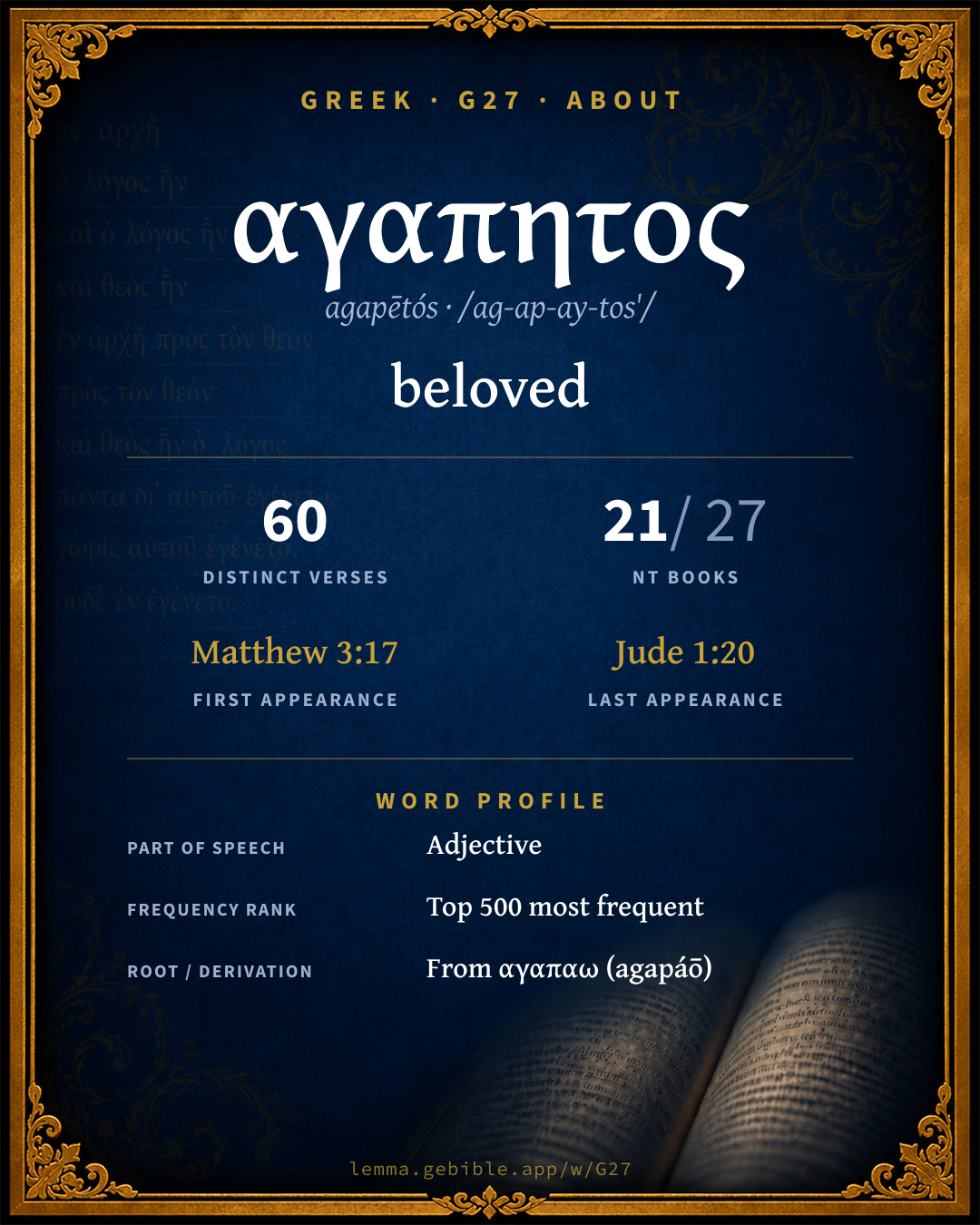
ἀγαπητός
beloved
Full lexicon entry — Thayer's Greek Lexicon
From Thayer's Greek Lexicon
Where this word appears
See every Vocative-case word in the Greek New Testament →
Grammar key — what these labels mean
Part of speech
- Adjective
- A word that describes or qualifies a noun.
Case
- Vocative
- The case of direct address (“O Lord”).
- Nominative
- The case of the subject (and the predicate nominative).
- Accusative
- The case of the direct object and of extent.
- Dative
- The case of the indirect object, means, or location — “to / for / with / in.”
- Genitive
- The case of source, possession, or “of” — answers “whose / from what.”
Gender
- Masculine
- Grammatically masculine.
- Neuter
- Grammatically neuter.
- Feminine
- Grammatically feminine.
Number
- Plural
- More than one.
- Singular
- One.
Grammatical forms 13 distinct
- Adjective, Vocative, Plural, Masculine 27 times (44%)
- Adjective, Nominative, Singular, Masculine 11 times (18%)
- Adjective, Accusative, Singular, Masculine 6 times (10%)
- Adjective, Dative, Singular, Masculine 3 times (5%)
- Adjective, Nominative, Plural, Masculine 3 times (5%)
- Adjective, Vocative, Singular, Masculine 3 times (5%)
- Adjective, Dative, Plural, Masculine 2 times (3%)
- Adjective, Accusative, Plural, Neuter 1 time (2%)
+5 more forms (5 occurrences)
Parsed forms decoded from the imported morphology (Robinson–Tischendorf, public domain), counted across 61 parsed occurrences — not distinct verses.
Every verse where G27 appears — 60 distinct verses across 21 books. Click any verse to open its interlinear word-by-word view. Verse text shown in the World English Bible for context — . Each verse’s Greek form is shown with its reference; the English is not keyword-highlighted, since the data carries no word-level English alignment. Use “Compare translations” on any verse to read it across multiple English versions. This concordance covers the Greek New Testament; Septuagint (Greek Old Testament) occurrences of this word are not indexed here.
Matthew 3 verses
- Matthew 3:17 ἀγαπητός adj nom sg masc Behold, a voice out of the heavens said, "This is my beloved Son, with whom I am well pleased."
- Matthew 12:18 ἀγαπητός adj nom sg masc "Behold, my servant whom I have chosen; My beloved in whom my soul is well pleased: I will put my Spirit on him. He will proclaim justice to the Gentiles.
- Matthew 17:5 ἀγαπητός adj nom sg masc While he was still speaking, behold, a bright cloud overshadowed them. Behold, a voice came out of the cloud, saying, "This is my beloved Son, in whom I am well pleased. Listen to him."
Mark 3 verses
- Mark 1:11 ἀγαπητός adj nom sg masc A voice came out of the sky, "You are my beloved Son, in whom I am well pleased."
- Mark 9:7 ἀγαπητός adj nom sg masc A cloud came, overshadowing them, and a voice came out of the cloud, "This is my beloved Son. Listen to him."
- Mark 12:6 ἀγαπητόν adj acc sg masc Therefore still having one, his beloved son, he sent him last to them, saying, 'They will respect my son.'
Luke 2 verses
- Luke 3:22 ἀγαπητός adj nom sg masc and the Holy Spirit descended in a bodily form as a dove on him; and a voice came out of the sky, saying "You are my beloved Son. In you I am well pleased."
- Luke 20:13 ἀγαπητόν adj acc sg masc The lord of the vineyard said, 'What shall I do? I will send my beloved son. It may be that seeing him, they will respect him.'
Acts 1 verse
Romans 7 verses
- Romans 1:7 ἀγαπητοῖς adj dat pl masc to all who are in Rome, beloved of God, called to be saints: Grace to you and peace from God our Father and the Lord Jesus Christ.
- Romans 11:28 ἀγαπητοὶ adj nom pl masc Concerning the Gospel, they are enemies for your sake. But concerning the election, they are beloved for the fathers' sake.
- Romans 12:19 ἀγαπητοί adj voc pl masc Don't seek revenge yourselves, beloved, but give place to God's wrath. For it is written, "Vengeance belongs to me; I will repay, says the Lord."
- Romans 16:5 ἀγαπητόν adj acc sg masc Greet the assembly that is in their house. Greet Epaenetus, my beloved, who is the first fruits of Achaia to Christ.
- Romans 16:8 ἀγαπητόν adj acc sg masc Greet Amplias, my beloved in the Lord.
- Romans 16:9 ἀγαπητόν adj acc sg masc Greet Urbanus, our fellow worker in Christ, and Stachys, my beloved.
- Romans 16:12 ἀγαπητήν adj acc sg fem Greet Tryphaena and Tryphosa, who labor in the Lord. Greet Persis, the beloved, who labored much in the Lord.
1 Corinthians 4 verses
- 1 Corinthians 4:14 ἀγαπητὰ adj acc pl neut I don't write these things to shame you, but to admonish you as my beloved children.
- 1 Corinthians 4:17 ἀγαπητὸν adj nom sg neut Because of this I have sent Timothy to you, who is my beloved and faithful child in the Lord, who will remind you of my ways which are in Christ, even as I teach everywhere in every assembly.
- 1 Corinthians 10:14 ἀγαπητοί adj voc pl masc Therefore, my beloved, flee from idolatry.
- 1 Corinthians 15:58 ἀγαπητοί adj voc pl masc Therefore, my beloved brothers, be steadfast, immovable, always abounding in the Lord's work, because you know that your labor is not in vain in the Lord.
2 Corinthians 2 verses
- 2 Corinthians 7:1 ἀγαπητοί adj voc pl masc Having therefore these promises, beloved, let us cleanse ourselves from all defilement of flesh and spirit, perfecting holiness in the fear of God.
- 2 Corinthians 12:19 ἀγαπητοί adj voc pl masc Again, do you think that we are excusing ourselves to you? In the sight of God we speak in Christ. But all things, beloved, are for your edifying.
Ephesians 2 verses
Philippians 2 verses
- Philippians 2:12 ἀγαπητοί adj voc pl masc So then, my beloved, even as you have always obeyed, not only in my presence, but now much more in my absence, work out your own salvation with fear and trembling.
- Philippians 4:1 ἀγαπητοὶ ἀγαπητοί adj voc pl masc adj voc pl masc Therefore, my brothers, beloved and longed for, my joy and crown, so stand firm in the Lord, my beloved.
Colossians 4 verses
- Colossians 1:7 ἀγαπητοῦ adj gen sg masc even as you learned of Epaphras our beloved fellow servant, who is a faithful minister of Christ on our behalf,
- Colossians 4:7 ἀγαπητὸς adj nom sg masc All my affairs will be made known to you by Tychicus, the beloved brother, faithful servant, and fellow bondservant in the Lord.
- Colossians 4:9 ἀγαπητῷ adj dat sg masc together with Onesimus, the faithful and beloved brother, who is one of you. They will make known to you everything that is going on here.
- Colossians 4:14 ἀγαπητὸς adj nom sg masc Luke, the beloved physician, and Demas greet you.
1 Thessalonians 1 verse
1 Timothy 1 verse
2 Timothy 1 verse
Philemon 2 verses
- Philemon 1:1 ἀγαπητῷ adj dat sg masc Paul, a prisoner of Christ Jesus, and Timothy our brother, to Philemon, our beloved fellow worker,
- Philemon 1:16 ἀγαπητόν adj acc sg masc no longer as a slave, but more than a slave, a beloved brother, especially to me, but how much rather to you, both in the flesh and in the Lord.
Hebrews 1 verse
James 3 verses
- James 1:16 ἀγαπητοί adj voc pl masc Don't be deceived, my beloved brothers.
- James 1:19 ἀγαπητοί adj voc pl masc So, then, my beloved brothers, let every man be swift to hear, slow to speak, and slow to anger;
- James 2:5 ἀγαπητοί adj voc pl masc Listen, my beloved brothers. Didn't God choose those who are poor in this world to be rich in faith, and heirs of the Kingdom which he promised to those who love him?
1 Peter 2 verses
- 1 Peter 2:11 Ἀγαπητοί adj voc pl masc Beloved, I beg you as foreigners and pilgrims, to abstain from fleshly lusts, which war against the soul;
- 1 Peter 4:12 Ἀγαπητοί adj voc pl masc Beloved, don't be astonished at the fiery trial which has come upon you, to test you, as though a strange thing happened to you.
2 Peter 6 verses
- 2 Peter 1:17 ἀγαπητός adj nom sg masc For he received from God the Father honor and glory, when the voice came to him from the Majestic Glory, "This is my beloved Son, in whom I am well pleased."
- 2 Peter 3:1 ἀγαπητοί adj voc pl masc This is now, beloved, the second letter that I have written to you; and in both of them I stir up your sincere mind by reminding you;
- 2 Peter 3:8 ἀγαπητοί adj voc pl masc But don't forget this one thing, beloved, that one day is with the Lord as a thousand years, and a thousand years as one day.
- 2 Peter 3:14 ἀγαπητοί adj voc pl masc Therefore, beloved, seeing that you look for these things, be diligent to be found in peace, without blemish and blameless in his sight.
- 2 Peter 3:15 ἀγαπητὸς adj nom sg masc Regard the patience of our Lord as salvation; even as our beloved brother Paul also, according to the wisdom given to him, wrote to you;
- 2 Peter 3:17 ἀγαπητοί adj voc pl masc You therefore, beloved, knowing these things beforehand, beware lest, being carried away with the error of the wicked, you fall from your own steadfastness.
1 John 6 verses
- 1 John 2:7 Ἀγαπητοί adj voc pl masc Brothers, I write no new commandment to you, but an old commandment which you had from the beginning. The old commandment is the word which you heard from the beginning.
- 1 John 3:2 Ἀγαπητοί adj voc pl masc Beloved, now we are children of God, and it is not yet revealed what we will be. But we know that, when he is revealed, we will be like him; for we will see him just as he is.
- 1 John 3:21 Ἀγαπητοί adj voc pl masc Beloved, if our hearts don't condemn us, we have boldness toward God;
- 1 John 4:1 Ἀγαπητοί adj voc pl masc Beloved, don't believe every spirit, but test the spirits, whether they are of God, because many false prophets have gone out into the world.
- 1 John 4:7 Ἀγαπητοί adj voc pl masc Beloved, let us love one another, for love is of God; and everyone who loves is born of God, and knows God.
- 1 John 4:11 Ἀγαπητοί adj voc pl masc Beloved, if God loved us in this way, we also ought to love one another.
3 John 4 verses
- 3 John 1:1 ἀγαπητῷ adj dat sg masc The elder to Gaius the beloved, whom I love in truth.
- 3 John 1:2 Ἀγαπητέ adj voc sg masc Beloved, I pray that you may prosper in all things and be healthy, even as your soul prospers.
- 3 John 1:5 Ἀγαπητέ adj voc sg masc Beloved, you do a faithful work in whatever you accomplish for those who are brothers and strangers.
- 3 John 1:11 Ἀγαπητέ adj voc sg masc Beloved, don't imitate that which is evil, but that which is good. He who does good is of God. He who does evil hasn't seen God.
Jude 3 verses
- Jude 1:3 Ἀγαπητοί adj voc pl masc Beloved, while I was very eager to write to you about our common salvation, I was constrained to write to you exhorting you to contend earnestly for the faith which was once for all delivered to the saints.
- Jude 1:17 ἀγαπητοί adj voc pl masc But you, beloved, remember the words which have been spoken before by the apostles of our Lord Jesus Christ.
- Jude 1:20 ἀγαπητοί adj voc pl masc But you, beloved, keep building up yourselves on your most holy faith, praying in the Holy Spirit.
About this entry
At a glance — auto-summarized from this page’s data, not written by a person. Every figure links to its source below. This summary describes the numbers; it doesn’t interpret them.
The Greek adjective αγαπητος centers on the idea of “beloved.” Its earliest occurrence is Matthew 3:17. It turns up in 60 verses across 21 books, a moderately common footprint. It shares a root with αγαπαω and αγαπη. For the data behind this summary, explore the sense tree and the renderings breakdown below.
Gloss history
Strong's 1890 vs modern scholarship

About this word
Strong's G27 catalogs a Greek word from the Greek New Testament.
These counts are not copied from any lexicon or concordance. They are computed here, from the morphology-tagged Greek New Testament. What Lemma adds →
- 60
- distinct verses
- The word appears in 60 distinct verses.
- 21 / 27
- NT books
- The word appears in 21 of 27 New Testament books.
- #267
- by frequency
- Top 500 most frequent Greek words (rank 267 of 5,347 Greek words by occurrence).
View all 60 occurrences in the concordance →
By section of the New Testament
By traditional corpus
Conventional, traditional groupings — biblical authorship is debated, so this is a traditional corpus grouping, not an authorship claim. Some books belong to more than one corpus (Luke is in both the Gospels and the Lukan corpus, and so on), so these shares overlap and need not total 100%. Each figure is a share of the word’s 60 distinct verses.
- Pauline corpus 26 verses · 43%
- General (Catholic) Epistles 24 verses · 40%
- Johannine 10 verses · 17%
- Gospels 8 verses · 13%
- Lukan (Luke–Acts) 3 verses · 5%
- Hebrews 1 verse · 2%
How translations render this word
Counts come from each version’s own published word-to-Strong’s tagging or interlinear alignment — an approximate guide to how each version renders this word, not a word-level alignment the data otherwise carries. Because each total is that version’s own tagged count, the per-version totals vary from one another and need not match the appearance or distinct-verse counts above. These counts may also differ from a printed concordance because Lemma counts each distinctly tagged rendering and does not collapse phrase taggings into a single head-word total. This is a fixed set of word-tagged versions (KJV, ASV, BSB, ULT) and does not change with the reading translation you choose elsewhere. Each version’s license is shown beside its name below (and on Sources).
- King James Version: Beloved 45×, Dearly beloved 9×, Dear 3×
- American Standard Version: Beloved 58×, To 2×
- Berean Standard Bible: Beloved 58×
- unfoldingWord Literal Text: Beloved 49×, Beloved ones 11×
King James Version Public Domain
Renders G27 across 62 tagged occurrences — most commonly:
Plus 2 renderings that appear only once — usually multi-word phrases or single function words the recovered tagging swept in, not distinct renderings.
American Standard Version Public Domain
Renders G27 across 63 tagged occurrences — most commonly:
Plus 3 renderings that appear only once — usually multi-word phrases or single function words the recovered tagging swept in, not distinct renderings.
Berean Standard Bible Public Domain
Renders G27 across 61 tagged occurrences — most commonly:
Plus 3 renderings that appear only once — usually multi-word phrases or single function words the recovered tagging swept in, not distinct renderings.
unfoldingWord Literal Text CC BY-SA 4.0
Renders G27 across 61 tagged occurrences — most commonly:
Plus 1 rendering that appears only once — usually multi-word phrases or single function words the recovered tagging swept in, not distinct renderings.
Senses in Thayer's
The 1 sense Thayer's distinguishes for this word, in lexicon order (not ranked by frequency or importance). The full entry — with sub-senses — is in the Lexicon Entry tab.
- beloved, esteemed, dear, favourite, worthy of love
Word origin
Derived from αγαπαω (agapáō) (G25) — to love.
From G25 ; beloved : - (dearly well) beloved dear.
— Strong’s Exhaustive Concordance (1890), public domain.
Forms in the corpus
The 14 distinct written forms G27 takes in the Greek New Testament, most frequent first — each parse links to that case’s occurrences in the concordance.
Same root — word family
Other Thayer's entries built from the same root as G27, grouped by Strong’s listed origin. These share a root / origin per the lexicon — not necessarily a shared meaning. Each links to that word’s own entry.
Derives from
Shares the same root
Compare all same-root words → They share a root, not necessarily a meaning.
Septuagint usage
The same Greek word αγαπητος appears 16 times in the Greek Old Testament (Septuagint), across 16 verses in 6 books.
- 16
- LXX occurrences
- Tagged occurrences of this Greek word in the Septuagint.
- 16
- verses
- Distinct Septuagint verses containing this word.
- 6 / 39
- OT books
- The word appears in 6 of the 39 Old Testament books.
Sample Septuagint occurrences
- Genesis 22:2 ἀγαπητός
- Psalms 37:21 ἀγαπητός
- Isaiah 26:17 ἀγαπητός
- Jeremiah 6:26 ἀγαπητός
- Amos 8:10 ἀγαπητός
- Zechariah 12:10 ἀγαπητός
Septuagint occurrences (same lexeme)
Every verse where the same Strong’s number (G27) appears in the Greek Septuagint. Verse text shown in the World English Bible for context; the Greek form is the matched word — the English is not keyword-highlighted.
- Genesis 22:2 ἀγαπητός He said, "Now take your son, your only son, whom you love, even Isaac, and go into the land of Moriah. Offer him there for a burnt offering on one of the mountains which I will tell you of."
- Genesis 22:12 ἀγαπητός He said, "Don't lay your hand on the boy, neither do anything to him. For now I know that you fear God, seeing you have not withheld your son, your only son, from me."
- Genesis 22:16 ἀγαπητός and said, "I have sworn by myself, says Yahweh, because you have done this thing, and have not withheld your son, your only son,
- Psalms 37:21 ἀγαπητός The wicked borrow, and don't pay back, But the righteous give generously.
- Psalms 44:1 ἀγαπητός We have heard with our ears, God; Our fathers have told us, What work you did in their days, In the days of old.
- Psalms 59:7 ἀγαπητός Behold, they spew with their mouth. Swords are in their lips, "For," they say, "who hears us?"
- Psalms 67:13 ἀγαπητός
- Psalms 83:2 ἀγαπητός For, behold, your enemies are stirred up. Those who hate you have lifted up their heads.
- Psalms 107:7 ἀγαπητός He led them also by a straight way, That they might go to a city to live in.
- Psalms 126:2 ἀγαπητός Then our mouth was filled with laughter, And our tongue with singing. Then they said among the nations, "Yahweh has done great things for them."
- Isaiah 26:17 ἀγαπητός Like as a woman with child, who draws near the time of her delivery, is in pain and cries out in her pangs; so we have been before you, Yahweh.
- Jeremiah 6:26 ἀγαπητός Daughter of my people, gird you with sackcloth, and wallow yourself in ashes: make you mourning, as for an only son, most bitter lamentation; for the destroyer shall suddenly come on us.
- Jeremiah 38:20 ἀγαπητός But Jeremiah said, They shall not deliver you. Obey, I beg you, the voice of Yahweh, in that which I speak to you: so it shall be well with you, and your soul shall live.
- Amos 8:10 ἀγαπητός I will turn your feasts into mourning, And all your songs into lamentation; And I will make you wear sackcloth on all your bodies, And baldness on every head. I will make it like the mourning for an only son, And the end of it like a bitter day.
- Zechariah 12:10 ἀγαπητός I will pour on the house of David, and on the inhabitants of Jerusalem, the spirit of grace and of supplication; and they will look to me whom they have pierced; and they shall mourn for him, as one mourns for his only son, and will grieve bitterly for him, as one grieves for his firstborn.
- Zechariah 13:6 ἀγαπητός One will say to him, 'What are these wounds between your arms?' Then he will answer, 'Those with which I was wounded in the house of my friends.'
These are occurrences of the same Greek lexeme (G27) in the Septuagint — not a translation of any one Hebrew word. The store carries no word-level Hebrew↔Greek alignment, so no Hebrew original is asserted here. Counts come from the recovered LXX Strong's tagging — high-frequency vocabulary is well covered, while rare or late forms may be untagged — so they reflect tagged occurrences and may slightly undercount.