

2 Thessalonians 2:13
Greek (Tischendorf 8th ed.) 2 Thessalonians 2:13 appears in the Greek New Testament. The text above is from the Tischendorf 8th edition. Each word links to its Strong’s number and a concise gloss. Click any word for its full Thayer’s Greek Lexicon entry.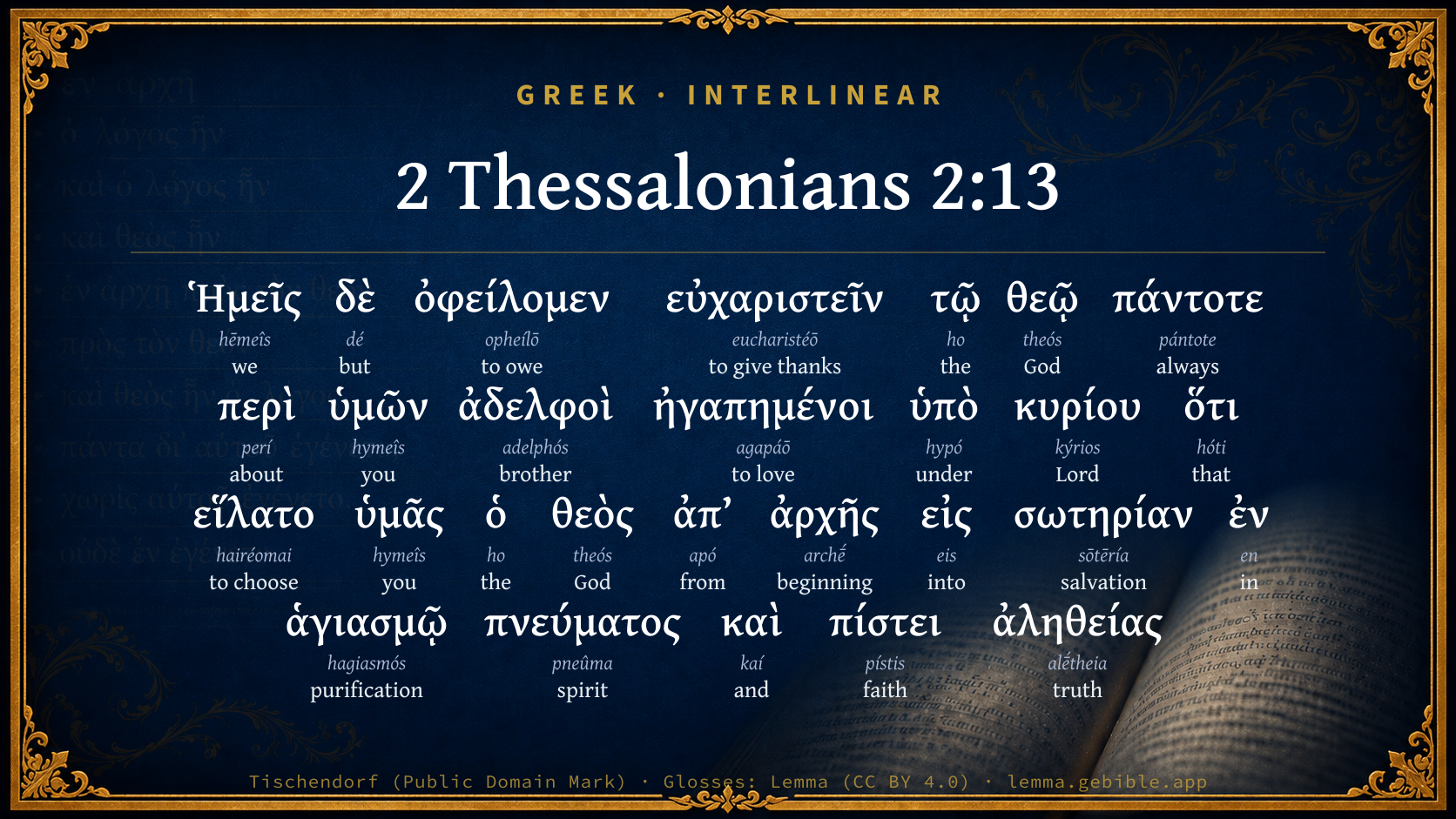
But we are bound to always give thanks to God for you, brothers loved by the Lord, because God chose you from the beginning for salvation through sanctification of the Spirit and belief in the truth;
Download a study sheet
One document with this verse’s original text, its word-by-word gloss line, the meaning frame, cross-references with their text, attributed commentary, and full source and license credits — printable, and it pastes into notes with its structure intact.
This verse Autodidact and up
A passage Seminary Student
Up to 50 verses in one chapter. A passage sheet keeps up to 6 commentary sources and 12 cross-references per verse, in the order this page ranks them, and says so on the sheet whenever that leaves anything out. Ask for a single verse and you get the Autodidact verse sheet above.
Everything on this page stays free to read, with no account — the sheet is a download of what is already on screen, not access to it.
Compare translations 3
The same verse in 3 English versions, stacked beneath the original-language interlinear above. Click any original word for its lexicon entry.
Each is an independent rendering of the whole verse — the interlinear is not word-aligned to these translations.
Highlighted words mark where these versions differ — a whole-verse word diff, not a word-by-word alignment.
-
World English Bible Public Domain
But we are bound to always give thanks to God for you, brothers loved by the Lord, because God chose you from the beginning for salvation through sanctification of the Spirit and belief in the truth;
-
King James Version Public Domain
But we are bound to give thanks alway to God for you, brethren beloved of the Lord, because God hath from the beginning chosen you to salvation through sanctification of the Spirit and belief of the truth:
-
unfoldingWord Literal Text CC BY-SA 4.0
Now we ought always to give thanks to God for you, brothers having been loved by the Lord. For God chose you firstfruits for salvation in sanctification of the Spirit and belief in the truth.
unfoldingWord Literal Text — © unfoldingWord, licensed CC BY-SA 4.0. Word-aligned USFM3 via Door43 (git.door43.org/unfoldingWord/en_ult).
Show all 19 translations
Every available English version of this verse, each an independent rendering of the whole verse.
-
World English Bible Public Domain
But we are bound to always give thanks to God for you, brothers loved by the Lord, because God chose you from the beginning for salvation through sanctification of the Spirit and belief in the truth;
-
Berean Standard Bible Public Domain
But we should always thank God for you, brothers who are loved by the Lord, because God has chosen you from the beginning to be saved by the sanctification of the Spirit and by faith in the truth.
-
Majority Standard Bible Public Domain
But we should always thank God for you, brothers who are loved by the Lord, because God has chosen you from the beginning to be saved by the sanctification of the Spirit and by faith in the truth.
-
King James Version Public Domain
But we are bound to give thanks alway to God for you, brethren beloved of the Lord, because God hath from the beginning chosen you to salvation through sanctification of the Spirit and belief of the truth:
-
American Standard Version (1901) Public Domain
But we are bound to give thanks to God always for you, brethren beloved of the Lord, for that God chose you from the beginning unto salvation in sanctification of the Spirit and belief of the truth:
-
Revised Version (1885) Public Domain
But we are bound to give thanks to God alway for you, brethren beloved of the Lord, for that God chose you from the beginning unto salvation in sanctification of the Spirit and belief of the truth:
-
Geneva Bible (1599) Public Domain
But we ought to giue thankes alway to God for you, brethren beloued of the Lord, because that God hath from the beginning chosen you to saluation, through sanctification of the Spirit, and the faith of trueth,
-
Douay-Rheims (1899) Public Domain
Whereunto also he hath called you by our gospel, unto the purchasing of the glory of our Lord Jesus Christ.
-
Young's Literal Translation Public Domain
And we -- we ought to give thanks to God always for you, brethren, beloved by the Lord, that God did choose you from the beginning to salvation, in sanctification of the Spirit, and belief of the truth,
-
Literal Standard Version CC BY-SA 4.0
And we ought to give thanks to God always for you, brothers, beloved by the LORD, that God chose you from the beginning to salvation, in sanctification of the Spirit, and belief of the truth,
-
Unlocked Literal Bible CC BY-SA 4.0
But we should always give thanks to God for you, brothers loved by the Lord. For God chose you as the firstfruits for salvation in sanctification of the Spirit and belief in the truth.
-
unfoldingWord Literal Text CC BY-SA 4.0
Now we ought always to give thanks to God for you, brothers having been loved by the Lord. For God chose you firstfruits for salvation in sanctification of the Spirit and belief in the truth.
-
Darby Bible Public Domain
But we ought to give thanks to God always for you, brethren beloved of [the] Lord, that God has chosen you from [the] beginning to salvation in sanctification of [the] Spirit and belief of [the] truth:
-
World Messianic Bible Public Domain
But we are bound to always give thanks to God for you, brothers loved by the Lord, because God chose you from the beginning for salvation through sanctification of the Spirit and belief in the truth,
-
Webster's Bible Public Domain
But we are bound to give thanks always to God for you, brethren, beloved by the Lord, because God hath from the beginning chosen you to salvation, through sanctification of the Spirit, and belief of the truth:
-
Free Bible Version CC BY-SA 4.0
But we just have to keep on thanking God for you, brothers and sisters loved by the Lord, because God from the beginning chose you to be saved through the Spirit who makes you right as you trust in the truth.
-
Bible in Basic English Public Domain
But it is right for us to give praise to God at all times for you, brothers, loved by the Lord, because it was the purpose of God from the first that you might have salvation, being made holy by the Spirit and by faith in what is true:
-
Text-Critical English NT CC BY 4.0
But we must always give thanks to God for you, brothers beloved by the Lord, because God chose you from the beginning for salvation through sanctification by the Spirit and belief in the truth.
-
Tyndale New Testament (1534) Public Domain
But we are bounde to geve thankes alwaye to god for you brethren beloved of the lorde for because that God hath from the begynnynge chosen you to saluacion thorow sanctifyinge of the sprete and thorowe belevynge the trueth:
Literal Standard Version (2020), Covenant Press — licensed CC BY-SA 4.0. Text via the HelloAO Bible API (eBible.org). Unlocked Literal Bible (unfoldingWord) — licensed CC BY-SA 4.0. Text via the HelloAO Bible API (eBible.org). unfoldingWord Literal Text — © unfoldingWord, licensed CC BY-SA 4.0. Word-aligned USFM3 via Door43 (git.door43.org/unfoldingWord/en_ult). Free Bible Version, Dr. Jonathan Gallagher — licensed CC BY-SA 4.0. Text via the HelloAO Bible API (eBible.org).
Word by word
More ways to search: Search by grammar → Find every occurrence → Compare this word →
Practice this passage: Drill this verse → Learn its vocabulary →
- Appears 3× in the Greek New Testament
- First appears at Philippians 1:22
- Part of Speech
- Verb
- Tense
- Aorist
- Voice
- Middle
- Mood
- Indicative
- Person
- 3rd person
- Number
- Singular
Full Thayer's Definition
- Ἡμεῖς hēmeîs G2249 “we” Personal pronoun, 1st person, Nominative, Plural
- δὲ dé G1161 “but” Conjunction
- ὀφείλομεν opheílō G3784 “to owe” Verb, Present, Active, Indicative, 1st person, Plural
- εὐχαριστεῖν eucharistéō G2168 “to give thanks” Verb, Present, Active, Infinitive
- τῷ ho G3588 “the” Article, Dative, Singular, Masculine
- θεῷ theós G2316 “God” Noun, Dative, Singular, Masculine
- πάντοτε pántote G3842 “always” Adverb
- περὶ perí G4012 “about” Preposition
- ὑμῶν hymeîs G5210 “you” Personal pronoun, 2nd person, Genitive, Plural
- ἀδελφοὶ adelphós G80 “brother” Noun, Vocative, Plural, Masculine
- ἠγαπημένοι agapáō G25 “to love” Verb, Perfect, Passive, Participle, Nominative, Plural, Masculine
- ὑπὸ hypó G5259 “under” Preposition
- κυρίου kýrios G2962 “Lord” Noun, Genitive, Singular, Masculine
- ὅτι hóti G3754 “that” Conjunction
- εἵλατο hairéomai G138 “to choose” Verb, Aorist, Middle, Indicative, 3rd person, Singular
- ὑμᾶς hymeîs G5210 “you” Personal pronoun, 2nd person, Accusative, Plural
- ὁ ho G3588 “the” Article, Nominative, Singular, Masculine
- θεὸς theós G2316 “God” Noun, Nominative, Singular, Masculine
- ἀπ’ apó G575 “from” Preposition
- ἀρχῆς archḗ G746 “beginning” Noun, Genitive, Singular, Feminine
- εἰς eis G1519 “into” Preposition
- σωτηρίαν sōtēría G4991 “salvation” Noun, Accusative, Singular, Feminine
- ἐν en G1722 “in” Preposition
- ἁγιασμῷ hagiasmós G38 “purification” Noun, Dative, Singular, Masculine
- πνεύματος pneûma G4151 “spirit” Noun, Genitive, Singular, Neuter
- καὶ kaí G2532 “and” Conjunction
- πίστει pístis G4102 “faith” Noun, Dative, Singular, Feminine
- ἀληθείας alḗtheia G225 “truth” Noun, Genitive, Singular, Feminine
About this verse
These counts appear in no published source. They are computed here, from the morphology-tagged text and Lemma’s own curated glosses. What Lemma adds →
- 28
- words
- 25
- distinct lemmas
- Pauline Epistles
- section
Cross-references
38Topical passages linked to 2 Thessalonians 2:13 in the Treasury of Scripture Knowledge — connected by theme and wording, ordered by reader-vote popularity; previews shown in the World English Bible.
- 2 Timothy 1:9 who saved us and called us with a holy calling, not according to our works, but according to his own purpose and grace, which was given to us in Christ Jesus before times eternal,
- Ephesians 1:4–5 even as he chose us in him before the foundation of the world, that we would be holy and without blemish before him in love;
- 1 Thessalonians 1:4 We know, brothers loved by God, that you are chosen,
- 1 Thessalonians 5:9 For God didn't appoint us to wrath, but to the obtaining of salvation through our Lord Jesus Christ,
- Romans 9:11 For being not yet born, neither having done anything good or bad, that the purpose of God according to election might stand, not of works, but of him who calls,
- Acts 13:48 As the Gentiles heard this, they were glad, and glorified the word of God. As many as were appointed to eternal life believed.
- 2 Thessalonians 1:3 We are bound to always give thanks to God for you, brothers, even as it is appropriate, because your faith grows exceedingly, and the love of each and every one of you towards one another abounds;
- Isaiah 46:10 declaring the end from the beginning, and from ancient times things that are not [yet] done; saying, My counsel shall stand, and I will do all my pleasure;
- Daniel 9:23 At the beginning of your petitions the commandment went forth, and I am come to tell you; for you are greatly beloved: therefore consider the matter, and understand the vision.
- Ezekiel 16:8 Now when I passed by you, and looked at you, behold, your time was the time of love; and I spread my skirt over you, and covered your nakedness: yes, I swore to you, and entered into a covenant with you, says the Lord Yahweh, and you became mine.
- 1 Peter 1:2–5 according to the foreknowledge of God the Father, in sanctification of the Spirit, that you may obey Jesus Christ and be sprinkled in his blood: Grace to you and peace be multiplied.
- 1 John 4:10 In this is love, not that we loved God, but that he loved us, and sent his Son as the atoning sacrifice for our sins.
- Deuteronomy 33:12 Of Benjamin he said, The beloved of Yahweh shall dwell in safety by him; He covers him all the day long, He dwells between his shoulders.
- Proverbs 8:23 I was set up from everlasting, from the beginning, Before the earth existed.
- Ephesians 2:8 for by grace you have been saved through faith, and that not of yourselves; it is the gift of God,
- Colossians 1:5 because of the hope which is laid up for you in the heavens, of which you heard before in the word of the truth of the Gospel,
- Jeremiah 31:3 Yahweh appeared of old to me, [saying], Yes, I have loved you with an everlasting love: therefore with loving kindness have I drawn you.
- Romans 1:7–8 to all who are in Rome, beloved of God, called to be saints: Grace to you and peace from God our Father and the Lord Jesus Christ.
- 2 Thessalonians 2:12 that they all might be judged who didn't believe the truth, but had pleasure in unrighteousness.
- 2 Samuel 12:25 and he sent by the hand of Nathan the prophet; and he named him Jedidiah, for Yahweh's sake.
- Daniel 10:11 He said to me, Daniel, you man greatly beloved, understand the words that I speak to you, and stand upright; for to you am I now sent. When he had spoken this word to me, I stood trembling.
- Acts 15:9 He made no distinction between us and them, cleansing their hearts by faith.
- Galatians 3:1 Foolish Galatians, who has bewitched you not to obey the truth, before whose eyes Jesus Christ was openly set forth among you as crucified?
- 2 Thessalonians 2:16 Now our Lord Jesus Christ himself, and God our Father, who loved us and gave us eternal comfort and good hope through grace,
- James 1:18 Of his own will he brought us forth by the word of truth, that we should be a kind of first fruits of his creatures.
- 1 John 4:19 We love Him, because he first loved us.
- Daniel 10:19 He said, "Greatly beloved man, don't be afraid: peace be to you, be strong, yes, be strong." When he spoke to me, I was strengthened, and said, "Let my lord speak; for you have strengthened me."
- Luke 1:75 In holiness and righteousness before him all the days of our life.
- John 1:1 In the beginning was the Word, and the Word was with God, and the Word was God.
- John 8:44–46 You are of your Father, the devil, and you want to do the desires of your father. He was a murderer from the beginning, and doesn't stand in the truth, because there is no truth in him. When he speaks a lie, he speaks on his own; for he is a liar, and the father of it.
- John 14:6 Jesus said to him, "I am the way, the truth, and the life. No one comes to the Father, except through me.
- Romans 6:17 But thanks be to God, that, whereas you were bondservants of sin, you became obedient from the heart to that form of teaching whereunto you were delivered.
- Romans 8:33 Who could bring a charge against God's chosen ones? It is God who justifies.
- 2 Thessalonians 2:10 and with all deception of wickedness for those who are being lost, because they didn't receive the love of the truth, that they might be saved.
- 2 Timothy 2:15 Give diligence to present yourself approved by God, a workman who doesn't need to be ashamed, properly handling the Word of Truth.
- 2 Timothy 3:15 From infancy, you have known the sacred writings which are able to make you wise for salvation through faith, which is in Christ Jesus.
- Hebrews 1:10 And, "You, Lord, in the beginning, laid the foundation of the earth. The heavens are the works of your hands.
- Colossians 3:12 Put on therefore, as God's chosen ones, holy and beloved, a heart of compassion, kindness, lowliness, humility, and perseverance;
Cross-references courtesy of OpenBible.info (CC BY 4.0).
Lesson kit
Teaching starters — assembled from the data on this page, not authored interpretation. Every prompt links to the verse data it draws on. Edit before teaching.
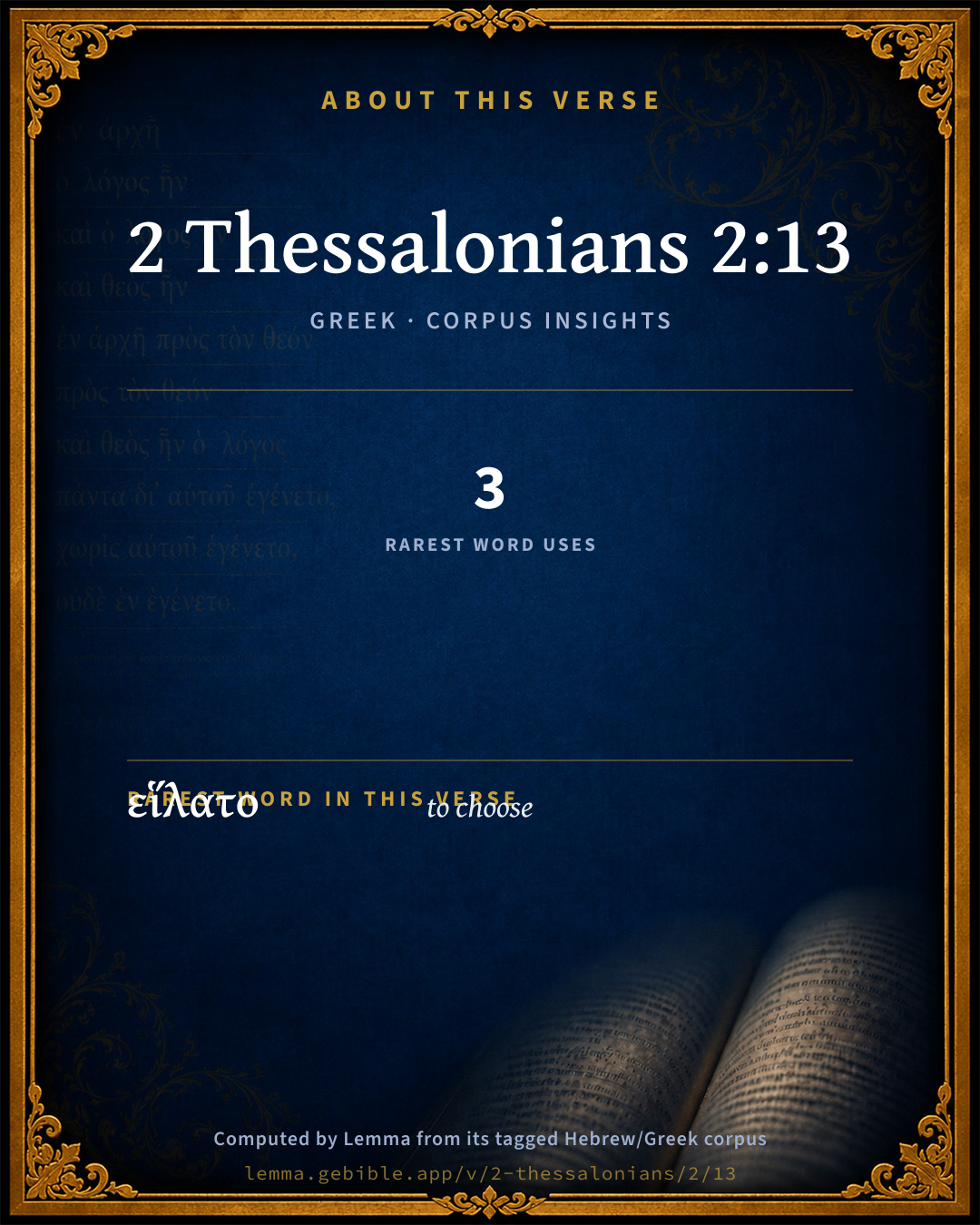
2 Thessalonians, in the Pauline Epistles, opens this verse with 28 words (25 distinct Greek lemmas). Its most distinctive word is hairéomai (“to choose”). A historical commentator’s framing appears above. Read the whole chapter for the surrounding context.
Discussion questions
- The word hairéomai carries the sense “to choose.” How does it shape the verse?
- Philippians 1:22 shares the word «to choose» with this verse. How do the two illuminate each other?
- “God” occurs 2× in this one verse. What is the effect of the repetition?
- These translations render this verse differently; the difference is in the English rendering, not the original. What questions does that raise?
- Reading how Matthew Henry's Commentary and The Cambridge Bible for Schools and Colleges read this verse, where do the two commentators agree and where do they part?
Things to notice
- These translations choose different wording for 17 words in this verse.
- “God” occurs 2× in this single verse.
- 25 distinct Greek lemmas span 28 words in this verse.
Commentary
Notes on 2 Thessalonians 2:13 from classic Christian and Jewish commentators (each source and its license shown beneath its notes). The classic Christian expositions comment on the surrounding passage and are grouped to its opening verse, so a note may address several verses; the Jewish commentaries on the Tanakh (Rashi and others) are per-verse, so they appear only where the commentator wrote on this verse.
Lemma curates 59 commentaries, every one of them public domain or Creative Commons licensed, each selected and text-cleaned for this edition rather than reprinted as found. About our sources →
Matthew Henry's Commentary
Matthew Henry's Commentary on the Whole Bible (1708–1710) — public domain (CC PDM 1.0). Text via the HelloAO Bible API.
The Cambridge Bible for Schools and Colleges
gen. ed. J. J. S. Perowne
The Cambridge Bible for Schools and Colleges (gen. ed. J. J. S. Perowne; Cambridge University Press, 1878–1918) — public domain. Text from a community e-Sword module.
Matthew Poole's English Annotations
Matthew Poole's English Annotations on the Holy Bible (1683–1685) — public domain. Text from a community e-Sword/MySword module.
The Biblical Illustrator
Joseph S. Exell
The Biblical Illustrator, edited by Joseph S. Exell (c. 1880s–1900s) — public domain. Text from a community e-Sword module.
Joseph Benson's Commentary
Joseph Benson's Commentary on the Old and New Testaments (1811–1818) — public domain. Text from a community e-Sword module.
Whedon's Commentary on the Bible
Daniel D. Whedon
Daniel D. Whedon (gen. ed.), Commentary on the Old and New Testaments (1874–1909) — public domain. Text from a community e-Sword module.
The Preacher's Complete Homiletical Commentary
Joseph S. Exell (gen. ed.)
The Preacher's Complete Homiletical Commentary (gen. ed. Joseph S. Exell; Funk & Wagnalls, c. 1892) — public domain (pre-1929). A full-Bible homiletical/sermon-outline anthology covering 65 of 66 books (2 John is absent from the source module). Text from a community e-Sword module.
Lange's Commentary on the Holy Scriptures
Lange's Commentary on the Holy Scriptures (Critical, Doctrinal, and Homiletical), ed. John Peter Lange, English translation edited by Philip Schaff (1864–1880) — public domain. Text from a community e-Sword module.
The Annotated Bible
Arno C. Gaebelein
Arno C. Gaebelein, The Annotated Bible (1913–1922) — public domain. Text from a community e-Sword module.
Kretzmann's Popular Commentary
Paul E. Kretzmann
Paul E. Kretzmann, Popular Commentary of the Bible (1921–1924) — public domain. Text from a community e-Sword module.
F. W. Grant's Numerical Bible
F. W. Grant, The Numerical Bible (4th ed., 1903) — public domain. Text from a community e-Sword module.
The Expositor's Bible
William Robertson Nicoll, ed., The Expositor's Bible (London: Hodder & Stoughton, 1887–1910) — public domain. 65 of 66 books (1 Corinthians is not separately keyed, as that volume carries no machine-parseable verse references); section-level commentary keyed to the opening verse. Introductory and overview sections not keyed to a specific passage are excluded.
Bengel's Gnomon
Johann Albrecht Bengel
Bengel's Gnomon of the New Testament — English translation (T&T Clark, Edinburgh, 1860) — public domain. Text from a community e-Sword module.
Meyer's Critical & Exegetical Commentary
Heinrich August Wilhelm Meyer
Meyer — Critical and Exegetical Commentary on the New Testament — English translation by Peter Christie, edited by Frederick Crombie (T&T Clark, 1880) — public domain. Text from a community e-Sword module.
Expositor's Greek Testament
ed. W. Robertson Nicoll
The Expositor's Greek Testament, edited by W. Robertson Nicoll (1897–1910) — public domain. Text from a community e-Sword module.
Cambridge Greek Testament for Schools and Colleges
Cambridge Greek Testament for Schools and Colleges (Cambridge University Press, 1896; 21 vols, various authors incl. Carr, Maclear, Plummer, Farrar, Lumby, Moule, M. R. James, Simcox) — public domain. Text from a community e-Sword module.
International Critical Commentary
International Critical Commentary — older volumes (1896–1929), various authors — public domain. Text from a community e-Sword module.
Geneva Bible (1599)
Geneva Bible translators
Geneva Bible (1599) marginal notes — public domain. Text via Bolls.life.
Jamieson, Fausset & Brown
Robert Jamieson, A. R. Fausset & David Brown
Jamieson, Fausset & Brown — Commentary Critical and Explanatory on the Whole Bible (1871) — public domain (CC PDM 1.0). Text via the HelloAO Bible API.
Adam Clarke's Commentary
Adam Clarke's Commentary on the Bible (1810–1826) — public domain. Text from a community e-Sword/MySword module.
John Calvin's Commentaries
John Calvin's Commentaries (1540-1563) — public domain. Text from the Calvin Translation Society English edition (1840s-50s) via the Christian Classics Ethereal Library (ccel.org). Calvin's coverage is partial (roughly two-thirds of the Bible); uncommented books and verses are honest gaps, never fabricated. The 19th-century editor's footnotes and remarks are omitted so the notes are faithfully Calvin's own voice.
Ellicott's Commentary for English Readers
A Bible Commentary for English Readers, edited by Charles John Ellicott (1878–1897) — public domain. Text from a community e-Sword module.
John Gill's Exposition
John Gill's Exposition of the Whole Bible (1746–1763) — public domain (CC PDM 1.0). Text via the HelloAO Bible API.
Trapp's Complete Commentary
John Trapp
John Trapp, A Commentary or Exposition upon All the Books of the Old and New Testament (1647–1656) — public domain. Text from a community e-Sword module.
Albert Barnes' Notes on the Bible
Albert Barnes' Notes on the Bible (1834–1885) — public domain. Text from a community e-Sword/MySword module.
The Pulpit Commentary
The Pulpit Commentary (1880–1919), ed. H.D.M. Spence-Jones & Joseph S. Exell — public domain. Text from a community e-Sword module.
John Wesley's Explanatory Notes
John Wesley, Explanatory Notes Upon the Whole Bible (1754–1765) — public domain. Text via the GEBible commentary corpus.
Scofield Reference Notes
C. I. Scofield
The Scofield Reference Bible (1917 edition), notes by C. I. Scofield — public domain. Text from a community e-Sword module.
Burkitt's Expository Notes on the New Testament
William Burkitt
William Burkitt's Expository Notes on the New Testament (1700–1703) — public domain. Text from a community e-Sword module.
Godbey's Commentary on the New Testament
William B. Godbey
William B. Godbey, Commentary on the New Testament (1896–1900) — public domain. Text from a community e-Sword module.
McGarvey & Pendleton's Commentaries
J. W. McGarvey
J. W. McGarvey (with Philip Y. Pendleton), Commentaries on the New Testament (The Fourfold Gospel, 1914; Acts; and the epistles) — public domain. Text from a community e-Sword/MySword module.
The People's New Testament
B. W. Johnson
B. W. Johnson's The People's New Testament with Notes (1889–1891) — public domain. Electronic text from the Christian Classics Ethereal Library (CCEL) ThML edition.
unfoldingWord translationNotes
Door43 World Missions Community
unfoldingWord translationNotes — © Distant Shores Media and the Door43 World Missions Community, licensed CC BY-SA 4.0. Source: git.door43.org/Door43/en_tn.
Alford’s Greek Testament
Henry Alford
Henry Alford, The Greek Testament (1849–1861) — public domain. Text from a community e-Sword module.
Vincent's Word Studies in the New Testament
Marvin R. Vincent
Marvin R. Vincent, Word Studies in the New Testament (1887–1900) — public domain. Text from a community e-Sword/MySword module.