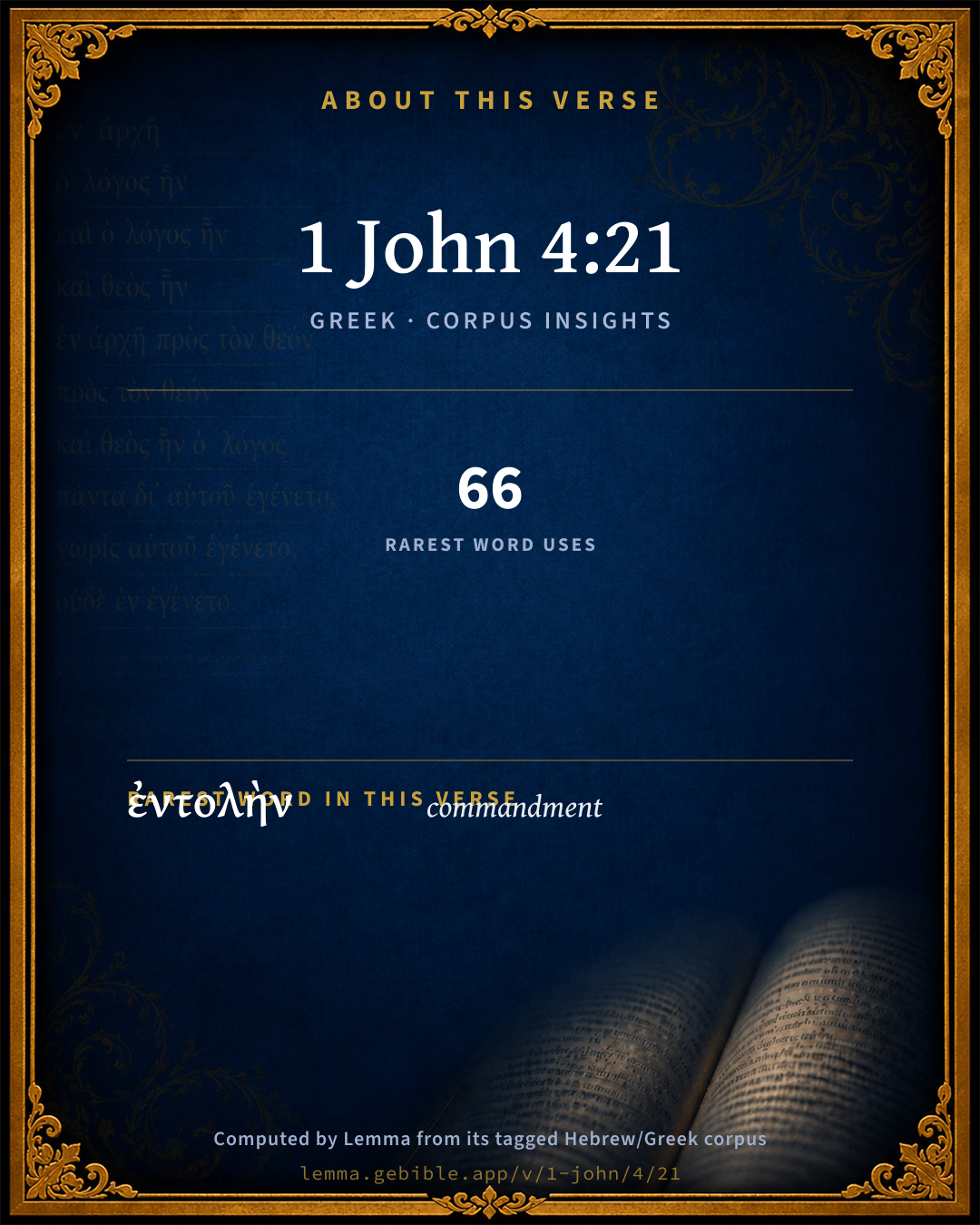
1 John 4:21

Greek (Tischendorf 8th ed.) 1 John 4:21 appears in the Greek New Testament. The text above is from the Tischendorf 8th edition. Each word links to its Strong’s number and a concise gloss. Click any word for its full Thayer’s Greek Lexicon entry.
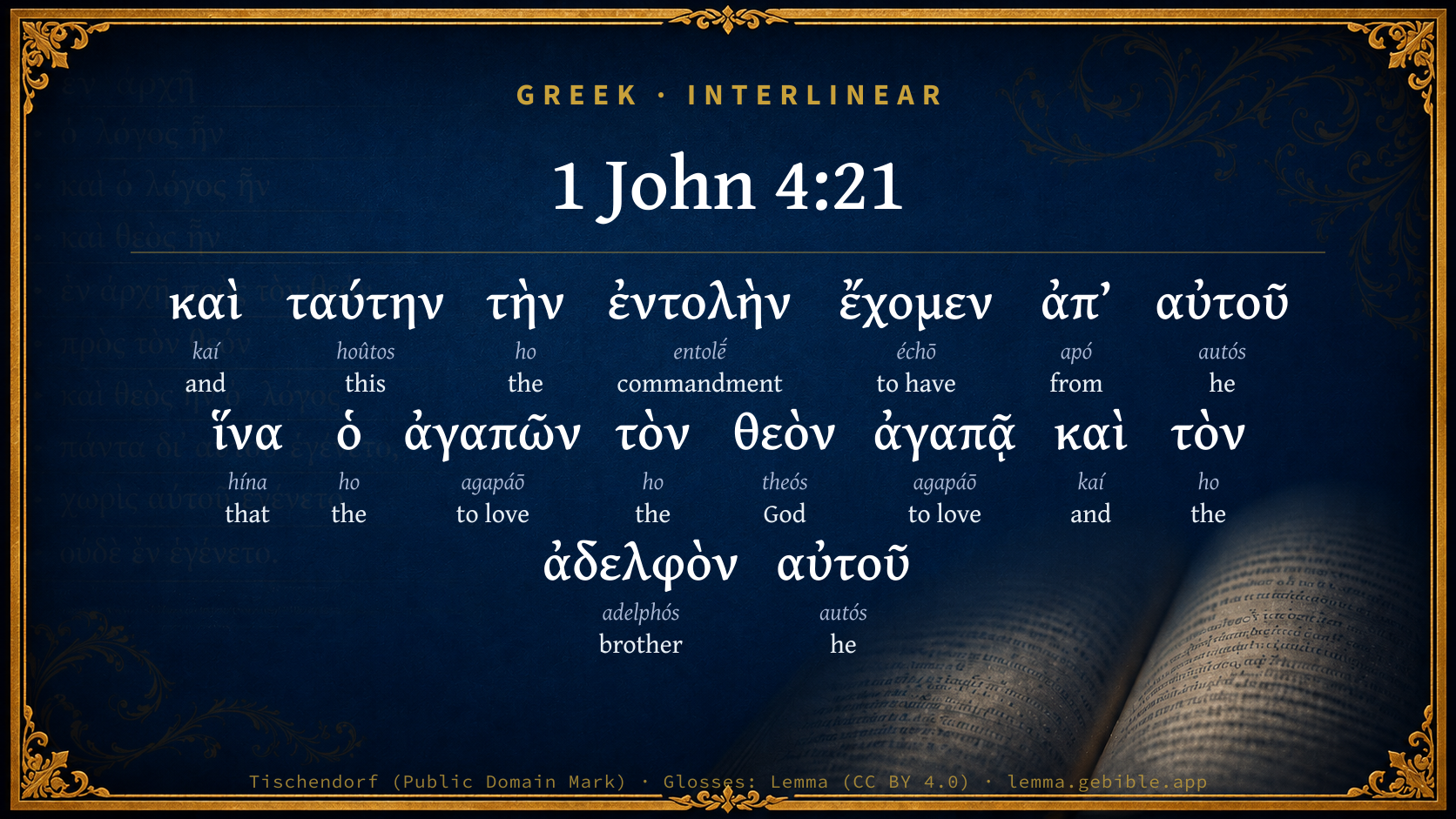
Download image
Cite this verse

1 John 4:21 (World English Bible). Public Domain. Lemma interlinear Bible study tool, https://lemma.gebible.app/v/1-john/4/21.

Show BibTeX & RIS
BibTeX
RIS
English Translation
This commandment we have from him, that he who loves God should also love his brother.
World English Bible · Public Domain
Download a study sheet

One document with this verse’s original text, its word-by-word gloss line, the meaning frame, cross-references with their text, attributed commentary, and full source and license credits — printable, and it pastes into notes with its structure intact.

This verse Autodidact and up

Study sheet (.html) Plain text (.txt)

A passage Seminary Student

Up to 50 verses in one chapter. A passage sheet keeps up to 6 commentary sources and 12 cross-references per verse, in the order this page ranks them, and says so on the sheet whenever that leaves anything out. Ask for a single verse and you get the Autodidact verse sheet above.

Everything on this page stays free to read, with no account — the sheet is a download of what is already on screen, not access to it.

Want to remove ads? Support Godless Engineer
Compare translations 3

The same verse in 3 English versions, stacked beneath the original-language interlinear above. Click any original word for its lexicon entry.

Each is an independent rendering of the whole verse — the interlinear is not word-aligned to these translations.

Highlighted words mark where these versions differ — a whole-verse word diff, not a word-by-word alignment.

  • World English Bible Public Domain
    This commandment we have from him, that he who loves God should also love his brother.
  • King James Version Public Domain
    And this commandment have we from him, That he who loveth God love his brother also.
  • unfoldingWord Literal Text CC BY-SA 4.0
    Indeed, we have this commandment from him, that the one loving God should also love his brother.

unfoldingWord Literal Text — © unfoldingWord, licensed CC BY-SA 4.0. Word-aligned USFM3 via Door43 (git.door43.org/unfoldingWord/en_ult).

Versions to compare (up to 4)

3 of 4 selected

Show all 19 translations

Every available English version of this verse, each an independent rendering of the whole verse.

  • World English Bible Public Domain
    This commandment we have from him, that he who loves God should also love his brother.
  • Berean Standard Bible Public Domain
    And we have this commandment from Him: Whoever loves God must love his brother as well.
  • Majority Standard Bible Public Domain
    And we have this commandment from Him: Whoever loves God must love his brother as well.
  • King James Version Public Domain
    And this commandment have we from him, That he who loveth God love his brother also.
  • American Standard Version (1901) Public Domain
    And this commandment have we from him, that he who loveth God love his brother also.
  • Revised Version (1885) Public Domain
    And this commandment have we from him, that he who loveth God love his brother also.
  • Geneva Bible (1599) Public Domain
    And this commandement haue we of him, that he that loueth God, should loue his brother also.
  • Douay-Rheims (1899) Public Domain
    And this commandment we have from God, that he, who loveth God, love also his brother.
  • Young's Literal Translation Public Domain
    and this `is' the command we have from Him, that he who is loving God, may also love his brother.
  • Literal Standard Version CC BY-SA 4.0
    And this [is] the command we have from Him, that he who is loving God, may also love his brother.
  • Unlocked Literal Bible CC BY-SA 4.0
    Also, this is the commandment we have from him: Whoever loves God must also love his own brother.
  • unfoldingWord Literal Text CC BY-SA 4.0
    Indeed, we have this commandment from him, that the one loving God should also love his brother.
  • Darby Bible Public Domain
    And this commandment have we from him, That he that loves God love also his brother.
  • World Messianic Bible Public Domain
    This commandment we have from him, that he who loves God should also love his brother.
  • Webster's Bible Public Domain
    And this commandment have we from him, That he who loveth God, love his brother also.
  • Free Bible Version CC BY-SA 4.0
    This is the command he gave to us: those who love God love their brothers and sisters too.
  • Bible in Basic English Public Domain
    And this is the word which we have from him, that he who has love for God is to have the same love for his brother.
  • Text-Critical English NT CC BY 4.0
    And this is the commandment we have from him: Whoever loves God must also love his brother.
  • Tyndale New Testament (1534) Public Domain
    And this commaundement have we of him: that he which loveth God shuld love his brother also.

Literal Standard Version (2020), Covenant Press — licensed CC BY-SA 4.0. Text via the HelloAO Bible API (eBible.org). Unlocked Literal Bible (unfoldingWord) — licensed CC BY-SA 4.0. Text via the HelloAO Bible API (eBible.org). unfoldingWord Literal Text — © unfoldingWord, licensed CC BY-SA 4.0. Word-aligned USFM3 via Door43 (git.door43.org/unfoldingWord/en_ult). Free Bible Version, Dr. Jonathan Gallagher — licensed CC BY-SA 4.0. Text via the HelloAO Bible API (eBible.org).

Word by word

More ways to search: Search by grammar → Find every occurrence → Compare this word →

Practice this passage: Drill this verse → Learn its vocabulary →

ἐντολὴν
entolḗ
G1785
“commandment”
Noun, Accusative, Singular, Feminine
Part of Speech
Noun
Case
Accusative
Number
Singular
Gender
Feminine
Full Thayer's Definition

Origin: from G1781

TDNT: 11:05,2

1. an order, command, charge, precept, injunction a. that which is prescribed to one by reason of his office 2. a commandment a. a prescribed rule in accordance with which a thing is done 1. a precept relating to lineage, of the Mosaic precept concerning the priesthood 2. ethically used of the commandments in the Mosaic law or Jewish tradition
  1. καὶ kaí G2532 “and” Conjunction
  2. ταύτην hoûtos G3778 “this” Demonstrative pronoun, Accusative, Singular, Feminine
  3. τὴν ho G3588 “the” Article, Accusative, Singular, Feminine
  4. ἔχομεν échō G2192 “to have” Verb, Present, Active, Indicative, 1st person, Plural
  5. ἀπ’ apó G575 “from” Preposition
  6. αὐτοῦ autós G846 “he” Personal pronoun, Genitive, Singular, Masculine
  7. ἵνα hína G2443 “that” Conjunction
  8. ὁ ho G3588 “the” Article, Nominative, Singular, Masculine
  9. ἀγαπῶν agapáō G25 “to love” Verb, Present, Active, Participle, Nominative, Singular, Masculine
  10. τὸν ho G3588 “the” Article, Accusative, Singular, Masculine
  11. θεὸν theós G2316 “God” Noun, Accusative, Singular, Masculine
  12. ἀγαπᾷ agapáō G25 “to love” Verb, Present, Active, Subjunctive, 3rd person, Singular
  13. καὶ kaí G2532 “and” Conjunction
  14. τὸν ho G3588 “the” Article, Accusative, Singular, Masculine
  15. ἀδελφὸν adelphós G80 “brother” Noun, Accusative, Singular, Masculine
  16. αὐτοῦ autós G846 “he” Personal pronoun, Genitive, Singular, Masculine

About this verse

These counts appear in no published source. They are computed here, from the morphology-tagged text and Lemma’s own curated glosses. What Lemma adds →

17
words
11
distinct lemmas
General Epistles
section

Repetition

Words recur within this verse:

  • ἀγαπῶν to love G25 ×2
  • τὴν the G3588 ×4
  • καὶ and G2532 ×2
  • αὐτοῦ he G846 ×2

Cross-references

19

Topical passages linked to 1 John 4:21 in the Treasury of Scripture Knowledge — connected by theme and wording, ordered by reader-vote popularity; previews shown in the World English Bible.

  • Matthew 22:37–39 Jesus said to him, "'You shall love the Lord your God with all your heart, and with all your soul, and with all your mind.'
  • Leviticus 19:18 You shall not take vengeance, nor bear any grudge against the children of your people; but you shall love your neighbor as yourself. I am Yahweh.
  • 1 John 3:11 For this is the message which you heard from the beginning, that we should love one another;
  • Galatians 5:14 For the whole law is fulfilled in one word, in this: "You shall love your neighbor as yourself."
  • 1 Thessalonians 4:9 But concerning brotherly love, you have no need that one write to you. For you yourselves are taught by God to love one another,
  • 1 Peter 3:8 Finally, be all like-minded, compassionate, loving as brothers, tenderhearted, courteous,
  • John 13:34–35 A new commandment I give to you, that you love one another, just like I have loved you; that you also love one another.
  • John 15:12 "This is my commandment, that you love one another, even as I have loved you.
  • Romans 12:9–10 Let love be without hypocrisy. Abhor that which is evil. Cling to that which is good.
  • 1 Peter 4:8 And above all things be earnest in your love among yourselves, for love covers a multitude of sins.
  • 1 John 3:14 We know that we have passed out of death into life, because we love the brothers. He who doesn't love his brother remains in death.
  • 1 John 3:23 This is his commandment, that we should believe in the name of his Son, Jesus Christ, and love one another, even as he commanded.
  • Mark 12:29–33 Jesus answered, "The greatest is, 'Hear, Israel, the Lord our God, the Lord is one:
  • Luke 10:37 He said, "He who showed mercy on him." Then Jesus said to him, "Go and do likewise."
  • Romans 13:9–10 For the commandments, "You shall not commit adultery," "You shall not murder," "You shall not steal," "You shall not give false testimony," "You shall not covet," and whatever other commandments there are, are all summed up in this saying, namely, "You shall love your neighbor as yourself."
  • Galatians 5:6 For in Christ Jesus neither circumcision amounts to anything, nor uncircumcision, but faith working through love.
  • 1 John 4:11 Beloved, if God loved us in this way, we also ought to love one another.
  • 1 John 3:18 My little children, let's not love in word only, neither with the tongue only, but in deed and truth.
  • Matthew 5:43 "You have heard that it was said, 'You shall love your neighbor, and hate your enemy.'

Cross-references courtesy of OpenBible.info (CC BY 4.0).

Commentary

Notes on 1 John 4:21 from classic Christian and Jewish commentators (each source and its license shown beneath its notes). The classic Christian expositions comment on the surrounding passage and are grouped to its opening verse, so a note may address several verses; the Jewish commentaries on the Tanakh (Rashi and others) are per-verse, so they appear only where the commentator wrote on this verse.

Lemma curates 59 commentaries, every one of them public domain or Creative Commons licensed, each selected and text-cleaned for this edition rather than reprinted as found. About our sources →

Bengel's Gnomon

Johann Albrecht Bengel

1Jn 4:21. Τὴν ἐντολὴν, the precept) which must be kept by those who love God: Mat 22:39. [He who loves not his brother, does not keep the commandment as to φιλαδελφία, and therefore does not love GOD.—V. g.]

Bengel's Gnomon of the New Testament — English translation (T&T Clark, Edinburgh, 1860) — public domain. Text from a community e-Sword module.

Meyer's Critical & Exegetical Commentary

Heinrich August Wilhelm Meyer

1Jn_4:21. Alterum argumentum cur amare proximum (or, more correctly: fratrem) debeamus: quia Deus id praecepit (Grotius).

καί] not = and yet (Paulus); for this verse does not contain an antithesis, but an expansion of the preceding thought.

ταύτην τὴν ἐντολὴν κ.τ.λ.] Lange interprets ἐντολή here by: teaching; and Grotius paraphrases ὁ ἀγαπῶν τὸν Θεόν by: qui a Deo pro amante ipsius haberi vult; both false and unnecessary; for although brotherly love is the natural fruit and activity of love to God, yet at the same time the practice of it is the habitual task which he who loves God has to perform, as one appointed him by God. It is doubtful whether we are to understand by αὐτοῦ God (Baumgarten-Crusius, de Wette, Düsterdieck, etc.) or Christ; that in the latter case ἐκείνου must be read is unfounded; because τὸν Θεόν follows, the second view seems to be the more correct; but as in the context there is no reference here at all to Christ, it might be safer to understand by αὐτοῦ God.

By ἵνα referring back to ταύτην, it is here, as frequently after verbs of wishing and commanding, not so much the purpose as the purport of the commandment (the realization of which is certainly the aim and object of the commandment) that is stated, which Braune here also incorrectly disputes.

Meyer — Critical and Exegetical Commentary on the New Testament — English translation by Peter Christie, edited by Frederick Crombie (T&T Clark, 1880) — public domain. Text from a community e-Sword module.

Expositor's Greek Testament

ed. W. Robertson Nicoll

1Jn 4:21 . The Old Commandment. Cf. 1Jn 2:7-11 .

The Expositor's Greek Testament, edited by W. Robertson Nicoll (1897–1910) — public domain. Text from a community e-Sword module.

Cambridge Greek Testament for Schools and Colleges

21. For ἀπʼ αὐτοῦ ([754][755][756]) [757] and Vulgate have ἀπὸ τοῦ θεοῦ. [758] omits from τόν to τόν: homoeoteleuton.

[754] 4th century. Brought to Rome about 1460. It is entered in the earliest catalogue of the Vatican Library, 1475. All three Epistles.

[755] 9th century. All three Epistles.

[756] 9th century. All three Epistles.

[757] 5th century. Brought by Cyril Lucar, Patriarch of Constantinople, from Alexandria, and afterwards presented by him to Charles I. in 1628. In the British Museum. All three Epistles.

[758] 4th century. Brought to Rome about 1460. It is entered in the earliest catalogue of the Vatican Library, 1475. All three Epistles.

Once more note that [759] very rarely supports a doubtful reading, and never an impossible one, excepting the accidental omission in 1Jn 4:21.

[759] 4th century. Brought to Rome about 1460. It is entered in the earliest catalogue of the Vatican Library, 1475. All three Epistles.

The main subject still continues, that God is Love; and that from this truth flows the moral obligation on Christians not only to love God but one another. But, as in chap. 3, there are subdivisions, each of which has a unity in itself as well as intimate and subtle relations to the whole. These subdivisions are mainly two: The Spirit of Truth and the Spirit of Error (1–6); Love as the Mark of the Children of the God who is Love (7–21). If we are asked as to the relation which this chapter bears to the preceding one, the answer would seem to be something of this kind. Chap. 3. insists upon the necessity of deeds in order to prove our relationship to God (1Jn 3:3; 1Jn 3:7; 1Jn 3:10; 1Jn 3:16-18; 1Jn 3:22); chap. 4. points out the certainty of our relationship to God as attested by our deeds (1Jn 4:4; 1Jn 4:6-7; 1Jn 4:12-13; 1Jn 4:15-17). The one gives us the evidence of our sonship, viz. deeds of righteousness towards God (1Jn 3:1-10) and deeds of love towards men (1Jn 3:11-21): the other shews us the source of our sonship, viz. possession of the Spirit as proved by confession of the Incarnation (1Jn 4:1-6) and by love of the brethren (1Jn 4:7-21).

21. καὶ τ. τ. ἐντ. ἔχ. ἀπ ̓ αὐτοῦ. The Apostle drives home his arguments for the practice of brotherly love by the fact that God has commanded all who love Him to love their brethren. So also S. Paul, here again in harmony with S. John: ‘The whole law is fulfilled in one word, even in this; Thou shalt love thy neighbour as thyself’ (Gal 5:14). Some take ‘Him’ to mean Christ. But this is unlikely, as Christ has not been mentioned for several verses: although it must be admitted that S. John is so full of the truth that ‘I and My Father are one’, that he makes the transition from the Father to the Son and from the Son to the Father almost unconsciously. Where has God given this commandment? In the whole Law, which is summed up in loving God with all one’s heart and one’s neighbour as oneself (Deu 6:5; Lev 19:18; Luk 10:27). The Apostle thus anticipates a possible objection. A man may say, ‘I can love God without loving my brother, and I can prove my love by keeping His commandments’ (Joh 14:15). ‘Nay’, says S. John, ‘your own argument shews your error: you cannot keep His commandments without loving your brother’. Thus then we have two revelations of God: our brother, who is His image; and commandment, which is His will. Not to love our brother is a flagrant violation of both. As Pascal puts it, we must know men in order to love them, but we must love God in order to know Him.

ἵνα … ἀγαπᾷ. “The final particle (ἵνα) gives more than the simple contents of the commandment. It marks the injunction as directed to an aim” (Westcott). See on 1Jn 1:9.

Cambridge Greek Testament for Schools and Colleges (Cambridge University Press, 1896; 21 vols, various authors incl. Carr, Maclear, Plummer, Farrar, Lumby, Moule, M. R. James, Simcox) — public domain. Text from a community e-Sword module.

Geneva Bible (1599)

Geneva Bible translators

A second reason, why God cannot be hated and our neighbor loved, because the selfsame Lawmaker commanded both to love him and our neighbor.

Geneva Bible (1599) marginal notes — public domain. Text via Bolls.life.

Jamieson, Fausset & Brown

Robert Jamieson, A. R. Fausset & David Brown

Besides the argument (Jo1 4:20) from the common feeling of men, he here adds a stronger one from God's express commandment (Mat 22:39). He who loves, will do what the object of his love wishes.

he who loveth God--he who wishes to be regarded by God as loving Him.

Next: 1 John Chapter 5

Jamieson, Fausset & Brown — Commentary Critical and Explanatory on the Whole Bible (1871) — public domain (CC PDM 1.0). Text via the HelloAO Bible API.

Adam Clarke's Commentary

Verse 21. This commandment have we] We should love one another, and love our neighbour as ourselves. The love of God and the love of man can never be separated; he who loves God will love his brother; he who loves his brother gives this proof that he loves God, because he loves with a measure of that love which, in its infinitude, dwells in God.

Adam Clarke's Commentary on the Bible (1810–1826) — public domain. Text from a community e-Sword/MySword module.

John Calvin's Commentaries

21 And this commandment This is a stronger argument, drawn from the authority and doctrine of Christ; for he not only gave a commandment respecting the love of God, but bade us also to love our brethren. We must therefore so begin with God, as that there may be at the same time a transition made to men.

John Calvin's Commentaries (1540-1563) — public domain. Text from the Calvin Translation Society English edition (1840s-50s) via the Christian Classics Ethereal Library (ccel.org). Calvin's coverage is partial (roughly two-thirds of the Bible); uncommented books and verses are honest gaps, never fabricated. The 19th-century editor's footnotes and remarks are omitted so the notes are faithfully Calvin's own voice.

The Cambridge Bible for Schools and Colleges

gen. ed. J. J. S. Perowne

21. And this commandment have we] The Apostle drives home his arguments for the practice of brotherly love by the fact that God has commanded all who love Him to love their brethren. Some take ‘Him’ to mean Christ. But this is unlikely, as Christ has not been mentioned for several verses: although it must be admitted that S. John is so full of the truth that ‘I and My Father are one’, that he makes the transition from the Father to the Son and from the Son to the Father almost unconsciously. Where has God given this commandment? In the whole Law, which is summed up in loving God with all one’s heart and one’s neighbour as oneself (Deu_6:5; Lev_19:18; Luk_10:27). The Apostle thus anticipates a possible objection. A man may say ‘I can love God without loving my brother, and I can prove my love by keeping His commandments’ (Joh_14:15). ‘Nay’, says S. John, ‘your own argument shews your error: you cannot keep His commandments without loving your brother’. Thus then we have two revelations of God: our brother, who is His image; and His commandment, which is His will. Not to love our brother is a flagrant violation of both. As Pascal puts it, we must know men in order to love them, but we must love God in order to know Him.

that he who loveth God love his brother also] “The final particle (ἵνα) gives more than the simple contents of the commandment. It marks the injunction as directed to an aim” (Westcott). See on 1Jn_1:9.

The Cambridge Bible for Schools and Colleges (gen. ed. J. J. S. Perowne; Cambridge University Press, 1878–1918) — public domain. Text from a community e-Sword module.

Trapp's Complete Commentary

John Trapp

21 And this commandment have we from him, That he who loveth God love his brother also.

Ver. 21. And this commandment we have from him] Lo, here a singular evidence of God’s great love to us, that he commandeth us also the love of our neighbour as well as of himself: quasi non tam de se amando fuerit sollicitus, quam de proximo nostro diligendo, saith Aretius. Our Saviour therefore, summing up the law, joineth those two precepts, "Thou shalt love the Lord thy God with all," &c., and "Thou shalt love thy neighbour as thyself." Yea, God prefers mercy before sacrifice; and is content that his own immediate service should be intermitted, rather than offices of love to our brother omitted. "Leave there thy gift, and go thy way; first be reconciled," Mat 5:24.

Love his brother also] If he be a good man, love him in God; if bad, for God.

John Trapp, A Commentary or Exposition upon All the Books of the Old and New Testament (1647–1656) — public domain. Text from a community e-Sword module.

Albert Barnes' Notes on the Bible

And this commandment have we from him - That is, the command to love a brother is as obligatory as that to love God. If one is obeyed, the other ought to be also; if a man feels that one is binding on him, he should feel that the other is also; and he can never have evidence that he is a true Christian, unless he manifests love to his brethren as well as love to God. See the notes at Jam 2:10.

That he who loveth God love his brother also - See the notes at Joh 13:34-35. Compare Joh 15:12, Joh 15:17.

Albert Barnes' Notes on the Bible (1834–1885) — public domain. Text from a community e-Sword/MySword module.

Matthew Poole's English Annotations

Both ought to be conjoined, being required both by the same authority.

Matthew Poole's English Annotations on the Holy Bible (1683–1685) — public domain. Text from a community e-Sword/MySword module.

Whedon's Commentary on the Bible

Daniel D. Whedon

21. And this whole doctrine of love takes the form of a commandment. Not only we may, but we must. It is a divine invariable law, that the lover of God be a lover of his brother. Our highest blessedness is our highest duty.

Daniel D. Whedon (gen. ed.), Commentary on the Old and New Testaments (1874–1909) — public domain. Text from a community e-Sword module.

The Pulpit Commentary

That he who loveth God love his brother also. This is the great commandment, on which hang all the Law and the prophets (Mat_22:37, Mat_22:39; Luk_10:27; Joh_13:34) and, whateverwe may think of the relation between seeing and loving, there is the Divine command to love, not only the invisible God, but the visible brother in whom the invisible God dwells. Sight may hinder as well as help; it is hard to love what is squalid and hideous. In such cases let us remember the Divine command; let us remember the Divinity which even the most debased humanity contains.

The Pulpit Commentary (1880–1919), ed. H.D.M. Spence-Jones & Joseph S. Exell — public domain. Text from a community e-Sword module.

John Wesley's Explanatory Notes

And this commandment have we from him - Both God and his opinions or mode of worship be, purely because he is the child, and bears the image, of God. Bigotry is properly the want of this pure and universal love. A bigot only loves those who embrace his opinions, and receives his way of worship; and he loves them for that, and not for Christ's sake.

John Wesley, Explanatory Notes Upon the Whole Bible (1754–1765) — public domain. Text via the GEBible commentary corpus.

Burkitt's Expository Notes on the New Testament

William Burkitt

This commandment; this great and chief commandment, above the rest, this summary and comprehensive commandment, including all the rest, namely, to love God above all, for his own sake, and to love our brother as ourselves, for God’s sake, this command, so full of wisdom, so agreeable to right reason, and so much our duty and interest to comply with, have we received from God; and it is most certain that we love him not, if we keep it not; This commandment have we from God, that he who loveth God, loveth his brother also.

Learn thence, 1. That the great God, by his gracious command, requires that we love him and place the supremacy of our love upon him.

2. That as God requires us to love him above ourselves, so does he oblige us, by virtue of his command, to love our brother as ourselves; as sincerely, though not so intensely, as ourselves.

Learn, 3. That the same commandment that requires us to love God, requires love to our brethren also; God interprets the neglect of our duty to our brother, as a neglect of our obligation to himself.

William Burkitt's Expository Notes on the New Testament (1700–1703) — public domain. Text from a community e-Sword module.

The People's New Testament

B. W. Johnson

21. This commandment. It is God's will that he who loves the Father should love the children also.

B. W. Johnson's The People's New Testament with Notes (1889–1891) — public domain. Electronic text from the Christian Classics Ethereal Library (CCEL) ThML edition.

Alford’s Greek Testament

Henry Alford

21.] And besides this argument from common sense, there is another most powerful one, which the Apostle here adds. “Quomodo diligis eum, cujus odisti præceptum?” as Aug. And this commandment we have from Him (God: not, Christ: see below), that he who loveth God, love also his brother (where have we this commandment? In the great summary of the law, “Thou shalt love the Lord thy God with all thy heart, … and thy neighbour as thyself,” so often cited by our Lord; see Mat 22:37-39).

Henry Alford, The Greek Testament (1849–1861) — public domain. Text from a community e-Sword module.

International Critical Commentary

21. The duty of love not only follows necessarily from what God has done for us, it rests on His direct commandment.

ἀπʼ αὐτοῦ] naturally refers to God, as the variant in the Vulgate interprets it, though here as elsewhere, in the language of meditation, when the writer is of Semitic origin, a change of person is by no means impossible.

The most direct statement of the command is Mar 12:29 ff., where the Lord quotes the command of Deu 6:4, Deu 6:5. The writer no doubt knew the Marcan passage, even if he had not himself heard the saying which it records, when it was originally spoken. Cf. also Joh 13:34.

εχομεν] accepimus sah. boh-codd.

απ αυτου] απο του θεου A vg. am. demid. harl. tol.

om. θεον… τον 2:0 B* A* (uid.).

om. και 2:0 13. 34.

αυτου (? 2:0)] εαυτου Ic 114 (335).

Ψ̠δ6. Athos. Lawra 172 (β52) (viii.-ix.).

אԠא. δ2. Codex Sinaiticus. Petersburg (iv.).

A δ4. Codex Alexandrinus. London. Brit. Mus. Royal Libr. I. D. v.-viii. (v.).

B δ1. Codex Vaticanus. Rome. Vat. Gr. 1209 (iv.).

C δ3. Codex Ephraimi. Paris. Bibl. Nat. 9 (v.); 1Jn 1:1 τους—(2) εωρα[κομεν]. 4:2 εστιν—(3Jn 1:2) ψυχη.

L α5. Rome. Angel. 39 (ol. A. 2. 15) (ix.).

13 13 ( = 33gosp.). δ48. Paris. Bibl. Nat. Gr. 14 (ix.-x.).

1 Cf. Holtzmann on 3Jn 1:9.

International Critical Commentary — older volumes (1896–1929), various authors — public domain. Text from a community e-Sword module.

Vincent's Word Studies in the New Testament

Marvin R. Vincent

That [ινα] . Not defining the contents of the commandment, but expressing intent. Compare Joh 13:34, and see on Joh 14:13. His brother. "To the persecutor Saul, Christ said, 'Saul, Saul, why persecutest thou Me? I have ascended into heaven, yet still I lie upon earth. Here I sit at the right hand of the Father; there I still hunger, thirst, and am a stranger '" (Augustine).

Marvin R. Vincent, Word Studies in the New Testament (1887–1900) — public domain. Text from a community e-Sword/MySword module.

Westcott on Hebrews & the Epistles of John

Brooke Foss Westcott

21. καὶ ταύτην τ, é.|] That which is a spiritual necessity is also an express injunction. The commandment of love which has been implied in the preceding verses is now defined. Comp. 6. iii. 23.

an’ αὐτοῦ] a Deo V., ab ipso Lat. Vet., from Him, from God. The con- © text makes it probable that, though the Divine Person is not clearly defined, the reference is to the Father (v. 19), Who by sending His Son shewed the way of love. The commandment was given in substance by Christ (John xiii. 34), but it came from God (ἀπό) as its final source. Compare i. 5; ii. 27 notes; and con-

John viii. 26, 40; x. 18.

ἵνα...) that... The final particle gives more than the simple contents of the commandment, It marks the injunction as directed to an aim ; and implies that the effort to obtain it can never be relaxed (ἵνα... ἀγαπᾷ). Comp. John xiii. 34 note.

Augustine (on. 6. v. 3) uses the words of the ascended Lord to Saul to illustrate and enforce the lesson : Persecutori Saulo [Christus] dixit desuper: Saule, Saule, guid me persequeris ? Ascendiin ceelum, sed adhuc in terra jaceo. Hic ad dexteram patris sedeo: ibi adhuc esurio, sitio et peregrinus sum.

Brooke Foss Westcott (1825–1901), The Epistle to the Hebrews (1889) and The Epistles of St John (1883) — public domain (pre-1929). Text recovered from Internet Archive / Google Books OCR scans. Westcott’s Gospel of John commentary is not included (its OCR lost the chapter running-heads required for reliable verse-keying). Some Greek quoted in the Hebrews volume is imperfectly rendered by the OCR.

Lesson kit

Teaching starters — assembled from the data on this page, not authored interpretation. Every prompt links to the verse data it draws on. Edit before teaching.

1 John, in the General Epistles, opens this verse with 17 words (11 distinct Greek lemmas). Its most distinctive word is entolḗ (“commandment”). A historical commentator’s framing appears above. Read the whole chapter for the surrounding context.

Discussion questions

  1. The word entolḗ carries the sense “commandment.” How does it shape the verse?
  2. How does Matthew 22:37–39, which shares this passage’s theme, read alongside this verse?
  3. What does the repetition of “to love” (2× in this one verse) do in this verse?
  4. These translations render this verse differently; the difference is in the English rendering, not the original. What questions does that raise?
  5. Compare how Bengel's Gnomon and Meyer's Critical & Exegetical Commentary read this verse. Where do they agree or differ?

Things to notice

  • These translations choose different wording for 7 words in this verse.
  • “to love” occurs 2× in this single verse.
  • 11 distinct Greek lemmas span 17 words in this verse.

Reading settings

Reading text

Shown beneath each verse's original-language words.

Old Testament
Old Testament edition

Read the OT as the Masoretic Hebrew (MT) or the Greek Septuagint (LXX).

English shown for the Greek Septuagint (in the Hebrew ↔ Greek comparison).

Comparing translations? Open the Compare panel on any verse page to stack up to four side by side.