δίκαιος
righteous
Full lexicon entry — Thayer's Greek Lexicon
From Thayer's Greek Lexicon
Where this word appears
See every Nominative-case word in the Greek New Testament →
Grammar key — what these labels mean
Part of speech
- Adjective
- A word that describes or qualifies a noun.
Case
- Nominative
- The case of the subject (and the predicate nominative).
- Accusative
- The case of the direct object and of extent.
- Genitive
- The case of source, possession, or “of” — answers “whose / from what.”
- Dative
- The case of the indirect object, means, or location — “to / for / with / in.”
- Vocative
- The case of direct address (“O Lord”).
Gender
- Masculine
- Grammatically masculine.
- Neuter
- Grammatically neuter.
- Feminine
- Grammatically feminine.
Number
- Singular
- One.
- Plural
- More than one.
Grammatical forms 16 distinct
- Adjective, Nominative, Singular, Masculine 20 times (25%)
- Adjective, Accusative, Singular, Masculine 9 times (11%)
- Adjective, Nominative, Plural, Masculine 9 times (11%)
- Adjective, Accusative, Plural, Masculine 6 times (8%)
- Adjective, Genitive, Plural, Masculine 6 times (8%)
- Adjective, Genitive, Singular, Masculine 6 times (8%)
- Adjective, Nominative, Singular, Neuter 6 times (8%)
- Adjective, Accusative, Singular, Neuter 3 times (4%)
+8 more forms (14 occurrences)
Parsed forms decoded from the imported morphology (Robinson–Tischendorf, public domain), counted across 79 parsed occurrences — not distinct verses.
Every verse where G1342 appears — 74 distinct verses across 20 books. Click any verse to open its interlinear word-by-word view. Verse text shown in the World English Bible for context — . Each verse’s Greek form is shown with its reference; the English is not keyword-highlighted, since the data carries no word-level English alignment. Use “Compare translations” on any verse to read it across multiple English versions. This concordance covers the Greek New Testament; Septuagint (Greek Old Testament) occurrences of this word are not indexed here.
Matthew 14 verses
- Matthew 1:19 δίκαιος adj nom sg masc Joseph, her husband, being a righteous man, and not willing to make her a public example, intended to put her away secretly.
- Matthew 5:45 δικαίους adj acc pl masc that you may be children of your Father who is in heaven. For he makes his sun to rise on the evil and the good, and sends rain on the just and the unjust.
- Matthew 9:13 δικαίους adj acc pl masc But you go and learn what this means: 'I desire mercy, and not sacrifice,' for I came not to call the righteous, but sinners to repentance."
- Matthew 10:41 δίκαιον δικαίου δικαίου adj acc sg masc adj gen sg masc adj gen sg masc He who receives a prophet in the name of a prophet will receive a prophet's reward: and he who receives a righteous man in the name of a righteous man will receive a righteous man's reward.
- Matthew 13:17 δίκαιοι adj nom pl masc For most assuredly I tell you that many prophets and righteous men desired to see the things which you see, and didn't see them; and to hear the things which you hear, and didn't hear them.
- Matthew 13:43 δίκαιοι adj nom pl masc Then the righteous will shine forth like the sun in the Kingdom of their Father. He who has ears to hear, let him hear.
- Matthew 13:49 δικαίων adj gen pl masc So will it be in the end of the world. The angels will come forth, and separate the wicked from among the righteous,
- Matthew 20:4 δίκαιον adj nom sg neut To them he said, 'You also go into the vineyard, and whatever is right I will give you.' So they went their way.
- Matthew 23:28 δίκαιοι adj nom pl masc Even so you also outwardly appear righteous to men, but inwardly you are full of hypocrisy and iniquity.
- Matthew 23:29 δικαίων adj gen pl masc "Woe to you, scribes and Pharisees, hypocrites! For you build the tombs of the prophets, and decorate the tombs of the righteous,
- Matthew 23:35 δίκαιον δικαίου adj nom sg neut adj gen sg masc that on you may come all the righteous blood shed on the earth, from the blood of righteous Abel to the blood of Zachariah son of Barachiah, whom you killed between the sanctuary and the altar.
- Matthew 25:37 δίκαιοι adj nom pl masc "Then the righteous will answer him, saying, 'Lord, when did we see you hungry, and feed you; or thirsty, and give you a drink?
- Matthew 25:46 δίκαιοι adj nom pl masc These will go away into eternal punishment, but the righteous into eternal life."
- Matthew 27:19 δικαίῳ adj dat sg masc While he was sitting on the judgment seat, his wife sent to him, saying, "Have nothing to do with that righteous man, for I have suffered many things this day in a dream because of him."
Mark 2 verses
- Mark 2:17 δικαίους adj acc pl masc When Jesus heard it, he said to them, "Those who are healthy have no need for a physician, but those who are sick. I came not to call the righteous, but sinners to repentance."
- Mark 6:20 δίκαιον adj acc sg masc for Herod feared John, knowing that he was a righteous and holy man, and kept him safe. When he heard him, he did many things, and he heard him gladly.
Luke 11 verses
- Luke 1:6 δίκαιοι adj nom pl masc They were both righteous before God, walking blamelessly in all the commandments and ordinances of the Lord.
- Luke 1:17 δικαίων adj gen pl masc He will go before him in the spirit and power of Elijah, 'to turn the hearts of the fathers to the children,' and the disobedient to the wisdom of the just; to make ready a people prepared for the Lord."
- Luke 2:25 δίκαιος adj nom sg masc Behold, there was a man in Jerusalem whose name was Simeon. This man was righteous and devout, looking for the consolation of Israel, and the Holy Spirit was on him.
- Luke 5:32 δικαίους adj acc pl masc I have not come to call the righteous, but sinners to repentance."
- Luke 12:57 δίκαιον adj acc sg neut Why don't you judge for yourselves what is right?
- Luke 14:14 δικαίων adj gen pl masc and you will be blessed, because they don't have the resources to repay you. For you will be repaid in the resurrection of the righteous."
- Luke 15:7 δικαίοις adj dat pl masc I tell you that even so there will be more joy in heaven over one sinner who repents, than over ninety-nine righteous people who need no repentance.
- Luke 18:9 δίκαιοι adj nom pl masc He spoke also this parable to certain people who were convinced of their own righteousness, and who despised all others.
- Luke 20:20 δικαίους adj acc pl masc They watched him, and sent out spies, who pretended to be righteous, that they might trap him in something he said, so as to deliver him up to the power and authority of the governor.
- Luke 23:47 δίκαιος adj nom sg masc When the centurion saw what was done, he glorified God, saying, "Certainly this was a righteous man."
- Luke 23:50 δίκαιος adj nom sg masc Behold, a man named Joseph, who was a member of the council, a good and righteous man
John 3 verses
- John 5:30 δικαία adj nom sg fem I can of myself do nothing. As I hear, I judge, and my judgment is righteous; because I don't seek my own will, but the will of my Father who sent me.
- John 7:24 δικαίαν adj acc sg fem Don't judge according to appearance, but judge righteous judgment."
- John 17:25 δίκαιε adj voc sg masc Righteous Father, the world hasn't known you, but I knew you; and these knew that you sent me.
Acts 6 verses
- Acts 3:14 δίκαιον adj acc sg masc But you denied the Holy and Righteous One, and asked for a murderer to be granted to you,
- Acts 4:19 δίκαιόν adj nom sg neut But Peter and John answered them, "Whether it is right in the sight of God to listen to you rather than to God, judge for yourselves,
- Acts 7:52 δικαίου adj gen sg masc Which of the prophets didn't your fathers persecute? They killed those who foretold the coming of the Righteous One, of whom you have now become betrayers and murderers.
- Acts 10:22 δίκαιος adj nom sg masc They said, "Cornelius, a centurion, a righteous man and one who fears God, and well spoken of by all the nation of the Jews, was directed by a holy angel to invite you to his house, and to listen to what you say."
- Acts 22:14 δίκαιον adj acc sg masc He said, 'The God of our fathers has appointed you to know his will, and to see the Righteous One, and to hear a voice from his mouth.
- Acts 24:15 δικαίων adj gen pl masc having hope toward God, which these also themselves look for, that there will be a resurrection of the dead, both of the just and unjust.
Romans 7 verses
- Romans 1:17 δίκαιος adj nom sg masc For in it is revealed God's righteousness from faith to faith. As it is written, "But the righteous shall live by faith."
- Romans 2:13 δίκαιοι adj nom pl masc For it isn't the hearers of the law who are righteous before God, but the doers of the law will be justified
- Romans 3:10 δίκαιος adj nom sg masc As it is written, "There is no one righteous. No, not one.
- Romans 3:26 δίκαιον adj acc sg masc to demonstrate his righteousness at this present time; that he might himself be just, and the justifier of him who has faith in Jesus.
- Romans 5:7 δικαίου adj gen sg masc For one will hardly die for a righteous man. Yet perhaps for a righteous person someone would even dare to die.
- Romans 5:19 δίκαιοι adj nom pl masc For as through the one man's disobedience many were made sinners, even so through the obedience of the one will many be made righteous.
- Romans 7:12 δικαία adj nom sg fem Therefore the law indeed is holy, and the commandment holy, and righteous, and good.
Galatians 1 verse
Ephesians 1 verse
Philippians 2 verses
- Philippians 1:7 δίκαιον adj nom sg neut It is even right for me to think this way on behalf of all of you, because I have you in my heart, because, both in my bonds and in the defense and confirmation of the Gospel, you all are partakers with me of grace.
- Philippians 4:8 δίκαια adj nom pl neut Finally, brothers, whatever things are true, whatever things are honorable, whatever things are just, whatever things are pure, whatever things are lovely, whatever things are of good report; if there is any virtue, and if there is any praise, think about these things.
Colossians 1 verse
2 Thessalonians 2 verses
- 2 Thessalonians 1:5 δικαίας adj gen sg fem This is an obvious sign of the righteous judgment of God, to the end that you may be counted worthy of the Kingdom of God, for which you also suffer.
- 2 Thessalonians 1:6 δίκαιον adj nom sg neut Since it is a righteous thing with God to repay affliction to those who afflict you,
1 Timothy 1 verse
2 Timothy 1 verse
Titus 1 verse
Hebrews 3 verses
- Hebrews 10:38 δίκαιός adj nom sg masc But the righteous will live by faith. If he shrinks back, my soul has no pleasure in him."
- Hebrews 11:4 δίκαιος adj nom sg masc By faith, Abel offered to God a more excellent sacrifice than Cain, through which he had testimony given to him that he was righteous, God bearing witness with respect to his gifts; and through it he, being dead, still speaks.
- Hebrews 12:23 δικαίων adj gen pl masc to the general assembly and assembly of the firstborn who are enrolled in heaven, to God the Judge of all, to the spirits of just men made perfect,
James 2 verses
- James 5:6 δίκαιον adj acc sg masc You have condemned, you have murdered the righteous one. He doesn't resist you.
- James 5:16 δικαίου adj gen sg masc Confess your offenses to one another, and pray one for another, that you may be healed. The effective, earnest prayer of a righteous man is powerfully effective.
1 Peter 3 verses
- 1 Peter 3:12 δικαίους adj acc pl masc For the eyes of the Lord are on the righteous, And his ears open to their prayer; But the face of the Lord is against those who do evil."
- 1 Peter 3:18 δίκαιος adj nom sg masc Because Christ also suffered for sins once, the righteous for the unrighteous, that he might bring you to God; being put to death in the flesh, but made alive in the spirit;
- 1 Peter 4:18 δίκαιος adj nom sg masc "If it is hard for the righteous to be saved, what will happen to the ungodly and the sinner?"
2 Peter 3 verses
- 2 Peter 1:13 δίκαιον adj acc sg neut I think it right, as long as I am in this tent, to stir you up by reminding you;
- 2 Peter 2:7 δίκαιον adj acc sg masc and delivered righteous Lot, who was very distressed by the lustful life of the wicked
- 2 Peter 2:8 δίκαιος δικαίαν adj nom sg masc adj acc sg fem (for that righteous man dwelling among them, was tormented in his righteous soul from day to day with seeing and hearing lawless deeds):
1 John 5 verses
- 1 John 1:9 δίκαιος adj nom sg masc If we confess our sins, he is faithful and righteous to forgive us the sins, and to cleanse us from all unrighteousness.
- 1 John 2:1 δίκαιον adj acc sg masc My little children, I write these things to you so that you may not sin. If anyone sins, we have a Counselor with the Father, Jesus Christ, the righteous.
- 1 John 2:29 δίκαιός adj nom sg masc If you know that he is righteous, you know that everyone who practices righteousness is born of him.
- 1 John 3:7 δίκαιός δίκαιός adj nom sg masc adj nom sg masc Little children, let no one lead you astray. He who does righteousness is righteous, even as he is righteous.
- 1 John 3:12 δίκαια adj nom pl neut unlike Cain, who was of the evil one, and killed his brother. Why did he kill him? Because his works were evil, and his brother's righteous.
Revelation 5 verses
- Revelation 15:3 δίκαιαι adj nom pl fem They sang the song of Moses, the servant of God, and the song of the Lamb, saying, "Great and marvelous are your works, Lord God, the Almighty; Righteous and true are your ways, you King of the nations.
- Revelation 16:5 δίκαιος adj nom sg masc I heard the angel of the waters saying, "You are righteous, who are and who were, you Holy One, because you have judged these things.
- Revelation 16:7 δίκαιαι adj nom pl fem I heard the altar saying, "Yes, Lord God, the Almighty, true and righteous are your judgments."
- Revelation 19:2 δίκαιαι adj nom pl fem for true and righteous are his judgments. For he has judged the great prostitute, who corrupted the earth with her sexual immorality, and he has avenged the blood of his servants at her hand."
- Revelation 22:11 δίκαιος adj nom sg masc He who acts unjustly, let him act unjustly still. He who is filthy, let him be filthy still. He who is righteous, let him do righteousness still. He who is holy, let him be holy still."
About this entry
At a glance — auto-summarized from this page’s data, not written by a person. Every figure links to its source below. This summary describes the numbers; it doesn’t interpret them.
The Greek adjective δικαιος centers on the idea of “righteous.” Its earliest occurrence is Matthew 1:19. Spanning 74 verses in 20 books, it ranks among the moderately common words of the Greek New Testament. Related forms include δικη, δικαστης and δικαιοκρισια. Dig into 74-verse concordance and the renderings breakdown below.
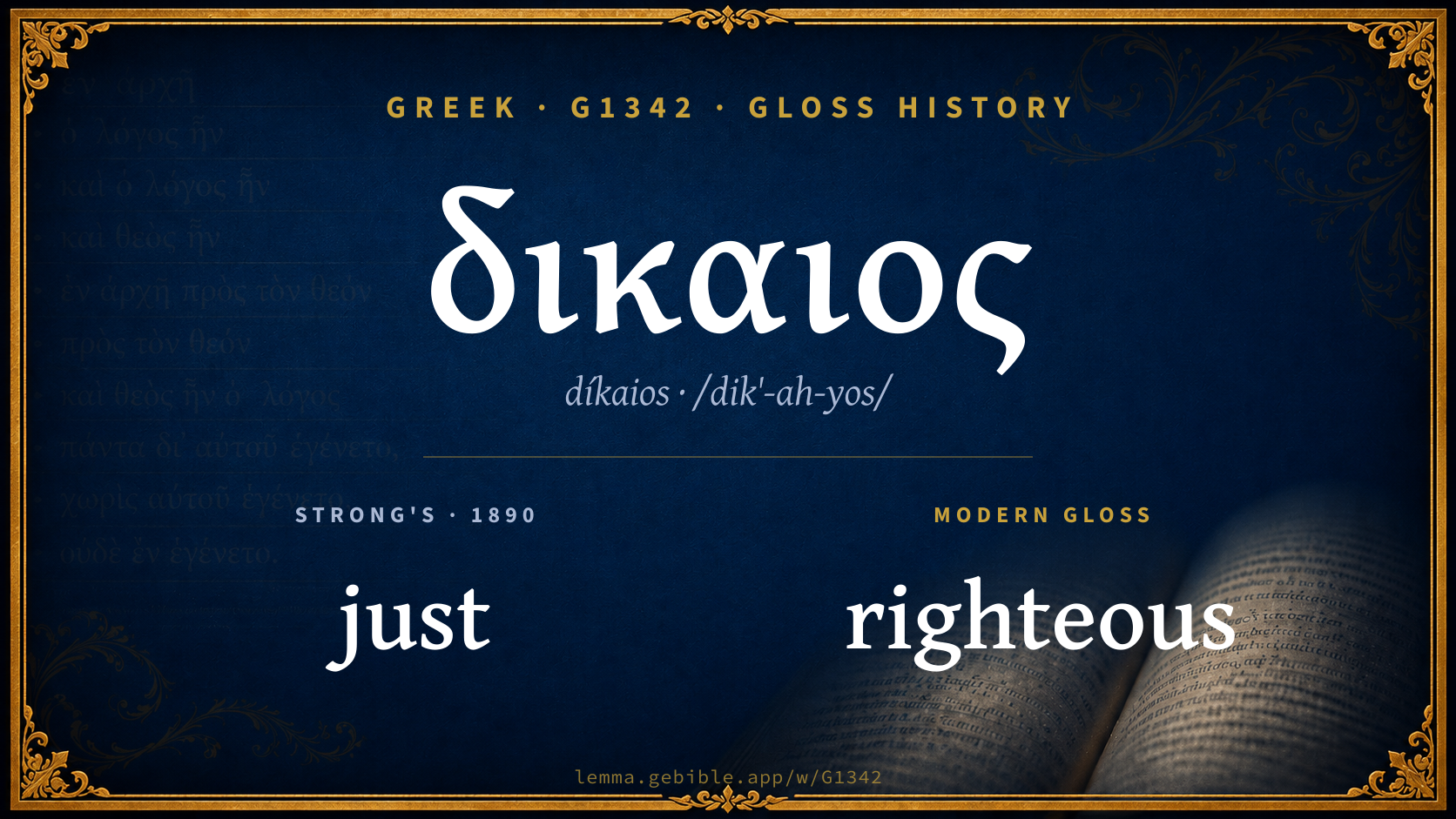
Gloss history
Strong's 1890 vs modern scholarship
About this word
Strong's G1342 catalogs a Greek word from the Greek New Testament.
These counts are not copied from any lexicon or concordance. They are computed here, from the morphology-tagged Greek New Testament. What Lemma adds →
- 74
- distinct verses
- The word appears in 74 distinct verses.
- 20 / 27
- NT books
- The word appears in 20 of 27 New Testament books.
- #214
- by frequency
- Top 250 most frequent Greek words (rank 214 of 5,347 Greek words by occurrence).
View all 74 occurrences in the concordance →
By section of the New Testament
By traditional corpus
Conventional, traditional groupings — biblical authorship is debated, so this is a traditional corpus grouping, not an authorship claim. Some books belong to more than one corpus (Luke is in both the Gospels and the Lukan corpus, and so on), so these shares overlap and need not total 100%. Each figure is a share of the word’s 74 distinct verses.
- Gospels 30 verses · 41%
- Lukan (Luke–Acts) 17 verses · 23%
- Pauline corpus 17 verses · 23%
- Johannine 13 verses · 18%
- General (Catholic) Epistles 13 verses · 18%
- Revelation 5 verses · 7%
- Hebrews 3 verses · 4%
How translations render this word
Counts come from each version’s own published word-to-Strong’s tagging or interlinear alignment — an approximate guide to how each version renders this word, not a word-level alignment the data otherwise carries. Because each total is that version’s own tagged count, the per-version totals vary from one another and need not match the appearance or distinct-verse counts above. These counts may also differ from a printed concordance because Lemma counts each distinctly tagged rendering and does not collapse phrase taggings into a single head-word total. This is a fixed set of word-tagged versions (KJV, ASV, BSB, ULT) and does not change with the reading translation you choose elsewhere. Each version’s license is shown beside its name below (and on Sources).
- King James Version: Righteous 30×, Just 21×, Righteous man 6×
- American Standard Version: Righteous 46×, Righteous man 9×, Just 6×
- Berean Standard Bible: Righteous 54×, Right 8×, Just 6×
- unfoldingWord Literal Text: Righteous 59×, Righteous one 6×, Man 4×
King James Version Public Domain
Renders G1342 across 81 tagged occurrences — most commonly:
Plus 10 renderings that appear only once — usually multi-word phrases or single function words the recovered tagging swept in, not distinct renderings.
American Standard Version Public Domain
Renders G1342 across 80 tagged occurrences — most commonly:
Plus 11 renderings that appear only once — usually multi-word phrases or single function words the recovered tagging swept in, not distinct renderings.
Berean Standard Bible Public Domain
Renders G1342 across 79 tagged occurrences — most commonly:
Plus 8 renderings that appear only once — usually multi-word phrases or single function words the recovered tagging swept in, not distinct renderings.
unfoldingWord Literal Text CC BY-SA 4.0
Renders G1342 across 88 tagged occurrences — most commonly:
Plus 7 renderings that appear only once — usually multi-word phrases or single function words the recovered tagging swept in, not distinct renderings.
Senses in Thayer's
The 1 sense Thayer's distinguishes for this word, in lexicon order (not ranked by frequency or importance). The full entry — with sub-senses — is in the Lexicon Entry tab.
- righteous, observing divine laws
Word origin
Derived from δικη (díkē) (G1349) — judgment.
From G1349 ; equitable (in character or act); by implication innocent holy (absolutely or relatively): - just meet right (-eous).
— Strong’s Exhaustive Concordance (1890), public domain.
Forms in the corpus
The 16 distinct written forms G1342 takes in the Greek New Testament, most frequent first — each parse links to that case’s occurrences in the concordance.
Same root — word family
Other Thayer's entries built from the same root as G1342, grouped by Strong’s listed origin. These share a root / origin per the lexicon — not necessarily a shared meaning. Each links to that word’s own entry.
Derives from
Shares the same root
Derived from this word
- δικαιοκρισια dikaiokrisía G1341 righteous judgment
- δικαιοσυνη dikaiosýnē G1343 righteousness
- δικαιοω dikaióō G1344 to justify
- δικαιως dikaíōs G1346 justly
Compare all same-root words → Showing 4 of 7 — not the complete family. They share a root, not necessarily a meaning.
Septuagint usage
The same Greek word δικαιος appears 303 times in the Greek Old Testament (Septuagint), across 281 verses in 28 books.
- 303
- LXX occurrences
- Tagged occurrences of this Greek word in the Septuagint.
- 281
- verses
- Distinct Septuagint verses containing this word.
- 28 / 39
- OT books
- The word appears in 28 of the 39 Old Testament books.
Sample Septuagint occurrences
- Genesis 6:9 δίκαιος
- Exodus 9:27 δίκαιος
- Leviticus 19:36 δίκαιος
- Numbers 23:10 δίκαιος
- Deuteronomy 4:8 δίκαιος
- 1 Samuel 2:2 δίκαιος
- 2 Samuel 4:11 δίκαιος
- 1 Kings 2:32 δίκαιος
- 2 Kings 10:9 δίκαιος
- 2 Chronicles 6:23 δίκαιος
- Ezra 9:15 δίκαιος
- Job 1:1 δίκαιος
Septuagint occurrences (same lexeme)
Every verse where the same Strong’s number (G1342) appears in the Greek Septuagint — showing the first 50 of 281. Verse text shown in the World English Bible for context; the Greek form is the matched word — the English is not keyword-highlighted.
- Genesis 6:9 δίκαιος This is the history of the generations of Noah. Noah was a righteous man, blameless among the people of his time. Noah walked with God.
- Genesis 7:1 δίκαιος Yahweh said to Noah, "Come with all of your household into the ark, for I have seen your righteousness before me in this generation.
- Genesis 18:23 δίκαιος Abraham drew near, and said, "Will you consume the righteous with the wicked?
- Genesis 18:24 δίκαιος What if there are fifty righteous within the city? Will you consume and not spare the place for the fifty righteous who are therein?
- Genesis 18:25 δίκαιος Be it far from you to do things like that, to kill the righteous with the wicked, that so the righteous should be as the wicked. May that be far from you. Shouldn't the Judge of all the earth do right?"
- Genesis 18:26 δίκαιος Yahweh said, "If I find in Sodom fifty righteous within the city, then I will spare all the place for their sake."
- Genesis 18:28 δίκαιος What if there will lack five of the fifty righteous? Will you destroy all the city for lack of five?" He said, "I will not destroy it, if I find forty-five there."
- Genesis 20:4 δίκαιος Now Abimelech had not come near her. He said, "Lord, will you kill even a righteous nation?
- Exodus 9:27 δίκαιος Pharaoh sent, and called for Moses and Aaron, and said to them, "I have sinned this time. Yahweh is righteous, and I and my people are wicked.
- Exodus 18:21 δίκαιος Moreover you shall provide out of all the people able men, such as fear God: men of truth, hating unjust gain; and place such over them, to be rulers of thousands, rulers of hundreds, rulers of fifties, and rulers of tens.
- Exodus 23:7 δίκαιος "Keep far from a false charge, and don't kill the innocent and righteous: for I will not justify the wicked.
- Exodus 23:8 δίκαιος You shall take no bribe, for a bribe blinds those who have sight and perverts the words of the righteous.
- Leviticus 19:36 δίκαιος Just balances, just weights, a just ephah, and a just hin, shall you have. I am Yahweh your God, who brought you out of the land of Egypt.
- Numbers 23:10 δίκαιος Who can count the dust of Jacob, Or number the fourth part of Israel? Let me die the death of the righteous, Let my last end be like his!
- Deuteronomy 4:8 δίκαιος What great nation is there, that has statutes and ordinances so righteous as all this law, which I set before you this day?
- Deuteronomy 16:18 δίκαιος Judges and officers shall you make you in all your gates, which Yahweh your God gives you, according to your tribes; and they shall judge the people with righteous judgment.
- Deuteronomy 16:19 δίκαιος You shall not wrest justice: you shall not respect persons; neither shall you take a bribe; for a bribe does blind the eyes of the wise, and pervert the words of the righteous.
- Deuteronomy 16:20 δίκαιος That which is altogether just shall you follow, that you may live, and inherit the land which Yahweh your God gives you.
- Deuteronomy 25:1 δίκαιος If there be a controversy between men, and they come to judgment, and [the judges] judge them; then they shall justify the righteous, and condemn the wicked;
- Deuteronomy 25:15 δίκαιος A perfect and just weight shall you have; a perfect and just measure shall you have: that your days may be long in the land which Yahweh your God gives you.
- Deuteronomy 32:4 δίκαιος The Rock, his work is perfect; For all his ways are justice: A God of faithfulness and without iniquity, Just and right is he.
- 1 Samuel 2:2 δίκαιος There is none holy as Yahweh; For there is none besides you, Neither is there any rock like our God.
- 1 Samuel 2:9 δίκαιος He will keep the feet of his holy ones; But the wicked shall be put to silence in darkness; For by strength shall no man prevail.
- 1 Samuel 24:18 δίκαιος You have declared this day how that you have dealt well with me, because when Yahweh had delivered me up into your hand, you didn't kill me.
- 2 Samuel 4:11 δίκαιος How much more, when wicked men have slain a righteous person in his own house on his bed, shall I not now require his blood of your hand, and take you away from the earth?
- 1 Kings 2:32 δίκαιος Yahweh will return his blood on his own head, because he fell on two men more righteous and better than he, and killed them with the sword, and my father David didn't know it, [to wit], Abner the son of Ner, captain of the host of Israel, and Amasa the son of Jether, captain of the host of Judah.
- 1 Kings 8:32 δίκαιος then hear you in heaven, and do, and judge your servants, condemning the wicked, to bring his way on his own head, and justifying the righteous, to give him according to his righteousness.
- 2 Kings 10:9 δίκαιος It happened in the morning, that he went out, and stood, and said to all the people, You are righteous: behold, I conspired against my master, and killed him; but who struck all these?
- 2 Chronicles 6:23 δίκαιος then hear from heaven, and do, and judge your servants, requiting the wicked, to bring his way on his own head; and justifying the righteous, to give him according to his righteousness.
- 2 Chronicles 12:6 δίκαιος Then the princes of Israel and the king humbled themselves; and they said, Yahweh is righteous.
- Ezra 9:15 δίκαιος Yahweh, the God of Israel, you are righteous; for we are left a remnant that is escaped, as it is this day: behold, we are before you in our guiltiness; for none can stand before you because of this.
- Ezra 19:8 δίκαιος
- Ezra 19:33 δίκαιος
- Job 1:1 δίκαιος There was a man in the land of Uz, whose name was Job. That man was blameless and upright, and one who feared God, and turned away from evil.
- Job 5:5 δίκαιος Whose harvest the hungry eats up, And take it even out of the thorns; The snare gapes for their substance.
- Job 6:29 δίκαιος Please return. Let there be no injustice; Yes, return again, my cause is righteous.
- Job 8:3 δίκαιος Does God pervert justice? Or does the Almighty pervert righteousness?
- Job 9:2 δίκαιος "Truly I know that it is so, But how can man be just with God?
- Job 9:15 δίκαιος Whom, though I were righteous, yet would I not answer. I would make supplication to my judge.
- Job 9:20 δίκαιος Though I am righteous, my own mouth shall condemn me. Though I am blameless, it shall prove me perverse.
- Job 9:23 δίκαιος If the scourge kills suddenly, He will mock at the trial of the innocent.
- Job 10:15 δίκαιος If I am wicked, woe to me. If I am righteous, I still shall not lift up my head, Being filled with disgrace, And conscious of my affliction.
- Job 11:2 δίκαιος "Shouldn't the multitude of words be answered? Should a man full of talk be justified?
- Job 12:4 δίκαιος I am like one who is a joke to his neighbor, I, who called on God, and he answered. The just, the blameless man is a joke.
- Job 13:18 δίκαιος See now, I have set my cause in order. I know that I am righteous.
- Job 15:14 δίκαιος What is man, that he should be clean? He who is born of a woman, that he should be righteous?
- Job 17:8 δίκαιος Upright men shall be astonished at this. The innocent shall stir up himself against the godless.
- Job 22:19 δίκαιος The righteous see it, and are glad; The innocent ridicule them,
- Job 24:4 δίκαιος They turn the needy out of the way. The poor of the earth all hide themselves.
- Job 24:11 δίκαιος They make oil within the walls of these men. They tread wine presses, and suffer thirst.
These are occurrences of the same Greek lexeme (G1342) in the Septuagint — not a translation of any one Hebrew word. The store carries no word-level Hebrew↔Greek alignment, so no Hebrew original is asserted here. Counts come from the recovered LXX Strong's tagging — high-frequency vocabulary is well covered, while rare or late forms may be untagged — so they reflect tagged occurrences and may slightly undercount.