2 Thessalonians 1:6

Greek (Tischendorf 8th ed.) 2 Thessalonians 1:6 appears in the Greek New Testament. The text above is from the Tischendorf 8th edition. Each word links to its Strong’s number and a concise gloss. Click any word for its full Thayer’s Greek Lexicon entry.
Download image
Cite this verse

2 Thessalonians 1:6 (World English Bible). Public Domain. Lemma interlinear Bible study tool, https://lemma.gebible.app/v/2-thessalonians/1/6.

Show BibTeX & RIS
BibTeX
RIS
English Translation
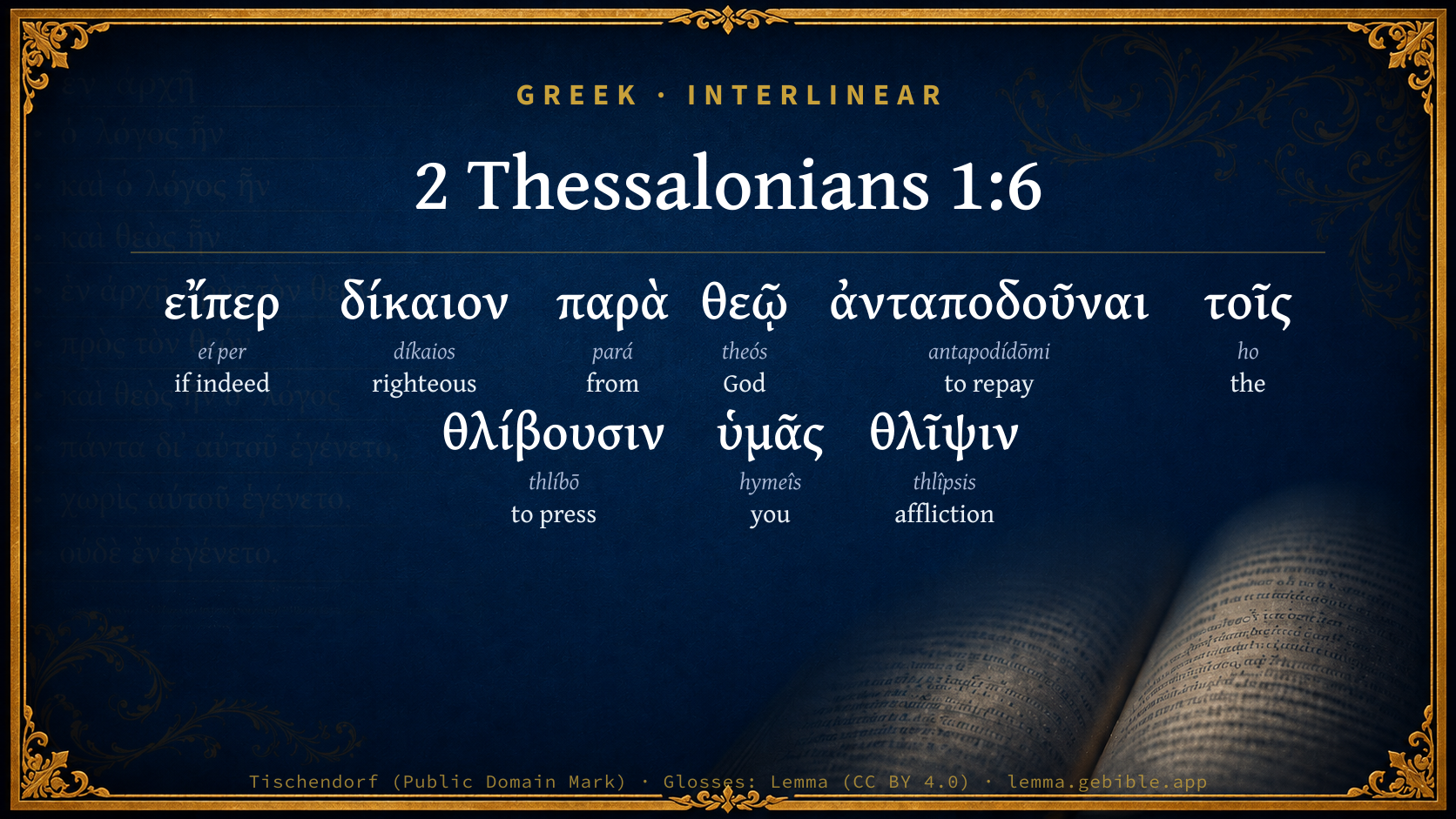
Since it is a righteous thing with God to repay affliction to those who afflict you,
World English Bible · Public Domain
Download a study sheet

One document with this verse’s original text, its word-by-word gloss line, the meaning frame, cross-references with their text, attributed commentary, and full source and license credits — printable, and it pastes into notes with its structure intact.

This verse Autodidact and up

Study sheet (.html) Plain text (.txt)

A passage Seminary Student

Up to 50 verses in one chapter. A passage sheet keeps up to 6 commentary sources and 12 cross-references per verse, in the order this page ranks them, and says so on the sheet whenever that leaves anything out. Ask for a single verse and you get the Autodidact verse sheet above.

Everything on this page stays free to read, with no account — the sheet is a download of what is already on screen, not access to it.

Want to remove ads? Support Godless Engineer
Compare translations 3

The same verse in 3 English versions, stacked beneath the original-language interlinear above. Click any original word for its lexicon entry.

Each is an independent rendering of the whole verse — the interlinear is not word-aligned to these translations.

Highlighted words mark where these versions differ — a whole-verse word diff, not a word-by-word alignment.

  • World English Bible Public Domain
    Since it is a righteous thing with God to repay affliction to those who afflict you,
  • King James Version Public Domain
    Seeing it is a righteous thing with God to recompense tribulation to them that trouble you;
  • unfoldingWord Literal Text CC BY-SA 4.0
    if indeed righteous for God to return affliction to the ones afflicting you,

unfoldingWord Literal Text — © unfoldingWord, licensed CC BY-SA 4.0. Word-aligned USFM3 via Door43 (git.door43.org/unfoldingWord/en_ult).

Versions to compare (up to 4)

3 of 4 selected

Show all 19 translations

Every available English version of this verse, each an independent rendering of the whole verse.

  • World English Bible Public Domain
    Since it is a righteous thing with God to repay affliction to those who afflict you,
  • Berean Standard Bible Public Domain
    After all, it is only right for God to repay with affliction those who afflict you,
  • Majority Standard Bible Public Domain
    After all, it is only right for God to repay with affliction those who afflict you,
  • King James Version Public Domain
    Seeing it is a righteous thing with God to recompense tribulation to them that trouble you;
  • American Standard Version (1901) Public Domain
    if so be that it is righteous thing with God to recompense affliction to them that afflict you,
  • Revised Version (1885) Public Domain
    if so be that it is a righteous thing with God to recompense affliction to them that afflict you,
  • Geneva Bible (1599) Public Domain
    For it is a righteous thing with God, to recompense tribulation to them that trouble you,
  • Douay-Rheims (1899) Public Domain
    Seeing it is a just thing with God to repay tribulation to them that trouble you:
  • Young's Literal Translation Public Domain
    since `it is' a righteous thing with God to give back to those troubling you -- trouble,
  • Literal Standard Version CC BY-SA 4.0
    since [it is] a righteous thing with God to give back to those troubling you—tribulation,
  • Unlocked Literal Bible CC BY-SA 4.0
    It is righteous for God to return affliction to those who afflict you,
  • unfoldingWord Literal Text CC BY-SA 4.0
    if indeed righteous for God to return affliction to the ones afflicting you,
  • Darby Bible Public Domain
    if at least [it is a] righteous thing with God to render tribulation to those that trouble you,
  • World Messianic Bible Public Domain
    For it is a righteous thing with God to repay affliction to those who afflict you,
  • Webster's Bible Public Domain
    Seeing it is a righteous thing with God to recompense tribulation to them that trouble you;
  • Free Bible Version CC BY-SA 4.0
    Since God does what's right he will deal appropriately with those who cause you trouble.
  • Bible in Basic English Public Domain
    For it is an act of righteousness on God's part to give trouble as their reward to those who are troubling you,
  • Text-Critical English NT CC BY 4.0
    It is indeed right for God to repay with affliction those who afflict you,
  • Tyndale New Testament (1534) Public Domain
    It is verely a rightewes thinge with God to recopence tribulacion to them that trouble you:

Literal Standard Version (2020), Covenant Press — licensed CC BY-SA 4.0. Text via the HelloAO Bible API (eBible.org). Unlocked Literal Bible (unfoldingWord) — licensed CC BY-SA 4.0. Text via the HelloAO Bible API (eBible.org). unfoldingWord Literal Text — © unfoldingWord, licensed CC BY-SA 4.0. Word-aligned USFM3 via Door43 (git.door43.org/unfoldingWord/en_ult). Free Bible Version, Dr. Jonathan Gallagher — licensed CC BY-SA 4.0. Text via the HelloAO Bible API (eBible.org).

Word by word

More ways to search: Search by grammar → Find every occurrence → Compare this word →

Practice this passage: Drill this verse → Learn its vocabulary →

About this verse

These counts appear in no published source. They are computed here, from the morphology-tagged text and Lemma’s own curated glosses. What Lemma adds →

9
words
9
distinct lemmas
Pauline Epistles
section

Notable vocabulary

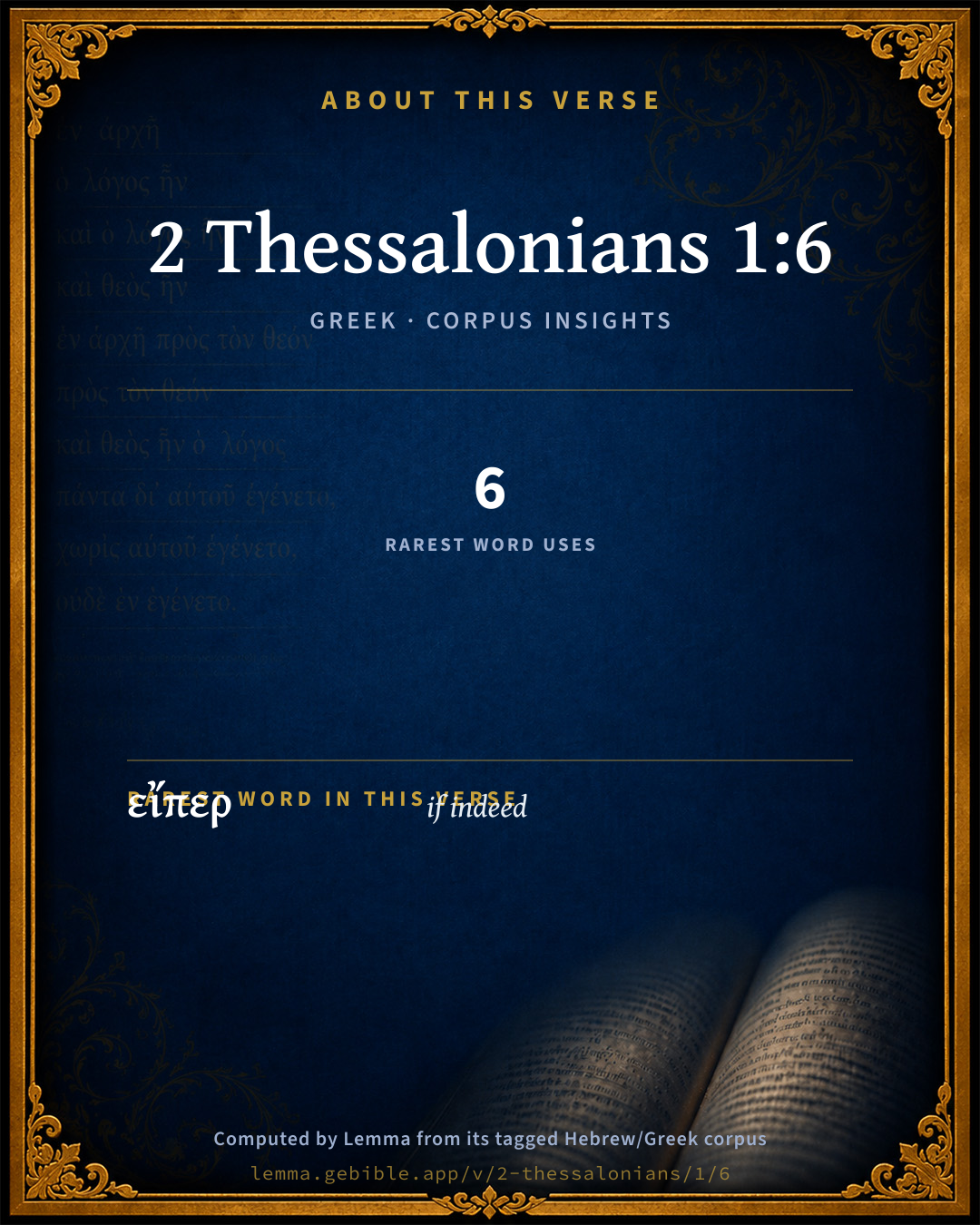
The rarest word here is εἴπερ if indeed G1512 — appearing just 6 times in the whole Greek New Testament.

Shared distinctive vocabulary

εἴπερ if indeed G1512 occurs in 6 verses of the Greek New Testament. Also found in:

Cross-references

15

Topical passages linked to 2 Thessalonians 1:6 in the Treasury of Scripture Knowledge — connected by theme and wording, ordered by reader-vote popularity; previews shown in the World English Bible.

  • Zechariah 2:8 For thus says Yahweh of hosts: 'For honor he has sent me to the nations which plundered you; for he who touches you touches the apple of his eye.
  • Colossians 3:25 But he who does wrong will receive again for the wrong that he has done, and there is no partiality.
  • Deuteronomy 32:41–43 If I whet my glittering sword, My hand take hold on judgment; I will render vengeance to my adversaries, Will recompense those who hate me.
  • Psalms 94:20–23 Shall the throne of wickedness have fellowship with you, Which brings about mischief by statute?
  • Exodus 23:22 But if you indeed listen to his voice, and do all that I speak, then I will be an enemy to your enemies, and an adversary to your adversaries.
  • Psalms 74:22–23 Arise, God! Plead your own cause. Remember how the foolish man mocks you all day.
  • Isaiah 49:26 I will feed those who oppress you with their own flesh; and they shall be drunken with their own blood, as with sweet wine: and all flesh shall know that I, Yahweh, am your Savior, and your Redeemer, the Mighty One of Jacob.
  • Revelation 6:10 They cried with a loud voice, saying, "How long, Master, the holy and true, until you judge and avenge our blood on those who dwell on the earth?"
  • Revelation 19:2 for true and righteous are his judgments. For he has judged the great prostitute, who corrupted the earth with her sexual immorality, and he has avenged the blood of his servants at her hand."
  • Psalms 79:10–12 Why should the nations say, "Where is their God?" Let it be known among the nations, before our eyes, That vengeance for your servants' blood is being poured out.
  • Revelation 11:18 The nations were angry, and your wrath came, as did the time for the dead to be judged, and to give your bondservants the prophets, their reward, as well as to the saints, and those who fear your name, to the small and the great; and to destroy those who destroy the earth."
  • Revelation 15:4 Who wouldn't fear you, Lord, And glorify your name? For you only are holy. For all the nations will come and worship before you. For your righteous acts have been revealed."
  • Revelation 16:5–6 I heard the angel of the waters saying, "You are righteous, who are and who were, you Holy One, because you have judged these things.
  • Revelation 18:20 Rejoice over her, O heaven, you saints, apostles, and prophets; for God has judged your judgment on her."
  • Revelation 18:24 In her was found the blood of prophets and of saints, and of all who have been slain on the earth."

Cross-references courtesy of OpenBible.info (CC BY 4.0).

Commentary

Notes on 2 Thessalonians 1:6 from classic Christian and Jewish commentators (each source and its license shown beneath its notes). The classic Christian expositions comment on the surrounding passage and are grouped to its opening verse, so a note may address several verses; the Jewish commentaries on the Tanakh (Rashi and others) are per-verse, so they appear only where the commentator wrote on this verse.

Lemma curates 59 commentaries, every one of them public domain or Creative Commons licensed, each selected and text-cleaned for this edition rather than reprinted as found. About our sources →

The Biblical Illustrator

Joseph S. Exell

2Th_1:6-7

Seeing it is a righteous thing with God to recompense tribulation to them that trouble you; and to you who are troubled rest with us when the Lord Jesus shall be revealed

The two troubles and the troublers

I.

The term applied to our Lords coming revealed. To reveal is to uncover what is hidden. This may be done in two ways--

1. Spiritually, as Jesus is now evidently set forth in His gospel.

2. Outwardly.

(1) In this way Christ has been already revealed, but only partially. Few saw Him, and those few very little.

(2) By and by He will come without disguise and every eye shall see Him.

II. The different portions which will then be given to various persons.

1. The troublers and their portion.

(1) Wherever God has a people there will sure to be troublers.

(2) Sometimes God visits such with His displeasure here, just to show that He marks what they are doing, but generally He seems to let them alone.

(3) Their position is--

(a) Tribulation. Of this we all know something, but the deepest sorrow we have ever felt compared with this is as a summer cloud to winter midnight.

(b) Recompense. It is to come upon them as a consequence of their unkindness to Gods people. Wretched they would have been had they let these people alone, but because they would not they shall be still more wretched.

(4) How seldom do some of us think of this. We regard the hard speeches of the ungodly as little more than the outbursts of prejudice, ill-humour, or harmless pleasantry; but God regards them differently.

(5) How this truth magnifies the love Christ bears to us, grounding His judicial proceedings on the conduct of men towards us as well as toward Himself. He that toucheth you, toucheth the apple of My eye.

2. The portion of the troubled.

(1) We must not think that we are in the number of these because the world ill-treats us. The world frequently torments its own followers.

(2) The blessing pronounced is--

(a) rest. The very thing for which most of us long. We are often grieved at this longing: but Christ in His compassion shows us that holy Paul had the same longings, and that they were lawful. This compassion is further shown in this revelation of heaven. Were we in that place where they rest not day nor night we should never call it by that name. That activity is quite in harmony with this rest; but Christ does not dwell upon it because He is addressing weary men.

(b) Rest with us. It will be a rest of the same kind as that enjoyed by the highest saints. It may be enough to be with Christ; but if we love Him we shall love His people, and to meet with the latter also will augment our joy. Paul could enter into this. It gave him as much joy as them.

III. The righteousness of this.

1. Christ came as a Saviour, and accordingly displayed love and mercy; He will come as a Judge, and what we look for in a judge is equity. Gods justice now is very much a matter of faith, but then it will be made fully manifest.

2. To bring this about there must be evident justice in the portions assigned to different men. Their destinies must be suited to their character and conduct. See standing before the Judge two separate companies. Here are those who bore willingly hatred and reproach for His names sake--there are those who reproached and hated them because they loved His name. Without looking any farther we see the force of these words.

(1) These latter have troubled Gods people, and it is but their desert that they should be troubled in their turn.

(2) The harassed people find rest. True they merit it not, and remembering what they are we should have expected the apostle to say, It is a merciful thing with God to give you rest. This he does say elsewhere, but here he enters into his Masters feelings who thinks only of His peoples services and forgets their sins.

3. What the grace of God leads Him to promise His justice will lead Him to perform. (C. Bradley, M. A.)

Divine retribution a manifestation of Divine justice:--

I. The justice of God.

1. Justice is Gods attribute as Governor. It is twofold.

(1) General--the perfection of the Divine nature. This is the same with His holiness. God loves righteousness and hates iniquity necessarily (Psa_5:4; Zec_3:5).

(2) Particular which respects His office as Judge of the world (Deu_32:4).

2. Of His government there are two acts.

(1) Legislative justice, which determines mans duty, binds him to the performance and defines the rewards and punishments which shall be due upon mans obedience and disobedience (Deu_30:15).

(2) Judiciary or distributive justice, whereby He renders to all men according to their works (Rom_2:6; 1Pe_1:17). This is twofold.

(a) Rewarding (Heb_6:10; 2Ti_4:8).

(b) Vindictive or punishing (Rom_2:7-9; Joh_3:19; Heb_10:29).

3. This distributive justice is exercised.

(1) More darkly here: yet even here the wicked are punished and the righteous rewarded (Rom_1:18; Psa_58:11).

(2) More plainly hereafter (Rom_2:5). The difference between the last time and this is--

(a) That the righteous and the wicked have but the beginnings of their reward and punishment: the wicked inwardly (Heb_2:15; Eph_4:19; Psa_81:12) and even outwardly, as witness the fall of nations, and the sudden and otherwise unaccountable destruction of individuals; so the righteous have inwardly much of his love, peace, etc.; and outwardly the wicked have it not all their own way (Mal_3:17-18).

(b) Gods justice now appears more negatively than positively, i.e., God does nothing contrary to justice. As to His rewards His servants have deserved nothing which they enjoy; and as to His restraint of due punishment it is to bring the sinner to repentance.

II. This justice as applied to the different recompenses.

1. Tribulation to them that trouble you for a double reason.

(1) Their own disobedience to Gods laws (Rom_2:8).

(2) Their opposition to those that would obey God, so consenting with the devil in his apostasy (Mat_23:13; Mat_24:49).

2. To you who are troubled rest. How is this just? Things may be said to be righteous with God.

(1) In respect of strict justice when what is done deserves reward by its intrinsic value. So no obedience of man or angel can bind God to reward it.

(2) In respect of His bounty God is just. When He rewards man because he is in some way righteous. This capacity of reward respects either the righteousness of Christ (Rom_3:25-26), or the difference between the person recompensed and others. General justice requires that He should put a difference between the godly and the wicked (Psa_11:7).

(3) In respect of His promise (1Jn_1:9).

3. Particularly discuss these two effects.

(1) The troublers are to be troubled (Rom_2:9). The law of retaliation operates often in the course of providence (Jdg_1:7; Oba_1:5). Ahabs blood was lapped up by dogs where Naboth was murdered. Haman was executed on the gallows he had erected for Mordecai. Henry III of France was killed in the chamber where the massacre was contrived; and Charles IX died flowing in his blood in his bed. The rich glutton wanted a drop who gave not a crumb.

(2) The troubled rest--and the rest in proportion to the trouble. (T. Manton, D. D.)

The thought of rest

While walking through the streets of the city we passed a man whose head was whitened and body bowed by the hardships of not less than sixty years. His limbs trembled under their heavy burden, and with much apparent effort he advanced but slowly. We overheard him talking in a low and subdued voice, evidently mourning over his weariness and poverty. Suddenly his tone changed and his step quickened, as he exclaimed, Ill rest when I get home. Even the thought of rest filled him with new life, so that he pursued with energy his weary way. To us it was a lesson. If the thought of the refreshing rest of home encourages the careworn labourer so that, almost unmindful of fatigue and burdens, he quickens his step homeward, surely the Christian, journeying heaven ward, in view of such a rest, should press onward with renewed vigour. This little incident often comes to mind amid the perplexing labours of the day, and stimulates to more constant and earnest effort. Each labourer toiling in his Masters vine yard, bearing the heat and burden of the day, can say, Ill rest when I get home.

Rest after suffering

None of us who have not read deeply into history can under stand how utterly the Russian and German peoples were threshed, as straw is threshed on the summer threshing floor, by the iron flail of Bonaparte. So extreme was the suffering that it broke the heart of that most beautiful and noble woman, the wife of King William, the father of the late Kaiser. She died, as it were, struggling with the sorrows of her people. For her her husband erected a tomb in the environs of Berlin. I can hardly mention it without tears. It is peculiarly built, standing alone in a forest, with glass that throws a sombre light upon all the hither part of it, while on the far part the golden and natural light of the sun shines--as if this side, where you enter, represented the gloom of this world, and the other side, where she lies, carved in marble over her dust, represented the light and the glory of the more blessed land. When I first was there I had read about, but never had fairly conceived of, that which met my eyes. The queen, sculptured at full length, lies as one upon a bed at rest. There is the most exquisite expression of having at last come to full, perfect, and joyful rest. (H. W. Beecher.)

Rest for the troubled

I. What is this rest? It is--

1. A felicitating rest. In it there is--

(1) Freedom from all troublesome evils.

(a) Sin (Rom_7:24) is the most grievous, but in heaven there is no sin (Eph_5:27). In paradise there was a tempter, but not in heaven.

(b) Misery and affliction (Rev_22:4).

(2) An enjoyment of all good, even God. To our felicity three things are necessary.

(a) A prepared faculty;

(b) a suitable object;

(c) the conjunction of these.

In a state of glory these things concur. The faculty is more prepared than here as we are purged from sin and fleshly delusions--the object is more manifested (1Co_13:12); the conjunction is more intimate; for here it is by faith, there by vision, here by an imperfect, there by a perfect love.

2. A holy rest, a perpetual sabbatizing (Heb_4:9). The Sabbath is not a time of idleness; on it the sacrifices were doubled (Num_28:1). So our service is not ended with our lives; holy work will be part of the blessedness of heaven (Rev_7:14-15).

3. A rest for the whole person--body and soul.

II. Why our reward is represented as rest. Because it suits--

1. The aim of the saints. It is the end of motion. None have it but those that seek after it. We are all travelling to the other world. Some are posting to eternal torment on the broad road, others to life and rest by the narrow way (Mat_7:13-14). Every day a Christian gets nearer the goal (Rom_13:11).

2. The goodness of God, who delights to recompense His people for their pain and weariness. He has a care for His weary servants here and gives them rest (Isa_50:4; Mat_11:28).

III. rest with us.

1. All Christians have the same felicity for substance though the degrees are different. Those who have been together in the labour, duty, and danger shall be together in the rest and recompense (Mat_25:1). The grounds of essential happiness are the same to all.

(1) The same Redeemer (Exo_30:15; 1Co_1:2; Rom_3:22).

(2) The same covenant which is the common charter of the saints (Act_2:39). It is a covenant which--

(a) Offers the same benefits, pardon, life (Rom_4:23-24; 2Ti_4:8).

(b) Requires the same duties (Gal_6:16; Rom_1:16).

2. Though the essential happiness of the saints is the same, yet there are degrees in glory. What relation holiness has to heaven, so more holiness here means more happiness there.

3. It is a comfortable adjunct to our felicity that we shall have such company there (Mat_8:11; Heb_12:22-23; Eph_2:19; Eph_3:15). Let this promote church unity. (T. Manton, D. D.)

The craving for rest

No one will easily believe how anxiously, for a long time, I have wished to retire from these labours into a scene of tranquility, and, for the rest of my life (dwindled, it is true, to the shortest span) to converse only with Him who once cried, Come unto Me all ye that labour, etc. In this turbulent and raging world, amid so many cares, which the state of the times heaps upon me in public, or which declining years and infirmity cause me in private, nothing do I find on which my mind can more comfortably repose than on secret communion with God. (Erasmus.)

Rest not for the present

Epaminondas, before going into battle with the Lacedaemonians, sat down to rest for a few moments, when his seat fell under him. That, quoth the soldiers, bodes no good. Nay, said their leader, with happy pre sence of mind; it is an intimation to me that I have no business to be sitting here when I should be leading you against the enemy. (Percy Anecdotes.)

Rest not on earth

There is the tradition of an Indian chief who with his wife fled before the prairie fires till he had crossed a broad river; when he struck his tent pole into the ground and cried, Alabama! (here we may rest). He was no prophet. Hostile tribes overpowered them; and they found only their graves where they sought a home. This is, may be, a parable of the soul; for it earth has no Alabama. (E. Foster.)

Rest at last

The pass of Glencoe in Scotland is reached by a long, steep, and winding path; but at its top is a stone with the inscription Rest and be thankful. Such is the pilgrims path; but at its end is heaven, on whose gates may be read a similar inscription. (T. Guthrie, D. D.)

The Biblical Illustrator, edited by Joseph S. Exell (c. 1880s–1900s) — public domain. Text from a community e-Sword module.

Joseph Benson's Commentary

2Th 1:6-8. Seeing it is a righteous thing — However men may judge of it; with God — To whom belongeth vengeance, (Rom 12:19,) and who will avenge his elect that cry unto him day and night; to recompense tribulation to them that trouble you — To remove the pressure from you to them. And it is remarkable that about this time, at the passover, the Jews raising a tumult, a great number, some say thirty thousand of them, were slain. St. Paul seems to allude to this beginning of sorrows, 1Th 2:16, which did not end but with their destruction. And to you that are troubled — That suffer persecution; rest with us — If not in the present world, where we do not ourselves expect it, yet at last, when the Lord Jesus shall be revealed from heaven. By the word ανεσις, here rendered rest, or, as it more properly means, relaxation, the apostle does not mean deliverance from persecution. The believing Jews, with whom St. Paul here ranks himself, had no relaxation in that sense any more than the believing Gentiles. But he meant deliverance from the troubles of this life at death, and the enjoyment of eternal rest, the rest of God, partly entered into then, and more especially after the coming of Christ here spoken of. With his mighty angels — Who shall be the ministers of his power in the execution of this great and awful judgment. In flaming fire — To which the aerial heavens and the earth are reserved, (2Pe 3:7; 2Pe 3:10,) and by which they shall be destroyed; taking vengeance — Or inflicting punishment, as διδοντος εκδικησιν also signifies; see 1Pe 2:14, where the same word is translated punishment. Does God, as some say, barely permit this punishment to come upon his enemies? or, as the Lord once rained brimstone and fire from the Lord out of heaven, (Gen 19:24,) does a fiery stream go forth from him? Who know not God — By an experimental and practical knowledge; who know him not so as, 1st, To be humbled before him, Job 40:4-5; Job 42:5-6; Job 2 d, To trust in him, (Psa 9:10,) namely, for pardon, holiness, and eternal life, being first truly penitent; 3d, To love him with a love shed abroad in their hearts, Joh 4:7; 4th, To keep his commandments, 1Jn 2:3-4; 1 John , , 5 th, To be transformed into his image, 2Co 3:18. In which passages the fruits of the saving knowledge of God are designedly specified, and two of them at least, namely, love and obedience to God, declared to be absolutely essential to the true knowledge of him. Reader, examine thyself! Does thy knowledge of the one living and true God produce these fruits? Surely it cannot, unless he that commanded light to shine out of darkness, hath shined into thy heart, to give thee the knowledge of his glory in and by Jesus Christ, 2Co 4:6; unless the Son of God hath given thee an understanding to know him, 1Jn 5:20. And who obey not the gospel — Who do not receive its truths and promises with a lively faith, productive of love and obedience, Christ being the author of eternal salvation only to those that love and obey him, 1Co 16:22; Heb 5:9. Believing the gospel is often termed by St. Paul the obedience of faith, both because God hath commanded men to believe it, and because it contains not only doctrines to be credited, threatenings to be revered, and promises to be trusted, but also a variety of precepts necessary to be obeyed. Probably in the former clause, who know not God, the apostle had chiefly the unbelieving Gentiles in view, and in this latter the unbelieving Jews.

Joseph Benson's Commentary on the Old and New Testaments (1811–1818) — public domain. Text from a community e-Sword module.

Bengel's Gnomon

Johann Albrecht Bengel

2Th 1:6. Παρὰ Θεῷ, with God) Although good and bad men do not estimate the injuries done by the latter, and the sufferings endured by the former, as of so great importance.—θλίβουσιν—θλίψιν, affliction [tribulation]—to them that afflict [trouble]) The lex talionis [compensation in kind]. To this refer 2Th 1:8-9.

Bengel's Gnomon of the New Testament — English translation (T&T Clark, Edinburgh, 1860) — public domain. Text from a community e-Sword module.

Meyer's Critical & Exegetical Commentary

Heinrich August Wilhelm Meyer

2Th_1:6. The suitableness and naturalness of this result to be expected from the righteousness of God, the mention of which was to comfort the Thessalonians and encourage them to continued endurance, is further carried out by an intimation of the retribution to be expected at the return of Christ. To assume a parenthesis from 2Th_1:6 to μεθʼ ἡμῶν, 2Th_1:7 (Grotius), or to 2Th_1:10 inclusive (Moldenhauer), is unnecessary arbitrariness.

εἴπερ] provided, does not express any doubt, but introduces by means of an elegant expression, under the form of suspense, a saying whose truth is fully acknowledged. Comp. 8:9, 17. See Hermann, ad Viger. p. 834; Hartung, Partikellehre, I. p. 343; Klotz, ad Devar. p. 528.

δίκαιον] righteous, joined to δικαίας κρίσεως, 2Th_1:5. The apostle here places himself upon the standpoint of the strict righteousness of God, which is conceived according to the analogy of human jus talionis, and is also so asserted in Rom_2:5 ff.; 2Co_5:10; Eph_6:8-9; Col_3:24-25. It is accordingly inadmissible to interpret δίκαιον, with Pelt and others, of the manifestation of divine grace. The idea that one may obtain eternal salvation by his own merits, which recently Bisping finds here expressed, is removed from the Pauline mode of thought generally, and also from this passage. Certainly, as all men are subject to sin as a ruling power, the possibility of obtaining salvation can only be contained in Christ; and that God revealed this possibility of salvation, and by the mission of Christ invited us into His kingdom, is a pure contrivance of His free grace; but with this grace His holiness and righteousness are not abolished. There remains room for the exercise of the strict righteousness of God, as only he can enter into His eternal kingdom who, with the desire of salvation, accepts the call; whereas whoever closes himself against it, or rises up in enmity against it, must incur righteous punishment at the last day.

Meyer — Critical and Exegetical Commentary on the New Testament — English translation by Peter Christie, edited by Frederick Crombie (T&T Clark, 1880) — public domain. Text from a community e-Sword module.

Cambridge Greek Testament for Schools and Colleges

6. εἴπερ δίκαιόν ἐστιν παρὰ θεῷ, if to be sure it is righteous with God. Εἴπερ is siquidem (Ambrose, &c.), not si tamen (Vulg.); cf. Rom 3:30; Rom 8:9; Rom 8:17; 1Co 8:5: the particle states rhetorically, in the form of hypothesis, a recognized fact; so Theodoret, οὐκ ἐπὶ ἀμφιβολίας τέθεικεν ἀλλʼ ἐπὶ βεβαιώσεως; “veluti verum inferens de quo nefas sit dubitare” (Erasmus). Δίκαιόν κ.τ.λ. repeats the δικαίας κρίσεως of 2Th 1:5; justice one certainly expects from God (Rom 3:5 f., Rom 3:26, Rom 9:14): “a token,” I say, “of God’s righteous judgement … for righteous it is with Him to pay back the afflicters with affliction, &c.” Παρὰ θεῷ, apud Deum, in His sight, or estimate, at His tribunal; cf. Rom 2:11; Rom 2:13; Luk 1:30, &c.

ἀνταποδοῦναι τοῖς θλίβουσιν ὑμᾶς θλίψιν, to recompense to those that afflict you affliction. For θλίβω, θλίψις, see notes to 2Th 1:4 and 1Th 1:6; and for ἀνταποδίδωμι, on 1Th 3:9. Τοῖς θλίβουσιν … θλίψιν follows the jus talionis, an axiom of justice inculcated by the Law of Moses in Lev 24:20, and generalized by St Paul in Col 3:25 as the principle of God’s future retributions; our Lord pictures its application in the story of Dives and Lazarus (Luk 16:25); see also Mat 26:52; Rev 13:10. Θλίψις is used once besides of the future pains of the wicked, in Rom 2:9: θλίψις κ. στενοχωρία ἐπὶ πᾶσαν ψυχὴν ἀνθρώπου τοῦ κατεργαζομένου τὸ κακόν; it represents their anguish as a personal infliction, that which God Himself lays upon them.

Ἀνταποδίδωμι (or ἀποδίδωμι), with its derivatives, is found in a series of O.T. sayings relating to God’s vengeance on the enemies of Israel, or upon His enemies within Israel (the idea pervades prophecy): see Isa 66:4 ff., Isa 66:14 ff., Isa 63:4; Isa 63:7, Isa 34:8; Isa 35:4; Isa 59:18; Jeremiah 28. (LXX) 6, 24, 56; Thren. 3:63; Oba 1:15; Sir 32:13; Sir 32:23 ff. (LXX). The first of the above passages is evidently before the writers’ mind; the context supplies other parallels to it, in the κρἰσεως (κριθήσονται) of the last verse, the ἐν πυρὶ φλογός, ἐκδίκησιν, and τοῖς μὴ ὑπακούουσιν (οὐχ ὑπήκουσαν, τοῖς ἀπειθοῦσιν) of 2Th 1:8. The whole Isaianic passage should be read in the LXX, also Psa 78:6, and Jer 10:25; Jer 25:12 (εἰς ἀφανισμὸν αἰώνιον), along with Isa 61:2, in order to realize how St Paul’s conception and imagery of the future judgement are steeped in the O.T. Apocalyptic. Other parallels will appear when we come to 2Th 1:9 ff.; cf. Introd. pp. lx. f.

Cambridge Greek Testament for Schools and Colleges (Cambridge University Press, 1896; 21 vols, various authors incl. Carr, Maclear, Plummer, Farrar, Lumby, Moule, M. R. James, Simcox) — public domain. Text from a community e-Sword module.

International Critical Commentary

6-7a. εἴπερ δίκαιον κτλ. The “righteous judgment of God” (v. 5) is not only positive, the salvation of the readers (v. 5), but also (δίκαιον παρὰ θεῷ resuming τῆς δικαίας κρίσεως τοῦ θεου) positive and negative, in keeping with the principle of recompense sharply stated as the ius talionis, namely, θλίψι for your persecutors and ἄνεσι for you who are persecuted (cf. Luk 16:25). The principle is put conditionally (εἴπε), “not indeed as if there were the least doubt respecting the righteousness of any part of the divine procedure in judging the world. On the contrary, it is the very certainty of that truth, as something altogether beyond cavil, that emboldens the writer, by a sort of logical meiosis, to argue from it conditionally” (Lillie; cf. Pelagius: hic “si tamen” confirmantis sermo est, non dubitantis).

ἄνεσιν μεθʼ ὑμῶ. As there is a present fellowship of readers and writers in suffering (καὶ πάσχετ v. 5), so also will there be a future fellowship in “rest” or “relief” from suffering,—a genuinely Pauline touch (cf. 1Co 4:8, 2Co 1:6 ff. Php 1:30).

On the positive side, ἄνεσι is entrance into the kingdom (v. 5) and eternal fellowship with the Lord (v. 10 as contrasted with v. 9; cf. I 4:17 πάντοτε σὺν κυρίῳ). θλίψι is, according to v. 9, eternal separation from Christ, the precise opposite of I 4:17. The moral ground of ἅνεσι, not expressed at this point, is faith leading to endurance as v. 4 shows, the ὑμῖ who are persecuted being those who have exhibited an unusual endurance inspired by faith. The same stress on faith is seen in v. 10, “all who became believers,” and in the explanatory clause with ὅτ The moral ground of θλίψι, not stated in our verse, is, in the light of v. 8, which describes “those who do not reverence God and do not obey the gospel of our Lord Jesus,” the lack of faith and its moral expression. Though the ius talionis is here exhibited in its clearest form (Ell.), the persecutors of the readers are not the only ones who are to receive θλίψι, as is evident from Rom 2:8 ff. where the disobedient receive ὀργὴ καὶ θυμός, θλίψις καὶ στενοχωρί (cf. also I 4:6, Rom 12:19, 2Co 5:10, Col 3:24 ff., etc.). In Rom 8:18 ff., the believers are to get δόξ for their παθήματ; in 2Co 4:17, δόξ for θλίψι On the Mosaic lex talionis, see the notes of Charles on Jub. 4:31, 48:14 and Montefiore on Mat 5:38 ff.—εἵπε is found in Gk. Bib., apart from Paul, only Judith 6:9 Sus. (Th.) 54, 4 Mac. 11:7. The condition is of itself colourless, the truth or error of the assumption being found, if at all, in the context; here and elsewhere (unless 1Co 8:5 is excepted), the context implies the truth of the condition with εἴπε (Rom 3:30, Rom 3:8:9, Rom 3:17, 1Co 15:15, 2Co 5:3). Chrys. makes εἴπε = ἐπείπε—παρὰ θεῷ (1Co 7:24) or παρὰ τῷ θεῷ (so A here; cf. Rom 2:11, Rom 2:13, Gal 3:11, 1Co 3:19) = “in the eyes of,” indice Deo; the day of judgment may here be in mind.—On δίκαιο, cf. Php 1:7; on θλίβει, I 3:4; on ἀνταποδιδόνα (I 3:9) as the expression of judicial recompense, cf. Rom 12:19 = Deu 32:35; also Isa 35:4, 59:18, 63:7, 66:4, Isa 35:6, Jer 28:6, 24, 56 f. Sir. 32:11, etc.—ἄνεσι (2Co 2:12, 2Co 2:7:5, 2Co 2:8:13; Act 24:23; Lxx) denotes a let up from restraint; hence “liberty,” “license,” or, as here and 2Co 7:5, 2Co 7:8:13, “relief” as opposed to θλίψι; cf. ἀνάψυξι Act 3:19. ἡμῶ refers here not to all Christians (De W.), not to the saints in Israel (Bengel, Ewald), but, in view of the specific ὑμᾶ and ὑμῖ and of καὶ πάσχετ, which balances μεθʼ ἡμῶ, to Paul and his two associates (Lün., Ell., Lft., Born, Mill., Dob.). In μεθʼ ἡμῶ as in αὐτοὺς ἡμᾶ (v. 4), Schmiedel inclines to see the hand of a forger putting Paul in a position of apostolic eminence. On the other hand, Dob. remarks on μεθʼ ἡμῶ: “these two little words belong to the genuine Pauline touches for the sake of which no one, with any feeling for the way in which the mind of Paul works, can give up the authenticity of this brief epistle.”

7b-10. The description of the advent unto judgment begins with a temporal phrase, ἐν τῇ ἀποκαλύψει κτλ. which is to be attached to ἀνταποδιδόναι κτλ (v. 6). First, with three prepositional adjuncts (cf. I 4:16), the external features of the revelation are described; then the function of the person revealed is indicated, the punishment (διδόντος ἐκδίκησι) of those who deserve it; then (v. 9), with οἵτινε resuming τοῖς μὴ εἰδόσιν κτλ and with δίκην τίσουσι resuming διδόντος ἐκδίκησι, the character of the punishment is exhibited, eternal separation from Christ; and finally, with ὅταν ἔλθῃ (v. 10), which is grammatically connected with τίσουσι, the beginning of the eternal fellowship of the saints and all believers with their Lord is suggested, in that, because of what they are, honour and admiration are asscribed to Christ. In writing πᾶσιν τοῖς πιστεύσασι to balance τοῖς ἁγίοις αὐτου, instead of τοῖς πιστεύουσι, Paul passes purposely from the general to the specific, having in mind the faint-hearted, as the parenthetical clause with ὅτ which refers distinctly to the welcome accorded to the gospel demonstrates. The ἐν τῇ ἡμέρᾳ which belongs with the infinitives is suspended temporarily by the parenthesis, only to take its place at the end with a solemn effectiveness. As in I 4:16-17 so here it is Paul himself who is responsible for the rhythmical description in which only such features are mentioned as serve both to bring out the value of the judgment and to inspire hope and assurance in the hearts of the faint-hearted. Though the description abounds in reminiscences from the Lxx, there is but one approximately exact citation. ἀπὸ προσώπο … ἰσχύος αὐτου (Isa 2:10; cf. ὄταν ἕλθῃ 2:10 and ἐν τῇ ἡμέρᾳ ἐκείνῃ 2:11).

The passage abounds in allusions to or reminiscences of the Lxx, but the only exact quotation is in v. 9, taken from the refrain of Isa 2:10 which is repeated in 2:19, 21: ἀπὸ προσώπου τοῦ φόβου κυρίου καὶ ἀπὸ τῆς δόξης τῆς ἰσχύος αὐτοῦ, ὅταν ἀναστῇ θραῦσαι τὴν γῆ; cf. ἐν τῇ ἡμέρᾳ ἐκείνῃ 2:11, 17. Though the citation is evident, τοῦ φόβο is omitted. Furthermore in v. 8 there is an apparent allusion to Isa 66:15: ἰδοὺ γὰρ κύριος ὡς πῦρ ἣξει καὶ ὡς καταιγὶς τὰ ἄρματα αὐτοῦ ἀποδοῦναι ἐν θυμῷ ἐκδίκησιν αὐτοῦ καὶ ἀποσκορακισμὸν αὐτοῦ ἐν φλογὶ πυρό Paul, however, is composing not copying, as the unique parallelism τοῖς μὴ εἰδόσιν θεὸν καὶ τοῖς μὴ ὑπακούουσιν κτλ suggests. At the same time, such passages as Jer 10:25 (cf. Psa 78:6): ἔκχεον τὸν θυμόν σου ἐπὶ ἓθνη τὰ μὴ εἰδότα σε καὶ ἐπὶ γενεὰς αἳ τὸ ὄνομά σου ἐπεκαλέσαντ and Isa 66:4: ὅτι ἐκάλεσα αὐτοὺς καὶ οὐχ ὑπήκουσάν μου, ἐλάλησα καὶ οὐκ ἤκουσα (cf. Isa 65:12) may have been running in his mind. In v. 10, where ἐνδοξασθῆνα and θαυμασθῆνα are in parallelism (cf. the description of God in Exo 15:11), there seems to be a reminiscence of Psa 88:8: ὁ θεὸς ἐνδοξαζόμενος ἐν βουλῇ ἁγίων, μέγας καὶ φοβερὸς ἐπὶ πάντας τοὺς περικύκλῳ αὐτου, and of Ps. 67:35 (א): θαυμαστὸς ὁ θεὸς ἐν τοῖς ἁγίοις αὐτου; cf. also Isa 49:3 and 66:5: εἴπατε, ἀδελφοὶ ἡμῶν, τοῖς μισοῦσιν ὑμᾶς καὶ βδελυσσομένοις, ἵνα τὸ ὄνομα κυρίου δοξασθῇ (cf. v. 12 of our chapter) καὶ ὀφθῆ ἐν τῇ εὐφροσύνη αὐτῶν, καὶ ἐκεῖνοι αἰσχυνθήσοντα Other words and phrases suggest the influence of non-canonical Jewish literature; e. g. ἀποκάλυψι (cf. Apoc. Bar. 29:3 with the note of Charles), ἀγγέλων δυνάμεως αὐτου (cf. Test. xii, Jud 1:3:10 and Eth. En. 61:10 “the angels of power”), ὅλεθρος αἰώνιο (4 Mac. 10:15 (A); cf. Eth. En. 84:5 Ps. Sol. 2:35 (cf. 3:13) ἀπώλεια αἰώνιο or (Gebhardt) αἰῶνο). On the other hand, τίνειν δίκη, a classic expression, is not found elsewhere in Gk. Bib. (Lxx uses with δίκη either ἀποδιδόνα or ἀνταποδιδόα or ἐκδικεῖ); so also the construction διδόναι ἐκδίκησίν τιν (Lxx has, however, ἀποδιδόνα or ἀνταποδιδόνα; cf. Num 31:3, Sir. 12:6, 32:23). The aorist πιστεύσασι (v. 10) instead of the present is due to the situation. It happens that “the gospel of our Lord Jesus” like “the gospel of his Son” in Rom 1:9 is unique in Paul.

While McGiffert (EB 5054) throws out the hint that vv. 6-10 are a possible interpolation, Born (cf. Find. lvii and Moff. Introd. 80) suggests that in vv. 6-10a or vv. 7b-10c Paul is citing or alluding to a Christian hymn. It has also been conjectured (cf. Encyc. Brit.11 XXVI, 841) that in vv. 7b-10 Paul is adapting to his own purposes a fragment of a Jewish apocalypse or a psalm like one of the Psalms of Solomon. The adaptation would consist in the insertion of Ἰησου (vv. 7, 8) and of the parenthesis ὅτ … ἐφʼ ὑμᾶ (v. 10); and in the substitution of εὐαγγελίῳ (v. 8) for, say, λόγῳ (cf. 2Ch 11:4 A), and of πᾶσι and πιστεύσασι (v. 10) for, say, πιστεύουσι (Isa 28:16 B). The insertion of Ἰησου would occur to any Christian; but the change from λόγῳ to εὐαγγελίῳ betrays the hand of Paul, for ὑπακούειν τῷ εὐαγγελίῳ is found elsewhere in N. T. only Rom 10:16 (First Peter would have used not ὑπακούει but ἀπειθεῖ); and the change from πιστεύουσι to πᾶσιν πιστεύσασι is, as the inserted clause with ὅτ demonstrates, due to one of the two main purposes of the epistle, the encouragement of the faint-hearted. Attractive as the hypothesis is and accounting as it does excellently for the position of ἐν τῇ ἡμέρᾳ ἐκείνῃ, it is unnecessary (cf. Clemen, Paulus, I, 119). For Paul himself, it must be remembered, is quite competent in the Spirit to produce a rhythmical psalm, apocalypse, or prophecy. The description is fragmentary; expected details such as the burning fire, the angels of punishment, the torture of the wicked in the fire of hell in the presence of the righteous are conspicuously absent. The external features of the revelation are few in number and are selected with a view to enhancing the dignity of the Judge. The reason why he executes judgment is clearly stated; the sentence is pronounced simply as eternal separation from Christ, with no details as to the manner of executing the sentence or the nature of the separation. The reward of the righteous, the character of the future felicity is not dwelt upon; in fact, the reward is only intimated—in virtue of what the believers are, Christ receives glory and admiration. The concentration upon the essential and the sole interest in values which signalise the description point rather to the free composition of Paul, influenced by O. T. and later Jewish literature, as is also the case in I 4:16-17.

7b. ἐν τῇ ἀποκαλύψει κτλ. With this clause, the time of the ἀνταποδοῦνα (v. 6) is indicated, “at the revelation of the Lord Jesus” = “when the Lord Jesus is revealed” (cf. v. 10 ὅταν ἔλθῃ). “The advent is here conceived of not as a Parousia (cf. I 2:19, 3:13, 5:23 ἐν τῇ παρουσίᾳ), but as a revelation (so 1Co 1:7; cf. Luk 17:30) of the Messiah, just as in the first epistle of Peter” (Briggs, Messiah of the Apostles, 90 ff.; cf. 1Pe 1:7, 1Pe 1:13).

Of the twenty-two instances of ἀποκάλυψι in the Gk. Bib., thirteen are in Paul. In the Lxx the word is used literally of uncovering (1 Reg. 20:30) and metaphorically of disclosing works or secrets (Sir. 11:27, 22:22, 42:1). In Paul, it denotes regularly a prophetic revelation in the Spirit; here, however, and in 1Co 1:7, it is equivalent to παρουσί Underlying this use of ἀποκάλυψῖ may be the idea that the Son of Man is hidden before God and that the elect, though they know him in the Spirit, do not behold him visibly until he comes to function as Messiah (cf. Eth. En. 48:6, 62:7; also revelabitur of the Messiah in 4 Ezra 13:32 Apoc. Bar. 39:7, etc.; see J. Weiss in Meyer on 1Co 1:7). Mill., however, who discusses carefully (141-151) ἀποκάλυψι in connection with ἐπιφἀνει (2:8) and παρουσί concludes that ἐπιφάνει or manifestation is also a “revelation of the divine plan and purpose which has run through all the ages, to find its consummation at length in the ‘one far-off divine event’ to which the whole creation is slowly moving.” On ὁ κύριος Ἰησοῦ, see I 2:15; L reads τοῦ κυρίου ἡμῶν Ἰ. Χ

ἀπʼ οὺρανοῦ κτλ. With three prepositional phrases (cf. I 4:16), the revelation is described in reference to the place “from heaven,” to the attendant retinue “with his angels of power,” and to the manner “in a fire of flame.” (1) The ἀπʼ οὑρανου seems to imply that the Messiah is hidden in heaven, concealed from the sight of men, though he operates in the souls of believers; hence he must be revealed “from heaven” (cf. Rom 1:18), namely, by coming down from heaven (I 4:16) either toward the earth and within the range of human vision, or to the earth. (2) The ἄγγελοι δυνάμεως αὐτου suggests the ἄγγελος δυνάμεω (Test. xii, Jud 1:3:10) and “all the angels of power and all the angels of principalities” (Eth. En. 61:10); and invites the translation “his angels of power” (cf. αὐτου in Rev 13:3, Heb 1:3, Col 1:13). (3) The manner in which the revelation is pictured, ἐν πυρὶ φλογί, is in keeping with the descriptions of theophanies in the O. T., for example, Exo 3:2 where the ἄγγελος κυρίο appears ἐν πυρὶ φλογὸς ἐκ τοῦ βάτο and Isa 66:15 κύριος ὡς πῦρ ἥξε (cf. Psa 49:3, etc.).

Usually αὐτου is taken solely with δυνάμεω and the gen. is explained as possessive: “which serves to mark that to which the ἄγγελο appertained and of which they were the ministers; exponents and instruments of his power” (Ell.). Dob. regards “his power” as a periphrasis for “his.” Calv. observes: angelos potentiae vocal in quibus sham potestatem exseret (cf. Bengel and Schmiedel). Some Gk. fathers (e. g. Theophylact and Œcumenius) and some moderns (e. g. Piscator, Flatt, Jowett) interpret with A. V. “his mighty angels.” Still others (see Lillie, ad loc.), taking δύναμι = “host” (cf. Psa 32:6, Psa 32:4 Reg. 21:5, etc.), translate “the host of his angels” (cf. Pesh). Hofmann avoids the difficulty but spoils the rhythm by joining αὐτου with διδόντο Since the position of αὐτου allows it, it is simpler to take “angels of power” as a class and αὐτου as a gen. poss. governing both ἄγγελο and δυνάμεω On ἄγγελο, see on I 4:16 and Charles’s notes on Eth. En. 61:10 and Slav. En. 20:1.—The phrase ἐν πυπὶ φλογό (אAKLP, etc.) is found also in Sir. 8:10, 45:19 (+ αὐτου) Exo 3:2 (B) Ps. Sol. 12:5, Act 7:30 (ACE); the easier reading ἐν φλογὶ πυρὀ (BDEGF, et al.) occurs also in Isa 66:15, Exo 3:2 (AF) Act 7:30 (אDB, et al.); compare the rather frequent φλὸξ πυρό (Isa 29:6, Dan 7:9, Sir. 21:9, etc.). The reference is to the glorious brilliancy of the revelation. Some commentators however (see Lillie), because of the present connection with judgment, assume that the fire is a burning, purifying fire (cf. the ποταμὸς πυρό in Dan 7:10) as in 1Co 3:13; and join the ἐ closely with διδόντο, thus specifying the manner or instrument of punishment. Still others (e. g. Lft., Dob.) are inclined to make the fire do double service. On the idea involved, see Bousset, Relig2 320.

International Critical Commentary — older volumes (1896–1929), various authors — public domain. Text from a community e-Sword module.

Geneva Bible (1599)

Geneva Bible translators

A proof: God is just, therefore he will worthily punish the unjust, and will do away the miseries of his people.

Geneva Bible (1599) marginal notes — public domain. Text via Bolls.life.

Jamieson, Fausset & Brown

Robert Jamieson, A. R. Fausset & David Brown

seeing it is a righteous thing--This justifies the assertion above of there being a "righteous judgment" (Th2 1:5), namely, "seeing that it is (literally, 'if at least,' 'if at all events it is') a righteous thing with (that is, in the estimation of) God" (which, as we all feel, it certainly is). Our own innate feeling of what is just, in this confirms what is revealed.

recompense--requite in kind, namely, tribulation to them that trouble you (affliction to those that afflict you); and to you who are troubled, rest from trouble.

Jamieson, Fausset & Brown — Commentary Critical and Explanatory on the Whole Bible (1871) — public domain (CC PDM 1.0). Text via the HelloAO Bible API.

Adam Clarke's Commentary

Verse 6. Seeing it is a righteous thing] Though God neither rewards nor punishes in this life in a general way, yet he often gives proofs of his displeasure, especially against those who persecute his followers. They, therefore, who have given you tribulation, shall have tribulation in recompense.

Adam Clarke's Commentary on the Bible (1810–1826) — public domain. Text from a community e-Sword/MySword module.

John Calvin's Commentaries

6 To appoint affliction. We have already stated why it is that he makes mention of the vengeance of God against the wicked — that we may learn to rest in the expectation of a judgment to come, because God does not as yet avenge the wicked, while it is, nevertheless, necessary that they should suffer the punishment of their crimes. Believers, however, at the same time, understand by this that there is no reason why they should envy the momentary and evanescent felicity of the wicked, which will ere long be exchanged for a dreadful destruction. What he adds as to the rest of the pious, accords with the statement of Paul, (Acts 3:20,) where he calls the day of the last judgment the day of refreshing

In this declaration, however, as to the good and the bad, he designed to shew more clearly how unjust and confused the government of the world would be, if God did not defer punishments and rewards till another judgment, for in this way the name of God were a thing that was dead. Hence he is deprived of his office and power by all that are not intent on that righteousness of which Paul speaks.

He adds with us, that he may gain credit to his doctrine from his experience of belief in his own mind; for he shews that he does not philosophize as to things unknown, by putting himself into the same condition, and into the same rank with them. We know, however, how much more authority is due to those who have, by long practice, been exercised in those things which they teach, and do not require from others anything but what they are themselves prepared to do. Paul, therefore, does not, while himself in the shade, give instructions to the Thessalonians as to how they should fight in the heat of the sun, but, fighting vigorously, exhorts them to the same warfare.

John Calvin's Commentaries (1540-1563) — public domain. Text from the Calvin Translation Society English edition (1840s-50s) via the Christian Classics Ethereal Library (ccel.org). Calvin's coverage is partial (roughly two-thirds of the Bible); uncommented books and verses are honest gaps, never fabricated. The 19th-century editor's footnotes and remarks are omitted so the notes are faithfully Calvin's own voice.

Ellicott's Commentary for English Readers

(6) Seeing it is.—Literally, if so be it is fair: a form very common in St. Paul, when he wishes to argue from some fact which he knows his readers will recognise (e.g., Rom_8:9). “Your persecution is a clear indication what God’s fair verdict will be—that He will pronounce you fit—unless indeed you deny (as you will not) that it is fair to recompense the persecutors with tribulation and the persecuted with rest.” The context shows that St. Paul does not mean that all suffering deserves a requital with bliss, but he does put it as a matter of common fairness that when men have suffered for the kingdom’s sake God should so reward them hereafter.

With God.—Such a system of requital commends itself as fair to men: is it likely to seem less fair in the eyes of God? Holy Scripture always sets forth the power of the human conscience to recognise God’s principles of action: whatever is righteous for men is so for God, and vice versâ.

A Bible Commentary for English Readers, edited by Charles John Ellicott (1878–1897) — public domain. Text from a community e-Sword module.

The Cambridge Bible for Schools and Colleges

gen. ed. J. J. S. Perowne

6. seeing it is a righteous thing with God] Lit., if verily (if, as all will admit) it is righteous with God.

The Apostle has just spoken (2Th_1:5) of “God’s righteous judgement” as manifest in the unshaken faith and courage of His servants. That visible token points to their future and unrevealed reward—on the admitted assumption, on which he now dilates, that the retribution awaiting the persecutors and the persecuted from His hand is in truth a righteous thing.

Now the justice of the award is self-evident; since it is affliction to them that afflict you, and to you the afflicted ease. Once besides St Paul speaks of the future suffering of the wicked as “affliction,” in Rom_2:9—“affliction and distress upon every soul of man that doeth evil.” The term represents this suffering as of the nature of a personal infliction. It indicates the reversal that will take place in the other world between the position of the sufferers and inflicters of wrong; comp. our Lord’s picture of Dives and Lazarus in Hades: “Now he (Lazarus) is comforted, and thou (Dives) art tormented,” Luk_16:25. Similarly in Col_3:25, “He that doeth wrong shall receive back the wrong that he did.” In Rev_13:10, Mat_26:52, the same principle of retribution in kind is illustrated. This is “just with God:” He must count it so; for it is a common rule of justice, and of all true justice He is the Fountain.

If this law demands that the inflicters of wrongful suffering shall suffer and smart for it, so it requires that faithful endurance shall win “relief.” The Greek word denotes relaxation, abatement,—as of a tightly strung bow, or the paroxysms of fever. So the Apostle designates his own “relief” from anxiety in 2Co_2:13; 2Co_7:5; it is contrasted with “affliction” again in 2Co_8:13.

“Sleep after toil, port after stormy seas,

Ease after war, death after life does greatly please.”

Job_3:17 is a striking parallel to the phrase to you the afflicted rest: “There the wicked cease from troubling; and there the weary be at rest.” But the rendering of the LXX in this passage is so different, that it is scarcely likely that these words were in the Apostle’s mind. Nor is he thinking, like Job and Edmund Spenser, of rest in death.

The Cambridge Bible for Schools and Colleges (gen. ed. J. J. S. Perowne; Cambridge University Press, 1878–1918) — public domain. Text from a community e-Sword module.

John Gill's Exposition

Seeing it is a righteous thing with God,.... That which is righteous in itself, is righteous in the sight of God, but it is not always so with men; men may think it a righteous thing that they should be rewarded for persecuting the followers of Christ, supposing they hereby do God good service; but on the contrary, with God, and in his sight and account, it is a righteous thing, or a point of justice,

to recompence tribulation to them that trouble you: persecution is an affliction, or a trouble to the saints; persecutors trouble them in their minds and bodies, in their persons and property; they trouble their minds by casting reflections and reproaches upon them, by severe revilings, and cruel mockings, which all are not alike able to bear; and they trouble and afflict their bodies by imprisonment and bonds, by scourging and beating, and various cruel and torturing deaths; and they disturb them in the possession of their estates, by spoiling their goods, and confiscating them to their own use; and it is but according to "lex talionis", the law of retaliation, to render tribulation to such troublers of God's Israel; and to them it is recompensed, either in this world, or in the world to come: sometimes in this world persecutors are manifest instances of God's judgments and wrath upon them, as Herod, who stretched out his hands to vex certain of the church, killed James the brother of John, and imprisoned Peter, and was smitten by the angel of the Lord, and was eaten of worms; and the Jews, who were now the only and the implacable persecutors of the saints, in a short time had the wrath of God come upon them to the uttermost, even upon their nation, city, and temple, upon their persons and property. And if not in this life, it is a certain thing that hereafter such shall have indignation and wrath, tribulation and anguish; they shall be cast into outward darkness, into the lake of fire; and the hottest place in hell will be their portion, even devouring flames, and everlasting burnings; and are what is designed by tribulations here.

John Gill's Exposition of the Whole Bible (1746–1763) — public domain (CC PDM 1.0). Text via the HelloAO Bible API.

Trapp's Complete Commentary

John Trapp

6 Seeing it is a righteous thing with God to recompense tribulation to them that trouble you;

Ver. 6. To recompense tribulation] To trouble these troublers of Israel, and that throughout all eternity, because they would be always troubling God’s people if they might; as it is said of the scorpion, that there is not one minute wherein it doth not put forth the sting. (Pliny.)

John Trapp, A Commentary or Exposition upon All the Books of the Old and New Testament (1647–1656) — public domain. Text from a community e-Sword module.

Albert Barnes' Notes on the Bible

Seeing it is a righteous thing with God to recompense tribulation to them that trouble you - The sense is: “There will be a future judgment, because it is proper that God should punish those who now persecute you. It is not right that they should go unpunished, and triumph forever. It is not an arbitrary thing, a thing which is indifferent, a thing which may or may not be done; it is a just and proper thing that the wicked should be punished.” The doctrine is, that the future punishment of the wicked is just and proper; and that, being just and proper, it will be inflicted. Many suppose that there would be no justice in the eternal punishment of the wicked; that the threatening of that punishment is wholly arbitrary; that it might easily be dispensed with, and that because it is unjust it will not be inflicted, and need not be dreaded. But that it is just and proper, a very slight degree of reflection must show. Because:

(1) It is inconceivable that God should threaten such punishment unless it were just. How can it be reconciled with his perfections that he can hold up before mankind the assurance that any of them will be punished forever, unless it be right that it should be so? Can we believe that he deliberately threatens what is wrong, or that, in the face of the universe, he publicly declares his intention to do what is wrong?

(2) People themselves believe that it is just that the wicked should be punished. They are constantly making laws, and affixing penalties to them, and executing them, under the belief that it is right. Can they regard it as wrong in God to do the same thing? Can that be wrong in him which is right in themselves?

(3) If it is right to punish wickedness here, it is not wrong to punish it in the future world. There is nothing in the two places which can change the nature of what is done. If it is right for God to visit the sinner here with the tokens of his displeasure, there is nothing which can make it wrong to visit him in like manner in the future world. Why should that be wrong in another world which is right and proper in this?

(4) It will be a righteous thing for God to punish the wicked in a future state, for they are not always punished here as they deserve. No one can seriously maintain that there is an equal distribution of rewards and punishments on the earth. Many a man goes to the grave having received no adequate punishment for his crimes. Many a murderer, pirate, robber, traitor, and plunderer of nations under the name of a conqueror, thus dies. No one can doubt that it would be a just thing to punish them here if they could be arrested. Why should it be any the less “just” to punish them when they enter another world? In like manner, many a man lives a life of profligacy; or is an open scoffer; or aims to cast off the government of God; or is a seducer of innocence; and yet lives in the midst of wealth, and goes down in calmness and peace to the grave; Psa 73:3-5; Job 21:23-33. Why is it not just that such an one should be punished in the future world? compare Psa 73:16-20. But, if it is right that God should punish the wicked in the future world, it will be done. Because:

(1) There is nothing to hinder him from doing it. He has all power, and has all necessary means of inflicting punishment, entirely at his disposal.

(2) It would not be right not to do it. It is not right for a magistrate to treat the righteous and the wicked alike, or to show that he has as much regard to the one as to the other.

(3) It cannot be believed that God has uttered a threatening which he never meant to execute, or to appear before the universe as having held up before men the terror of the most awful punishment which could be inflicted, but which he never intended to carry into effect. Who could have confidence in such a Being? Who could know what to believe when he makes the most solemn declaration?

(4) The Judge of all the earth “will do right;” and if it is right to declare that “the wicked shall be turned into hell,” it will not be wrong to inflict the sentence. And if, on the whole, it is right that the sinner should be punished, it will be done.

Them that trouble you. - Those who persecute you; see 1Th 2:14.

Albert Barnes' Notes on the Bible (1834–1885) — public domain. Text from a community e-Sword/MySword module.

Haydock's Catholic Bible Commentary

Seeing [1] it is a just thing. Literally, If yet it be just. St. John Chrysostom takes notice, that we must not expound the text as if St. Paul made a doubt whether it was just or not for God to repay retribution to such as troubled, afflicted, and persecuted his faithful servants, and to punish them when he shall be revealed (i.e. at the day of judgment) with flaming fire, or with the flames of hell: nothing certainly is more just; as on the contrary, it is just to reward the pious and those who are found worthy of the glorious kingdom of God. (Witham)

===============================

[BIBLIOGRAPHY]

Si tamem justum est, Greek: eiper dikaion. See St. John Chrysostom, (Greek: log. b. p. 226) Greek: eiper entautha anti tou epei, &c.

George Leo Haydock (1774–1849), Haydock's Catholic Family Bible and Commentary, 1859 edition — public domain. Excludes Psalms (Douay-Rheims chapter numbering differs from Protestant) and Deuterocanonical books (Catholic canon only).

Matthew Poole's English Annotations

By these words the apostle doth illustrate his argument for a judgment to come, taken from the persecutions and tribulations of the saints. It is of necessity that God should be righteous, and recompensing is a necessary act of righteousness; but we yet see it not, therefore there is a judgment to come. And this recompence is both to the righteous and the wicked, the persecutors and persecuted. The former he here speaks first of: and to recompense tribulation to them that trouble the people of God, is a just recompence; it is according to the law of retaliation, whereof we have some instances in this world, as in Pharaoh, Adoni-bezek, Haman, &c.; and many others, whereof we have a large account in the history of the church and her persecutors; but this will be more fully verified in the judgment to come, called the revelation of the righteous judgment of God, Rom 2:5. And God’s recompence to them is here called tribulation; so Rom 2:9. And though in other scriptures the punishment of the wicked is set forth by other names, yet here it is called by this name; not only for elegancy of speech, by a paranomasia, but to parallel their suffering to their sin; they brought tribulation upon others, and God will bring it upon them. And under this word is comprehended all the torments of hell, which our Saviour expresseth by weeping, wailing, and gnashing of teeth, Mat 8:12, which is the extremity of tribulation. And it is said here, God will recompense, &c., which should teach us not to revenge ourselves; as Psa 94:1; Rom 12:19. And this the apostle sets before these Thessalonians by way of comfort; not that we ought to reioice in men’s destruction merely for itself, but in the honour that will thereby arise to God’s justice, and in the favour, honour, and salvation God will vouchsafe to his people herein.

Matthew Poole's English Annotations on the Holy Bible (1683–1685) — public domain. Text from a community e-Sword/MySword module.

Whedon's Commentary on the Bible

Daniel D. Whedon

6. A more complete explication of its being a token of righteous judgment.

A righteous thing—A just retribution. The doom of sinners, awful as it may be, at the judgment-day, is not beyond the measure of their desert. A false humanitarianism, cultivating an exaggerated and morbid style of benevolence, and silencing the solemn voice of the stern moral monitor within, may reject the divine attribute of justice. But the proofs of that attribute reign throughout nature and history, as well as in the pages of revelation.

6. Recompense—Repay, like for like. For the individual, retaliation is no law. But for government, divine or human, it is a measure of righteousness.

Tribulation… trouble—The same word in Greek for both; God repays trouble for trouble. The sinner is paid in kind, to teach the universe that sin and misery are inseparably one.

Daniel D. Whedon (gen. ed.), Commentary on the Old and New Testaments (1874–1909) — public domain. Text from a community e-Sword module.

The Pulpit Commentary

Seeing it is; or rather, if indeed it is; if so be that it is (R.V). A hypothetical sentence, not, however, introducing an uncertain or conditional fact, but an emphatic assertion what is felt by all to be true. A righteous thing with God. Not only will the justice of God be displayed in the rewards of the righteous, in counting them worthy of the kingdom of God for which they suffer, but it will also be displayed in the punishments to be inflicted on their persecutors. To recompense tribulation to them that trouble you. We have here an example of one of the most common defects of our English Version in rendering cognate words by different terms, and thus creating needless perplexities and giving rise to erroneous interpretations; the words "tribulation" and "trouble" are cognate, and hence the verse ought to be rendered as in the R.V, "If so be that it is a righteous thing with God to recompense affliction to them that afflict you.

Vers. 6, 7.

A future state of retribution.

Rewards and punishments in this world are unequally distributed. The righteous are often persecuted and afflicted, whereas the wicked are often happy and prosperous. Herod sits upon the throne, and Christ expires on the cross. But this state of things shall be rectified. Christ shall recompense to the wicked tribulation they shall be punished with everlasting destruction from the presence of the Lord; and he shall recompense to the righteous rest they shall be counted worthy of the kingdom of God for which they suffer.

Vers. 6-10.

The future judgment as to its righteousness, time, circumstances, and results to the two classes concerned in it.

The apostle proceeds to set forth the certainty of the Divine judgment as affecting the saints and their persecutors.

I THE RIGHTEOUSNESS OF THIS JUDGMENT. "Seeing it is a righteous thing with God to recompense affliction to them that afflict you; and to you who are afflicted rest with us.

1. An appeal is made to man"s innate sense of justice. A want of this element of justice in human character is regarded as a defect. A right-minded man is indignant at wrong, and delights in the retribution that fails upon wrong doers. This sentiment of justice is but a reflection of Divine character, for we are made in the image of that God who hates sin with "a perfect hatred". (Psa_139:22)

2. God is not unrighteous who taketh vengeance, (Rom_3:5) for he has established in his government of the world an inseparable connection between sin and misery. Therefore we may expect to see a Divine retaliation upon transgressors to them that afflict you" the penalty partaking of the very character of the sin. On the other Hand,god is not "unrighteous to forget your work of faith and labour of love." The afflicted shall be recompensed with "rest," as well as reward for all their patience.

II THE TIME OF THE JUDGMENT. "When the Lord Jesus shall be revealed from heaven.

1. There is a day appointed for the judgment of the world; for God "hath appointed a day in which he wilt judge the world in righteousness by that Man whom he hath ordained". (Act_17:30, Act_17:31)

2. The day is that which is to be the manifestation of the Lord from heaven. He is now in heaven, "sitting at the right hand of God"; (Act_7:56) but he shall then come forth in glory to those who "wait for him," to the judgment of the world.

3. The time of the judgment is unknown to man. The day of the Lord "shall come as a thief in the night.

III THE SUBORDINATE CIRCUMSTANCES OF THE JUDGMENT.

1. The angelic retinue. "The Lord Jesus shall be revealed from heaven with the angels of his power.

(1) They manifest his power and enhance his glory. They will be with him when he "shall come in glory, and shall sit on the throne of his glory". (Mat_25:31)

(2) They execute his purposes, whether of wrath or mercy.

(a) They "gather together his elect from the four winds". (Mar_13:27)

(b) They "shall gather out of his kingdom all things that offend, and them that do iniquity, and shall east them into a furnace of fire". (Mat_13:41, Mat_13:42)

2. The flaming glory of his manifestation. It shall be "in flaming fire;" not as the instrument of vengeance, but as enhancing the glory of the Divine presence. "Our God shall come, and shall not keep silence: a fire shall devour before him, and it shall be very tempestuous round about him. He shall call to the heavens from above, and to the earth, that he may judge his people". (Psa_50:3, Psa_50:4)

IV THE RESULTS OF THE JUDGMENT TO THE TWO CLASSES.

1. The class of persecutors. "Those which afflict you.

(1) Wicked men cannot endure the saints. It is with them as with Cain, who slew his brother. Wherefore? "Because his own works were evil, and his brother"s righteous". (1Jn_3:12)

(2) The cry of the saints rises to heaven against them. "How long, O Lord, holy and true, dost thou not judge and avenge our blood on them that dwell on the earth?". (Rev_6:10)

(3) The persecutors are of two classes. "Them that know not God, and that obey not the gospel of our Lord Jesus Christ.

(a) The first class refers to Gentile persecutors. "They know not God." Ignorance is their great sin. They had resisted the light of nature.

(a) It was wilful ignorance, for they had the truth brought to their doors in Thessalonica;

(b) their ignorance made confidence in God impossible,

(c) as well as an intelligent worship of God.

(b) The second class refers to Jewish persecutors obey not the gospel of our Lord Jesus Christ." As ignorance was the sin of the Gentiles, disobedience was the sin of the Jews. They knew God, but rejected the gospel of Christ. They were fiercer persecutors of the saints even than the Gentiles.

(a) Christ is the Author of the gospel as well as its theme.

(b) The gospel is to be obeyed as well as received, and is thereforecalled "the obedience of faith;" for faith without obedience is dead, as obedience without faith has no value.

(4) The judgment upon the persecutors. It is described first generally and then more definitely. The Lord Jesus shall take vengeance upon them. They "shall be punished with everlasting destruction from the presence of the Lord, and from the glory of his power." This represents "the wrath of the. (Rev_6:16, Rev_6:17)

(a) The judgment is everlasting destruction. This does not imply annihilation an idea equally opposed to Scripture and to the facts of natural science. The term "everlasting" associated with it neutralizes the idea of annihilation, which implies a point of time in which the wicked cease to exist. The duration of the punishment will be as the duration of the blessedness (Rev_16:2-5; Heb_9:14; Mat_25:46)

(b) It involves separation from "the face of the Lord, and the glory of his strength." It is heaven to "see Christ as he is," to be "with him where he is, that they may behold his glory." The sum of all woe is, "Depart from me." A great gulf is fixed between the saved and the lost. (Luk_16:26) The wicked are to be outside the apocalyptic city of God. "Outside are dogs". (Rev_16:14, Rev_16:15)

2. The class of saints. The results of the judgment as affecting them are thus described.

(1) They are to be accounted "worthy of the kingdom of God.

(a) They are heirs of it, as children of God.

(b) They are called into it.

(c) The kingdom "shall be given to the people of the saints of the Most. (Dan_7:27) "The saints shall judge the world". (1Co_6:2, 1Co_6:3) They shall "inherit the kingdom". (Mat_25:34) This is "the grace that is to he brought to them at the revelation of Jesus Christ". (1Pe_1:13)

(2) They shall receive rest with us," as the Lord"s recompense for all their sufferings. It points to their release from persecutions.

(a) There is a rest a sabbatism the people of God". (Heb_4:9) They "shall rest from their labours, and their works do follow them". (Rev_14:13)

(b) It is rest in the fellowship of all saints with us.

(3) The effect of the Lord"s second advent he may be glorified in his saints, and be admired in all them that believe.

(a) The Church is to be "the glory of Christ." Jesus said, "The glory which thou gavest me I have given them". (Joh_17:10, Joh_17:22) "The beauty ofthe Lord God shall be upon her," and "his glory shall be seen upon her"; (Psa_90:17) (Isa_60:2) The Church is addressed thus: "Thereshall also be a crown of glory in the hand of the Lord, and a royal diadem in the hand of thy God". (Isa_62:3)

(b) Christ shall be an Object of wonder to believers in that day. "To be admired in all them that believe." The wonder will spring out of the extraordinary manifestations of his glory and power. T.C.

Vers. 6-10.

The judgment day.

This vivid description of the judgment day begins with an appeal to the justice of its awful events: "If so be that it is a righteous thing," etc. The details of the great day can only be revealed by Divine inspiration. But the great outlines of its proceedings may be predicted by our own consciences.

I THE SEPARATION OF DESTINIES. Destinies are now apparently mixed and disarranged without any evident regard to justice. They will not be so then. There will be a clear division between the sheep and the goats.

1. Suffering to the persecuters. They who give affliction shall suffer affliction. There is a law of nature as well as a principle of fairness in the lex talionis when it is rightly applied. A bad man"s doom is to be the recoil of his evil deeds upon his own head.

2. Rest to the persecuted. The specially coveted reward of the afflicted is rest. To the weary sufferer that alone is an immeasurable blessing. There is some compensation in the fact that rest, which to the idle and comfortable is itself a weariness, becomes the most happy solace to the suffering. Note:

(1) This rest is the more enjoyable because it is shared with beloved friends (Paul, Silas, etc).

(2) It is not given to all the afflicted, but to afflicted Christians.

II THE TIME OF THE JUDGMENT. It is here synchronized with the second advent of Christ. He is King and Judge as well as Friend and Saviour. His repudiation of the office of Judge during his earthly humiliation (Luk_12:14) should only make us feel how surely the exercise of his rightful judicial functions must be reserved for some future occasion. Jesus Christ cannot endure eternal injustice. He is strong to execute as well as righteous to desire judgment.

III THE PERSONS CONDEMNED. Two classes are named.

1. Those who are ignorant of God. The heathen world seems to be here referred to. Why should these benighted people be punished for their ignorance? Because they might have known God. (Rom_1:18-20) But they can only be punished in so far as their ignorance was wilful and came from moral causes, i.e. in so far as they "held down the truth in unrighteousness." Doubtless there have been good heathen men who have not committed that offence.

2. Those who obey not the gospel. People of Christendom are now referred to. It is of no use to live in a Christian nation, nor to belong to a Christian Church, nor to believe in the truths of the gospel, if we do not obey the gospel. Obedience is the one test. Heathen are only condemned for wilful neglect of God, Christian nations for disobedience to the Christian gospel.

IV THE DOOM OF THE GUILTY.

1. They are to suffer punishment. Their doom will not be purely privative, nor will merely natural consequences follow their evil conduct. Distinct penalties will be imposed.

2. The punishment will chiefly consist in "eternal destruction. This dreadful phrase certainly cannot be taken as an equivalent foreverlasting torment. Is not sin everywhere destructive? The wages of sin is not pain though pain does follow it but death. This destroying process, left to itself, will go on forever. All hope of a far off end to it must be in some interference with its action by the Divine mercy, which is also eternal.

3. The punishment will be increased by the measure of the glory that is missed. The eternal destruction involves separation "from the face of the Lord." In his presence there is fulness of joy. Spiritual destruction includes the killing out of the spiritual eye that beholds the beatific vision. W.F.A.

The Pulpit Commentary (1880–1919), ed. H.D.M. Spence-Jones & Joseph S. Exell — public domain. Text from a community e-Sword module.

John Wesley's Explanatory Notes

It is a righteous thing with God - (However men may judge) to transfer the pressure from you to them. And it is remarkable that about this time, at the passover, the Jews raising a tumult, a great number (some say thirty thousand) of them were slain. St. Paul seems to allude to this beginning of sorrows, 1 Thess. ii, 16, which did not end but with their destruction.

John Wesley, Explanatory Notes Upon the Whole Bible (1754–1765) — public domain. Text via the GEBible commentary corpus.

Burkitt's Expository Notes on the New Testament

William Burkitt

Our apostle had shown in the foregoing verse, that their patience under persecution was a manifest evidence of God’s intending them a portion of that kingdom, for which they suffered persecution; now in this verse he denounces the persecutor’s doom upon them, namely, That the righteous nature of God did oblige him to recompense tribulation, and to repay trouble, to all such as did trouble them, and unkindly persecute them for righteousness’ sake.

Learn thence, That as persecutors generally do continue finally impenitent, so the heaviest stroke of divine vengeance shall fall on such, in the day of God’s most righteous judgment: It is a righteous thing with God to render tribulation to them that trouble you.

William Burkitt's Expository Notes on the New Testament (1700–1703) — public domain. Text from a community e-Sword module.

Godbey's Commentary on the New Testament

William B. Godbey

ARGUMENT 3

THE RAPTURE

Paul gave us the largest paragraph in the first epistle on the rapture of the saints. Here we have it again in glowing colors, describing the unearthly

splendors of that glorious revelation of the triumphant God-man in scenes of grandeur, sublimity, and glory, beggaring all description.

6. An awful retribution awaits the persecutors of God’s saints.

7. “To you who are troubled rest with us.” How glorious to have rest with apostles and saints in that awful day! Shall we have it? It is the revelation of our Lord Jesus Christ from heaven, with the angels of his power.

8. “In fire of flame.” Fire throughout the Bible means destruction. It is the regular symbol of sanctification, because sin is destroyed in that work. Here, as in Daniel 7, it symbolizes the destruction of the wicked when our Lord comes in his glory to execute retribution on the incorrigible, to gather his saints, take up his Bride, and receive his crown at the hands of the Father, King of kings and Lord of lords. The finally incorrigible are to be destroyed, as symbolized by the fire here, and Daniel 7, Act 3:23, Rev 11:18.

9. “Eternal destruction.” Aionion is the strong word in the Greek language for endless punishment. It is used by the Holy Ghost to reveal the eternity of the heavenly life (Mat 24:46), human redemption (Heb 9:12), and God (5:14).

10. “When he comes to be glorified among his saints, and to be wondered at in that day among all the believers, because our testimony was believed by you.” O what a time of wonder and admiration! Immortal tongue fails to describe the ineffable glories of our King, who will be the center of adoring wonder by all his saints. Meanwhile we will be lost in utter bewilderment in contemplating God’s mercy to us, and how it happened, in the wonderful providence of God, that we ever believed his Word and got saved. Shall you and I participate in the enraptured wonders and glories of God’s saints in that day?

11. Well do we join Paul in his prayers in your behalf, that God may count us worthy of our high calling in Christ.

1. “We pray you, brethren, concerning the coming of our Lord Jesus Christ and our gathering unto him.” When our Lord comes, all the members of his Bridehood will be gathered to him, and taken up to the marriage supper in heaven.

William B. Godbey, Commentary on the New Testament (1896–1900) — public domain. Text from a community e-Sword module.

McGarvey & Pendleton's Commentaries

J. W. McGarvey

if so be that it is a righteous thing with God to recompense affliction to them that afflict you ,

J. W. McGarvey (with Philip Y. Pendleton), Commentaries on the New Testament (The Fourfold Gospel, 1914; Acts; and the epistles) — public domain. Text from a community e-Sword/MySword module.

The People's New Testament

B. W. Johnson

6–10. Seeing it is a righteous thing. Your trials prove a coming judgment, because it is a righteous thing for God to punish those who trouble you. They must be requited for their wrongs.

B. W. Johnson's The People's New Testament with Notes (1889–1891) — public domain. Electronic text from the Christian Classics Ethereal Library (CCEL) ThML edition.

unfoldingWord translationNotes

Door43 World Missions Community

Connecting Statement:

As Paul continues, he talks about God being just.

It is righteous for God

"God is right" or "God is just"

for God to return affliction to those who afflict you, and relief to you

Here "to return" is a metaphor that means to cause someone to experience the same thing they did to someone else. AT: "for God to afflict those who afflict you, and to relieve you" (See: Metaphor)

relief to you

You can make it explicit that God is the one who provides relief. AT: "for God to provide relief to you" (See: Ellipsis)

the angels of his power

"his powerful angels"

In flaming fire he will take vengeance on those who do not know God and on those who

"He will punish with blazing fire those who do not know God and those who" or "Then with blazing fire he will punish those who do not know God and those who"

translationWords

righteous

God

afflicted

lord

Jesus

heaven

fire

good news

unfoldingWord translationNotes — © Distant Shores Media and the Door43 World Missions Community, licensed CC BY-SA 4.0. Source: git.door43.org/Door43/en_tn.

Alford’s Greek Testament

Henry Alford

6.] if at least (reff.: it refers back to δικαίας above, and introduces a substantiation of it by an appeal to our ideas of strict justice) it is just with (in the esteem of, reff.) God to requite to those who trouble you, tribulation (according to the strict jus talionis), and to you who are troubled, rest (reff.: literally, relaxation: ‘the glory of the kingdom of God on its negative side, as liberation from earthly affliction.’ Lün.) with us (viz. the writers, Paul, Silvanus, and Timotheus, who are troubled like yourselves: not ‘with us (all) Christians,’ as De W., al.,—for all Christians were not θλιβόμενοι, which is the condition of this ἄνεσις in our sentence: still less, ‘with us Jews,’ you being Gentiles (Bengel, al.)) at the revelation (manifestation in His appearing, reff.) of the Lord Jesus from heaven (cf. 1Th 4:16) with the angels of His power (no hendiadys—not as E. V., ‘his mighty angels,’ which as usual, obscures and stultifies the sense: for the might of the angels is no element here, but His might, of which they are the angels—serving His power and proclaiming His might) in (the) fire of flame (further specification of the ἀποκάλυψις above: does not belong to the following. On the analogy, see Exo 3:2; Exo 19:18; Dan 7:9, Dan 7:10) allotting (distributing as their portion: reff.) vengeance to those who know not God (the Gentiles, see reff.), and to those (the τοῖς repeated indicates a new class of persons) who obey not the Gospel of our Lord Jesus (the unbelieving Jews, see Rom 10:3, Rom 10:16), which persons (οἵτινες, generic and classifying, refers back to their characteristics just mentioned, thus containing in itself the reason for τίσουσιν &c. following (against Ellic.). See ὅστις discussed by Hermann, Præf. ad Soph. Œd. Tyr. pp. vii-xv) shall pay the penalty of everlasting destruction from (local, as in Mat 7:23, ἀποχωρεῖτε ἀπ ̓ ἐμοῦ οἱ ἐργαζόμενοι τὴν ἀνομίαν,—‘apart from,’ see reff. (so Pisc., Beza, Schott, Olsh., Lünem., al.). It has been interpreted of time,—‘from the time of the appearing &c.’ (Chr., Œc., Thl., &c.), but ἀπὸ προσώπου will not bear this:—also of the cause, which would make ver. 9 a mere repetition of ἐν τῇ ἀποκ. to διδόντος ἐκδ. above (so Grot., Beng., Pelt, De W., Baumg.-Crus., al.)) the face of the Lord and from the glory of his Power (i.e. from the manifestation of his power in the glorification of his saints (see ref. Isa.). De W. makes these words, ἀπὸ δόξης κ.τ.λ., an objection to the local sense of ἀπό. But it is not so:—the δόξα being the visible localized result of the ἰσχύς; see next verse) when He shall have come (follows on δίκην τίσουσιν &c. above. On the aor. subj. with ὅταν, see Winer, edn. 6, § 42. 5) to be glorified (aor.: by the great manifestation at His coming) in (not ‘through’ (τουτέστι, διὰ, Chrys.: so Œc., Thl., Pelt, al.), nor ‘among:’ but they will be the element of His glorification: He will be glorified in them, just as the Sun is reflected in a mirror) his saints (not angels, but holy men), and to be wondered at in (see above) all them that believed (aor. participle, looking back from that day on the past),—because our testimony to you (ref., not τὸ ἐφ ̓ ὑμ., as ἐφ ̓ belongs immediately to μαρτύριον) was believed (parenthesis, serving to include the Thessalonians among the πιστεύσαντες),—in that day (of which we all know: to be joined with θαυμασθ., &c., not with ὅτι ἐπιστεύθη, &c., as Syr., Ambr., Grot., al., who also take ἐπιστ. as a future, ‘for in that day our testimony with regard to you will be substantiated.’ Most unwarrantable—requiring also ἐπιστώθη instead of -εύθη.

Calvin says, ‘repetit in die illa … ideo autem repetit, ut fidelium vota cohibeat, ne ultra modum festinent.’ I should rather say, to give more fixity and definiteness to the foregoing). We may observe, as against Jowett’s view of the arguments here being merely “they suffer now; therefore their enemies will suffer hereafter:—their enemies will suffer hereafter; therefore they will be comforted hereafter,”—that the arguments are nothing of the kind, resting entirely on the word δίκαιον, bringing in as it does all the relations of the Christian covenant, of them to God, and God to them,—and by contrast, of God to their enemies and persecutors.

Henry Alford, The Greek Testament (1849–1861) — public domain. Text from a community e-Sword module.

Vincent's Word Studies in the New Testament

Marvin R. Vincent

Seeing it is [ειπερ] . More literally, if so be that. Confirming, in a hypothetical form, the assertion of God 's judgment upon persecutors, ver.

2Th 1:5It implies no doubt, but rhetorically puts a recognized fact as a supposition. So Rom 3:30; Rom 8:9, 17; 1Co 8:5.

Marvin R. Vincent, Word Studies in the New Testament (1887–1900) — public domain. Text from a community e-Sword/MySword module.

Lesson kit

Teaching starters — assembled from the data on this page, not authored interpretation. Every prompt links to the verse data it draws on. Edit before teaching.

2 Thessalonians, in the Pauline Epistles, opens this verse with 9 words (9 distinct Greek lemmas). Its most distinctive word is eí per (“if indeed”). A historical commentator’s framing appears above. Read the whole chapter for the surrounding context.

Discussion questions

  1. The word eí per carries the sense “if indeed.” How does it shape the verse?
  2. How does Romans 3:30, which shares the word «if indeed», read alongside this verse?
  3. These translations render this verse differently. What is at stake in choosing one wording over another?
  4. Compare how The Biblical Illustrator and Joseph Benson's Commentary read this verse. Where do they agree or differ?

Things to notice

Reading settings

Reading text

Shown beneath each verse's original-language words.

Old Testament
Old Testament edition

Read the OT as the Masoretic Hebrew (MT) or the Greek Septuagint (LXX).

English shown for the Greek Septuagint (in the Hebrew ↔ Greek comparison).

Comparing translations? Open the Compare panel on any verse page to stack up to four side by side.