
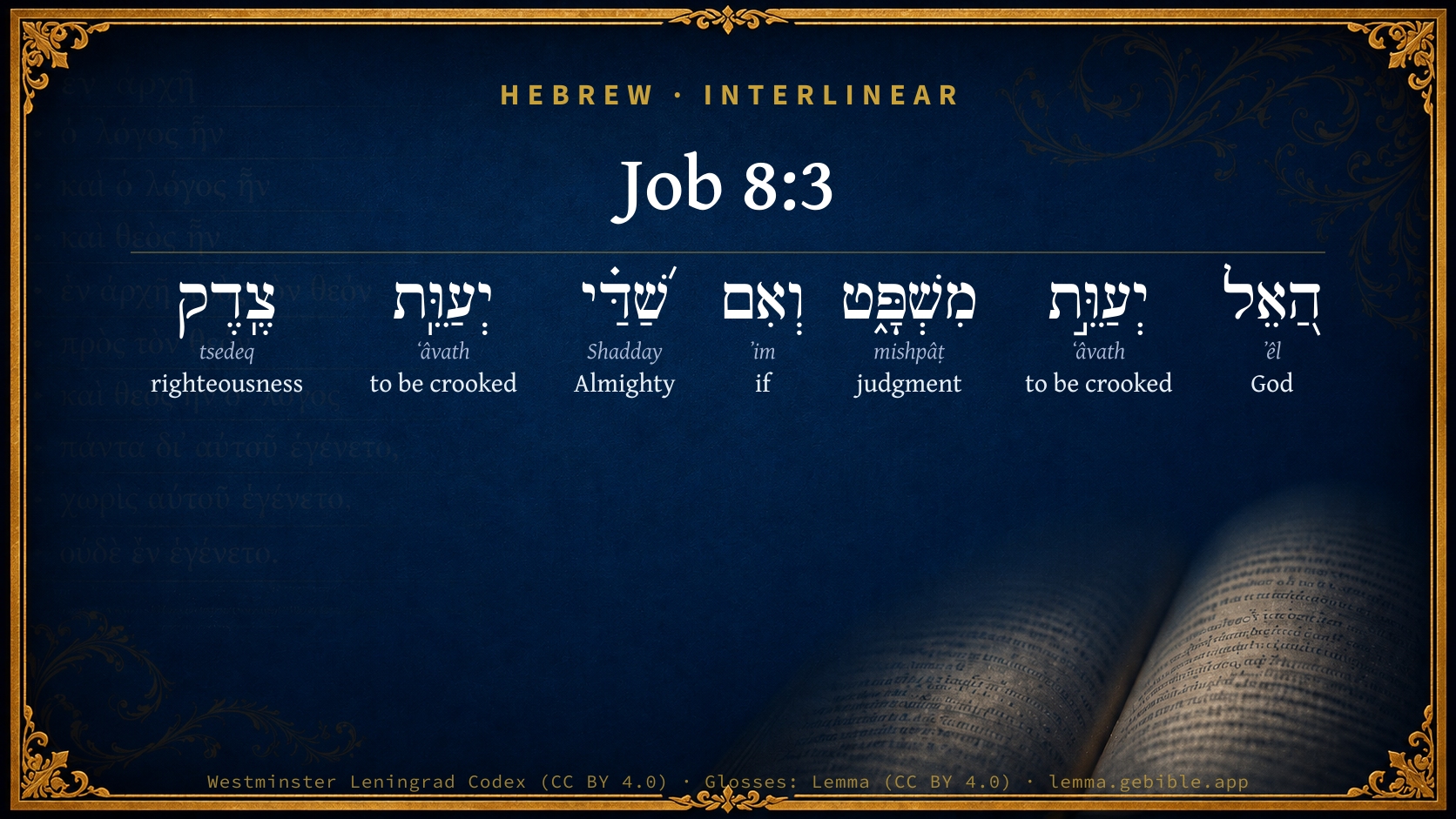
Job 8:3

Hebrew (Westminster Leningrad Codex) Job 8:3 appears in the Hebrew Old Testament. The text above is from the Westminster Leningrad Codex. Each word links to its Strong’s number, a concise gloss, and parsing drawn from the Open Scriptures Hebrew Bible morphology. Click any word for its full Brown-Driver-Briggs (BDB) entry.
Download image
Cite this verse

Job 8:3 (World English Bible). Public Domain. Lemma interlinear Bible study tool, https://lemma.gebible.app/v/job/8/3.

Show BibTeX & RIS
BibTeX
RIS
English Translation
Does God pervert justice? Or does the Almighty pervert righteousness?
World English Bible · Public Domain
Highlights Full analysis ↓
Download a study sheet

One document with this verse’s original text, its word-by-word gloss line, the meaning frame, cross-references with their text, attributed commentary, and full source and license credits — printable, and it pastes into notes with its structure intact.

This verse Autodidact and up

Study sheet (.html) Plain text (.txt)

A passage Seminary Student

Up to 50 verses in one chapter. A passage sheet keeps up to 6 commentary sources and 12 cross-references per verse, in the order this page ranks them, and says so on the sheet whenever that leaves anything out. Ask for a single verse and you get the Autodidact verse sheet above.

Everything on this page stays free to read, with no account — the sheet is a download of what is already on screen, not access to it.

Want to remove ads? Support Godless Engineer
Compare translations 3

The same verse in 3 English versions, stacked beneath the original-language interlinear above. Click any original word for its lexicon entry.

Each is an independent rendering of the whole verse — the interlinear is not word-aligned to these translations.

Highlighted words mark where these versions differ — a whole-verse word diff, not a word-by-word alignment.

  • World English Bible Public Domain
    Does God pervert justice? Or does the Almighty pervert righteousness?
  • King James Version Public Domain
    Doth God pervert judgment? or doth the Almighty pervert justice?
  • unfoldingWord Literal Text CC BY-SA 4.0
    Does God pervert justice? Or does the Almighty pervert righteousness?

unfoldingWord Literal Text — © unfoldingWord, licensed CC BY-SA 4.0. Word-aligned USFM3 via Door43 (git.door43.org/unfoldingWord/en_ult).

Versions to compare (up to 4)

3 of 4 selected

Show all 18 translations

Every available English version of this verse, each an independent rendering of the whole verse.

  • World English Bible Public Domain
    Does God pervert justice? Or does the Almighty pervert righteousness?
  • Berean Standard Bible Public Domain
    Does God pervert justice? Does the Almighty pervert what is right?
  • Majority Standard Bible Public Domain
    Does God pervert justice? Does the Almighty pervert what is right?
  • King James Version Public Domain
    Doth God pervert judgment? or doth the Almighty pervert justice?
  • American Standard Version (1901) Public Domain
    Doth God pervert justice? Or doth the Almighty pervert righteousness?
  • Revised Version (1885) Public Domain
    Doth God pervert judgment? or doth the Almighty pervert justice?
  • Geneva Bible (1599) Public Domain
    Doeth God peruert iudgement? or doeth the Almightie subuert iustice?
  • Douay-Rheims (1899) Public Domain
    Doth God pervert judgment, or doth the Almighty overthrow that which is just?
  • Young's Literal Translation Public Domain
    Doth God pervert judgment? And doth the Mighty One pervert justice?
  • Literal Standard Version CC BY-SA 4.0
    Does God pervert judgment? And does the Mighty One pervert justice?
  • Unlocked Literal Bible CC BY-SA 4.0
    Does God pervert justice? Does the Almighty pervert righteousness?
  • unfoldingWord Literal Text CC BY-SA 4.0
    Does God pervert justice? Or does the Almighty pervert righteousness?
  • Darby Bible Public Domain
    Doth ùGod pervert judgment, and the Almighty pervert justice?
  • World Messianic Bible Public Domain
    Does God pervert justice? Or does the Almighty pervert righteousness?
  • Webster's Bible Public Domain
    Doth God pervert judgment; or doth the Almighty pervert justice?
  • Free Bible Version CC BY-SA 4.0
    Does God pervert justice? Does the Almighty pervert what is right?
  • Bible in Basic English Public Domain
    Does God give wrong decisions? or is the Ruler of all not upright in his judging?
  • JPS Tanakh (1917) Public Domain
    Doth God pervert judgment? Or doth the Almighty pervert justice?

Literal Standard Version (2020), Covenant Press — licensed CC BY-SA 4.0. Text via the HelloAO Bible API (eBible.org). Unlocked Literal Bible (unfoldingWord) — licensed CC BY-SA 4.0. Text via the HelloAO Bible API (eBible.org). unfoldingWord Literal Text — © unfoldingWord, licensed CC BY-SA 4.0. Word-aligned USFM3 via Door43 (git.door43.org/unfoldingWord/en_ult). Free Bible Version, Dr. Jonathan Gallagher — licensed CC BY-SA 4.0. Text via the HelloAO Bible API (eBible.org).

Word by word

More ways to search: Search by grammar → Find every occurrence → Compare this word →

Practice this passage: Drill this verse → Learn its vocabulary →

About this verse

These counts appear in no published source. They are computed here, from the morphology-tagged text and Lemma’s own curated glosses. What Lemma adds →

7
words
6
distinct lemmas
Wisdom
section

Notable vocabulary

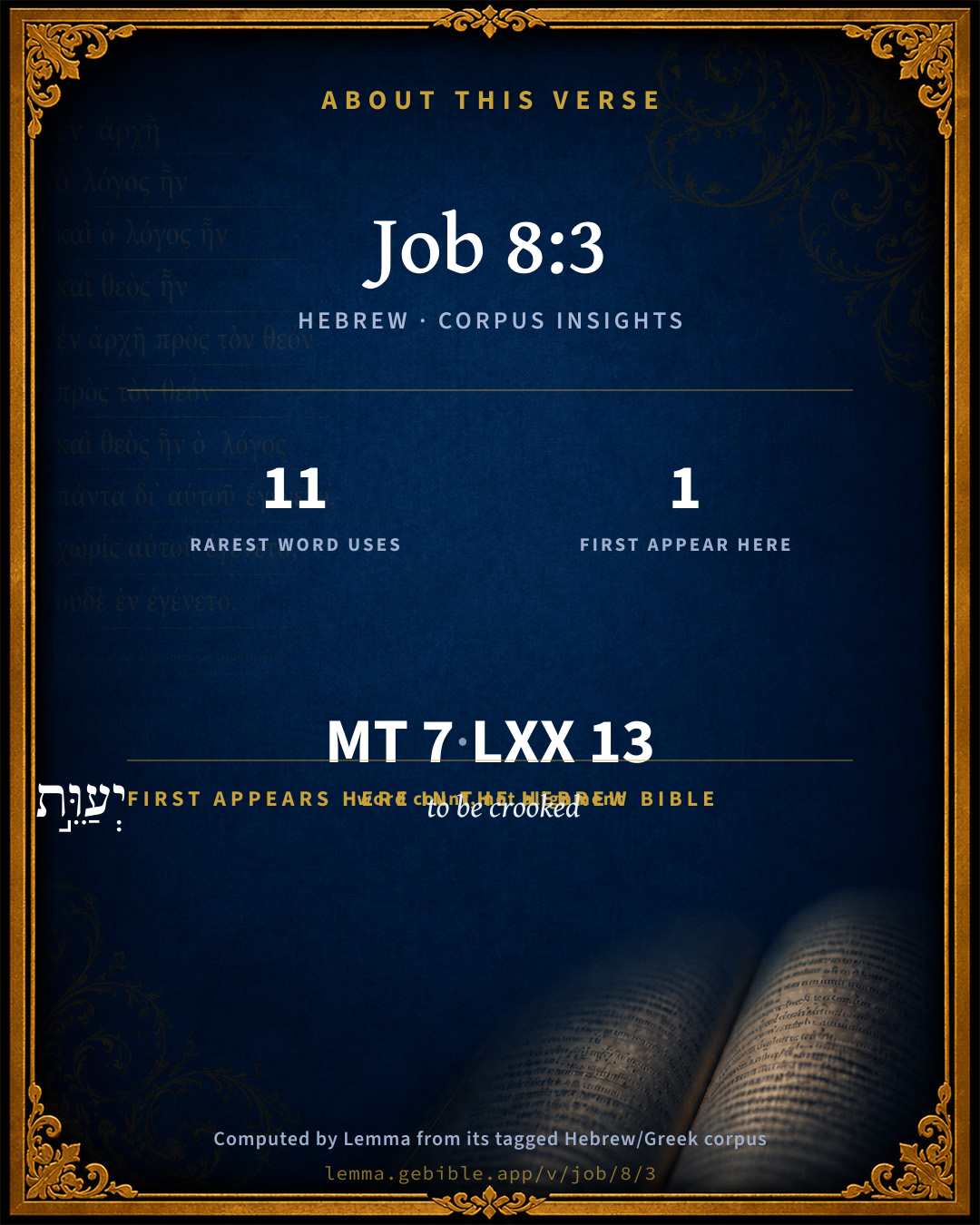
The rarest word here is יְעַוֵּ֣ת to be crooked H5791 — appearing just 11 times in the whole Hebrew Bible.

First appearance in Scripture

This word makes its first canonical appearance in the Hebrew Bible here:

  • יְעַוֵּ֣ת to be crooked H5791

Shared distinctive vocabulary

יְעַוֵּ֣ת to be crooked H5791 occurs in 10 verses of the Hebrew Bible. Also found in:

Grammatical profile

  • 2 verbs
  • 4 nouns
  • 1 conjunction

Verb forms

  • יְעַוֵּ֣ת Piel · Imperfect
  • יְעַוֵּֽת Piel · Imperfect

Repetition

A word recurs within this verse — often emphatic in Hebrew:

  • יְעַוֵּ֣ת to be crooked H5791 ×2

Hebrew & Septuagint length

In English translation the verse runs 10 words from the Hebrew and 18 from the Septuagint (LXX English) — the Septuagint runs noticeably longer here. See the side-by-side →

A rough comparison of the two English renderings, which tokenize alike — not a word-level alignment.

Word counts can differ between the Hebrew and the Greek without any difference in meaning — e.g. the Hebrew direct-object marker אֵת has no separate Greek word, and Greek often adds the article ὁ.

In the original languages it is 7 Hebrew tokens and 13 Greek tokens — but the two are counted differently (Hebrew bundles its prefixes and suffixes into one token; the Greek is in lemma form), so that isn’t a like-for-like length.

Cross-references

25

Topical passages linked to Job 8:3 in the Treasury of Scripture Knowledge — connected by theme and wording, ordered by reader-vote popularity; previews shown in the World English Bible.

  • Genesis 18:25 Be it far from you to do things like that, to kill the righteous with the wicked, that so the righteous should be as the wicked. May that be far from you. Shouldn't the Judge of all the earth do right?"
  • Deuteronomy 32:4 The Rock, his work is perfect; For all his ways are justice: A God of faithfulness and without iniquity, Just and right is he.
  • 2 Chronicles 19:7 Now therefore let the fear of Yahweh be on you; take heed and do it: for there is no iniquity with Yahweh our God, nor respect of persons, nor taking of bribes.
  • Job 34:10–12 "Therefore listen to me, you men of understanding: Far be it from God, that he should do wickedness, From the Almighty, that he should commit iniquity.
  • Ezekiel 33:20 Yet you say, The way of the Lord is not equal. House of Israel, I will judge you everyone after his ways.
  • Daniel 9:14 Therefore has Yahweh watched over the evil, and brought it on us; for Yahweh our God is righteous in all his works which he does, and we have not obeyed his voice.
  • Romans 3:4–6 May it never be! Yes, let God be found true, but every man a liar. As it is written, "That you might be justified in your words, And might prevail when you come into judgment."
  • Job 4:17 'Shall mortal man be more just than God? Shall a man be more pure than his Maker?
  • Job 9:2 "Truly I know that it is so, But how can man be just with God?
  • Job 10:3 Is it good to you that you should oppress, That you should despise the work of your hands, And smile on the counsel of the wicked?
  • Job 19:7 "Behold, I cry out of wrong, but I am not heard: I cry for help, but there is no justice.
  • Job 21:15 What is the Almighty, that we should serve him? What profit should we have, if we pray to him?'
  • Job 21:20 Let his own eyes see his destruction. Let him drink of the wrath of the Almighty.
  • Job 34:5 For Job has said, 'I am righteous, God has taken away my right:
  • Job 34:17–19 Shall even one who hates justice govern? Will you condemn him who is righteous and mighty?--
  • Job 35:13 Surely God will not hear an empty cry, Neither will the Almighty regard it.
  • Job 40:2 "Shall he who argues contend with the Almighty? He who argues with God, let him answer it."
  • Job 40:8 Will you even annul my judgment? Will you condemn me, that you may be justified?
  • Psalms 89:14 Righteousness and justice are the foundation of your throne. Loving kindness and truth go before your face.
  • Psalms 99:4 The King's strength also loves justice. You do establish equity. You execute justice and righteousness in Jacob.
  • Ezekiel 18:25 Yet you say, The way of the Lord is not equal. Hear now, house of Israel: Is my way not equal? Aren't your ways unequal?
  • Ezekiel 33:17 Yet the children of your people say, The way of the Lord is not equal: but as for them, their way is not equal.
  • Romans 2:5 But according to your hardness and unrepentant heart you are treasuring up for yourself wrath in the day of wrath, revelation, and of the righteous judgment of God;
  • Revelation 15:3 They sang the song of Moses, the servant of God, and the song of the Lamb, saying, "Great and marvelous are your works, Lord God, the Almighty; Righteous and true are your ways, you King of the nations.
  • Revelation 16:7 I heard the altar saying, "Yes, Lord God, the Almighty, true and righteous are your judgments."

Cross-references courtesy of OpenBible.info (CC BY 4.0).

Hebrew and Greek witnesses Masoretic Hebrew ↔ Greek Septuagint

The same verse in the two great witnesses to the Old Testament, shown verse-for-verse.

Here the Septuagint runs noticeably longer than the Hebrew — LXX2012 (modern English Septuagint) 18 words vs World English Bible 10. A rough length comparison of the two English translations, not a word-level alignment — read both below.

These are two independent witnesses, not word-aligned to each other, and the Septuagint is shown in lemma (dictionary) form.

Hebrew Job 8:3 Masoretic · Westminster Leningrad Codex

הַ֭אֵל יְעַוֵּ֣ת מִשְׁפָּ֑ט וְאִם שַׁ֝דַּ֗י יְעַוֵּֽת צֶֽדֶק

Does God pervert justice? Or does the Almighty pervert righteousness?

World English Bible · Public Domain

Greek LXX Job 8:3 Septuagint · lemma form

μή ὁ κύριος ἀδικέω κρίνω ἤ ὁ ὁ πᾶς ποιέω ταράσσω ὁ δίκαιος

Will the Lord be unjust when he judges; or will he that has made all things pervert justice?

LXX2012 (modern English Septuagint) · Public Domain

Hebrew: Westminster Leningrad Codex (CC BY 4.0). Greek: Septuagint (public domain); English from LXX2012 (modern English Septuagint) (Public Domain). How the Septuagint differs from the Hebrew →

Commentary

Notes on Job 8:3 from classic Christian and Jewish commentators (each source and its license shown beneath its notes). The classic Christian expositions comment on the surrounding passage and are grouped to its opening verse, so a note may address several verses; the Jewish commentaries on the Tanakh (Rashi and others) are per-verse, so they appear only where the commentator wrote on this verse.

Lemma curates 59 commentaries, every one of them public domain or Creative Commons licensed, each selected and text-cleaned for this edition rather than reprinted as found. About our sources →

Trapp's Complete Commentary

John Trapp

Job 8:3 Doth God pervert judgment? or doth the Almighty pervert justice?

Ver. 3. Doth God prevent judgment?] By not punishing the wicked; or doth the Almighty prevent justice? by not rewarding the righteous (so the Hebrews expound it). Why, no; neither did Job ever say such a thing; only he had pathetically set forth the greatness of his pain, and the unkindness of his friends, and wished to die rather than to endure it. Now this was construed for blasphemy, or little less; and Bildad is very hot in his invective against Job, as good reason he had, if he had not been so mistaken. Here he wresteth in a most true proposition ( commodam sane sed non accommodam), but yet such a one as very little concerned this present disputation; and he doth it with as small wisdom and discretion, saith Beza, as with great pride and confidence. For doth it either argue Job a hypocrite and wicked man, or charge God with injustice, if it be said, that Job for his sins was not so afflicted by God (whereas he in the mean time denieth himself to be a sinner, and to have deserved God’s heavy hand upon him), but rather proved and tried by him according to his good pleasure? yet Bildad goeth on as if he had done very well; and in the next verse in plain words boldly avoucheth that Job’s children were by God’s judgment destroyed with the fall of the house, whatever betide their souls.

John Trapp, A Commentary or Exposition upon All the Books of the Old and New Testament (1647–1656) — public domain. Text from a community e-Sword module.

The Biblical Illustrator

Joseph S. Exell

Job_8:3

Doth the Almighty pervert justice?

Judgment and justice

These two words may be taken as expressing one and the same thing. If we distinguish them, judgment may serve to express Gods righteous procedure in punishing the wicked; and justice His procedure in vindicating the righteous when they are oppressed. Job is unjustly charged, and accordingly he vindicates himself.

1. Jobs maintaining of his own righteousness is not a quarrelling of Gods righteousness, who afflicted him. Job held both to be true, though he could not reconcile Gods dealing with the testimony of his own conscience, that did evidence his weakness, but not charge God With unrighteousness.

2. As for his complaints of Gods dealings, he was indeed more culpable therein than he would at first see and acknowledge; yet therein he intended no direct accusation against Gods righteousness. Learn--

(1) The justice of God is so uncontrovertedly clear in all His proceeding, whether He act immediately, or mediately by instruments, that the conscience of the greatest complainer, when put to it seriously, must subscribe to it; and all are bound to the defence of it, as witnesses for God.

(2) Such as know God, in His perfect and holy nature and attributes, will see clear cause to justify God in His proceeding; and particularly they who look upon His omniscient power and all-sufficiency, will see that He can neither be moved to injustice by hope of any reward, nor hindered to be just by the fear of the greatness of any, or any other by-respect.

(3) Though God be unquestionably just, yet His dispensations may, sometimes, be such toward His people as they cannot easily reconcile His justice in His dealing, with the testimony of their own consciences, concerning their own integrity.

(4) The study of Gods sovereignty will solve many difficulties in the sad lots and sufferings of saints. (George Hutcheson.)

The Biblical Illustrator, edited by Joseph S. Exell (c. 1880s–1900s) — public domain. Text from a community e-Sword module.

Joseph Benson's Commentary

Job 8:3. Doth God — Hebrew, אל, Eel, the mighty God, as this word signifies; pervert judgment? — Judge unrighteously? No: this is inconsistent with God’s nature, Which is essentially and necessarily just, and with his office of governor of the world. Or doth the Almighty pervert justice? — Hebrew, שׁדי, Shaddai, a word that sets forth God’s omnipotence and all-sufficiency. These names are emphatically used to prove that God cannot deal unjustly or falsely with men: because he hath no need so to do, nor temptation to it, being self-sufficient for his own happiness, and being able, by his own invincible power, to do whatsoever pleaseth him.

Joseph Benson's Commentary on the Old and New Testaments (1811–1818) — public domain. Text from a community e-Sword module.

Tyndale Open Study Notes

Tyndale Open Resources

8:3-4 According to Bildad, God does not twist justice, so the death of Job’s children proved that they had sinned against God. Bildad divided people into the blameless (Hebrew tam, 8:20a; see 1:1) and the secretly wicked (Hebrew khanep, 8:13b). He believed that they could be differentiated by watching what God did to them.

Tyndale Open Study Notes — © Tyndale Open Resources, licensed CC BY-SA 4.0. Text via the HelloAO Bible API.

Jamieson, Fausset & Brown

Robert Jamieson, A. R. Fausset & David Brown

The repetition of "pervert" gives an emphasis galling to Job (Job 34:12). "Wouldst thou have God," as thy words imply, "pervert judgment," by letting thy sins go unpunished? He assumes Job's guilt from his sufferings.

Jamieson, Fausset & Brown — Commentary Critical and Explanatory on the Whole Bible (1871) — public domain (CC PDM 1.0). Text via the HelloAO Bible API.

Adam Clarke's Commentary

Verse 3. Doth God pervert judgment!] God afflicts thee; can he afflict thee for naught? As he is just, his judgment is just; and he could not inflict punishment unless there be a cause.

Adam Clarke's Commentary on the Bible (1810–1826) — public domain. Text from a community e-Sword/MySword module.

The Cambridge Bible for Schools and Colleges

gen. ed. J. J. S. Perowne

3. doth God pervert] Or, will God pervert … will the Almighty, &c.? This is what Bildad means by his reference to these things. Job’s speech put briefly is an assertion that God perverts justice. God is referred to in his character of ruler of the world. By the question Bildad expresses his astonishment and abhorrence of what seems the drift of Job’s language. The words “God” and “Almighty” stand first in the sentence for the sake of emphasis, will God …? and the same word “pervert” is also used in both clauses with an intonation of astonishment.

The Cambridge Bible for Schools and Colleges (gen. ed. J. J. S. Perowne; Cambridge University Press, 1878–1918) — public domain. Text from a community e-Sword module.

John Gill's Exposition

If thy children have sinned against him,.... As no doubt they had, and, as Bildad thought, in a very notorious manner, and therefore were righteously punished for them; this instance is produced as a proof of God's not perverting, but doing justice, and the rather, because it was on account of this that it was supposed that Job charged, or was ready to charge, God with injustice; this was so far from it, that it was a righteous thing to do it, "if" or "seeing" his children had sinned; or "because" they have sinned, or "though" they have sinned, as the words (h) are by some differently rendered; and either way shows that God did not pervert justice, but acted agreeably to it. Mr. Broughton renders them, "as thy children have sinned against him, so hath he sent them into the hand of their trespass"; as a righteous retaliation for it: that Job's children had sinned, there is no question to be made of it; they were born in sin, though born of godly parents; and though they had a religious education, yet no doubt were guilty of sin in their younger years, as well as when grown up; and even though good men, as there may be reason to conclude they were, yet daily sinning, for there are none without sin; and also it is true, that all sin is against God, contrary to his nature and will, a breach and transgression of his law, and an act of hostility against himself, and a trampling under foot, or at least a neglect, of his legislative power and authority, which is an aggravation of it; yet it does not appear that Job's children were guilty of any notorious sins or atrocious crimes, or lived a sinful course of life, for which the judgments of God came upon them; nor is it a clear case that they were taken away by death in the manner they were on account of their sins, but rather purely for the trial of Job's integrity, faith, and patience:

and he have cast them away for their transgression; or "by the hand of it" (i); by means of it, because of it, being provoked with it. Bildad represents them as abandoned sinners, as castaways and reprobates, rejected of God with abhorrence, and utterly ruined. Some render it, "hath sent them into the hand of their transgression" (k), or trespass; that is, delivered them up to the power and dominion of sin, gave them up to their hearts' lusts, and to vile affections, to do things not convenient, and which they pursued to their ruin; the Targum is,"he sent them into the place of their transgression (l);''into hell, which their transgressions deserved, and for which they were fitted by them. Some a little more mildly render the words, "he sent them away" (m); that is, dismissed them out of the world, took them out of it by death; which dismission is sometimes in peace, as good old Simeon prayed for, and sometimes in wrath, as Saul was taken away, see Luk 2:29; the latter is the meaning here.

(h) "quandoquidem", Michaelis; "quia", Vatablus; "etiamsi", V. L. (i) "in manu iniquitatis suae", V. L. so Montanus, Cocceius. (k) "In manum transgressionis ipsorum", Piscator, Beza, Schmidt, Michaelis, Schultens; "in potestatem defectionis ipsorum", Junius & Tremellius. (l) So Munster (m) "et dimisit eos", Drusius; "e mundo", Pagninus, Vatablus; so Gersom.

John Gill's Exposition of the Whole Bible (1746–1763) — public domain (CC PDM 1.0). Text via the HelloAO Bible API.

Albert Barnes' Notes on the Bible

Doth God pervert judgment? - That is, Does God afflict people unjustly? Does he show favor to the evil, and punish the good? Bildad here undoubtedly refers to Job, and supposes that he had brought this charge against God. But he had not done it in so many words. He had complained of the severity of his sufferings, and had indulged in irreverent language toward God. But he had not advanced the charge openly that God had perverted right. Bildad strenuously maintains that God would do right. His argument is based on the supposition that God would deal with people in this life according to their character; and thus he infers that Job must have been guilty of some great wickedness, that punishment should come upon him in this manner.

Albert Barnes' Notes on the Bible (1834–1885) — public domain. Text from a community e-Sword/MySword module.

Haydock's Catholic Bible Commentary

Just. He begins with the same principle as Eliphaz, which nobody denied. But he does not reflect, that God may cause even the just to be afflicted, for their trial and improvement.

George Leo Haydock (1774–1849), Haydock's Catholic Family Bible and Commentary, 1859 edition — public domain. Excludes Psalms (Douay-Rheims chapter numbering differs from Protestant) and Deuterocanonical books (Catholic canon only).

Matthew Poole's English Annotations

God, Heb. the mighty God, as this word signifies; the almighty or all-sufficient God, as the next name of God here implies. These names are emphatically used, to prove that God cannot deal unjustly or falsely with men, because he hath no need of it, nor temptation to it, being self-sufficient for his own happiness, and being able by his own invincible power to do whatsoever pleaseth him; unless men will impudently say that God doth falsely for mere love to falsehood, without any necessity of it, or advantage to himself by it, than which nothing can be more absurd and ridiculous; for this makes him worse than the vilest of men, who act unjustly and falsely because they cannot otherwise accomplish their designs.

Pervert judgment, i.e. overthrow the course of justice in giving judgment, or judge unrighteously. No, this is inconsistent with God’s nature, which is essentially and necessarily just, and with his office of Governor of the world, Gen 18:25.

Matthew Poole's English Annotations on the Holy Bible (1683–1685) — public domain. Text from a community e-Sword/MySword module.

Whedon's Commentary on the Bible

Daniel D. Whedon

3. God… the Almighty — אל, el, and שׁדי, shaddai. Though differing in form, the root idea of both is that of power. These, perhaps, were world-wide titles of God, while the name Jehovah was confined to the chosen people. Balaam (as well as the Gentile Job and his friends) uses the terms el and shaddai, (Num_24:4; Num_24:16,) and in a juxtaposition similar to that of our text. The latter name rarely appears in the later books of the Bible. it occurs nine times in the Pentateuch, twice in Ruth, thirty-one times in Job, and six times in all the other poets. The word shaddai is a plural of pre-eminence, probably from shadhadh, “to be strong.” Shaddai is the God who makes good his covenants, (Gen_17:1, see note,) who everywhere enforces his will, punishes the wicked, and protects the just. Here for the first time appears the favourite thought of Job’s co-reasoners, that an almighty being cannot do wrong. Bildad, the apostle of inexorable law, contemplated God only through the attribute of his almightiness, from which justice is inseparable.

Daniel D. Whedon (gen. ed.), Commentary on the Old and New Testaments (1874–1909) — public domain. Text from a community e-Sword module.

The Pulpit Commentary

Doth God pervert judgment? This was, no doubt, what Job"s words of expostulation might seem to imply. But he had never gone so far as to make the direct charge, and a true friend would have shrunk from taxing him with an impiety, witch could only be deduced from his speech by way of inference. It is our duty to put the best construction that we can on our friends" words, no less than upon their actions. Or doth the Almighty pervert justice? "Justice" is not altogether the same thing with "judgment." Judgment is the act, justice the principle which underlies or ought to underlie the act. It is, of course, impossible for God to pervert either. "Shall not the Judge of all the earth do right?". (Gen_18:25)

The justice of God.

Bildad asks if it can be right for Job to complain as he does. Such conduct is an arraignment of the Divine justice. Human judges have been known to twist justice to suit their own purposes; this conduct was and is only too common in the East. But is it to be thought that God would act in this way? Surely the Judge of all the earth must do right. (Gen_18:25)

I GOD"S JUSTICE IS GOOD AND DESIRABLE. It is the mistake of narrow, one-sided views to confine the idea of God"s justice to his relations with sin and punishment, and to regard it solely as that which provokes his wrath. This mistake leads people t, have a horror of the very notion of God"s justice. They would be profoundly thankful if it could be blotted out of the list of his attributes. They regard it as solely inimical to them. Their supreme desire is to escape from its clutches. It is to them a most dreadful thing. How contrary is all this to the scriptural idea of the justice of God! In the Bible God"s justice is welcomed with delight in contrast to the terrible injustice of man. It is God"s righteousness, God"s fairness, God"s equal dealing. This must be good and desirable.

II THE JUSTICE OF GOD IS NOT ALWAYS APPARENT. Sometimes he seems to show himself in the same light as the unjust judges of imperfect human society. We cannot see the equity of his dealings. He even seems to be perverting judgment. Good men suffer, and evil men prosper. This is the common complaint of the Old Testament saints in their trouble. (e.g. Psa_73:3) But how is it possible if God is just? There is not only an apparent negligence that lets wrong be done among men unchecked. God himself appears to pervert justice in his own providential dealings, sending calamities to the innocent, and heaping favours on the guilty. This obvious fact was forced on the notice of men, and it raised most perplexing doubts at a time when temporal good was assumed to be the right reward of moral good.

III WE HAVE GOOD REASON TO TRUST THE JUSTICE OF GOD.

1. He is almighty. He has not the inducement to act unjustly that tempts the weak. Deceit and injustice are the refuges of feebleness. Cowards are unjust. Strength can afford to be magnanimous.

2. He is perfectly wise. He will not blunder into injustice, as the most immaculate human judge may do.

3. He is absolutely good. Our revelations of God"s character should assure us that his justice must be without a flaw, even though all appearances are against it. The faith that will not bear a strain is worthless. If we cannot trust God when he seems to be acting hardly and unfairly, it is little that we trust him when we can see that all is going well. The goodness of God is our security; we must judge of events by what we know of God in Christ, not of God by what we appear to discover in events.

4. Justice is not always what we should expect. The principle must be simple and intelligible. We must believe that justice in God must be what we know as justice only infinitely exalted. But the application of this justice may be beyond our conceptions. It may be just for God to do what looks to us now as unfair. Here we must trust and wait for the end. W.F.A.

The Pulpit Commentary (1880–1919), ed. H.D.M. Spence-Jones & Joseph S. Exell — public domain. Text from a community e-Sword module.

John Wesley's Explanatory Notes

Doth God - Hebrew. The might God, as this word signifies, the Almighty, or All-sufficient God, as the next name of God implies. These names are emphatically used, to prove that God cannot deal unjustly or falsely with men, because he hath no need of it, nor temptation to it, being self-sufficient for his own happiness, and being able by his own invincible power to do whatsoever pleaseth him. Pervert - Judge unrighteously? No, this is inconsistent with God's nature, and with his office of governor of the world.

John Wesley, Explanatory Notes Upon the Whole Bible (1754–1765) — public domain. Text via the GEBible commentary corpus.

Rashi

Rabbi Shlomo Yitzchaki (Rashi)

Does God pervert judgment Heb. הא-ל. The “hey” is vowelized with a “patach,” and it means an expression of wonder.

Rashi on the Tanakh — English translations: “The Judaica Press complete Tanach with Rashi, translated by A. J. Rosenberg” (CC BY 4.0); “Pentateuch with Rashi's commentary by M. Rosenbaum and A.M. Silbermann, 1929-1934” (public domain); “The Metsudah Tanach series, Lakewood, N.J” (CC BY 4.0); and “The Book of Joshua, Metsudah Publications, 1997” (CC BY 4.0). Text via Sefaria.

Lesson kit

Teaching starters — assembled from the data on this page, not authored interpretation. Every prompt links to the verse data it draws on. Edit before teaching.

Job, in the Wisdom, opens this verse with 7 words (6 distinct Hebrew lemmas). Its most distinctive word is ʻâvath (“to be crooked”). The Greek Septuagint runs longer here. A historical commentator’s framing appears above. Read the whole chapter for the surrounding context.

Discussion questions

  1. The word ʻâvath carries the sense “to be crooked.” How does it shape the verse?
  2. The word “to be crooked” first appears here in Scripture. What is being introduced at this debut?
  3. Job 19:6 shares the word «to be crooked» with this verse. How do the two illuminate each other?
  4. “to be crooked” occurs 2× in this one verse. What is the effect of the repetition?
  5. Compared with the Hebrew, the Septuagint runs longer here. What questions does that raise?
  6. These translations render this verse differently. What is at stake in choosing one wording over another?
  7. The verb «יְעַוֵּ֣ת» is Piel Imperfect. How does its form color the action?
  8. Reading how Trapp's Complete Commentary and The Biblical Illustrator read this verse, where do the two commentators agree and where do they part?

Things to notice

Reading settings

Reading text

Shown beneath each verse's original-language words.

Old Testament
Old Testament edition

Read the OT as the Masoretic Hebrew (MT) or the Greek Septuagint (LXX).

English shown for the Greek Septuagint (in the Hebrew ↔ Greek comparison).

Comparing translations? Open the Compare panel on any verse page to stack up to four side by side.