
Revelation 22:11

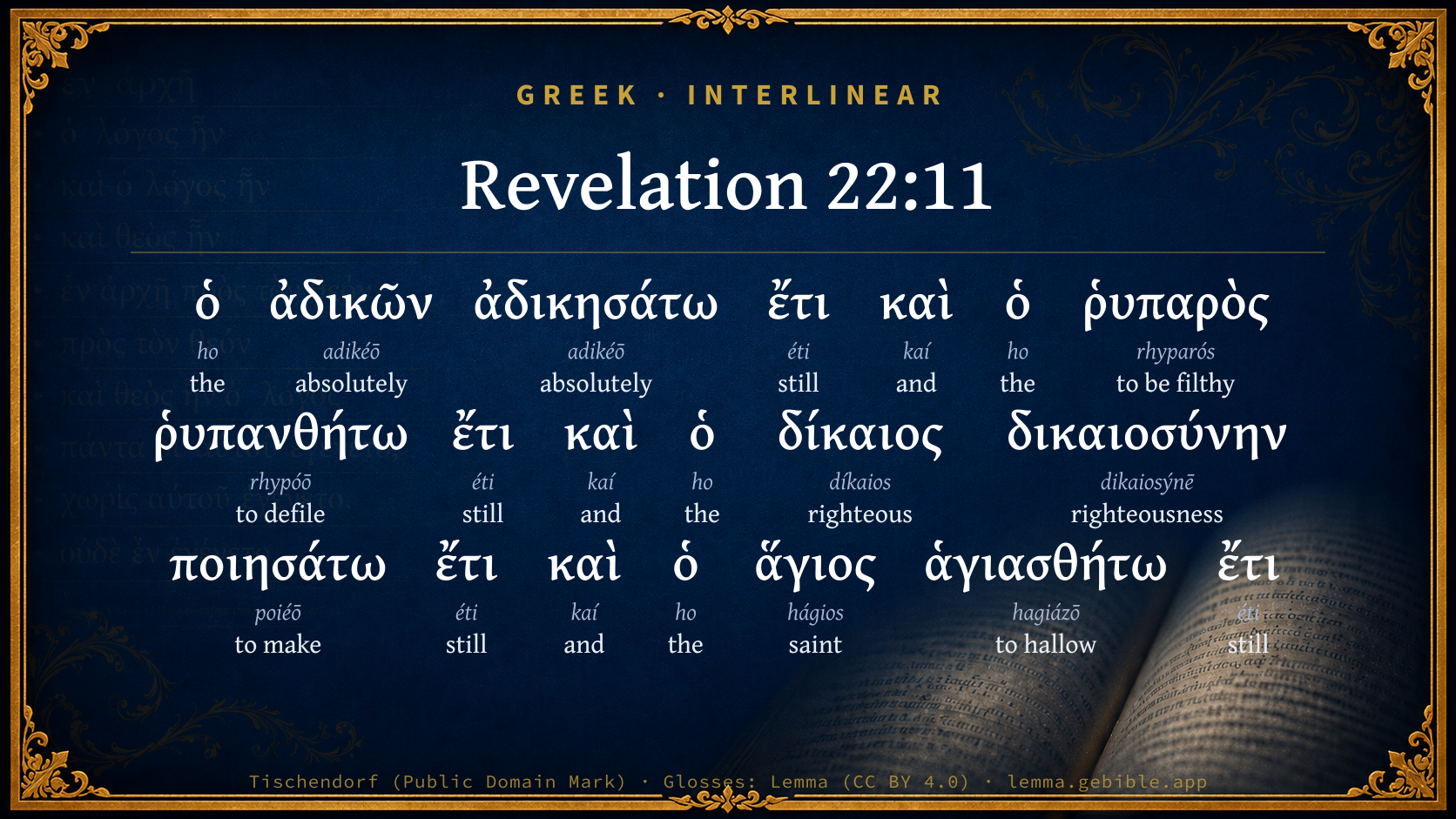
Greek (Tischendorf 8th ed.) Revelation 22:11 appears in the Greek New Testament. The text above is from the Tischendorf 8th edition. Each word links to its Strong’s number and a concise gloss. Click any word for its full Thayer’s Greek Lexicon entry.
Download image
Cite this verse

Revelation 22:11 (World English Bible). Public Domain. Lemma interlinear Bible study tool, https://lemma.gebible.app/v/revelation/22/11.

Show BibTeX & RIS
BibTeX
RIS
English Translation
He who acts unjustly, let him act unjustly still. He who is filthy, let him be filthy still. He who is righteous, let him do righteousness still. He who is holy, let him be holy still."
World English Bible · Public Domain
Highlights
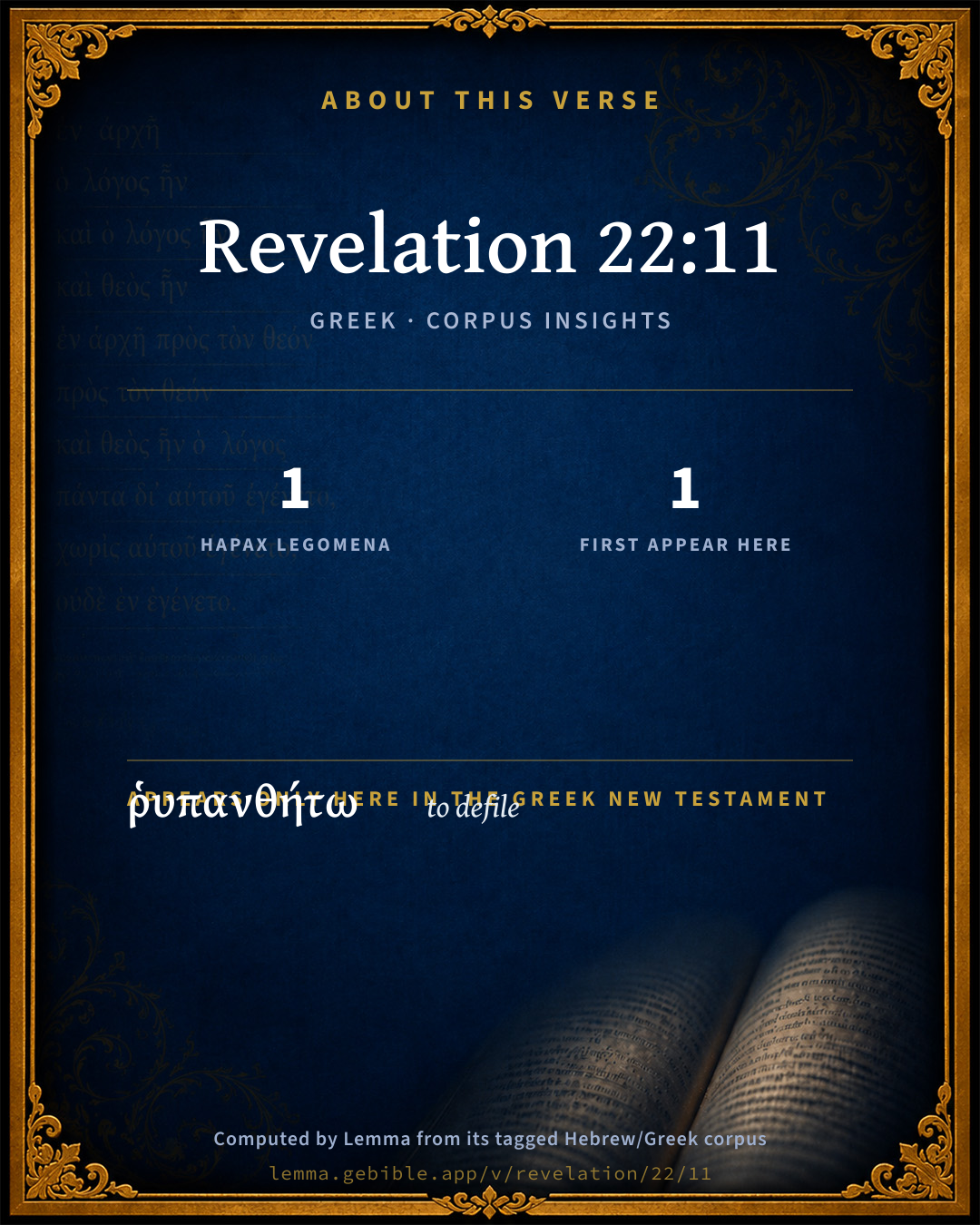
  • 1 hapax legomenon — only here in the Greek New Testament
  • 1 first appearance in the Greek New Testament
Full analysis ↓
Download a study sheet

One document with this verse’s original text, its word-by-word gloss line, the meaning frame, cross-references with their text, attributed commentary, and full source and license credits — printable, and it pastes into notes with its structure intact.

This verse Autodidact and up

Study sheet (.html) Plain text (.txt)

A passage Seminary Student

Up to 50 verses in one chapter. A passage sheet keeps up to 6 commentary sources and 12 cross-references per verse, in the order this page ranks them, and says so on the sheet whenever that leaves anything out. Ask for a single verse and you get the Autodidact verse sheet above.

Everything on this page stays free to read, with no account — the sheet is a download of what is already on screen, not access to it.

Want to remove ads? Support Godless Engineer
Compare translations 3

The same verse in 3 English versions, stacked beneath the original-language interlinear above. Click any original word for its lexicon entry.

Each is an independent rendering of the whole verse — the interlinear is not word-aligned to these translations.

Highlighted words mark where these versions differ — a whole-verse word diff, not a word-by-word alignment.

  • World English Bible Public Domain
    He who acts unjustly, let him act unjustly still. He who is filthy, let him be filthy still. He who is righteous, let him do righteousness still. He who is holy, let him be holy still."
  • King James Version Public Domain
    He that is unjust, let him be unjust still: and he which is filthy, let him be filthy still: and he that is righteous, let him be righteous still: and he that is holy, let him be holy still.
  • unfoldingWord Literal Text CC BY-SA 4.0
    Let the one being unrighteous still be unrighteous, and let the filthy still be filthy, and let the righteous still do righteousness, and let the holy still be holy.

unfoldingWord Literal Text — © unfoldingWord, licensed CC BY-SA 4.0. Word-aligned USFM3 via Door43 (git.door43.org/unfoldingWord/en_ult).

Versions to compare (up to 4)

3 of 4 selected

Show all 19 translations

Every available English version of this verse, each an independent rendering of the whole verse.

  • World English Bible Public Domain
    He who acts unjustly, let him act unjustly still. He who is filthy, let him be filthy still. He who is righteous, let him do righteousness still. He who is holy, let him be holy still."
  • Berean Standard Bible Public Domain
    Let the unrighteous continue to be unrighteous, and the vile continue to be vile; let the righteous continue to practice righteousness, and the holy continue to be holy.”
  • Majority Standard Bible Public Domain
    Let the unrighteous continue to be unrighteous, and the vile continue to be vile; let the righteous continue to practice righteousness, and the holy continue to be holy.”
  • King James Version Public Domain
    He that is unjust, let him be unjust still: and he which is filthy, let him be filthy still: and he that is righteous, let him be righteous still: and he that is holy, let him be holy still.
  • American Standard Version (1901) Public Domain
    He that is unrighteous, let him do unrighteousness still: and he that is filthy, let him be made filthy still: and he that is righteous, let him do righteousness still: and he that is holy, let him be made holy still.
  • Revised Version (1885) Public Domain
    He that is unrighteous, let him do unrighteousness still: and he that is filthy, let him be made filthy still: and he that is righteous, let him do righteousness still: and he that is holy, let him be made holy still.
  • Geneva Bible (1599) Public Domain
    He that is vniust, let him be vniust stil and he which is filthie, let him be filthie still: and hee that is righteous, let him be righteous stil: and he that is holy, let him be holy still.
  • Douay-Rheims (1899) Public Domain
    He that hurteth, let him hurt still: and he that is filthy, let him be filthy still: and he that is just, let him be justified still: and he that is holy, let him be sanctified still.
  • Young's Literal Translation Public Domain
    he who is unrighteous -- let him be unrighteous still, and he who is filthy -- let him be filthy still, and he who is righteous -- let him be declared righteous still, and he who is sanctified -- let him be sanctified still:
  • Literal Standard Version CC BY-SA 4.0
    The [one] being unrighteous—let him be unrighteous still; and the filthy—let him be filthy still; and the righteous—let him do righteousness still; and the holy—let him be holy still.
  • Unlocked Literal Bible CC BY-SA 4.0
    The one who is unrighteous, let him continue to do unrighteousness. The one who is morally filthy, let him continue to be morally filthy. The one who is righteous, let him continue to do what is righteous. The one who is holy, let him continue to be holy.”
  • unfoldingWord Literal Text CC BY-SA 4.0
    Let the one being unrighteous still be unrighteous, and let the filthy still be filthy, and let the righteous still do righteousness, and let the holy still be holy.
  • Darby Bible Public Domain
    Let him that does unrighteously do unrighteously still; and let the filthy make himself filthy still; and let him that is righteous practise righteousness still; and he that is holy, let him be sanctified still.
  • World Messianic Bible Public Domain
    He who acts unjustly, let him act unjustly still. He who is filthy, let him be filthy still. He who is righteous, let him do righteousness still. He who is holy, let him be holy still.”
  • Webster's Bible Public Domain
    He that is unjust, let him be unjust still: and he who is filthy, let him be filthy still: and he that is righteous, let him be righteous still: and he that is holy, let him be holy still.
  • Free Bible Version CC BY-SA 4.0
    Whoever doesn't do what is right, let them stay that way. Whoever is impure, let them stay that way. Whoever does what is right, let them stay that way. Whoever is holy, let them stay that way.”
  • Bible in Basic English Public Domain
    Let the evil man go on in his evil: and let the unclean be still unclean: and let the upright go on in his righteousness: and let the holy be holy still.
  • Text-Critical English NT CC BY 4.0
    Let the evildoer still do evil, and the filthy still be filthy, and the righteous still do right, and the holy still be holy.”
  • Tyndale New Testament (1534) Public Domain
    He that doeth evyl let him do evyl still: and he which is fylthy let him be fylthy still: and he that is righteous let him be more righteous: and he that is holy let him be more holy.

Literal Standard Version (2020), Covenant Press — licensed CC BY-SA 4.0. Text via the HelloAO Bible API (eBible.org). Unlocked Literal Bible (unfoldingWord) — licensed CC BY-SA 4.0. Text via the HelloAO Bible API (eBible.org). unfoldingWord Literal Text — © unfoldingWord, licensed CC BY-SA 4.0. Word-aligned USFM3 via Door43 (git.door43.org/unfoldingWord/en_ult). Free Bible Version, Dr. Jonathan Gallagher — licensed CC BY-SA 4.0. Text via the HelloAO Bible API (eBible.org).

Word by word

More ways to search: Search by grammar → Find every occurrence → Compare this word →

Practice this passage: Drill this verse → Learn its vocabulary →

ῥυπανθήτω
rhypóō
G4510
“to defile”
Verb, Aorist, Passive, Imperative, 3rd person, Singular
Part of Speech
Verb
Tense
Aorist
Voice
Passive
Mood
Imperative
Person
3rd person
Number
Singular
Full Thayer's Definition

Origin: from G4509

TDNT: None

1. to make filthy, defile, soil 2. to be filthy (morally)
  1. ὁ ho G3588 “the” Article, Nominative, Singular, Masculine
  2. ἀδικῶν adikéō G91 “absolutely” Verb, Present, Active, Participle, Nominative, Singular, Masculine
  3. ἀδικησάτω adikéō G91 “absolutely” Verb, Aorist, Active, Imperative, 3rd person, Singular
  4. ἔτι éti G2089 “still” Adverb
  5. καὶ kaí G2532 “and” Conjunction
  6. ὁ ho G3588 “the” Article, Nominative, Singular, Masculine
  7. ῥυπαρὸς rhyparós G4508 “to be filthy” Adjective, Nominative, Singular, Masculine
  8. ἔτι éti G2089 “still” Adverb
  9. καὶ kaí G2532 “and” Conjunction
  10. ὁ ho G3588 “the” Article, Nominative, Singular, Masculine
  11. δίκαιος díkaios G1342 “righteous” Adjective, Nominative, Singular, Masculine
  12. δικαιοσύνην dikaiosýnē G1343 “righteousness” Noun, Accusative, Singular, Feminine
  13. ποιησάτω poiéō G4160 “to make” Verb, Aorist, Active, Imperative, 3rd person, Singular
  14. ἔτι éti G2089 “still” Adverb
  15. καὶ kaí G2532 “and” Conjunction
  16. ὁ ho G3588 “the” Article, Nominative, Singular, Masculine
  17. ἅγιος hágios G40 “saint” Adjective, Nominative, Singular, Masculine
  18. ἁγιασθήτω hagiázō G37 “to hallow” Verb, Aorist, Passive, Imperative, 3rd person, Singular
  19. ἔτι éti G2089 “still” Adverb

About this verse

These counts appear in no published source. They are computed here, from the morphology-tagged text and Lemma’s own curated glosses. What Lemma adds →

20
words
11
distinct lemmas
Revelation
section

Notable vocabulary

1 hapax legomenon — a word that appears only here in the entire Greek New Testament:

  • ῥυπανθήτω to defile G4510

First appearance in Scripture

This word makes its first canonical appearance in the Greek New Testament here:

  • ῥυπανθήτω to defile G4510

Shared distinctive vocabulary

ῥυπαρὸς to be filthy G4508 occurs in 2 verses of the Greek New Testament. Also found in:
Repetition

Words recur within this verse:

  • ἔτι still G2089 ×4
  • ἀδικῶν absolutely G91 ×2
  • ὁ the G3588 ×4
  • καὶ and G2532 ×3

Cross-references

21

Topical passages linked to Revelation 22:11 in the Treasury of Scripture Knowledge — connected by theme and wording, ordered by reader-vote popularity; previews shown in the World English Bible.

  • Daniel 12:10 Many shall purify themselves, and make themselves white, and be refined; but the wicked shall do wickedly; and none of the wicked shall understand; but those who are wise shall understand.
  • Proverbs 4:18 But the path of the righteous is like the dawning light, That shines more and more until the perfect day.
  • Ezekiel 3:27 But when I speak with you, I will open your mouth, and you shall tell them, Thus says the Lord Yahweh: He who hears, let him hear; and he who forbears, let him forbear: for they are a rebellious house.
  • 2 Timothy 3:13 But evil men and impostors will grow worse and worse, deceiving and being deceived.
  • Matthew 15:14 Leave them alone. They are blind guides of the blind. If the blind guide the blind, both will fall into a pit."
  • Job 17:9 Yet shall the righteous hold on his way. He who has clean hands shall grow stronger and stronger.
  • Matthew 5:6 Blessed are those who hunger and thirst after righteousness, For they shall be filled.
  • Proverbs 14:32 The wicked is brought down in his calamity, But in death, the righteous has a refuge.
  • Matthew 25:10 While they went away to buy, the bridegroom came, and those who were ready went in with him to the marriage feast, and the door was shut.
  • Jude 1:24 Now to him who is able to keep them from stumbling, and to present you faultless before the presence of his glory in great joy,
  • Proverbs 1:24–33 Because I have called, and you have refused; I have stretched out my hand, and no one has paid attention;
  • Ephesians 5:27 that he might present the assembly to himself gloriously, not having spot or wrinkle or any such thing; but that it should be holy and without blemish.
  • Matthew 21:19 Seeing a fig tree by the road, he came to it, and found nothing on it but leaves. He said to it, "Let there be no fruit from you forever!" Immediately the fig tree withered away.
  • Psalms 81:12 So I let them go after the stubbornness of their hearts, That they might walk in their own counsels.
  • John 8:21 Jesus said therefore again to them, "I am going away, and you will seek me, and you will die in your sins. Where I go, you can't come."
  • Revelation 16:8–11 The fourth poured out his bowl on the sun, and it was given to him to scorch men with fire.
  • Revelation 16:21 Great hailstones, about the weight of a talent, came down out of the sky on people. People blasphemed God because of the plague of the hail, for this plague is exceedingly severe.
  • Revelation 7:13–15 One of the elders answered, saying to me, "These who are arrayed in white robes, who are they, and from where did they come?"
  • Colossians 1:22 yet now he has reconciled in the body of his flesh through death, to present you holy and without blemish and blameless before him,
  • Ecclesiastes 11:3 If the clouds are full of rain, they empty themselves on the earth; And if a tree falls toward the south, or toward the north, In the place where the tree falls, there shall it be.
  • Revelation 22:3 There will be no curse any more. The throne of God and of the Lamb will be in it, and his servants serve him.

Cross-references courtesy of OpenBible.info (CC BY 4.0).

Commentary

Notes on Revelation 22:11 from classic Christian and Jewish commentators (each source and its license shown beneath its notes). The classic Christian expositions comment on the surrounding passage and are grouped to its opening verse, so a note may address several verses; the Jewish commentaries on the Tanakh (Rashi and others) are per-verse, so they appear only where the commentator wrote on this verse.

Lemma curates 59 commentaries, every one of them public domain or Creative Commons licensed, each selected and text-cleaned for this edition rather than reprinted as found. About our sources →

Tyndale Open Study Notes

Tyndale Open Resources

22:11 Vile people who refuse to accept God’s forgiveness will continue to be vile (see 16:9), yet John reminds the righteous to maintain their integrity. This verse is a warning to evildoers, and it calls the righteous to recognize the crucial significance of Christ’s return relative to their commitments and their actions.

Tyndale Open Study Notes — © Tyndale Open Resources, licensed CC BY-SA 4.0. Text via the HelloAO Bible API.

Bengel's Gnomon

Johann Albrecht Bengel

Rev 22:11. Ῥυπαρευθήτω[245]) Erasmus, here patching up Greek words from Latin, made ῥυπωσάτω, from ῥυπόω. I said in my Apparatus that ῥυπάω, not ῥυπόω, is a neuter verb: but Wolf expressed his fear, that it could not be proved, that ῥυπάω only was neuter. It was the part of that most learned man, to maintain by examples his assertion concerning the use of ῥυπόω also as a neuter. Neuters in οω are indeed given, δολιόω, μεσόω, σκηνόω: but when two verbs are formed from one theme, very frequently the form in οω is active, and the form in εω or αω is neuter, as καρπόω, εὐκαρπέω· ἀντιστατέω, ἀναστατόω· ἀσθενέω, ἀσθενόω· κρατερέω, κρατερόω· and thus ῥυπάω, ῥυπόω. Undoubtedly in Aristophanes, who is quoted by Wolf (besides ῥυπῶν, which is ambiguous when taken by itself), ῥυπῶντα, ἐῤῥύπων, are neuter, not ῥυποῦντα, ἐῤῥύπουν. But grant that ῥυποῦν also is neuter, the verb ῥυπαρεύομαι, even though it does not elsewhere occur, is however defended by the analogy of the words πονηρεύομαι, σοβαρεύομαι, ψυχρεύομαι, which also are rare verbs, and, which is the point of chief importance, by all the manuscripts.—δικαιοσύνην ποιησάτω, let him do righteousness) Thus, ὁ ποιῶν τὴν δικαιοσύνην, who doeth righteousness, 1Jn 2:29; 1Jn 3:7.—ὁ ἅγιος, the holy) and pure, fleeing from all things filthy and profane, in opposition to the practice of dogs and swine.

[245] A omits the clause. B has ῥυπαρευθητω: so Tisch.; but Orig. 4,419c and Cypr. ῥυπανθήτω: so Lachm.—E.

Bengel's Gnomon of the New Testament — English translation (T&T Clark, Edinburgh, 1860) — public domain. Text from a community e-Sword module.

Geneva Bible (1599)

Geneva Bible translators

An objection prevented. But there will be some that will abuse this occasion unto evil, and will wrest this Scripture unto their own destruction, as Peter saith. What then saith the Angel, the mysteries of God must not therefore be concealed, which it hath pleased him to communicate unto us. Let them be hurtful unto others, let such be more and more vile in themselves, whom this Scripture doth not please: yet others shall be further conformed thereby unto righteousness and true holiness. The care and reformation of these may not be neglected, because of the voluntary and malicious offense of others.

Geneva Bible (1599) marginal notes — public domain. Text via Bolls.life.

Jamieson, Fausset & Brown

Robert Jamieson, A. R. Fausset & David Brown

unjust--"unrighteous"; in relation to one's fellow men; opposed to "righteous," or "just" (as the Greek may be translated) below. More literally, "he that doeth unjustly, let him do unjustly still."

filthy--in relation to one's own soul as unclean before God; opposed to holy," consecrated to God as pure. A omits the clause, "He which is filthy let him be filthy still." But B supports it. In the letter of the Vienne and Lyons Martyrs (in EUSEBIUS) in the second century, the reading is, "He that is lawless (Greek, 'anomos') let him be lawless; and he that is righteous let him be righteous (literally, 'be justified') still." No manuscript is so old. A, B, Vulgate, Syriac, Coptic, ANDREAS, and CYPRIAN read, "let him do righteousness" (Jo1 2:29; Jo1 3:7). The punishment of sin is sin, the reward of holiness is holiness. Eternal punishment is not so much an arbitrary law, as a result necessarily following in the very nature of things, as the fruit results from the bud. No worse punishment can God lay on ungodly men than to give them up to themselves. The solemn lesson derivable from this verse is, Be converted now in the short time left (Rev 22:10, end) before "I come" (Rev 22:7, Rev 22:12), or else you must remain unconverted for ever; sin in the eternal world will be left to its own natural consequences; holiness in germ will there develop itself into perfect holiness, which is happiness.

Jamieson, Fausset & Brown — Commentary Critical and Explanatory on the Whole Bible (1871) — public domain (CC PDM 1.0). Text via the HelloAO Bible API.

Adam Clarke's Commentary

Verse 11. He that is unjust, let him be unjust still] The time of fulfilment will come so suddenly that there will be but little space for repentance and amendment. What is done must be done instantly; and let him that is holy persevere, and hold fast what he has received.

Adam Clarke's Commentary on the Bible (1810–1826) — public domain. Text from a community e-Sword/MySword module.

Ellicott's Commentary for English Readers

(11) He that is unjust, let him be unjust . . .—Better, Let him that is unjust, do injustice still; and let the foul pollute himself still; and let the righteous do righteousness still; and let the holy sanctify himself still. Two pairs are selected to stand as representatives of the good and of the bad: in these four are included all classes of godly and ungodly: those who sin against society, and those who sin against themselves: those who act honourably, and those who keep themselves pure. But what does the verse mean? Does it mean that the time is so short that it is hardly sufficient to allow of men reforming themselves, so as to be ready for their Lord, and that therefore the lesson is, let those who would be ready for Him remember that now is the day of salvation? This is the view adopted by some: it contains a truth, but the meaning of the verse seems more general. Is it not the declaration of the ever terrible truth, that men are building up their destiny by the actions and habits of their lives? “Sow an act—reap a habit: sow a habit—reap a character: sow a character—reap a destiny.” The righteous become righteous: the godly become godly.

“Thus, all characters

Must shrink or widen, as our wine-skins do,

For more or less that we can pass in them:

And added years give ever a new key

To fixed prediction.”

So, slowly, but surely, may the power of being masters of our fate pass out of our hands. It is in this law of our nature that the key to many of the darkest problems of the future may lie; and not without a solemn declaration of this law does the Book of Revelation close.

A Bible Commentary for English Readers, edited by Charles John Ellicott (1878–1897) — public domain. Text from a community e-Sword module.

The Cambridge Bible for Schools and Colleges

gen. ed. J. J. S. Perowne

11. He that is unjust &c.] The sense is generally understood to be, “The time is so short, that it is too late to change: for good or evil, you must go on as you are;” a solemn and terrible irony, like “Sleep on now, and take your rest,” to the Disciples who had missed their opportunity. As that was followed by “Rise, let us be going,” so there is nothing inconsistent with this in the Church continuing to preach repentance to the unjust and the filthy. But in the Epistle of the Churches of Gaul (Eus. H. E. v. i. 53) the passage is quoted (not quite accurately, it is true) as though the sense were, ‘Let the unrighteous do more unrighteousness” &c.; a possible rendering of the Greek. Then the sense will be, that the world “must be worse before it is better”—that sin must come to its height, in order that the righteous may be made perfect. For “unjust” it would be better to render “unrighteous,” or else “just” for “righteous” below, as the two words are the exact opposites of each other.

be righteous] Read, do righteousness.

be holy] More literally, be sanctified.

The Cambridge Bible for Schools and Colleges (gen. ed. J. J. S. Perowne; Cambridge University Press, 1878–1918) — public domain. Text from a community e-Sword module.

John Gill's Exposition

He that is unjust, let him be unjust still,.... These words are not to be considered as ironical expressions, such as in Ecc 11:9 much less as an allowance to do injustice and commit filthy actions; nor even as deterring persons from these things, by tacitly suggesting, that should they continue unjust and filthy, they would be severely punished; nor as an anticipation of an objection that might be made against the publication of this book, and the sayings of it, taken from the ill use that some men might make of it, who might be provoked to injure and persecute the saints more and more, or indulge a filthy conversation; but as a prophecy of what would be at the close of time, at the second coming of Christ. The imperative is put for the future, as is usual in the Hebrew language, in which it is said, let such and such things be, when the sense is, that they shall be; see Eze 3:27 Zac 11:9 and so the meaning of this expression is, he that is now found without a righteousness, and full of all unrighteousness, and acts unrighteously, will continue so; there will be no change made in him, no regeneration, renovation, repentance, or reformation; he will remain the same wicked man he ever was; or he that hurts, or does injury to his fellow creatures, will still do mischief; at least he will have the same inclination, though not the opportunity and power, but will attempt it, of which there will be an instance in the wicked dead, when raised; see Rev 20:8.

And he which is filthy, let him be filthy still: or he shall be filthy still: all mankind are originally, naturally, and universally filthy, or defiled with sin. Some are cleansed from it by the blood of Christ, others are not; and these will continue polluted, nor will the fire of hell fetch out the filthiness of their hearts and nature: or the words may be rendered, "he that defileth, let him defile still"; though he will not be able to defile the temple of God, or corrupt the good communications of the saints, yet he will continue to defile himself; the same evil thoughts, &c. will proceed out of him as ever, which defile the man.

And he that is righteous, let him be righteous still; a truly righteous man is one that is righteous, not by his own righteousness, but by the righteousness of Christ imputed to him; he is one, who by faith looks to Christ for righteousness, and receives it from him, and, in consequence of it, lives soberly, righteously, and godly, and such will continue righteous; not that they will be made more righteous, though they may have a clearer view of their justification, for the sentence of it will be afresh pronounced upon them; but the meaning is, they will ever remain in a justified state, and never enter into condemnation, their righteousness being an everlasting one. The Alexandrian copy, the Complutensian edition, Syriac and Arabic versions, read, "and the righteous man, let him do righteousness still"; as he will do, for such will ever be before the throne of God, and serve him in his temple day and night, Rev 7:15. And he that is holy, let him be holy still. They are holy who are sanctified by the Spirit of God, and none but such will be admitted into the pure state of things upon Christ's second coming; and such will then be perfectly holy, and without sin, and shall continue so: hence we may learn, that justification and sanctification are two distinct things, and that both are durable. With these sayings may be compared some expressions of the Jewish doctors (h), as the sense of Lev 11:43

"if a man defiles himself a little, they defile him much; the gloss on it is, they let, or suffer him to be more defiled; if below, they defile him above; if in this world, they defile him in the world to come; if a man sanctifies himself a little, they sanctify him much; if below, they sanctify him above; if in this world, they sanctify him in the world to come.''

(h) T. Bab. Yoma, fol. 39. 1.

John Gill's Exposition of the Whole Bible (1746–1763) — public domain (CC PDM 1.0). Text via the HelloAO Bible API.

Trapp's Complete Commentary

John Trapp

11 He that is unjust, let him be unjust still: and he which is filthy, let him be filthy still: and he that is righteous, let him be righteous still: and he that is holy, let him be holy still.

Ver. 11. He that is unjust, &c.] q.d. Let things be foretold never so plainly, and fall out never so accordingly, yet wicked men will be uncounsellable, incorrigible, Isa 26:10; "But if any man be ignorant, let him be ignorant," 1Co 14:38. He falls with open eyes, let him fall at his own peril: who so blind as he that will not see? "Ephraim is joined to idols, let him alone," Hos 4:17. He hath made a match with mischief, he shall have his belly full of it.

And he that is filthy, let him be filthy still] This is the last judgment we read of (befalling in this life) in all the New Testament. As that judgment of pining away in their iniquity (as if nothing could awaken them) is the last that God mentioneth, Lev 26:39, after those dismal ones there threatened to befall the people. It is contiguous, and as it were bordering upon hell itself.

Let him be righteous still] Let him persevere and proceed.

John Trapp, A Commentary or Exposition upon All the Books of the Old and New Testament (1647–1656) — public domain. Text from a community e-Sword module.

Albert Barnes' Notes on the Bible

He that is unjust, let him be unjust still - This must refer to the scenes beyond the judgment, and must be intended to affirm an important truth in regard to the condition of people in the future state. It cannot refer to the condition of human beings on this side the grave, for there is no fixed and unchangeable condition in this world. At the close of this book, and at the close of the whole volume of revealed truth, it was proper to declare, in the most solemn manner, that when these events were consummated, everything would be fixed and unchanging; that all who were then found to be righteous would remain so forever; and that none who were impenitent, impure, and wicked, would ever change their character or condition. That this is the meaning here seems to me to be plain; and this sentiment accords with all that is said in the Bible of the final condition of the righteous and the wicked.

See Mat 25:46; Rom 2:6-9; 1Th 1:7-10; Dan 12:2; Ecc 11:3. Every assurance is held out in the Bible that the righteous will be secure in holiness and happiness, and that there will be no danger - no possibility - that they will fall into sin, and sink to woe; and by the same kind of arguments by which it is proved that their condition will be unchanging, is it demonstrated that the condition of the wicked will be unchanging also. The argument for the eternal punishment of the wicked is as strong as that for the eternal happiness of the righteous; and if the one is open to doubt, there is no security for the permanence of the other. The word “unjust” here is a general term for an unrighteous or wicked man. The meaning is, that he to whom that character properly belongs, or of whom it is properly descriptive, will remain so forever. The design of this seems to be, to let the ungodly and the wicked know that there is no change beyond the grave, and by this solemn consideration to warn them now to flee from the wrath to come. And assuredly no more solemn consideration can ever be presented to the human mind than this.

And he which is filthy, let him be filthy still - The word “filthy” here is, of course, used with reference to moral defilement or pollution. It refers to the sensual, the corrupt, the profane; and the meaning is, that, their condition will be fixed, and that they will remain in this state of pollution forever. There is nothing more awful than the idea that a polluted soul will be always polluted; that a heart corrupt will be always corrupt; that the defiled will be put forever beyond the possibility of being cleansed from sin.

And he that is righteous, let him be righteous still - The just, the upright man - in contradistinction from the unjust mentioned in the first part of the verse.

And he that is holy, let him be holy still - He that is pure, in contradistinction from the filthy mentioned in the former part of the verse. The righteous and the holy will be confirmed in their character and condition, as well as the wicked. The affirmation that their condition will be fixed is as strong as that that of the wicked will be - and no stronger; the entire representation is, that all beyond the judgment will be unchanging forever. Could anymore solemn thought be brought before the mind of man?

Albert Barnes' Notes on the Bible (1834–1885) — public domain. Text from a community e-Sword/MySword module.

Haydock's Catholic Bible Commentary

He that hurteth, (by living in sins against God, himself, and his neighbours) let him hurt still; i.e. he shall be permitted; and he that is just, let him be justified still, and increase in virtues by God’s assistance. (Witham) --- It is not an exhortation or license to go on in sin, but an intimation that how far soever the wicked may proceed, their progress shall quickly end, and then they must expect to meet with proportionable punishments. (Challoner)

George Leo Haydock (1774–1849), Haydock's Catholic Family Bible and Commentary, 1859 edition — public domain. Excludes Psalms (Douay-Rheims chapter numbering differs from Protestant) and Deuterocanonical books (Catholic canon only).

Matthew Poole's English Annotations

He that is unjust, let him be unjust still: and he which is filthy, let him be filthy still: it may be the keeping of this book open, and the publication of it, will displease wicked and filthy men; but let them be displeased, the truths of God must not be concealed.

And he that is righteous, let him be righteous still: and he that is holy, let him be holy still: it will, on the other side, confirm the servants of God in their faith, patience, and holiness, and all the fruits of righteousness.

Matthew Poole's English Annotations on the Holy Bible (1683–1685) — public domain. Text from a community e-Sword/MySword module.

Whedon's Commentary on the Bible

Daniel D. Whedon

11. As the words Rev_1:7 conceive the advent as really present, so the words of this verse conceive it so near that probation is closed, and moral change impossible. As there is a moment at every closing life when character and destiny are fixed, so there is a moment of the closing world-history when the fixedness of eternity has already arrived. Repent? It is too late!

Unjust—Referring to offences against equity.

Filthy— Referring to shameful iniquities, offences against chastity, decency, and honour.

Righteous—Moral rectitude.

Holy—Implying spiritual consecration, including moral rectitude.

Let him—There is no space for the reformation of the evil, or the apostasy of the good.

Daniel D. Whedon (gen. ed.), Commentary on the Old and New Testaments (1874–1909) — public domain. Text from a community e-Sword module.

The Pulpit Commentary

He that is unjust, let him be unjust still: and he which is filthy, let him be filthy still: and he that is righteous, let him be righteous still: and he that is holy, let him be holy still; he that is unrighteous, let him do unrighteousness still, etc. (Revised Version). These words seem to be used ironically, as was sometimes the case with the prophets. (cf. Eze_3:27 Eze_20:39) The intention seems to be to stir men up to a realization of the nature of their conduct in continuing to reject the warnings of God. Note that the words immediately succeeding, as well as those immediately preceding, are connected with the judgment.

Permanency of character: a sermon for the closing year.

These very solemn words have been used again and again to illustrate and enforce the lessons of this great truth of permanency of character the fact that after a while character becomes fixed, stereotyped as it were, and therefore unalterable; so that he that is unrighteous remains unrighteous still, and, thank God, he that is holy remains holy still. But this is not their true meaning, though by their form and sound they seem to teach this. But their purport is to exhort and encourage the faithful, by bidding them yet hold on, yet persevere; for the time of recompense, the Lord"s coming, is at hand. Let the unrighteous, since they are so determined, be unrighteous still; and let the foul, since they love to be so, be foul still; let them, if they will have it so, if men will be wicked they must; but let you righteous and holy ones be righteous and holy still; your trial wilt soon be over, and your day of reward have come. The parallel passage in Dan_12:9 confirms this interpretation, and seems to have been in St. John"s mind when he wrote our text. (cf. also Eze_3:27) But because what a man wills to be he eventually and increasingly comes permanently to be, therefore we may yet use our text as teaching that tendency of character to become permanent, let the character be what it may. He that is righteous will go on doing righteousness; whilst he that is filthy will go on making himself yet more foul. Both will have it so, and it comes to be so, blessed as is the fact for the righteous, terrible as it is for the unrighteous, Now, this is a subject appropriate to the closing year. For at such times we are wont to look back along the way we have come, and to ascertain where we stand. We do so in regard to our business, our health, our position in society, our attainments in know ledge, etc. And such review is right. Look back, then, on the paths along which we have gone during the past year. There have been some in which we have made too little progress, in which we have halted too often, and at times turned back the paths of prayer, of trust, of obedience, of love to God and man, of service, of charity, and the like. And there have been others in which it would have been well if we had not gone at all, or had halted in them, and come away from them paths sinful, foolish, injurious to ourselves and others. Halt now, if any be in such paths, and forsake them at once. But there are others in which we cannot halt. This dying year tells of one such the path that leads to death and eternity. "Our hearts, like muffled drums, keep beating Funeral marches to the grave.

Along that path, whether we will or no, we must go, without halt or pause; and here we are, a long stretch of that way left behind us in this past year. And another of these paths along which we are ever proceeding is that one which leads to fixity of character, the permanent bent and bias of the will. It is to this that our text specially summons our thought. We are ever engaged in gathering together the materials which go to the formation and fixing of character, no matter whether it be good or ill. All our pursuits, pleasures, companionships, books, work; all our thoughts, words, and deeds are busy, like a very colony of ants, all at work, and all tending to that ultimate result in character which binds us down to be ever still the same. Each day finds that work nearer done, and a year must make, does make, a great difference. The walls of the building may have risen hardly above the foundation a year ago, but now, at the year"s end, they are a good way up; and a year hence, if we be spared so long, the whole structure will be much nearer completion. What inquiry, then, can be more important than this, as to the direction which our character is taking? It would not matter so much, though even then it would be serious enough, if our varied, separate acts were isolated and independent, without linking on the one to the other; and not, as they are, all tending to fix and stereotype character in one direction or the other, for good or for evil. It would not matter if at any time we could, as we say, "turn over a new leaf;" if it were "never too late to mend." But there comes a time when that new leaf will not be turned over, and it is too late to mend. A time when, like Esau, we find no place of repentance, though we seek it carefully with tears, as he did. (cf. Pro_1:24-32) When the great suspension bridge over the Niagara Falls was built, first of all a slender wire was carried over by a kite to the other side; that drew over a stronger one; that a chain; and that, one heavier; and so by degrees the bridge was put together and completed. So is it with our characters. Some slight, insignificant action, as we deem it, draws after it some others which are not so insignificant; and these draw others more important still; and so at length the whole structure of our completed character, whatever it be, is brought together and remains permanently fixed. There are harbours round our coast within whose shelter large and numerous ships were wont to gather, so that important towns grew up on their banks, and much trade was done. But rivers that flowed into those harbours brought down with them, year after year, such amount of sandy deposit, though only a very little each year, that after a while the accumulation became so great that a huge bar began to stretch across the harbour mouth; and this increased until at length the port was blocked and all its prosperity at an end. That result was brought about by the sum of small and trifling additions, each one but little in itself, but together accomplishing so much. And so with the myriad minute acts that go to make habits, and habits form character. Well, then, looking back over the year, what does the retrospect declare? How is it with our souls? The year cannot but have done much in regard to them. Is it leaving us nearer God, more in sympathy with his will, more desiring to be, and more actually, what he would have us be? With some, no doubt, it is so, and let such give thanks; for, indeed, they have cause so to do. Others may have mournfully to confess that they are further off, that they have gone back, have lost much of their religion, its joy, strength, and peace. Let such cry unto the Lord and turn unto him with all their hearts; for they have need so to do, lest they fall further away still. "I remember, some time ago, hearing a remarkable circumstance related by a public speaker to whom I was listening. It happened that a ship was being towed across the Niagara river, in America, some little distance above the well known falls. Just as she got into the middle of the stream the hawser parted, and the unfortunate ship began to drift down the river, stern foremost. Efforts were made to save her from impending ruin, but every effort failed, and the unfortunate ship kept drifting further and further down the stream towards the terrible abyss below. The news of the disaster spread along the banks of the river, and in a very short time there were. hundreds of people, and they soon swelled to thousands, looking on in breathless anxiety to see what was to become of this unfortunate crew. There is a point that stretches into the river, which bears the name of "Past Redemption Point," and it is believed in the neighbourhood that nothing that passes that point can escape destruction. The current there becomes so strong, the influence so fatal, that whatever goes by Past Redemption Point is inevitably lost. The excited multitude upon the banks of the river watched the helpless ship drifting down farther and further, till she was within a few hundred yards of the fatal point. One after another were efforts made, but of no avail; still she drifted on. Only a few moments, and she passed the point. There was a kind of sigh of horror from the vast multitude as they saw that she had passed, for they knew she was lost. But just as they rounded the point the captain felt a strong breeze smite upon his cheek. Quick as thought, he shouted at the top of his voice, "All sails set!" and in almost less time than it takes to tell, every stitch of canvas on board the ship was stretched to catch the favouring gale. A cheer broke from the multitude on shore as they witnessed this last effort for salvation. But would it succeed? The ship was still drifting, though the wind was blowing against it, and she was still moving downwards, stern foremost, though the wind was bulging out all her sails. It was a battle between the wind and the current. With breathless anxiety they watched the result. She slacks! Another moment they scarcely dare whisper it she stands! Yes, that terrible, downward course was actually stopped. There she was, still as a log upon the water. Another moment, and inch by inch she began to forge her way up the stream, until the motion was perceptible to those on shore, and one great shout of victory burst forth from a thousand voices, "Thank God, she is saved! Thank God, she is saved!" In a few moments more, with considerable headway upon her, she swept right up the stream, by Past Redemption Point, right into the still water, saved from what appeared to be inevitable destruction, just because in the very moment of moments she caught the favouring breeze" (Aitken). Now, if any have, like this all but lost ship, drifted ruinwards and away from God during this past year and, doubtless, some have and if conscience be now rebuking and the Holy Spirit pleading with you by quickening in you desires after a truer, better life, do not delay, but at once take advantage of the favouring breath of the Spirit of God, and let him waft you away from where you are to where you fain would be. "On your knees fall down and pray," lest you be hardened by the deceitfulness of sin. S.C.

Moral character becoming unalterable.

"He which is filthy, let him be filthy still." Detaching these words from the context, they suggest the dawning of a crisis in human history when moral character becomes unalterable. Notice

I THAT THE MORAL CHARACTER OF MAN SOMETIMES BECOMES UNALTERABLE BEFORE DEATH. There is reason to believe that this crisis occurs in this world. We find in the Bible, for example, such expressions as, "My Spirit shall not always strive with man;" "Ephraim is joined to idols: let him alone;" "If thou hadst known... the things that belonged to thy peace! but now they are hid from thine eyes;" of men having their conscience "seared with a hot iron;" of souls being "twice dead, and plucked up by the roots." If these passages mean anything, they mean that in this life a corrupt character may become unalterable. The alteration of character requires deep thought and earnest resolve. It requires effort of the most strenuous and determined kind.

II THAT IF IT IS NOT ALTERED BEFORE DEATH, IT IS NOT LIKELY TO BE ALTERED AT DEATH. There is no opportunity afforded at death for such a work as this. The character that has been built up by a lifetime cannot be altered in a few hours or days at most, and that in most cases amidst physical agony and moral forebodings. True, death does effect great changes in men. The greatest change is the breaking up of the bodily organization, reducing it to its primitive elements; but there is no power in this to alter character. There is no tendency in bodily changes to effect a positive reformation. Such changes in the body are constantly going on here. Once in every seven years every man receives a new body, and. yet the moral character remains unaltered. Wrong moral principles and habits do not pass away from us as the particles of our body depart day after day, and year after year. Death, therefore, seems to us powerless to effect any change in moral character.

III THAT IF IT IS NOT ALTERED BEFORE DEATH, IT IS NOT LIKELY TO BE ALTERED AFTER DEATH.

1. A change in moral character can only be effected by the force of moral truth. Truth alone can expel errors, and generate true motives and impulses of action.

2. We cannot conceive of moral truth in a mightier form than we have it here. Truth in example is truth in its mightiest form, and the gospel is truth in the highest example; hence it is "the power of God unto salvation." Christ says, "If they hear not Moses and the prophets," etc.

3. The longer the force of truth is resisted, the less likely is it to succeed. If truth does not succeed with souls who come into the world free from all prejudices and tenderly susceptible of impressions, its probability of success in this life, we know, weakens as habits are formed and the heart grows harder. Supposing that a soul who has passed unrenovated through all the influences of moral truth in this life enters eternity, and comes under a system of truth even as powerful as the one that has worked on him here, its chances of failure on him are perhaps greater there than here. Now is the time for moral reformation. Earth is the scene for regenerating corrupt souls. D.T.

The Pulpit Commentary (1880–1919), ed. H.D.M. Spence-Jones & Joseph S. Exell — public domain. Text from a community e-Sword module.

John Wesley's Explanatory Notes

He that is unrighteous - As if he had said, The final judgment is at hand; after which the condition of all mankind will admit of no change forever. Unrighteous - Unjustified. Filthy - Unsanctified, unholy.

John Wesley, Explanatory Notes Upon the Whole Bible (1754–1765) — public domain. Text via the GEBible commentary corpus.

Scofield Reference Notes

C. I. Scofield

See definitions O.T. righteousness Luk 2:25 N.T. righteousness (See Scofield "Rom 3:21"), Rom 10:10 righteous living 1Jn 3:7 self-righteousness Rom 10:3.

holy

Sanctification, holiness, Summary:

(1) In both Testaments the same Hebrew and Greek words are rendered by the English works "sanctify" and "holy," in their various grammatical forms. The one uniform meaning is, "to set apart for God."

(2) In both Testaments the words are used of "things" and "persons".

(3) When used of things no moral quality is implied; they are sanctified or made holy because set apart for God.

(4) Sanctification when used of persons has a threefold meaning.

(a) In position, believers are eternally set apart for God by redemption, "through the offering of the body of Jesus Christ once" Heb 10:9; Heb 10:10. Positionally, therefore, believers are "saints" and "holy" from the moment of believing; Php 1:1; Heb 3:1.

(b) In experience, the believer is being sanctified by the work of the Holy Spirit through the Scriptures Joh 17:17; 2Co 3:18; Eph 5:25; Eph 5:26; 1Th 5:23; 1Th 5:24

(c) In consummation, the believer’s complete sanctification awaits the appearing of the Lord Eph 5:27; 1Jn 3:2 See "Salvation," (See Scofield "Rom 1:16").

The Scofield Reference Bible (1917 edition), notes by C. I. Scofield — public domain. Text from a community e-Sword module.

Godbey's Commentary on the New Testament

William B. Godbey

THE SECOND BLESSING CONFIRMED AND FUTURE PROBATION ANNIHILATED

11. “Let the unrighteous man still be unrighteous and the filthy still be filthy; let the righteous still do righteousness; and let the holy still be sanctified.” The prophetical panorama has already swept through the whole realm of human probation. This significant verse is the verdict of the Holy Ghost pronounced on all the sons and daughters of Adam’s fallen race. You see indubitably entire humanity divided into four classes; i.e., the righteous, the wicked, the holy, and the filthy. Justification by the free grace of God in Christ, received and appropriated, takes away the guilt pertinent to your own sins, and makes you righteous. This does not reach the deep pollution of your fallen. nature. Hence the Holy Spirit calls you “filthy.” The Greek word hagiadzo, throughout the Bible translated “sanctify,” is a compound, from alpha (not) and gee (the earth). Hence it means to take the world out of you. 1Jn 2:16 says:

“All this is the world, the lust of the flesh, the lust of the eye, and the pride of life.”

Therefore, you see that sanctification is the antithesis of pollution, and the grace by which all the filthiness of the flesh and spirit are expurgated. In these Scriptures, certainly the two works of grace are distinctly and irrefutably set forth, the one to save you from condemnation and make you righteous, and the other to save you from “all filthiness of the flesh and spirit” (2Co 7:1), and make you holy. This verse not only establishes beyond controversy the two distinct works of grace in the plan of salvation — i.e., justification and entire sanctification — but, with the irresistible logic of the divine ipse dixit, positively reveals the fact that these indispensable graces must be received in the present life, or forever forfeited, thus triumphantly and irrefutably sweeping from the field all the specious dogmata propagated by the advocates of physical death, fiery purgatory, or any other theory of post-mortem sanctification. You are liable this moment to reach the end of your probation. How awful to think, as you are now under condemnation for your sins — i.e., unrighteous — you are liable instantly to forfeit the last possibility of change, and remain a miserable culprit through all eternity! Though your own sins are forgiven, and you are saved from evil habits, yet you are not saved from evil tempers. The pollution of the Adamic nature still inheres in the deep interior of your spiritual organism; i.e., in the bold phraseology of the Holy Ghost, you are still “filthy.” Will you not fly to the cleansing fountain lest the black curtain fall, eclipsing the last hope of your sanctification and sealing your doom, consigning you to the society of the “filthy” through all eternity? Perhaps you are not saved from the filth of tobacco, opium, strong drink, gluttony, jewelry, and needless ornamentation, which defile your body. Are you saved from pride, vanity, folly, anger, wrath, malice, revenge, hatred, envy, jealousy, ambition, covetousness, love of the world, self-love, selfishness, Church pride, and other forms of spiritual filthiness? Hasten to the cleansing fountain, get washed from all this “filthiness of the flesh and spirit,” lest the dark curtain fall and consign you to remain filthy through all eternity. When God speaks, let angels, men, and devils be silent. You know this is the positive word of the Almighty. You must have these two works of grace. If you are not both righteous and holy, you are liable any moment to be shut out of heaven forever. God give you a superlative appreciation of His word! You will not be judged by your creed, nor what your preacher says; but by the word of God.

12. “Behold, I come quickly, and my reward is with me, to give unto each as his work is.” While our work is not the condition of our salvation, yet it is the measure of our reward in heaven. Consequently, the rewards of the righteous and the retributions of the wicked will be as diversified as their lives in this world. This declaration of the Almighty should present every conceivable incentive to do our utmost to help Jesus save the world. The smallest deeds of philanthropy, mercy, and grace will receive an abundant reward in the good time coning. We should all substitute the expectation of death with the constant outlook for our glorious Lord.

13. Alpha and Omega are simply the first and last letters of the Greek alphabet Christ is first and last in the plan of salvation. Himself is our salvation. He is all and in all. When you have Him enthroned in your heart, you are saved to the uttermost. God help us to rise above creeds and sink out of self into Christ!

William B. Godbey, Commentary on the New Testament (1896–1900) — public domain. Text from a community e-Sword module.

The People's New Testament

B. W. Johnson

11. He that is unjust, let him be unjust still. This is not a command, but a warning. He that is fixed in injustice and unrighteousness, let him go on. The future judgments revealed in the preceding visions show that he shall reap that he has sown. But the holy and true, let them be encouraged to press on; they have their reward. The reason that the saints may be sure of this is next given.

B. W. Johnson's The People's New Testament with Notes (1889–1891) — public domain. Electronic text from the Christian Classics Ethereal Library (CCEL) ThML edition.

Cambridge Greek Testament for Schools and Colleges

11. ὁ ἀδικῶν ἀδικησάτω ἔτι. Cyp[877] and Primas[878] hii qui perseverant nocere noceant, i.q. οἱ ἀδ. ἔτι ἀδ. Ep. Lugd. ὁ ἄνομος ἀνομησάτω ἔτι καὶ ὁ δίκαιος δικαιωθήτω (so Cyp[879] Primas[880] justiora faciat, Aug. Justus fiat) ἔτι, apparently omitting ὁ ῥυπαρὸς ῥυπανθήτω ἔτι with A 1 …: Orig. has ὁ καθαρὸς καθαρισθήτω ἔτι καὶ ὁ ἅγιος ἁγ. ἔτι, so aeth[881] omitting ὁ δίκαιος δικαιοσύνην ποιησάτω ἔτι.

[877] St Cyprian as quoted by Haussleiter.

[878] Primasius, edited by Haussleiter.

[879] St Cyprian as quoted by Haussleiter.

[880] Primasius, edited by Haussleiter.

[881] Aethiopic Version.

11. ὁ ἀδικῶν. The sense is generally understood to be, “The time is so short, that it is too late to change: for good or evil, you must go on as you are”; a solemn and terrible irony, like “Sleep on now, and take your rest,” to the Disciples who had missed their opportunity. As that was followed by “Rise, let us be going,” so there is nothing inconsistent with this in the Church continuing to preach repentance to the unjust and the filthy. But in the Epistle of the Churches of Gaul (Eus. H. E. V. i. 53) the passage is quoted (not quite accurately, it is true) as though the sense were, “Let the unrighteous do more unrighteousness” &c.; a possible rendering of the Greek. Then the sense will be, that the world “must be worse before it is better”—that sin must come to its height, in order that the righteous may be made perfect. For “unjust” it would be better to render “unrighteous,” or else “just” for “righteous” below, as the two words are the exact opposites of each other.

Cambridge Greek Testament for Schools and Colleges (Cambridge University Press, 1896; 21 vols, various authors incl. Carr, Maclear, Plummer, Farrar, Lumby, Moule, M. R. James, Simcox) — public domain. Text from a community e-Sword module.

Vincent's Word Studies in the New Testament

Marvin R. Vincent

Unjust [αδικων] . Rev., better, unrighteous.

Let him be unjust [αδικησατω] . The verb means to do wickedly. Hence Rev., correctly, let him do unrighteousness.

He which is filthy [ο ρυπων] . Only here in the New Testament. On the kindred noun rJupov filth, see on 1Pe 3:21. Ruparia filthiness occurs only in Jas 1:21; and the adjective rJuparov filthy only in Jas 2:2. Let him be filthy [ρυπωσατω] . The best texts read rJupanqhtw let him be made filthy. So Rev.

Let him be righteous [δικαιωθητω] . Read dikaiosunhn poihsatw let him do righteousness. So Rev.

Let him be holy [αγιασθητω] . Rev., giving literally the force of the passive voice, let him be made holy.

Marvin R. Vincent, Word Studies in the New Testament (1887–1900) — public domain. Text from a community e-Sword/MySword module.

Lesson kit

Teaching starters — assembled from the data on this page, not authored interpretation. Every prompt links to the verse data it draws on. Edit before teaching.

Revelation, in the Revelation, opens this verse with 20 words (11 distinct Greek lemmas). Its most distinctive word is rhypóō (“to defile”). A historical commentator’s framing appears above. Read the whole chapter for the surrounding context.

Discussion questions

  1. How does “to defile” (rhypóō) shape what this verse is saying?
  2. 1 word here appears nowhere else in the Greek New Testament. Why might the author reach for such rare wording?
  3. This is the first place “to defile” appears in Scripture (first appears here). What does its debut here establish?
  4. How does James 2:2, which shares the word «to be filthy», read alongside this verse?
  5. What does the repetition of “still” (4× in this one verse) do in this verse?
  6. These translations render this verse differently; the difference is in the English rendering, not the original. What questions does that raise?
  7. Compare how Tyndale Open Study Notes and Bengel's Gnomon read this verse. Where do they agree or differ?

Things to notice

  • 1 word in this verse appears nowhere else in the Greek New Testament.
  • 1 word makes its first canonical appearance in Scripture here.
  • These translations choose different wording for 12 words in this verse.
  • “still” occurs 4× in this single verse.
  • 11 distinct Greek lemmas span 20 words in this verse.

Reading settings

Reading text

Shown beneath each verse's original-language words.

Old Testament
Old Testament edition

Read the OT as the Masoretic Hebrew (MT) or the Greek Septuagint (LXX).

English shown for the Greek Septuagint (in the Hebrew ↔ Greek comparison).

Comparing translations? Open the Compare panel on any verse page to stack up to four side by side.