2 Peter 2:7

Greek (Tischendorf 8th ed.) 2 Peter 2:7 appears in the Greek New Testament. The text above is from the Tischendorf 8th edition. Each word links to its Strong’s number and a concise gloss. Click any word for its full Thayer’s Greek Lexicon entry.
Download image
Cite this verse

2 Peter 2:7 (World English Bible). Public Domain. Lemma interlinear Bible study tool, https://lemma.gebible.app/v/2-peter/2/7.

Show BibTeX & RIS
BibTeX
RIS
English Translation
and delivered righteous Lot, who was very distressed by the lustful life of the wicked
World English Bible · Public Domain
Highlights
  • 1 first appearance in the Greek New Testament
Full analysis ↓
Download a study sheet

One document with this verse’s original text, its word-by-word gloss line, the meaning frame, cross-references with their text, attributed commentary, and full source and license credits — printable, and it pastes into notes with its structure intact.

This verse Autodidact and up

Study sheet (.html) Plain text (.txt)

A passage Seminary Student

Up to 50 verses in one chapter. A passage sheet keeps up to 6 commentary sources and 12 cross-references per verse, in the order this page ranks them, and says so on the sheet whenever that leaves anything out. Ask for a single verse and you get the Autodidact verse sheet above.

Everything on this page stays free to read, with no account — the sheet is a download of what is already on screen, not access to it.

Want to remove ads? Support Godless Engineer
Compare translations 3

The same verse in 3 English versions, stacked beneath the original-language interlinear above. Click any original word for its lexicon entry.

Each is an independent rendering of the whole verse — the interlinear is not word-aligned to these translations.

Highlighted words mark where these versions differ — a whole-verse word diff, not a word-by-word alignment.

  • World English Bible Public Domain
    and delivered righteous Lot, who was very distressed by the lustful life of the wicked
  • King James Version Public Domain
    And delivered just Lot, vexed with the filthy conversation of the wicked:
  • unfoldingWord Literal Text CC BY-SA 4.0
    and he rescued righteous Lot, being oppressed by the behavior of the lawless ones in licentiousness,

unfoldingWord Literal Text — © unfoldingWord, licensed CC BY-SA 4.0. Word-aligned USFM3 via Door43 (git.door43.org/unfoldingWord/en_ult).

Versions to compare (up to 4)

3 of 4 selected

Show all 19 translations

Every available English version of this verse, each an independent rendering of the whole verse.

  • World English Bible Public Domain
    and delivered righteous Lot, who was very distressed by the lustful life of the wicked
  • Berean Standard Bible Public Domain
    and if He rescued Lot, a righteous man distressed by the depraved conduct of the lawless
  • Majority Standard Bible Public Domain
    and if He rescued Lot, a righteous man distressed by the depraved conduct of the lawless
  • King James Version Public Domain
    And delivered just Lot, vexed with the filthy conversation of the wicked:
  • American Standard Version (1901) Public Domain
    and delivered righteous Lot, sore distressed by the lascivious life of the wicked
  • Revised Version (1885) Public Domain
    and delivered righteous Lot, sore distressed by the lascivious life of the wicked
  • Geneva Bible (1599) Public Domain
    And deliuered iust Loth vexed with the vncleanly conuersation of the wicked:
  • Douay-Rheims (1899) Public Domain
    And delivered just Lot, oppressed by the injustice and lewd conversation of the wicked.
  • Young's Literal Translation Public Domain
    and righteous Lot, worn down by the conduct in lasciviousness of the impious, He did rescue,
  • Literal Standard Version CC BY-SA 4.0
    and He rescued righteous Lot, worn down by the conduct of the lawless in licentiousness,
  • Unlocked Literal Bible CC BY-SA 4.0
    But as for the righteous Lot, he was oppressed by the sensual behavior of lawless people.
  • unfoldingWord Literal Text CC BY-SA 4.0
    and he rescued righteous Lot, being oppressed by the behavior of the lawless ones in licentiousness,
  • Darby Bible Public Domain
    and saved righteous Lot, distressed with the abandoned conversation of the godless,
  • World Messianic Bible Public Domain
    and delivered righteous Lot, who was very distressed by the lustful life of the wicked
  • Webster's Bible Public Domain
    And delivered just Lot, grieved with the habitual lewdness of the wicked:
  • Free Bible Version CC BY-SA 4.0
    But God rescued Lot because he was a good man, sickened by the disgusting immorality of his neighbors.
  • Bible in Basic English Public Domain
    And kept safe Lot, the upright man, who was deeply troubled by the unclean life of the evil-doers
  • Text-Critical English NT CC BY 4.0
    and if he rescued righteous Lot, who was distressed by the sensual conduct of the lawless
  • Tyndale New Testament (1534) Public Domain
    And iust Lot vexed with the vnclenly conversacion of the wicked delivered he.

Literal Standard Version (2020), Covenant Press — licensed CC BY-SA 4.0. Text via the HelloAO Bible API (eBible.org). Unlocked Literal Bible (unfoldingWord) — licensed CC BY-SA 4.0. Text via the HelloAO Bible API (eBible.org). unfoldingWord Literal Text — © unfoldingWord, licensed CC BY-SA 4.0. Word-aligned USFM3 via Door43 (git.door43.org/unfoldingWord/en_ult). Free Bible Version, Dr. Jonathan Gallagher — licensed CC BY-SA 4.0. Text via the HelloAO Bible API (eBible.org).

Word by word

More ways to search: Search by grammar → Find every occurrence → Compare this word →

Practice this passage: Drill this verse → Learn its vocabulary →

καταπονούμενον
kataponéō
G2669
“to tire out”
Verb, Present, Passive, Participle, Accusative, Singular, Masculine
Part of Speech
Verb
Tense
Present
Voice
Passive
Mood
Participle
Case
Accusative
Number
Singular
Gender
Masculine
Full Thayer's Definition

Origin: from G2596 and a derivative of G4192

TDNT: None

1. to tire down with toil, exhaust with labour a. to afflict or oppress with evils b. to make trouble for c. to treat roughly
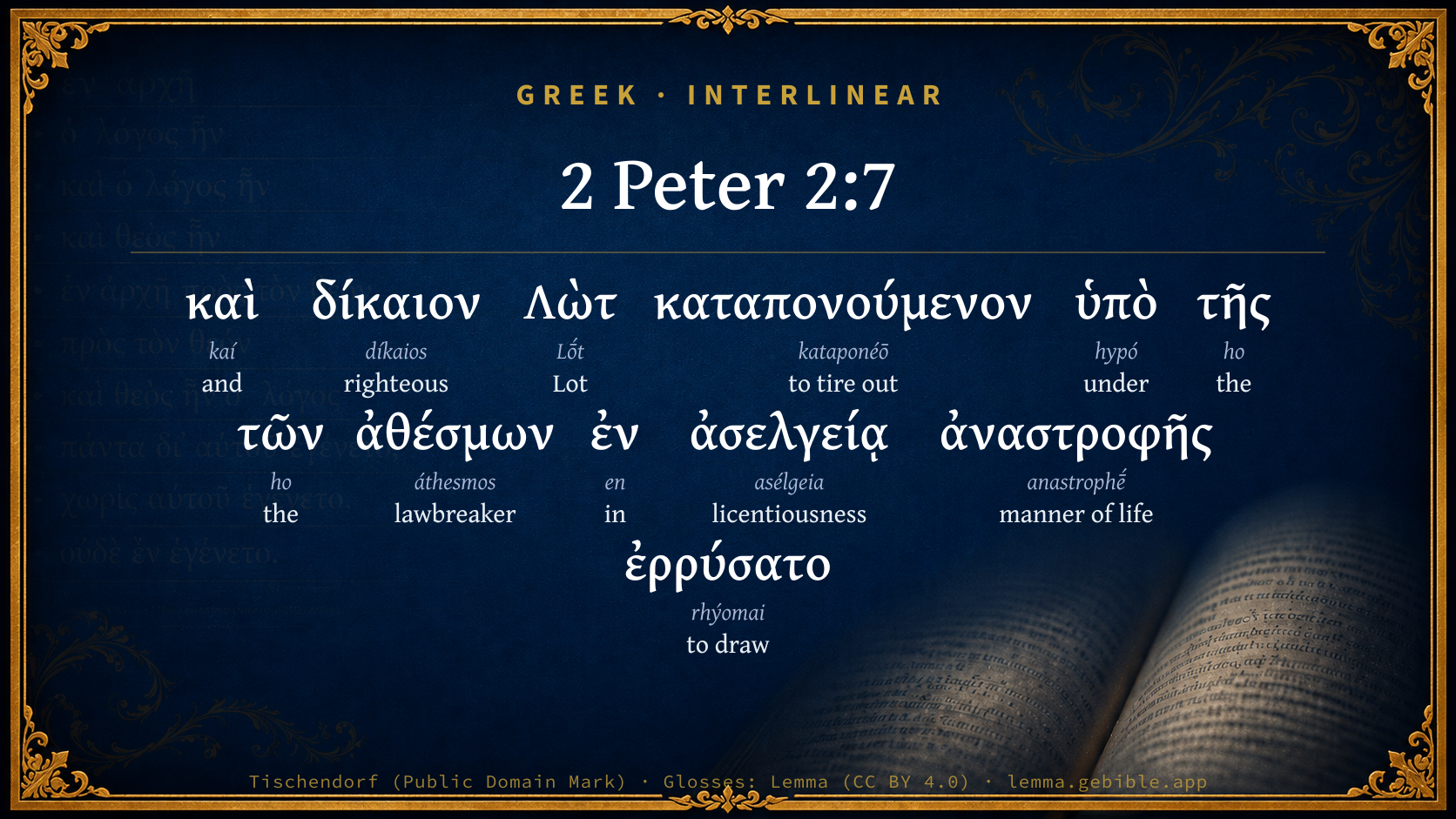
  1. καὶ kaí G2532 “and” Conjunction
  2. δίκαιον díkaios G1342 “righteous” Adjective, Accusative, Singular, Masculine
  3. Λὼτ Lṓt G3091 “Lot” Noun, Proper, indeclinable
  4. ὑπὸ hypó G5259 “under” Preposition
  5. τῆς ho G3588 “the” Article, Genitive, Singular, Feminine
  6. τῶν ho G3588 “the” Article, Genitive, Plural, Masculine
  7. ἀθέσμων áthesmos G113 “lawbreaker” Adjective, Genitive, Plural, Masculine
  8. ἐν en G1722 “in” Preposition
  9. ἀσελγείᾳ asélgeia G766 “licentiousness” Noun, Dative, Singular, Feminine
  10. ἀναστροφῆς anastrophḗ G391 “manner of life” Noun, Genitive, Singular, Feminine
  11. ἐρρύσατο rhýomai G4506 “to draw” Verb, Aorist, Middle or Passive deponent, Indicative, 3rd person, Singular

About this verse

These counts appear in no published source. They are computed here, from the morphology-tagged text and Lemma’s own curated glosses. What Lemma adds →

12
words
11
distinct lemmas
General Epistles
section

Notable vocabulary

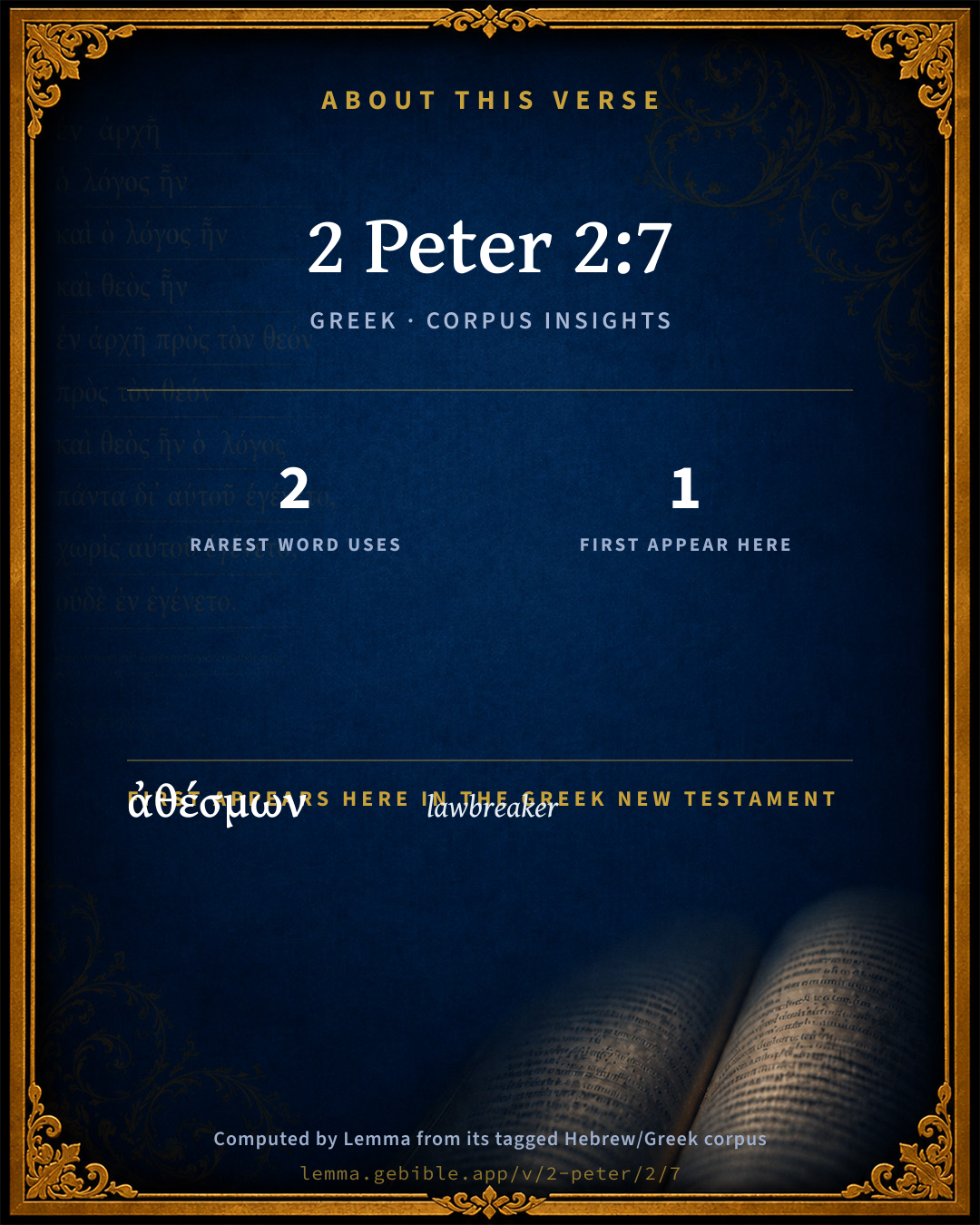
The rarest word here is καταπονούμενον to tire out G2669 — appearing just 2 times in the whole Greek New Testament.

First appearance in Scripture

This word makes its first canonical appearance in the Greek New Testament here:

  • ἀθέσμων lawbreaker G113

Shared distinctive vocabulary

καταπονούμενον to tire out G2669 occurs in 2 verses of the Greek New Testament. Also found in:

Repetition

A word recurs within this verse:

Cross-references

10

Topical passages linked to 2 Peter 2:7 in the Treasury of Scripture Knowledge — connected by theme and wording, ordered by reader-vote popularity; previews shown in the World English Bible.

  • Genesis 19:16 But he lingered; and the men laid hold on his hand, and on the hand of his wife, and on the hand of his two daughters, Yahweh being merciful to him; and they took him out, and set him outside of the city.
  • Genesis 19:29 It happened, when God destroyed the cities of the plain, that God remembered Abraham, and sent Lot out of the midst of the overthrow, when he overthrew the cities in which Lot lived.
  • Genesis 19:7–8 He said, "Please, my brothers, don't act so wickedly.
  • Genesis 13:13 Now the men of Sodom were exceedingly wicked and sinners against Yahweh.
  • Genesis 19:22 Hurry, escape there, for I can't do anything until you get there." Therefore the name of the city was called Zoar.
  • Jeremiah 9:1–6 Oh that my head were waters, and my eyes a spring of tears, that I might weep day and night for the slain of the daughter of my people!
  • Jeremiah 23:9 Concerning the prophets. My heart within me is broken, all my bones shake; I am like a drunken man, and like a man whom wine has overcome, because of Yahweh, and because of his holy words.
  • 1 Corinthians 10:13 No temptation has taken you except what is common to man. God is faithful, who will not allow you to be tempted above what you are able, but will with the temptation also make the way of escape, that you may be able to endure it.
  • 2 Peter 3:17 You therefore, beloved, knowing these things beforehand, beware lest, being carried away with the error of the wicked, you fall from your own steadfastness.
  • Psalms 120:5 Woe is me, that I live in Meshech, That I dwell among the tents of Kedar!

Cross-references courtesy of OpenBible.info (CC BY 4.0).

Commentary

Notes on 2 Peter 2:7 from classic Christian and Jewish commentators (each source and its license shown beneath its notes). The classic Christian expositions comment on the surrounding passage and are grouped to its opening verse, so a note may address several verses; the Jewish commentaries on the Tanakh (Rashi and others) are per-verse, so they appear only where the commentator wrote on this verse.

Lemma curates 59 commentaries, every one of them public domain or Creative Commons licensed, each selected and text-cleaned for this edition rather than reprinted as found. About our sources →

Tyndale Open Study Notes

Tyndale Open Resources

2:7-8 Even though the Old Testament does not portray Lot as a particularly righteous man (see “Lot” Profile), he remained basically faithful to the Lord; Jewish tradition also portrays him as righteous (see Wisdom of Solomon 10:6; 19:17).

Tyndale Open Study Notes — © Tyndale Open Resources, licensed CC BY-SA 4.0. Text via the HelloAO Bible API.

Bengel's Gnomon

Johann Albrecht Bengel

2Pe 2:7. Δίκαιον, righteous) Gen 19:1; Gen 19:7.—ἀθέσμων, of the lawless or impious) of those who sinned against nature.—ἐν ἀσελγείᾳ, in wantonness) Gen 19:5.

Bengel's Gnomon of the New Testament — English translation (T&T Clark, Edinburgh, 1860) — public domain. Text from a community e-Sword module.

Meyer's Critical & Exegetical Commentary

Heinrich August Wilhelm Meyer

2Pe_2:7. Contrast to the divine justice in punishing, which is not to be found in Jude. Wiesinger: The expansion of the thought, introduced by the mention antithetically of Noah, 2Pe_2:5, gains, by the co-ordination (καί) of the deliverance of Lot, independent value, and prepares the way for the double inference, 2Pe_2:9.

καί] has not here an adversative force (Jachmann), but is simply the copulative particle.

δίκαιον Λώτ] δίκαιος here like δικαιοσύνη, 2Pe_2:5.

καταπονούμενον] besides here, in Act_7:24 (2Ma_8:2, where, however, it is doubtful whether the reading should be καταπονούμενον or καταπατούμενον); Pott, Schol. Soph. in Trachin. v. 328, verba: ἀλλʼ εἴεν ὠδινοῦσα exponit per καταπονουμένη.

ὑπὸ τῆς … ἐῤῥύσατο] ὑπό belongs not to ἐῤῥύσατο, but to καταπον.; cf. Winer, p. 330 [E. T. 461];with ἡ ἐν ἀσελγ. ἀναστροφή, cf. 1Pe_1:17.

ἀθέσμων, besides here only in chap. 2Pe_3:17 : homines nefarii, qui nec jus nec fas curant (Gerhard).

Meyer — Critical and Exegetical Commentary on the New Testament — English translation by Peter Christie, edited by Frederick Crombie (T&T Clark, 1880) — public domain. Text from a community e-Sword module.

Expositor's Greek Testament

ed. W. Robertson Nicoll

2Pe 2:7 . καταπονούμενον , the word applied to the condition of the slave whom Moses delivered, Act 7:24 . It implies outward discomfort. ἀθέσμων . Cf. 2Pe 3:17 , “a stronger word than ἄνομος , because θεσμός is used especially of a divine ordinance, a fundamental law” (Mayor).

The Expositor's Greek Testament, edited by W. Robertson Nicoll (1897–1910) — public domain. Text from a community e-Sword module.

Matthew Henry's Commentary

When God sends destruction on the ungodly, he commands deliverance for the righteous; and, if he rain fire and brimstone on the wicked, he will cover the head of the just, and they shall be hid in the day of his anger. This we have an instance of in his preserving Lot. Here observe, 1. The character given of Lot; he is called a just man; this he was as to the generally prevailing bent of his heart and through the main of his conversation. God does not account men just or unjust from one single act, but from their general course of life. And here is a just man in the midst of a most corrupt and profligate generation universally gone off from all good. He does not follow the multitude to do evil, but in a city of injustice he walks uprightly. 2. The impression the sins of others made upon this righteous man. Though the sinner takes pleasure in his wickedness, it is a grief and vexation to the soul of the righteous. In bad company we cannot escape either guilt or grief. Let the sins of others be a trouble to us, otherwise it will not be possible for us to keep ourselves pure. 3. Here is a particular mention of the duration and continuance of this good man's grief and vexation: it was from day to day. Being accustomed to hear and see their wickedness did not reconcile him to it, nor abate of the horror that was occasioned by it. This is the righteous man whom God preserved from the desolating judgment that destroyed all round about him. From this instance we are taught to argue that God knows how to deliver his people and punish his enemies. It is here presupposed that the righteous must have their temptations and trials. The devil and his instruments will thrust sore at them, that they may fall; and, if we will get to heaven, it must be through many tribulations. It is therefore our duty to reckon upon and prepare for them. Observe here, (1.) The Lord knows those that are his. He has set apart him who is godly for himself; and, if there is but one in five cities, he knows him; and where there is a greater number he cannot be ignorant of nor overlook any one of them. (2.) The wisdom of God is never at a loss about ways and means to deliver his people. They are often utterly at a loss, and can see no way; he can deliver a great many. (3.) The deliverance of the godly is the work of God, that which he concerns himself in, both his wisdom to contrive the way and his power to work out the deliverance out of temptation, to prevent their falling into sin and their being ruined by their troubles. And surely, if he can deliver out of temptation, he could keep from falling into it if he did not see such trials to be necessary. (4.) God makes a very great difference in his dealings with the godly and the wicked. When he saves his people from destruction, he delivers over his enemies to deserved ruin. The unjust has no share in the salvation God works out for the righteous. The wicked are reserved to the day of judgment. Here we see, [1.] There is a day of judgment. God has appointed a day wherein he will judge the world. [2.] The preservation of impenitent sinners is only a reserving of them to the day of the revelation of the righteous judgment of God.

Matthew Henry's Commentary on the Whole Bible (1708–1710) — public domain (CC PDM 1.0). Text via the HelloAO Bible API.

Jamieson, Fausset & Brown

Robert Jamieson, A. R. Fausset & David Brown

just--righteous.

filthy conversation--literally, "behavior in licentiousness" (Gen 19:5).

the wicked--Greek, "lawless": who set at defiance the laws of nature, as well as man and God. The Lord reminds us of Lot's faithfulness, but not of his sin in the cave: so in Rahab's case.

Jamieson, Fausset & Brown — Commentary Critical and Explanatory on the Whole Bible (1871) — public domain (CC PDM 1.0). Text via the HelloAO Bible API.

Adam Clarke's Commentary

Verse 7. Vexed with the filthy conversation] Καταπονουμενον ὑπο της των αθεσμων εν ασελγεια αναστροφης· Being exceedingly pained with the unclean conduct of those lawless persons. What this was, see in the history, Gen. 19., and the notes there.

Adam Clarke's Commentary on the Bible (1810–1826) — public domain. Text from a community e-Sword/MySword module.

Ellicott's Commentary for English Readers

(7) And delivered just Lot.—Better, righteous Lot; it is the same adjective as occurs twice in the next verse. These repetitions of the same word, of which there are several examples in this Epistle (“destruction” thrice, 2Pe_2:1-3; various repetitions, 2Pe_3:10-12; “look for” thrice, 2Pe_3:12-14, &c), and which have been stigmatised as showing poverty of language, are perfectly natural in St. Peter, and not like the laboured efforts of a writer endeavouring to personate him. A person writing under strong emotion does not stop to pick his words; he uses the same word over and over again if it expresses what he means and no other word at once occurs to him. This is still more likely to be the case when a person is writing in a foreign language. The fact that such repetitions are frequent in the Second Epistle, but not in the First, is not only fully explained by the circumstances, but, as being so entirely in harmony with them, may be regarded as a mark of genuineness. “Delivered righteous Lot.” Here, as in the case of the Flood (2Pe_2:5), the destruction of the guilty suggests the preservation of the innocent. Is it fanciful to think that these lights in a dark picture are characteristic of one who had himself “denied the Master who bought him,” and yet had been preserved like Noah and rescued like Lot? This brighter side is wanting in Jude, so that in the strictly historical illustrations this Epistle is more full than the other (see Note on 2Pe_2:15); it is where apocryphal books seem to be alluded to that St. Jude has more detail.

The filthy conversation.—Literally, behaviour in wantonness (comp. 2Pe_2:2; 2Pe_2:18)—i.e., licentious mode of life. The word for “conversation,” or “behaviour,” is a favourite one with St. Peter—six times in the First Epistle, twice in this (2Pe_3:11); elsewhere in the New Testament only five times.

Of the wicked.—Literally, of the lawless—a word peculiar to this Epistle; we have it again in 2Pe_3:17. The word translated “abominable” in 1Pe_4:3 is closely allied to it.

The judgment on Sodom and Gomorrha forms a fitting complement to that of the Flood as an instance of God’s vengeance, a judgment by fire being regarded as more awful than a judgment by flood, as is more distinctly shown in 2Pe_3:6-7, where the total destruction of the world by fire is contrasted with the transformation of it wrought by the Flood.

A Bible Commentary for English Readers, edited by Charles John Ellicott (1878–1897) — public domain. Text from a community e-Sword module.

The Cambridge Bible for Schools and Colleges

gen. ed. J. J. S. Perowne

7. vexed with the filthy conversation of the wicked] More accurately, vexed with the mode of life (or conduct) of the lawless ones in lasciviousness. On “conversation” see notes on 1Pe_1:15, and on “lasciviousness” note on 2Pe_2:2.

The Cambridge Bible for Schools and Colleges (gen. ed. J. J. S. Perowne; Cambridge University Press, 1878–1918) — public domain. Text from a community e-Sword module.

John Gill's Exposition

And delivered just Lot,.... Who was a just man, being justified by the righteousness of Christ imputed to him; and having the new man formed in him, which is created in righteousness and true holiness; and living soberly, righteously, and godly, though not without sin: for there is not a just man that lives and sinneth not; this righteous man was delivered from the burning of Sodom by the means of angels, Gen 19:16. The Jews are very injurious to this good man's character, and give a very different one of him from this of the apostle's; they call him a wicked man, a perfect wicked man, as wicked as the inhabitants of Sodom (d); and say, that because they abounded in sin, therefore Lot chose to dwell among them (e); and affirm (f), that all the time he was with Abraham, God did not join himself to him, and did not commune with Abraham on his account; but, when he was separated from him, did; they call him the evil imagination, and the old serpent that was accursed, and cursed Lot (g); but Philo the Jew (h) speaks better of him, and says that he did not embrace and delight in the iniquities of the inhabitants, though he did not arrive to the perfection of wisdom; and the author of the book of Wisdom calls him the "righteous man",

"When the ungodly perished, she delivered the righteous man, who fled from the fire which fell down upon the five cities.'' (Wisdom 10:6)

as the apostle does here; and very truly, since it follows:

vexed with the filthy conversation of the wicked; the inhabitants of Sodom, who had no regard to the laws of God or man, or to the law and light of nature; but as worse than brute beasts, lived daily in the commission of unnatural lusts; and therefore their conversation is rightly said to be filthy, and was a grievous burden to righteous Lot: for to a good man, not only his own sins, but the sins of others, whether professors or profane, are a burden, and make him groan under them, being grievously fatigued with them, as this good man was, and weary of life because of them, as Rebekah was, through the daughters of Heth.

(d) Tzeror Hammot, fol. 14. 4. & 16. 4. & 20. 2. (e) Jarchi in Gen. xiii. 10. (f) Zohar in Gen. fol. 57. 2. Jarchi in Gen. xiii. 13. (g) Zohar in Gen. fol. 56. 1, 2. Tzeror Hammor, fol. 7. 3. & 14. 3. & 20. 2. Bereshit Rabba, sect. 44. fol. 39. 1. (h) De Vita Mosis, l. 2. p. 662.

John Gill's Exposition of the Whole Bible (1746–1763) — public domain (CC PDM 1.0). Text via the HelloAO Bible API.

Trapp's Complete Commentary

John Trapp

7 And delivered just Lot, vexed with the filthy conversation of the wicked:

Ver. 7. Vexed] Gr. καταπονουμενοι, labouring under it, as under a heavy burden, and as much tortured as if he had been set upon a rack, as it is 2Pe 2:8.

John Trapp, A Commentary or Exposition upon All the Books of the Old and New Testament (1647–1656) — public domain. Text from a community e-Sword module.

Albert Barnes' Notes on the Bible

And delivered just Lot - Gen 19:16. This case is incidentally referred to, to show that God makes a distinction between the righteous and the wicked; and that while the latter will be destroyed, the former will be saved. See 2Pe 2:9. Lot is called “just,” because he preserved himself uncontaminated amidst the surrounding wickedness. As long as he lived in Sodom he maintained the character of an upright and holy man.

Vexed with the filthy conversation of the wicked - By the corrupt and licentious conduct of the wicked around him. On the word “conversation,” see the notes at Phi 1:27. The original phrase, which is rendered “filthy,” has reference to licentiousness. The corruption of Sodom was open and shameless; and as Lot was compelled to see much of it, his heart was pained. The word here rendered “vexed,” means that he was wearied or burdened. The crimes of those around him he found it hard to bear with.

Albert Barnes' Notes on the Bible (1834–1885) — public domain. Text from a community e-Sword/MySword module.

Matthew Poole's English Annotations

Vexed; grievously afflicted or wearied.

The wicked; unjust, lawless, (understand men), such as had no respect to law or justice, in opposition to Lot, whom he calls just and righteous.

Matthew Poole's English Annotations on the Holy Bible (1683–1685) — public domain. Text from a community e-Sword/MySword module.

Whedon's Commentary on the Bible

Daniel D. Whedon

7. Delivered—A second example of preservation of the godly, in the case of Lot. Gen_19:12-23. Just is the same Greek with righteous, in 2Pe_2:8.

Vexed—Literally, Worn down by the conduct of the lawless in licentiousness. Αθεσμος, says Bloomfield, “signifies a despiser of all laws. The term is applied to these, because they did not live after that primeval law, partly of nature and partly of tradition, with which they were favoured.”

Daniel D. Whedon (gen. ed.), Commentary on the Old and New Testaments (1874–1909) — public domain. Text from a community e-Sword module.

The Pulpit Commentary

And delivered just Lot, vexed with the filthy conversation of the wicked; literally, and delivered righteous Lot, who was being worn out (kataponoumenon; comp. Act_7:24, the only other place of the New Testament where the word occurs) with the behaviour of the lawless in licentiousness. The word translated "lawless" (ajqesmwn) is found only in one other place of the New Testament; (2Pe_3:17) but it is near akin to the ajqemitoiv ("abominable") of 1Pe_4:3.

The Pulpit Commentary (1880–1919), ed. H.D.M. Spence-Jones & Joseph S. Exell — public domain. Text from a community e-Sword module.

Burkitt's Expository Notes on the New Testament

William Burkitt

Observe here, 1. As bad as Sodom was, it had a good man in it; God leaves not himself without witness, in the vilest and worst of places God has some that profess his name, and bear witness to his truth.

Observe, 2. The character given of him, just Lot; the denomination was taken from the habitual frame of his heart, and the general tenor of his life.

Observe, 3. How this good man laid to heart the wickedness of Sodom; he was grieved for their wicked and filthy conversation before God, more than for their unkind and cruel behavior towards him; the spirit of a child of God is a sympathizing spirit, it sadly lays to heart both the sins and the sufferings of others.

Observe, 4. The care that God took for this good man’s preservation, he delivered just Lot; he delivered him both from the company and conversation of the wicked, which was a continual vexation to him; and also delivered him from the judgments which were righteously brought upon the wicked; and delivered just Lot, vexed with the filthy conversation of the wicked.

William Burkitt's Expository Notes on the New Testament (1700–1703) — public domain. Text from a community e-Sword module.

The People's New Testament

B. W. Johnson

7. And delivered righteous Lot. The saving of the righteous is as marked as the punishment of the wicked. See Gen. 19:1, 7. Vexed, etc. See Gen. 19:5.

B. W. Johnson's The People's New Testament with Notes (1889–1891) — public domain. Electronic text from the Christian Classics Ethereal Library (CCEL) ThML edition.

unfoldingWord translationNotes

Door43 World Missions Community

Connecting Statement:

Peter gives an example of Lot, whom God rescued out from among men who deserved punishment.

the sensual behavior of lawless people

"the immoral behavior of people who broke God's law"

that righteous man

This refers to Lot.

was tormented in his righteous soul

Here the word "soul" refers to Lot's thoughts and emotions. The immoral behavior of the citizens of Sodom and Gomorrah disturbed him emotionally. AT: "was greatly disturbed" (See: Synecdoche)

translationWords

righteous

Lot

lawful

torment

soul

lord

godly

trial

righteous

punish

judgment day

unfoldingWord translationNotes — © Distant Shores Media and the Door43 World Missions Community, licensed CC BY-SA 4.0. Source: git.door43.org/Door43/en_tn.

Cambridge Greek Testament for Schools and Colleges

7. ὑπὸ τῆς τῶν ἀθέσμων ἐν ἀσελγείᾳ ἀναστροφῆς. The structure reminds us of the clause 2Pe 1:4 τῆς ἐν τῷ κόσμῳ ἐν ἐπιθυμίᾳ φθορᾶς.

ἀθέσμων again in 2Pe 3:17, and nowhere else in N.T. ἔκθεσμος is used by Philo of the inhabitants of the cities of the plain.

Cambridge Greek Testament for Schools and Colleges (Cambridge University Press, 1896; 21 vols, various authors incl. Carr, Maclear, Plummer, Farrar, Lumby, Moule, M. R. James, Simcox) — public domain. Text from a community e-Sword module.

Alford’s Greek Testament

Henry Alford

7.] and rescued (the contrast, the deliverance of the righteous, is here brought out at more length. This contrast is wanting in Jude, where only the punitive dealings of God are treated) righteous Lot (δίκαιον, as repeating the δικαιοσύνη of ver. 5: see also again, ver. 8) distressed (καταπονέω, properly to wear down or tire out by toil, as τῇ ἐνδείᾳ τῆς τροφῆς τὴν ἀλκὴν τοῦ θηρίου καταπονεῖν, Diod. iii. 37: Ἡρακλῆς ὁ καταπονούμενος τῷ τῆς Δηϊανείρας χιτῶνι, Pol. xl. 7. 3: hence to oppress, as in ref. Acts, or harass beyond bearing as here) by the behaviour of the lawless (ἄθεσμοι, “homines nefarii, qui nec jus nec fas curant”) in licentiousness (ἐν ἀσελγ. ἀναστροφή is to be taken together, as ἐν ἀσελγ. ἀναστρέφεσθαι; ἐν ἀσελγ. denoting the character of the behaviour or manner of life):

8] Explanation of καταπονούμενον. For by sight and hearing (these datives belong to ἐβασάνιζεν below, not as vulg., Erasm., al„ ungrammatically, to ὁ δίκαιος,—“adspectu et auditu justus erat,” nor as Gerh. to ἐγκατοικῶν: nor again are they to be understood of the Sodomites, as Wetstein,—“Lotus vultu eorum meretricio conspecto, et audita fama impudicitiæ eorum.…” It was by his own sight and hearing of what went on around him, that he ψυχὴν δικαίαν ἐβασάνιζεν.

βλέμμα is more usually of the look of a man from without: so in Demosth. Mid. in Wetst. τῷ σχήματι, τῷ βλέμματι, τῇ φωνῇ, and in numerous other examples in Wetst. The transition from this to the subjective sense is obvious) the righteous man, dwelling among them, day by day tormented his righteous soul with their lawless deeds (the form of the sentence is peculiar: that being represented as a deliberate act of Lot on himself, which was in fact the impression made on him by the lawlessness around him. The same way of speaking is common among us, when we say that a man “distresses himself” at any occurrence: cf. Isa 58:5, “a day for a man to afflict his soul,”—ἡμέραν ταπεινοῦν ἄνθρωπον τὴν ψυχὴν αὐτοῦ. The older expositors have curiously and characteristically missed the right sense: so Œc., πρὸς ζῆλον τῶν ἀσεβῶν αὐτῶν πράξεων ἡμέραν ἐξ ἡμέρας παρακαλούμενον, εἶτα βασανίζοντα τὴν ἑαυτοῦ ψυχὴν διὰ τῆς τούτων ἀποχῆς καὶ ἐγκρατείας (which he further expands afterwards): and similarly Thl.):

Henry Alford, The Greek Testament (1849–1861) — public domain. Text from a community e-Sword module.

Vincent's Word Studies in the New Testament

Marvin R. Vincent

Just [δικαιον] . Occurring three times in vv. 7, 8.

Vexed [καταπονουμενον] . Only here and Act 7:24. Kata gives the force of worn down. So Rev., sore distressed.

With the filthy conversation of the wicked [υπο της των αθεσμων εν ασελγεια αναστροφης] . Lit., by the behavior of the lawless in wantonness. Rev., the lascivious life of the wicked. Life or behavior [αναστροφης] . See on 1Pe 1:15. Wicked [αθεσμων] , lit., lawless. Only here and ch. 3 17. Wantonness [ασελγεια] , see on Mr 7:22.

Marvin R. Vincent, Word Studies in the New Testament (1887–1900) — public domain. Text from a community e-Sword/MySword module.

Lesson kit

Teaching starters — assembled from the data on this page, not authored interpretation. Every prompt links to the verse data it draws on. Edit before teaching.

2 Peter, in the General Epistles, opens this verse with 12 words (11 distinct Greek lemmas). Its most distinctive word is kataponéō (“to tire out”). A historical commentator’s framing appears above. Read the whole chapter for the surrounding context.

Discussion questions

  1. The word kataponéō carries the sense “to tire out.” How does it shape the verse?
  2. This is the first place “lawbreaker” appears in Scripture (first appears here). What does its debut here establish?
  3. How does Acts 7:24, which shares the word «to tire out», read alongside this verse?
  4. What does the repetition of “the” (2× in this one verse) do in this verse?
  5. These translations render this verse differently; the difference is in the English rendering, not the original. What questions does that raise?
  6. Compare how Tyndale Open Study Notes and Bengel's Gnomon read this verse. Where do they agree or differ?

Things to notice

  • 1 word makes its first canonical appearance in Scripture here.
  • These translations choose different wording for 19 words in this verse.
  • “the” occurs 2× in this single verse.
  • 11 distinct Greek lemmas span 12 words in this verse.

Reading settings

Reading text

Shown beneath each verse's original-language words.

Old Testament
Old Testament edition

Read the OT as the Masoretic Hebrew (MT) or the Greek Septuagint (LXX).

English shown for the Greek Septuagint (in the Hebrew ↔ Greek comparison).

Comparing translations? Open the Compare panel on any verse page to stack up to four side by side.