
Job 6:29

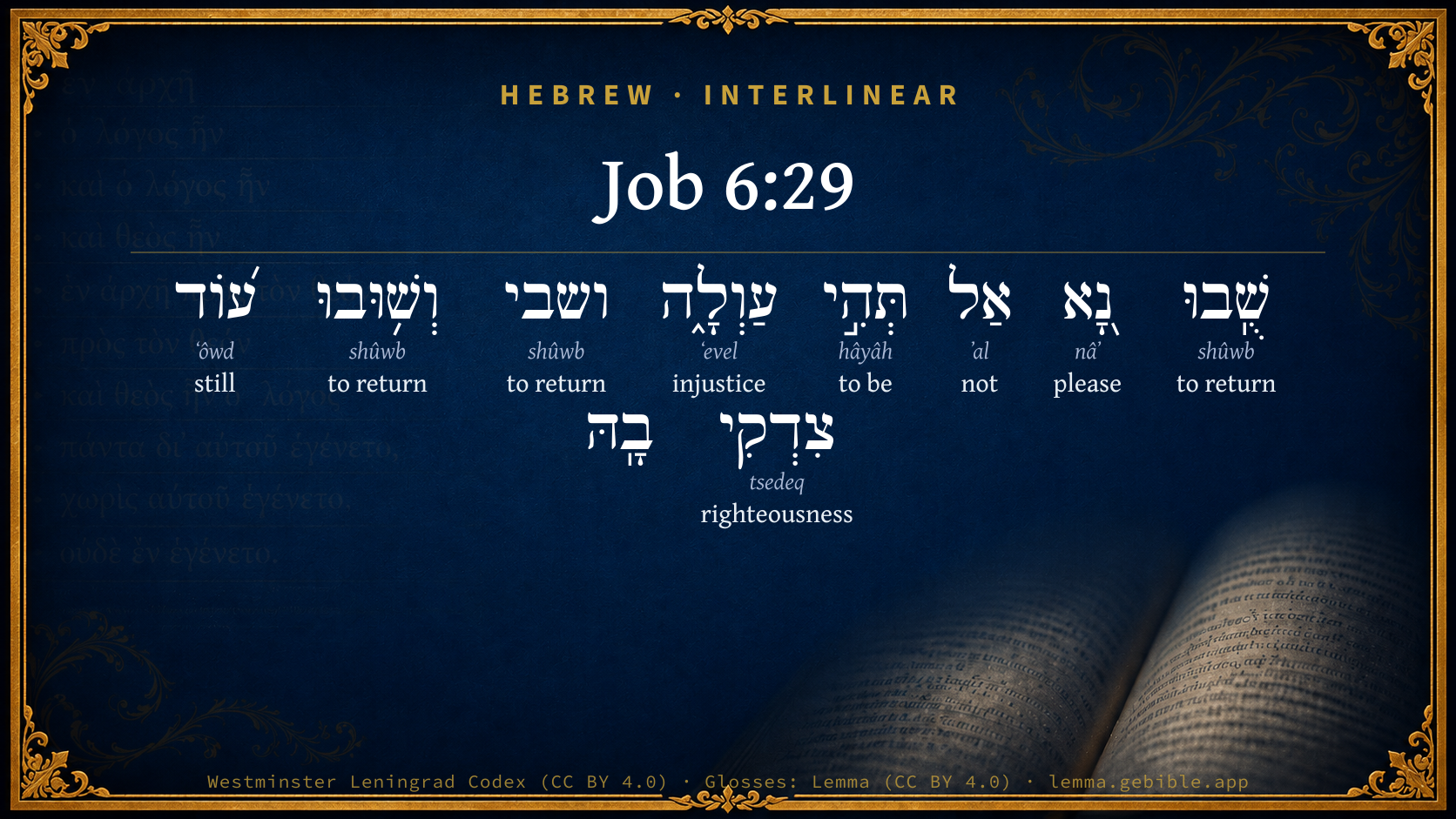
Hebrew (Westminster Leningrad Codex) Job 6:29 appears in the Hebrew Old Testament. The text above is from the Westminster Leningrad Codex. Each word links to its Strong’s number, a concise gloss, and parsing drawn from the Open Scriptures Hebrew Bible morphology. Click any word for its full Brown-Driver-Briggs (BDB) entry.
Download image
Cite this verse

Job 6:29 (World English Bible). Public Domain. Lemma interlinear Bible study tool, https://lemma.gebible.app/v/job/6/29.

Show BibTeX & RIS
BibTeX
RIS
English Translation
Please return. Let there be no injustice; Yes, return again, my cause is righteous.
World English Bible · Public Domain
Download a study sheet

One document with this verse’s original text, its word-by-word gloss line, the meaning frame, cross-references with their text, attributed commentary, and full source and license credits — printable, and it pastes into notes with its structure intact.

This verse Autodidact and up

Study sheet (.html) Plain text (.txt)

A passage Seminary Student

Up to 50 verses in one chapter. A passage sheet keeps up to 6 commentary sources and 12 cross-references per verse, in the order this page ranks them, and says so on the sheet whenever that leaves anything out. Ask for a single verse and you get the Autodidact verse sheet above.

Everything on this page stays free to read, with no account — the sheet is a download of what is already on screen, not access to it.

Want to remove ads? Support Godless Engineer
Compare translations 3

The same verse in 3 English versions, stacked beneath the original-language interlinear above. Click any original word for its lexicon entry.

Each is an independent rendering of the whole verse — the interlinear is not word-aligned to these translations.

Highlighted words mark where these versions differ — a whole-verse word diff, not a word-by-word alignment.

  • World English Bible Public Domain
    Please return. Let there be no injustice; Yes, return again, my cause is righteous.
  • King James Version Public Domain
    Return, I pray you, let it not be iniquity; yea, return again, my righteousness is in it.
  • unfoldingWord Literal Text CC BY-SA 4.0
    Please turn, let injustice not be; yes, turn, my righteousness yet in it.

unfoldingWord Literal Text — © unfoldingWord, licensed CC BY-SA 4.0. Word-aligned USFM3 via Door43 (git.door43.org/unfoldingWord/en_ult).

Versions to compare (up to 4)

3 of 4 selected

Show all 18 translations

Every available English version of this verse, each an independent rendering of the whole verse.

  • World English Bible Public Domain
    Please return. Let there be no injustice; Yes, return again, my cause is righteous.
  • Berean Standard Bible Public Domain
    Reconsider; do not be unjust. Reconsider, for my righteousness is at stake.
  • Majority Standard Bible Public Domain
    Reconsider; do not be unjust. Reconsider, for my righteousness is at stake.
  • King James Version Public Domain
    Return, I pray you, let it not be iniquity; yea, return again, my righteousness is in it.
  • American Standard Version (1901) Public Domain
    Return, I pray you, let there be no injustice; Yea, return again, my cause is righteous.
  • Revised Version (1885) Public Domain
    Return, I pray you, let there be no injustice; yea, return again, my cause is righteous.
  • Geneva Bible (1599) Public Domain
    Turne, I pray you, let there be none iniquitie: returne, I say, and ye shall see yet my righteousnesse in that behalfe. Is there iniquitie in my tongue? doeth not my mouth feele sorowes?
  • Douay-Rheims (1899) Public Domain
    Answer, I beseech you, without contention: and speaking that which is just, judge ye.
  • Young's Literal Translation Public Domain
    Turn back, I pray you, let it not be perverseness, Yea, turn back again -- my righteousness `is' in it.
  • Literal Standard Version CC BY-SA 4.0
    Please turn back, let it not be perverseness, || Indeed, turn back again—my righteousness [is] in it.
  • Unlocked Literal Bible CC BY-SA 4.0
    Relent, I beg you; let there be no injustice with you; Indeed, relent, for my cause is just.
  • unfoldingWord Literal Text CC BY-SA 4.0
    Please turn, let injustice not be; yes, turn, my righteousness yet in it.
  • Darby Bible Public Domain
    Return, I pray you, let there be no wrong; yea, return again, my righteousness shall be in it.
  • World Messianic Bible Public Domain
    Please return. Let there be no injustice. Yes, return again. My cause is righteous.
  • Webster's Bible Public Domain
    Return, I pray you, let it not be iniquity; yes, return again, my righteousness is in it.
  • Free Bible Version CC BY-SA 4.0
    Don't talk like this! Don't be unjust! What I'm saying is right.
  • Bible in Basic English Public Domain
    Let your minds be changed, and do not have an evil opinion of me; yes, be changed, for my righteousness is still in me.
  • JPS Tanakh (1917) Public Domain
    Return, I pray you, let there be no injustice; yea, return again, my cause is righteous.

Literal Standard Version (2020), Covenant Press — licensed CC BY-SA 4.0. Text via the HelloAO Bible API (eBible.org). Unlocked Literal Bible (unfoldingWord) — licensed CC BY-SA 4.0. Text via the HelloAO Bible API (eBible.org). unfoldingWord Literal Text — © unfoldingWord, licensed CC BY-SA 4.0. Word-aligned USFM3 via Door43 (git.door43.org/unfoldingWord/en_ult). Free Bible Version, Dr. Jonathan Gallagher — licensed CC BY-SA 4.0. Text via the HelloAO Bible API (eBible.org).

Word by word

More ways to search: Search by grammar → Find every occurrence → Compare this word →

Practice this passage: Drill this verse → Learn its vocabulary →

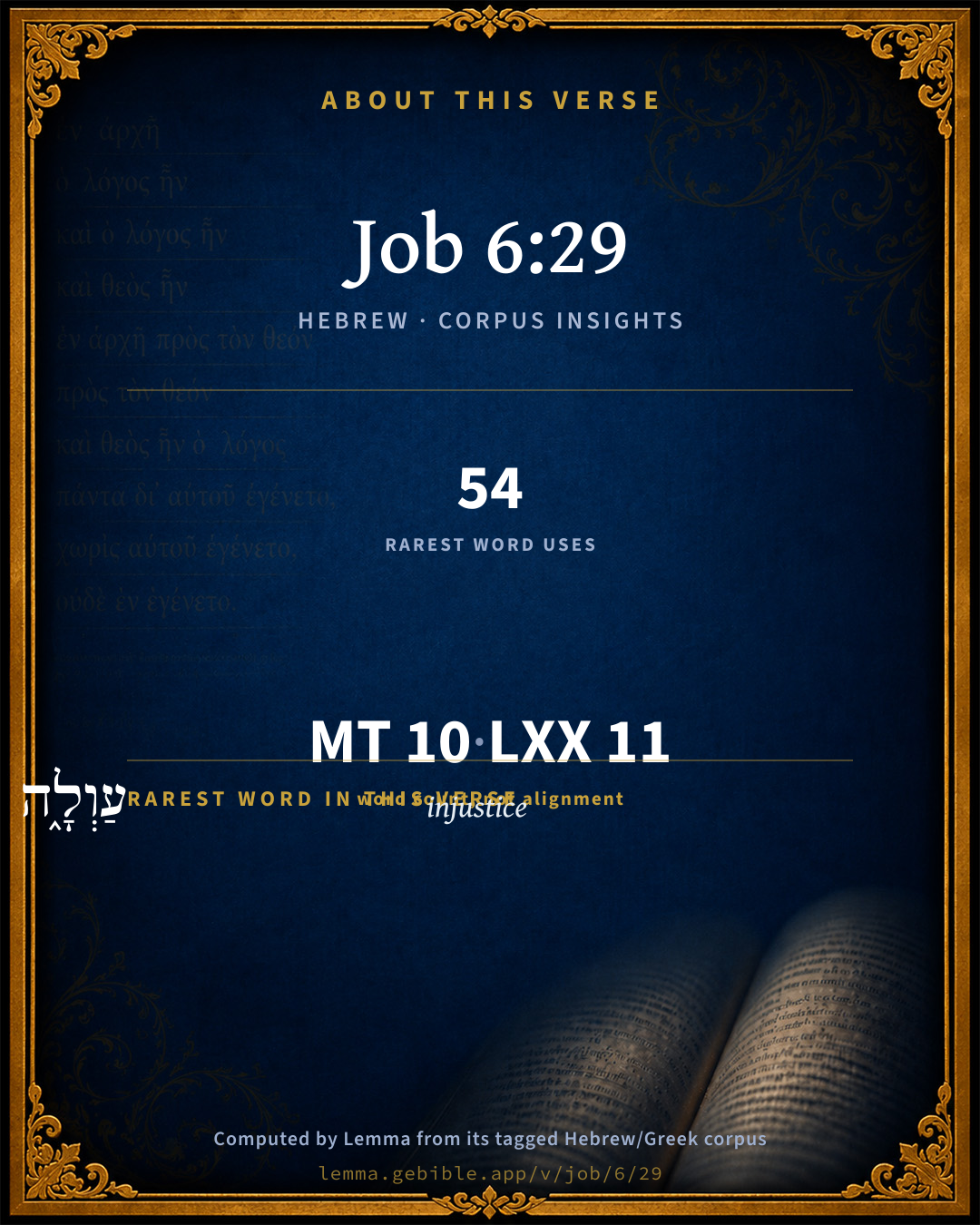
About this verse

These counts appear in no published source. They are computed here, from the morphology-tagged text and Lemma’s own curated glosses. What Lemma adds →

10
words
7
distinct lemmas
Wisdom
section

Shared distinctive vocabulary

עַוְלָ֑ה injustice H5766 occurs in 51 verses of the Hebrew Bible. Also found in:

Grammatical profile

  • 4 verbs
  • 2 nouns
  • 1 preposition
  • 1 adverb
  • 2 particles

Verb forms

  • שֻֽׁבוּ Qal · Imperative
  • תְּהִ֣י Qal · Jussive
  • ושבי Qal · Imperative
  • וְשׁ֥וּבוּ Qal · Imperative

Repetition

A word recurs within this verse — often emphatic in Hebrew:

  • שֻֽׁבוּ to return H7725 ×3

Hebrew & Septuagint length

In English translation the verse runs 14 words from the Hebrew and 15 from the Septuagint (LXX English) — closely comparable.

A rough comparison of the two English renderings, which tokenize alike — not a word-level alignment.

Word counts can differ between the Hebrew and the Greek without any difference in meaning — e.g. the Hebrew direct-object marker אֵת has no separate Greek word, and Greek often adds the article ὁ.

In the original languages it is 10 Hebrew tokens and 11 Greek tokens — but the two are counted differently (Hebrew bundles its prefixes and suffixes into one token; the Greek is in lemma form), so that isn’t a like-for-like length.

Cross-references

6

Topical passages linked to Job 6:29 in the Treasury of Scripture Knowledge — connected by theme and wording, ordered by reader-vote popularity; previews shown in the World English Bible.

  • Job 17:10 But as for you all, come on now again; I shall not find a wise man among you.
  • Job 23:10 But he knows the way that I take. When he has tried me, I shall come forth like gold.
  • Job 27:4–6 Surely my lips shall not speak unrighteousness, Neither shall my tongue utter deceit.
  • Job 34:5 For Job has said, 'I am righteous, God has taken away my right:
  • Job 42:6 Therefore I abhor myself, And repent in dust and ashes."
  • Malachi 3:18 Then you shall return and discern between the righteous and the wicked, between him who serves God and him who doesn't serve him.

Cross-references courtesy of OpenBible.info (CC BY 4.0).

Hebrew and Greek witnesses Masoretic Hebrew ↔ Greek Septuagint

The same verse in the two great witnesses to the Old Testament, shown verse-for-verse.

These are two independent witnesses, not word-aligned to each other, and the Septuagint is shown in lemma (dictionary) form.

Hebrew Job 6:29 Masoretic · Westminster Leningrad Codex

שֻֽׁבוּ נָ֭א אַל תְּהִ֣י עַוְלָ֑ה ושבי וְשׁ֥וּבוּ ע֝וֹד צִדְקִי בָֽהּ

Please return. Let there be no injustice; Yes, return again, my cause is righteous.

World English Bible · Public Domain

Greek LXX Job 6:29 Septuagint · lemma form

καταἵζω δή καί μή εἰμί ἄδικος καί πάλιν ὁ δίκαιος συνἔρχομαι

Sit down now, and let there not be unrighteousness; and unite again with the just.

LXX2012 (modern English Septuagint) · Public Domain

Hebrew: Westminster Leningrad Codex (CC BY 4.0). Greek: Septuagint (public domain); English from LXX2012 (modern English Septuagint) (Public Domain). How the Septuagint differs from the Hebrew →

Commentary

Notes on Job 6:29 from classic Christian and Jewish commentators (each source and its license shown beneath its notes). The classic Christian expositions comment on the surrounding passage and are grouped to its opening verse, so a note may address several verses; the Jewish commentaries on the Tanakh (Rashi and others) are per-verse, so they appear only where the commentator wrote on this verse.

Lemma curates 59 commentaries, every one of them public domain or Creative Commons licensed, each selected and text-cleaned for this edition rather than reprinted as found. About our sources →

Trapp's Complete Commentary

John Trapp

Job 6:29 Return, I pray you, let it not be iniquity; yea, return again, my righteousness [is] in it.

Ver. 29. Return, I pray you] Change your minds of me, and your language to me, Bona verba quaeso; I seek good words, what need all this heat of speech, and height of spirit? be better advised, I beseech you, Job 17:10; Job 19:28. Some think that Job’s friends were rising to be gone; and he hastily calleth them back again.

Let it not be iniquity] Judge charitably, and make not the worst of matters: I may be weak, but am not wicked. Or thus, take heed that God fault you not for usurping his right; taking upon you to judge secret things even against your neighbour, with calumniations and cruelty.

Yea, return again] See you do it at your peril: either you must do it, or do worse.

My righteousness is in it] I am surely in the right; and that will appear to you upon better consideration. I shall be recta in curia, and you utterly mistaken. Uprightness hath boldness, and dares put itself upon God’s examination, as David did, Psa 139:23, yea, Abimelech, Gen 20:5.

John Trapp, A Commentary or Exposition upon All the Books of the Old and New Testament (1647–1656) — public domain. Text from a community e-Sword module.

Joseph Benson's Commentary

Job 6:29. Return, I pray, let it not be iniquity — Or, Recollect yourselves, I beseech you; call it not wickedness: yea, return again; my righteousness is in it — Or, Consider it yet again, righteousness may be in me. — Chappelow. Notwithstanding your suspicion, if you will examine more candidly and strictly, you may, perhaps, be convinced that I am not the sinner you think; but that righteousness is still in me, though I have fallen under these sore afflictions.

Joseph Benson's Commentary on the Old and New Testaments (1811–1818) — public domain. Text from a community e-Sword module.

Jamieson, Fausset & Brown

Robert Jamieson, A. R. Fausset & David Brown

Return--rather, "retract" your charges:

let it not be iniquity--that is, (retract) that injustice may not be done me. Yea retract, "my righteousness is in it"; that is, my right is involved in this matter.

Jamieson, Fausset & Brown — Commentary Critical and Explanatory on the Whole Bible (1871) — public domain (CC PDM 1.0). Text via the HelloAO Bible API.

Adam Clarke's Commentary

Verse 29. Return, I pray you] Reconsider the whole subject. Do not be offended. Yea, reconsider the subject; my righteousness is in it - my argumentation is a sufficient proof of my innocence.

Adam Clarke's Commentary on the Bible (1810–1826) — public domain. Text from a community e-Sword/MySword module.

Ellicott's Commentary for English Readers

(29) Return, I pray you.—“Do not regard the case as settled, but come again and examine it; try once more before you decide there is no unrighteousness in my case;” or, as some understand it, in my tongue, which is expressed immediately afterwards, and is here anticipated in the pronoun her. This rendering is certainly confirmed by Job_6:30.

A Bible Commentary for English Readers, edited by Charles John Ellicott (1878–1897) — public domain. Text from a community e-Sword module.

The Cambridge Bible for Schools and Colleges

gen. ed. J. J. S. Perowne

29. Return, I pray you] The verse means,

Turn, I pray you, let there be no injustice;

Turn again, I say; my cause is righteous.

The word “turn” appears to mean not “begin anew,” but “adopt another course,” that is, proceed on other suppositions than that of my guiltiness, and seek another explanation of my calamities. Hence, he adds, let there be no injustice, or wrong, that is, on the part of his friends in imputing guilt to him. The phrase “my cause is righteous” means literally my right is in it, that is, is here, is present; in other words, I have a righteous cause. In it can hardly mean, in the matter under discussion, as if the meaning were: the question is one that concerns my rectitude. By his right or righteous cause Job means his plea against God in reference to his afflictions; in this plea he has right on his side.

The Cambridge Bible for Schools and Colleges (gen. ed. J. J. S. Perowne; Cambridge University Press, 1878–1918) — public domain. Text from a community e-Sword module.

John Gill's Exposition

Is there iniquity in my tongue?.... Meaning in his words; either those which he uttered when he cursed the day on which he was born, or in charging his friends with unkindness and falsehood; otherwise the tongue is a world of iniquity, and the best of men are apt to offend both God and men in word:

cannot my taste discern perverse things? which is to be understood not of his natural taste, which very probably through his disease might be greatly vitiated, and incapable of relishing his food as in time of health, and of distinguishing good from bad; but of his intellectual taste, or of his sense and reason, his rational and spiritual taste; he had his senses exercised to discern good and evil; he could distinguish between right and wrong that was said or done, either by himself or others; be had the use of his rational powers and faculties, and therefore not to be treated as a mad or distracted man, but as one capable of carrying on a conversation, of opening his true case, and defending himself; see Job 12:11.

Next: Job Chapter 7

John Gill's Exposition of the Whole Bible (1746–1763) — public domain (CC PDM 1.0). Text via the HelloAO Bible API.

Albert Barnes' Notes on the Bible

Return, I pray you - That is, return to the argument. Give your attention to it again. Perhaps he may have discerned a disposition in them to turn away from what he was saying, and to withdraw and leave him. Job expresses his belief that he could convince them; and he proposes more fully to state his views, if they would attend to him.

Let it not be iniquity - Let it not be considered as wrong thus to come back to the argument. Or, let it not be assumed that my sentiments are erroneous, and my heart evil. Job means, that it should not be taken for granted that he was a hypocrite; that he was conscious of sincerity, and that he was convinced that he could satisfy them of it if they would lend a listening ear. A similar sentiment he expresses in Job 19:28 :

But ye should say, Why persecute we him?

Seeing the root of the matter is found in me.

My righteousness is in it - Margin, that is, this matter. The sense is, “my complete vindication is in the argument which I propose to state. I am prepared to show that I am innocent.” On that account, he wishes them to return and attend to what he proposed to say.

Albert Barnes' Notes on the Bible (1834–1885) — public domain. Text from a community e-Sword/MySword module.

Matthew Poole's English Annotations

Turn from your former course of perverse judgment; lay aside passion and prejudice against me; let me beg your second thoughts and a serious review of my case.

Let it not be iniquity, to wit, in your thoughts or debates; I beg not your favour, but your justice; judge according to right, and do not conclude me to be wicked, because you see me to be miserable, as you have falsely and unjustly done. Or, there shall be no iniquity, to wit, in my words which I have spoken, and which I am further about to speak; which you will find upon the review.

In it, i.e. in this cause or matter between you and me; the relative without the antecedent, which is frequent in the Hebrew language. You will find the right to be on my side.

Matthew Poole's English Annotations on the Holy Bible (1683–1685) — public domain. Text from a community e-Sword/MySword module.

Whedon's Commentary on the Bible

Daniel D. Whedon

29. Return… return — Renan supposes that Job’s friends, astonished by his apostrophes, turn away as if about to depart, and Job calls them back.

Let it not be iniquity — Let there be no wrong (between us.)

My righteousness is in it — That is, in the matter about which we treat, (Dillmann, Hirtzel.) My position is impregnable, for my cause is a righteous one.

Daniel D. Whedon (gen. ed.), Commentary on the Old and New Testaments (1874–1909) — public domain. Text from a community e-Sword module.

The Pulpit Commentary

Return, I pray you; i.e. "go back upon my case: reconsider it." And then, Let it not be iniquity; or, let there be no iniquity; i.e. let no injustice be done me. Yea, return again, my righteousness is in it If my cause be well considered, it will be seen that I am in no way blameworthy.

The Pulpit Commentary (1880–1919), ed. H.D.M. Spence-Jones & Joseph S. Exell — public domain. Text from a community e-Sword module.

John Wesley's Explanatory Notes

Return - Turn from your former judgment. Iniquity - Or, there shall be no iniquity, in my words. Righteousness - In this cause or matter between you and me; and you will find the right to be on my side.

John Wesley, Explanatory Notes Upon the Whole Bible (1754–1765) — public domain. Text via the GEBible commentary corpus.

Rashi

Rabbi Shlomo Yitzchaki (Rashi)

Return now to test, and you will determine that there shall be no more injustice; return to investigate, and behold, my righteousness will be found in it.

Rashi on the Tanakh — English translations: “The Judaica Press complete Tanach with Rashi, translated by A. J. Rosenberg” (CC BY 4.0); “Pentateuch with Rashi's commentary by M. Rosenbaum and A.M. Silbermann, 1929-1934” (public domain); “The Metsudah Tanach series, Lakewood, N.J” (CC BY 4.0); and “The Book of Joshua, Metsudah Publications, 1997” (CC BY 4.0). Text via Sefaria.

Lesson kit

Teaching starters — assembled from the data on this page, not authored interpretation. Every prompt links to the verse data it draws on. Edit before teaching.

Job, in the Wisdom, opens this verse with 10 words (7 distinct Hebrew lemmas). Its most distinctive word is ʻevel (“injustice”). A historical commentator’s framing appears above. Read the whole chapter for the surrounding context.

Discussion questions

  1. The word ʻevel carries the sense “injustice.” How does it shape the verse?
  2. Leviticus 19:15 shares the word «injustice» with this verse. How do the two illuminate each other?
  3. “to return” occurs 3× in this one verse. What is the effect of the repetition?
  4. These translations render this verse differently; the difference is in the English rendering, not the original. What questions does that raise?
  5. The verb «שֻֽׁבוּ» is Qal Imperative. How does its form color the action?
  6. Reading how Trapp's Complete Commentary and Joseph Benson's Commentary read this verse, where do the two commentators agree and where do they part?

Things to notice

Reading settings

Reading text

Shown beneath each verse's original-language words.

Old Testament
Old Testament edition

Read the OT as the Masoretic Hebrew (MT) or the Greek Septuagint (LXX).

English shown for the Greek Septuagint (in the Hebrew ↔ Greek comparison).

Comparing translations? Open the Compare panel on any verse page to stack up to four side by side.