1 Timothy 1:9

Greek (Tischendorf 8th ed.) 1 Timothy 1:9 appears in the Greek New Testament. The text above is from the Tischendorf 8th edition. Each word links to its Strong’s number and a concise gloss. Click any word for its full Thayer’s Greek Lexicon entry.
Download image
Cite this verse

1 Timothy 1:9 (World English Bible). Public Domain. Lemma interlinear Bible study tool, https://lemma.gebible.app/v/1-timothy/1/9.

Show BibTeX & RIS
BibTeX
RIS
English Translation
as knowing this, that law is not made for a righteous man, but for the lawless and insubordinate, for the ungodly and sinners, for the unholy and profane, for murderers of fathers and murderers of mothers, for manslayers,
World English Bible · Public Domain
Highlights
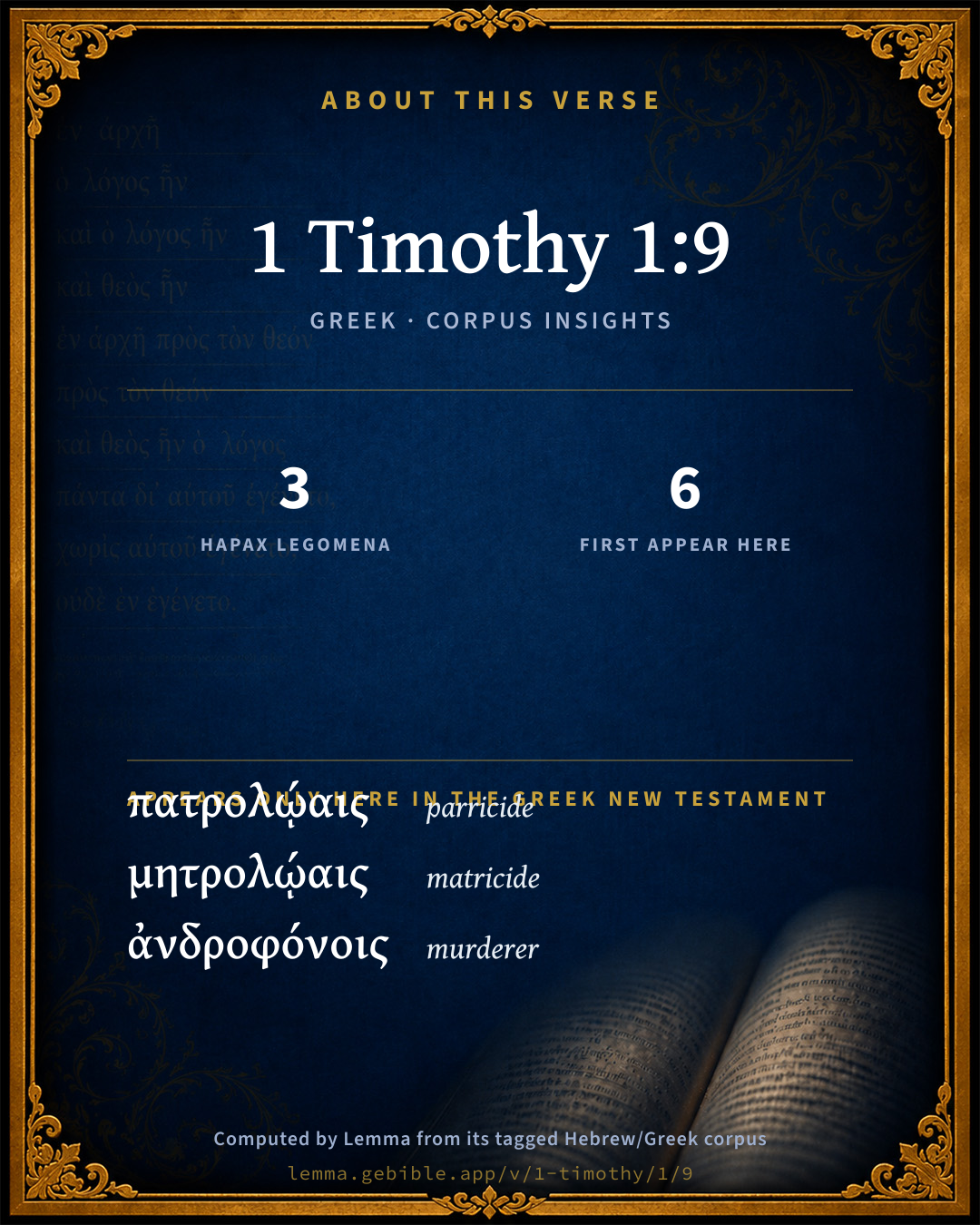
  • 3 hapax legomena — only here in the Greek New Testament
  • 6 first appearances in the Greek New Testament
Full analysis ↓
Download a study sheet

One document with this verse’s original text, its word-by-word gloss line, the meaning frame, cross-references with their text, attributed commentary, and full source and license credits — printable, and it pastes into notes with its structure intact.

This verse Autodidact and up

Study sheet (.html) Plain text (.txt)

A passage Seminary Student

Up to 50 verses in one chapter. A passage sheet keeps up to 6 commentary sources and 12 cross-references per verse, in the order this page ranks them, and says so on the sheet whenever that leaves anything out. Ask for a single verse and you get the Autodidact verse sheet above.

Everything on this page stays free to read, with no account — the sheet is a download of what is already on screen, not access to it.

Want to remove ads? Support Godless Engineer
Compare translations 3

The same verse in 3 English versions, stacked beneath the original-language interlinear above. Click any original word for its lexicon entry.

Each is an independent rendering of the whole verse — the interlinear is not word-aligned to these translations.

Highlighted words mark where these versions differ — a whole-verse word diff, not a word-by-word alignment.

  • World English Bible Public Domain
    as knowing this, that law is not made for a righteous man, but for the lawless and insubordinate, for the ungodly and sinners, for the unholy and profane, for murderers of fathers and murderers of mothers, for manslayers,
  • King James Version Public Domain
    Knowing this, that the law is not made for a righteous man, but for the lawless and disobedient, for the ungodly and for sinners, for unholy and profane, for murderers of fathers and murderers of mothers, for manslayers,
  • unfoldingWord Literal Text CC BY-SA 4.0
    knowing this, that the law is not laid down for the righteous but for the lawless and the rebellious, the ungodly and the sinful, the unholy and the profane, father-killers and mother-killers, man-slayers,

unfoldingWord Literal Text — © unfoldingWord, licensed CC BY-SA 4.0. Word-aligned USFM3 via Door43 (git.door43.org/unfoldingWord/en_ult).

Versions to compare (up to 4)

3 of 4 selected

Show all 19 translations

Every available English version of this verse, each an independent rendering of the whole verse.

  • World English Bible Public Domain
    as knowing this, that law is not made for a righteous man, but for the lawless and insubordinate, for the ungodly and sinners, for the unholy and profane, for murderers of fathers and murderers of mothers, for manslayers,
  • Berean Standard Bible Public Domain
    We realize that law is not enacted for the righteous, but for the lawless and rebellious, for the ungodly and sinful, for the unholy and profane, for killers of father or mother, for murderers,
  • Majority Standard Bible Public Domain
    We realize that law is not enacted for the righteous, but for the lawless and rebellious, for the ungodly and sinful, for the unholy and profane, for killers of father or mother, for murderers,
  • King James Version Public Domain
    Knowing this, that the law is not made for a righteous man, but for the lawless and disobedient, for the ungodly and for sinners, for unholy and profane, for murderers of fathers and murderers of mothers, for manslayers,
  • American Standard Version (1901) Public Domain
    as knowing this, that law is not made for a righteous man, but for the lawless and unruly, for the ungodly and sinners, for the unholy and profane, for murderers of fathers and murderers of mothers, for manslayers,
  • Revised Version (1885) Public Domain
    as knowing this, that law is not made for a righteous man, but for the lawless and unruly, for the ungodly and sinners, for the unholy and profane, for murderers of fathers and murderers of mothers, for manslayers,
  • Geneva Bible (1599) Public Domain
    Knowing this, that the Lawe is not giuen vnto a righteous man, but vnto the lawles and disobedient, to the vngodly, and to sinners, to the vnholy, and to the prophane, to murtherers of fathers and mothers, to manslayers,
  • Douay-Rheims (1899) Public Domain
    Knowing this, that the law is not made for the just man, but for the unjust and disobedient, for the ungodly, and for sinners, for the wicked and defiled, for murderers of fathers, and murderers of mothers, for manslayers,
  • Young's Literal Translation Public Domain
    having known this, that for a righteous man law is not set, but for lawless and insubordinate persons, ungodly and sinners, impious and profane, parricides and matricides, men-slayers,
  • Literal Standard Version CC BY-SA 4.0
    having known this, that law is not set for a righteous man, but for lawless and insubordinate persons, ungodly and sinners, impious and profane, murderers of fathers and murderers of mothers, manslayers,
  • Unlocked Literal Bible CC BY-SA 4.0
    We know this, that law is not made for a righteous man, but for a lawless and rebellious people, for ungodly people and sinners, and for those who are godless and profane. It is made for those who kill their fathers and mothers, for murderers,
  • unfoldingWord Literal Text CC BY-SA 4.0
    knowing this, that the law is not laid down for the righteous but for the lawless and the rebellious, the ungodly and the sinful, the unholy and the profane, father-killers and mother-killers, man-slayers,
  • Darby Bible Public Domain
    knowing this, that law has not its application to a righteous person, but to [the] lawless and insubordinate, to [the] impious and sinful, to [the] unholy and profane, to smiters of fathers and smiters of mothers; to murderers,
  • World Messianic Bible Public Domain
    as knowing this, that law is not made for a righteous person, but for the lawless and insubordinate, for the ungodly and sinners, for the unholy and profane, for murderers of fathers and murderers of mothers, for manslayers,
  • Webster's Bible Public Domain
    Knowing this, that the law is not made for a righteous man, but for the lawless and disobedient, for the ungodly and for sinners, for unholy and profane, for murderers of fathers, and murderers of mothers, for man-slayers,
  • Free Bible Version CC BY-SA 4.0
    We also know that law isn't laid down for those who do what is good and right, but for those who are rebellious and ignore the law. It applies to people who have no use for God, who are sinful, who treat nothing as holy and are completely irreligious. It's for those who kill fathers and mothers, for murderers,
  • Bible in Basic English Public Domain
    With the knowledge that the law is made, not for the upright man, but for those who have no respect for law and order, for evil men and sinners, for the unholy and those who have no religion, for those who put their fathers or mothers to death, for takers of life,
  • Text-Critical English NT CC BY 4.0
    We know that the law is not laid down for the righteous, but for the lawless and rebellious, for the ungodly and sinners, for the unholy and profane, for those who kill their father or mother, for murderers,
  • Tyndale New Testament (1534) Public Domain
    vnderstondinge this how that the lawe is not geven vnto a righteous man but vnto the vnrighteous and disobedient to the vngodly and to synners to vnholy and vnclean to murtherers of fathers and murtherers of mothers to manslears

Literal Standard Version (2020), Covenant Press — licensed CC BY-SA 4.0. Text via the HelloAO Bible API (eBible.org). Unlocked Literal Bible (unfoldingWord) — licensed CC BY-SA 4.0. Text via the HelloAO Bible API (eBible.org). unfoldingWord Literal Text — © unfoldingWord, licensed CC BY-SA 4.0. Word-aligned USFM3 via Door43 (git.door43.org/unfoldingWord/en_ult). Free Bible Version, Dr. Jonathan Gallagher — licensed CC BY-SA 4.0. Text via the HelloAO Bible API (eBible.org).

Word by word

More ways to search: Search by grammar → Find every occurrence → Compare this word →

Practice this passage: Drill this verse → Learn its vocabulary →

πατρολῴαις
patralṓias
G3964
“parricide”
Noun, Dative, Plural, Masculine
Part of Speech
Noun
Case
Dative
Number
Plural
Gender
Masculine
Full Thayer's Definition

Origin: from G3962 and the same as the latter part of G3389

TDNT: None

1. a patricide
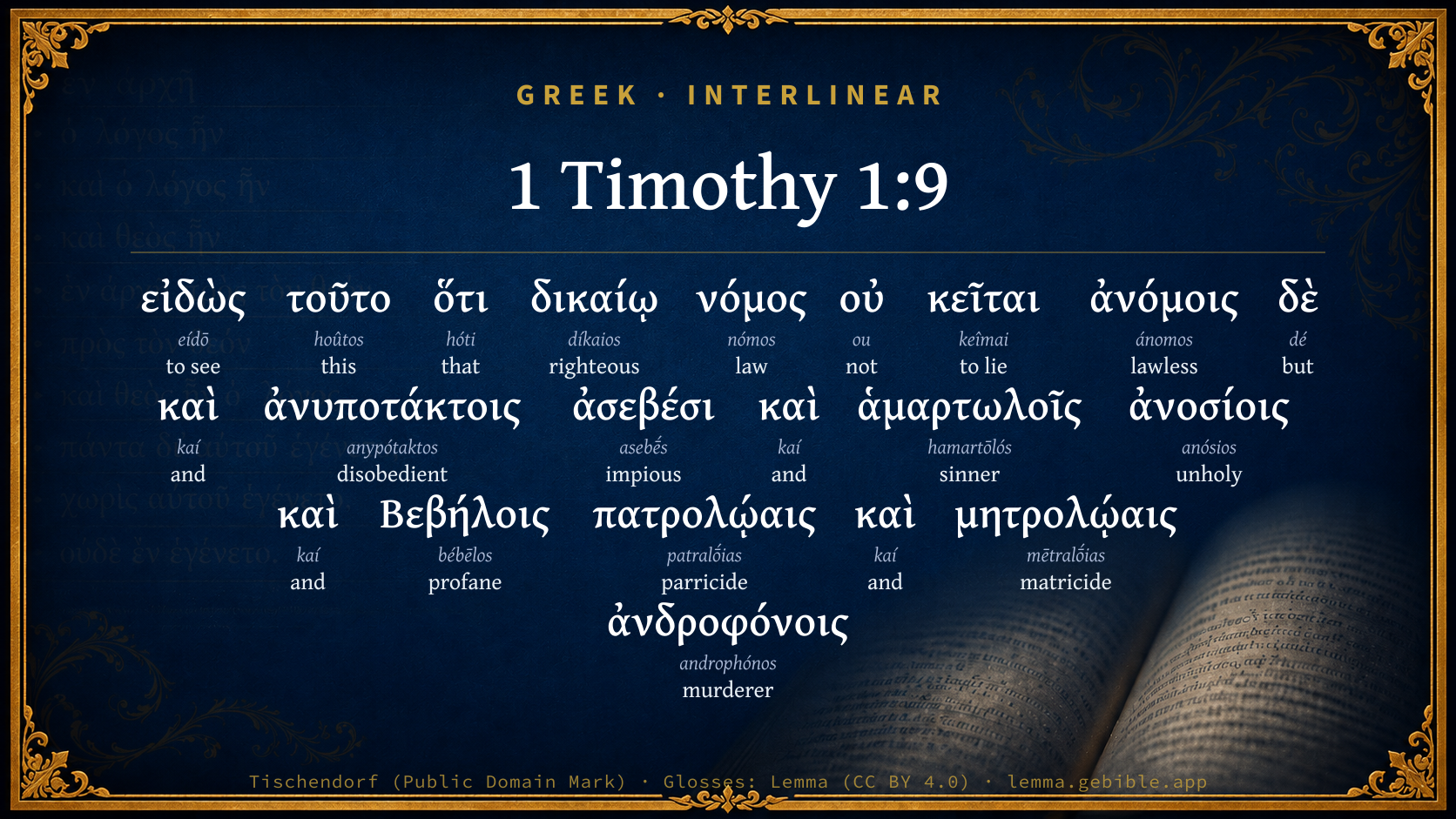
  1. εἰδὼς eídō G1492 “to see” Verb, Perfect, Active, Participle, Nominative, Singular, Masculine
  2. τοῦτο hoûtos G3778 “this” Demonstrative pronoun, Accusative, Singular, Neuter
  3. ὅτι hóti G3754 “that” Conjunction
  4. δικαίῳ díkaios G1342 “righteous” Adjective, Dative, Singular, Masculine
  5. νόμος nómos G3551 “law” Noun, Nominative, Singular, Masculine
  6. οὐ ou G3756 “not” Particle, Negative
  7. κεῖται keîmai G2749 “to lie” Verb, Present, Middle or Passive deponent, Indicative, 3rd person, Singular
  8. ἀνόμοις ánomos G459 “lawless” Adjective, Dative, Plural, Masculine
  9. δὲ dé G1161 “but” Conjunction
  10. καὶ kaí G2532 “and” Conjunction
  11. ἀνυποτάκτοις anypótaktos G506 “disobedient” Adjective, Dative, Plural, Masculine
  12. ἀσεβέσι asebḗs G765 “impious” Adjective, Dative, Plural, Masculine
  13. καὶ kaí G2532 “and” Conjunction
  14. ἁμαρτωλοῖς hamartōlós G268 “sinner” Adjective, Dative, Plural, Masculine
  15. ἀνοσίοις anósios G462 “unholy” Adjective, Dative, Plural, Masculine
  16. καὶ kaí G2532 “and” Conjunction
  17. Βεβήλοις bébēlos G952 “profane” Adjective, Dative, Plural, Masculine
  18. καὶ kaí G2532 “and” Conjunction
  19. μητρολῴαις mētralṓias G3389 “matricide” Noun, Dative, Plural, Masculine
  20. ἀνδροφόνοις androphónos G409 “murderer” Noun, Dative, Plural, Masculine

About this verse

These counts appear in no published source. They are computed here, from the morphology-tagged text and Lemma’s own curated glosses. What Lemma adds →

21
words
18
distinct lemmas
Pauline Epistles
section

Notable vocabulary

3 hapax legomena — words that appear only here in the entire Greek New Testament:

  • πατρολῴαις parricide G3964
  • μητρολῴαις matricide G3389
  • ἀνδροφόνοις murderer G409

First appearance in Scripture

These words make their first canonical appearance in the Greek New Testament here:

  • ἀνυποτάκτοις disobedient G506
  • ἀνοσίοις unholy G462
  • Βεβήλοις profane G952
  • πατρολῴαις parricide G3964
  • μητρολῴαις matricide G3389
  • ἀνδροφόνοις murderer G409

Shared distinctive vocabulary

ἀνοσίοις unholy G462 occurs in 2 verses of the Greek New Testament. Also found in:

Repetition

A word recurs within this verse:

Cross-references

37

Topical passages linked to 1 Timothy 1:9 in the Treasury of Scripture Knowledge — connected by theme and wording, ordered by reader-vote popularity; previews shown in the World English Bible.

  • Galatians 3:19 What then is the law? It was added because of transgressions, until the seed should come to whom the promise has been made. It was ordained through angels by the hand of a mediator.
  • 1 Peter 4:18 "If it is hard for the righteous to be saved, what will happen to the ungodly and the sinner?"
  • Romans 5:20 The law came in besides, that the trespass might abound; but where sin abounded, grace did abound more exceedingly;
  • Galatians 3:10–14 For as many as are of the works of the law are under a curse. For it is written, "Cursed is everyone who doesn't continue in all things that are written in the book of the law, to do them."
  • Galatians 5:23 gentleness, and self-control. Against such things there is no law.
  • Titus 3:3 For we were also once foolish, disobedient, deceived, serving various lusts and pleasures, living in malice and envy, hateful, and hating one another.
  • Romans 6:14 For sin will not have dominion over you. For you are not under law, but under grace.
  • Romans 1:30 backbiters, hateful to God, insolent, haughty, boastful, inventors of evil things, disobedient to parents,
  • Genesis 9:5–6 I will surely require your blood of your lives. At the hand of every animal I will require it. At the hand of man, even at the hand of every man's brother, I will require the life of man.
  • Titus 1:16 They profess that they know God, but by their works they deny him, being abominable, disobedient, and unfit for any good work.
  • Revelation 21:8 But for the cowardly, unbelieving, sinners, abominable, murderers, sexually immoral, sorcerers, idolaters, and all liars, their part is in the lake that burns with fire and sulfur, which is the second death."
  • Revelation 22:15 Outside are the dogs, the sorcerers, the sexually immoral, the murderers, the idolaters, and everyone who loves and practices falsehood.
  • Exodus 20:13 "You shall not murder.
  • Exodus 21:14 If a man schemes and comes presumptuously on his neighbor to kill him, you shall take him from my altar, that he may die.
  • Leviticus 20:9 "'For everyone who curses his father or his mother shall surely be put to death: he has cursed his father or his mother; his blood shall be upon him.
  • Numbers 35:30–33 Whoever kills any person, the murderer shall be slain at the mouth of witnesses: but one witness shall not testify against any person that he die.
  • Deuteronomy 21:6–9 All the elders of that city, who are nearest to the slain man, shall wash their hands over the heifer whose neck was broken in the valley;
  • Deuteronomy 27:16 Cursed be he who sets light by his father or his mother. All the people shall say, Amen.
  • 2 Samuel 16:11 David said to Abishai, and to all his servants, Behold, my son, who came forth from my bowels, seeks my life: how much more [may] this Benjamite now [do it]? let him alone, and let him curse; for Yahweh has invited him.
  • 2 Samuel 17:1–4 Moreover Ahithophel said to Absalom, Let me now choose out twelve thousand men, and I will arise and pursue after David this night:
  • 2 Kings 19:37 It happened, as he was worshipping in the house of Nisroch his god, that Adrammelech and Sharezer struck him with the sword: and they escaped into the land of Ararat. Esar Haddon his son reigned in his place.
  • 2 Chronicles 32:21 Yahweh sent an angel, who cut off all the mighty men of valor, and the leaders and captains, in the camp of the king of Assyria. So he returned with shame of face to his own land. When he was come into the house of his god, those who came forth from his own bowels killed him there with the sword.
  • Proverbs 20:20 Whoever curses his father or his mother, His lamp shall be put out in blackness of darkness.
  • Proverbs 28:17 A man who is tormented by life blood will be a fugitive until death; No one will support him.
  • Proverbs 28:24 Whoever robs his father or his mother, and says, "It's not wrong." He is a partner with a destroyer.
  • Proverbs 30:11 There is a generation that curses their father, And doesn't bless their mother.
  • Proverbs 30:17 The eye that mocks at his father, And scorns obedience to his mother: The ravens of the valley shall pick it out, The young eagles shall eat it.
  • Jeremiah 23:11 for both prophet and priest are profane; yes, in my house have I found their wickedness, says Yahweh.
  • Ezekiel 21:25 You, deadly wounded wicked one, the prince of Israel, whose day is come, in the time of the iniquity of the end,
  • Matthew 10:21 "Brother will deliver up brother to death, and the father his child. Children will rise up against parents, and cause them to be put to death.
  • Romans 4:13 For the promise to Abraham and to his seed that he should be heir of the world wasn't through the law, but through the righteousness of faith.
  • 2 Thessalonians 2:8 Then the lawless one will be revealed, whom the Lord will kill with the breath of his mouth, and bring to nothing by the brightness of his coming;
  • Hebrews 11:31 By faith, Rahab the prostitute, didn't perish with those who were disobedient, having received the spies in peace.
  • 1 Peter 3:20 who before were disobedient, when God waited patiently in the days of Noah, while the ark was being built. In it, few, that is, eight souls, were saved through water.
  • Galatians 5:21 envyings, murders, drunkenness, orgies, and things like these; of which I forewarn you, even as I also forewarned you, that those who practice such things will not inherit the Kingdom of God.
  • Hebrews 12:16 lest there be any sexually immoral person, or profane person, as Esau, who sold his birthright for one meal.
  • 1 Peter 2:7 For you therefore who believe is the honor, but for such as are disobedient, "The stone which the builders rejected, Has become the chief cornerstone,"

Cross-references courtesy of OpenBible.info (CC BY 4.0).

Commentary

Notes on 1 Timothy 1:9 from classic Christian and Jewish commentators (each source and its license shown beneath its notes). The classic Christian expositions comment on the surrounding passage and are grouped to its opening verse, so a note may address several verses; the Jewish commentaries on the Tanakh (Rashi and others) are per-verse, so they appear only where the commentator wrote on this verse.

Lemma curates 59 commentaries, every one of them public domain or Creative Commons licensed, each selected and text-cleaned for this edition rather than reprinted as found. About our sources →

Albert Barnes' Notes on the Bible

Knowing this - That is, “If anyone knows, or admits this, he has the prover view of the design of the law.” The apostle does not refer particularly to himself as knowing or conceding this, for then he would have uses the plural form of the participle (see the Greek), but he means that anyone who had just views of the law would see that that which he proceeds to specify was its real purpose.

The law is not made for a righteous man - There has been great variety in the interpretation of this passage. Some suppose that the law here refers to the ceremonial laws of Moses (Clarke, Rosenmuller, Abbot); others to the denunciatory part of the law (Doddridge and Bloomfield); and others that it means that the chief purpose of the law was to restrain the wicked. It seems clear, however, that the apostle does not refer merely to the ceremonial law, for he specifies that which condemns the unholy and profane; the murderers of fathers and mothers; liars and perjured persons. It was not the ceremonial law which condemned these things, but the moral law. It cannot be supposed, moreover, that the apostle meant to say that the law was not binding on a righteous man, or that he was under no obligation to obey it - for he everywhere teaches that the moral law is obligatory on all mankind.

To suppose also that a righteous man is released from the obligation to obey the law, that is, to do right, is an absurdity. Nor does he seem to mean, as Macknight supposes, that the law was not given for the purpose of justifying a righteous man - for this was originally one of its designs. Had man always obeyed it, he would have been justified by it. The meaning seems to be, that the purpose of the law was not to fetter and perplex those who were righteous, and who aimed to do their duty and to please God. It was not intended to produce a spirit of servitude and bondage. As the Jews interpreted it, it did this, and this interpretation appears to have been adopted by the teachers at Ephesus, to whom Paul refers. The whole tendency of their teaching was to bring the soul into a state of bondage, and to make religion a condition, of servitude. Paul teaches, on the other hand, that religion was a condition of freedom, and that the main purpose of the law was not to fetter the minds of the righteous by numberless observances and minute regulations, but that it was to restrain the wicked from sin. This is the case with all law. No good man feels himself lettered and manacled by wholesome laws, nor does he feel that the purpose of law is to reduce him to a state of servitude. It is only the wicked who have this feeling - and in this sense the law is made for a man who intends to do wrong.

For the lawless - To bind and restrain them. The word here used means, properly, those who have no law, and then those who are transgressors - the wicked. It is rendered transgressors in Mat 15:28; Luk 22:37, and wicked, Act 2:23; 2Th 2:8.

And disobedient - Those who are insubordinate, lawless, refractory. The word properly means those who are under no subjection or authority. It occurs in the New Testament only here, and Tit 1:6, Tit 1:10, where it is rendered unruly, and Heb 2:8, where it is translated not put under; that is, under Christ.

For the ungodly - Those who have no religion; who do not worship or honor God. The Greek word occurs in the following places, in all of which it is rendered ungodly; Rom 4:5; Rom 5:6; 1Ti 1:9; 1Pe 4:18; 2Pe 2:5; 2Pe 3:7; Jud 1:15. The meaning is, that the law is against all who do not worship or honor God.

And for sinners - The word used here is the common word to denote sinners. It is general, and includes sins of all kinds.

For unholy - “Those who are regardless of duty to God or man,” Robinson, Lexicon. The word occurs in the New Testament only here, and in 2Ti 3:2. It has particular reference to those who fail of their duty toward God, and means those who have no piety; who are irreligious.

And profane - This does not necessarily mean that they were profane in the sense that blasphemed the name of God, or were profane swearers - though the word would include that - but it means properly those who are impious, or who are scoffers; notes, Heb 12:16. The word occurs only in the following places, in all of which it is rendered profane: 1Ti 1:9; 1Ti 4:7; 1Ti 6:20; 2Ti 2:16; Heb 12:16. A man who treats religion with contempt. mockery, or scorn, would correspond with the meaning of the word.

For murderers of fathers - The Greek properly means a “smiter of a father” (Robinson), though here it undoubtedly means a parricide. This was expressly forbidden by the law of Moses, and was a crime punishable by death; Exo 21:15. It is said to have been a crime which the Roman law did not contemplate as possible, and hence that there was no enactment against it. It is, indeed, a crime of the highest order; but facts have shown that if the Romans supposed it would never be committed, they did not judge aright of human nature. There is no sin which man will not commit if unrestrained, and there is in fact no conceivable form of crime of which he has not been guilty.

Murderers of mothers - A still more atrocious and monstrous crime, if possible, than the former. We can conceive nothing superior to this in atrocity, and yet it has been committed. Nero caused his mother to be murdered, and the annals of crime disclose the names of not a few who have imbrued their own hands in the blood of those who bare them. This was also expressly forbidden by the law of Moses; Exo 21:15.

For manslayers - This word occurs nowhere else in the New Testament. It means a homicide - a murderer. The crime is expressly forbidden by the law; Exo 20:13; Gen 9:6.

Albert Barnes' Notes on the Bible (1834–1885) — public domain. Text from a community e-Sword/MySword module.

Fairbairn on Ezekiel, Jonah & the Pastoral Epistles

Patrick Fairbairn

Vers. 9, 10. The specific application is here given of the general principle just announced—not, of course, the only application which it admitted of, but the one which was of importance for the present time: knowing this (holding it as a settled point regarding the proper design of the law), that the law is not made for a righteous person. Although νόμος is here without the article, there seems no reason why it should not be understood of the law of God as revealed in Old Testament Scripture, rather than, with some, of law generally. For parallel passages, see Rom 2:25, Rom 3:30, Rom 7:1; Gal 2:19, Gal 6:13, etc. (See Winer, Gr. § 19.1. He brings the usage under the general rule, that appellatives often want the article, when they are such that only one of the kind exists, or are so used that there can be no reasonable doubt as to what object is intended. Besides νόμος, such words as δικαιοσύνη, ἀγάπη, and others, are similarly used.) Middleton would take an intermediate view; he would understand law in the general sense, but take it as inclusive of the law of Moses. It is, however, of this law, specially and peculiarly, that the apostle is evidently speaking: for the persons against whom he is directing his remarks assumed to be teachers of law only in this specific sense; and we have no reason for supposing that the subject of law was in any other respect before the mind of the apostle. But law so considered, unless the context plainly determines otherwise, always bears pointed reference to the decalogue; for this was the law in the more emphatic sense—the heart and essence of the whole economy of law; hence alone deposited in the ark of the covenant. And that this here also is more especially in the eye of the apostle, is evident from the different sorts of character presently after mentioned as intended to be checked and restrained by the law: they admit of being all ranged under the precepts of the two tables. Now this law is not made (οὐ κεῖται, the appropriate expression for the introduction or enactment of a law; whence οἱ νόμοι οἱ κείμενοι is equivalent to our phrase, “the established laws”) for the righteous (δικαίῳ). By the latter expression is to be understood, not one who in a worldly sense is just or upright (for the apostle is not here speaking of such), but who in the stricter sense is such,—one who, whether by nature or by grace, has the position and character of a righteous man. Why is the law not made for such? It can only be because he is of himself inclined to act in conformity with its requirements. If Adam had continued in such a state of righteousness, he would not have needed any objective revelation of law; the spirit of the law in his bosom would spontaneously have prompted him to all that is pure and good. And of justified believers now the apostle elsewhere says: “They are not under law, but under grace;” yet so under grace that sin cannot have dominion over them, and their walk is not after the flesh, but after the Spirit (Rom 6:14, Rom 8:4). It is thus they have found whatever goodness belongs to them, and thus also that they are to go on to perfection—not by serving themselves of the law, or using it as the ladder for reaching to higher attainments in goodness, but by laying hold of, or apprehending, that for which they are apprehended of Christ; drinking more deeply into the spirit of His gospel, and receiving into their souls fuller impressions of the great realities and hopes it presents to their acceptance. But this bespeaks nothing as to imperfection in the law itself, or the possibility of attaining to a height of excellence beyond its requirements. What is said has respect, not to the kind or measure of goodness men are called to aspire after, but to the way and means necessary to reach it; and when the law is represented as the antithesis of moral evil, in its various forms of irreligious and wicked behaviour, it is manifestly implied that the spirit and aim of the law itself is the perfection of moral excellence.

In regard to those for whom, he says, the law is made,—those, that is, who need the check and restraint of its discipline,—the apostle gives first a general description: they are the lawless and unruly, or disobedient, the self-willed, fiery and arrogant spirits that would fain spurn from them all surveillance and control. Then he branches out into particulars, the earlier portion of which have respect to offences against God, the later to offences against one’s fellow-men: for the ungodly and sinful (ἀνοσίοις καὶ βεβήλοις, both words occurring in 1Pe 4:18), the unholy and profane (ἀσεβέσι καὶ ἁμαρτωλοῖς), differing from the preceding pair only in pointing more distinctly to certain manifestations of the ungodly spirit, in irreverent and contemptuous behaviour toward the things more peculiarly associated with the name of God. What follows has respect to human relations: for smiters of fathers and smiters of mothers—πατρολῴαις καὶ μητρολῴαις—such is the proper import of the terms, rather than murderers of fathers and mothers; for the verb (ἀλόαω or ἀλοίαω) which forms the root of the second part of the compound expressions signifies merely to thresh, smite, or beat down; and so the smiting of father and mother, in itself a most unnatural and shameful violation of the honour due to them, whether or not it might issue in fatal consequences, was in the Old Testament legislation reckoned so heinous a transgression of the fifth command, that the penalty of death was attached to it (Exo 21:15). Then come the violators of the sixth command, murderers; those of the seventh, fornicators, abusers of themselves with mankind (ἀρσενοκοίταις, a term for which fortunately our language has no proper equivalent); those of the eighth, the most repulsive and inhuman class of them, men-stealers, kidnapping and making merchandise of their fellow-creatures; finally, those of the ninth commandment, liars, perjured persons. But as in this enumeration the apostle had mentioned only the more flagrant forms of transgression, and had no intention of furnishing a complete list of lawless characters, he winds up the description with a comprehensive form of expression, which includes whatever besides that can be reckoned evil: and if there be anything else that is contrary to the sound instruction (τῇ ὑγιαινούσῃ διδασκαλίᾳ),—that sort of instruction, namely, which was exemplified in the teaching of our Lord and His apostles. Why such teaching should be characterized as sound or healthful—why, at least, it should be so characterized here, and often besides in the Pastoral epistles (as at 1Ti 6:3; 2Ti 1:13; 2Ti 4:3; Tit 1:9, Tit 2:1), but not in Paul’s other writings, we may be but imperfectly competent to say. But neither can others be entitled to deny that the circumstances of the time were of a kind to render such an expression natural to Paul—natural for him now, as contradistinguished from a preceding time. And the simple fact of its absence from the earlier epistles of Paul was almost certain to have deterred a forger of Paul’s name to have used it, at least with such marked frequency. The apostle himself, however, might well enough do it, if the erring tendencies against which he warned and wrote in the closing period of his ministry differed materially from those which had manifested themselves previously, and, in a moral respect, were of a sickly and distempered nature. Such appears to have been actually the case. It was no longer the avowed adversaries of the gospel that the apostle had to meet, nor its mistaken and bigoted corrupters of the pharisaical type, but a class of sophistical, dreamy, self-sufficient theosophists, who, without directly opposing or disparaging the gospel, sought to introduce a fine-spun but sickly sentimentalism,—teaching abstinence from things in themselves proper and lawful, as if incompatible with the higher attainments of the divine life, and refining upon the law so as to derive from it an instruction it could not yield in its direct and natural import. This was essentially a morbid, an unhealthful sort of teaching, to which the apostle fitly opposed the sound and robust character of his own teaching and that of the other apostles. It was therefore the altered circumstances of the times which gave rise to this change in the language of the apostle; and it is absurd to urge the phraseology employed as an argument against the apostolic origin of the epistles, unless one could disprove the previous alteration in the circumstances—which has certainly not yet been done.

Patrick Fairbairn — An Exposition of Ezekiel (1851), Jonah (1849), and The Pastoral Epistles (1874) — public domain. Text from a community e-Sword module.

Tyndale Open Study Notes

Tyndale Open Resources

1:9 the law was not intended for people who do what is right: As a general principle, the virtuous person needs no law. For Christians, a righteous life results from faith apart from the law (see Gal 5:16-26; Eph 2:11-14; Titus 2:11-14; cp. Rom 8:1-17; Jas 2:14-16).

Tyndale Open Study Notes — © Tyndale Open Resources, licensed CC BY-SA 4.0. Text via the HelloAO Bible API.

Bengel's Gnomon

Johann Albrecht Bengel

1Ti 1:9. Εἰδὼς, knowing) construed with χρῆται, use.—δικαίῳ, for a righteous man) Many things which follow are put in antithesis to this one word. Therefore righteousness is widely spread.—οὐ κεῖται) is not in force, doth not exist among us, in its application is not intended [“is not made”]. Therefore a true teacher ought not to use the law against a righteous person, Gal 5:23. The antithesis is ἀντίκειται, in the following verse.—ἀνόμοις, for the [lawless] unrighteous) Paul here names the unrighteous according to the order of the Decalogue; from which it is evident that the commandment, Honour thy father, is fourth, not third.[6]—ἀνόμοις καὶ ἀνυποτάκτοις, lawless and disobedient) Referring to the first commandment, the foundation of the law, the foundation of all obedience.—ἀσεβέσι καὶ ἀμαρτωλοῖς, for the ungodly and sinners) not reverencing the ‘name’ of God, and thereby involved in great guilt,[7] Exo 20:7,—ἀνοσίοις καὶ βεβήλοις, for unholy and profane) despising the true worship of God with a profane mind.[8] Such were those very persons whom Paul notices; comp. 1Ti 4:7. Βέβηλος is compounded of the inseparable preposition, βε, Lat. ve, and βηλὸς, a threshold, especially a sacred threshold: whence βέβηλοι τόποι, οἱ βατοὶ καὶ τοῖς τυχοῦσι, places accessible to the common people. See E. Schmid. on Matthew 12, and Eustathius.

[6] The Church of Rome suppresses the second commandment, and divides the tenth into two. So Beng. also. Thus our fifth is his fourth. To make our fifth into third, their third and fourth must be joined and made second.—ED.

[7] Referring to the third commandment, as we divide them.—ED.

[8] This will answer to our fourth commandment.—ED.

Bengel's Gnomon of the New Testament — English translation (T&T Clark, Edinburgh, 1860) — public domain. Text from a community e-Sword module.

Meyer's Critical & Exegetical Commentary

Heinrich August Wilhelm Meyer

1Ti_1:9-10. Εἰδὼς τοῦτο] is not to be referred to οἴδαμεν, but to τις, i.e. to the teacher of the church. The use of the same verb is against the construction with οἴδαμεν. As to the meaning of the word, it is to be observed that here, as in many other passages of the N. T., it expresses not only the idea of knowing, but also that of weighing, considering. De Wette says, as he knows and considers. The law is rightly used only when it is considered that, etc.

ὅτι δικαίῳ νόμος οὐ κεῖται] We may, with Hofmann, take this sentence quite generally, so as to understand by νόμος not any special law, but law in general, and by δίκαιος any one who does rightly, φύσει, and not for the laws sake (Theophylact: ὃς διʼ αὐτὸ τὸ καλὸν τὴν τε πονηρίαν μισεῖ καὶ τὴν ἀρετὴν περιπτύσσεται). In that case we would have the same thought here as in Antiph. ad Stobaeum, 9: ὁ μηδὲν ἀδικῶν οὐδενὸς δεῖται νόμου (comp. also the expression of Socrates in Clemens Alex. Stromata, iv. 678: νόμον ἕνεκεν ἀγαθῶν οὐκ ἂν γενέσθαι).

The sentence, however, may also be taken in such a way as to make νόμος the Mosaic law (notwithstanding the omission of the article; comp. Rom_2:12; Rom_2:14; Rom_2:23, al.), and δίκαιος the righteous man in the specially Christian sense, i.e. the man who, in faith as a child of God, fulfils the divine will in the free obedience of the spirit. In that case we have here the thought which forms the fundamental idea of Pauls view regarding the relations of the Christian to the law (comp. Rom_6:14; Gal_5:18, al.). As Paul in 1Ti_1:11 appeals to the gospel entrusted to him for confirmation of the thought expressed in this verse, the connection of ideas decidedly favours the latter view, which is adopted also by Matthies, de Wette, Wiesinger, Van Oosterzee, et al.

κεῖται] has not, as Heydenreich thinks probable, the additional notion of an oppressive burden; νόμος κεῖται, simply means, according to a usage current even in profane writings: the law is given, exists. Otto rightly remarks: the νόμος κείμενος is one which has not only been given, but is still valid. The collocation does not occur elsewhere in the N. T.; comp., however, Luk_2:34 (Php_1:16); 1Th_3:3; especially also 2Ma_4:11.

If the law was not given for the δίκαιος (as the heretics falsely maintained), then it is valid only for the ἄδικος. This thought Paul emphasizes by pointing out the nature of the ἄδικος in various aspects, mentioning them at first in pairs.

ἀνόμοις δὲ καὶ ἀνυποτάκτοις] These two ideas, which express the most decided contrast, are rightly placed first. Ἄνομοι, in 1Co_9:21, means the heathen (Rom_2:14 : ἔθνη τὰ μὴ νόμον ἔχοντα); but here it means those who withstand the law, who do not serve the law, but their own pleasure; comp. Mar_15:28.

To this corresponds the following ἀνυπότακτοι (only here and in Tit_1:6; Tit_1:10; comp. Heb_2:8), as a designation of those who submit themselves to no higher will, no higher order. It is quite arbitrary, with Tittmann and Leo, to refer ἀνομ. to divine, and ἀνυπ. to human ordinances.

ἀσεβέσι καὶ ἁμαρτωλοῖς] These ideas (found together also in 1Pe_4:18 and in Wisd. 41:5) are distinguished from the foregoing by a more definite reference to God; ἀσεβής (used by Paul only here and in Rom_4:5; Rom_5:6) is the man who does not stand in awe, who has no holy awe of God in his heart.

ἀνοσίοις καὶ βεβήλοις] give prominence to the opposition to what is holy. Ἀνόσιος (again in 2Ti_3:2), when joined with ἀσεβής in the classical usage, refers to the injury of human rights (Xenophon, Cyrop. viii. 8. 13: ἀσεβεστέρους περὶ θεοὺς, καὶ ἀνοσιωτέρους περὶ συγγενεῖς). This distinction, however, cannot here be pressed. βέβηλος, which occurs only in the Epistles to Timothy and in Heb_12:16 (the verb βεβηλόω in Mat_12:5; Act_24:6), is synonymous with ἀνόσιος. In these first three pairs the ἄδικοι are characterized as those who stand opposed to what is divine, recognising no divine law, and having no awe of God, and whose life is not consecrated by communion with God.

The ideas that follow refer, on the other hand, to our relations with our neighbour.

πατραλῴαις καὶ μητραλῴαις] only here in N. T.: parricides and matricides. Hesychius explains them: ὁ τὸν πατέρα ἀτιμάζων, τύπτων, ἢ κτείνων; and similarly Matthies: those who actually assault father and mother. As the word occurs in this wider sense in Demosth. 732, 14; Lys. 348, ult.; Plato, Phaed. chap. 62, it may be so taken here. At least we cannot, with de Wette, quote the following ἀνδροφόνοις as a cogent reason against it.

ἀνδροφόνοις] 2Ma_9:28; ἅπαξ λεγόμ. in N. T.; the compound is selected to correspond with the previous words.

πόρνοις, ἀρσενοκοίταις] refer to un-chastity, the one towards the female, the other towards the male sex; for this latter, comp. Rom_1:27; 1Co_6:9.

ἀνδραποδισταῖς] The Scholiast on Aristoph. Plut. v. 521, says: εἴρηται ἀνδραποδιστὴς παρὰ τὸ ἄνδρα ἀποδίδοσθαι, τουτέστι πωλεῖν. This crime is often mentioned in Greek authors; but also in Exo_21:16; Deu_24:7.

ψεύσταις, ἐπιόρκοις] stand both in opposition to truthfulness; ἐπίορκος is one who wantonly breaks an oath, as well as one who swears something false.

We cannot help seeing that in enumerating these various classes of the ἄδικοι, the apostle has had the Decalogue in mind, not adhering to it strictly, but partly extending, partly limiting it, still without departing from its order.

In order to describe the ἀδικία as a whole, the apostle adds: καὶ εἴ τι ἕτερον τῇ ὑγιαινούσῃ διδασκαλίᾳ ἀντίκειται.

The expression ἡ ὑγιαίν. διδασκ. is one of those which only occur in the Pastoral Epistles, and help to give them a peculiar impress; comp. 2Ti_4:3; Tit_2:1; Tit_1:9.

In 1Ti_6:3 and in 2Ti_1:13, we have ὑγιαίνοντες λόγοι; in Tit_2:8, λόγος ὑγιής. In these epistles ὑγιαίνειν is even used figuratively in another connection; thus Tit_1:13; Tit_2:2 (νοσεῖν in opposite sense, 1Ti_6:4); elsewhere in the N. T. it occurs only in its proper meaning. The expression διδασκαλία is particularly frequent in these epistles, sometimes denoting the doctrine (so here) in the objective sense, sometimes subjectively, the teaching (comp. chap. 1Ti_4:1; 1Ti_4:6; 1Ti_4:13; 1Ti_4:16, al.; 2Ti_3:10; 2Ti_4:3; Tit_1:9 ff.).

He lays emphasis on sound doctrine, as opposed to the ματαιολογία of the heretics. Luther translates ὑγιαίνουσα inaccurately by wholesome; the wholesomeness is only the result of the soundness. By ἡ ὑγιαίν. διδ. is here meant the pure gospel, free from all foreign admixture, having nothing unclean or sickly in it. The apostle here is certainly thinking chiefly of the ethical side of the διδασκ.; still Leo is wrong in translating it sound morality. By the form εἴ … ἀντίκειται Paul gives us to understand that there are indeed other forms and shapes of unrighteousness, incompatible with the pure doctrine of the gospel. The neuter form τὶ ἕτερον is strange. In explanation, we might appeal to passages like 1Co_1:17, Heb_7:7, and others, where the neuter denotes persons; but the use of the verb ἀντίκειται is against this. It is better to regard it as a transition from persons to things.[58]

[58] As Wiesinger rightly remarks, vv. 9 and 10 show that the apostle is not contending here against actual Judaizers, but against such as consider the law a means of attaining to a still higher moral perfection.

Meyer — Critical and Exegetical Commentary on the New Testament — English translation by Peter Christie, edited by Frederick Crombie (T&T Clark, 1880) — public domain. Text from a community e-Sword module.

Expositor's Greek Testament

ed. W. Robertson Nicoll

1Ti 1:9 . εἰδώς refers to τις , as knowing this (R.V). For the expression cf. οἶδας τοῦτο , 2Ti 1:15 and Eph 5:5 . νόμος : Although νόμος when anarthrous may mean the Mosaic Law, the statement here is perfectly general (so R.V.). The Mosaic Law does not differ in the range of its application, though it may in the details of its enactments, from law in general, of which it is a subdivision. Law is not enacted for a naturally law-abiding man (dative of reference). δίκαιος is used here in the popular sense, as in “I came not to call the righteous”. It is unnecessary to suppose that St. Paul had his theory of justification in his mind when writing this; though of course those who “are led by the Spirit” are δίκαιοι of the highest quality, κατὰ τῶν τοιούτων οὐκ ἔστιν νόμος (Gal 5:18 sqq. , Gal 5:23 ). The enumeration of those whom legislators have in view when enacting laws naturally begins with ἄνομοι , of whom the ἀνυπότακτοι , unruly , those who deliberately rebel against restriction of any kind, are the extreme type. There is no special class or quality of crime involved in the terms ἄνομος and ἀνυπότακτος . As the series advances, the adjectives indicate more definite and restricted aspects of lawlessness: the first three pairs represent states of mind; then follow examples of violations of specific enactments. Since St. Paul is here dealing with the law of natural religion, it is not safe to deepen the shade of ἀσεβής , κ . τ . λ . by looking at the conceptions they express in the light of the Lord.

ὁ ἀσεβὴς καὶ ἁμαρτωλός is a pair of epithets familiar from its occurrence in Pro 11:31 (quoted 1Pe 4:18 . See also Jud 1:15 ). The ἀσεβής is one whose mental attitude towards God Himself is that of deliberate irreverence; the βέβηλος acts contumeliously towards recognised expressions or forms of reverence to God.

Alford and Ellicott, following a hint from Bengel, suppose that in the series commencing πατρολῴαις St. Paul is going through the second table of the Decalogue. It is an argument against this that when St, Paul is unquestionably enumerating the Commandments, Rom 13:9 , he places the command against adultery before that against murder (so Luk 18:20 ; Jas 2:11 ; Philo, De Decalogo , xxiv. and xxxii.; Tert. de Pudic , v., all following LXX ( [256] ) of Deut. chap. 5). There is therefore no necessity to give πατρολῴας the weak rendering smiter of a father (R.V. m.) in order to make the word refer to normal breaches of the Fifth Commandment, It can, of course, both by derivation and use, be so rendered, The Greek word, like parricide in Latin and English, may be applied to any unnatural treatment of a parent.

[256] Codex Vaticanus (sæc. iv.), published in photographic facsimile in 1889 under the care of the Abbate Cozza-Luzi.

The apostle is here purposely specifying the most extreme violations of law, as samples ( καὶ εἴ τι ἕτερον ) of what disregard of law may lead to. The healthy, wholesome teaching of Christ is of course in opposition to such enormities; it is also in opposition to the false teachers; these teachers have failed to attain to a pure heart, etc. Consequently, although professing to teach the Law, they find themselves in opposition to the essential spirit of law. Let them, and those who listen to them, take care lest their teaching inevitably issue in similar enormities.

The Expositor's Greek Testament, edited by W. Robertson Nicoll (1897–1910) — public domain. Text from a community e-Sword module.

Geneva Bible (1599)

Geneva Bible translators

He indeed escapeth the curse of the Law, and therefore doth not abhor it, who fleeing and eschewing those things which the Law condemneth, giveth himself with all his heart to observe it: and not he that maketh a vain babbling of outward and curious matters.

And such a one is he, whom the Lord hath endued with true doctrine, and with the holy Ghost.

To such as make an art as it were of sinning.

Geneva Bible (1599) marginal notes — public domain. Text via Bolls.life.

Jamieson, Fausset & Brown

Robert Jamieson, A. R. Fausset & David Brown

law is not made for a righteous man--not for one standing by faith in the righteousness of Christ put on him for justification,and imparted inwardly by the Spirit for sanctification. "One not forensically amenable to the law" [ALFORD]. For sanctification, the law gives no inward power to fulfil it; but ALFORD goes too far in speaking of the righteous man as "not morally needing the law." Doubtless, in proportion as he is inwardly led by the Spirit, the justified man needs not the law, which is only an outward rule (Rom 6:14; Gal 5:18, Gal 5:23). But as the justified man often does not give himself up wholly to the inward leading of the Spirit, he morally needs the outward law to show him his sin and God's requirements. The reason why the ten commandments have no power to condemn the Christian, is not that they have no authority over him, but because Christ has fulfilled them as our surety (Rom 10:4).

disobedient--Greek, "not subject"; insubordinate; it is translated "unruly," Tit 1:6, Tit 1:10; "lawless and disobedient" refer to opposers of the law, for whom it is "enacted" (so the Greek, for "is made").

ungodly and . . . sinners--Greek, he who does not reverence God, and he who openly sins against Him; the opposers of God, from the law comes.

unholy and profane--those inwardly impure, and those deserving exclusion from the outward participation in services of the sanctuary; sinners against the third and fourth commandments.

murderers--or, as the Greek may mean, "smiters" of fathers and . . . mothers; sinners against the fifth commandment.

manslayers--sinners against the sixth commandment.

Jamieson, Fausset & Brown — Commentary Critical and Explanatory on the Whole Bible (1871) — public domain (CC PDM 1.0). Text via the HelloAO Bible API.

Adam Clarke's Commentary

Verse 9. The law is not made for a righteous man] There is a moral law as well as a ceremonial law: as the object of the latter is to lead us to Christ; the object of the former is to restrain crimes, and inflict punishment on those that commit them. It was, therefore, not made for the righteous as a restrainer of crimes, and an inflicter of punishments; for the righteous avoid sin, and by living to the glory of God expose not themselves to its censures. This seems to be the mind of the apostle; he does not say that the law was not MADE for a righteous man, but ουκειται, it does not LIE against a righteous man; because he does not transgress it: but it lies against the wicked; for such as the apostle mentions have broken it, and grievously too, and are condemned by it. The word κειται, lies, refers to the custom of writing laws on boards, and hanging them up in public places within reach of every man, that they might be read by all; thus all would see against whom the law lay.

The lawless] ανομοις. Those who will not be bound by a law, and acknowledge none, therefore have no rule of moral conduct.

Disobedient] ανυποτακτοις. Those who acknowledge no authority; from α, negative, and οποτασσω, to subject; they neither acknowledge law, nor executive authority, and consequently endeavour to live as they list; and from such dispositions all the crimes in the following catalogue may naturally spring.

For the ungodly] ασεβεσι. The irreligious-those who do not worship God, or have no true worship; from α, negative, and σεβω, to worship. For sinners, αμαπτωλοις those who transgress the laws; from α, negative, and μαρπτω, to hit the mark. This has been elsewhere explained.

For unholy] ανοσιοις. Persons totally polluted-unclean within, and unclean without; from α, negative, and οσιος holy.

And profane] βεβηλοις. Such who are so unholy and abominable as not to be fit to attend any public worship; from βε, denoting privation or separation, and βηλος, a threshold or pavement, particularly of a temple. Our word profane comes from procul a fano, "far from the temple." When the ancients, even heathens, were about to perform some very sacred rites, they were accustomed to command the irreligious to keep at a distance; hence that saying in a fragment of Orpheus:-

Φθεγξομαι οἱς θεμις εστι· θυρας δ' επιθεσθε βεβηλοις Πασιν ὁμως.

"I will speak to whom it is lawful; but these doors, O, shut against the profane."

And that of Virgil, AEn. vi. ver. 258.

Procul! O procul! este profani.

Far! ye profane! get hence.

Murderers of fathers] πατραλωαις. The murderer of a father or a mother, notwithstanding the deep fall of man, and the general profligacy of the world, has been so rare, and is a crime so totally opposite to nature, that few civilized nations have found it necessary to make laws against it. Yet, such monsters, like the most awful and infrequent portents, have sometimes terrified the world with their appearance. But I think the original does not necessarily imply the murder of a father or of a mother; πατραλωας comes from πατερα, a father, and αλοιαω, to strike, and may mean simply beating or striking a father or mother: this is horrible enough; but to murder a parent out-herods Herod.

Manslayers] ανδροφονοις. Murderers simply; all who take away the life of a human being contrary to law. For no crime, unless it be murder, should any man lose his life. If the law did not speak differently, I should not scruple to say that he whose life is taken away, except for murder, is murdered.

Adam Clarke's Commentary on the Bible (1810–1826) — public domain. Text from a community e-Sword/MySword module.

John Calvin's Commentaries

9 That the law is not made for a righteous man The apostle did not intend to argue about the whole office of the law, but views it in reference to men. It frequently happens that they who wish to be regarded as the greatest zealots for the law, give evidence by their whole life that they are the greatest despisers of it. A remarkable and striking instance of this is found in those who maintain the righteousness of works and defend free-will. They have continually in their mouth these words, “Perfect holiness, merits, satisfactions;” but their whole life cries out against them, that they are outrageously wicked and ungodly, that they provoke in every possible way the wrath of God, and fearlessly set his judgment at naught. They extol in lofty terms the free choice of good and evil; but they openly shew, by their actions, that they are the slaves of Satan, and are most firmly held by him in the chains of slavery.

Having such adversaries, in order to restrain their haughty insolence, Paul remonstrates that the law is, as it were, the sword of God to slay them; and that neither he nor any like him have reason for viewing the law with dread or aversion; for it is not opposed to righteous persons, that is, to the godly and to those who willingly obey God. I am well aware that some learned men draw an ingenious sense out of these words; as if Paul were treating theologically about the nature of “the law.” They argue that the law has nothing to do with the sons of God, who have been regenerated by the Spirit; because it was not given for righteous persons. But the connection in which these words occur shuts me up to the necessity of giving a more simple interpretation to this statement. He takes for granted the well-known sentiment, that “from bad manners have sprung good laws,” and maintains that the law of God was given in order to restrain the licentiousness of wicked men; because they who are good of their own accord do not need the authoritative injunction of the law.

A question now arises, “Is there any mortal man who does not belong to this class?” I reply, in this passage Paul gives the appellation “righteous” to those who are not absolutely perfect, (for no such person will be found,) but who, with the strongest desire of their heart, aim at what is good; so that godly desire is to them a kind of voluntary law, without any motive or restraint from another quarter. He therefore wished to repress the impudence of adversaries, who armed themselves with the name of “the law” against godly men, whose whole life exhibits the actual role of the law, since they had very great need of the law, and yet did not care much about it; which is more clearly expressed by the opposite clause. If there be any who refuse to admit that Paul brings an implied or indirect charge against his adversaries as guilty of those wicked acts which he enumerates, still it will be acknowledged to be a simple repelling of the slander; and if they were animated by a sincere and unfeigned zeal for the law, they ought rather to have made use of their armor for carrying on war with offenses and crimes, instead of employing it as a pretext for their own ambition and silly talking.

For the unrighteous and disobedient Instead of “unrighteous,” it would have been better if translators had made use of the word “lawless;” for the Greek word is ἀνόμους, which does not differ much from the second word in the clause, “disobedient.” By sinners he means wicked persons, or those who lead a base and immoral life.

For the ungodly and profane These words might have been fitly rendered “profane and impure;” but I did not wish to be fastidious in matters of little importance.

John Calvin's Commentaries (1540-1563) — public domain. Text from the Calvin Translation Society English edition (1840s-50s) via the Christian Classics Ethereal Library (ccel.org). Calvin's coverage is partial (roughly two-thirds of the Bible); uncommented books and verses are honest gaps, never fabricated. The 19th-century editor's footnotes and remarks are omitted so the notes are faithfully Calvin's own voice.

Ellicott's Commentary for English Readers

(9) Knowing this.—The teacher of the Law, being aware of this great truth, now to be detailed—viz.:—

That the law is not made for a righteous man.—The stern Mosaic Law was enacted centuries before the Messiah Jesus had given to men His new Law. The Law of Moses was not, then, enacted for a “righteous man”—that is, for a Christian in the true sense of the word, who has sought and found justification by faith in Jesus, and who, sanctified by the Holy Ghost, is living a new life. In other words, the “teacher,” Paul says, must teach the flock of Ephesus (1) the true use of the prohibitions of the Law, viz., that they served to convince a man of his hopeless condition; they showed him he was a slave to sin, from which wretched bondage, the Law, which made him bitterly conscious of his condition, gave him no assistance to free himself; (2) the “teacher” was to press home to the people that the Law, good though it was, if used as a means to open men’s eyes to see their true condition, was not made for them if they were reckoned among the righteous—that is, if they had found acceptance in the Redeemer. In the case of these justified and sanctified ones the moral law was written in their hearts and was embodied in their lives.

But for the lawless.—Now the Law was not made for the holy and humble men of heart, whom St. Paul trusted formed the main body of the congregation of believers in Ephesus, and in every city where men and women were found who called on the name of the Lord Jesus, and who struggled to follow their dear Master’s footsteps. It was made centuries before Jesus of Nazareth walked on earth, as a great protest against the every-day vices which dishonoured Israel in common with the rest of mankind. The terrible enumeration of sins and sinners in these 9th and 10th verses, while following the order of the ancient Tables of Sinai, seems to allude pointedly to the vices especially prevalent in that day in the great centres of the Roman empire.

And disobedient.—More accurately rendered, unruly, or insubordinate.

For the ungodly and for sinners.—These four terms with which the Apostle opens his sad list of those for whom the Law was enacted, generally denote those who care nothing for human law, and who despise all obedience; who to their careless neglect for all constituted authorities, unite irreligion and contempt for all sacred things.

For unholy and profane.—The persons designated in these terms are those wanting in inner purity—men who scoff at holiness of life and character in its deepest sense. These six classes may be assumed in general terms to include the prohibitions of the first four Commandments (the First Table, as it is termed), where sins against God are especially dwelt upon. The sins against man, which form the subject of the prohibitions of the Second Table (Commandments Five to Ten), are included in the following enumeration of wrong-doers.

For murderers of fathers and murderers of mothers.—The original Greek expressions here require the milder rendering, smiters of fathers and smiters of mothers, and refer to persons of various ages who refuse all reverence, even all kindly treatment, to their parents. The words of the Fifth Commandment exactly explain this unnatural conduct.

A Bible Commentary for English Readers, edited by Charles John Ellicott (1878–1897) — public domain. Text from a community e-Sword module.

The Cambridge Bible for Schools and Colleges

gen. ed. J. J. S. Perowne

9. knowing this] The A.V. putting a full stop after ‘lawfully’ gives an entirely wrong turn here; the R.V. puts a comma and inserts ‘as’ in order to shew the connexion of ‘knowing’ with ‘a man’; we may continue the above rendering rather more idiomatically, if it be handled as law should be and with the knowledge that.

the law is not made] There is no article, and we may with the R.V. translate, law is not made; not thereby drawing a marked distinction between ‘law’ here and ‘the law’ of Moses above, but following St Paul’s instinct of language, and by the omission drawing attention to the play on words or the antithesis intended, in a crisper and more proverbial way. This explanation will satisfy all the cases of omission of article before ‘law’ quoted by Winer from Gal_2:21; Gal_3:11; Gal_3:18; Gal_3:21; Gal_4:5. Cf. Winer, § 19, Moulton n.; Lightfoot’s Gal. 11. 19. Here ‘law’ and ‘the lawless’ stand in sharper contrast without the article.

for a righteous man] By ‘righteous’ we may well understand one ‘who has his measure of fruit in holiness’ (Ellicott, quoting Hooker), in contrast to those who not only ignore the law as any check on their life, lawless, but are positively disobedient or unruly, delighting in open defiance of it; being ungodly, with no fear of God or sense of His presence before their mind; and sinners, marked as such by definite acts of sin (Luk_18:13), (2Pe_1:6); (for the two words together compare Judges 15).

unholy] They are further breakers of the first and second commandments; the word describes the disregard of duty to God, and only occurs here and 2Ti_3:2; but the corresponding word for the performing of this duty occurs in 1Ti_2:8, ‘lifting up holy hands in worship.’

profane] breakers of the third and fourth commandments; the N. T. use of the word describes disregard of God’s day, Mat_12:5; of God’s house, Act_24:6; of God’s law and truth, 1Ti_4:7; 1Ti_6:20; 2Ti_2:16; of God’s name and birthright blessing, Heb_12:16.

murderers of fathers and murderers of mothers] breakers of the fifth commandment, cf. Exo_21:15. In this and in the following words St Paul evidently singles out the worst breaches of the Jaw, his argument being ‘the law was meant to convict the vilest—you apply it to the holiest.’ Hence, we must keep the stronger meaning ‘parricide,’ though the Greek word by its proper derivation means ‘father-beater.’ When it came to have the meaning ‘parricide,’ a different derivation was also assigned to it and the spelling a little altered accordingly. For similar corruptions in English to fit a supposed derivation compare ‘reindeer,’ ‘causeway,’ ‘camel leopard.’

manslayers] breakers of the sixth commandment.

The Cambridge Bible for Schools and Colleges (gen. ed. J. J. S. Perowne; Cambridge University Press, 1878–1918) — public domain. Text from a community e-Sword module.

John Gill's Exposition

Knowing this, that the law is not made for a righteous man,.... No man is naturally righteous since Adam, excepting the man Christ Jesus: some that are righteous in their own opinion, and in the esteem of others, are not truly and really so; none are righteous, or can be justified in the sight of God by the works of the law; those only are righteous men, who are made so through the imputation of Christ's righteousness to them: and such a righteous man is here intended, who believes in Christ with the heart unto righteousness, who lays hold on Christ's righteousness, and receives it by faith; in consequence of which he lives soberly, righteously, and godly, though not without sin, since there is no such just man upon earth. Now for such a man the law was not made; which must be understood not of its original constitution and make, for it was certainly made for, and given to Adam, who was a righteous man, and was written upon his heart in a state of innocence; and who had a positive law made also for him, and given to him as a trial of his obedience to this: it was also delivered to the Israelites on Mount Sinai, who were, many of them, at least, righteous men; and besides all this, the law was made for Jesus Christ; he was the end, the mark, and scope at which it aimed, and for whose sake it was given to Israel, that he might be made under it, and fulfil it. Nor does this expression deny all use of the law to a righteous man, which has been pointed out on the preceding verse, but only removes an unlawful use, and a wrong end of the law: it never was made with any such view as to obtain righteousness by it; for, a righteous man, as Adam, in innocence, and all that are justified by Christ's righteousness, need it not for such a purpose, because they are already righteous; and sinners can never attain to righteousness by it, since it cannot give life unto them: it is made therefore not for the former with the view now mentioned, but for the latter, and that both for the restraining of sin, and punishing of sinners. The words , may be rendered, "the law does not lie upon a righteous man", or against him. It does not lie as a weight or burden on him; its precept does not lie on him, as a task to be performed; nor does its penalty, the curse, lie on him as a punishment to be bore by him: it does not lie upon him, nor against him, as an accusing law, its mouth is stopped by the righteousness of Christ, by which he is denominated a righteous man; nor as a terrifying law, and bringing into bondage by its threats and menaces; nor as a rigorous law, obliging to obedience in a forcible and compulsive way; seeing there is no need of it, the righteous man delights in it, and cheerfully serves it, and the love of Christ constrains him to obey it freely. And much less does it lie on him, or against him as a cursing or condemning law, since Christ has redeemed him from the curse of it,

But for the lawless and disobedient; by the "lawless" are meant, not the Gentiles, which were without the written law, but such who have it, and despise and reject it, and live not according to it, but transgress it: and "the disobedient" design such who are not subject to it: who are sons of Belial, children without the yoke; who cast the law of the Lord behind their backs; who are not, nor can they be subject to it, without the powerful and efficacious grace of God. Now the law lies upon, and against such persons, as an accusing, terrifying, cursing, and condemning law,

For the ungodly, and for sinners; by the "ungodly" are intended, such as are without God in the world, who neither fear God, nor regard man, who neglect and despise the worship of God, and say to him, depart from us, Job 21:14 and by "sinners" are designed notorious ones, who are exceeding great sinners, always sinning, making sin their constant business and employment; on and against these the law lies:

for unholy and profane: such are unholy persons, who are destitute of inward principles of truth and holiness, and who live unholy lives and conversations; and "profane" persons are those who profane the name of the Lord by cursing and swearing, and who profane his day, doctrines, and ordinances, and live dissolute and profane lives, being abandoned to all sin and wickedness; these three couples of wicked men, expressed in general terms, seem to have respect greatly to the moral part of the four precepts of the decalogue, as the following particulars do to the other six:

for murderers of fathers, and murderers of mothers; though there is no law that expressly mentions this, yet is beyond all doubt a breach both of the fifth and sixth commands; and if cursing parents, and disobedience to them, were punishable by the law with death, then much more the murder of them; see Lev 20:9 though the words will bear to be rendered, "for strikers of fathers, and strikers of mothers"; and so the Syriac and Arabic versions render them, and against this there was an express law, Exo 21:15. According to the Pompeian law, one guilty of parricide was to be sewed up in a sack with a dog, a cock, a viper, and an ape, and cast into the sea, or into a river (h):

for manslayers, guilty of the murder of any man, which was always punishable with death, and was a breach of the sixth command; see Gen 9:6.

(h) Pompon. Laetus de Leg. Rom. p. 156.

John Gill's Exposition of the Whole Bible (1746–1763) — public domain (CC PDM 1.0). Text via the HelloAO Bible API.

Trapp's Complete Commentary

John Trapp

9 Knowing this, that the law is not made for a righteous man, but for the lawless and disobedient, for the ungodly and for sinners, for unholy and profane, for murderers of fathers and murderers of mothers, for manslayers,

Ver. 9. Is not made for a righteous] For he is freed by Christ from the coaction, malediction, and irritation of the law. The law lieth not upon the righteous (so the Greek soundeth), it urgeth not upon them, as it doth upon the wicked. To these it is as chains and shackles, to the righteous as girdles and garters, which gird up his loins and expedite his course the better. It confineth him (saith Rev. Dr Preston) to live in that element where he would live; as if one should be confined to Paradise, where he would be, though there were no such law. The wicked (on the contrary) it confineth to the place where he would not be, and to the actions that he would not do; as Shimei confined, leapeth over the pale after profit and pleasure, and dieth for it.

But for the lawless, &c.] Those masterless monsters, that send messages after Christ, saying, "We will not have this man to reign over us." But shall they thus escape by iniquity? "In thine anger thou wilt cast down these people, O God," Psa 56:7. Aut faciendum, aut patiendum. Either do or suffer. They that will not bend shall break; they that will not be Christ’s subjects shall be his footstool: his arrows are sharp in the hearts of the king’s enemies, whereby the people (that fall not down before him) fall under him, Psa 45:5.

John Trapp, A Commentary or Exposition upon All the Books of the Old and New Testament (1647–1656) — public domain. Text from a community e-Sword module.

Haydock's Catholic Bible Commentary

The law is not, &c. He means that the just man doth good, and avoideth evil, not as compelled by the law, and merely for fear of the punishment appointed for transgressors, but voluntarily, and for the love of God and virtue; and would do so, though there were no law. (Challoner) --- If all men were just, the law would be unnecessary, as law are made against transgressors. (Calmet) --- It is not the just, but the unjust, that the law threatens, binds, and chastises. The just man obeys it without violence or constraint; he fulfils it with pleasure. (St. Augustine, lib. de Spiritu. &c.)

George Leo Haydock (1774–1849), Haydock's Catholic Family Bible and Commentary, 1859 edition — public domain. Excludes Psalms (Douay-Rheims chapter numbering differs from Protestant) and Deuterocanonical books (Catholic canon only).

Matthew Poole's English Annotations

By the law is to be understood the moral law, (though possibly not excluding the law of Moses, consisting in many ordinances), as it is armed with stings and terrors, to restrain rebellious sinners; by the

righteous man, one in whom a principle of Divine grace is planted, and, from the knowledge and love of God, chooses the things that are pleasing to him, and is ardent and active to do his will. Now it is true, the holiness commanded in the law, that, consists in the love of God and our neighhour, obliges every reasonable creature indispensably and eternally; but as the law was delivered in so terrible a manner, as it has annexed so many severe threatenings to the transgressors of it, it is evident that it is directed to the wicked, who will only be compelled by fear from an outrageous breaking of it. And this may be emphatically signified in the word here used, κειται, for it signifies to be laid, as well as to be made. The law non objicitur is not lald against a righteous man. Thus we translate it, Mat 3:10; The axe is laid unto the root of the trees: there is some difference in the construction; here it is immediately joined with the dative case, there with an accusative case, with the preposition προς between the verb and the case; but that must be the sense. It is very probable, that these false teachers had been terrifying the Christians with the law, in opposition to whom the apostle saith, the law was not made for a righteous man, as to its condemning office; it was never intended against a righteous man, but against men that committed and lived in gross sin and wickedness. These sinners are first mentioned in general terms, then the apostle proceedeth to a more particular enumeration of them; whether in them (as some think) the apostle hath respect to the several precepts of the decalogue, I cannot determine. By the lawless he meaneth persons living without any respect to the laws of God or men. By the

disobedient he meaneth such as will live in subjection to no government. The word by us translated

ungodly, signifieth such as live without any religion, having no regard to the worship of God, ασεβεσι. The word translated sinners signifies infamous, scandalous sinners.

Unholy and profane are also general terms, signifying persons that have no piety, but lewdly talk of things sacred, and live as lewdly.

Murderers of fathers and murderers of mothers: the words signify such as strike or beat their parents, though they do not give them mortal wounds, and well expresseth violaters of the fifth commandment.

Manslayers, androfonouv, signifies such as kill men, whether maliciously or passionately, violaters of the sixth commandment.

Matthew Poole's English Annotations on the Holy Bible (1683–1685) — public domain. Text from a community e-Sword/MySword module.

Whedon's Commentary on the Bible

Daniel D. Whedon

9. Not made for—Literally, does not lie for, does not exist for. The term lies does not express a penal effect upon the just man, though the severe strain of the following verses indicates that such is the implication. Legal penalty is not for the good, but for the criminal.

A righteous man—As the subtle teacher of the fables and genealogies claimed to be. The law did not exist for the purpose of making him wise in his own conceit. Law, here, means not the absolute rule of right, for that exists for, and is binding on, all beings; but it means the vocal or written expression of that rule; the commandment in words. For beings who do absolutely and continually right, no such verbal commandment would be needed. It would be intrinsically good, but relatively superfluous. In practical daily morals this truth has been recognized among the best pagan writers. From many passages in Wetstein we select the following: Antiphon says, “The man doing no wrong needs no law.” “Aristippus, being asked what was the superiority of the philosophers, replied, in the fact that if the laws were abrogated we should live the same.” AElian says, “Solon did not legislate for lions, when he enacted that it was obligatory to support one’s parents.” See our note on Mat_11:30. But Paul’s righteous man is the gospel ideal; the made righteous, not by nature, but by grace purifying and exalting nature. To him Christ, by faith embraced, is the substitute for law, being a living law, and the Spirit is the quickener to a conformity with Christ. As the man sinks below Christ, he sinks into law, and feels its enslaving and condemning power until he rises again into Christ.

The objects of law are now first described in three severe antitheses. The lawless are those who ignore law, and act as if it had no existence; the disobedient recognise law and consciously rebel against it. The ungodly neither recognize nor reverence God, and think and live as if no God existed; sinners know God, yet consciously disregard his authority as God, and transgress his commandments. Unholy are those whose hearts and lives possess no inward purity or conformity to the divine ideal; the profane are those who regard nothing and nobody as sacred or holy.

The above three antitheses specify qualities of character; the following epithets characterize classes of evil men according to their evil actions. The apostle’s mind evidently runs along the prohibitions of the second table of the decalogue, from the fifth to the ninth commandment, selecting what he deems the most flagrant transgressions of each. The transgressors against the fifth commandment are parricides and matricides; and against the sixth are manslayers.

Daniel D. Whedon (gen. ed.), Commentary on the Old and New Testaments (1874–1909) — public domain. Text from a community e-Sword module.

The Pulpit Commentary

As knowing for knowing, A.V; Law for the Law, A.V; unruly for disobedient, A.V; and sinners for and for sinners, A.V; the unholy for unholy, A.V Law is not made for a righteous man. It is much better to render nomov, with the A.V, "the Law," as e.g. Rom_2:12-14. The whole proposition relates to the Law of Moses, which these teachers perverted and tried to force upon Christians, being ignorant that the Law was made, not for the righteous, but for sinners. For is not made, we might render does not apply to or is not in force against. Keitai with the dative following as (RAPC 2Ma 4:11) suggests some such meaning, somewhat different from the simple nomov keitai. This freedom of the righteous from the Law is what St. Paul everywhere asserts (Rom_6:14 Rom_8:2; Gal_2:19 Gal_3:25 Gal_5:18, etc.) the Law being viewed, not as a holy rule of life, but as a system of penalties Law of sin and death." That nomov here means the Law of Moses is further evident from this, that in the following list the apostle clearly follows the general order of the Decalogue, taking first the offences against the first table, and then sins against the fifth, sixth, seventh, and ninth commandments (compare, too, ver. 11 with. Rom_2:16) Lawless (ajnomoiv); with no special reference to its etymology, but meaning simply "transgressors," "wicked," Luk_22:37; Act_2:23; 2Th_2:8 (A.V) and very frequently in the LXX Unruly (ajnupotaktoiv); insubordinate, resisting lawful authority. In the LXX for the Hebrew liylib, (1Sa_2:12, Symmachus) and perhaps Pro_16:27. In the New Testament it is peculiar in this sense to the pastoral Epistles, being only found here and in Tit_1:6, 10 In Heb_2:10 it has the classical sense of "unsubdued." The express application of the word insi, Tit_1:10, to the "unruly talkers of the circumcision," shows that St. Paul has them in view here also. Ungodly and sinners, for the unholy and profane. All terms implying offences against the first table. (jAsebe) (with the kindred ajsebeia and ajsebew) is always rendered "ungodly," "ungodliness," "to act ungodly;" aJmartwloiv, sinners, viz. against God; ajnosioiv, unholy (found only here and at 2Ti_3:2 in the New Testament, but frequent in the LXX) is the contrary to osiov, holy, saintly; bebhloiv (whence bebhlow, to profane, (Mat_12:5; Act_24:6) profane, of persons and things not consecrated to God peculiar in the New Testament to the pastoral Epistles (1Ti_4:7; 2Ti_2:16) andaiv, Heb_12:16, but found commonly in the LXX and in classical Greek. Patralwaiv and mhtralw not murderers, but, as in the margin, smiters, ill-users of father and mother." Both words are only found here in the New Testament, but found in Demosthenes, Aristophanes, etc. The allusion here is tow Exo_21:15, where the Hebrew word for "smiteth" is XXX, which does not necessarily mean "to smite to death" any more than ajloa does. jAndrofonoiv, man-slayers; found only here in the New Testament, but used in RAPC 2Macc 9:28 and in classical writers. The reference is to Exo_21:12.

The Pulpit Commentary (1880–1919), ed. H.D.M. Spence-Jones & Joseph S. Exell — public domain. Text from a community e-Sword module.

John Wesley's Explanatory Notes

The law doth not lie against a righteous man - Doth not strike or condemn him. But against the lawless and disobedient - They who despise the authority of the lawgiver violate the first commandment, which is the foundation of the law, and the ground of all obedience. Against the ungodly and sinners - Who break the second commandment, worshipping idols, or not worshipping the true God. The unholy and profane - Who break the third commandment by taking his name in vain.

John Wesley, Explanatory Notes Upon the Whole Bible (1754–1765) — public domain. Text via the GEBible commentary corpus.

Burkitt's Expository Notes on the New Testament

William Burkitt

Our apostle here declares the persons,

1. whom the law was not made for; and,

2. them for whom it was made.

It was not made for a righteous man, that is, say some, it was not made for him as a burden, to be an uneasiness to him, because he has a love to it, a delight in it, and does voluntarily comform himself to the observations of it;

others say thus, The law was not made for a righteous man, that is, the righteous man is not under the coercive or vindictive, but directive, power of the law only: he is not under the curse of the law actually, though all are under it meritoriously; adn accordingly the law was never made to terrify, and affrighten, and condemn them.

Next the apostle declares for whom, for what persons, and for what purposes, the law was made, intended, and designed; namely, for restraining and condemning first, in general, all lawless persons, sons of Belial, as the scripture calls them, that is, men without yoke; the moral law in general is a rule of holy living, and the gospel in particular is Christ’s yoke; now such as will not wear the yoke of Christ, must expect no benefit by the cross of Christ: then he instances in particular, what and whom the law was made for, namely, to deter and restrain persons from all impiety and profaneness, from all disobedience and stubbornness, from murder and manslaughter, from sodomy, from whoredom, and all manner of uncleanness, either natural or unnatural, from theft, from perjury, from lying and falsehood; and, summarily, to curb and restrain wicked men from the practice of every thing which is contrary to the pure and holy nature of God.

Learn hence, That there is such a propensity and inclination in the corrupt and depraved nature of man to the practice of all sins, even the greatest, the vilest, and the worst of sins, that the law of God, with all its threatened punishments, is not sufficient to deter, to terrify, or restrain sinners from the commission of them; but such as will not be under the restraining, must lie under the condemning, power of the law.

William Burkitt's Expository Notes on the New Testament (1700–1703) — public domain. Text from a community e-Sword module.

The People's New Testament

B. W. Johnson

9. The law is not made for a righteous man. Law (there is no article) is not given to justify righteous men, but to restrain, condemn, and punish the wicked. A long catalogue of sins, common in the Gentile world, are given, which were all condemned by the law.

B. W. Johnson's The People's New Testament with Notes (1889–1891) — public domain. Electronic text from the Christian Classics Ethereal Library (CCEL) ThML edition.

unfoldingWord translationNotes

Door43 World Missions Community

We know this

"Because we realize this" or "We also know this"

that law is not made for a righteous man

This can be stated in active form. AT: "that God did not make the law for the righteous man" (See: Active or Passive)

a righteous man

Here "man" includes both male and female. AT: "a righteous person" or "a good person" (See: When Masculine Words Include Women)

It is made

This can be stated in active form. AT: "God made the law" (See: Active or Passive)

sexually immoral people

This refers to anyone who sleeps with someone to whom they are not married.

homosexuals

men who sleep with other men

those who kidnap people for slaves

"those who kidnap people to sell as slaves" or "those who take people to sell as slaves"

for whatever else is against faithful instruction

"for those who do anything else that is against true Christian teaching"

the glorious gospel of the blessed God

"the gospel about the glory that belongs to the blessed God" or "the gospel of the glorious and blessed God"

with which I have been entrusted

This can be stated in active form. AT: "which God has given me and made me responsible for" (See: Active or Passive)

translationWords

law

lawful

rebel

godly

sin

profane

sexual immorality

servant

corrupt witness

good news

bless

unfoldingWord translationNotes — © Distant Shores Media and the Door43 World Missions Community, licensed CC BY-SA 4.0. Source: git.door43.org/Door43/en_tn.

Cambridge Greek Testament for Schools and Colleges

9. πατρολῴαις καὶ μητρολῴαις. This is the spelling of the best MSS.; the rec. text, following the majority of the cursives, has πατραλῴαις, μητραλῴαις.

9. εἰδὼς τοῦτο. This refers to the foregoing τις; the view which must be taken of the law by the teacher who would use it lawfully is now expounded.

δικαίῳ νόμος οὐ κεῖται. The law (sc. the Mosaic law, in particular, although the proposition is true of law in general) is not laid down (enacted) for a righteous man (δίκαιος being here used in its largest sense). κεῖμαι is the passive of τίθημι. τίθημι νόμον ‘I enact a law,’ sc. for other people; but κεῖται νόμος, ‘the law is enacted,’ and so is binding. It is quite in accordance with St Paul’s usage to omit the article before νόμος when it signifies the Mosaic law; there are many examples in the Epistles to the Romans (e.g. Rom 2:25) and the Galatians (Gal 2:19).

ἀνόμοις δὲ καὶ ἀνυποτάκτοις. But for the lawless and unruly, a general description of those who will not submit to the restraints of law, viewed as an ordinance of man. We have the epithet ἀνυπότακτος again in Tit 1:6; Tit 1:10, and (in the sense of ‘not subject to’) in Heb 2:8; it is not found in the LXX., nor elsewhere in the N.T., but ὑποτάσσειν is a common Pauline word.

ἀσεβέσι καὶ ἁμαρτωλοῖς. The ungodly and sinners, a general description of those who will not obey the law, viewed now as an ordinance of God. ἀσεβής is the man without inward reverence, ἁμαρτωλός the man who defies God by outward act. The two epithets are conjoined again 1Pe 4:18 (a quotation of Pro 11:31) and Jud 1:15.

These lawless ones are now more exactly described, the order of the Decalogue being followed, and the extremest form of the violation of the Commandment being specified in each case.

ἀνοσίοις καὶ βεβήλοις. The unholy and profane. Such is the temper which lies at the root of the sin of perjury, explicitly forbidden in the Third Commandment. ἀνόσιος is a LXX. word, only occurring again in N.T. at 2Ti 3:2; βέβηλος is also a LXX. word, but not found in St Paul outside the Pastorals. βέβηλος conveys the idea of secularity (see esp. Lev 10:10; Heb 12:16), and strictly means what may be ‘walked on’ (βα-), and so is outside the shrine.

πατρολῴαις καὶ μητρολῴαις. Smiters of fathers and smiters of mothers. These words do not occur again in the Bible, but are common in Greek literature; the rendering of A.V. and R.V. ‘murderers of fathers’ is, no doubt, legitimate, but it is not the sin of murder, but of dishonouring parents, which is here uppermost in the writer’s thought, and the wider translation is justified by the usage of the words elsewhere. For this extreme and outrageous violation of the Fifth Commandment the punishment of death was provided in the Mosaic law (Exo 21:15).

ἀνδροφόνοις. Manslayers. The word only occurs in the Greek Bible elsewhere at 2Ma 9:28. Murder is, in itself, the worst and most explicit manifestation of human hate, forbidden in the Sixth Commandment.

Cambridge Greek Testament for Schools and Colleges (Cambridge University Press, 1896; 21 vols, various authors incl. Carr, Maclear, Plummer, Farrar, Lumby, Moule, M. R. James, Simcox) — public domain. Text from a community e-Sword module.

International Critical Commentary

9. δικαίῳ νόμος οὐ κεῖται: cf. Gal 5:22, Gal 5:23 κατὰ τῶν τοιούτων οὐκ ἔστι νόμος. He appeals to an universal principle, acknowledged generally, and Cf. ὁ μηδὲν ἀδικῶν οὐδενὸς δεῖται νόμου, Antiphanes Fr. 288 (Koch), and Aristotle’s claim for philosophy; τὸ ἀνεπιτάκτως ποιεῖν ἅτινες διὰ τὸν τῶν νόμων φόβον ποιοῦσιν, Diog. Laert. 5:20 (Wetstein). The heathen imagined a past golden age in which law was not needed (Tac. Ann. iii. 26; Ovid, M. i. 90), and the Christian Fathers attributed the same to the patriarchal period; cf. Ambrosiaster, ad loc., “Custodientes legem naturalem, quam si humanum genus ducem habuisset, lex in litteris per Moysem data non esset”; and Iren. iv. 16, 3, quoting this verse, “‘lex non posita est justis’: justi autem patres virtutem decalogi conscriptam habentes in cordibus et animabus suis … non fuit necesse admoneri eos correptoriis literis.” Ambrose, de Off. iii. 5.31, “Justus legem habet mentis suæ et æquitatis et justitiæ suæ normam, ideoque non terrore pœnæ revocatur a culpa sed honestatis regula” (Wohlenberg).

ἀνόμοις κ.τ.λ.] The list follows the order of the Decalogue: ἀνομ. καὶ ἀνυποτ., the general refusal to obey all law: ἀσεβ. καὶ ἁμ. (cf. 1 P 4:18, Jud 1:15) the general refusal to obey the law of God: ἀνος. καὶ βεβήλ., the more detailed opposition to the law of God: πατρολ. μητρολ. the 5th, ἀνδροφ. the 6th Commandment, cf. Exo 20:15, πόρν. ἀρς. the 7th, ἀνδραπ. the 8th, ψεύστ. ἐπιόρκ. the 9th. In each case extreme forms of the sin are chosen to emphasize the strength of the evil in the heathen world and the real need of law for those who have not heard of the gospel: cf. Rom 1:21-32. Plato, Phœd., pp. 113, 114; Verg. Æn. vi. 608 sqq.

International Critical Commentary — older volumes (1896–1929), various authors — public domain. Text from a community e-Sword module.

Vincent's Word Studies in the New Testament

Marvin R. Vincent

Knowing [ειδως] . The participle is connected with tiv one, a man, in the preceding clause.

Is not made [ου κειται] . Lit. Is not laid down, set, appointed. Comp. 1Th 3:3. This is the only instance of its use with nomov law. That usage is frequent in Class. See, for instance, Thucyd. 2 37. Righteous [δικαιω] . Morally upright. Not in the Pauline sense of justified by faith. Comp. 2Ti 2:22; 2Ti 3:16. This appears from the way in which the opposite of righteous is described in the next clause. Lawless [ανομοις] . Recognizing no law; a sense which accords better with the following context than not having a law, as 1Co 9:21. Disobedient [ανυποτακτοις] . Only in Pastorals and Hebrews. Better unruly. Disobedient is too specific. It means those who will not come into subjection. It is closely allied with lawless. In the one case no legal obligation is recognized; in the other, subjection to law is refused. Ungodly - sinners [ασεβεσι - αμαρτωλοις] . The same collocation in 1Pe 4:18; Jude 1:15. See on godliness, 2Pe 1:3.

Unholy - profane [ανοσιοις - βεβηλοις] . Anosiov unholy, Past o See on holiness, Luk 1:75. Bebhlov profane, comp. ch. 1Ti 4:7; 1Ti 6:20; 2Ti 2:16; Heb 12:16. The verb bebhloun to profane, Mt 12:5; Act 24:6, and often in LXX Derived from bhlov threshold (comp. bainein to go). Hence the primary sense is that may be trodden. Comp. Lat. Profanus before the temple, on the ground outside. What is permitted to be trodden by people at large is unhallowed, profane. Esau is called bebhlov in Heb 12:16, as one who did not regard his birthright as sacred, but as something to be sold in order to supply a common need.

Murderers of fathers - murders of mothers [πατρολωαις - μητρολωαις] . Both words Past o and o LXX Both in Class. More literally, smiters of fathers and mothers, though used in Class. Of parricides and matricides. Derived from ajloan to smite or thresh. The simple verb, 1Co 9:9, 10.

Manslayers [ανδροφονοις] . N. T. o. Once in LXX, 2 Macc. 9 28.

Marvin R. Vincent, Word Studies in the New Testament (1887–1900) — public domain. Text from a community e-Sword/MySword module.

Lesson kit

Teaching starters — assembled from the data on this page, not authored interpretation. Every prompt links to the verse data it draws on. Edit before teaching.

1 Timothy, in the Pauline Epistles, opens this verse with 21 words (18 distinct Greek lemmas). Its most distinctive word is patralṓias (“parricide”). A historical commentator’s framing appears above. Read the whole chapter for the surrounding context.

Discussion questions

  1. What does “parricide” (patralṓias) contribute to the verse as a whole?
  2. 3 words here appear nowhere else in the Greek New Testament. Why might the author reach for such rare wording?
  3. 6 words make their first appearance in Scripture here. What does this debut establish?
  4. How does 2 Timothy 3:2, which shares the word «unholy», read alongside this verse?
  5. What does the repetition of “and” (4× in this one verse) do in this verse?
  6. These translations render this verse differently; the difference is in the English rendering, not the original. What questions does that raise?
  7. Compare how Albert Barnes' Notes on the Bible and Fairbairn on Ezekiel, Jonah & the Pastoral Epistles read this verse. Where do they agree or differ?

Things to notice

  • 3 words in this verse appear nowhere else in the Greek New Testament.
  • 6 words make their first canonical appearance in Scripture here.
  • These translations choose different wording for 16 words in this verse.
  • “and” occurs 4× in this single verse.
  • 18 distinct Greek lemmas span 21 words in this verse.

Reading settings

Reading text

Shown beneath each verse's original-language words.

Old Testament
Old Testament edition

Read the OT as the Masoretic Hebrew (MT) or the Greek Septuagint (LXX).

English shown for the Greek Septuagint (in the Hebrew ↔ Greek comparison).

Comparing translations? Open the Compare panel on any verse page to stack up to four side by side.