
Job 13:18

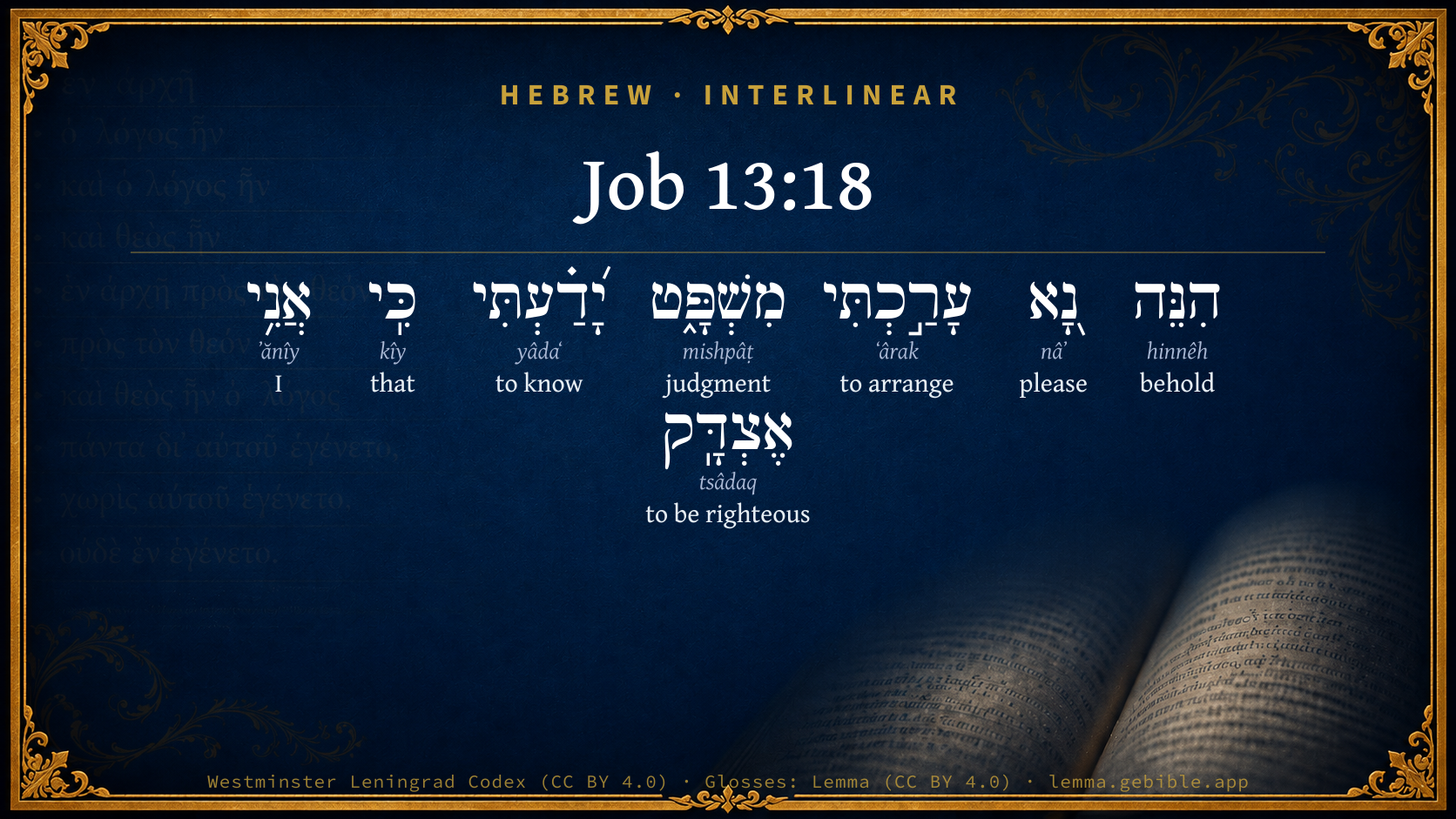
Hebrew (Westminster Leningrad Codex) Job 13:18 appears in the Hebrew Old Testament. The text above is from the Westminster Leningrad Codex. Each word links to its Strong’s number, a concise gloss, and parsing drawn from the Open Scriptures Hebrew Bible morphology. Click any word for its full Brown-Driver-Briggs (BDB) entry.
Download image
Cite this verse

Job 13:18 (World English Bible). Public Domain. Lemma interlinear Bible study tool, https://lemma.gebible.app/v/job/13/18.

Show BibTeX & RIS
BibTeX
RIS
English Translation
See now, I have set my cause in order. I know that I am righteous.
World English Bible · Public Domain
Download a study sheet

One document with this verse’s original text, its word-by-word gloss line, the meaning frame, cross-references with their text, attributed commentary, and full source and license credits — printable, and it pastes into notes with its structure intact.

This verse Autodidact and up

Study sheet (.html) Plain text (.txt)

A passage Seminary Student

Up to 50 verses in one chapter. A passage sheet keeps up to 6 commentary sources and 12 cross-references per verse, in the order this page ranks them, and says so on the sheet whenever that leaves anything out. Ask for a single verse and you get the Autodidact verse sheet above.

Everything on this page stays free to read, with no account — the sheet is a download of what is already on screen, not access to it.

Want to remove ads? Support Godless Engineer
Compare translations 3

The same verse in 3 English versions, stacked beneath the original-language interlinear above. Click any original word for its lexicon entry.

Each is an independent rendering of the whole verse — the interlinear is not word-aligned to these translations.

Highlighted words mark where these versions differ — a whole-verse word diff, not a word-by-word alignment.

  • World English Bible Public Domain
    See now, I have set my cause in order. I know that I am righteous.
  • King James Version Public Domain
    Behold now, I have ordered my cause; I know that I shall be justified.
  • unfoldingWord Literal Text CC BY-SA 4.0
    Behold now, I have prepared my defense; I know that I am righteous.

unfoldingWord Literal Text — © unfoldingWord, licensed CC BY-SA 4.0. Word-aligned USFM3 via Door43 (git.door43.org/unfoldingWord/en_ult).

Versions to compare (up to 4)

3 of 4 selected

Show all 18 translations

Every available English version of this verse, each an independent rendering of the whole verse.

  • World English Bible Public Domain
    See now, I have set my cause in order. I know that I am righteous.
  • Berean Standard Bible Public Domain
    Behold, now that I have prepared my case, I know that I will be vindicated.
  • Majority Standard Bible Public Domain
    See now, I have prepared my case; I know that I will be vindicated.
  • King James Version Public Domain
    Behold now, I have ordered my cause; I know that I shall be justified.
  • American Standard Version (1901) Public Domain
    Behold now, I have set my cause in order; I know that I am righteous.
  • Revised Version (1885) Public Domain
    Behold now, I have ordered my cause; I know that I am righteous.
  • Geneva Bible (1599) Public Domain
    Beholde nowe: if I prepare me to iudgement, I knowe that I shalbe iustified.
  • Douay-Rheims (1899) Public Domain
    If I shall be judged, I know that I shall be found just.
  • Young's Literal Translation Public Domain
    Lo, I pray you, I have set in order the cause, I have known that I am righteous.
  • Literal Standard Version CC BY-SA 4.0
    Now behold, I have set the cause in order, || I have known that I am righteous.
  • Unlocked Literal Bible CC BY-SA 4.0
    See now, I have set my defense in order; I know that I am innocent.
  • unfoldingWord Literal Text CC BY-SA 4.0
    Behold now, I have prepared my defense; I know that I am righteous.
  • Darby Bible Public Domain
    Behold now, I have ordered the cause; I know that I shall be justified.
  • World Messianic Bible Public Domain
    See now, I have set my cause in order. I know that I am righteous.
  • Webster's Bible Public Domain
    Behold now, I have ordered my cause; I know that I shall be justified.
  • Free Bible Version CC BY-SA 4.0
    Look, I've prepared my case—I know I will be proved right.
  • Bible in Basic English Public Domain
    See now, I have put my cause in order, and I am certain that I will be seen to be right.
  • JPS Tanakh (1917) Public Domain
    Behold now, I have ordered my cause; I know that I shall be justified.

Literal Standard Version (2020), Covenant Press — licensed CC BY-SA 4.0. Text via the HelloAO Bible API (eBible.org). Unlocked Literal Bible (unfoldingWord) — licensed CC BY-SA 4.0. Text via the HelloAO Bible API (eBible.org). unfoldingWord Literal Text — © unfoldingWord, licensed CC BY-SA 4.0. Word-aligned USFM3 via Door43 (git.door43.org/unfoldingWord/en_ult). Free Bible Version, Dr. Jonathan Gallagher — licensed CC BY-SA 4.0. Text via the HelloAO Bible API (eBible.org).

Word by word

More ways to search: Search by grammar → Find every occurrence → Compare this word →

Practice this passage: Drill this verse → Learn its vocabulary →

אֶצְדָּֽק
tsâdaq
H6663
“to be righteous”
Verb, Qal, Imperfect, 1st Person, Common, Singular
Part of Speech
Verb
Stem
Qal
Form
Imperfect
Person
1st Person
Gender
Common
Number
Singular
Full BDB Definition

Origin: a primitive root

TWOT: 1879

to be just, be righteous - (Qal) - to have a just cause, be in the right - to be justified - to be just (of God) - to be just, be righteous (in conduct and character) - (Niphal) to be put or made right, be justified - (Piel) justify, make to appear righteous, make someone righteous - (Hiphil) - to do or bring justice (in administering law) - to declare righteous, justify - to justify, vindicate the cause of, save - to make righteous, turn to righteousness - (Hithpael) to justify oneself
  1. הִנֵּה hinnêh H2009 “behold” Particle, Demonstrative
  2. נָ֭א nâʼ H4994 “please” Particle, Exhortation
  3. עָרַ֣כְתִּי ʻârak H6186 “to arrange” Verb, Qal, Perfect, 1st Person, Common, Singular
  4. מִשְׁפָּ֑ט mishpâṭ H4941 “judgment” Noun, Common, Masculine, Singular, Absolute
  5. יָ֝דַ֗עְתִּי yâdaʻ H3045 “to know” Verb, Qal, Perfect, 1st Person, Common, Singular
  6. כִּֽי kîy H3588 “that” Conjunction
  7. אֲנִ֥י ʼănîy H589 “I” Pronoun, Personal, 1st Person, Common, Singular

About this verse

These counts appear in no published source. They are computed here, from the morphology-tagged text and Lemma’s own curated glosses. What Lemma adds →

8
words
8
distinct lemmas
Wisdom
section

Shared distinctive vocabulary

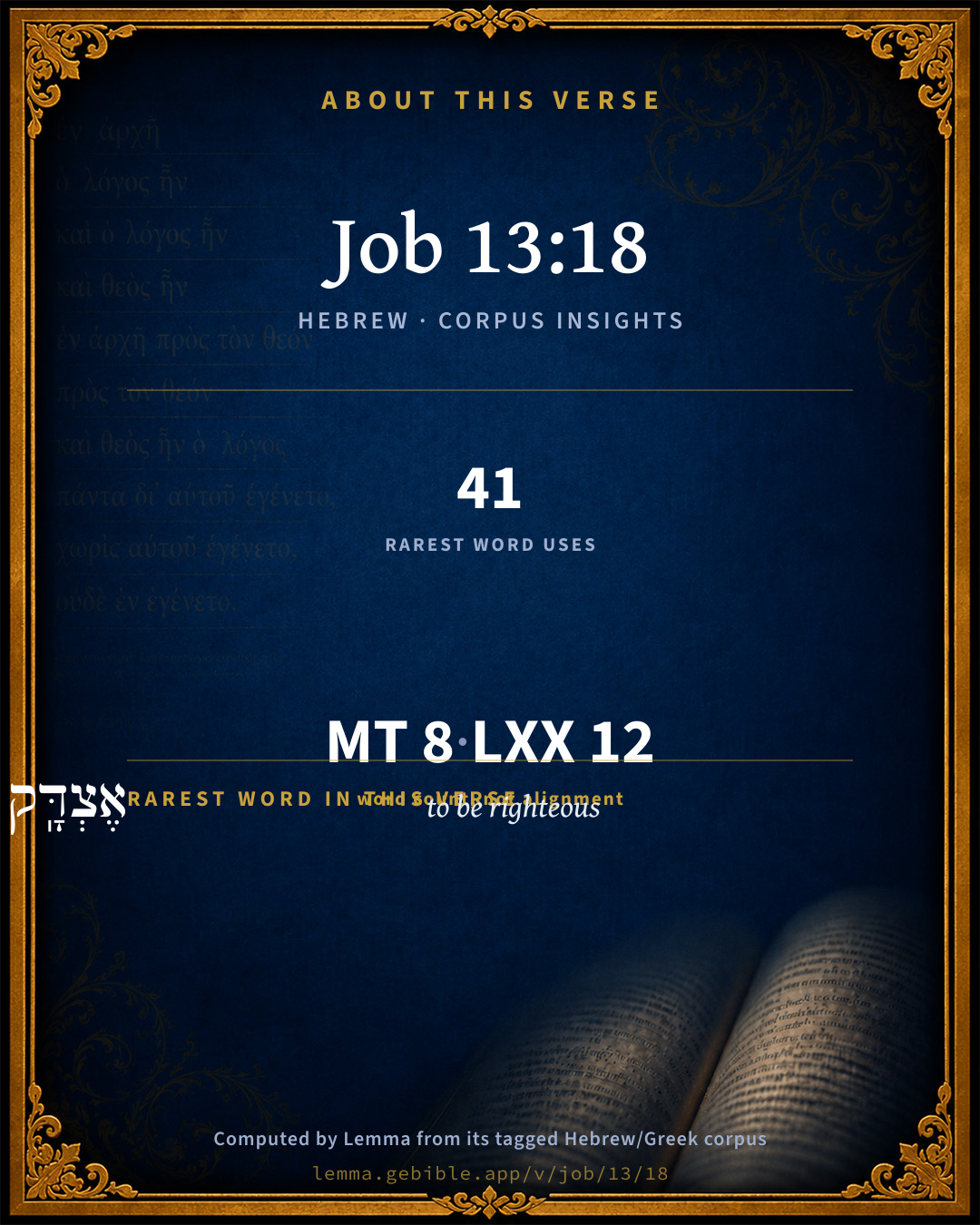
אֶצְדָּֽק to be righteous H6663 occurs in 40 verses of the Hebrew Bible. Also found in:

Grammatical profile

  • 3 verbs
  • 1 noun
  • 1 pronoun
  • 1 conjunction
  • 2 particles

Verb forms

  • עָרַ֣כְתִּי Qal · Perfect
  • יָ֝דַ֗עְתִּי Qal · Perfect
  • אֶצְדָּֽק Qal · Imperfect

Hebrew & Septuagint length

In English translation the verse runs 15 words from the Hebrew and 14 from the Septuagint (LXX English) — closely comparable.

A rough comparison of the two English renderings, which tokenize alike — not a word-level alignment.

Word counts can differ between the Hebrew and the Greek without any difference in meaning — e.g. the Hebrew direct-object marker אֵת has no separate Greek word, and Greek often adds the article ὁ.

In the original languages it is 8 Hebrew tokens and 12 Greek tokens — but the two are counted differently (Hebrew bundles its prefixes and suffixes into one token; the Greek is in lemma form), so that isn’t a like-for-like length.

Cross-references

8

Topical passages linked to Job 13:18 in the Treasury of Scripture Knowledge — connected by theme and wording, ordered by reader-vote popularity; previews shown in the World English Bible.

  • Job 23:4 I would set my cause in order before him, And fill my mouth with arguments.
  • Job 9:2–3 "Truly I know that it is so, But how can man be just with God?
  • Job 9:20 Though I am righteous, my own mouth shall condemn me. Though I am blameless, it shall prove me perverse.
  • Job 16:21 That he would maintain the right of a man with God, Of a son of man with his neighbor!
  • Job 40:7–8 "Now brace yourself like a man. I will question you, and you will answer me.
  • Isaiah 43:26 Put me in remembrance; let us plead together: set you forth [your cause], that you may be justified.
  • Romans 8:33–34 Who could bring a charge against God's chosen ones? It is God who justifies.
  • 2 Corinthians 1:12 For our boasting is this: the testimony of our conscience, that in holiness and sincerity of God, not in fleshly wisdom but in the grace of God we behaved ourselves in the world, and more abundantly toward you.

Cross-references courtesy of OpenBible.info (CC BY 4.0).

Hebrew and Greek witnesses Masoretic Hebrew ↔ Greek Septuagint

The same verse in the two great witnesses to the Old Testament, shown verse-for-verse.

These are two independent witnesses, not word-aligned to each other, and the Septuagint is shown in lemma (dictionary) form.

Hebrew Job 13:18 Masoretic · Westminster Leningrad Codex

הִנֵּה נָ֭א עָרַ֣כְתִּי מִשְׁפָּ֑ט יָ֝דַ֗עְתִּי כִּֽי אֲנִ֥י אֶצְדָּֽק

See now, I have set my cause in order. I know that I am righteous.

World English Bible · Public Domain

Greek LXX Job 13:18 Septuagint · lemma form

ἰδού ἐγώ ἐγγύς εἰμί ὁ κρίμα ἐγώ οἶδα ἐγώ ὅτι δίκαιος ἀναφαίνω

Behold, I am near my judgment: I know that I shall appear evidently just.

LXX2012 (modern English Septuagint) · Public Domain

On this verse, Albert Barnes' Notes on the Bible discusses the Septuagint’s reading. Read the note in Commentary ↓

Hebrew: Westminster Leningrad Codex (CC BY 4.0). Greek: Septuagint (public domain); English from LXX2012 (modern English Septuagint) (Public Domain). How the Septuagint differs from the Hebrew →

Commentary

Notes on Job 13:18 from classic Christian and Jewish commentators (each source and its license shown beneath its notes). The classic Christian expositions comment on the surrounding passage and are grouped to its opening verse, so a note may address several verses; the Jewish commentaries on the Tanakh (Rashi and others) are per-verse, so they appear only where the commentator wrote on this verse.

Lemma curates 59 commentaries, every one of them public domain or Creative Commons licensed, each selected and text-cleaned for this edition rather than reprinted as found. About our sources →

Trapp's Complete Commentary

John Trapp

Job 13:18 Behold now, I have ordered [my] cause; I know that I shall be justified.

Ver. 18. Behold now, I have ordered my cause] Heb. My judgment. He had spoken before of his declaration, which is conceived to be a term of law; for in law suits, the plaintiff putteth in a declaration of his grievance. Job had his declaration ready drawn, and craved audience; he asketh afterwards, Who will plead with me? and here in the like language he telleth us that he had ordered his cause, he had marshalled and methodized his arguments, he had set and stated the controversy. Lo, here I stand ready prepared to plead, and am confident I shall prevail.

I know that I shall be justified] That is, I am persuaded, or, I am sure, as Rom 8:38, I believe and I know, as Joh 6:69, sc. with a fiducial knowledge, that I shall be justified, sc. from my sins, by Christ’s righteousness imputed (yea, that I am so already, and that for ever; for peccata non redeunt, discharges in justification are not repealed or called in again), and that I shall depart from God’s bar acquitted in this particular controversy. And so he did; for God justified Job, and reproved his three friends, Job 42:7-8

John Trapp, A Commentary or Exposition upon All the Books of the Old and New Testament (1647–1656) — public domain. Text from a community e-Sword module.

Joseph Benson's Commentary

Job 13:18-19. Behold, now, I have ordered my cause — Namely, in my own mind. I have seriously considered the state of my case, what can be said, either for me or against me, and am ready to plead my cause. I know that I shall be justified — Acquitted by God of that hypocrisy and wickedness wherewith you charge me, and declared a righteous person, human infirmities excepted. Who is he that will plead with me? — Let who will come and accuse me, I am ready to answer. If I hold my tongue, I shall give up the ghost — My grief would break my heart, if I did not give vent to it.

Joseph Benson's Commentary on the Old and New Testaments (1811–1818) — public domain. Text from a community e-Sword module.

Geneva Bible (1599)

Geneva Bible translators

That is, cleared and not cast off for my sins, as you reason.

Geneva Bible (1599) marginal notes — public domain. Text via Bolls.life.

Jamieson, Fausset & Brown

Robert Jamieson, A. R. Fausset & David Brown

ordered--implying a constant preparation for defense in his confidence of innocence.

Jamieson, Fausset & Brown — Commentary Critical and Explanatory on the Whole Bible (1871) — public domain (CC PDM 1.0). Text via the HelloAO Bible API.

Adam Clarke's Commentary

Verse 18. Behold now, I have ordered] I am now ready to come into court, and care not how many I have to contend with, provided they speak truth.

Adam Clarke's Commentary on the Bible (1810–1826) — public domain. Text from a community e-Sword/MySword module.

The Cambridge Bible for Schools and Colleges

gen. ed. J. J. S. Perowne

18. I know that I shall be justified] i. e. be found in the right, ch. Job_11:2.

The Cambridge Bible for Schools and Colleges (gen. ed. J. J. S. Perowne; Cambridge University Press, 1878–1918) — public domain. Text from a community e-Sword module.

John Gill's Exposition

Behold now, I have ordered my cause,.... Or "judgment" (t); that is, he had looked over his cause afresh, had reviewed the state of his case, had considered it in every light, had drawn a plan of it, had digested it in a proper manner, and had arranged his reasons and arguments in vindication of himself in a regular form; and had them at hand, and could readily and easily come at them on occasion, to vindicate himself; and upon the whole could say, in the strongest, manner, and could draw this conclusion,

I know that I shall be justified; which, though it may primarily respect the case in dispute between him and his friends, and the charge of wickedness and hypocrisy brought against him by them, from which he doubted not he should upon a fair hearing be acquitted by God himself, yet it may include his whole state of justification, God-ward, in which he was and should continue; and so may respect, not only the justification of his cause before men, as it was ordered and managed by him, but also the justification of his person before God, of which he had a full assurance; having ordered his cause aright, settled matters well, and proceeded upon a good plan and foundation; which to do is not to put justification upon the foot of purity of nature at first birth, and a sober life and conversation from youth upward, and a perfection of good works arrived unto, as imagined; nor upon a comparative righteousness with respect to other men, even profane and ungodly persons; nor, upon repentance, and sincere though imperfect obedience; nor upon an external belief of evangelic truths, and a submission to Gospel ordinances: but such order their cause well, and rightly conclude their justification, who see and own themselves to be transgressors of the law of God, behold and acknowledge their own righteousness to be insufficient to justify them, view the righteousness of Christ revealed in the Gospel, in its glory, excellency, and suitableness, and lay hold upon it as their justifying righteousness; and observing that the word of God declares, that those that believe in Christ are and shall be justified, and finding in themselves that they do with the heart believe in Christ for righteousness, hence they most comfortably and most sensibly conclude that they are justified persons; for this knowledge is of faith, and this faith the faith of assurance; it is not barely for a man to know that there is righteousness in Christ, and justification by it, but that there is righteousness in him for himself, and that he is the Lord his righteousness; for the words may be rendered, "I know that I am righteous"; or, "am justified" (u); justification is a past act in the mind of God; it is present, as it terminates on the conscience of a believer; it is future, as it will be notified at the day of judgment before angels and men; see Isa 45:25.

(t) "judicium", Pagninus, Montanus, &c. (u) "quod ego justus sum", Schmidt; "me justum esse, vel fore", Schultens.

John Gill's Exposition of the Whole Bible (1746–1763) — public domain (CC PDM 1.0). Text via the HelloAO Bible API.

Albert Barnes' Notes on the Bible

I have ordered my cause - literally. “judgment?” - משׁפט mı̂shpâṭ. The Septuagint renders it, “I am near (ἐγγύς εἰμί engus eimi) to my judgment,” or my trial. The meaning may be, that he had gone through the pleading, and had said what he wished in self-vindication, and he was willing to leave the cause with God, and did not doubt the issue. Or more probably, I think, the word ערכתי ‛âraketı̂y should be taken, as the word ידעתי yāda‛tı̂y is, in the present tense, meaning “I now set in order my cause; I enter on the pleading; I am confident that I shall so present it as to be declared righteous.”

I know that I shall be justified - I have no doubt as to the issue. I shall be declared to be an holy man, and not a hypocrite. The word rendered “I shall be justified” (אצדק 'etsâdaq) is used here in the proper and literal sense of the word justify. It is a term of law; and means, “I shall be declared to be righteous. I shall be shown not to be guilty in the form charged on me, and shall be acquitted or vindicated.” This sense is different from that which so often occurs in the Scriptures when applied to the doctrine of the justification of a sinner. Then it means, to treat one AS IF he were righteous, though he is personally guilty and undeserving.

Albert Barnes' Notes on the Bible (1834–1885) — public domain. Text from a community e-Sword/MySword module.

Haydock's Catholic Bible Commentary

Just. He was in extreme anguish, yet still trusted in God. (Worthington)

George Leo Haydock (1774–1849), Haydock's Catholic Family Bible and Commentary, 1859 edition — public domain. Excludes Psalms (Douay-Rheims chapter numbering differs from Protestant) and Deuterocanonical books (Catholic canon only).

Matthew Poole's English Annotations

I have ordered my cause, to wit, within myself. I have seriously and sincerely considered the state of my case, and what can be said either for me or against me, and am ready to plead my cause.

Justified, i.e. acquitted by God from that hypocrisy and wickedness wherewith you charge me, and declared a righteous and innocent person, human infirmities excepted.

Matthew Poole's English Annotations on the Holy Bible (1683–1685) — public domain. Text from a community e-Sword/MySword module.

Whedon's Commentary on the Bible

Daniel D. Whedon

18. Ordered — Set in order, or made ready.

Daniel D. Whedon (gen. ed.), Commentary on the Old and New Testaments (1874–1909) — public domain. Text from a community e-Sword module.

The Pulpit Commentary

Behold now, I have ordered my cause; i.e. I have prepared my pleadings, and arranged them; I know what I am about to say. Also I know that I shall be justified. I am confident, i.e. " that tile cause, if it be fully heard, will be decided in my favour. It will appear that I have not brought my calamities upon myself by my own misdoings. Of justification, in the forensic sense, of imputed righteousness, with its concomitant ideas, Job, of course, knows nothing.

The Pulpit Commentary (1880–1919), ed. H.D.M. Spence-Jones & Joseph S. Exell — public domain. Text from a community e-Sword module.

John Wesley's Explanatory Notes

Behold - I have seriously considered the state of my case, and am ready to plead my cause.

John Wesley, Explanatory Notes Upon the Whole Bible (1754–1765) — public domain. Text via the GEBible commentary corpus.

unfoldingWord translationNotes

Door43 World Missions Community

Connecting Statement:

Job continues speaking to God.

See now

This emphasizes what follows. "Listen now" or "Please pay special attention"

I have set my defense in order

Setting his defense in order represents deciding what he will say to defend himself. AT: "I have thought through how I will defend myself" or "I have decided how I will explain myself" (See: Metaphor)

Who is the one who would argue against me in court?

Job uses this question to express his belief that since he is right, no one would argue against him. AT: "I do not believe that anyone would argue against me in court." (See: Rhetorical Question)

If you came to do so

"If you came to argue against me"

If you

"You" here means God himself.

if I were proved wrong

This can be stated in active form. AT: "if you were to prove me wrong" (See: Active or Passive)

give up my life

Giving up one's life is a metaphor for dying. AT: "die" (See: Metaphor)

translationWords

innocent

court

unfoldingWord translationNotes — © Distant Shores Media and the Door43 World Missions Community, licensed CC BY-SA 4.0. Source: git.door43.org/Door43/en_tn.

Rashi

Rabbi Shlomo Yitzchaki (Rashi)

I have set up judgement [I have prepared] my case. I have arranged my arguments in my heart viz. what to answer.

Rashi on the Tanakh — English translations: “The Judaica Press complete Tanach with Rashi, translated by A. J. Rosenberg” (CC BY 4.0); “Pentateuch with Rashi's commentary by M. Rosenbaum and A.M. Silbermann, 1929-1934” (public domain); “The Metsudah Tanach series, Lakewood, N.J” (CC BY 4.0); and “The Book of Joshua, Metsudah Publications, 1997” (CC BY 4.0). Text via Sefaria.

Lesson kit

Teaching starters — assembled from the data on this page, not authored interpretation. Every prompt links to the verse data it draws on. Edit before teaching.

Job, in the Wisdom, opens this verse with 8 words (8 distinct Hebrew lemmas). Its most distinctive word is tsâdaq (“to be righteous”). A historical commentator’s framing appears above. Read the whole chapter for the surrounding context.

Discussion questions

  1. How does “to be righteous” (tsâdaq) shape what this verse is saying?
  2. Genesis 38:26 shares the word «to be righteous» with this verse. How do the two illuminate each other?
  3. These translations render this verse differently. What is at stake in choosing one wording over another?
  4. The verb «עָרַ֣כְתִּי» is Qal Perfect. How does its form color the action?
  5. Reading how Trapp's Complete Commentary and Joseph Benson's Commentary read this verse, where do the two commentators agree and where do they part?

Things to notice

Reading settings

Reading text

Shown beneath each verse's original-language words.

Old Testament
Old Testament edition

Read the OT as the Masoretic Hebrew (MT) or the Greek Septuagint (LXX).

English shown for the Greek Septuagint (in the Hebrew ↔ Greek comparison).

Comparing translations? Open the Compare panel on any verse page to stack up to four side by side.