2 Peter 1:13

Greek (Tischendorf 8th ed.) 2 Peter 1:13 appears in the Greek New Testament. The text above is from the Tischendorf 8th edition. Each word links to its Strong’s number and a concise gloss. Click any word for its full Thayer’s Greek Lexicon entry.
Download image
Cite this verse

2 Peter 1:13 (World English Bible). Public Domain. Lemma interlinear Bible study tool, https://lemma.gebible.app/v/2-peter/1/13.

Show BibTeX & RIS
BibTeX
RIS
English Translation
I think it right, as long as I am in this tent, to stir you up by reminding you;
World English Bible · Public Domain
Download a study sheet

One document with this verse’s original text, its word-by-word gloss line, the meaning frame, cross-references with their text, attributed commentary, and full source and license credits — printable, and it pastes into notes with its structure intact.

This verse Autodidact and up

Study sheet (.html) Plain text (.txt)

A passage Seminary Student

Up to 50 verses in one chapter. A passage sheet keeps up to 6 commentary sources and 12 cross-references per verse, in the order this page ranks them, and says so on the sheet whenever that leaves anything out. Ask for a single verse and you get the Autodidact verse sheet above.

Everything on this page stays free to read, with no account — the sheet is a download of what is already on screen, not access to it.

Want to remove ads? Support Godless Engineer
Compare translations 3

The same verse in 3 English versions, stacked beneath the original-language interlinear above. Click any original word for its lexicon entry.

Each is an independent rendering of the whole verse — the interlinear is not word-aligned to these translations.

Highlighted words mark where these versions differ — a whole-verse word diff, not a word-by-word alignment.

  • World English Bible Public Domain
    I think it right, as long as I am in this tent, to stir you up by reminding you;
  • King James Version Public Domain
    Yea, I think it meet, as long as I am in this tabernacle, to stir you up by putting you in remembrance;
  • unfoldingWord Literal Text CC BY-SA 4.0
    But I think right, as long as I am in this tent, to arouse you in remembrance,

unfoldingWord Literal Text — © unfoldingWord, licensed CC BY-SA 4.0. Word-aligned USFM3 via Door43 (git.door43.org/unfoldingWord/en_ult).

Versions to compare (up to 4)

3 of 4 selected

Show all 19 translations

Every available English version of this verse, each an independent rendering of the whole verse.

  • World English Bible Public Domain
    I think it right, as long as I am in this tent, to stir you up by reminding you;
  • Berean Standard Bible Public Domain
    I think it is right to refresh your memory as long as I live in the tent of my body,
  • Majority Standard Bible Public Domain
    I think it is right to refresh your memory as long as I live in the tent of my body,
  • King James Version Public Domain
    Yea, I think it meet, as long as I am in this tabernacle, to stir you up by putting you in remembrance;
  • American Standard Version (1901) Public Domain
    And I think it right, as long as I am in this tabernacle, to stir you up by putting you in remembrance;
  • Revised Version (1885) Public Domain
    And I think it right, as long as I am in this tabernacle, to stir you up by putting you in remembrance;
  • Geneva Bible (1599) Public Domain
    For I thinke it meete as long as I am in this tabernacle, to stirre you vp by putting you in remembrance,
  • Douay-Rheims (1899) Public Domain
    But I think it meet as long as I am in this tabernacle, to stir you up by putting you in remembrance.
  • Young's Literal Translation Public Domain
    and I think right, so long as I am in this tabernacle, to stir you up in reminding `you',
  • Literal Standard Version CC BY-SA 4.0
    and I think right, so long as I am in this tent, to stir you up in reminding [you],
  • Unlocked Literal Bible CC BY-SA 4.0
    It is proper for me to think, as long as I am in this tent, to stir you up by way of reminder.
  • unfoldingWord Literal Text CC BY-SA 4.0
    But I think right, as long as I am in this tent, to arouse you in remembrance,
  • Darby Bible Public Domain
    But I account it right, as long as I am in this tabernacle, to stir you up by putting [you] in remembrance,
  • World Messianic Bible Public Domain
    I think it right, as long as I am in this tent, to stir you up by reminding you,
  • Webster's Bible Public Domain
    Indeed, I think it meet, as long as I am in this tabernacle, to stir you up by putting you in remembrance;
  • Free Bible Version CC BY-SA 4.0
    But I still think it's a good idea to encourage you by giving you reminders while I live.
  • Bible in Basic English Public Domain
    And it seems right to me, as long as I am in this tent of flesh, to keep your minds awake by working on your memory;
  • Text-Critical English NT CC BY 4.0
    I think it is right, as long as I am in this bodily tent, to stir you up by way of reminder,
  • Tyndale New Testament (1534) Public Domain
    Notwithstodinge I thynke that mete (as longe as I am in this tabernacle) to stere you vp by puttynge you in remembraunce

Literal Standard Version (2020), Covenant Press — licensed CC BY-SA 4.0. Text via the HelloAO Bible API (eBible.org). Unlocked Literal Bible (unfoldingWord) — licensed CC BY-SA 4.0. Text via the HelloAO Bible API (eBible.org). unfoldingWord Literal Text — © unfoldingWord, licensed CC BY-SA 4.0. Word-aligned USFM3 via Door43 (git.door43.org/unfoldingWord/en_ult). Free Bible Version, Dr. Jonathan Gallagher — licensed CC BY-SA 4.0. Text via the HelloAO Bible API (eBible.org).

Word by word

More ways to search: Search by grammar → Find every occurrence → Compare this word →

Practice this passage: Drill this verse → Learn its vocabulary →

σκηνώματι
skḗnōma
G4638
“tent”
Noun, Dative, Singular, Neuter
Part of Speech
Noun
Case
Dative
Number
Singular
Gender
Neuter
Full Thayer's Definition

Origin: from G4637

TDNT: 13:23,1

1. a tent, a tabernacle a. of the temple as God's habitation b. of the tabernacle of the covenant c. metaph. of the human body as the dwelling of the soul
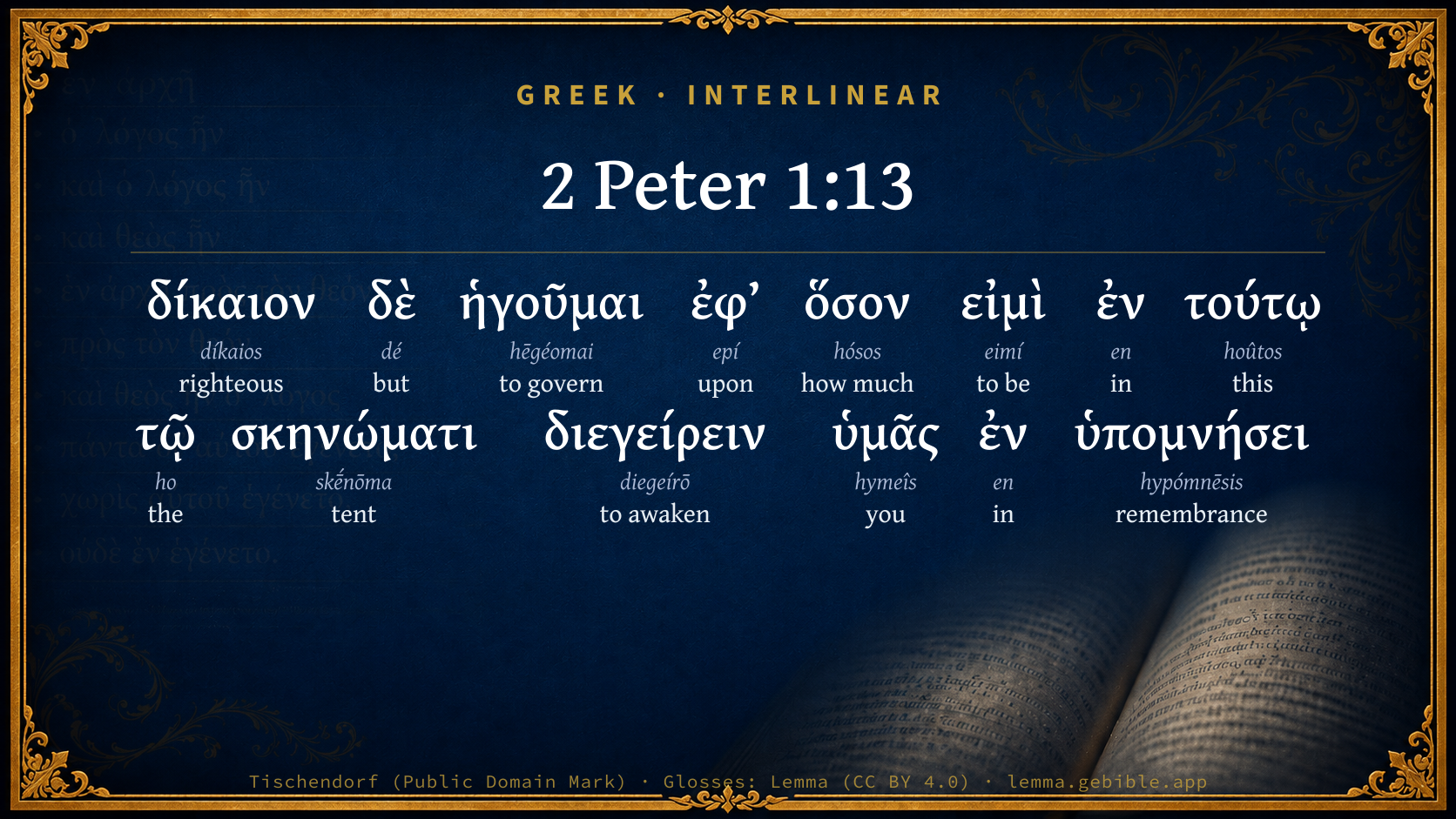
  1. δίκαιον díkaios G1342 “righteous” Adjective, Accusative, Singular, Neuter
  2. δὲ dé G1161 “but” Conjunction
  3. ἡγοῦμαι hēgéomai G2233 “to govern” Verb, Present, Middle or Passive deponent, Indicative, 1st person, Singular
  4. ἐφ’ epí G1909 “upon” Preposition
  5. ὅσον hósos G3745 “how much” Correlative pronoun, Accusative, Singular, Masculine
  6. εἰμὶ eimí G1510 “to be” Verb, Present, Active, Indicative, 1st person, Singular
  7. ἐν en G1722 “in” Preposition
  8. τούτῳ hoûtos G3778 “this” Demonstrative pronoun, Dative, Singular, Neuter
  9. τῷ ho G3588 “the” Article, Dative, Singular, Neuter
  10. διεγείρειν diegeírō G1326 “to awaken” Verb, Present, Active, Infinitive
  11. ὑμᾶς hymeîs G5210 “you” Personal pronoun, 2nd person, Accusative, Plural
  12. ἐν en G1722 “in” Preposition
  13. ὑπομνήσει hypómnēsis G5280 “remembrance” Noun, Dative, Singular, Feminine

About this verse

These counts appear in no published source. They are computed here, from the morphology-tagged text and Lemma’s own curated glosses. What Lemma adds →

14
words
13
distinct lemmas
General Epistles
section

Notable vocabulary

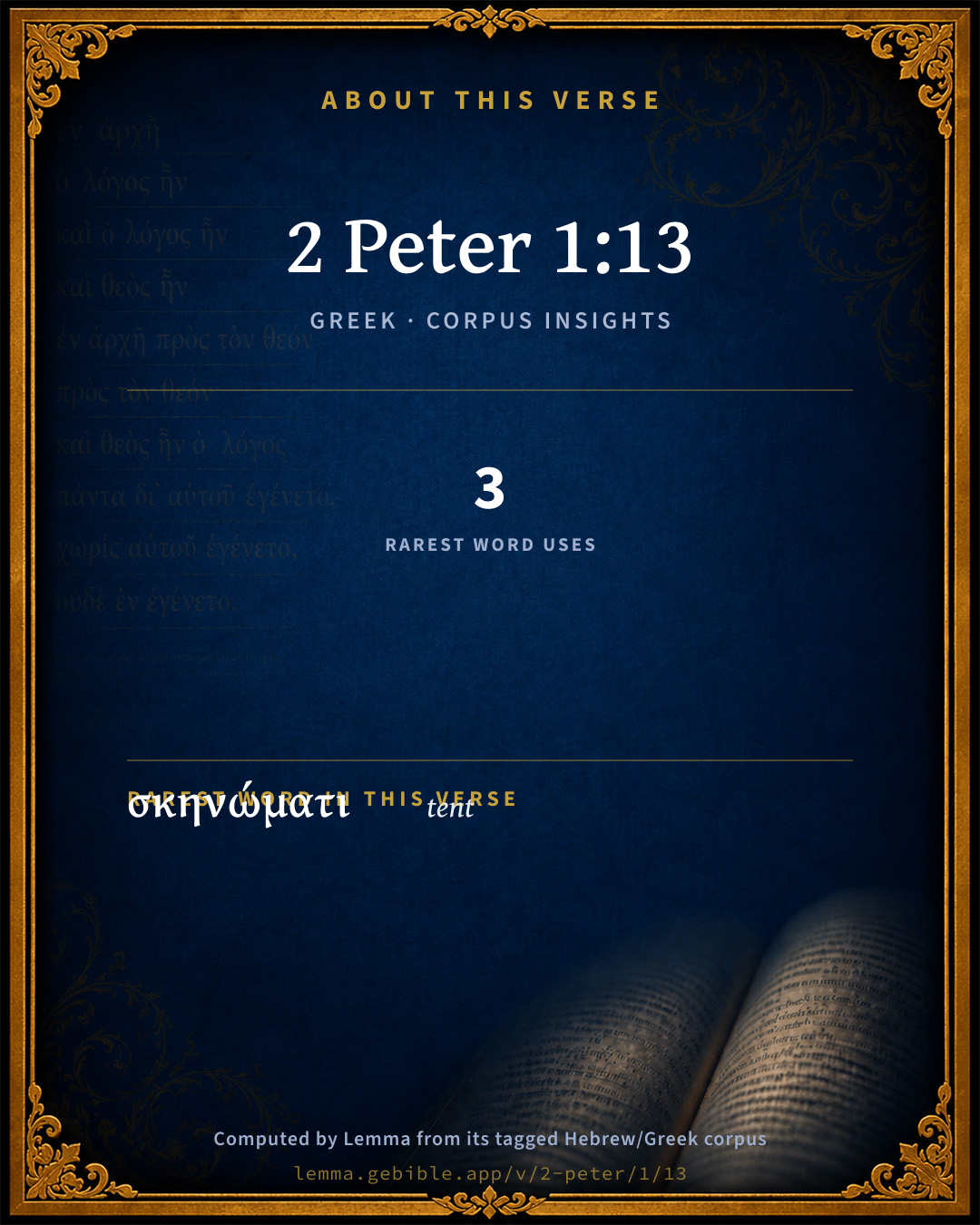
The rarest word here is σκηνώματι tent G4638 — appearing just 3 times in the whole Greek New Testament.

Shared distinctive vocabulary

σκηνώματι tent G4638 occurs in 3 verses of the Greek New Testament. Also found in:

Repetition

A word recurs within this verse:

Cross-references

8

Topical passages linked to 2 Peter 1:13 in the Treasury of Scripture Knowledge — connected by theme and wording, ordered by reader-vote popularity; previews shown in the World English Bible.

  • 2 Peter 1:14 knowing that the putting off of my tent comes swiftly, even as our Lord Jesus Christ made clear to me.
  • 2 Peter 3:1 This is now, beloved, the second letter that I have written to you; and in both of them I stir up your sincere mind by reminding you;
  • Hebrews 13:3 Remember those who are in bonds, as bound with them; and those who are ill-treated, since you are also in the body.
  • 2 Corinthians 5:8 We are of good courage, I say, and are willing rather to be absent from the body, and to be at home with the Lord.
  • 2 Timothy 1:6 For this cause, I remind you that you should stir up the gift of God which is in you through the laying on of my hands.
  • Haggai 1:14 Yahweh stirred up the spirit of Zerubbabel, the son of Shealtiel, governor of Judah, and the spirit of Joshua, the son of Jehozadak, the high priest, and the spirit of all the remnant of the people; and they came and worked on the house of Yahweh of Hosts, their God,
  • 2 Corinthians 5:1–4 For we know that if the earthly house of our tent is dissolved, we have a building from God, a house not made with hands, eternal, in the heavens.
  • 2 Peter 1:12 Therefore I will not be negligent to remind you of these things, though you know them, and are established in the present truth.

Cross-references courtesy of OpenBible.info (CC BY 4.0).

Commentary

Notes on 2 Peter 1:13 from classic Christian and Jewish commentators (each source and its license shown beneath its notes). The classic Christian expositions comment on the surrounding passage and are grouped to its opening verse, so a note may address several verses; the Jewish commentaries on the Tanakh (Rashi and others) are per-verse, so they appear only where the commentator wrote on this verse.

Lemma curates 59 commentaries, every one of them public domain or Creative Commons licensed, each selected and text-cleaned for this edition rather than reprinted as found. About our sources →

Bengel's Gnomon

Johann Albrecht Bengel

2Pe 1:13. Δὲ, but) A particle of explaining or declaring.—σκηνὠματι, tabernacle) There is a reference to the immortality of the soul, and its brief abode in the mortal body, together with the easy departure of believers.

Bengel's Gnomon of the New Testament — English translation (T&T Clark, Edinburgh, 1860) — public domain. Text from a community e-Sword module.

Meyer's Critical & Exegetical Commentary

Heinrich August Wilhelm Meyer

2Pe_1:13-14. δίκαιον δὲ ἡγοῦμαι] I consider it right and reasonable (Dietlein: as a duty); cf. Php_1:7; 2Pe_1:14 states the reason.

ἐφʼ ὅσον εἰμὶ ἐν τούτῳ τῷ σκηνώματι] σκήνωμα, like σκῆνος, 2Co_5:1, the tabernacle, a figurative designation of the human body; cf. Wis_9:15 : τὸ γεῶδες σκῆνος. There can hardly be here any direct reference to the nomadic life in tents (Hornejus).

διεγείρειν ὑμᾶς ἐν ὑπομνήσει] to stir you up by reminding you, i.e. to encourage you. The same combination takes place in chap. 2Pe_3:1; διεγείρειν is to be found elsewhere only in the Gospels, and there in its strict signification.

ἐν ὑπομνήσει points back to ὑπομιμνήσκειν in 2Pe_1:12, which, in the aim of it, διεγείρειν serves to define more nearly. In de Wettes opinion, these words are written with special reference to the advent of Christ; but there is nothing to indicate any such limitation of them. It cannot, with Dietlein, be concluded that this letter is linked on to the First Epistle of Peter, from the circumstance that in 1Pe_5:8-9, γρηγορήσατε is to be found followed by στερεοί.2Pe_1:14. εἰδώς] since I know, gives the reason for the δίκαιον ἡγοῦμαι, 2Pe_1:13.

ὅτι ταχινή ἐστιν ἡ ἀπόθεσις τοῦ σκηνώματός μου] The expression ἀπόθεσις is to be explained by a mingling of the figure of a garment and that of a tent (de Wette).

ταχινή is taken by most commentators (as also by Wiesinger and Brückner) to mean soon. Accordingly some (de Wette, Fronmüller, and others) think that in the subsequent words the writer does not refer to the prediction of Christ contained in Joh_21:18 ff., but to a later revelation vouchsafed to Peter (such as is mentioned by Hegesippus, De Excid. Jerosolym. iii. 2, and by Ambrose, Ep. 33); but Bengel already translated ταχινή ἐστιν correctly by repentina est; observing: Praesens; qui diu aegrotant, possunt alios adhuc pascere. Crux id Petro non erat permissura. Ideo prius agit, quod agendum erat.[45] In chap. 2Pe_2:1 also, ΤΑΧΙΝΌς means sudden, swift (Vulg. velox), not soon. Peter says here that he will end his life by a sudden (i.e. violent) death; so too Steinfass, Schott, Hofmann; the adjective ταχινή states, not the time, but the manner of the ἈΠΌΘΕΣΙς. Accordingly the assumption of a later revelation has no foundation in this passage.[46]

The particle ΚΑΊ after ΚΑΘΏς, for the most part left unnoticed, shows that the words ΚΑΘῺς Κ.Τ.Λ. are added in confirmation of Peters certainty as to his sudden death, equivalent to even as indeed. With ἐδήλωσεν, cf. 1Pe_1:11.

[45] Besser: The Lord had communicated to him that a quick and sudden putting off of the tabernacle of the body awaited him.

[46] Even if ταχινή meant soon, it would not be necessary to understand this here; for as Joh_21:18 expressly says: ὅταν δὲ γεράσῃς, Peter could, if writing this epistle in his old age, appeal to those words of Christ as corroborating his expectation of a speedy death.

Meyer — Critical and Exegetical Commentary on the New Testament — English translation by Peter Christie, edited by Frederick Crombie (T&T Clark, 1880) — public domain. Text from a community e-Sword module.

Expositor's Greek Testament

ed. W. Robertson Nicoll

2Pe 1:13 . δίκαιον δὲ ἡγοῦμαι . “I consider it a duty.” The language in 2Pe 1:13-14 , is studiously solemn and impressive. σκηνώματι , used in literal sense of “tent” in Deu 33:18 . In Act 7:46 , it is used of the Tabernacle of God. Elsewhere in N.T. σκῆνος is used in the metaphorical sense of human existence. Cf. 2Co 5:4 . A similar use of σκήνωμα is found in Ep. ad Diogn. 6. ἀθάνατος ἡ ψυχὴ ἐν θνητῷ σκηνώματι κατοικεῖ . σκηνή is the word used by Peter in the transfiguration story (Mat 17:4 ; Mar 9:5 ; Luk 9:33 ). διεγείρειν ὑμᾶς ἐν ὑπομνήσει · διεγ · is always used in N.T. = “awaken” or “rouse from sleep” (except in Joh 6:18 of the sea); significant in view of the reference to the Transfiguration in 2Pe 1:16 ff. Cf. διαγρηγορήσαντες (“fully awake”) in St. Luke’s account; Introd . p. 95.

The Expositor's Greek Testament, edited by W. Robertson Nicoll (1897–1910) — public domain. Text from a community e-Sword module.

Geneva Bible (1599)

Geneva Bible translators

In this body.

Geneva Bible (1599) marginal notes — public domain. Text via Bolls.life.

Jamieson, Fausset & Brown

Robert Jamieson, A. R. Fausset & David Brown

Yea--Greek, "But"; though "you know" the truth (Pe2 1:12).

this tabernacle--soon to be taken down (Co2 5:1): I therefore need to make the most of my short time for the good of Christ's Church. The zeal of Satan against it, the more intense as his time is short, ought to stimulate Christians on the same ground.

by--Greek, "in" (compare Pe2 3:1).

Jamieson, Fausset & Brown — Commentary Critical and Explanatory on the Whole Bible (1871) — public domain (CC PDM 1.0). Text via the HelloAO Bible API.

Adam Clarke's Commentary

Verse 13. As long as I am in this tabernacle] By tabernacle we are to understand his body; and hence several of the versions have σωματι, body, instead of σκηνωματι, tabernacle. Peter's mode of speaking is very remarkable: as long as I AM in this tabernacle, so then the body was not Peter, but Peter dwelt in that body. Is not this a proof that St. Peter believed his soul to be very distinct from his body? As a man's house is the place where he dwells, so the body is the house where the soul dwells.

Adam Clarke's Commentary on the Bible (1810–1826) — public domain. Text from a community e-Sword/MySword module.

John Calvin's Commentaries

13. Yea, I think it meet, or right. He expresses more clearly how useful and how necessary is admonition, because it is needful to arouse the faithful, for otherwise torpor will creep in from the flesh. Though, then, they might not have wanted teaching, yet he says that the goads of admonitions were useful, lest security and indulgence (as it is usually the case) should weaken what they had learned, and at length extinguish it.

He adds another cause why he was so intent on writing to them, because he knew that a short time remained for him. “I must diligently employ my time,” he says; “for the Lord has made known to me that my life in this world will not be long.”

We hence learn, that admonitions ought to be so given, that the people whom we wish to benefit may not think that wrong is done to them, and also that offenses ought to be so avoided, that yet the truth may have a free course, and exhortations may not be discontinued. Now, this moderation is to be observed towards those to whom a sharp reproof would not be suitable, but who ought on the contrary to be kindly helped, since they are inclined of themselves to do their duty. We are also taught by the example of Peter, that the shorter term of life remains to us, the more diligent ought we to be in executing our office. It is not commonly given to us to foresee our end; but they who are advanced in years, or weakened by illness, being reminded by such indications of the shortness of their life, ought to be more sedulous and diligent, so that they may in due time perform what the Lord has given them to do; nay, those who are the strongest and in the flower of their age, as they do not render to God so constant a service as it behooves them to do, ought to quicken themselves to the same care and diligence by the recollection of approaching death; lest the occasion of doing good may pass away, while they attend negligently and slothfully to their work.

At the same time, I doubt not but that it was Peter’s object to gain more authority and weight to his teaching, when he said that he would endeavor to make them to remember these things after his death, which was then nigh at hand. For when any one, shortly before he quits this life, addresses us, his words have in a manner the force and power of a testament or will, and are usually received by us with greater reverence.

John Calvin's Commentaries (1540-1563) — public domain. Text from the Calvin Translation Society English edition (1840s-50s) via the Christian Classics Ethereal Library (ccel.org). Calvin's coverage is partial (roughly two-thirds of the Bible); uncommented books and verses are honest gaps, never fabricated. The 19th-century editor's footnotes and remarks are omitted so the notes are faithfully Calvin's own voice.

Ellicott's Commentary for English Readers

(13) Yea, I think it meet.—Better, But I think it right. So Rheims; Tyndale and Cranmer have “notwithstanding.” The meaning is, “but (so far from my writing being unnecessary) I think it right,” &c.

In this tabernacle.—The comparison of the human body to a dwelling is common in all literatures, and the temporary nature of a tent makes it specially appropriate. (Comp. 2Co_5:1.)

By putting you in remembrance.—Better, in putting you. The stirring up consists in the reminding. (See 2Pe_1:1-2; 2Pe_1:4; also 2Pe_3:1, where the same phrase occurs.)

A Bible Commentary for English Readers, edited by Charles John Ellicott (1878–1897) — public domain. Text from a community e-Sword module.

The Cambridge Bible for Schools and Colleges

gen. ed. J. J. S. Perowne

13. Yea, I think it meet] More accurately, But I think it right. Though he knows them to be established in the truth, he yet looks on it as his duty to remind them of what they know.

as long as I am in this tabernacle] The term chosen is interesting (1) as a parallel to St Paul’s use of the same imagery in 2Co_5:1, and (2) as connected with the reference to the Transfiguration which follows. In that vision on the mount, it will be remembered, St Peter had uttered the prayer “Let us make three tabernacles …” (Mat_17:4). He had now learnt that the true tabernacle of Christ was His human body, and to think of his own body also as the tabernacle of His Spirit.

to stir you up by putting you in remembrance] The phrase, which occurs again in chap. 2Pe_3:1, may be noticed as characteristic of St Peter. He assumes a knowledge not only of the broad outlines of Gospel truth, but of the facts of the Gospel history, including, it is obvious, the history of the Transfiguration, and corresponding therefore to the record found in the first three Gospels.

The Cambridge Bible for Schools and Colleges (gen. ed. J. J. S. Perowne; Cambridge University Press, 1878–1918) — public domain. Text from a community e-Sword module.

John Gill's Exposition

Yea, I think it meet,.... Or "just". This is the apostle's other reason for his conduct, taken from the duty of his place and office; judging it to be what became him as an apostle and elder, and the minister of the circumcision, and was what was due to God and Christ, whom he served, and the souls of men under his care:

as long as I am in this tabernacle: or "body", as the Syriac and Ethiopic versions render it, and so some copies; for the body is as a tabernacle for the soul to dwell in, pitched for a time, and, ere long, to be taken down; See Gill on Co2 5:1,

to stir you up; to the lively exercise of grace, and constant performance of duty: by putting you in remembrance: of the said things; for saints are apt to be forgetful of their duty, and backward to it, and sluggish and slothful in it.

John Gill's Exposition of the Whole Bible (1746–1763) — public domain (CC PDM 1.0). Text via the HelloAO Bible API.

Trapp's Complete Commentary

John Trapp

13 Yea, I think it meet, as long as I am in this tabernacle, to stir you up by putting you in remembrance;

Ver. 13. To stir you up] Gr. διεγειρειν, to rouse you and raise you, ex veterno torporis, teporis et oblivionis. Grace in the best is like a dull seacoal fire; which, if not stirred up, though it want no fuel, will yet easily go out of itself.

John Trapp, A Commentary or Exposition upon All the Books of the Old and New Testament (1647–1656) — public domain. Text from a community e-Sword module.

Albert Barnes' Notes on the Bible

Yea, I think it meet - I think it becomes me as an apostle. It is my appropriate duty; a duty which is felt the more as the close of life draws near.

As long as I am in this tabernacle - As long as I live; as long as I am in the body. The body is called a tabernacle, or tent, as that in which the soul resides for a little time. See the notes at 2Co 5:1.

To stir you up, by putting you in remembrance - To excite or arouse you to a diligent performance of your duties; to keep up in your minds a lively sense of Divine things. Religion becomes more important to a man’s mind always as he draws near the close of life, and feels that he is soon to enter the eternal world.

Albert Barnes' Notes on the Bible (1834–1885) — public domain. Text from a community e-Sword/MySword module.

Haydock's Catholic Bible Commentary

As long as I am in this tabernacle: to wit, of the body, in this mortal life. (Witham)

George Leo Haydock (1774–1849), Haydock's Catholic Family Bible and Commentary, 1859 edition — public domain. Excludes Psalms (Douay-Rheims chapter numbering differs from Protestant) and Deuterocanonical books (Catholic canon only).

Matthew Poole's English Annotations

In this tabernacle; in the body; q.d. Having not long to live, I would live to the best purpose, and so as I may do the most good. He calls his body a tabernacle both in respect of its short continuance, its mean structure, and his laborious life in it.

To stir you up; to awaken and rouse you up, as ye have need, the flesh being slothful; and lest ye should by security and slightness lose the benefit of what ye have learned: where knowledge is not wanting, yet admonitions may be useful.

Matthew Poole's English Annotations on the Holy Bible (1683–1685) — public domain. Text from a community e-Sword/MySword module.

Whedon's Commentary on the Bible

Daniel D. Whedon

13. In this tabernacle—His body, the tent in which the I, the real Peter, dwelt. See notes on 2Co_5:1. He thinks it right, as long as he remains in it, to stir them up by reminding them of the truth, and admonishing them of the danger of departing from it through the seductions of the false teachers.

Daniel D. Whedon (gen. ed.), Commentary on the Old and New Testaments (1874–1909) — public domain. Text from a community e-Sword module.

The Pulpit Commentary

Yea, I think it meet, as long as I am in this tabernacle; rather, as in the Revised Version, and I think it right. The natural body is but a tabernacle for the soul, a tent to dwell in during our earthly pilgrimage, not a permanent habitation. The word reminds us of 2Co_5:1-4, where St. Paul uses the same metaphor; and also of St. Peter"s words at the Transfiguration, "Let us make three tabernacles." To stir you up by putting you in remembrance; literally, to arouse you in reminding. The phrase occurs again in 2Pe_3:1. St. Peter"s readers knew the facts of the gospel history; they needed, as we all need, to be aroused to a sense of the solemn responsibilities which that knowledge involves.

Vers. 12-15.

The saint"s earnest endeavour to enforce spiritual truth.

At the close of Peter"s life the corrupt heresies of the second and third centuries were threatened, and against these he would fortify the Church by making them "mindful" of the Word of God. The Church would be strong strong to resist the encroachments of heresy, if established in theknowledge of God through Scripture. The apostle"s work was nearly done, the end of his pilgrimage was in sight, but he could not rest till he had again urged the old theme; and he writes this second letter, which they might keep and read, and thus remember what he had said when he had passed away. The touching earnestness in these words is not so much that of Christ"s servant (speaking by the Holy Ghost) as of his Lord, and the lessons it involves come to us with the authority of the throne.

I THE SUPREME IMPORTANCE OF BEING ESTABLISHED IN DIVINE TRUTH. There are certain fundamental facts which are essential to salvation, and essential to the understanding of the rest; certain great doors, so to speak, without passing through which it is not possible to thread the winding corridors within, and gaze upon the glory of the inner shrine. I understand it to be these whose constant remembrance is here enforced. Earnest research after truth is part of the honour due to the God of truth. It were an error to confine ourselves to one set of truths, and still more to any one aspect of them; yet there are some which are the key-note to the others, and the main channels through which life flows to the believer, and we must be established in them, and we must endeavour to "have these things always in remembrance." "These things are written that we may know;" and not to know them intelligently were fatal, if not to salvation, at least to spiritual peace and strength and hope.

II THE SAINT"S RESPONSIBILITY FOR THIS WITH REGARD TO THOSE HE LOVES.

1. The apostle recognizes that human teaching is a Divine agency. God can dispense with human teaching. His Spirit accompanies his Word; though there may be no instrumentality, that Word may be "the power of God unto salvation." But none the less has he made it incumbent on those who know the truth to teach it. Think of this in connection with parental teaching. On parents the primary obligation of teaching their children rests; let them do it day by day, patiently, systematically, prayerfully instructing them in those things which it most concerns them to know.

1. The apostle recognizes that this must be continued so long as opportunity lasts. "Ye know these things, and are established in the truth," he says, and yet he will not be negligent to put them always in remembrance; he knows that it is not so much the knowledge as the recollection of truth that is operative. We think that because we know the truth we can dispense with the study of it. That is a great error, and full of evil. It is not the truths that are stored away in the memory which serve us in the battle of life, but those which can be grasped in a moment; they are they which operate on our spirituality and become ceaseless means of grace. That is why we need to study Scripture day by day, if not that we may know it, at least that we may remember it. And if this be true of us,

2. how much more is it true of those we teach the children! We must sow the same ground again and again if we would reap a harvest.

3. The apostle recognizes that the teaching may abide when the teacher has gone. For the Word is "incorruptible;" the seed we sow has life in itself; and, so far from being dismayed when it springs not up at once, we should remember it is said, "That which thou sowest is not quickened except it die;" that "the harvest is the end of the world;" and that, though when we pass hence there is still no life in the hard soil, there is time for us to witness, from another shore, first the blade, then the car, and then the full corn in the car. Life"s work continues after life, to many generations; we never know for whom or for what we work. Temptations are resisted today, and crises passed, and sorrows borne, through the power of principles enforced long years before by those who arc now employed in higher spheres. "Blessed are the dead which die in the Lord from henceforth: Yea, saith the Spirit, that they may rest from their labours; and their works do follow them." Many of us can say, "Amen." May those who come when we are gone, as they hear these words, think of us, and say, "Amen." And that they may, let us say with Peter We will endeavour that they may be able after our decease to have these things always in remembrance. "We will endeavour;" yes, we can only endeavour. Paul plants, and Apollos waters, but God must give the increase.

III THIS RESPONSIBILITY INTENSIFIED BY THE SHORTNESS OF ITS OPPORTUNITY.

will not be negligent knowing that shortly I must put off this my tabernacle, even as our Lord Jesus Christ hath showed me.

1. We cannot look calmly at death unless we have a sense of fidelity with regard to this. Calmness in the prospect of death can only be enjoyed by those who (like Peter, faithful to the end) are conscious that to their utmost they have been faithful to the opportunities of life. The evening of our days will be distressing (Christians though we be) unless we can look up and say (though the work seems poor indeed, and perhaps a failure), "O Father, I have glorified thee on the earth, I have finished the work which thou gavest me to do." But we may not even reckon on an evening to our days; our sun may go down while it is yet noon.

2. Immediate fidelity is demanded, in that death-bed exhortations may be impossible. "Knowing that shortly I must put off this my tabernacle, should rather read, "knowing that swiftly by a sharp, quick stroke.

Then what he does he will do quickly. If some of us knew what Christ might tell us, we should find that we also are to die thus swiftly. Have we done our work? Have we pleaded with those we love? Have we taught the children the great things of God"s Word? Have we lived remembering that "there is no work, nor device, in the grave whither" we arc going? C.N.

The Pulpit Commentary (1880–1919), ed. H.D.M. Spence-Jones & Joseph S. Exell — public domain. Text from a community e-Sword module.

John Wesley's Explanatory Notes

In this tabernacle - Or tent. How short is our abode in the body! How easily does a believer pass out of it!

John Wesley, Explanatory Notes Upon the Whole Bible (1754–1765) — public domain. Text via the GEBible commentary corpus.

The People's New Testament

B. W. Johnson

13. I think it meet. Right. As long as I am in this tabernacle. In the body, the present home of his spirit.

B. W. Johnson's The People's New Testament with Notes (1889–1891) — public domain. Electronic text from the Christian Classics Ethereal Library (CCEL) ThML edition.

Cambridge Greek Testament for Schools and Colleges

13, 14. It is the more necessary for me to remind you, since I shall not be long with you.

ἐν is here used of the instrument.

ταχινή, speedy: we may take it to mean that the change is to come soon, and also that it will be sudden and violent when it comes: certainly the former. ὁ καιρὸς τῆς ἀναλύσεώς μου ἐφέστηκεν says St Paul at a similar time, 2Ti 4:6.

ἀπόθεσις τοῦ σκηνώματος. In N.T. the metaphor is employed in 2Co 5:2-4. The word occurs 1Pe 3:21 σαρκὸς ἀπόθεσις ῥύπου. The verb is common, e.g. ἀπέθεντο τὰ ἱμάτια, Act 7:58.

καθὼς καὶ ὁ κύριος ἡμῶν Ἰ. Χ. ἑδήλωσέν μοικαθὼς καὶ ὁ κύριος ἡμῶν Ἰ. Χ. ἑδήλωσέν μοι. We have of course an account of one occasion on which our Lord spoke of St Peter’s death, and predicted that it would be a violent one (possibly even by crucifixion) in Joh 21:18-19. It has been usual to interpret our passage as referring to that. On the other hand, it is urged that the point of the prophecy in John is the violent death, while here the writer seems to say that he has been told that he is to die shortly. There is a famous and ancient legend that St Peter fleeing from the Neronian persecution at the instance of the brethren met our Lord just outside the gates of Rome, and asked whither He was going (Domine, quo vadis?). “I am about to be crucified again” (ἄνωθεν μέλλω σταυρωθῆναι in the oldest form of the story) was the reply: and Peter turned back and fulfilled his destiny. The Lord’s words here have been variously interpreted, (a) Since you flee I am come to be crucified in your stead; (b) more probably: It is ordained that you are to be crucified, and I suffer in the person of all my disciples who suffer; (c) the word ἄνωθεν is not impossibly the origin of the story that Peter was crucified head downwards.

Possibly this legend may have been in the mind of the writer of 2 Peter.

Cambridge Greek Testament for Schools and Colleges (Cambridge University Press, 1896; 21 vols, various authors incl. Carr, Maclear, Plummer, Farrar, Lumby, Moule, M. R. James, Simcox) — public domain. Text from a community e-Sword module.

Alford’s Greek Testament

Henry Alford

13.] But (notwithstanding this previously conceded fact, that you know and stand firm in the truth) I think it right (why, follows, ver. 14) as long as (ἐφʼ ὅσον, scil. χρόνον, see Rom 7:1 al.) I am in this tabernacle (see for the sense 2Co 5:1 ff.: and below), to stir you up in (not, “by:” in, as the medium in which I strive towards the stirring up, and in using which it has place) reminding (the same phrase occurs in ch. 3:1):

Henry Alford, The Greek Testament (1849–1861) — public domain. Text from a community e-Sword module.

Vincent's Word Studies in the New Testament

Marvin R. Vincent

Tabernacle [σκηνωματι] . A figurative expression for the body, used also by Paul, 2Co 5:1, 4, though he employs the shorter kindred word skhnov. Peter also has the same mixture of metaphors which Paul employs in that passage, viz., building and clothing. See next verse. Peter's use of tabernacle is significant in connection with his words at the transfiguration, " Let us make three tabernacles (Mt 17:4). The word, as well as the entire phrase, carries the idea of brief duration - a frail tent, erected for a night. Compare ver. 14.

To stir you up by putting you in remembrance [διεγειρειν υμας εν υπομνησει] . Lit., to stir you up in reminding. See the same phrase in ch. 3 1.

Marvin R. Vincent, Word Studies in the New Testament (1887–1900) — public domain. Text from a community e-Sword/MySword module.

Lesson kit

Teaching starters — assembled from the data on this page, not authored interpretation. Every prompt links to the verse data it draws on. Edit before teaching.

2 Peter, in the General Epistles, opens this verse with 14 words (13 distinct Greek lemmas). Its most distinctive word is skḗnōma (“tent”). A historical commentator’s framing appears above. Read the whole chapter for the surrounding context.

Discussion questions

  1. What does “tent” (skḗnōma) contribute to the verse as a whole?
  2. How does Acts 7:46, which shares the word «tent», read alongside this verse?
  3. What does the repetition of “in” (2× in this one verse) do in this verse?
  4. These translations render this verse differently; the difference is in the English rendering, not the original. What questions does that raise?
  5. Compare how Bengel's Gnomon and Meyer's Critical & Exegetical Commentary read this verse. Where do they agree or differ?

Things to notice

Reading settings

Reading text

Shown beneath each verse's original-language words.

Old Testament
Old Testament edition

Read the OT as the Masoretic Hebrew (MT) or the Greek Septuagint (LXX).

English shown for the Greek Septuagint (in the Hebrew ↔ Greek comparison).

Comparing translations? Open the Compare panel on any verse page to stack up to four side by side.