
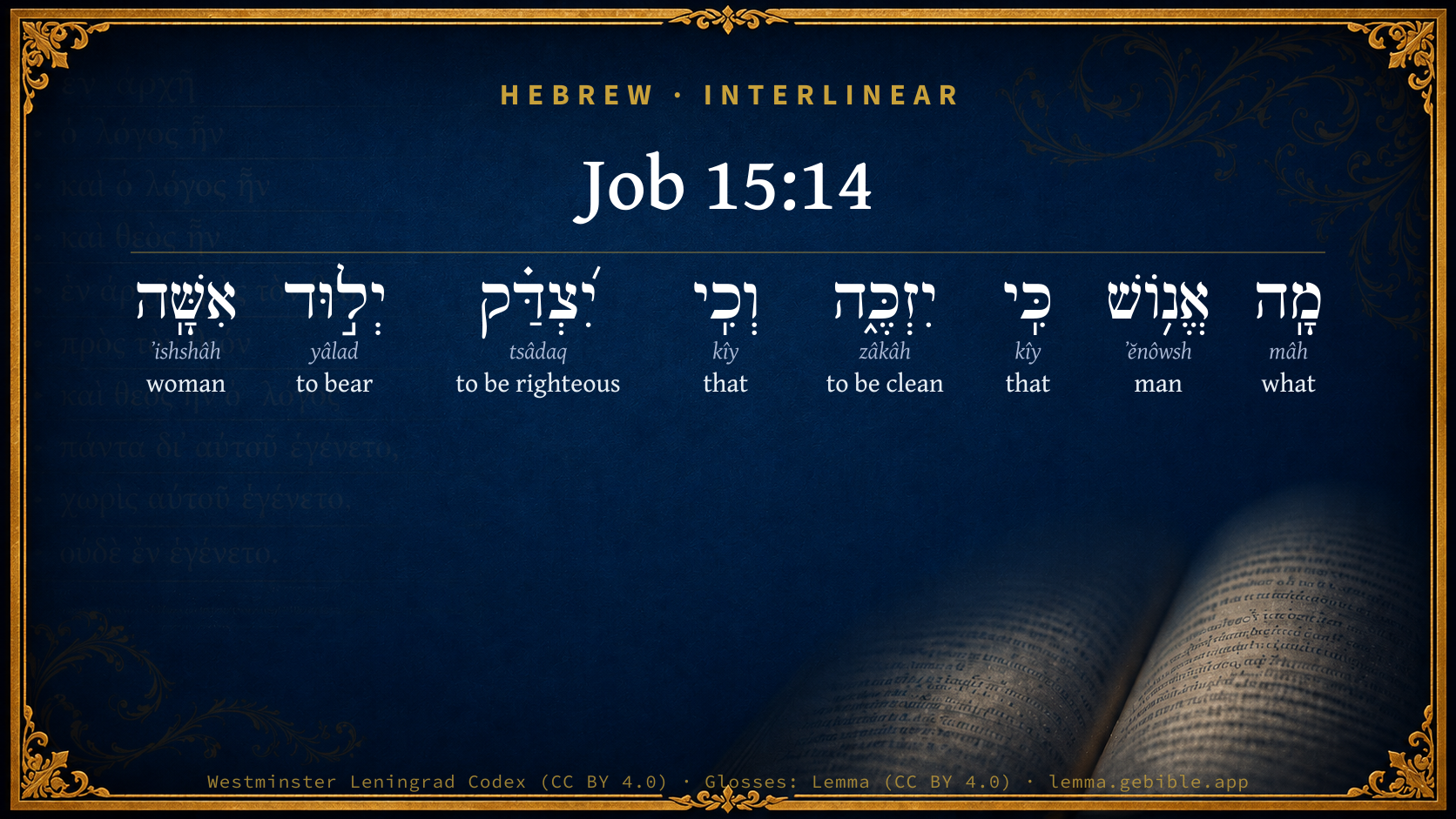
Job 15:14

Hebrew (Westminster Leningrad Codex) Job 15:14 appears in the Hebrew Old Testament. The text above is from the Westminster Leningrad Codex. Each word links to its Strong’s number, a concise gloss, and parsing drawn from the Open Scriptures Hebrew Bible morphology. Click any word for its full Brown-Driver-Briggs (BDB) entry.
Download image
Cite this verse

Job 15:14 (World English Bible). Public Domain. Lemma interlinear Bible study tool, https://lemma.gebible.app/v/job/15/14.

Show BibTeX & RIS
BibTeX
RIS
English Translation
What is man, that he should be clean? He who is born of a woman, that he should be righteous?
World English Bible · Public Domain
Highlights
  • 1 first appearance in the Hebrew Bible
Full analysis ↓
Download a study sheet

One document with this verse’s original text, its word-by-word gloss line, the meaning frame, cross-references with their text, attributed commentary, and full source and license credits — printable, and it pastes into notes with its structure intact.

This verse Autodidact and up

Study sheet (.html) Plain text (.txt)

A passage Seminary Student

Up to 50 verses in one chapter. A passage sheet keeps up to 6 commentary sources and 12 cross-references per verse, in the order this page ranks them, and says so on the sheet whenever that leaves anything out. Ask for a single verse and you get the Autodidact verse sheet above.

Everything on this page stays free to read, with no account — the sheet is a download of what is already on screen, not access to it.

Want to remove ads? Support Godless Engineer
Compare translations 3

The same verse in 3 English versions, stacked beneath the original-language interlinear above. Click any original word for its lexicon entry.

Each is an independent rendering of the whole verse — the interlinear is not word-aligned to these translations.

Highlighted words mark where these versions differ — a whole-verse word diff, not a word-by-word alignment.

  • World English Bible Public Domain
    What is man, that he should be clean? He who is born of a woman, that he should be righteous?
  • King James Version Public Domain
    What is man, that he should be clean? and he which is born of a woman, that he should be righteous?
  • unfoldingWord Literal Text CC BY-SA 4.0
    What man, that he should be pure, or that one born of a woman should be righteous?

unfoldingWord Literal Text — © unfoldingWord, licensed CC BY-SA 4.0. Word-aligned USFM3 via Door43 (git.door43.org/unfoldingWord/en_ult).

Versions to compare (up to 4)

3 of 4 selected

Show all 18 translations

Every available English version of this verse, each an independent rendering of the whole verse.

  • World English Bible Public Domain
    What is man, that he should be clean? He who is born of a woman, that he should be righteous?
  • Berean Standard Bible Public Domain
    What is man, that he should be pure, or one born of woman, that he should be righteous?
  • Majority Standard Bible Public Domain
    What is man, that he should be pure, or one born of woman, that he should be righteous?
  • King James Version Public Domain
    What is man, that he should be clean? and he which is born of a woman, that he should be righteous?
  • American Standard Version (1901) Public Domain
    What is man, that he should be clean? And he that is born of a woman, that he should be righteous?
  • Revised Version (1885) Public Domain
    What is man, that he should be clean? and he which is born of a woman, that he should be righteous?
  • Geneva Bible (1599) Public Domain
    What is man, that he should be cleane? and he that is borne of woman, that he shoulde be iust?
  • Douay-Rheims (1899) Public Domain
    What is man that he should be without spot, and he that is born of a woman that he should appear just?
  • Young's Literal Translation Public Domain
    What `is' man that he is pure, And that he is righteous, one born of woman?
  • Literal Standard Version CC BY-SA 4.0
    What [is] man that he is pure, || And that he is righteous, one born of woman?
  • Unlocked Literal Bible CC BY-SA 4.0
    What is man that he should be clean? What is he who is born of a woman that he should be righteous?
  • unfoldingWord Literal Text CC BY-SA 4.0
    What man, that he should be pure, or that one born of a woman should be righteous?
  • Darby Bible Public Domain
    What is man, that he should be pure? and he that is born of a woman, that he should be righteous?
  • World Messianic Bible Public Domain
    What is man, that he should be clean? What is he who is born of a woman, that he should be righteous?
  • Webster's Bible Public Domain
    What is man, that he should be clean? and he who is born of a woman, that he should be righteous?
  • Free Bible Version CC BY-SA 4.0
    Who can say they are clean? Which human being can say that they do what is right?
  • Bible in Basic English Public Domain
    What is man, that he may be clean? and how may the son of woman be upright?
  • JPS Tanakh (1917) Public Domain
    What is man, that he should be clean? And he that is born of a woman, that he should be righteous?

Literal Standard Version (2020), Covenant Press — licensed CC BY-SA 4.0. Text via the HelloAO Bible API (eBible.org). Unlocked Literal Bible (unfoldingWord) — licensed CC BY-SA 4.0. Text via the HelloAO Bible API (eBible.org). unfoldingWord Literal Text — © unfoldingWord, licensed CC BY-SA 4.0. Word-aligned USFM3 via Door43 (git.door43.org/unfoldingWord/en_ult). Free Bible Version, Dr. Jonathan Gallagher — licensed CC BY-SA 4.0. Text via the HelloAO Bible API (eBible.org).

Word by word

More ways to search: Search by grammar → Find every occurrence → Compare this word →

Practice this passage: Drill this verse → Learn its vocabulary →

About this verse

These counts appear in no published source. They are computed here, from the morphology-tagged text and Lemma’s own curated glosses. What Lemma adds →

8
words
7
distinct lemmas
Wisdom
section

Notable vocabulary

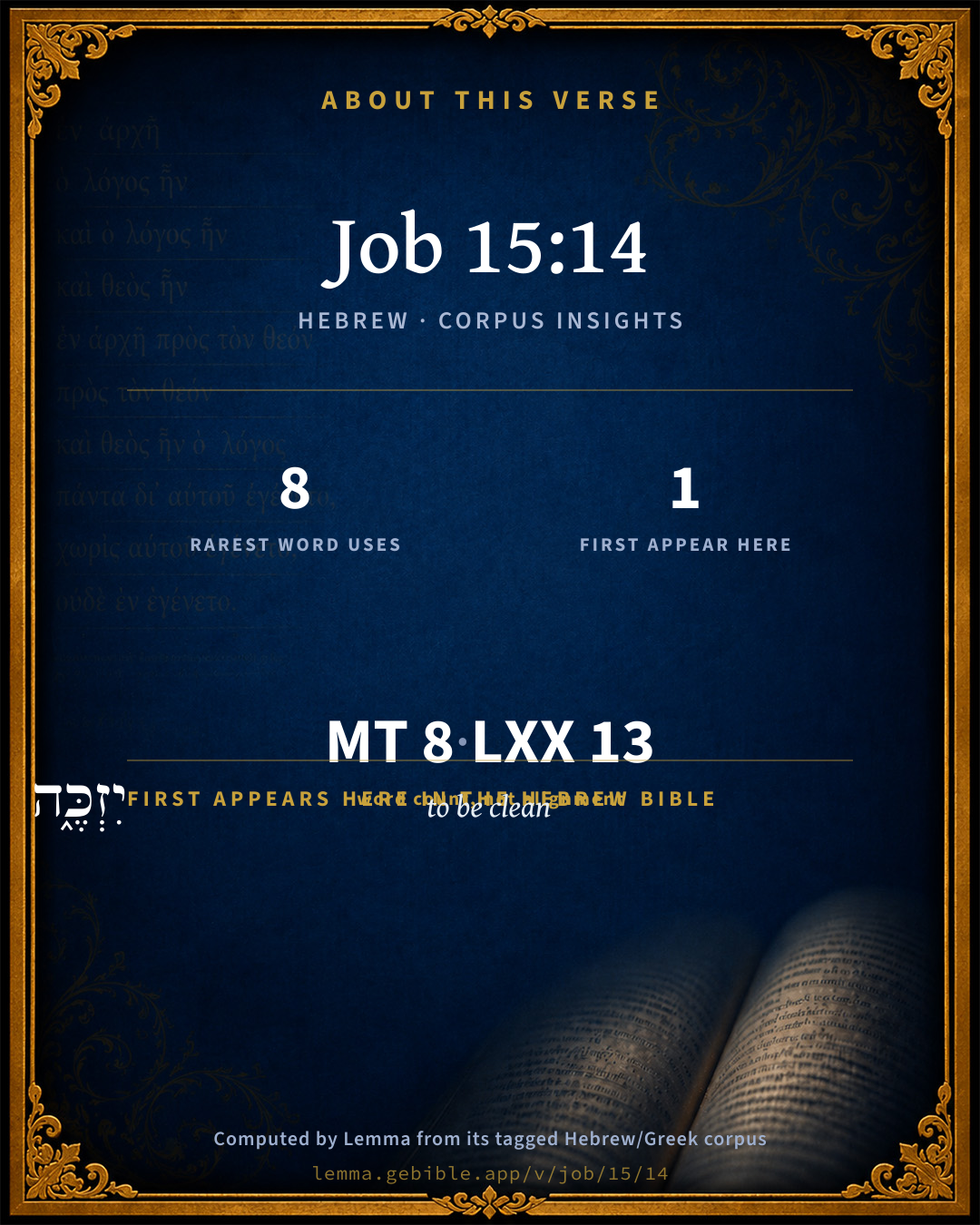
The rarest word here is יִזְכֶּ֑ה to be clean H2135 — appearing just 8 times in the whole Hebrew Bible.

First appearance in Scripture

This word makes its first canonical appearance in the Hebrew Bible here:

  • יִזְכֶּ֑ה to be clean H2135

Shared distinctive vocabulary

יִזְכֶּ֑ה to be clean H2135 occurs in 8 verses of the Hebrew Bible. Also found in:

Grammatical profile

  • 3 verbs
  • 2 nouns
  • 2 conjunctions
  • 1 particle

Verb forms

  • יִזְכֶּ֑ה Qal · Imperfect
  • יִ֝צְדַּ֗ק Qal · Imperfect
  • יְל֣וּד Qal · Participle Passive

Repetition

A word recurs within this verse — often emphatic in Hebrew:

  • כִּֽי that H3588 ×2

Hebrew & Septuagint length

In English translation the verse runs 20 words from the Hebrew and 25 from the Septuagint (LXX English) — closely comparable.

A rough comparison of the two English renderings, which tokenize alike — not a word-level alignment.

Word counts can differ between the Hebrew and the Greek without any difference in meaning — e.g. the Hebrew direct-object marker אֵת has no separate Greek word, and Greek often adds the article ὁ.

In the original languages it is 8 Hebrew tokens and 13 Greek tokens — but the two are counted differently (Hebrew bundles its prefixes and suffixes into one token; the Greek is in lemma form), so that isn’t a like-for-like length.

Cross-references

15

Topical passages linked to Job 15:14 in the Treasury of Scripture Knowledge — connected by theme and wording, ordered by reader-vote popularity; previews shown in the World English Bible.

  • Ecclesiastes 7:20 Surely there is not a righteous man on earth, who does good and doesn't sin.
  • Job 14:4 Who can bring a clean thing out of an unclean? Not one.
  • Proverbs 20:9 Who can say, "I have made my heart pure. I am clean and without sin?"
  • Romans 7:18 For I know that in me, that is, in my flesh, dwells no good thing. For desire is present with me, but I don't find it doing that which is good.
  • Job 25:4–6 How then can man be just with God? Or how can he who is born of a woman be clean?
  • 1 Kings 8:46 If they sin against you (for there is no man who doesn't sin), and you are angry with them, and deliver them to the enemy, so that they carry them away captive to the land of the enemy, far off or near;
  • Psalms 14:3 They have all gone aside. They have together become corrupt. There is none who does good, no, not one.
  • 1 John 1:8–10 If we say that we have no sin, we deceive ourselves, and the truth is not in us.
  • 2 Chronicles 6:36 If they sin against you (for there is no man who doesn't sin), and you are angry with them, and deliver them to the enemy, so that they carry them away captive to a land far off or near;
  • Job 9:2 "Truly I know that it is so, But how can man be just with God?
  • Psalms 51:5 Behold, I was brought forth in iniquity. In sin my mother conceived me.
  • Ecclesiastes 7:29 Behold, this only have I found: that God made man upright; but they search for many schemes.
  • John 3:6 That which is born of the flesh is flesh. That which is born of the Spirit is spirit.
  • Galatians 3:22 But the Scriptures shut up all things under sin, that the promise by faith in Jesus Christ might be given to those who believe.
  • Ephesians 2:2–3 in which you once walked according to the course of this world, according to the prince of the powers of the air, the spirit who now works in the children of disobedience;

Cross-references courtesy of OpenBible.info (CC BY 4.0).

Hebrew and Greek witnesses Masoretic Hebrew ↔ Greek Septuagint

The same verse in the two great witnesses to the Old Testament, shown verse-for-verse.

These are two independent witnesses, not word-aligned to each other, and the Septuagint is shown in lemma (dictionary) form.

Hebrew Job 15:14 Masoretic · Westminster Leningrad Codex

מָֽה אֱנ֥וֹשׁ כִּֽי יִזְכֶּ֑ה וְכִֽי יִ֝צְדַּ֗ק יְל֣וּד אִשָּֽׁה

What is man, that he should be clean? He who is born of a woman, that he should be righteous?

World English Bible · Public Domain

Greek LXX Job 15:14 Septuagint · lemma form

τίς γάρ εἰμί βροτός ὅτι εἰμί ἄμεμπτος ἤ ὡς εἰμί δίκαιος γεννητός γυνή

For who, being a mortal, is such that he shall be blameless? or, who that is born of a woman, that he should be just?

LXX2012 (modern English Septuagint) · Public Domain

Hebrew: Westminster Leningrad Codex (CC BY 4.0). Greek: Septuagint (public domain); English from LXX2012 (modern English Septuagint) (Public Domain). How the Septuagint differs from the Hebrew →

Commentary

Notes on Job 15:14 from classic Christian and Jewish commentators (each source and its license shown beneath its notes). The classic Christian expositions comment on the surrounding passage and are grouped to its opening verse, so a note may address several verses; the Jewish commentaries on the Tanakh (Rashi and others) are per-verse, so they appear only where the commentator wrote on this verse.

Lemma curates 59 commentaries, every one of them public domain or Creative Commons licensed, each selected and text-cleaned for this edition rather than reprinted as found. About our sources →

Trapp's Complete Commentary

John Trapp

Job 15:14 What [is] man, that he should be clean? and [he which is] born of a woman, that he should be righteous?

Ver. 14. What is man, that he should be clean?] Eliphaz hath now done chiding (it is but time he should), and falls to reasoning; wherein nevertheless he showeth himself an empty and troublesome disputer, urging again the same arguments as before, Job 14:17-19, and not resting satisfied in a sufficient answer. Did Job ever assert himself clean? Said he not the clean contrary in many places? See Job 14:4. Only as washed, sanctified, and justified in the name of the Lord Jesus, and by the Spirit of his God, 1Co 6:11, he discoursed of his integrity and righteousness; not denying himself otherwise tainted with original sin, and guilty of actual; which he begged pardon for; according to the tenour of the covenant of grace. And therefore Eliphaz might have spared these words, and better bestowed his pains in comforting Job, and exhorting him to patience. The Jesuits have at this day a device in handling texts of Scripture by their nice distinctions to perplex and obscure the clearest places; and for those that are doubtful, not at all to distinguish or illustrate them. Again, in points of controversy they make a great putter about that which we deny not, but say little or nothing to the main business.

Haec quae desperant renitescere posse relinquunt.

John Trapp, A Commentary or Exposition upon All the Books of the Old and New Testament (1647–1656) — public domain. Text from a community e-Sword module.

The Biblical Illustrator

Joseph S. Exell

Job_15:14-16

What is man that he should be clean?

Original sin

Of all the truths acknowledged and assumed in this ancient book, we find none more clearly or readily confessed than that of mans original sin and native corruption. What is man that he should be clean? When a question is asked in argument and left unanswered, it is the strongest possible form of denial. It is more than saying no man is clean or righteous. It represents such a supposition as mans priority or holiness to be preposterous and absurd. Man, as man, and as born of woman by natural descent, is necessarily imperfect and impure. God is Himself the pure and perfect one, and nothing is pure or perfect but what is in God. All other purity and perfection is therefore comparative. Man may be pure and perfect as a man, while he is still very far from the purity and holiness of God. God has other and higher beings than man. Compare man with these. By saints here are meant the holy angels. God is said not to put trust in them. Their perfection is derived and comparative, not absolute. Contemplate man as he actually is; take the positive side of the charge brought against him in the text. II he is not clean, and cannot be righteous in Gods sight, then what is he? How much more abominable and filthy is man, which drinketh iniquity like water. It might be urged that this is the representation made of the case by an angry and unscrupulous disputant, only anxious to establish his own position. But does not Job himself allow much the same? Is he not brought to say, Behold, I am vile. I abhor myself? Such representations abound in Scripture. Away, then, with all human maxims and all worldly opinions, which only throw a false gloss over the heart, and conceal its hidden corruption without touching it. Let us always look at ourselves in the looking glass of Gods Word, and not in the deceitful mirror of our own judgment, or the flattering worlds opinion. (W. E. Light, M. A.)

Holiness imperfect in the best men

Archbishop Usher was once asked to write a treatise upon sanctification; this he promised to do, but six months rolled away and the good Archbishop had not written a sentence. He said to a friend, I have not begun the treatise, yet I cannot confess to a breach of my promise, for to tell you the truth I have done my best to write upon the subject; but when I came to look into my own heart I saw so little of sanctification there, and found that so much which I could have written would have been merely by rote as a parrot might have talked, that I had not the face to write it. Yet if ever there was a man renowned for holiness it was Archbishop Usher; if ever there was a saintly man who seemed to be one of the seraphic spirits permitted to stray beyond the companionship of his kind among poor earthworms here, it was Usher, yet this is the confession he makes concerning himself. Where, then, shall we hide our diminished heads? (C. H. Spurgeon.)

The Biblical Illustrator, edited by Joseph S. Exell (c. 1880s–1900s) — public domain. Text from a community e-Sword module.

Joseph Benson's Commentary

Job 15:14-15. What is man? — Hebrew, אנושׁ, enosh, frail, weak, imperfect man; that he should be clean? — That is, that he should pretend to be so; or, that any should expect to find him so: and he that is born of a woman — A sinful woman, from whom he has derived infirmity, corruption, and guilt; that he should be righteous? — Just and holy in his own eyes, or in the eyes of others, and especially that he should be such in the sight of the just and holy God? Behold, he putteth no trust in his saints — That is, in his angels, (see Job 4:18,) who are called his saints or holy ones, Deu 33:2; Dan 4:13; Dan 4:23. Who, though they were created holy, yet many of them fell. Yea, the heavens are not clean in his sight — The angels that dwell in heaven; heaven being put for its inhabitants. None of these are pure, simply, and perfectly, and comparatively to God. The angels are pure from corruption, but not from imperfection.

Joseph Benson's Commentary on the Old and New Testaments (1811–1818) — public domain. Text from a community e-Sword module.

Keil & Delitzsch

C. F. Keil & F. Delitzsch

14 What is mortal man that he should be pure,

And that he who is born of woman should be righteous?

15 He trusteth not His holy ones,

And the heavens are not pure in His eyes:

16 How much less the abominable and corrupt,

Man, who drinketh iniquity as water!

The exclamation in Job 15:14 is like the utterance: mortal man and man born flesh of flesh cannot be entirely sinless. Even "the holy ones" and "the heavens" are not. The former are, as in Job 5:1, according to Job 4:18, the angels as beings of light (whether קדשׁ signifies to be light from the very first, spotlessly pure, or, vid., Psalter, i. 588f., to be separated, distinct, and hence exalted above what is common); the latter is not another expression for the אנגּלי מרומא (Targ.), the "angels of the heights," but שׁמים is the word used for the highest spheres in which they dwell (comp. Job 25:5); for the angels are certainly not corporeal, but, like all created things, in space, and the Scriptures everywhere speak of angels and the starry heavens together. Hence the angels are called the morning stars in Job 38:7, and hence both stars and angels are called צבא השׁמים and צבאות (vid., Genesis. S. 128). Even the angels and the heavens are finite, and consequently are not of a nature absolutely raised above the possibility of sin and contamination.

Eliphaz repeats here what he has already said, Job 4:18.; but he does it intentionally, since he wishes still more terribly to describe human uncleanness to Job (Oetinger). In that passage אף was merely the sign of an anti-climax, here כּי אף is quanto minus. Eliphaz refers to the hereditary infirmity and sin of human nature in Job 15:14, here (Job 15:16) to man's own free choice of that which works his destruction. He uses the strongest imaginable words to describe one actualiter and originaliter corrupted. נתעב denotes one who is become an abomination, or the abominated = abominable (Ges. 134, 1); נאלח, one thoroughly corrupted (Arabic alacha, in the medial VIII conjugation: to become sour, which reminds one of ζύμη, Rabb. שׂאר שׁבּעסּה, as an image of evil, and especially of evil desire). It is further said of him (an expression which Elihu adopts, Job 34:7), that he drinks up evil like water. The figure is like Pro 26:6, comp. on Psa 73:10, and implies that he lusts after sin, and that it is become a necessity of his nature, and is to his nature what water is to the thirsty. Even Job does not deny this corruption of man (Job 14:4), but the inferences which the friends draw in reference to him he cannot acknowledge. The continuation of Eliphaz' speech shows how they render this acknowledgment impossible to him.

Keil & Delitzsch — Biblical Commentary on the Old Testament (1861–1891) — public domain (CC PDM 1.0). Text via the HelloAO Bible API. (Old Testament only.)

Tyndale Open Study Notes

Tyndale Open Resources

15:14 Can any mortal be pure? Eliphaz repeated himself (4:17-19) and Job (7:17; 14:4). • anyone born of a woman: Both “mortal” and “born of woman” imply weakness.

Tyndale Open Study Notes — © Tyndale Open Resources, licensed CC BY-SA 4.0. Text via the HelloAO Bible API.

Geneva Bible (1599)

Geneva Bible translators

His purpose is to prove that Job as an unjust man, and an hypocrite is punished for his sins, like as he did before, Job 4:8.

Geneva Bible (1599) marginal notes — public domain. Text via Bolls.life.

Jamieson, Fausset & Brown

Robert Jamieson, A. R. Fausset & David Brown

Eliphaz repeats the revelation (Job 4:17) in substance, but using Job's own words (see on Job 14:1, on "born of a woman") to strike him with his own weapons.

Jamieson, Fausset & Brown — Commentary Critical and Explanatory on the Whole Bible (1871) — public domain (CC PDM 1.0). Text via the HelloAO Bible API.

Adam Clarke's Commentary

Verse 14. What is man, that he should be clean?] מה אנוש mah enosh; what is weak, sickly, dying, miserable man, that he should be clean? This is the import of the original word enosh.

And - born of a woman, that he should be righteous?] It appears, from many passages in the sacred writings, that natural birth was supposed to be a defilement; and that every man born into the world was in a state of moral pollution. Perhaps the word יצדק yitsdak should be translated, that he should justify himself, and not that he should be righteous.

Adam Clarke's Commentary on the Bible (1810–1826) — public domain. Text from a community e-Sword/MySword module.

Ellicott's Commentary for English Readers

(14) What is man?—This is the ceaseless burden.·(See Job_4:17; Job_9:2; Job_25:4, &c.)

A Bible Commentary for English Readers, edited by Charles John Ellicott (1878–1897) — public domain. Text from a community e-Sword module.

The Cambridge Bible for Schools and Colleges

gen. ed. J. J. S. Perowne

14. What is there to justify such passion—thy pretended innocence? What is man that he should be clean? cf. ch. Job_14:1. Eliphaz recurs again to his principles formerly enunciated, ch. Job_4:17 seq., for his former speech is in his mind throughout.

The Cambridge Bible for Schools and Colleges (gen. ed. J. J. S. Perowne; Cambridge University Press, 1878–1918) — public domain. Text from a community e-Sword module.

John Gill's Exposition

What is man, that he should be clean?.... Frail, feeble, mortal man, or woeful man, as Mr. Broughton renders it; since he is sinful, whereby he is become such a weak and dying creature: this question, as well as the following, is put by way of contempt, and as lessening man in a comparative sense, and in order to abate any high conceit of himself; who is not naturally clean, but the reverse, being conceived and born in sin; nor can he be so of himself, nor by any means he is capable of; and however clean he may be in his own eyes, or in the eyes of others, yet is not clean in the sight of God, and still less pure than him, his Maker, as in Job 4:17; and indeed cannot be clean at all, but through the grace of God, and blood of Christ, which cleanses from all sin:

and he which is born of a woman; a periphrasis of man, Job 14:1;

that he should be righteous? as no man is naturally; there is none righteous, no, not one; though man originally was made righteous, yet sinning he lost his righteousness, and all his posterity are without any; nor can they become righteous of themselves, or by any works of righteousness done by them; and though they may trust in themselves that they are righteous, and may appear outwardly so before men, yet by the deeds of the law no flesh can be justified or accounted righteous in the sight of God, and much less be more just than he, as in Job 4:17; nor can any of the sons of men be made or reckoned righteous but by the obedience of Christ, or by that justifying righteousness that is in him: what Eliphaz here says concerning the impurity, imperfection, and unrighteousness of men, are very great truths; but if he aims at Job, as he seems to do he misses his mark, and mistakes the man, and it is in vain with respect to him, or as a refutation of any notions of his; for Job asserts the corruption and depravity of human nature as strongly as it is expressed here, Job 14:4; nor does he ever claim, but disclaims, sinless perfection, Job 9:20; nor did he expect to be personally justified before God by any righteousness of his own, the imperfection of which he was sensible of, but by the righteousness of his living Redeemer, Job 9:30; but what he pleaded for was the integrity and uprightness of his heart in opposition to hypocrisy he was charged with; and the holiness and righteousness of his life and conversation, in opposition to a course of living in sin, or to his being guilty of some notorious sin or sins for which he was afflicted, as was insinuated. Eliphaz here recurs to his oracle, Job 4:17; and expresses it much to the same sense.

John Gill's Exposition of the Whole Bible (1746–1763) — public domain (CC PDM 1.0). Text via the HelloAO Bible API.

Albert Barnes' Notes on the Bible

What is man that he should be clean? - The object of Eliphaz in this is to overturn the positions of Job that he was righteous, and had been punished beyond his deserts. He had before maintained Job 4:7, that no one ever perished being innocent, and that the righteous were not cut off. This was with him a favorite position; and indeed the whole drift of the argument maintained by him and his friends was, to prove that uncommon calamities were proof of uncommon guilt. Job had insisted on it that he was a righteous man, and had not deserved the calamities which had come upon him - a position which Eliphaz seems to have regarded as an assertion of innocence. To meet this he now maintains that no one is righteous; that all that are born of women are guilty; and in proof of this he goes back to the oracle which had made so deep an impression on his mind, and to the declaration then made to him that no one was pure before God; Job 4: He does not repeat it exactly as the oracle was then delivered to him, but adverts to the substance of it, and regards it as final and indisputable. The meaning is, “What are all the pretensions of man to purity, when even the angels are regarded as impure and the heavens unclean?”

He which is born of a woman - Another mode of denoting man. No particular argument to maintain the doctrine of man’s depravity is couched in the fact that he is born of a woman. The sense is, simply, how can anyone of the human family be pure?

Albert Barnes' Notes on the Bible (1834–1885) — public domain. Text from a community e-Sword/MySword module.

Haydock's Catholic Bible Commentary

Just. Few are free from all spot; but venial sins do not hinder a man from being styled truly virtuous. (Worthington)

George Leo Haydock (1774–1849), Haydock's Catholic Family Bible and Commentary, 1859 edition — public domain. Excludes Psalms (Douay-Rheims chapter numbering differs from Protestant) and Deuterocanonical books (Catholic canon only).

Matthew Poole's English Annotations

What is man, Heb. frail, or sick, or wretched man? his mean original and corrupt nature showeth him to be unclean.

Which is born of a woman; from whom he derives infirmity, and corruption, and guilt, and the curse consequent upon it.

Righteous, to wit, in his own eyes, as thou, O Job, art.

Matthew Poole's English Annotations on the Holy Bible (1683–1685) — public domain. Text from a community e-Sword/MySword module.

Whedon's Commentary on the Bible

Daniel D. Whedon

14. Born of a woman — The words of Job are now turned upon him, and give point to the citations Eliphaz makes from his wonderful revelation, Job_4:17. Job’s admission “born of a woman,” (see note Job_14:1,) justifies Eliphaz in seizing again his fallen weapon — “Job a sinner.”

Daniel D. Whedon (gen. ed.), Commentary on the Old and New Testaments (1874–1909) — public domain. Text from a community e-Sword module.

The Pulpit Commentary

What is man, that he should be clean? A vain "beating of the air." Eliphaz had asserted the same truth in his first speech, when he said, "Shall mortal man be more just than God? shall a man be more pure than his Maker? Behold, he put no trust in his servants; and his angels he taxeth with folly: how m u ch less in them that dwell in houses of clay"whose foundation is in the dust, which are crushed before the moth?"; (Job_4:17-19) and Job had given his full assent to it, when he exclaimed, "I know it is so of a truth: but how should man be just with God? If he will contend with him, he cannot answer him one of a thousand". (Job_9:2, Job_9:3) The true question was not whether Job or any other man was" clean," i.e. wholly sinless" but whether Job had sinned so deeply and grievously that his sufferings were the natural and just punishment for his sins. And a mere repetition of the statement that all men were sinful and unclean was off the point nihil ad rem-altogether futile and superfluous. And he that is born of a woman, that he should be righteous?. (Job_25:4) The clause is a mere variant of the preceding one.

Vers. 14-16. Human sinfuless.

Eliphaz accuses Job of his attempt to justify himself, and speaks with great apparent acerbity of spirit. His words are cutting and cruel. He secretly declares Job to be sinful in proportion to his sufferings. He branches into generalities, and affirms the general human sinfulness with the quiet accusation, "All men are sinful; therefore thou art. Sorrow is the punishment of the wicked; therefore thy suffering is proof of thy guilt." Eliphaz"s view is imperfect, and needs to be supplemented. Job, in his struggling, cries aloud for that supplement. It is found only in the assurance of the future, and in the fact that, with the future in view, it pleases the Almighty to discipline and prepare men for it. Suffering is seen to be a method of that discipline. Of human sinfulness it is affirmed

I IT IS AN INHERENT CONDITION OF HUMAN LIFE. "What is man, that he should be clean? and he that is born of a woman, that he should be righteous?" as though he had said, "It is of the nature of man to be unclean." "That which is born of the flesh is flesh." The human nature derived from the imperfect and unholy is necessarily unholy and imperfect. Evidences of this may be seen in the general observed depravity of man; in the necessity for very powerful influences to check sinfulness; in the constant recognition of the Fall in Holy Scripture; in the difficulty with which even good men preserve their goodness; and in the sad examples of deep degradation in all lands.

II THIS SINFULNESS IS MOST APPARENT TO THE DIVINE JUDGMENT. Men are not always alive to their own sinfulness. Not apprehending righteousness, they have not an accurate standard by which to judge themselves. But in the Divine view the very angels, who are superior to men, are not pure: "The heavens are not clean in his sight.

III THIS SINFULNESS EXHIBITS ITSELF IN GREAT IMPURITY OF LIFE AND SPIRIT. Happily there are many exceptions, and we live in brighter, better times than did Job; yet how truly is it still to be said, "How much more abominable and filthy is man!

IV THIS SINFULNESS IS ESPECIALLY SHOWN IN AN ACTIVE PREFERENCE OF EVIL BEFORE GOOD. He "drinketh iniquity like water." Eliphaz has been led from general views to single out the sad cases which all may observe, and which bear such painful testimony, that if human life be not checked in its natural tendencies, it degenerates to the worst conditions of evil.

Therefore:

1. Life to be guarded with great care, lest degenerating influences exert destructive power over it.

2. The most potent corrections to be sought; the need of regeneration.

3. The instruction, grace, and sanctification of the Spirit of God to be thankfully received and most carefully cherished. R.G.

Vers. 14-16. God"s holiness and man"s sin.

Eliphaz takes up Job"s words, (Job_14:1-4) but turns them against their author. Job had spoken of inherited frailty as a ground for pity; Eliphaz seizes on it as an accusation of guilt. How dare this puny, imperfect creature, man, boast of his innocence in the sight of the holy God?

I GOD"S HOLINESS IS INCOMPARABLE. This is an idea which we take for granted. Yet it was not found in most heathen religions. Monotheism is commonly reckoned as the great peculiarity of the Hebrew faith; but a more striking peculiarity is holiness. The neighbouring divinities were just representations of magnified human passions, often more degraded and immoral than men. The revelation of the true God shows that he is not only above all human passion; he is perfect in holiness. We can find no image with which to compare his purity. The mountain is high above the plain, hut mountain and plain are equally low when we think of the stars. Our goodness may mean something among men, but it does not extend to God. (Psa_16:2) Even the very angels veil their faces before him, awed by the majesty of absolute goodness. Yet God"s goodness in being absolute is not so because he is infinite. If it were, it would be unfair to complain that we could not approach it. An inch of snow may be as pure as an acre of snow.

II GOD"S HOLINESS REVEALS MAN"S SIN. We do not know our sin till we see it in the light of God. There are in the farmyard fowls black and white. But when the snow has fallen the white fowls look so no longer, because by the side of the Heaven-sent purity of the snow their plumage is seen to be of a very impure colour. There are men of various character, and some are accounted white-souled saints. But when placed by the side of God"s holiness these are the first to confess that their righteousness is as filthy rags. Christ revealed the sin of his age in contrast to his own holiness. We do not own our sinfulness because we do not know God"s goodness. It is not the Law, but God"s goodness in Christ, that most makes us feel our sin.

III GOD"S HOLINESS CANNOT ENDURE SIN. Sin may stand uurebuked and unchecked in the world, because all are "tarred with the same brush." Thus there is a dangerous condoning of conventional evil. But this is not possible with God. Holiness and sin are opposed as light and darkness. The thought of God"s holiness alone makes men tremble. "Eternal Light, Eternal Light! How pure the soul must be When, placed within thy searching sight, It shrinks not, but with calm delight Can live and look on thee!

Therefore God must deal with sin, to banish and destroy it. If the sinner cleaves to his sin he cannot but share in its doom. If, however, he will detach himself from it, it will be destroyed, while he is saved. God hates the sin, not the sinner. Now, God"s holy hatred of sin should be regarded by us as a reason for great thankfulness. For the sin he hates is just our most deadly enemy. If he destroys our sin, he saves our soul from its fatal foe. On the other hand, only God can give the purity which is needed for his presence. We may make ourselves seem fair before man. Only God can purify us so that we are fit for his presence, only the blood of Christ can cleanse from all sin. W.F.A. (1Jn_1:7)

The Pulpit Commentary (1880–1919), ed. H.D.M. Spence-Jones & Joseph S. Exell — public domain. Text from a community e-Sword module.

Kretzmann's Popular Commentary

Paul E. Kretzmann

Eliphaz Accuses Job of Impiety

v. 14. What is man that he should be clean, and he which is born of a woman that he should be righteous? Eliphaz here takes up a point which he had broached in his first discourse, 4:17-20, and which Job himself had conceded, 14:1-4. If Job admitted man’s mortality and frailty in general, he should also concede his own particular wickedness.

v. 15. Behold, He putteth no trust in His saints, not even in His holy angels, because they are finite and beneath Him in dignity; yea, the heavens, the very home of bliss, are not clean in His sight, they do not measure up to the essential purity of God’s nature.

v. 16. How much more abominable and filthy is man, or, "much less, then, is the utterly corrupt man," which drinketh iniquity like water? The characteristic of natural man is that he is so desirous for wickedness in one form or other that he pants for it like a thirsty person. After this sharp arraignment of Job, Eliphaz attempts a more objective form of rebuke.

v. 17. I will show thee, hear me, giving Job the information which he needed; and that which I have seen, what he has gained by experience, I will declare,

v. 18. which wise men have told from their fathers and have not hid it, setting it forth without concealment, without deception, without hypocrisy or hidden meanness;

v. 19. unto whom alone the earth was given, their tribe alone inhabited the land where they first settled, and no stranger passed among them, the purity of their race had been maintained from the earliest times, a fact which was considered the sign of the highest nobility. Eliphaz now sets forth this doctrine of the moral order of the world, in order to convince Job of the justice of his sufferings.

v. 20. The wicked man travaileth with pain all his days, writhing, twisting, and trembling in torments of one form or other, and the number of years is hidden to the oppressor, rather, a definite number of years is set aside for the tyrant, the one who commits violence in any manner.

v. 21. A dreadful sound is in his ears, noises that fill him with terror; in prosperity the destroyer shall come upon him, falling upon him in the midst of peace, when he is expecting no such evil.

v. 22. He believeth not that he shall return out of darkness, he despairs of ever being relieved of his misfortune, and he is waited for of the sword, marked out, destined for its attack and for destruction by it.

v. 23. He wandereth abroad for bread, saying, Where is it? In the midst of plenty the miser is tortured by anxiety concerning his food. He knoweth that the day of darkness is ready at his hand, namely, to seize him and to thrust him into punishment of the most severe kind.

v. 24. Trouble and anguish shall make him afraid, fill him with terror, anguish, find alarm; they shall prevail against him, overpower, overthrow him, as a king ready to the battle, the rush of the sudden attack sweeping over him and leaving him prostrate and beaten,

v. 25. For he, the wicked one, stretcheth out his hand against God, in a bold show of rebellion, and strengtheneth himself against the Almighty, boasting himself in proud insolence.

v. 26. He runneth upon him, even on his neck, that is, with his neck rigid, with all the muscles of his body taut for the attack, upon the thick bosses of his bucklers, as the leader of a whole army of rebels he rushes forward with his weapons of offense and of defense,

v. 27. because he covereth his face with his fatness, a mark of his unbounded greed, and maketh collops of fat on his flanks, having gathered lumps of fat upon his loins as a result of his immoderate indulgence.

v. 28. And he dwelleth in desolate cities, and in houses which no man inhabiteth, which are ready to become heaps, about to fall into ruins. The description is that of a tyrant who sets aside all regard for the opinion of men, living even among the ruins of an accursed city. The result of such unparalleled insolence is now shown.

v. 29. He shall not be rich, neither shall his substance continue, his wealth would have no stability, neither shall he prolong the perfection thereof upon the earth, literally, "not bow down to the earth the gains of such"; that is, even if the wicked succeed in having the finest stand of grain, the ears do not fill out; they may have a show of opulence, but it is not substantial.

v. 30. He shall not depart, not escape, out of darkness; the flame shall dry up his branches, a parching heat withering his shoots, destroying his hopes for new gains, and by the breath of his mouth shall he go away, the Lord Himself sending the last great catastrophe upon him.

v. 31. Let not him that is deceived trust in vanity, rather, let him not trust in vanity, he deceives himself; for vanity shall be his recompense, everyone who trusts in the vain possessions of this world will find himself rewarded with their hollow emptiness.

v. 32. It shall be accomplished before his time, before his appointed time has run its course, the fulfillment of the evil will strike him, and his branch shall not be green, the picture of a decaying, palm-tree being applied to the wicked person.

v. 33. He shall shake off his unripe grape as the vine, losing his gains before he has had any enjoyment of them, and shall cast off his flower as the olive. As the olive-tree, every other year, casts its blossoms without bearing fruit, so the godless will not realize their hopes, which are directed entirely upon vanity.

v. 34. For the congregation of hypocrites, the company of the wicked and profligate, shall be desolate, barren, having no lasting good fortune, and fire shall consume the tabernacles of bribery, the fire of God’s judgment devours the dwellings of those who build up their substance on bribery and wickedness.

v. 35. They conceive mischief, pregnant with misery, and bring forth vanity, and their belly prepareth deceit, bearing it, bringing it forth, as a child of their wickedness. The point of this speech of Eliphaz is, of course, directed against Job, whom he wants to include in the category of such wicked and godless people as he has here described. The same bad habit of drawing unwarranted conclusions and placing innocent men under suspicion is employed to this day. and believers must guard most carefully against the practise of judging and condemning others.

Paul E. Kretzmann, Popular Commentary of the Bible (1921–1924) — public domain. Text from a community e-Sword module.

Rashi

Rabbi Shlomo Yitzchaki (Rashi)

What is man that he should be innocent What is his strength, that he can be innocent against the Holy One, blessed be He?

Rashi on the Tanakh — English translations: “The Judaica Press complete Tanach with Rashi, translated by A. J. Rosenberg” (CC BY 4.0); “Pentateuch with Rashi's commentary by M. Rosenbaum and A.M. Silbermann, 1929-1934” (public domain); “The Metsudah Tanach series, Lakewood, N.J” (CC BY 4.0); and “The Book of Joshua, Metsudah Publications, 1997” (CC BY 4.0). Text via Sefaria.

Lesson kit

Teaching starters — assembled from the data on this page, not authored interpretation. Every prompt links to the verse data it draws on. Edit before teaching.

Job, in the Wisdom, opens this verse with 8 words (7 distinct Hebrew lemmas). Its most distinctive word is zâkâh (“to be clean”). A historical commentator’s framing appears above. Read the whole chapter for the surrounding context.

Discussion questions

  1. How does “to be clean” (zâkâh) shape what this verse is saying?
  2. The word “to be clean” first appears here in Scripture. What is being introduced at this debut?
  3. Job 25:4 shares the word «to be clean» with this verse. How do the two illuminate each other?
  4. “that” occurs 2× in this one verse. What is the effect of the repetition?
  5. The translations on this page render this verse differently — a whole-verse word diff, not a word-by-word alignment. What might account for the different wordings?
  6. The verb «יִזְכֶּ֑ה» is Qal Imperfect. How does its form color the action?
  7. Reading how Trapp's Complete Commentary and The Biblical Illustrator read this verse, where do the two commentators agree and where do they part?

Things to notice

Reading settings

Reading text

Shown beneath each verse's original-language words.

Old Testament
Old Testament edition

Read the OT as the Masoretic Hebrew (MT) or the Greek Septuagint (LXX).

English shown for the Greek Septuagint (in the Hebrew ↔ Greek comparison).

Comparing translations? Open the Compare panel on any verse page to stack up to four side by side.