

2 Corinthians 6:10
Greek (Tischendorf 8th ed.) 2 Corinthians 6:10 appears in the Greek New Testament. The text above is from the Tischendorf 8th edition. Each word links to its Strong’s number and a concise gloss. Click any word for its full Thayer’s Greek Lexicon entry.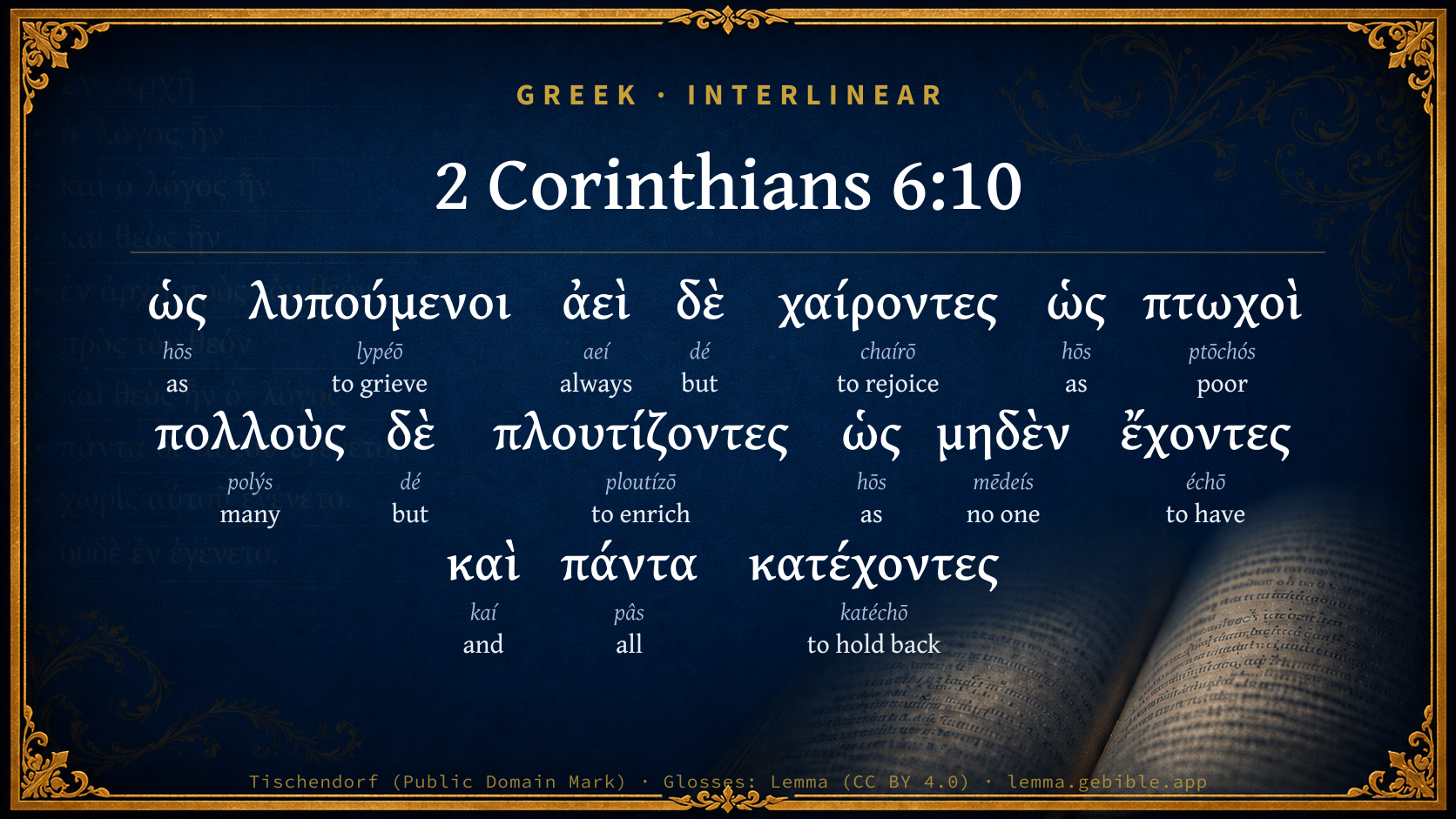
as sorrowful, yet always rejoicing; as poor, yet making many rich; as having nothing, and yet possessing all things.
Download a study sheet
One document with this verse’s original text, its word-by-word gloss line, the meaning frame, cross-references with their text, attributed commentary, and full source and license credits — printable, and it pastes into notes with its structure intact.
This verse Autodidact and up
A passage Seminary Student
Up to 50 verses in one chapter. A passage sheet keeps up to 6 commentary sources and 12 cross-references per verse, in the order this page ranks them, and says so on the sheet whenever that leaves anything out. Ask for a single verse and you get the Autodidact verse sheet above.
Everything on this page stays free to read, with no account — the sheet is a download of what is already on screen, not access to it.
Compare translations 3
The same verse in 3 English versions, stacked beneath the original-language interlinear above. Click any original word for its lexicon entry.
Each is an independent rendering of the whole verse — the interlinear is not word-aligned to these translations.
Highlighted words mark where these versions differ — a whole-verse word diff, not a word-by-word alignment.
-
World English Bible Public Domain
as sorrowful, yet always rejoicing; as poor, yet making many rich; as having nothing, and yet possessing all things.
-
King James Version Public Domain
As sorrowful, yet alway rejoicing; as poor, yet making many rich; as having nothing, and yet possessing all things.
-
unfoldingWord Literal Text CC BY-SA 4.0
as being sorrowful, but always rejoicing; as poor, but making many rich; as having nothing, yet possessing all things.
unfoldingWord Literal Text — © unfoldingWord, licensed CC BY-SA 4.0. Word-aligned USFM3 via Door43 (git.door43.org/unfoldingWord/en_ult).
Show all 19 translations
Every available English version of this verse, each an independent rendering of the whole verse.
-
World English Bible Public Domain
as sorrowful, yet always rejoicing; as poor, yet making many rich; as having nothing, and yet possessing all things.
-
Berean Standard Bible Public Domain
sorrowful, yet always rejoicing; poor, yet making many rich; having nothing, and yet possessing everything.
-
Majority Standard Bible Public Domain
sorrowful, yet always rejoicing; poor, yet making many rich; having nothing, and yet possessing everything.
-
King James Version Public Domain
As sorrowful, yet alway rejoicing; as poor, yet making many rich; as having nothing, and yet possessing all things.
-
American Standard Version (1901) Public Domain
as sorrowful, yet always rejoicing; as poor, yet making many rich; as having nothing, and `yet' possessing all things.
-
Revised Version (1885) Public Domain
as sorrowful, yet alway rejoicing; as poor, yet making many rich; as having nothing, and yet possessing all things.
-
Geneva Bible (1599) Public Domain
As sorowing, and yet alway reioycing: as poore, and yet make many riche: as hauing nothing, and yet possessing all things.
-
Douay-Rheims (1899) Public Domain
As sorrowful, yet always rejoicing; as needy, yet enriching many; as having nothing, and possessing all things.
-
Young's Literal Translation Public Domain
as sorrowful, and always rejoicing; as poor, and making many rich; as having nothing, and possessing all things.
-
Literal Standard Version CC BY-SA 4.0
as sorrowful, and always rejoicing; as poor, and making many rich; as having nothing, and possessing all things.
-
Unlocked Literal Bible CC BY-SA 4.0
We work as sorrowful, but we are always rejoicing. We work as poor, but we are making many rich. We work as having nothing and yet as possessing all things.
-
unfoldingWord Literal Text CC BY-SA 4.0
as being sorrowful, but always rejoicing; as poor, but making many rich; as having nothing, yet possessing all things.
-
Darby Bible Public Domain
as grieved, but always rejoicing; as poor, but enriching many; as having nothing, and possessing all things.
-
World Messianic Bible Public Domain
as sorrowful yet always rejoicing, as poor yet making many rich, as having nothing and yet possessing all things.
-
Webster's Bible Public Domain
As sorrowful, yet always rejoicing; as poor, yet making many rich; as having nothing, and yet possessing all things.
-
Free Bible Version CC BY-SA 4.0
Seen as miserable, we are always rejoicing; as poor, but we make many rich; as destitute, but we own everything!
-
Bible in Basic English Public Domain
As full of sorrow, but ever glad; as poor, but giving wealth to others; as having nothing, but still having all things.
-
Text-Critical English NT CC BY 4.0
as sorrowful, yet always rejoicing; as poor, yet making many rich; as having nothing, yet possessing everything.
-
Tyndale New Testament (1534) Public Domain
as sorowynge and yet alwaye mery: as poore and yet make many ryche: as havynge nothynge and yet possessynge all thynges.
Literal Standard Version (2020), Covenant Press — licensed CC BY-SA 4.0. Text via the HelloAO Bible API (eBible.org). Unlocked Literal Bible (unfoldingWord) — licensed CC BY-SA 4.0. Text via the HelloAO Bible API (eBible.org). unfoldingWord Literal Text — © unfoldingWord, licensed CC BY-SA 4.0. Word-aligned USFM3 via Door43 (git.door43.org/unfoldingWord/en_ult). Free Bible Version, Dr. Jonathan Gallagher — licensed CC BY-SA 4.0. Text via the HelloAO Bible API (eBible.org).
Word by word
More ways to search: Search by grammar → Find every occurrence → Compare this word →
Practice this passage: Drill this verse → Learn its vocabulary →
- Appears 3× in the Greek New Testament
- First appears at 1 Corinthians 1:5
- Part of Speech
- Verb
- Tense
- Present
- Voice
- Active
- Mood
- Participle
- Case
- Nominative
- Number
- Plural
- Gender
- Masculine
Full Thayer's Definition
- ὡς hōs G5613 “as” Adverb
- λυπούμενοι lypéō G3076 “to grieve” Verb, Present, Passive, Participle, Nominative, Plural, Masculine
- ἀεὶ aeí G104 “always” Adverb
- δὲ dé G1161 “but” Conjunction
- χαίροντες chaírō G5463 “to rejoice” Verb, Present, Active, Participle, Nominative, Plural, Masculine
- ὡς hōs G5613 “as” Adverb
- πτωχοὶ ptōchós G4434 “poor” Adjective, Nominative, Plural, Masculine
- πολλοὺς polýs G4183 “many” Adjective, Accusative, Plural, Masculine
- δὲ dé G1161 “but” Conjunction
- πλουτίζοντες ploutízō G4148 “to enrich” Verb, Present, Active, Participle, Nominative, Plural, Masculine
- ὡς hōs G5613 “as” Adverb
- μηδὲν mēdeís G3367 “no one” Adjective, Accusative, Singular, Neuter, Negative
- ἔχοντες échō G2192 “to have” Verb, Present, Active, Participle, Nominative, Plural, Masculine
- καὶ kaí G2532 “and” Conjunction
- πάντα pâs G3956 “all” Adjective, Accusative, Plural, Neuter
- κατέχοντες katéchō G2722 “to hold back” Verb, Present, Active, Participle, Nominative, Plural, Masculine
About this verse
These counts appear in no published source. They are computed here, from the morphology-tagged text and Lemma’s own curated glosses. What Lemma adds →
- 16
- words
- 13
- distinct lemmas
- Pauline Epistles
- section
Cross-references
42Topical passages linked to 2 Corinthians 6:10 in the Treasury of Scripture Knowledge — connected by theme and wording, ordered by reader-vote popularity; previews shown in the World English Bible.
- John 16:22 Therefore you now have sorrow, but I will see you again, and your heart will rejoice, and no one will take your joy away from you.
- 2 Corinthians 8:9 For you know the grace of our Lord Jesus Christ, that, though he was rich, yet for your sakes he became poor, that you through his poverty might become rich.
- James 2:5 Listen, my beloved brothers. Didn't God choose those who are poor in this world to be rich in faith, and heirs of the Kingdom which he promised to those who love him?
- Revelation 2:9 "I know your works, oppression, and your poverty (but you are rich), and the blasphemy of those who say they are Jews, and they are not, but are a synagogue of Satan.
- Philippians 4:4 Rejoice in the Lord always! Again I will say, Rejoice!
- 1 Timothy 4:8 For bodily exercise has some value, but godliness has value for all things, having the promise of the life which is now, and of that which is to come.
- Hebrews 10:34 For you both had compassion on me in my chains, and joyfully accepted the plundering of your possessions, knowing that you have for yourselves a better possession and an enduring one in the heavens.
- 1 Peter 1:6–8 Wherein you greatly rejoice, though now for a little while, if need be, you have been put to grief in various trials,
- Proverbs 16:16 How much better it is to get wisdom than gold! Yes, to get understanding is to be chosen rather than silver.
- Luke 16:11–12 If therefore you have not been faithful in the unrighteous mammon, who will commit to your trust the true riches?
- Colossians 3:16 Let the word of Christ dwell in you richly; in all wisdom teaching and admonishing one another with psalms, hymns, and spiritual songs, singing with grace in your heart to the Lord.
- 1 Thessalonians 1:6 You became imitators of us, and of the Lord, having received the word in much affliction, with joy of the Holy Spirit,
- Matthew 5:4 Blessed are those who mourn, For they shall be comforted.
- Matthew 6:19–20 "Don't lay up treasures for yourselves on the earth, where moth and rust consume, and where thieves break through and steal;
- Romans 11:12 Now if their fall is the riches of the world, and their loss the riches of the Gentiles; how much more their fullness?
- Romans 12:15 Rejoice with those who rejoice. Weep with those who weep.
- Romans 15:13 Now may the God of hope fill you with all joy and peace in believing, that you may abound in hope, in the power of the Holy Spirit.
- 2 Corinthians 4:7 But we have this treasure in clay vessels, that the exceeding greatness of the power may be of God, and not from ourselves.
- Philippians 2:17 Yes, and if I am poured out on the sacrifice and service of your faith, I rejoice, and rejoice with you all.
- 1 Peter 4:13 But because you are partakers of Christ's sufferings, rejoice; that at the revelation of his glory also you may rejoice with exceeding joy.
- Luke 6:21 Blessed are you who hunger now, For you will be filled. Blessed are you who weep now, For you will laugh.
- Acts 5:41 They therefore departed from the presence of the council, rejoicing that they were counted worthy to suffer dishonor for Jesus' name.
- Romans 5:2–3 through whom we also have our access by faith into this grace in which we stand. We rejoice in hope of the glory of God.
- 2 Corinthians 2:4 For out of much affliction and anguish of heart I wrote to you with many tears, not that you should be made sorry, but that you might know the love that I have so abundantly for you.
- Psalms 84:11 For Yahweh God is a sun and a shield. Yahweh will give grace and glory. He withholds no good thing from those who walk blamelessly.
- Acts 3:6 But Peter said, "Silver and gold have I none, but what I have, that I give you. In the name of Jesus Christ of Nazareth, get up and walk!"
- Acts 16:25 But about midnight Paul and Silas were praying and singing hymns to God, and the prisoners were listening to them.
- Romans 8:32 He who didn't spare his own Son, but delivered him up for us all, how would he not also with him freely give us all things?
- 1 Corinthians 3:21–23 Therefore let no one boast in men. For all things are yours,
- 1 Thessalonians 3:7–10 for this cause, brothers, we were comforted over you in all our distress and affliction through your faith.
- 1 Thessalonians 5:16 Rejoice always.
- 1 Timothy 6:18 that they do good, that they be rich in good works, that they be ready to distribute, willing to communicate;
- James 1:2–4 Count it all joy, my brothers, when you fall into various temptations,
- Matthew 5:12 Rejoice, and be exceedingly glad, for great is your reward in heaven. For that is how they persecuted the prophets who were before you.
- Romans 9:2 that I have great sorrow and unceasing pain in my heart.
- 1 Corinthians 1:5 that in everything you were enriched in him, in all speech and all knowledge;
- 2 Corinthians 4:15 For all things are for your sakes, that the grace, being multiplied through the many, may cause the thanksgiving to abound to the glory of God.
- Ephesians 3:8 To me, the very least of all saints, was this grace given, to preach to the Gentiles the unsearchable riches of Christ,
- Ephesians 3:16 that he would grant you, according to the riches of his glory, that you may be strengthened with power through his Spirit in the inward man;
- Colossians 1:24 Now I rejoice in my sufferings for your sake, and fill up on my part that which is lacking of the afflictions of Christ in my flesh for his body's sake, which is the assembly;
- Revelation 21:7 He who overcomes, I will give him these things. I will be his God, and he will be my son.
- 2 Corinthians 7:3–10 I say this not to condemn you, for I have said before, that you are in our hearts to die together and live together.
Cross-references courtesy of OpenBible.info (CC BY 4.0).
Lesson kit
Teaching starters — assembled from the data on this page, not authored interpretation. Every prompt links to the verse data it draws on. Edit before teaching.
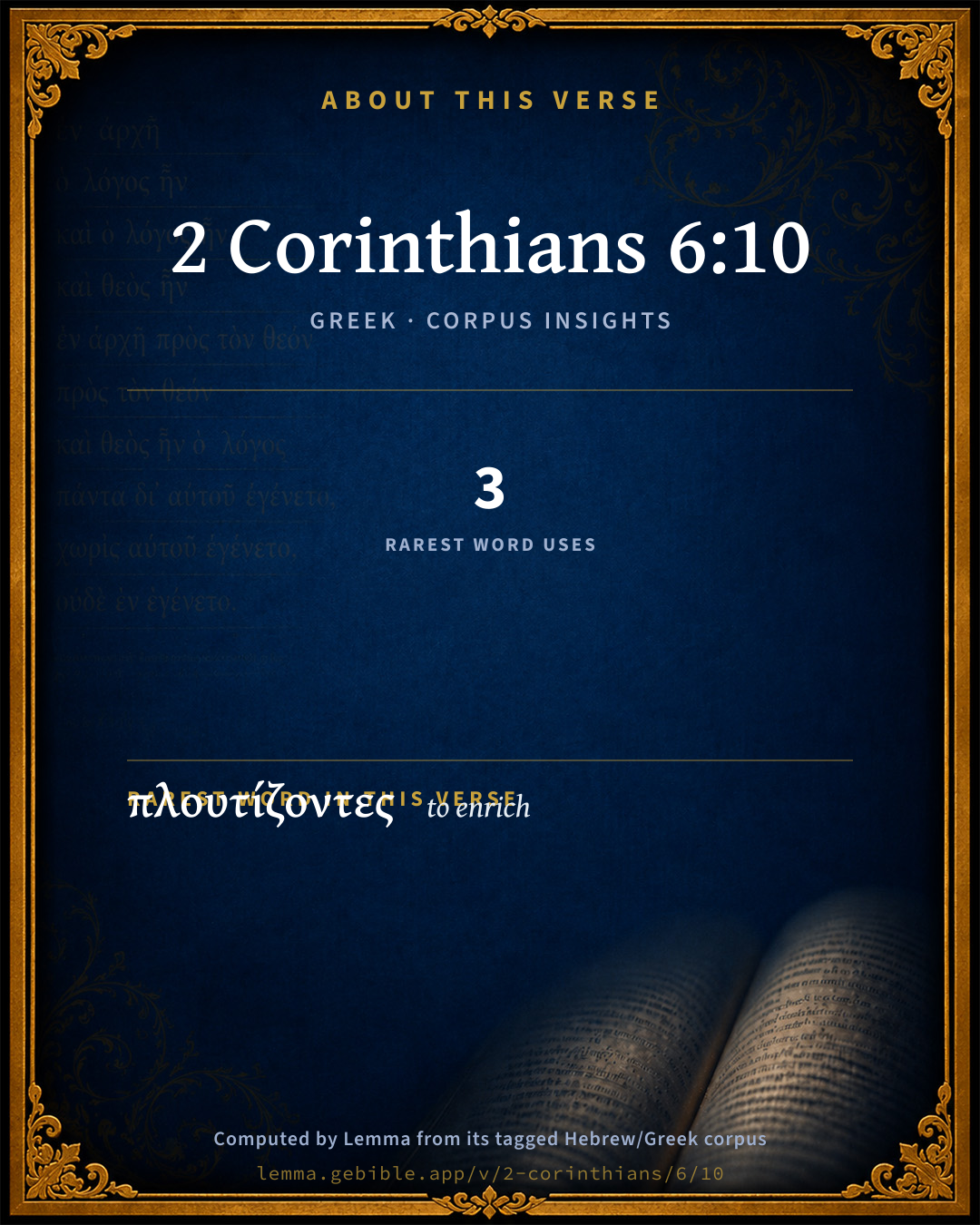
2 Corinthians, in the Pauline Epistles, opens this verse with 16 words (13 distinct Greek lemmas). Its most distinctive word is ploutízō (“to enrich”). A historical commentator’s framing appears above. Read the whole chapter for the surrounding context.
Discussion questions
- What does “to enrich” (ploutízō) contribute to the verse as a whole?
- How does 1 Corinthians 1:5, which shares the word «to enrich», read alongside this verse?
- What does the repetition of “as” (3× in this one verse) do in this verse?
- These translations render this verse differently; the difference is in the English rendering, not the original. What questions does that raise?
- Compare how Bengel's Gnomon and Expositor's Greek Testament read this verse. Where do they agree or differ?
Things to notice
- These translations choose different wording for 3 words in this verse.
- “as” occurs 3× in this single verse.
- 13 distinct Greek lemmas span 16 words in this verse.
Commentary
Notes on 2 Corinthians 6:10 from classic Christian and Jewish commentators (each source and its license shown beneath its notes). The classic Christian expositions comment on the surrounding passage and are grouped to its opening verse, so a note may address several verses; the Jewish commentaries on the Tanakh (Rashi and others) are per-verse, so they appear only where the commentator wrote on this verse.
Lemma curates 59 commentaries, every one of them public domain or Creative Commons licensed, each selected and text-cleaned for this edition rather than reprinted as found. About our sources →
Bengel's Gnomon
Johann Albrecht Bengel
Bengel's Gnomon of the New Testament — English translation (T&T Clark, Edinburgh, 1860) — public domain. Text from a community e-Sword module.
Expositor's Greek Testament
ed. W. Robertson Nicoll
The Expositor's Greek Testament, edited by W. Robertson Nicoll (1897–1910) — public domain. Text from a community e-Sword module.
Jamieson, Fausset & Brown
Robert Jamieson, A. R. Fausset & David Brown
Jamieson, Fausset & Brown — Commentary Critical and Explanatory on the Whole Bible (1871) — public domain (CC PDM 1.0). Text via the HelloAO Bible API.
Adam Clarke's Commentary
Adam Clarke's Commentary on the Bible (1810–1826) — public domain. Text from a community e-Sword/MySword module.
Ellicott's Commentary for English Readers
A Bible Commentary for English Readers, edited by Charles John Ellicott (1878–1897) — public domain. Text from a community e-Sword module.
The Cambridge Bible for Schools and Colleges
gen. ed. J. J. S. Perowne
The Cambridge Bible for Schools and Colleges (gen. ed. J. J. S. Perowne; Cambridge University Press, 1878–1918) — public domain. Text from a community e-Sword module.
John Gill's Exposition
John Gill's Exposition of the Whole Bible (1746–1763) — public domain (CC PDM 1.0). Text via the HelloAO Bible API.
Trapp's Complete Commentary
John Trapp
John Trapp, A Commentary or Exposition upon All the Books of the Old and New Testament (1647–1656) — public domain. Text from a community e-Sword module.
Albert Barnes' Notes on the Bible
Albert Barnes' Notes on the Bible (1834–1885) — public domain. Text from a community e-Sword/MySword module.
Matthew Poole's English Annotations
Matthew Poole's English Annotations on the Holy Bible (1683–1685) — public domain. Text from a community e-Sword/MySword module.
Whedon's Commentary on the Bible
Daniel D. Whedon
Daniel D. Whedon (gen. ed.), Commentary on the Old and New Testaments (1874–1909) — public domain. Text from a community e-Sword module.
The Pulpit Commentary
The Pulpit Commentary (1880–1919), ed. H.D.M. Spence-Jones & Joseph S. Exell — public domain. Text from a community e-Sword module.
John Wesley's Explanatory Notes
John Wesley, Explanatory Notes Upon the Whole Bible (1754–1765) — public domain. Text via the GEBible commentary corpus.
McGarvey & Pendleton's Commentaries
J. W. McGarvey
J. W. McGarvey (with Philip Y. Pendleton), Commentaries on the New Testament (The Fourfold Gospel, 1914; Acts; and the epistles) — public domain. Text from a community e-Sword/MySword module.
The People's New Testament
B. W. Johnson
B. W. Johnson's The People's New Testament with Notes (1889–1891) — public domain. Electronic text from the Christian Classics Ethereal Library (CCEL) ThML edition.
Cambridge Greek Testament for Schools and Colleges
Cambridge Greek Testament for Schools and Colleges (Cambridge University Press, 1896; 21 vols, various authors incl. Carr, Maclear, Plummer, Farrar, Lumby, Moule, M. R. James, Simcox) — public domain. Text from a community e-Sword module.
Alford’s Greek Testament
Henry Alford
Henry Alford, The Greek Testament (1849–1861) — public domain. Text from a community e-Sword module.
International Critical Commentary
International Critical Commentary — older volumes (1896–1929), various authors — public domain. Text from a community e-Sword module.
Vincent's Word Studies in the New Testament
Marvin R. Vincent
Marvin R. Vincent, Word Studies in the New Testament (1887–1900) — public domain. Text from a community e-Sword/MySword module.