2 Corinthians 10:15

Greek (Tischendorf 8th ed.) 2 Corinthians 10:15 appears in the Greek New Testament. The text above is from the Tischendorf 8th edition. Each word links to its Strong’s number and a concise gloss. Click any word for its full Thayer’s Greek Lexicon entry.
Download image
Cite this verse

2 Corinthians 10:15 (World English Bible). Public Domain. Lemma interlinear Bible study tool, https://lemma.gebible.app/v/2-corinthians/10/15.

Show BibTeX & RIS
BibTeX
RIS
English Translation
not boasting beyond proper limits in other men's labors, but having hope that as your faith grows, we will be abundantly enlarged by you in our sphere of influence,
World English Bible · Public Domain
Download a study sheet

One document with this verse’s original text, its word-by-word gloss line, the meaning frame, cross-references with their text, attributed commentary, and full source and license credits — printable, and it pastes into notes with its structure intact.

This verse Autodidact and up

Study sheet (.html) Plain text (.txt)

A passage Seminary Student

Up to 50 verses in one chapter. A passage sheet keeps up to 6 commentary sources and 12 cross-references per verse, in the order this page ranks them, and says so on the sheet whenever that leaves anything out. Ask for a single verse and you get the Autodidact verse sheet above.

Everything on this page stays free to read, with no account — the sheet is a download of what is already on screen, not access to it.

Want to remove ads? Support Godless Engineer
Compare translations 3

The same verse in 3 English versions, stacked beneath the original-language interlinear above. Click any original word for its lexicon entry.

Each is an independent rendering of the whole verse — the interlinear is not word-aligned to these translations.

Highlighted words mark where these versions differ — a whole-verse word diff, not a word-by-word alignment.

  • World English Bible Public Domain
    not boasting beyond proper limits in other men's labors, but having hope that as your faith grows, we will be abundantly enlarged by you in our sphere of influence,
  • King James Version Public Domain
    Not boasting of things without our measure, that is, of other men's labours; but having hope, when your faith is increased, that we shall be enlarged by you according to our rule abundantly,
  • unfoldingWord Literal Text CC BY-SA 4.0
    not boasting to the immeasurable things in the labors of others, but having hope, your faith increases, to be enlarged among you according to our limit to abundance

unfoldingWord Literal Text — © unfoldingWord, licensed CC BY-SA 4.0. Word-aligned USFM3 via Door43 (git.door43.org/unfoldingWord/en_ult).

Versions to compare (up to 4)

3 of 4 selected

Show all 19 translations

Every available English version of this verse, each an independent rendering of the whole verse.

  • World English Bible Public Domain
    not boasting beyond proper limits in other men's labors, but having hope that as your faith grows, we will be abundantly enlarged by you in our sphere of influence,
  • Berean Standard Bible Public Domain
    Neither do we boast beyond our limits in the labors of others. But we hope that as your faith increases, our area of influence among you will greatly increase as well,
  • Majority Standard Bible Public Domain
    Neither do we boast beyond our limits in the labors of others. But we hope that as your faith increases, our area of influence among you will greatly increase as well,
  • King James Version Public Domain
    Not boasting of things without our measure, that is, of other men's labours; but having hope, when your faith is increased, that we shall be enlarged by you according to our rule abundantly,
  • American Standard Version (1901) Public Domain
    not glorying beyond `our' measure, `that is,' in other men's labors; but having hope that, as your faith groweth, we shall be magnified in you according to our province unto `further' abundance,
  • Revised Version (1885) Public Domain
    not glorying beyond our measure, that is, in other men’s labours; but having hope that, as your faith groweth, we shall be magnified in you according to our province unto further abundance,
  • Geneva Bible (1599) Public Domain
    Not boasting of things which are without our measure: that is, of other mens labours: and we hope, when your faith shall increase, to bee magnified by you according to our line aboundantly,
  • Douay-Rheims (1899) Public Domain
    Not glorying beyond measure in other men's labours; but having hope of your increasing faith, to be magnified in you according to our rule abundantly;
  • Young's Literal Translation Public Domain
    not boasting of the things not measured, in other men's labours, and having hope -- your faith increasing -- in you to be enlarged, according to our line -- into abundance,
  • Literal Standard Version CC BY-SA 4.0
    not boasting of the things not measured, in other men’s labors, and having hope—your faith increasing—in you to be enlarged, according to our line—into abundance,
  • Unlocked Literal Bible CC BY-SA 4.0
    We have not boasted beyond limits about the labors of others. Instead, we expect that as your faith continues to grow, our work among you will greatly expand.
  • unfoldingWord Literal Text CC BY-SA 4.0
    not boasting to the immeasurable things in the labors of others, but having hope, your faith increases, to be enlarged among you according to our limit to abundance
  • Darby Bible Public Domain
    not boasting out of measure in other people's labours, but having hope, your faith increasing, to be enlarged amongst you, according to our rule, yet more abundantly
  • World Messianic Bible Public Domain
    not boasting beyond proper limits in other men’s labors, but having hope that as your faith grows, we will be abundantly enlarged by you in our sphere of influence,
  • Webster's Bible Public Domain
    Not boasting of things without our measure, that is, of other men's labors; but having hope, when your faith is increased, that we shall be enlarged by you, according to our rule abundantly,
  • Free Bible Version CC BY-SA 4.0
    We're not boasting in extravagant terms that can't be measured, claiming credit for what others have done. On the contrary, we hope that as your trust in God grows, our work among you will greatly increase.
  • Bible in Basic English Public Domain
    Not taking credit to ourselves for what is not our business, that is, for the work of others; but having hope that, with the growth of your faith, we may get the credit for an increase which is the effect of our work,
  • Text-Critical English NT CC BY 4.0
    We do not go beyond our limits by boasting in the labors of others. On the contrary, our hope is that, as your faith increases, our area of ministry among you will be greatly expanded,
  • Tyndale New Testament (1534) Public Domain
    and we bost not oure selves out of measure in other mens labours. Ye and we hope when youre fayth is increased amonge you to be magnified acordynge to oure measure more largely

Literal Standard Version (2020), Covenant Press — licensed CC BY-SA 4.0. Text via the HelloAO Bible API (eBible.org). Unlocked Literal Bible (unfoldingWord) — licensed CC BY-SA 4.0. Text via the HelloAO Bible API (eBible.org). unfoldingWord Literal Text — © unfoldingWord, licensed CC BY-SA 4.0. Word-aligned USFM3 via Door43 (git.door43.org/unfoldingWord/en_ult). Free Bible Version, Dr. Jonathan Gallagher — licensed CC BY-SA 4.0. Text via the HelloAO Bible API (eBible.org).

Word by word

More ways to search: Search by grammar → Find every occurrence → Compare this word →

Practice this passage: Drill this verse → Learn its vocabulary →

ἄμετρα
ámetros
G280
“immense”
Adjective, Accusative, Plural, Neuter
Part of Speech
Adjective
Case
Accusative
Number
Plural
Gender
Neuter
Full Thayer's Definition

Origin: from G1 (as a negative particle) and G3358

TDNT: 14:32,6

1. without measure, immense
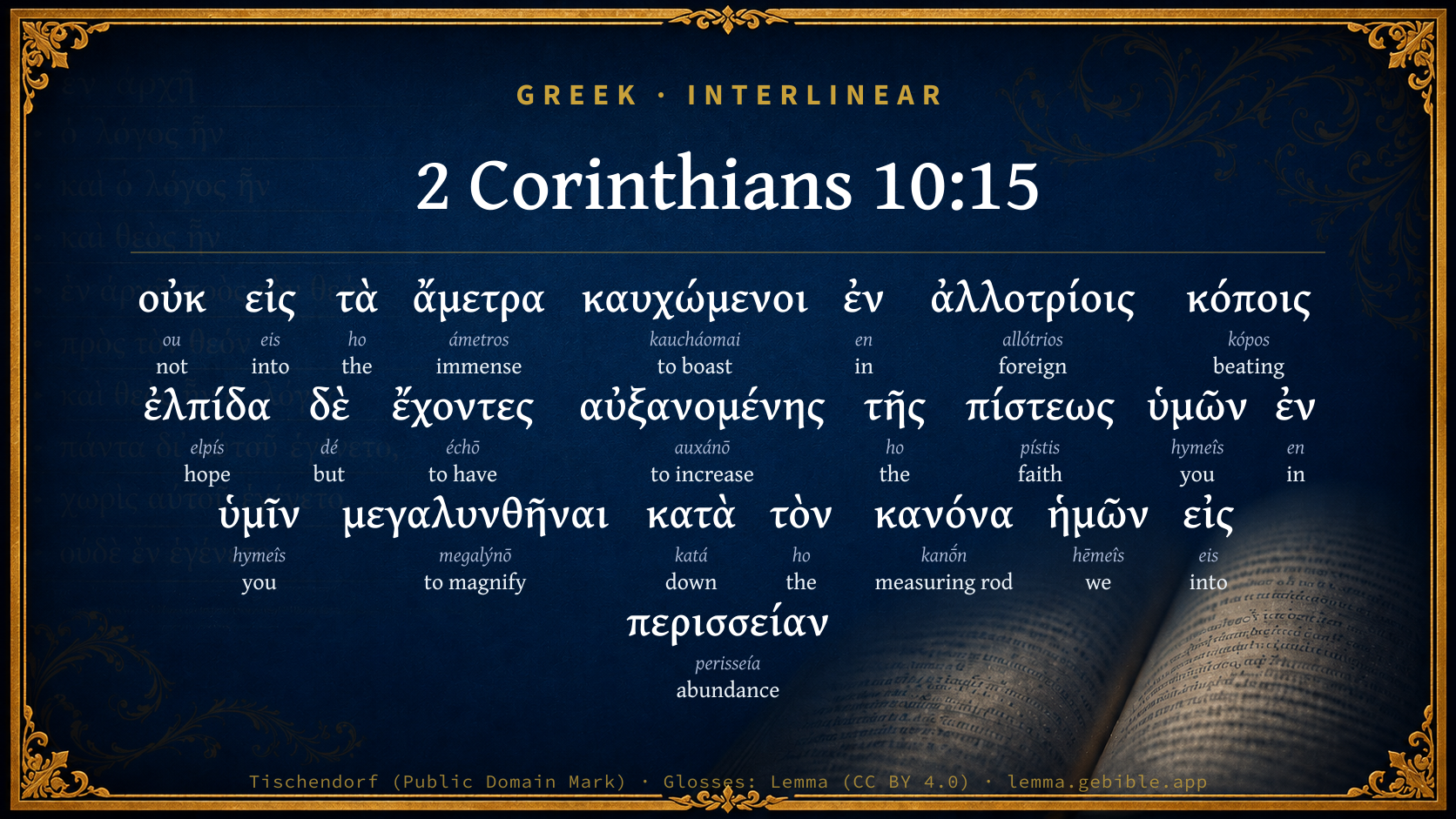
  1. οὐκ ou G3756 “not” Particle, Negative
  2. εἰς eis G1519 “into” Preposition
  3. τὰ ho G3588 “the” Article, Accusative, Plural, Neuter
  4. καυχώμενοι kaucháomai G2744 “to boast” Verb, Present, Middle or Passive deponent, Participle, Nominative, Plural, Masculine
  5. ἐν en G1722 “in” Preposition
  6. ἀλλοτρίοις allótrios G245 “foreign” Adjective, Dative, Plural, Masculine
  7. κόποις kópos G2873 “beating” Noun, Dative, Plural, Masculine
  8. ἐλπίδα elpís G1680 “hope” Noun, Accusative, Singular, Feminine
  9. δὲ dé G1161 “but” Conjunction
  10. ἔχοντες échō G2192 “to have” Verb, Present, Active, Participle, Nominative, Plural, Masculine
  11. αὐξανομένης auxánō G837 “to increase” Verb, Present, Passive, Participle, Genitive, Singular, Feminine
  12. τῆς ho G3588 “the” Article, Genitive, Singular, Feminine
  13. πίστεως pístis G4102 “faith” Noun, Genitive, Singular, Feminine
  14. ὑμῶν hymeîs G5210 “you” Personal pronoun, 2nd person, Genitive, Plural
  15. ἐν en G1722 “in” Preposition
  16. ὑμῖν hymeîs G5210 “you” Personal pronoun, 2nd person, Dative, Plural
  17. μεγαλυνθῆναι megalýnō G3170 “to magnify” Verb, Aorist, Passive, Infinitive
  18. κατὰ katá G2596 “down” Preposition
  19. τὸν ho G3588 “the” Article, Accusative, Singular, Masculine
  20. κανόνα kanṓn G2583 “measuring rod” Noun, Accusative, Singular, Masculine
  21. ἡμῶν hēmeîs G2249 “we” Personal pronoun, 1st person, Genitive, Plural
  22. εἰς eis G1519 “into” Preposition
  23. περισσείαν perisseía G4050 “abundance” Noun, Accusative, Singular, Feminine

About this verse

These counts appear in no published source. They are computed here, from the morphology-tagged text and Lemma’s own curated glosses. What Lemma adds →

24
words
19
distinct lemmas
Pauline Epistles
section

Notable vocabulary

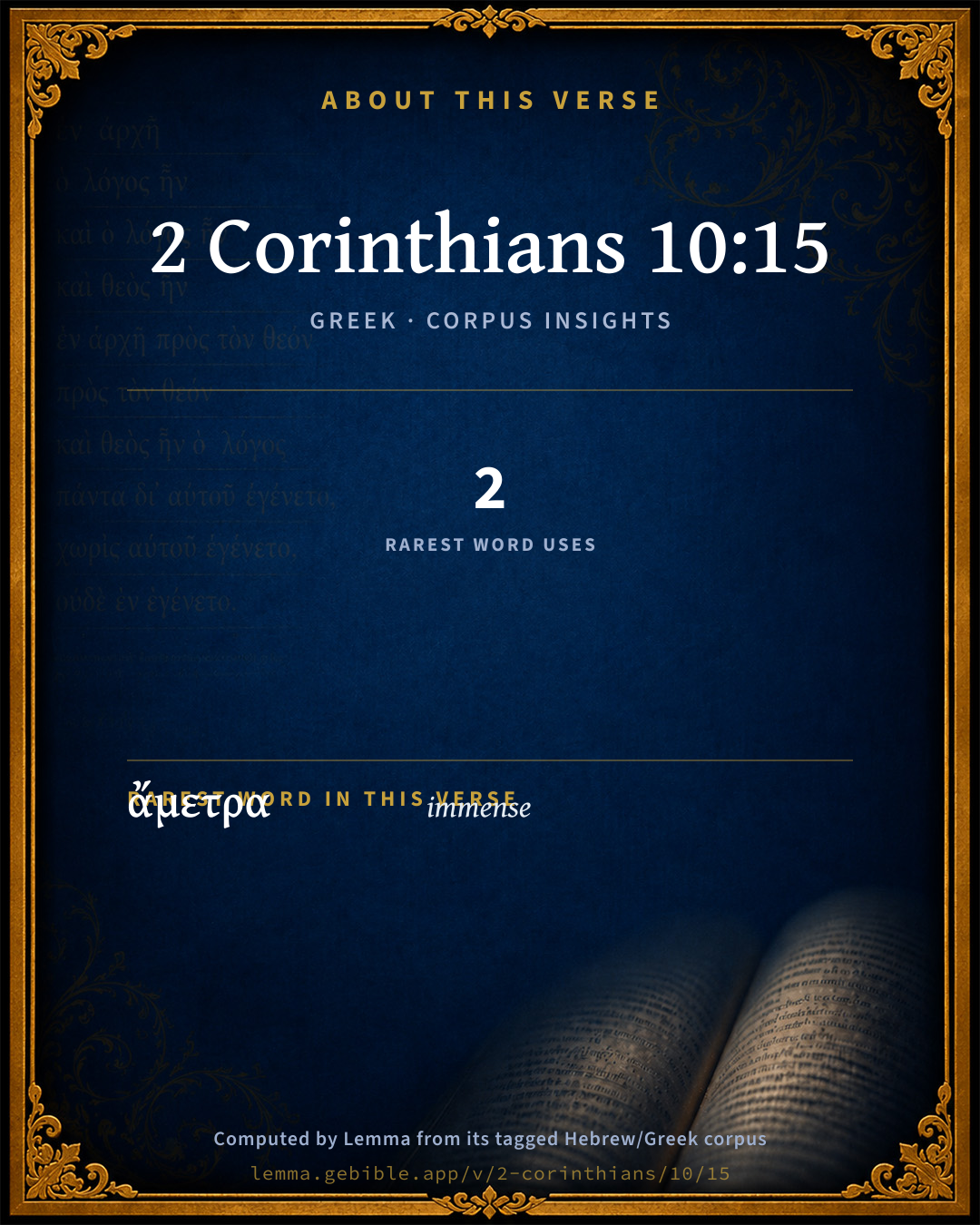
The rarest word here is ἄμετρα immense G280 — appearing just 2 times in the whole Greek New Testament.

Shared distinctive vocabulary

ἄμετρα immense G280 occurs in 2 verses of the Greek New Testament. Also found in:

Repetition

Words recur within this verse:

Cross-references

4

Topical passages linked to 2 Corinthians 10:15 in the Treasury of Scripture Knowledge — connected by theme and wording, ordered by reader-vote popularity; previews shown in the World English Bible.

  • Romans 15:20 yes, making it my aim to preach the Gospel, not where Christ was already named, that I might not build on another's foundation.
  • 2 Thessalonians 1:3 We are bound to always give thanks to God for you, brothers, even as it is appropriate, because your faith grows exceedingly, and the love of each and every one of you towards one another abounds;
  • 2 Corinthians 10:13 But we will not boast beyond proper limits, but within the boundaries with which God appointed to us, which reach even to you.
  • Acts 5:13 None of the rest dared to join them, however the people honored them.

Cross-references courtesy of OpenBible.info (CC BY 4.0).

Commentary

Notes on 2 Corinthians 10:15 from classic Christian and Jewish commentators (each source and its license shown beneath its notes). The classic Christian expositions comment on the surrounding passage and are grouped to its opening verse, so a note may address several verses; the Jewish commentaries on the Tanakh (Rashi and others) are per-verse, so they appear only where the commentator wrote on this verse.

Lemma curates 59 commentaries, every one of them public domain or Creative Commons licensed, each selected and text-cleaned for this edition rather than reprinted as found. About our sources →

Bengel's Gnomon

Johann Albrecht Bengel

2Co 10:15. Οὐκ εἰς, not in relation to) This is the beginning of the second member [See beginning of note 2Co 10:13], which, so far as the construction is concerned, is connected with the end of the first: comp. notes on Rom 8:1. We will not make an advance into any other man’s province, saying: These are mine.—αὐξανομένης, increasing) The present [as your faith is now increasing. But Engl. V. When your faith is increased]. Paul wished neither to leave the Corinthians before the proper time, nor to put off [preaching to] others too long.—ἐν ὑμῖν, in your case, [by you]) Our altogether solid and complete success in your case will give us an important step towards still farther successes.—μεγαλυνθῆναι—εὐαγγελίσασθαι) to be truly enlarged by preaching the Gospel [lit. So as to preach the Gospel]. To boast is in antithesis to both verbs conjointly, but especially to enlarged.—εἰς περισσείαν) abundantly.

Bengel's Gnomon of the New Testament — English translation (T&T Clark, Edinburgh, 1860) — public domain. Text from a community e-Sword module.

Meyer's Critical & Exegetical Commentary

Heinrich August Wilhelm Meyer

2Co_10:15. As οὐκ εἰς τὰ ἄμετρα καυχ. is evidently intended to resume the οὐχὶ εἰς τὰ ἄμετρα καυχ. in 2Co_10:13, and as 2Co_10:14 is merely a confirmatory statement occasioned by ἐφικέσθαι ἄχρι κ. ὑμῶν, it is most natural and logically most suitable, with Lachmann, Osiander, Ewald, to place the whole of 2Co_10:14 in a parenthesis (not the second half of the verse merely, as is done by Griesbach, Scholz, de Wette, Hofmann), so that καυχώμενοι depends on the καυχησόμεθα to be supplied in the second clause of 2Co_10:13, not on οὐ γὰρ … ὑπερεκτείν. ἑαυτούς (de Wette, Hofmann). To attach it, with Rückert (comp. Tischendorf), to ἐφθάσαμεν is quite unsuitable, because the latter contains an historical remark,only made, moreover, in passing,and thus heterogeneous elements would be combine.

ἐν ἀλλοτρίοις κόποις] object of the negatived εἰς τὰ ἄμετρα καυχᾶσθαι. With his opponents it was the case that their unmeasured boasting referred to labours which were done by others, but were boasted of by them as their work.

ἐλπίδα δὲ ἔχοντες] but having doubtless hope, when your faith increases, to become large among you according to our rule abundantly, i.e. but doubtless hoping, with the growth of your faith, to attain among you this, that starting from you we may be able still further abundantly to extend our working according to the measure of our destination. This meaning Paul expresses figuratively, and that with faithful adherence to the figure used in 2Co_10:13-14. He, namely, who can work far off, is a man of great stature, who without overstretching himself reaches afar; hence μεγαλυνθῆναι.[312] Further: because Paul still thinks of working forth to distances indefinitely remote, he hopes to become large εἰς περισσείαν (comp. Pro_21:5). Still he knows that this wide working, on which he cherishes the hope of being able to enter, will be in keeping with the line drawn for him by Godi.e. the spatial limit divinely appointed for himand thus will be no ὑπερεκτείνειν ἑαυτ.; hence κατὰ τὸν κανόνα ἡμῶν,[313] which Beza ought not to have taken for ἘΝ Τῷ ΚΑΝΌΝΙ ἩΜ. (comp. 2Co_10:13). Further: the possibility of this wider working will not set in, if the faith of the Corinthians does not grow, namely, intensively, by becoming always purer, firmer, and more living than now, because Paul will not sooner be able to leave Corinth and travel onward; hence αὐξανομ. τῆν πίστεως ὑμῶν,[314] so that thusand what a wholesome impulse ought this to be to themit is the Corinthians themselves, among whom he will see himself brought to the point of being able to extend his working further; hence ἐν ὑμῖν[315] μεγαλυνθ.: among you to become large in order to further abundant workin.

εἰς περισσείαν] for Paul knew that he was destined to preach the gospel among all nations (Rom_1:14-15, and see on Rom_15:23; Rom_15:33; Act_19:21); hence beyond doubt he had already at that time the intention of proceeding by way of Rome to Spain. Thus in μεγαλυνθῆναι … εἰς περισσείαν the whole grand feeling of his apostolic destiny finds earnest and true expression. Rückert, on the contrary, sees a touch of irony, as if Paul would say: if the Corinthians would become a church as perfect as he wishes and expects, there will thence accrue a gain also for him; he, too, will then grow with them, and become capable not only of doing in the midst of them what is necessary, but also of doing yet something more, of growing, as it were, beyond the proper stature, etc. But both κατὰ τὸν κανόνα ἡμῶν and εἰς περισσείαν are at variance with the character of irony. If Paul had wished to express himself ironically, he would have written possibly ἐν ὑμῖν μεγαλυνθῆναι ὀλίγον or the like, which would have expressed something different from what he properly meant.

[312] μεγαλ. is by most taken as celebrari, which departs from the figure and hence is at variance with the context (Luk_1:46; Act_5:13; Act_10:46; Act_19:17; Php_1:20). So Flatt, Billroth, and Ewald: to be exceedingly praised, instead of being bitterly blamed, to which κατὰ τ. κανόνα ἡμῶν is not suitable. The whole figure demands the explanation to become large (Mat_23:5; Luk_1:58), and only thus does it stand in its right relation to, and bearing on, αὐξανομ. τ. πιστ. ὑμ. Theodoret seems to have understood μεγαλ. rightly, since he explains it: περαιτέρω πορευθῆναι. Comp. Luther: proceed further, which explains the figurative expression no doubt, but does not translate it. Osiander understands under it an actual glorifying of the office,that its influence, greatness, and glory shall become advanced. Hofmann: that the continuation of the preaching in the far West will make him still greater, whereby he will have still more ground for boastinga view made impossible by the fact that ἐν ὑμῖν must be joined with μεγαλ. κ.τ.λ. With all such interpretations the bold, concrete figure, which is set forth in μεγαλυνθ., isin opposition to the connectionabandoned according to a subjective standard of taste, as if it were too strong and harsh. Erasmus in his Annot. (not in the Paraphr.) aptly says: Significat se sperare futurum ut in dies crescente fide Corinthiorum creseat et ipse et major majorque fiat.

[313] Rückert, at variance with the context, understands under κανών here the apostles rule of not working where others had already wrought. See against this, ver. 13.

[314] Bengel rightly remarks on the present participle: Paulus Corinthios neque ante tempus omittere voluit, neque alios diutius differre. Olshausen erroneously thinks that Paul was waiting for the completion of faith among the Corinthians. The apostle rather means the proportionate increase of the faith of the readers, which hitherto had not attained such a degree of development as to make it possible for him to withdraw his working from them and extend the sphere of his activity further. This delicate reference of αὐξανομ. τ. πίστ. ὑμῶν, which appeals to the whole sense of honour in the readers, and according to which Paul makes his further working at a distance depend on their Christian progress, is missed by Hofmann, who explains αὐξανομ. κ.τ.λ. merely in the sense of coincidence in time (while faith grows). This is bound up with his incorrect joining of ἐν ὑμῖν with αὐξανομ. See the following note.

[315] This ἐν ὑμῖν is not, with Luther, Castalio, Beza, Mosheim, Billroth, de Wette, Hofmann, to be joined to αὐξανομ. (whereby either ὑμῶν or ἐν ὑμῖν at any rate, even with the meaning imported into it by Hofmann: within your own sphere, would seem very superfluous); nor yet is it to be taken as per vos (Erasmus, Grotius, Flatt), which only impairs the vividness and completeness of the figure, and in substance is already contained in αὐξανομ. τ. πίστ. ὑμ.

Meyer — Critical and Exegetical Commentary on the New Testament — English translation by Peter Christie, edited by Frederick Crombie (T&T Clark, 1880) — public domain. Text from a community e-Sword module.

Expositor's Greek Testament

ed. W. Robertson Nicoll

2Co 10:15 . οὐκ εἰς τὰ ἄμετρα κ . τ . λ .: not glorying beyond our measure (the argument is resumed from 2Co 10:13 ), that is, in other men’s labours . This he steadily avoided ( cf. Rom 15:20 ); even Rome itself was to be visited en route to Spain (Rom 15:24 ). But his Corinthian opponents were not so scrupulous about intruding into another man’s sphere (1Co 3:10 ; 1Co 4:15 ). ἐλπίδα δὲ ἔχ . κ . τ . λ .: but having hope that, as your faith groweth (see Eph 2:21 ; Eph 4:15 , Col 1:10 ; Col 2:19 . for intrans. use of αὐξάνειν , and cf. chap. 2Co 9:10 ), we shall be magnified in you ( cf. Act 5:13 ) according to our rule, i.e. , our “line,” our apportionment of Apostolic work, unto further abundance, so as , etc.

The Expositor's Greek Testament, edited by W. Robertson Nicoll (1897–1910) — public domain. Text from a community e-Sword module.

Geneva Bible (1599)

Geneva Bible translators

As though God had divided the whole world among the Apostles, to be husbanded.

Geneva Bible (1599) marginal notes — public domain. Text via Bolls.life.

Jamieson, Fausset & Brown

Robert Jamieson, A. R. Fausset & David Brown

"Not boasting to unmeasured bounds (that is, not exceeding our own bounds by boasting) of (literally, 'in') other men's labors."

when--"As your faith goes on increasing." The cause of his not yet reaching with the Gospel the regions beyond Corinth, was the weakness as yet of their faith. He desired not to leave the Corinthians before the proper time, and yet not to put off preaching to others too long.

enlarged by you--Greek, "in your case." Our success in your case will give us an important step towards further progress beyond you (Co2 10:16).

according to our rule--according to our divinely assigned apportionment of the area or sphere of our work; for "we stretch not ourselves beyond our measure" (Co2 10:14).

abundantly--Greek, "unto exceeding abundance": so as to exceed the limits we have yet reached (Co2 10:16).

Jamieson, Fausset & Brown — Commentary Critical and Explanatory on the Whole Bible (1871) — public domain (CC PDM 1.0). Text via the HelloAO Bible API.

Adam Clarke's Commentary

Verse 15. Not boasting of things without our measure] We speak only of the work which God has done by us; for we have never attempted to enter into other men's labours, and we study to convert those regions assigned to us by the Holy Spirit. We enter the course lawfully, and run according to rule. See above.

When your faith is increased] When you receive more of the life and power of godliness, and when you can better spare me to go to other places.

We shall be enlarged by you] μεγαλυνθηναι probably signifies here to be praised or commended; and the sense would be this; We hope that shortly, on your gaining an increase of true religion, after your long distractions and divisions, you will plainly see that we are the true messengers of God to you, and that in all your intercourse with your neighbours, or foreign parts, you will speak of this Gospel preached by us as a glorious system of saving truth; and that, in consequence, the heathen countries around you will be the better prepared to receive our message; and thus our rule or district will be abundantly extended. This interpretation agrees well with the following verse.

Adam Clarke's Commentary on the Bible (1810–1826) — public domain. Text from a community e-Sword/MySword module.

John Calvin's Commentaries

15. In the labors of others. He now reproves more freely the false Apostles, who, while they had put forth their hand in the reaping of another man’s harvest, had the audacity at the same time to revile those, who had prepared a place for them at the expense of sweat and toil. Paul had built up the Church of the Corinthians — not without the greatest struggle, and innumerable difficulties. Those persons afterwards come forward, and find the road made and the gate open. That they may appear persons of consequence, they impudently claim for themselves what did not of right belong to them, and disparage Paul’s labors.

But having hope. He again indirectly reproves the Corinthians, because they had stood in the way of his making greater progress in advancing the gospel. For when he says that he hopes that, when their faith is increased the boundaries of his glowing will be enlarged, he intimates, that the weakness of faith under which they labored was the reason, why his career had been somewhat retarded. “I ought now to have been employed in gaining over new Churches, and that too with your assistance, if you had made as much proficiency as you ought to have done; but now you retard me by your infirmity. I hope, however, that the Lord will grant, that greater progress will be made by you in future, and that in this way the glory of my ministry will be increased according to the rule of the divine calling.” To glory in things that have been prepared is equivalent to glorying in the labors of others; for, while Paul had fought the battle, they enjoyed the triumph.

John Calvin's Commentaries (1540-1563) — public domain. Text from the Calvin Translation Society English edition (1840s-50s) via the Christian Classics Ethereal Library (ccel.org). Calvin's coverage is partial (roughly two-thirds of the Bible); uncommented books and verses are honest gaps, never fabricated. The 19th-century editor's footnotes and remarks are omitted so the notes are faithfully Calvin's own voice.

Ellicott's Commentary for English Readers

(15) Not boasting of things without our measure . . .—The words are not merely defensive. He presses home the charge of intrusion. They, not he, were finding ground for their boasts in other men’s labours. The context leads, however, to the conclusion that it was a charge that had been brought against him. They had spoken of him as pushing on from point to point, as with a measureless ambition. Perhaps the fact that he had worked at Antioch, where the gospel had been preached by men of Cyprus and Cyrene (Act_11:20), at Troas, where it had been preached by St. Luke (see Notes on 2Co_2:12; Act_16:8), to the Romans whom he found at Corinth, and who, like Aquila and Priscilla, had been already converted (see Notes on Act_18:2), were thought to give a colour to the charge that he was boasting in other men’s labours.

Having hope, when your faith is increased.—The verb is in the present tense, and should be translated, as your faith grows. The words are spoken in the spirit of one—

“Nil actum reputans si quid superesset agendum”

[“Who thinks nought done while aught remains to do”]—

who seeks for fresh provinces to annex to the territory of his king. The growth of their faith will give him fresh courage, perhaps also fresh resources. But what does he mean by his “hope that we shall be enlarged according to” (or, perhaps, in relation to) “our rule”? The words seem to imply something more than a mere extension of labours, and suggest the probability that in his journey to Jerusalem, with the large and liberal gifts of the Gentile churches, he had an intention, here half-avowed, to endeavour to modify the terms of the concordat referred to in Gal_2:9, and to get the sanction of the Church of Jerusalem for his mission work at Rome: though there the gospel had been preached by others, and it was, primarily, at least, one of the Churches of the Circumcision. It will be seen that this supposition explains better than any other the apologetic tone of Rom_15:20-29. It was his reluctance even to appear to build on another man’s foundation that had hitherto kept him from them. He does not intend to appear, when he comes, in the character of the founder of this Church, or even as building the superstructure, but only as a friend, seeking mutual help and counsel. Spain is his goal. He takes Rome as a parenthesis. But he is going to Jerusalem, and he hopes that the difficulty which has hitherto hindered him will be removed.

A Bible Commentary for English Readers, edited by Charles John Ellicott (1878–1897) — public domain. Text from a community e-Sword module.

The Cambridge Bible for Schools and Colleges

gen. ed. J. J. S. Perowne

15. not boasting of things without our measure] The Apostle now repeats what he has before said in 2Co_10:13, but directs his remarks more pointedly against the false teachers by adding ‘in other men’s labours.’ For they, as Meyer remarks, were adorning themselves with strange feathers as they intruded themselves into other men’s spheres of work. See also for St Paul’s line of conduct Rom_15:20, Gal_2:9.

when your faith is increased] Two reasons may be assigned for this reservation; (1) that as we have seen (ch. 2Co_2:12-13), St Paul could not settle himself to any other work while the Corinthian Church was in such an unsatisfactory condition, and (2) that the consistent conduct of one Christian community was an immense help to the first missionaries of the Gospel in founding another. See Tit_2:8; 1Pe_2:12.

enlarged] The Apostle seems to identify himself with his work as he has before identified himself with the Corinthian Church. See ch. 2Co_3:2, 2Co_7:3. He is enlarged when the Church is enlarged by his means.

by you] Literally, in or among you. Some connect these words with ‘when your faith is increased,’ i.e. among yourselves.

abundantly] Literally, unto superabundance.

The Cambridge Bible for Schools and Colleges (gen. ed. J. J. S. Perowne; Cambridge University Press, 1878–1918) — public domain. Text from a community e-Sword module.

John Gill's Exposition

But he that glorieth, let him glory in the Lord. Not in himself, nor in his outward circumstances of life, or inward endowments of mind; not in his natural or acquired parts; not in his wisdom, knowledge, learning, and eloquence; nor in his own righteousness, labours, and services, much less in other men's labours; nor in his own sense of himself; nor in the opinion and popular applause of others; but in the Lord Jesus Christ, as the author and donor of all gifts, natural and spiritual; in his wisdom, righteousness, sanctification, and redemption; and in his judgment and approbation of men and things, which sense the following words direct unto.

2 Corinthians 10:18

John Gill's Exposition of the Whole Bible (1746–1763) — public domain (CC PDM 1.0). Text via the HelloAO Bible API.

Trapp's Complete Commentary

John Trapp

15 Not boasting of things without our measure, that is, of other men’s labours; but having hope, when your faith is increased, that we shall be enlarged by you according to our rule abundantly,

Ver. 15. Not boasting of things] Ammianus Marcellinus tells of one Lampadius, a great person in Rome, who through all parts of the city, where other men had bestowed cost in building, he would set up his own name, not as a repairer of the work, but as the chief builder. Of the same fault Trajan the emperor is said to have been guilty; whence he was commonly called Herba parietina, or Wall Wort.

John Trapp, A Commentary or Exposition upon All the Books of the Old and New Testament (1647–1656) — public domain. Text from a community e-Sword module.

Albert Barnes' Notes on the Bible

Not boasting of things without our measure - There is here probably an allusion to the false teachers at Corinth. They had come after Paul had been there, and had entered into his labors. When he had founded the church; when he had endured trials and persecutions in order to reach Corinth; when he had labored there for a year and a half Act 18:11, they came and entered the quiet and easy field, formed parties. and claimed the field as their own. Paul says that he had not courage to do that; see note, 2Co 10:12. That required a species of boldness to which he could lay no claim; and he did not assume honor to himself like that.

That is, of other men’s labors - Not intruding into churches which we did not establish, and claiming the right to direct their affairs, and to exclude the founders from all proper honors and all influence, and endeavoring to alienate the affections of Christians from their spiritual father and guide.

But having hope ... - So far from this; so far from a desire to enter into the labors of others and quietly enjoying the avails of their industry; and so far even from a desire to sit down ourselves and enjoy the fruit of our own labors, I desire to penetrate other untrodden regions; to encounter new dangers; to go where the gospel has not been planted, and to rear other churches there. I do not, therefore, make these remarks as if I wished even to dispossess the teachers that have entered into my labors. I make them because I wish to be aided by you in extending the gospel further; and I look to your assistance in order that I may have the means of going into the regions where I have not made known the name of the Redeemer.

When your faith is increased - When you become so strong as not to need my presence and my constant care; and when you shall be able to speed me on my way and to aid me on my journey. He expected to be assisted by them in his efforts to carry the gospel to other countries.

That we shall be enlarged - Margin, “Magnified by you.” Bloomfield supposes that this means. “to gain fame and glory by you;” that is, as the teacher may justly by his pupils. So Robinson renders it. “to make great, to praise.” But to me the idea seems to be that he wished them to enlarge or magnify him by introducing him to larger fields of action; by giving him a wider sphere of labor. It was not that he wished to be magnified by obtaining a wider reputation, not as a matter of praise or ambition, but he wished to have his work and success greatly enlarged. This he hoped to be enabled to do partly by the aid of the church at Corinth. When they became able to manage their own affairs; when his time was not demanded to superintend them; when their faith became so strong that his presence was not needed; and when they should assist him in his preparations for travel, then he would enter on his wider field of labor. He had no intention of sitting down in ease as the false teachers in Corinth seem disposed to have done.

According to our rule - Greek, “According our canon;” see on 2Co 10:13. The sense is, according to the rule by which the sphere of his labors had been marked out. His rule was to carry the gospel as far as possible to the pagan world. He regarded the regions lying far beyond Corinth as coming properly within his limits; and he desired to occupy that field.

Abundantly - Greek, Unto abundance. So as to abound; that is, to occupy the field assigned as far as possible.

Albert Barnes' Notes on the Bible (1834–1885) — public domain. Text from a community e-Sword/MySword module.

Haydock's Catholic Bible Commentary

In these three following chapters, St. Paul, for the common good of those whom he had converted, and to obviate the prejudice raised by his adversaries against his person and preaching, is forced to set in a true light his apostolical authority, the favours he had received from God, his actions, his labours, and his sufferings, with an apology for mentioning them, giving all the glory to God. (Witham)

===============================

[BIBLIOGRAPHY]

Non in immensum, Greek: ouk eis ta ametra, non in non mensurata.

====================

George Leo Haydock (1774–1849), Haydock's Catholic Family Bible and Commentary, 1859 edition — public domain. Excludes Psalms (Douay-Rheims chapter numbering differs from Protestant) and Deuterocanonical books (Catholic canon only).

Matthew Poole's English Annotations

So that although we have boasted of you, we have not boasted

of things without our measure; that is, of things that are not, or (as the apostle expounds himself) of things that were not done by him but by other men; for his line did reach unto them, and his labours had been employed and made successful amongst them. And he declares his hope, that when the gospel should have had its full success amongst them, and their

faith should be increased, ( either by the addition of more persons to the church amongst them, or by the perfecting of their faith, and other graces), they, who were apostles and the ministers of the gospel to them, should by it be magnified, or made great; to wit, by their means, who using much navigation, would have opportunities to comment the gospel, and the ministry of it, to other people, amongst whom they should come: wherein yet they should not exceed their rule; for though ordinary ministers be fixed in particular churches and places, yet the apostles’ rule was to go and preach the gospel over the whole world, being tied to no certain people or places.

Matthew Poole's English Annotations on the Holy Bible (1683–1685) — public domain. Text from a community e-Sword/MySword module.

Whedon's Commentary on the Bible

Daniel D. Whedon

15. Without… measure—Indefinite and unruled.

Other men’s labours— Trenching on other missionaries’ ground, and taking an easy time, when there is ample pioneer work to do on untried fields.

Having a hope—Kling subtly and truly says, that having a hope is more forcible than hoping. There dwells in the apostle’s heart this constant, permanent hope. A blessed inmate in the human heart is a hope.

Enlarged—Our magnitude is now pretty fair; but we hope to grow with your growing faith.

According to our rule—In accordance with the divine measuring rule.

Abundantly—As his magnifying is not to be merely for himself, but for the gospel, he trusts it may be done abundantly.

Daniel D. Whedon (gen. ed.), Commentary on the Old and New Testaments (1874–1909) — public domain. Text from a community e-Sword module.

The Pulpit Commentary

That is, of other men"s labours. Not to thrust himself obtrusively into spheres of labour which legitimately belonged to others was a part of St. Paul"s scrupulously chivalrous rule (Gal_2:9; Rom_15:20) It contrasted with the usurping arrogance of these Jerusalem emissaries. When your faith is increased; rather, increases or grows. He delicately implies that their lack of faith prevents the extension of his labours. He could not leave in his rear an unstormed fortress of opposition to the gospel. The spread of the gospel depends on them. We shall be enlarged by you according to our rule abundantly. The Revised Version renders it more clearly, "We shall be magnified in you according to our province unto further abundance."

The Pulpit Commentary (1880–1919), ed. H.D.M. Spence-Jones & Joseph S. Exell — public domain. Text from a community e-Sword module.

John Wesley's Explanatory Notes

Having hope, now your faith is increased - So that you can the better spare us. To be enlarged by you abundantly - That is, enabled by you to go still further.

John Wesley, Explanatory Notes Upon the Whole Bible (1754–1765) — public domain. Text via the GEBible commentary corpus.

Burkitt's Expository Notes on the New Testament

William Burkitt

Here the apostle tells the Corinthians, that he would not boast of other men’s labours, nor pretend any title to those Christians at Corinth, nor any where else, whom others had converted, as the false apostles did: Notwithstanding he declares his hope, that when the gospel should have an eminent success amongst them, and thereby their faith be increased, that the increase of their faith would increase his joy and comfort, his present advantage and future reward; because it was the fruit and increase of the seed which he had himself sown amongst them. The apostle also doth farther declare his hopes, that he should preach the gospel beyond Corinth, in the regions of Achaia, where it had not been preached before; he being unwilling to enter upon other men’s labours.

Here note, That though ordinary ministers are fixed in particular places, and confined to particular churches, yet the apostles had a commission to go into all places, and preach the gospel over the whole world, and were tied to no certain place or people.

Note farther, That the apostle seems to prefer an instrumentality in the work of conversion, before being instrumental in the work of edification. The false apostles could only pretend to build upon other men’s foundations, and carry on a work by others made ready to their hands: But the apostle preferred preaching the gospel where Christ had never been heard of, as being unwilling to build upon another’s foundation, or to boast of another man’s line. It is a special favour now vouchsafed by God to us his ministers, if he puts the honour upon us, to make us instruments in his hands, either for conversion, or edification, either for bringing home, or building up a people.

Happy we, if when our predecessors have laboured before us, we enter into their labour, and see the seed, which they sowed with a laborious hand, flourishing in the lives of our people, to the joy of our hearts. Ere long, both he that sowed, and he that reapeth, shall rejoice together.

William Burkitt's Expository Notes on the New Testament (1700–1703) — public domain. Text from a community e-Sword module.

McGarvey & Pendleton's Commentaries

J. W. McGarvey

not glorying beyond our measure, that is, in other men's labors; but having hope that, as your faith groweth, we shall be magnified in you according to our province unto further abundance ,

J. W. McGarvey (with Philip Y. Pendleton), Commentaries on the New Testament (The Fourfold Gospel, 1914; Acts; and the epistles) — public domain. Text from a community e-Sword/MySword module.

The People's New Testament

B. W. Johnson

15. Not boasting … of other men's labors. It was Paul's uniform course to preach where no one before him had preached the gospel. Having hope, etc. The passage expresses the hope that his success at Corinth and the support of the church will enable him to carry the gospel beyond. That city, at this time, was the western limit of his work. The thought is made clear by verse 16.

B. W. Johnson's The People's New Testament with Notes (1889–1891) — public domain. Electronic text from the Christian Classics Ethereal Library (CCEL) ThML edition.

unfoldingWord translationNotes

Door43 World Missions Community

have not boasted beyond limits

This is an idiom. See how similar words were translated in 2 Corinthians 10:13. AT: "have not boasted about things over which we have no authority" or "have not boasted only about things over which we have authority" (See: Idiom)

another's area

"an area God has assigned to someone else"

translationWords

boast

labor

faith

works

hope

preach

good news

unfoldingWord translationNotes — © Distant Shores Media and the Door43 World Missions Community, licensed CC BY-SA 4.0. Source: git.door43.org/Door43/en_tn.

Cambridge Greek Testament for Schools and Colleges

15, 16. οὐκ εἰς τὰ ἄμετρα καυχώμενοι … εἰς τὰ ἕτοιμα καυχήσασθαι. A long and rather obscure sentence, which it is more simple to connect with 2Co 10:14 than with 2Co 10:13. There need not be more than a comma, and certainly should not be a full stop (A.V.), at the end of 2Co 10:14. Not glorying beyond our measure (as in 2Co 10:13) in other men’s labours, but having hope that, as your faith groweth, we shall be magnified in you, according to our province unto still greater abundance, so as to preach the Gospel unto the regions beyond you, and not to glory in another man’s province of things ready to our hand. Seeing that in coming to Corinth he has not come out of his own sphere into that of other people, he is not claiming what is really the work of others (comp. Rom 15:20); whereas his opponents, by setting themselves up as teachers in Corinth have been glorying in another man’s province of what he did and not they: quum Paulus militasset, illi triumphum agebant (Calvin). And he hopes that, as the Corinthians grow in faith, he will be magnified among them in his own sphere, so that his influence will extend, and he will be able to preach the Gospel beyond them with a recommendation. S. Paul may already have had thoughts of Rome and Spain (Rom 15:24; Rom 15:28). But he could not easily work still further westward, while Corinth was in so unsatisfactory a state; and hence the qualification αὐξανομένης τῆς πίστεως ὑμῶν. Their progress in the faith was necessary for the spread of the faith to others. It is possible to take ἐν ὑμῖν with αὐξανομένης (Luther, Calvin): but it has much more point if we take it with μεγαλυνθῆναι. It is in them and through them, that his powers are enlarged, if their faith increases. For μεγαλυνθῆναι ἐν comp. Php 1:20. For the thought comp. 2Co 3:2-3.

Dr Kennedy points out that εἰς τὰ ὑπερέκεινα ὑμῶν fits Rome and Spain much better, if we suppose that this is part of a letter written from Ephesus (whence the painful letter was written), than if we suppose it to be part of a letter written from Macedonia. To a person in Macedonia ‘the regions beyond Corinth’ would be in the South, not in the West. Neither in classical Greek, nor elsewhere in Biblical Greek, is ὑπερέκεινα found. It is perhaps colloquial for ἐπέκεινα, which is quite classical (Act 7:43 and LXX.). For καυχ. εἰς comp. διὰ τὸ καυχ. εἰς τὴν ἡλικίαν αὐτοῦ (Arist. Pol. v. x. 16).

Cambridge Greek Testament for Schools and Colleges (Cambridge University Press, 1896; 21 vols, various authors incl. Carr, Maclear, Plummer, Farrar, Lumby, Moule, M. R. James, Simcox) — public domain. Text from a community e-Sword module.

Alford’s Greek Testament

Henry Alford

15.] in apposition with οὐ γὰρ κ.τ.λ. ver. 14, and carrying out the thought. Not boasting without measure in other men’s labours (the element of the boasting), but having a hope if (or, as) your faith grows, to he enlarged (not as many Commentators, ‘celebrated:’ the metaphor of measure still remains) among you (so Chrys., Theophyl., Est., Meyer. ἐν ὑμ. is not to be joined with αὐξ., as Luth., Calv., Beza, Olsh., De W., in which case it would be superfluous) according to our rule (i.e. our apportionment of apostolic work, for we seek not ὑπερεκτείνειν ἑαυτούς) unto abundance (‘so as to abound more than we now do,’ viz. as ver. 16 explains),

Henry Alford, The Greek Testament (1849–1861) — public domain. Text from a community e-Sword module.

International Critical Commentary

15, 16. These verses are connected with v. 14 rather than with v. 13. The clumsiness of expression is due to dictation, in which the sentence has become unduly prolonged. The Judaizing teachers had intruded into his province and taken credit for what was his work, and he aims at showing that he himself has done nothing of the kind.

οὐκ εἰς τὰ ἄμετρα κ.τ.λ. ‘Not glorying beyond our measure in other men’s labours, but having hope that, as your faith grows, we shall be magnified in you according to our province unto still greater abundance, so as to preach the Gospel unto the regions beyond you, and not to glory in another man’s province in respect of things ready to our hand.’ At present Corinth is the Western limit of his sphere of missionary work. When the Corinthian Church is more firmly established, he hopes to extend his labours still farther into Europe.

15. ἐν ὑμῖν. The words are amphibolous, but they have more point if they are taken with μεγαλυνθῆναι. They are almost superfluous if taken with αὐξανομένης (Luther, Calvin); if their faith increases, it must increase in them and among them; but it is not superfluous to remind them that it lies in their power to make it quickly possible for him to extend his sphere of work. Both καυχώμενοι and ἔχοντες are participiabsoluta, of which St Paul makes freq. use. See on 8:20. With μεγαλυνδῆναι comp. Php 1:20, with περισσείαν, 8:2.

International Critical Commentary — older volumes (1896–1929), various authors — public domain. Text from a community e-Sword module.

Vincent's Word Studies in the New Testament

Marvin R. Vincent

Be enlarged by you - according to our rule abundantly [εν υμιν μεγαλυνθηναι - εις περισσειαν] . Paul means that, as the faith of the Corinthians increases, he hopes that his apostolic efficiency will increase, so that Corinth shall become the basis of larger efforts, extending into other regions. The verb megalunw also means to praise or celebrate, as Luk 1:46; Act 5:13; Act 10:46, and is so explained by some interpreters here. But this would be inconsistent with the figure, to which Paul adheres. "He who can work far off is a man of great stature, who, without overstretching himself, reaches afar" (Meyer).

According to our rule. His wider labors will still be regulated by God 's measuring - line.

Marvin R. Vincent, Word Studies in the New Testament (1887–1900) — public domain. Text from a community e-Sword/MySword module.

Lesson kit

Teaching starters — assembled from the data on this page, not authored interpretation. Every prompt links to the verse data it draws on. Edit before teaching.

2 Corinthians, in the Pauline Epistles, opens this verse with 24 words (19 distinct Greek lemmas). Its most distinctive word is ámetros (“immense”). A historical commentator’s framing appears above. Read the whole chapter for the surrounding context.

Discussion questions

  1. What does “immense” (ámetros) contribute to the verse as a whole?
  2. How does 2 Corinthians 10:13, which shares the word «immense», read alongside this verse?
  3. What does the repetition of “into” (2× in this one verse) do in this verse?
  4. The translations on this page render this verse differently — a whole-verse word diff, not a word-by-word alignment. What might account for the different wordings?
  5. Compare how Bengel's Gnomon and Meyer's Critical & Exegetical Commentary read this verse. Where do they agree or differ?

Things to notice

Reading settings

Reading text

Shown beneath each verse's original-language words.

Old Testament
Old Testament edition

Read the OT as the Masoretic Hebrew (MT) or the Greek Septuagint (LXX).

English shown for the Greek Septuagint (in the Hebrew ↔ Greek comparison).

Comparing translations? Open the Compare panel on any verse page to stack up to four side by side.