2 Corinthians 3:16

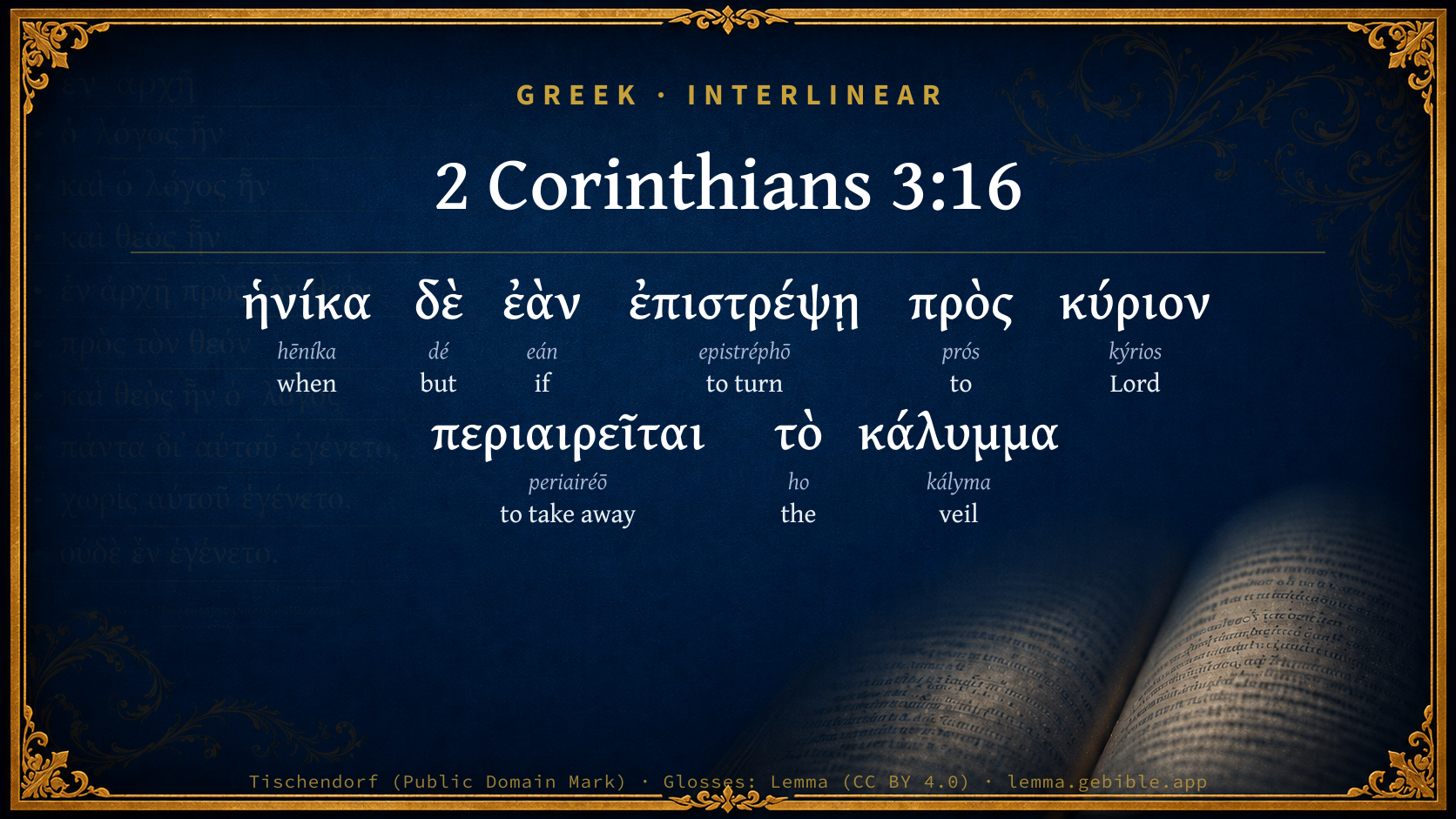
Greek (Tischendorf 8th ed.) 2 Corinthians 3:16 appears in the Greek New Testament. The text above is from the Tischendorf 8th edition. Each word links to its Strong’s number and a concise gloss. Click any word for its full Thayer’s Greek Lexicon entry.
Download image
Cite this verse

2 Corinthians 3:16 (World English Bible). Public Domain. Lemma interlinear Bible study tool, https://lemma.gebible.app/v/2-corinthians/3/16.

Show BibTeX & RIS
BibTeX
RIS
English Translation
But whenever one turns to the Lord, the veil is taken away.
World English Bible · Public Domain
Download a study sheet

One document with this verse’s original text, its word-by-word gloss line, the meaning frame, cross-references with their text, attributed commentary, and full source and license credits — printable, and it pastes into notes with its structure intact.

This verse Autodidact and up

Study sheet (.html) Plain text (.txt)

A passage Seminary Student

Up to 50 verses in one chapter. A passage sheet keeps up to 6 commentary sources and 12 cross-references per verse, in the order this page ranks them, and says so on the sheet whenever that leaves anything out. Ask for a single verse and you get the Autodidact verse sheet above.

Everything on this page stays free to read, with no account — the sheet is a download of what is already on screen, not access to it.

Want to remove ads? Support Godless Engineer
Compare translations 3

The same verse in 3 English versions, stacked beneath the original-language interlinear above. Click any original word for its lexicon entry.

Each is an independent rendering of the whole verse — the interlinear is not word-aligned to these translations.

Highlighted words mark where these versions differ — a whole-verse word diff, not a word-by-word alignment.

  • World English Bible Public Domain
    But whenever one turns to the Lord, the veil is taken away.
  • King James Version Public Domain
    Nevertheless when it shall turn to the Lord, the vail shall be taken away.
  • unfoldingWord Literal Text CC BY-SA 4.0
    but whenever one might turn to the Lord, the veil is taken away.

unfoldingWord Literal Text — © unfoldingWord, licensed CC BY-SA 4.0. Word-aligned USFM3 via Door43 (git.door43.org/unfoldingWord/en_ult).

Versions to compare (up to 4)

3 of 4 selected

Show all 19 translations

Every available English version of this verse, each an independent rendering of the whole verse.

  • World English Bible Public Domain
    But whenever one turns to the Lord, the veil is taken away.
  • Berean Standard Bible Public Domain
    But whenever anyone turns to the Lord, the veil is taken away.
  • Majority Standard Bible Public Domain
    But whenever anyone turns to the Lord, the veil is taken away.
  • King James Version Public Domain
    Nevertheless when it shall turn to the Lord, the vail shall be taken away.
  • American Standard Version (1901) Public Domain
    But whensoever it shall turn to the Lord, the veil is taken away.
  • Revised Version (1885) Public Domain
    But whensoever it shall turn to the Lord, the veil is taken away.
  • Geneva Bible (1599) Public Domain
    Neuertheles when their heart shall be turned to the Lord, the vaile shalbe taken away.
  • Douay-Rheims (1899) Public Domain
    But when they shall be converted to the Lord, the veil shall be taken away.
  • Young's Literal Translation Public Domain
    and whenever they may turn unto the Lord, the vail is taken away.
  • Literal Standard Version CC BY-SA 4.0
    and whenever they may turn to the LORD, the veil is taken away.
  • Unlocked Literal Bible CC BY-SA 4.0
    But when a person turns to the Lord, the veil is taken away.
  • unfoldingWord Literal Text CC BY-SA 4.0
    but whenever one might turn to the Lord, the veil is taken away.
  • Darby Bible Public Domain
    But when it shall turn to [the] Lord, the veil is taken away.)
  • World Messianic Bible Public Domain
    But whenever someone turns to the Lord, the veil is taken away.
  • Webster's Bible Public Domain
    Nevertheless, when it shall turn to the Lord, the vail shall be taken away.
  • Free Bible Version CC BY-SA 4.0
    But when they turn and accept the Lord, the veil is removed.
  • Bible in Basic English Public Domain
    But when it is turned to the Lord, the veil will be taken away.
  • Text-Critical English NT CC BY 4.0
    But whenever someone turns to the Lord, the veil is taken away.
  • Tyndale New Testament (1534) Public Domain
    Neverthelesse when they tourne to the Lorde the vayle shalbe taken awaye.

Literal Standard Version (2020), Covenant Press — licensed CC BY-SA 4.0. Text via the HelloAO Bible API (eBible.org). Unlocked Literal Bible (unfoldingWord) — licensed CC BY-SA 4.0. Text via the HelloAO Bible API (eBible.org). unfoldingWord Literal Text — © unfoldingWord, licensed CC BY-SA 4.0. Word-aligned USFM3 via Door43 (git.door43.org/unfoldingWord/en_ult). Free Bible Version, Dr. Jonathan Gallagher — licensed CC BY-SA 4.0. Text via the HelloAO Bible API (eBible.org).

Word by word

More ways to search: Search by grammar → Find every occurrence → Compare this word →

Practice this passage: Drill this verse → Learn its vocabulary →

About this verse

These counts appear in no published source. They are computed here, from the morphology-tagged text and Lemma’s own curated glosses. What Lemma adds →

9
words
9
distinct lemmas
Pauline Epistles
section

Notable vocabulary

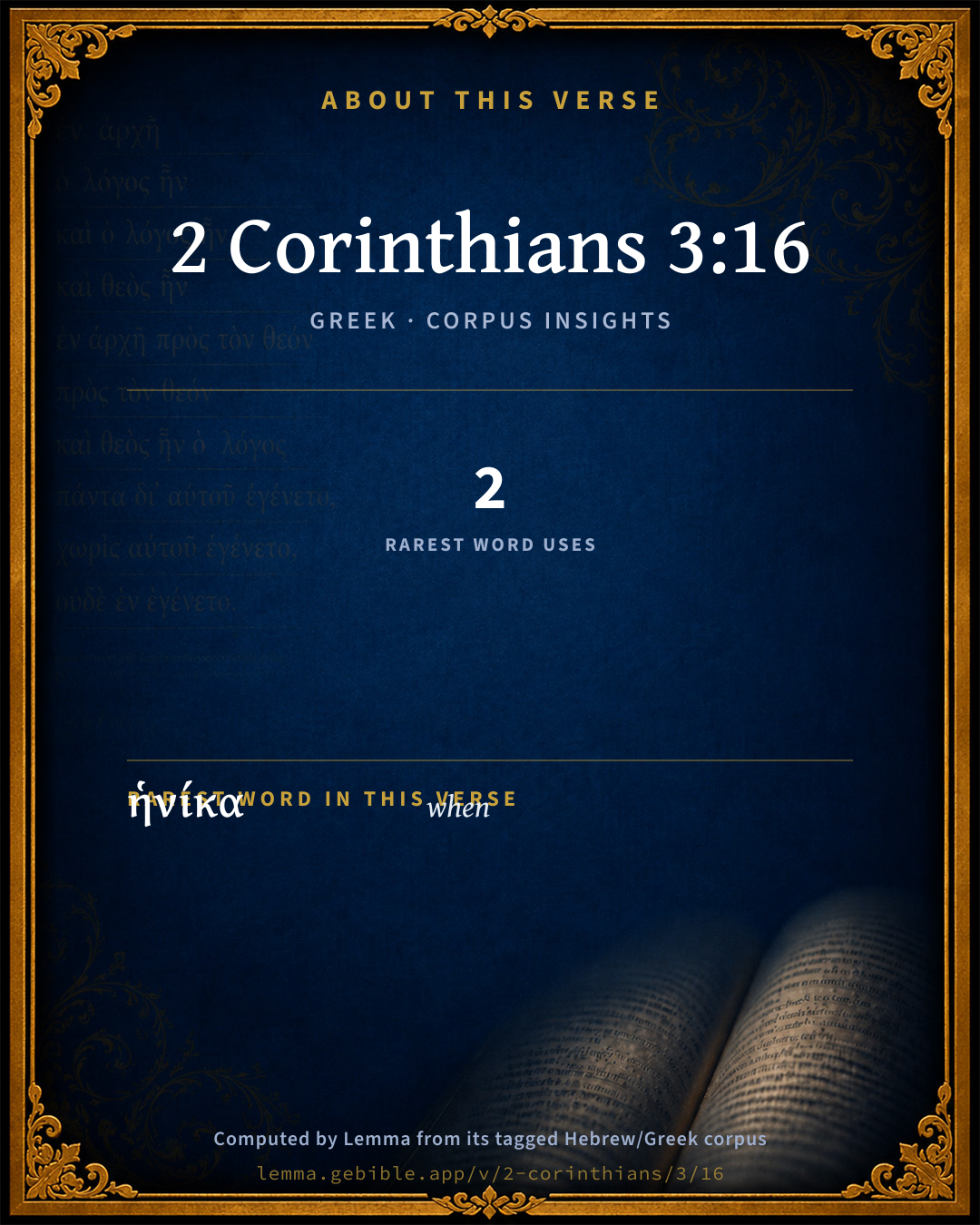
The rarest word here is ἡνίκα when G2259 — appearing just 2 times in the whole Greek New Testament.

Shared distinctive vocabulary

ἡνίκα when G2259 occurs in 2 verses of the Greek New Testament. Also found in:

Cross-references

12

Topical passages linked to 2 Corinthians 3:16 in the Treasury of Scripture Knowledge — connected by theme and wording, ordered by reader-vote popularity; previews shown in the World English Bible.

  • Exodus 34:34 But when Moses went in before Yahweh to speak with him, he took the veil off, until he came out; and he came out, and spoke to the children of Israel that which he was commanded.
  • Isaiah 25:7 He will destroy in this mountain the surface of the covering that covers all peoples, and the veil that is spread over all nations.
  • Isaiah 29:18 In that day shall the deaf hear the words of the book, and the eyes of the blind shall see out of obscurity and out of darkness.
  • John 6:45–46 It is written in the prophets, 'They will all be taught by God.' Therefore everyone who hears from the Father, and has learned, comes to me.
  • Jeremiah 31:34 and they shall teach no more every man his neighbor, and every man his brother, saying, Know Yahweh; for they shall all know me, from the least of them to the greatest of them, says Yahweh: for I will forgive their iniquity, and their sin will I remember no more.
  • Romans 11:23 They also, if they don't continue in their unbelief, will be grafted in, for God is able to graft them in again.
  • Romans 11:25–27 For I don't desire, brothers, to have you ignorant of this mystery, so that you won't be wise in your own conceits, that a partial hardening has happened to Israel, until the fullness of the Gentiles has come in,
  • Lamentations 3:40 Let us search and try our ways, and turn again to Yahweh.
  • Deuteronomy 4:30 When you are in oppression, and all these things are come on you, in the latter days you shall return to Yahweh your God, and listen to his voice:
  • Deuteronomy 30:10 if you shall obey the voice of Yahweh your God, to keep his commandments and his statutes which are written in this book of the law; if you turn to Yahweh your God with all your heart, and with all your soul.
  • Isaiah 54:13 All your children shall be taught of Yahweh; and great shall be the peace of your children.
  • Hosea 3:4–5 For the children of Israel shall abide many days without king, and without prince, and without sacrifice, and without sacred stone, and without ephod or idols.

Cross-references courtesy of OpenBible.info (CC BY 4.0).

Commentary

Notes on 2 Corinthians 3:16 from classic Christian and Jewish commentators (each source and its license shown beneath its notes). The classic Christian expositions comment on the surrounding passage and are grouped to its opening verse, so a note may address several verses; the Jewish commentaries on the Tanakh (Rashi and others) are per-verse, so they appear only where the commentator wrote on this verse.

Lemma curates 59 commentaries, every one of them public domain or Creative Commons licensed, each selected and text-cleaned for this edition rather than reprinted as found. About our sources →

Tyndale Open Study Notes

Tyndale Open Resources

3:16-18 The believer who turns to the Lord has freedom in the Spirit. We receive something Moses never knew as we become more and more like Christ (4:4; John 1:1-14; Col 1:15; Heb 1:1-4) and reflect the glory of the Lord. Divine glory in this present life leads to our being like Christ in the next life (Rom 8:29; Gal 4:19; Phil 3:21; 1 Jn 3:2).

Tyndale Open Study Notes — © Tyndale Open Resources, licensed CC BY-SA 4.0. Text via the HelloAO Bible API.

Bengel's Gnomon

Johann Albrecht Bengel

2Co 3:16. Ἡνίκα δʼ ἂν—περιαιρεῖται τὸ κάλυμμα, but when the veil is taken away) This is a paraphrase on Exo 34:34, ἡνίκα δʼ ἂν εἰσεπορεύετο Μωῦσης ἔναντι Κυρίου λαλεῖν αὐτῷ περιῃρεῖτο τὸ κάλυμμα. But when Moses went in before the Lord to speak to Him, the veil was taken away. Therefore ἡνίκα, meaning not if, but when, evidently affirms, as in the preceding verse, and frequently in the LXX., ἡνίκα ἐὰν, ἡνίκα ἂν, Gen 24:41; Gen 27:40; Exo 1:10; Exo 34:24; Lev 6:4; Lev 10:9; Deu 25:19. ἡνίκα δʼ ἂν, Exo 33:8; Exo 33:22; Exo 40:36.—ἐπιστρέψῃ, shall be turned) namely their heart. The truth is acknowledged by repentance, 2Ti 2:25. The method, not of disputation, but of conversion, is to be applied to the Jews.—πρὸς Κυρίον, to the Lord) Christ, 2Co 3:14. A distinguished appellation, 2Co 4:5.—περιαιρεῖτιαι) περιαιροῦμαι is passive, Act 27:20, and in the LXX., Lev 4:31; Lev 4:35; but middle very often in the LXX., and that too in the very passage to which Paul refers. The antithesis of 2Co 3:15-16 shows, however, that here the signification is passive. The veil lies [κεῖται, 2Co 3:15]; the veil is taken away. The present, is [that moment, and by that very fact] taken away, is emphatic [not as Engl. shall be taken away.]

Bengel's Gnomon of the New Testament — English translation (T&T Clark, Edinburgh, 1860) — public domain. Text from a community e-Sword module.

Meyer's Critical & Exegetical Commentary

Heinrich August Wilhelm Meyer

2Co_3:16. When, however, it shall have turned to the Lord, shall have come to believe on Christ, the veil, which lies on their heart (2Co_3:15), is taken away; i.e., when Moses is read before them, it will no longer remain unperceived by them that the Old Covenant ceases in Christ. The subject to ἐπιστρέψῃ is ἡ καρδία αὐτῶν, 2Co_3:15 (Luther in the gloss, Beza, Grotius, Bengel, and several others, including Billroth, Olshausen, de Wette, Hofmann), not ὁ Ἰσραήλ (Chrysostom, Theodoret, Theophylact, Pelagius, Erasmus, and many others, including Osiander), nor Μωϋσῆς (Calvin, Estius[173]), nor the general ΤΊς (Origen, Storr, Flatt).

The common supposition, that in 2Co_3:16 there is an allegorical reference to Moses, who, returning from the people to God, conversed unveiled with God (Exo_34:34), is in itself probable from the context, and is confirmed even by the choice of the words (Ex. l.c.: ἡνίκα δʼ ἂν εἰσεπορεύετο Μ. ἔναντι κυρίου … περιῃρεῖτο τὸ κάλυμμα), though the same veil with which Moses was veiled (ΤῸ ΑὐΤῸ ΚΆΛ., 2Co_3:14) is no longer spoken of, but a veil on the hearts of the Jew.

ἩΝΊΚΑ with ἌΝ and the subjunctive aorist[174] denotes: then, when it shall have turned (Luther wrongly: when it turned itself), and that as something conceived, thought of, not as an unconditioned fact. The πρὸς κύριον, however, does not affirm: to God, who is now revealed in the Lord (Hofmann), but, in simple accordance with ἐν Χριστῷ of 2Co_3:15 : to Christ. The conversion of Israel which Paul has in view is, now that it is wholly relegated to the experience of the future, the conversion as a whole, Rom_11:25. It was, however, obvious of itself that what is affirmed finds its application to all individual cases which had already occurred and were still to be expecte.

περιαιρ. has the emphasis, both of its important position at the head of the clause (removed is the veil) and of the future realized as present. The passive is all the more to be retained, seeing that the subject of ἐπιστρ. is the heart; the sense of self-liberation (Hofmann) may not be imported on account of Exo_34:34. The conversion and deliverance of Israel is Gods work. See 2Co_3:17 and Rom_11:26 f. The compound corresponds to the conception of the veil covering the heart round about. Comp. Plato, Polit. p. 288 E: δέρματα σωμάτων περιαιροῦσα, Dem. 125,26: ΠΕΡΙΕῖΛΕ ΤᾺ ΤΕΊΧΗ, 802, 5 : ΠΕΡΙῌΡΗΤΑΙ ΤΟῪς ΣΤΕΦΆΝΟΥς, Jdt_10:3 : ΤῸΝ ΣΆΚΚΟΝ, Bar_4:34; Bar_6:58; Act_27:40.

[173] Calvin thinks that Moses is here tantamount in meaning to the law, and that the sense is: When the law is referred to Christ, when Christ is sought in the law by the Jews, then will the truth dawn upon them. Estius, who refers κύριον to God, says: Moses conversus ad Dominmuatque retectam habens faciem, typum gessit populi Christiani ad Deum conversi et revelata cordis facie salutis mysteria contemplantis.

[174] See Ellendt, Lex. Soph. I. p. 773.

Meyer — Critical and Exegetical Commentary on the New Testament — English translation by Peter Christie, edited by Frederick Crombie (T&T Clark, 1880) — public domain. Text from a community e-Sword module.

Expositor's Greek Testament

ed. W. Robertson Nicoll

2Co 3:16 . ἡνίκα δʼ ἄν κ . τ . λ .: but whensoever it, i.e. , Israel, shall turn to the Lord, the veil is taken away ; a paraphrase of Exo 34:34 , ἡνίκα δʼ ἄν εἰσεπορεύετο Μωσῆς ἔναντι Κυρίου λαλεῖν αὐτῷ , περιῃρεῖτο τὸ κάλυμμα ἔως τοῦ ἐκπορεύεσθαι .

The Expositor's Greek Testament, edited by W. Robertson Nicoll (1897–1910) — public domain. Text from a community e-Sword module.

Jamieson, Fausset & Brown

Robert Jamieson, A. R. Fausset & David Brown

Moses took off the veil on entering into the presence of the Lord. So as to the Israelites whom Moses represents, "whensoever their heart (it) turns (not as English Version, 'shall turn') to the Lord, the veil is (by the very fact; not as English Version, 'shall be') taken away." Exo 34:34 is the allusion; not Exo 34:30-31, as ALFORD thinks. Whenever the Israelites turn to the Lord, who is the Spirit of the law, the veil is taken off their hearts in the presence of the Lord: as the literal veil was taken off by Moses in going before God: no longer resting on the dead letter, the veil, they by the Spirit commune with God and with the inner spirit of the Mosaic covenant (which answers to the glory of Moses' face unveiled in God's presence).

Jamieson, Fausset & Brown — Commentary Critical and Explanatory on the Whole Bible (1871) — public domain (CC PDM 1.0). Text via the HelloAO Bible API.

Adam Clarke's Commentary

Verse 16. When it shall turn to the Lord] When the Israelitish nation shall turn to the LORD Jesus, the veil shall be taken away; the true light shall shine; and they shall see all things clearly.

There is an evident allusion here to the case of Moses, mentioned Ex 34:34. When he came from the Lord, and spoke to the Israelites, he put the veil over his face; but when he returned to speak with the Lord, then he took off the veil. So, when the Israelitish nation shall return to speak with and pray to the Lord Jesus, the veil of darkness and ignorance shall be taken away from their hearts; but never before that time. The words seem to imply:

1. That there will be a conversion of the Jews to Christianity; and,

2. That this conversion will be en masse; that a time will come when the whole nation of the Jews, in every place, shall turn to Christ; and then the Gentiles and Jews make one fold, under one Shepherd and Bishop of all souls.

Adam Clarke's Commentary on the Bible (1810–1826) — public domain. Text from a community e-Sword/MySword module.

John Calvin's Commentaries

16. But when he shall have turned to the Lord. This passage has hitherto been badly rendered, for both Greek and Latin writers have thought that the word Israel was to be understood, whereas Paul is speaking of Moses. He had said, that a veil is upon the hearts of the Jews, when Moses is read. He immediately adds, As soon as he will have turned to the Lord, the veil will be taken away. Who does not see, that this is said of Moses, that is, of the law? For as Christ is the end of it, (Romans 10:4,) to which it ought to be referred, it was turned away in another direction, when the Jews shut out Christ from it. Hence, as in the law they wander into by-paths, so the law, too, becomes to them involved like a labyrinth, until it is brought to refer to its end, that is, Christ. If, accordingly, the Jews seek Christ in the law, the truth of God will be distinctly seen by them, but so long as they think to be wise without Christ, they will wander in darkness, and will never arrive at a right understanding of the law. Now what is said of the law applies to all Scripture — that where it is not taken as referring to Christ as its one aim, it is mistakingly twisted and perverted.

John Calvin's Commentaries (1540-1563) — public domain. Text from the Calvin Translation Society English edition (1840s-50s) via the Christian Classics Ethereal Library (ccel.org). Calvin's coverage is partial (roughly two-thirds of the Bible); uncommented books and verses are honest gaps, never fabricated. The 19th-century editor's footnotes and remarks are omitted so the notes are faithfully Calvin's own voice.

Ellicott's Commentary for English Readers

(16) Nevertheless when it shall turn to the Lord.—Better, But when it shall turn. The allegorising process is still carried on. Moses removed the veil when he went into the tabernacle to commune with the Lord (Exo_34:35); so, in the interpretation of the parable, the veil shall be taken away when the heart of Israel shall turn, in the might of a real conversion, to the Lord of Israel. The very word for “turn” is taken from the same context: “Moses called them, and Aaron and all the rulers of the congregation turned to him” (Exo_34:31).

A Bible Commentary for English Readers, edited by Charles John Ellicott (1878–1897) — public domain. Text from a community e-Sword module.

The Cambridge Bible for Schools and Colleges

gen. ed. J. J. S. Perowne

16. when it shall turn to the Lord] The A. V. makes (1) Israel’s heart the nominative to the verb in this sentence. Wiclif and the other Protestant translators (2) make Israel itself the nominative, while (3) the Rhemish version makes Moses the nominative, referring to the fact that in the narrative in Exodus 34 he is said in almost the same words as here, to remove the veil when he turns to God. Origen (4) would supply any one. Each rendering is defended by commentators of note, but the first seems preferable. Cf. Rom_11:23; Rom_11:26; Rom_11:32.

the vail shall be taken away] The tense in the original is present, not future, and may be interpreted, (1) with Bp. Wordsworth, ‘is in process of removal,’ or perhaps better, (2) with Dean Alford, is there and then removed, i.e. at the moment when the heart turns to the Lord, just as Moses took off the veil when he turned to speak to God. See also Isa_25:7. It is to be observed that these words are a quotation of the LXX. of Exo_34:34, substituting, however, the present for the past tense.

The Cambridge Bible for Schools and Colleges (gen. ed. J. J. S. Perowne; Cambridge University Press, 1878–1918) — public domain. Text from a community e-Sword module.

John Gill's Exposition

Nevertheless, when it shall turn to the Lord,.... The heart, upon which the veil now is; or the body of the Jewish nation, as in the latter day; when they "shall turn", or "be turned", by the Spirit, power, and grace of God, to the Lord Jesus Christ, and look upon him whom they have pierced, and mourn, and embrace him as the true Messiah and only Saviour:

the veil shall be taken away; the veil of blindness and ignorance, respecting themselves, case, state, and condition, and the way of salvation by Christ; the veil of unbelief, with regard to his person, offices, and grace, and of error in points of the greatest moment and importance; then all the darkness and obscurity that is upon the books of Moses and the prophets, and which is now upon their hearts in reading them, will be gone. The prophecies of the Old Testament will be seen in their proper light, and to be evidently fulfilled in Christ; the true nature, use, and end of the law, will be discovered; and both they and that will be freed from all darkness that now attends them. The Jews themselves acknowledge, that though the law is light, yet there is an obscurity in it, by reason of the several ways of interpreting it; and therefore,

"he that studies in it, has need to remove, , "veil after veil", which is upon the face of it, in order to come at the light of it (g):''

and intimate, that the veil on Moses's face was an emblem of this obscurity, which agrees with what the apostle hints in this context; and also own, that there is now upon them a veil of ignorance; and, say they (h), God has promised to remove, , perhaps it should be "the veil of folly off of our understanding", referring, as is thought, to Isa 25:7.

(g) R. Abraham Seba in Tzeror Hammor, fol. 90. 2. (h) Chobat Halebabot, par. 1. c. 3. apud L. Capell. in loc.

John Gill's Exposition of the Whole Bible (1746–1763) — public domain (CC PDM 1.0). Text via the HelloAO Bible API.

Trapp's Complete Commentary

John Trapp

16 Nevertheless when it shall turn to the Lord, the vail shall be taken away.

Ver. 16. When it shall turn] Of the Jews’ conversion, and what hinders it. {See Trapp on "Rom 11:7"} {See Trapp on "Rom 11:8"} {See Trapp on "Rom 11:25"}

John Trapp, A Commentary or Exposition upon All the Books of the Old and New Testament (1647–1656) — public domain. Text from a community e-Sword module.

Albert Barnes' Notes on the Bible

Nevertheless - This is not always to continue. The time is coming when they shall understand their own Scriptures, and see their true beauty.

When it shall turn to the Lord - When the Jewish people shall be converted. The word “it” here refers undoubtedly to “Israel” in 2Co 3:13; and the sense is, that their blindness is not always to remain; there is to be a period when they shall turn to God, and shall understand his promises, and become acquainted with the true nature of their own religion. This subject the apostle has discussed at much greater length in the eleventh chapter of the Epistle to the Romans; see the notes on that chapter.

The vail shall be taken away - They shall then understand the true meaning of the prophecies, and the true nature of their own institutions. They shall see that they refer to the Lord Jesus, the incarnate Son of God, and the true Messiah. The genuine sense of their sacred oracles shall break upon their view with full and irresistible light. There may be an allusion in the language here to the declaration in Isa 25:7, “And he will destroy in this mountain the face of the covering cast over all people, and the vail that is spread over all nations.” This verse teaches:

(1) That the time will come when the Jews shall be converted to Christianity; expressed here by their turning unto the Lord, that is, the Lord Jesus; see the note, Act 1:24.

(2) It seems to be implied that their conversion will be a conversion of “the people” at large; a conversion that shall be nearly simultaneous; a conversion “en masse.” Such a conversion we have reason to anticipate of the Jewish nation.

(3) The effect of this will be to make them acquainted with the true sense of their own Scriptures, and the light and beauty of the sayings of their own prophets, Now they are in deep darkness on the sub ject; then they will see how entirely they meet and harmonize in the Lord Jesus.

(4) The true and only way of having a correct and full meaning of the Bible is by turning unto God. Love to Him, and a disposition to do His will, is the best means of interpreting the Bible.

Albert Barnes' Notes on the Bible (1834–1885) — public domain. Text from a community e-Sword/MySword module.

Matthew Poole's English Annotations

When it shall turn, may be understood of the whole, or of the generality (at least) of the Jews; when they shall be converted to the faith of Christ, or when any particular person shall be converted to Christ, then

the veil shall be taken away; not the veil with which God covered and veiled the mysteries of the gospel, (that was already taken away upon Christ’s coming in the flesh), but the veil of blindness, which they had drawn over their own souls. Though the light of the gospel shineth clearly, and Christ be unveiled, yet until men, by a true faith, receive Christ, and turn from sinful courses to the obedience of the gospel, they see little or nothing of Christ. The taking away of this veil, and the turning to the Lord, are things done in souls at the same time; therefore nothing is to be concluded here, from the apostle’s naming the removal of the impediment, after the effect of which that is a cause.

Matthew Poole's English Annotations on the Holy Bible (1683–1685) — public domain. Text from a community e-Sword/MySword module.

Whedon's Commentary on the Bible

Daniel D. Whedon

16. Nevertheless—St. Paul relieves the dark view with a ray of light. As the vail was once upon Moses, so it is now on the Jewish heart; but as when Moses went in to the Lord the vail “was taken off,” (Exo_34:34,) so when the Jewish heart shall turn to the Lord, the vail shall be taken away.

Daniel D. Whedon (gen. ed.), Commentary on the Old and New Testaments (1874–1909) — public domain. Text from a community e-Sword module.

The Pulpit Commentary

When it shall turn to the Lord. The nominative of the verb is not expressed. Obviously the most natural word to supply is the one last alluded to, namely, "the heart of Israel." The verb may have been suggested by Exo_34:31. Shall be taken away; literally, is in course of removal. The tenses imply that "the moment the heart of Israel shall have turned to the Lord, the removal of the veil begins." Then "they shall look on him whom they pierced"; (Zec_12:10) "He will destroy in this mountain the face of the covering cast over all people, and the veil that is spread over all nations". (Isa_25:7)

The Pulpit Commentary (1880–1919), ed. H.D.M. Spence-Jones & Joseph S. Exell — public domain. Text from a community e-Sword module.

John Wesley's Explanatory Notes

When it - Their heart. Shall turn to the Lord - To Christ, by living faith. The veil is taken away - That very moment; and they see, with the utmost clearness, how all the types and prophecies of the law are fully accomplished in him.

John Wesley, Explanatory Notes Upon the Whole Bible (1754–1765) — public domain. Text via the GEBible commentary corpus.

McGarvey & Pendleton's Commentaries

J. W. McGarvey

But whensoever it shall turn to the Lord, the veil is taken away . [The word "end" in 2Co_3:13 is the bone of contention in this passage. It has two meanings: (1) The termination or stopping-point. (2) The purpose, design or ultimate result. Macknight, Alford and others give it the first meaning, and construe Paul as saying that Moses covered his face that the children of Israel might not see the termination of the glory, as it faded from his face. But this construction limits the typical concealment to the mere fact that the Mosaic dispensation was to pass away, and is not large enough for Paul's thought, as is shown by the context. Cameron, Barnes, etc., give it the second meaning, which we have embodied in the following paraphrase: "In dealing with the glory of our ministration we do not veil our meaning in types and shadows, as Moses showed that he did with his ministration, when he typically concealed the glory of his face by putting a veil upon it. He concealed the meaning of his ministration that the children of Israel should not look stedfastly on Christ, the end or fulfillment of that dispensation or law which was typically passing away in the fading glory of Moses' face (now, Christ is thus the end of Moses' law-- Rom_10:4 ); but the true hindrance was not the typical veil worn by Moses, but the real veil on the minds of the people, who were dull of understanding and sinfully hardened, so that from the very beginning they understood not his dispensation, nor do they yet, for even now when the law is read the great truth is not revealed to them that it is all done away, having ended in Christ. But unto this day, whensoever Moses is read, a veil is upon their heart, and they do not see that Moses preaches Christ. But whensoever the Jewish nation shall turn to the Lord, then the veil is taken away, and they see that the end or purpose of the law is to lead to Christ."-- Gal_3:24 ]

J. W. McGarvey (with Philip Y. Pendleton), Commentaries on the New Testament (The Fourfold Gospel, 1914; Acts; and the epistles) — public domain. Text from a community e-Sword/MySword module.

The People's New Testament

B. W. Johnson

16. When it shall turn to the Lord. The heart. Then the veil of blindness will fall away so that they will see clearly.

B. W. Johnson's The People's New Testament with Notes (1889–1891) — public domain. Electronic text from the Christian Classics Ethereal Library (CCEL) ThML edition.

Cambridge Greek Testament for Schools and Colleges

16. ἡνίκα δὲ ἐάν. But whensoever it shall turn to the Lord. The nominative is ἡ καρδία αὐτῶν, or possibly τις: ‘whensoever a man.’ The ἡνίκα here balances ἡνίκα in 2Co 3:15: whenever they hear the Law read, they fail to understand: whenever they turn to the Lord (Christ) the true meaning is revealed to them. He probably has Exo 34:34 in his mind; but περιῃρεῖτο becomes περιαιρεῖται, ‘he then and there removes.’ The verb is used of taking away what envelopes or surrounds a thing: τὰ ἱμάτια, τὸν δακτύλιον, πᾶν τὸ στέαρ (Gen 38:14; Gen 41:42; Lev 4:8), and hence τὰς ἁμαρτίας, τὰ ἀδικήματα (Heb 10:11; Zech. 3:15). As in Exod., the verb is probably middle, not passive; ‘but whenever one turns, he ipso facto takes away the veil: his own act of conversion removes it.’ The subject of the verbs is left characteristically indefinite; Israel, any typical Israelite. S. Paul saw the turning to the Lord of the ἐκλογή (Rom 11:7-10), and foresaw that of all Israel (2Co 11:25). Here he may have his own conversion in his mind. The veil was taken off by Moses, whenever he turned to the Lord; and the heart of Israel takes it off, whenever it turns to the Lord. For ἡνίκα δὲ ἐάν (אA) many authorities have ἡνίκα δʼ ἄν (BDFGKLP): but this looks like a correction. In popular language ἐάν for ἄν seems to have been common (1Co 6:18; 1Co 16:3; Gal 6:7; Mat 5:19; Mat 5:32; Mat 10:42; Mat 11:27, &c.). Winer, p. 390; Blass, § 26. 4, 65. 7. This passage may have suggested the variant κεκαλυμμένη of the δ-text in Luk 24:32.

Cambridge Greek Testament for Schools and Colleges (Cambridge University Press, 1896; 21 vols, various authors incl. Carr, Maclear, Plummer, Farrar, Lumby, Moule, M. R. James, Simcox) — public domain. Text from a community e-Sword module.

Alford’s Greek Testament

Henry Alford

16.] Here, the tertium comparationis is, the having on a vail, and taking it off on going into the presence of the Lord. This Moses did; and the choice of the same words as those of the LXX, shews the closeness of the comparison; ἡνίκα δʼ ἂν εἰσεπορεύετο Μωυσῆς ἔναντι κυρίου λαλεῖν αὐτῷ, περιῃρεῖτο τὸ κάλυμμα. This shall likewise be done in the case of the Israelites: when it (i.e. ἡ καρδία αὐτῶν,—not Israel, as Chrys., Theod., Theophyl., Erasm., al.,—nor Moses, as Calv., Estius,—nor τίς, as , al.) shall turn to the Lord (here again ἐπιστρέψῃ πρός is carefully chosen, being the very expression of the LXX, when the Israelites, having been afraid of the glory of the face of Moses, returned to him after being summoned by him:—ἐφοβήθησαν ἐγγίσαι αὐτῷ· καὶ ἐκάλεσεν αὐτοὺς Μωυσῆς, καὶ ἐπεστράφησαν πρὸς αὐτὸν.…,—and κύριον appears to be used for the same reason) the vail is taken away (not, shall be, because ἡ καρδία is the subject, and thus the taking away becomes an individual matter, happening whenever and wherever conversion takes place). Let me restate this,—as it is all-important towards the understanding of vv. 17, 18. ‘When their heart goes in to speak with God,—ceases to contemplate the dead letter, and begins to commune with the Spirit of the old covenant (the Spirit of God), then the vail is removed, as it was from the face of Moses.’

Henry Alford, The Greek Testament (1849–1861) — public domain. Text from a community e-Sword module.

International Critical Commentary

16. ἡνίκα δὲ ἐὰν ἐπιστρέψῃ πρὸς Κύριον. ‘But, whensoever a man shall turn to the Lord, at once the veil is taken away.’ The emphasis on περιαιρεῖται justfies ‘at once’; ‘away the veil is taken.’ The nom. to ὲπιστρέψῃ is probably τις (so Origen); anyone in the synagogue, any who hears the Law read. Others make ἡ καρδία αὐτών the nom., or Israel, or Moses as the representative, either of the old Israel, or of the new. The last is Calvin’s idea. No doubt St Paul has Exo 34:34 in his mind; ἡνίκα δʼ ἂν εἰσεπορεύετο Μωσῆς ἔναντι Κυρίον λαλεῖν αὐτῷ, περιῃρεῖτο τὸ κάλυμμα ἕως τοῦ ἐκπορεύεσθαι. But that does not prove that here he is thinking of Moses as a type, or that here περιαιρεῖται is midd., as περιῃρεῖτο is in Exodus. Whenever Moses turned to the Lord (in the tabernacle), he took off the veil from his head; whenever a Jew turns to the Lord (Christ), the veil is taken off from his heart. The compound verb expresses the removing of something which envelops.

In ἐπιστρέψη πρὸς Κύριον we have another echo of Ex. 34., and possibly more than one. When the people were afraid to come near him, Moses called them, καὶ ἐπεστράφησαν πρὸς αὐτόν. And St Paul probably says Κύριον rather than Χριστόν, because of ἔναντι Κυρίου in Exodus. Frequently the Apostle transfers to Christ expressions which in O.T. are used of Jehovah; and Κύριον here clearly means Christ, for it balances ἐν Χριστῷ, and Jews had no need to turn to Jehovah. He is speaking of devout Jews worshipping in the synagogue, and perhaps he is thinking of his own conversion.

It is difficult to decide between ἡνίκα δὲ ἐάν (א* A 17) and ἡνίκα δʼ ἄν (א3; B D E F G K L P) the latter may be assimilation to v. 15, where, however, D E F G K L P omit ἄν. There is good reason for suspecting that, independently of v. 15, ἄν may be a correction to literary form. Cf. ὃ ἐὰν ποιήση (1Co 6:18); οὓς ἐὰν δοκιμάσητε (1Co 16:3); ὃ γὰρ ἐὰν σπείρῃ (Gal 6:7). In many places WH. have restored ἐάν, in accordance with the best, MSS., where inferior texts have ἄν. The evidence of papyri is overwhelming as to this use of ἐάν for ἄν after ὅς, ὅστις, ὅπου, etc., being very common in the vernacular Greek of the first three centuries. “It seems that in this small point the uncials faithfully reproduce originals written under conditions long obsolete” (J. H. Moulton, p. 43). See Deissmann, Bible Studies, pp. 202 f.; he gives numerous examples.

International Critical Commentary — older volumes (1896–1929), various authors — public domain. Text from a community e-Sword module.

Vincent's Word Studies in the New Testament

Marvin R. Vincent

It shall turn. The heart of Israel.

Shall be taken away [περιαιρειται] . Rev., correctly, is taken away. The verb occurs twice in Acts (xxvii. 20, 40) of the taking away of hope, and of the unfastening of the anchors in Paul 's shipwreck; and in Heb 10:11, of the taking away of sins. There is an allusion here to the removal of the veil from Moses ' face whenever he returned to commune with God. See Exo 34:34.

Marvin R. Vincent, Word Studies in the New Testament (1887–1900) — public domain. Text from a community e-Sword/MySword module.

Lesson kit

Teaching starters — assembled from the data on this page, not authored interpretation. Every prompt links to the verse data it draws on. Edit before teaching.

2 Corinthians, in the Pauline Epistles, opens this verse with 9 words (9 distinct Greek lemmas). Its most distinctive word is hēníka (“when”). A historical commentator’s framing appears above. Read the whole chapter for the surrounding context.

Discussion questions

  1. How does “when” (hēníka) shape what this verse is saying?
  2. 2 Corinthians 3:15 shares the word «when» with this verse. How do the two illuminate each other?
  3. These translations render this verse differently. What is at stake in choosing one wording over another?
  4. Reading how Tyndale Open Study Notes and Bengel's Gnomon read this verse, where do the two commentators agree and where do they part?

Things to notice

Reading settings

Reading text

Shown beneath each verse's original-language words.

Old Testament
Old Testament edition

Read the OT as the Masoretic Hebrew (MT) or the Greek Septuagint (LXX).

English shown for the Greek Septuagint (in the Hebrew ↔ Greek comparison).

Comparing translations? Open the Compare panel on any verse page to stack up to four side by side.