2 Corinthians 3:17

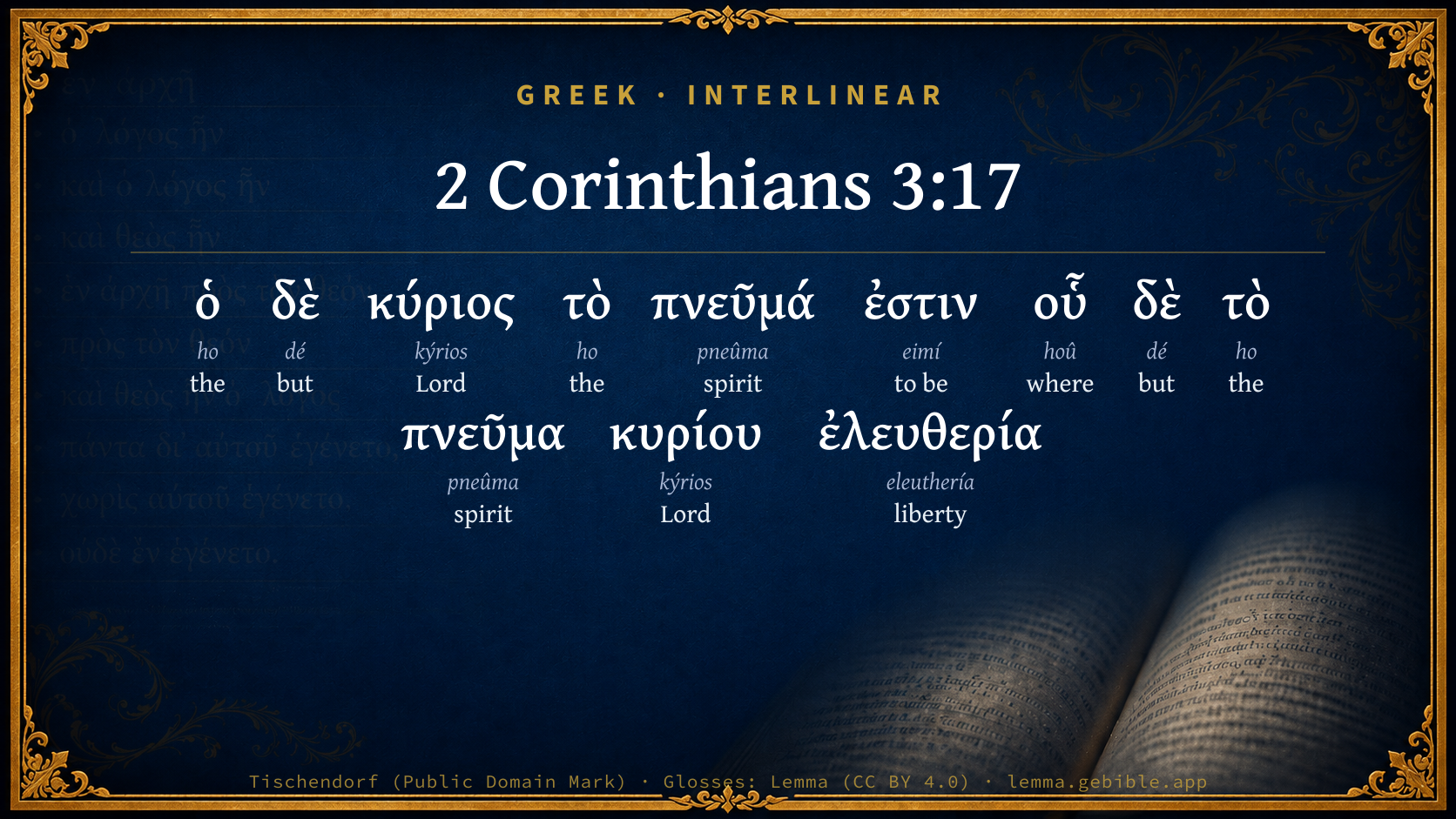
Greek (Tischendorf 8th ed.) 2 Corinthians 3:17 appears in the Greek New Testament. The text above is from the Tischendorf 8th edition. Each word links to its Strong’s number and a concise gloss. Click any word for its full Thayer’s Greek Lexicon entry.
Download image
Cite this verse

2 Corinthians 3:17 (World English Bible). Public Domain. Lemma interlinear Bible study tool, https://lemma.gebible.app/v/2-corinthians/3/17.

Show BibTeX & RIS
BibTeX
RIS
English Translation
Now the Lord is the Spirit and where the Spirit of the Lord is, there is liberty.
World English Bible · Public Domain
Download a study sheet

One document with this verse’s original text, its word-by-word gloss line, the meaning frame, cross-references with their text, attributed commentary, and full source and license credits — printable, and it pastes into notes with its structure intact.

This verse Autodidact and up

Study sheet (.html) Plain text (.txt)

A passage Seminary Student

Up to 50 verses in one chapter. A passage sheet keeps up to 6 commentary sources and 12 cross-references per verse, in the order this page ranks them, and says so on the sheet whenever that leaves anything out. Ask for a single verse and you get the Autodidact verse sheet above.

Everything on this page stays free to read, with no account — the sheet is a download of what is already on screen, not access to it.

Want to remove ads? Support Godless Engineer
Compare translations 3

The same verse in 3 English versions, stacked beneath the original-language interlinear above. Click any original word for its lexicon entry.

Each is an independent rendering of the whole verse — the interlinear is not word-aligned to these translations.

Highlighted words mark where these versions differ — a whole-verse word diff, not a word-by-word alignment.

  • World English Bible Public Domain
    Now the Lord is the Spirit and where the Spirit of the Lord is, there is liberty.
  • King James Version Public Domain
    Now the Lord is that Spirit: and where the Spirit of the Lord is, there is liberty.
  • unfoldingWord Literal Text CC BY-SA 4.0
    Now the Lord is the Spirit, and where the Spirit of the Lord, freedom.

unfoldingWord Literal Text — © unfoldingWord, licensed CC BY-SA 4.0. Word-aligned USFM3 via Door43 (git.door43.org/unfoldingWord/en_ult).

Versions to compare (up to 4)

3 of 4 selected

Show all 19 translations

Every available English version of this verse, each an independent rendering of the whole verse.

  • World English Bible Public Domain
    Now the Lord is the Spirit and where the Spirit of the Lord is, there is liberty.
  • Berean Standard Bible Public Domain
    Now the Lord is the Spirit, and where the Spirit of the Lord is, there is freedom.
  • Majority Standard Bible Public Domain
    Now the Lord is the Spirit, and where the Spirit of the Lord is, there is freedom.
  • King James Version Public Domain
    Now the Lord is that Spirit: and where the Spirit of the Lord is, there is liberty.
  • American Standard Version (1901) Public Domain
    Now the Lord is the Spirit: and where the Spirit of the Lord is, `there' is liberty.
  • Revised Version (1885) Public Domain
    Now the Lord is the Spirit: and where the Spirit of the Lord is, there is liberty.
  • Geneva Bible (1599) Public Domain
    Nowe the Lord is the Spirite, and where the Spirite of the Lord is, there is libertie.
  • Douay-Rheims (1899) Public Domain
    Now the Lord is a Spirit. And where the Spirit of the Lord is, there is liberty.
  • Young's Literal Translation Public Domain
    And the Lord is the Spirit; and where the Spirit of the Lord `is', there `is' liberty;
  • Literal Standard Version CC BY-SA 4.0
    And the LORD is the Spirit; and where the Spirit of the LORD [is], there [is] liberty;
  • Unlocked Literal Bible CC BY-SA 4.0
    Now the Lord is the Spirit. Where the Spirit of the Lord is, there is freedom.
  • unfoldingWord Literal Text CC BY-SA 4.0
    Now the Lord is the Spirit, and where the Spirit of the Lord, freedom.
  • Darby Bible Public Domain
    Now the Lord is the Spirit, but where the Spirit of [the] Lord [is, there is] liberty.
  • World Messianic Bible Public Domain
    Now the Lord is the Spirit; and where the Spirit of the Lord is, there is liberty.
  • Webster's Bible Public Domain
    Now the Lord is that Spirit: and where the Spirit of the Lord is, there is liberty.
  • Free Bible Version CC BY-SA 4.0
    Now the Lord is the Spirit, and wherever the Spirit of the Lord is, there's freedom.
  • Bible in Basic English Public Domain
    Now the Lord is the Spirit: and where the Spirit of the Lord is, there the heart is free.
  • Text-Critical English NT CC BY 4.0
    Now the Lord is the Spirit, and where the Spirit of the Lord is, there is freedom.
  • Tyndale New Testament (1534) Public Domain
    The Lorde no dout is a sprete. And where the sprete of the Lorde is there is libertie.

Literal Standard Version (2020), Covenant Press — licensed CC BY-SA 4.0. Text via the HelloAO Bible API (eBible.org). Unlocked Literal Bible (unfoldingWord) — licensed CC BY-SA 4.0. Text via the HelloAO Bible API (eBible.org). unfoldingWord Literal Text — © unfoldingWord, licensed CC BY-SA 4.0. Word-aligned USFM3 via Door43 (git.door43.org/unfoldingWord/en_ult). Free Bible Version, Dr. Jonathan Gallagher — licensed CC BY-SA 4.0. Text via the HelloAO Bible API (eBible.org).

Word by word

More ways to search: Search by grammar → Find every occurrence → Compare this word →

Practice this passage: Drill this verse → Learn its vocabulary →

About this verse

These counts appear in no published source. They are computed here, from the morphology-tagged text and Lemma’s own curated glosses. What Lemma adds →

12
words
7
distinct lemmas
Pauline Epistles
section

Notable vocabulary

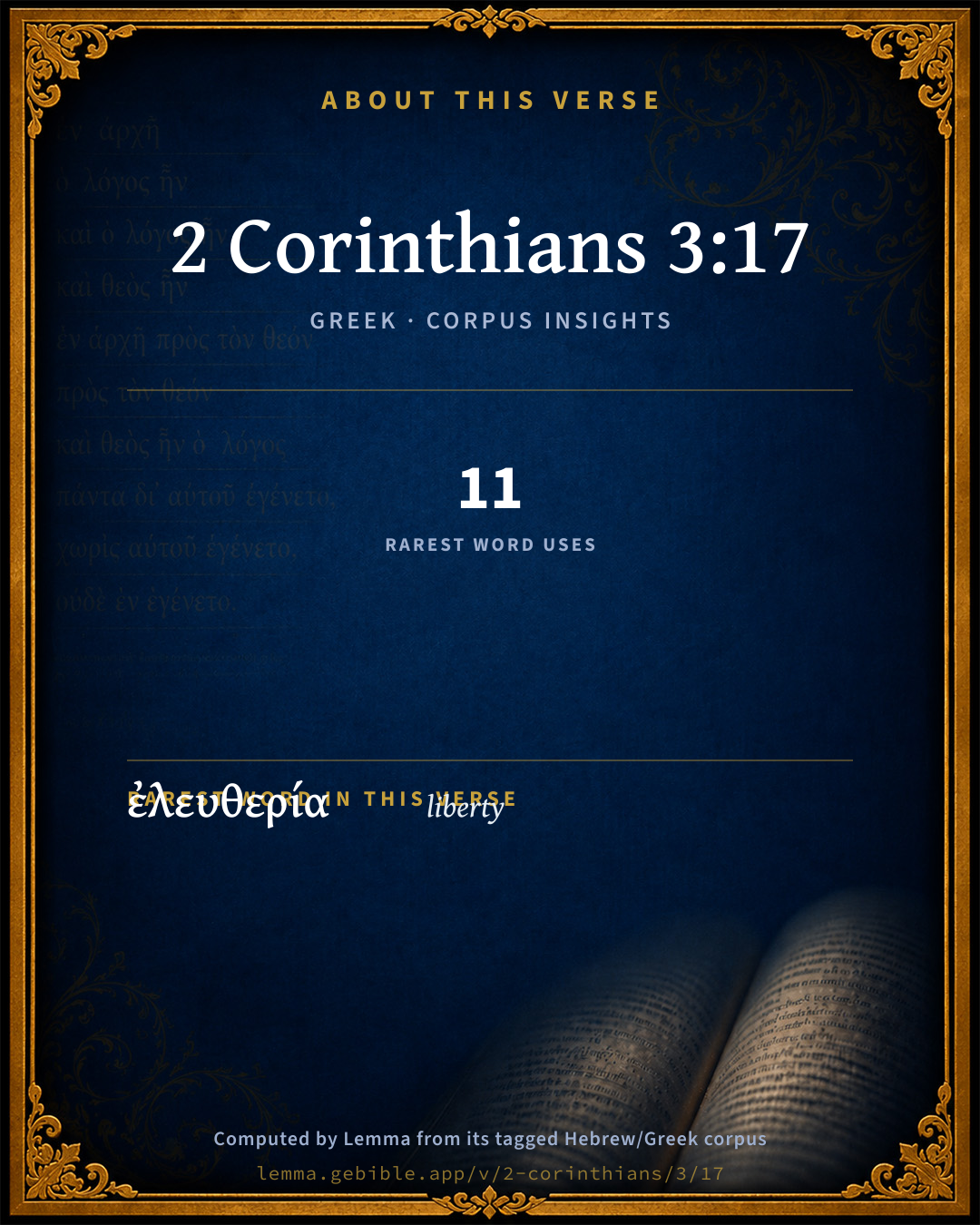
The rarest word here is ἐλευθερία liberty G1657 — appearing just 11 times in the whole Greek New Testament.

Shared distinctive vocabulary

ἐλευθερία liberty G1657 occurs in 10 verses of the Greek New Testament. Also found in:

Repetition

Words recur within this verse:

Cross-references

12

Topical passages linked to 2 Corinthians 3:17 in the Treasury of Scripture Knowledge — connected by theme and wording, ordered by reader-vote popularity; previews shown in the World English Bible.

  • Romans 8:2 For the law of the Spirit of life in Christ Jesus made me free from the law of sin and of death.
  • John 8:32 You will know the truth, and the truth will make you free."
  • Galatians 5:13 For you, brothers, were called for freedom. Only don't use your freedom for gain to the flesh, but through love be servants to one another.
  • Galatians 4:6 And because you are children, God sent out the Spirit of his Son into your hearts, crying, "Abba, Father!"
  • Galatians 5:1 Stand firm therefore in the liberty by which Christ has made us free, and don't be entangled again with a yoke of bondage.
  • Isaiah 61:1–2 The Spirit of the Lord Yahweh is on me; because Yahweh has anointed me to preach good news to the humble; he has sent me to bind up the broken-hearted, to proclaim liberty to the captives, and the opening [of the prison] to those who are bound;
  • John 6:63 It is the spirit who gives life. The flesh profits nothing. The words that I speak to you are spirit, and are life.
  • 2 Timothy 1:7 For God didn't give us a spirit of fear, but of power, love, and self-control.
  • Romans 8:15–16 For you didn't receive the spirit of bondage again to fear, but you received the Spirit of adoption, by whom we cry, "Abba! Father!"
  • Psalms 51:12 Restore to me the joy of your salvation. Uphold me with a willing spirit.
  • 2 Corinthians 3:6 who also made us sufficient as servants of a new covenant; not of the letter, but of the Spirit. For the letter kills, but the Spirit gives life.
  • 1 Corinthians 15:45 So also it is written, "The first man, Adam, became a living soul." The last Adam became a life-giving spirit.

Cross-references courtesy of OpenBible.info (CC BY 4.0).

Commentary

Notes on 2 Corinthians 3:17 from classic Christian and Jewish commentators (each source and its license shown beneath its notes). The classic Christian expositions comment on the surrounding passage and are grouped to its opening verse, so a note may address several verses; the Jewish commentaries on the Tanakh (Rashi and others) are per-verse, so they appear only where the commentator wrote on this verse.

Lemma curates 59 commentaries, every one of them public domain or Creative Commons licensed, each selected and text-cleaned for this edition rather than reprinted as found. About our sources →

The Biblical Illustrator

Joseph S. Exell

2Co_3:17

Now the Lord is that Spirit: and where the Spirit of the Lord is, there is liberty.

Christ the Spirit of Christianity

I. Note the great principles in the text.

1. Christianity is a spirit.

(1) There is a letter and a spirit in everything. These two things are quite distinct. The letter may be changed, the spirit may be unchangeable. The same spirit may require for its expression to different minds different letters. The spirit may not only cease to be represented, but may be positively misrepresented, by its form. Christ, e.g., enjoined the washing of one anothers feet where washing the feet was a common service; but we smile at the professed obedience to this precept every year of his holiness of Rome.

(2) The Old Testament was a letter in which there was a spirit. The very idea of a letter supposes that something is written. And, further, that spirit, so far as it went, was the same as in the gospel; the law represented the same ideas and sentiments as the gospel, but in a different way, and with different results, so as to justify the calling of one a letter and the other a spirit. The first, though not without spirit, had more letter in it; and the second, though not without letter, has more spirit in it. Christianity is like a book for men, which assumes many things that children must have in most explicit statement. It is more suggestive than explanatory, trusts more to conscience than to argument, and appeals more to reason than to rule. Its doctrines are principles, not propositions; its institutions are grand outlines, not precise ceremonies; its laws are moral sentiments, not minute directions.

2. Christ is the Spirit of Christianity.

(1) The fact of there being a revelation at all is owing to Christ. But for Him the beginning of sin would have been the end of humanity, But God had, in anticipation of the fall, devised a plan of redemption. Forfeited life was continued because of Christ. Whatever was done was for Him. The great events of past times were preparatory to Him. Prophets spoke of Him, kings ruled for Him, priests typified Him. According to Christs contemplated work men were treated. But if the law was through Christ as its grand reason, how much more is the gospel! For now He is not the secret but the revealed agent of Gods providence. What was done before was done because of Him, what is done now is done directly by Him. He realised the conceptions expressed by Judaism, made its figures facts, its predictions history.

(2) Christ is the Spirit of Christianity, as He is the personal representation of its truths. The gospel is Christ. It shines in Him as in a mirror, it lives in Him as in a body. Is God the prime idea of all religion? He that has seen Me has seen the Father. Is the moral character of God as important as His existence? Behold the image of the invisible God as He goes about doing good. Is reunion with God the great need of humanity? It is consummated in the Incarnation. Do we want law? Walk even as He walked. Do we die? Christ, the firstfruits of them that slept. Are we sighing for immortality? This is the eternal life.

(3) The Holy Spirit, by whom spiritual blessings are conveyed, is emphatically the Spirit of Christ. This Spirit, the closest and most quickening contact of God with our souls, is the fruit of the reconciliation with God effected by Christ. That effected, Christ went to heaven that He might give us this other Comforter, even the Spirit of truth.

3. Christ, as the Spirit of Christianity, is the Spirit of liberty. The genius of a spiritual life is to be free. The law was not made for a righteous man, but for the lawless and disobedient. The more spiritual men are, the less do they require external regulations; and one of the most striking features of Christianity is its comparative freedom from such. It is a law of liberty, in the sense of leaving us at liberty upon many points; moral excellence is its requirement, not ceremonial exactness. Its law is summed up by love to God and man. You do not need to fetter a loving child with the rules you lay upon a hireling. The gospel is spiritual in its form, because it is spiritual in its power. In the following verse a sublime truth is set before us. The liberty of the gospel is holiness. The law of the Spirit of life in Christ Jesus hath made me free from the law of sin and death: only the Spirit can do this. The letter may keep sin down, but the spirit turns it out. The letter may make us afraid to do it, the spirit makes us dislike to have it. And is not that liberty, when we are free to serve God in the gospel of His Son, free to have access to Him with the spirit of adoption, free to run the way of His commandments, because enlarged in heart? He is the slave whose will is in fetters; and nothing but the Spirit, the Lord, can set that free.

II. The subject is fruitful in reflections and admonitions.

1. The text is one of a large class which intimate and require the divinity of Christ. The place assigned to Christ in the scheme and providence of God is such that only on the supposition of His Divine nature can it be understood and explained. Destroy Him, take Him away, and you do not merely violate the language, but annihilate the very life of Gods covenant. If Christianity be what we are accustomed to regard it, He who is its Spirit, in the way and for the reasons which itself explains, can be no other than the true God and eternal life.

2. We see the greatness of the privileges with which, as Christians, we have been favoured, and the source of their derivation. The apostles do employ language severely depreciating in its tone, when contrasting previous economies with our own. Darkness, flesh, letter, bondage, the world, are set against light, spirit, grace, liberty, and the kingdom of God and of heaven. And the reason of our being so blessed is to be found in Christ. Shall we not be grateful? And shall not gratitude express itself in holiness? Ye are not under the law, but under grace, and the great worth of this position is in the facilities for sanctification which it affords.

3. Let us give to the personal element in Christianity its proper place and power. In the apostles writings there was an indestructible connection of every principle of the gospel with the personal Christ. Everything was in Him. Christ was Christianity. He is the Truth, the Way, the Life, the peace, hope, and resurrection of men; He is their wisdom, righteousness, sanctification, and redemption. Religion is not merely a contemplation of truth, or a doing of morality; it is fellowship with God and with His Son. We are to love Christ, not spiritual beauty; to believe in Christ, not spiritual truth; to live to Christ, not spiritual excellence.

4. Our subject instructs and encourages us in connection with the diffusion of our religion through the earth. The gospel is a spirit. Well, indeed, might we despond, when contemplating the powers of darkness, if we could not associate with our religion the attributes of spirit. But, said Christ, the words that I speak unto you are spirit and life. And our subject also teaches charity. Can there be any heart unaffected when the promise of liberty, in its highest state and completest measure, is before us? Can you dwell upon the hard bondage of the souls of men, both in civilised and uncivilised conditions, and not long to preach deliverance to the captives, and the opening of the prison to them that are bound? (A. J. Morris.)

Liberty of the spiritual life

The heavenly life imparted is liberty and truth and peace; it is the removal of bondage and darkness and pain. So far from being a mechanical constraint, as some would represent, it is the removal of the iron chain with which guilt had bound the sinner. It acts like an army of liberation to a down-trodden country, like the warm breath of spring to the frost-fettered tree. For the entrance of true life or living truth into mans soul must be liberty, not bondage. (A. Bonar.)

The spirit of liberty

1. It is remarkable that, when our Lord expounded in the synagogue of Nazareth, He chose a passage of which two-fifths related to liberty. Between that passage and my text there is a singular connection. The Spirit of the Lord is upon me, etc. Where the Spirit of the Lord is, there is liberty.

I. We are all of us so constituted that there must be a certain sense of freedom to make a play of the affections.

1. Satan knew this quite well when he destroyed the loving allegiance of our first parents by introducing first into their minds the thought of bondage. Yea, hath God said, Ye shall not cat of every tree of the garden? And so the poison had worked. You are not free. In catching at a fictitious freedom the first Adam lost the true. The second Adam made Himself a servant of servants, that He might restore to us a greater freedom than Adam lost.

2. But still the same enemy is always trying to spoil our paradises by making us deny our freedom. He has two ways of doing this. Sometimes he gives us a sense of bondage, which keeps us back from peace, and therefore holiness. Sometimes he gives us an idea of imaginary liberty, of which the real effect is that it leaves us the slave of a sentiment or of a passion.

3. Some persons are afraid of liberty, lest it should run into licentiousness. But I do not find in the whole Bible that we are warned against too much liberty. In fact, it is almost always those who have felt themselves too shut up who break out into lawlessness of conduct. Just as the stopped river, bursting its barrier, runs into the more violent stream.

II. That you should stand fast in the liberty wherewith Christ makes his people free, understand what your real liberty is.

1. By and by, somebody says, when I have believed and prayed a little more, and lived a little more religiously, then I hope God will forgive me. So every night he has to consider whether he is yet good enough to justify the hope that he is a child of God; and the consequence is that man prays with no liberty. But, all the while, what is the fact? God does love him. All he wants is to take facts as facts. It needs but one act of realisation, and every promise of the Bible belongs to that man. This done, see the difference. He feels himself a child of God through Gods own grace, and his liberated mind leaps to the God who has loved him. Now the right spring is put into the machinery of his breast. He works in the freedom of a certainty. And from that date that mans real sanctification begins.

2. There are many whose minds are continually recurring to old sins. They have prayed over them again and again, but still they cannot take their thoughts off them. But the freeman of the Lord knows the meaning of those words--He that is washed needeth not save to wash his feet, but is clean every whit. All he feels he has to do is to bring his daily sins to that Fountain where he has washed all the sins of his former life. And do not you see that that man will go with a lightened feeling?

3. See the nature of that mans forgiveness. To obey the command of any one we love is pleasant, but to obey because it will please him, though he has not commanded it, is much happier. The spirit of the law is always better than the law. Deuteronomy is better than Leviticus. Now this is the exact state of a Christian. He has studied the commands till he has reached to the spirit of the commands. He has gathered the mind of God, and he follows that. A command prescribes, and whatever prescribes circumscribes, and is so far painful. But the will of God is an unlimited thing, and therefore it is unlimiting.

(1) And when man, free because the Son has made him free, goes to read his Bible, like a man who has got the free range of all its pastures, to cull flowers wherever he likes, he is free to all the promises that are there, for he has the mind of Christ.

(2) Or hear him in prayer. How close it is! How boldly he puts in his claim!

(3) The fear of death never hurts that man. Why? Because his death is over.

(4) And, because he is so very free, you will find there is a large-heartedness and a very charitable judgment in that man. He lives above party. (J. Vaughan, M. A.)

The liberty of the Spirit

How much is made of earthly liberty--the shadow of true freedom. How true it is that, whilst many men profess to give liberty to others, they themselves are the slaves of corruption. Men are content to be slaves within who would be very indignant at any attempt to make them slaves without. The apostle, speaking of the bondage of the law, said that, when the heart of the Jew shall turn to the Lord, then, and not till then, shall they come to the true freedom. Where the Spirit of the Lord is, there is--

I. Liberty from condemnation. If a man is under sentence of death he cannot find liberty. He may forget his imprisonment in mirth and feasting, but it is not the less real because he forgets it. The morning will come when he will be dragged off to his fearful doom. We are under the sentence of Gods broken law. The soul that sinneth, it shall die. How beautiful, then, the language of the apostle! (Rom_8:1).

II. Liberty from law. The law knows nothing of mercy and forgiveness, nor does it afford the least help to holiness. Its command is, Do this, and live; break this in the least, and die. Therefore, by the deeds of the law shall no man have peace with God. But what the law could not do, etc. (Rom_8:2-4).

III. Liberty to obey. Many think they are free, and that they will do as they like; but they do not like to do what they ought to like, and therefore they are slaves after all. The way in which a man may convince himself of his slavery is to try to be what he ought to be. He can do nothing of himself, and he must be brought to feel that he can do no good thing without God. But what the flesh cannot do the Spirit will enable him to do. It is God which worketh in us, both to will and to do of His good pleasure; therefore work out your own salvation, etc.

IV. Liberty to fight the good fight of faith. A man can do battle with his corrupt nature, he can win the victory over the principalities and powers of darkness, and his sword is a sword of liberty. The drunkard becomes sober, the impure chaste, the vindictive forgiving, by the power of the Spirit of God.

V. Liberty of access to God. The one true and living way is open, but it cannot be discerned except a man has it revealed to him by the Spirit of God. Through Christ we have access by one Spirit unto the Father.

VI. Liberty of holy boldness and fortitude in the service of God. (H. Stowell, M. A.)

The freedom of the Spirit

1. To possess the Lord Jesus Christ is to possess the Holy Ghost, who is the minister and guardian of Christs presence in the soul. The apostles conclusion is that those who are converted to Jesus have escaped from the veil which darkened the spiritual intelligence of Israel. The converting Spirit is the source of positive illumination; but, before He enlightens thus, He must give freedom from the veil of prejudice which denies to Jewish thought the exercise of any real insight into the deeper sense of Scripture. That sense is seized by the Christian student of the ancient law, because in the Church of Christ he possesses the Spirit; and where the Spirit of the Lord is, there is liberty.

2. The Holy Spirit is called the Spirit of Christ because He is sent by Christ, and for the purpose of endowing us with Christs nature and mind. His presence does not supersede that of Christ: He co-operates in, He does not work apart from, the mediatorial work Of Christ. To possess the Holy Spirit is to possess Christ; to have lost the one is to have lost the other. Accordingly our Lord speaks of the gift of Pentecost as if it were His own second coming (Joh_14:18). And, after telling the Romans that if any man have not the Spirit of Christ he is none of His, St. Paul adds, Now if Christ be in you, the body is dead because of sin. Here Christs being in the Christian, and the Christians having the Spirit of Christ, are equivalent terms.

3. Freedom is not an occasional largess of the Divine Spirit; it is not merely a reward for high services or conspicuous devotion. It is the very atmosphere of His presence. Wherever He really is, there is also freedom. He does not merely strike off the fetters of some narrow national prejudice, or of some antiquated ceremonialism. His mission is not to bestow an external, political, social freedom. For no political or social emancipation can give real liberty to an enslaved soul. And no tyranny of the state or of society can enslave a soul that has been really freed. At His bidding the inmost soul of man has free play. He gives freedom from error for the reason, freedom from constraint for the affections, freedom for the will from the tyranny of sinful and human wills.

4. The natural images which are used to set forth the presence and working of the Holy Spirit are suggestive of this freedom. The Dove, which pictures His gentle movement on the soul and in the Church, suggests also the power of rising at will above the dead level of the soil into a higher region where it is at rest. The cloven tongue like as of fire is at once light and heat; and light and heat imply ideas of the most unrestricted freedom. The wind blowing where it listeth; the well of water in the soul, springing up, like a perpetual fountain, unto everlasting life--such are our Lords own chosen symbols of the Pentecostal gift. All these figures prepare us for the language of the apostles when they are tracing the results of the great Pentecostal gift. With St. James, the Christian, no less than the Jew, has to obey a law, but the Christian law is a law of library. With St. Paul, the Church is the Jerusalem which is free; in contrast with the bondwoman the Christian is to stand fast in a liberty with which Christ has freed him; he is made free from sin, and become the servant of righteousness. St. Paul compares the glorious liberty of the children of God with the bondage of corruption; he contrasts the law of the spirit of life in Christ Jesus, which gives us Christians our freedom, with the enslaving law of sin and death. According to St. Paul, the Christian slave is essentially free, even while he still wears his chain (1Co_7:22). Where the Spirit of the Lord is, there is--

I. Mental liberty.

1. From the first God has consecrated liberty of thought by withdrawing thought from the control of society. Society protects our persons and goods, and passes judgment upon our words and actions; but it cannot force the sanctuary of our thought. And the Spirit comes not to suspend, but to recognise, to carry forward, to expand, and to fertilise almost indefinitely the thought of man. He has vindicated for human thought the liberty of its expression against imperial tyranny and official superstition. The blood of the martyrs witnessed to the truth that, where the Spirit of the Lord is, there is mental liberty.

2. In the judgment of an influential school dogma is the enemy of religious freedom. But what is dogma? The term belongs to the language of civilians; it is applied to the imperial edicts. It also finds a home in the language of philosophy; and the philosophers who denounce the dogmatic statements of the gospel are hardly consistent when they are elaborating their own theories. Dogma is essential Christian truth thrown by authority into a form which admits of its permanently passing into the understanding and being treasured by the heart of the people. For dogma is an active protest against those sentimental theories which empty revelation of all positive value. Dogma proclaims that revelation does mean something, and what. Accordingly dogma is to be found no less truly in the volume of the New Testament than in Fathers and Councils. It is specially embodied in our Lords later discourses, in the sermons of His apostles, in the epistles of St. Paul. The Divine Spirit, speaking through the clear utterances of Scripture, is the real author of essential dogma; and we know that where the Spirit of the Lord is, there is liberty.

3. But is not dogma, as a matter of fact, a restraint upon thought? Unquestionably. But there is a notion of liberty which is impossible. Surely a being is free when he moves without difficulty in the sphere which is assigned to him by his natural constitution. If he can only travel beyond his sphere with the certainty of destroying himself, it is not an unreasonable tax upon his liberty whereby he is confined within the barrier that secures his safety. Now truth is originally the native element of human thought; and Christian dogma prescribes the direction and limits of truth concerning God and His relations to man.

(1) Certainly the physical world does not teach us that obedience to law is fatal to freedom. The heavens would cease to declare the glory of God if the astronomers were to destroy those invariable forces which confine the movement of the swiftest stars to their fixed orbits. And when man himself proceeds to claim that empire which God has given him over the world of nature, he finds his energies bounded and controlled by law in every direction. We men can transport ourselves to and fro on the surface of this earth. But if in an attempt to reach the skies we should succeed in mounting to a region where animal life is impossible, we know that death would be the result of our success. Meanwhile our aeronauts, and even our Alpine climbers, do not complain of the tyranny of the air.

(2) So it is in the world of thought. Look at those axioms which form the basis of the freest and most exact science known to the human mind. We cannot demonstrate them, we cannot reject them; but the submissive glance by which reason accepts them is no unworthy figure of the action of faith. Faith also submits, it is true; but her submission to dogma is the guarantee at once of her rightful freedom and of her enduring power.

(3) So submission to revealed truth involves a certain limitation of intellectual licence. To believe the dogma that God exists is inconsistent with a liberty to deny His existence. But such liberty is, in the judgment of faith, parallel to that of denying the existence of the sun or of the atmosphere. To complain of the Creed as an interference with liberty is to imitate the savage who had to walk across London at night, and who remarked that the lamp-posts were an obstruction to traffic.

4. They only can suppose that Christian dogma is the antagonist of intellectual freedom whose misery it is to disbelieve. For dogma stimulates and provokes thought--sustains it at an elevation which, without it, is impossible. It is a scaffolding by which we climb into a higher atmosphere. It leaves us free to hold converse with God, to learn to know Him. We can speak of Him and to Him, freely and affectionately, within the ample limits of a dogmatic definition. Besides this, dogma sheds, from its home in the heart of revelation, an interest on all surrounding branches of knowledge. God is everywhere, and to have a fixed belief in Him is to have a perpetual interest in all that reflects Him. What composition can be more dogmatic than the Te Deum? Yet it stimulates unbounded spiritual movement. The soul finds that the sublime truths which it adores do not for one moment fetter the freedom of its movement.

II. Moral liberty.

1. There is no such thing as freedom from moral slavery, except for the soul which has laid hold on a fixed objective truth. But when, at the breath of the Divine Spirit upon the soul, heaven is opened to the eye of faith, and man looks up from his misery and his weakness to the everlasting Christ upon His throne; when that glorious series of truths, which begins with the Incarnation, and which ends with the perpetual intercession, is really grasped by the soul as certain--then assuredly freedom is possible. It is possible, for the Son has taken flesh, and died, and risen again, and interceded with the Father, and given us His Spirit and His sacraments, expressly that we might enjoy it.

2. But, then, we are to be enfranchised on the condition of submission. Submission! you say--is not this slavery? No; obedience is the school of freedom. In obeying God you escape all the tyrannies which would fain rob you of your liberty. In obeying God you are emancipated from the cruel yet petty despotisms which enslave, sooner or later, all rebel wills. As in the material world all expansion is proportioned to the compression which precedes it, so in the moral world the will acts with a force which is measured by its power of self-control.

3. As loyal citizens of that kingdom of the Spirit which is also the kingdom of the Incarnation, you may be really free. If the Son shall make you free, ye shall be free indeed. Political liberty is a blessing; liberty of thought is a blessing. But the greatest blessing is liberty of the conscience and the will. It is freedom from a sense of sin when all is known to have been pardoned through the atoning blood; freedom from a slavish fear of our Father in heaven when conscience is offered to His unerring eye by that penitent love which fixes its eye upon the Crucified; freedom from current prejudice and false human opinion when the soul gazes by intuitive faith upon the actual truth; freedom from the depressing yoke of weak health or narrow circumstances, since the soul cannot be crushed which rests consciously upon the everlasting arms; freedom from that haunting fear of death which holds those who think really upon death at all, all their lifetime subject to bondage, unless they are His true friends and clients who by the sharpness of His own death has led the way and opened the kingdom of heaven to all believers. It is freedom in time, but also, and beyond, freedom in eternity. In that blessed world, in the unclouded presence of the emancipator, the brand of slavery is inconceivable. In that world there is indeed a perpetual service; yet, since it is the service of love made perfect, it is only and by necessity the service of the free. (Canon Liddon.)

Spiritual liberty

Liberty is the birthright of every man. But where do you find liberty unaccompanied by religion? This land is the home of liberty, not so much because of our institutions as because the Spirit of the Lord is here--the spirit of true and hearty religion. But the liberty of the text is an infinitely greater and better one, and one which Christian men alone enjoy. He is the free man whom the truth makes free. Without the Spirit of the Lord, in a free country, ye may still be bondsmen; and where there are no serfs in body, ye may be slaves in soul. Note--

I. What we are freed from.

1. The bondage of sin. Of all slavery there is none more horrible than this. O wretched man that I am, who shall deliver me from it? But the Christian is free.

2. The penalty of sin--eternal death.

3. The guilt of sin.

4. The dominion of sin. Profane men glory in free living and free thinking. Free living! Let the slave hold up his fetters and jingle them, and say, This is music, and I am free. A sinner without grace attempting to reform himself is like Sisiphus rolling the stone up hill, which always comes down with greater force. A man without grace attempting to save himself is engaged in as hopeless a task as the daughters of Danaus, when they attempted to fill a vast vessel with bottomless buckets. He has a bow without a string, a sword without a blade, a gun without powder.

5. Slavish fear of law. Many people are honest because they are afraid of the policeman. Many are sober because they are afraid of the eye of the public. If a man be destitute of the grace of God, his works are only works of slavery; he feels forced to do them. But now, Christian, Love makes your willing feet in swift obedience move. We are free from the law that we may obey it better.

6. The fear of death. I recollect a good old woman, who said, Afraid to die, sir! I have dipped my foot in Jordan every morning before breakfast for the last fifty years, and do you think I am afraid to die now? A good Welsh lady, when she lay a-dying, was visited by her minister, who said to her, Sister, are you sinking? But, rising a little in the bed, she said, Sinking! Sinking! Did you ever know a sinner sink through a rock? If I had been standing on the sand I might sink; but, thank God! I am on the Rock of Ages, and there is no sinking there.

II. What we are free to. Where the Spirit of the Lord is, there is liberty, and that liberty gives us certain rights and privileges.

1. To heavens charter. Heavens Magna Charta is the Bible, and you are free to it--to all its doctrines, promises, etc. You are free to all that is in the Bible. It is the bank of heaven: you may draw from it as much as you please without let or hindrance.

2. To the throne of grace. It is the privilege of Englishmen that they can always send a petition to Parliament; and it is the privilege of a believer that he can always send a petition to the throne of God. It signifies nothing what, where, or under what circumstances I am.

3. To enter into the city. I am not a freeman of London, which is doubtless a great privilege, but I am a freeman of a better city. Now some of you have obtained the freedom of the city, but you wont take it up. Dont remain outside the Church any longer, for you have a right to come in.

4. To heaven. When a Christian dies he knows the password that can make the gates wide open fly; he has the white stone whereby he shall be known as a ransomed one, and that shall pass him at the barrier. (C. H. Spurgeon.)

Signs of spiritual liberty

Wheresoever the Spirit of God is, there is--

I. A liberty of holiness, to free us from the dominion of sin (Luk_1:75). As children can give a bird leave to fly so it be in a string to pull it back again, so Satan hath men in a string if they live in sin. The beast that runs away with a cord about him is catched by the cord again; so, having Satans cords about us, he can pull us in when he lists. From this we are freed by the Spirit.

II. A blessed freedom and an enlargement of heart to duties, Gods people are a voluntary people. Those that are under grace are anointed by the Spirit (Psa_89:20), and that spiritual anointment makes them nimble. Otherwise spiritual duties are as opposite to flesh and blood as fire and water. When we are drawn, therefore, to duties, as a bear to a stake, for fear, or out of custom, with extrinsical motives, and not from a new nature, this is not from the Spirit. For the liberty of the Spirit is when actions come off naturally, without any extrinsical motive. A child needs not extrinsical motives to please his father. So there is a new nature in those that have the Spirit of God to stir them up to duty, though Gods motives may help as the sweet encouragements and rewards. But the principle is to do things naturally. Artificial things move from a principle without them, therefore they are artificial. Clocks and such things have weights that stir all the wheels they go by, and that move them; so it is with an artificial Christian. He moves with weights without him; he hath not an inward principle of the Spirit to make things natural to him.

III. Courage against all opposition whatsoever, joined with light and strength of faith, breaking through all oppositions. Opposition to a spiritual man adds but courage and strength to him to resist. In Act_4:23, seq., when they had the Spirit of God, they encountered opposition; and the more they were opposed, the more they grew. They were cast in prison, and rejoiced; and the more they were imprisoned, the more courageous they were still. There is no setting against this wind, no quenching of this fire, by any human power. See how the Spirit triumphed in the martyrs. The Spirit of God is a victorious Spirit (Rom_8:33-34; Act_6:10; Act_6:15).

IV. Boldness with God himself, otherwise a consuming fire? For the Spirit of Christ goes through the mediation of Christ to God. That familiar boldness whereby we cry, Abba, Father, comes from sons. This comes from the Spirit. If we be sons, then we have the Spirit, whereby we cry, Abba, Father. (R. Sibbes, D. D.)

The Biblical Illustrator, edited by Joseph S. Exell (c. 1880s–1900s) — public domain. Text from a community e-Sword module.

Joseph Benson's Commentary

2Co 3:17-18. Now the Lord Christ is that Spirit — Of the law of which I spake before, to whom the letter of it was intended to lead; and it is the office of the Spirit of God, as the great agent in his kingdom, to direct the minds of men to it. And where the Spirit of the Lord is — Enlightening and renewing men’s minds; there is liberty — Not the veil, the emblem of slavery. There is liberty from servile fear, liberty from the guilt and power of sin, liberty to behold with open face the glory of the Lord. Accordingly it is added, we all — That believe in him with a faith of his operation; beholding as in a glass the glory of the Lord, &c. — By the glory of the Lord here, we are to understand his divine attributes, his wisdom, power, and goodness; his truth, justice, mercy; his holiness and grace, and especially his love; these, and his other moral perfections, are his greatest glory. But these cannot be beheld by man immediately and directly, while he is in the body: they can only be seen as in a glass, or through a glass darkly; (1Co 13:12;) namely, 1st, In that of the works of creation, as the apostle states, Rom 1:20, where see the note.

Invisible in himself, he is “dimly seen In these his lowest works, which all declare His goodness beyond thought, and power divine.”

2d, In the dispensations of his providence, in which glass not only his natural, but also his moral attributes are manifested; his long-suffering in bearing with sinful individuals, families, cities, nations; his justice in punishing when they persist in their iniquities; his mercy in pardoning them when they break off their sins by repentance. 3d, In the work of redemption; a work in which divine goodness in designing, wisdom in contriving, and power in executing, are conspicuously declared; in which justice and mercy meet together, righteousness and peace kiss each other: a wonderful plan! in which God demonstrates that he is just, while he is the justifier of him that believeth in Jesus. See on Rom 3:25-26. 4th, In the glass in which all these are united, and set in a clear point of view, namely, the Word of God, or the gospel of Christ, in which the divine character is clearly and fully delineated; as it is also still more manifestly, and in a more striking light, in his incarnate Son, the brightness of his glory, the express image of his person; the Word made flesh; God manifest in the flesh. But by whom is the divine glory beheld in these glasses? Only by those from whose faces the veil of ignorance, prejudice, and unbelief is removed; so that with open, ανεκεκαλυμμενω, with unveiled face, and with the eyes of their understanding opened, they behold, view attentively, and contemplate this glory of the Lord.

Now, observe the effect produced on those who behold this glory; they are changed into the same image. While we steadfastly and with open face behold the divine likeness exhibited in these glasses, we discern its amiableness and excellence, and the necessity of a conformity thereto, in order to our happiness here and hereafter. And hence arises sincere and earnest desire after that conformity, and an endeavour to imitate such perfections as are imitable by us. Add to this, the very beholding and meditating on the divine glories, has a transforming efficacy. For instance, by contemplating his wisdom, as manifested in his works and word, we are enlightened and made wise: by viewing his power, and by faith arming ourselves with it, we become strong; able to withstand our enemies, as also to do and suffer his will. The contemplation of his truth, justice, mercy, and holiness, inspires us with the same amiable and happy qualities, and knowing and believing the love that he hath to us, and all his people, we learn to love him who hath first loved us; and loving him that beget, we are disposed and enabled also to love all that are begotten of him; and even all mankind, if not with a love of approbation and complacency, yet with a love of benevolence and beneficence, knowing that he is the Father of the spirits of all flesh, and that the whole race of Adam are his offspring. Thus we become godlike, and put on the new man, which is renewed in and by this spiritual knowledge, after the image of him that created him, Col 3:10. From glory to glory — That Isaiah , 1 st, As the light and glory of the moon and planets are by reflection from the sun; so from the unbounded, absolutely perfect, and underived glory of the Creator, when beheld and contemplated, results this limited, increasing, and derived glory in the creature: increasing, observe; for, 2d, this expression, from glory to glory, (which is a Hebraism, denoting a continued succession and increase of glory,) signifies from one degree of this glorious conformity to God to another: this on earth. But it implies also, 3d, from grace, (which is glory in the bud,) to glory in heaven, which is the ripe fruit. It is of importance to notice likewise the grand agent in this work, namely, the Spirit of the Lord. 1st, He hath prepared these glasses, particularly the two last mentioned, the Holy Scriptures, indited by his inspiration, and the human nature of Christ, formed by his agency in the womb of the virgin. And he causes the glory of the Lord to be reflected from them. 2d, He rends the veil from our minds, and opens the eyes of our understanding, that we may be enabled to behold the divine glory in these glasses. 3d, He causes the sight to be transforming, communicating his own renewing and sanctifying influences, and thereby imparting his likeness and nature.

Joseph Benson's Commentary on the Old and New Testaments (1811–1818) — public domain. Text from a community e-Sword module.

Bengel's Gnomon

Johann Albrecht Bengel

2Co 3:17. Ὁ δὲ Κύριος τὸ πνεῦμά ἐστιν, but the Lord is that Spirit) The Lord is the subject. Christ is not the letter, but He is the Spirit and the end of the law. A sublime announcement: comp. Php 1:21; Gal 3:16. The particle but, or now, shows that the preceding is explained by this verse. The turning (conversion) takes place [is made] to the Lord, as the Spirit.—οὗ δὲ τὸ πνεῦμα Κυρίου, and where the Spirit of the Lord is) Where Christ is, there the Spirit of Christ is; where the Spirit of Christ is, there Christ is; Rom 8:9-10. Where Christ and His Spirit are, there is liberty: Joh 8:36; Gal 4:6-7.—ἐκεῖ) there, and there only.—ἐλευθερία) liberty, opposed to the veil, the badge of slavery: liberty, without such fear in looking, as the children of Israel had, Exo 34:30.

Bengel's Gnomon of the New Testament — English translation (T&T Clark, Edinburgh, 1860) — public domain. Text from a community e-Sword module.

Meyer's Critical & Exegetical Commentary

Heinrich August Wilhelm Meyer

2Co_3:17. Remark giving information regarding what is asserted in 2Co_3:16.

δέ, [the German] aber, appends not something of contrast, i.e. to Moses, who is the letter (Hofmann), but a clause elucidating what was just said, περιαιρ. τὸ κάλ.,[175] equivalent to namely. See Hermann, ad Viger. p. 845; Hartung, Partikell. I. p. 167. Rückert (comp. de Wette) is of a different opinion, holding that there is here a continued chain of reasoning, so that Paul in 2Co_3:16-17 means to say: When the people of Israel shall have turned to the Lord, then will the κάλυμμα be taken from it; and when this shall have happened, it will also attain the freedom (from the yoke of the law) which is at present wanting to it. But, because in that case the ἘΛΕΥΘΕΡΊΑ would be a more important point than the taking away of the veil, 2Co_3:18 must have referred back not to the latter, but to the former. Seeing, however, that 2Co_3:18 refers back to the taking away of the veil, it is clear that 2Co_3:17 is only an accessory sentence, which is intended to remove every doubt regarding the ΠΕΡΙΑΙΡΕῖΤΑΙ ΤῸ ΚΆΛΥΜΜΑ.[176] Besides, if Rückert were right, Paul would have continued his discourse illogically; the logical continuation would have been, 2Co_3:17 : ΟὟ ΔῈ ΠΕΡΙΑΙΡΕῖΤΑΙ ΤῸ ΚΆΛΥΜΜΑ, ΤῸ ΠΝΕῦΜΑ ΚΥΡΊΟΥ ἘΣΤΊΝ· ΟὟ ΔῈ ΤῸ ΠΝ. ΚΥΡ. Κ.Τ.Λ.

Ὁ ΔῈ ΚΎΡΙΟς ΤῸ ΠΝΕῦΜΑ ἘΣΤΙΝ] Ὁ ΚΎΡΙΟς is subject, not (as Chrysostom, Theodoret, Oecumenius, Theophylact, Estius, Schulz held, partly in the interest of opposition to Arianism) predicate, which would be possible in itself, but cannot be from the connection with 2Co_3:16.[177] The words, however, cannot mean: Dominus significat Spiritum (Wetstein), because previously the conversion to Christ, to the actual personal Christ, was spoken of; they can only mean: the Lord, however, is the Spirit, i.e. the Lord, however, to whom the heart is converted (note the article) is not different from the (Holy) Spirit, who is received, namely, in conversion, and (see what follows) is the divine life-power that makes free. That this was meant not of hypostatical identity, but according to the dynamical oeconomic point of view, that the fellowship of Christ, into which we enter through conversion, is the fellowship of the Holy Spirit, was obvious of itself to the believing consciousness of the readers, and is also put beyond doubt by the following τὸ πνεῦμα κυρίου. And Christ is the Spirit in so far as at conversion, and generally in the whole arrangements of salvation, He communicates Himself in the Holy Spirit, and this Spirit is His Spirit, the living principle of the influence and indwelling of Christ,certainly the living ground of life in the church, and the spirit of its life (Hofmann), but as such just the Holy Spirit, in whom the Lord reveals Himself as present and savingly active. The same thought is contained in Rom_8:9-11, as is clear especially from 2Co_3:10-11, where Χριστός and ΤῸ ΠΝΕῦΜΑ ΤΟῦ ἘΓΕΊΡΑΝΤΟς ἸΗΣΟῦΝ and ΠΝΕῦΜΑ ΧΡΙΣΤΟῦ (2Co_3:9) appear to be identical as the indwelling principle of the Christian being and life, so that there must necessarily lie at the bottom of it the idea: ΧΡΙΣΤῸς ΤῸ ΠΝΕῦΜΑ ἘΣΤΙ. Comp. Gal_2:20; Gal_4:6, Php_1:19, Act_20:28, along with Eph_4:11. As respects His immanence, therefore, in His people, Christ is the Spirit. Comp. also Krummel, l.c. p. 97, who rightly remarks that, if Christ calls Himself the light, the way, the truth, etc., all this is included in the proposition: the Lord is the Spirit. Fritzsche, Dissert. I. p. 42, takes it: Dominus est ita Sp. St. perfusus, ut totus quasi τὸ πνεῦμα sit. So also Rückert, who nevertheless (following Erasmus and Beza) believes it necessary to explain the article before πνεῦμα by retrospective reference to 2Co_3:6; 2Co_3:8.[178] But in that case the whole expression would be reduced to a mere quasi, with which the further inference οὗ δὲ τὸ πνεῦμα κυρίου would not be logically in accord; besides, according to analogy of Scripture elsewhere, it cannot be said of the exalted Christ (and yet it is He that is meant), Spiritu sancto perfusus est, or Spiritu gaudet divino, an expression which can only belong to Christ in His earthly state (Luk_1:35; Mar_1:10; Act_1:2; Act_10:38); whereas the glorified Christ is the sender of the Spirit, the possessor and disposer (comp. also Rev_3:1; Rev_4:5; Rev_5:6), and therewith Lord of the Spirit, 2Co_3:18. The weakened interpretation: Christ, however, imparts the Spirit (Piscator, L. Cappellus, Scultetus, and others, including Emmerling and Fiatt), is at variance with the words, and is not to be supported by passages like Joh_14:6, since in these the predicates are not concretes but abstracts. In keeping with the view and the expression in the present passage are those Johannine passages in which Christ promises the communication of the Spirit to the disciples as His own return (Joh_14:18, al.). Others have departed from the simple sense of the words Christ is the Spirit, either by importing into τὸ πνεῦμα another meaning than that of the Holy Spirit, or by not taking ὁ κύριος to signify the personal Christ. The former course is inadmissible, partly on account of the following οὗ δὲ τὸ πνεῦμα κυρίον, partly because the absolute τὸ πνεῦμα admits of no other meaning whatever than the habitual one; the latter is made impossible by 2Co_3:16. Among those adhering to the former view are Morus: Quum Dominum dico, intelligo illam divinitus datam religionis scientiam; Erasmus and Calvin: that τὸ πνεῦμα is the spirit of the law, which only becomes viva et vivifica, si a Christo inspiretur, whereby the spirit comes to the body; also Olshausen: the Lord now is just the Spirit, of which there was mention above (2Co_3:6); by this is to be understood the spiritual institute, the economy of the Spirit; Christ, namely, fills His church with Himself; hence it is itself Christ. Comp. Ewald, according to whom Christ is designated, in contrast to the letter and compulsion of law, as the Spirit absolutely (just as God is, Joh_4:24). Similarly Neander. To this class belongs also the interpretation of Baur, which, in spite of the article in τὸ πνεῖμα, amounts to this, that Christ in His substantial existence is spirit, i.e. an immaterial substance composed of light;[179] comp. his neut. Theol. p. 18 7 f. See, on the contrary, Räbiger, Christol. Paul. p. 36 f.; Krummel, l.c. p. 79 ff. Among the adherents of the second mode of interpretation are Vorstius, Mosheim, Bolten: ὁ κύριος is the doctrine of Jesus; also Billroth, who recognises as its meaning: in the kingdom of the Lord the Spirit rules; the essence of Christianity is the Spirit of the Lord, which He confers on His own. For many other erroneous interpretations (among which is included that of Estius, Calovius, and others, who refer ὁ κύριος to God, and so explain the words of the divinity of the Holy Spirit), see Pole and Wol.

ἐλευθερία] spiritual freedom in general, without special limitation.[180] To have a veil on the heart (see 2Co_3:15), and to be spiritually free, are opposite; hence the statement περιαιρεῖται τὸ κάλυμμα, 2Co_3:16, obtains elucidation by our ἘΛΕΥΘΕΡΊΑ. The veil on the heart hinders the spiritual activity, and makes it fettered; where, therefore, there is freedom, the veil must be away; but freedom must have its seat, where the Spirit of the Lord is, which Spirit carries on and governs all the thinking and willing, and removes all barriers external to its sway. That Paul has regard (Erasmus, Beza, Grotius, Bengel, Fritzsche) to the conception that the veil is an outward sign of subjection (1Co_11:10), is to be denied all the more, seeing that here what is spoken of is not a covering of the head (which would be the sign of a foreign ἐξουσία), as 1 Cor. l.c., but a veiling of the heart, 2Co_3:15.

[175] Bengel aptly says: Particula autem ostendit, hoc versn declarari praecedentem. Conversio fit ad Dominum ut spiritual. Theodoret rightly furnishes the definition of the δέ as making the transition to an explanation by the intermediate question: τίς δὲ οὗτος πρὸς ὅν δεῖ ἀποβλέψαι;

[176] There is implied, namely, in ver. 17 a syllogism, of which the major premiss is: οὗ δὲ τὸ πνεῦμα κυρίου, ἐλευθερία, where the Spirit of the Lord is, there is liberty; the minor premiss is: this Spirit he who is converted to the Lord has, because the Lord is the Spirit; the conclusion: consequently that κάλυμμα can no longer have a place with the converted, but only freedom.

[177] For the most complete, historical, and critical conspectus of the many different interpretations of this passage, see Krummel, p. 58 ff.

[178] Quite erroneously, since no reader could hit on this retrospective reference, and also the following τὸ πνεῦμα κυρίον is said without any such reference. Paul, if he wished to express himself so as to be surely intelligible, could not do otherwise than put the article; for, if he had written ὁ δὲ κύριος πνεῦμα ἐστι, he might have given rise to quite another understanding than he wished to express, namely: the Lord is spirit, a spiritual being, as Joh_4:24, πνεῦμα ὁ Θεός,a possible misinterpretation, which is rejected already by Chrysostom. Comp. 1Co_15:45. We may add that τὸ πνεῦμα is to be explained simply according to hallowed usage of the Holy Spirit, not, as Lipsius (Rechtfertigungsl. p. 167) unreasonably presses the article, the whole full πνεῦμα. So also Ernesti, Uspr. d. Sünde, I. p. 222.

[179] Weiss also, bibl. Theol. p. 308, explains it to the effect, that Christ in His resurrection received a pneumatic body composed of light, and therefore became entirely πνεῦμα (1Co_15:45). But the article is against this also. Besides, the body of Christ in His resurrection was not yet the body of light, which it is in heaven (Php_3:21).

[180] Grotius understands it as libertas a vitiis; while Rückert, de Wette, and others, after Chrysostom, make it the freedom from the law of Moses. According to Erasmus, Paraphr., it is free virtue and love.

Meyer — Critical and Exegetical Commentary on the New Testament — English translation by Peter Christie, edited by Frederick Crombie (T&T Clark, 1880) — public domain. Text from a community e-Sword module.

Expositor's Greek Testament

ed. W. Robertson Nicoll

2Co 3:17 . ὁ δὲ Κύριος τὸ πνεῦμά ἐστιν : but the LORD, i.e. , the Jehovah of Israel, spoken of in the preceding quotation, is the Spirit , the Author of the New Covenant of grace, to whom the new Israel is invited to turn ( cf. Act 9:35 ). It is quite perverse to compare 1Co 15:45 (where it is said that Christ, as “the last Adam,” became πνεῦμα ζωοποιοῦν ) or Ignatius, Mag. , § 15, ἀδιάκριτον πνεῦμα ὅς ἐστιν Ἰησοῦς Χριστός , and to find here an “identification” of Christ with the Holy Spirit. ὁ Κύριος is here not Christ, but the Jehovah of Israel spoken of in Exo 34:34 ; and in St. Paul’s application of the narrative of the Veiling of Moses, the counterpart of ὁ Κύριος under the New Covenant is the Spirit, which has been already contrasted in the preceding verses (2Co 3:3 ; 2Co 3:6 ) with the letter of the Mosaic law. At the same time it is true that the identification of “the Lord” ( i.e. , the Son) and “the Spirit” intermittently appears afterwards in Christian theology. See (for reff.) Swete in Dict. Chr. Biog. , iii., 115 a. οὖ δὲ τὸ πνεῦμα κ . τ . λ .: and where the Spirit of the Lord is , there is liberty; sc. , in contradistinction to the servile fear of Exo 34:30 ; cf. Joh 8:32 , Rom 8:15 , Gal 4:7 , in all of which passages the freedom of Christian service is contrasted with the bondage of the Law. The thought here is not of the freedom of the Spirit’s action (Joh 3:8 , 1Co 12:11 ), but of the freedom of access to God under the New Covenant, as exemplified in the removal of the veil, when the soul turns itself to the Divine glory. “The Spirit of the Lord” is an O.T. phrase (see reff.). We now return to the thought of 2Co 3:12 , the openness and boldness of the Apostolical service.

The Expositor's Greek Testament, edited by W. Robertson Nicoll (1897–1910) — public domain. Text from a community e-Sword module.

International Critical Commentary

17. These two abrupt sentences supply premises in support of the emphatic statement, ‘away is taken the veil.’ They might be omitted without loss to the argument, for no proof is required for the assertion that whenever men turn to the Lord, the veil which hides Him from them is taken away, and v. 18 would follow well immediately after v. 16. Using these two sentences as premises, we get an argument in this form; ‘The Lord is the spirit,’ ‘Where the spirit is, is freedom.’ Therefore, ‘Where the Lord is, the bondage of the letter is taken away.’ Or, as Pseudo-Primasius puts it, Dominus spiritus est. Liber est spiritus. Idcirco non potest velamen accipere, sed magis ipse revelat. Injected statements and appeals are found elsewhere in Paul; 1Co 15:56, 1Co 15:16:13, 1Co 15:14; Gal 3:20.

In these two verses (17, 18) the fluctuation between τὸ πνεῦμα as that which is opposed to τὸ γράμμα, and to τὸ πνεῦμα as the spiritual nature or the inspiring power of Christ, must be allowed for. The contrast between Moses and Christ is one between letter and spirit, between compulsion and inspiration; that is the main fact. How far St Paul thinks of the Spirit as a power distinct from Christ is not clear; at any rate Christ and the Spirit work in the same way and produce the same effects. See on 1Co 2:12.

The two verses have a rhythm and swing, the balance of which is easily felt in reading aloud.

ὁ δὲ Κύριος τὸ πνεῦμά ἐστιν.

οὗ δὲ τὸ πνεῦμα Κυρίου, ἐλευθερία.

ἡμεῖς δὲ πάντες ἀνακεκαλυμμένῳ προσώπῳ

τὴν δόξαν Κυρίου, κατοπτριζόμενοι

τὴν αὐτὴν εἰκόνα μεταμορφούμεθα

ἀπὸ δόξης εἰς δόξαν,

καθάπερ ἀπὸ Κυρίου πνεύματος.

These rhythmical passages, of which there are several in the Epistle, are evidence of exalted emotion, and perhaps of rhetorical skill that has been acquired by study. In the next chapter note the correspondence in structure between v. 4 and v. 6 and the evenly balanced clauses in vv. 8-10.

ὁ δὲ Κύριος τὸ πνεῦμά ἐστιν. This statement has been misused controversially; on the one side to prove the Divinity of the Holy Spirit, on the other to show that St Paul identifies the Holy Spirit with the Lord Christ. The Apostle is not constructing metaphysical propositions respecting the Divine Nature. He has still in his mind the distinction between ἡ διακονία γράμματος and ἡ διακονία πνεύματος, the former of which is transient and is obscured by ignorance and exclusiveness, while the latter is permanent, informing, and open. Moses placed restrictions on external conduct; Christ transforms the inner life. Therefore to turn from Judaism to Christianity is to turn from the letter which enslaves to the spirit which gives freedom, and to welcome Christ is to receive in oneself the Spirit of the Lord. “It is impossible in the Pauline Epistles to make a rigid distinction between the Holy Spirit and the Spiritual Christ. Life in Christ and life in the Spirit are the same. It is by partaking of the Holy Spirit that believers grow into Christ. In 1Co 15:45 Paul says that the last Adam, that is Christ, was made a life-giving Spirit. In 2Co 3:17 he says, ‘The Lord is the Spirit.’ Paul sometimes falls into the way of speaking of the Christian community as a manifestation of the Divine Spirit, and sometimes he speaks of the indwelling Christ. In Rom 8:9, Rom 8:10 the words ‘Spirit of God,’ ‘Spirit of Christ,’ ‘Spirit’ and ‘Christ’ are all used interchangeably” (P. Gardner, The Religious Experience of St. Paul, pp. 176 f.).

It is in the interests of the Trinitarian doctrine that the possible, but most improbable translation, ‘The Spirit is the Lord,’ is sometimes adopted. Grammar allows it, for both terms have the article; but the preceding πρὸς Κύριον, which shows that ὁ Κύριος means Christ, and the order of the words forbid it. Lias, in Appendix I., has collected patristic interpretations; Meyer-Heinrici gives several modern suggestions. It is a passage, about the exact meaning of which we must be content to remain in doubt. It is well treated by Headlam, St Paul and Christianity, pp. 106 f.

οὗ δὲ τὸ πνεῦμα Κυρίου, ἐλευθερία. ‘He who possesses the Spirit of Christ has liberty.’ Spiritual freedom of all kinds is meant, with special reference to the bondage of the Law and of sin; cf. 1Co 9:1, 1Co 9:19, 1Co 9:10:29; Rom 8:15; Gal 4:6, Gal 4:7. In Rom 6:15-23, Rom 7:1-6, St Paul expounds the freedom which comes by leaving the strictness of the Law for union with Christ. He compares it to release from slavery and to marriage with a second husband after the death of the first. In each case there is the substitution of new ties for old ones, not the abolition of all ties. Christian freedom is not licence; it is the free acceptance of the ties of affection instead of the enforced acceptance of bonds of fear. Service voluntarily rendered to Him who is the Truth is the most perfect freedom of which a creature is capable; ἡ ἀλήθεια ἐλευθερώσει ὑμᾶς. ἐὰν οὖν ὁ υἱὸς ὑμᾶς ἐλευθερώσῃ ὄντως ἐλεύθεροι ἔσεσθε (Joh 8:32, Joh 8:36). * Ubicunque est Spiritus Filii, ibi est mentis libertas, ut remoto servili velamine possit libere mens veritatem inspicere (Herveius). Cf. 1Co 7:22, and Seneca, De vite beata, 15:6, In regno nati sumus; Deo parere libertas est.

Several conjectural emendations of the text have been suggested. In the first sentence for ὁ δὲ κύριος Baljon and othere would read οὗ δὲ κύριος or οὗ δʼ ὁ κύριος, ‘Now where the Lord is, there is the Spirit.’ In the second sentence, for Κύριου Hort would read κύριον, ‘Where the Spirit (or, ‘the spirit,’ in opposition to the letter) is Sovereign, is freedom.’ But Hort admits that there is no obvious difficult in the universally attested reading; and St Paul would be familiar with the expression πνεῦμα Κυρίου in LXX (1Ki 18:12; 2Ki 2:16; Isa 61:1).

L has τὸ ἅγιον instead of Κυρίου. The ἐκεῖ before ἐλευθερία should be omitted with א* A B C D* 17, 67*, Syr-Pesh. Copt. Elsewhere St Paul does not write ἐκεῖ answering to οὗ (Rom 4:15, Rom 5:20).

International Critical Commentary — older volumes (1896–1929), various authors — public domain. Text from a community e-Sword module.

Geneva Bible (1599)

Geneva Bible translators

Job 4:14

Christ is that spirit which taketh away that covering, by working in our hearts, whereunto also the Law itself called us, though in vain, because it speaketh to dead men, until the spirit quickeneth us.

Geneva Bible (1599) marginal notes — public domain. Text via Bolls.life.

Jamieson, Fausset & Brown

Robert Jamieson, A. R. Fausset & David Brown

the Lord--Christ (Co2 3:14, Co2 3:16; Co2 4:5).

is that Spirit--is THE Spirit, namely, that Spirit spoken of in Co2 3:6, and here resumed after the parenthesis (Co2 3:7-16): Christ is the Spirit and "end" of the Old Testament, who giveth life to it, whereas "the letter killeth" (Co1 15:45; Rev 19:10, end).

where the Spirit of the Lord is--in a man's "heart" (Co2 3:15; Rom 8:9-10).

there is liberty-- (Joh 8:36). "There," and there only. Such cease to be slaves to the letter, which they were while the veil was on their heart. They are free to serve God in the Spirit, and rejoice in Christ Jesus (Phi 3:3): they have no longer the spirit of bondage, but of free sonship (Rom 8:15; Gal 4:7). "Liberty" is opposed to the letter (of the legal ordinances), and to the veil, the badge of slavery: also to the fear which the Israelites felt in beholding Moses' glory unveiled (Exo 34:30; Jo1 4:18).

Jamieson, Fausset & Brown — Commentary Critical and Explanatory on the Whole Bible (1871) — public domain (CC PDM 1.0). Text via the HelloAO Bible API.

Adam Clarke's Commentary

Verse 17. Now the Lord is that Spirit] In 2Co 3:6; 2Co 3:8, the word το πνευμα, spirit, evidently signifies the Gospel; so called because it points out the spiritual nature and meaning of the law; because it produces spiritual effects; and because it is especially the dispensation of the Spirit of God. Here Jesus Christ is represented as that Spirit, because he is the end of the law for justification to every one that believes; and because the residue of the Spirit is with him, and he is the dispenser of all its gifts, graces, and influences.

And where the Spirit of the Lord is] Wherever this Gospel is received, there the Spirit of the Lord is given; and wherever that Spirit lives and works, there is liberty, not only from Jewish bondage, but from the slavery of sin-from its power, its guilt, and its pollution. See Joh 8:33-36, and the notes there.

Adam Clarke's Commentary on the Bible (1810–1826) — public domain. Text from a community e-Sword/MySword module.

John Calvin's Commentaries

17. The Lord is the Spirit. This passage, also, has been misinterpreted, as if Paul had meant to say, that Christ is of a spiritual essence, for they connect it with that statement in John 4:24, God is a Spirit. The statement before us, however, has nothing to do with Christ’s essence, but simply points out his office, for it is connected with what goes before, where we found it stated, that the doctrine of the law is literal, and not merely dead, but even an occasion of death. He now, on the other hand, calls Christ its spirit, meaning by this, that it will be living and life-giving, only if it is breathed into by Christ. Let the soul be connected with the body, and then there is a living man, endowed with intelligence and perception, fit for all vital functions. Let the soul be removed from the body, and there will remain nothing but a useless carcase, totally devoid of feeling.

The passage is deserving of particular notice, as teaching us, in what way we are to reconcile those encomiums which David pronounces upon the law — (Psalm 19:7,8) — “the law of the Lord converteth souls, enlighteneth the eyes, imparteth wisdom to babes,” and passages of a like nature, with those statements of Paul, which at first view are at variance with them — that it is the ministry of sin and death — the letter that does nothing but kill. (2 Corinthians 3:6,7.) For when it is animated by Christ, those things that David makes mention of are justly applicable to it. If Christ is taken away, it is altogether such as Paul describes. Hence Christ is the life of the law.

Where the Spirit of the Lord. He now describes the manner, in which Christ gives life to the law — by giving us his Spirit. The term Spirit here has a different signification from what it had in the preceding verse. There, it denoted the soul, and was ascribed metaphorically to Christ. Here, on the other hand, it means the Holy Spirit, that Christ himself confers upon his people. Christ, however, by regenerating us, gives life to the law, and shows himself to be the fountain of life, as all vital functions proceed from man’s soul. Christ, then, is to all (so to speak) the universal soul, not in respect of essence, but in respect of grace. Or, if you prefer it, Christ is the Spirit, because he quickens us by the life-giving influence of his Spirit.

He makes mention, also, of the blessing that we obtain from that source. “There,” says he, “is liberty.” By the term liberty I do not understand merely emancipation from the servitude of sin, and of the flesh, but also that confidence, which we acquire from His bearing witness as to our adoption. For it is in accordance with that statement —

We have not again received the spirit of bondage, to fear, etc. (Romans 8:15.)

In that passage, the Apostle makes mention of two things — bondage, and fear. The opposites of these are liberty and confidence. Thus I acknowledge, that the inference drawn from this passage by Augustine is correct — that we are by nature the slaves of sin, and are made free by the grace of regeneration. For, where there is nothing but the bare letter of the law, there will be only the dominion of sin, but the term Liberty, as I have said, I take in a more extensive sense. The grace of the Spirit might, also, be restricted more particularly to ministers, so as to make this statement correspond with the commencement of the chapter, for ministers require to have another grace of the Spirit, and another liberty from what others have. The former signification, however, pleases me better, though at the same time I have no objection, that this should be applied to every one according to the measure of his gift. It is enough, if we observe, that Paul here points out the efficacy of the Spirit, which we experience for our salvation — as many of us, as have been regenerated by his grace.

John Calvin's Commentaries (1540-1563) — public domain. Text from the Calvin Translation Society English edition (1840s-50s) via the Christian Classics Ethereal Library (ccel.org). Calvin's coverage is partial (roughly two-thirds of the Bible); uncommented books and verses are honest gaps, never fabricated. The 19th-century editor's footnotes and remarks are omitted so the notes are faithfully Calvin's own voice.

Ellicott's Commentary for English Readers

(17) Now the Lord is that Spirit.—Better, the Lord is the Spirit. The words seem at first inconsistent with the formulated precision of the Church’s creeds, distinguishing the persons of the Godhead from each other. We apply the term “Lord,” it is true, as a predicate of the Holy Spirit when we speak, as in the Nicene Creed, of the Holy Ghost as “the Lord, and Giver of life,” or say, as in the pseudo-Athanasian, that “the Holy Ghost is Lord;” but using the term “the Lord” as the subject of a sentence, those who have been trained in the theology of those creeds would hardly say, “The Lord” (the term commonly applied to the Father in the Old Testament, and to the Son in the New) “is the Spirit.” We have, accordingly, to remember that St. Paul did not contemplate the precise language of these later formularies. He had spoken, in 2Co_3:16, of Israel’s “turning to the Lord;” he had spoken also of his own work as “the ministration of the Spirit” (2Co_3:8). To turn to the Lord—i.e., to the Lord Jesus—was to turn to Him whose essential being, as one with the Father, was Spirit (Joh_4:24), who was in one sense, the Spirit, the life-giving energy, as contrasted with the letter that killeth. So we may note that the attribute of “quickening,” which is here specially connected with the name of the Spirit (2Co_3:6), is in Joh_5:21 connected also with the names of the Father and the Son. The thoughts of the Apostle move in a region in which the Lord Jesus, not less than the Holy Ghost, is contemplated as Spirit. This gives, it is believed, the true sequence of St. Paul’s thoughts. The whole verse may be considered as parenthetical, explaining that the “turning to the Lord” coincides with the “ministration of the Spirit.” Another interpretation, inverting the terms, and taking the sentence as “the Spirit is the Lord,” is tenable grammatically, and was probably adopted by the framers of the expanded form of the Nicene Creed at the Council of Constantinople (A.D. 380). It is obvious, however, that the difficulty of tracing the sequence of thought becomes much greater on this method of interpretation.

Where the Spirit of the Lord is, there is liberty.—The Apostle returns to the more familiar language. To turn to the Lord, who is Spirit, is to turn to the Spirit which is His, which dwelt in Him, and which He gives. And he assumes, almost as an axiom of the spiritual life, that the presence of that Spirit gives freedom, as contrasted with the bondage of the letter—freedom from slavish fear, freedom from the guilt and burden of sin, freedom from the tyranny of the Law. Compare the aspect of the same thought in the two Epistles nearly contemporary with this:—the Spirit bearing witness with our spirit that we are the children of God, those children being partakers of a glorious liberty (Rom_8:16-21); the connection between walking in the Spirit and being called to liberty (Gal_5:13-16). The underlying sequence of thought would seem to be something like this: “Israel, after all, with all its seeming greatness and high prerogatives, was in bondage, because it had the letter, not the Spirit; we who have the Spirit can claim our citizenship in the Jerusalem which is above and which is free” (Gal_4:24-31).

A Bible Commentary for English Readers, edited by Charles John Ellicott (1878–1897) — public domain. Text from a community e-Sword module.

The Cambridge Bible for Schools and Colleges

gen. ed. J. J. S. Perowne

17. Now the Lord is that Spirit] Literally the spirit, i.e. the spirit which was to replace the letter. The sense is as follows: ‘The Lord (of whom I have just spoken—see last verse) is the spirit of which I have said (2Co_3:6) that it should be substituted for the letter.’ For the Lord, even Jesus Christ, is Himself that new power—that higher inspiration—through which man finds what he ought to do written, no longer in precepts external to himself, but in his own regenerate heart. The new birth of the Spirit is but the implanting in man the humanity of Jesus Christ. ‘The last Adam was made a life-giving spirit.’ 1Co_15:45. This expression like Joh_4:24, refers, not to the person, but to the essential nature of God, just as in Joh_6:63, the expression is applied even to the words of God, when they communicate to man essential principles of God’s spiritual kingdom. Cf. also Joh_1:13; Joh_3:3; Joh_3:5; Rom_8:2; Rom_8:4. Other explanations of this most difficult passage have been given. (1) ‘The Spirit is the Lord,’ (Chrysostom); and he remarks on the order of the words in the Greek of Joh_4:24 in support of his translation. (2) ‘The Lord is identical with the Holy Spirit.’ (3) ‘The Lord with Whom Moses spoke is the Holy Spirit.’ (4) ‘The Lord is the Holy Ghost in so far as the Holy Ghost is the living principle of the indwelling of Christ.’ (5) ‘The Lord no dout is a sprete,’ Tyndale, whom Cranmer follows. It seems on the whole best to interpret the words as above. St Paul now boldly declares that the ‘spirit’ of which he has spoken is nothing less than Christ Himself.

and where the Spirit of the Lord is] Hitherto St Paul has been speaking of the Divine Nature of Him who transforms the heart of man. He now speaks of the personal agency through Whom that work is achieved. Christ does these things by His Spirit, who is also the Spirit of the Father. Rom_8:9. Cf. also Gal_4:6; Php_1:19; 1Pe_1:11, with Joh_14:16-17; Joh_14:26; Joh_15:26; 1Co_2:10-12, &c. This interpretation involves no incongruity with the rest of the passage. The Three Persons in the Blessed Trinity are one in essence, and that essence is Spirit. But the personal agency whereby God works His purpose in man’s heart is the Holy Spirit, as Scripture everywhere declares. See the passages cited above.

there is liberty] Liberty not only to speak openly (2Co_3:12), but (2Co_3:18) to gaze with unveiled face upon the glory of God, and thus to learn how to fulfil the law of man’s being. This liberty is the special privilege assured to man by the Gospel. See Joh_8:32; Rom_6:18; Rom_6:22; Rom_8:2; Jas_1:25; Jas_2:12; 1Pe_2:16.

The Cambridge Bible for Schools and Colleges (gen. ed. J. J. S. Perowne; Cambridge University Press, 1878–1918) — public domain. Text from a community e-Sword module.

John Gill's Exposition

Now the Lord is that Spirit,.... "The Lord", to whom the heart is turned, when the veil is removed, is Jesus Christ; and he is "that Spirit", or "the Spirit": he, as God, is of a spiritual nature and essence; he is a spirit, as God is said to be, Joh 4:24 he is the giver of the Spirit of God, and the very life and spirit of the law, without whom as the end of it, it is a mere dead letter: or rather as by Moses in Co2 3:15 is meant, the law of Moses, so by the "Lord" here may be meant the Gospel of Christ: and this is that Spirit, of which the apostles were made ministers, and is said to give life, Co2 3:6.

And where the Spirit of the Lord is, there is liberty; which may be understood of the third person in the Godhead; where he is as a spirit of illumination, there is freedom from former blindness and darkness; where he is as a spirit of regeneration and sanctification, there is freedom from the bondage of sin, and captivity of Satan; where he is as a comforter, there is freedom from the fear of hell, wrath, and damnation: where he is as a spirit of adoption, there is the freedom of children with a father; where he is as a spirit of prayer and supplication, there is liberty of access to God with boldness, Though rather the Gospel as attended with the Spirit of God, in opposition to the law, is here designed; and which points out another difference between the law and the Gospel; where the law is, there is bondage, it genders to it; it has a natural tendency to it: quite contrary is this to what the Jews (i) say, who call the law, "liberty": and say,

"that he that studies in the law, hath , "freedom from everything":''

whereas it gives freedom in nothing, but leads into, and brings on persons a spirit of bondage; it exacts rigorous obedience, where there is no strength to perform; it holds men guilty, curses and condemns for non-obedience; so that such as are under it, and of the works of it, are always under a spirit of bondage; they obey not from love, but fear, as servants or slaves for wages, and derive all their peace and comfort from their obedience: but where the Gospel takes place under the influence of the Spirit of God, there is liberty; not to sin, which is contrary to the Gospel, to the Spirit of God in believers, and to the principle of grace wrought in their souls; but a liberty from the bondage and servitude of it: a liberty from the law's rigorous exaction, curse, and condemnation, and from the veil of former blindness and ignorance.

(i) Zohar in Gen. fol. 90. 1. & in Exod. fol. 72. 1. & in Numb. fol. 73. 3.

John Gill's Exposition of the Whole Bible (1746–1763) — public domain (CC PDM 1.0). Text via the HelloAO Bible API.

Trapp's Complete Commentary

John Trapp

17 Now the Lord is that Spirit: and where the Spirit of the Lord is, there is liberty.

Ver. 17. The Lord is that Spirit] Christ only can give the Jews that noble spirit, as David calleth him, Psa 51:12, that freeth a man from the invisible chains of the kingdom of darkness.

John Trapp, A Commentary or Exposition upon All the Books of the Old and New Testament (1647–1656) — public domain. Text from a community e-Sword module.

Albert Barnes' Notes on the Bible

Now the Lord is that Spirit - The word “Lord” here evidently refers to the Lord Jesus; see 2Co 3:16. It may be observed in general in regard to this word, that where it occurs in the New Testament unless the connection require us to understand it of God, it refers to the Lord Jesus. It was the common name by which he was known; see Joh 20:13; Joh 21:7, Joh 21:12; Eph 4:1, Eph 4:5. The design of Paul in this verse seems to be to account for the “liberty” which he and the other apostles had, or for the boldness, openness, and plainness 2Co 3:12 which they evinced in contradistinction from the Jews. who so little understood the nature of their institutions. He had said 2Co 3:6, that he was a minister “not of the letter, but of the Spirit;” and he had stated that the Old Testament was not understood by the Jews who adhered to the literal interpretation of the Scriptures. He here says, that the Lord Jesus was “the Spirit” to which he referred, and by which he was enabled to understand the Old Testament so as to speak plainly, and without obscurity. The sense is, that Christ was the Spirit; that is, the sum, the substance of the Old Testament. The figures, types, prophecies, etc. all centered in him, and he was the end of all those institutions. If contemplated as having reference to him, it was easy to understand them. This I take to be the sentiment of the pas sage, though expositors have been greatly divided in regard to its meaning. Thus explained, it does not mean absolutely and abstractly that the Lord Jesus was “a Spirit,” but that he was the sum, the essence, the end, and the purport of the Mosaic rites, the spirit of which Paul had spoken in 2Co 3:6, as contradistinguished from the letter of the Law.

And where the Spirit of the Lord is, there is liberty - This is a general truth designed to illustrate the particular sentiment which he had just advanced. The word “liberty” here (ἐλευθερία eleutheria) refers, I think, to freedom in speaking; the power of speaking openly, and freely, as in 2Co 3:12. It states the general truth, that the effect of the Spirit of God was to give light and clearness of view; to remove obscurity from a subject, and to enable one to see it plainly. This would be a truth that could not be denied by the Jews, who held to the doctrine that the Spirit of God revealed truth, and it must be admitted by all. Under the influence of that Spirit, therefore, Paul says, that he was able to speak with openness, and boldness; that he had a clear view of truth, which the mass of the Jews had not; and that the system of religion which he preached was open, plain, and clear. The word “freedom,” would perhaps, better convey the idea. “There is freedom from the dark and obscure views of the Jews; freedom from their prejudices, and their superstitions; freedom from the slavery and bondage of sin; the freedom of the children of God, who have clear views of him as their Father and Redeemer and who are enabled to express those views openly and boldly to the world.”

Albert Barnes' Notes on the Bible (1834–1885) — public domain. Text from a community e-Sword/MySword module.

Haydock's Catholic Bible Commentary

Now the Lord is a Spirit. Many expound it, the Spirit is the Lord. And where this Lord and this Spirit is, there is liberty; i.e. by this Spirit, they who are sanctified are freed from the slavery of sin and the devil. (Witham) --- We must recollect what he had said before, that the letter killeth and that the Spirit giveth life; that by the Spirit was meant the gospel, and by the letter was meant the law of Moses. Here he says that God is the Spirit, in opposition to the law of Moses; that he is the Author of the liberty of the children of God, in the new law; that in the new law are found the true adorers in spirit and truth, in opposition to the spirit of servitude which animated the Jews. (Calmet)

George Leo Haydock (1774–1849), Haydock's Catholic Family Bible and Commentary, 1859 edition — public domain. Excludes Psalms (Douay-Rheims chapter numbering differs from Protestant) and Deuterocanonical books (Catholic canon only).

Matthew Poole's English Annotations

The Lord Christ was a man, but not a mere man; but one who had the Divine nature personally united to his human nature, which is called the

Spirit, Mar 2:8. But some think, that the article here is not merely prepositive, but emphatical; and so referreth to 2Co 3:6, where the gospel (the substance of which is Christ) was called the Spirit. So it is judged by some, that the apostle preventeth a question which some might have propounded, viz. how the veil should be taken away by men’s turning unto the Lord? Saith the apostle:

The Lord is that Spirit, or he is that Spirit mentioned 2Co 3:18; he is a Spirit, and he gives out of the Spirit unto his people, the Spirit of holiness and sanctification.

And where the Spirit of the Lord is, ( that holy, sanctifying Spirit, which is often called the Spirit of Christ),

there is liberty; for our Saviour told the Jews, Joh 8:36; If the Son make you free, then shall ye be free indeed: a liberty from the yoke of the law, from sin, death, hell; but the liberty which seemeth here to be chiefly intended, is a liberty from that blindness and hardness which is upon men’s hearts, until they have received the Holy Spirit.

Matthew Poole's English Annotations on the Holy Bible (1683–1685) — public domain. Text from a community e-Sword/MySword module.

Whedon's Commentary on the Bible

Daniel D. Whedon

17. That Spirit—Rather, the Spirit. The Lord is the spirit, in opposition to the letter, 2Co_3:6; he giveth life by unvailing the letter and inspiring it with vivifying power.

Liberty—Emancipation from the killing dominion of the letter into the glorious liberty of the sons of God.

Daniel D. Whedon (gen. ed.), Commentary on the Old and New Testaments (1874–1909) — public domain. Text from a community e-Sword module.

The Pulpit Commentary

Now the Lord is that Spirit. The "but" (Authorized Version, "now") introduces an explanation. To whom shall they turn? To the Lord. "But the Lord is the Spirit." The word "spirit" could not be introduced thus abruptly and vaguely; it must refer to something already said, and therefore to the last mention of the word "spirit" in ver. 3. The Lord is the Spirit, who giveth life and freedom, in antithesis to the spirit of death and legal bondage. (see ver. 6; and comp. 1Co_15:45) The best comment on the verse is Rom_8:2, "For the law of the spirit of life in Christ Jesus hath made me free from the law of sin and death." All life and all religion had become to St. Paul a vision of all things in Christ. He has just said that the spirit giveth life, and, after the digression about the moral blindness which prevented the Jews from being emancipated from the bondage of the letter, it was quite natural for him to add, "Now the Lord is the Spirit to which I alluded." The connection in which the verse stands excludes a host of untenable meanings which have been attached to it. There is liberty. The liberty of confidence (ver. 4), and of frank speech (ver. 12), and of sonship, (Gal_4:6, Gal_4:7) and of freedom from guilt; (Joh_8:36) so that the Law itself, obeyed no longer in the mere letter but also in the spirit, becomes a royal law of liberty, and not a yoke which gendereth to bondage (Jam_1:25 Jam_2:12) a service, indeed, but one which is perfect freedom (Rom_5:1-21; 1Pe_2:16)

The spirit of liberty.

If there are two words especially dear to St. Paul, they are these the spirit as distinguished from the form and the letter, and liberty as distinguished from religious bondage.

I MAN"S NEED OF LIBERATION.

1. Sin is bondage, however he may confuse between liberty and licence. There is no slave so crippled and so pitiable as is the bondman of sin.

2. Man"s happiness and well being depend upon his deliverance from thisspiritual serfdom.

3. No earthly power can effect this great enfranchisement.

II THE DIVINE LIBERATOR. Many of the designations applied to our Lord Jesus imply this character and function. He is the Saviour, who saves from the yoke of sin, the doom of death; the Redeemer, who ransoms from a spiritual captivity, who pays the price, and sets the prisoner free. "The Lord is the Spirit;" i.e. the work of redemption was wrought by Jesus in the body, and is applied and made actual to the individual soul by the unseen but mighty and ever-present Spirit, in whose operations the Lord. Christ perpetuates his action and achieves his dominion.

III THE ESSENCE OF SPIRITUAL LIBERTY. It is irrespective of personal condition; for the slave can enjoy its sweets, even when his clanking chains remind him of his earthly bondage. It is emancipation from the curse and penalty of the Law, as this oppresses every sinner who is at all aware of his real condition. It is freedom from what St. Patti calls the dominion of sin. It is the glad consecration of all powers to the service of the Divine Redeemer. It is "the glorious liberty of the children of God.

IV THE FRUITS OF FREEDOM.

1. Obedience, strange and paradoxical as the assertion seems, is the consequence of the gracious enfranchisement of the soul. The service of the heart, which cannot be rendered in bondage, is natural in the state of emancipation.

2. Joy is natural to the emancipated slave, who realizes the dignity and the blessedness of freedom.

3. Praise of the Deliverer never ceases, but ascends in unintermitting strains to the Author and Giver of spiritual and everlasting liberty. T.

The liberty of the Spirit.

apostle assumes, almost as an axiom of the spiritual life, that the presence of the Spirit gives freedom, as contrasted with the bondage of the letter freedom from slavish fear, freedom from the guilt and burden of sin, freedom from the tyranny of the Law." Distinguish carefully between liberty and licence. Whether a man can have and use liberty depends entirely upon what a man is. Some men are better in bonds; they must be in bonds; their fancied liberty is but a delusion. The point urged by the apostle is that the man who is renewed in Christ Jesus can be safely trusted with his full liberty, because he is established in principles, and upheld by a power which guarantees that he will put his liberty into reasonable and righteous limitations. We observe some of the reasons why "where the Spirit of the Lord is, there is liberty.

I BECAUSE THERE IS LIFE. A new life, a Divine life. Life can always be allowed its free and natural expression. It is disease that must be set in limitations and bondages. The forces and expressions of life are evenly and harmoniously balanced; and order is preserved when life is permitted to be free. The expressions of the Christian life, the life of the Spirit, can only be true and beautiful and good.

II BECAUSE THERE IS FREEDOM FROM BONDS. That is, from the bonds of formal rules. The Spirit establishes principles, and so frees us from rules. God"s laws are written by the Spirit in our minds and on our hearts. Illustrate by the passing away of schoolboy commands and regulations when manhood has come and principles are established.

III BECAUSE THERE IS KNOWLEDGE OF THE RIGHT. This the indwelling Spirit guarantees, because he takes of the things of Christ and reveals them unto us. He is our inward Monitor, our Teacher as well as our Comforter. Illustrate by the perplexity of life if we must control it by fashion and custom, deciding what we may eat and what we may not eat; what we may enjoy and what we may not enjoy; what is consistent and what is inconsistent. The Spirit shows the right; it is liberty to act on its great principle that we must everywhere be

(1) true to God, and

(2) helpful to our brethren.

IV BECAUSE THERE IS DESIRE FOR THE RIGHT. He who is without the Spirit may "know the better but follow the worse." That is saying he is in bondages of self-will and evil which he cannot break. The indwelling Spirit controls the will and affections so that we desire what is right, and therefore are tree to follow the right of which we may know.

V BECAUSE THERE IS QUICK SENSITIVENESS TO THE WRONG. So that it is detected and its slavery resisted. The liberty of the Spirit is such that it cannot be taken at unawares. From these considerations plead for the importance of keeping our minds and hearts ever open to the Spirit"s love and lead, as the secret of maintaining the only liberty that is worth calling such. For the liberty that is assured to man by the gospel, see Joh_8:32; Rom_6:18, 22 8:2; Jam_1:25 2 12; 1Pe_2:16. R.T.

The Pulpit Commentary (1880–1919), ed. H.D.M. Spence-Jones & Joseph S. Exell — public domain. Text from a community e-Sword module.

John Wesley's Explanatory Notes

Now the Lord - Christ is that Spirit of the law whereof I speak, to which the letter was intended to lead. And where the Spirit of the Lord, Christ, is, there is liberty - Not the veil, the emblem of slavery. There is liberty from servile fear, liberty from the guilt and from the power of sin, liberty to behold with open face the glory of the Lord.

John Wesley, Explanatory Notes Upon the Whole Bible (1754–1765) — public domain. Text via the GEBible commentary corpus.

Burkitt's Expository Notes on the New Testament

William Burkitt

As if he had said, Christ is that quickening and life-giving Spirit who takes away the veil from off our hearts; and where that Spirit, that all-glorious and all-powerful Spirit of the Lord is, there is liberty; that is, clearness, and no more veil; freedom from the yoke of the legal administration, a liberty and freedom from sin, a liberty unto righteousness, a freeness and readiness of spirit to do good, a liberty of address and approach to God, a liberty of speech in prayer before God. Thus the Spirit of the Lord is a free spirit.

William Burkitt's Expository Notes on the New Testament (1700–1703) — public domain. Text from a community e-Sword module.

Godbey's Commentary on the New Testament

William B. Godbey

17. “But the Lord is a Spirit, and where the Spirit of the Lord is there is liberty.” “Lord” here means “Christ,” the Second Person of the Trinity, and “the Spirit of the Lord” means “the Holy Ghost.” And since the Holy Ghost has been sent into the world as a Revelation of the spiritual Christ — who is none other than the Hero of Mt. Calvary; who has conquered sin, death and Hell, and “brought life and immortality to light,” gloriously delivering His people from all of their enemies and crowning them with the diadem of perfect freedom — the Holy Ghost is here among us to conduct all of our meetings, His constant work being the revelation and the glorification of Christ. The poorest beggar becomes a millionaire when it is all given to him by a rich friend. Then he has perfect liberty in financial and temporal matters. How sad to see the spiritual bondage in the churches, the preacher afraid of his members and official board, and they all afraid of one another and the preacher, and afraid of other churches, and afraid of the worldly people; so there is no liberty, they are all in bondage. What a pity they will not all let the Holy Ghost come in and introduce King Jesus, who breaks every chain, sunders every fetter, and makes them all free as angels!

William B. Godbey, Commentary on the New Testament (1896–1900) — public domain. Text from a community e-Sword module.

McGarvey & Pendleton's Commentaries

J. W. McGarvey

Now the Lord is the Spirit: and where the Spirit of the Lord is, there is liberty .

J. W. McGarvey (with Philip Y. Pendleton), Commentaries on the New Testament (The Fourfold Gospel, 1914; Acts; and the epistles) — public domain. Text from a community e-Sword/MySword module.

The People's New Testament

B. W. Johnson

17. Now the Lord is that Spirit. The New Covenant is of “the Spirit.” See verses 3, 6, 8. But turning to the Lord is entering into this covenant, for the “Lord is that Spirit.” The Spirit is Christ's presence with us. There is liberty. He who comes into this covenant of the Spirit is freed from the bondage of the law.

B. W. Johnson's The People's New Testament with Notes (1889–1891) — public domain. Electronic text from the Christian Classics Ethereal Library (CCEL) ThML edition.

unfoldingWord translationNotes

Door43 World Missions Community

Now all of us

Here the word "us" refers to all believers, including Paul and the Corinthians. (See: Inclusive "We")

with unveiled faces, see the glory of the Lord

Unlike the Israelites who could not see God's glory reflected on Moses' face because he had covered it with a veil, there is nothing to prevent believers from seeing and understanding God's glory. (See: Metaphor)

We are being transformed into the same glorious likeness

The Spirit is changing believers to be glorious like him. This can be stated in active form. AT: "The Lord is transforming us into his same glorious likeness" (See: Active or Passive)

from one degree of glory into another

"from one amount of glory to another amount of glory." This means that the Spirit is constantly increasing the glory of believers.

just as from the Lord

"just as this comes from the Lord"

translationWords

lord

Holy Spirit

free

glory

like

unfoldingWord translationNotes — © Distant Shores Media and the Door43 World Missions Community, licensed CC BY-SA 4.0. Source: git.door43.org/Door43/en_tn.

Cambridge Greek Testament for Schools and Colleges

17. Κυρίου, ἐλευθερία (אABCD) rather than Κυρίου, ἐκεῖ ἐλευθερία (א3D2D3FGKLP, Arm. Aeth.). Hort suspects that the original reading was κύριον, ἑλευθερία.

2Co 3:1 to 2Co 6:10. VINDICATION IN DETAIL OF HIS APOSTOLIC OFFICE, OF HIMSELF AS AN APOSTLE, AND OF THE GOSPEL WHICH HE PREACHES

17. ὁ δὲ κύριος τὸ πνεῦμά ἐστιν. Now the Lord is the Spirit: see on 2Co 2:16. The interpretations of this difficult passage are many, and we must be content to remain in doubt as to the Apostle’s meaning. But to whatever extent the verse throws light upon Trinitarian doctrine, there is no evidence that it was written for the purpose of doing so. ‘The Lord’ here, as in 2Co 3:16, means Christ. To turn to Christ is to turn from the letter that killeth to the spirit that giveth life (2Co 3:6). Thus Christ, and the spirit as opposed to the letter, are treated as in some sense equivalents. As both substantives have the article, we may translate, The Spirit is the Lord; but the order of the words is against it, and the preceding πρὸς Κύριον is decisive. Yet Chrysostom and others take it so, and find in the words evidence for the Divinity of the Holy Spirit, a doctrine which may be gathered from 2Co 13:13, but which is not here in question. The Lord is the Spirit is probably the right translation; and the meaning, which is at once simple and fitting, is, that to turn to Christ and receive Him is to receive the Spirit of the Lord. We may compare, ‘And the rock was Christ,’ or ‘And Christ was the rock,’ either of which may represent ἡ πέτρα δὲ ἦν ὁ Χριστός (1Co 10:4). The spiritual rock was Christ in effect. The water of the spiritual rock was to the Israelites what the sustaining presence of Christ is to Christians. The effect in each case was the same, and therefore the cause was the same; the rock was Christ. As to the relation between the effect of Christ’s presence with that of the Spirit’s presence, comp. Joh 14:16; Joh 14:26; Joh 16:7; Joh 16:14. For patristic interpretations of the passage see Lias, Appendix I., and Chase, Chrysostom, p. 93. But κύριος in both verses must mean Christ, and not Jehovah. The Jews turned to Jehovah, but refused to turn to Christ.

οὗ δὲ τὸ πνεῦμα Κυρίου, ἐλευθερία. See critical note. Freedom from the trammels of the Jewish Law is perhaps specially meant, but not exclusively. Spiritual liberty of all kinds may be understood; Gal 4:31; Gal 5:1. By the indwelling of the Spirit bondservants are changed into sons. The freedom of the Gospel, its openness (2Co 3:2), confidence (2Co 3:4), and boldness (2Co 3:12), especially in contrast to the formalism and reserve of the Law, is a note which sounds throughout this section. ‘The Spirit bloweth where it listeth’ (Joh 3:8); its very life is freedom and energy in opposition to the bondage of the letter. Comp. Seneca’s saying, ‘To obey God is liberty’ (De Vit. beat. 15). See Mayor on Jas 1:25.

Hort conjectures κύριον for Κυρίου (WH. II. App. p. 119). But is it possible that κύριος is the right reading? S. Paul simply draws a conclusion from his previous words, and naturally simply repeats the two words on which all turn. In the latter clause κύριος is not strictly personal, but, on the other hand, is not a mere adjective, as with the reading κύριον. ‘The Lord Jesus is the Source of the life-giving spirit, as opposed to the condemning, death-giving letter: indeed the Lord is the life-giving spirit. But such an identification reveals the sovereign power of that spirit: and where, as in the realm of the Gospel, the spirit (not the letter) is Sovereign, there there is freedom.’ Act 2:36 is some justification for the otherwise difficult transition from ὁ κύριος, which to us is a proper name, to κύριος as descriptive.

Cambridge Greek Testament for Schools and Colleges (Cambridge University Press, 1896; 21 vols, various authors incl. Carr, Maclear, Plummer, Farrar, Lumby, Moule, M. R. James, Simcox) — public domain. Text from a community e-Sword module.

Alford’s Greek Testament

Henry Alford

17.] Now (δέ exponentis. τίς δὲ οὗτος πρὸς ὃν δεῖ ἀποβλέψαι; Theodoret) the Lord is the Spirit: i.e. the κύριος of ver. 16, is, the Spirit, whose word the O. T. is: the πνεῦμα,—as opposed to the γράμμα,—which ζωοποιεῖ, ver. 6.

But it is not merely, as Wetst., ‘Dominus significat Spiritum,’ nor is πνεῦμα merely, as Olsh., the spiritual sense of the law: but, ‘the Lord,’ as here spoken of, ‘Christ,’ ‘is the Spirit,’ is identical with the Holy Spirit: not personally nor essentially, but, as is shewn by τὸ πνεῦμα κυρίου following, in this department of His divine working:—Christ, here, is the Spirit of Christ. The principal mistaken interpretation (among many, see Pool’s Synops., Meyer, De Wette) is that of Chrys., Theodoret, Theophyl., Œcum., Estius, Schulz,—making τὸ πνεῦμα the subject, and ὁ κύρ. the predicate, which though perhaps (but would δέ then have had its present position?) allowable, is against the context, ὁ δὲ κύρ. being plainly resumed from ὁ κύρ. in ver. 16. The words are then used by them as a proof of the Divinity of the Holy Spirit.

But (δέ appealing to a known or evident axiom, as in a mathematical demonstration) where the Spirit of the Lord (see above) is, is liberty (ἐκεῖ has probably been inserted, as being usual after οὗ: but, as Meyer remarks, not in St. Paul’s style, see Rom 4:15; Rom 5:20). They are fettered in spirit as long as they are slaves to the letter, = as long as they have the vail on their hearts; but when they turn to the Lord the Spirit, which is not πνεῦμα δουλείας but πν. υἱοθεσίας, Rom 8:15,—and by virtue of whom οὐκ ἔτι εἶ δοῦλος, ἀλλὰ νἱός, Gal 4:7,—then they are at liberty. There can hardly be any allusion to a vail over the head implying subjection, as 1Co 11:10, (Erasm., Beza, Grot., Bengel, Fritz.,) for here the covering of the head with a vail is not thought of, but merely intercepting the sight.

Henry Alford, The Greek Testament (1849–1861) — public domain. Text from a community e-Sword module.

Vincent's Word Studies in the New Testament

Marvin R. Vincent

Now the Lord is that Spirit. Kuriov the Lord is used in Exo 34:34 for Jehovah. The Lord Christ of ver. 16 is the Spirit who pervades and animates the new covenant of which we are ministers (ver. 6), and the ministration of which is with glory (ver. 8). Compare Rom 8:9 - 11; Joh 14:16, 18.

Liberty. Compare Rom 8:15; Gal 4:7.

Marvin R. Vincent, Word Studies in the New Testament (1887–1900) — public domain. Text from a community e-Sword/MySword module.

Lesson kit

Teaching starters — assembled from the data on this page, not authored interpretation. Every prompt links to the verse data it draws on. Edit before teaching.

2 Corinthians, in the Pauline Epistles, opens this verse with 12 words (7 distinct Greek lemmas). Its most distinctive word is eleuthería (“liberty”). A historical commentator’s framing appears above. Read the whole chapter for the surrounding context.

Discussion questions

  1. What does “liberty” (eleuthería) contribute to the verse as a whole?
  2. How does Romans 8:21, which shares the word «liberty», read alongside this verse?
  3. What does the repetition of “Lord” (2× in this one verse) do in this verse?
  4. These translations render this verse differently; the difference is in the English rendering, not the original. What questions does that raise?
  5. Compare how The Biblical Illustrator and Joseph Benson's Commentary read this verse. Where do they agree or differ?

Things to notice

  • These translations choose different wording for 3 words in this verse.
  • “Lord” occurs 2× in this single verse.
  • 7 distinct Greek lemmas span 12 words in this verse.

Reading settings

Reading text

Shown beneath each verse's original-language words.

Old Testament
Old Testament edition

Read the OT as the Masoretic Hebrew (MT) or the Greek Septuagint (LXX).

English shown for the Greek Septuagint (in the Hebrew ↔ Greek comparison).

Comparing translations? Open the Compare panel on any verse page to stack up to four side by side.