2 Corinthians 6:12

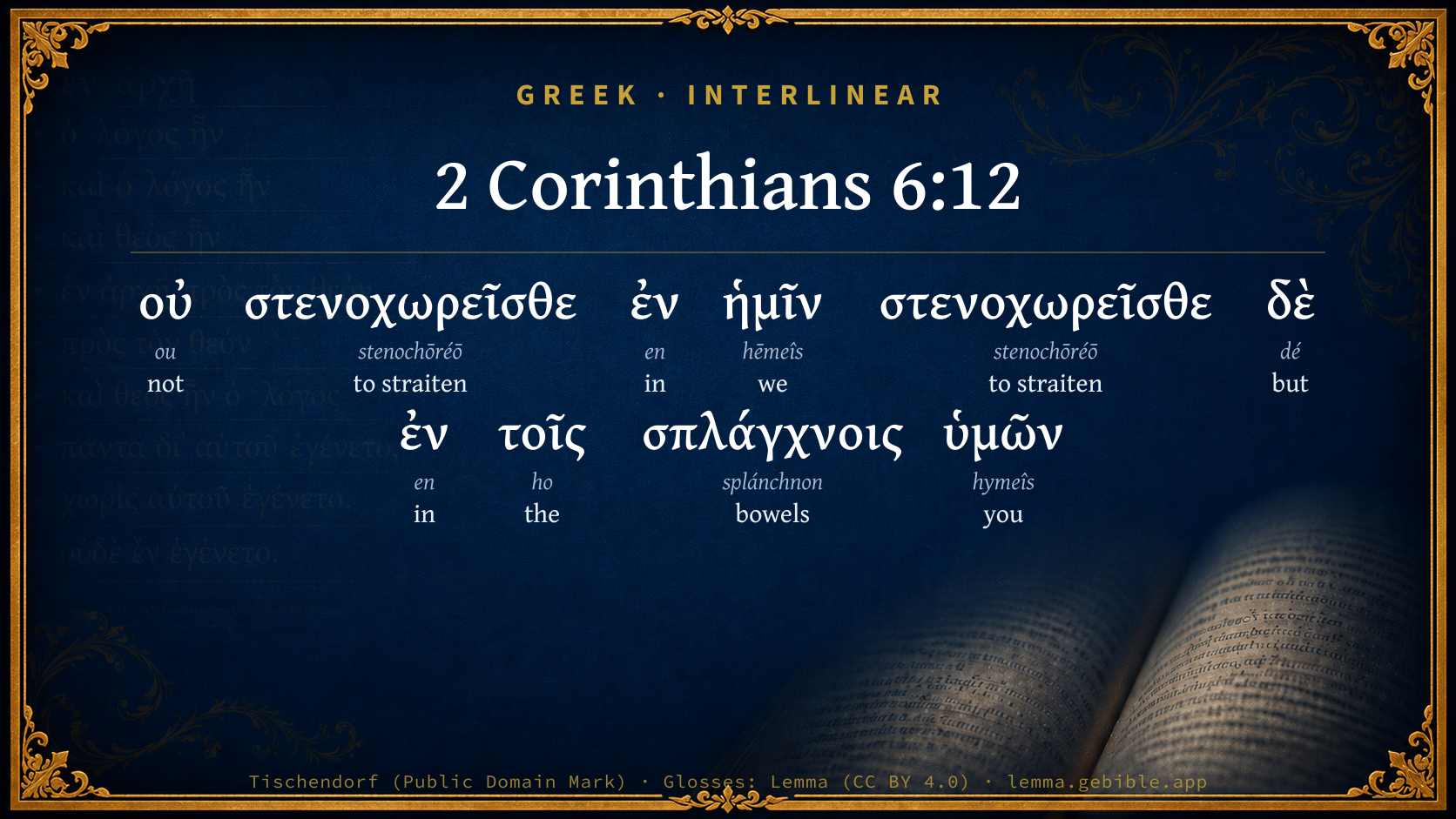
Greek (Tischendorf 8th ed.) 2 Corinthians 6:12 appears in the Greek New Testament. The text above is from the Tischendorf 8th edition. Each word links to its Strong’s number and a concise gloss. Click any word for its full Thayer’s Greek Lexicon entry.
Download image
Cite this verse

2 Corinthians 6:12 (World English Bible). Public Domain. Lemma interlinear Bible study tool, https://lemma.gebible.app/v/2-corinthians/6/12.

Show BibTeX & RIS
BibTeX
RIS
English Translation
You are not restricted by us, but you are restricted by your own affections.
World English Bible · Public Domain
Download a study sheet

One document with this verse’s original text, its word-by-word gloss line, the meaning frame, cross-references with their text, attributed commentary, and full source and license credits — printable, and it pastes into notes with its structure intact.

This verse Autodidact and up

Study sheet (.html) Plain text (.txt)

A passage Seminary Student

Up to 50 verses in one chapter. A passage sheet keeps up to 6 commentary sources and 12 cross-references per verse, in the order this page ranks them, and says so on the sheet whenever that leaves anything out. Ask for a single verse and you get the Autodidact verse sheet above.

Everything on this page stays free to read, with no account — the sheet is a download of what is already on screen, not access to it.

Want to remove ads? Support Godless Engineer
Compare translations 3

The same verse in 3 English versions, stacked beneath the original-language interlinear above. Click any original word for its lexicon entry.

Each is an independent rendering of the whole verse — the interlinear is not word-aligned to these translations.

Highlighted words mark where these versions differ — a whole-verse word diff, not a word-by-word alignment.

  • World English Bible Public Domain
    You are not restricted by us, but you are restricted by your own affections.
  • King James Version Public Domain
    Ye are not straitened in us, but ye are straitened in your own bowels.
  • unfoldingWord Literal Text CC BY-SA 4.0
    You are not restricted by us, but you are restricted by your affections;

unfoldingWord Literal Text — © unfoldingWord, licensed CC BY-SA 4.0. Word-aligned USFM3 via Door43 (git.door43.org/unfoldingWord/en_ult).

Versions to compare (up to 4)

3 of 4 selected

Show all 19 translations

Every available English version of this verse, each an independent rendering of the whole verse.

  • World English Bible Public Domain
    You are not restricted by us, but you are restricted by your own affections.
  • Berean Standard Bible Public Domain
    It is not our affection, but yours, that is restrained.
  • Majority Standard Bible Public Domain
    It is not our affection, but yours, that is restrained.
  • King James Version Public Domain
    Ye are not straitened in us, but ye are straitened in your own bowels.
  • American Standard Version (1901) Public Domain
    Ye are not straitened in us, but ye are straitened in your own affections.
  • Revised Version (1885) Public Domain
    Ye are not straitened in us, but ye are straitened in your own affections.
  • Geneva Bible (1599) Public Domain
    Ye are not kept strait in vs, but ye are kept strait in your owne bowels.
  • Douay-Rheims (1899) Public Domain
    You are not straitened in us, but in your own bowels you are straitened.
  • Young's Literal Translation Public Domain
    ye are not straitened in us, and ye are straitened in your `own' bowels,
  • Literal Standard Version CC BY-SA 4.0
    You are not restricted in us, and you are restricted in your [own] yearnings,
  • Unlocked Literal Bible CC BY-SA 4.0
    You are not restrained by us, but you are restrained in your own hearts.
  • unfoldingWord Literal Text CC BY-SA 4.0
    You are not restricted by us, but you are restricted by your affections;
  • Darby Bible Public Domain
    Ye are not straitened in us, but ye are straitened in your affections;
  • World Messianic Bible Public Domain
    You are not restricted by us, but you are restricted by your own affections.
  • Webster's Bible Public Domain
    Ye are not straitened in us, but ye are straitened in your own bowels.
  • Free Bible Version CC BY-SA 4.0
    We haven't kept our love from you, but you have kept your love from us.
  • Bible in Basic English Public Domain
    It is not our feelings to you which are narrow, but yours to us.
  • Text-Critical English NT CC BY 4.0
    You are not restricted by us, but by your own affections.
  • Tyndale New Testament (1534) Public Domain
    ye are in no strayte in vs but are in a strayte in youre awne bowelles:

Literal Standard Version (2020), Covenant Press — licensed CC BY-SA 4.0. Text via the HelloAO Bible API (eBible.org). Unlocked Literal Bible (unfoldingWord) — licensed CC BY-SA 4.0. Text via the HelloAO Bible API (eBible.org). unfoldingWord Literal Text — © unfoldingWord, licensed CC BY-SA 4.0. Word-aligned USFM3 via Door43 (git.door43.org/unfoldingWord/en_ult). Free Bible Version, Dr. Jonathan Gallagher — licensed CC BY-SA 4.0. Text via the HelloAO Bible API (eBible.org).

Word by word

More ways to search: Search by grammar → Find every occurrence → Compare this word →

Practice this passage: Drill this verse → Learn its vocabulary →

About this verse

These counts appear in no published source. They are computed here, from the morphology-tagged text and Lemma’s own curated glosses. What Lemma adds →

10
words
8
distinct lemmas
Pauline Epistles
section

Notable vocabulary

The rarest word here is στενοχωρεῖσθε to straiten G4729 — appearing just 3 times in the whole Greek New Testament.

Shared distinctive vocabulary

στενοχωρεῖσθε to straiten G4729 occurs in 2 verses of the Greek New Testament. Also found in:

Repetition

Words recur within this verse:

  • στενοχωρεῖσθε to straiten G4729 ×2
  • ἐν in G1722 ×2

Cross-references

7

Topical passages linked to 2 Corinthians 6:12 in the Treasury of Scripture Knowledge — connected by theme and wording, ordered by reader-vote popularity; previews shown in the World English Bible.

  • 2 Corinthians 7:2 Open your hearts to us. We wronged no one. We corrupted no one. We took advantage of no one.
  • Micah 2:7 Shall it be said, O house of Jacob: "Is the Spirit of Yahweh angry? Are these his doings? Don't my words do good to him who walks blamelessly?"
  • Philippians 1:8 For God is my witness, how I long after all of you in the tender mercies of Christ Jesus.
  • Job 36:16 Yes, he would have allured you out of distress, Into a broad place, where there is no restriction. That which is set on your table would be full of fatness.
  • 1 John 3:17 But whoever has the world's goods, and sees his brother in need, and closes his heart of compassion against him, how does the love of God remain in him?
  • Proverbs 4:12 When you go, your steps will not be hampered. When you run, you will not stumble.
  • Ecclesiastes 6:9 Better is the sight of the eyes than the wandering of the desire. This also is vanity and a chasing after wind.

Cross-references courtesy of OpenBible.info (CC BY 4.0).

Commentary

Notes on 2 Corinthians 6:12 from classic Christian and Jewish commentators (each source and its license shown beneath its notes). The classic Christian expositions comment on the surrounding passage and are grouped to its opening verse, so a note may address several verses; the Jewish commentaries on the Tanakh (Rashi and others) are per-verse, so they appear only where the commentator wrote on this verse.

Lemma curates 59 commentaries, every one of them public domain or Creative Commons licensed, each selected and text-cleaned for this edition rather than reprinted as found. About our sources →

Bengel's Gnomon

Johann Albrecht Bengel

2Co 6:12. Οὐ στενοχωρεῖσθε, ye are not straitened) The Indicative. The antithesis is, be ye enlarged [2Co 6:13].—ἐν ἡμῖν) in us. ἐν, in its strict sense, in, as at ch. 2Co 7:3. Our heart has sufficient room to take you in. The largeness of Paul’s heart is the same as that of the Corinthians, on account of their spiritual relationship, of which 2Co 6:13.—στενοχωρεῖσθε, ye are straitened) by the narrowness of your heart on account of your late offence.—ἐν τοῖς σπλάγχνοις ὑμῶν, in your bowels) which have been grieved on my account.

Bengel's Gnomon of the New Testament — English translation (T&T Clark, Edinburgh, 1860) — public domain. Text from a community e-Sword module.

Meyer's Critical & Exegetical Commentary

Heinrich August Wilhelm Meyer

2Co_6:12. A negative confirmation of the ἡ καρδία ἡμ. πεπλάτ. just said, and opposite state of matters on the part of the Corinthians.

Not straitened are ye in us, but straitened in your innermost part (σπλ., the seat of love, like καρδία, 2Co_6:11, to which the expression stands related under the increasing emotion by way of climax). The meaning of it is: valde vos amo, non item vos me. It is impossible, on account of the οὐ, to take it as an imperative (Aretius, Luther, Heumann, Morus, Schleusner).

οὐ στενοχ. ἐν ἡμῖν] non angusto spatio premimini in animis nostris: in this Paul retains the figure of the previous ἡ καρδ. ἡμ. πεπλάτ. Chrysostom aptly says: ὁ γὰρ φιλούμενος μετὰ πολλῆς ἔνδον ἐν τῇ καρδίᾳ τοῦ φιλοῦντος βαδίζει τῆς ἀδείας. Comp. 2Co_7:3; Php_1:7. The negative expression is an affectionate, pathetic litotes, to be followed by an equally affectionate paternal reproof. This is explanation enough, and dispenses with the hypothesis that Paul is referring to the opinion of the church, that it had too narrow a spacea smaller place than it wishedin his heart (Hofmann). Those who interpret πλατ., 2Co_6:11, as to cheer, take the meaning to be: not through us do ye become troubled, but through yourselves (Kypke, Flatt; comp. Elsner, Estius, Wolf, Zachariae, Schrader; comp. also Luther),a thought, however, which is foreign to the whole connection; hence Flatt also assumes that Paul has 2Co_7:2 ff. already in his thoughts; and Schrader explains 2Co_6:14 to 2Co_7:1 as an interpolation.[249]

στενοχ. δὲ ἐν τ. σπλ. ὑμ.] so that there is in them no right place for us (comp. 1Jn_3:17). Chrysostom: οὐκ εἶπεν· οὐ φιλεῖτε ἡμᾶς, ἀλλʼ· οὐ μετὰ τοῦ αὐτοῦ μέτρου. Paul did not write στενοχωρούμεθα δὲ ἡμεῖς ἐν τοῖς σπλ. ἡμ., because by this the contrast would have passed from the thing to the persons (for he had not, in fact, written οὐχ ὑμεῖς στενοχωρ. ἐν ἡμῖν), and so the passage would have lost in fitting concert and sharp force. Rückert thinks that Paul refers in 2Co_6:12 to an utterance of the Corinthians, who had said: στενωχορούμεθα ἐν αὐτῷ! meaning, we are perplexed at him, and that now he explains to them how the matter stood with this στενοχωρεῖσθαι, but takes the word in another sense than they themselves had done. A strangely arbitrary view, since the use of the στενοχωρεῖσθαι in our passage was occasioned very naturally and completely by the previous πεπλάτ. Comp. Chrysostom, Theodoret.

[249] Emmerling explains this section 2Co_6:14 to 2Co_7:1 to be, not an interpolation, but a disturbing addition, only inserted by Paul on reading over the Epistle again, sententiis subito in animo exortis. And recently Ewald has explained it as an inserted fragment from another Epistle, proceeding probably only from some apostolic man, to a Gentile Christian church. But (1) the apparent want of fitting in to the connection, even if it did exist (but see on ver. 14), would least of all warrant this view in the case of an Epistle written under so lively emotion. (2) The contents are quite Pauline, and sufficiently ingenious. (3) The name βελίαρ, which does not occur elsewhere in Scripture, is not evidence against Paul, since in his Epistles (the Pastoral ones excepted) even the name διάβολος, so current elsewhere, occurs only at two passages of the Epistle to the Ephesians. Besides, the συμφών. Χριστῷ πρὸς βελίαρ may be an echo of some apocryphal utterance known to the readers (comp. Eph_5:14). (4) The expressions μετοχή (comp. μετέχειν, 1Co_9:10, al.), μερές (comp. Col_1:12), συμφώνησις (comp. σύμφωνος, 1Co_7:5), καθαρίζα (comp. Eph_5:26), cannot, any more than συγκατάθεσις which he does not use elsewhere, excite well-grounded suspicion in the case of one so rich in handling the language. (5) The critical evidence gives not the slightest trace of ground for assuming that the section did not originally stand in all the manuscripts. How different it is with passages really interpolated, such as Mar_16:9 ff.; Joh_7:33 ff.! Yet Holsten has also, zur Evang. d. Paul. u. Petr. p. 387, assented to the condemnation of the section.

Meyer — Critical and Exegetical Commentary on the New Testament — English translation by Peter Christie, edited by Frederick Crombie (T&T Clark, 1880) — public domain. Text from a community e-Sword module.

Expositor's Greek Testament

ed. W. Robertson Nicoll

2Co 6:12 . οὐ στενοχωρεῖσθε ἐν ἡμῖν κ . τ . λ .: ye are not straitened in us (this carries on the metaphor of πεπλάτυνται ), but ye are straitened in your own affections; i.e. , his adversaries at Corinth may have said that he was a man of narrow sympathies, and that there was no room in his heart for his Corinthian converts, but, in fact, the lack of sympathy was on their side it is they that are “narrow-minded”. τὰ σπλάγχνα = the upper viscera, i.e. , the heart, lungs and liver, the vital parts, and so may be rendered “the affections”.

The Expositor's Greek Testament, edited by W. Robertson Nicoll (1897–1910) — public domain. Text from a community e-Sword module.

Geneva Bible (1599)

Geneva Bible translators

After the manner of the Hebrews, he calleth those tender affections which rest in the heart, bowels.

You are in mine heart, as in an house, and that no narrow or strait house, for I have opened my whole heart to you, but you are inwardly straitlaced to me-ward.

Geneva Bible (1599) marginal notes — public domain. Text via Bolls.life.

Jamieson, Fausset & Brown

Robert Jamieson, A. R. Fausset & David Brown

Any constraint ye feel towards me, or narrowness of heart, is not from want of largeness of heart on my part towards you, but from want of it on your part towards me.

bowels--that is, affections (compare Co2 12:15).

not straitened in us--that is, for want of room in our hearts to take you in.

Jamieson, Fausset & Brown — Commentary Critical and Explanatory on the Whole Bible (1871) — public domain (CC PDM 1.0). Text via the HelloAO Bible API.

Adam Clarke's Commentary

Verse 12. Ye are not straitened in us] That is, Ye have not a narrow place in our affections: the metaphor here is taken from the case of a person pent up in a small or narrow place, where there is scarcely room to breathe.

Ye are straitened in your own bowels.] I have not the same place in your affections which you have in mine. The bowels are used in Scripture to denote the most tender affections. See Clarke on Mt 9:36.

Adam Clarke's Commentary on the Bible (1810–1826) — public domain. Text from a community e-Sword/MySword module.

John Calvin's Commentaries

12. Ye are not straitened in us That is, “It is owing to your own fault that you are not able to share in this feeling of cheerfulness, which I entertain towards you. My mouth is opened, so that I deal familiarly with you, my very heart would willingly pour itself forth, but you shut up your bowels.” He means to say, that it is owing to their corrupt judgment, that the things that he utters are not relished by them.

John Calvin's Commentaries (1540-1563) — public domain. Text from the Calvin Translation Society English edition (1840s-50s) via the Christian Classics Ethereal Library (ccel.org). Calvin's coverage is partial (roughly two-thirds of the Bible); uncommented books and verses are honest gaps, never fabricated. The 19th-century editor's footnotes and remarks are omitted so the notes are faithfully Calvin's own voice.

Ellicott's Commentary for English Readers

(12) Ye are not straitened in us.—The word presents a natural contrast to the expansion, the dilatation, of heart of the previous verse. There was no narrowness in him. In that large heart of his there was room for them and for a thousand others. It had, as it were, an infinite elasticity in its sympathies. The narrowness was found in their own “bowels”—i.e., in their own affections. They would not make room for him in those hearts that were so straitened by passions, and prejudices, and antipathies.

A Bible Commentary for English Readers, edited by Charles John Ellicott (1878–1897) — public domain. Text from a community e-Sword module.

The Cambridge Bible for Schools and Colleges

gen. ed. J. J. S. Perowne

12. Ye are not straitened in us, but ye are straitened in your own bowels] i.e. “our heart is large enough to receive you and give you full possession of our affections, but yours is too narrow to receive any one but yourselves;” for such would seem to be the meaning hinted at, though not fully expressed, by the Apostle. The word bowels is a Hebraism for loving-kindness. As instances of its use in the O. T., take Son_5:4; Isa_16:11; and in the New, Php_2:1. For straitened (angwischid, Wiclif) see note on ch. 2Co_4:8. The original meaning of the word is to coop up in a narrow space. The word strait in the sense of narrow (Latin, strictus) was a common phrase when the A. V. was made. e.g. Mat_7:13. It survives in modern English in such words as straits, strait-waistcoat.

The Cambridge Bible for Schools and Colleges (gen. ed. J. J. S. Perowne; Cambridge University Press, 1878–1918) — public domain. Text from a community e-Sword module.

John Gill's Exposition

Now for a recompence in the same,.... That your love to me may answer mine to you; that as you have my heart, I may have yours, and the same room in your heart, as you have in mine. The Vulgate Latin version reads, "having the same recompence"; and the Arabic version renders it, "grant to me the same recompence"; and the Syriac version, "recompense to me my usuries that are with you"; that is, repay me with affection, let love be returned for love.

I speak as unto my children; which relation subsisting between us requires mutual affection; for as a father should love his children, so children should love their father:

be ye also enlarged; in your love to me, as I am to you; and then, as if he should say, you will bear with, and take in good part the following exhortation and advice.

John Gill's Exposition of the Whole Bible (1746–1763) — public domain (CC PDM 1.0). Text via the HelloAO Bible API.

Trapp's Complete Commentary

John Trapp

12 Ye are not straitened in us, but ye are straitened in your own bowels.

Ver. 12. Ye are not straitened in us] Non habitatis anguste in nobis; so Piscator renders it.

But ye are straitened] Ye are bankrupts in love, ye comply not, ye do not reciprocate. Plain things will join every point one with another; not so round and rugged things.

John Trapp, A Commentary or Exposition upon All the Books of the Old and New Testament (1647–1656) — public domain. Text from a community e-Sword module.

Albert Barnes' Notes on the Bible

Ye are not straitened in us - That is, you do not possess a narrow or contracted place in our affections. We love you fully, ardently, and are ready to do all that can be done for your welfare. There is no lack of room in our affections toward you. It is not narrow, confined, pent up. It is ample and free.

But ye are straitened in your own bowels - That is, in the affections of your hearts. The word used here (σπλάγχνα splangchna) commonly means in the Bible the tender affections. The Greek word properly denotes the upper viscera; the heart, the lungs, the liver. It is applied by Greek writers to denote those parts of victims which were eaten during or after the sacrifice - Robinson (Lexicon). Hence, it is applied to the heart, as the seat of the emotions and passions; and especially the gentler emotions, the tender affections, compassion, pity, love, etc. Our word “bowels” is applied usually to the lower viscera, and by no means expresses the idea of the word which is used in Greek. The idea here is, that they were straitened, or were confined in their affections for him. It is the language of reproof, meaning that he had not received from them the demonstrations of attachment which he had a right to expect, and which was a fair and proportionate return for the love bestowed on them. Probably he refers to the fact that they had formed parties; had admitted false teachers; and had not received his instructions as implicitly and as kindly as they ought to have done.

Albert Barnes' Notes on the Bible (1834–1885) — public domain. Text from a community e-Sword/MySword module.

Matthew Poole's English Annotations

Ye are not straitened in us; if you cannot mutually rejoice in me, and what I write, or if you do not repay me the like affection, the fault is not in me; I have done my duty, and that too from a true principle of love to you.

But ye are straitened in your own bowels; but it is through mistakes and misapprehensions in yourselves, your not aright conceiving of me in the discharge of my apostolical office. Or the cause of your trouble and sorrow is from yourselves, upon your suffering the incestuous person, and other scandalous persons, to abide in your communion; which was an error I could not but take notice of, according to that apostolical authority which God hath committed to me.

Matthew Poole's English Annotations on the Holy Bible (1683–1685) — public domain. Text from a community e-Sword/MySword module.

Whedon's Commentary on the Bible

Daniel D. Whedon

12. Straitened—Narrowed; as being closely squeezed by a narrow entrance or small apartment.

In us—In our hearts. The Corinthians were tightened, but not by or in the narrowness of the apostolic soul.

Straitened in your own bowels—Narrowed and contracted in your own affections. The apostle is, indeed, aroused to free, bold, copious plainness of declaration.

Bowels—The inwards or intestines, which, being often excited by aroused feeling, become the physical term for the feeling or its abode.

Daniel D. Whedon (gen. ed.), Commentary on the Old and New Testaments (1874–1909) — public domain. Text from a community e-Sword module.

The Pulpit Commentary

Ye are not straitened in us. Any narrowing of the sympathy or straining of the relations between us does not rise in any way from me. (For the verb, see 2Co_4:8) Ye are straitened in your own bowels; rather, in your own hearts. Any tightening or pressure of the feelings which should exist between us rises solely from your own hearts. Enlarge and open them, as I have done, and we shall once more love each other aright. The verb has already occurred in 2Co_4:8 ("distressed") Your own bowels. It is to be regretted that the Authorized Version adopted the meaningless and often rather incongruous word "bowels" for the Greek word splagcna used in its Hebraic sense of "feelings," "affections" (Son_5:4; Isa_16:11) This literalism is always out of place, and especially in Phm_1:7, 12, 20.

Where are men straitened?

The apostle, in an intense outburst of feeling, bad just said, "O ye Corinthians, our mouth is open unto you, our heart is enlarged." He was referring to that opening of his ministry, and disclosure of his love for them, which filled the previous part of the chapter. And so he is led to ask from them a worthy response. He would have his love quicken love. He wanted it to break down the barriers and enmities and prejudices which were so sadly limiting the confidence of the Corinthians in St. Paul. So he pleads with them, "Ye are not straitened in us;" there is no limit of our love to you; "but ye are straitened in your own bowels," your own affections, which are sadly kept in bondage by your passions and prejudices and antipathies; by misrepresentations of me and my doings, and the influence of unworthy teachers. Then he urges them to break the bonds, to be enlarged, and to let their hearts express the love they feel. What they needed in their spiritual life was breadth and expansiveness of affection. There is suggested by the apostle"s words a series of contrasts between

I THE LIMITED IDEAS AND AFFECTIONS OF MEN. Who are straitened by ignorance, imperfect character, prejudice, false sentiments, readiness to misjudge and to impute bad motive, etc.

II THE BROAD IDEAS AND AFFECTIONS OF APOSTLES. Who see in men souls to be redeemed unto God, and, labouring for men"s spiritual and eternal well being, can rise above the smaller occasions of difference and separation.

III THE SUBLIME IDEAS AND AFFECTIONS OF GOD IN CHRIST. Who would have all men saved; who loved the world; whose love found expression in self-sacrifice; and whose invitations now are sent to whosoever will. No man is straitened in God. "When my father and mother forsake me, then the Lord will take me up." In his heart and home there "yet is room." Men are straitened, limited, in themselves, not in God, not in the gospel, not in Christian teachers. They forge, and fix on, their own bondages. R.T.

The Pulpit Commentary (1880–1919), ed. H.D.M. Spence-Jones & Joseph S. Exell — public domain. Text from a community e-Sword module.

John Wesley's Explanatory Notes

Ye are not straitened in us - Our heart is wide enough to receive you all. But ye are straitened in your own bowels - Your hearts are shut up, and so not capable of the blessings ye might enjoy.

John Wesley, Explanatory Notes Upon the Whole Bible (1754–1765) — public domain. Text via the GEBible commentary corpus.

McGarvey & Pendleton's Commentaries

J. W. McGarvey

Ye are not straitened in us, but ye are straitened in your own affections .

J. W. McGarvey (with Philip Y. Pendleton), Commentaries on the New Testament (The Fourfold Gospel, 1914; Acts; and the epistles) — public domain. Text from a community e-Sword/MySword module.

The People's New Testament

B. W. Johnson

12. Ye are not straitened in us. Our heart is large enough to embrace you all. It is you who are straitened; your hearts are confined so that you do not give me free admission. After the noble portraiture of what he suffered for them, he proceeds to affectionate entreaty.

B. W. Johnson's The People's New Testament with Notes (1889–1891) — public domain. Electronic text from the Christian Classics Ethereal Library (CCEL) ThML edition.

Cambridge Greek Testament for Schools and Colleges

12. στενοχωρεῖσθε δὲ ἐν τοῖς σπλάγχνοις ὑμῶν. See on 2Co 4:8. If there is not τελεία ἀγάπη between them and him, the reason is, not that he has little room in his heart for them, but that they have no room in their affections for him. They were too full of prejudice and suspicion and unfounded resentment to admit the love which οὐ παροξύνεται, οὐ λογίζεται τὸ κακόν, πάντα ἐλπίζει (1Co 13:5-6). There seems to be no special point in the change from his καρδία to their σπλάγχνα beyond the avoidance of repetition. In both cases the seat of the affections is meant. The σπλάγχνα include the heart, lungs, and liver, rather than the bowels. See Lightfoot on Php 1:8; Php 2:1; Phm 1:12. Comp. κλείσῃ τὰ σπλάγχνα αὐτοῦ ἀπʼ αὐτοῦ (1Jn 3:17).

Cambridge Greek Testament for Schools and Colleges (Cambridge University Press, 1896; 21 vols, various authors incl. Carr, Maclear, Plummer, Farrar, Lumby, Moule, M. R. James, Simcox) — public domain. Text from a community e-Sword module.

Alford’s Greek Testament

Henry Alford

12.] that they are not straitened in him, i.e. that any constraint which they may feel towards him, any want of confidence in him and persuasion of his real appreciation of their state and interests, arose, not from his being really unable to appreciate them, and love them, and advise them,—but from their own confined view of him, of his love, his knowledge of and feeling for them.

Henry Alford, The Greek Testament (1849–1861) — public domain. Text from a community e-Sword module.

International Critical Commentary

12. οὐ στενοχωρεῖσθε ἐν ἡμῖν. ‘There is no restraint on my side; but whatever restraint there is is in your hearts.’ He had perhaps been accused of being close and reserved. Like the rapid changes of expression in vv. 14-16, the change from his καρδία to their σπλάγχνα is made to avoid repetition of the same word. In both cases the seat of the affections is meant. ‘Bowels’ is an unfortunate rendering; the word means the upper part of the intestines, heart, liver, lungs, etc. “Theophilus (ad Autol. ii. 10, 22) uses σπλάγχνα and καρδία as convertible terms” (Lightfoot on Php 1:8). Many things cause the heart to close against others, meanness, suspicion, resentment for supposed injury. Are they quite free from all these things? 1Jn 3:17.

International Critical Commentary — older volumes (1896–1929), various authors — public domain. Text from a community e-Sword module.

Vincent's Word Studies in the New Testament

Marvin R. Vincent

Not straitened in us. It is not that our hearts are too narrow to take you in. Straitened in antithesis with enlarged.

In your own bowels [τοις οπλαγχνοις υμων] . See on 1Pe 3:8; Jas 5:11. Rev., affections. It is your love that is contracted.

Marvin R. Vincent, Word Studies in the New Testament (1887–1900) — public domain. Text from a community e-Sword/MySword module.

Lesson kit

Teaching starters — assembled from the data on this page, not authored interpretation. Every prompt links to the verse data it draws on. Edit before teaching.

2 Corinthians, in the Pauline Epistles, opens this verse with 10 words (8 distinct Greek lemmas). Its most distinctive word is stenochōréō (“to straiten”). A historical commentator’s framing appears above. Read the whole chapter for the surrounding context.

Discussion questions

  1. How does “to straiten” (stenochōréō) shape what this verse is saying?
  2. How does 2 Corinthians 4:8, which shares the word «to straiten», read alongside this verse?
  3. What does the repetition of “to straiten” (2× in this one verse) do in this verse?
  4. These translations render this verse differently. What is at stake in choosing one wording over another?
  5. Compare how Bengel's Gnomon and Meyer's Critical & Exegetical Commentary read this verse. Where do they agree or differ?

Things to notice

  • These translations choose different wording for 6 words in this verse.
  • “to straiten” occurs 2× in this single verse.
  • 8 distinct Greek lemmas span 10 words in this verse.

Reading settings

Reading text

Shown beneath each verse's original-language words.

Old Testament
Old Testament edition

Read the OT as the Masoretic Hebrew (MT) or the Greek Septuagint (LXX).

English shown for the Greek Septuagint (in the Hebrew ↔ Greek comparison).

Comparing translations? Open the Compare panel on any verse page to stack up to four side by side.