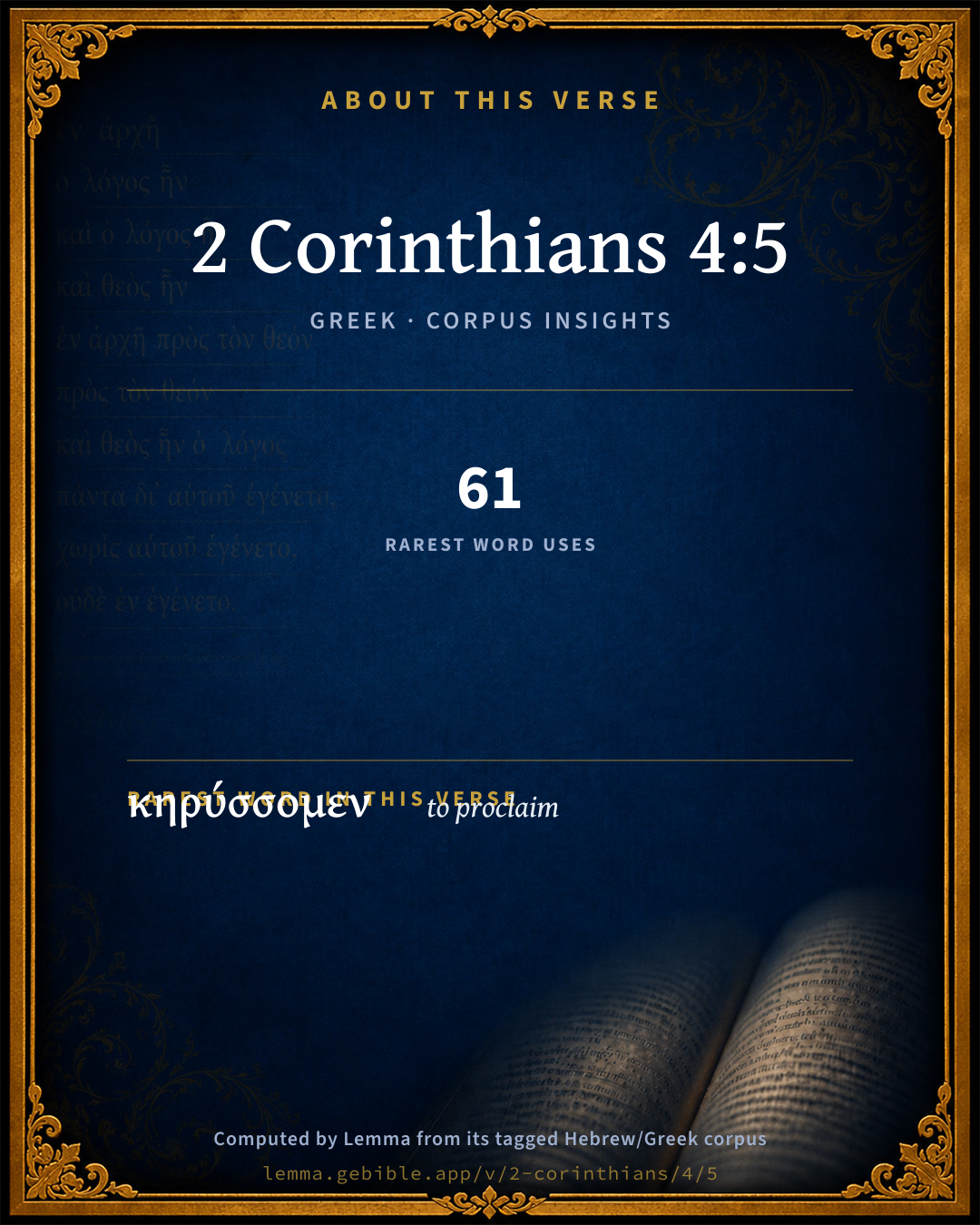
2 Corinthians 4:5

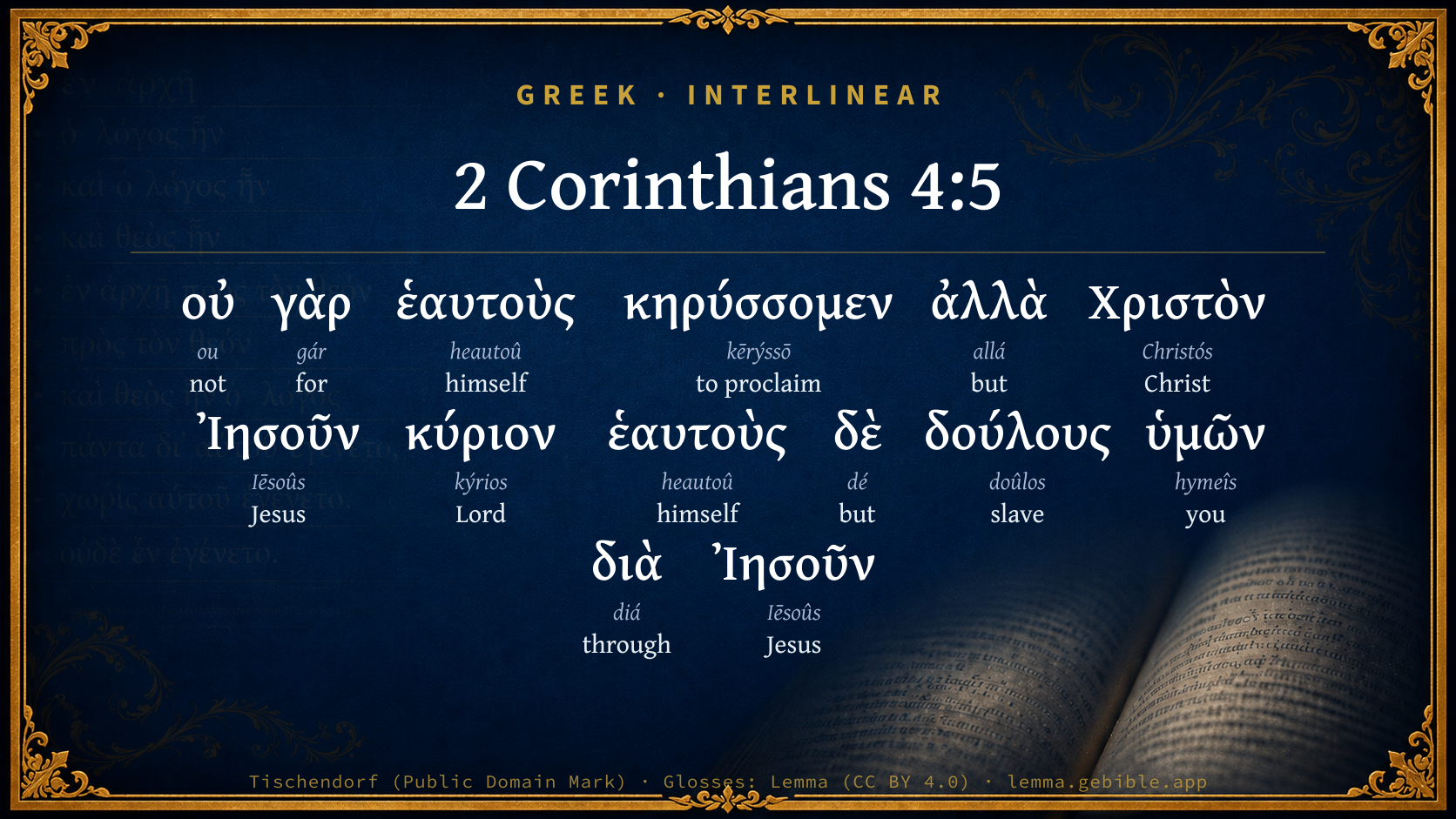
Greek (Tischendorf 8th ed.) 2 Corinthians 4:5 appears in the Greek New Testament. The text above is from the Tischendorf 8th edition. Each word links to its Strong’s number and a concise gloss. Click any word for its full Thayer’s Greek Lexicon entry.
Download image
Cite this verse

2 Corinthians 4:5 (World English Bible). Public Domain. Lemma interlinear Bible study tool, https://lemma.gebible.app/v/2-corinthians/4/5.

Show BibTeX & RIS
BibTeX
RIS
English Translation
For we don't preach ourselves, but Christ Jesus as Lord, and ourselves as your servants for Jesus' sake;
World English Bible · Public Domain
Download a study sheet

One document with this verse’s original text, its word-by-word gloss line, the meaning frame, cross-references with their text, attributed commentary, and full source and license credits — printable, and it pastes into notes with its structure intact.

This verse Autodidact and up

Study sheet (.html) Plain text (.txt)

A passage Seminary Student

Up to 50 verses in one chapter. A passage sheet keeps up to 6 commentary sources and 12 cross-references per verse, in the order this page ranks them, and says so on the sheet whenever that leaves anything out. Ask for a single verse and you get the Autodidact verse sheet above.

Everything on this page stays free to read, with no account — the sheet is a download of what is already on screen, not access to it.

Want to remove ads? Support Godless Engineer
Compare translations 3

The same verse in 3 English versions, stacked beneath the original-language interlinear above. Click any original word for its lexicon entry.

Each is an independent rendering of the whole verse — the interlinear is not word-aligned to these translations.

Highlighted words mark where these versions differ — a whole-verse word diff, not a word-by-word alignment.

  • World English Bible Public Domain
    For we don't preach ourselves, but Christ Jesus as Lord, and ourselves as your servants for Jesus' sake;
  • King James Version Public Domain
    For we preach not ourselves, but Christ Jesus the Lord; and ourselves your servants for Jesus' sake.
  • unfoldingWord Literal Text CC BY-SA 4.0
    For we do not proclaim ourselves, but the Lord Christ Jesus, and ourselves your servants for Jesus’ sake.

unfoldingWord Literal Text — © unfoldingWord, licensed CC BY-SA 4.0. Word-aligned USFM3 via Door43 (git.door43.org/unfoldingWord/en_ult).

Versions to compare (up to 4)

3 of 4 selected

Show all 19 translations

Every available English version of this verse, each an independent rendering of the whole verse.

  • World English Bible Public Domain
    For we don't preach ourselves, but Christ Jesus as Lord, and ourselves as your servants for Jesus' sake;
  • Berean Standard Bible Public Domain
    For we do not proclaim ourselves, but Jesus Christ as Lord, and ourselves as your servants for Jesus’ sake.
  • Majority Standard Bible Public Domain
    For we do not proclaim ourselves, but Christ Jesus as Lord, and ourselves as your servants for Jesus’ sake.
  • King James Version Public Domain
    For we preach not ourselves, but Christ Jesus the Lord; and ourselves your servants for Jesus' sake.
  • American Standard Version (1901) Public Domain
    For we preach not ourselves, but Christ Jesus as Lord, and ourselves as your servants for Jesus' sake.
  • Revised Version (1885) Public Domain
    For we preach not ourselves, but Christ Jesus as Lord, and ourselves as your servants for Jesus’ sake.
  • Geneva Bible (1599) Public Domain
    For we preach not our selues, but Christ Iesus the Lord, and our selues your seruaunts for Iesus sake.
  • Douay-Rheims (1899) Public Domain
    For we preach not ourselves, but Jesus Christ our Lord; and ourselves your servants through Jesus.
  • Young's Literal Translation Public Domain
    for not ourselves do we preach, but Christ Jesus -- Lord, and ourselves your servants because of Jesus;
  • Literal Standard Version CC BY-SA 4.0
    for we do not preach ourselves, but Christ Jesus—LORD, and [we are] ourselves your servants because of Jesus;
  • Unlocked Literal Bible CC BY-SA 4.0
    For we do not proclaim ourselves, but Christ Jesus as Lord, and ourselves as your servants for Jesus' sake.
  • unfoldingWord Literal Text CC BY-SA 4.0
    For we do not proclaim ourselves, but the Lord Christ Jesus, and ourselves your servants for Jesus’ sake.
  • Darby Bible Public Domain
    For we do not preach ourselves, but Christ Jesus Lord, and ourselves your bondmen for Jesus' sake.
  • World Messianic Bible Public Domain
    For we don’t proclaim ourselves, but Messiah Yeshua as Lord, and ourselves as your servants for Yeshua’s sake,
  • Webster's Bible Public Domain
    For we preach not ourselves, but Christ Jesus the Lord; and ourselves your servants for Jesus' sake.
  • Free Bible Version CC BY-SA 4.0
    We are not promoting ourselves, but Christ Jesus as Lord. In fact we are your servants for Jesus' sake.
  • Bible in Basic English Public Domain
    For our preaching is not about ourselves, but about Christ Jesus as Lord, and ourselves as your servants through Jesus.
  • Text-Critical English NT CC BY 4.0
    For what we preach is not ourselves, but Christ Jesus as Lord, and ourselves as your servants for Jesus' sake.
  • Tyndale New Testament (1534) Public Domain
    For we preache not oure selves but Christ Iesus to be the Lorde and oure selves youre servautes for Iesus sake.

Literal Standard Version (2020), Covenant Press — licensed CC BY-SA 4.0. Text via the HelloAO Bible API (eBible.org). Unlocked Literal Bible (unfoldingWord) — licensed CC BY-SA 4.0. Text via the HelloAO Bible API (eBible.org). unfoldingWord Literal Text — © unfoldingWord, licensed CC BY-SA 4.0. Word-aligned USFM3 via Door43 (git.door43.org/unfoldingWord/en_ult). Free Bible Version, Dr. Jonathan Gallagher — licensed CC BY-SA 4.0. Text via the HelloAO Bible API (eBible.org).

Word by word

More ways to search: Search by grammar → Find every occurrence → Compare this word →

Practice this passage: Drill this verse → Learn its vocabulary →

κηρύσσομεν
kērýssō
G2784
“to proclaim”
Verb, Present, Active, Indicative, 1st person, Plural
Part of Speech
Verb
Tense
Present
Voice
Active
Mood
Indicative
Person
1st person
Number
Plural
Full Thayer's Definition

Origin: of uncertain affinity

TDNT: 14:37,4

1. to be a herald, to officiate as a herald a. to proclaim after the manner of a herald b. always with the suggestion of formality, gravity and an authority which must be listened to and obeyed 2. to publish, proclaim openly: something which has been done 3. used of the public proclamation of the gospel and matters pertaining to it, made by John the Baptist, by Jesus, by the apostles and other Christian teachers
  1. οὐ ou G3756 “not” Particle, Negative
  2. γὰρ gár G1063 “for” Conjunction
  3. ἑαυτοὺς heautoû G1438 “himself” Reflexive pronoun, 1st person, Accusative, Plural, Masculine
  4. ἀλλὰ allá G235 “but” Conjunction
  5. Χριστὸν Christós G5547 “Christ” Noun, Accusative, Singular, Masculine
  6. Ἰησοῦν Iēsoûs G2424 “Jesus” Noun, Accusative, Singular, Masculine
  7. κύριον kýrios G2962 “Lord” Noun, Accusative, Singular, Masculine
  8. ἑαυτοὺς heautoû G1438 “himself” Reflexive pronoun, 1st person, Accusative, Plural, Masculine
  9. δὲ dé G1161 “but” Conjunction
  10. δούλους doûlos G1401 “slave” Noun, Accusative, Plural, Masculine
  11. ὑμῶν hymeîs G5210 “you” Personal pronoun, 2nd person, Genitive, Plural
  12. διὰ diá G1223 “through” Preposition
  13. Ἰησοῦν Iēsoûs G2424 “Jesus” Noun, Accusative, Singular, Masculine

About this verse

These counts appear in no published source. They are computed here, from the morphology-tagged text and Lemma’s own curated glosses. What Lemma adds →

14
words
12
distinct lemmas
Pauline Epistles
section

Repetition

Words recur within this verse:

  • ἑαυτοὺς himself G1438 ×2
  • Ἰησοῦν Jesus G2424 ×2

Cross-references

38

Topical passages linked to 2 Corinthians 4:5 in the Treasury of Scripture Knowledge — connected by theme and wording, ordered by reader-vote popularity; previews shown in the World English Bible.

  • 1 Corinthians 1:23 but we preach Christ crucified; a stumbling block to Jews, and foolishness to Greeks,
  • 2 Corinthians 1:24 Not that we have lordship over your faith, but are fellow workers with you for your joy. For you stand firm in faith.
  • 1 Thessalonians 2:5–6 For neither were we at any time found using words of flattery, as you know, nor a cloak of covetousness (God is witness),
  • Galatians 5:13 For you, brothers, were called for freedom. Only don't use your freedom for gain to the flesh, but through love be servants to one another.
  • 2 Corinthians 5:14–15 For the love of Christ constrains us; because we judge thus, that one died for all, therefore all died.
  • Philippians 1:15 Some indeed preach Christ even out of envy and strife, and some also out of good will.
  • Philippians 2:11 and that every tongue should confess that Jesus Christ is Lord, to the glory of God the Father.
  • 1 Corinthians 1:13–15 Is Christ divided? Was Paul crucified for you? Or were you baptized into the name of Paul?
  • 1 Corinthians 3:5–6 Who then is Apollos, and who is Paul, but servants through whom you believed; and each as the Lord gave to him?
  • 1 Corinthians 9:19–23 For though I was free from all, I brought myself under bondage to all, that I might gain the more.
  • 2 Timothy 2:10 Therefore I endure all things for the chosen ones' sake, that they also may obtain the salvation which is in Christ Jesus with eternal glory.
  • Titus 1:11 whose mouths must be stopped; men who overthrow whole houses, teaching things which they ought not, for dishonest gain's sake.
  • 2 Peter 2:3 In covetousness they will exploit you with deceptive words: whose sentence now from of old doesn't linger, and their destruction will not slumber.
  • Matthew 3:11 I indeed baptize you in water for repentance, but he who comes after me is mightier than I, whose shoes I am not worthy to carry. He will baptize you in the Holy Spirit.
  • Matthew 20:25–27 But Jesus summoned them, and said, "You know that the rulers of the Gentiles lord it over them, and their great ones exercise authority over them.
  • Matthew 23:8 But don't you be called 'Rabbi,' for one is your teacher, the Christ, and all of you are brothers.
  • Luke 22:25–26 He said to them, "The kings of the Gentiles lord it over them, and those who have authority over them are called 'benefactors.'
  • John 1:21–23 They asked him, "What then? Are you Elijah?" He said, "I am not." "Are you the Prophet?" He answered, "No."
  • John 3:27–31 John answered, "A man can receive nothing, unless it has been given him from heaven.
  • John 7:18 He who speaks from himself seeks his own glory, but he who seeks the glory of him who sent him, the same is true, and no unrighteousness is in him.
  • John 13:14–15 If I then, the Lord and the Teacher, have washed your feet, you also ought to wash one another's feet.
  • Acts 2:36 "Let all the house of Israel therefore know assuredly that God has made him both Lord and Christ, this Jesus whom you crucified."
  • Acts 3:12–13 When Peter saw it, he responded to the people, "You men of Israel, why do you marvel at this man? Why do you fasten your eyes on us, as though by our own power or godliness we had made him walk?
  • Acts 5:31 God exalted him with his right hand to be a Prince and a Savior, to give repentance to Israel, and remission of sins.
  • Acts 8:9–10 But there was a certain man, Simon by name, who used to practice sorcery in the city, and amazed the people of Samaria, making himself out to be some great one,
  • Acts 10:25–26 When it happened that Peter entered, Cornelius met him, fell down at his feet, and worshiped him.
  • Acts 10:36 The word which he sent to the children of Israel, preaching good news of peace by Jesus Christ--he is Lord of all--
  • Acts 14:11–15 When the multitude saw what Paul had done, they lifted up their voice, saying in the language of Lycaonia, "The gods have come down to us in the likeness of men!"
  • Romans 14:8–9 For if we live, we live to the Lord. Or if we die, we die to the Lord. If therefore we live or die, we are the Lord's.
  • Romans 15:1–2 Now we who are strong ought to bear the weaknesses of the weak, and not to please ourselves.
  • Romans 15:17–18 I have therefore my boasting in Christ Jesus in things pertaining to God.
  • 1 Corinthians 2:2 For I determined not to know anything among you, except Jesus Christ, and him crucified.
  • 1 Corinthians 8:6 yet to us there is one God, the Father, of whom are all things, and we for him; and one Lord, Jesus Christ, through whom are all things, and we live through him.
  • 1 Corinthians 12:3 Therefore I make known to you that no man speaking by God's Spirit says, "Jesus is accursed." No one can say, "Jesus is Lord," but by the Holy Spirit.
  • 1 Peter 5:2–5 Shepherd the flock of God which is among you, exercising the oversight, not under compulsion, but voluntarily, not for dishonest gain, but willingly;
  • 1 Corinthians 10:33 even as I also please all men in all things, not seeking my own profit, but the profit of the many, that they may be saved.
  • 1 Corinthians 15:47 The first man is of the earth, made of dust. The second man is the Lord from heaven.
  • 2 Corinthians 1:19 For the Son of God, Jesus Christ, who was preached among you by us, by me, Silvanus, and Timothy, was not "Yes and no," but in him is "Yes."

Cross-references courtesy of OpenBible.info (CC BY 4.0).

Commentary

Notes on 2 Corinthians 4:5 from classic Christian and Jewish commentators (each source and its license shown beneath its notes). The classic Christian expositions comment on the surrounding passage and are grouped to its opening verse, so a note may address several verses; the Jewish commentaries on the Tanakh (Rashi and others) are per-verse, so they appear only where the commentator wrote on this verse.

Lemma curates 59 commentaries, every one of them public domain or Creative Commons licensed, each selected and text-cleaned for this edition rather than reprinted as found. About our sources →

The Biblical Illustrator

Joseph S. Exell

2Co_4:5-6

For we preach not ourselves, but Christ Jesus the Lord.

The Christian ministry and its message

I. The true position of the Christian minister--his relation to those to whom he ministers--is here clearly set forth as--

1. A position of humble servitude. We preach … ourselves as your servants (lit., bondservants). He cannot preach Christ effectively who has not first learned the spirit of Christ--the spirit of complete self-sacrifice and self-abasement. He Himself, though Lord of all, took upon Himself the form of a servant. The service of the servants of God means the dedication of the inner man. The fetters of Christ are upon his heart.

2. But, on the other hand, the position of the Christian minister, as here indicated, is one of noble independence. Your servants for Jesus sake (lit., on behalf of Jesus). To the preacher the exhortation comes with special force, One is your Master, even Christ. And this complete independence of the Christian minister is absolutely essential to the faithful discharge of his duties. He is not set to please men. For only in liberty can he be strong, and only in bondage to Christ can he be free.

II. The subject-matter of the message; or, the preachers only theme. We preach … Christ Jesus the Lord.

1. Observe the uncompromising exclusiveness of this theme. It is a theme which must never be relinquished, or even temporarily lost sight of. Nothing else must ever be allowed to take its place. The subject-matter of the message is not morality; it is neither duty nor dogma, but Christ Jesus the Lord.

2. But although this theme is exclusive it is by no means narrow. I ask you to note its infinite comprehensiveness. It is not morality, yet it is all morality. It is not duty, yet it includes every duty. It is not dogma, yet it comprises the entire circle of Divine doctrine. In Christ there is the fulness of manhood, as welt as the fulness of the Godhead; and out of His fulness may we all receive encouragement and helpfulness in every circumstance of life.

III. The preachers high responsibility. Not ourselves. (J. Pollock.)

An apostolic ministry

I. The subject-matter of the apostles ministry--Christ Jesus the Lord. Wherever he went he preached nothing else. There are some who say that there is a certain style of preaching for the poor and unlearned, and a different style for the cultivated. But Paul preached the same gospel in Athens and Jerusalem. He preached Jesus as the Christ--the Messiah predicted in the O.T., and typified by the ceremonies of the Mosaic economy. He preached Jesus as the Messiah whom the world at that time felt convinced that they needed. He preached Him also as the Prophet and the Priest, and the King of His Church. He preached Him further in the dignity of His person, and in the combination of two natures represented in one person. He preached Christ in the grandeur of His miracles, in His wondrous atonement, in all the purity and power of His righteousness. He preached Him as the Lord of the conscience. We preach Him, then, as the Lord in every sense of the term--the Lord over the body as well as the soul. The Lord over our conscience, over our property, of our hopes, of our love and desires; the Lord of our future, and the Lord of our confidence here. Our Lord in times of prosperity and in times of trial, in times of joy, and when on a sick-bed; in the dying moment, at the day of judgment, and in eternity.

II. His mode. Paul regarded himself as the servant of the Church. The minister of religion should give to the Church, first of all, the entire of his time and ability, and should be with his people in times of trial, and especially in times of affliction. The minister has to do many things that other men will not do, and perhaps are not called upon to do. Let us look at--

III. His motive. I am Christs ambassador, and for His sake I will be your servant. (H. Allon, D. D.)

Self disclaimed and Christ exalted

I. What that selfishness is which the apostle here disclaims, etc.

1. It is not that regular self-love that induces ministers to zeal and faithfulness in the discharge of their sacred trust, from the consideration of future rewards and punishments.

2. This disclaiming ourselves does not imply a total disregard to our reputation and character among men, for on this the success of our ministry, and consequently the advancement of the Redeemers kingdom, may in some measure depend.

But, positively, the selfishness here disclaimed is, in general, that which stands in direct opposition to the honour of God and the interest of Jesus Christ, which sets up self in the place of God in our estimation, affections, intentions, and pursuits.

1. Then ministers may be said to preach themselves when the matter of their public preaching is such as tends rather to promote self-honour and self-interest than the honour of God and the interest of Jesus Christ.

2. This selfishness respects the form as well as the matter of our preaching--i.e., the governing principle from which we act in our public ministry, and the ultimate end we have in view. And this is doubtless the principal thing here intended; for, be the matter of our preaching ever so good, yet self may be the root of it all, and the object of our principal aim.

II. To consider some of the operations of this corrupt principle in those particular instances that tend to discover its reigning dominion. A faithful discharge of this important trust requires more self-denial than any employment under the sun, yet there are many things in the sacred office that may be alluring baits to men of corrupt minds. A life of study, and an opportunity to furnish the mind with the various improvements of human science, may be an inducement to those who have a turn for speculation, and would be willing to shine in literature, from mere selfish principles, to undertake the ministry. And as these undertake the sacred employment for themselves, and not for God, so they will ever preach themselves, and not Christ Jesus the Lord. And, when self has done its work in their study, and made their sermon, it will attend them even to the pulpit, and there it will form their very countenance and gesture, and modulate their voice, and animate their delivery. And when the sermon is ended self goes home with the preacher, and makes him much more solicitous to know whether he is applauded than whether he has prevailed for the conversion of souls. Sometimes this selfish disposition will work up envious thoughts against all those who they imagine stand in their light, or, by out-shining them, eclipse their glory, and hinder the progress of their idolised reputation.

III. What it is to preach christ. We preach not ourselves, but Christ Jesus the Lord. As it respects the matter, it includes in general the whole sum of gospel doctrine relating to mans salvation by Jesus Christ--the original contrivance, the meritorious imputation, and actual application of it, through His blood and spirit. But particularly--

1. To preach Christ is to hold Him forth, not merely as a lawgiver, to be obeyed, but chiefly as a law-fulfiller, to be believed in for pardon, righteousness, and everlasting life.

2. To preach Christ is to exhibit to view His infinite Divine fulness and the freeness of His unbounded grace, His almighty power to save, and His willingness to exert that power.

3. To preach Christ is to make Him the grand centre of all the variety of subjects we enter upon in the whole credenda and agenda of religion. As to the formal manner, it implies that we aim at the honour of Christ and the advancement of His interest. Let me now endeavour to improve this subject by an inference or two from each of the principal foregoing heads, and then conclude with a particular application.

And--

1. If ministers are not to preach or to seek themselves in the execution of the sacred office, then none can ever discharge this important trust acceptably in the sight of God who are under the reigning dominion of mercenary and selfish principles.

2. If the business of gospel ministers be to preach Christ, hence see the honour and dignity of their office. Let us guard against that fear of man which selfishness would prompt us to. If the reigning dominion of selfishness is inconsistent with a ministerial, it is equally inconsistent with a truly Christian, character. (D. Bestwick, M. A.)

Christ the supreme theme of a gospel ministry

I. That to preach Christ Jesus the Lord is the distinguishing characteristic and proper employment of a gospel minister. It may be affirmed that something concerning Christ hath been the principal subject of every revelation that came from God, downward from the original promise made to our first parents (Act_10:43; 1Pe_1:10). And if Christ was an object of such importance to those who lived before His manifestation in the flesh, it cannot surprise us to find that they who could testify that He was come, and had finished the work that was given Him to do, should in all their writings and discourses dwell upon Him as their constant theme. But what are we to understand by preaching Christ?

1. It plainly imports that we make Christ the principal subject of our sermons.

2. To preach Christ Jesus the Lord is to handle every other subject of discourse in such a way as to keep Christ continually in the eye of our hearers. We must acknowledge Him as the author of the truths we deliver, and improve them so as to lead men to Him. The apostles introduced upon all occasions the peculiar doctrines of Christianity, both into their discourses and epistles, and never failed to press the duties they enjoined by those regards which are due to Christ Himself. Thus humility and self-denial are recommended by the lowliness and patience of Christ. Husbands are charged to love their wives, as Christ loved His Church.

3. To preach Christ Jesus the Lord is to make the advancement of His kingdom and the salvation of men the sole aim of our preaching.

II. That preaching Christ is the proper business and the distinguishing characteristic of a gospel minister. Can anything be more reasonable than that they who profess to derive their authority from Christ should make Him the principal subject of their sermons, and recommend Him to the esteem and love of their hearers? But what I would chiefly observe is that preaching Christ Jesus the Lord is the great means which God hath appointed for the conversion of sinners; and therefore it is not only highly reasonable, but absolutely necessary. (R. Walker.)

Self rejected and Christ exalted

I. What we do not preach. Ourselves.

1. This practice is prevalent, and ought to be censured. Men preach themselves when they preach--

(1) Only to promote their own interest.

(2) Only to display their own talents.

(3) Only to maintain some particular system, regardless of the glory of Christ and the salvation of souls.

2. This practice is not apostolical, and should be avoided.

(1) Was emolument their object? Silver and gold, said they, we have none.

(2) Did they seek the applause of men? They were content to be esteemed as the filth of the earth, etc.

(3) Were they ambitious to display their own talents? We came to you, not with excellency of speech, etc.

(4) Had they a system of their own to establish--any human institutions to contend for? No. We determined to know nothing among you, save Jesus Christ and Him crucified.

3. This practice is ruinous, and ought to be condemned. It is, indeed, to defeat the very design of the gospel, and entails eternal ruin on those who persist in it.

II. What we do preach. Christ Jesus the Lord. How wide the extreme! From an object the most contemptible we turn to one the most dignified.

1. What is implied in preaching Christ Jesus the Lord?

(1) That His person and work be the principal subject of our preaching. It is not enough that we speak of Him occasionally. He must be the Alpha and the Omega. In every science there are first and general principles to which every teacher of that science constantly refers; and the first principles of the science which is to make men wise unto salvation are found in the scheme of redemption.

(2) That His glory must be the aim and the end of our preaching. Our own glory is to be placed quite out of the question; nor must we seek to please men, for, saith the apostle, if I seek to please men I should not be the servant of Christ. His own glory is the great end which God has in view in all His works. It is impossible it should be otherwise. What is the great end of all the works of creation? For Thy glory they were and are created. What is His great object in the government of the world? That He may direct everything to the grand consummation of that day in which the whole scheme of His moral government shall be accomplished. But what is the glory of creation and providence compared with that which shines in the great work of redemption? Hence--

2. The absolute necessity of thus preaching Christ in order to attain the great object of our ministry.

(1) It is the only object for which it has been appointed. Suppose, instead of setting up the brazen serpent, Moses had elevated a figure of himself, not many only, but all the people, would have perished.

(2) Its peculiar adaptation to all the purposes of our ministry proves the necessity of preaching Christ Jesus the Lord.

(a) Do we attempt to awaken the sinner, to arouse the careless? Shall we have recourse to moral suasion? Shall we exhibit the enormities of vice and the beauties of virtue, or the punishment due to the one and the rewards promised to the other? Alas! the moral history of the world is but a uniform record of the inefficacy of these efforts. But he who is insensible to every other attraction, and resists every other impression, is often affected by aa exhibition of the Cross.

(b) By what means shall we administer consolation to the wounded spirit? Palliatives may be easily found. Hence the complaint, They have healed the hurt of the daughter of My people slightly. But has the arrow of conviction pierced the conscience? What can effect a cure but the balm in Gilead, applied by the hand of the Physician there?

(c) Do we seek to promote the edification, the holiness, the comfort of believers? These objects will be attained only as we preach Christ Jesus the Lord. That knowledge which is unto salvation is the knowledge of Him (Joh_17:3). Your holiness consists in conformity to His image. Comfort can only be given by Him who is the consolation of Israel.

(3) It is to secure the co-operation of the Holy Spirit, without which our ministry must be altogether ineffectual. Success depends upon His influence. He shall glorify Me; for He shall receive of Mine, and shall shew it unto you. Conclusion: We are taught from this subject--

1. The intrinsic value of the Christian ministry is to be estimated by the degree of attention it pays to the Redeemer, and the place which it assigns to Him, in the discharge of its functions. Rank, intellectual endowment, literary attainment, graces of oratory, are only subservient to the nobler pursuits of the Christian minister.

2. As it is the duty of ministers to preach Christ Jesus the Lord, it is equally the duty of those who hear to receive Him. Without this, the most eminent ministry will be in vain.

3. Are you willing to receive Him? He is willing to receive you. He waiteth to be gracious.

4. Have you received Him? Remember your obligations, and seek to glorify Him.

5. The certain perdition of all who reject Christ. (J. Hunt.)

Christ as Lord

1. We preach. Preaching is a peculiar function. No other religion but Christianity has preaching in it. It is not discussion or mere explanation; it is the proclamation of gospel truth in such a way that the lives of men may be made Christian. The Christian preacher must never wear a muzzle. He must pray for boldness, and his hearers must above all ask God to give him this gift. The surgeon needs a firm hand to perform an operation; the captain needs a clear utterance to keep the vessels head well to the storm.

2. We preach not ourselves. Preachers may have some influence, but it is absolutely of no worth if it glorifies the man. People soon tire of a prophet whose prophecy is only about himself or in his own name. If he gain influence, it is through his service.

3. Is tie, then, to be a kind of spiritual servant of all work? No; he is your servant for Jesus sake. An ambassador is a servant that waits in a foreign court; but it is to do the will of the monarch who sent him. Now, what is the substance of the message which a Christian preacher has to bring? Christ Jesus as Lord. We preach--

I. The Divine personality in Christ. Mans greatest need is to see God. All Biblical history is a series of pathways leading to God. And if this be so the Bible was leading through the O.T. to Christ. All the history of Gods dealings with men sums itself up in Christ as Lord. If all men need to see God, the proof that Christ is God will be this that men do actually see God when Christ is preached to them. The real proofs of Christs Divinity are in the spiritual experiences of men who love Christ.

1. Christ legislates as God. When men hear Him they feel He speaks with authority. The world knows in its heart that it would be a Godlike world if it would but listen to Jesus.

2. He judges like God. He divides man from man, nation from nation, Church from Church, with unerring vision.

3. He loves like God. If He loves only Peter and James and John, what thanks has He, for these love Him in return? But when He loves Judas, Mary Magdalene, Pontius Pilate, and the poor dying thief, then men feel that a new manifestation of Divine love has come to them.

II. The Divine propitiation through Christ. When Paul first went to Corinth he made a special resolution--to know nothing save Jesus Christ and Him crucified. And there are people in all our large cities who need such a treatment as this to-day, because Christ crucified meets their central want. It is not that they do not want good books, music, politics, houses, etc., but the want that towers over all is that they want a Saviour. If man is morally diseased he needs a remedy, and that remedy is in Christ, who was crucified on the Cross for our sins. The word propitiation refers to Christs death, whereby Gods mercy is brought to us as sinners. But mercy is a very humbling word. Yet, when conviction has been brought home to us that we are guilty, it is the one word out of Gods rich vocabulary that we most of all need. Mercy is a twofold word.

1. It is a cry. You are labouring under one fell complaint, and you must cry for help. The prisoner has had a fair trial, and his guilt has been brought home to him. You are that prisoner.

2. It is an offer. The sick man need not die, for the Good Physician has come; the prisoner need not suffer, for Christ has borne the burden and curse of his sin.

III. The Divine sovereignty in Christ. Christ Jesus as Lord. We are apt to let this idea slip out of our conceptions of evangelical religion. As soon as we have apprehended Christ as Saviour, we suppose sometimes that the work is done, whereas it is but just begun. Christ is Saviour in order that He may be King. If Christ does not rule men He has failed in the purpose that called Him here. Christ is Lord of man; Lord of the woman; Lord of the child; Lord of the home, determining its expenditure, its giving, its habits, its prayers, and its purposes; Lord of the Church; Lord of the state, decreeing justice to all, bringing law into harmony with Divine teaching; Lord of the world, driving back the darkness, destroying false religion, bringing in the true, making earth like heaven. That lordship of Christ will not let us put on our religion and put it off like our Sunday clothes. It calls upon Christians to be the subjects of Christ everywhere--to obey Christ in business, in the home, in politics, in reading, in talking, in amusements, in social life, in crying, in laughing, in giving, in dying. There is a majesty about this name that men have not yet felt. (S. Pearson, M. A.)

For Jesus sake.--

The great argument

1. A melting argument. Of all the arguments that address the emotional nature of man, none can have such force as that which addresses him by the love of God--For Jesus sake.

2. A winning argument. It does not repel the soul; it draws it. It does not compel it unwillingly; it is an argument of love that wins a willing mind. Are you a man or woman of taste? If you will own the truth, that Jesus is the author of all the beauties that salute your senses, not only as the Creator, without whom was not anything made that was made, but as the Redeemer, without whose sacrifice the human race would not have any more blessings than the fallen angels had, then all the separate beauties of art and nature will be so many alluring voices to win you to Jesus. Are you a man or woman of intellectual acquirement? Go through the round of human studies. Revel in all the glories of the visible creation and of mind, and while you are doing it rise to the dignity of the fact that the master mind of your Creator--Redeemer--was the glorious model in which all these magnificent things were east, and how will you be allured to give yourself up to the worship and service of your blessed Master!

3. A commanding argument. Oh, there is that in the offices of our Redeemer, as governor of the nations and judge of the race, that invests the argument of our text with a commanding power which nothing can equal!

4. A comforting argument. For Jesus sake has brought the sublimest joys that earth ever witnessed, even amid the deepest distresses that earth ever endured.

5. An ennobling argument.

6. An all-embracing argument.

7. A comprehensive argument. It appeals to us to forsake all sin. For Jesus sake let us put away all sin. It appeals to us to perform all duty. (N. D. Williamson.)

For God, who commanded the light to shine, hath shined in our hearts.--

True soul light

There are two lights in the soul. There is--

1. The light of nature. This consists of those moral intuitions which heaven implanted within us at first. These intuitions are good enough for angels, did for Adam before he fell, but now, through sin, they are so blunt and dim that the soul is in moral darkness.

2. The light of the gospel. This comes because the light of nature is all but gone out, and this is the light to which the text refers.

I. It emanates from the highest source. God. The reference is to Gen_1:3. It reminds us--

1. Of antecedent darkness. The state of the soul before this light enters it is analogous to the state of the earth before God kindled the lights of the firmament.

2. Of almighty sovereignty. Let light be, and light was. The luminaries of the firmament were kindled by the free, uncontrolled, almighty power of God. So it is with real spiritual light. It comes because God wills it.

II. It reveals the grandest subject. The knowledge of the glory of God. Gospel light entering the soul makes God visible as the eternal reality and the fountain of being, and the source of all blessedness. Where this gospel light is not the soul either ignores or denies Him, or at most speculates about Him, and at best has now and then flitting visions.

III. It streams through the sublimest medium. In the face of Jesus Christ. In the person of Christ the glory of God shone clearly, and the divinity appeared without a veil. This light coming through Christ, who is the image of the invisible God, is--

1. True light. He is the truth.

2. Softened light. The soul could not stand the light coming directly from the infinite source--it is too dazzling.

3. Quickening light. It falls on the soul like the sunbeam on the seed quickening into life. (D. Thomas, D. D.)

Divine knowledge

I. Its necessity.

1. When God viewed the earth it was formless and void, and darkness was upon the face of the deep. So, when He comes to the soul, He sees it full of disorder and ignorance.

(1) It is hard to determine at what period idolatry commenced. But there were lords many and gods many. As the object of worship was misunderstood, so the service rendered Him was no longer a reasonable service. Even human blood streamed upon their altars.

(2) Some acknowledge this to be a just statement of the heathen world, but will not allow it as regards nations blessed with the gospel. But are men secure from error and delusion in a land of vision? Do we not often see their ignorance in their views of the evil of sin and of the way of salvation--in their subjection to the world and their disaffection to God? The rays of the sun may shine around a man, while yet, because of his blindness, he may grope in darkness at noonday. We may be delivered from gross idolatry, and yet indulge in a more relined species of it, and which is equally destructive to the soul. Many make gold their hope, and fine gold their confidence.

2. But this knowledge, of which we are destitute, is indispensable. For the soul to be without knowledge, says Solomon, it is not good; it is like the body without the eye, or the earth without the sun. The devil maintains his empire by error, but God maintains His cause by truth. One reigns in a kingdom of darkness, the other in a kingdom of light. All Gods operations in His people are begun and carried on in the illumination of the mind. Repentance, faith, patience, courage, love, result from, and are influenced by, just views of things, which supply what we call motives.

II. Its medium The face of Jesus Christ (Joh_1:18); He declared Him, not only by the doctrines He taught, but by the work to which He was appointed, and by His temper, His life, His character. If we would know what God is, we must learn of Him who went about doing good, and who said to Philip, He that hath seen Me hath seen the Father. Hence He is called the image of the invisible God, the brightness of His glory, etc.

1. Much of God is indeed displayed in the works of nature.

2. It is in Christ that we see the glory of God without being dazzled to death by the effulgence. There it is approachable, inviting. There we have the only discovery of Him that could meet our case.

III. Its residence--the heart. We may perish not only by ignorance, but by knowledge. The head may be clear while the heart is cold. The knowledge of which the apostle speaks is distinguishable from mere opinion and speculation; it has to do with the heart. It affects it--

1. In a way of godly sorrow. There is a broken heart which God will not despise, and here it is produced. They shall look upon Him whom they have pierced, etc.

2. In a way of desire. The man longs to appropriate what he discovers. It is called hungering and thirsting after righteousness.

3. In a way of complacency. The believer not only submits, but acquiesces. His necessity is his choice.

4. In a way of gratitude. We love Him because He first loved us, and cannot but ask, What shall we render unto the Lord for all His benefits towards us?

IV. Its author--God Himself. When Peter had made a good confession, our Lord said to him, Flesh and blood hath not revealed this unto thee, but My Father which is in heaven. The same may be said of every enlightened sinner. The secret of the Lord is with them that fear Him, and He will show them His covenant. The nature, efficacy, blessedness of this knowledge prove it to be of a Divine original. And to this every believer readily subscribes. (W. Jay.)

To give the light of the knowledge of the glory of God in the face of Jesus Christ.--

The glory of God in the face of Jesus Christ

Note--

I. The subject of that knowledge in which Paul delighted--God. A most needful knowledge. For a man not to know his Maker is deplorable. The proper study of mankind is God. Paul does not mean the knowledge of the existence or character of God; he had known that from the O.T. before his conversion. He meant that now he knew God in a clearer and surer way, for he had seen Him in the person of Christ. He had also received the knowledge of the glory of God. He had seen that glory in creation and in the law; but now, beyond all else, he had come to perceive it in the face, or person, of Jesus Christ, and this had won his soul. Consider this glory in the face of Jesus Christ--

1. Historically. In every incident of His life God is seen.

(1) At Bethlehem I perceive a choice glory, for God despises the pomp which little minds esteem so highly. The glory of God in Christ asks no aid from the splendour of courts and palaces. Yet mark how the Magi and the shepherds hasten to salute the new-born King.

(2) In the temple. What wisdom there was in that Child! The foolishness of God is wiser than men.

(3) In the carpenters shop. See there how God can wait! We should have hastened to begin our life-work long before.

(4) In His public ministry. Behold, while He feeds five thousand, the glory of God in the commissariat of the universe. See Him cast out devils, and learn the Divine power over evil. Hear Him raise the dead, and reverence the Divine prerogative to kill and to make alive. Hear how He speaks and infallibly reveals the truth, and you will perceive the God of knowledge to whom the wise-hearted owe their instruction. When He receives sinners, what is this but the Lord God, merciful and gracious?

(5) But never did the love of God reveal itself so clearly as when He laid down His life; nor did the justice of God ever flame forth as when He would suffer rather than sin should go unpunished and the law be dishonoured.

(6) In His resurrection He spoiled principalities and powers, led death captive, and rifled the tomb.

(7) In His ascension His Godhead was conspicuous, for He again put on the glory which He had with the Father or ever the world was.

(8) In heaven they never conceive of Jesus apart from the Divine glory which perpetually surrounds Him.

(9) The glory of God will most abundantly be seen in the second advent.

2. By way of observation. In the material universe the reverent mind perceives enough of the glory of God to constrain worship, and yet after a while it pines for more. Even when your thought sweeps round the stars, and circumnavigates space, you feel that even the heaven of heavens cannot contain Him. In Christ, however, you have a mirror equal to the reflection of the eternal face, for in Him dwelleth all the fulness of the Godhead bodily. He is the image of God. In the person of Jesus we see the glory of God--

(1) In the veiling of His splendour. The Lord is not eager to display Himself. Verily thou art a God that hidest Thyself. Gods glory in the field of creation is as a light shaded to suit the human eye, and in the face of Christ it is so. How softly breaks the Divine glory through His human life! When Moses face shone the people could not look thereon, but when Jesus came from His transfiguration the people ran to Him and saluted Him. In Him we see God to the full, but the Deity so mildly beams through the medium of human flesh that mortal man may look and live.

(2) In the wondrous blending of the attributes, behold His mercy, for He dies for sinners; but see His justice, for He sits as judge of quick and dead. Observe His immutability, for He is the same yesterday, to-day, and for ever; and see His power, for His voice shakes not only earth, but also heaven. See how infinite is His love, for He espouses His chosen; but how terrible His wrath, for He consumes His adversaries.

(3) In the outgoing of His great heart; for He is altogether unselfish and unsparingly communicative. We may conceive a period when the Eternal dwelt alone. He must have been inconceivably blessed; but He was not content to enjoy perfect bliss alone. He began to create, and probably formed innumerable beings long before this world came into existence; and He did this that He might multiply beings capable of happiness. This is His glory, and is it not to be seen most evidently in Christ, who saved others, Himself He could not save? Neither in life nor in death did Christ live within Himself; He lived for His people, and died for them.

(4) There are two things I have noticed in the glory of God. I have stood upon a lofty hill and looked abroad upon the landscape--

(a) I have felt the outflow of Deity. Even as the sun pours himself over all things, so does God; and in the hum of an insect, as well as in the crash of a thunderbolt, we hear a voice saying, God is here. Is not this the feeling of the heart in the presence of Christ? Is not He to us the everybody, the one only person of His age? I cannot think of Caesar or Rome, or all the myriads that dwell on the earth, as being anything more than small figures in the background of the picture when Jesus is before me.

(b) I also have felt the indrawing of all things towards God as steps to His throne, and every tree and hill has seemed to return to Him from whom it came. Is it not just so in the life of Christ? I, if I be lifted up, will draw all men unto Me.

3. By way of experience. Have you ever heard Christs doctrine in your soul? If so, you have felt it to be Divine. Has your heart heard the voice of Christ speaking peace and pardon through the blood? If so, you have known Him to be Lord of all. There are times when the elevating influence of the presence of Christ has put His Godhead beyond the possibility of question.

II. The nature of this knowledge. How, and in what respects, do we know the glory of God in the face of Jesus Christ?

1. By faith. Upon the testimony of the Word we believe that God is in Christ. The Lord hath said, This is My beloved Son, hear ye Him (1Jn_5:20).

2. By consideration and meditation. The more carefully we pay attention to the four evangelists the more is our understanding persuaded that no mere man stands before us.

3. By inward consciousness. We have come into contact with Christ, and have known, therefore, that He is God. We love Him, and we also love God, and we perceive that these two are one. It is by the heart that we know God and Christ, and as our affections are purified we become sensible of Gods presence in Christ.

4. Moreover, as we look at our Lord we begin to grow like Him. Our beholding Him has purified the eye which has gazed on His purity. The light of the sun blinds us, but the light of Jesus strengthens the eye.

III. The means of this knowledge.

1. Why did not everybody see the glory of God in Christ when He was here? Answer: It mattereth not how brightly the sun shineth among blind men. Now, the human heart is blind, and, moreover, there is a god of this world, the prince of darkness, who confirms the natural darkness of the human mind. He blinds mens minds with error, ignorance, or pride. As only the pure iii heart can see God, we, being impure in heart, could not see God in Christ What, then, hath happened to us? That same God who said, Light be, and light was, hath shined into our hearts.

2. Do you see the glory of God in Christ? Then let that sight be an evidence to you of your salvation. When our Lord asked, Whom do men say that I, the Son of Man, am? Peter answered, Thou art the Christ, the Son of the living God. And our Lord replied, Flesh and blood hath not revealed it unto you, but My Father which is in heaven. No man can say that Jesus is the Christ but by the Holy Ghost. Whosoever believeth that Jesus is the Christ is born of God.

IV. The responsibilities of this knowledge. Some expositors make the verse run thus: God … hath shined in our hearts, that we might give out again the light of the knowledge of the glory of God in the face of Jesus Christ. Never is a gleam of light given to any man to hide away. Only think of a person, when his room is full of sunlight, saying to his servant, Close the shutters, and let us keep this precious light to ourselves, So, when a child of God gets the light from Christs face, he must not say, I shall keep this to myself, for that would shut it out. No; you have the light that you may reflect it. If you have learned the truth, make it plain to others. Let Jesus manifest Himself in His own light; do not cast a light on Him, or attempt to show the sun with a candle. Do not aim at converting men to your views, but let the light shine for itself and work its own way. Scatter your light in all unselfishness. Wish to shine, not that others may say How bright he is! but that they, getting the light, may rejoice in the source from which it came to you and to them. (C. H. Spurgeon.)

The glory of God in the face of Jesus Christ

The light of the knowledge of the glory of God. A question arises as to the meaning of this expression. The knowledge of God is here metaphorically represented to be light. Now, as light, in Scripture language, is an emblem of purity, and as the glory of God is just the manifestation of the Divine character and attributes, the meaning of the whole expression, the light of the knowledge of the glory of God, will be the correct knowledge; viewed in reference to ourselves, the correct and clear apprehension of the Divine character and attributes. This, the text tells us, is obtained in the face of Jesus Christ.

I. We are to consider this knowledge in the medium of its manifestation.

1. And here I would observe, this knowledge is gloriously manifested in the person of Christ. It is true that the whole universe manifests forth the glory of God. In all that He does He shows Himself to be inconceivably wise and good and great and excellent. The heavens declare the glory of God. But how vastly are these views of the Divine character strengthened, extended, and intensified by contemplating the glorious person of Jesus! Why, the gospel narratives furnish a convincing proof of their truth and inspiration merely from the fact of the moral grandeur with which they invest the person of Jesus.

2. I observe, further, that the knowledge of God is gloriously manifested in the doctrine of Christ. There is, so to speak, a heartfelt harmony between the person of Christ and the doctrines which He taught. The manifold excellences which encircle the former find their appropriate expression in the sublime benevolence which forms the very essence of the latter.

3. I observe, finally, that the knowledge of God is gloriously manifested in the work of Christ. The work of Christ is the foundation of the doctrines which He taught. Moreover, the benevolence of this work is equalled by the vastness of its aims. Where can the knowledge of God be more gloriously manifested than in the work of the incarnate Son? Here we see God in Christ reconciling the world unto Himself, seeing He hath made Him to be sin for us who knew no sin.

II. Consider this knowledge in regard to the object on which it operates--the heart.

1. And here I remark that it operates on the heart first in the way of illumination--it makes the heart acquainted with itself. To make the heart acquainted with itself is no easy task. Indeed, the difficulties to be encountered in a work of this kind are, to a merely human power, entirely insurmountable, for the heart has no desire to be acquainted with itself, but, instead of this, the most sensitive aversion to everything like self-knowledge. But this is not all. It invariably resorts to those shifts and expedients which serve to make the light little better than darkness. How often do we find, when examining ourselves, that our hearts interpose to exhibit everything through a false and flattering medium. And there is no difficulty in accounting for this. Knowledge, which is external to ourselves, flatters our vanity, raises us in the eyes of our neighbours, and adds to our importance in the world. But a severe and searching inquiry into the state of our own hearts wounds our pride and lowers us in our own esteem. Now, it is upon this dark, deceitful heart that the knowledge of God operates. It may be asked, What effect does this revelation to him of the state of his heart have upon the sinner? The sinner trembles as he sees the sentence of condemnation which his conscience, now thoroughly aroused, writes on the scroll of his spiritual vision as in characters of fire; and, however self-satisfied he might formerly have been, now that he sees himself in the light of Divine truth, he readily confesses with Job, Behold, I am vile; what shall I say unto Thee?

2. I remark, further, this knowledge operates upon the heart in the way of purification. The man that hath this hope in Him purifieth himself, even as He is pure. Every follower of Christ must strive to be like Him--like Him in benevolence and benignity of character; like Him in purity and elevation of soul; like Him in thought, feeling, and action; like Him in all those qualities which constitute His true and proper humanity--till he come through the unity of the faith to the knowledge of the Son of God, to a perfect man, to the measure of the fulness of Christ Jesus.

III. Consider this knowledge in relation to its author--God, who commanded the light to shine out of darkness,

1. Now, in a certain sense God is the author of all things in relation to us. He made us, and not we ourselves. Our circumstances in life, our natural endowments, our means of instruction and improvement, and, as a consequence, our position in and influence upon the world, fall out according to the wise and beneficent arrangements of His providence. But while, in relation to these matters, God may be said to act by natural established laws, in certain other things in relation to us He acts by a direct creative act of His almighty power. It is God, who commanded the light to shine out of darkness, who shines in our hearts. In this descriptive appellation of God the apostle refers to the grandest exhibition of almighty power the universe ever beheld.

2. Further, the Divine authorship of this knowledge is apparent from its nature. You cannot more surely trace a ray of light to its source in the sun than you can trace the moral lineaments of that Being who is holy, wise, just, and good, in the revelation which He has given of Himself in Jesus Christ. The Divine authorship of any work is held to be proved when the means by which it is brought about are, humanly speaking, inadequate to the ends in view. Where are these conditions more amply fulfilled than in the revelation which God has given of Himself in Christ Jesus? Why, the work to be done is confessedly the most difficult in the world.

3. Finally, the Divine authorship of this knowledge is apparent by the blessedness its possession brings. This blessedness is altogether of a singular kind. It is singular as to its origin. It is not produced by the most fortunate collusion of outward circumstances, neither is it affected by the discontinuance of these. The world cannot give it, and the world cannot take it away. I would call upon all of you to remember that by nature we are all ignorant of the knowledge referred to in the text. Gods willingness to impart the knowledge of Himself, and the preciousness of this knowledge. Note the apostles language here. He does not state it as a thing that may be, or a thing that will be, but he states it as a thing that has actually occurred God hath shined in our hearts. (J. Imrie, M. A.)

Gods glory in Christ

1. In order to the perception of Gods material creation, two things are indispensable--the presence of light and the possession of an eye as the perceiving power or medium. So, in order to the knowledge of the highest spiritual truth, there must be a revelation and an appropriate organ or state of the soul. Spiritual things are spiritually discerned.

2. But reference is not merely to the receiving, but also to the imparting, of light. See preceding verses and chap.

3. If we appear to be the speakers, it is nevertheless Christ, who works by us, and who inwardly enlightens us, in order that we should enlighten others. Nor need we confine the design of such enlightenment to apostles or ministers. Every Christian is to be a light-giver in the world. Observe--

I. That the glory of God is most clearly and fully revealed in the face of Christ. In Christ we behold--

1. The real and direct expression of God. In nature we have the indirect--in the ancient modes of revelation the typical--expressions of God, in Christ the direct and true.

2. The Divine excellences embodied in a living person. The attributes of God, considered abstractly, have little influence compared with that exerted by their personal embodiment in Jesus Christ.

3. The expression of the Divine perfections in their human form--perfections which, from their very glory and exaltation, we regard as beyond our imitation. In Christ, however, we see holiness, not merely in conjunction with infinite power, but in human circumstances, contending with human weakness and difficulties. And then His love--how human, tender, touching! He reveals the heart of God.

4. The perfect blending of all Gods attributes in beautiful harmony. In other revelations of God you have the divided, and sometimes distorted, beam; here, in the face of Christ, shines the pure and perfect light.

II. That God gives a state of soul adapted to receive and realise His glory in the face of Christ.

1. The appropriate state of soul is specially a heart preparation. In our hearts. Unlike other truths, which need to be understood in order to be loved, religious truths require to be loved in order to be known. How can the carnal mind, at enmity with God, perceive the beauty of holiness, or the narrow, selfish heart realise a love which is as wide as the world, which stoops from the highest glory to the deepest abasement, and gives itself forth unto death that others might have eternal life? The heart must be opened, purged, clear, to receive the light of the knowledge of Christ.

2. Such preparation is a great and Divine work. No mere resolutions or arguments can accomplish the new creation in the soul. Gently and almost unconsciously are men often led to behold the glory of God in Christ, as the eyelids unclose beneath the brightening beams of morning.

III. That the purpose for which God gives His light to some is that they may impart it to others.

1. The fact of our having received light enables us to impart it; and the more we receive, the more shall we be able to give.

2. This fact also renders it a most solemn duty, incumbent on all who have received the truth, to impart it to others.

3. And should we not, too, by dwelling on the glory of God in Christ, be inspired with motives sufficiently strong to bear us through all the difficulties attending the endeavour to diffuse the truth? (B. Dale, M. A.)

The face of Jesus Christ

1. How much is contained in the face of Jesus Christ? Everything--the glory of God, for Christ is the Son of God; all that pertains to ideal humanity, for Christ is true man; the history of everything pertaining to redemption is written there.

2. The Bible is a photographic album. It is full of faces taken from Gods camera. Chief among these is the face of Jesus. It is a remarkable thing that nowhere have we any clue to Christs physical identity. We have no portrait of His person, nor have we any authentic description of it. Coins and statues reveal the features of some contemporaries of Jesus, and history gives pen-pictures of Socrates, etc.; but of Him, the one historic personage of whose form and face the whole world most desires some knowledge, there is not a trace in the Bible.

3. Why this absence of Christ in marble or on canvas? Why this silence of inspired biographers? I believe it was from God. God sets Christ forth as man, and not as any particular man, so that He may not be localised.

4. We are satisfied with this way of presenting the face of Jesus Christ. While we do not have His features, we have His mind, His moral qualities, His spiritual nature. After all, is it not the aim of true art to set forth these qualities? A true artist is not satisfied with putting mere physical beauty upon the canvas. Let us turn the pages of the Bible album and look into some of the faces of Jesus Christ. There is--

I. The heroic face (Luk_9:41).

1. That face turned Jerusalem-ward is a mirror. He kept His face fronting awful realities. That fixed face ought to move our souls, and react in our fidelity to Him and His cause.

2. Do not undervalue His heroism as seen in this face. He did not find it easy to walk to Jerusalem. The shrinking of His sensitive humanity stood in the way. The words imply a desperate conflict, and victory won only by means of it.

3. This heroic face helps to set forth the fierceness of the battle of Calvary, which He won as our champion.

II. The face bruised by human contempt and intolerance. This picture is a revelation of the patience of Jesus. He was keenly sensitive, and yet He bore all this indignity without a murmur.

III. The face in the dust (Mat_26:39). Gethsemane was to the prostrate form Calvary before its time. Gethsemane means simply Christ shrinking from sin.

IV. The face awfully marred (Isa_53:1-12.). This is the face of Christ when sin and suffering have completed their work. The hand of time takes the human face and works into it every experience through which the man passes, just as the sculptor works his thoughts into a piece of marble. His earthly career was enough to mar any face, and especially a face which belonged to a nature so exquisitely constructed.

V. The transfigured face. This revelation is better than the face of God in nature. When we look into the face of history the different attributes of God seem to clash; but in the life of Jesus all the attributes of God are brought into play, and they work together in perfect harmony.

VI. The face in the white throne. We can only recognise the fact that this face is there.

VII. The flashing face amid the golden candlesticks (Rev_1:1-20.). In the face buried in the dust we saw a reflection of the dark past; in the flashing face amid the golden candlesticks we see a reflection of the glorious future. Conclusion:

1. Our treatment of the face of Jesus Christ is an index of our character. Among our privileges is access to the face of Jesus Christ. If we avail ourselves of this privilege we indicate a familiarity with Christ, and a knowledge of Christ, and a desire and a love toward Christ. We indicate that we are born from above and are the sons of God.

2. The face of Christ affords an inexhaustible and soul-satisfying study. Looking forward to his awakening from the grave, the Hebrew poet sings, As for me, I shall behold Thy face in righteousness; I shall be satisfied when I awake with Thy likeness. The highest prayer which Christ found it possible to pray for us was, Father, I will that they also, whom Thou hast given Me, be with Me where I am; that they may behold My glory. (D. Gregg.)

The face of Jesus

Let us consider this as--

I. Grandly typical. Of what? Of the family of Mary? No. Of the tribe of Judah from which He sprang? No. Of the Jewish race? Nay, for He was less a Jew than a man. The appellation by which He designates Himself about sixty-six times is Son of Man, as if the blood of the whole human race was in His veins.

1. His face had no distinct, narrow, national type. Grecian, Roman, Syrian, Jew, ever bore the distinctive features of their age and nation. Not so with Christ. The whole world can claim kindred here and have the claim allowed. In His heart there is room for all; in His atoning blood there is merit for all.

2. His face typified the ideal man. He was fairer than the children of men, the perfect type of moral and spiritual excellency. Our best aspirations can never go beyond the infinite heights of holiness upon which He trod. The face of man is an index to his character. Place a light within a marble vase, and it becomes translucent. Let holy principles dwell within a man, and they will give an expression to the face. But on no human face yet were all excellences ever expressed. One has patience, another generosity, another gentleness, another boldness. But from the countenance of Jesus there beamed forth every ray from a full-orbed and complete character. His heart was bold as a lions, yet gentle as a lambs.

II. Touchingly historical. It doubtless laughed in infancy upon a mothers breast. To behold it sages travelled far, and lowly shepherds bowed before it with reverence and awe. When Simeon beheld it, he said, Now lettest Thou Thy servant depart in peace, for mine eyes have seen Thy salvation. In the temple doctors gazed upon His face with wonder. From before it devils fled in fear, while poor sufferers sought it, finding it to be like a rising sun with healing in its beams. Often and often during the night-watches was it upturned for hours in prayer. Three times at least was it bedewed with tears. The fiendish mob spat in it and smote it, which indignity He bore with Godlike fortitude (Isa_1:6; Isa_53:4). On the Mount His face did shine as the sun, but on the Cross unutterable anguish found dread expression there. And yet, to hearts instructed as to the cause of this grief, that fair face was never more lovely than when ploughed with furrows and stained with blood. A mother, young and beautiful, once dashed into the flames of a burning chamber, and thus saved her child; but to her dying day she bore in charred cheeks the effects of that awful moment. But who shall say her face, to husband and child at least, was not more beautiful than before? In rescuing us the face of Jesus became more marred than that of any man, and to those who know His love His face of sorrow is resplendent with the glory of God. Yet that face is very different now (Rev_1:1-20.). It is the light of heaven, and all who trust and follow Him shall see it. Underneath the thin veil which covered the Athenian Jove, the worshippers could see the sharp outline of his countenance and some of his more prominent features. But on the festive days, when he was uncovered, and the sun shone upon that magnificent statue, women fell down fainting, and strong men were overcome; hence the proverb that was circulated through Greece … Unhappy is the man that has not seen the Athenian Jove. Whatever veil of flesh or sense hides from us the face of our Well-Beloved, the day is coming when it shall be taken away, and as we gaze we shall feel, Unhappy they who have not seen Thy face. And yet, under one aspect or another, all must see it; for every eye shall see Him, and they also which pierced Him.

III. Instructively beautiful. The glory of God was the specific name for the Shekinah, and by it we understand the pouring out from Himself of the perfectness and beauty of His own character. The glory of God may be said to bear a similar relation to the Father of lights as the rays of the sun bear to the great orb of day. By the face of Jesus we need not necessarily understand His countenance, for in Scripture the face is often taken to mean the person (Exo_33:14). The text means that the perfections of the Divine nature were in the person of Jesus. Never had these been manifested so clearly, so fully, as now. Notwithstanding the wonderful disclosures of the Deity under the old dispensation, Jehovah was still a God that did hide Himself. But all the fulness of the Godhead was in Christ. In Christ we have--

1. Deity sweetly conspicuous. He that hath seen Me hath seen the Father. The Divine indignation against sin, the Divine love for humanity, the gentleness, patience, and mercy of God are more fully revealed to us in Christ than in all other revelations combined.

2. Deity sweetly attractive. The glory of God as seen in nature and providence often repels by its awful majesty. But in Jesus we see His glory in a human face--a face so gentle that children might well be attracted to it, and the most timid natures feel safe in its presence. (W. Williams.)

.

The Biblical Illustrator, edited by Joseph S. Exell (c. 1880s–1900s) — public domain. Text from a community e-Sword module.

Joseph Benson's Commentary

2Co 4:5-6. For, &c. — As if he had said, The cause of their continuing in unbelief, and perishing, is not in us, nor in the doctrine they hear from us; for we preach not ourselves — As able either to enlighten, or pardon, or sanctify mankind; but Christ Jesus the Lord — Their only infallible Teacher, all-sufficient Saviour, and righteous Governor; their only wisdom, righteousness, sanctification, and redemption; and ourselves your servants — Ready to do the meanest offices, and advance the best interests of you, and all the other disciples of Christ, to whom we minister; for Jesus’s sake — Out of love to him, and with a view to his glory; and not for honour, interest, pleasure, or any worldly consideration. For — To produce in us this disposition, and to qualify us for this great and important work; God, who — In the first creation of this world; commanded the light to shine out of darkness — By his infinitely powerful word; hath shined in our hearts — And not only in the hearts of us apostles, and his other ministers, but in the hearts of all those whom the god of this world no longer blinds, and thereby shuts them up in unbelief: to give the light of the knowledge, &c. — Προς φωτισμον της γνωσεως, &c. In order to our illumination with, or to impart the lustre of; the knowledge of the glory of God — Of his glorious perfections, especially of his glorious love, and his glorious image, see on 2Co 3:18; in the face of Jesus Christ — Which reflects this glory in another manner than the face of Moses did. Or, as εν προσωπω Ιησου Χριστου, may be properly rendered, in the person of Jesus Christ; for undoubtedly the glory here spoken of was reflected not merely from his face, but from his whole person, through the union of Deity with humanity in him, and all the wonderful things he did and suffered in consequence of it.

Joseph Benson's Commentary on the Old and New Testaments (1811–1818) — public domain. Text from a community e-Sword module.

Tyndale Open Study Notes

Tyndale Open Resources

4:5 We preach that Jesus Christ is Lord: See also Rom 10:9-10; 1 Cor 12:3; Col 2:6.

Tyndale Open Study Notes — © Tyndale Open Resources, licensed CC BY-SA 4.0. Text via the HelloAO Bible API.

Bengel's Gnomon

Johann Albrecht Bengel

2Co 4:5. Οὐ, not) We do not commend ourselves, 2Co 3:1; although they who perish think so.—γὰρ, for) The fault of their blindness does not lie at our door.—Κυρίον, δούλους, the Lord; servants) An antithesis: we do not preach ourselves as masters; comp. 2Co 1:24.—δούλους ὑμῶν, your servants) Hence Paul is accustomed to prefer the Corinthians to himself, 2Co 4:12-13.—διὰ Ἰησοῦν, for Jesus’ sake) The majesty of Christians is derived from Him.

Bengel's Gnomon of the New Testament — English translation (T&T Clark, Edinburgh, 1860) — public domain. Text from a community e-Sword module.

Meyer's Critical & Exegetical Commentary

Heinrich August Wilhelm Meyer

2Co_4:5. What his gospel (τὸ εὐαγγ. ἡμῶν) proclaimed, he has just described as that which is most glorious and sublime, namely, the δόξα τοῦ Χριστοῦ, ὅς ἐστιν κ.τ.λ. And that nothing else than this is the lofty contents of his preaching, he now establishes, and that under an antithetic point of view, which (comp. 2Co_3:1) takes into account hostile calumny. This antithetic aim so fully justifies the reference of the γάρ to what immediately precedes, and the emphasis laid on Χριστ. Ἰησ. as κύριον, as well as the contents of 2Co_4:6, so obviously confirms it, that we have no warrant for going back with γάρ to 2Co_3:1, even if we include 2Co_4:3-5 (Hofmann).

ἑαυτοὺς κηρύσσ.] In virtue of the contrast that follows (Kühner, ad Xen. Anab. iv. 8. 25), κυρίονς might be supplied (de Wette and others, also my own view hitherto), and with this 2Co_1:24 might be compared. But since it was self-evident that he did not preach himself as Lord, and this could not be attributed to him even by his opponents, however much they may have accused him of selfish conduct, it is better (comp. Hofmann) to let the expression retain its quite general character: not ourselves, not our own persons, their insight, standing, repute, and other interests, do we make the contents and aim of our preaching.

κύριον] as Lord. In this lies the whole great confessional contents of his preaching, which absolutely excludes all desire for self-assertion; comp. Php_2:11; 1Co_12:3. This κύριον also is to be left quite in its generality,[193] so that the following ὑμῶν has no joint reference to it (Hofmann).

διὰ Ἰησοῦν] This it is by which the relation of service to the readers (δούλους ὑμῶν) is conditioned. For on His account, not irrespectively of Him, we are your servants. Comp. 1Co_4:1. To do the will of Jesus, and to carry on His workthis it is which determines us to be your servants, i.e. to do our labour for your service; only in this respect, in this relation of service to you, do we preach ourselves, which, therefore, is something quite different from the ἑαυτ. κηρυσσ. before denied.

[193] The whole majesty of Christ (ver. 4) lies in this one predicate.

Meyer — Critical and Exegetical Commentary on the New Testament — English translation by Peter Christie, edited by Frederick Crombie (T&T Clark, 1880) — public domain. Text from a community e-Sword module.

Expositor's Greek Testament

ed. W. Robertson Nicoll

2Co 4:5 . οὐ γὰρ ἑαυτοὺς κ . τ . λ .: for we preach not ourselves, but Christ Jesus as Lord ( cf. 1Co 12:3 , “No man can say, Jesus is Lord, but in the Holy Spirit”), and ourselves your slaves for Jesus’ sake ( cf. 1Co 9:19 and chap. 2Co 1:24 above; see also 2Co 11:20 καταδουλοῖ ).

The Expositor's Greek Testament, edited by W. Robertson Nicoll (1897–1910) — public domain. Text from a community e-Sword module.

Geneva Bible (1599)

Geneva Bible translators

To preach this selfsame Jesus to you.

He removeth according to his accustomed manner, all suspicion of ambition: avouching that he teacheth faithfully, but as a servant, and witnessing that all this light which he and his fellows give to others, proceedeth from the Lord.

Geneva Bible (1599) marginal notes — public domain. Text via Bolls.life.

Jamieson, Fausset & Brown

Robert Jamieson, A. R. Fausset & David Brown

For--Their blindness is not our fault, as if we had self-seeking aims in our preaching.

preach . . . Christ . . . the Lord--rather, "Christ as Lord," and ourselves as your servants, &c. "Lord," or "Master," is the correlative term to "servants."

Jamieson, Fausset & Brown — Commentary Critical and Explanatory on the Whole Bible (1871) — public domain (CC PDM 1.0). Text via the HelloAO Bible API.

Adam Clarke's Commentary

Verse 5. For we preach not ourselves] We neither proclaim our own wisdom nor power; we have nothing but what we have received; we do not wish to establish our own authority, nor to procure our own emolument.

But Christ Jesus the Lord] We proclaim the author of this glorious Gospel as CHRIST, ο χριστος, the same as המשיח hammashiach, the MESSIAH, the Anointed One; him of whom the prophets wrote; and who is the expectation, as he is the glory, of Israel, We proclaim him as JESUS יהושע Yehoshua, the Saviour and Deliverer, who saves men from their sins. See Mt 1:21. And we proclaim Jesus of Nazareth to be the long-expected Messiah; and that there will be none other. And farther we proclaim this Jesus the Messiah to be the LORD, ο κυριος, the great Ruler who has all power in heaven and earth; who made and governs the world; and who can save to the uttermost all that come to God through him. Such was the Redeemer preached by St. Paul.

And ourselves your servants] Labouring as fervently and as faithfully for your eternal interests as your most trusty slaves can do for your secular welfare. And we do this for Christ's sake; for although we by our labour show ourselves to be your servants, yea, your slaves, δουλους, yet it is a voluntary service; and we are neither employed by you nor receive our wages from you. We belong to Jesus; and are your servants on his account, and by his order.

Adam Clarke's Commentary on the Bible (1810–1826) — public domain. Text from a community e-Sword/MySword module.

John Calvin's Commentaries

5. For we preach not ourselves Some make this to be an instance of Zeugma, in this manner: We preach not ourselves to be lords, but God’s only Son, whom the Father has set over all things, to be the one Lord. I do not, indeed, find fault with that interpretation, but as the expression is more emphatic (εμφατικωτερα) and has a more extensive signification, when it is said, that one preaches himself. I am more inclined to retain this interpretation, especially as it is almost unanimously approved of. For there are other ways in which men preach themselves, than by arrogating to themselves dominion, as for example, when they aim at show, rather than at edification — when they are desirous in any way to have distinction — when, farther, they make gain of the gospel. Ambition, therefore, and avarice, and similar vices in a minister, taint the purity of his doctrine, so that Christ has not there the exclusive distinction. Hence, he that would preach Christ alone, must of necessity forget himself.

And ourselves your servants. Lest any one should mutter out the objection—”But in the mean time you say many things respecting yourself,” he answers, that he desires nothing farther, than that he should be their servant. “Whatever things I declare respecting myself (so loftily, and boastfully, in your opinion) have this object in view — that I may in Christ serve you advantageously.” It follows, that the Corinthians are excessively proud and ungrateful, if they reject this condition. Nay more, it follows, that they had been previously of a corrupt judgment, inasmuch as they had not perceived his holy affection.

Here, however, all pastors of the Church are admonished as to their state and condition, for by whatever title of honor they may be distinguished, they are nothing more than the servants of believers, and unquestionably, they cannot serve Christ, without serving his Church at the same time. An honorable servitude, it is true, this is, and superior to any principality, but still it is a servitude, so that Christ alone may be elevated to distinction — not encumbered by the shadow of a single rival Hence it is the part of a good pastor, not merely to keep aloof from all desire of domineering, but to regard it as the highest pitch of honor, at which he aspires — that he may serve the people of God. It is the duty of the people, on the other hand, to esteem the servants of Christ first of all on the ground of the dignity of their Master, and then farther on account of the dignity and excellence of their office, that they may not despise those, whom the Lord has placed in so illustrious a station.

John Calvin's Commentaries (1540-1563) — public domain. Text from the Calvin Translation Society English edition (1840s-50s) via the Christian Classics Ethereal Library (ccel.org). Calvin's coverage is partial (roughly two-thirds of the Bible); uncommented books and verses are honest gaps, never fabricated. The 19th-century editor's footnotes and remarks are omitted so the notes are faithfully Calvin's own voice.

Ellicott's Commentary for English Readers

(5) For we preach not ourselves.—The words, like those about “commending ourselves,” imply a reference to something that had been said. He was charged with being egotistic in his preaching, perhaps with special reference to passages like 1Co_2:1-4; 1Co_3:1-10; 1Co_4:11-13. He indignantly repudiates that charge. “Christ Jesus” had been all along the subject of his preaching. (Comp. 1Co_2:2.) So far as he had spoken of himself at all, it had been as a minister and servant for their sake (1Co_3:22-23; 1Co_9:19).

A Bible Commentary for English Readers, edited by Charles John Ellicott (1878–1897) — public domain. Text from a community e-Sword module.

The Cambridge Bible for Schools and Colleges

gen. ed. J. J. S. Perowne

5. For we preach not ourselves] A reason is here given for the foregoing statement. If St Paul’s Gospel be hid, it is not because it is his own, and therefore destined to come to nought (see ch. 2Co_3:7). No, it is the Gospel of Christ which he preaches, and if any refuse to listen to it, it is because he has suffered himself to be blinded by the devil. See note on 2Co_4:3.

but Christ Jesus the Lord] i.e. Christ Jesus as Lord, not ourselves.

and ourselves your servants] The original is stronger, and ourselves your slaves. “He does not say ‘the slaves of Jesus,’ but what is by far more humble and lowly, ‘your slaves.’ Yet that he may not appear to speak or think in too abject a strain, he adds, ‘for Jesus’ sake.’ ” Estius.

The Cambridge Bible for Schools and Colleges (gen. ed. J. J. S. Perowne; Cambridge University Press, 1878–1918) — public domain. Text from a community e-Sword module.

John Gill's Exposition

For we preach not ourselves,.... These words contain a reason why the apostles behaved themselves in the manner described, Co2 4:2 and serve to explain in what sense this inspired writer is to be understood, when he calls the Gospel our Gospel, Co2 4:3 and most clearly proves the Gospel to be a glorious one, which he had asserted, Co2 4:4 since Christ, and not themselves, is the subject of it, "for we preach not ourselves". They did not preach any doctrine of their own devising; they did not set up themselves as lords over the faith and consciences of men; nor was their view in preaching to set forth their learning, parts, and eloquence, or to amass wealth and riches to themselves; nor did they assert the purity of human nature, or the power of man to do anything of himself that is spiritually good; or that justification and salvation are by works of righteousness done by men. To do any, or each, or all of these, as did the false apostles, is to preach a man's self: but so did not these faithful dispensers of the word, but they

preached Christ Jesus the Lord; that is, the doctrines respecting the person, office, and grace of Christ; as that he is truly and properly God, the eternal and only begotten Son of God, God and man in one person, the only Mediator between God and man, and the Saviour and Redeemer of lost sinners; that Jesus of Nazareth is the Christ, the true Messiah; and that this Christ is Jesus, a Saviour, the only able and willing one; and that this Jesus Christ is "Lord" of all, especially of the saints; not only as Creator, but as their head, husband, and Redeemer; that peace and reconciliation, pardon and righteousness, life and salvation, are only by him: and they also declared themselves the servants of the churches,

and ourselves your servants. The apostle does not say they were the servants of Christ, though they were, and esteemed it their greatest honour to be so; for he had no need to observe this, since this is included in their preaching him as "Lord": nor does he say they were the servants of men, or menpleasers, for then they would not be the servants of Christ; but he asserts them to be the servants of the churches: and which must be understood, not with respect to things temporal, with which they had no concern; but with regard to things spiritual, particularly to the ministration of the word, and administration of ordinances: and this they professed to be,

for Jesus' sake; either for the sake of preaching Christ unto them; or because they were chosen and called by him to this service, and in which they were willing to continue, for the sake of his honour and interest.

John Gill's Exposition of the Whole Bible (1746–1763) — public domain (CC PDM 1.0). Text via the HelloAO Bible API.

Trapp's Complete Commentary

John Trapp

5 For we preach not ourselves, but Christ Jesus the Lord; and ourselves your servants for Jesus’ sake.

Ver. 5. We preach not ourselves] We are Christ’s paranymphs or spokesmen, and must woo for him. Now if we should speak one word for him and two for ourselves, as all self-seekers do, how can we answer it?

John Trapp, A Commentary or Exposition upon All the Books of the Old and New Testament (1647–1656) — public domain. Text from a community e-Sword module.

Albert Barnes' Notes on the Bible

For we preach not ourselves - The connection here is not very apparent, and the design of this verse has been variously understood. The connection seems to me to be this. Paul gives here a reason for what he had said in the previous parts of the Epistle respecting his conduct in the ministry. He had said that his course had been open, and pure, and free from all dishonest arts and tricks, and that he had not corrupted the Word of God, or resorted to any artifice to accomplish his designs; 2Co 2:17; 2Co 4:1-2. The “reason” of this he here says is, that he had not preached himself, or sought to advance his own interest. He regarded himself as sent to make known a Saviour; himself as bound by all means to promote his cause, and to imitate him. Other people - the false teachers, and the cunning priests of the pagan religion - sought to advance their own interest, and to perpetuate a system of delusion that would be profitable to themselves; and they therefore resorted to all arts, and stratagems, and cunning devices to perpetuate their authority, and extend their influence. But the fact that Paul and his associates went forth to make known the Lord Jesus, was a reason why they avoided all such dishonest arts and artifices. “We are merely the “ambassadors” of another. We are not “principals” in this business, and do not despatch it as a business of our own, but we transact it as the “agents” for another, that is, for the Lord Jesus, and we feel ourselves bound, therefore, to do it as he would have done it himself; and as he was free from all trick, and dishonest art, we feel bound to be also.” This seems to me to be the design of this passage. Ministers may be said to preach themselves in the following ways:

(1) When their preaching has a primary reference to their own interest; and when they engage in it to advance their reputation, or to secure in some way their own advantage. When they aim at exalting their authority, extending their influence, or in any way promoting their own welfare.

(2) When they proclaim their own opinions and not the gospel of Christ; when they derive their doctrines from their own reasonings, and not from the Bible.

(3) When they put themselves forward; speak much of themselves; refer often to themselves; are vain of their powers of reasoning, of their eloquence, and of their learning, and seek to make these known rather than the simple truths of the gospel. In one word, when self is primary, and the gospel is secondary; when they prostitute the ministry to gain popularity; to live a life of ease; to be respected; to obtain a livelihood: to gain influence; to rule over a people; and to make the preaching of the gospel merely an occasion of advancing themselves in the world. Such a plan, it is implied here, would lead to dishonest arts and devices, and to trick and stratagem to accomplish the end in view. And it is implied here, also, that to avoid all such tricks and arts the true way is not to preach ourselves, but Jesus Christ.

But Christ Jesus the Lord - This Paul states to be the only purpose of the ministry. It is so far the sole design of the ministry that had it not been to make known the Lord Jesus, it would never have been established; and whatever other objects are secured by its appointment, and whatever other truths are to be illustrated and enforced by the ministry, yet, if this is not the primary subject, and if every other object is not made subservient to this, the design of the ministry is not secured. The word “Christ” properly means the anointed that is, the Messiah, the anointed of God for this great office (see the note, Mat 1:1); but it is used in the New Testament as a proper name, the name that was appropriate to “Jesus.” Still it may be used with a reference to the fact of the Messiahship, and not merely as a proper name, and in this place it may mean that they preached Jesus as the Messiah, or the Christ and defended his claims to that high appointment. The word “Lord” also is used to designate him Mar 11:3; Joh 20:25; and when it stands by itself in the New Testament, it denotes the Lord Jesus (note, Act 1:24); but it properly denotes one who has rule or authority, or proprietorship; and it is used here not merely as a part of the appropriate title of the Saviour, but with reference to the fact that he had the supreme headship, or lordship over the church and the world. This important passage, therefore, means, that they made it their sole business to make known Jesus the Messiah, or the Christ, as the supreme head and Lord of people that is, to set forth the Messiahship and the lordship of Jesus of Nazareth appointed to these high offices by God. To do this, or to preach Jesus Christ the Lord, implies the following things:

(1) To prove that he is the Messiah so often predicted in the Old Testament, and so long expected by the Jewish people. To do this was a very vital part of the work of the ministry in the time of the apostles, and was essential to their success in all their attempts to convert the Jews; and to do this will be no less important in all attempts to bring the Jews now or in future times to the knowledge of the truth. No man can be successful among them who is not able to prove that Jesus is the Messiah. It is not indeed so vital and leading a point now in reference to those to whom the ministers of the gospel usually preach; and it is probable that the importance of this argument is by many overlooked, and that it is not urged as it should be by those who “preach Christ Jesus the Lord.” It involves the whole argument for the truth of Christianity. It leads to all the demonstrations that this religion is from God; and the establishment of the proposition that Jesus is the Messiah, is one of the most direct and certain ways of proving that his religion is from heaven. Because:

It contains the argument from the fulfillment of the prophecies - one of the main evidences of the truth of revelation; and, It involves an examination of all the evidences that Jesus gave that he was the Messiah sent from God, and of course an examination of all the miracles that he performed in attestation of his divine mission.

The first object of a preacher, therefore, is to demonstrate that Jesus is sent from God in accordance with the predictions of the prophets.

(2) To proclaim the truths that he taught. To make known his sentiments, and his doctrines, and not our own. This includes, of course, all that he taught respecting God, and respecting man; all that he taught respecting his own nature, and the design of his coming; all that he taught respecting the character of the human heart, and about human obligation and duty; all that he taught respecting death, the judgment, and eternity - respecting an eternal heaven, and an eternal hell. To explain, enforce, and vindicate his doctrines, is one great design of the ministry; and were there nothing else, this would be a field sufficiently ample to employ the life; sufficiently glorious to employ the best talents of man. The minister of the gospel is to teach the sentiments and doctrines of Jesus Christ, in contradistinction from all his own sentiments, and from all the doctrines of mere philosophy. He is not to teach science, or mere morals, but he is to proclaim and defend the doctrines of the Redeemer.

(3) He is to make known the facts of the Saviour’s life. He is to show how he lived - to hold up his example in all the trying circumstances in which he was placed. For he came to show by his life what the Law required; and to show how people should live. And it is the office of the Christian ministry, or a part of their work in preaching “Christ Jesus the Lord,” to show how he lived, and to set forth his self-denial, his meekness, his purity, his blameless life, his spirit of prayer, his submission to the divine will, his patience in suffering, his forgiveness of his enemies, his tenderness to the afflicted, the weak, and the tempted; and the manner of his death. Were “this” all, it would be enough to employ the whole of a minister’s life, and to command the best talents of the world. For he was the only perfectly pure model; and his example is to be followed by all his people, and his example is designed to exert a deep and wide influence on the world. Piety flourishes just in proportion as the pure example of Jesus Christ is kept before a people; and the world is made happier and better just as that example is kept constantly in view. To the frivolous and the thoughtless, the ministers of the gospel are to show how serious and calm was the Redeemer; to the worldly-minded, to show trow he lived above the world; to the avaricious, how benevolent he was; to the profane and licentious, how pure he was; to the tempted, how he endured temptation; to the afflicted, how patient and resigned; to the dying, how he died: to all, to show how holy, and heavenly-minded, and prayerful, and pure he was; in order that they may be won to the same purity, and be prepared to dwell with him in his kingdom.

(4) To set forth the design of his death. To show why he came to die; and what was the great object to be effected by his sufferings and death. To exhibit, therefore, the sorrows of his life; to describe his many trials; to dwell upon his sufferings in the Garden of Gethsemane, and on the cross. To show why he died, and what was to be the influence of his death on the destiny of man. To Show how it makes an atonement for sin; how it reconciles God to man; how it is made efficacious in the justification and the sanctification of the sinner. And were there nothing else, this would be sufficient to employ all the time, and the best talents in the ministry. For the salvation of the soul depends on the proper exhibition of the design of the death of the Redeemer. There is no salvation but through his blood; and hence, the nature and design of his atoning sacrifice is to be exhibited to every man, and the offers of mercy through that death to be pressed upon the attention of every sinner.

(5) To set forth the truth and the design of his resurrection. To prove that he rose from the dead, and that he ascended to heaven; and to show the influence of his resurrection on our hopes and destiny. The whole structure of Christianity is dependent on making out the fact that he rose; and if he rose, all the difficulties in the doctrine of the resurrection of the dead are removed at once, and his people will also rise. The influence of that fact, therefore, on our hopes and on our prospects for eternity, is to be shown by the ministry of the gospel; and were there nothing else, this would be ample to command all the time, and the best talents of the ministry.

(6) To proclaim him as “Lord.” This is expressly specified in the passage before us. “For we preach Christ Jesus the Lord;” we proclaim him as the Lord. That is, he is to be preached as having dominion over the conscience; as the Supreme Ruler in his Church; as above all councils, and synods, and conferences, and all human authority; as having a right to legislate for his people; a right to prescribe their mode of worship; a right to define and determine the doctrines which they shall believe. He is to be proclaimed also as ruling over all, and as exalted in his mediatorial character over all worlds, and as having all things put beneath his feet; Psa 2:6; Isa 9:6-7; Mat 28:18; Joh 17:2; Eph 1:20; Heb 2:8.

And ourselves your servants ... - So far as we make any mention of ourselves, it is to declare that we are your servants, and that we are bound to promote your welfare in the cause and for the sake of the Redeemer. That is, they were their servants in all things in which they could advance the interests of the Redeemer’s kingdom among them. The doctrine is, that they regarded themselves as under obligation not to seek their own interest, or to build up their own reputation and cause, but to seek the welfare of the church; and promote its interests, as a servant does that of his master. They should not seek to lord it over God’s heritage, and to claim supreme and independent authority. They were not masters but servants. The church at large was the master, and they were its servants. This implies the following things:

(1) That the “time” of ministers belongs to the church, and should be employed in its welfare. It is not their own; and it is not to be employed in farming, or in speculating, or in doing business, or in idleness, or in lounging, or in unprofitable visiting, or in mere science, or in reading or making books that will not advance the interests of the church. The time of the ministry is not for ease, or ambition, or self-indulgence, but is to promote the interests of the body of Christ. So Paul felt, and so he lived.

(2) Their “talents” belong to the church. All their original talents, and all that they can acquire, should be honestly devoted to the welfare of the church of the Redeemer.

(3) Their best efforts and plans, the avails of their best thoughts and purposes, belong to the church, and should be honestly devoted to it. Their strength and vigor, and influence should be devoted to it, as the vigor, and strength, and talent, and skill of a servant belong to the master; see Psa 137:5-6. The language of the ministry, as of every Christian, should be:

I love thy church, O God,

Her walls before thee stand,

Dear as the apple of thine eye,

And graven on thy hand,

If e’er to bless thy sons.

My voice or hands deny,

These hands let useful skill forsake,

This voice in silence die.

If e’er my heart forget.

Her welfare or her wo,

Let every joy this heart forsake,

And every grief o’erflow.

For her my tears shall fall,

For her my prayers ascend,

To her my cares and toils be given,

Until toils and cares shall end.

And it implies:

(4) That they are the servants of the church in time of trial, temptation, and affliction. They are to devote themselves to the comfort of the afflicted. They are to be the guide to the perplexed. They are to aid the tempted. They are to comfort those that mourn, and they are to sustain and console the dying. They are to regard themselves as the servants of the church to accomplish these great objects; and are to be willing to deny themselves, and to take up their cross, and to consecrate their time to the advancement of these great interests. And they are, in all respects, to devote their time, and talents, and influence to the welfare of the church, with as much single-mindedness as the servant is to seek the interest of his master. It was in this way eminently that Paul was favored with the success with which God blessed him in the ministry; and so every minister will be successful, just in proportion to the single-mindedness with which he devotes himself to the work of preaching Jesus Christ the Lord.

Albert Barnes' Notes on the Bible (1834–1885) — public domain. Text from a community e-Sword/MySword module.

Matthew Poole's English Annotations

For we preach not ourselves: for a man to preach himself, is to preach the devices and imaginations of his own heart, instead of the revealed will of God; to make his discourses the evomitions of his own lusts and passions; or to make himself the end of his preaching; preaching merely for filthy lucre sake, or to supply himself with bread, or for the ostentation of his own wit, and learning, and parts.

But we preach Christ Jesus the Lord; we preach what he hath commanded us to preach, and he is the subject of our discourses; we either preach what Christ is, or declare in our preaching what he hath done and suffered for sinners, or what he hath commanded us to do in order to our and your obtaining of life and salvation through him. And in our preaching, though in the first place we are Christ’s servants, who hath commanded us to go and preach, and who is the subject matter of our preaching, and whose honour and glory is the end of all our preaching; yet we are also

your servants: really so, not in that we serve your lusts and humours, and speak smooth things, Such as may be pleasing to your humours; but

for Jesus’ sake, because in revealing the will of God to you, and in publishing the grace of the gospel to you, we do you the highest service we can in your eternal concerns.

Matthew Poole's English Annotations on the Holy Bible (1683–1685) — public domain. Text from a community e-Sword/MySword module.

Whedon's Commentary on the Bible

Daniel D. Whedon

5. Preach not ourselves—Literally, Proclaim not ourselves. The professed party of Christ might, in fact, think so little of Christ as to have ample room for proclaiming themselves; but Paul’s ideal of Christ left no room for any rival or substitute. Christ is the Lord, and we are servants.

For Jesus’ sake—On his account, and in order to the extension of his gospel.

Daniel D. Whedon (gen. ed.), Commentary on the Old and New Testaments (1874–1909) — public domain. Text from a community e-Sword module.

The Pulpit Commentary

For we preach not ourselves. There is no glory or illumination on our faces, and we have no personal ends to gain, nor are we "lords" over your faith. This is, perhaps, meant as an answer to some charge of egotism. The Lord; rather, as Lord (Php_2:11; 1Co_12:3) Your servants; literally, your slaves. (1Co_9:19) For Jesus" sake. So Christ had himself desired. (Mat_20:27)

Preaching.

"For we preach not ourselves," etc. Here is

I A SAD POSSIBILITY in preaching. What is that? To "preach ourselves." To preach ourselves is to propound our own notions, to exhibit our own talents, genius, and learning, to parade our own productions. It is to put self, not Christ, in the front. In these days the egotism of the pulpit has become all but intolerable.

II A GLORIOUS THEME for preaching. "Christ Jesus the Lord.

1. Preach him as the Mediator between God and man. He whose grandmission it is to reconcile man to his Maker.

2. Preach him as the great Example for man"s imitation. He who embodiesthe ideal of human perfection and blessedness.

III The RIGHT SERVICE in preaching. "Ourselves your servants for Jesus" sake." The true preacher is:

1. The servant of souls.

2. The servant of souls inspired by love for Christ. "Servants for Jesus"sake.

The theme of preaching.

Christianity was first diffused by the proclamation of the living voice, and the same method has always held the most prominent position in the history of the Church and especially of its missions. Yet the success of this method has been in proportion to the prominence which preachers give to their theme in comparison with their own individuality.

I THE THEME THE APOSTLE DISCLAIMS. "We preach not ourselves.

1. Ie. not about ourselves, as is the way with many. Not our own speculations, our own theories, our own fancies. Not even our own experiences in the religious life.

2. For it was felt by the modest and the wise that such preaching couldonly be to offer, in many cases, weakness, folly, and ignorance; in all cases human imperfection, and infirmity, to men who know quite enough of all this, and who stand in need of what is superhuman and Divine.

II THE THEME IN WHICH THE APOSTLE GLORIES.

1. Christ as a historical Person. It was and still is necessary, in the first place, to inform the hearers of the gospel of the actual facts of our Lord"s earthly manifestation his incarnation, his ministry, his humiliation and obedience, his sufferings and death, his resurrection and exaltation. All good, sound doctrine is based upon fact.

2. Christ as a Divine Person; i.e. the Lord. He is to be preached as being what he declared himself to be one with the Father, the King of angels and of men. It is such an all-sufficient Friend and Helper that mac needs.

If thou wert less than One Divine, My soul would be dismayed; But through thy human lips God says, "Tis I; be not afraid!

1. Christ as a Mediator, complete in all the qualifications needed to discharge the duties of all the orifices he sustains.

2. Christ as a living Person One who has not ceased to interest himself in men because he is no longer among them in bodily form; but One who, as represented in the Apocalypse, is living with and for those whom he died to save.

APPLICATION. There is danger lest those who accept this view of the apostle should be content with the mere reiteration of Christ"s name. Be it remembered that Christ should be preached as to the intelligence and to the heart of men. T.

HOMILIES BY D. FRASER Ver. 5.

Not self, but the Lord.

Two imputations had been cast on St. Paul during his absence from Corinth, and to each of these this verse contains a reply. It had been said that he sought commendation; and he answered that he set forth, not himself, but his Lord. It had been said that he tried to domineer over the Churches; and he answered that he was a servant of the Church for Jesus" sake.

I THE PROMINENCE GIVEN TO THE LORD. "We preach not ourselves." By this disclaimer is not meant that the apostle excluded all reference to his own faith or experience, and maintained an altogether impersonal tone while delivering Christian testimony and instruction to the Churches. Extant specimens of his preaching and writing indicate the contrary. St. Paul freely spoke of his own experience of the mercy of God and sustaining grace of Christ, of his faith and hope, his sorrow and joy. So have all wise and successful ministers of the Word of life shown their own hearts to the people as holding the gospel precious. They have said, "What we preach to you we ourselves know and believe; what we commend to your acceptance we have ourselves accepted and proved; so we come before you, not merely as messengers by whom tidings are sent, but also as witnesses who can testify that those tidings are true." The apostle spoke and wrote freely of himself, but did not preach himself, i.e. did not set himself before the people as the leader or the Saviour. It was the fault of those factious teachers at Corinth, who tried to disparage the authority of St. Paul, that they commended themselves, taught their own speculations, eyed their own advancement, and drew away disciples after them. This was what the apostle disclaimed and abhorred, and what all preachers of the gospel must scrupulously, and even jealously, avoid. It is positively fatal to spiritual success to project one"s self before the people instead of setting forth the all-sufficiency of Christ Jesus, the living Essence of the gospel. Some one complained to the excellent William Romaine of his constantly preaching Christ; and he answered, "We have nothing else to preach;" i.e. we preach nothing separate from him or disconnected with him. All sound doctrine converges towards, and all acceptable obedience issues from, the excellency of the knowledge of Christ. "Preach the Law," the Jews demanded of Paul; and he preached Christ, the end of the Law to every believer. "Preach wisdom," cried the Greeks; and he preached Christ as the Wisdom of God. "Preach practical virtues and good conduct," cry many modern critics and monitors; and we must preach Christ in order to make hearts new, and so make lives pure and upright from the roots. It is not enough to teach the existence of God, his attributes of being and character, his all-controlling providence, or even his universal fatherhood. We preach Jesus, the Teacher, the Healer, the Saviour, the Son of God. We preach him as Christ, the Messiah announced in ancient prophecy, who should suffer many things and so enter into his glow. And we preach Jesus Christ as Lord. He is Lord of all. He is Lord both of the dead and of the living. He is Lord "to the glory of God the Father." Do any think this impracticable? Do they point to the ignorance that has to be removed, vice to be restrained, selfishness to be corrected, and count it a mere waste of time to speak so much of a Personage who lived, and the things which he said and did in Judaea ever so long ago? Do they ask, "What good can this do?" We are bold to answer If this will not do good, nothing will. Moral directions and monitions cannot lift men out of themselves or raise them above low levels of thought and conduct. There must be some new and near relation to God, some help from heaven; and this is gained only through faith in Jesus Christ the Lord. In no other way have been produced powerful and permanent transmutations of human character. In no other way are men rescued from evil habits and made good, and kind, and just, and pure. Therefore we will persist in preaching what Paul preached.

II THE PLACE TAKES BY THE APOSTOLIC PREACHER. We do not wish to lord it over the Church. "We are your servants for Jesus" sake." The factious teachers at Corinth sought their own advancement, and, judging St. Paul by themselves, alleged that he assumed more authority than he was entitled to, and wished to play dictator to the Churches. The sensitive and generous heart of the apostle acutely felt the imputation. He was, indeed, bound to assert his apostolate, but, absorbed as he was with the thought of his Saviour"s authority as Lord, he abhorred the idea of claiming lordship over God"s Church, and was careful to describe himself as a servant, and to associate with himself by name such fellow servants as Silas and Timothy. Much more are modern ministers of the Word, while maintaining the reality and dignity of their ministry, to beware of anything that savours of lordly assumption. They are servants of the saints for Jesus" sake. Not for the sake of men, or for any inducement or remuneration which men can offer. They are not employes of the people, engaged by them to do their religious work, and responsible to them for their conduct, in fact, they are servants of the people, and yet the people are not their masters. One is their Master, even Christ; and they serve the Church under his orders and for his sake. So Jesus Christ himself became the Servant of all because he was God"s elect Servant. Among his followers it is always better and nobler to serve than to be served. What an example Paul showed as a servant for Jesus" sake! wearing out his frame in severe and dangerous travels and voyages, caring for all the Churches, praying for them, writing to them, visiting and revisiting them, running all risks, enduring all things even that which was hardest of all, the ingratitude and fickleness of those to whom he had ministered that he might fulfil the service which had been assigned to him by the Lord Jesus. Others might spare themselves, but he never did. "I will most gladly spend and be Slant for your souls." It is a high standard; but we do well to keep lofty models before us, and try to rise to them according to the necessity and opportunity of our own time, and the ability which is given to us of God. F.

The Pulpit Commentary (1880–1919), ed. H.D.M. Spence-Jones & Joseph S. Exell — public domain. Text from a community e-Sword module.

John Wesley's Explanatory Notes

For - The fault is not in us, neither in the doctrine they hear from us. We preach not ourselves - As able either to enlighten, or pardon, or sanctify you. But Jesus Christ - As your only wisdom, righteousness, sanctification. And ourselves your servants - Ready to do the meanest offices. For Jesus' sake - Not for honour, interest, or pleasure.

John Wesley, Explanatory Notes Upon the Whole Bible (1754–1765) — public domain. Text via the GEBible commentary corpus.

Burkitt's Expository Notes on the New Testament

William Burkitt

In these words our apostle further manifests his fidelity and integrity in preaching the gospel, by showing that he sought to advance Christ, and not himself, in preaching of it.

Here note, 1. The duty practised by St. Paul: We preach. How mean and ignoble soever this office of preaching is esteemed by some men, who value not their own nor other men’s souls, and therefore no wonder that they undervalue the means of making them happy; yet will the faithful ministers of Christ magnify this part of their office, not by pomp and state, not by scorn and superciliousness, as thinking it beneath them to preach, but by an humble and painful attendance upon the ministry which they have received of the Lord; and will dipsense the word with evidence and perspicuity, with faithfulness and sincerity, with power and authority, with courage and boldness, and with exemplariness of conversation; not preaching angelical sermons, and leading diabolical lives.

Observe, 2. The subject matter of the apostle’s preaching: Not ourselves, but Christ Jesus the Lord.

But when may persons be said to preach themselves?

Ans. When they make themselves the authors of their own ministry, running before they are sent, and are self-created preachers: when they make themselves the matter of their preaching, venting their own passions, and prejudices and private opinions instead of the doctrine of Christ; and when they make themselves the end of their preaching, aiming rather at pleasing others, and profiting themselves, than at the glory of God, and the good of men’s souls.

But what is it to preach Christ? We preach not ourselves, but Christ Jesus the Lord.

Ans. When he is the author of our ministry, and we receive our mission from him; when we make him the object of our preaching; when the subject-matter and substance of it is Jesus Christ, either explicity or reductively; and when we make him the end of our preaching, designing to promote the honour and interest of Christ by our ministry, that his people may be gathered, his body edified, his saints perfected, his enemies subdued, his gospel propagated, and he finally admired in all them that believe.

Observe, 3. In what capacity the apostle looked upon himself in the church of Christ; not as a lord, but as a servant: Ourselves your servants. There is an honour belonging to Christ’s ministers; but verily that honour consists in service which we owe to the church of Christ: servants we are to the souls of men, but not to the humours of men; at the same time that we are servants to them, we are to rule over them, and they are to obey, and submit unto us as those who watch for their souls. Therefore it is added, servants for Jesus’ sake; that is, servants in order to the promoting of his honour, and his church’s interest: We preach not ourselves, but Christ Jesus the Lord; and ourselves your servants for Jesus’ sake.

William Burkitt's Expository Notes on the New Testament (1700–1703) — public domain. Text from a community e-Sword module.

McGarvey & Pendleton's Commentaries

J. W. McGarvey

For we preach not ourselves, but Christ Jesus as Lord, and ourselves as your servants for Jesus' sake .

J. W. McGarvey (with Philip Y. Pendleton), Commentaries on the New Testament (The Fourfold Gospel, 1914; Acts; and the epistles) — public domain. Text from a community e-Sword/MySword module.

The People's New Testament

B. W. Johnson

5, 6. We preach not ourselves. We have no self-seeking sins in preaching, but only seek to preach Christ Jesus, the Lord. We know that Paul's preaching was perverted. He called on the disciples to follow him as he followed Christ (1 Cor. 11:1; 4:16; 7:6), and they asserted that he preached himself. Instead he made himself “the servant of all” (1 Cor. 9:19) for Christ's sake.

B. W. Johnson's The People's New Testament with Notes (1889–1891) — public domain. Electronic text from the Christian Classics Ethereal Library (CCEL) ThML edition.

unfoldingWord translationNotes

Door43 World Missions Community

but Christ Jesus as Lord, and ourselves as your servants

You can supply the verb for these phrases. AT: "but we proclaim Christ Jesus as Lord, and we proclaim ourselves as your servants" (See: Ellipsis)

for Jesus' sake

"because of Jesus"

Light will shine out of darkness

With this sentence, Paul refers to God creating light, as described in the book of Genesis.

He has shone ... to give the light of the knowledge of the glory of God

Here the word "light" refers to the ability to understand. Just as God created light, he also creates understanding for believers. AT: "He has shone ... to enable us to understand the glory of God" (See: Metaphor)

in our hearts

Here the word "hearts" refers to the mind and thoughts. AT: "in our minds" (See: Metonymy)

the light of the knowledge of the glory of God

"the light, which is the knowledge of the glory of God"

the glory of God in the presence of Jesus Christ

"the glory of God in the face of Jesus Christ." Just as God's glory shone upon Moses' face (See: 2 Corinthians 3:7), it also shines upon Jesus face. This means that when Paul preaches the gospel, people are able to see and understand the message about God's glory. (See: Metaphor)

translationWords

preach

Jesus

lord

servant

God

heart

light

know

glory

unfoldingWord translationNotes — © Distant Shores Media and the Door43 World Missions Community, licensed CC BY-SA 4.0. Source: git.door43.org/Door43/en_tn.

Cambridge Greek Testament for Schools and Colleges

5. It is difficult to decide between Χριστὸν Ἰησοῦν (BHKL, Copt. Arm.) and Ἰησοῦν Χριστόν (אACD, Latt. Goth.), and between διὰ Ἰησοῦν (BDFG) and διὰ Ἰησοῦ (אC), which διὰ Χριστοῦ (א15) supports. See on 2Co 1:1.

5. οὐ γὰρ ἑαυτοὺς κηρύσσομεν. It is very far-fetched to make γάρ refer back to 2Co 3:1-5. It refers quite naturally to 2Co 4:2 or 2Co 4:4 or both. ‘I am quite justified in saying that we do not adulterate the word of God by mixing our own advantage with it, and that our Gospel is the Gospel of the glory of Christ, for it is not ourselves (first with emphasis) that we preach, but (on the contrary) Christ Jesus as Lord, and ourselves as your bondservants for Jesus’ sake.’ He is not insinuating that his opponents preach themselves: he is repelling a charge which they brought against him. Such passages as 1Co 4:16; 1Co 7:7; 1Co 11:1 might be used to support such a charge. We are not to understand κυρίους from κύριον, ‘we preach not ourselves as lords.’ But δούλους must have its full meaning, ‘bondservants, slaves.’ And he does not say ‘Christ’s slaves’ but ‘your slaves’; yet, to show that this is said in no servile, fawning spirit, he adds ‘for Jesus’ sake,’ or possibly ‘through Jesus.’ See critical note, and on 2Co 1:1.

Cambridge Greek Testament for Schools and Colleges (Cambridge University Press, 1896; 21 vols, various authors incl. Carr, Maclear, Plummer, Farrar, Lumby, Moule, M. R. James, Simcox) — public domain. Text from a community e-Sword module.

Alford’s Greek Testament

Henry Alford

5.] For we preach not (the subject of our preaching is not) ourselves (Meyer understands κυρίους, ‘as lords;’ but as De W. observes, this would anticipate the development of thought which follows, the contrast between χρ. Ἰησοῦν as κύριον, and ourselves as your δούλους, not being yet raised),—but Christ Jesus as Lord, and ourselves as your servants for Jesus’ sake (on account of Him and His work).

Henry Alford, The Greek Testament (1849–1861) — public domain. Text from a community e-Sword module.

International Critical Commentary

5. οὐ γὰρ ἑαυτοὺς κηρύσσομεν. In spite of such strong disclaimers as 1Co 1:13, St Paul was accused of preaching himself. His giving himself as a pattern to be imitated (1Co 4:16, 1Co 4:7:7, 1Co 4:11:1; etc.) would serve as a handle for this charge; see on 3:1. It is less probable that by this accusation his enemies meant that his revelations were delusions or deliberate fictions; he had never seen Jesus and knew nothing about Him; what he called “preaching Christ” was preaching his own fancies. This does not suit the context very well. The γάρ refers to the preceding verses. ‘I call it “our Gospel” (v. 3), because we preach it, but its contents are “the glory of Christ” (v. 4); for it is not ourselves that we preach, but (what is very different) Christ Jesus as Lord.’ Ἑαυτούς is emphatic by position, but κυρίους is not to be understood with it. ‘It is not ourselves that we preach as lords, but Christ Jesus that we preach as Lord’ is an antithesis which St Paul would not be likely to make. To ‘preach Christ as Lord’ is to preach Him as crucified, risen, and glorified, the Lord to whom ‘all authority in heaven and earth has been given.’ To confess Him as Lord is to declare oneself a Christian (Rom 10:9; 1Co 12:3). Κύριον suggests the δούλους which follows as an antithesis.

ἑαυτοὺς δὲ δούλους ὑμῶν. ‘While (we account) ourselves as your bondservants.’ Grammatically, κηρύσσομεν governs the second ἑαυτοὺς as well as the first, but that is not what the Apostle means. He has just stated that he does not preach himself, which is to be understood absolutely. From no point of view and in no capacity does he do that; but the position which he assumes in relation to his converts is not that of Saviour, but of a slave. In 1Co 3:5 he said διάκονοι, ‘servants’: in 1Co 4:1, ὑπηρέται, ‘underlings’; here he says δοῦλοι, ‘slaves.’ Elsewhere he calls himself the δοῦλος of Jesus Christ (Rom 1:1; Php 1:1); and the qualifying words which he adds here show that this is his meaning here. It is because Christian ministers are the bondservants of Christ that they are the bondservants of those to whom they minister; and only so far as service to them does not interfere with service to Him, is it allowable to be bondservants to men. This is the only passage in which St Paul speaks of being the δοῦλος of his converts. See Chadwick, Pastoral Teaching of St Paul, p. 128. Cf. 1Co 7:23, 1Co 9:19.

διὰ Ἰησοῦν. Propter Jesum, ‘for Jesus’ sake.’ The use of this name without Χριστόν commonly denotes our Lord in the time of His humiliation (vv. 10-14; 1Th 1:10, 1Th 4:14); see on 1Co 9:1; J. A. Robinson, Ephesians, pp. 23, 107. It is rare in the Pauline Epistles, but it has special point here. It is not in order to curry favour with the Corinthians, or to flatter their conceit, that he counts himself as their δοῦλος, but he does so for the sake of Him who ἑαυτὸν ἐκένωσεν μορφὴν δούλου λαβών (Php 2:7); for the sake of Him who commanded His Apostles to be ready for the meanest service (Joh 13:14-16). Non ad gloriam nostram praedicamus Evangelium, sed ad claritatem Christi, cui obedimus, dum vobis in ministerio verbi servimus non propter vestrum meritum, sed propter Domini praeceptum (Herveius). For His sake they made themselves the servants of all, in order to bring the more adherents to Him; see on 1Co 9:19.

Some editors make vv. 3 and 4 parenthetical and treat this verse as a continuation and explanation of v. 2. Others, with more reason, make this verse a parenthesis. Clearness is not gained by either arrangement. The connexion (γάρ) of v. 5 with vv. 3 and 4 has been pointed out. There is perhaps yet another thought. ‘We do not preach ourselves but Jesus as Lord; therefore those unbelievers who reject our preaching reject, not us, but the Lord Jesus.’ On the other hand, the connexion between v. 4 and v. 6 is close.

This is one of the places in which it is hard to decide between Χριστὸν Ιησοῦν (B H K L, Syr-Pesh. Copt. Arm.) and Ἰης. Χπ (א A C D E, Latt. Syr-Hark. Goth.). F G have Κύριον before Ἰης. Χρ. P omits Κύριον. Vulg-Clem. and some inferior Latin authorities insert nostrum after Dominum; ‘we preach Jesus Christ our Lord.’ For διὰ Ἰησοῦν, א* A** C 17, Latt. (per, not propter) Copt. have διὰ Ἰησοῦ, ‘through Jesus.’

5. 1 I affirm this because we known well that, if the tentlike body which is our earthly dwelling should be taken down, God supplies us with a better building, a dwelling that is supernatural, lasting, with its site not on earth but in heaven. 2 For truly in this tent-dwelling we sigh and groan, desiring greatly to have our heavenly home put over us, 3 sure that this putting of it on will secure us from being found at Christ’s coming without any house at all. 4 For verily we that are still in our tent, awaiting His return, have reason to sigh and groan, feeling oppressed because, while we shrink from the idea of losing it by death, we desire to have the better dwelling placed over it, in order that all that is perishable in the one may be swallowed up by the imperishable nature of the other. 5 Our feelings may seem to be a poor security for this, but we have a far stronger one. He who has schooled us for this very change is none other than God Himself; and He has given us, as a guarantee that we shall have it, no less than His Holy Spirit.

6 Having, therefore, at all times such a sure ground for confidence, and knowing that so long as we are still at home in the body we are in a sort of exile from our home in the Lord—7 for here we have to guide our steps by means of faith, because the realities which shape our lives cannot be seen—8 we have, I say, a sure ground for confidence, and in that confidence we are well content rather to go into exile from our home in the body, and take up our abode in our home with the Lord. 9 Having such a preference, we are not only well content to leave the body, but we earnestly desire that, whether we are still in it or already out of it, we may find acceptance with Him. 10 This desire, in all conditions of existence to be acceptable to Him, is inevitable, when we remember that, by God’s decree, from which we cannot escape, there is not one of us but will have the whole of his life and character laid bare before Christ at His judgment-seat, in order that he may receive recompense for the things of which his body was the instrument, in exact requital for his conduct, whether it was meritorious or worthless.

Edmund Waller’s lines on Old Age may serve as a prelude to this part of the Epistle.

The soul’s dark cottage, battered and decayed,

Lets in new light through chinks that Time hath made:

Stronger by weakness, wiser men become

As they draw near to their eternal home.

Leaving the old, both worlds at once they view

That stand upon the threshold of the new.

The subject remains the same,—the value of the Apostolic office; but it is regarded from a new point of view. He has shown the exceeding glory of the new dispensation and its superiority to the old, especially with regard to the courage and frankness exhibited by its ministers (3:4-4:6). That does not mean that the ministers are magnificent persons. In the Apostle’s case, so far from external magnificence, there is constant weakness with frequent suffering and depression. But in the weakness of the preachers the Divine power of the Gospel becomes all the more conspicuous, and they know that they may count upon the necessary support here and an eternal reward hereafter.

These sufferings and compensating supports are discussed in three aspects; in reference to the difficulties of ministerial work (7-15), in reference to the hope of resurrection (16-5:5), and in reference to life, death, and judgment (5:5-10). In the first of these he is possibly referring once more to his opponents’ reproaches. They may have said that his frequent sufferings were a judgment on him for his false teaching about the Law. We know that they had laughed at his mean appearance and want of eloquence (10:10). But, he now urges, the contents of a vessel cannot always be inferred from the character of the vessel.

International Critical Commentary — older volumes (1896–1929), various authors — public domain. Text from a community e-Sword module.

Lesson kit

Teaching starters — assembled from the data on this page, not authored interpretation. Every prompt links to the verse data it draws on. Edit before teaching.

2 Corinthians, in the Pauline Epistles, opens this verse with 14 words (12 distinct Greek lemmas). Its most distinctive word is kērýssō (“to proclaim”). A historical commentator’s framing appears above. Read the whole chapter for the surrounding context.

Discussion questions

  1. What does “to proclaim” (kērýssō) contribute to the verse as a whole?
  2. How does 1 Corinthians 1:23, which shares this passage’s theme, read alongside this verse?
  3. What does the repetition of “himself” (2× in this one verse) do in this verse?
  4. These translations render this verse differently. What is at stake in choosing one wording over another?
  5. Compare how The Biblical Illustrator and Joseph Benson's Commentary read this verse. Where do they agree or differ?

Things to notice

  • These translations choose different wording for 4 words in this verse.
  • “himself” occurs 2× in this single verse.
  • 12 distinct Greek lemmas span 14 words in this verse.

Reading settings

Reading text

Shown beneath each verse's original-language words.

Old Testament
Old Testament edition

Read the OT as the Masoretic Hebrew (MT) or the Greek Septuagint (LXX).

English shown for the Greek Septuagint (in the Hebrew ↔ Greek comparison).

Comparing translations? Open the Compare panel on any verse page to stack up to four side by side.