2 Corinthians 7:10

Greek (Tischendorf 8th ed.) 2 Corinthians 7:10 appears in the Greek New Testament. The text above is from the Tischendorf 8th edition. Each word links to its Strong’s number and a concise gloss. Click any word for its full Thayer’s Greek Lexicon entry.
Download image
Cite this verse

2 Corinthians 7:10 (World English Bible). Public Domain. Lemma interlinear Bible study tool, https://lemma.gebible.app/v/2-corinthians/7/10.

Show BibTeX & RIS
BibTeX
RIS
English Translation
For godly sorrow works repentance to salvation, which brings no regret. But the sorrow of the world works death.
World English Bible · Public Domain
Download a study sheet

One document with this verse’s original text, its word-by-word gloss line, the meaning frame, cross-references with their text, attributed commentary, and full source and license credits — printable, and it pastes into notes with its structure intact.

This verse Autodidact and up

Study sheet (.html) Plain text (.txt)

A passage Seminary Student

Up to 50 verses in one chapter. A passage sheet keeps up to 6 commentary sources and 12 cross-references per verse, in the order this page ranks them, and says so on the sheet whenever that leaves anything out. Ask for a single verse and you get the Autodidact verse sheet above.

Everything on this page stays free to read, with no account — the sheet is a download of what is already on screen, not access to it.

Want to remove ads? Support Godless Engineer
Compare translations 3

The same verse in 3 English versions, stacked beneath the original-language interlinear above. Click any original word for its lexicon entry.

Each is an independent rendering of the whole verse — the interlinear is not word-aligned to these translations.

Highlighted words mark where these versions differ — a whole-verse word diff, not a word-by-word alignment.

  • World English Bible Public Domain
    For godly sorrow works repentance to salvation, which brings no regret. But the sorrow of the world works death.
  • King James Version Public Domain
    For godly sorrow worketh repentance to salvation not to be repented of: but the sorrow of the world worketh death.
  • unfoldingWord Literal Text CC BY-SA 4.0
    For the sorrow with respect to God works repentance towards salvation without regret. But the sorrow of the world produces death.

unfoldingWord Literal Text — © unfoldingWord, licensed CC BY-SA 4.0. Word-aligned USFM3 via Door43 (git.door43.org/unfoldingWord/en_ult).

Versions to compare (up to 4)

3 of 4 selected

Show all 19 translations

Every available English version of this verse, each an independent rendering of the whole verse.

  • World English Bible Public Domain
    For godly sorrow works repentance to salvation, which brings no regret. But the sorrow of the world works death.
  • Berean Standard Bible Public Domain
    Godly sorrow brings repentance that leads to salvation without regret, but worldly sorrow brings death.
  • Majority Standard Bible Public Domain
    Godly sorrow brings repentance that leads to salvation without regret, but worldly sorrow brings death.
  • King James Version Public Domain
    For godly sorrow worketh repentance to salvation not to be repented of: but the sorrow of the world worketh death.
  • American Standard Version (1901) Public Domain
    For godly sorrow worketh repentance unto salvation, `a repentance' which bringeth no regret: but the sorrow of the world worketh death.
  • Revised Version (1885) Public Domain
    For godly sorrow worketh repentance unto salvation, a repentance which bringeth no regret: but the sorrow of the world worketh death.
  • Geneva Bible (1599) Public Domain
    For godly sorowe causeth repentance vnto saluation, not to be repented of: but the worldly sorowe causeth death.
  • Douay-Rheims (1899) Public Domain
    For the sorrow that is according to God worketh penance, steadfast unto salvation; but the sorrow of the world worketh death.
  • Young's Literal Translation Public Domain
    for the sorrow toward God reformation to salvation not to be repented of doth work, and the sorrow of the world doth work death,
  • Literal Standard Version CC BY-SA 4.0
    for sorrow toward God works conversion to salvation without regret, and the sorrow of the world works death,
  • Unlocked Literal Bible CC BY-SA 4.0
    For godly sorrow brings about repentance that accomplishes salvation without regret. Worldly sorrow, however, brings about death.
  • unfoldingWord Literal Text CC BY-SA 4.0
    For the sorrow with respect to God works repentance towards salvation without regret. But the sorrow of the world produces death.
  • Darby Bible Public Domain
    For grief according to God works repentance to salvation, never to be regretted; but the grief of the world works death.
  • World Messianic Bible Public Domain
    For godly sorrow produces repentance leading to salvation, which brings no regret. But the sorrow of the world produces death.
  • Webster's Bible Public Domain
    For godly sorrow worketh penitence to salvation not to be repented of: but the sorrow of the world worketh death.
  • Free Bible Version CC BY-SA 4.0
    The kind of sorrow God wants us to have makes us change our minds and brings salvation. This kind of sorrow leaves no sense of regret, but worldly sorrow brings death.
  • Bible in Basic English Public Domain
    For the sorrow which God gives is the cause of salvation through a change of heart, in which there is no reason for grief: but the sorrow of the world is a cause of death.
  • Text-Critical English NT CC BY 4.0
    For godly sorrow produces a repentance that leads to salvation, leaving no regret, but worldly sorrow produces death.
  • Tyndale New Testament (1534) Public Domain
    For godly sorowe causeth repentaunce vnto salvacion not to be repented of: when worldly sorow causeth deeth.

Literal Standard Version (2020), Covenant Press — licensed CC BY-SA 4.0. Text via the HelloAO Bible API (eBible.org). Unlocked Literal Bible (unfoldingWord) — licensed CC BY-SA 4.0. Text via the HelloAO Bible API (eBible.org). unfoldingWord Literal Text — © unfoldingWord, licensed CC BY-SA 4.0. Word-aligned USFM3 via Door43 (git.door43.org/unfoldingWord/en_ult). Free Bible Version, Dr. Jonathan Gallagher — licensed CC BY-SA 4.0. Text via the HelloAO Bible API (eBible.org).

Word by word

More ways to search: Search by grammar → Find every occurrence → Compare this word →

Practice this passage: Drill this verse → Learn its vocabulary →

ἀμεταμέλητον
ametamélētos
G278
“unregretted”
Adjective, Accusative, Singular, Feminine
Part of Speech
Adjective
Case
Accusative
Number
Singular
Gender
Feminine
Full Thayer's Definition

Origin: from G1 (as a negative particle) and a presumed derivative of G3338

TDNT: 14:26,6

1. not repentant of, unregretted
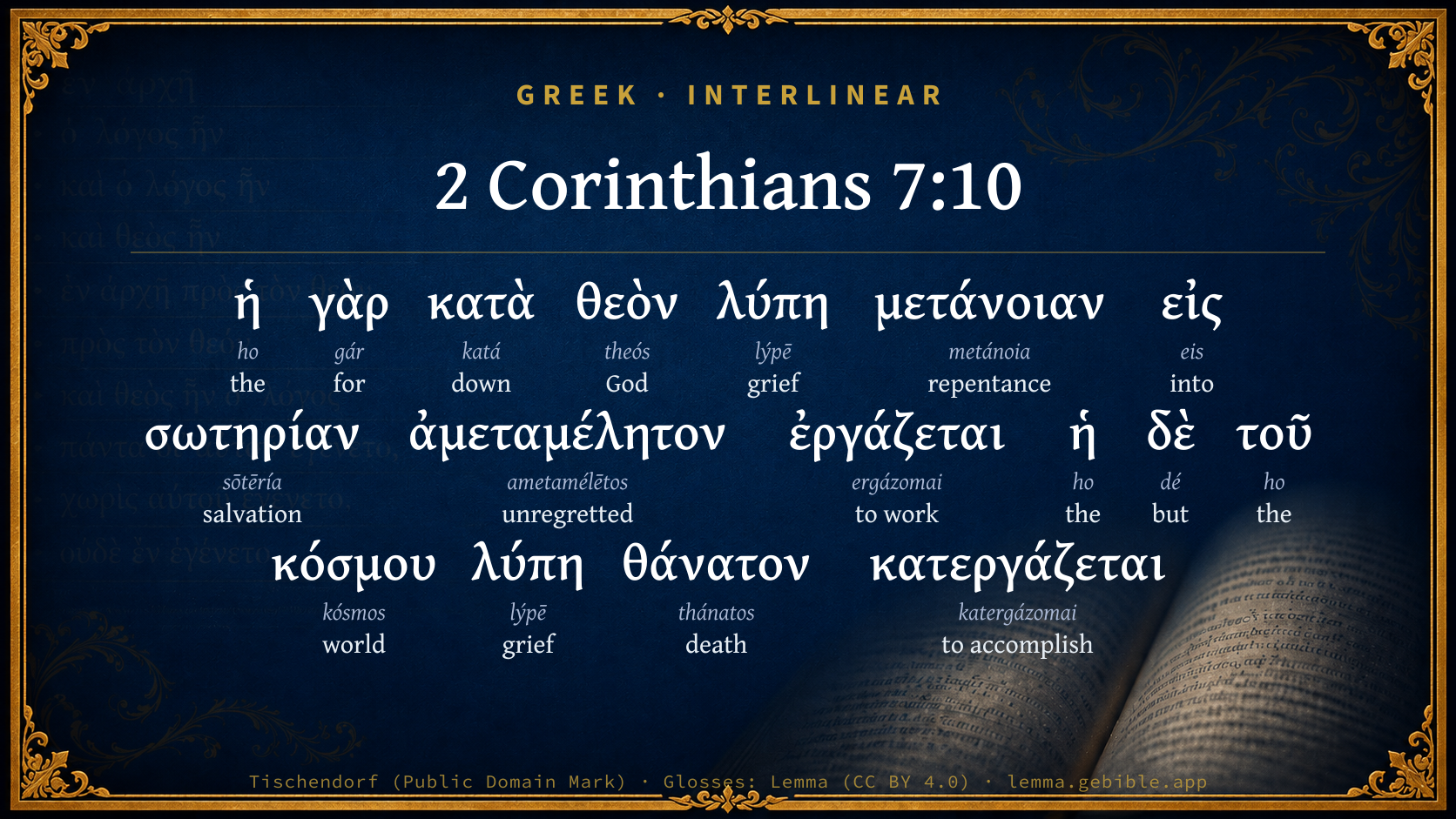
  1. ἡ ho G3588 “the” Article, Nominative, Singular, Feminine
  2. γὰρ gár G1063 “for” Conjunction
  3. κατὰ katá G2596 “down” Preposition
  4. θεὸν theós G2316 “God” Noun, Accusative, Singular, Masculine
  5. λύπη lýpē G3077 “grief” Noun, Nominative, Singular, Feminine
  6. μετάνοιαν metánoia G3341 “repentance” Noun, Accusative, Singular, Feminine
  7. εἰς eis G1519 “into” Preposition
  8. σωτηρίαν sōtēría G4991 “salvation” Noun, Accusative, Singular, Feminine
  9. ἐργάζεται ergázomai G2038 “to work” Verb, Present, Middle or Passive deponent, Indicative, 3rd person, Singular
  10. ἡ ho G3588 “the” Article, Nominative, Singular, Feminine
  11. δὲ dé G1161 “but” Conjunction
  12. τοῦ ho G3588 “the” Article, Genitive, Singular, Masculine
  13. κόσμου kósmos G2889 “world” Noun, Genitive, Singular, Masculine
  14. λύπη lýpē G3077 “grief” Noun, Nominative, Singular, Feminine
  15. θάνατον thánatos G2288 “death” Noun, Accusative, Singular, Masculine
  16. κατεργάζεται katergázomai G2716 “to accomplish” Verb, Present, Middle or Passive deponent, Indicative, 3rd person, Singular

About this verse

These counts appear in no published source. They are computed here, from the morphology-tagged text and Lemma’s own curated glosses. What Lemma adds →

17
words
14
distinct lemmas
Pauline Epistles
section

Notable vocabulary

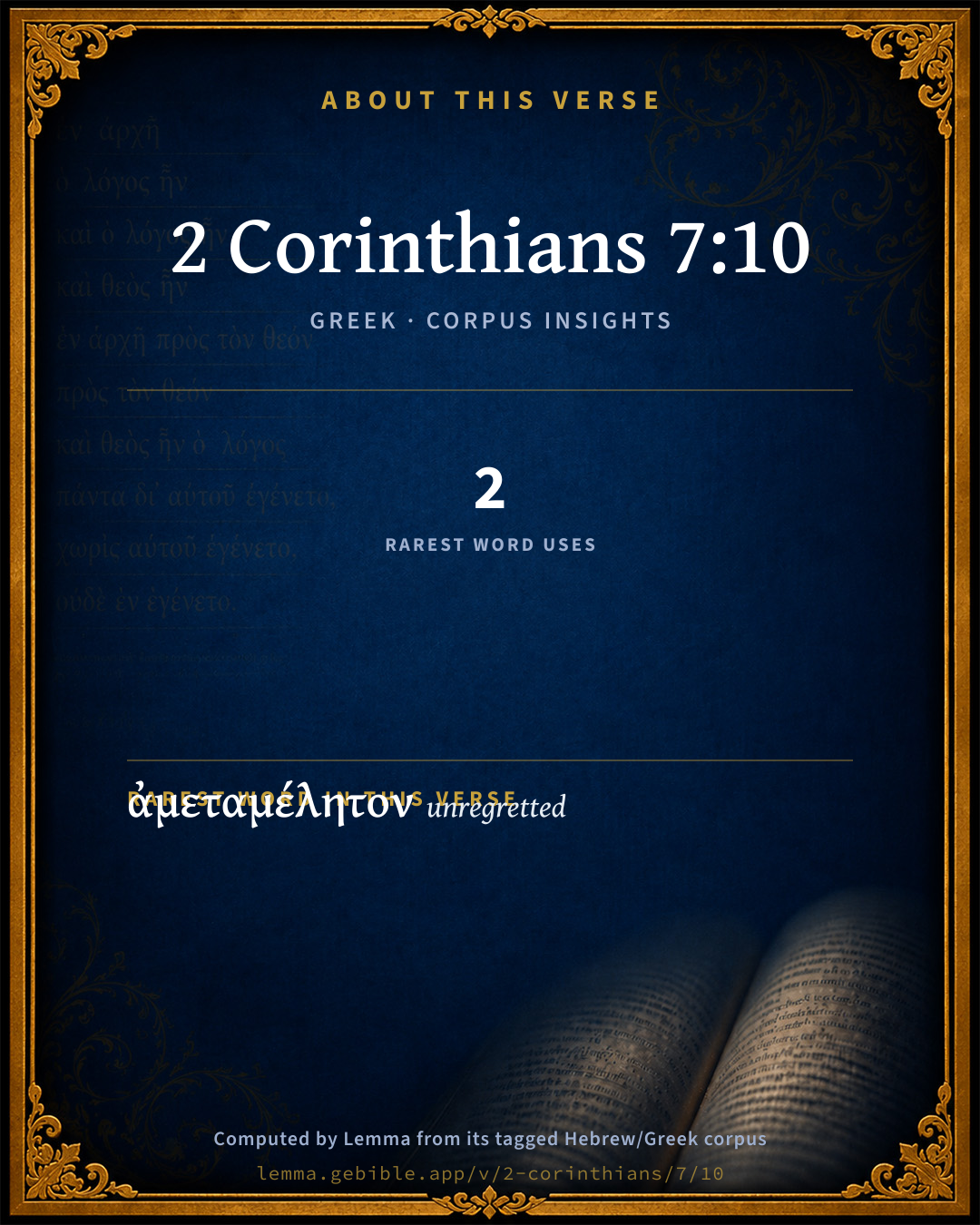
The rarest word here is ἀμεταμέλητον unregretted G278 — appearing just 2 times in the whole Greek New Testament.

Shared distinctive vocabulary

ἀμεταμέλητον unregretted G278 occurs in 2 verses of the Greek New Testament. Also found in:

Repetition

Words recur within this verse:

Cross-references

29

Topical passages linked to 2 Corinthians 7:10 in the Treasury of Scripture Knowledge — connected by theme and wording, ordered by reader-vote popularity; previews shown in the World English Bible.

  • Acts 3:19 "Repent therefore, and turn again, that your sins may be blotted out, so that there may come times of refreshing from the presence of the Lord,
  • Acts 11:18 When they heard these things, they held their peace, and glorified God, saying, "Then God has also granted to the Gentiles repentance to life!"
  • 2 Timothy 2:25–26 in gentleness correcting those who oppose him: perhaps God may give them repentance leading to a full knowledge of the truth,
  • 2 Samuel 12:13 David said to Nathan, "I have sinned against Yahweh." Nathan said to David, "Yahweh also has put away your sin. You will not die.
  • Luke 18:13 But the tax collector, standing far away, wouldn't even lift up his eyes to heaven, but beat his breast, saying, 'God, be merciful to me, a sinner!'
  • Luke 15:10 Even so, I tell you, there is joy in the presence of the angels of God over one sinner repenting."
  • 1 Kings 8:47–50 yet if they shall repent themselves in the land where they are carried captive, and turn again, and make supplication to you in the land of those who carried them captive, saying, We have sinned, and have done perversely, we have dealt wickedly;
  • Jonah 3:10 God saw their works, that they turned from their evil way. God repented of the evil which he said he would do to them, and he didn't do it.
  • Hebrews 12:17 For you know that even when he afterward desired to inherit the blessing, he was rejected, for he found no place for a change of mind though he sought it diligently with tears.
  • Job 33:27–28 He sings before men, and says, 'I have sinned, and perverted that which was right, And it didn't profit me.
  • Proverbs 17:22 A cheerful heart makes good medicine, But a crushed spirit dries up the bones.
  • Matthew 21:28–32 But what do you think? A man had two sons, and he came to the first, and said, 'Son, go work today in my vineyard.'
  • Ezekiel 18:27–30 Again, when the wicked man turns away from his wickedness that he has committed, and does that which is lawful and right, he shall save his soul alive.
  • Proverbs 15:15 All the days of the afflicted are wretched, But one who has a cheerful heart enjoys a continual feast.
  • Jonah 4:9 God said to Jonah, "Is it right for you to be angry about the vine?" He said, "I am right to be angry, even to death."
  • Matthew 26:75 Peter remembered the word which Jesus had said to him, "Before the rooster crows, you will deny me three times." He went out and wept bitterly.
  • Genesis 4:13–15 Cain said to Yahweh, "My punishment is greater than I can bear.
  • 1 Samuel 30:6 David was greatly distressed; for the people spoke of stoning him, because the soul of all the people was grieved, every man for his sons and for his daughters: but David strengthened himself in Yahweh his God.
  • 2 Samuel 13:4 He said to him, Why, son of the king, are you thus lean from day to day? Won't you tell me? Amnon said to him, I love Tamar, my brother Absalom's sister.
  • Proverbs 15:13 A glad heart makes a cheerful face; But an aching heart breaks the spirit.
  • Proverbs 18:14 A man's spirit will sustain him in sickness, But a crushed spirit, who can bear?
  • Jeremiah 31:9 They shall come with weeping; and with petitions will I lead them: I will cause them to walk by rivers of waters, in a straight way in which they shall not stumble; for I am a father to Israel, and Ephraim is my firstborn.
  • Ezekiel 7:16 But those of those who escape shall escape, and shall be on the mountains like doves of the valleys, all of them moaning, every one in his iniquity.
  • Jonah 3:8 but let them be covered with sackcloth, both man and animal, and let them cry mightily to God. Yes, let them turn everyone from his evil way, and from the violence that is in his hands.
  • Genesis 30:1 When Rachel saw that she bore Jacob no children, Rachel envied her sister. She said to Jacob, "Give me children, or else I will die."
  • 2 Samuel 17:23 When Ahithophel saw that his counsel was not followed, he saddled his donkey, and arose, and got him home, to his city, and set his house in order, and hanged himself; and he died, and was buried in the tomb of his father.
  • 1 Kings 21:4 Ahab came into his house sullen and angry because of the word which Naboth the Jezreelite had spoken to him; for he had said, I will not give you the inheritance of my fathers. He laid him down on his bed, and turned away his face, and would eat no bread.
  • Matthew 27:4–5 saying, "I have sinned in that I betrayed innocent blood." But they said, "What is that to us? You see to it."
  • 2 Corinthians 12:21 that again when I come my God would humble me before you, and I would mourn for many of those who have sinned before now, and not repented of the uncleanness and sexual immorality and lustfulness which they committed.

Cross-references courtesy of OpenBible.info (CC BY 4.0).

Commentary

Notes on 2 Corinthians 7:10 from classic Christian and Jewish commentators (each source and its license shown beneath its notes). The classic Christian expositions comment on the surrounding passage and are grouped to its opening verse, so a note may address several verses; the Jewish commentaries on the Tanakh (Rashi and others) are per-verse, so they appear only where the commentator wrote on this verse.

Lemma curates 59 commentaries, every one of them public domain or Creative Commons licensed, each selected and text-cleaned for this edition rather than reprinted as found. About our sources →

MacLaren's Expositions of Holy Scripture

Alexander MacLaren

2 Corinthians

SORROW ACCORDING TO GOD

2Co 7:10.

Very near the close of his missionary career the Apostle Paul summed up his preaching as being all directed to enforcing two points, ‘Repentance towards God, and faith in our Lord Jesus Christ.’ These two, repentance and faith, ought never to be separated in thought, as they are inseparable in fact. True repentance is impossible without faith, true faith cannot exist without repentance.

Yet the two are separated very often, even by earnest Christian teachers. The tendency of this day is to say a great deal about faith, and not nearly enough in proportion about repentance; and the effect is to obscure the very idea of faith, and not seldom to preach ‘Peace! peace! when there is no peace.’ A gospel which is always talking about faith, and scarcely ever talking about sin and repentance, is denuded, indeed, of some of its most unwelcome characteristics, but is also deprived of most of its power, and it may very easily become an ally of unrighteousness, and an indulgence to sin. The reproach that the Christian doctrine of salvation through faith is immoral in its substance derives most of its force from forgetting that ‘repentance towards God’ is as real a condition of salvation as is ‘faith in our Lord Jesus Christ.’ We have here the Apostle’s deliverance about one of these twin thoughts. We have three stages--the root, the stem, the fruit; sorrow, repentance, salvation. But there is a right and a wrong kind of sorrow for sin. The right kind breeds repentance, and thence reaches salvation; the wrong kind breeds nothing, and so ends in death.

Let us then trace these stages, not forgetting that this is not a complete statement of the case, and needs to be supplemented in the spirit of the words which I have already quoted, by the other part of the inseparable whole, ‘faith towards our Lord Jesus Christ.’

I. First, then, consider the true and the false sorrow for sin.

The Apostle takes it for granted that a recognition of our own evil, and a consequent penitent regretfulness, lie at the foundation of all true Christianity. Now I do not insist upon any uniformity of experience in people, any more than I should insist that all their bodies should be of one shape or of one proportion. Human lives are infinitely different, human dispositions are subtly varied, and because neither the one nor the other are ever reproduced exactly in any two people, therefore the religious experience of no two souls can ever be precisely alike.

We have no right to ask--and much harm has been done by asking--for an impossible uniformity of religious experience, any more than we have a right to expect that all voices shall be pitched in one key, or all plants flower in the same month, or after the same fashion. You can print off as many copies as you like, for instance, of a drawing of a flower on a printing-press, and they shall all be alike, petal for petal, leaf for leaf, shade for shade; but no two hand-drawn copies will be so precisely alike, still less will any two of the real buds that blow on the bush. Life produces resemblance with differences; it is machinery that makes facsimiles.

So we insist on no pedantic or unreal uniformity; and yet, whilst leaving the widest scope for divergencies of individual character and experience, and not asking that a man all diseased and blotched with the leprosy of sin for half a lifetime, and a little child that has grown up at its mother’s knee, ‘in the nurture and admonition of the Lord,’ and so has been kept ‘innocent of much transgression,’ shall have the same experience; yet Scripture, as it seems to me, and the nature of the case do unite in asserting that there are certain elements which, in varying proportions indeed, will be found in all true Christian experience, and of these an indispensable one--and in a very large number, if not in the majority of cases, a fundamental one--is this which my text calls ‘godly sorrow.’

Dear brethren, surely a reasonable consideration of the facts of our conduct and character point to that as the attitude that becomes us. Does it not? I do not charge you with crimes in the eye of the law. I do not suppose that many of you are living in flagrant disregard of the elementary principles of common every-day morality. Some are, no doubt. There are, no doubt, unclean men here; there are some who eat and drink more than is good for them, habitually; there are, no doubt, men and women who are living in avarice and worldliness, and doing things which the ordinary conscience of the populace points to as faults and blemishes. But I come to you respectable people that can say: ‘I am not as other men are, unjust, adulterers, or even as this publican’; and pray you, dear friends, to look at your character all round, in the light of the righteousness and love of God, and to plead to the indictment which charges you with neglect of many a duty and with sin against Him. How do you plead, ‘guilty or not guilty, sinful or not sinful?’ Be honest with yourselves, and the answer will not be far to seek.

Notice how my text draws a broad distinction between the right and the wrong kind of sorrow for sin. ‘Godly sorrow’ is, literally rendered,’sorrow according to God,’ which may either mean sorrow which has reference to God, or sorrow which is in accordance with His will; that is to say, which is pleasing to Him. If it is the former, it will be the latter. I prefer to suppose that it is the former--that is, sorrow which has reference to God. And then, there is another kind of sorrow, which the Apostle calls the ‘sorrow of the world,’ which is devoid of that reference to God. Here we have the characteristic difference between the Christian way of looking at our own faults and shortcomings, and the sorrow of the world, which has got no blessing in it, and will never lead to anything like righteousness and peace. It is just this--one has reference to God, puts its sin by His side, sees its blackness relieved against the ‘fierce light’ of the Great White Throne, and the other has not that reference.

To expand that for a moment,--there are plenty of us who, when our sin is behind us, and its bitter fruits are in our hands, are sorry enough for our faults. A man that is lying in the hospital a wreck, with the sins of his youth gnawing the flesh off his bones, is often enough sorry that he did not live more soberly and chastely and temperately in the past days. That fraudulent bankrupt who has not got his discharge and has lost his reputation, and can get nobody to lend him money enough to start him in business again, as he hangs about the streets, slouching in his rags, is sorry enough that he did not keep the straight road. The ‘sorrow of the world’ has no thought about God in it at all. The consequences of sin set many a man’s teeth on edge who does not feel any compunction for the wrong that he did. My brethren, is that the position of any that are listening to me now?

Again, men are often sorry for their conduct without thinking of it as sin against God. Crime means the transgression of man’s law, wrong means the transgression of conscience’s law, sin is the transgression of God’s law. Some of us would perhaps have to say--’I have done crime.’ We are all of us quite ready to say: ‘I have done wrong many a time’; but there are some of us who hesitate to take the other step, and say: ‘I have done sin.’ Sin has, for its correlative, God. If there is no God there is no sin. There may be faults, there may be failures, there may be transgressions, breaches of the moral law, things done inconsistent with man’s nature and constitution, and so on; but if there be a God, then we have personal relations to that Person and His law; and when we break His law it is more than crime; it is more than fault; it is more than transgression; it is more than wrong; it is sin. It is when you lift the shutter off conscience, and let the light of God rush in upon your hearts and consciences, that you have the wholesome sorrow that worketh repentance and salvation and life.

Oh, dear friends, I do beseech you to lay these simple thoughts to heart. Remember, I urge no rigid uniformity of experience or character, but I do say that unless a man has learned to see his sin in the light of God, and in the light of God to weep over it, he has yet to know ‘the strait gate that leadeth unto life.’

I believe that a very large amount of the superficiality and easy-goingness of the Christianity of to-day comes just from this, that so many who call themselves Christians have never once got a glimpse of themselves as they really are. I remember once peering over the edge of the crater of Vesuvius, and looking down into the pit, all swirling with sulphurous fumes. Have you ever looked into your hearts, in that fashion, and seen the wreathing smoke and the flashing fire there? If you have, you will cleave to that Christ, who is your sole deliverance from sin.

But, remember, there is no prescription about depth or amount or length of time during which this sorrow shall be felt. If, on the one hand, it is essential, on the other hand there are a great many people who ought to be walking in the light and the liberty of God’s Gospel who bring darkness and clouds over themselves by the anxious scrutinising question: ‘Is my sorrow deep enough?’ Deep enough! What for? What is the use of sorrow for sin? To lead a man to repentance and to faith. If you have as much sorrow as leads you to penitence and trust you have enough. It is not your sorrow that is going to wash away your sin, it is Christ’s blood. So let no man trouble himself about the question, Have I sorrow enough? The one question is: ‘Has my sorrow led me to cast myself on Christ?’

II. Still further, look now for a moment at the next stage here. ‘Godly sorrow worketh repentance.’

What is repentance? No doubt many of you would answer that it is ‘sorrow for sin,’ but clearly this text of ours draws a distinction between the two. There are very few of the great key-words of Christianity that have suffered more violent and unkind treatment, and have been more obscured by misunderstandings, than this great word. It has been weakened down into penitence, which in the ordinary acceptation, means simply the emotion that I have already been speaking about, viz., a regretful sense of my own evil. And it has been still further docked and degraded, both in its syllables and in its substance, into _penance_. But the ‘repentance’ of the New Testament and of the Old Testament--one of the twin conditions of salvation--is neither sorrow for sin nor works of restitution and satisfaction, but it is, as the word distinctly expresses, a change of purpose in regard to the sin for which a man mourns. I cannot now expand and elaborate this idea as I should like, but let me remind you of one or two passages in Scripture which may show that the right notion of the word is not sorrow but changed attitude and purpose in regard to my sin.

We find passages, some of which ascribe and some deny repentance to the Divine nature. But if there be a repentance which is possible for the Divine nature, it obviously cannot mean sorrow for sin, but must signify a change of purpose. In the Epistle to the Romans we read, ‘The gifts and calling of God are without repentance,’ which clearly means without change of purpose on His part. And I read in the story of the mission of the Prophet Jonah, that ‘the Lord repented of the evil which He had said He would do unto them, and He did it not.’ Here, again, the idea of repentance is clearly and distinctly that of a change of purpose. So fix this on your minds, and lay it on your hearts, dear friends, that the repentance of the New Testament is not idle tears nor the twitchings of a vain regret, but the resolute turning away of the sinful heart from its sins. It is ‘repentance toward God,’ the turning from the sin to the Father, and that is what leads to salvation. The sorrow is separated from the repentance in idea, however closely they may be intertwined in fact. The sorrow is one thing, and the repentance which it works is another.

Then notice that this change of purpose and breaking off from sin is produced by the sorrow for sin, of which I have been speaking; and that the production of this repentance is the main characteristic difference between the godly sorrow and the sorrow of the world. A man may have his paroxysms of regret, but the question is: Does it make any difference in his attitude? Is he standing, after the tempest of sorrow has swept over him, with his face in the same direction as before; or has it whirled him clean round, and set him in the other direction? The one kind of sorrow, which measures my sin by the side of the brightness and purity of God, vindicates itself as true, because it makes me hate my evil and turn away from it. The other, which is of the world, passes over me like the empty wind through an archway, it whistles for a moment and is gone, and there is nothing left to show that it was ever there. The one comes like one of those brooks in tropical countries, dry and white for half the year, and then there is a rush of muddy waters, fierce but transient, and leaving no results behind. My brother! when your conscience pricks, which of these two things does it do? After the prick, is the word of command that your Will issues ‘Right about face!’ or is it ‘As you were’? Godly sorrow worketh a change of attitude, purpose, mind; the sorrow of the world leaves a man standing where he was. Ask yourselves the question: Which of the two are you familiar with?

Again, the true means of evoking true repentance is the contemplation of the Cross. Law and the fear of hell may startle into sorrow, and even lead to some kind of repentance. But it is the great power of Christ’s love and sacrifice which will really melt the heart into true repentance. You may hammer ice to pieces, but it is ice still. You may bray a fool in a mortar, and his folly will not depart from him. Dread of punishment may pulverise the heart, but not change it; and each fragment, like the smallest bits of a magnet, will have the same characteristics as the whole mass. But ‘the goodness of God leads to repentance’ as the prodigal is conquered and sees the true hideousness of the swine’s trough, when he bethinks himself of the father’s love. I beseech you to put yourselves under the influence of that great love, and look on that Cross till your hearts melt.

III. We come to the last stage here. Salvation is the issue of repentance. ‘Godly sorrow worketh repentance unto salvation not to be repented of.’

What is the connection between repentance and salvation? Two sentences will answer the question. You cannot get salvation without repentance. You do not get salvation by repentance.

You cannot get the salvation of God unless you shake off your sin. It is no use preaching to a man, ‘Faith, Faith, Faith!’ unless you preach along with it,’Break off your iniquities.’ ‘Let the wicked forsake his way and the unrighteous man his thoughts, and let him turn unto the Lord.’ The nature of the case forbids it. It is a clear contradiction in terms, and an absolute impossibility in fact, that God should save a man with the salvation which consists in the deliverance from sin, whilst that man is holding to his sin. Unless, therefore, you have not merely sorrow, but repentance, which is turning away from sin with resolute purpose, as a man would turn from a serpent, you cannot enter into the Kingdom of Heaven.

But you do not get salvation for your repentance. It is no case of barter, it is no case of salvation by works, that work being repentance:

‘Could my zeal no respite know,

Could my tears for ever flow,

All for sin could not atone,

Thou must save, and Thou alone.’

Not my penitence, but Christ’s death, is the ground of the salvation of every one that is saved at all. Yet repentance is an indispensable condition of salvation.

What is the connection between repentance and faith? There can be no true repentance without trust in Christ. There can be no true trust in Christ without the forsaking of my sin. Repentance without faith, in so far as it is possible, is one long misery; like the pains of those poor Hindoo devotees that will go all the way from Cape Comorin to the shrine of Juggernaut, and measure every foot of the road with the length of their own bodies in the dust. Men will do anything, and willingly make any sacrifice, rather than open their eyes to see this,--that repentance, clasped hand in hand with Faith, leads the guiltiest soul into the forgiving presence of the crucified Christ, from whom peace flows into the darkest heart.

On the other hand, faith without repentance is not possible, in any deep sense. But in so far as it is possible, it produces a superficial Christianity which vaguely trusts to Christ without knowing exactly what it is trusting Him for, or why it needs Him; and which has a great deal to say about what I may call the less important parts of the Christian system, and nothing to say about its vital centre; which preaches a morality which is not a living power to create; which practises a religion which is neither a joy nor a security. The old word of the Master has a deep truth in it: ‘These are they which heard the word, and anon with joy received it.’ Having no sorrow, no penitence, no deep consciousness of sin, ‘they have no root in themselves, and in time of temptation they fall away.’ If there is to be a profound, an all-pervading, life-transforming-sin, and devil-conquering faith, it must be a faith rooted deep in penitence and sorrow for sin.

Dear brethren, if, by God’s grace, my poor words have touched your consciences at all, I beseech you, do not trifle with the budding conviction! Do not seek to have the wound skinned over. Take care that you do not let it all pass in idle sorrow or impotent regret. If you do, you will be hardened, and the worse for it, and come nearer to that condition which the sorrow of the world worketh, the awful death of the soul. Do not wince from the knife before the roots of the cancer are cut out. The pain is merciful. Better the wound than the malignant growth. Yield yourselves to the Spirit that would convince you of sin, and listen to the voice that calls to you to forsake your unrighteous ways and thoughts. But do not trust to any tears, do not trust to any resolves, do not trust to any reformation. Trust only to the Lord who died on the Cross for you, whose death for you, whose life in you, will be deliverance from your sin. Then you will have a salvation which, in the striking language of my text, ‘is not to be repented of,’ which will leave no regrets in your hearts in the day when all else shall have faded, and the sinful sweets of this world shall have turned to ashes and bitterness on the lips of the men that feed on them.

‘The sorrow of the world works death.’ There are men and women listening to me now who are half conscious of their sin, and are resisting the pleading voice that comes to them, who at the last will open their eyes upon the realities of their lives, and in a wild passion of remorse, exclaim: ‘I have played the fool, and have erred exceedingly.’ Better to make thorough work of the sorrow, and by it to be led to repentance toward God and faith in Christ, and so secure for our own that salvation for which no man will ever regret having given even the whole world, since he gains his own soul.

Alexander MacLaren, Expositions of Holy Scripture (1904–1910) — public domain. Text from a community e-Sword module.

Bengel's Gnomon

Johann Albrecht Bengel

2Co 7:10. Μετάνοιαν—ἀμεταμέλητον, repentance—not to be repented of) From the meaning of the primitive word, μετάνοια belongs properly to the understanding; μεταμέλεια to the will; because the former expresses the change of sentiment, the latter, the change of care [solicitude], or rather of purpose. Whence Thomas Gataker, Advers. misc. posth., c. 29, where he treats very accurately of these words signifying repentance, closes a long dissertation with this recapitulation: We have thus a series not completely, but exactly delineated, by which that feeling from its first origin, as it were by certain degrees and advances, is at length brought on, as Septimius would say, to its proper maturity. In the first place, censure or punishment is inflicted [animadversio], a proceeding which is termed by the Hebrews שוב לב for שות לב: from this arises acknowledgment of error, and μετάνοια, reformation [resipiscentia, coming to a right state of mind]. Δυσαρέστησις or λύπη, dissatisfaction with one’s self and sorrow, follow this μετάνοια, that which is explained by the Hebrew, נחם, penitence. The consequence of this, where it has become efficacious, καὶ γνησία, genuine, is שוב, conversion, ἐπιστροφὴ, μεταμέλεια, which finishes and crowns the work, since it brings in quite a new mode of living, instead of the old.” Such are his views. Furthermore, on account of the very close relationship between the understanding and the will, μεταμέλεια and μετάνοια occur together, and both the nouns and verbs are promiscuously used even by philosophers, and they correspond in the LXX. with the single Hebrew word נחם; in both μετὰ signifies after. Whence Plato in the Gorgias, ταῦτα προνοήσασι μὲν, δυνατά· μετανοήσασι δὲ, ἀδύνατα. These things are possible to them that think beforehand, but impossible to those that think afterwards. Synesius, Ep. iv., τῷ ἐπιμήθει, φασὶν, τὸ μὲν μέλειν οὐκ ἦν, τὸ δὲ μεταμέλειν, ἐνῆν. It is said, that Epimetheus had no care at the time, but that he afterwards had care.[39] Both these words are therefore applied to him, who repents of what he has done, and of the counsel which he has followed, whether his penitence be good or bad, whether it be on account of something evil or good, whether accompanied with a change of future conduct or not. If we consider their use however, μεταμέλεια is generally a term midway between good and bad [μέσον, indifferent[40]], and is chiefly referred to single actions; but μετάνοια, especially in the New Testament, is taken in a good sense, by which is denoted the repentance [regret on account] of the whole life, and, in some respects, [loathing] of ourselves,[41] or that whole blessed remembrance of the mind [the mind’s review of the past, and of its own state heretofore] after error and sin, with all the affections entering into it, which suitable fruits follow. Hence it happens, that μετανοεῖν is often put in the imperative, μεταμελεῖσθαι never; but in other places, wherever μετάνοια is read, μεταμέλεια may be substituted: but not vice versa. Therefore, Paul distinctly uses both words in this passage, and applies to μετάνοιαν εἰς σωτηρίαν the term ἀμεταμέλητον, because neither he can regret, that he had occasioned this μετάνοιαν, repentance, to the Corinthians, nor they, that they had felt it.—εἰς σωτηρίαν, to salvation) all the impediments to which are thus removed.—κατεργάζεται, worketh) Therefore sorrow is not repentance itself, but it produces repentance; that is, carefulness (σπουδήν), 2Co 7:11.—ἡ δὲ) but the mere sorrow of the world, etc., of which I was not a promoter among you.—τοῦ κόσμου) of the world, not merely, according to the world (answering to the epithet of λύπη, viz., ἡ κατὰ θεὸν). [Such was the sorrow of Ahab in the case of Naboth. Now and then the malignant powers of darkness also mingle themselves with it, as in the case of Saul. In such cases, even the innocent cheerfulness of children, or the singing of birds, or the frisking of calves sometimes move their indignation. The sorrow of the world, such as this, is not less to be avoided than the joy of the world. The world experiences joy at their social feasts, for the rest of the time they are generally under the dominion of sorrow.—V. g.]—θάνατον, death) chiefly of the soul, which is evident from the antithesis [‘salvation’].

[39] Epimetheus was fabled, in contrast to Prometheus, to have had no thought, but to have had after thought when too late.—ED.

[40] Μεταμέλεια is often used of the remorse and regret of such a one as Judas. Μετάνοια of the true penitent.—ED.

[41] Repentance of ourselves is not English, and does not suggest any very clear idea. I think the author meant to apply it to our original depravity, which to believers is the subject of confession and lamentation before God. This may be considered as a species of repentance, and seems to agree with the qualifying phrase in some respects.—TR.

Bengel's Gnomon of the New Testament — English translation (T&T Clark, Edinburgh, 1860) — public domain. Text from a community e-Sword module.

Meyer's Critical & Exegetical Commentary

Heinrich August Wilhelm Meyer

2Co_7:10. Ground assigned for ἵνα ἐν μηδ. ζημιωθ. ἐξ ἡμῶν: for godly sadness works repentance unto salvation unregretted, i.e. unto the Messianic salvation, the attainment of which is not regretted. The connection of ἀμεταμέλ. with σωτηρίαν is held by Augustine and other Latin Fathers, following the Vulgate, which has stabilem,[260] and among modern expositors by Fritzsche, Billroth (yet doubtfully), Schrader, de Wette, Ewald; decidedly by Castalio also, but undecidedly by Erasmus, Annot. The more common connection is with μετάνοιαν, so as to give the antanaclasis poenitentiam non poenitendam (for similar collocations see Wetstein, comp. Pliny, Ep. vii. 10); οὐδεὶς γὰρ ἑαυτοῦ καταγνώσεται, ἐὰν λυπηθῇ ἐφʼ ἁμαρτίᾳ, ἐὰν πενθήσῃ καὶ ἑαυτὸν συντρίψῃ, Chrysostom. But for such an antanaclasis Paul would not have chosen an adjective from quite a different root, but ἀμετανόητον (Lucian, Oba_1:11, comp. also Rom_2:5), which is also the reading[261] of some minor authorities. And if ἈΜΕΤΑΜΈΛ. were to belong to ΜΕΤΆΝΟΙΑΝ, it would stand immediately by its side, so as to make ΕἸς ΣΩΤΗΡΊΑΝ appear as the result throwing light upon ἈΜΕΤΑΜΈΛ. When placed after ΕἸς ΣΩΤΗΡΊΑΝ, ἈΜΕΤΑΜΈΛ. is an epithet of ΜΕΤΆΝΟΙΑΝ no longer suitable, insipid, and halting. Olshausen and Hofmann wrongly object that the epithet is not suitable to the idea of salvation, the absolute good. It expresses by way of litotes the eternal satisfaction of the ΣΩΤΗΡΊΑ, and is selected with a glance back to what was said in 2Co_7:8. If the apostle, namely, has caused a sadness which works a contrition unto a salvation exposed to no regret, it is obvious how this step of his can no longer give rise to any regret in his case, but can only make him joyful. Comp. on the expression itself, Rom_11:29, and especially Plato, Tim. p. 59 D: ἀμεταμέλητον ἡδονὴν κτᾶται, Legg. ix. p. 866 E; Polyb. xxi. 9. 11; Plutarch, Mor. p. 137 B; Socrates in Stob. 101, p. 552; Clem. Cor. I. 2.

ἡ δὲ τοῦ κόσμον λύπη] i.e. the sadness, however, which is felt by the world, by the ungodly-minded unbelievers. This is certainly λύπν διὰ χρήματα, διὰ δόξαν, διὰ τὸν ἀπελθόντα κ.τ.λ. (Chrysostom), in so far, namely, as the loss of outward advantage in and for itself determines the sadness,[262] but the genitive τοῦ κόσμου is the genitivus subjecti, and we must retain as the characteristic of this λύπη that it is not κατὰ θεόν (because it cannot be determined by the knowledge of God and of His will); hence, instead of working repentance unto salvation, it works despondency, despair, exasperation, obduracy, etc., unto death. Even ΔΙᾺ ΧΡΉΜΑΤΑ Κ.Τ.Λ. there may be a sadness ΚΑΤᾺ ΘΕΌΝ.

ΘΆΝΑΤΟΝ] i.e. not generally: all that is embraced in a state of things not founded on God (Hofmann), but, as the opposite of that unregretted σωτηρία, eternal death, the Messianic ἀπώλεια; comp. 2Co_2:16. Calovius says aptly: quia mundus dolet, cum affligitur, solatii ex verbo Dei expers ac fide destitutus. The exposition of vexing oneself to death (Theodoret), or the reference made by Grotius, Rosenmüller, and others to fatal diseases and suicide, is quite at variance with the context; and Sir_38:18 has no bearing here. Even the ethical view (moral ruin through despair or new sins, de Wette, comp. Neander) is not in keeping with the contrast to σωτηρία; besides, Paul never uses ΘΆΝΑΤΟς of ethical death. See on Rom_5:12.

Regarding the difference between ἐργάζεται and ΚΑΤΕΡΓΆΖ. (bring to pass), see on Rom_1:27; van Hengel, ad Rom_2:10.

[260] According to the reading ἀμετάβλητον, which Origen has (once), but before εἰς σωτηρ.

[261] And which (in opposition to Osiander) would have expressed the idea of something painful quite as well as ἀμεταμέλ.

[262] As this would have been the case also with the Corinthians, if they had grieved over the reproof only, and not over the sin. Comp. Elwert in the Wûrtemberg. Stud. IX. 1 p. 135 ff.

Meyer — Critical and Exegetical Commentary on the New Testament — English translation by Peter Christie, edited by Frederick Crombie (T&T Clark, 1880) — public domain. Text from a community e-Sword module.

Expositor's Greek Testament

ed. W. Robertson Nicoll

2Co 7:10 . ἡ γὰρ κατὰ Θεὸν λύπη κ . τ . λ .: for such godly sorrow, i.e. , sorrow for sin as an offence against God (Psa 50:6 ) and not only for the temporal consequences of sin ( cf. Bengel, “animi Deum spectantis et sequentis”), worketh repentance which leads to salvation , a repentance which bringeth no regret . ἀμεταμέλητον may be taken with σωτηρία (see R.V. margin), but there would be no point in applying such an adj. to σωτηρία , whereas it is quite apposite as applied to μετάνοια (as by Chrys., R.V., etc.). ἡ δὲ τοῦ κόσμου κ . τ . λ .: but the sorrow of the world, sc. , such sorrow as the world feels for failure, not for sin worketh out death, sc. , as opposed to σωτηρία ( cf. chap. 2Co 2:16 ).

The Expositor's Greek Testament, edited by W. Robertson Nicoll (1897–1910) — public domain. Text from a community e-Sword module.

Geneva Bible (1599)

Geneva Bible translators

Godly sorrow is when we are not terrified with the fear of punishment, but because we feel we have offended God our most merciful Father: contrary to this, there is another sorrow, that only feareth punishment, or when a man is vexed for the loss of some worldly goods: the fruit of the first, repentance, and the fruit of the second, is desperation, unless the Lord helps speedily.

Geneva Bible (1599) marginal notes — public domain. Text via Bolls.life.

Jamieson, Fausset & Brown

Robert Jamieson, A. R. Fausset & David Brown

worketh . . . worketh--In the best Greek reading the translation is, "worketh (simply) . . . worketh out." "Sorrow" is not repentance, but, where it is "godly," "worketh" it; that is, contributes or tends to it (the same Greek word is in Rom 13:10). The "sorrow of the world" (that is, such as is felt by the worldly) "worketh out," as its result at last, (eternal) death (the same Greek verb is in Co2 4:17; also see on Co2 4:17).

repentance . . . not to be repented of--There is not in the Greek this play on words, so that the word qualified is not "repentance" merely, but "repentance unto salvation"; this, he says, none will ever regret, however attended with "sorrow" at the time. "Repentance" implies a coming to a right mind; "regret" implies merely uneasiness of feeling at the past or present, and is applied even to the remorse of Judas (Mat 27:3; Greek, "stricken with remorse," not as English Version, "repented himself"); so that, though always accompanying repentance, it is not always accompanied by repentance. "Repentance" removes the impediments in the way of "salvation" (to which "death," namely, of the soul, is opposed). "The sorrow of the world" is not at the sin itself, but at its penal consequences: so that the tears of pain are no sooner dried up, than the pleasures of ungodliness are renewed. So Pharaoh, Exo 9:27-30; and Saul, Sa1 15:23-30. Compare Isa 9:13; Rev 16:10-11. Contrast David's "godly sorrow," Sa2 12:13, and Peter's, Mat 26:75.

Jamieson, Fausset & Brown — Commentary Critical and Explanatory on the Whole Bible (1871) — public domain (CC PDM 1.0). Text via the HelloAO Bible API.

Adam Clarke's Commentary

Verse 10. For godly sorrow] That which has the breach of God's holy law for its object.

Worketh repentance] A thorough change of mind unto salvation, because the person who feels it cannot rest till he finds pardon through the mercy of God.

But the sorrow of the world worketh death.] Sorrow for lost goods, lost friends, death of relatives, c., when it is poignant and deep, produces diseases, increases those that already exist, and often leads men to lay desperate hands on themselves. This sorrow leads to destruction, the other leads to salvation the one leads to heaven, the other to hell.

Adam Clarke's Commentary on the Bible (1810–1826) — public domain. Text from a community e-Sword/MySword module.

John Calvin's Commentaries

10. Sorrow according to God In the first place, in order to understand what is meant by this clause according to God, we must observe the contrast, for the sorrow that is according to God he contrasts with the sorrow of the world Let us now take, also, the contrast between two kinds of joy. The joy of the world is, when men foolishly, and without the fear of the Lord, exult in vanity, that is, in the world, and, intoxicated with a transient felicity, look no higher than the earth. The joy that is according to God is, when men place all their happiness in God, and take satisfaction in His grace, and show this by contempt of the world, using earthly prosperity as if they used it not, and joyful in the midst of adversity. Accordingly, the sorrow of the world is, when men despond in consequence of earthly afflictions, and are overwhelmed with grief; while sorrow according to God is that which has an eye to God, while they reckon it the one misery — to have lost the favor of God; when, impressed with fear of His judgment, they mourn over their sins. This sorrow Paul makes the cause and origin of repentance. This is carefully to be observed, for unless the sinner be dissatisfied with himself, detest his manner of life, and be thoroughly grieved from an apprehension of sin, he will never betake himself to the Lord. On the other hand, it is impossible for a man to experience a sorrow of this kind, without its giving birth to a new heart. Hence repentance takes its rise in grief, for the reason that I have mentioned — because no one can return to the right way, but the man who hates sin; but where hatred of sin is, there is self-dissatisfaction and grief.

There is, however, a beautiful allusion here to the term repentance, when he says — not to be repented of; for however unpleasant the thing is at first taste, it renders itself desirable by its usefulness. The epithet, it is true, might apply to the term salvation, equally as to that of repentance; but it appears to me to suit better with the term repentance “We are taught by the result itself, that grief ought not to be painful to us, or distressing. In like manner, although repentance contains in it some degree of bitterness, if, is spoken of as not to be repented of on account of the precious and pleasant fruit which it produces.”

To salvation Paul seems to make repentance the ground of salvation. Were it so, it would follow, that we are justified by works. I answer, that we must observe what Paul here treats of, for he is not inquiring as to the ground of salvation, but simply commending repentance from the fruit which it produces, he says that it is like a way by which we arrive at salvation. Nor is it without good reason; for Christ calls us by way of free favor, but it is to repentance. (Matthew 9:13.) God by way of free favor pardons our sins, but only when we renounce them. Nay more, God accomplishes in us at one and the same time two things: being renewed by repentance, we are delivered from the bondage of our sins; and, being justified by faith, we are delivered also from the curse of our sins. They are, therefore, inseparable fruits of grace, and, in consequence of their invariable connection, repentance may with fitness and propriety be represented as an introduction to salvation, but in this way of speaking of it, it is represented as an effect rather than as a cause. These are not refinements for the purpose of evasion, but a true and simple solution, for, while Scripture teaches us that we never obtain forgiveness of sins without repentance, it represents at the same time, in a variety of passages, the mercy of God alone as the ground of our obtaining it.

John Calvin's Commentaries (1540-1563) — public domain. Text from the Calvin Translation Society English edition (1840s-50s) via the Christian Classics Ethereal Library (ccel.org). Calvin's coverage is partial (roughly two-thirds of the Bible); uncommented books and verses are honest gaps, never fabricated. The 19th-century editor's footnotes and remarks are omitted so the notes are faithfully Calvin's own voice.

Ellicott's Commentary for English Readers

(10) For godly sorrow.—Again we note the needless variation which is the easily besetting sin of the English version. Better, as before, the sorrow which is after the will of God.

Repentance to salvation not to be repented of.—Here the English effaces a distinction in the original. (See Note on Mat_27:3,) Better, repentance unto salvation, giving no matter for regret. The adjective, or adjectival phrase, may qualify either “repentance” or “salvation.” The latter seems preferable.

But the sorrow of the world worketh death.—As contrasted with “salvation,” death must be taken in its widest sense. The mere sorrow of the world leads only to remorse and despair, to the death of a broken heart, possibly to suicide; in any case, to the loss of the true eternal life.

A Bible Commentary for English Readers, edited by Charles John Ellicott (1878–1897) — public domain. Text from a community e-Sword module.

The Cambridge Bible for Schools and Colleges

gen. ed. J. J. S. Perowne

10. For godly sorrow worketh repentance] Rather, For the sorrow which is according to God (that is aftir God, Wiclif) worketh change of mind. The difference between the true repentance and the false remorse may be illustrated by the cases of David and Saul, St Peter and Judas.

to salvation not to be repented of] Or not to be regretted, the word here used involving the idea of sorrow or anxiety. It is by most commentators connected with salvation, as though that were the result not to be regretted. But it may as naturally be referred to the change of mind. “The beautiful law is,” says Robertson, “that in proportion as the repentance increases, the grief diminishes. ‘I rejoice,’ says St Paul, ‘that I made you sorry, though it were but for a time.’ Grief for a time, but repentance for ever.”

but the sorrow of the world] i.e. of the world untouched and un-regenerated by the Spirit of God—the sorrow of the natural man, “the opposite of the sorrow according to God.” Stanley. See 1Co_2:14.

worketh death] Death of the body, sometimes, as when despair tempts to suicide, or brings on deadly sickness. Death of the soul, when sorrow fails to melt the heart, but leads it to that state of rebellious stubbornness, of entire alienation from God, which is expressed in the words “hardness of heart and contempt of His word and commandment.” Cf. Pro_17:22.

The Cambridge Bible for Schools and Colleges (gen. ed. J. J. S. Perowne; Cambridge University Press, 1878–1918) — public domain. Text from a community e-Sword module.

John Gill's Exposition

For godly sorrow worketh repentance unto salvation,.... These words contain a reason, proving that they had received no damage, but profit by the sorrow that had possessed them, from the nature of it, a "godly" sorrow; a sorrow which had God for its author; it did not arise from the power of free will, nor from the dictates of a natural conscience, nor from a work of the law on their hearts, or from a fear of hell and damnation, but it sprung from the free grace of God; it was a gift of his grace, the work of his Spirit, and the produce of his almighty power; being such, which no means, as judgments, mercies, or the most powerful ministry of themselves could effect; it was owing to divine instructions; it was heightened and increased with a discovery of the love of God, and views of pardoning grace and mercy being attended with faith in the Lord Jesus Christ: it had God also for its object, as well as its author; it was a sorrow, , "which is for God", as the Syriac version reads the words, and also the Ethiopic; on the account of God, his honour, interest, and glory; it was a sorrow for sin, because it was committed against a God of infinite holiness, justice, and truth, goodness, grace, and mercy; and it was a sorrow, , "according to God", according to the mind and will of God; it was, as it is rendered by the Arabic version, "grateful to God"; what he took notice of, observed, and approved of; and was also such a sorrow as bore some resemblance to what in God goes by the name of grieving and repenting, as that he had made man, because of sin; there being in it a displicency with sin, an hatred of it, and a repentance that ever it was committed: moreover, this sorrow is further described, from its salutary operation, it "worketh repentance"; it is the beginning of it, a part of it, an essential part of it, without which there is no true repentance; this produces it, issues in it, even in an ingenuous confession of sin, a forsaking of it, and in bringing forth fruits meet for repentance, in the life and conversation: and this repentance is unto salvation; not the cause or author of it, for that is Christ alone; nor the condition of it, but is itself a blessing of salvation, a part of it, the initial part of it, by which, and faith we enter upon the possession of salvation; it is an evidence of interest in it, and issues in the full enjoyment of it: and this, or repentance, is such as is

not to be repented of; or that is stable and immovable, as the Vulgate Latin version renders it; which "never returns", or goes back, as the Syriac version, but remains the same not repented of; for to either of them may it be applied: salvation is not to be repented of; it is not repented of by God, who repents not, neither of the thing itself, nor of the way and manner in which it is effected, nor of the persons saved by it, and his choice of them to it; nor is it repented of by them, who believe in Christ to the saving of their souls: nor is true repentance, which is connected with it, to be repented of; God does not repent of giving it, for "his gifts and calling are without repentance"; nor does the repenting sinner repent of it; nor has he any occasion, since it is unto life, even "unto eternal life", as the Ethiopic version here renders it; and as it is called "repentance unto life", in Act 11:18. This sorrow is likewise illustrated by its contrary,

but the sorrow of the world worketh death; a worldly sorrow is such, as is common to men of the world, as Cain, Pharaoh, Judas, and others; it springs from worldly selfish principles, and proceeds on worldly views; it is often nothing more than a concern for the loss of worldly things, as riches, honours, &c. or for a disappointment in the gratification of worldly lusts and pleasures: and this worketh death; temporal and eternal death; it sometimes brings diseases and disorders on the body, which issue in death; and sometimes puts men upon destroying themselves, as it did Ahithophel and Judas; it works in the minds of men a fearful apprehension of eternal death, and, if grace prevent not, issues in it.

John Gill's Exposition of the Whole Bible (1746–1763) — public domain (CC PDM 1.0). Text via the HelloAO Bible API.

Trapp's Complete Commentary

John Trapp

10 For godly sorrow worketh repentance to salvation not to be repented of: but the sorrow of the world worketh death.

Ver. 10. Godly sorrow worketh] Sin bred sorrow, and sorrow, being right, destroyeth sin; as the worm that breeds in the wood, eats into it and devours it. (Chrysost.) So that of this sorrow according to God we may say as the Romans did of Pompey the Great, that it is the fair and happy daughter of an ugly and odious mother. (Εχθρου πατρος φιλτατον τεκνον. Plutarch.) It may fitly be compared to Faustus, son of Vortigern king of Britain (incestuously begotten of his own daughter) who wept himself blind (saith the chronicler) for the abominations of his parents.

Repentance never to be repented of] That is, saith one, never to fall back again, for a man in falling back, seemeth to repent him of his repentance (αμεταμελητον). Others interpret it, such a repentance as a man shall never have cause to repent of. (Marbury on Repentance.) Job cursed the day of his birth; but no man was ever heard to curse the day of his new birth. For it is repentance to salvation, it hath heaven; it is that rainbow, which if God see shining in our hearts, he will never drown our souls.

But the sorrow of the world] That which carnal men conceive either for the want or loss of good, or for the sense or fear of evil.

Worketh death] As it did in Queen Mary, who died (as some supposed by her much sighing before her death) of thought and sorrow either for the departure of King Philip, or the loss of Calais, or both. There are those who interpret death in this place, of spiritual death, because it is opposed here to life and salvation. (Dike on the Heart.)

John Trapp, A Commentary or Exposition upon All the Books of the Old and New Testament (1647–1656) — public domain. Text from a community e-Sword module.

Albert Barnes' Notes on the Bible

For godly sorrow - “Sorrow according to God” (Ἡ γὰρ κατὰ Θεὸν λύπη Hē gar kata Theon lupē). That is, such sorrow as has respect to God, or is according to his will, or as leads the soul to him. This is a very important expression in regard to true repentance, and shows the exact nature of that sorrow which is connected with a return to God. The phrase may be regarded as implying the following things:

(1) Such sorrow as God approves, or such as is suitable to. or conformable to his will and desires. It cannot mean that it is such sorrow or grief as God has, for he has none; but such as shall be in accordance with what God demands in a return to him. It is a sorrow which his truth is suited to produce on the heart; such a sorrow as shall appropriately arise from viewing sin as God views it; such sorrow as exists in the mind when our views accord with his in regard to the existence, the extent, the nature, and the ill-desert of sin. Such views will lead to sorrow that it has ever been committed; and such views will be “according to God.”

(2) Such sorrow as shall be exercised toward God in view of sin; which shall arise from a view of the evil of sin as committed against a holy God. It is not mainly that it will lead to pain; that it will overwhelm the soul in disgrace; that it will forfeit the favor or lead to the contempt of man; or that it will lead to an eternal hell; but it is such as arises from a view of the evil of sin as committed against a holy and just God, deriving its main evil from the fact that it is an offence against his infinite Majesty. Such sorrow David had Psa 2:4, when he said, “against thee, thee only have I sinned;” when the offence regarded as committed against, man, enormous as it was, was lost and absorbed in its greater evil when regarded as committed against God. So all true and genuine repentance is that which regards sin as deriving its main evil from the fact that it is committed against God.

(3) That which leads to God. It leads to God to obtain forgiveness; to seek for consolation. A heart truly contrite and penitent seeks God, and implores pardon from him. Other sorrow in view of sin than that which is genuine repentance, leads the person away from God. He seeks consolation in the world; he endeavors to drive away his serious impressions or to drown them in the pleasures and the cares of life. But genuine sorrow for sin leads the soul to God, and conducts the sinner, through the Redeemer, to him to obtain the pardon and peace which he only can give to a wounded spirit. In God alone can pardon and true peace be found; and godly sorrow for sin will seek them there.

Worketh repentance - Produces a change that shall be permanent; a reformation. It is not mere regret; it does not soon pass away in its effects, but it produces permanent and abiding changes. A man who mourns over sin as committed against God, and who seek to God for pardon, will reform his life and truly repent. He who has grief for sin only because it will lead to disgrace or shame, or because it will lead to poverty or pain, will not necessarily break off from it and reform. It is only when it is seen that sin is committed against God and is evil in his sight, that it leads to a change of life.

Not to be repented of - (ἀμεταμέλητον ametamelēton); see the note on 2Co 7:8. Not to be regretted. It is permanent and abiding. There is no occasion to mourn over such repentance and change of life. It is that which the mind approves, and which it will always approve. There will be no reason for regretting it, and it will never be regretted. And it is so. Who ever yet repented of having truly repented of sin? Who is there, who has there ever been, who became a true penitent, and a true Christian, who ever regretted it? Not an individual has ever been known who regretted his having become a Christian. Not one who regretted that he had become one too soon in life, or that he had served the Lord Jesus too faithfully or too long.

But the sorrow of the world - All sorrow which is not toward God, and which does not arise from just views of sin as committed against God, or lead to God. Probably Paul refers here to the sorrow which arises from worldly causes and which does not lead to God for consolation. Such may be the sorrow which arises from the loss of friends or property; from disappointment, or from shame and disgrace, Perhaps it may include the following things:

(1) Sorrow arising from losses of property and friends, and from disappointment.

(2) Sorrow for sin or vice when it overwhelms the mind with the consciousness of guilt, and when it does not lead to God, and when there is no contrition of soul from viewing it as an offence against God. Thus, a female who has wandered from the paths of virtue, and involved her family and herself in disgrace; or a man who has been guilty of forgery, or perjury, or any other disgraceful crime, and who is detected; a man who has violated the laws of the land, and who has involved himself and family in disgrace, will often feel regret, and sorrow, and also remorse, but it arises wholly from worldly considerations, and does not lead to God.

(3) When the sorrow arises from a view of worldly consequences merely, and when there is no looking to God for pardon and consolation. Thus, people, when they lose their property or friends, often pine in grief without looking to God. Thus, when they have wandered from the path of virtue and have fallen into sin, they often look merely to the disgrace among people, and see their names blasted, and their comforts gone, and pine away in grief. There is no looking to God for pardon or for consolation. The sorrow arises from this world, and it terminates there. It is the loss of what they valued pertaining to this world, and it is all which they had, and it produces death. It is sorrow such as the people of this world have, begins with this world, and terminates with this world.

Worketh death - Tends to death, spiritual, temporal, and eternal. It does not tend to life.

(1) It produces distress only. It is attended with no consolation.

(2) It tends to break the spirit, to destroy the peace, and to mar the happiness.

(3) It often leads to death itself. The spirit is broken, and the heart pines away under the influence of the unalleviated sorrow; or under its influence people often lay violent hands on themselves and take their lives. Life is often closed under the influence of such sorrow.

(4) It tends to eternal death. There is no looking to God; no looking for pardon. It produces murmuring, repining, complaining, fretfulness against God, and thus leads to his displeasure and to the condemnation and ruin of the soul.

Albert Barnes' Notes on the Bible (1834–1885) — public domain. Text from a community e-Sword/MySword module.

Haydock's Catholic Bible Commentary

For the sorrow, &c. Sorrow for the loss of temporal goods, such as friends, riches, honours, &c. is productive of no good effects; but on the contrary, it ruins the constitution, exciting in the soul emotions of anger, murmuring, revenge, and brooding melancholy. It moreover betrays an inordinate attachment to creatures. But sorrow for our own sins, and for those of others, sufferings which we endure for the glory of God, work penance unto salvation, of which we shall never repent. For tears shed in prayer unto God are sweeter, says St. Augustine, (Psalm cxxvii.) than any pleasure that can be procured from the stage, &c. The tears of the saints are like sweet wine, which inebriate those who love God. (St. Augustine, Psalm lxxxiii.) ---Contrition, or a hearty sorrow for sin, and not faith alone, as some pretend, is essential to salvation.

George Leo Haydock (1774–1849), Haydock's Catholic Family Bible and Commentary, 1859 edition — public domain. Excludes Psalms (Douay-Rheims chapter numbering differs from Protestant) and Deuterocanonical books (Catholic canon only).

Matthew Poole's English Annotations

Godly sorrow; that sorrow which is according to God, either commanded by him, (as sorrow for our own or others’ sins, or for the judgments of God, as they are the indications of God’s wrath and displeasure for sin), or which he, as the God of grace, worketh in the soul, touching the heart by the finger of his Spirit, Zec 12:10. Or that sorrow whose end is the glory of God, in the reformation of the person sorrowing, by a hatred and detestation of sin, and a hearty turning from it.

Worketh repentance to salvation not to be repented of; it is not repentance, but it produceth that change of heart and life which is repentance; and shall not be imperfect, but perfect, which shall issue in the salvation of the soul, and will never be repented of. Never did any when he came to die repent of true repentance; nor is it possible that reasonable souls should repent of what issueth in their eternal salvation.

But the sorrow of the world worketh death; but all sorrow except this is but the sorrow of the world, the effect of which is ofttimes natural death; while men bow down under their burdens, and through impatience destroy themselves, or at least so fix their thoughts upon sad objects, and so afflict themselves with them, that they bring themselves into diseases tending to death. It also worketh spiritual death; as it indisposeth men for their duty, (as it was in the case of Elijah), and is a temptation to them to be angry against God, (as in the case of Jonah), to fret, murmur, and repine against God’s providence: and by this means it also worketh towards eternal death, which is the wages belonging to sin.

Matthew Poole's English Annotations on the Holy Bible (1683–1685) — public domain. Text from a community e-Sword/MySword module.

Whedon's Commentary on the Bible

Daniel D. Whedon

10. Godly sorrow—Sorrow in view of God, his law and judgment.

Not to be repented of—An unrepentable repentance.

Death—Not only a visible death, by a wasting of the body, but an eternal death, from the impenitent, worldly, godless sorrow. Sad destiny, when temporal sorrow does but work an eternal sorrow!

Daniel D. Whedon (gen. ed.), Commentary on the Old and New Testaments (1874–1909) — public domain. Text from a community e-Sword module.

The Pulpit Commentary

For godly sorrow, etc. "For the sorrow Which is according to God worketh out a repentance unto salvation which bringeth no regret." Sin causes regret, remorse, that sort of repentance (metomeleia) which is merely an unavailing rebellion against the inevitable consequences of misdoing; but the sorrow of self-reproach which follows true repentance (metanoia, change of mind) is never followed by regret. Some take "not to be regretted" with "salvation," but it is a very unsuitable adjective to that substantive. The sorrow of the world. Here sorrow for the loss, or disappointment, or shame, or ruin, or sickness caused by sin; such as the false repentance of Cain, Saul, Ahithophel, Judas, etc. Death. Moral and spiritual death always, and sometimes physical death, and always unless it is followed by true repentance eternal death, which is the opposite of salvation. (Rom_5:21)

Sorrow and repentance.

here is only one way to avoid sorrow, and that is to avoid sin. Even then sympathy will awaken sorrow on account of the sin of others. But so long as there is evil in this world, so long will it be a world of anguish and of tears It is not the sorrow which is to be regretted, but the sin which is its cause. "They that lack time to mourn lack time to mend.

I THE SORROW OF THE WORLD. The ungodly may sorrow because they have sinned. But observe:

1. What are the characteristics of this sorrow. When the irreligious are rebuked and chastened for their wrong doing, their vanity is wounded, their anger is excited, their resentment is aroused, they are vexed because they lose the favour of their neighbours or suffer in reputation.

2. The issue of this sorrow is death; instead of being profitable, it is deleterious, drawing the thoughts away from the moral heinousness of sin, and confirming the sinner in courses whose only end is spiritual death.

II THE SORROW WHICH IS GODLY.

1. This is occasioned by the recognition of the sin as an offence against theDivine Law. "Against thee, thee only, have I sinned.

2. And by the feeling that sin is a grief to the Divine heart. As a tenderchild grieves to hurt his father"s spirit, so a truly sensitive nature is pained in the very pain of Christ.

3. And by the knowledge that human sin brought the holy Saviour to the cross.

4. And is heightened by the knowledge that privileges have been abusedand grace defied.

III THE REPENTANCE TO WHICH GODLY SORROW LEADS. It is a change of mind and purpose; a turning away from the error, the folly, the unbelief of the past, a turning away from temptation and from the society of the sinful, a turning to God as he has revealed in Christ his infinite mercy and loving-kindness. Especially is this repentance that "which bringeth no regret." He who comes out of bondage into liberty can never rue his choice.

IV THE ULTIMATE ISSUE OF TRUE REPENTANCE. This is salvation, which contrasts with that death to which worldly sorrow leads. Such is the appointment of Infinite Wisdom. And be who studies this process must acknowledge that, to a true and eternal salvation, there can be no other path than the path of repentance and of faith. T.

The Pulpit Commentary (1880–1919), ed. H.D.M. Spence-Jones & Joseph S. Exell — public domain. Text from a community e-Sword module.

John Wesley's Explanatory Notes

The sorrow of the world - Sorrow that arises from worldly considerations. Worketh death - Naturally tends to work or occasion death, temporal, spiritual, and eternal.

John Wesley, Explanatory Notes Upon the Whole Bible (1754–1765) — public domain. Text via the GEBible commentary corpus.

Scofield Reference Notes

C. I. Scofield

salvation (See Scofield "Rom 1:16")

world kosmos = world-system. Gal 6:14; Joh 7:7. (See Scofield "Rev 13:8").

The Scofield Reference Bible (1917 edition), notes by C. I. Scofield — public domain. Text from a community e-Sword module.

Burkitt's Expository Notes on the New Testament

William Burkitt

Note here, that sorrow for sin, will be of no advantage or avail upon us, if it be not godly sorrow, or a sorrow according to God, as it runs in the original. Now it may be called a sorrow according to God, when it is a sorrow wrought in us by the Spirit of God, in obedience to the command of God, and with an eye at the glory of God; when it has sin, and not wrath, for its object; sin, as a wrong to God, as a contempt of his sovereignty, and a contrariety to his holiness.

Again, It is then a godly sorrow, when it puts us upon an high prizing of Jesus Christ, who became a sacrifice for sin; and prompts us to a cordial and unfeigned forsaking of all sin to such a turning from it, as is resolved against all returning to it.

The sorrow of the world may be taken two ways, 1. For the sorrow of worldly men, whose sorrow for sin is only a vexing of their hearts, not a breaking or humbling of their hearts; which being separate from true faith, and without any purpose to leave sin, worketh death, by wearing out the natural life lingeringly, and sometimes destroying the natural life violently, as in the case of Judas.

2. By the sorrow of the world, may be understood a sorrow for worldly things, a sorrow for worldly losses and disappointments. This is sinful, when it is excessive; and as it is prejudicial to the soul, so doth it hurt the body, and it hasteneth death. Worldly sorrow is a killing sorrow: Godly sorrow worketh repentance: But the sorrow of the world worketh death.

William Burkitt's Expository Notes on the New Testament (1700–1703) — public domain. Text from a community e-Sword module.

McGarvey & Pendleton's Commentaries

J. W. McGarvey

For godly sorrow worketh repentance unto salvation, a repentance which bringeth no regret: but the sorrow of the world worketh death . [Godly sorrow results in repentance, and repentance results in salvation, and this result is never to be regretted, either by those who attain it, or by those who have helped towards its attainment. While it is true that the sorrow of the world tends toward despair and suicide and so towards death, as is witnessed by the cases of Saul, Ahithophel and Judas, yet this is not the apostle's thought; he means that worldly sorrow tends toward that eternal death which is the antithesis of salvation. This becomes apparent when we consider that a worldly sorrow, arising because of and by means of the consequences of sin, tends to make the sinner worse instead of better, for it breeds in him a boldness, a malignant recklessness and a morbid despair which tend to paralyze all efforts toward reformation.]

J. W. McGarvey (with Philip Y. Pendleton), Commentaries on the New Testament (The Fourfold Gospel, 1914; Acts; and the epistles) — public domain. Text from a community e-Sword/MySword module.

The People's New Testament

B. W. Johnson

10. Godly sorrow worketh repentance to salvation, not to be repented of. The steps are (1) godly sorrow; (2) repentance as a result of godly sorrow; (3) salvation secured by repentance; (4) this effect of repentance is never regretted. See Revision. The difference of repentance from sorrow and regret is seen when we bear in mind that it means the change of mind and heart wrought by godly sorrow for sin. The state implied by repentance always leads to a change of life. The Common Version here and elsewhere has made confusion by translating two Greek words which mean different things by the same English term. One, rendered by the Revision “regret,” is found in Matt. 27:3, 5; the other, properly rendered “repent,” is found in Acts 2:38. The sorrow of the world. Not godly sorrow, but remorse. The sorrow of Judas was remorse. In the case of many besides Judas, it has resulted in despair, which has led to destruction of life, or to eternal death.

B. W. Johnson's The People's New Testament with Notes (1889–1891) — public domain. Electronic text from the Christian Classics Ethereal Library (CCEL) ThML edition.

Cambridge Greek Testament for Schools and Colleges

10. ἐργάζεται (אBCDP) rather that κατεργάζεται (א3FGKL).

10. μετάνοιαν εἰς σωτηρίαν ἀμεταμέλητον. Repentance which bringeth no regret. The A.V. again creates a verbal antithesis which is not in the Greek; ‘repentance not to be repented of.’ To connect ἀμεταμέλητον with σωτηρίαν produces an empty truism. Who could suppose that σωτηρία would ever bring regret? But a ‘change of mind’ might be regretted. With stabilem (Vulg.) as the rendering of ἀμεταμέλητον, it is easy for Latin commentators to take the epithet with salutem and interpret non transitoriam, sed aeternam (Herveius Burgidol.).

ἡ δὲ τοῦ κόσμου λύπη θάνατον κατεργάζεται. But the sorrow of the world worketh out death. The world feels the painful consequences of sin, without any thought of returning to God. Comp. the case of Judas; μεταμεληθεὶς … ἀπελθὼν ἀπήγξατο (Mat 27:3; Mat 27:5). Just as σωτηρία is spiritual soundness tending to eternal life, so θάνατος means spiritual deadness tending to eternal death. Comp. ἡ ἁμαρτία κατεργαζομένη θάνατον (Rom 7:13). The difference between ἐργάζεται and κατεργάζεται (2Co 4:7, 2Co 5:5) is that between promoting and producing. The Vulgate has operatur for both. For the play on words comp. 2Co 1:13, 2Co 3:2, 2Co 4:8, 2Co 5:4, 2Co 6:10, 2Co 10:5-6; 2Co 10:12.

The contrast between different kinds of sorrow and shame is found both in heathen and in Jewish literature; αἰδὼς ἥτʼ ἄνδρας μέγα σίνεται, ἠδʼ ὀνίνησι (Hes. Opp. et D. i. 316), which may be an interpolation from Hom. Il. xxiv. 44, or both may come from an older source; comp. εἰσὶ δʼ ἡδοναὶ πολλαὶ βίου, μακραί τε λέσχαι καὶ σχολὴ, τερπνὸν κακὸν, αἰδώς τε. δισσαὶ δʼ εἰσίν· ἡ μὲν οὐ κακὴ, ἡ δʼ ἄχθος οἴκων (Eur. Hippol. 383): ἔστιν γὰρ αἰσχύνη ἐπάγουσα ἁμαρτίαν, καὶ ἔστιν αἰσχύνη δόξα καὶ χάρις (Sir 4:21), which in the LXX. is found also in Pro 26:11.

Cambridge Greek Testament for Schools and Colleges (Cambridge University Press, 1896; 21 vols, various authors incl. Carr, Maclear, Plummer, Farrar, Lumby, Moule, M. R. James, Simcox) — public domain. Text from a community e-Sword module.

Alford’s Greek Testament

Henry Alford

10.] How ‘grief according to God’ produces such an effect. For grief according to God works (brings about, promotes, see ref.) repentance unto salvation never to be regretted.

ἀμεταμέλητον best belongs to σωτηρίαν, as Vulg., Theophyl., , Est., Fritzsche, Meyer, De Wette; not to μετάνοιαν, as most Commentators:—not necessarily however from the position of the words, as Meyer and De Wette maintain: for what more common than for the predicate of a substantive (εἰς σωτηρίαν) to be placed between it and a qualifying adjective?—but on account of the sense, and the fact that not ἀμετανόητον, but ἀμεταμέλητον is chosen, so that the play in E. V., ‘repentance not to be repented of,’ does not seem to have been intended. De W. well explains σωτηρία ἀμεταμέλητος—‘salvation which none will ever regret’ having attained, however difficult it may have been to reach, however dearly it may have been bought.

ἡ τ. κόσμου λύπη] τί δέ ἐστι, κατὰ κόσμον; ἐὰν λυπηθῇς διὰ χρήματα, διὰ δόξαν, διὰ τὸν ἀπελθόντα. Chrys. ib. τοῦ κόσμ. is subjective: ‘the grief felt by the children of this world.’

θάνατον] Death eternal, as contrasted with σωτηρίαν: not ‘deadly sickness,’ or ‘suicide,’ as Theophyl. (in part, πάντως μὲν τὸν ψυχικόν, πολλάκις δὲ καὶ τὸν σωματικόν), al. The grief which contemplates nothing but the blow given, and not the God who chastens, can produce nothing but more and more alienation from Him, and result in eternal banishment from His presence. So that ἐργάζ. is rather works, ‘contributes to,’ and κατεργάζ., works out, ‘results in.’

Henry Alford, The Greek Testament (1849–1861) — public domain. Text from a community e-Sword module.

International Critical Commentary

10. μετάνοιαν εἰς σωτηρίαν ἀμεταμέλητον. The adj. belongs to μετάνοιαν. There is no need to say that salvation brings no regret. To make this clear we must repeat; ‘repentance unto salvation, a repentance which bringeth no regret’ (RV), or ‘repentance which bringeth no regret, repentance unto salvation.‘Repentance not to be repented of’ (AV) is a pleasing verbal antithesis, like ‘righteousness with unrighteousness’ (6:14), but neither is justified by the Greek.† Vulg. has paenitentiam in salutem stabilem operatur, and stabilem can be taken readily with salutem without perpetrating a truism; but stabilis is not an accurate rendering of ἀμεταμέλητος. In Rom 11:29 Vulg. has sine paenitentia for ἀμετ. Εἰς σωτηπίαν is freq. in Paul, being found in all groups (Rom 1:16, Rom 1:10:1, Rom 1:10; Php 1:19; 2Th 2:13; 2Ti 3:15), but nowhere does he weaken σωτηρία by giving it an epithet.

ἡ δὲ τοῦ κόσμου λύπη θάνατον κατεργάζεται. ‘But the sorrow of the world worketh out death.’ The Revisers adopt the reading κατεργάζεται (see below), but make no difference between it and ἐργάζεται, and Vulg. has operatur in both places; ἡ κατὰ Θεὸν λύπη ‘works’ or ‘promotes’ σωτηρία, ἡ τ. κόσμου λ ‘works out’ or ‘produces’ θάνατον Cf. Rom 7:13.* Perhaps the reference is chiefly to sorrow for sin, and Cain, Esau, and Judas may be illustrations of the wrong kind of sorrow. But we need not confine the verse to that. Sorrow for worldly losses and troubles does not lessen them; indeed sorrow for sickness may aggravate the disease and prevent recovery; but sorrow for sin may cure the sin. Affliction which is not taken as discipline, but resented as unreasonable, hardens and deadens the soul: submission to God’s will brings peace. Moreover, men regret the sorrow which they feel for worldly losses, but they do not regret the sorrow which cures sin. Cf. ἔστιν αἰσχύνη ἐπάγόσα ἁμαρτίαν, καὶ ἔστιν αἰσχύνη δόξα καὶ χάρις (Ecclus. 4:21). In the Testaments (Gad 5:7) there seems to be a reminiscence of this passage; ἡ γὰρ κατὰ θεὸν ἀληθὴς μετάνοια … ὁδηγεῖ τὸ διαβούλιον πρὸς σωτηρίαν. See Heinrici-Meyer.

ἐργάζεται (א* B C D E P 37) after ἀμεταμέλητον is to be preferred to κατεργάζεται (א3 G K L), which is assimilation to the next clause.

International Critical Commentary — older volumes (1896–1929), various authors — public domain. Text from a community e-Sword module.

Vincent's Word Studies in the New Testament

Marvin R. Vincent

Sorrow - repentance [λυπη - μετανοιαν] . Paul 's words strike effectively at the popular identification of sorrow with repentance. Not to be repented of [αμεταμελητον] . Construe with repentance. The Rev., in order to bring out this connection, amplifies the translation : a repentance which bringeth no regret. The oxymoron (see on Rom 1:20; Rom 4:18) is in the A. V. rather than in the Greek. It should be carefully observed that the two words, repentance, not to be repented of, represent different roots and different ideas : repentance [μετανοιαν] denoting the moral change, and to be repented of denoting the sentiment of misgiving or regret (see on Mt 21:29), and so answering to luph sorrow. The Rev. brings out the distinction by substituting regret for repentance. 148 Sorrow of the world. Antithesis with the sorrow which is according to God (A. V., godly sorrow). Sorrow which is characteristic of the world; grief for the consequences rather than for the sin as sin.

Worketh [κατεργαζεται] . Brings to pass. Notice that the simple verb ejrgazeti is used in the previous clause, the distinction from this verb being obliterated by rendering both worketh. The difference is between contributing to a result and achieving it.

Marvin R. Vincent, Word Studies in the New Testament (1887–1900) — public domain. Text from a community e-Sword/MySword module.

Lesson kit

Teaching starters — assembled from the data on this page, not authored interpretation. Every prompt links to the verse data it draws on. Edit before teaching.

2 Corinthians, in the Pauline Epistles, opens this verse with 17 words (14 distinct Greek lemmas). Its most distinctive word is ametamélētos (“unregretted”). A historical commentator’s framing appears above. Read the whole chapter for the surrounding context.

Discussion questions

  1. The word ametamélētos carries the sense “unregretted.” How does it shape the verse?
  2. Romans 11:29 shares the word «unregretted» with this verse. How do the two illuminate each other?
  3. “grief” occurs 2× in this one verse. What is the effect of the repetition?
  4. These translations render this verse differently. What is at stake in choosing one wording over another?
  5. Reading how MacLaren's Expositions of Holy Scripture and Bengel's Gnomon read this verse, where do the two commentators agree and where do they part?

Things to notice

Reading settings

Reading text

Shown beneath each verse's original-language words.

Old Testament
Old Testament edition

Read the OT as the Masoretic Hebrew (MT) or the Greek Septuagint (LXX).

English shown for the Greek Septuagint (in the Hebrew ↔ Greek comparison).

Comparing translations? Open the Compare panel on any verse page to stack up to four side by side.