2 Corinthians 11:21

Greek (Tischendorf 8th ed.) 2 Corinthians 11:21 appears in the Greek New Testament. The text above is from the Tischendorf 8th edition. Each word links to its Strong’s number and a concise gloss. Click any word for its full Thayer’s Greek Lexicon entry.
Download image
Cite this verse

2 Corinthians 11:21 (World English Bible). Public Domain. Lemma interlinear Bible study tool, https://lemma.gebible.app/v/2-corinthians/11/21.

Show BibTeX & RIS
BibTeX
RIS
English Translation
I speak by way of disparagement, as though we had been weak. Yet however any is bold (I speak in foolishness), I am bold also.
World English Bible · Public Domain
Download a study sheet

One document with this verse’s original text, its word-by-word gloss line, the meaning frame, cross-references with their text, attributed commentary, and full source and license credits — printable, and it pastes into notes with its structure intact.

This verse Autodidact and up

Study sheet (.html) Plain text (.txt)

A passage Seminary Student

Up to 50 verses in one chapter. A passage sheet keeps up to 6 commentary sources and 12 cross-references per verse, in the order this page ranks them, and says so on the sheet whenever that leaves anything out. Ask for a single verse and you get the Autodidact verse sheet above.

Everything on this page stays free to read, with no account — the sheet is a download of what is already on screen, not access to it.

Want to remove ads? Support Godless Engineer
Compare translations 3

The same verse in 3 English versions, stacked beneath the original-language interlinear above. Click any original word for its lexicon entry.

Each is an independent rendering of the whole verse — the interlinear is not word-aligned to these translations.

Highlighted words mark where these versions differ — a whole-verse word diff, not a word-by-word alignment.

  • World English Bible Public Domain
    I speak by way of disparagement, as though we had been weak. Yet however any is bold (I speak in foolishness), I am bold also.
  • King James Version Public Domain
    I speak as concerning reproach, as though we had been weak. Howbeit whereinsoever any is bold, (I speak foolishly,) I am bold also.
  • unfoldingWord Literal Text CC BY-SA 4.0
    According to dishonor I speak, namely that we ourselves have been weak! However, in whatever anyone might be bold—I am speaking in foolishness—I too am bold.

unfoldingWord Literal Text — © unfoldingWord, licensed CC BY-SA 4.0. Word-aligned USFM3 via Door43 (git.door43.org/unfoldingWord/en_ult).

Versions to compare (up to 4)

3 of 4 selected

Show all 19 translations

Every available English version of this verse, each an independent rendering of the whole verse.

  • World English Bible Public Domain
    I speak by way of disparagement, as though we had been weak. Yet however any is bold (I speak in foolishness), I am bold also.
  • Berean Standard Bible Public Domain
    To my shame I concede that we were too weak for that! Speaking as a fool, however, I can match what anyone else dares to boast about.
  • Majority Standard Bible Public Domain
    To my shame I concede that we were too weak for that! Speaking as a fool, however, I can match what anyone else dares to boast about.
  • King James Version Public Domain
    I speak as concerning reproach, as though we had been weak. Howbeit whereinsoever any is bold, (I speak foolishly,) I am bold also.
  • American Standard Version (1901) Public Domain
    I speak by way of disparagement, as though we had been weak. Yet whereinsoever any is bold (I speak in foolishness), I am bold also.
  • Revised Version (1885) Public Domain
    I speak by way of disparagement, as though we had been weak. Yet whereinsoever any is bold (I speak in foolishness), I am bold also.
  • Geneva Bible (1599) Public Domain
    I speake as concerning the reproche: as though that we had bene weake: but wherein any man is bold (I speake foolishly) I am bold also.
  • Douay-Rheims (1899) Public Domain
    I speak according to dishonour, as if we had been weak in this part. Wherein if any man dare (I speak foolishly), I dare also.
  • Young's Literal Translation Public Domain
    in reference to dishonour I speak, how that we were weak, and in whatever any one is bold -- in foolishness I say `it' -- I also am bold.
  • Literal Standard Version CC BY-SA 4.0
    I speak in reference to dishonor, how that we were weak, and in whatever anyone is bold—in foolishness I say [it]—I also am bold.
  • Unlocked Literal Bible CC BY-SA 4.0
    I will say to our shame that we were too weak to do that. Yet if anyone boasts—I am speaking like a fool—I too will boast.
  • unfoldingWord Literal Text CC BY-SA 4.0
    According to dishonor I speak, namely that we ourselves have been weak! However, in whatever anyone might be bold—I am speaking in foolishness—I too am bold.
  • Darby Bible Public Domain
    I speak as to dishonour, as though *we* had been weak; but wherein any one is daring, (I speak in folly,) *I* also am daring.
  • World Messianic Bible Public Domain
    To my shame, I speak as though we had been weak. Yet in whatever way anyone is bold (I speak in foolishness), I am bold also.
  • Webster's Bible Public Domain
    I speak as concerning reproach, as though we had been weak. But in whatever respect any is bold, (I speak foolishly) I am bold also.
  • Free Bible Version CC BY-SA 4.0
    I'm so sorry that we were too weak to do anything like that! But whatever people dare to boast about, I dare to do too. (Here I'm talking like a fool again.)
  • Bible in Basic English Public Domain
    I say this by way of shaming ourselves, as if we had been feeble. But if anyone puts himself forward (I am talking like a foolish person), I will do the same.
  • Text-Critical English NT CC BY 4.0
    To my shame I admit that we were too weak for that! But whatever anyone else dares to boast about—I am speaking like a fool—I also dare to boast about.
  • Tyndale New Testament (1534) Public Domain
    I speake as concernynge rebuke as though we had bene weake. How be it wherin soever eny man dare be bolde (I speake folisshly) I dare be bolde also

Literal Standard Version (2020), Covenant Press — licensed CC BY-SA 4.0. Text via the HelloAO Bible API (eBible.org). Unlocked Literal Bible (unfoldingWord) — licensed CC BY-SA 4.0. Text via the HelloAO Bible API (eBible.org). unfoldingWord Literal Text — © unfoldingWord, licensed CC BY-SA 4.0. Word-aligned USFM3 via Door43 (git.door43.org/unfoldingWord/en_ult). Free Bible Version, Dr. Jonathan Gallagher — licensed CC BY-SA 4.0. Text via the HelloAO Bible API (eBible.org).

Word by word

More ways to search: Search by grammar → Find every occurrence → Compare this word →

Practice this passage: Drill this verse → Learn its vocabulary →

ἀφροσύνῃ
aphrosýnē
G877
“foolishness”
Noun, Dative, Singular, Feminine
Part of Speech
Noun
Case
Dative
Number
Singular
Gender
Feminine
Full Thayer's Definition

Origin: from G878

TDNT: 12:40,1

1. foolishness, folly, senselessness 2. thoughtlessness, recklessness
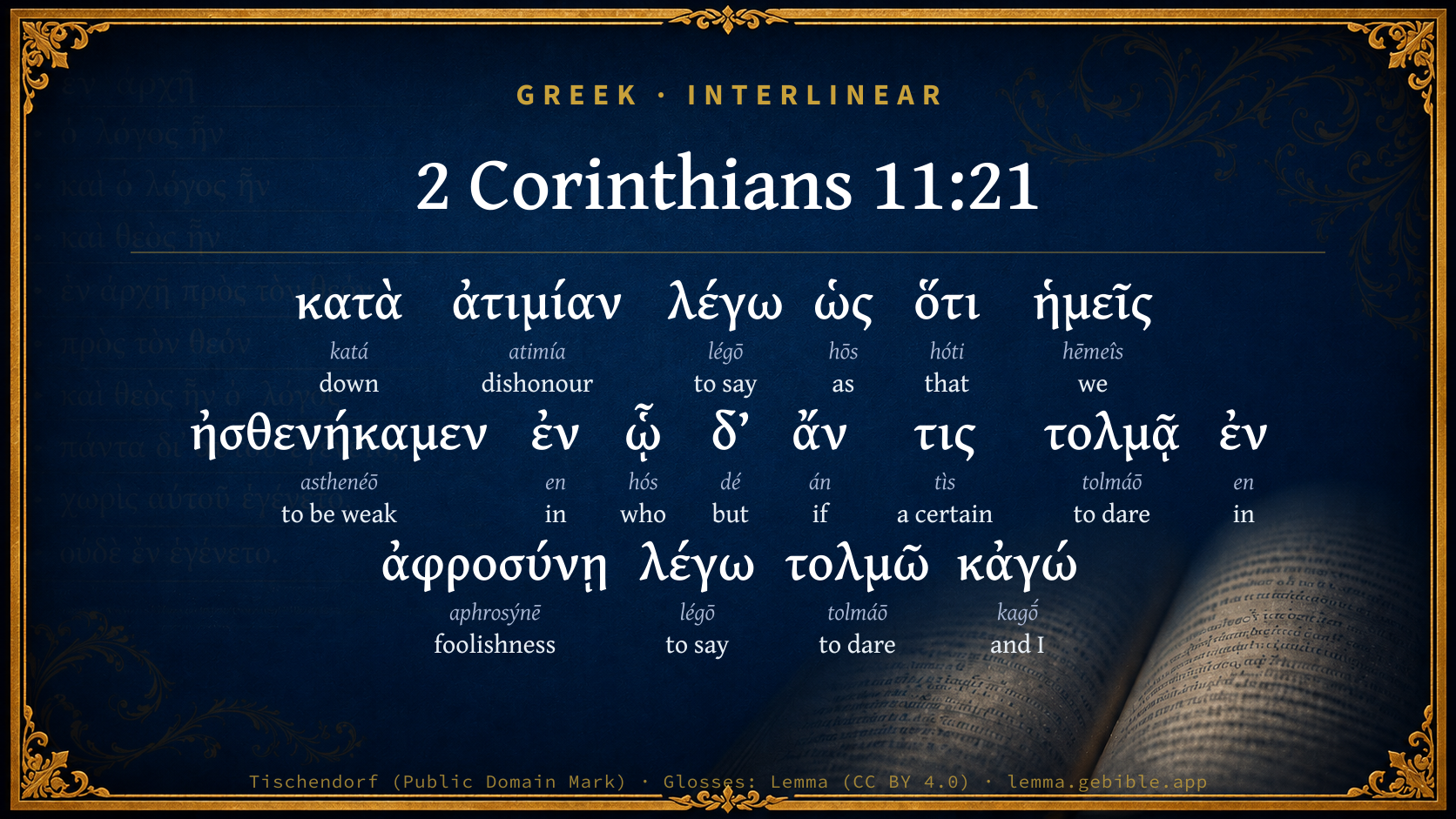
  1. κατὰ katá G2596 “down” Preposition
  2. ἀτιμίαν atimía G819 “dishonour” Noun, Accusative, Singular, Feminine
  3. λέγω légō G3004 “to say” Verb, Present, Active, Indicative, 1st person, Singular
  4. ὡς hōs G5613 “as” Adverb
  5. ὅτι hóti G3754 “that” Conjunction
  6. ἡμεῖς hēmeîs G2249 “we” Personal pronoun, 1st person, Nominative, Plural
  7. ἠσθενήκαμεν asthenéō G770 “to be weak” Verb, Perfect, Active, Indicative, 1st person, Plural
  8. ἐν en G1722 “in” Preposition
  9. ᾧ hós G3739 “who” Relative pronoun, Dative, Singular, Neuter
  10. δ’ dé G1161 “but” Conjunction
  11. ἄν án G302 “if” Particle
  12. τις tìs G5100 “a certain” Indefinite pronoun, Nominative, Singular, Masculine
  13. τολμᾷ tolmáō G5111 “to dare” Verb, Present, Active, Subjunctive, 3rd person, Singular
  14. ἐν en G1722 “in” Preposition
  15. λέγω légō G3004 “to say” Verb, Present, Active, Indicative, 1st person, Singular
  16. τολμῶ tolmáō G5111 “to dare” Verb, Present, Active, Indicative, 1st person, Singular
  17. κἀγώ kagṓ G2504 “and I” Personal pronoun, 1st person, Nominative, Singular, Aramaic form

About this verse

These counts appear in no published source. They are computed here, from the morphology-tagged text and Lemma’s own curated glosses. What Lemma adds →

18
words
15
distinct lemmas
Pauline Epistles
section

Notable vocabulary

The rarest word here is ἀφροσύνῃ foolishness G877 — appearing just 4 times in the whole Greek New Testament.

Shared distinctive vocabulary

ἀφροσύνῃ foolishness G877 occurs in 4 verses of the Greek New Testament. Also found in:

Repetition

Words recur within this verse:

  • λέγω to say G3004 ×2
  • τολμᾷ to dare G5111 ×2
  • ἐν in G1722 ×2

Cross-references

6

Topical passages linked to 2 Corinthians 11:21 in the Treasury of Scripture Knowledge — connected by theme and wording, ordered by reader-vote popularity; previews shown in the World English Bible.

  • 2 Corinthians 10:10 For, "His letters," they say, "are weighty and strong, but his bodily presence is weak, and his speech is despised."
  • 2 Corinthians 10:1–2 Now I Paul, myself, entreat you by the humility and gentleness of Christ; I who in your presence am lowly among you, but being absent am of good courage toward you.
  • 2 Corinthians 11:17 That which I speak, I don't speak according to the Lord, but as in foolishness, in this confidence of boasting.
  • 2 Corinthians 11:22–27 Are they Hebrews? So am I. Are they Israelites? So am I. Are they the seed of Abraham? So am I.
  • 2 Corinthians 13:10 For this cause I write these things while absent, that I may not deal sharply when present, according to the authority which the Lord gave me for building up, and not for tearing down.
  • Philippians 3:3–6 For we are the circumcision, who worship God in the Spirit, and rejoice in Christ Jesus, and have no confidence in the flesh;

Cross-references courtesy of OpenBible.info (CC BY 4.0).

Commentary

Notes on 2 Corinthians 11:21 from classic Christian and Jewish commentators (each source and its license shown beneath its notes). The classic Christian expositions comment on the surrounding passage and are grouped to its opening verse, so a note may address several verses; the Jewish commentaries on the Tanakh (Rashi and others) are per-verse, so they appear only where the commentator wrote on this verse.

Lemma curates 59 commentaries, every one of them public domain or Creative Commons licensed, each selected and text-cleaned for this edition rather than reprinted as found. About our sources →

The Biblical Illustrator

Joseph S. Exell

2Co_11:21-33

I speak as concerning reproach, as though we had been weak.

Howbeit … I am bold also.

Pauls avowal of his advantages and his history of his trials

I. His manly avowal of his distinguished advantages.

1. His superior character (2Co_11:21).

2. His superior ancestry (2Co_11:22).

3. His superior apostleship (2Co_11:23).

II. His historic sketch of his extraordinary trials. The trials here sketched indicate several things.

1. The mysteriousness of Gods procedure with His servants. One might have thought that the man inspired with supreme love to Him, and receiving a commission from Him, involving the salvation of souls, would have made his way clear, safe, and even pleasant. The more important the Divine work intrusted to a man, and the more faithful he is in its discharge, the more trials will embarrass and distract him. For an explanation of this we must await the great explaining day.

2. The unconquerableness of Christly love in the soul. What stimulated Paul to embark in, and what bore him up under such an enterprise as this? The answer is, The love of Christ constraineth me.

3. The indelibility of the impressions which trials produce. They had long since transpired, but they were fresh in Pauls memory. It is a law in our nature that our trials make a deeper impression on us than our mercies. Why? Because they are the exceptions, not the rule.

4. The blessedness which the memory of trials rightly endured produces. In Pauls case--

(1) It generated sympathy with the woes of others (2Co_11:29). No man can sympathise with the trials of others, unless he has passed through trials himself.

(2) It inspired the soul with true rejoicing (2Co_11:30). (D. Thomas, D. D.)

In labours more abundant.--

Service in sorrow

Look at yon miller on the village hill. How does he grind his grist? Does he bargain that he will only grind in the west wind, because its gales are so full of health? No, but the east wind, which searches joints and marrow, makes the millstones revolve, and together with the north and the south it is yoked to his service. Even so should it be with you who are true workers for God; all your ups and your downs, your successes and your defeats, should be turned to the glory of God. (C. H. Spurgeon.)

The trials of busy life

Now, from many causes, from the temper of the day, and from the temper of our nation, the being busy is most natural to us; around us on every hand men and women are largely occupied, toiling for the necessaries, for the comforts, or for the luxuries of life. The more men have, the more they seem to need, and so that desire. Still, to be busy is natural, and to be busy is good; slothfulness, in the case of the majority, would mean poverty or misery. Honest industry stands upon the footing of being a service agreeable to God. Herein lies one of the trials of this life.

1. In proportion as a persons work is great, as the activity of busy life increases, especially if that activity be attended with temporal success, then increases the danger of this God-ward aspect being lost sight of--the work comes to be more and more regarded, as from the first it may have been taken up, only on its earthly side. So much of success seems to be dependent on the individual himself, his knowledge, his energies, his foresight, that at last he comes to say, My power and the might of my hand hath gotten me this, forgetting Who it is that gives power to get it. Then mark what flows from this forgetfulness of God, or this failing to recognise lifes work as given us of Him.

2. Restlessness and disquietude, when success is denied: pride and presumption when it flows in full tide. The present are days of great restlessness; disquietude and much anxiety are too common. Oh! it is sad to see, a sight which makes a thinking man weep at any time, to look around him anywhere, and see how Satan and the world are befooling souls for which Christ died, and which might find rest in Him.

3. The third trial to which busy life is exposed, is the trial of procrastination, the putting off until the convenient season lifes higher duties. Business in these days seems to occupy all peoples time, and nearly all their thoughts. It thins our churches, breeds a painful irregularity in the actions of the truer life of the soul.

4. Another trial which attends busy life is the trial of steadfastness. Business is often another name for the world; and what a world is this with which we have to do! What a mixture of good and bad, of vice and virtue, of honesty and corruption! And when the Christian has to face all this, to mix daily with all this, to act under or against all this, how terrible must be the strain on his steadfastness, that is, his walking uprightly before God.

5. The last trial is the trial of integrity: that trial, I mean, which, in some form or other, comes to every one--the conflict between principle and our interest. Oh! in the busy life, does not this conflict rage? Such are a few, a very few, of the many trials of busy life. The one leading thought of them all, is this, their danger--unless we be watchful--to divert the soul from its God. Their snare is to leave no time, or to leave no inclination, or to leave no power for high and holy things. But this, remember, through the abuse of them, not through the right and prayerful use. If God has given us our work, however great, we must do it, and we may do it unto Him. (C. C. Chamberlain, M. A.)

The Biblical Illustrator, edited by Joseph S. Exell (c. 1880s–1900s) — public domain. Text from a community e-Sword module.

Tyndale Open Study Notes

Tyndale Open Resources

11:21b-29 Rather than boasting about his strengths and successes like the false teachers did, Paul boasts in weakness and defeat, pointing away from himself and toward God.

Tyndale Open Study Notes — © Tyndale Open Resources, licensed CC BY-SA 4.0. Text via the HelloAO Bible API.

Bengel's Gnomon

Johann Albrecht Bengel

2Co 11:21. Κατὰ ἀτίμιαν, in the way of ignominy [as concerning reproach]) as if I were already considered as one dishonoured [‘despised’]. See 1Co 4:10, and from the same passage we may also compare the term weak with this before us, and wise, φρόνιμοι, at 2Co 11:19. Comp. with the use of κατὰ here, the καθʼ ὑστέρησιν, in respect of, in the way of, want, Php 4:11.—ὡς ὅτι ἡμεῖς ἠσθενήσαμεν) as though we had been weak in mind, having nothing, of which we might boast and in which we might show boldness. The antithesis follows: but wherein soever any one is bold: the weak and dishonoured [ἄτιμοι] cannot boast, but still I will be bold; comp. 2Co 11:30.—ἐν ἀφροσύνῃ, foolishly) So he terms it κατʼ ἄνθρωπον, after the manner of men: comp. v. 16; and for the sake of modesty.

Bengel's Gnomon of the New Testament — English translation (T&T Clark, Edinburgh, 1860) — public domain. Text from a community e-Sword module.

Meyer's Critical & Exegetical Commentary

Heinrich August Wilhelm Meyer

2Co_11:21. In a disgraceful way (for me) I say, that we have been weak! Ironical comparison of himself with the false apostles, who, according to 2Co_11:20, had shown such energetic bravery in Corinth. For such things we, I confess it to my shame, were too weak!

κατὰ ἀτιμίαν] is the generally current paraphrase of the adverb (ἀτίμως), to be explained from the notion of measure (Bernhardy, p. 241). See Matthiae, p. 1359 f.

ὡς ὅτι] as that (see in general, Bast, ad Gregor. Cor. p. 52), introduces the contents of the shameful confession, not, however, in an absolutely objective way, but as a fact conceived of (ὡς). Comp. 2Th_2:2; Xen. Hist. iii. 2. 14; and the passages from Joseph, c. Rev_1:11, and Dionys. Hal. 9 (ἐπιγνοὺς, ὡς ὅτι ἐσχάτοις εἰσὶν οἱ κατακλεισθέντες) in Kypke, II. p. 268; also Isocr. Busir. arg. p. 362, Lang.: κατηγόρουν αὐτοῦ, ὡς ὅτι καινὰ δαιμόνια εἰσφέρει, and the causal ὡς ὅτι, 2Co_5:19. The confession acquires by ὡς ὅτι something of hesitancy, which strengthens the touch of iron.

ἡμεῖς] is with great emphasis opposed to the men of power mentioned in 2Co_11:20.

ἠσθενήσαμεν] namely, when we were there; hence the aorist. On the subject-matter, comp. 1Co_2:2.

There agree, on the whole, with our view of the passage Bengel, Zachariae, Storr, Flatt, Schrader, de Wette, Neander, Osiander, and others. The main point in it is, that κατʼ ἀτιμίαν denotes something shameful for the apostle, and λέγω has a prospective reference. Rückert also gives λέγω a prospective reference, but he diverges in regard to κατʼ ἀτιμίαν, and supplies μέν: in the point, indeed, to bring disgrace upon you, I must acknowledge that I have been weak. But in that case how unintelligibly would Paul have expressed himself! For, apart from the arbitrary supplying of μέν, the definite ἀτιμίαν would be quite unsuitable. Paul, to be understood, must have written κατὰ τὴν ἀτιμίαν ὑμῶν (as regards your disgrace), or at least, with reference to 2Co_11:20, κατὰ τὴν ἀτιμίαν (as regards the disgrace under consideration). Ewald and Hofmann take κατὰ ἀτιμ. rightly, but give λέγω a retrospective reference. In their view of ὡς ὅτι they diverge from one another, Ewald explaining it: as if I from paternal weakness could not have chastised you myself; Hofmann, on the other hand, taking ὡς ὅτι on as specifying the reason for saying such a thing (comp. 2Co_5:19). Against Ewald it may be urged that ὡς ὅτι does not mean as if, and that the five points previously mentioned are not brought under the general notion of chastisement; and against both expositors, it may be urged that if κατὰ ἀτιμίαν were in reference to what precedes to mean a dishonour of the apostle himself, ἡμῶν must of necessity (in Php_4:11, κατά is different) have been appended in order to be understood, because the previous points were a shame of the readers; consequently the fine point would have lain just in an emphatically added ἡμῶν (such as κατὰ τὴν ἡμῶν ἀτιμίαν). In our interpretation, on the other hand, κατὰ ἀτιμίαν receives its definite reference through ὡς ὅτι ἡμεῖς (that we), and a ἡμῶν with ἀτιμίαν would have been quite superfluous. Most of the older commentators, too, though with many variations in detail, refer κατὰ ἀτιμ. λέγω to what precedes, but explain κατὰ ἀτιμ. of the shame of the readers. So Chrysostom,[334] Theophylact, Theodoret, Pelagius, Erasmus, Beza, Calvin, Hunnius, and others: to your shame I say this (2Co_11:20), as if [rather: as because] we had been weak, and could not have done the same thing, although we could do it but would not. Similarly also Billroth (followed by Olshausen): In a disgraceful way, I maintain, you put up with that injustice from the alleged reason that we are weak (rather: had been). But since κατὰ ἀτιμ. is not more precisely defined by a ὑμῶν, we have no right to give to it another definition than it has already received from Paul by the emphatic ἡμεῖς ἠσθενήσ. Against the retrospective reference of λέγω, see above. Finally, in that view the passage would lose its ironical character, which however still continues, as is shown at once by the following ἐν ἀφροσύνῃ λέγω.

ἐν ᾧ δʼ ἄν τις τολμᾶ κ.τ.λ.] Contrast with the ironical ἠσθενήσαμεν: wherein, however, any one is bold

I say it irrationally

I too am bold; in whatever respect (quocunque nomine) any one possesses boldness, I too have boldness. In ἐν ᾧ lies the real ground, in which the τολμᾶν has its causal basis. As to τολμᾷ, comp. on 2Co_10:2. ἄν contains the conception: should the case occur. See Fritzsche, Conject. p. 35.

ἐν ἀφροσύνῃ λέγω] Irony; for μή τίς με δόξῃ ἄφρονα εἶναι, 2Co_11:16. But Paul knew that the τολμῶ κἀγώ would appear to the enemies to be a foolish assertion.

[334] Chrysostom observes that ὡς ὅτι κ.τ.λ. is given obscurely, in order to conceal the unpleasantness of the meaning by the obscurity.

Meyer — Critical and Exegetical Commentary on the New Testament — English translation by Peter Christie, edited by Frederick Crombie (T&T Clark, 1880) — public domain. Text from a community e-Sword module.

Expositor's Greek Testament

ed. W. Robertson Nicoll

2Co 11:21 . κατὰ ἀτιμίαν λέγω κ . τ . λ .: by way of disparagement, sc. , humbly of myself, I say that we, i.e. , I myself, ἡμεῖς being ironically emphasised, have been weak, i.e. , I have not attempted to enforce my authority in any of these directions ( cf. 2Co 10:10 and 1Co 2:3 ). He now changes his tone from irony to direct and masterful assertion, and in the splendid passage which follows he makes the “boast” which he has been leading up to with such prolonged explanations. ἐν ᾧ δʼ ἄν κ . τ . λ .: and yet whereinsoever any man is bold ( I speak in foolishness this he is careful to add once more; see 2Co 11:17 ), I am bold also. His whole life will justify him.

The Expositor's Greek Testament, edited by W. Robertson Nicoll (1897–1910) — public domain. Text from a community e-Sword module.

Geneva Bible (1599)

Geneva Bible translators

Paul is called weak, in that he seemeth to the Corinthians a vile and abject man, a beggarly artificer, a most wretched and miserable idiot, whereas notwithstanding therein God’s mighty power was made manifest.

As if he said, in respect of that reproach which they do unto you (I speak it) which surely is as evil as if they did beat you.

Geneva Bible (1599) marginal notes — public domain. Text via Bolls.life.

Jamieson, Fausset & Brown

Robert Jamieson, A. R. Fausset & David Brown

as concerning reproach--rather, "by way of dishonor (that is, self-disparagement) I say it."

as though we . . . weak--in not similarly (Co2 11:20) showing our power over you. "An ironical reminiscence of his own abstinence when among them from all these acts of self-exaltation at their expense" (as if such abstinence was weakness) [ALFORD]. The "we" is emphatically contrasted with the false teachers who so oppressively displayed their power. I speak so as though WE had been weak when with you, because we did not show our power this way. Howbeit (we are not really weak; for), whereinsoever any is bold . . . I am bold also.

Jamieson, Fausset & Brown — Commentary Critical and Explanatory on the Whole Bible (1871) — public domain (CC PDM 1.0). Text via the HelloAO Bible API.

Adam Clarke's Commentary

Verse 21. I speak as concerning reproach] Dr. Whitby thus paraphrases this verse: "That which I said of smiting you upon the face, I speak as concerning the reproach they cast upon you as profane and uncircumcised, whereas they all profess to be a holy nation; as though we had been weak-inferior to them in these things, not able to ascribe to ourselves those advantages as well as they. Howbeit, whereinsoever any is bold, and can justly value himself on these advantages, I am bold also, and can claim the same distinctions, though I speak foolishly in setting any value on those things; but it is necessary that I should show that such men have not even one natural good that they can boast of beyond me."

Adam Clarke's Commentary on the Bible (1810–1826) — public domain. Text from a community e-Sword/MySword module.

John Calvin's Commentaries

21. Nay, in whatsoever. Paul had asked, why the Corinthians showed more respect to others than to him, while he had not been by any means weak, that is, contemptible. He now confirms this, because, if a comparison had been entered upon, he would not have been inferior to any one in any department of honor.

John Calvin's Commentaries (1540-1563) — public domain. Text from the Calvin Translation Society English edition (1840s-50s) via the Christian Classics Ethereal Library (ccel.org). Calvin's coverage is partial (roughly two-thirds of the Bible); uncommented books and verses are honest gaps, never fabricated. The 19th-century editor's footnotes and remarks are omitted so the notes are faithfully Calvin's own voice.

Ellicott's Commentary for English Readers

(21) I speak as concerning reproach, as though we had been weak.—Better, I speak it as a matter of reproach to myself, as though we were weak. The irony becomes more intense than ever. He has named these acts of outrage, he says, as though by way of self-disparagement. “We” (the pronoun is strongly emphasised) “were too infirm to venture on such things.” The taunt flung at his bodily infirmities is still present to his thoughts, and he assumes, in the bitterness of his irony, that it was through them he had been kept from like acts of self-asserting authority. Then he resumes his contrast, still dwelling on the offensive words, “folly” or “insanity,” which had been used of him: “Yes, but on every ground of daring—I know you will see my insanity again in this—I have as much right to dare as they.”

A Bible Commentary for English Readers, edited by Charles John Ellicott (1878–1897) — public domain. Text from a community e-Sword module.

The Cambridge Bible for Schools and Colleges

gen. ed. J. J. S. Perowne

21. I speak as concerning reproach, as though we had been weak] Literally, after reproach (or dishonour, see ch. 2Co_6:8, and see note on 2Co_11:17), “to my reproach” (Stanley), or perhaps ‘about the dishonour that has been cast upon me,’ that I ventured to do none of these things, because I dared not. The ‘we’ is emphatic. We, the true ministers of Christ, incurred the reproach of weakness while among you (see ch. 2Co_10:10, and 1Co_4:10), for we ventured upon no such evidences of our power. And this ‘weakness’ has been alleged against us as proof positive that we are no true Apostles of Christ. ‘As though’ implies that St Paul does not admit the justice of the accusation. But he passes it by, and proceeds to shew that he, too, can shew boldness upon occasion.

whereinsoever any is bold] There is no ground upon which the ‘false Apostles’ have based their authority which St Paul could not also advance: there are few on which his title to the respect of his flock is not greater than theirs.

I am bold also] St Paul is not here so much thinking of his boldness in asserting his Apostolic authority (ch. 2Co_10:2; 2Co_10:11) as of his boldness in asserting his personal claims on the allegiance of the Corinthian Christians; for now, though not ‘after the Lord,’ but ‘after the flesh,’ he commences that eloquent and impassioned description of his ministerial labours and experiences, which has done more than any other passage in Scripture to bring the person of the great Apostle before us, and to endear him to the Christian conscience.

The Cambridge Bible for Schools and Colleges (gen. ed. J. J. S. Perowne; Cambridge University Press, 1878–1918) — public domain. Text from a community e-Sword module.

John Gill's Exposition

Are they Hebrews? so am I,.... The nation of the Jews were called Hebrews, not from Abraham, as some have (w) thought, through ignorance of the Hebrew language, which will by no means admit of such a derivation and etymology of the name; wherefore the Jewish writers never make mention of this opinion as among any of them; had they took their name from Abram or Abraham, they would rather have been called Abramires or Abrahamites, and not Hebrews; besides, Abraham himself is called an Hebrew, Gen 14:13 and to be so called from himself, and not denominated from some other person or thing, can never be imagined, it would be most absurd and ridiculous; to which may be added, that the apostle in this verse makes mention of being the seed of Abraham, as a distinct character from that of Hebrews: others have been of opinion that the name is derived from "Habar", which signifies, "to pass over"; and was occasioned by one or other of the following events; either from Abraham's passing over the river Euphrates, when he came out of Mesopotamia into the land of Canaan, and so was called Abram, "Hahibri, the passer over", or the Hebrew (x), and so his posterity were called after him; or from the posterity of Canaan, who, after the confusion at Babel, settled in that part of Asia which lies between the river Jordan and the Mediterranean sea, and from them called the land of Canaan; and who were called by the Chaldeans, from whom they separated, and by the neighbouring nations, Hebrews, or passers over, because they passed over the river Jordan; and so Abraham passing over the river Euphrates to them, and learning their language, and continuing there, he was called an Hebrew also, and his posterity after him (y); or from Arphaxad, or Heber, passing over the river Tigris or Euphrates, and settling in the land of Canaan (z); but it is not likely that a nation should take its name from such an event: others think it a more probable opinion that Abraham was so called, and hence his posterity after him, from the name which the Canaanites gave to Mesopotamia, from whence he came; calling it Heber Hannahar, or the country beyond the river: just as we call foreigners Transmarines, or people beyond sea; and of this opinion were some of the Jewish writers (a); but not Mesopotamia, but Canaan, is called the land of the Hebrews, Gen 40:15. The more commonly received opinion with the (b) Jews is, and which is most likely, that they are so called from Heber, the father of Peleg, in whose days the confusion of languages was made, and what is now called the Hebrew language being the first and original one, was retained in him and in his family; hence Shem is said to be the father of all the children of Heber, Gen 10:21 that is, the Hebrews, as the same people are called the children of Israel from Israel, and the children of Judah from Judah, and sometimes they go by the name of Heber, as in Num 24:24 when as the Assyrians are called Ashur, from whom they have their name, so the Hebrews are called Heber, from whom they take their denomination: and it should be observed, that this is not only a national but a religious name, and those people were called so, because they were of the faith as well as the descendants of Heber; so Shem was the father of others, but in a peculiar manner the father of the children of Heber, because the religion he professed was continued with them; and so Abraham is particularly called the Hebrew, not only because he descended from Heber, but was of the same, religion; and so his posterity, not in the line of Ishmael, but of Isaac, are so called; and not as descending from Isaac in the line of Esau, but of Jacob; and hence it was not lawful for the Egyptians to eat bread with the Hebrews, not because they were of another nation, but because of another religion, Gen 43:32. It seems that these false apostles were Jews, since it is not denied by the apostle, but granted; they were some such like false brethren as those who came from Judea to Antioch, and disturbed the church there, Act 15:1 and whereas they boasted of their being Hebrews, the descendants of the ancient patriarch Heber in the line of Abraham; the apostle was able to match them in this, and asserts himself to be an Hebrew too, which he could do with the strictest truth, for he was an Hebrew of the Hebrews, he was an Hebrew by father and mother's side:

are they Israelites? so am I. The Jews were called Israelites from Israel, a name which was given to Jacob their ancestor, upon his wrestling with an angel, and prevailing over him; and was accounted an honourable one, or title of honour; for the people of Israel were they whom God chose for a peculiar people to himself above all others, brought them out of Egypt, fed them in the wilderness, and led them through it, and settled them in the land of Canaan, and bestowed upon them special and peculiar privileges; see Rom 9:4. The Jews are very extravagant in the praise of Israelites; they not only make them the favourites of God, beloved of him, because called children, and had the law given them (c), and extol them above all mankind; See Gill on Rom 3:9 but they even make them equal to the ministering angels, and say they are pure from sin as they, especially on the day of atonement (d), yea, more excellent than they (e): in this also the apostle could answer them, for he was of the stock of Israel, and of the tribe of Benjamin, a son of Jacob, or Israel; and was an Israelite indeed, as Nathanael, for all are not Israel that are of Israel:

are they the seed of Abraham? so am I: of this the Jews mightily boasted; see Joh 8:33 they reckon themselves, even the poorest among them, as the nobles and princes of the earth (f); and even other people have been fond of being reckoned of the stock of Abraham, as particularly the Lacedemonians,

"Areus king of the Lacedemonians to Onias the high priest, greeting: It is found in writing, that the Lacedemonians and Jews are brethren, and that they are of the stock of Abraham:'' (1 Maccabees 12:20,21)

The Jews make a merciful disposition to men to be a sign and evidence of being of the seed of Abraham (g); but in a spiritual sense, an interest in Christ, and faith in him, denominate men to be truly Abraham's seed, and heirs of the promise: this is to be understood here in a natural sense, and of being of Abraham's seed in the line of Jacob, for otherwise the Ishmaelites and Idumeans were of the seed of Abraham; but they were his seed in that line in which the promised seed, the Messiah, was to come; though this was of no avail, without having the same faith Abraham had, and believing truly in Christ, as his spiritual seed do, whether they be Jews or Gentiles; however, the apostle was equal to them in this respect; he was of the seed of Abraham according to the flesh, and above them in another, in that he was of Abraham's spiritual seed by faith in Christ Jesus.

(w) Artapanus apud Euseb. praepar. l. 9. c. 18. p. 420. Ambrosius sive Hilarius in Phil. iii. 5. & alii. (x) Hicronymus in Ezek. c. 7. fol. 183. B. Theodoret. in Gen. Qu. 60. (y) Erpeuius. (z) Ar. Montan. Canaan, c. 9. Vid. Sigonium de Repub. Heb. l. 1. c. 1. p. 16. (a) Bereshit Rabba, sect. 42. fol. 37. 3. Vid. Jarchium in Gen. x. 21. & xiv. 13. & Aben Ezram in Exod. xxi. 2. (b) Joseph. Antiqu. l. 1. c. 6. sect. 4. Targ. Jon. in Gen. x. 21. Sepher Cosri, par. 1. sect. 49. fol. 24. 2. R. Nehemiah in Bereshit Rabba, ut supra, Aben Ezra in Gen. x. 21. & xxxix. 14. & in Exod. i. 16. Kimchi in rad. (c) Pirke Abot, c. 3. sect. 14. (d) Pirke Eliezer, c. 48. (e) lb. c. 47. (f) Misn. Bava Kama, c. 8. sect. 6. (g) T. Bab. Betza, fol. 32. 2.

John Gill's Exposition of the Whole Bible (1746–1763) — public domain (CC PDM 1.0). Text via the HelloAO Bible API.

Trapp's Complete Commentary

John Trapp

21 I speak as concerning reproach, as though we had been weak. Howbeit whereinsoever any is bold, (I speak foolishly,) I am bold also.

Ver. 21. As though we had been weak] i.e. Worthless and spiritless. But mistake not yourselves; I am another manner of man than you imagine me. It is said of Athanasius, that he was Magnes et Adamas; a loadstone in his sweet, gentle, drawing nature, and yet an adamant in his resolute, stout carriage against heretics and evildoers. (Nazianzen.)

John Trapp, A Commentary or Exposition upon All the Books of the Old and New Testament (1647–1656) — public domain. Text from a community e-Sword module.

Albert Barnes' Notes on the Bible

I speak as concerning reproach - I speak of disgrace. That is, says Rosenmuller, “I speak of your disgrace, or, as others prefer it, of the disgrace of the false apostles.” Doddridge regards it as a question. “Do I speak this by way of dishonor, from an envious desire to derogate from my superiors so as to bring them down to my own level?” But to me it seems that Paul refers to what he had been admitting respecting himself - to what he had evinced in rudeness of speech 2Co 11:6, and to his not having urged his claims to the support which an apostle had a right to receive - to things, in short, which they esteemed to be disgraceful or reproachful. And his idea, it seems to me, is this: “I have been speaking of reproach or disgrace as if I was weak, that is, as if I was disposed to admit as true all that has been said of me as reproachful or disgraceful; all that has been said of my lack of qualifications for the office, of my lack of talent, or elevated rank, or honorable birth, etc. I have not pressed my claims, but have been reasoning as if all this were true - as if all that was honorable in birth and elevated in rank belonged to them - all that is mean and unworthy pertained to me. But it is not so. Whatever they have I have. Whatever they can boast of, I can boast of in a more eminent degree. Whatever advantage there is in birth is mine; and I can tell of toils, and trials, and sufferings in the apostolic office which far surpass theirs.” Paul proceeds, therefore, to a full statement of his advantages of birth and of his labors in the cause of the Redeemer.

As though we had been weak - As if I had no claims to urge; as if I had no just cause of boldness, but must submit to this reproach.

Howbeit - (δέ de). But. The sense is, if anyone is disposed to boast, I am ready for him. I can tell also of things that have as high claims to confidence as they can. If they are disposed to go into a comparison on the points which qualify a man for the office of an apostle, I am ready to compare myself with them.

Whereinsoever - (ἐν ᾧ en hō. In what. Whatever they have to boast of I am prepared also to show that I am equal to them. Be it pertaining to birth, rank, education, labors, they will find that I do not shrink from the comparison.

Any is bold - (τις τολμᾷ tis tolma). Anyone who dares to boast; anyone who is bold.

I speak foolishly - Remember now that I speak as a fool. I have been charged with this folly. Just now keep that in mind; and do not forget that it is only a fool who is speaking. Just recollect that I have no claims to public confidence; that I am destitute of all pretensions to the apostolic office; that I am given to a vain parade and ostentation, and to boasting of what does not belong to me, and when you recollect this let me tell my story. The whole passage is ironical in the highest degree. The sense is, “It is doubtless all nonsense and folly for a man to boast who has only the qualifications which I have. But there is a great deal of wisdom in their boasting who have so much more elevated endowments for the apostolic office.”

I am bold also - I can meet them on their own ground, and speak of qualifications not inferior to theirs.

Albert Barnes' Notes on the Bible (1834–1885) — public domain. Text from a community e-Sword/MySword module.

Haydock's Catholic Bible Commentary

I speak according to dishonour, as if we had been weak in this part. The interpreters are divided on this verse; the sense seems to be, I speak what others took upon as dishonourable in us, that we had not the like authority over you as these false teachers, and therefore could not keep you in such subjection as they have done. But yet I must tell you, that wherein if any man is bold, I am bold also; that is, I have no less motives to domineer and boast, than they have. And then he proceeds to particulars. (Witham)

George Leo Haydock (1774–1849), Haydock's Catholic Family Bible and Commentary, 1859 edition — public domain. Excludes Psalms (Douay-Rheims chapter numbering differs from Protestant) and Deuterocanonical books (Catholic canon only).

Matthew Poole's English Annotations

I speak as to those reproaches they cast on me, who am by them represented to you as though I were weak and contemptible; as indeed I am, as to my person, but not as to my doctrine, and the miracles I have wrought amongst you. And being some of them are so confident in boasting what they are, and what they have done and suffered; let me be a little bold as well as they, in telling you what I am, and what I have done and suffered.

Matthew Poole's English Annotations on the Holy Bible (1683–1685) — public domain. Text from a community e-Sword/MySword module.

Whedon's Commentary on the Bible

Daniel D. Whedon

21. St. Paul now declares that all this reproach upon himself is ironical. Render it thus: In regard to all this matter of reproach, I am talking as if I really had been weak. However, I am now going to be bold, (foolish, my enemies may call it,) if any body ever was. And so he forthwith boldly proceeds to bring his opponents to close issue.

Daniel D. Whedon (gen. ed.), Commentary on the Old and New Testaments (1874–1909) — public domain. Text from a community e-Sword module.

The Pulpit Commentary

I steak as concerning reproach, as though we had been weak. The sense is uncertain, but if with the Revised Version we render it, "I speak by way of disparagement," the verse may be understood as an ironical admission that, if absence from these violent and self-assertive proceedings be a sign of weakness, he has been weak. He proceeds to correct the ironical admission in the next clause. The meaning can hardly be, "I admit the disgraces I have suffered", (comp. 2Co_6:8) because he is speaking of the Corinthians, not of himself. I am bold also. If they derive their right to this audacious and overweening line of conduct from any privileges of theirs, there is not one of these privileges which I too may not claim.

Paul"s avowal of his advantages and his history of his trials.

speak as concerning reproach," etc. The two subjects for thought that stand out conspicuously in these verses are Paul"s manly avowal of his distinguished advantages and his historic sketch of his extraordinary trials.

I HIS MANLY AVOWAL OF HIS DISTINGUISHED ADVANTAGES, There are three advantages which he here touches upon.

1. His superior character. "I speak as concerning reproach by way of disparagement, as though we had been weak." Hitherto I have spoken of myself as if all the disparaging things you have said of me were true. The idea of Paul"s language here seems to be this: "I have been speaking of reproach or disgrace, as if I was weak, i.e. as if I was disposed to admit as true all that has been said of me, as reproachful or disgraceful, all that has been said of my want of qualifications for the office, of my want of talent, my dignity of character, my folly. In all this I have been speaking ironically. I am superior to all; I am not ignorant, but learned; I am not foolish, but wise; not greedy, but generous; not proud, but humble; not ignoble, but dignified." How far his character transcended that of his traducers, history shows.

2. His superior ancestry. "Are they Hebrews? so am I Are they Israelites? so am I Are they the seed of Abraham? so am His traducers, the false teachers, were, it would seem, Jews; probably boasted of their descent, and certainly implied that Paul was a mere Hellenistic Jew, born at Tarsus. If they gloried in their descent, so could he; the blood of Abraham quivered in his veins, he was a lineal descendant of the man who wrestled with Jehovah and prevailed, an Israelite.

3. His superior apostleship. "Are they ministers of Christ? (I speak as a fool) I am more." They called themselves "ministers of Christ," and belonged, perhaps, to the party in the Corinthian Church who said they were "of Christ Christites. But he was more an apostle of Christ than they were. Of this he was conscious. In touching this Paul says, "I speak as a fool," or as one beside myself. Here his great soul seems to flash out in the fire of indignant irony. There is an egotism here, say some. True, but it is a just, manly, necessary egotism.

II HIS HISTORIC SKETCH OF HIS EXTRAORDINARY TRIALS. He was scourged "five times," in "prisons frequent" and in "deaths oft," thrice "beaten with rods," once "stoned," "thrice suffered shipwrecks," in "perils in the sea" and on laud, midst foes and friends, in the "wilderness" and in cities, tried by "weariness and painfulness, in watchings often, in hunger and thirst, in fastings often, in cold and nakedness." Besides all this, he refers to the trials that came "daily" upon him in "the care of all the Churches." The Churches were dear to his heart, and all the dissensions, heresies, unchastities, immoralities, that appeared from time to time in the Churches would carry anguish into his heart. Why he should refer in the last Verse to the event that happened at Damascus, when he was let down "through a window in a basket," has been a puzzle to commentators. But as it was amongst his first trials as an apostle, it, perhaps, made the greatest impression on his mind. The trials here sketched indicate several things.

1. The mysteriousness of Gods procedure with his servants. One might have thought that the man inspired with supreme love to God, and receiving a commission from him, involving the salvation of souls, would have had his way made clear and safe and even pleasant for him; that in his path no enemy should appear, no peril should threaten, no pain should be endured, that all things would be propitious; that he who embarked in such an enterprise as Paul"s would sail in a bark absolutely secure, under a sky without a cloud, with every billow and every breeze propitious. But not so. The more important the Divine work entrusted to a man, and the more faithful he is in its discharge, the more trials will embarrass and distract him. For an explanation of this we must await the great explaining day.

2. The unconquerableness of Christly love in the soul. What stimulated Paul to embark in such an enterprise as this? What urged him on through innumerable difficulties and dangers? What bore him up under distressing and ever-thickening trials? Here is the answer: "The love of Christ constraineth me." This is the love that is unconquerable and all-conquering, the love that makes the true hero.

3. The indelibility of the impressions which trials produce. The trials in this long catalogue, so varied and tremendous, had long since transpired, but they were fresh in Paul"s memory. Each one stood before the eye of his memory in living reality. It is a law in our nature that our trials make a deeper impression on us than our mercies. Why should this be so? Because they are the exceptions, not the rule.

4. The blessedness which the memory of trials rightly endured produces. In Paul"s case it did two things.

(1) It generated sympathy with the woes of others. "Who is weak, and I am not weak? who is offended, and I burn not?" No man can sympathize with the trials of others unless he has passed through trials himself. The sufferings that Christ endured qualified him to sympathize with the woes of the world. He who hungers for sympathy in his sufferings will go in vain to the man who has never suffered.

(2) It inspired the soul with true rejoicing. "If I must needs glory, I will glow of the things which concern mine infirmities." The reminiscence of the trials he had endured, the foes he had encountered, the perils he had braved, in the cause of Christ were now for him subjects for congratulation and glorifying. They had exerted such a beneficent influence on his character, and were endured in such a noble cause, that he rejoiced in them. In declaring all this Paul makes a solemn appeal for its truth. "The God and Father of our Lord Jesus Christ, which is blessed forevermore, knoweth that I lie not?

Vers. 21-33.

What St. Paul was and what he had suffered as an apostle of Christ.

If, indeed, the standard of strength which the deceiving ministers of Satan had set up among them were a correct one, then he must say that he had been weak in his intercourse with them on his visit to Corinth. He had not abused them as slaves, nor been avaricious, nor offered them insults. Yes; he must admit that they were strong and he weak, they wise and he foolish, and he confesses the shame he felt. The sharp irony is now dropped, and he proceeds to show what reasons he had for genuine boasting. If he had to vindicate his claims against these men who had transformed themselves into "ministers of righteousness," it was extremely abasing, but he would be bold (boastful), since there was no escape from the painful task. And, as we shall see, he would do it with great deliberation, item by item, the points clearly made, and only such points as were capable of easy verification.

I AS TO NATIONALITY. These Judaizers, seeking to prop up a sinking theocracy by means of a perverted Christianity, and putting a most inordinate and carnal estimate on their prerogatives as members of an elect race, had made on this score a very earnest appeal to the Corinthians, and especially to the converted Jews. "Are they Hebrews?" By this general race title the chosen people had been early known, and it was still in vogue. If they are Hebrews, St. Paul says, "so am I" Again, "Are they Israelites?" That name was derived from Israel, the name given to Jacob after wrestling with the angel at Peniel, and designated, originally, the union of the tribes as one community under Jehovah"s rule, and set apart to bear witness against all idolatry. "Israelite" carried in its import a reference to the nation as representative of the Divine unity, and was, therefore, distinctively religious. St. Paul responds again, "So am I" Finally, as to nationality.

they the seed of Abraham? so am I" One by one the honourable distinctions are mentioned, closing with the highest a son of Abraham, and in them he claims equality with these pretentious teachers. There was an evident reason for this mode of procedure. No one suspected his devotion to the Gentiles and his zeal in behalf of the apostleship of the uncircumcision. But there were prejudices, strong and bitter, against him on his supposed want of fealty to his nation, and hence his anxiety to show on all occasions that he prized his blood and loved his people. We see from our standpoint that he was an ideal Jew, the truest and most sagacious Jew of his age; and yet it was a memorable part of his discipline, anti a main factor in his fortunes, to be subjected to all sorts of vexations and persecutions on the ground of disloyalty to his nation. Other uses he subsequently made of these and similar facts, giving them an enlarged application, (Php 3) and directing them with exclusive intent to objects then engaging his thought; but, at present, he only individualizes far enough to prove that the "false apostles" had no advantage over him as to national ties.

II AS TO THE MINISTRY OF THE LORD JESUS. Do these men claim to be Christ"s ministers? Whatever they might assume to be in this regard, he (speaking as one beside himself) "was more." And what evidence shall he give of the fact that he was more? Shall he point to his wonderful successes? "He proceeds to mention, as the reason for his pre-eminence, no illustrious achievements or wonderful results he had accomplished, but difficulties, troubles, conflicts, perils" (Kling). Could more be condensed in the same number of words than he compresses in one short verse? The "more" means "in labours more abundant, in stripes above measure, in prisons more frequent, in deaths oft." But he will furnish particular illustrations of the statement just made. His own countrymen head the list, for "of the Jews five times received I forty stripes save one," thrice was he "beaten with rods," once stoned, thrice ship wrecked, "a night and a day in the deep." Yet this is only a partial account, and he offers other instances of his superior devotion as a minister of Christ. There were his frequent journeys, and what a history of perils! perils of waters, perils of robbers, perils by his own countrymen, perils by the heathen, perils in the city, perils in the wilderness, perils in the sea; did not this enumeration exhaust the sad experience? Nay; one pictures him pausing at this point and falling into a mood. of most touching reflection. To one who loved the name of brother in Christ as he did, who recalled how Ananias had come to him at Damascus and addressed him as "Brother Saul," and who remembered how often it had cheered him to be recognized and honoured as a brother in the ministry, what could be more oppressive to his spirit than to write at the last, "perils among false brethren? Thus closes the account of perils. Have his sorrows all been catalogued? The outward sufferings have been generalized in classes of peril and in forms of physical torture. Enough has been said to make good his claim to pre-eminence in affliction for the cause of Christ. Outside of the duties he was discharging as the Lord"s servant, not one of these evils had befallen him. It was the cross of Christ, and only the cross, which had brought all these upon him. But he had more to say. A man of feeble health, of acute nervous sensibility, struggling with disease and infirmity; who among us can enter into all he meant by "weariness and painfulness, watchings often, hunger and thirst, lastings often, cold and nakedness"? It is only a rude outline; imagine the details. But what were details to him? The rapid summation shows why he writes. Artistic effect offers him no temptation. Literary motives are impossible to his imagination and tastes. The eagerness of his spirit, approaching a topic most dear to his soul, hurries him to "the care of all the Churches." Ah! that was something transcendent. Daily it came upon him amidst weariness, painfulness, and other ills, and daily it came as a crowd pressing upon him with anxieties beyond utterance. Sympathy is incapable of complete expression. It cannot make itself known. It can only make itself felt, and therefore contents itself with hints. "Who is weak," sympathy asks, "and I am not weak?" And who is overcome by temptation (made to stumble), and I burn not? The sympathetic man is now deeply moved, and his heart breaks forth, "If I must needs glory, I will glory of the things which concern mine infirmities my weakness.

III THE TRUE NATURE OF HIS BOASTING. Examine this fragment of St. Paul"s biography, and what do you find as the shaping thought? It is the idea of suffering as expressive of human infirmity. Suffering for a moral purpose is continually kept before the mind, and, agreeably to that end, it is suffering that not only humbles its subject in a spiritual point of view, but humiliates him in the eyes of the world. Hence the conclusion to which he brings the mournful narration, "If I must needs glory, I will glory of the things which concern my weakness." No doubt it seemed very strange to many that he should boast of these things, but this was its justification. Had it not appeared as "folly," it would not have vindicated him against the malicious taunts of his adversaries; for it is exactly such a "folly" as identifies his life and experience with the "foolishness" of the gospel, the preaching of Christ crucified, on which, at the outset, he had laid a very distinctive stress. Boast he must to meet the low state of intellect and spirituality in those of the Church who had fallen under the influence of these self-aggrandizing "apostles." Boast he would in defence of himself, of his motives and intentions. Yet, while stooping to such a worldly method, he would do so in no carnal spirit, but as one who had a profound sense of his own unworthiness. What did the Jewish world think of his apostleship? Let the five times "forty stripes save one" answer. What did the Roman world think of it? The thrice "beaten with rods" was the reply. No allusion is made to his having been a "blasphemer" and "persecutor," for this had no bearing on the question at issue. It is a contrast throughout of himself with the "deceitful workers." And, finally, to make the contrast as perfect as possible, he refers to "the care of all the Churches" among the Gentiles. This point reached, he shows why he had made these concessions to the folly of certain Corinthians, and his true heart exclaims, "If I must needs glory, I will glory of the things which concern my weakness." Here, then, we have the first distinct appearance of one among those great thoughts that we find frequently in various forms in his subsequent writingsthe idea of glorying in his infirmities. Not enough is it for him to accept it as a burden and tolerate it as a thing providentially ordained to be borne. From this hour he enters on a higher experience, for he has learned to cherish a sentiment as well as find a duty and a principle in his infirmities. He will welcome them, he will press them to his heart as a treasure, he will "glory" in them. And if, hereafter, we shall often listen to his exultation when he rejoices in tribulation and glories in the cross, we can revert to the time and circumstances that first made this experience an era in his career. No wonder that he appeals with such solemnity to God for the truths asserted. It is a moment of impassioned thought which brings the past most vividly before his eye, and lo! the opening scene in a long series of afflictions for the gospel. There it was the far-off Syrian city of the Damascenes, and the beginning of that persecution which the Jews had continued so unrelentingly. And there, too, it had been announced to Ananias in a vision that the Lord had made Saul of Tarsus "a chosen vessel" unto himself, and would show him "how great things he must suffer." Straightway the revelation of sorrow began, for the stay at Damascus was interrupted by a conspiracy of the Jews, and he sought refuge in Arabia. All the intervening years had been years of suffering, the first link of the unbroken chain forged by the hatred of the Jews at Damascus, the last up to this period forged by the same hands at Corinth, and the issue of his experience was that he had learned to glory in his weakness. L.

The Pulpit Commentary (1880–1919), ed. H.D.M. Spence-Jones & Joseph S. Exell — public domain. Text from a community e-Sword module.

John Wesley's Explanatory Notes

I speak with regard to reproach, as though we had been weak - I say, "Bear with me," even on supposition that the weakness be real which they reproach me with.

John Wesley, Explanatory Notes Upon the Whole Bible (1754–1765) — public domain. Text via the GEBible commentary corpus.

Kretzmann's Popular Commentary

Paul E. Kretzmann

The apostle’s commendation of himself:

v. 21. I speak as concerning reproach, as though we had been weak. Howbeit, whereinsoever any is bold, (I speak foolishly,) I am bold also.

v. 22. Are they Hebrews? So am I. Are they Israelites? So am I. Are they the seed of Abraham? So am I.

v. 23. Are they ministers of Christ? (I speak as a fool) I am more; in labors more abundant, in stripes above measure, in prisons more frequent, in deaths oft.

v. 24. Of the Jews five times received I forty stripes save one.

v. 25. Thrice was I beaten with rods, once was I stoned, thrice I suffered shipwreck, a night and a day I have been in the deep;

v. 26. in journeyings often, in perils of waters, in perils of robbers, in perils by mine own countrymen, in perils by the heathen, in perils in the city, in perils in the wilderness, in perils in the sea, in perils among false brethren;

v. 27. in weariness and painfulness, in watchings often, in hunger and thirst, in fastings often, in cold and nakedness;

v. 28. beside those things that are without, that which cometh upon me daily, the care of all the churches.

Powerful irony and forceful reproach are contained in the first words of this section; for he truly must seem weak to the Corinthians in comparison with such spiritual bosses: To the disgrace (of you) I say it, as though it were so that we had become weak. It was a shame to the Corinthians that the apostle was obliged to write this way, as though he and his fellow-laborers appeared weak in comparison with the false apostles. The latter were regarded very highly in their eyes, from them they endured the most humiliating conduct, while the real teachers, to whom they owed all their spiritual riches, were despised in their eyes.

The apostle now changes to a tone of masterful assertion in bringing out his own claims: But in whatever things any one is bold, dares to boast, (I speak it foolishly), I also dare to boast. His whole life since his conversion, the whole course of his ministry, will justify him, will show what labors and sufferings he has borne. The apostle speaks in an altogether general way; he challenges any of the false teachers, although he regards his boasting as an act of foolishness. Thereby he intimates, as Luther says, that the opponents, that have nothing to show that will in any way compare with his record, are worse than fools with their bragging. For his own person, Paul begins with the very lowest advantage: Hebrews are they? I also. Israelites are they? I also. The seed of Abraham are they? I also. What the false teachers extolled beyond measure Paul places in the lowest place; even in this meanest and lowest advantage they were not ahead of him. For he was a Hebrew, a member of the Jewish nation, who retained the Jewish language and customs; he was an Israelite, a member of God’s chosen people of the Old Testament; he was a descendant of Abraham, he inherited the Messianic promises given to Abraham. In this point, therefore, the false apostles could not exalt themselves above Paul.

But there is a more important comparison: Ministers of Christ they are? That was their boast, and Paul, for the sake of argument, lets it stand, saying, however, in turn: As one beside himself I speak, I am more. The great humility of the apostle compels him to use this strong word, accusing himself of madness for presuming to boast in this sacred matter. Nevertheless he insists that he is a servant of Christ in a higher degree than his opponents: he has a much better right to call himself a minister of the Lord. This assertion he proves not by the success which he has had in his labors, not by naming the number of souls that were gained by his preaching, but by a reference to his labors and his self-denial. For that is the test of a minister’s faithfulness, that he denies himself for the sake of his Lord, that he cheerfully takes upon himself the shame and disgrace, the trials and sufferings and tribulations that are wont to accompany his office. Thus Paul was able to say of himself: In labors more abundantly, in prisons more abundantly, in stripes above measure, in deaths often. That was a summary of his sufferings: Not only now and then, but continually he was struggling under the load of his labors; not once, but often he was in prison, not only in Philippi. Act 16:1-40; Act 23:1-35, but also at other places, as the later epistles show; time and again he was subjected to beatings; frequently he was in perils of death. In all these facts the false teachers cannot stand a comparison, for they had had no such experiences in their work.

The apostle now gives a few details to support his contention. Five times, by order of some synagogue council, he had been sentenced to the beating spoken of Deu 25:3, which incidentally prohibited more than forty stripes, for which reason the Jews, with hypocritical carefulness, applied only thirty-nine blows lest they transgress the letter of the Law. This punishment was often so severe, as Josephus relates, that death followed. Not only the Jews maltreated him, but the heathen also had sentenced him three times to be beaten with rods. See Act 16:23-37. Once was he stoned, namely, at Lystra, on his first missionary journey, Act 14:19. Three times he suffered shipwreck, all these occasions being different from that spoken of Act 27:1-44. In one of these cases his life had been suspended by only a thread, since he had been a night and a day in the deep; clinging to some bit of wreckage, he had been tossed about by the waves for almost twenty-four hours before being rescued.

Paul now resumes his proof of the fact that he was a servant of Christ in a higher sense or degree than his opponents. He had made many journeys, the extent of which is merely indicated in Luke’s account; he had been indefatigable in going from one country to another, in order to bring the Gospel to the heathen. On his journeys he had endured perils of rivers, when crossing dangerous torrents; perils of robbers, who infested remote mountain fastnesses, as in the Taurus Mountains in Asia Minor; perils on the part of his own people, the Jews, who often attempted to take his life, as well as on the part of the Gentiles, as at Iconium, Act 14:5, at Philippi, Act 16:20, and at Ephesus, Act 21:31; perils in the city, in populated districts with police protection; perils in the desert, in wild and remote regions; perils in the sea, such as he has just mentioned; perils among false brethren, very likely the Judaizing teachers, who now proved his bitter opponents. Paul had done the work of his ministry in hard labor and travail, often without an opportunity for sufficient sleep, since he used the nights to labor with his own hands. He had endured hunger and thirst, because he did not possess, or could not obtain, food. He had fasted frequently to inure his body against the hardships of his journeys and labors. He had suffered cold and nakedness, not having the necessary clothing to be provided for all the changes of weather in the various countries. See 2Ti 4:13. In this way Paul showed himself an example of a self-denying servant of Christ, for whom no trouble, no labor was too great, whom no hardships could deter, if the object was to serve the Lord.

But Paul endured also burdens and cares which came to him daily in the performance of his duty. He does not enumerate all the difficulties and hardships of either body and mind, but reminds the Corinthians only of the fact that there was the business which he had to attend to day by day, the many details which must be decided by him personally and which naturally pressed upon him, causing him many hours of anxiety and worry, with regard to all the congregations which he had founded.

Paul E. Kretzmann, Popular Commentary of the Bible (1921–1924) — public domain. Text from a community e-Sword module.

McGarvey & Pendleton's Commentaries

J. W. McGarvey

I speak by way of disparagement, as though we had been weak. Yet whereinsoever any is bold (I speak in foolishness), I am bold also . [You encourage me to talk foolishly, for it pleaseth you to indulge fools that ye may thereby flatter yourselves with a show of superiority, and by your recent conduct toward these, my rivals in boasting, you have shown to what lengths of patient endurance you will go in this matter, for you have permitted them to bring you into bondage to their authority and their false doctrine, to impoverish you by exorbitant exactions of wages, to treat you as their captives, and to exalt themselves over you as though they were your conquerors, and even to smite you as though you had become their slaves. If you bore with such strenuous boastfulness, you can bear with me in my weak foolishness. But I have indeed disparaged myself when I talked about my meekness, as I will now show you, for if any ever addressed bold words to you, you are now about to hear such from me also. And yet my words will all be foolishness, for all the things whereof I boast are really worthless as commendations to you in comparison with my being called of Christ as his apostle. The apostle speaks of the whole class of false apostles as if they were a single individual. Thus, after many preliminary apologies and explanations, Paul comes at last to his boast, not of his exploits or talents, as one Fight expect, but of his sufferings and humiliations, revelations and self-sacrifices.]

J. W. McGarvey (with Philip Y. Pendleton), Commentaries on the New Testament (The Fourfold Gospel, 1914; Acts; and the epistles) — public domain. Text from a community e-Sword/MySword module.

The People's New Testament

B. W. Johnson

21. I speak by way of disparagement. The opposers had said that “his bodily presence was weak” (10:10). They had suffered what he had described in verse 20, but he had never been so bold. Yet, wherein any were bold, he had the right to be bold also. He next states grounds which he might have for boasting.

B. W. Johnson's The People's New Testament with Notes (1889–1891) — public domain. Electronic text from the Christian Classics Ethereal Library (CCEL) ThML edition.

Cambridge Greek Testament for Schools and Colleges

21. ἠσθενήκαμεν (אB 80) rather than ἠσθενήσαμεν (DFGKLMP).

21. κατὰ ἀτιμίαν λέγω, ὡς ὅτι ἡμεῖς ἠσθενήκαμεν. See critical note. By way of dishonour (2Co 6:8) I speak, as though we have been weak. This apparently means, ‘To my own discredit I admit that I was so weak as to be unequal to treating you in this way.’ But the passage is obscure, and the Versions vary very much. He is still very satirical. ‘It is a disgraceful confession to make; but in apostolic behaviour of this kind (such as is described in 2Co 11:20) I have been as wanting as you like to make me.’ The ἀτιμία is, no doubt, his own: had he meant ‘to your dishonour,’ he would have written κατὰ τὴν ἀτιμίαν ὑμῶν. In ὡς ὅτι (comp. 2Th 2:2 with Lightfoot’s note) the ὡς indicates that what is introduced by ὅτι is given as the thought of another, which may or may not be correct. Winer, p. 771. Comp. 2Co 5:19, which, however, is not quite parallel. Blass says that the combination is not classical (§ 70. 2); but it is found in Xen. Hellen. III. 2Co 2:14 and Isocr. Busir. Argum. The ἡμεῖς is in emphatic opposition to the sham διάκονοι δικαισύνης with their fraud and violence. The perf., ἠσθενήκαμεν sums up the general impression of the Corinthians about him.

ἐν ᾦ δʼ ἄν τις τολμᾷ. The δέ and the τολμᾷ mark a contrast to ἠσθενήκαμεν: But whereinsoever any is bold; ‘when it comes to real boldness, no matter when, or by whom, exhibited.’ The τις, like the πολλοί in 2Co 11:18, takes the statement beyond the limits of the false apostles. For τολμᾷ see on 2Co 10:2.

ἐν ἀφροσύνῃ λέγω. It is in folly that I speak. This parenthesis is in harmony with ὡς ἄφρονα δέξασθέ με (2Co 11:16). He inserts it, partly as a protest against the line of argument which (κατὰ τὴν σάρκα and οὐ κατὰ κύριον) he is taking; partly because he assumes that they will not believe in his being really bold. ‘Of course I am a fool to say this.’

Cambridge Greek Testament for Schools and Colleges (Cambridge University Press, 1896; 21 vols, various authors incl. Carr, Maclear, Plummer, Farrar, Lumby, Moule, M. R. James, Simcox) — public domain. Text from a community e-Sword module.

Alford’s Greek Testament

Henry Alford

21.] By way of disparagement (κατʼ ἀτιμ.,—so κατὰ ληΐην ἐκπλώσαντες, Herod, ii. 152; κατὰ θέαν ἧκεν, Thucyd. vi. 31) I assume that (ὡς ὅτι, see ch. 5:19, note,—does not positively state a fact, but assumes one, or states the import of a saying) we (emphatic) were weak (when we were among you). An ironical reminiscence of his own abstinence when among them from all these acts of self-exaltation at their expense, q. d. (ironically), ‘I feel that I am much letting myself down by the confession that I was too weak ever to do any of these things among you.’ This I believe with Schrader, De Wette, and Meyer, to be the only satisfactory rendering. See also Stanley. Most expositors (1) refer λέγω back to ver. 20, ‘I say it’—‘I speak,’ as E. V. So Chrys., Theophyl., Theodoret, Pelag., Erasm., Calv., al. (Chrys. remarks on ὡς ὅτι,—ἀσαφὲς τὸ εἰρημένον. ἐπειδὴ γὰρ φορτικὸν ἦν, διὰ τοῦτο οὕτως αὐτὸ τέθεικεν, ἵνα κλέψῃ τὴν ἐπάχθειαν τῇ ἀσαφείᾳ,. p. 609), and (2) understand κατὰ ἀτιμ, ‘to your shame,’ and (3) ὡς ὅτι, ‘as though.’ But (1) can hardly be, seeing that λέγω below and λαλῶ ver. 23 have a forward reference: (2) would require ὑμῶν, and even then would be exceedingly harsh,—cf. the similar meaning 1Co 15:34, where we have πρὸς ἐντροπὴν ὑμῖν λαλῶ: and (3) it may be doubted whether ὡς ὅτι ever can mean ‘as though,’ even in ref. 2 Thess., where Winer. edn, 6, § 65. 9 (see German edn.), renders it by mie baß: it is pleonastic, answering to our expression ‘how that’—‘I told him, how that’ … Winer, in a former edition, instances the use of wie daß in a somewhat similar way: wie daß ich gehort habe, … where either wie or daß would be enough. Besides the instances given on ch. 5:19, Meyer quotes from Dion. Hal. ix. (with no further ref.) ἐπιγνούς, ὡς ὅτι ἐν ἐσχάτοις εἰσὶν οἱ κατακλεισθέντες.

ἐν ᾧ δʼ ἄν] But in whatsoever matter any one (the τις of ver. 20) is bold (the ἄν signifies habit, recurrence: so Soph. Philoct. 290, ταῦτʼ ἂν ἐξέρπων τάλας ἐμηχανώμην· εἶτα πῦρ ἂν οὐ παρῆν, and Eur. Phœn. 412, ποτὲ μὲν ἐπʼ ἦμαρ εἶχον, εἶτʼ οὐκ εἶχον ἄν where see Porson). Throughout this passage, compare by all means Stanley’s interesting notes.

ἐν ἀφρ.] see ver. 17.

Henry Alford, The Greek Testament (1849–1861) — public domain. Text from a community e-Sword module.

International Critical Commentary

21. κατὰ ἀτιμίαν λἐγω, ὠς ὅτι ἡμεῖς ἠσθενήκαμεν. ‘By way of dishonour (6:8) I say it, as though we have been weak.’ The meaning of this is obscure, and the words have been rendered in a variety of ways; but two things may be regarded as certain. (1) The dishonour is his own; if he had meant ‘to your disgrace I say it’ we should probably have had τὴν ἀτιμίαν ὑμῶν.* (2) The ἡμεῖς is in emphatic opposition to some people who are not regarded as weak; and these can hardly be any but the Judaizing teachers. It is also highly probable that ἠσθενήκαμεν looks back to the charge of weakness mentioned in 10:10. We must therefore regard the verse as a continuation of the irony against himself, like οὐ γὰρ τολμῶμεν in 10:12. ‘It is with shame that I have to confess that with regard to behaviour of this kind (that mentioned in v. 20) I may be stigmatized as a weakling.’† In ὡς ὅτι the ὡς intimates that what is introduced by ὅτι is given as the thought of another, for the correctness of which the speaker does not vouch. See Lightfoot and Milligan on 2Th 2:2. Milligan shows that in late Greek ὡς ὅτι hardly differs from ὅτι. Indeed some editors write ὡσότι. If the MS. evidence in Xen. Hell. 111. ii.14 be rejected, then the statement of Blass (§ 70. 2) may be accepted, that ὡς ὅτι is not classical. Schmiedel, ad loc. p. 287; Winer, pp. 771, 772.

The ironical confession of his own ‘dishonour’ is a real rebuke to the Corinthians; they more than tolerate those who trample on them, while they criticize as ‘weak’ one who shows them great consideration.

ἐν ᾧ δʼ ἅν τις τολμᾷ.̀ ‘But, whereinsoever any is bold.’ Yet in whatever matter any person (whether Judaizer or not) exhibits real courage, the Apostle does not fear comparison. For τολμᾷ see 10:2, 12.

ἐν ἀφροσύνῃ λέγω. He parenthetically protests once more that this comparing himself with others, and glorying in being their equal or superior, is folly. It is a preface to the vigorous statement of his own claims, as contrasted with those of his opponents, which follows. Chrysostom may be right in suggesting that the Apostle is anxious that this highly exceptional conduct of his should not be regarded by his converts as an example for them to follow. It is folly to be shunned. He perhaps does not also mean, ‘I am fool to say this, because you will not believe me.’ He expects that most of them will believe him.

ἠσθενήκαμεν (א B 17) rather than ἠσθενήσαμεν (D E G K L M P). After ἠσθ. D E, d e add ἐν τούτῳ τῷ μέρεν. Sixtine and Clem. Vulg. has in hac parte, but the better witnesses omit. It is a gloss, but a good one, limiting the idea of ‘I weakness’ to the contrast with his opponents’ violence. ‘You think me’ “weak.” Just look at the “strong” measures of your new leaders, and is it you or I that have to feel ashamed?’

International Critical Commentary — older volumes (1896–1929), various authors — public domain. Text from a community e-Sword module.

Vincent's Word Studies in the New Testament

Marvin R. Vincent

As concerning reproach [κατα ατιμιαν] . Better, Rev., by way of disparagement. Intensely ironical. Yes, you have borne with these enslavers and devourers and smiters. I could never ask you to extend such toleration to me. I speak as one without position or authority, having shown myself weak as you know.

I speak foolishly [εν αφροσυνη] . Rev., in foolishness. My pretensions are equal to theirs, but, of course, it is folly to advance them, and they amount to nothing. Yet, even speaking in this foolish way, I possess every qualification on which they plume themselves.

Marvin R. Vincent, Word Studies in the New Testament (1887–1900) — public domain. Text from a community e-Sword/MySword module.

Lesson kit

Teaching starters — assembled from the data on this page, not authored interpretation. Every prompt links to the verse data it draws on. Edit before teaching.

2 Corinthians, in the Pauline Epistles, opens this verse with 18 words (15 distinct Greek lemmas). Its most distinctive word is aphrosýnē (“foolishness”). A historical commentator’s framing appears above. Read the whole chapter for the surrounding context.

Discussion questions

  1. What does “foolishness” (aphrosýnē) contribute to the verse as a whole?
  2. How does Mark 7:22, which shares the word «foolishness», read alongside this verse?
  3. What does the repetition of “to say” (2× in this one verse) do in this verse?
  4. These translations render this verse differently; the difference is in the English rendering, not the original. What questions does that raise?
  5. Compare how The Biblical Illustrator and Tyndale Open Study Notes read this verse. Where do they agree or differ?

Things to notice

Reading settings

Reading text

Shown beneath each verse's original-language words.

Old Testament
Old Testament edition

Read the OT as the Masoretic Hebrew (MT) or the Greek Septuagint (LXX).

English shown for the Greek Septuagint (in the Hebrew ↔ Greek comparison).

Comparing translations? Open the Compare panel on any verse page to stack up to four side by side.