
2 Corinthians 10:13

Greek (Tischendorf 8th ed.) 2 Corinthians 10:13 appears in the Greek New Testament. The text above is from the Tischendorf 8th edition. Each word links to its Strong’s number and a concise gloss. Click any word for its full Thayer’s Greek Lexicon entry.
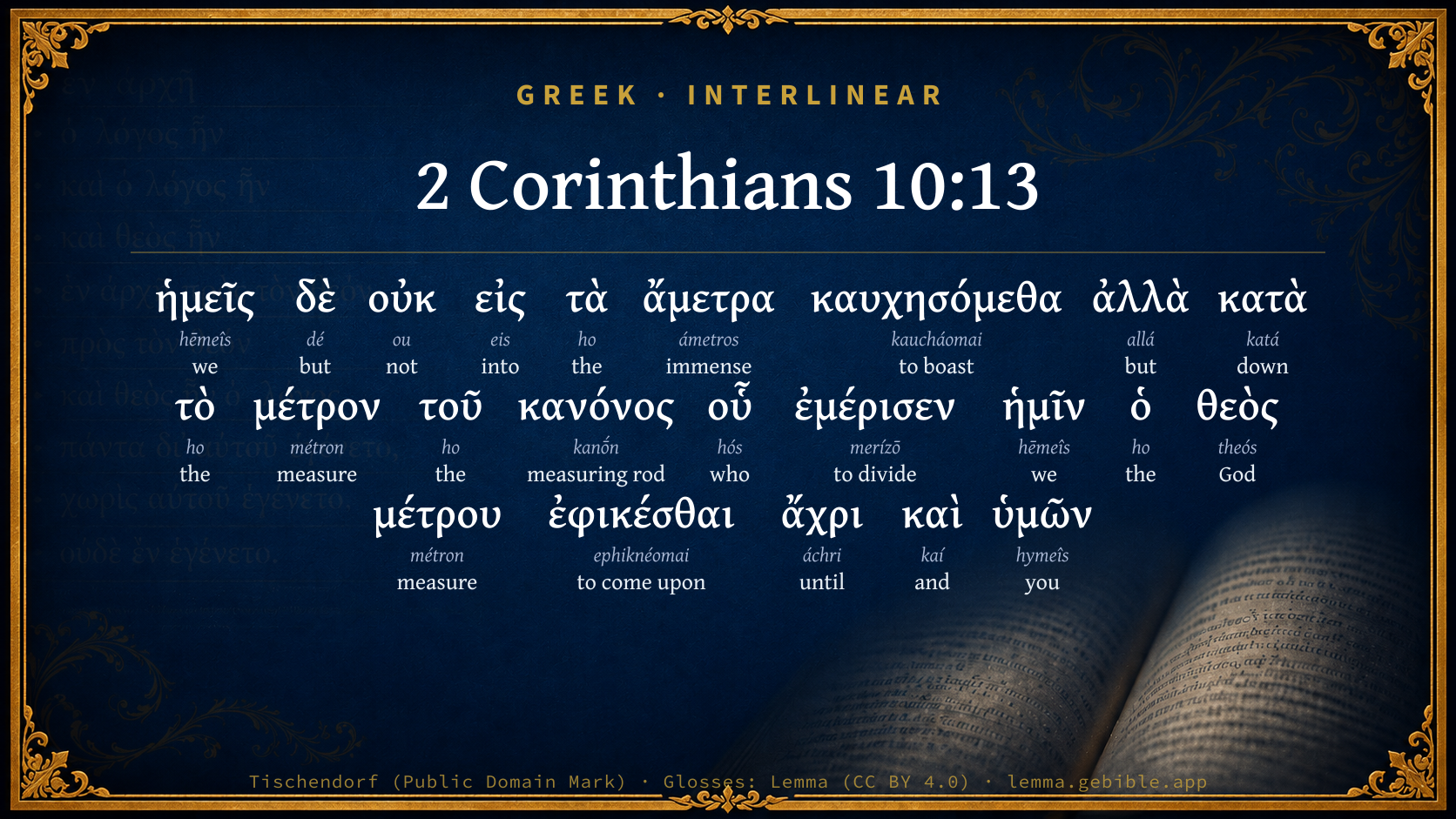
Download image
Cite this verse

2 Corinthians 10:13 (World English Bible). Public Domain. Lemma interlinear Bible study tool, https://lemma.gebible.app/v/2-corinthians/10/13.

Show BibTeX & RIS
BibTeX
RIS
English Translation
But we will not boast beyond proper limits, but within the boundaries with which God appointed to us, which reach even to you.
World English Bible · Public Domain
Highlights
  • 3 first appearances in the Greek New Testament
Full analysis ↓
Download a study sheet

One document with this verse’s original text, its word-by-word gloss line, the meaning frame, cross-references with their text, attributed commentary, and full source and license credits — printable, and it pastes into notes with its structure intact.

This verse Autodidact and up

Study sheet (.html) Plain text (.txt)

A passage Seminary Student

Up to 50 verses in one chapter. A passage sheet keeps up to 6 commentary sources and 12 cross-references per verse, in the order this page ranks them, and says so on the sheet whenever that leaves anything out. Ask for a single verse and you get the Autodidact verse sheet above.

Everything on this page stays free to read, with no account — the sheet is a download of what is already on screen, not access to it.

Want to remove ads? Support Godless Engineer
Compare translations 3

The same verse in 3 English versions, stacked beneath the original-language interlinear above. Click any original word for its lexicon entry.

Each is an independent rendering of the whole verse — the interlinear is not word-aligned to these translations.

Highlighted words mark where these versions differ — a whole-verse word diff, not a word-by-word alignment.

  • World English Bible Public Domain
    But we will not boast beyond proper limits, but within the boundaries with which God appointed to us, which reach even to you.
  • King James Version Public Domain
    But we will not boast of things without our measure, but according to the measure of the rule which God hath distributed to us, a measure to reach even unto you.
  • unfoldingWord Literal Text CC BY-SA 4.0
    We, however, will not boast to the immeasurable things, but according to the measure of the limit that God has assigned to us, a measure that reached even as far as you.

unfoldingWord Literal Text — © unfoldingWord, licensed CC BY-SA 4.0. Word-aligned USFM3 via Door43 (git.door43.org/unfoldingWord/en_ult).

Versions to compare (up to 4)

3 of 4 selected

Show all 19 translations

Every available English version of this verse, each an independent rendering of the whole verse.

  • World English Bible Public Domain
    But we will not boast beyond proper limits, but within the boundaries with which God appointed to us, which reach even to you.
  • Berean Standard Bible Public Domain
    We, however, will not boast beyond our limits, but only within the field of influence that God has assigned to us—a field that reaches even to you.
  • Majority Standard Bible Public Domain
    We, however, will not boast beyond our limits, but only within the field of influence that God has assigned to us—a field that reaches even to you.
  • King James Version Public Domain
    But we will not boast of things without our measure, but according to the measure of the rule which God hath distributed to us, a measure to reach even unto you.
  • American Standard Version (1901) Public Domain
    But we will not glory beyond `our' measure, but according to the measure of the province which God apportioned to us as a measure, to reach even unto you.
  • Revised Version (1885) Public Domain
    But we will not glory beyond our measure, but according to the measure of the province which God apportioned to us as a measure, to reach even unto you.
  • Geneva Bible (1599) Public Domain
    But we wil not reioyce of things, which are not within our measure, but according to the measure of the line, whereof God hath distributed vnto vs a measure to attaine euen vnto you.
  • Douay-Rheims (1899) Public Domain
    But we will not glory beyond our measure; but according to the measure of the rule, which God hath measured to us, a measure to reach even unto you.
  • Young's Literal Translation Public Domain
    and we in regard to the unmeasured things will not boast ourselves, but after the measure of the line that the God of measure did appoint to us -- to reach even unto you;
  • Literal Standard Version CC BY-SA 4.0
    and we will not boast ourselves in regard to the unmeasured things, but after the measure of the line that the God of measure appointed to us—to reach even to you;
  • Unlocked Literal Bible CC BY-SA 4.0
    We, however, will not boast beyond limits. Instead, we will do so only within the limits of what God has assigned to us, limits that reach as far as you.
  • unfoldingWord Literal Text CC BY-SA 4.0
    We, however, will not boast to the immeasurable things, but according to the measure of the limit that God has assigned to us, a measure that reached even as far as you.
  • Darby Bible Public Domain
    Now *we* will not boast out of measure, but according to the measure of the rule which the God of measure has apportioned to us, to reach to you also.
  • World Messianic Bible Public Domain
    But we will not boast beyond proper limits, but within the boundaries with which God appointed to us, which reach even to you.
  • Webster's Bible Public Domain
    But we will not boast of things without our measure, but according to the measure of the rule which God hath distributed to us, a measure to reach even to you.
  • Free Bible Version CC BY-SA 4.0
    But we won't boast about ourselves in extravagant terms that can't be measured. We simply measure what we have done using God's system of measurement that he gave us—and that includes you.
  • Bible in Basic English Public Domain
    We will not give glory to ourselves in over-great measure, but after the measure of the rule which God has given us, a measure which comes even to you.
  • Text-Critical English NT CC BY 4.0
    We, however, will not boast beyond certain limits, but will confine our boasting to the area of ministry that God has assigned to us, which reaches even as far as you.
  • Tyndale New Testament (1534) Public Domain
    But we wyll not reioyce above measure: but accordynge to the quantitie of the measure which god hath distributed vnto vs a measure that reacheth even vnto you.

Literal Standard Version (2020), Covenant Press — licensed CC BY-SA 4.0. Text via the HelloAO Bible API (eBible.org). Unlocked Literal Bible (unfoldingWord) — licensed CC BY-SA 4.0. Text via the HelloAO Bible API (eBible.org). unfoldingWord Literal Text — © unfoldingWord, licensed CC BY-SA 4.0. Word-aligned USFM3 via Door43 (git.door43.org/unfoldingWord/en_ult). Free Bible Version, Dr. Jonathan Gallagher — licensed CC BY-SA 4.0. Text via the HelloAO Bible API (eBible.org).

Word by word

More ways to search: Search by grammar → Find every occurrence → Compare this word →

Practice this passage: Drill this verse → Learn its vocabulary →

ἄμετρα
ámetros
G280
“immense”
Adjective, Accusative, Plural, Neuter
Part of Speech
Adjective
Case
Accusative
Number
Plural
Gender
Neuter
Full Thayer's Definition

Origin: from G1 (as a negative particle) and G3358

TDNT: 14:32,6

1. without measure, immense
  1. ἡμεῖς hēmeîs G2249 “we” Personal pronoun, 1st person, Nominative, Plural
  2. δὲ dé G1161 “but” Conjunction
  3. οὐκ ou G3756 “not” Particle, Negative
  4. εἰς eis G1519 “into” Preposition
  5. τὰ ho G3588 “the” Article, Accusative, Plural, Neuter
  6. καυχησόμεθα kaucháomai G2744 “to boast” Verb, Future, Middle deponent, Indicative, 1st person, Plural
  7. ἀλλὰ allá G235 “but” Conjunction
  8. κατὰ katá G2596 “down” Preposition
  9. τὸ ho G3588 “the” Article, Accusative, Singular, Neuter
  10. μέτρον métron G3358 “measure” Noun, Accusative, Singular, Neuter
  11. τοῦ ho G3588 “the” Article, Genitive, Singular, Masculine
  12. κανόνος kanṓn G2583 “measuring rod” Noun, Genitive, Singular, Masculine
  13. οὗ hós G3739 “who” Relative pronoun, Genitive, Singular, Masculine
  14. ἐμέρισεν merízō G3307 “to divide” Verb, Aorist, Active, Indicative, 3rd person, Singular
  15. ἡμῖν hēmeîs G2249 “we” Personal pronoun, 1st person, Dative, Plural
  16. ὁ ho G3588 “the” Article, Nominative, Singular, Masculine
  17. θεὸς theós G2316 “God” Noun, Nominative, Singular, Masculine
  18. μέτρου métron G3358 “measure” Noun, Genitive, Singular, Neuter
  19. ἐφικέσθαι ephiknéomai G2185 “to come upon” Verb, Aorist, Middle deponent, Infinitive
  20. ἄχρι áchri G891 “until” Adverb
  21. καὶ kaí G2532 “and” Conjunction
  22. ὑμῶν hymeîs G5210 “you” Personal pronoun, 2nd person, Genitive, Plural

About this verse

These counts appear in no published source. They are computed here, from the morphology-tagged text and Lemma’s own curated glosses. What Lemma adds →

23
words
18
distinct lemmas
Pauline Epistles
section

Notable vocabulary

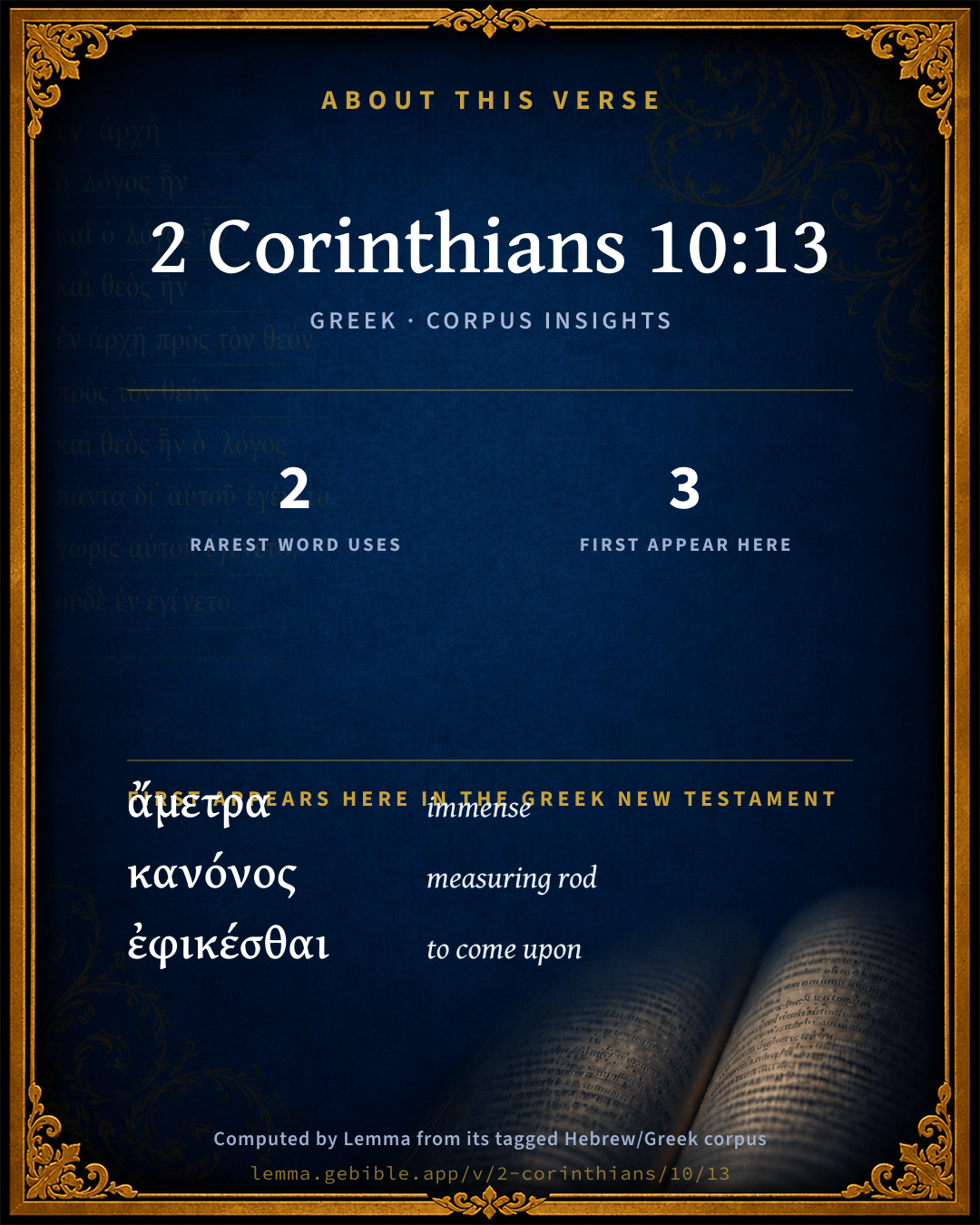
The rarest word here is ἄμετρα immense G280 — appearing just 2 times in the whole Greek New Testament.

First appearance in Scripture

These words make their first canonical appearance in the Greek New Testament here:

  • ἄμετρα immense G280
  • κανόνος measuring rod G2583
  • ἐφικέσθαι to come upon G2185

Shared distinctive vocabulary

ἄμετρα immense G280 occurs in 2 verses of the Greek New Testament. Also found in:
Repetition

Words recur within this verse:

  • μέτρον measure G3358 ×2
  • τὰ the G3588 ×4
  • ἡμεῖς we G2249 ×2

Cross-references

12

Topical passages linked to 2 Corinthians 10:13 in the Treasury of Scripture Knowledge — connected by theme and wording, ordered by reader-vote popularity; previews shown in the World English Bible.

  • Romans 12:6 Having gifts differing according to the grace that was given to us, if prophecy, let us prophesy according to the proportion of our faith;
  • 1 Peter 4:10 According as each has received a gift, be ministering it among yourselves, as good stewards of the grace of God in its various forms.
  • Romans 12:3 For I say, through the grace that was given me, to every man who is among you, not to think of himself more highly than he ought to think; but to think reasonably, as God has apportioned to each person a measure of faith.
  • Romans 15:20 yes, making it my aim to preach the Gospel, not where Christ was already named, that I might not build on another's foundation.
  • 2 Corinthians 10:14–15 For we don't stretch ourselves too much, as though we didn't reach to you. For we came even as far as to you with the Gospel of Christ,
  • Ephesians 4:7 But to each one of us was the grace given according to the measure of the gift of Christ.
  • 1 Corinthians 12:11 But the one and the same Spirit works all of these, distributing to each one separately as he desires.
  • Psalms 19:4 Their voice has gone out through all the earth, Their words to the end of the world. In them he has set a tent for the sun,
  • Proverbs 25:14 As clouds and wind without rain, So is he who boasts of gifts deceptively.
  • Isaiah 28:17 I will make justice the line, and righteousness the plummet; and the hail shall sweep away the refuge of lies, and the waters shall overflow the hiding-place.
  • Matthew 25:15 To one he gave five talents, to another two, to another one; to each according to his own ability. Then he went on his journey.
  • Romans 10:18 But I say, didn't they hear? Yes, most assuredly, "Their sound went out into all the earth, Their words to the ends of the world."

Cross-references courtesy of OpenBible.info (CC BY 4.0).

Commentary

Notes on 2 Corinthians 10:13 from classic Christian and Jewish commentators (each source and its license shown beneath its notes). The classic Christian expositions comment on the surrounding passage and are grouped to its opening verse, so a note may address several verses; the Jewish commentaries on the Tanakh (Rashi and others) are per-verse, so they appear only where the commentator wrote on this verse.

Lemma curates 59 commentaries, every one of them public domain or Creative Commons licensed, each selected and text-cleaned for this edition rather than reprinted as found. About our sources →

Jamieson, Fausset & Brown

Robert Jamieson, A. R. Fausset & David Brown

not boast . . . without . . . measure--Greek, "to unmeasured bounds." There is no limit to a man's high opinion of himself, so long as he measures himself by himself (Co2 10:13) and his fellows, and does not compare himself with his superiors. It marks the personal character of this Epistle that the word "boast" occurs twenty-nine times in it, and only twenty-six times in all the other Epistles put together. Undeterred by the charge of vanity, he felt he must vindicate his apostolic authority by facts [CONYBEARE and HOWSON]. It would be to "boast of things without our measure," were we to boast of conversions made by "other men's labors" (Co2 10:15).

distributed--apportioned [ALFORD].

a measure--as a measure [ALFORD].

to reach--"that we should reach as far as even to you": not that he meant to go no further (Co2 10:16; Rom 15:20-24). Paul's "measure" is the apportionment of his sphere of Gospel labors ruled for him by God. A "rule" among the so-called "apostolic canons" subsequently was, that no bishop should appoint ministers beyond his own limits. At Corinth no minister ought to have been received without Paul's sanction, as Corinth was apportioned to him by God as his apostolic sphere. The Epistle here incidentally, and therefore undesignedly, confirms the independent history, the Acts, which represents Corinth as the extreme limit as yet of his preaching, at which he had stopped, after he had from Philippi passed southward successively through Amphipolis, Apollonia, Thessalonica, Berea, and Athens [PALEY, Horæ Paulinæ].

Jamieson, Fausset & Brown — Commentary Critical and Explanatory on the Whole Bible (1871) — public domain (CC PDM 1.0). Text via the HelloAO Bible API.

John Gill's Exposition

Not boasting of things without our measure,.... The apostle here asserts what he had done before, Co2 10:13 with a view to explain it, as he does, saying,

that is of other men's labours; when they boasted of the Corinthians as their converts and children, whom they had begotten through the Gospel of Christ, they did not boast of other men's labours, as did the false apostles; who when they came to Corinth, found a church already planted by the apostle, and a multitude of believers, of whose conversion and faith he had been an instrument; and yet these men claimed them as their own, and an authority over them, when they were the fruit of the apostle's labours:

but having hope, when your faith is increased, that we shall be enlarged by you according to our rule abundantly; the sense is, that the apostle hoped, for he could not be sure, this lying in the secret will of God, that when the faith of the Corinthians was grown stronger, and more settled and established, and so would not stand in so much need of their care and instruction, they should be enlarged through their means; and that they should not stop here, but that the line, measure, or rule of their ministry, should be drawn to a greater length, and the bounds of it extended and carried abundantly further. The apostle intimates, that the weakness of their faith, and the disorders and divisions that were among them, were a hinderance to the spread of the Gospel; and that if their church state were in a better and a more settled condition, as it would give the apostles more leisure to preach the Gospel elsewhere, so it would serve to recommend it to other places beyond them; which would be an enlargement of the bounds of their ministry, and a means of magnifying of Christ and his Gospel, and of them also.

John Gill's Exposition of the Whole Bible (1746–1763) — public domain (CC PDM 1.0). Text via the HelloAO Bible API.

The Biblical Illustrator

Joseph S. Exell

2Co_10:13-16

We will not boast of things without our measure, but according to the measure of the rule which God hath distributed to us.

The mission field admeasured

I. The field measured out for the labours of the preachers of the gospel.

1. The world. It was impossible for the apostle, with all his impulsive zeal, to go beyond his measure. Not that the world had been left without moral assistance from revelation. In the care of the Father of the spirits of all flesh, all nations have had an interest. The antediluvians enjoyed the benefits of all the revelations which were made in that first age. The long life of the patriarchs secured this. In the truths which were introduced by Noah into the new world, and the additional revelations, his sons were sharers; and that the whole might have been preserved is evident from the fact that many of them still exist. The vocation of Abraham was intended for the instruction of the world (Heb_11:10). The Jewish institute was designed for the benefit of the world (1Ki_8:41-43). To all the world Christ sent His disciples; and to a great part they actually went. The continuance of the zeal of the first ages would have left no regions beyond.

2. Why, then, do we wonder at the mysteries of Providence, in leaving so many of our race to live without the gospel? God has not left them, but they have been left by their more highly favoured fellow-men. It is a mystery, not of Divine reprobation, but of human unfeelingness. The Jewish and Christian Churches, in succession, have incurred the guilt of unfaithfulness. If any person say this only shifts the difficulty, we may allow it. But why should we single this out as a peculiar mystery? Has not God made man dependent upon man in everything? Christians are the light of the world; and if we refuse to hold forth the word of life, then are we verily guilty concerning our brother.

II. The means by which those labours were directed.

1. The measure of the rule refers to the line which marked out the racecourses, or that which was used in measuring land. The apostles were appointed to places by Him who knew where they might be best employed.

(1) Sometimes the direction was supernatural, as when Peter was taught by a vision and Paul by a man of Macedonia. Sometimes the Spirit of God spoke in an audible voice (Act_8:29).

(2) In other cases--

(a) A strong impression was made upon the mind, as when Paul was pressed in the spirit to preach Christ in Corinth.

(b) They were directed by what appeared the most effectual means of promoting their great work. Thus Paul, in one of his journeys, purposed to return through Macedonia, and oftentimes to visit Rome.

(c) The peculiar moral wretchedness and want of some particular people affected them (Act_17:16).

(d) They were led by the spirit of enterprise and experiment, and concluded from their success that the line had been stretched out.

2. These views are of importance from their connection with modern efforts. Too long have Christians dozed upon the pillow of lukewarmness, waiting to be roused to action by a miraculous summons.

(1) Our duty is as extensive as theirs. The command, Go ye into all the world, etc., has never been repealed.

(2) Have we no men pressed in spirit as the apostles were? What about those Moravians who went into the West Indies, to sell themselves as slaves, that they might preach to the negroes? Did not God then stretch out their line? What about Carey and Dr. Coke?

(3) Did the first preachers meet with men like Gaius, zealous to encourage their labours? The revival of this disposition in the present day is another proof that our line is extending. Tens of thousands are ready to assist the mission work by their prayers and contributions.

(4) Did the apostle consider the sight of the superstitions of Athens a call to preach Jesus? The circumstance that the state of the heathen world is brought before us is our call to the same work.

(5) Did the apostles see in opportunities of access the hand of God stretching out their line? By what authority do we put a different construction upon the openings which are everywhere presented to us? Where have we no access? Does commerce see her lines extending in so many directions, and shall we be so blind as not to see that she marks the track which Christian zeal is to follow?

(6) Did the apostles contemplate their successes as the proof that God had directed their progress and assigned them their work? Where have modern missionaries laboured without substantial proofs of this kind?

III. The compassionate regard of the apostle for those nations which were not visited by the light of Christianity. His line had stretched as far as Corinth; and he now looks with anticipation into larger fields. And why? Because he knew their moral condition and subsequent danger, and that the gospel would save thousands who would not be saved without it. This is the case in regard to heathen nations now. What they were in the apostolic age they are now, and they ought to excite equal regards, They are regions of--

1. Darkness. That is so dense that the plainest morals are confounded, and the only way of reconciliation hidden.

2. Vain, inefficient superstitions. Many are ridiculous, but they have been laughed at too long, and we ought now to weep over them. They offer sacrifices which leave sin unatoned; they call on Baal, but he hears them not; they purify the body, but the polluted spirit retains all its foulness (Isa_44:20). Do we laugh at the ravings of lunacy? Do we scoff at the stumbles of the blind? Who, then, would not give light to them that sit in moral darkness, and wisdom to those who have no spiritual understanding?

3. Diabolical dominion (Rom_1:29-31).

4. Misery. Happy is the people that have the Lord for their God. Change the God and you reverse the effect.

IV. The manner in which the apostle connects his missionary enterprises with the co-operation of Christian churches (2Co_10:15).

1. The apostle supposes that the Corinthians were equally bound with him to the duty of enlarging the sphere of evangelical labour. We collect from this that as soon as a church is established in the faith, it is to become co-operative in exertions to spread the kingdom of Christ. As soon as its own lamp is trimmed, it is to be held forth to direct the steps of others.

2. But by what means can this enlargement be granted by you?

(1) By your friendly and affectionate feelings towards Christian missionaries. The word enlarged also signifies to extol, to praise. The missionary spirit ought to be held in high esteem. Can we more effectually damp the holy ardour by which it is characterised than by treating it with lightness and coldness?

(2) By considering the cause your own. You should identify yourselves with it.

(3) By your prayers.

(4) By your counsels and contributions. In these respects the first Christians were fellow-helpers to the truth; and they have left us an example. (R. Watson.)

For we stretch not ourselves beyond our measure.

The true sphere of human usefulness and the source of human glory

I. The true sphere of human usefulness.

1. It is a sphere in which we are placed by Divine appointment. Paul teaches that his sphere of labour at Corinth was according to Gods will (2Co_10:14). I am not come to Corinth merely by my own inclinations, or as a matter of impulse or caprice, or as an intruder. I am licensed by God to this sphere.

2. The consciousness that we are in this sphere is a just reason for exultation. Not boasting of things without our measure. Pauls opponents boasted of their influence in the Church which he had founded, whereas his rejoicing was that he was doing the work of God in the sphere to which he had been sent.

3. It is a sphere which widens with our usefulness. The increase of their faith would lead to an enlargement of his sphere of labour. The true method of extending the sphere of labour to which we have been sent is by the multiplication of our converts.

II. The true source of human exultation. Paul boasted--

1. Not in crediting himself with the labours of other men. He did not boast in another mans line (province) of things made ready to our hand. How common it is for men to credit themselves with the labours of others! In literature there are plagiarists, in scientific discoveries and artistic inventions there are unjust claimants, and even in religion one minister is often found to claim the good that others have accomplished. Paul was above this. The genius of Christianity condemns this mean and miserable dishonesty.

2. Not in self-commendation. For not he that commendeth himself is approved. That conscience approves of our conduct, though at all times a source of pleasure is not a true source of exultation; for conscience is not infallible.

3. But in the Lord (2Co_10:17). God forbid that I should glory save in the Cross. (D. Thomas, D. D.)

.

The Biblical Illustrator, edited by Joseph S. Exell (c. 1880s–1900s) — public domain. Text from a community e-Sword module.

Joseph Benson's Commentary

2Co 10:13. But we will not, like them, boast of things without measure — Assume the credit of other men’s labours, (2Co 10:15,) nor meddle with those converted by them; but according to the measure of the rule, or province, which God hath distributed, or allotted, to us — To me, in particular, as the apostle of the Gentiles; a measure which reaches even to you — Here “God is represented as measuring out, or dividing to, the first preachers of the gospel, their several offices, and their several scenes of action, that they might labour each in the parts assigned to them. To the apostles he allotted the charge of converting the world, and endowed them with gifts suited to the greatness of that work. To them, therefore, it belonged to form their converts into churches, and to appoint rules for their government. They had authority to dictate the religious faith and practice of mankind. In short, they had the supreme direction, under Christ, of all religious matters whatever. Yet none of them interfered in the labours of the others, except by common consent. The province assigned by God to the evangelists, and other inferior ministers, was to assist the apostles; to build upon the foundation laid by them; to labour in the gospel under their direction, and in all things to consider themselves as subordinate to the apostles.”

Joseph Benson's Commentary on the Old and New Testaments (1811–1818) — public domain. Text from a community e-Sword module.

Tyndale Open Study Notes

Tyndale Open Resources

10:13-16 Paul had not trespassed on the limits God set for his missionary service, which includes our working with you. So he justifies his integrity and authority, insisting that when he first came to Corinth (Acts 18:1-17) he did so in response to God’s call. Paul was determined not to enter someone else’s territory (see Rom 15:20), but he was the first to travel all the way to Corinth with the Good News of Christ. His more recent opponents visited the church much later (2 Cor 11:4), so their claim to Corinth as their territory was empty.

Tyndale Open Study Notes — © Tyndale Open Resources, licensed CC BY-SA 4.0. Text via the HelloAO Bible API.

Bengel's Gnomon

Johann Albrecht Bengel

2Co 10:13. Οὐχι, not) From 2Co 10:13-16, both the ἔγκρισις and the σύγκρισις [alleged by the false apostles as subsisting] between the apostle and the false apostles are utterly set aside. This is the summary of his argument: οὐχὶ εἰς τὰ ἄμετρα καυχησόμεθα ἐν ἀλλοτρίοις κόποις. The first member, οὐχὶ εἰς τὰ ἄμετρα, is put in antithesis to the ἐν ἐαυτοῖς μετροῦντες, and is treated of 2Co 10:13-14, the word μέτρον being often repeated. The second, οὐχι ἐν ἀλλοτρίοις κόποις, is put in antithesis to the ἑαυτοῖς συγκρίνοντες, and is treated of 2Co 10:15-16, the word ἀλλοτρίοις being repeated. Paul has a measure; they boast as to things that are without measure [in immensa gloriantur], and Paul will proceed to preach the Gospel among the untutored [rudes, heretofore untaught] Gentiles; they boast εἰς τὰ ἓτοιμα, of things made ready for them [2Co 10:16].—εἰς) as to, concerning; comp. 2Co 10:15, note.—ἄμετρα, things without measure) an acute amphibology; ἄμετρον is that which either does not keep, or else has not a standard or measure. Paul keeps his measure; the false apostles have none at all.—ἀλλὰ) but, viz., we will act.—τὸ μέτρον τοῦ κανόνος, the measure of the rule) Μέτρον καὶ κανὼν is a phrase sometimes used as a combination of synonyms: here they differ. Μέτρον is said in respect of God who distributes the several functions, κανὼν, in respect of the apostle who labours in the discharge of his function. Therefore κανὼν is determined by μέτρον; for μέτρον with Eustathius is τάξις; and μέτρον and μερίζω are conjugates, because both are from μείρω, comp. Clavis Homerica, p. 222. Their respective provinces were apportioned to each of the apostles.—μέτρου, a measure) This word is repeated, so that the οὗ may be explicitly recognised as having relation to μέτρον.—τοῦ κανόνος is put absolutely. After the accusative μέτρον the genitive μέτρου is put, to mark the part [μέρος taken out of ἐμέρισεν, i.e. the province assigned to Paul] among the Corinthians.—ἐμέρισεν, distributed) By this verb the false apostles are openly excluded.—ἐφικέσθαι) i.e. τοῦ ἐφικέσθαι.—ἄχρι καὶ ὑμῶν) even to you. Meiosis.[70]

[70] See App.

Bengel's Gnomon of the New Testament — English translation (T&T Clark, Edinburgh, 1860) — public domain. Text from a community e-Sword module.

Meyer's Critical & Exegetical Commentary

Heinrich August Wilhelm Meyer

2Co_10:13. Εἰς τὰ ἄμετρα] so that we with our καυχᾶσθαι go beyond measure, go into limitless extravagance. This is what is done by the man who measures himself by himself, because in that case no check external to himself is put on his imagination and self-exaltation. Such a man certainly has an object of the καυχᾶσθαι, and is not simply aiming at the having one (Hofmann), which would yield an absurd idea; but he has no bounds in the manner and degree of his καυχᾶσθαι; he is wanting in μετριότης. Regarding the use of εἰς with an adjective of degree and the article, see Viger. ed. Herm. p. 596; Matthiae, p. 1349. On the expression itself, comp. Homer, Il. ii. 212, where Thersites is called ἀμετροεπής.

καυχησόμεθα] The future asserts that this case will not occur. Comp. Rom_10:14, al.; Dissen, ad Dem. de Cor. p. 369.

ἀλλὰ κατὰ τὸ μέτρον τοῦ κανόνος, οὗ κ.τ.λ.] sc. καυχησόμεθα: but according to the measure of the boundary-line, which God (not our own choice) has assigned to us as measure, to reach even unto you, i.e. but our boasting will restrict and measure itself according to the limit which God has drawn for us, and by which He has measured off the sphere of our activity, in order that we should reach even to you with our working. By this Paul is manifestly aiming at the vaingloriousness of the false apostles, who decked themselves with extraneous feathers, inasmuch as they intruded into the provinces of others, into spheres which had not been assigned to them by God as the measure of their activity: as, indeed, in particular they had come also to Corinth, which lay within the boundary-line of Pauls apostolic action, and were now boasting as if the church-life in Corinth were chiefly their work. For, although they could not give themselves out to be the founders of the church (Baur, Tüb. Zeitschr. 1832, 4, p. 101), they could still put forward as their merit the rapid growth of the church and many points of detail, and thereby presume to put the apostle in the shade. Olshausen thinks that the false apostles had appropriated to themselves Corinth as their province, because they had already been at work there before Paul; but that the latter had still felt himself at liberty to preach in Corinth, because no apostle had been there before him. This is an hypothesis quite as superfluous as it is unhistorical, since neither in the Book of Acts is there found any trace of Christianity at Corinth before Pauls arrival, nor in the Epistles, in which, on the contrary, he states expressly that he was the first to preach there (1Co_3:6; 1Co_3:10), and that all other teachers had entered later into the work (1Co_4:15).

κατὰ τὸ μέτρον τοῦ κανόνος] Here τὸ μέτρον is the measure defined for the καυχᾶσθαι, as is clear from the previous οὐχὶ εἰς τὰ ἄμετρα καυχ.,and τοῦ κανόνος is the genitivus subjecti: the measure given by the drawn measuring-line. And the subsequent μετροῦ[311] is an apposition to τοῦ κανόνος not at all unnatural (as Hofmann declares it), but attracted by the relative clause according to a very frequent Greek usage (see Bernhardy, p. 302; Pflugk, ad Eur. Hec. 771; Stallbaum, ad Plat. Phaed. p. 66 E; Rep. p. 402 C; Buttmann, neut. Gr. p. 246 [E. T. 286]); consequently not again the measure of the boasting, but, as appears from the definition of the object aimed at ἐφικέσθαι ἄχρι κ. ὑμῶν, the spatial measure, namely, how far one is to reach (see what follows), or, dropping the figure: the measure of extent of the destined working. Paul, namely, conceives of the local extension assigned to his official working as a space marked out by God with a measuring-line, in which he takes his stand and is able to reach to all points of it without unduly stretching or straining himself, 2Co_10:14. Hence: ἐφικέσθαι ἄχρι καὶ ὑμῶν, which is not simply exegetical (Hofmann), nor does it express the consequence (Rückert, de Wette), but is, in accordance with the notion of ἐμέρ., to be taken as infinitive of definition of οὗ ἐμέρ. ἡμ. ὁ θεὸς μέτρου.

κανών does not mean sphere of vocation (Flatt and many others), but measuring-rod, measuring-line. Here the latter. Comp. Gal_6:16; Aq. Job_38:5; Psa_18:4. See in general, Duncan, Lex. ed. Rost. p. 587 f. On μερίζειν τινί τι, to impart something to one, assign as ones share, comp. Rom_12:3; 1Co_7:17; Heb_7:23; Polyb. xi. 28. 9, xxxi. 18. 3. The ἐφικνεῖσθαι is, in keeping with the figurative representation of the state of the matter (see especially 2Co_10:14), not to arrive at (Hofmann), which is only expressed by ἐφθάσαμεν, but to reach to, pertingere, as the Vulgate aptly renders it. The word is found nowhere else in the N. T., and is here selected for the sense indicated. Comp. Xen. Cyr. i. 1. 5, v. 5. 8; Plut. Mor. p. 190 E; Lucian, Jup. conf. 19, al.; also Sir_43:27; Sir_43:30. The Corinthians, because not to be found beyond the bounds of his κανών, were to the apostle ἐφικτοί, reachable.

[311] For which Grotius ought not to have conjectured μέτρον. But the most mistaken view as regards μέτρον is that lighted on by Hofmann, who attaches it to ὁ θεός: the God of measure, by which, in his view, it is affirmed that to everything God sets some sort of measure. As if this singular way of designating God (altogether different from such appellations as: the God of glory, of peace, of love, of hope, and the like) were even possible without the article before μέτρον! In Wis_9:1, πατέρων required no article, according to the well-known anarthrous usage of πατήρ in the singular and plural; and in Sir_33:1, πάντων without the article is quite according to rule.

Meyer — Critical and Exegetical Commentary on the New Testament — English translation by Peter Christie, edited by Frederick Crombie (T&T Clark, 1880) — public domain. Text from a community e-Sword module.

Expositor's Greek Testament

ed. W. Robertson Nicoll

2Co 10:13 . ἡμεῖς δὲ οὐχὶ κ . τ . λ .: but we will not glory beyond our measure ( εἰς τὰ representing the direction and extent of his boasting), but according to the measure of the rule which ( οὗ for ὅν by attraction) God hath apportioned (see reff.) to us as a measure, to reach (the infin. of purpose) even unto you . κανών is a line of direction (see reff., and cf. Clem. Rom., § 41, μὴ παρεκβαίνων τὸν ὡρισμένον τῆς f1λειτουργίας αὐτοῦ κανόνα ), and so here represents the “province” or sphere in which St. Paul conceives himself as appointed by God to proclaim the Gospel. He especially emphasises this here; to Corinth he has a “mission,” as the Apostle of the Gentiles; his authority over the Corinthian Church is not usurped, but has been divinely given him.

The Expositor's Greek Testament, edited by W. Robertson Nicoll (1897–1910) — public domain. Text from a community e-Sword module.

Geneva Bible (1599)

Geneva Bible translators

Of those things which God hath not measured to me.

Geneva Bible (1599) marginal notes — public domain. Text via Bolls.life.

Adam Clarke's Commentary

Verse 13. Things without our measure] There is a great deal of difficulty in this and the three following verses, and there is a great diversity among the MSS.; and which is the true reading can scarcely be determined. Our version is perhaps the plainest that can be made of the text. By the measure mentioned here, it seems as if the apostle meant the commission he received from God to preach the Gospel to the Gentiles; a measure or district that extended through all Asia Minor and Greece, down to Achaia, where Corinth was situated, a measure to reach even unto you. But the expressions in these verses are all agonistical, and taken from the stadium or race course in the Olympic and Isthmian games. The μετρον, or measure, was the length of the δρομος, or course; and the κανων, rule or line, 2Co 10:15; 2Co 10:16, was probably the same with the γραμμα, or white line, which marked out the boundaries of the stadium; and the verbs reach unto, stretch out, &c., are all references to the exertions made to win the race. As this subject is so frequently alluded to in these epistles, I have thought it of importance to consider it particularly in the different places where it occurs.

Adam Clarke's Commentary on the Bible (1810–1826) — public domain. Text from a community e-Sword/MySword module.

John Calvin's Commentaries

13. But we will not boast beyond our measure He now contrasts his own moderation with the folly of the false Apostles, and, at the same time, he shows what is the true measure of glorying — when we keep within the limits that have been marked out for us by the Lord. “Has the Lord given me such a thing? I shall be satisfied with this measure. I shall not either desire or claim to myself any thing more.” This he calls the measure of his rule. For every one’s rule, according to which he ought to regulate himself is this — God’s gift and calling. At the same time, it is not lawful for us to glow in God’s gift and calling on our own account, but merely in so far as it is expedient for the glory of him, who is so liberal to us with this view — that we may acknowledge ourselves indebted to him for everything.

A measure to reach. By this clause he intimates, that he stands in no need of commendations expressed in words among the Corinthians, who were a portion of his glow, as he says elsewhere, (Philippians 4:1,) ye are my crown. He carries out, however, the form of expression, which he had previously entered upon. “I have,” says he, “a most ample field for glorying, so as not to go beyond my own limits, and you are one department of that field.” He modestly reproves, however, their ingratitude, in overlooking, in a manner, his apostleship, which ought to have been especially in estimation among them, on the ground of God’s commendation of it. In each clause, too, we must understand as implied, a contrast between him and the false Apostles, who had no such approbation to show.

John Calvin's Commentaries (1540-1563) — public domain. Text from the Calvin Translation Society English edition (1840s-50s) via the Christian Classics Ethereal Library (ccel.org). Calvin's coverage is partial (roughly two-thirds of the Bible); uncommented books and verses are honest gaps, never fabricated. The 19th-century editor's footnotes and remarks are omitted so the notes are faithfully Calvin's own voice.

Ellicott's Commentary for English Readers

(13) But we will not boast of things without our measure.—The words imply, of course, that his opponents were doing this. He refers in it to the concordat established between himself and Barnabas, on the one hand, and Peter, James, and John on the other, to which he refers in Gal_2:9. He had not transgressed the terms of that concordat by thrusting himself upon a Church which had been founded by one of the Apostles of the circumcision. He had gone, step by step, seeking “fresh fields and pastures new,” till he had reached Corinth as, at present, the farthest limit of his work. In that apportionment of work, though it was a compact with human teachers, he saw the guidance of God; his opponents, on the other hand, had systematically violated it. They had come to the Church of Antioch, which had been founded by Paul and Barnabas (Act_15:1); they had followed in his footsteps in Galatia (see Introduction to Epistle to the Galatians); they were now stirring up strife and disloyalty at Corinth. We note as an undesigned coincidence that a few weeks or months later, as in Rom_15:19, he had preached the gospel as far as Illyricum, but this was during the time immediately following on the despatch of this Epistle, during which, on his way to Corinth, whence he wrote to Rome, he had “gone over those parts, and given them much exhortation” (Act_20:2).

A Bible Commentary for English Readers, edited by Charles John Ellicott (1878–1897) — public domain. Text from a community e-Sword module.

The Cambridge Bible for Schools and Colleges

gen. ed. J. J. S. Perowne

13. of things without our measure] Literally, unto the measureless things, i.e. ‘beyond the measure which God has meted out to us,’ ‘beyond the region of our own work, which was ever, save in the case of Rome, among Churches which we ourselves have founded.’ Nor was Rome really an exception. For the Church there seemed not to have been formally founded by any one, but to have grown up of itself through the gravitation of persons from all parts to the great metropolis. This is why St Paul, on his way into Spain, desires to ‘impart some spiritual gift’ to a Church which had not had the privilege of the personal superintendence of an Apostle. See Rom_1:11; Rom_15:23-24.

rule] This word is translated line in 2Co_10:16. It means (1) a measuring rod and then (2) the line marked out by such means. It has become an English word familiar to our ears (3) as a rule or precept of Ecclesiastical Law, known as a Canon. A cognate word in English is cane.

which God hath distributed to us, a measure] Better, a measure which God apportioned, i.e. which is His work, not man’s.

to reach even unto you] That God had done this was very evident. The Corinthians owed their existence as a Church to St Paul. See ch. 2Co_3:2-3; 1Co_3:6; 1Co_3:10; 1Co_9:2. The metaphor, says Estius, is derived from handicraftsmen, who have a rule prescribed to them by the master, which they are not permitted to go beyond.

The Cambridge Bible for Schools and Colleges (gen. ed. J. J. S. Perowne; Cambridge University Press, 1878–1918) — public domain. Text from a community e-Sword module.

Trapp's Complete Commentary

John Trapp

13 But we will not boast of things without our measure, but according to the measure of the rule which God hath distributed to us, a measure to reach even unto you.

Ver. 13. But we will not boast, &c.] As any man is more worthy, he is more modest: full vessels yield no such sound as empty casks do. A vessel cast into the sea, the more it fills the deeper it sinks; the leaden scale goes downward; the most precious balm sinks to the bottom. The good ear of grain, the fuller it is, the lower it hangs the head.

John Trapp, A Commentary or Exposition upon All the Books of the Old and New Testament (1647–1656) — public domain. Text from a community e-Sword module.

Albert Barnes' Notes on the Bible

But we will not boast of things without our measure - Tyndale renders this:” But we will not rejoice above measure.” There is great obscurity in the language here, arising from its brevity. But the general idea seems to be plain. Paul says that he had not boldness as they had to boast of things wholly beyond his proper rule and his actual attainments and influence: and, especially, that he was not disposed to enter into other people’s labors; or to boast of things that had been done by the mere influence of his name, and beyond the proper limits of his personal exertions. He made no boast of having done anything where he had not been himself on the ground and labored assiduously to secure the object. They, it is not improbable, had boasted of what had been done in Corinth as though it were really their work though it had been done by the apostle himself. Nay more, it is probable that they boasted of what had been done by the mere influence of their name. Occupying a central position, they supposed that their reputation had gone abroad, and that the mere influence of their reputation had had an important effect. Not, so with Paul. He made no boast of anything but what God had enabled him to do by his evangelical labors, and by personal exertions. He entered into no one else’s labors and claimed nothing that others had done as his own. He was not bold enough for that.

But according to the measure of the rule ... - Margin, Or, “line.” The word rendered “rule” (Greek, κανὼν kanōn, whence our English word canon) means properly a reed, rod, or staff employed to keep anything stiff, erect, asunder (Hom. ii. 8. 103): then a measuring rod or line; then any standard or rule - its usual meaning in the New Testament, as, for example, of life and doctrine, Gal 6:16; Phi 3:16 - Robinson’s Lexicon. Here it means the limit, boundary line, or sphere of action assigned to anyone. Paul means to say that God had appropriated a certain line or boundary as the proper limit of his sphere of action; that his appropriate sphere extended to them; that in going to them, though they were far distant from the field of his early labors, he had confined himself within the proper limits assigned him by God; and that in boasting of his labors among them he was not boasting of anything which did not properly fall within the sphere of labor assigned to him. The meaning is, that Paul was especially careful not to boast of anything beyond his proper bounds.

Which God hath distributed to us - Which in assigning our respective fields of labor God has assigned unto me and my fellow-laborers. The Greek word rendered here as “distributed” (ἐμερίσεν emerisen) means properly to measure; and the sense is, that God had measured out or apportioned their respective fields of labor; that by his providence he had assigned to each one his proper sphere, and that in the distribution Corinth had fallen to the lot of Paul. In going there he had kept within the proper limits; in boasting of his labors and success there he did not boast of what did not belong to him.

A measure to reach even unto you - The sense is, “the limits assigned me include you, and I may therefore justly boast of what I have done among you as within my proper field of labor.” Paul was the apostle to the Gentiles Act 26:17-18; and the whole country of Greece therefore he regarded as falling within the limits assigned to him. No one therefore could blame him for going there as if he was an intruder; no one assert that he had gone beyond the proper bounds.

Albert Barnes' Notes on the Bible (1834–1885) — public domain. Text from a community e-Sword/MySword module.

Haydock's Catholic Bible Commentary

The apostle here reprehends the vain boasting of false teachers. I will not, like them, say, that I have carried the light of the gospel to the utmost limits of the globe, that I have converted millions of men, avoided an infinity of dangers, performed many miracles, &c. No: I confine myself to the part assigned me by God. I will only glory in have come even to you. This I can do with justice, and without arrogance. Each one has his share, his measure, or his part to cultivate in the vineyard of Christ. (Calmet and Bible de Vence)

George Leo Haydock (1774–1849), Haydock's Catholic Family Bible and Commentary, 1859 edition — public domain. Excludes Psalms (Douay-Rheims chapter numbering differs from Protestant) and Deuterocanonical books (Catholic canon only).

Matthew Poole's English Annotations

The apostle may be understood as speaking both of spiritual gifts, and also of his travels to the several places whither he had gone preaching the gospel. He reflecteth still upon the false teachers who were crept into this church; who (as it should seem) had much boasted of their gifts and abilities, and of their labours and successes. In opposition to whom, he saith, that he boasted not

without his measure, or, (as it is in the Greek, τα αμετρα) unmeasurable things; but he kept himself within the measure of the rule; that is, according to that regular measure which God hath set us. Which

measure extendeth even to you. You have those amongst you who boast unmeasurably of the gifts which they have, and of the great things which they do; I durst not do so (saith the apostle); God hath given me a measure and a rule, according to that I have acted, and of those actings only I will glory. And in my so doing I can boast of you, for to you my measure and line hath reached; God hath made me an instrument to raise him up a church amongst you.

Matthew Poole's English Annotations on the Holy Bible (1683–1685) — public domain. Text from a community e-Sword/MySword module.

Whedon's Commentary on the Bible

Daniel D. Whedon

13. Boast… without measure—Omitting the italic our, interpolated by the translators. The apostle disclaims boasting about τα αμετρα, the unmeasured, the indefinite, the aimless, which formed, in fact, the boast of the purposeless Christines. He had a well-defined mission from Christ himself, as he will next declare. Paul now has changed the figure of measure, from a measurement of the tallness of the man, to a measurement of the length and breadth of the territory covered by his divine commission. By personal measurement he is tall as the tallest apostle; by territorial measurement he stretches to Corinth and beyond, as said in 2Co_10:16.

Measure… rule—Rule, κανον, canon, here signifies a rod, staff, measuring rod. Paul’s image is, that God has, as it were with a measuring rod, marked out the measure of his missionary ground. His master has drawn his map for him.

Distributed—Rather, apportioned. The thought, then, is: I, Paul, boast not, (like these Christines,) of an unmeasured vagrant field, but a mission apportioned according to the measure of God’s own measuring rod. Paul’s apostolic office was universal; but the space he could corporeally occupy was, of course, limited, and, as he affirms, divinely measured off. Yet how wide is now the controlling power of this man’s apostolate!

Reach… you—Here is a keen point. The divine measuring rod brought Corinth within his territory, and he was promptly on the spot in due season.

Daniel D. Whedon (gen. ed.), Commentary on the Old and New Testaments (1874–1909) — public domain. Text from a community e-Sword module.

The Pulpit Commentary

Will not boast of things without our measure. This might be rendered, "will not indulge in these immeasurable boastings;" but ver. 15 points to the sense, "we will not glory beyond our measure." Of the rule; i.e. of the measuring line. I will keep to the province and limit which God has assigned to me in my proper measure. St. Paul declines the favourite office of being "other people"s bishop (ajllotrioepiskopov)". (1Pe_4:15) Hath distributed; rather, apportioned.

The Pulpit Commentary (1880–1919), ed. H.D.M. Spence-Jones & Joseph S. Exell — public domain. Text from a community e-Sword module.

John Wesley's Explanatory Notes

But we will not, like them, boastingly extend ourselves beyond our measure, but according to the measure of the province which God hath allotted us - To me, in particular, as the apostle of the gentiles. A measure which reaches even unto you - God allotted to each apostle his province, and the measure or bounds thereof.

John Wesley, Explanatory Notes Upon the Whole Bible (1754–1765) — public domain. Text via the GEBible commentary corpus.

McGarvey & Pendleton's Commentaries

J. W. McGarvey

But we will not glory beyond our measure, but according to the measure of the province which God apportioned to us as a measure, to reach even unto you . [Paul got no false idea of his own stature by measuring himself with other men; but as the most apt measure for the point to be determined, viz.: his stature or capacity as a minister of the gospel, he chose the province or territory which God had assigned him as his field of operation. Though the whole world was his bishopric ( Gal_2:7-9 ), yet he contents himself with saying it included Corinth. In the eyes of his opponents Corinth was the sum and center of all things, but in the larger life of Paul it was a mere dot in a limitless field of operations. See 2Co_11:28 ]

J. W. McGarvey (with Philip Y. Pendleton), Commentaries on the New Testament (The Fourfold Gospel, 1914; Acts; and the epistles) — public domain. Text from a community e-Sword/MySword module.

The People's New Testament

B. W. Johnson

13. We will not boast of things without our measure. Will not, like those just alluded to, suffer our boasting to carry us beyond all bounds. But according to the measure. We confine ourselves simply to the line of action assigned to us by the Lord. To reach even unto you. The line assigned by the Lord (Gal. 2:7–9) sent Paul to the Gentiles.

B. W. Johnson's The People's New Testament with Notes (1889–1891) — public domain. Electronic text from the Christian Classics Ethereal Library (CCEL) ThML edition.

unfoldingWord translationNotes

Door43 World Missions Community

General Information:

Paul speaks of the authority he has as if it were a land over which he rules, those things over which he has authority as being within the borders or "limits" of his land, and those things not under his authority as being beyond the "limits." (See: Metaphor)

will not boast beyond limits

This is an idiom. AT: "will not boast about things over which we have no authority" or "will boast only about things over which we have authority" (See: Idiom)

within the limits of what God

"about things under the authority that God"

limits that reach as far as you

Paul speaks of the authority he has as if it were a land over which he rules. AT: "and you are within the border of our authority" (See: Metaphor)

did not overextend ourselves

"did not go beyond our borders"

translationWords

boast

God

good news

Christ

unfoldingWord translationNotes — © Distant Shores Media and the Door43 World Missions Community, licensed CC BY-SA 4.0. Source: git.door43.org/Door43/en_tn.

Cambridge Greek Testament for Schools and Colleges

13. ἡμεῖς δὲ οὐκ εἰς τὰ ἄμετρα καυχησόμεθα. But we (in emphatic contrast to αὐτοί) will not glory beyond measure. For this use of εἰς comp. εἰς τρίς, εἰς τὰ μάλιστα. He does not say’ we do not glory’; such conduct is excluded for all time. He is not going to imitate them in glorying beyond all bounds. His assertions about himself shall be confined to the sphere of work assigned to him by God as ἀπόστολος τῆς ἀκροβυστίας, a sphere which of course includes Gentile Corinth. But εἰς τὰ ἄμ. might mean ‘in respect to things (places) beyond (our) measure,’ and this makes sense both here and in 2Co 10:15.

ἀλλὰ κατὰ τὸ μέτρον τοῦ κανόνος κ.τ.λ. But according to the measure of the province which God apportioned to us as a measure to reach as far as even you. Can κανών mean ‘province’ (R.V.), a definitely bounded sphere of activity? It means (1) that which measures, as a rod or a ruler; (2) that which is measured, a fixed amount of anything. But it is commonly used of length rather than of surface; and here it may refer to the distance which the Apostle was allowed to go from his centre. In colloquial language τὸ μέτρον τοῦ κανόνος is ‘the length of his tether.’ But from the ideas of mapping out territory with measuring rods, and assigning measured allotments, κανών might acquire the meaning of a measured space, the Apostle’s definitely allotted sphere of work. Comp. πρὸς ὅλον τὸν τῆς φιλοσοφίας κανόνα εὐσεβῶς φιλοσοφῶν (4Ma 7:21), and see the LXX. and Vulgate of Ps. 77:54, 55. See Lightfoot on Gal 6:16, the only other place in the N.T. where the word occurs (not Php 3:16), and Westcott, Canon of the N.T., App. A. Comp. μὴ παρεκβαίνων τὸν ὡρισμένον τῆς λειτουργίας αὐτοῦ κανόνα (Clem. Rom. Cor. 41).

οὐ ἐμέρισεν ἡμῖν ὁ θεὸς μέτρου. He did not appoint himself to it or choose it for himself: God apportioned (1Co 7:17; Rom 12:3; Heb 7:2) it to him. For the construction see Winer, p. 665. The apparently superfluous μέτρου (which some suspect of being a gloss) is possibly added for the sake of alliteration; μέτρου … ἐμέρισεν … μέτρου. He perhaps again hints that the opposite is true of his opponents; they are self-appointed workers in a sphere which they chose for themselves.

ἐφικέσθαι ἄχρι καὶ ὑμῶν. It was plain matter of fact that the Church of Corinth existed owing to S. Paul’s being allowed to come there: they were ἐν ἐφικτῷ τῆς ἀποστολῆς αὐτοῦ. The verb is very rare in Biblical Greek; perhaps here only: in Sir 43:27; Sir 43:30 the right reading may be ἀφικ., which F has here. The Vulgate has pertingendi usque ad vos.

Cambridge Greek Testament for Schools and Colleges (Cambridge University Press, 1896; 21 vols, various authors incl. Carr, Maclear, Plummer, Farrar, Lumby, Moule, M. R. James, Simcox) — public domain. Text from a community e-Sword module.

Alford’s Greek Testament

Henry Alford

13.] But we (opposed to those spoken of in last verse) will not (ever: will never allow ourselves to) boast without measure (lit. ‘boast as far as to things unmeasured.’ εἰς with an adj. and the art. is used to signify the extent to which; so Herod. vii. 229, κατεκέατο ἐν Ἀλπηνοῖσι ὀφθαλμιῶντες ἐς τὸ ἔσχατον: as ἐπί with the same denotes the direction towards which, as ἐπὶ τὸ μεῖζον κοσμοῦντες, … ἐπὶ τὸ μυθῶδες ἐκνενικηκότα, Thucyd. i. 21,—without measure, scil. as they do who compare themselves with themselves and measure themselves by themselves,—for there is no standard for, no limit to, a man’s good opinion of himself. The plur. τὰ ἄμετρα, instead of τὸ ἄμετρον, seems to be chosen to generalize the negative—‘we adopt no such vague standard for our boasting’), but according to the measure of the rule (τὸ μέτρ. τοῦ καν.—‘the measure pointed out by the rule,’ gen. subj.) which God apportioned to us as a measure, to reach as far as to you—οὗ ἐμέρισεν ἡμῖν ὁ θ. μέτρου = ὂν ἐμέρ. ἡμ. ὁ θ. μέτρον, which (κανών) God apportioned to us as a measure,—or, as De W., τοῦ μέτρου ὃ ἐμέρ. ἡμ. ὁ θ., in which latter case μέτρου is in appos. with κανόνος: but I prefer the former. Mr. Green, Grammar of the N. T. dialect, p. 269, makes μέτρου governed by ἐφικέσθαι, as in οὕτω τάρβους ἀφικόμην, Eur. Phoen. 361; τοῦ βίου εὖ ἥκοντι, Herod. i. 30. My objections to this construction are, (1) that ἐφικνούμενοι εἰς ὑμᾶς is used absolutely in the very next clause, which makes it probable that the same usage is found here:—(2) that an unnecessary harshness is introduced, which I cannot persuade myself that the Apostle would have used, and which is apparent even in Mr. G.’s English, ‘of advancing in standard as far as even you.’ See Stanley’s note.

ἐφικέσθαι is the inf. of the purpose, that we should reach: or perhaps (but not so well) of the result, ‘so that we reach.’

Henry Alford, The Greek Testament (1849–1861) — public domain. Text from a community e-Sword module.

International Critical Commentary

13. ἡμεῖς δὲ οὐκ εἰς τὰ ἄμετρα καυχησόμεθα. ‘But we will not glory beyond our measure’. He does not fix his own standard, and he does not exceed the limits fixed for him; moreover, he has a settled determination never to exceed these limits. Εἰς τὰ ἄμετρα is indefinite; it may refer to the excessive self—admiration of his opponents, or it may mean ‘in respect of things beyond our scope’; but this is less probable. Cf. εἰς τὰ μάλιστα.

ἀλλὰ κατὰ τὸ μέτρον τοῦ κανόνος κ.τ.λ. ‘But according to the measure of the length which God apportioned to us as a measure, to reach as far as even you.’ RV. and other authorities render κανών ‘province,’ and the rendering is so suitable to the context that we may perhaps regard it as admissible; a specified sphere, definitely marked out, is the meaning required, and ‘province’ expresses this very well. But κανών is generally used of length, and τὸ μέτρον τοῦ κανόνος would mean ‘the length of one’s tether,’ the length of the radius from one’s centre. In this case it would mean the distance which God told the Apostle to go in his missionary work. But seeing that κανών means (1) the rod which measures, and (2) the amount which is measured, and seeing that fixing the bounds of territory may require measuring rods, it is possible that κανών may be used of the territory thus measured. Lightfoot on Gal 6:16, the only other place in N.T. in which the word occurs, seems to take this as certain. There, however, the term is used of line, and not of surface; ‘all those who shall guide their steps by this rule.’* In Judith 13:6 it seems to, mean a bedpole. More akin to the use here Isa_4 Macc. 7:21, πρὸς ὅλον τὸν τῆς φιλοσοφίας κανόνα εὐσεβῶς φιλοσοφῶν, where κανόνα might be rendered ‘sphere,’ or ‘province,’ although ‘rule’ may be better. Westcott, Canon of N.T., App. A, gives a history of the word.

οὗ ἐμέρισεν ἡμῖν ὁ θεὸς μέτρου. ‘Which God apportioned to us as our measure.’ St Paul did not determine his own province any more than his own standard of excellence. God did that. Cf. 1Co 7:17; Rom 12:3; Heb 7:2. Some editors bracket μέτρου as probably as gloss, but ἐμέρισεν μέτρου is another alliteration, and St Paul is harping on the idea of ‘measure.’ Vulg. omits; quam mensus est nobis Deus. Both οὖ and μέτρου are attracted in case to τοῦ κανόνος.

ἐφικέσδαι ἄχρι καὶ ὑμῶν. This was what God intended; that his line should ‘reach as far as even you’; pertingendi usque advos. This was indisputable. St Paul was the first to preach the Gospel in Corinth, and it was God who had turned him from a persecutor into a preacher. The verb is common enough in class. Grk., but it is found nowhere else in N.T., and perhaps nowhere in LXX.

οὐκ (א B D* G K L P) rather than οὐχι D3 E). εἰς τὰ ἄμετρα (א B D3 K L P) rather than εἰς τὸ ἄμετρον (D * G) in immensum (Latt.). ἐφικέσθαι (א B G K L P) rather than ἀφικέσθαι ( D E F).

International Critical Commentary — older volumes (1896–1929), various authors — public domain. Text from a community e-Sword module.

Vincent's Word Studies in the New Testament

Marvin R. Vincent

Of things without measure [εις τα αμετρα] . Of things is wrong; the translators failing to see that the article forms, with the following word, an adverbial phrase. Rev., correctly, glory beyond our measure. Rule [κανονος] . Used by Paul only. Originally, a straight rod or ruler. Hence a carpenter 's rule. Metaphorically, that which measures or determines anything, in morals, art, or language. The Alexandrian grammarians spoke of the classic Greek authors collectively as the canon or standard of the pure language. In later Greek it was used to denote a fixed tax. In christian literature it came to signify the standard of faith or of christian teaching; the creed; the rule of Church discipline, and the authorized collection of sacred writings. Hence canon of Scripture. To understand this expression, it is to be remembered that Paul regarded his ministry as specially to the Gentiles, and that he habitually refused to establish himself permanently where any former Christian teacher had preached. The Jewish teachers at Corinth had invaded his sphere as the apostle to the Gentiles, and had also occupied the ground which he had won for himself by his successful labors among the Corinthians, as they did also at Antioch and in Galatia. He says here, therefore, that his boasting of his apostolic labors is not without measure, like that of those Jewish teachers who establish themselves everywhere, but is confined to the sphere appointed for him, of which Corinth, thus far, was the extreme limit. Hence the measure of the rule is the measure defined by the line which God has drawn. The image is that of surveying a district, so as to assign to different persons their different parcels of ground. I see no good reason for Rev. province. The measure is given by God 's measuring - line : "Which God hath apportioned to us as a measure;" and his boasting extends only to this limit.

To reach even unto you. Corinth being thus far the extreme limit of the field measured out for him.

Marvin R. Vincent, Word Studies in the New Testament (1887–1900) — public domain. Text from a community e-Sword/MySword module.

Lesson kit

Teaching starters — assembled from the data on this page, not authored interpretation. Every prompt links to the verse data it draws on. Edit before teaching.

2 Corinthians, in the Pauline Epistles, opens this verse with 23 words (18 distinct Greek lemmas). Its most distinctive word is ámetros (“immense”). A historical commentator’s framing appears above. Read the whole chapter for the surrounding context.

Discussion questions

  1. The word ámetros carries the sense “immense.” How does it shape the verse?
  2. 3 words make their first appearance in Scripture here. What does this debut establish?
  3. How does 2 Corinthians 10:15, which shares the word «immense», read alongside this verse?
  4. What does the repetition of “measure” (2× in this one verse) do in this verse?
  5. The translations on this page render this verse differently — a whole-verse word diff, not a word-by-word alignment. What might account for the different wordings?
  6. Compare how Jamieson, Fausset & Brown and John Gill's Exposition read this verse. Where do they agree or differ?

Things to notice

  • 3 words make their first canonical appearance in Scripture here.
  • These translations choose different wording for 21 words in this verse.
  • “measure” occurs 2× in this single verse.
  • 18 distinct Greek lemmas span 23 words in this verse.

Reading settings

Reading text

Shown beneath each verse's original-language words.

Old Testament
Old Testament edition

Read the OT as the Masoretic Hebrew (MT) or the Greek Septuagint (LXX).

English shown for the Greek Septuagint (in the Hebrew ↔ Greek comparison).

Comparing translations? Open the Compare panel on any verse page to stack up to four side by side.