
2 Corinthians 1:18

Greek (Tischendorf 8th ed.) 2 Corinthians 1:18 appears in the Greek New Testament. The text above is from the Tischendorf 8th edition. Each word links to its Strong’s number and a concise gloss. Click any word for its full Thayer’s Greek Lexicon entry.
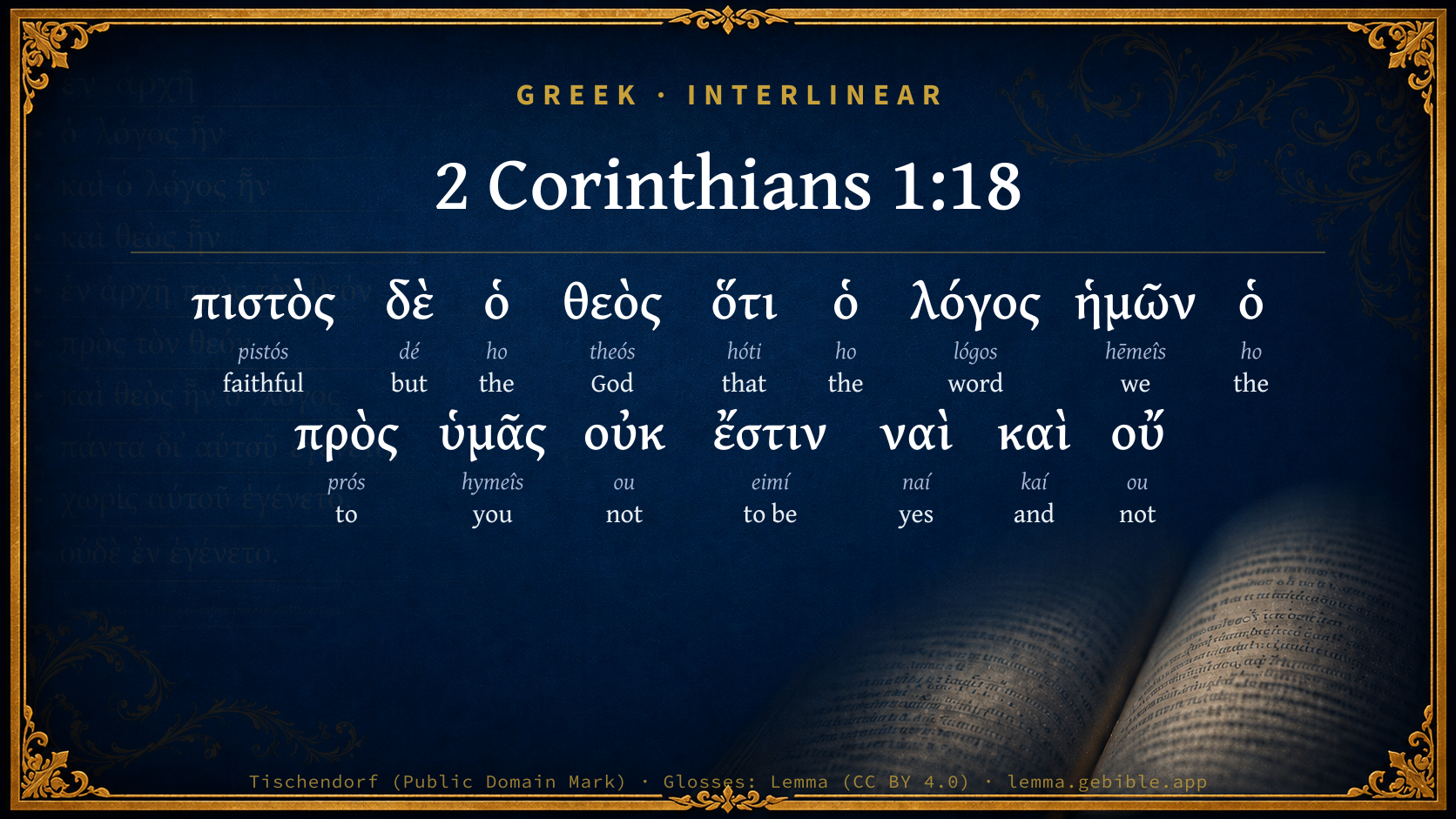
Download image
Cite this verse

2 Corinthians 1:18 (World English Bible). Public Domain. Lemma interlinear Bible study tool, https://lemma.gebible.app/v/2-corinthians/1/18.

Show BibTeX & RIS
BibTeX
RIS
English Translation
But as God is faithful, our word toward you was not "Yes and no."
World English Bible · Public Domain
Download a study sheet

One document with this verse’s original text, its word-by-word gloss line, the meaning frame, cross-references with their text, attributed commentary, and full source and license credits — printable, and it pastes into notes with its structure intact.

This verse Autodidact and up

Study sheet (.html) Plain text (.txt)

A passage Seminary Student

Up to 50 verses in one chapter. A passage sheet keeps up to 6 commentary sources and 12 cross-references per verse, in the order this page ranks them, and says so on the sheet whenever that leaves anything out. Ask for a single verse and you get the Autodidact verse sheet above.

Everything on this page stays free to read, with no account — the sheet is a download of what is already on screen, not access to it.

Want to remove ads? Support Godless Engineer
Compare translations 3

The same verse in 3 English versions, stacked beneath the original-language interlinear above. Click any original word for its lexicon entry.

Each is an independent rendering of the whole verse — the interlinear is not word-aligned to these translations.

Highlighted words mark where these versions differ — a whole-verse word diff, not a word-by-word alignment.

  • World English Bible Public Domain
    But as God is faithful, our word toward you was not "Yes and no."
  • King James Version Public Domain
    But as God is true, our word toward you was not yea and nay.
  • unfoldingWord Literal Text CC BY-SA 4.0
    But God faithful, so that our word to you is not “Yes” and “No.”

unfoldingWord Literal Text — © unfoldingWord, licensed CC BY-SA 4.0. Word-aligned USFM3 via Door43 (git.door43.org/unfoldingWord/en_ult).

Versions to compare (up to 4)

3 of 4 selected

Show all 19 translations

Every available English version of this verse, each an independent rendering of the whole verse.

  • World English Bible Public Domain
    But as God is faithful, our word toward you was not "Yes and no."
  • Berean Standard Bible Public Domain
    But as surely as God is faithful, our message to you is not “Yes” and “No.”
  • Majority Standard Bible Public Domain
    But as surely as God is faithful, our message to you was not “Yes” and “No.”
  • King James Version Public Domain
    But as God is true, our word toward you was not yea and nay.
  • American Standard Version (1901) Public Domain
    But as God is faithful, our word toward you is not yea and nay.
  • Revised Version (1885) Public Domain
    But as God is faithful, our word toward you is not yea and nay.
  • Geneva Bible (1599) Public Domain
    Yea, God is faithfull, that our worde towarde you was not Yea, and Nay.
  • Douay-Rheims (1899) Public Domain
    But God is faithful, for our preaching which was to you, was not, It is, and It is not.
  • Young's Literal Translation Public Domain
    and God `is' faithful, that our word unto you became not Yes and No,
  • Literal Standard Version CC BY-SA 4.0
    And God [is] faithful, that our word to you did not become Yes and No,
  • Unlocked Literal Bible CC BY-SA 4.0
    But just as God is faithful, we do not say both “Yes” and “No.”
  • unfoldingWord Literal Text CC BY-SA 4.0
    But God faithful, so that our word to you is not “Yes” and “No.”
  • Darby Bible Public Domain
    Now God [is] faithful, that our word to you is not yea and nay.
  • World Messianic Bible Public Domain
    But as God is faithful, our word toward you was not “Yes and no.”
  • Webster's Bible Public Domain
    But as God is true, our word towards you was not yea and nay.
  • Free Bible Version CC BY-SA 4.0
    Just as God can be trusted, when we give you our word it's not both Yes and No.
  • Bible in Basic English Public Domain
    As God is true, our word to you is not Yes and No.
  • Text-Critical English NT CC BY 4.0
    As surely as God is faithful, our message to you did not waver between “Yes” and “No.”
  • Tyndale New Testament (1534) Public Domain
    God is faythfull: For oure preachynge vnto you was not ye and naye.

Literal Standard Version (2020), Covenant Press — licensed CC BY-SA 4.0. Text via the HelloAO Bible API (eBible.org). Unlocked Literal Bible (unfoldingWord) — licensed CC BY-SA 4.0. Text via the HelloAO Bible API (eBible.org). unfoldingWord Literal Text — © unfoldingWord, licensed CC BY-SA 4.0. Word-aligned USFM3 via Door43 (git.door43.org/unfoldingWord/en_ult). Free Bible Version, Dr. Jonathan Gallagher — licensed CC BY-SA 4.0. Text via the HelloAO Bible API (eBible.org).

Word by word

More ways to search: Search by grammar → Find every occurrence → Compare this word →

Practice this passage: Drill this verse → Learn its vocabulary →

About this verse

These counts appear in no published source. They are computed here, from the morphology-tagged text and Lemma’s own curated glosses. What Lemma adds →

16
words
13
distinct lemmas
Pauline Epistles
section

Shared distinctive vocabulary

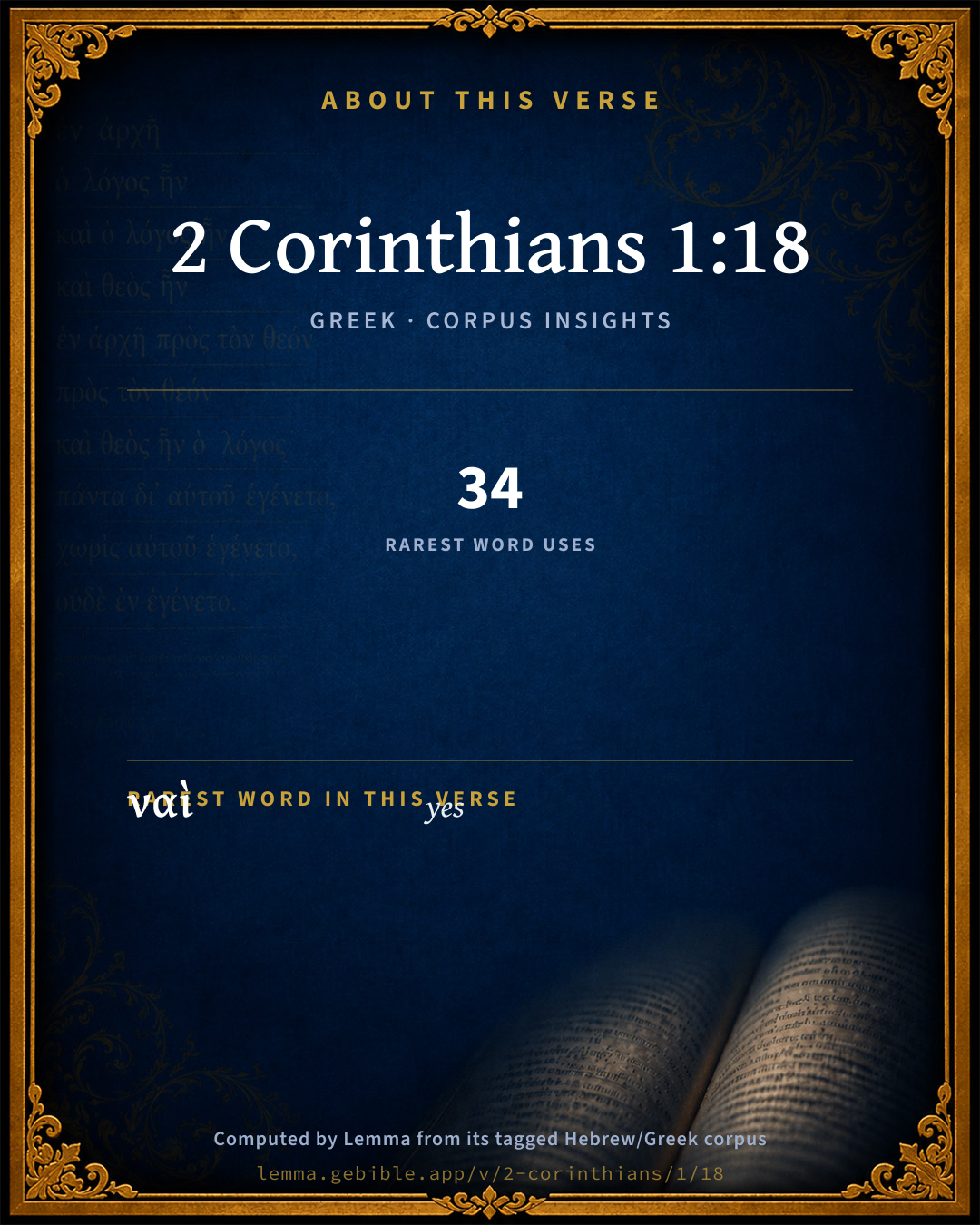
ναὶ yes G3483 occurs in 30 verses of the Greek New Testament. Also found in:
Repetition

Words recur within this verse:

Cross-references

9

Topical passages linked to 2 Corinthians 1:18 in the Treasury of Scripture Knowledge — connected by theme and wording, ordered by reader-vote popularity; previews shown in the World English Bible.

  • 1 Corinthians 1:9 God is faithful, through whom you were called into the fellowship of his Son, Jesus Christ, our Lord.
  • Revelation 3:7 "To the angel of the assembly in Philadelphia write: "He who is holy, he who is true, he who has the key of David, he who opens and no one can shut, and who shuts and no one opens, says these things:
  • John 7:28 Jesus therefore cried out in the temple, teaching and saying, "You both know me, and know where I am from. I have not come of myself, but he who sent me is true, whom you don't know.
  • Revelation 3:14 "To the angel of the assembly in Laodicea write: "The Amen, the Faithful and True Witness, the Head of God's creation, says these things:
  • John 8:26 I have many things to speak and to judge concerning you. However he who sent me is true; and the things which I heard from him, these I say to the world."
  • 2 Corinthians 1:23 But I call God for a witness to my soul, that I didn't come to Corinth to spare you.
  • 2 Corinthians 2:17 For we are not as so many, peddling the word of God. But as of sincerity, but as of God, in the sight of God, we speak in Christ.
  • 2 Corinthians 11:31 The God and Father of the Lord Jesus Christ, he who is blessed forevermore, knows that I don't lie.
  • 1 John 5:20 We know that the Son of God has come, and has given us an understanding, that we know him who is true, and we are in him who is true, in his Son Jesus Christ. This is the true God, and eternal life.

Cross-references courtesy of OpenBible.info (CC BY 4.0).

Commentary

Notes on 2 Corinthians 1:18 from classic Christian and Jewish commentators (each source and its license shown beneath its notes). The classic Christian expositions comment on the surrounding passage and are grouped to its opening verse, so a note may address several verses; the Jewish commentaries on the Tanakh (Rashi and others) are per-verse, so they appear only where the commentator wrote on this verse.

Lemma curates 59 commentaries, every one of them public domain or Creative Commons licensed, each selected and text-cleaned for this edition rather than reprinted as found. About our sources →

Tyndale Open Study Notes

Tyndale Open Resources

1:18-22 It was bad enough that Paul’s enemies at Corinth had attacked his character as unreliable and shifty (1:17). It was worse when they charged that his entire message was just as uncertain. In these verses Paul answers that allegation.

1:18-20 As surely as God is faithful: God can be trusted, as can his promises in Christ and his ministry through the apostles.

Tyndale Open Study Notes — © Tyndale Open Resources, licensed CC BY-SA 4.0. Text via the HelloAO Bible API.

Bengel's Gnomon

Johann Albrecht Bengel

2Co 1:18. Πιστὸς, faithful) The categorical statement implied is this, “Our doctrine is sure.” The mode [or expression of feeling, as opposed to a naked, categorical statement, end. on modalis sermo], however, is added: God is faithful, נאמן: comp. amen, 2Co 1:20.—δὲ, but) The antithesis is between his intention of travelling to see them, and the doctrine itself. The external change of that intention for good reasons infers no inconsistency in the doctrine. In the mean time, Paul shows, that those who are light [fickle] in external matters are wont to be, and to appear to be, light also in things spiritual.—πρὸς) with, to; with (towards) you, is an antithesis to with me, 2Co 1:17.—οὐκ ἐγένετο ναὶ καὶ οὐ, was not made yea and nay) Contradictories have no place in Theology.

Bengel's Gnomon of the New Testament — English translation (T&T Clark, Edinburgh, 1860) — public domain. Text from a community e-Sword module.

Meyer's Critical & Exegetical Commentary

Heinrich August Wilhelm Meyer

2Co_1:18. But according to His faithfulness, God causes our speech to you to be not yea and nay, not untrustworthy.[133] The δέ introduces the contrast (yea rather) to the state of things denied in the preceding question (Baeumlein, Partik. p. 95); and ὅτι is equivalent to εἰς ἐκεῖνο, ὅτι, like Joh_2:18; Joh_9:17; Joh_11:51; 1Co_1:26, al.: Faithful is God in reference to this, that our speech, etc., i.e. God shows Himself faithful by this, that, etc. Beza, Calvin, and others, including Flatt, Rückert, de Wette, Osiander, Neander, Ewald, Hofmann, take πιστὸς ὁ Θεός as an asseveration: proh Dei fidem! Against all linguistic usage, for the ζῶ ἐγὼ … ὅτι (see on Rom_14:11), which is compared, is a habitual formula of swearing, which the πιστὸς ὁ Θεός, very frequent with the apostle (1Co_1:9; 1Co_10:13; 1Th_5:24; 2Th_3:3; 1Jn_1:9), is not. Nor can we compare 2Co_11:10, where a subjective state of things is asserted as a guarantee of what is uttere.

ὁ λόγος ἡμῶν] is by most understood of the preaching of the gospel, according to which Paul thus, against the suspicion of untruthfulness in his resolves and assurances, puts forward the truthfulness of his preaching,in which there lies a moral argument a majori ad minus; for the opinion of Hofmann, that Paul means to say that his preaching stands in a different position from the conditioned quality of his yea and nay, falls with his view of 2Co_1:17. From 2Co_1:19, however, it appears to be beyond doubt that the usual explanation of λόγος, of the preaching, not in general of the apostles speech (Rückert), or of that unfulfilled promise (Erasmus in the Annot.), is the right one. Olshausen mixes up the two explanations.

[133] Erasmus says aptly, Paraphr.: Sed non fallit Deus, cujus praesidio factum est, ut sermo noster, quo vobis illius evangelium praedicavimus, non vacillarit, sed semper sui similis fuerit.

Meyer — Critical and Exegetical Commentary on the New Testament — English translation by Peter Christie, edited by Frederick Crombie (T&T Clark, 1880) — public domain. Text from a community e-Sword module.

Expositor's Greek Testament

ed. W. Robertson Nicoll

2Co 1:18 . πιστὸς δὲ ὁ Θεὸς ὅτι κ . τ . λ .: but as God is faithful, our word, etc. For the construction, cf. the similar forms of asseveration ζῇ κύριος ὅτι , “as the Lord liveth” (1Sa 20:3 , 2Sa 2:27 ), and ἔστιν ἀλήθεια Χριστοῦ ἐν ἐμοὶ ὅτι , “as the truth of Christ is in me” (2Co 11:10 ). For πιστός as applied to God, see Deu 7:9 , 1Co 1:9 ; 1Co 10:13 , 1Th 5:24 , 2Th 3:3 , 2Ti 2:13 , and cf. 1Sa 15:29 . ὁ λόγος ἡμῶν ὁ πρὸς ὑμᾶς οὐκ ἔστιν Ναὶ καὶ Οὔ : our word ( sc. , my personal communications about my journey, as well as the message of the Gospel) towards you is not Yea and Nay . I do not deceive you or vacillate in my purpose: cf. 2Co 2:17 .

The Expositor's Greek Testament, edited by W. Robertson Nicoll (1897–1910) — public domain. Text from a community e-Sword module.

Alford’s Greek Testament

Henry Alford

18.] Such fickleness, you know, was not my habit in preaching to you. Chrys. gives the connexion well: καλῶς ἀντίθεσιν ἀνακύπτουσαν καταλύει. εἰ γὰρ ὑποσχόμενος, φησί, παραγενέσθαι ὑπερέθου, καὶ οὐκ ἔστι παρά σοι ναί, ναί (predicate in Chrys.’s interpretation; see above), καὶ οὔ, οὔ, ἀλλὰ νῦν ἃ λέγεις ἀνατρέπεις μετὰ ταῦτα, ὥσπερ ἐπὶ τῆς σῆς ἐπιδημίας ἐποίησας· οὐαὶ ἡμῖν, μή ποτε καὶ ἐν τῷ κηρύγματι τοῦτο γέγονεν. ἵνʼ οὖν μὴ ταῦτα ἐννοῶσι, μηδὲ θορυβῶνται, φησί· πιστὸς δὲ ὁ θεὸς κ.τ.λ. p. 446.

πιστ. δὲ ὁ θ., ὅτι] a form of asseveration: see reff.

The δέ follows on the denial of the preceding question.

ὁ λόγ. Our doctrine (which we preached, cf. ὁ λόγος ὁ τοῦ σταυροῦ, 1Co 1:18), to you is not (present, inasmuch as the character of the doctrine was present and abiding. The pres. has been altered in rec. to the easier ἐγένετο) yea and nay (i.e. inconsistent with itself).

Henry Alford, The Greek Testament (1849–1861) — public domain. Text from a community e-Sword module.

Geneva Bible (1599)

Geneva Bible translators

He calleth God to witness, and for judge of his constancy in preaching and teaching one selfsame Gospel.

True, and of whose faithfulness it [were] horrible wickedness to doubt.

Geneva Bible (1599) marginal notes — public domain. Text via Bolls.life.

Jamieson, Fausset & Brown

Robert Jamieson, A. R. Fausset & David Brown

He adds this lest they might think his DOCTRINE was changeable like his purposes (the change in which he admitted in Co2 1:17, while denying that it was due to "lightness," and at the same time implying that not to have changed, where there was good reason, would have been to imitate the fleshly-minded who at all costs obstinately hold to their purpose).

true--Greek, "faithful" (Co1 1:9).

our word--the doctrine we preach.

was not--The oldest manuscripts read "is not."

yea and nay--that is, inconsistent with itself.

Jamieson, Fausset & Brown — Commentary Critical and Explanatory on the Whole Bible (1871) — public domain (CC PDM 1.0). Text via the HelloAO Bible API.

Adam Clarke's Commentary

Verse 18. But as God is true] Setting the God of truth before my eyes, I could not act in this way: and as sure as he is true, so surely were my purposes sincere; and it was only my uncertainty about your state that induced me to postpone my visit. See 2Co 1:23.

Adam Clarke's Commentary on the Bible (1810–1826) — public domain. Text from a community e-Sword/MySword module.

John Calvin's Commentaries

18. God is faithful. By the term word he means doctrine, as is manifest from the reason that he adds, when he says, that the Son of God, who is preached by him, is not variable, etc. As to his being always consistent with himself in point of doctrine, and not differing from himself, he intends that by this they shall form a judgment as to his integrity, and in this way he removes every unfavorable suspicion of fickleness or unfaithfulness. It does not, however, necessarily follow, that the man who is faithful in doctrine, is also observant of truth in all his words. But as Paul did not reckon it of much importance in what estimation he was held, provided only the majesty of his doctrine remained safe and sound, he, on that account, calls the attention of the Corinthians chiefly to that matter. He intimates, it is true, that he observed in his whole life the same course of fidelity, as the Corinthians had seen in his ministry. He seems, however, as if intentionally, in repelling the calumny, to transfer it from his person to his doctrine, because he was unwilling that his apostleship should be indirectly defamed, while he was not greatly concerned as to himself in other respects.

But observe, with what zeal he applies himself to this. For he calls God to witness, how simple and pure his preaching was — not ambiguous, not variable, not temporizing. In his oath, too, he connects the truth of God with the truth of his doctrine. “The truth of my preaching is as sure and stable as God is faithful and true.” Nor is this to be wondered at, for the word of God, which Isaiah says endureth for ever, (Isaiah 40:8,) is no other than what prophets and apostles published to the world, as Peter explains it. (1 Peter 1:25.) Hence, too, his confidence in denouncing a curse upon angels, if they dared to bring another gospel, one that was at variance with his. (Galatians 1:8.) Who would dare to make the angels of heaven subject to his doctrine, if he had not God as his authority and defense? With such an assurance of a good conscience does it become ministers to be endowed, who mount the pulpit to speak the word in Christ’s name — so as to feel assured that their doctrine can no more be overthrown than God himself.

John Calvin's Commentaries (1540-1563) — public domain. Text from the Calvin Translation Society English edition (1840s-50s) via the Christian Classics Ethereal Library (ccel.org). Calvin's coverage is partial (roughly two-thirds of the Bible); uncommented books and verses are honest gaps, never fabricated. The 19th-century editor's footnotes and remarks are omitted so the notes are faithfully Calvin's own voice.

Ellicott's Commentary for English Readers

(18) As God is true.—Literally, as God is faithful. The words were one of St. Paul’s usual formulæ of assertion. (Comp. 1Co_1:9; 1Co_10:13; 2Th_3:3.) In other instances it is followed commonly by a statement as to some act or attribute of God. Here it is more of the nature of an oath: “As God is faithful in all His words, so my speech” (the vague term is used to include preaching, writing, personal intercourse) “is true and faithful also.” There had been no “Yes” and “No” in the same breath; no saying one thing when he meant another.

A Bible Commentary for English Readers, edited by Charles John Ellicott (1878–1897) — public domain. Text from a community e-Sword module.

The Cambridge Bible for Schools and Colleges

gen. ed. J. J. S. Perowne

18. But as God is true, our word toward you was not yea and nay] There was no more infirmity of purpose in the Apostle’s preaching than there is untruth, or rather, unfaithfulness in God. ‘Word’ here means speech, discourse, as in 1Co_1:5.

was not] Rather, is not, since the doctrine once preached remains ever the same. See Gal_1:8-9.

The Cambridge Bible for Schools and Colleges (gen. ed. J. J. S. Perowne; Cambridge University Press, 1878–1918) — public domain. Text from a community e-Sword module.

John Gill's Exposition

But as God is true,.... It seems that the false apostles had insinuated, that as the apostle had not kept his word in coming to them as he had promised, that he was not to be depended upon in his ministry; that he might as well contradict himself, and deceive others in the one, as well as in the other: wherefore he appeals to God in a very solemn manner, calls him to witness to the truth of his doctrine; for these words may be considered as the form of an oath; or he argues from, the truth and faithfulness of God, to the certainty and invariableness of the word preached, who is so true and faithful as that he will never suffer his word to be yea and nay: for when the apostle says, that

our word towards you was not yea and nay, he does not mean his word of promise to come to Corinth; but the word of his preaching, the doctrine of the Gospel, which was not uncertain, changeable, sometimes one thing, and sometimes another, and contradictory to itself. And by this the apostle would intimate, that since he was faithful and upright, uniform, consistent, and all of a piece in preaching the Gospel to them; so they ought to believe, that he was sincere in his resolutions and promises to come and see them, though as yet he had been hindered, and had not been able to perform them.

John Gill's Exposition of the Whole Bible (1746–1763) — public domain (CC PDM 1.0). Text via the HelloAO Bible API.

Trapp's Complete Commentary

John Trapp

18 But as God is true, our word toward you was not yea and nay.

Ver. 18. Our word toward you, &c.] God’s children are all such as will not lie, say and unsay, blow hot and cold with a blast, Isa 63:8. Christianus est, non mentietur, He is a Christian, he will not lie, was an old proverb. Sophronins testifieth of Chrysostom, nunquam eum mentitum fuisse, that he was never taken in a lie.

John Trapp, A Commentary or Exposition upon All the Books of the Old and New Testament (1647–1656) — public domain. Text from a community e-Sword module.

Albert Barnes' Notes on the Bible

But as God is true - Tyndale renders this in accordance more literally with the Greek, “God is faithful; for our preaching unto you was not yea and nay.” The phrase seems to have the form of an oath, or to be a solemn appeal to God as a Witness, and to be equivalent to the expression “the Lord liveth,” or “as the Lord liveth.” The idea is,” God is faithful and true. He never deceives; never promises that which he does not perform. So true is it that I am not fickle and changing in my purposes.” This idea of the faithfulness of God is the argument which Paul urges why he felt himself bound to be faithful also. That faithful God he regarded as a witness, and to that God he could appeal on the occasion.

Our word - Margin, “preaching” (ὁ λόγος ho logos. This may refer either to his preaching, to his promises of visiting them, or his declarations to them in general on any subject. The particular subject under discussion was the promise which he had made to visit them. But he here seems to make his affirmation general, and to say universally of his promises, and his teaching, and of all his communications to them, whether orally or in writing, that they were not characterized by inconstancy and changeableness. It was not his character to be fickle, unsettled, and vacillating.

Albert Barnes' Notes on the Bible (1834–1885) — public domain. Text from a community e-Sword/MySword module.

Haydock's Catholic Bible Commentary

But God is faithful: The sense seems to be, as God is faithful, or I appeal to God, who is faithful, that in what I have preached to you, there is not yes and no; my doctrine concerning the faith in Jesus Christ, is and was always the same. Whether I, or Silvanus, or Timothy preached the Son of God, that is, what we taught concerning the Son of God, was not yes and no, was not first one thing, and then another; but in him was yes only, that is, in him, and his doctrine, which we have taught, all is yes, firm, and unchangeable. --- And all the promises of God, of sanctification and salvation, made to us in him, by his merits and grace, are equally yes, certain, and infallible; and therefore by him, and his promises are Amen to God, must needs be true, unto our glory, will turn to the salvation and glory of his elect in heaven. (Witham)

George Leo Haydock (1774–1849), Haydock's Catholic Family Bible and Commentary, 1859 edition — public domain. Excludes Psalms (Douay-Rheims chapter numbering differs from Protestant) and Deuterocanonical books (Catholic canon only).

Matthew Poole's English Annotations

As God is true to his promises, so he hath taught me to be true to mine. Some make these words not to be merely declarative of the truth of God, but a kind of an oath, or calling the God of truth to witness, that his

word toward them; by which some understand the gospel, or the word which he had preached amongst them (and of that indeed he speaketh in the next verse); but to me it seemeth much less strained, to interpret Paul’s word, in this verse, of that word of promise of which he had before spoken, the promise which he owned before that he had made them of his coming to them. That

word, he saith, was not yea and nay, that is, he did not make it with a quite contrary intention; but when he promised, he faithfully intended to have justified his word, and indeed to have come; but the providence of God, to which all men are subjected, had otherwise ordered him and disposed of him; which was the cause why he had not yet been as good as his word. It is very observable, how careful this great apostle was to clear himself from any imputations of levity and falsehood; and it should teach us to be careful to maintain our reputation in the world for truth and steadiness.

Matthew Poole's English Annotations on the Holy Bible (1683–1685) — public domain. Text from a community e-Sword/MySword module.

Whedon's Commentary on the Bible

Daniel D. Whedon

18. Our word toward you—Our speech, whether by letter, by converse, or by preaching.

Not yea… nay—Was not of our own fickle human decision.

Daniel D. Whedon (gen. ed.), Commentary on the Old and New Testaments (1874–1909) — public domain. Text from a community e-Sword module.

The Pulpit Commentary

But as God is true; rather, but God is faithful, whatever man may be (1Co_1:9 1Co_10:13; 1Th_5:24; 2Th_3:3; 1Jn_1:9) Our word towards you, etc. The verse should be rendered, But God is faithful, because (faithful herein, that) our preaching to you proved itself to be not yea and may. Whatever you may say of my plans and my conduct, there was one thing which involved an indubitable "yea," namely, my preaching to you. In that, at any rate, there was nothing capricious, nothing variable, nothing vacillating. St. Paul, in a manner characteristic to his moods of deepest emotion, "goes off at a word." The Corinthians talked of his "yea" and "nay" as though one was little better than the other, and neither could be depended on; well, at any rate, one thing, and that the most essential, was as sure as the faithfulness of God.

Vers. 18-20.

The promises of God.

If Paul, in delaying his promised visit to Corinth, had seemed chargeable with levity and fickleness, he was not really thus guilty. Such qualities were alien from his Christian nature. And not only so; they were contrary to the character of the God he worshipped, the Saviour he preached; contrary to the promises of the gospel he believed which they had received through his ministry. Thus the personal reference suggests the statement of a great Christian doctrine.

I GOD IS GRACIOUS AND GIVES PROMISES.

1. Revelation is one long promise; it consists, not merely of commands andadmonitions, but of assurances of favour and of help. Herein it proves its adaptation to the nature and to the needs of men. There were promises addressed to our first parents, to Abraham, to Moses.

2. The one promise distinctive of the old covenant was the promise of theSaviour, the Servant of the Lord, the Desire of all nations. In promising the Christ, Jehovah did indeed virtually promise all spiritual blessings to mankind.

3. The one promise of the new covenant is the promise of the Holy Spirit,in whom is grace and help for all human want and need.

4. The promises of God extend beyond this life into eternity, and includethe vision of our Saviour and the possession of an immortal inheritance and home.

II GOD IS FAITHFUL AND FULFILS HIS PROMISES.

1. Of this his unchangeableness and omnipotence are the certain pledge.What his fatherly goodness assures, his inexhaustible resources will realize.

2. The gifts of his Son and of his Spirit are the proof of his faithfulness. Allhis promises relating to these gifts have been already made good, and none who receives them can doubt his power and willingness to fulfil what yet remains.

3. The promises of individual guidance, protection, and aid cannot befalsified. "Ye know in all your hearts, that not one thing hath failed of all the good things which the Lord your God spoke concerning you.

4. Our confidence in Divine faithfulness may be tried, but cannot bedisappointed. The stream sometimes disappears and flows for a space underground and unseen; but it is there, and soon emerges in beauty and power. So with the purposes of God; they may be hidden and delayed, but they shall all be accomplished. T.

The Pulpit Commentary (1880–1919), ed. H.D.M. Spence-Jones & Joseph S. Exell — public domain. Text from a community e-Sword module.

John Wesley's Explanatory Notes

Our word to you - The whole tenor of our doctrine. Hath not been yea and nay - Wavering and uncertain.

John Wesley, Explanatory Notes Upon the Whole Bible (1754–1765) — public domain. Text via the GEBible commentary corpus.

Burkitt's Expository Notes on the New Testament

William Burkitt

By the word here, some understand St. Paul’s promise to come to Corinth, that he did very seriously intend to come unto them; as if he had said, "As God is true to his promise, so has he taught me to be true to mine." Others understand by the word, St. Paul’s preaching, that his doctrine was not mutable and changeable, but always the same.

Here note, How ready and forward the adversaries of religion are from any real or supposed imperfections in the ministers of God, presently to blame and burden their ministry, to charge their private errors and mistakes upon their doctrine. There is a mighty propensity and great forwardness in bad men, to cast all the imperfections of the ministers of the gospel upon their ministry and doctrine.

The devil is glad of an opportunity, by the failings of preachers, to bring the doctrines they preach either into doubt or disesteem. But though it be a great reproach for a minister to be mutable and contradictory in his doctrine, yet the wicked world do often accuse them of it, and charge them with it, when there is not the least occasion of it: Verily, as God is true, our word was not yea and nay.

William Burkitt's Expository Notes on the New Testament (1700–1703) — public domain. Text from a community e-Sword module.

McGarvey & Pendleton's Commentaries

J. W. McGarvey

But as God is faithful, our word toward you is not yea and nay .

J. W. McGarvey (with Philip Y. Pendleton), Commentaries on the New Testament (The Fourfold Gospel, 1914; Acts; and the epistles) — public domain. Text from a community e-Sword/MySword module.

The People's New Testament

B. W. Johnson

18. Our word … was not yea and nay. That is, ambiguous and unreliable.

B. W. Johnson's The People's New Testament with Notes (1889–1891) — public domain. Electronic text from the Christian Classics Ethereal Library (CCEL) ThML edition.

Cambridge Greek Testament for Schools and Colleges

18. ἔστιν (אABCD, Latt.) rather than ἐγένετο (א3D3KL).

18. πιστὸς δὲ ὁ θεός. But (whatever you may think of me) God is faithful, in that our word toward you is not yea and nay. Comp. 1Co 1:9; 1Co 10:13; 1Th 5:24; 2Th 3:3. Neither Wiclif, following the Vulgate, nor Tyndale, nor Cranmer takes the words as an adjuration (A.V., R.V.), ‘as God is faithful.’ Rom 14:11 is urged in support of this; but there we have a known form of adjuration, which this is not. It is safer not to turn either this or 2Co 11:10 into an adjuration. By ὁ λόγος ἡμῶν he means the message of the Gospel (2Co 1:19): hence he quite naturally returns from the singular (2Co 1:15-17) to the plural (18–22). ‘Our doctrine is plain enough. The faithfulness of God is reflected in it, and you can find no inconsistency there. If, then, we have been faithful in the greater things, why do you distrust me in the less?’ He says ἔστιν, not ἐγένετο or ἦν (see critical note), because the doctrine is still before them; they all know what he taught month after month: αὐτοὺς καλῶν εἰς μαρτυρίαν (Theodoret). Possibly there is the further thought, ‘This is more than my Judaizing opponents can say. They make God to be not faithful. He has promised salvation to all. They say, Yea, He has to the Jews; to the Gentiles, nay.’

Cambridge Greek Testament for Schools and Colleges (Cambridge University Press, 1896; 21 vols, various authors incl. Carr, Maclear, Plummer, Farrar, Lumby, Moule, M. R. James, Simcox) — public domain. Text from a community e-Sword module.

International Critical Commentary

18. πιστὸς δὲ ὁ Θεὸς ὅτι κ.τ.λ. There is doubt whether this is an adjuration or not. In favour of its being an adjuration (Genevan, AV, RV.) is the fact that ‘as God is faithful’ makes excellent sense, and that it seems to be analogous to such expressions as ζῶ ἐγώ, ὅτι (Rom 14:11 from Isa 45:23, where LXX has κατʼ ἐμαυτοῦ ὀμνύω), ζῇ Κύριος ὅτι (1Sa 20:3 ; 2Sa 2:27, 2Sa 2:12:5 ; etc.). Bousset and Lietzmann adopt the rendering, Bei Gottes Treue. But there is much to be said against this interpretation. The formula, πιστὸς ὁ Θεός, is used elsewhere by St Paul in places where it is not an adjuration (1Co 1:9, 1Co 1:10:13; cf. 1Th 5:24; 2Th 3:3). In adjurations and solemn asseverations he uses forms which are quite different; e.g. μάρτυρα τ. Θεὸν ἐπικαλοῦμαι (v. 3), Θεὸς μάρτυς (1Th 2:5, 1Th 2:10), μάρτυς γάρ μού ἐστιν ὀ Θεός (Rom 1:9), μάρτυς γάρ μου ὁ Θεός (Php 1:8), ὁ Θεὸς οἶδεν (11:11), ὀ Θ. καὶ πατὴρ τ. Κυρίου Ἰησοῦ οἶδεν ὅτι οὐ ψεύδομαι (11:31), ἰδοὺ ἐνώπιον τ. Θεοῦ ὅτι οὐ ψεύδομαι (Gal 1:20), διαμαρτύρομαι ἐνώπιον τ. Θεοῦ (1Ti 5:21; cf. 2Ti 2:14, 2Ti 4:1), παραγγέλλω σοι ἐνώπιον τ. Θεοῦ (1Ti 6:13). Wiclif, Tyndale and Cranmer follow the Vulgate (Fidelis autem Deus) in not making this an adjuration. Schmiedel has, Treuer Bürge ist Gott.

This use of πιστός as a special attribute of God is frequent in N.T. and LXX (e.g. 2Ti 2:13; Heb 10:23, Heb 10:11:11; Deu 7:9; Isa 49:7); cf. πιστὸς Κύριος τοῖς ἀγαπῶσιν αὐτὸν, and πιστὸς ὁ Κύριος ἐν πᾶσι τοῖς κρίμασιν αὐτοῦ (Ps. Sol. xiv. I, xvii .12). As in Joh 2:18, Joh 9:17, ὃτι = ‘in that’; ‘God is faithful in that our word toward you is (not ‘was,’ AV) not a wavering between Yes and No.’ They have his letters, they have in their minds what he and others taught them, and there is no inconsistency or insincerity in the Gospel which they possess; it is a reflexion of the faithfulness of God. Chrys. paraphrases, ‘Mistrust not what is from God, for what is from God cannot be untrue.’ The argument is one from “ethical congruity.” God is faithful in the fact that the Gospel which is proclaimed by His messengers is not a Gospel of duplicity, full of misleading statements and of promises which are not fulfilled.

οὐκ ἔστιν (א* A B C D* F G P 17, Latt. Copt. Goth. Arm.) rather than οὑκ ἐγένετο (א3 D2 and 3 E K L, Syrr. Aeth.), which is assimilation to v. 19.

International Critical Commentary — older volumes (1896–1929), various authors — public domain. Text from a community e-Sword module.

Vincent's Word Studies in the New Testament

Marvin R. Vincent

As God is true [πιστος ο θεος] . Not to be taken as a formula of swearing. He means that God will answer for him against the charge of fickleness by the power and blessing (benefit) which will attend his presence. Hence the meaning is : faithful is God (in this) that our speech, etc.

Marvin R. Vincent, Word Studies in the New Testament (1887–1900) — public domain. Text from a community e-Sword/MySword module.

Lesson kit

Teaching starters — assembled from the data on this page, not authored interpretation. Every prompt links to the verse data it draws on. Edit before teaching.

2 Corinthians, in the Pauline Epistles, opens this verse with 16 words (13 distinct Greek lemmas). Its most distinctive word is naí (“yes”). A historical commentator’s framing appears above. Read the whole chapter for the surrounding context.

Discussion questions

  1. How does “yes” (naí) shape what this verse is saying?
  2. Matthew 5:37 shares the word «yes» with this verse. How do the two illuminate each other?
  3. “the” occurs 3× in this one verse. What is the effect of the repetition?
  4. These translations render this verse differently; the difference is in the English rendering, not the original. What questions does that raise?
  5. Reading how Tyndale Open Study Notes and Bengel's Gnomon read this verse, where do the two commentators agree and where do they part?

Things to notice

Reading settings

Reading text

Shown beneath each verse's original-language words.

Old Testament
Old Testament edition

Read the OT as the Masoretic Hebrew (MT) or the Greek Septuagint (LXX).

English shown for the Greek Septuagint (in the Hebrew ↔ Greek comparison).

Comparing translations? Open the Compare panel on any verse page to stack up to four side by side.