2 Corinthians 6:13

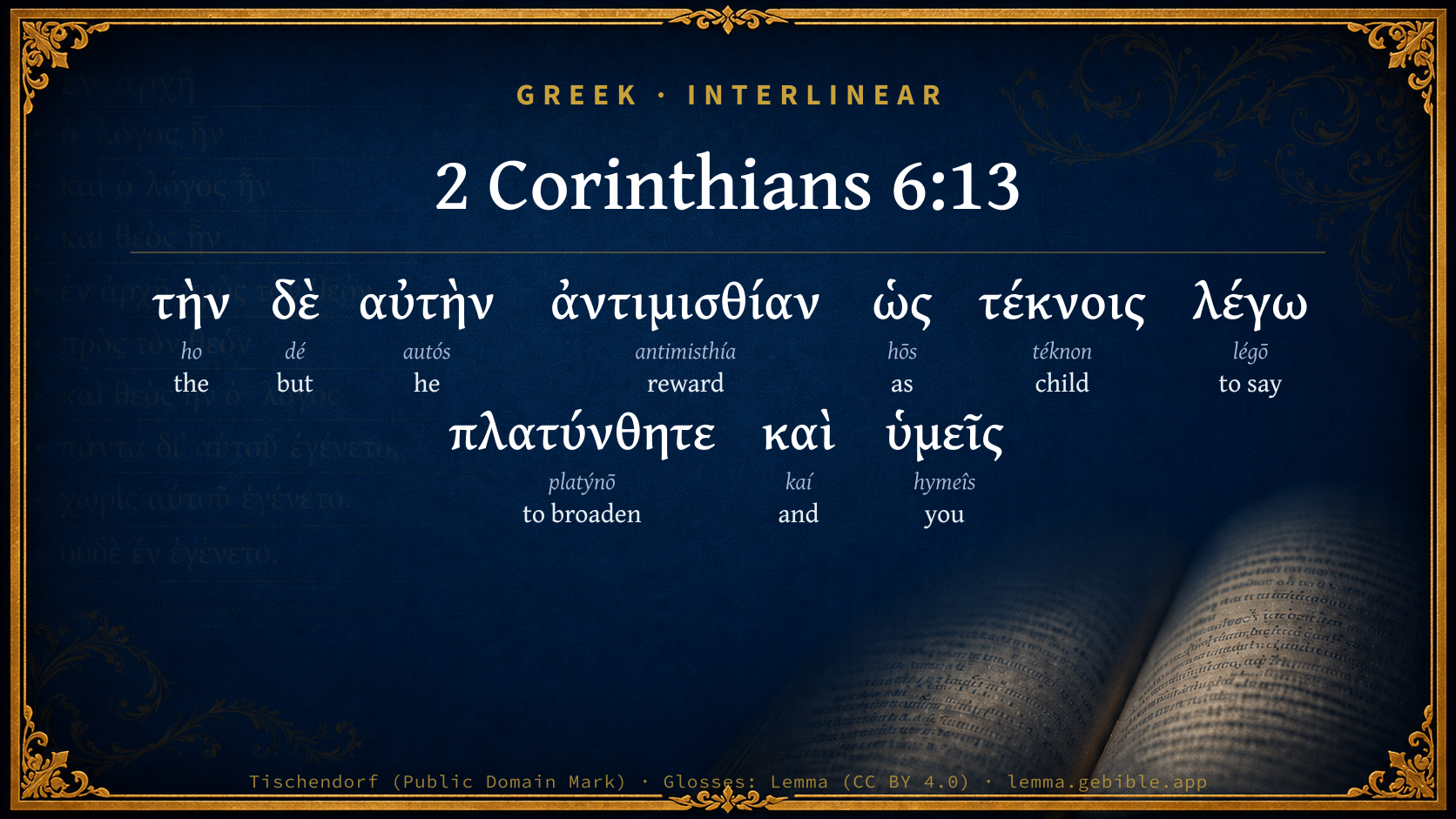
Greek (Tischendorf 8th ed.) 2 Corinthians 6:13 appears in the Greek New Testament. The text above is from the Tischendorf 8th edition. Each word links to its Strong’s number and a concise gloss. Click any word for its full Thayer’s Greek Lexicon entry.
Download image
Cite this verse

2 Corinthians 6:13 (World English Bible). Public Domain. Lemma interlinear Bible study tool, https://lemma.gebible.app/v/2-corinthians/6/13.

Show BibTeX & RIS
BibTeX
RIS
English Translation
Now in return, I speak as to my children, you also be open wide.
World English Bible · Public Domain
Download a study sheet

One document with this verse’s original text, its word-by-word gloss line, the meaning frame, cross-references with their text, attributed commentary, and full source and license credits — printable, and it pastes into notes with its structure intact.

This verse Autodidact and up

Study sheet (.html) Plain text (.txt)

A passage Seminary Student

Up to 50 verses in one chapter. A passage sheet keeps up to 6 commentary sources and 12 cross-references per verse, in the order this page ranks them, and says so on the sheet whenever that leaves anything out. Ask for a single verse and you get the Autodidact verse sheet above.

Everything on this page stays free to read, with no account — the sheet is a download of what is already on screen, not access to it.

Want to remove ads? Support Godless Engineer
Compare translations 3

The same verse in 3 English versions, stacked beneath the original-language interlinear above. Click any original word for its lexicon entry.

Each is an independent rendering of the whole verse — the interlinear is not word-aligned to these translations.

Highlighted words mark where these versions differ — a whole-verse word diff, not a word-by-word alignment.

  • World English Bible Public Domain
    Now in return, I speak as to my children, you also be open wide.
  • King James Version Public Domain
    Now for a recompence in the same, (I speak as unto my children,) be ye also enlarged.
  • unfoldingWord Literal Text CC BY-SA 4.0
    and the same exchange—I speak as to children—open yourselves wide also.

unfoldingWord Literal Text — © unfoldingWord, licensed CC BY-SA 4.0. Word-aligned USFM3 via Door43 (git.door43.org/unfoldingWord/en_ult).

Versions to compare (up to 4)

3 of 4 selected

Show all 19 translations

Every available English version of this verse, each an independent rendering of the whole verse.

  • World English Bible Public Domain
    Now in return, I speak as to my children, you also be open wide.
  • Berean Standard Bible Public Domain
    As a fair exchange, I ask you as my children: Open wide your hearts also.
  • Majority Standard Bible Public Domain
    As a fair exchange—I speak as to my children—open wide your hearts also.
  • King James Version Public Domain
    Now for a recompence in the same, (I speak as unto my children,) be ye also enlarged.
  • American Standard Version (1901) Public Domain
    Now for a recompense in like kind (I speak as unto `my' children), be ye also enlarged.
  • Revised Version (1885) Public Domain
    Now for a recompense in like kind (I speak as unto my children), be ye also enlarged.
  • Geneva Bible (1599) Public Domain
    Nowe for the same recompence, I speake as to my children, Be you also inlarged.
  • Douay-Rheims (1899) Public Domain
    But having the same recompense, (I speak as to my children,) be you also enlarged.
  • Young's Literal Translation Public Domain
    and `as' a recompense of the same kind, (as to children I say `it',) be ye enlarged -- also ye!
  • Literal Standard Version CC BY-SA 4.0
    and [as] a repayment of the same kind (as to children I say [it]), be enlarged—also you!
  • Unlocked Literal Bible CC BY-SA 4.0
    Now in fair exchange—I speak as to children—open yourselves wide also.
  • unfoldingWord Literal Text CC BY-SA 4.0
    and the same exchange—I speak as to children—open yourselves wide also.
  • Darby Bible Public Domain
    but for an answering recompense, (I speak as to children,) let *your* heart also expand itself.
  • World Messianic Bible Public Domain
    Now in return—I speak as to my children—you also open your hearts.
  • Webster's Bible Public Domain
    Now for a recompense in the same (I speak as to my children,) be ye also enlarged.
  • Free Bible Version CC BY-SA 4.0
    Please respond in the same way, as if you were my children, and be big-hearted!
  • Bible in Basic English Public Domain
    Now to give me back payment of the same sort (I am talking as to my children), let your hearts be wide open to me.
  • Text-Critical English NT CC BY 4.0
    Now in return—I am speaking as I would to my own children—open your hearts to us.
  • Tyndale New Testament (1534) Public Domain
    I promyse you lyke rewarde with me as to my childre. Set youreselues therfore at large

Literal Standard Version (2020), Covenant Press — licensed CC BY-SA 4.0. Text via the HelloAO Bible API (eBible.org). Unlocked Literal Bible (unfoldingWord) — licensed CC BY-SA 4.0. Text via the HelloAO Bible API (eBible.org). unfoldingWord Literal Text — © unfoldingWord, licensed CC BY-SA 4.0. Word-aligned USFM3 via Door43 (git.door43.org/unfoldingWord/en_ult). Free Bible Version, Dr. Jonathan Gallagher — licensed CC BY-SA 4.0. Text via the HelloAO Bible API (eBible.org).

Word by word

More ways to search: Search by grammar → Find every occurrence → Compare this word →

Practice this passage: Drill this verse → Learn its vocabulary →

About this verse

These counts appear in no published source. They are computed here, from the morphology-tagged text and Lemma’s own curated glosses. What Lemma adds →

10
words
10
distinct lemmas
Pauline Epistles
section

Notable vocabulary

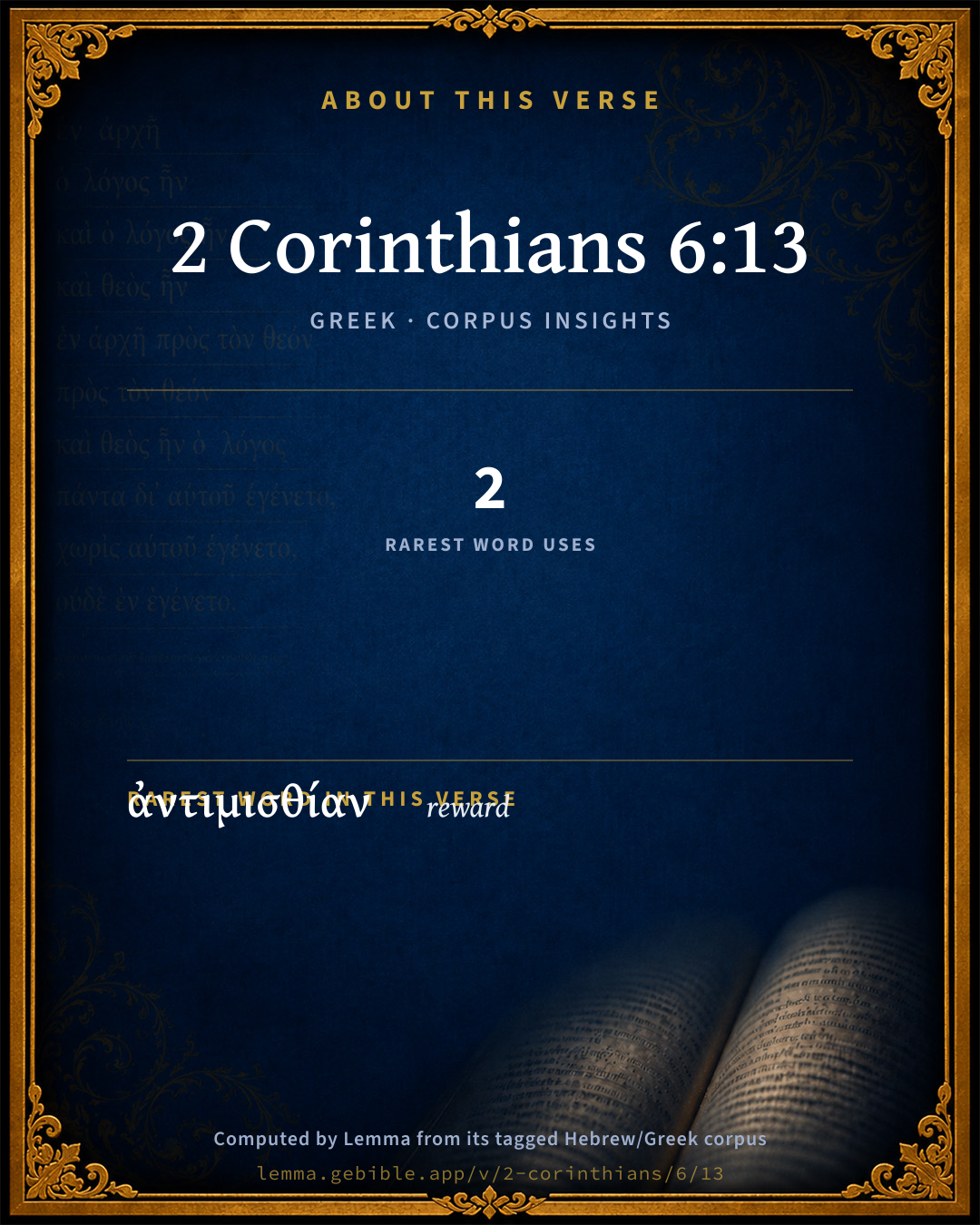
The rarest word here is ἀντιμισθίαν reward G489 — appearing just 2 times in the whole Greek New Testament.

Shared distinctive vocabulary

ἀντιμισθίαν reward G489 occurs in 2 verses of the Greek New Testament. Also found in:

Cross-references

18

Topical passages linked to 2 Corinthians 6:13 in the Treasury of Scripture Knowledge — connected by theme and wording, ordered by reader-vote popularity; previews shown in the World English Bible.

  • 1 John 3:18 My little children, let's not love in word only, neither with the tongue only, but in deed and truth.
  • 3 John 1:4 I have no greater joy than this, to hear about my children walking in truth.
  • 1 Corinthians 4:14–15 I don't write these things to shame you, but to admonish you as my beloved children.
  • 1 John 2:1 My little children, I write these things to you so that you may not sin. If anyone sins, we have a Counselor with the Father, Jesus Christ, the righteous.
  • 1 John 3:7 Little children, let no one lead you astray. He who does righteousness is righteous, even as he is righteous.
  • 1 Thessalonians 2:11 As you know how we exhorted, comforted, and implored every one of you, as a father does his own children,
  • 2 Kings 13:14–19 Now Elisha was fallen sick of his sickness of which he died: and Joash the king of Israel came down to him, and wept over him, and said, My father, my father, the chariots of Israel and the horsemen of it!
  • Psalms 81:10 I am Yahweh, your God, Who brought you up out of the land of Egypt. Open your mouth wide, and I will fill it.
  • Matthew 9:28–29 When he had come into the house, the blind men came to him. Jesus said to them, "Do you believe that I am able to do this?" They told him, "Yes, Lord."
  • Matthew 17:19–20 Then the disciples came to Jesus privately, and said, "Why weren't we able to cast it out?"
  • Mark 6:4–6 Jesus said to them, "A prophet is not without honor, except in his own country, and among his own relatives, and in his own house."
  • Mark 11:24 Therefore I tell you, all things whatever you pray and ask for, believe that you receive them, and you shall have them.
  • Galatians 4:12 I beg you, brothers, become as I am, for I also have become as you are. You did me no wrong,
  • Hebrews 12:5–6 and you have forgotten the exhortation which reasons with you as with children, "My son, don't take lightly the chastening of the Lord, Nor faint when you are reproved by him;
  • 1 John 2:12–14 I write to you, little children, because your sins are forgiven you for his name's sake.
  • 1 John 5:14–15 This is the boldness which we have toward him, that, if we ask anything according to his will, he listens to us.
  • Galatians 4:19 My little children, of whom I am again in travail until Christ is formed in you--
  • James 1:6–7 But let him ask in faith, without any doubting, for he who doubts is like a wave of the sea, driven by the wind and tossed.

Cross-references courtesy of OpenBible.info (CC BY 4.0).

Commentary

Notes on 2 Corinthians 6:13 from classic Christian and Jewish commentators (each source and its license shown beneath its notes). The classic Christian expositions comment on the surrounding passage and are grouped to its opening verse, so a note may address several verses; the Jewish commentaries on the Tanakh (Rashi and others) are per-verse, so they appear only where the commentator wrote on this verse.

Lemma curates 59 commentaries, every one of them public domain or Creative Commons licensed, each selected and text-cleaned for this edition rather than reprinted as found. About our sources →

Bengel's Gnomon

Johann Albrecht Bengel

2Co 6:13. Τὴν) supply κατὰ, according to.—αὐτὴν) the same; that you may have the same feeling, as we.—ἀντιμισθίαν, recompense) which you owe to me as a father; comp. Gal 4:12.—ὡς τέκνοις λέγω, I speak as to children) He hints in this parenthesis, that he demands nothing severe or bitter.—πλατύνθητε, be ye enlarged) A double exhortation. Throw yourselves open before the Lord, and then before us; comp. 2Co 8:5; be enlarged, that the Lord may dwell in you, 2Co 6:14—ch. 2Co 7:1, receive us, ch. 2Co 7:2.

Bengel's Gnomon of the New Testament — English translation (T&T Clark, Edinburgh, 1860) — public domain. Text from a community e-Sword module.

Meyer's Critical & Exegetical Commentary

Heinrich August Wilhelm Meyer

2Co_6:13. A demand for the opposite of the said στενοχωρεῖσθε ἐν τοῖς σπλ. ὑμ. just said.

The accusative τὴν αὐτὴν ἀντιμισθίαν is not to be supplemented either by habentes (Vulgate), nor by εἰσενέγκατε (Oecumenius, Theophylact), nor to be connected with λέγω (Chrysostom, Beza, and others); it is anacoluthic (accusative absolute), so that it emphatically sets forth an object of discourse, without grammatically attaching to it the further construction. It is otherwise in 2Co_3:18. There is not an interruption, but a rhetorical breaking off of the construction. These accusatives, otherwise explained by κατά, are therefore the beginning of a construction which is not continued. See Schaefer, ad Dem. V. pp. 314, 482 f.; Matthiae, p. 955. Comp. Bernhardy, p. 132 f.; Dissen, ad Pind. p. 329, ad Dem. de Cor. p. 407; Winer, p. 576 [E. T. 774].

αὐτήν] Paul has blended by way of attraction the two conceptions τὸ αὐτό and τὴν ἀντιμισθίαν. See Fritzsche, Dissert. II. p. 114 ff. Rückert arbitrarily says: Paul wished to write ὡσαύτως δὲ καὶ ὑμεῖς πλατύνθητε, τὴν ἐμὴν ἀντιμισθίαν, but, by prefixing the latter, he brought the idea of ὡσαύτως also into the first clause, where it necessarily had now to appear as an adjective. He certainly has not only placed, but also thought τὴν ἀντιμισθίαν first, but at the same time τὸ αὐτό was also in his mind.

The parenthetic ὡς τέκνοις λέγω justifies the expression τὴν αὐτ. ἀντιμισθίαν; for it is the duty of children to recompense a fathers love by love in return. Comp. 1Ti_5:4. Chrysostom: οὐδὲν μέγα αἰτῶ, εἰ πατὴρ ὢν βούλομαι φιλεῖσθαι παρʼ ὑμῶν. The notion of children yet untrained (Ewald) would be indicated by something like νηπίοις (1Co_3:1).

Meyer — Critical and Exegetical Commentary on the New Testament — English translation by Peter Christie, edited by Frederick Crombie (T&T Clark, 1880) — public domain. Text from a community e-Sword module.

Expositor's Greek Testament

ed. W. Robertson Nicoll

2Co 6:13 . τὴν δὲ αὐτὴν ἀντιμισθίαν κ . τ . λ .: now for a recompense in like kind (an accus. abs.) I speak as unto children, sc. , who should respect and imitate their parents ( cf. 1Co 4:14 ) be ye also enlarged, sc. , in heart.

The Expositor's Greek Testament, edited by W. Robertson Nicoll (1897–1910) — public domain. Text from a community e-Sword module.

Cambridge Greek Testament for Schools and Colleges

13. τῂν δὲ αὐτὴν ἀντιμισθίαν. These words have no regular construction. Apparently the adverbial τὸ αὐτό and ἀντιμισθία have coalesced by attraction. But as the same requital (Rom 1:27), i.e. as a requital in kind, a return of love for love: an adverbial accusative. The word is not found in the LXX.

ὡς τέκνοις λέγω. More affectionate than νἱοῖς: must not children love their parents? Comp. the outburst of affection, 1Co 4:14.

πλατύνθητε καὶ ὑμεῖς. Comp. καταλλάγητε τῷ θεῷ (2Co 5:20). This is the point to which the letter, after the eloquent outburst in 2Co 6:3-10, now returns. He had said, ‘Be reconciled to God,’ and ‘receive not the grace of God in vain’ (2Co 6:1). He has just added, ‘Be reconciled to me’ (2Co 6:13). He is now ready to tell them how they may prove their reconciliation to God and himself and make good use of the grace which God has given them. Corinthian immorality must be banished from among them.

Cambridge Greek Testament for Schools and Colleges (Cambridge University Press, 1896; 21 vols, various authors incl. Carr, Maclear, Plummer, Farrar, Lumby, Moule, M. R. James, Simcox) — public domain. Text from a community e-Sword module.

International Critical Commentary

13. τὴν δὲ αὐτὴν ἀντιμισθίαν. In dictating he omits to supply a verb to govern this acc. Lit. ‘But as the same requital,’ i.e. ‘In order to give me an exact equivalent for what I give you, repay open heart with open heart.’ Ἀντιμισθία occurs Rom 1:27, but nowhere else in Bibl. Grk. Various ways are suggested of explaining the irregular construction, but the meaning is the same however we regard it. The simplest explanation is that, after the affectionate parenthesis ὡς τέκνοις λέγω, he forgets the opening construction. See cornely, ad loc.; Blass, § 34. 3, 6.

ὡς τέκνοις λέγω. ‘I am speaking as to my children’; not ‘as to children,’ implying that they are still young in the faith and need to be fed with milk (νηπίοις, 1Co 3:1); still less ‘as the children say,’ which the Greek cannot mean. In neither case would τέκνα be used, but it is St Paul’s usual word in speaking of or to his spiritual children; 1Co 4:14, 1Co 4:17; Gal 4:19; 1Ti 1:2, 1Ti 1:18; etc. By inserting these words he mitigates the severity of στενοχωρεῖσθε. ‘It is not a large demand, if a father claims affection from his children.’

πλατύνθητε καὶ ὑμεῖς. ‘Do you also open your hearts wide’; looking back to v. 11. The Corinthians must surely make some response to his open-hearted statement; τὸν αὐτὸν πλατυσμὸν ὡς ἀντιμισθίαν πλατύνθητε. “He asks for the enlargement of their heart towards him; which was to be shown in separation from the world’ (F. W. Robertson).

6:14-7:1. This strongly worded admonition to make no compromise with heathenism comes in so abruptly here that a number of critics suppose that it is a fragment of another letter, and some maintain that the fragment is not by St Paul. We may set aside the latter hypothesis with confidence. The fact that ἑτεροζυγέω, μετοχή, συμφώνησις, συνκάθεσις, Βελίαρ, and μολυσμός are found nowhere else in N.T. counts for very little. There are more than three dozen of such words in each of the three Epistles, Ephesians, Colossians, and Philippians, and here these unusual words are needed by the subject. There is no inconsistency between this severe injunction and 1Co 5:9 f., 1Co 10:27 f. What is discouraged here is something much more intimate than accepting a heathen’s invitation to dinner. And there is nothing un-Pauline in ‘defilement of flesh and spirit.’ It is true that he often treats the flesh as the sphere of sin, and the spirit as its opponent. But here he is using popular language, in which ‘flesh and spirit’ sum up the totality of human nature. What stains the whole man is an abomination to be avoided. *

There is more to be said for the hypothesis that we have here a fragment of another of the Apostle’s letters, and probably the one mentioned 1Co 5:9. These verses might easily form part of the one there described. Moreover, if we abstract the passage, 7:2 fits on to 6:13 admirably; it is obviously a continuation, either immediate or by resumption, of the same topic. Nevertheless, this attractive hypothesis is a violent one. † There is no evidence in Ms., or version, or quotation, that any copy of the Epistle ever lacked this passage. If it belonged originally to another Epistle, how did it come to be inserted here, if not in the letter dictated by St Paul, in one of the earliest copies made from it? An interpolator would have chosen a more suitable place. The interpolation, if it be one, might possibly be due to accident, the careless insertion of a leaf from one MS. among the leaves of another. But we require very strong internal evidence to justify the use of such an explanation; and on this point opinions differ. ‡ Some critics regard the disconnexion with the context so glaring, and the connexion of 6:13 with 7:2 so obvious, that the theory of insertion, either deliberate or accidental, is demonstrated. Others contend that the connexion with the context is natural and close. There is perhaps some exaggeration in both these views. It is not incredible that in the middle of his appeal for mutual frankness and affection, and after his declaration that the cramping constraint is all on their side, he should dart off to one main cause of that constraint, viz. their compromising attitude towards anti-Christian influences. Having relieved his mind of this distressing subject, he returns at once to his tender appeal. On the whole, this view seems better than the hypothesis of interpolation. But this is one of the many places in 2 Cor. in which our ignorance of the state of things at Corinth renders certainty unattainable. We do not know to what kind of intimacy with heathen acquaintances and customs the Apostle is alluding. But a sudden digression for a few minutes is more probable than a long pause.* In the latter case the return to v. 13 in 7:2 would be less probable. See Meyer or Kiöpper, ad loc.; Zahn, Intr. i. p. 349.

International Critical Commentary — older volumes (1896–1929), various authors — public domain. Text from a community e-Sword module.

Jamieson, Fausset & Brown

Robert Jamieson, A. R. Fausset & David Brown

Translate, "As a recompense in the same kind . . . be enlarged also yourselves" [ELLICOTT]. "In the same way" as my heart is enlarged towards you (Co2 6:11), and "as a recompense" for it (Gal 4:12).

I speak as unto my children--as children would naturally be expected to recompense their parents' love with similar love.

Jamieson, Fausset & Brown — Commentary Critical and Explanatory on the Whole Bible (1871) — public domain (CC PDM 1.0). Text via the HelloAO Bible API.

Adam Clarke's Commentary

Verse 13. Now for a recompense in the same] That you may, in some sort, repay me for my affection towards you, I speak to you as unto my children, whom I have a right to command, be ye also enlarged-love me as I love you.

Adam Clarke's Commentary on the Bible (1810–1826) — public domain. Text from a community e-Sword/MySword module.

John Calvin's Commentaries

13. Now the same requital He softens his reproof by addressing them kindly as his sons, and also by this exhortation, by which he intimates that he still entertains good hopes of them. By the same requital he means — mutual duty, for there is a mutual return of duty between a father and his sons. For as it is the duty of parents to nourish their children, to instruct them, to direct them by their counsel, and to defend them, so it is the dictate of equity, that children should requite their parents. (1 Timothy 6:4.) In fine, he means what the Greeks call ἀντιπελαργίαν — affection exercised in return. “I cherish,” says he, “towards you paternal affection: show yourselves then to be my sons by affection and respect in return.” At the same time there is a particular circumstance that must be noticed, That the Corinthians, having found so indulgent a father, may also show gentleness in their turn, and may requite his kind condescension by their docility, he exhorts them with this view to be enlarged in their own bowels. The Old Interpreter, not having caught Paul’s meaning, has added the participle having, and has thus expressed his own view rather than Paul’s. In our exposition, on the other hand, (which is Chrysostom’s, also,) there is nothing forced.

John Calvin's Commentaries (1540-1563) — public domain. Text from the Calvin Translation Society English edition (1840s-50s) via the Christian Classics Ethereal Library (ccel.org). Calvin's coverage is partial (roughly two-thirds of the Bible); uncommented books and verses are honest gaps, never fabricated. The 19th-century editor's footnotes and remarks are omitted so the notes are faithfully Calvin's own voice.

Ellicott's Commentary for English Readers

(13) Now for a recompence in the same.—Better, perhaps, as a return, as expressing the idea of reciprocity. Children should requite the care and love of parents. (Comp. 2Co_12:14.) They, the Corinthians, are his spiritual children. (Comp. 1Co_4:15.) What does he demand of them, but that they should love him in return for his love? What they needed in their spiritual life was breadth and expansiveness of affection.

A Bible Commentary for English Readers, edited by Charles John Ellicott (1878–1897) — public domain. Text from a community e-Sword module.

The Cambridge Bible for Schools and Colleges

gen. ed. J. J. S. Perowne

13. Now for a recompence in the same] “St Paul details the circumstances of his ministry, and he asks in return, not the affection of the Corinthians, nor their admiration, but this: that they ‘receive not the grace of God in vain,’ and again ‘be ye also enlarged.’ ” Robertson. Tyndale, whom Cranmer follows, has a curious mistranslation here, I promyse you lyke rewarde with me as to my children.

be ye also enlarged] i.e. return my affection by shewing a similar sympathy with mine for all who are Christ’s.

The Cambridge Bible for Schools and Colleges (gen. ed. J. J. S. Perowne; Cambridge University Press, 1878–1918) — public domain. Text from a community e-Sword module.

John Gill's Exposition

Be ye not unequally yoked together with unbelievers,.... This seems to be an allusion to the law in Deu 22:10 and to be a mystical explanation of it; and is to be understood not as forbidding civil society and converse with unbelievers; for this is impracticable, then must believers needs go out of the world; this the many natural and civil relations subsisting among men make absolutely necessary; and in many cases is both lawful and laudable, especially when there is any opportunity or likelihood of doing them any service in a spiritual way: not is it to be understood as dehorting from entering into marriage contracts with such persons; for such marriages the apostle, in his former epistle, had allowed to be lawful, and what ought to be abode by; though believers would do well carefully to avoid such an unequal yoke, since oftentimes they are hereby exposed to many snares, temptations, distresses, and sorrows, which generally more or less follow hereon: but there is nothing in the text or context that lead to such an interpretation; rather, if any particular thing is referred to, it is to joining with unbelievers in acts of idolatry; since one of the apostle's arguments to dissuade from being unequally yoked with unbelievers is, "what agreement hath the temple of God with idols?" and from the foregoing epistle it looks as if some in this church had joined with them in such practices; see Co1 10:14. But I rather think that these words are a dissuasive in general, from having any fellowship with unbelievers in anything sinful and criminal, whether in worship or in conversation:

for what fellowship hath righteousness with unrighteousness? This, with what is said in the following verse, and in the beginning of the next to that, contain reasons or arguments engaging believers to attend to the exhortation given not to keep company with unbelievers. By "righteousness" is meant righteous persons, who are made the righteousness of God in Christ, to whom Christ is made righteousness, or to whom the righteousness of Christ is imputed for justification; and who also have principles of grace and holiness in their hearts, or have the kingdom of God in them, which consists of righteousness, peace, and joy in the Holy Ghost; and who being made free from the dominion of sin, are become servants of righteousness: and by unrighteousness is designed unrighteous persons, who are destitute of a justifying righteousness, are filled with all unrighteousness, and are, as it were, a mass and lump of iniquity; now, what fellowship can there be between persons of such distant characters?

And what communion hath light with darkness? regenerate men are made light in the Lord; they are enlightened into their state and condition by nature, to see the exceeding sinfulness of sin, to behold the glory, beauty, fulness, and suitableness of Christ, so as to be sensible of their need of him, and to be able to look unto him for life and salvation; they are enlightened more or less into the doctrines of the Gospel, and the duties of religion; and their path is a shining light, shining more and more unto the perfect day. Unregenerate persons are "darkness" itself; they are dark and ignorant of God in Christ, of the way of salvation by Christ, of the work of the Spirit of God upon the heart, and of the mysteries of grace; they know not themselves, nor the sad estate they are in; they are born, and brought up in darkness worse than Egyptian darkness; they go on in it, and if grace prevent not, will be cast into utter and eternal darkness. Now, what "communion" can there be between persons so different one from another? for what is more so than light and darkness? these the God of nature has divided from each other; and they are in nature irreconcilable to one another, and so they are in grace.

John Gill's Exposition of the Whole Bible (1746–1763) — public domain (CC PDM 1.0). Text via the HelloAO Bible API.

Trapp's Complete Commentary

John Trapp

13 Now for a recompence in the same, (I speak as unto my children,) be ye also enlarged.

Ver. 13. I speak as unto my children] Here are soft words, hard arguments. This is the way to win; and that was a sad complaint, 2Co 12:15. Love lost is a bitter affliction.

John Trapp, A Commentary or Exposition upon All the Books of the Old and New Testament (1647–1656) — public domain. Text from a community e-Sword module.

Albert Barnes' Notes on the Bible

Now for a recompence in the same - “By way of recompence, open your hearts in the same manner toward me as I have done toward you. It is all the reward or compensation which I ask of you; all the return which I desire. I do not ask silver or gold, or any earthly possessions. I ask only a return of love, and a devotedness to the cause which I love, and which I endeavor to promote.”

I speak as unto my children - I speak as a parent addressing his children. I sustain toward you the relation of a spiritual father, and I have a right to require and expect a return of affection.

Be ye also enlarged - Be not straitened in your affections. Love me as I love you. Give to me the same proofs of attachment which I have given you. The idea in this verse is, that the only compensation or remuneration which he expected for all the love which he had shown them, and for all his toils and self-denials in their behalf 2Co 6:4-5, was, that they would love him, and yield obedience to the laws of the gospel requiring them to be separate from the world, 2Co 6:14-18. One ground of the claim which he had to their affection was, that he sustained toward them the relation of a father, and that he had a right to require and to expect such a return of love. The Syriac renders it well: “Enlarge your love toward me.” Tyndale renders it: “I speak unto you as unto children, which have like reward with us; stretch yourselves therefore out; bear not the yoke with unbelievers.”

Albert Barnes' Notes on the Bible (1834–1885) — public domain. Text from a community e-Sword/MySword module.

Matthew Poole's English Annotations

Be ye also enlarged, both in love to me, and also in obedience; it is but a just recompence for that great affection which I have borne, and upon all occasions showed to you; and also for that faithfulness which I have showed in discharging the duty of my relation to you. For I speak as a father unto children, it being but reasonable, that children should recompense to their fathers their love to them, and be as exact and faithful in their duty to their parents, as their parents are in their duty towards them.

Matthew Poole's English Annotations on the Holy Bible (1683–1685) — public domain. Text from a community e-Sword/MySword module.

Whedon's Commentary on the Bible

Daniel D. Whedon

13. A recompense in the same—A reciprocity in the largeness of affection. I speak of mutuality in love as unto my children—As a parent claims the natural love of its child, so I claim your Christian love.

Be… enlarged—Let a richer Christian love expand your hearts, so as to return to your founder-apostle a recompense of equal love. Let large, full heart, flow out to large, full heart.

Daniel D. Whedon (gen. ed.), Commentary on the Old and New Testaments (1874–1909) — public domain. Text from a community e-Sword module.

The Pulpit Commentary

Now, for a recompense in the same. He begs them to give him "a reward in kind;" in other words, he wishes them to be as frank with him as he has been to them. As unto my children. And therefore, as a spiritual father, I may surely ask for sympathy. St. Paul uses the same metaphor in 1Co_4:14; 1Th_2:11. Be ye also enlarged. Treat me as I have treated you. (comp. "Be as I am,". Gal_4:12)

Be ye enlarged.

The apostle had specially in view the increase of joy. But we may use the exhortation to commend the enlargement of Christian people as respects head and heart and hand.

I BE ENLARGED IN YOUR THOUGHTS. No doubt there is a dangerous breadth or laxity; but there is also mischief in the opposite direction, in narrowness. Good people are apt to become the slaves of their own phraseology, and to insist on their own traditions of expression and definition as exclusively safe and orthodox. Christian truth appears to be with them quite a narrow ledge of stone shaped to their liking, whereas it is a broad firm rock that does not submit itself to men"s measuring lines. Never follow a narrow-minded religious teacher. He is sure to be opinionative and monotonous. And even when he lodges a truth in the mind, he gives it the effect of a prejudice. Be enlarged in the comprehensive and manifold wisdom of the Bible. Dare to give yourself room in the far-reaching thoughts and words of God. Especially seek to be enlarged in your estimate of Jesus Christ. Only by degrees was any sufficient knowledge of him attained by those who "companied with him" on earth. They loved him from the first and often wondered. They tried by questions to peer into his mind, but could not make him out. They were surprisingly slow in their apprehensions, till he opened the Scriptures to them after his resurrection, and the Holy Spirit fell on them after his ascension. And now, though the Holy Spirit is with us, his teaching is not received all at once by disciples, and they need more and more enlargement. It is the mark of a growing Christian that in his view Christ increases; the mark of a great Christian that to him Christ is very great. Augustine, Bernard, Leighton, Rutherford, Owen, Martyn, were these great Christians? And what had they in common? Large and admiring thoughts of Christ.

II BE ENLARGED IN YOUR SYMPATHIES. Narrow hearts are even more mischievous and unchristian than narrow heads. It is confessedly difficult for one who may have received little mental culture, or has been early imbued with strong prejudices, to gain breadth of view; but there is no excuse for any one who, while naming the name of Jesus, and professing to know the love of God, retains a peevish and contracted heart. We have said "professes to know the love of God," because, when this love is really "shed abroad by the Holy Spirit," it must tend to expand the affections and sympathies. Argument will not do it. Admonition cannot produce the effect. Love only kindles love, and so imparts a larger kindness and more delicate sensibility. Love cries shame on harshness and envy, spreads brotherly kindness, disposes to forgiveness of wrong and a kindly construction of motives, covers a multitude of sins. Have sympathy with all good objects, though you cannot actually help all. Take the part of right-hearted men. A great Christian is one to whom the Lord has given "largeness" of heart. Paul, Chrysostom, Bengel, Baxter, Whitefield, Chalmers, were these great Christians? And what had they in common? Great hearts, large generosity of soul, the capacity of loving much, and of enlisting the love and sympathy of others for worthy objects.

The truly generous is the truly wise, And he who loves not others lives unblest.

III BE ENLARGED IN LABOURS AND GIFTS. A grudging hand and indolent temper in the Church go with a narrow spirit; but where mind and heart are enlarged in Christ, the hands will be found ready to every good enterprise and open in giving up to the measure of ability. F.

The Pulpit Commentary (1880–1919), ed. H.D.M. Spence-Jones & Joseph S. Exell — public domain. Text from a community e-Sword module.

John Wesley's Explanatory Notes

Now for a recompence of the same - Of my parental tenderness. I speak as to my children - I ask nothing hard or grievous. Be ye also enlarged - Open your hearts, first to God, and then to us, so chap. viii, 5, that God may "dwell in you," 2 Cor. vi, 16; vii, 1; and that ye may "receive us," chap. vii, 2.

John Wesley, Explanatory Notes Upon the Whole Bible (1754–1765) — public domain. Text via the GEBible commentary corpus.

McGarvey & Pendleton's Commentaries

J. W. McGarvey

Now for a recompense in like kind (I speak as unto my children), be ye also enlarged . [When Paul had written his former letter his heart had been narrowed by his suspicious as to the loyalty of the Corinthians, and he had spoken to them as with compressed and guarded lips, weighing not only his words, but mindful, as it were, of the tone in which he uttered them. But by their obedience to the instructions which he gave them his confidence in them had been restored, his heart had dilated to its former largeness and wealth of affection toward them, and his mouth had been set free to speak to them unreservedly and openly. If any strained or straitened relations existed between them, they arose from the hearts of the Corinthians themselves. Paul therefore beseeches them to recompense his love with their love, his largeheartedness with corresponding largeness of heart on their part, and he does this in the spirit and with the expectation which a father has when talking with his children. Thus, after the long parenthetical digression which began at verse 3, the apostle comes back to the subject-matter of verses 1 and 2. Having put himself in a proper position to give an admonition, and the Corinthians in the right attitude to receive it, he imparts the warning which he began to introduce in [ 2Co_6:1 ]

J. W. McGarvey (with Philip Y. Pendleton), Commentaries on the New Testament (The Fourfold Gospel, 1914; Acts; and the epistles) — public domain. Text from a community e-Sword/MySword module.

The People's New Testament

B. W. Johnson

13. Now for a recompense. In return for his openness and tender affection, let there be a reciprocation of his love for them. He speaks as their spiritual father in paternal tenderness.

B. W. Johnson's The People's New Testament with Notes (1889–1891) — public domain. Electronic text from the Christian Classics Ethereal Library (CCEL) ThML edition.

Alford’s Greek Testament

Henry Alford

13.] τὴν αὐτὴν ἀντιμ., as τὸν ὅμοιον τρόπον Jud 1:7, κλισίας, Luk 9:14, not governed by κατά understood, but in fact an accus. of a remoter object, answering in many cases exactly to the further removed of the two accusatives in the double accusative government. The sense seems to be compounded of τὸν αὐτὸν τρόπον and ἀντιμισθίαν, In the same manner, as a return for my largeness of heart to you.

ὡς τέκνοις λ. explains ἀντιμισθίαν,—it being naturally expected of children that they should requite the love and care of their parents, by corresponding love and regard.

Henry Alford, The Greek Testament (1849–1861) — public domain. Text from a community e-Sword module.

Lesson kit

Teaching starters — assembled from the data on this page, not authored interpretation. Every prompt links to the verse data it draws on. Edit before teaching.

2 Corinthians, in the Pauline Epistles, opens this verse with 10 words (10 distinct Greek lemmas). Its most distinctive word is antimisthía (“reward”). A historical commentator’s framing appears above. Read the whole chapter for the surrounding context.

Discussion questions

  1. How does “reward” (antimisthía) shape what this verse is saying?
  2. Romans 1:27 shares the word «reward» with this verse. How do the two illuminate each other?
  3. These translations render this verse differently. What is at stake in choosing one wording over another?
  4. Reading how Bengel's Gnomon and Meyer's Critical & Exegetical Commentary read this verse, where do the two commentators agree and where do they part?

Things to notice

Reading settings

Reading text

Shown beneath each verse's original-language words.

Old Testament
Old Testament edition

Read the OT as the Masoretic Hebrew (MT) or the Greek Septuagint (LXX).

English shown for the Greek Septuagint (in the Hebrew ↔ Greek comparison).

Comparing translations? Open the Compare panel on any verse page to stack up to four side by side.