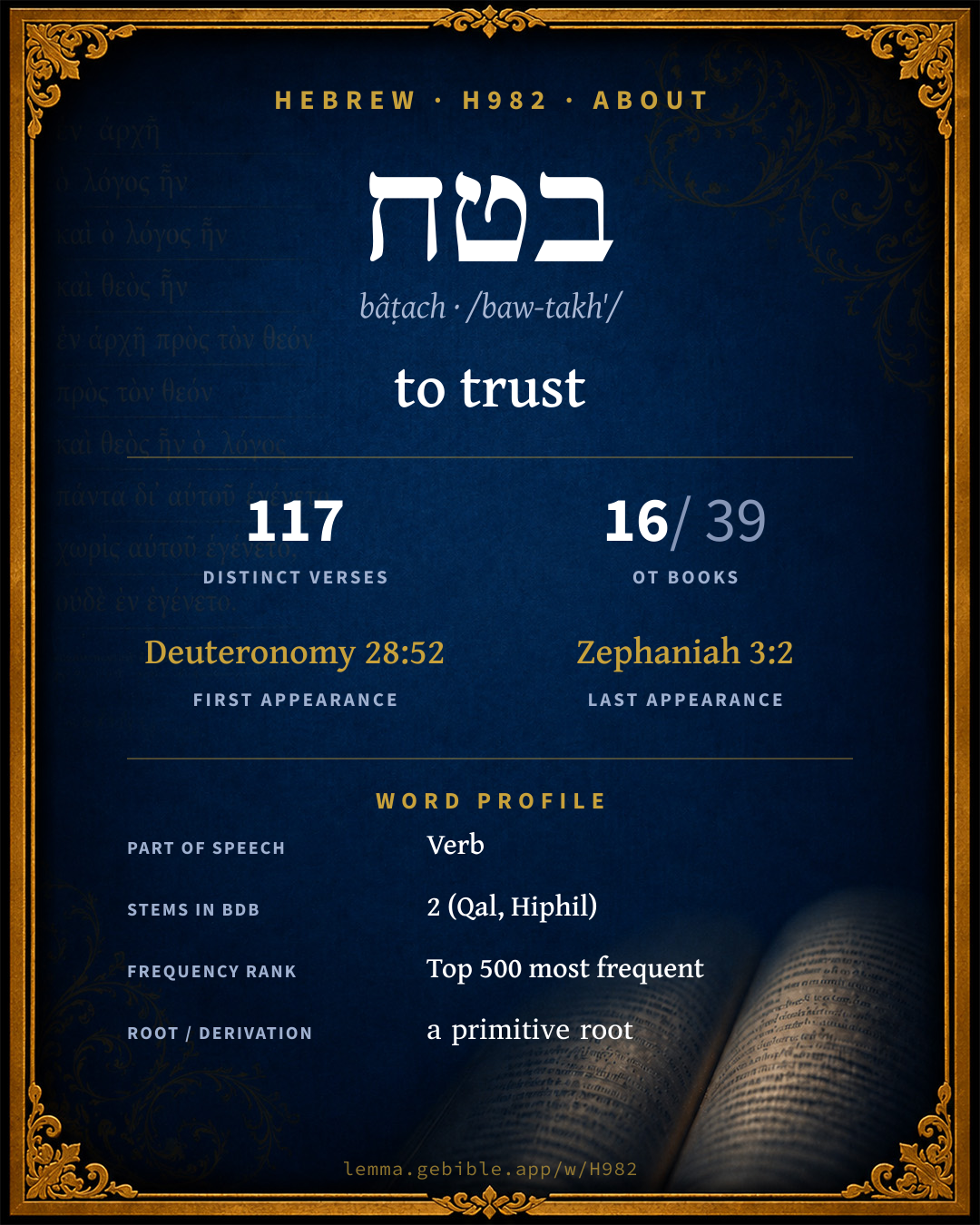
בָּטַח
to trust
‘to trust’ is one of 2 main senses fuller range ↓
Full lexicon entry — Brown-Driver-Briggs (BDB)
From Brown-Driver-Briggs (BDB)
Where this word appears
See every Qal verb in the Hebrew Bible →
Grammar key — what these labels mean
Part of speech
- Verb
- An action or state-of-being word.
Stem
- Qal
- The basic, simple active stem — the plain form of the verb (“he wrote”). Here: ‘with cogn. acc.’
- Hiphil
- The causative active stem (“he caused / brought about”).
Form
- Participle Active
- A verbal adjective expressing ongoing or characteristic action (“writing / one who writes”).
- Perfect
- A completed action or state — Hebrew marks aspect (completeness) more than strict tense (“he wrote”).
- Imperfect
- An incomplete, ongoing, or future action (“he will / would write”).
- Jussive
- A third- or second-person volitional form expressing wish or command (“let him write”).
- Imperative
- A direct command (“write!”).
- Sequential Imperfect
- An imperfect with prefixed waw — the standard past-narrative form (waw-consecutive imperfect).
- Infinitive Construct
- A bound verbal noun, frequently with prepositions (“to write / in writing”).
- Participle Passive
- A verbal adjective expressing action received (“written”).
- Sequential Perfect
- A perfect with prefixed waw continuing a preceding imperfect or command (waw-consecutive perfect).
- Infinitive Absolute
- An unbound verbal noun, often intensifying or standing in for a finite verb.
State
- Absolute
- The independent form of a noun, not bound to a following word.
- Construct
- A noun bound to a following noun in a possessive / “of” relationship (the construct chain).
Person
- 1st Person
- The speaker (“I / we”).
- 2nd Person
- The one addressed (“you”).
- 3rd Person
- The one spoken about (“he / she / it / they”).
Gender
- Masculine
- Grammatically masculine.
- Common
- Either gender — not distinguished for this form.
- Feminine
- Grammatically feminine.
Number
- Singular
- One.
- Plural
- More than one (in Hebrew, generally three or more).
Grammatical forms 31 distinct
- Verb, Qal, Participle Active, Masculine, Singular, Absolute 22 times (18%)
- Verb, Qal, Perfect, 1st Person, Common, Singular 11 times (9%)
- Verb, Qal, Participle Active, Masculine, Plural, Absolute 10 times (8%)
- Verb, Qal, Perfect, 2nd Person, Masculine, Singular 8 times (7%)
- Verb, Qal, Perfect, 3rd Person, Common, Plural 6 times (5%)
- Verb, Qal, Perfect, 3rd Person, Masculine, Singular 6 times (5%)
- Verb, Qal, Imperfect, 1st Person, Common, Singular 5 times (4%)
- Verb, Qal, Imperfect, 3rd Person, Masculine, Singular 5 times (4%)
+23 more forms (47 occurrences)
Parsed forms decoded from the imported morphology (morphhb / Westminster Leningrad Codex — WLC text public domain, morphhb tagging CC BY 4.0), counted across 120 parsed occurrences — not distinct verses.
Every verse where H982 appears — 117 distinct verses across 16 books. Click any verse to open its interlinear word-by-word view. Verse text shown in the World English Bible for context — . Each verse’s Hebrew form is shown with its reference; the English is not keyword-highlighted, since the data carries no word-level English alignment. Use “Compare translations” on any verse to read it across multiple English versions. This concordance covers the Hebrew Bible; Septuagint (Greek Old Testament) occurrences are not indexed here.
Deuteronomy 1 verse
Judges 5 verses
- Judges 9:26 וַ/יִּבְטְחוּ conj + Qal wimpf 3mp Gaal the son of Ebed came with his brothers, and went over to Shechem; and the men of Shechem put their trust in him.
- Judges 18:7 וּ/בֹטֵ֗חַ conj + Qal ptcp.act ms Then the five men departed, and came to Laish, and saw the people who were therein, how they lived in security, after the manner of the Sidonians, quiet and secure; for there was none in the land, possessing authority, that might put [them] to shame in anything, and they were far from the Sidonians, and had no dealings with any man.
- Judges 18:10 בֹּטֵ֗חַ Qal ptcp.act ms When you go, you shall come to a people secure, and the land is large; for God has given it into your hand, a place where there is no want of anything that is in the earth.
- Judges 18:27 וּ/בֹטֵ֔חַ conj + Qal ptcp.act ms They took that which Micah had made, and the priest whom he had, and came to Laish, to a people quiet and secure, and struck them with the edge of the sword; and they burnt the city with fire.
- Judges 20:36 בָֽטְחוּ֙ Qal pf 3cp So the children of Benjamin saw that they were struck; for the men of Israel gave place to Benjamin, because they trusted to the liers-in-wait whom they had set against Gibeah.
2 Kings 8 verses
- 2 Kings 18:5 בָּטָ֑ח Qal pf 3ms He trusted in Yahweh, the God of Israel; so that after him was none like him among all the kings of Judah, nor [among them] that were before him.
- 2 Kings 18:19 בָּטָֽחְתָּ Qal pf 2ms Rabshakeh said to them, Say you now to Hezekiah, Thus says the great king, the king of Assyria, What confidence is this in which you trust?
- 2 Kings 18:20 בָטַ֔חְתָּ Qal pf 2ms You say (but they are but vain words), [There is] counsel and strength for the war. Now on whom do you trust, that you have rebelled against me?
- 2 Kings 18:21 בָטַ֣חְתָּ הַ/בֹּטְחִ֖ים Qal pf 2ms ptcl def.art + Qal ptcp.act mp Now, behold, you trust on the staff of this bruised reed, even on Egypt; whereon if a man lean, it will go into his hand, and pierce it: so is Pharaoh king of Egypt to all who trust on him.
- 2 Kings 18:22 בָּטָ֑חְנוּ Qal pf 1cp But if you tell me, We trust in Yahweh our God; isn't that he whose high places and whose altars Hezekiah has taken away, and has said to Judah and to Jerusalem, You shall worship before this altar in Jerusalem?
- 2 Kings 18:24 וַ/תִּבְטַ֤ח conj + Qal wimpf 2ms How then can you turn away the face of one captain of the least of my master's servants, and put your trust on Egypt for chariots and for horsemen?
- 2 Kings 18:30 יַבְטַ֨ח Hiphil juss 3ms neither let Hezekiah make you trust in Yahweh, saying, Yahweh will surely deliver us, and this city shall not be given into the hand of the king of Assyria.
- 2 Kings 19:10 בֹּטֵ֥חַ Qal ptcp.act ms Thus shall you speak to Hezekiah king of Judah, saying, Don't let your God in whom you trust deceive you, saying, Jerusalem shall not be given into the hand of the king of Assyria.
1 Chronicles 1 verse
2 Chronicles 1 verse
Job 4 verses
- Job 6:20 בָטָ֑ח Qal pf 3ms They were distressed because they were confident; They came there, and were confounded.
- Job 11:18 וּֽ֭/בָטַחְתָּ conj + Qal wpf 2ms You shall be secure, because there is hope; Yes, you shall search, and shall take your rest in safety.
- Job 39:11 הֲֽ/תִבְטַח ptcl inter + Qal impf 2ms Will you trust him, because his strength is great? Or will you leave to him your labor?
- Job 40:23 יִבְטַ֓ח Qal impf 3ms Behold, if a river overflows, he doesn't tremble. He is confident, though the Jordan swells even to his mouth.
Psalms 45 verses
- Psalms 4:5 וּ֝/בִטְח֗וּ conj + Qal impv 2mp Offer the sacrifices of righteousness. Put your trust in Yahweh.
- Psalms 9:10 וְ/יִבְטְח֣וּ conj + Qal impf 3mp Those who know your name will put their trust in you, For you, Yahweh, have not forsaken those who seek you.
- Psalms 13:5 בָטַחְתִּי֮ Qal pf 1cs But I trust in your loving kindness. My heart rejoices in your salvation.
- Psalms 21:7 בֹּטֵ֣חַ Qal ptcp.act ms For the king trusts in Yahweh. Through the loving kindness of the Most High, he shall not be moved.
- Psalms 22:4 בָּטְח֣וּ בָּ֝טְח֗וּ Qal pf 3cp Qal pf 3cp Our fathers trusted in you. They trusted, and you delivered them.
- Psalms 22:5 בָטְח֣וּ Qal pf 3cp They cried to you, and were delivered. They trusted in you, and were not disappointed.
- Psalms 22:9 מַ֝בְטִיחִ֗/י Hiphil ptcp.act ms cs + sfx pers 1cs But you brought me out of the womb. You made me trust at my mother's breasts.
- Psalms 25:2 בָ֭טַחְתִּי Qal pf 1cs My God, I have trusted in you, Don't let me be shamed. Don't let my enemies triumph over me.
- Psalms 26:1 בָּ֝טַ֗חְתִּי Qal pf 1cs Judge me, Yahweh, for I have walked in my integrity. I have trusted also in Yahweh without wavering.
- Psalms 27:3 בוֹטֵֽחַ Qal ptcp.act ms Though a host should encamp against me, My heart shall not fear. Though war should rise against me, Even then I will be confident.
- Psalms 28:7 בָטַ֥ח Qal pf 3ms Yahweh is my strength and my shield. My heart has trusted in him, and I am helped. Therefore my heart greatly rejoices. With my song I will thank him.
- Psalms 31:6 בָּטָֽחְתִּי Qal pf 1cs I hate those who regard lying vanities, But I trust in Yahweh.
- Psalms 31:14 בָטַ֣חְתִּי Qal pf 1cs But I trust in you, Yahweh. I said, "You are my God."
- Psalms 32:10 וְ/הַ/בּוֹטֵ֥חַ conj + ptcl def.art + Qal ptcp.act ms Many sorrows shall be to the wicked, But he who trusts in Yahweh, loving kindness shall surround him.
- Psalms 33:21 בָטָֽחְנוּ Qal pf 1cp For our heart rejoices in him, Because we have trusted in his holy name.
- Psalms 37:3 בְּטַ֣ח Qal impv 2ms Trust in Yahweh, and do good. Dwell in the land, and enjoy safe pasture.
- Psalms 37:5 וּ/בְטַ֥ח conj + Qal impv 2ms Commit your way to Yahweh. Trust also in him, and he will do this:
- Psalms 40:3 וְ֝/יִבְטְח֗וּ conj + Qal impf 3mp He has put a new song in my mouth, even praise to our God. Many shall see it, and fear, and shall trust in Yahweh.
- Psalms 41:9 בָּטַ֣חְתִּי Qal pf 1cs Yes, my own familiar friend, in whom I trusted, Who ate bread with me, Has lifted up his heel against me.
- Psalms 44:6 אֶבְטָ֑ח Qal impf 1cs For I will not trust in my bow, Neither shall my sword save me.
- Psalms 49:6 הַ/בֹּטְחִ֥ים ptcl def.art + Qal ptcp.act mp Those who trust in their wealth, And boast in the multitude of their riches--
- Psalms 52:7 וַ֭/יִּבְטַח conj + Qal wimpf 3ms "Behold, this is the man who didn't make God his strength, But trusted in the abundance of his riches, And strengthened himself in his wickedness."
- Psalms 52:8 בָּטַ֥חְתִּי Qal pf 1cs But as for me, I am like a green olive tree in God's house. I trust in God's loving kindness forever and ever.
- Psalms 55:23 אֶבְטַח Qal impf 1cs But you, God, will bring them down into the pit of destruction. Bloodthirsty and deceitful men shall not live out half their days, But I will trust in you.
- Psalms 56:3 אֶבְטָֽח Qal impf 1cs When I am afraid, I will put my trust in you.
- Psalms 56:4 בָּ֭טַחְתִּי Qal pf 1cs In God, I praise his word. In God, I put my trust. I will not be afraid. What can flesh do to me?
- Psalms 56:11 בָּ֭טַחְתִּי Qal pf 1cs I have put my trust in God. I will not be afraid. What can man do to me?
- Psalms 62:8 בִּטְח֘וּ Qal impv 2mp Trust in him at all times, you people. Pour out your heart before him. God is a refuge for us. Selah.
- Psalms 62:10 תִּבְטְח֣וּ Qal juss 2mp Don't trust in oppression. Don't become vain in robbery. If riches increase, Don't set your heart on them.
- Psalms 78:22 בָ֝טְח֗וּ Qal pf 3cp Because they didn't believe in God, And didn't trust in his salvation.
- Psalms 84:12 בֹּטֵ֥חַ Qal ptcp.act ms Yahweh of Hosts, Blessed is the man who trusts in you.
- Psalms 86:2 הַ/בּוֹטֵ֥חַ ptcl def.art + Qal ptcp.act ms Preserve my soul, for I am godly. You, my God, save your servant who trusts in you.
- Psalms 91:2 אֶבְטַח Qal impf 1cs I will say of Yahweh, "He is my refuge and my fortress; My God, in whom I trust."
- Psalms 112:7 בָּטֻ֥חַ Qal ptcp.pass ms He will not be afraid of evil news. His heart is steadfast, trusting in Yahweh.
- Psalms 115:8 בֹּטֵ֣חַ Qal ptcp.act ms Those who make them will be like them; Yes, everyone who trusts in them.
- Psalms 115:9 בְּטַ֣ח Qal impv 2ms Israel, trust in Yahweh! He is their help and their shield.
- Psalms 115:10 בִּטְח֣וּ Qal impv 2mp House of Aaron, trust in Yahweh! He is their help and their shield.
- Psalms 115:11 בִּטְח֣וּ Qal impv 2mp You who fear Yahweh, trust in Yahweh! He is their help and their shield.
- Psalms 118:8 מִ֝/בְּטֹ֗חַ prep + Qal inf.cs It is better to take refuge in Yahweh, Than to put confidence in man.
- Psalms 118:9 מִ֝/בְּטֹ֗חַ prep + Qal inf.cs It is better to take refuge in Yahweh, Than to put confidence in princes.
- Psalms 119:42 בָ֝טַחְתִּי Qal pf 1cs So I will have an answer for him who reproaches me, For I trust in your word.
- Psalms 125:1 הַ/בֹּטְחִ֥ים ptcl def.art + Qal ptcp.act mp Those who trust in Yahweh are as Mount Zion, Which can't be moved, but remains forever.
- Psalms 135:18 בֹּטֵ֣חַ Qal ptcp.act ms Those who make them will be like them; Yes, everyone who trusts in them.
- Psalms 143:8 בָ֫טָ֥חְתִּי Qal pf 1cs Cause me to hear your loving kindness in the morning, For I trust in you. Cause me to know the way in which I should walk, For I lift up my soul to you.
- Psalms 146:3 תִּבְטְח֥וּ Qal juss 2mp Don't put your trust in princes, Each a son of man in whom there is no help.
Proverbs 10 verses
- Proverbs 3:5 בְּטַ֣ח Qal impv 2ms Trust in Yahweh with all your heart, And don't lean on your own understanding.
- Proverbs 11:15 בּוֹטֵֽחַ Qal ptcp.act ms He who is collateral for a stranger will suffer for it, But he who refuses pledges of collateral is secure.
- Proverbs 11:28 בּוֹטֵ֣חַ Qal ptcp.act ms He who trusts in his riches will fall, But the righteous shall flourish as the green leaf.
- Proverbs 14:16 וּ/בוֹטֵֽחַ conj + Qal ptcp.act ms A wise man fears, and shuns evil, But the fool is hotheaded and reckless.
- Proverbs 16:20 וּ/בוֹטֵ֖חַ conj + Qal ptcp.act ms He who heeds the Word finds prosperity. Whoever trusts in Yahweh is blessed.
- Proverbs 28:1 יִבְטָֽח Qal impf 3ms The wicked flee when no one pursues; But the righteous are as bold as a lion.
- Proverbs 28:25 וּ/בוֹטֵ֖חַ conj + Qal ptcp.act ms One who is greedy stirs up strife; But one who trusts in Yahweh will prosper.
- Proverbs 28:26 בּוֹטֵ֣חַ Qal ptcp.act ms One who trusts in himself is a fool; But one who walks in wisdom, he is kept safe.
- Proverbs 29:25 וּ/בוֹטֵ֖חַ conj + Qal ptcp.act ms The fear of man proves to be a snare, But whoever puts his trust in Yahweh is kept safe.
- Proverbs 31:11 בָּ֣טַח Qal pf 3ms The heart of her husband trusts in her. He shall have no lack of gain.
Isaiah 19 verses
- Isaiah 12:2 אֶבְטַ֖ח Qal impf 1cs Behold, God is my salvation. I will trust, and will not be afraid; for Yah, Yahweh, is my strength and song; and he has become my salvation."
- Isaiah 26:3 בָּטֽוּחַ Qal ptcp.pass ms You will keep [him] in perfect peace, [whose] mind [is] stayed [on you]; because he trusts in you.
- Isaiah 26:4 בִּטְח֥וּ Qal impv 2mp Trust in Yahweh forever; for in Yah, Yahweh, is an everlasting Rock.
- Isaiah 30:12 וַֽ/תִּבְטְחוּ֙ conj + Qal wimpf 2mp Therefore thus says the Holy One of Israel, "Because you despise this word, and trust in oppression and perverseness, and rely thereon;
- Isaiah 31:1 וַ/יִּבְטְח֨וּ conj + Qal wimpf 3mp Woe to those who go down to Egypt for help, and rely on horses, and trust in chariots because they are many, and in horsemen because they are very strong, but they don't look to the Holy One of Israel, neither seek Yahweh!
- Isaiah 32:9 בֹּֽטח֔וֹת Qal ptcp.act fp Rise up, you women who are at ease, [and] hear my voice; you careless daughters, give ear to my speech.
- Isaiah 32:10 בֹּֽטְח֑וֹת Qal ptcp.act fp For days beyond a year shall you be troubled, you careless women; for the vintage shall fail, the harvest shall not come.
- Isaiah 32:11 בֹּֽטְח֑וֹת Qal ptcp.act fp Tremble, you women who are at ease; be troubled, you careless ones; strip yourselves, and make yourselves naked, and gird [sackcloth] on your loins.
- Isaiah 36:4 בָּטָֽחְתָּ Qal pf 2ms Rabshakeh said to them, Say you now to Hezekiah, Thus says the great king, the king of Assyria, What confidence is this in which you trust?
- Isaiah 36:5 בָטַ֔חְתָּ Qal pf 2ms I say, [your] counsel and strength for the war are but vain words: now on whom do you trust, that you have rebelled against me?
- Isaiah 36:6 בָטַ֡חְתָּ הַ/בֹּטְחִ֖ים Qal pf 2ms ptcl def.art + Qal ptcp.act mp Behold, you trust on the staff of this bruised reed, even on Egypt, whereon if a man lean, it will go into his hand, and pierce it: so is Pharaoh king of Egypt to all who trust on him.
- Isaiah 36:7 בָּטָ֑חְנוּ Qal pf 1cp But if you tell me, We trust in Yahweh our God: isn't that he, whose high places and whose altars Hezekiah has taken away, and has said to Judah and to Jerusalem, You shall worship before this altar?
- Isaiah 36:9 וַ/תִּבְטַ֤ח conj + Qal wimpf 2ms How then can you turn away the face of one captain of the least of my master's servants, and put your trust on Egypt for chariots and for horsemen?
- Isaiah 36:15 יַבְטַ֨ח Hiphil juss 3ms neither let Hezekiah make you trust in Yahweh, saying, Yahweh will surely deliver us; this city shall not be given into the hand of the king of Assyria.
- Isaiah 37:10 בּוֹטֵ֥חַ Qal ptcp.act ms Thus shall you speak to Hezekiah king of Judah, saying, Don't let your God in whom you trust deceive you, saying, Jerusalem shall not be given into the hand of the king of Assyria.
- Isaiah 42:17 הַ/בֹּטְחִ֖ים ptcl def.art + Qal ptcp.act mp They shall be turned back, they shall be utterly disappointed, who trust in engraved images, who tell molten images, You are our gods.
- Isaiah 47:10 וַ/תִּבְטְחִ֣י conj + Qal wimpf 2fs For you have trusted in your wickedness; you have said, None sees me; your wisdom and your knowledge, it has perverted you, and you have said in your heart, I am, and there is none else besides me.
- Isaiah 50:10 יִבְטַח֙ Qal impf 3ms Who is among you who fears Yahweh, who obeys the voice of his servant? He who walks in darkness, and has no light, let him trust in the name of Yahweh, and rely on his God.
- Isaiah 59:4 בָּט֤וֹחַ Qal inf.abs None sues in righteousness, and none pleads in truth: they trust in vanity, and speak lies; they conceive mischief, and bring forth iniquity.
Jeremiah 16 verses
- Jeremiah 5:17 בּוֹטֵ֥חַ Qal ptcp.act ms They shall eat up your harvest, and your bread, [which] your sons and your daughters should eat; they shall eat up your flocks and your herds; they shall eat up your vines and your fig trees; they shall beat down your fortified cities, in which you trust, with the sword.
- Jeremiah 7:4 תִּבְטְח֣וּ Qal juss 2mp Don't you trust in lying words, saying, The temple of Yahweh, the temple of Yahweh, the temple of Yahweh, are these.
- Jeremiah 7:8 בֹּטְחִ֣ים Qal ptcp.act mp Behold, you trust in lying words, that can't profit.
- Jeremiah 7:14 בֹּטְחִ֣ים Qal ptcp.act mp therefore will I do to the house which is called by my name, in which you trust, and to the place which I gave to you and to your fathers, as I did to Shiloh.
- Jeremiah 9:4 תִּבְטָ֑חוּ Qal juss 2mp Take you heed everyone of his neighbor, and don't you trust in any brother; for every brother will utterly supplant, and every neighbor will go about with slanders.
- Jeremiah 12:5 בוֹטֵ֔חַ Qal ptcp.act ms If you have run with the footmen, and they have wearied you, then how can you contend with horses? and though in a land of peace you are secure, yet how will you do in the pride of the Jordan?
- Jeremiah 13:25 וַֽ/תִּבְטְחִ֖י conj + Qal wimpf 2fs This is your lot, the portion measured to you from me, says Yahweh; because you have forgotten me, and trusted in falsehood.
- Jeremiah 17:5 יִבְטַ֣ח Qal impf 3ms Thus says Yahweh: Cursed is the man who trusts in man, and makes flesh his arm, and whose heart departs from Yahweh.
- Jeremiah 17:7 יִבְטַ֖ח Qal impf 3ms Blessed is the man who trusts in Yahweh, and whose trust Yahweh is.
- Jeremiah 28:15 הִבְטַ֛חְתָּ Hiphil pf 2ms Then said the prophet Jeremiah to Hananiah the prophet, Hear now, Hananiah: Yahweh has not sent you; but you make this people to trust in a lie.
- Jeremiah 29:31 וַ/יַּבְטַ֥ח conj + Hiphil wimpf 3ms Send to all them of the captivity, saying, Thus says Yahweh concerning Shemaiah the Nehelamite: Because Shemaiah has prophesied to you, and I didn't send him, and he has caused you to trust in a lie;
- Jeremiah 39:18 בָטַ֥חְתָּ Qal pf 2ms For I will surely save you, and you shall not fall by the sword, but your life shall be for a prey to you; because you have put your trust in me, says Yahweh.
- Jeremiah 46:25 הַ/בֹּטְחִ֖ים ptcl def.art + Qal ptcp.act mp Yahweh of Hosts, the God of Israel, says: Behold, I will punish Amon of No, and Pharaoh, and Egypt, with her gods, and her kings; even Pharaoh, and those who trust in him:
- Jeremiah 48:7 בִּטְחֵ֤/ךְ Qal inf.cs + sfx pers 2fs For, because you have trusted in your works and in your treasures, you also shall be taken: and Chemosh shall go forth into captivity, his priests and his princes together.
- Jeremiah 49:4 הַ/בֹּֽטְחָה֙ ptcl def.art + Qal ptcp.act fs Why glory you in the valleys, your flowing valley, backsliding daughter? who trusted in her treasures, [saying], Who shall come to me?
- Jeremiah 49:11 תִּבְטָֽחוּ Qal juss 3fp Leave your fatherless children, I will preserve them alive; and let your widows trust in me.
Ezekiel 2 verses
- Ezekiel 16:15 וַ/תִּבְטְחִ֣י conj + Qal wimpf 2fs But you did trust in your beauty, and played the prostitute because of your renown, and poured out your prostitution on everyone who passed by; his it was.
- Ezekiel 33:13 בָטַ֥ח Qal pf 3ms When I tell the righteous, that he shall surely live; if he trust to his righteousness, and commit iniquity, none of his righteous deeds shall be remembered; but in his iniquity that he has committed, therein shall he die.
Hosea 1 verse
Amos 1 verse
Micah 1 verse
Habakkuk 1 verse
Zephaniah 1 verse
About this entry
At a glance — auto-summarized from this page’s data, not written by a person. Every figure links to its source below. This summary describes the numbers; it doesn’t interpret them.
The Hebrew verb בטח centers on the idea of “to trust.” Debuting at Deuteronomy 28:52, it then recurs through the corpus. Spanning 117 verses in 16 books, it ranks among the common words of the Hebrew Bible. Psalms dominates its distribution — 45 of 117 verses. Different stems carry different senses — BDB groups them under 2 stems, among them Qal and Hiphil. For the data behind this summary, explore the sense tree and the renderings breakdown below.
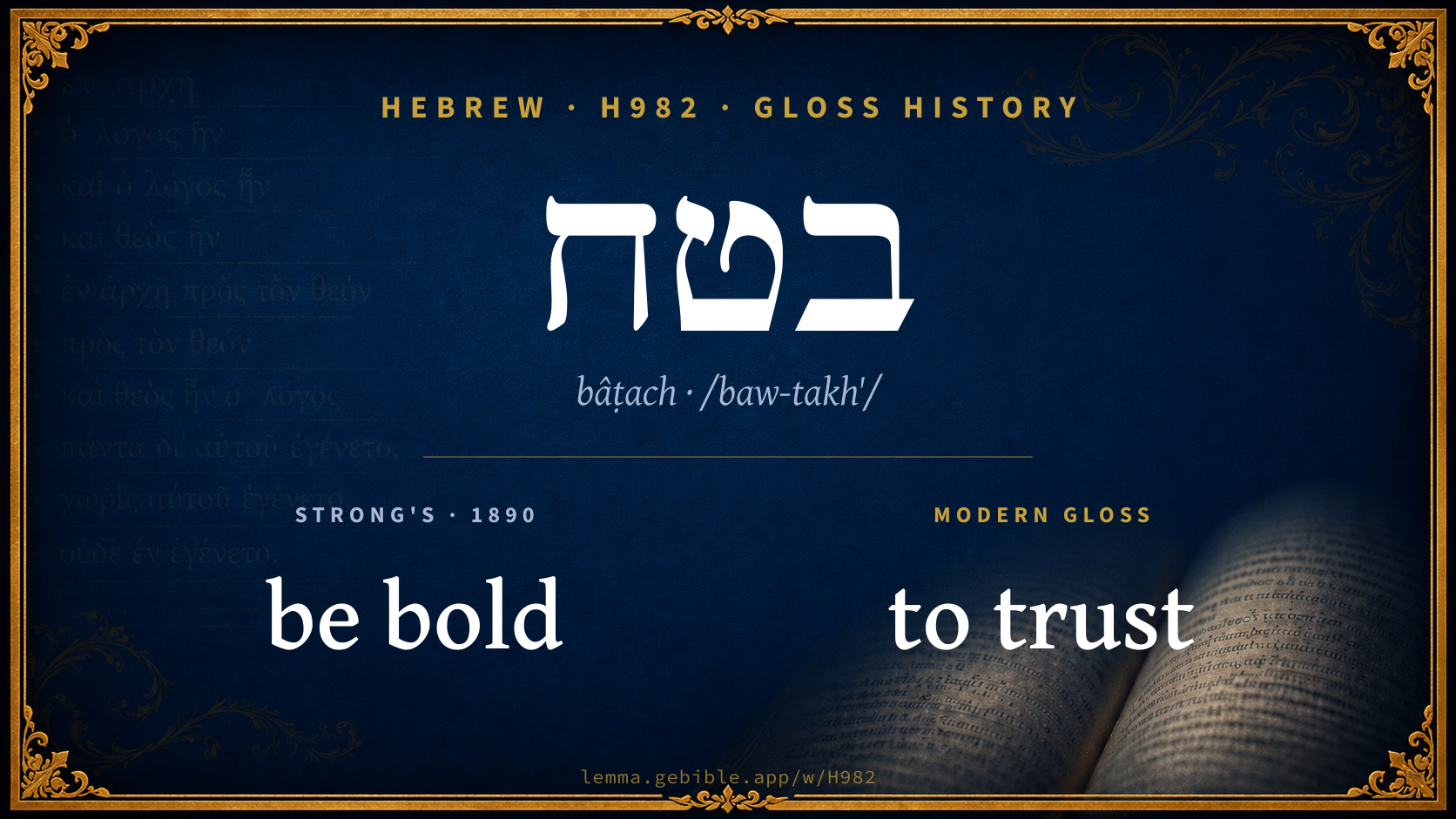
Gloss history
Strong's 1890 vs modern scholarship
About this word
Strong's H982 catalogs a Hebrew word from the Hebrew Old Testament.
These counts are not copied from any lexicon or concordance. They are computed here, from the morphology-tagged Hebrew Old Testament. What Lemma adds →
- 117
- distinct verses
- The word appears in 117 distinct verses.
- 16 / 39
- OT books
- The word appears in 16 of 39 Old Testament books.
- #360
- by frequency
- Top 500 most frequent Hebrew words (rank 360 of 8,640 Hebrew words by occurrence).
View all 117 occurrences in the concordance →
By section of the Old Testament
By traditional corpus
Conventional, traditional groupings — biblical authorship is debated, so this is a traditional corpus grouping, not an authorship claim. Each share is this word’s portion of its verses in that division of the Hebrew canon. Each figure is a share of the word’s 117 distinct verses.
- Writings (Ketuvim) 61 verses · 52%
- Prophets (Nevi'im) 55 verses · 47%
- Torah (Pentateuch) 1 verse · 1%
How translations render this word
Counts come from each version’s own published word-to-Strong’s tagging or interlinear alignment — an approximate guide to how each version renders this word, not a word-level alignment the data otherwise carries. Because each total is that version’s own tagged count, the per-version totals vary from one another and need not match the appearance or distinct-verse counts above. These counts may also differ from a printed concordance because Lemma counts each distinctly tagged rendering and does not collapse phrase taggings into a single head-word total. This is a fixed set of word-tagged versions (KJV, ASV, BSB, ULT) and does not change with the reading translation you choose elsewhere. Each version’s license is shown beside its name below (and on Sources).
- King James Version: Trust 17×, Trusted 6×, Trusteth 6×
- American Standard Version: Trust 14×, Trusteth 5×, Me 4×
- Berean Standard Bible: Trust 34×, Trusts 10×, I trust 6×
- unfoldingWord Literal Text: Trust 22×, You trust 7×, Do 6×
King James Version Public Domain
Renders H982 across 120 tagged occurrences — most commonly:
Plus other, less common renderings. Plus 48 renderings that appear only once — usually multi-word phrases or single function words the recovered tagging swept in, not distinct renderings.
American Standard Version Public Domain
Renders H982 across 118 tagged occurrences — most commonly:
Plus other, less common renderings. Plus 51 renderings that appear only once — usually multi-word phrases or single function words the recovered tagging swept in, not distinct renderings.
Berean Standard Bible Public Domain
Renders H982 across 120 tagged occurrences — most commonly:
Plus other, less common renderings. Plus 38 renderings that appear only once — usually multi-word phrases or single function words the recovered tagging swept in, not distinct renderings.
unfoldingWord Literal Text CC BY-SA 4.0
Renders H982 across 130 tagged occurrences — most commonly:
Plus other, less common renderings. Plus 25 renderings that appear only once — usually multi-word phrases or single function words the recovered tagging swept in, not distinct renderings.
17 senses and sub-senses in the full BDB
Hebrew verbs can shift meaning by stem (binyan): Qal is the basic action, Niphal is often passive or reflexive, Piel often intensifies or makes it factitive, and Hiphil is typically causative. The senses below are grouped under the stem BDB assigns to each.
What do BDB’s symbols mean?
BDB uses these scholarly abbreviations:
| Symbol | Meaning |
|---|---|
| 𝔊 | the Septuagint (the ancient Greek translation, LXX) |
| 𝔙 | the Vulgate (the Latin translation) |
| 𝔖 | the Syriac version (the Peshitta) |
| 𝔗 | the Targum (the Aramaic translation) |
| ψ | the Psalms |
| √ | root (the underlying root or stem) |
| ‖ | parallel passage (a synonymous or contrasted parallel) |
| † | the dagger: every passage where the word occurs is cited |
The 17 senses and sub-senses the full Brown-Driver-Briggs lexicon distinguishes for this word, in lexicon order (not ranked by frequency), with BDB’s own verbatim wording and sub-sense lettering. Shown in Hebrew script with BDB’s own scholarly abbreviations. The condensed entry is in the Lexicon Entry tab. See also the Forms in the corpus table below.
Qal
- Pf. בָּטַח ψ 28:7 + 35 times; Impf. יִבְטַח Jb 40:23 + 27 times; Imv. בְּטַח ψ 37:3 + 8 times; Inf. abs. בָּטוֹחַ Is 59:4, cstr. בְּטֹחַ ψ 118:8 + 2 times; Pt. בֹּטֵחַ ψ 21:8 + 35 times; pass. בָּטוּחַ ψ 112:7 Is 26:3. i. trust. e.g. Psalms 28:7
- 1. abs. Is 12:2. e.g. Isaiah 12:2
- 2. with cogn. acc. מה הבטחון הזה אשׁר בטחת what is this trust that thou dost trust? 2 K 18:19 = Is 36:4. e.g. 2 Kings 18:19
- 3. with בְּ trust in—
- a. God 2 K 18:5; 19:10 1 Ch 5:20 ψ 9:11; 21:8; 22:5, 6; 25:2; 26:1; 28:7; 32:10; 37:3; 40:4; 55:24; 56:5, 12; 62:9; 84:13; 91:2; 112:7; 115:9, 10, 11; 125:1; 143:8 Pr 16:20; 29:25 Is 26:3, 4; 37:10 Je 17:7; 39:18 Zp 3:2. e.g. 2 Kings 18:5
- b. persons Ju 9:26 ψ 41:10; 118:8, 9; 146:3 Pr 31:11 Je 17:5; 46:25 Mi 7:5. e.g. Judges 9:26
- c. things Dt 28:52 Jb 39:11 ψ 27:3; 44:7; 52:9; 62:11; 115:8; 135:18 Pr 11:28; 28:26 Is 30:12; 42:17; 47:10 Je 5:17; 7:14; 12:5; 13:25; 48:7; 49:4 Ez 16:15 Ho 10:13 Am 6:1. e.g. Deuteronomy 28:52
- d. in the name of God ψ 33:21 Is 50:10; mercy of God ψ 13:6; 52:10; word of God ψ 119:42; salvation of God ψ 78:22. e.g. Psalms 33:21
- 4. with עַל, trust or rely upon—
- a. God ψ 31:15; 37:5 Pr 28:25 Je 49:11. e.g. Psalms 31:15
- b. persons 2 K 18:20, 21, 24 = Is 36:5, 6, 9, Je 9:3. e.g. 2 Kings 18:20
- c. things 2 K 18:21 = Is 36:6 2 Ch 32:10, ψ 49:7 Is 31:1; 59:4 Ez 33:13 Hb 2:18. e.g. 2 Kings 18:21
- 5. with אֶל trust to—
- a. God 2 K 18:22 (= Is 36:7) ψ 4:6; 31:7; 56:4; 86:2 Pr 3:5. e.g. 2 Kings 18:22
- b. persons Ju 20:36. e.g. Judges 20:36
- c. things Je 7:4 (= על דבר 7:8). ii. be confident Jb 6:20; 40:23 Pr 14:16; צַדִּיקִים כִּכְפִיר יִבְטַח the righteous are bold as a lion Pr 28:1; secure Jb 11:18 Pr 11:15; עַם בֹּטֵחַ a people secure Ju 18:7, 10, 27; בָּנוֹת בֹּטְחוֹת careless daughters, (women) Is 32:9 cf. v 10, 11. e.g. Jeremiah 7:4
Hiphil
- Pf. הִבְטַחְתָּ Je 28:15; Impf. יַבְטַח Is 36:15 + 2 times; Pt. מַבְטִיחִי ψ 22:10; cause to trust, make secure, abs. ψ 22:10; with עַל Je 28:15; 29:31; with אֶל 2 K 18:30 = Is 36:15. e.g. Jeremiah 28:15
Senses from the full Brown-Driver-Briggs lexicon (Brown, Driver, Briggs; Oxford 1906 — public domain), digitized via Sefaria, supplemented by the OpenScriptures HebrewLexicon (CC BY 4.0). Full attribution on Sources.
Word origin
vb. trust (cf. Arabic بَطَحَ to throw one down upon his face Thes, اِنْبَطَحَ lie extended on the ground, ‘se reposer sur quelqu’un’ Fl MV)—
— Brown-Driver-Briggs (Oxford 1906, public domain), digitized via Sefaria, supplemented by the OpenScriptures HebrewLexicon (CC BY 4.0). See Sources.
Origin: a primitive root
Jastrow Dictionary
A second Hebrew/Aramaic lexicon for comparison, covering Aramaic and post-biblical (Talmudic, Targumic, Midrashic) usage that the biblical-Hebrew BDB does not. Matched by lemma rather than by Strong’s number, so a lemma may carry more than one Jastrow headword (shown separately below), and the entries cover usage well beyond the Bible.
בָּטַח
- , v. בטי; cmp. רָוַח) to be at ease, without trouble, whence to trust. Ber. 6ᵇ הו"ל לבְטוֹחַ וכ׳ he ought to have trusted in the name of the Lord, but did not trust.—Part. pass. בָּטוּחַ assured. Y. Naz. IV, end, 53ᶜ.—Lev. R. s. 31 ב׳ שגוזר he may rest assured that &c.; a. fr.
- to assure, promise. Ber. 17ᵃ הבטחה שה׳ the assurance which the Lord has given. Pesik. R. s. 1, beg. אע"פ שמתו המַבְטִיחִין וכ׳ though those who gave the assurances, the prophets, are dead, but the Lord who promised (through them) is ever-living; a. fr.—Part. Hof. מוּבְטָח (= בָּטוּחַ) confident, sure. Ber. 4ᵃ מ׳ אני בך וכ׳ I am sure that thou rewardest &c. Ib.ᵇ מ׳ לו may rest assured. Gitt. 58ᵃ מוּבְטַחְנִי = מ׳ אני; a. fr.
בְּטַח I
- Taan. 22ᵇ הואיל וקא ב׳ בע"א since he trusts in idols.
- = preced. Hif. Targ. Ruth II, 13.
- to feel safe. Targ. Jer. XII, 5.
בְּטַח II
- (בטח, בטי, v. Ges. H. Dict. s. v. בטח; cmp. מִקְוֶה) a hollow column-like receptacle of rain water near the house. [Maim., a projection in front of the window to stand upon in climbing.] Ohol. XII, 3 הבטח (Ar. Var. אבטח). Tosef. ib. XIII, 3 אבטי (ed. Zuck. אבטו, corr. acc.). [Cmp. פותי for פותח, טְפֵי IV for טפח.] V. בִּטְוַיָּא.
A Dictionary of the Targumim, the Talmud Babli and Yerushalmi, and the Midrashic Literature (Marcus Jastrow; London, Luzac, 1903) — Public Domain. Digitized via Sefaria. Digitized via Sefaria. Full attribution on Sources.
Forms in the corpus
The 91 distinct written forms H982 takes in the Hebrew Bible, most frequent first — each parse links to that stem’s occurrences in the concordance. Hebrew forms include their vowel points and cantillation, so a single lemma takes many written forms.
The 60 most common forms are shown; 31 rarer forms follow in the full concordance.
Same root — word family
Other BDB entries built from the same root as H982, grouped by Strong’s listed origin. These share a root / origin per the lexicon — not necessarily a shared meaning. Each links to that word’s own entry.
Derived from this word
- בטח beṭach H983 security
- בטחון biṭṭâchôwn H986 trust
- בטחות baṭṭuchôwth H987 safety
- מבטח mibṭâch H4009 trust
Compare all same-root words → Showing 4 of 5 — not the complete family. They share a root, not necessarily a meaning.
Septuagint verse parallels
This word appears in 108 verses that also exist in the Greek Old Testament (Septuagint), out of the 117 Hebrew verses it occurs in. You can read those verses in Greek by switching the Old Testament edition to the Septuagint.
Read these verses in the Septuagint
- Deuteronomy 28:52
- Judges 9:26
- 2 Kings 18:5
- 1 Chronicles 5:20
- 2 Chronicles 32:10
- Job 6:20
- Psalms 4:5
- Proverbs 3:5
- Isaiah 12:2
- Jeremiah 5:17
- Ezekiel 16:15
- Hosea 10:13
This is a verse-level parallel only — the same verses exist in both the Hebrew and Greek Old Testaments. No word-level Hebrew↔Greek correspondence is claimed: the data carries no such alignment, so no Greek word is shown as this Hebrew word’s translation. Coverage is not total — the Septuagint omits the deuterocanon and renumbers the Psalms, so some Hebrew verses have no direct Greek parallel.