
Ezekiel 33:13

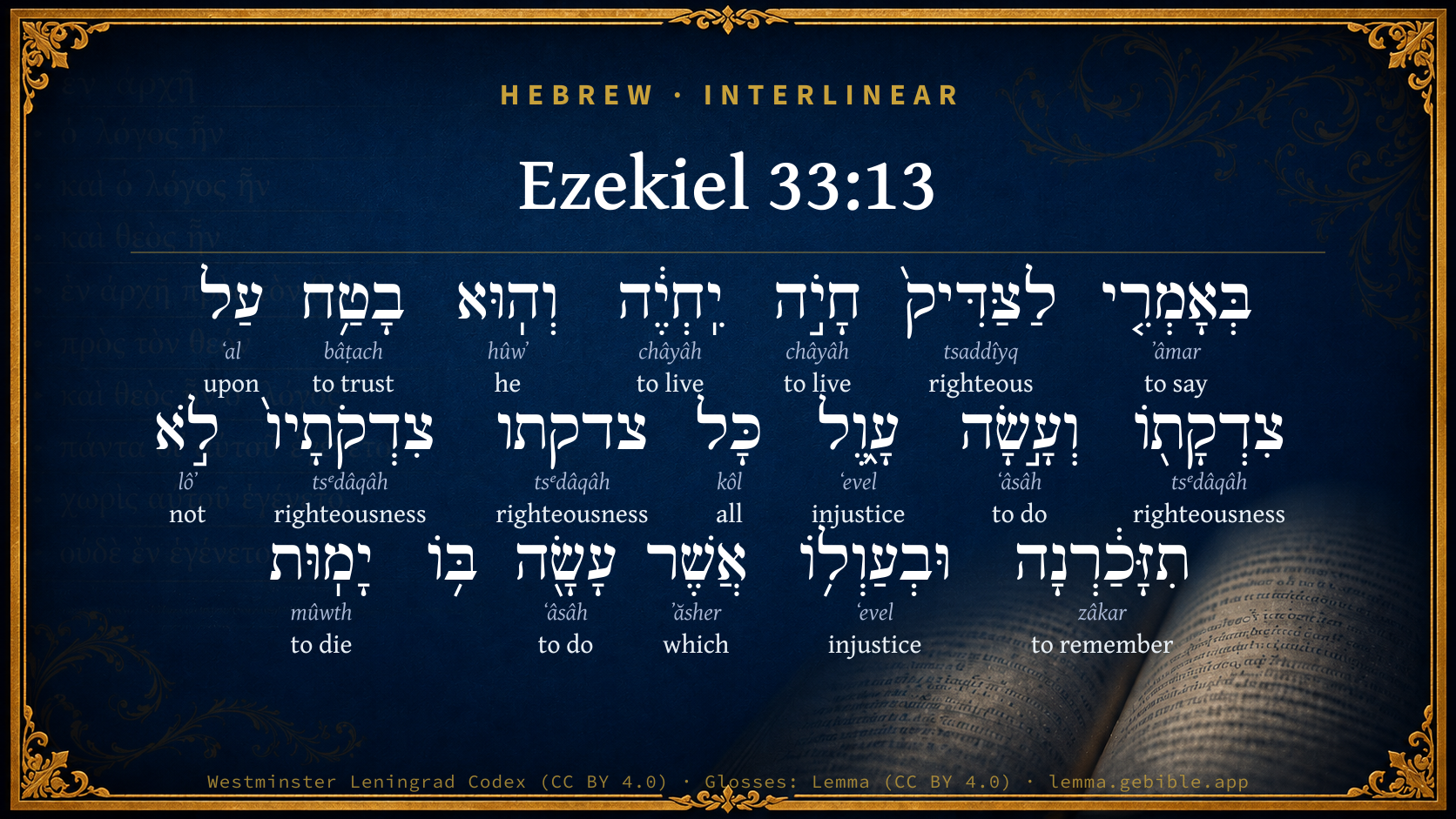
Hebrew (Westminster Leningrad Codex) Ezekiel 33:13 appears in the Hebrew Old Testament. The text above is from the Westminster Leningrad Codex. Each word links to its Strong’s number, a concise gloss, and parsing drawn from the Open Scriptures Hebrew Bible morphology. Click any word for its full Brown-Driver-Briggs (BDB) entry.
Download image
Cite this verse

Ezekiel 33:13 (World English Bible). Public Domain. Lemma interlinear Bible study tool, https://lemma.gebible.app/v/ezekiel/33/13.

Show BibTeX & RIS
BibTeX
RIS
English Translation
When I tell the righteous, that he shall surely live; if he trust to his righteousness, and commit iniquity, none of his righteous deeds shall be remembered; but in his iniquity that he has committed, therein shall he die.
World English Bible · Public Domain
Download a study sheet

One document with this verse’s original text, its word-by-word gloss line, the meaning frame, cross-references with their text, attributed commentary, and full source and license credits — printable, and it pastes into notes with its structure intact.

This verse Autodidact and up

Study sheet (.html) Plain text (.txt)

A passage Seminary Student

Up to 50 verses in one chapter. A passage sheet keeps up to 6 commentary sources and 12 cross-references per verse, in the order this page ranks them, and says so on the sheet whenever that leaves anything out. Ask for a single verse and you get the Autodidact verse sheet above.

Everything on this page stays free to read, with no account — the sheet is a download of what is already on screen, not access to it.

Want to remove ads? Support Godless Engineer
Compare translations 3

The same verse in 3 English versions, stacked beneath the original-language interlinear above. Click any original word for its lexicon entry.

Each is an independent rendering of the whole verse — the interlinear is not word-aligned to these translations.

Highlighted words mark where these versions differ — a whole-verse word diff, not a word-by-word alignment.

  • World English Bible Public Domain
    When I tell the righteous, that he shall surely live; if he trust to his righteousness, and commit iniquity, none of his righteous deeds shall be remembered; but in his iniquity that he has committed, therein shall he die.
  • King James Version Public Domain
    When I shall say to the righteous, that he shall surely live; if he trust to his own righteousness, and commit iniquity, all his righteousnesses shall not be remembered; but for his iniquity that he hath committed, he shall die for it.
  • unfoldingWord Literal Text CC BY-SA 4.0
    If I say to the righteous, “He will surely live!” and if he trusts in his righteousness and then commits injustice, I will not call to mind any of his righteousness. He will die for the wickedness he committed.

unfoldingWord Literal Text — © unfoldingWord, licensed CC BY-SA 4.0. Word-aligned USFM3 via Door43 (git.door43.org/unfoldingWord/en_ult).

Versions to compare (up to 4)

3 of 4 selected

Show all 18 translations

Every available English version of this verse, each an independent rendering of the whole verse.

  • World English Bible Public Domain
    When I tell the righteous, that he shall surely live; if he trust to his righteousness, and commit iniquity, none of his righteous deeds shall be remembered; but in his iniquity that he has committed, therein shall he die.
  • Berean Standard Bible Public Domain
    If I tell the righteous man that he will surely live, but he then trusts in his righteousness and commits iniquity, then none of his righteous works will be remembered; he will die because of the iniquity he has committed.
  • Majority Standard Bible Public Domain
    If I tell the righteous man that he will surely live, but he then trusts in his righteousness and commits iniquity, then none of his righteous works will be remembered; he will die because of the iniquity he has committed.
  • King James Version Public Domain
    When I shall say to the righteous, that he shall surely live; if he trust to his own righteousness, and commit iniquity, all his righteousnesses shall not be remembered; but for his iniquity that he hath committed, he shall die for it.
  • American Standard Version (1901) Public Domain
    When I say to the righteous, that he shall surely live; if he trust to his righteousness, and commit iniquity, none of his righteous deeds shall be remembered; but in his iniquity that he hath committed, therein shall he die.
  • Revised Version (1885) Public Domain
    When I say to the righteous, that he shall surely live; if he trust to his righteousness, and commit iniquity, none of his righteous deeds shall be remembered; but in his iniquity that he hath committed, therein shall he die.
  • Geneva Bible (1599) Public Domain
    When I shall say vnto the righteous, that he shall surely liue, if he trust to his owne righteousnes, and commit iniquitie, all his righteousnes shall be no more remembred, but for his iniquitie that he hath committed, he shall die for the same.
  • Douay-Rheims (1899) Public Domain
    Yea, if I shall say to the just that he shall surely live, and he, trusting in his justice, commit iniquity: all his justices shall be forgotten, and in his iniquity, which he hath committed, in the same shall he die.
  • Young's Literal Translation Public Domain
    In My saying of the righteous: He surely liveth, And -- he hath trusted on his righteousness, And he hath done perversity, All his righteous acts are not remembered, And for his perversity that he hath done, For it he doth die.
  • Literal Standard Version CC BY-SA 4.0
    In My saying of the righteous: He surely lives, || And—he has trusted on his righteousness, || And he has done perversity, || All his righteous acts are not remembered, || And for his perversity that he has done, || He dies for it.
  • Unlocked Literal Bible CC BY-SA 4.0
    If I say to the righteous, “He will surely live!” and if he trusts in his righteousness and then commits injustice, I will not call to mind any of his righteousness. He will die for the wickedness he committed.
  • unfoldingWord Literal Text CC BY-SA 4.0
    If I say to the righteous, “He will surely live!” and if he trusts in his righteousness and then commits injustice, I will not call to mind any of his righteousness. He will die for the wickedness he committed.
  • Darby Bible Public Domain
    When I say to the righteous that he shall certainly live, and he trusteth to his righteousness and doeth what is wrong, none of his righteous acts shall be remembered; but in his unrighteousness which he hath done, in it shall he die.
  • World Messianic Bible Public Domain
    When I tell the righteous that he will surely live, if he trusts in his righteousness and commits iniquity, none of his righteous deeds will be remembered; but he will die in his iniquity that he has committed.
  • Webster's Bible Public Domain
    When I shall say to the righteous, that he shall surely live; if he shall trust to his own righteousness, and commit iniquity, all his righteousnesses shall not be remembered; but for his iniquity that he hath committed, he shall die for it.
  • Free Bible Version CC BY-SA 4.0
    If I tell a good person that they will live and then they rely on their goodness and start sinning, then none of the good things they did will be remembered; he will die because of the sins.
  • Bible in Basic English Public Domain
    When I say to the upright that life will certainly be his; if he puts his faith in his righteousness and does evil, not one of his upright acts will be kept in memory; but in the evil he has done, death will overtake him.
  • JPS Tanakh (1917) Public Domain
    When I say to the righteous, that he shall surely live; if he trust to his righteousness, and commit iniquity, none of his righteous deeds shall be remembered; but for his iniquity that he hath committed, for it shall he die.

Literal Standard Version (2020), Covenant Press — licensed CC BY-SA 4.0. Text via the HelloAO Bible API (eBible.org). Unlocked Literal Bible (unfoldingWord) — licensed CC BY-SA 4.0. Text via the HelloAO Bible API (eBible.org). unfoldingWord Literal Text — © unfoldingWord, licensed CC BY-SA 4.0. Word-aligned USFM3 via Door43 (git.door43.org/unfoldingWord/en_ult). Free Bible Version, Dr. Jonathan Gallagher — licensed CC BY-SA 4.0. Text via the HelloAO Bible API (eBible.org).

Word by word

More ways to search: Search by grammar → Find every occurrence → Compare this word →

Practice this passage: Drill this verse → Learn its vocabulary →

עָ֑וֶל
ʻevel
H5766
“injustice”
Noun, Common, Both, Singular, Absolute
Part of Speech
Noun
Type
Common
Gender
Both
Number
Singular
State
Absolute
Full BDB Definition

Origin: from H5765

TWOT: 1580a , 1580b

injustice, unrighteousness, wrong - violent deeds of injustice - injustice (of speech) - injustice (generally)
  1. בְּאָמְרִ֤י ʼâmar H559 “in/at · to say · me” Preposition + Verb, Qal, Infinitive Construct + Suffix, Personal, 1st Person, Common, Singular
  2. לַצַּדִּיק֙ tsaddîyq H6662 “to/for the · righteous” Preposition, Determined + Adjective, Adjective, Masculine, Singular, Absolute
  3. חָיֹ֣ה châyâh H2421 “to live” Verb, Qal, Infinitive Absolute
  4. יִֽחְיֶ֔ה châyâh H2421 “to live” Verb, Qal, Imperfect, 3rd Person, Masculine, Singular
  5. וְהֽוּא hûwʼ H1931 “and · he” Conjunction + Pronoun, Personal, 3rd Person, Masculine, Singular
  6. בָטַ֥ח bâṭach H982 “to trust” Verb, Qal, Perfect, 3rd Person, Masculine, Singular
  7. עַל ʻal H5921 “upon” Preposition
  8. צִדְקָת֖וֹ tsᵉdâqâh H6666 “righteousness · his” Noun, Common, Feminine, Singular, Construct + Suffix, Personal, 3rd Person, Masculine, Singular
  9. וְעָ֣שָׂה ʻâsâh H6213 “and · to do” Conjunction + Verb, Qal, Sequential Perfect, 3rd Person, Masculine, Singular
  10. כָּל kôl H3605 “all of” Noun, Common, Masculine, Singular, Construct
  11. צדקתו tsᵉdâqâh H6666 “righteousness · his” Noun, Common, Feminine, Singular, Construct + Suffix, Personal, 3rd Person, Masculine, Singular
  12. צִדְקֹתָיו֙ tsᵉdâqâh H6666 “righteous acts · his” Noun, Common, Feminine, Plural, Construct + Suffix, Personal, 3rd Person, Masculine, Singular
  13. לֹ֣א lôʼ H3808 “not” Particle, Negative
  14. תִזָּכַ֔רְנָה zâkar H2142 “to remember” Verb, Niphal, Imperfect, 3rd Person, Feminine, Plural
  15. וּבְעַוְל֥וֹ ʻevel H5766 “and · in/at · injustice · his” Conjunction + Preposition + Noun, Common, Both, Singular, Construct + Suffix, Personal, 3rd Person, Masculine, Singular
  16. אֲשֶׁר ʼăsher H834 “which” Particle, Relative
  17. עָשָׂ֖ה ʻâsâh H6213 “to do” Verb, Qal, Perfect, 3rd Person, Masculine, Singular
  18. יָמֽוּת mûwth H4191 “to die” Verb, Qal, Imperfect, 3rd Person, Masculine, Singular

About this verse

These counts appear in no published source. They are computed here, from the morphology-tagged text and Lemma’s own curated glosses. What Lemma adds →

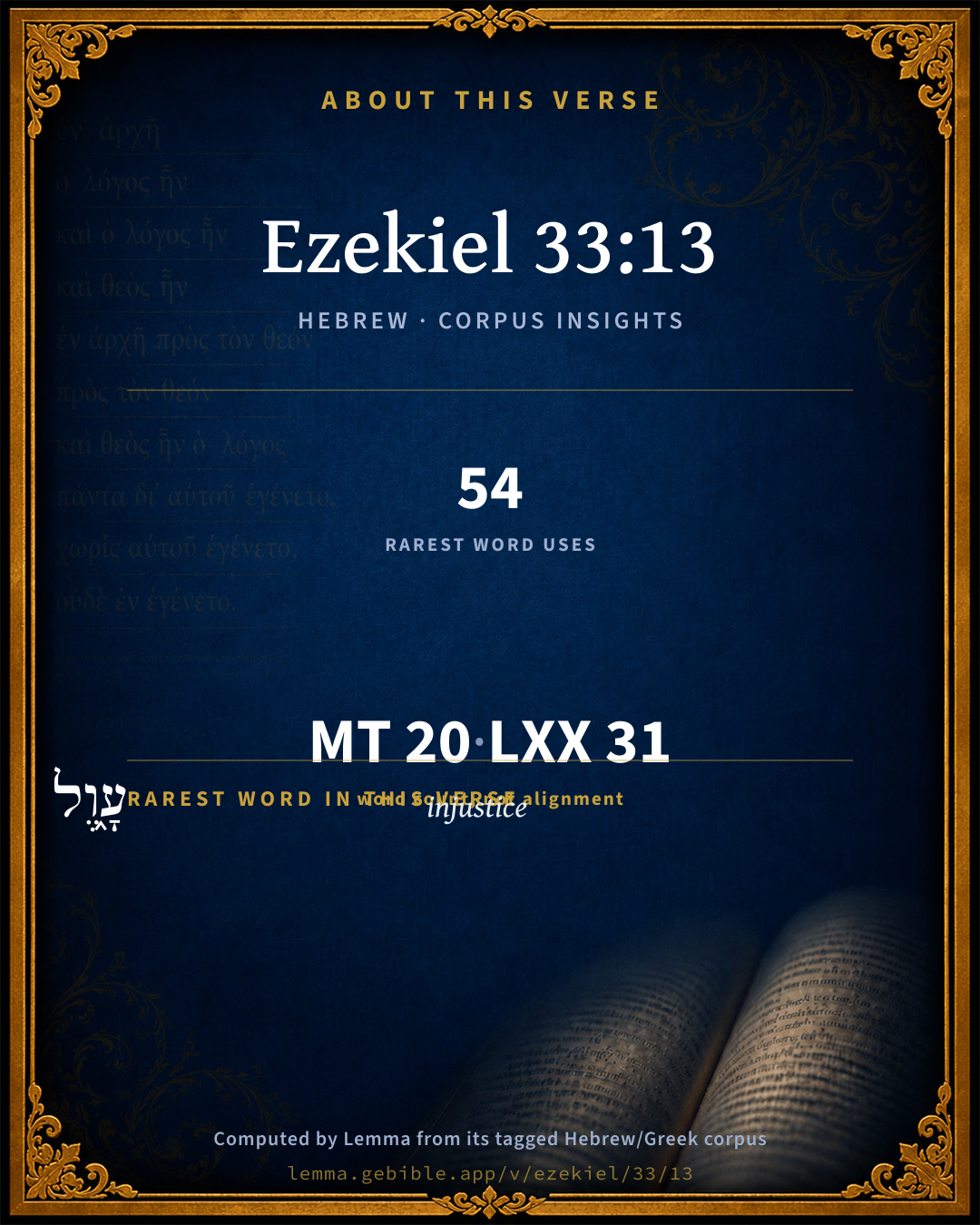
20
words
14
distinct lemmas
Prophets
section

Shared distinctive vocabulary

עָ֑וֶל injustice H5766 occurs in 51 verses of the Hebrew Bible. Also found in:

Grammatical profile

  • 8 verbs
  • 6 nouns
  • 1 adjective
  • 1 pronoun
  • 2 prepositions
  • 2 particles

Verb forms

  • בְּאָמְרִ֤י Qal · Infinitive Construct
  • חָיֹ֣ה Qal · Infinitive Absolute
  • יִֽחְיֶ֔ה Qal · Imperfect
  • בָטַ֥ח Qal · Perfect
  • וְעָ֣שָׂה Qal · Sequential Perfect
  • תִזָּכַ֔רְנָה Niphal · Imperfect
  • עָשָׂ֖ה Qal · Perfect
  • יָמֽוּת Qal · Imperfect

Repetition

Words recur within this verse — often emphatic in Hebrew:

  • צִדְקָת֖וֹ righteousness H6666 ×3
  • חָיֹ֣ה to live H2421 ×2
  • וְעָ֣שָׂה to do H6213 ×2
  • עָ֑וֶל injustice H5766 ×2

Hebrew & Septuagint length

In English translation the verse runs 39 words from the Hebrew and 38 from the Septuagint (LXX English) — closely comparable.

A rough comparison of the two English renderings, which tokenize alike — not a word-level alignment.

Word counts can differ between the Hebrew and the Greek without any difference in meaning — e.g. the Hebrew direct-object marker אֵת has no separate Greek word, and Greek often adds the article ὁ.

In the original languages it is 20 Hebrew tokens and 31 Greek tokens — but the two are counted differently (Hebrew bundles its prefixes and suffixes into one token; the Greek is in lemma form), so that isn’t a like-for-like length.

Cross-references

9

Topical passages linked to Ezekiel 33:13 in the Treasury of Scripture Knowledge — connected by theme and wording, ordered by reader-vote popularity; previews shown in the World English Bible.

  • Ezekiel 18:24 But when the righteous turns away from his righteousness, and commits iniquity, and does according to all the abominations that the wicked man does, shall he live? None of his righteous deeds that he has done shall be remembered: in his trespass that he has trespassed, and in his sin that he has sinned, in them shall he die.
  • Hebrews 10:38 But the righteous will live by faith. If he shrinks back, my soul has no pleasure in him."
  • Ezekiel 18:4 Behold, all souls are mine; as the soul of the father, so also the soul of the son is mine: the soul who sins, he shall die.
  • Ezekiel 3:20 Again, when a righteous man does turn from his righteousness, and commit iniquity, and I lay a stumbling block before him, he shall die: because you have not given him warning, he shall die in his sin, and his righteous deeds which he has done shall not be remembered; but his blood will I require at your hand.
  • Luke 18:9–14 He spoke also this parable to certain people who were convinced of their own righteousness, and who despised all others.
  • Romans 10:3 For being ignorant of God's righteousness, and seeking to establish their own righteousness, they didn't subject themselves to the righteousness of God.
  • Philippians 3:9 and be found in him, not having a righteousness of my own, that which is of the law, but that which is through faith in Christ, the righteousness which is from God by faith;
  • 2 Peter 2:20–22 For if, after they have escaped the defilement of the world through the knowledge of the Lord and Savior Jesus Christ, they are again entangled therein and overcome, the last state has become worse with them than the first.
  • 1 John 2:19 They went out from us, but they didn't belong to us; for if they had belonged to us, they would have continued with us. But they left, that they might be revealed that none of them belong to us.

Cross-references courtesy of OpenBible.info (CC BY 4.0).

Hebrew and Greek witnesses Masoretic Hebrew ↔ Greek Septuagint

The same verse in the two great witnesses to the Old Testament, shown verse-for-verse.

These are two independent witnesses, not word-aligned to each other, and the Septuagint is shown in lemma (dictionary) form.

Hebrew Ezekiel 33:13 Masoretic · Westminster Leningrad Codex

בְּאָמְרִ֤י לַצַּדִּיק֙ חָיֹ֣ה יִֽחְיֶ֔ה וְהֽוּא בָטַ֥ח עַל צִדְקָת֖וֹ וְעָ֣שָׂה עָ֑וֶל כָּל צדקתו צִדְקֹתָיו֙ לֹ֣א תִזָּכַ֔רְנָה וּבְעַוְל֥וֹ אֲשֶׁר עָשָׂ֖ה בּ֥וֹ יָמֽוּת

When I tell the righteous, that he shall surely live; if he trust to his righteousness, and commit iniquity, none of his righteous deeds shall be remembered; but in his iniquity that he has committed, therein shall he die.

World English Bible · Public Domain

Greek LXX Ezekiel 33:13 Septuagint · lemma form

ἐν ὁ εἶπον ἐγώ ὁ δίκαιος οὗτος πείθω ἐπί ὁ δικαιοσύνη αὐτός καί ποιέω ἀνομία πᾶς ὁ δικαιοσύνη αὐτός οὐ μή ἀναμιμνήσκω ἐν ὁ ἀδικία αὐτός ὅς ποιέω ἐν αὐτός ἀποθνήσκω

When I say to the righteous, You shall live; and he trusts in his righteousness, and shall commit iniquity, none of his righteousnesses shall be remembered; in his unrighteousness which he has wrought, in it shall he die.

LXX2012 (modern English Septuagint) · Public Domain

Hebrew: Westminster Leningrad Codex (CC BY 4.0). Greek: Septuagint (public domain); English from LXX2012 (modern English Septuagint) (Public Domain). How the Septuagint differs from the Hebrew →

Targum (Aramaic paraphrase)

1

The Targum is the ancient Jewish Aramaic paraphrase of the Hebrew Scriptures — an interpretive translation, not the Hebrew text itself. Onkelos (literal) and Pseudo-Jonathan (expansive) render the Torah, and Jonathan the Prophets. Coverage is partial: where no permissively-licensed English translation exists for a verse, only the Aramaic is shown. This is verse-level text, not a word-by-word alignment to the Hebrew.

  1. Targum Jonathan Prophets (Joshua–Malachi)
    בִּדְאֲמָרֵית לְזַכָּאָה מֵיחָא יְחֵי וְהוּא יִתְרְחִיץ עַל זְכוּתֵיהּ וַעֲבַד שְׁקַר כָּל זָכוּתֵיהּ לָא יִדְכְּרַן וּבְשִׁקְרֵיהּ דַעֲבֵד בֵּיהּ יְמוּת:

    (no public-domain English translation for this verse)

    Targum Jonathan — Aramaic: “Mikraot Gedolot” (public domain). English: “Sefaria Community Translation” (CC0 1.0 (public-domain dedication)); “London "Chaldee Paraphrase," 1871” (public domain). Text via Sefaria.

Commentary

Notes on Ezekiel 33:13 from classic Christian and Jewish commentators (each source and its license shown beneath its notes). The classic Christian expositions comment on the surrounding passage and are grouped to its opening verse, so a note may address several verses; the Jewish commentaries on the Tanakh (Rashi and others) are per-verse, so they appear only where the commentator wrote on this verse.

Lemma curates 59 commentaries, every one of them public domain or Creative Commons licensed, each selected and text-cleaned for this edition rather than reprinted as found. About our sources →

Trapp's Complete Commentary

John Trapp

Eze 33:13 When I shall say to the righteous, [that] he shall surely live; if he trust to his own righteousness, and commit iniquity, all his righteousnesses shall not be remembered; but for his iniquity that he hath committed, he shall die for it.

Ver. 13. When I shall say to the righteous.] See on Eze 18:24.

If he trust to his own righteousness.] As thinking that he hath thereby purchased a licence to commit iniquity.

John Trapp, A Commentary or Exposition upon All the Books of the Old and New Testament (1647–1656) — public domain. Text from a community e-Sword module.

Joseph Benson's Commentary

Eze 33:13. When I shall say to the righteous, that he shall surely live — When I make him a promise of life, peace, and every blessing which he stands in need of; if he trust to his own righteousness — Formerly performed, but now abandoned; or, if he rely upon the good works he hath done, and think the worth of them will overbalance the guilt of his evil deeds; which seems to have been the opinion of the later Jews, who lay it down for a rule in their Mishna, That all Israel shall have a share in the world to come. All his righteousness shall not be remembered, &c. — He shall come again under the guilt of all his past sins, and shall be exposed to condemnation and wrath: see notes on Eze 18:24-29. It is evidently signified here, that to trust in our own righteousness, whether internal or external, whether graces or virtues, past or present, or to entertain high thoughts of our own attainments in religion, and to put confidence therein, is one step toward a fall, and generally issues in apostacy.

Joseph Benson's Commentary on the Old and New Testaments (1811–1818) — public domain. Text from a community e-Sword module.

Adam Clarke's Commentary

Verse 13. If he trust to his own righteousness, and commit iniquity] If he trust in his acting according to the statutes and ordinances of religion, and according to the laws relative to rights and wrongs among men, and in other respects commit iniquity, he shall die for it.

Adam Clarke's Commentary on the Bible (1810–1826) — public domain. Text from a community e-Sword/MySword module.

The Cambridge Bible for Schools and Colleges

gen. ed. J. J. S. Perowne

13. Cf. Eze_3:20, Eze_18:24.

The Cambridge Bible for Schools and Colleges (gen. ed. J. J. S. Perowne; Cambridge University Press, 1878–1918) — public domain. Text from a community e-Sword module.

John Gill's Exposition

Again, when I say unto the wicked, thou shalt surely die,.... That is, provided he continues in the same course of life, impenitent and unbelieving:

but if he turn from his sin; repent of it, and forsake it:

and do that which is lawful and right; or "judgment and justice"; do that which is agreeably to the law of God, and what is right between man and man; lives soberly, righteously, and godly, as well as denies ungodliness and worldly lusts; whereby it appears that his repentance is genuine and true.

John Gill's Exposition of the Whole Bible (1746–1763) — public domain (CC PDM 1.0). Text via the HelloAO Bible API.

Matthew Poole's English Annotations

The righteous; who hath in his life that is past kept the law and forborne evil, hath done what is right and good, and not done what is evil, both which parts of this righteousness are described in Eze. 18:5-9.

He shall surely live; make him promise of doing him good, and giving him life, peace, every blessing, and happiness. If he trust to his own righteousness; if he conclude former righteousness is sufficient, and therefore turn to ways of sin, pleasing to an evil heart.

Commit iniquity; give himself to doing evil, as it were his work.

Shall not be remembered; no regard shall be had to what he had done, he doth himself practically renounce it, and interpretatively recant his doing it.

His iniquity that he hath committed; in his apostacy and backslidden state.

He shall die; shall be punished, his comforts shall be taken away or die in his hand, he shall live and die miserably.

For it; his iniquity and punishment of it, and this is emphatically repeated, as Eze 18:26.

Matthew Poole's English Annotations on the Holy Bible (1683–1685) — public domain. Text from a community e-Sword/MySword module.

Rashi

Rabbi Shlomo Yitzchaki (Rashi)

none... will be remembered to save him from being punished for his sin.

Rashi on the Tanakh — English translations: “The Judaica Press complete Tanach with Rashi, translated by A. J. Rosenberg” (CC BY 4.0); “Pentateuch with Rashi's commentary by M. Rosenbaum and A.M. Silbermann, 1929-1934” (public domain); “The Metsudah Tanach series, Lakewood, N.J” (CC BY 4.0); and “The Book of Joshua, Metsudah Publications, 1997” (CC BY 4.0). Text via Sefaria.

Lesson kit

Teaching starters — assembled from the data on this page, not authored interpretation. Every prompt links to the verse data it draws on. Edit before teaching.

Ezekiel, in the Prophets, opens this verse with 20 words (14 distinct Hebrew lemmas). Its most distinctive word is ʻevel (“injustice”). A historical commentator’s framing appears above. Read the whole chapter for the surrounding context.

Discussion questions

  1. What does “injustice” (ʻevel) contribute to the verse as a whole?
  2. How does Leviticus 19:15, which shares the word «injustice», read alongside this verse?
  3. What does the repetition of “righteousness” (3× in this one verse) do in this verse?
  4. These translations render this verse differently. What is at stake in choosing one wording over another?
  5. «בְּאָמְרִ֤י» is a Qal Infinitive Construct verb. How does that grammatical form shape the action described?
  6. Compare how Trapp's Complete Commentary and Joseph Benson's Commentary read this verse. Where do they agree or differ?

Things to notice

Reading settings

Reading text

Shown beneath each verse's original-language words.

Old Testament
Old Testament edition

Read the OT as the Masoretic Hebrew (MT) or the Greek Septuagint (LXX).

English shown for the Greek Septuagint (in the Hebrew ↔ Greek comparison).

Comparing translations? Open the Compare panel on any verse page to stack up to four side by side.