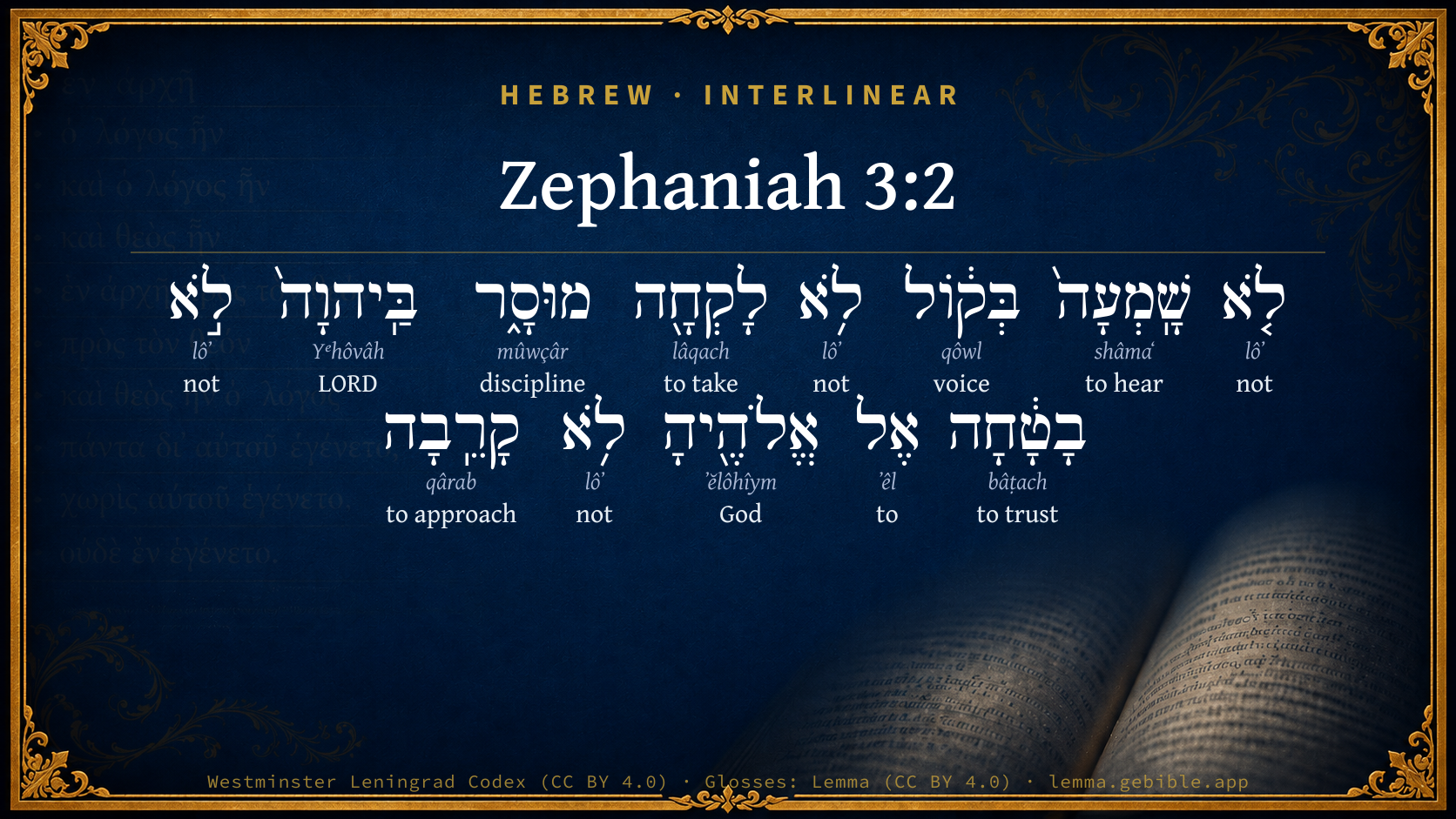
Zephaniah 3:2

Hebrew (Westminster Leningrad Codex) Zephaniah 3:2 appears in the Hebrew Old Testament. The text above is from the Westminster Leningrad Codex. Each word links to its Strong’s number, a concise gloss, and parsing drawn from the Open Scriptures Hebrew Bible morphology. Click any word for its full Brown-Driver-Briggs (BDB) entry.
Download image
Cite this verse

Zephaniah 3:2 (World English Bible). Public Domain. Lemma interlinear Bible study tool, https://lemma.gebible.app/v/zephaniah/3/2.

Show BibTeX & RIS
BibTeX
RIS
English Translation
She didn't obey the voice. She didn't receive correction. She didn't trust in Yahweh. She didn't draw near to her God.
World English Bible · Public Domain
Download a study sheet

One document with this verse’s original text, its word-by-word gloss line, the meaning frame, cross-references with their text, attributed commentary, and full source and license credits — printable, and it pastes into notes with its structure intact.

This verse Autodidact and up

Study sheet (.html) Plain text (.txt)

A passage Seminary Student

Up to 50 verses in one chapter. A passage sheet keeps up to 6 commentary sources and 12 cross-references per verse, in the order this page ranks them, and says so on the sheet whenever that leaves anything out. Ask for a single verse and you get the Autodidact verse sheet above.

Everything on this page stays free to read, with no account — the sheet is a download of what is already on screen, not access to it.

Want to remove ads? Support Godless Engineer
Compare translations 3

The same verse in 3 English versions, stacked beneath the original-language interlinear above. Click any original word for its lexicon entry.

Each is an independent rendering of the whole verse — the interlinear is not word-aligned to these translations.

Highlighted words mark where these versions differ — a whole-verse word diff, not a word-by-word alignment.

  • World English Bible Public Domain
    She didn't obey the voice. She didn't receive correction. She didn't trust in Yahweh. She didn't draw near to her God.
  • King James Version Public Domain
    She obeyed not the voice; she received not correction; she trusted not in the LORD; she drew not near to her God.
  • unfoldingWord Literal Text CC BY-SA 4.0
    She does not hear the voice; she does not take correction. In Yahweh she does not trust; to her God she does not draw near.

unfoldingWord Literal Text — © unfoldingWord, licensed CC BY-SA 4.0. Word-aligned USFM3 via Door43 (git.door43.org/unfoldingWord/en_ult).

Versions to compare (up to 4)

3 of 4 selected

Show all 18 translations

Every available English version of this verse, each an independent rendering of the whole verse.

  • World English Bible Public Domain
    She didn't obey the voice. She didn't receive correction. She didn't trust in Yahweh. She didn't draw near to her God.
  • Berean Standard Bible Public Domain
    She heeded no voice; she accepted no correction. She does not trust in the LORD; she has not drawn near to her God.
  • Majority Standard Bible Public Domain
    She heeded no voice; she accepted no correction. She does not trust in the LORD; she has not drawn near to her God.
  • King James Version Public Domain
    She obeyed not the voice; she received not correction; she trusted not in the LORD; she drew not near to her God.
  • American Standard Version (1901) Public Domain
    She obeyed not the voice; she received not correction; she trusted not in Jehovah; she drew not near to her God.
  • Revised Version (1885) Public Domain
    She obeyed not the voice; she received not correction; she trusted not in the LORD; she drew not near to her God.
  • Geneva Bible (1599) Public Domain
    She heard not the voyce: she receiued not correction: she trusted not in the Lord: she drew not neere to her God.
  • Douay-Rheims (1899) Public Domain
    She hath not hearkened to the voice, neither hath she received discipline: she hath not trusted in the Lord, she drew not near to her God.
  • Young's Literal Translation Public Domain
    She hath not hearkened to the voice, She hath not accepted instruction, In Jehovah she hath not trusted, Unto her God she hath not drawn near.
  • Literal Standard Version CC BY-SA 4.0
    She has not listened to the voice, || She has not accepted instruction, || In YHWH she has not trusted, || She has not drawn near to her God.
  • Unlocked Literal Bible CC BY-SA 4.0
    She has not listened to the voice of God, nor accepted correction from Yahweh. She does not trust in Yahweh and will not approach her God.
  • unfoldingWord Literal Text CC BY-SA 4.0
    She does not hear the voice; she does not take correction. In Yahweh she does not trust; to her God she does not draw near.
  • Darby Bible Public Domain
    She hearkened not to the voice; she received not correction; she confided not in Jehovah; she drew not near her God.
  • World Messianic Bible Public Domain
    She didn’t obey the voice. She didn’t receive correction. She didn’t trust in the LORD. She didn’t draw near to her God.
  • Webster's Bible Public Domain
    She obeyed not the voice; she received not correction; she trusted not in the LORD; she drew not near to her God.
  • Free Bible Version CC BY-SA 4.0
    You don't listen to anybody, you don't accept correction, you don't trust in the Lord, you don't ask for God's help.
  • Bible in Basic English Public Domain
    She gave no attention to the voice, she had no use for teaching, she put no faith in the Lord, she did not come near to her God.
  • JPS Tanakh (1917) Public Domain
    She hearkened not to the voice, she received not correction; she trusted not in the LORD, she drew not near to her God.

Literal Standard Version (2020), Covenant Press — licensed CC BY-SA 4.0. Text via the HelloAO Bible API (eBible.org). Unlocked Literal Bible (unfoldingWord) — licensed CC BY-SA 4.0. Text via the HelloAO Bible API (eBible.org). unfoldingWord Literal Text — © unfoldingWord, licensed CC BY-SA 4.0. Word-aligned USFM3 via Door43 (git.door43.org/unfoldingWord/en_ult). Free Bible Version, Dr. Jonathan Gallagher — licensed CC BY-SA 4.0. Text via the HelloAO Bible API (eBible.org).

Word by word

More ways to search: Search by grammar → Find every occurrence → Compare this word →

Practice this passage: Drill this verse → Learn its vocabulary →

מוּסָ֑ר
mûwçâr
H4148
“discipline”
Noun, Common, Masculine, Singular, Absolute
Part of Speech
Noun
Type
Common
Gender
Masculine
Number
Singular
State
Absolute
Full BDB Definition

Origin: from H3256

TWOT: 877b

discipline, chastening, correction - discipline, correction - chastening
  1. לֹ֤א lôʼ H3808 “not” Particle, Negative
  2. שָֽׁמְעָה֙ shâmaʻ H8085 “to hear” Verb, Qal, Perfect, 3rd Person, Feminine, Singular
  3. בְּק֔וֹל qôwl H6963 “in/at · voice” Preposition + Noun, Common, Masculine, Singular, Absolute
  4. לֹ֥א lôʼ H3808 “not” Particle, Negative
  5. לָקְחָ֖ה lâqach H3947 “to take” Verb, Qal, Perfect, 3rd Person, Feminine, Singular
  6. בַּֽיהוָה֙ Yᵉhôvâh H3068 “in/at · LORD” Preposition + Noun, Proper
  7. לֹ֣א lôʼ H3808 “not” Particle, Negative
  8. בָטָ֔חָה bâṭach H982 “to trust” Verb, Qal, Perfect, 3rd Person, Feminine, Singular
  9. אֶל ʼêl H413 “to” Preposition
  10. אֱלֹהֶ֖יהָ ʼĕlôhîym H430 “God(s) · her” Noun, Common, Masculine, Plural, Construct + Suffix, Personal, 3rd Person, Feminine, Singular
  11. לֹ֥א lôʼ H3808 “not” Particle, Negative
  12. קָרֵֽבָה qârab H7126 “to approach” Verb, Qal, Perfect, 3rd Person, Feminine, Singular

About this verse

These counts appear in no published source. They are computed here, from the morphology-tagged text and Lemma’s own curated glosses. What Lemma adds →

13
words
10
distinct lemmas
Prophets
section

Shared distinctive vocabulary

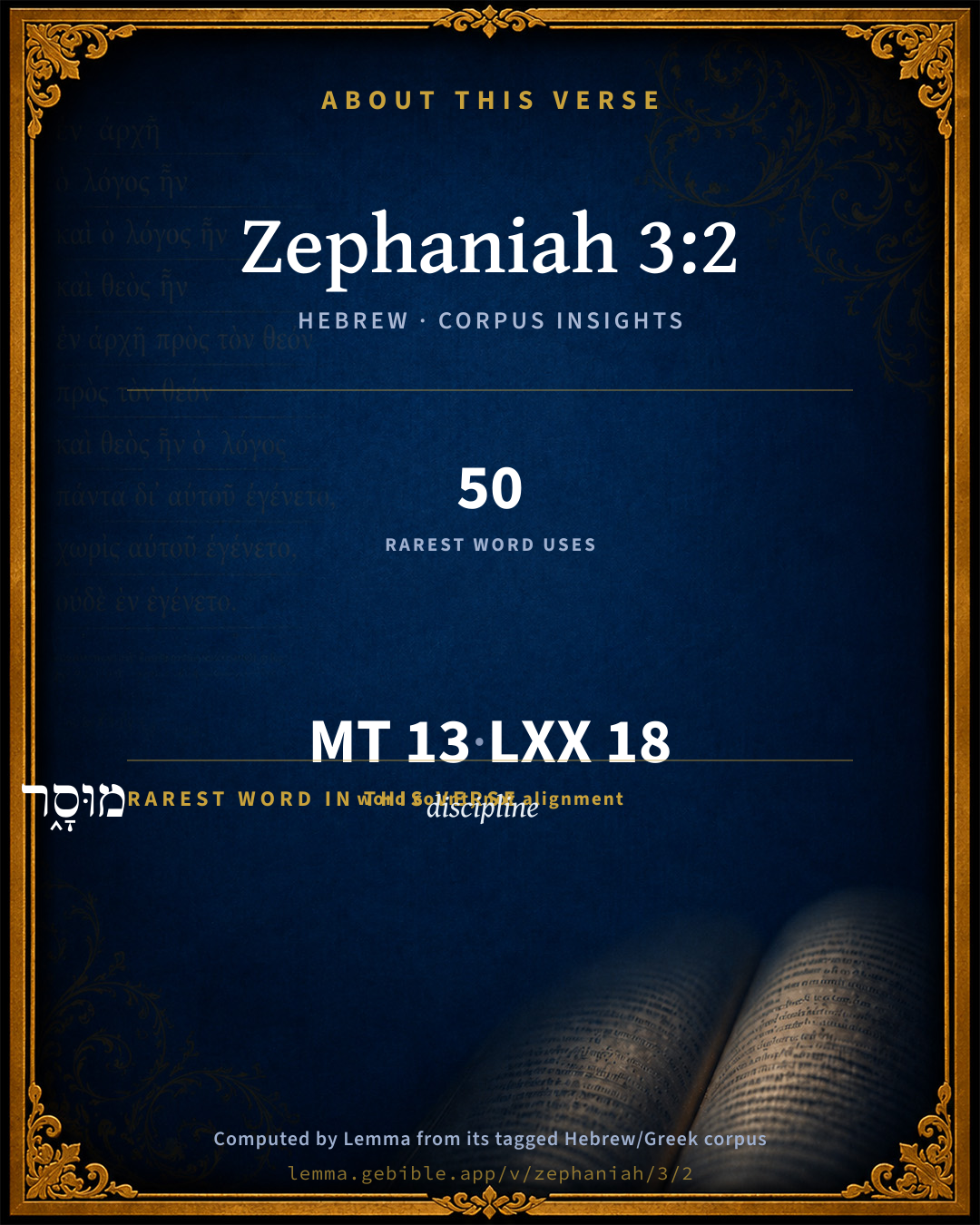
מוּסָ֑ר discipline H4148 occurs in 50 verses of the Hebrew Bible. Also found in:

Grammatical profile

  • 4 verbs
  • 4 nouns
  • 1 preposition
  • 4 particles

Verb forms

  • שָֽׁמְעָה֙ Qal · Perfect
  • לָקְחָ֖ה Qal · Perfect
  • בָטָ֔חָה Qal · Perfect
  • קָרֵֽבָה Qal · Perfect

Repetition

A word recurs within this verse — often emphatic in Hebrew:

Hebrew & Septuagint length

In English translation the verse runs 21 words from the Hebrew and 25 from the Septuagint (LXX English) — closely comparable.

A rough comparison of the two English renderings, which tokenize alike — not a word-level alignment.

Word counts can differ between the Hebrew and the Greek without any difference in meaning — e.g. the Hebrew direct-object marker אֵת has no separate Greek word, and Greek often adds the article ὁ.

In the original languages it is 13 Hebrew tokens and 18 Greek tokens — but the two are counted differently (Hebrew bundles its prefixes and suffixes into one token; the Greek is in lemma form), so that isn’t a like-for-like length.

Cross-references

25

Topical passages linked to Zephaniah 3:2 in the Treasury of Scripture Knowledge — connected by theme and wording, ordered by reader-vote popularity; previews shown in the World English Bible.

  • Jeremiah 5:3 O Yahweh, don't your eyes look on truth? you have stricken them, but they were not grieved; you have consumed them, but they have refused to receive correction: they have made their faces harder than a rock; they have refused to return.
  • Jeremiah 22:21 I spoke to you in your prosperity; but you said, I will not hear. This has been your manner from your youth, that you didn't obey my voice.
  • Psalms 73:28 But it is good for me to come close to God. I have made the Lord Yahweh my refuge, That I may tell of all your works.
  • Psalms 78:22 Because they didn't believe in God, And didn't trust in his salvation.
  • Jeremiah 7:23–28 but this thing I commanded them, saying, Listen to my voice, and I will be your God, and you shall be my people; and walk you in all the way that I command you, that it may be well with you.
  • Deuteronomy 28:15–68 But it shall come to pass, if you will not listen to the voice of Yahweh your God, to observe to do all his commandments and his statutes which I command you this day, that all these curses shall come on you, and overtake you.
  • Nehemiah 9:26 Nevertheless they were disobedient, and rebelled against you, and cast your law behind their back, and killed your prophets that testified against them to turn them again to you, and they committed awful blasphemies.
  • Psalms 10:4 The wicked, in the pride of his face, Has no room in his thoughts for God.
  • Psalms 50:17 Seeing you hate instruction, And throw my words behind you?
  • Proverbs 5:12 And say, "How I have hated instruction, And my heart despised reproof;
  • Isaiah 29:13 The Lord said, Because this people draw near [to me], and with their mouth and with their lips to honor me, but have removed their heart far from me, and their fear of me is a commandment of men which has been taught [them];
  • Isaiah 43:22 Yet you have not called on me, Jacob; but you have been weary of me, Israel.
  • Jeremiah 2:30 In vain have I struck your children; they received no correction: your own sword has devoured your prophets, like a destroying lion.
  • Jeremiah 32:33 They have turned to me the back, and not the face: and though I taught them, rising up early and teaching them, yet they have not listened to receive instruction.
  • John 3:18–19 He who believes in him is not judged. He who doesn't believe has been judged already, because he has not believed in the name of the one and only Son of God.
  • Isaiah 1:5 Why should you be beaten more, That you revolt more and more? The whole head is sick, And the whole heart faint.
  • Isaiah 30:1–3 Woe to the rebellious children, says Yahweh, who take counsel, but not of me; and who make a league, but not of my Spirit, that they may add sin to sin,
  • Isaiah 31:1 Woe to those who go down to Egypt for help, and rely on horses, and trust in chariots because they are many, and in horsemen because they are very strong, but they don't look to the Holy One of Israel, neither seek Yahweh!
  • Jeremiah 17:5–6 Thus says Yahweh: Cursed is the man who trusts in man, and makes flesh his arm, and whose heart departs from Yahweh.
  • Jeremiah 35:13 Thus says Yahweh of Hosts, the God of Israel: Go, and tell the men of Judah and the inhabitants of Jerusalem, Will you not receive instruction to listen to my words? says Yahweh.
  • Jeremiah 35:17 therefore thus says Yahweh, the God of hosts, the God of Israel: Behold, I will bring on Judah and on all the inhabitants of Jerusalem all the evil that I have pronounced against them; because I have spoken to them, but they have not heard; and I have called to them, but they have not answered.
  • Ezekiel 24:13 In your filthiness is lewdness: because I have cleansed you and you weren't cleansed, you shall not be cleansed from your filthiness any more, until I have caused my wrath toward you to rest.
  • Zechariah 7:11–14 But they refused to listen, and turned their backs, and stopped their ears, that they might not hear.
  • Hebrews 10:22 let's draw near with a true heart in fullness of faith, having our hearts sprinkled from an evil conscience, and having our body washed with pure water,
  • Proverbs 1:7 The fear of Yahweh is the beginning of knowledge; But the foolish despise wisdom and instruction.

Cross-references courtesy of OpenBible.info (CC BY 4.0).

Hebrew and Greek witnesses Masoretic Hebrew ↔ Greek Septuagint

The same verse in the two great witnesses to the Old Testament, shown verse-for-verse.

These are two independent witnesses, not word-aligned to each other, and the Septuagint is shown in lemma (dictionary) form.

Hebrew Zephaniah 3:2 Masoretic · Westminster Leningrad Codex

לֹ֤א שָֽׁמְעָה֙ בְּק֔וֹל לֹ֥א לָקְחָ֖ה מוּסָ֑ר בַּֽיהוָה֙ לֹ֣א בָטָ֔חָה אֶל אֱלֹהֶ֖יהָ לֹ֥א קָרֵֽבָה

She didn't obey the voice. She didn't receive correction. She didn't trust in Yahweh. She didn't draw near to her God.

World English Bible · Public Domain

Greek LXX Zephaniah 3:2 Septuagint · lemma form

οὐ εἰςἀκούω φωνή οὐ δέχομαι παιδεία ἐπί ὁ κύριος οὐ πείθω καί πρός ὁ θεός αὐτός οὐ ἐγγίζω

The dove listened not to the voice; she received not correction; she trusted not in the Lord, and she drew not near to her God.

LXX2012 (modern English Septuagint) · Public Domain

Hebrew: Westminster Leningrad Codex (CC BY 4.0). Greek: Septuagint (public domain); English from LXX2012 (modern English Septuagint) (Public Domain). How the Septuagint differs from the Hebrew →

Targum (Aramaic paraphrase)

1

The Targum is the ancient Jewish Aramaic paraphrase of the Hebrew Scriptures — an interpretive translation, not the Hebrew text itself. Onkelos (literal) and Pseudo-Jonathan (expansive) render the Torah, and Jonathan the Prophets. Coverage is partial: where no permissively-licensed English translation exists for a verse, only the Aramaic is shown. This is verse-level text, not a word-by-word alignment to the Hebrew.

  1. Targum Jonathan Prophets (Joshua–Malachi)
    לָא שְׁמָעַת בְּקַל עַבְדוֹהִי נְבִיַיָא וְלָא קַבִּילַת אוּלְפַן בְּמֵימְרָא דַייָ לָא אִתְרְחִיצַת וּלְפוּלְחַן דֶאֱלָהָא לָא אִתְקְרָבַת:

    (no public-domain English translation for this verse)

    Targum Jonathan — Aramaic: “Mikraot Gedolot” (public domain). English: “Sefaria Community Translation” (CC0 1.0 (public-domain dedication)); “London "Chaldee Paraphrase," 1871” (public domain). Text via Sefaria.

Commentary

Notes on Zephaniah 3:2 from classic Christian and Jewish commentators (each source and its license shown beneath its notes). The classic Christian expositions comment on the surrounding passage and are grouped to its opening verse, so a note may address several verses; the Jewish commentaries on the Tanakh (Rashi and others) are per-verse, so they appear only where the commentator wrote on this verse.

Lemma curates 59 commentaries, every one of them public domain or Creative Commons licensed, each selected and text-cleaned for this edition rather than reprinted as found. About our sources →

Trapp's Complete Commentary

John Trapp

Zep 3:2 She obeyed not the voice; she received not correction; she trusted not in the LORD; she drew not near to her God.

Ver. 2. She obeyed not the voice] sc. Of her teachers, nor inclined her ear to them that instructed her, as Pro 5:13. Hence she was so filthy and oppressive; who, if she had hearkened to wholesome counsel, and hidden the word of God’s grace in her heart, would have purified herself even as he is pure, 1Jn 3:3, and not have exacted money and grain, but have left off that usury, Neh 5:10.

She received not correction] Or discipline, as being incurable or incorrigible, pining away in her iniquity, Lev 26:39, and not accepting the chastisement of her sin.

She trusted not in the Lord] But knocked at the creature’s door for help in her distress, and made flesh her arm, her heart departed from the Lord, Jer 17:5. This God taketh very ill, Jer 2:12-13, as he hath very great reason; confidence being the least and yet the best we can render to him for all his benefits.

She drew not near to her God] Though he were her God, yet she went as far from him as she could; and, like a wild beast, would not be tamed nor managed by him. Now, if these be undoubted arguments of a filthy and polluted state, as surely they are, what shall we think of ourselves, who are as deeply guilty as ever Jerusalem was in the promises? what shall the Lord do, or what shall he not do, rather, to a nation so incorrigibly flagitious, so obliged, so warned, so shamelessly, so lawlessly wicked?

John Trapp, A Commentary or Exposition upon All the Books of the Old and New Testament (1647–1656) — public domain. Text from a community e-Sword module.

The Biblical Illustrator

Joseph S. Exell

Zep_3:2

She obeyed not the voice; she received not correction; she trusted not in the Lord.

Gods lamentations of His peoples incorrigibleness

There can be no doubt that the city mentioned in the first verse of this chapter is Jerusalem; and if we duly consider the whole description of its moral state, as detailed from Zep_3:1-4 inclusive, we shall be constrained to exclaim, How is the faithful city become an harlot! And to confirm this statement, we only need refer to the historical records of the two preceding reigns, to that of Josiah, at the beginning of the latter of which Zephaniah prophesied. Manasseh and Amen, the two preceding kings of Judah referred to, were flagrant idolaters, and filled Jerusalem with impiety, violence, and blood (2Ki_21:3-6; 2Ki_21:11; 2Ki_21:16; 2Ki_21:19; 2Ki_21:22). What a change in that city which had been called a city of righteousness! Well, indeed, might Jehovah say, Shall I not visit far these things, and shall not my soul be avenged on such a nation as this? Yes; and He assures them in verse 8 that He will punish them in an exemplary manner. The timely reformation of good King Josiah, however, averted the stroke for a time; but ultimately wrath came upon them to the uttermost.

I. That the four facts affirmed in the text are applicable to sinners of the present time, as well as to the Jews of old time. The facts alleged are the following--

1. Inattention to instruction, She obeyed not the voice. During the reign of Manasseh, God sent His prophets to remonstrate with the idolatrous king and His people, but they would not hear (2Ch_33:10). Their conduct in this matter seems to have disappointed Jehovah Himself, as is evident from verse 7: I said thou wilt fear Me, for thou wilt receive instruction, but they rose early, and corrupted all their doings. Truly, then, They obeyed not the voice. The fact is asserted concerning them, Jer_22:21 : I spake unto thee in thy prosperity, but thou saidst I will not hear. This hath been thy manner from thy youth, that thou obeyedst not My voice. Ministers preach, conscience reproves, the Holy Spirit strives, and Providence pleads against men; yet do they not hearken nor consider. Furthermore, the text alleges against them--

2. Incorrigibleness. She received not correction. For the confirmation of this part of the charge let us hear the prophet Jeremiah, Jer_5:3 : O Lord, are not Thine eyes upon the truth? Thou hast stricken them, but they have not grieved; Thou hast consumed them, but they have refused to receive correction; they have made their faces harder than a rock; they have refused to return. And if you would know how severely and repeatedly He had stricken them, read Amo_4:6-11, There you will find that Jehovah had stricken them by want of bread, scarcity of water, blasting mildew, palmer worms, pestilence, the sword, fire, and destruction; and yet, after all, had to say, Yet have ye not returned unto Me, saith the Lord. How impervious must have been their hearts to withstand all these corrective measures. Call to mind, ye hitherto incorrigible sinners, the afflictions, privations, losses, and troubles that have come upon you; still many of you have not yet heard the rod, nor Him that appointed it. Can all these things have come upon you by chance? Is there no meaning in them? He that, being often reproved, hardeneth his neck, shall suddenly be destroyed, and that without remedy. Hear, therefore, and your souls shall live. Again, our text alleges against them--

3. Perfidy, or faithlessness towards God--She trusted not in the Lord. This stroke makes their moral portraiture darker still. In the days of their fidelity to the God of their forefathers, in seasons of perplexity, they had confided in the all-sufficiency of His wisdom, love, power, and faithfulness. But when they turned aside after other gods, in their straits and national troubles, they looked to man alone for succour and deliverance. Hence they are reproved for this by the prophet Isaiah (Isa_30:1; Isa_30:3; Isa_30:15-16, and Jer_2:18-36). Ah, how anxiously did they rely upon Egypt, Assyria, or any other heathen nation, in time of invasion, instead of trusting in their God. And, alas! is not this the conduct pursued by multitudes in the present day? In times of afflictive visitations they know not God, nor put their trust in Him. They look alone to human prudence and prowess; they weary themselves in the fire; but seek not unto Him who alone can save or deliver. But how frequently are they ashamed of their confidence, as was Israel of Egypt. No language can sufficiently describe the turpitude of this defection, from God. Finally, our text alleges against them--

4. Neglect of His worship. She drew not near to her God. There can be no doubt that by drawing near to God, His worship is meant (1Sa_4:36;. Psa_73:28; Heb_10:22). It appears that in the days of the prophet Isaiah they drew near with their lips; but now they had entirely relinquished the worship of Jehovah. Manasseh, and Amon his son, had uprooted the worship of the living and true God, and established the worship of idols instead thereof, having placed images and altars in the very house of the Lord (chap. Zep_1:4-5; 2Ki_21:3-7). Thus they forsook the Lord, and lightly esteemed the Rock of their salvation. Solemn feasts and daily sacrifices to her God no longer graced this city. Well, indeed, might He say, I will go and return to My place till they acknowledge their iniquity (Hos_5:15). I will forsake you (Jer_23:33). But what did these backsliders more than is done by multitudes in the present day? Have we need to go far to find those who walk in the same footsteps? First look at the scanty attendance at every place of worship; then visit those synagogues of Satan which abound in our land, and mark the crowds, the bustle, and the business there. We need not ask, do these draw near to God?

II. Give a general view of what is implied in this case.

1. An awful manifestation of wilful disobedience. The very facts here stated, as well as the manner of their being stated, demonstrate that all this was done by the Israelites contrary to the will of God. The doctrine of human free-agency is here, as in many other places of sacred writ, and also in the daily deportment of millions of transgressors, most decisively and irrefragably demonstrated.

2. A state of dreadful impiety. The allegations contained in the text are at variance with every thing like duty to God. There is no docility, reverence, affiance, nor devotion. Notwithstanding all God had done for that people, thus did they requite Him with hatred and disobedience. So enormous was their guilt that Jehovah exclaims, Hear, O heavens, and give ear, O earth,--I have nourished and brought up children, and they have rebelled against Me. But what shall be said concerning the flagrant impiety of vast numbers in our times? If possible, the latter outdoes the former. If we reflect on the vastly increased facilities we enjoy for knowing and serving God, can we hesitate to entertain this fact?

3. A view of the gradations of apostasy from God. When men depart from God, He reproves them secretly by His Spirit; if they proceed, He chastens them by various means; if they fly from Him still, and put their trust in men, He withdraws His Spirit, and frequently confirmed apostasy is the result. Let this serve as a warning beacon to us; for assuredly it is written for our admonition. Would we avoid this disgraceful conduct we must beware of turning away our ear from the warning voice of the Spirit.

4. A rational vindication of those signal acts of retribution which have fallen on incorrigible sinners at sundry times. Certainly the most appalling calamities have befallen the Jews at sundry times, especially by the Chaldeans and others of their surrounding nations, as well as the Romans. Yes, whenever God has arisen to shake terribly the nations, or sections of His Church, there has certainly been a cause; nor could that cause be other than what is indicated in our text. Apart from the necessary exercises of a probationary state, the unerring wisdom, pure benevolence, and impartial justice of our Sovereign God, necessarily prevent Him from wanton displays of His omnipotent power and terrible majesty. The just Lord, it was said of old, is in the midst of us, and He will not do iniquity. Rather than complain, therefore, when God cometh out of His place to punish the inhabitants of the earth, be it our care to stand in awe and sin not; to humble ourselves under His mighty hand. Remark--

1. What a caution we have here against apostasy: in effect it says to professors of religion, awake to righteousness, and sin not.

2. What care and concern does the Almighty manifest in using so many endeavours for the preservation of His followers.

3. What an inducement for sinners to avail themselves of the mercy and forbearance of God.

4. How affecting the expressions of Gods regret at the infidelities and apostasies of His people. How pathetic His apostrophy, Why will ye die, O house of Israel? (G. W. Armitage.)

The Biblical Illustrator, edited by Joseph S. Exell (c. 1880s–1900s) — public domain. Text from a community e-Sword module.

Jamieson, Fausset & Brown

Robert Jamieson, A. R. Fausset & David Brown

received not correction--Jerusalem is incurable, obstinately rejecting salutary admonition, and refusing to be reformed by "correction" (Jer 5:3).

trusted not in . . . Lord--Distrust in the Lord as if He were insufficient, is the parent of all superstitions and wickednesses [CALVIN].

drew not near to her God--Though God was specially near to her (Deu 4:7) as "her God," yet she drew not near to Him, but gratuitously estranged herself from Him.

Jamieson, Fausset & Brown — Commentary Critical and Explanatory on the Whole Bible (1871) — public domain (CC PDM 1.0). Text via the HelloAO Bible API.

Adam Clarke's Commentary

Verse 2. She obeyed not the voice] Of conscience, of God, and of his prophets.

She received not correction] Did not profit by his chastisements; was uneasy and ill-tempered under her afflictions, and derived no manner of good from these chastisements.

She trusted not in the Lord] Did not consider him as the Fountain whence all help and salvation should come; and rather sought for support from man and herself, than from God.

She drew not near to her God.] Did not worship him; did not walk in his ways; did not make prayer and supplication to him.

Adam Clarke's Commentary on the Bible (1810–1826) — public domain. Text from a community e-Sword/MySword module.

Ellicott's Commentary for English Readers

(2) Obeyed not the voice.—Better, hearkened not to the voice—i.e., of Jehovah, when He addresses her, as in Zep_2:1-3. She trusts not in Jehovah, but in her own wealth (Zep_1:12); she draws not nigh to her God, but to Baal and Moloch (Zep_1:4-6).

A Bible Commentary for English Readers, edited by Charles John Ellicott (1878–1897) — public domain. Text from a community e-Sword module.

The Cambridge Bible for Schools and Colleges

gen. ed. J. J. S. Perowne

2. She obeyed not the voice] i.e. the voice of God by the prophets. Jer_7:23; Jer_22:21.

she received not correction] Or, instruction, Jer_5:3. Comp. Jer_7:28, “This is the nation that obeyeth not the voice of the Lord, nor receiveth correction.” Ch. Jer_32:33.

trusted not in the Lord] Faith was always greatly insisted on by the prophets as the essential thing in religion; Isa_7:9, “if ye will not believe ye shall not be established;” Jer_17:7, “Blessed is the man who trusteth in the Lord.” Cf. Isa_10:20; Isa_17:7; Isa_30:18.

The Cambridge Bible for Schools and Colleges (gen. ed. J. J. S. Perowne; Cambridge University Press, 1878–1918) — public domain. Text from a community e-Sword module.

John Gill's Exposition

She obeyed not the voice Of his servants the prophets, as the Targum, by way of explanation, adds, who warned her of her sins and of her ruin. The inhabitants of Jerusalem hearkened not to the voice of John the Baptist, the forerunner of Christ, who gave notice of his coming; nor to the voice of Christ himself, who stretched out his hand all the day to a disobedient and gainsaying people; nor to the voice of his apostles, whose doctrines they contradicted and blasphemed; and put away the word of God from them, thereby judging themselves unworthy of eternal life: she received not correction; by the rod, by the judgments of God upon her: or "instruction" F25; by the Gospel preached to her inhabitants. So the Targum interprets it, ``she received not doctrine;'' the doctrine of baptism, repentance, and remission of sins, preached by John; but rejected the counsel of God by him against themselves, ( Luke 7:31 ) nor the doctrine and instruction of Christ and his apostles, though of more worth than gold and silver; but, on the contrary, slighted and despised it, and rejected it with the utmost contempt: she trusted not in the Lord; not in the Word of the Lord, as the Targum; the essential Word, Christ Jesus; the Word made flesh, and dwelling among them; they trusted in the law of Moses, and in their obedience to it; in their rites and ceremonies, and in the observance of them, and the traditions of their elders; they trusted in the flesh, in their carnal privileges; in their own legal righteousness, and in themselves, that they were righteous, and despised others; and particularly the righteousness of Christ they submitted not unto; they trusted not in him, nor in that; though they were told, that, if they believed not that he was the Messiah, they should die in their sins: she drew not near to her God; Immanuel, God manifest in the flesh, who was promised to the Jews, and sent unto them, whom their fathers expected, and whose God he was, and theirs also; being in his human nature of them, and God over all blessed for ever; so far were they from drawing near to him, and embracing, him, that they hid, as it were, their faces from him; they would not come to him for life and light, for grace, righteousness, and salvation; nor even to hear him preach, nor suffer others to do the same; but, as much as in them lay, hindered them from attending his ministry, word, and ordinances. The Targum is, ``she drew not nigh to the worship of her God.'' FOOTNOTES: F25 (rowm) "institutionem", Drusius, Tarnovius.

John Gill's Exposition of the Whole Bible (1746–1763) — public domain (CC PDM 1.0). Text via the HelloAO Bible API.

Albert Barnes' Notes on the Bible

She obeyed not the Voice - Of God, by the law or the prophets, teaching her His ways; and when, disobeying, He chastened her, “she received not correction,” and when He increased His chastisements, she, in the declining age of the state and deepening evil, turned not unto Him, as in the time of the judges, nor ceased to do evil.

In the Lord she trusted not - But in Assyria or Egypt or her idols. Our practical relation to God is summed up in the four words, “Mis-trust self; trust God.” Man reverses this, and when “self-trust” has of course failed him, then he “mistrusts God” . “Such rarely ask of God, what they hope they may obtain from man. They strain every nerve of their soul to obtain what they want; canvass, flatter, fawn, bribe, court favor; and betake themselves to God when all human help fails. They would be indebted, not to God, but to their own diligence. For the more they receive of God, the less, they see, can they exalt their own diligence, the more they are bound to thank God, and obey Him the more strictly.”

To her God she drew not nigh - Even in trouble, when all draw near unto Him, who are not wholly alien from Him; she drew not near by repentance, by faith hope or love, or by works meet for repentance, but in heart remained far from Him. And yet He was “her” own “God,” as He had shown Himself in times past, who changes not, while we change; is faithful to us, while we fail Him; is still our God, while we forget Him; “waits, to have mercy upon us;” shines on us while we interpose our earth-born clouds between us and Him. Dionysius: “Not in body nor in place, but spiritually and inwardly do we approach to the uncircumscribed God,” owning Him as our Father, to whom we daily say “Our Father.”

Albert Barnes' Notes on the Bible (1834–1885) — public domain. Text from a community e-Sword/MySword module.

Haydock's Catholic Bible Commentary

Lord. She had recourse rather to the princes of Assyria and of Egytp, which proved her ruin.

George Leo Haydock (1774–1849), Haydock's Catholic Family Bible and Commentary, 1859 edition — public domain. Excludes Psalms (Douay-Rheims chapter numbering differs from Protestant) and Deuterocanonical books (Catholic canon only).

Matthew Poole's English Annotations

She obeyed not the voice, of the law, her prophets or her faithful priests, (which were too few, yet some there were.) nor of God, by his mercy and judgments crying loud, warning, inviting, persuading to return.

She received not correction, or instruction, did not learn, would not be instructed; there is a meiosis in the words, she hated instruction, as that wicked one, Psa 50:17; Pro 5:12; 13:18.

She trusted not in the Lord; put her confidence in Egypt and Asshur, in any carnal refuges, rather than in her God; in her kings, princes, counsellors, warriors, and confederates, &c.

She drew not near to her God; when revolted did not return, when in distress did not seek him, did not draw near with prayer, &c.

Matthew Poole's English Annotations on the Holy Bible (1683–1685) — public domain. Text from a community e-Sword/MySword module.

The Pulpit Commentary

The voice; i.e. of God, as heard in the Law and at the mouth of his prophets. (comp. Jer_7:24, etc.; Jer_9:13) Received not correction. They took not to heart the chastisements sent upon them, and did not profit by them. She trusted not in the Lord, but in man. When danger threatened, she relied on human aid, made alliances with the heathen, or else had recourse to idols and prayed for help to false gods, as the next clause complains. She drew not near to her God. She broke the covenant which she had made, would not avail herself of the privilege bestowed upon her, and had no intercourse with the Lord in prayer and worship.

The Pulpit Commentary (1880–1919), ed. H.D.M. Spence-Jones & Joseph S. Exell — public domain. Text from a community e-Sword module.

John Wesley's Explanatory Notes

The voice - Of God by his mercy and judgments crying aloud.

John Wesley, Explanatory Notes Upon the Whole Bible (1754–1765) — public domain. Text via the GEBible commentary corpus.

Scofield Reference Notes

C. I. Scofield

trusted

(See Scofield "Psa 2:12")

The Scofield Reference Bible (1917 edition), notes by C. I. Scofield — public domain. Text from a community e-Sword module.

Lesson kit

Teaching starters — assembled from the data on this page, not authored interpretation. Every prompt links to the verse data it draws on. Edit before teaching.

Zephaniah, in the Prophets, opens this verse with 13 words (10 distinct Hebrew lemmas). Its most distinctive word is mûwçâr (“discipline”). A historical commentator’s framing appears above. Read the whole chapter for the surrounding context.

Discussion questions

  1. The word mûwçâr carries the sense “discipline.” How does it shape the verse?
  2. How does Deuteronomy 11:2, which shares the word «discipline», read alongside this verse?
  3. What does the repetition of “not” (4× in this one verse) do in this verse?
  4. These translations render this verse differently; the difference is in the English rendering, not the original. What questions does that raise?
  5. «שָֽׁמְעָה֙» is a Qal Perfect verb. How does that grammatical form shape the action described?
  6. Compare how Trapp's Complete Commentary and The Biblical Illustrator read this verse. Where do they agree or differ?

Things to notice

Reading settings

Reading text

Shown beneath each verse's original-language words.

Old Testament
Old Testament edition

Read the OT as the Masoretic Hebrew (MT) or the Greek Septuagint (LXX).

English shown for the Greek Septuagint (in the Hebrew ↔ Greek comparison).

Comparing translations? Open the Compare panel on any verse page to stack up to four side by side.