
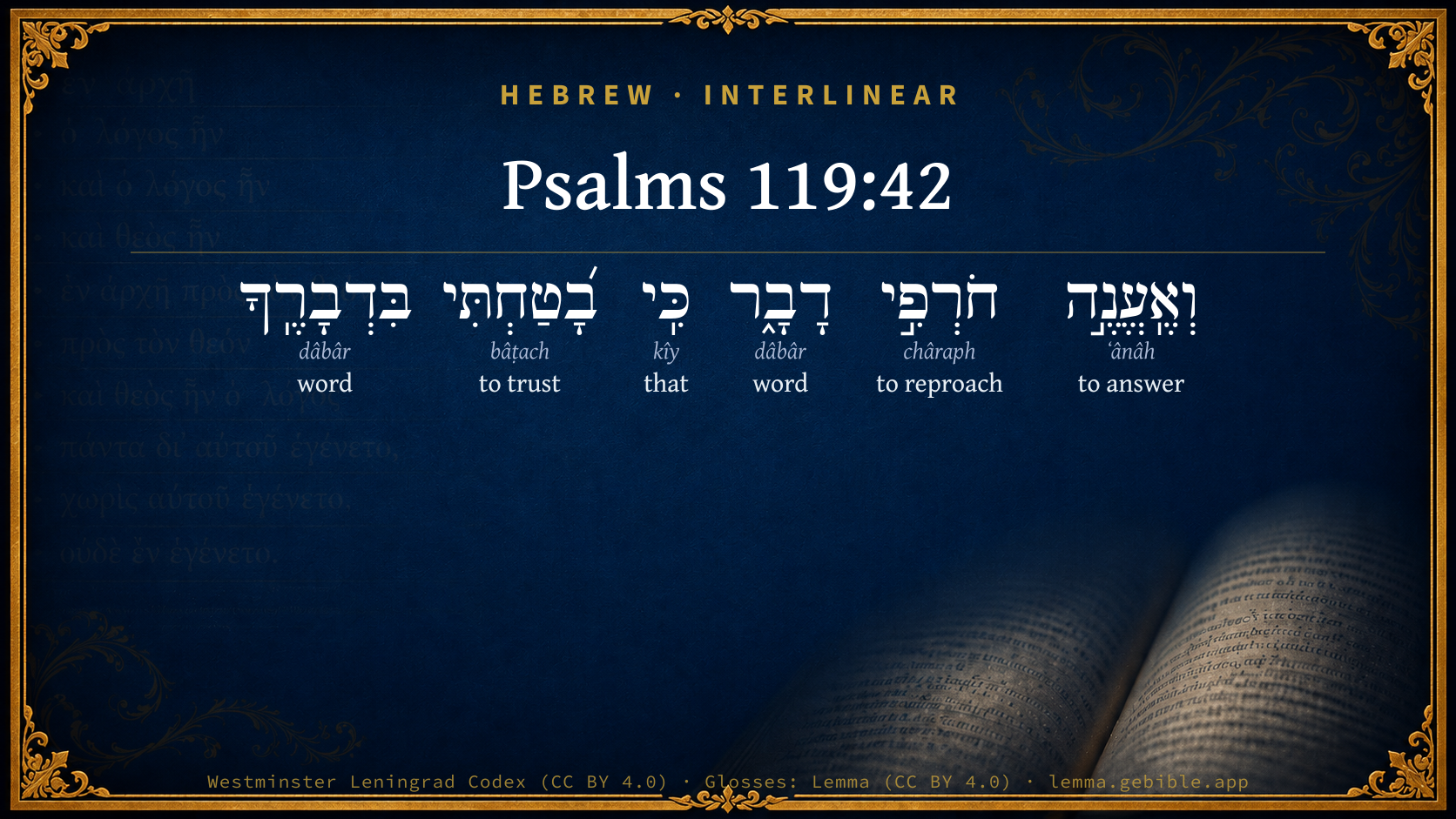
Psalms 119:42

Hebrew (Westminster Leningrad Codex) Psalms 119:42 appears in the Hebrew Old Testament. The text above is from the Westminster Leningrad Codex. Each word links to its Strong’s number, a concise gloss, and parsing drawn from the Open Scriptures Hebrew Bible morphology. Click any word for its full Brown-Driver-Briggs (BDB) entry.
Download image
Cite this verse

Psalms 119:42 (World English Bible). Public Domain. Lemma interlinear Bible study tool, https://lemma.gebible.app/v/psalms/119/42.

Show BibTeX & RIS
BibTeX
RIS
English Translation
So I will have an answer for him who reproaches me, For I trust in your word.
World English Bible · Public Domain
Download a study sheet

One document with this verse’s original text, its word-by-word gloss line, the meaning frame, cross-references with their text, attributed commentary, and full source and license credits — printable, and it pastes into notes with its structure intact.

This verse Autodidact and up

Study sheet (.html) Plain text (.txt)

A passage Seminary Student

Up to 50 verses in one chapter. A passage sheet keeps up to 6 commentary sources and 12 cross-references per verse, in the order this page ranks them, and says so on the sheet whenever that leaves anything out. Ask for a single verse and you get the Autodidact verse sheet above.

Everything on this page stays free to read, with no account — the sheet is a download of what is already on screen, not access to it.

Want to remove ads? Support Godless Engineer
Compare translations 3

The same verse in 3 English versions, stacked beneath the original-language interlinear above. Click any original word for its lexicon entry.

Each is an independent rendering of the whole verse — the interlinear is not word-aligned to these translations.

Highlighted words mark where these versions differ — a whole-verse word diff, not a word-by-word alignment.

  • World English Bible Public Domain
    So I will have an answer for him who reproaches me, For I trust in your word.
  • King James Version Public Domain
    So shall I have wherewith to answer him that reproacheth me: for I trust in thy word.
  • unfoldingWord Literal Text CC BY-SA 4.0
    then I will answer the one reproaching me a word, for I trust in your word.

unfoldingWord Literal Text — © unfoldingWord, licensed CC BY-SA 4.0. Word-aligned USFM3 via Door43 (git.door43.org/unfoldingWord/en_ult).

Versions to compare (up to 4)

3 of 4 selected

Show all 17 translations

Every available English version of this verse, each an independent rendering of the whole verse.

  • World English Bible Public Domain
    So I will have an answer for him who reproaches me, For I trust in your word.
  • Berean Standard Bible Public Domain
    Then I can answer him who taunts, for I trust in Your word.
  • Majority Standard Bible Public Domain
    Then I can answer him who taunts, for I trust in Your word.
  • King James Version Public Domain
    So shall I have wherewith to answer him that reproacheth me: for I trust in thy word.
  • American Standard Version (1901) Public Domain
    So shall I have an answer for him that reproacheth me; For I trust in thy word.
  • Revised Version (1885) Public Domain
    So shall I have an answer for him that reproacheth me; for I trust in thy word.
  • Geneva Bible (1599) Public Domain
    So shall I make answere vnto my blasphemers: for I trust in thy woorde.
  • Young's Literal Translation Public Domain
    And I answer him who is reproaching me a word, For I have trusted in Thy word.
  • Literal Standard Version CC BY-SA 4.0
    And I answer him who is reproaching me a word, || For I have trusted in Your word.
  • Unlocked Literal Bible CC BY-SA 4.0
    then I will have a reply for the one who mocks me, for I trust in your word.
  • unfoldingWord Literal Text CC BY-SA 4.0
    then I will answer the one reproaching me a word, for I trust in your word.
  • Darby Bible Public Domain
    So shall I have wherewith to answer him that reproacheth me; for I confide in thy word.
  • World Messianic Bible Public Domain
    So I will have an answer for him who reproaches me, for I trust in your word.
  • Webster's Bible Public Domain
    So shall I have with which to answer him that reproacheth me: for I trust in thy word.
  • Free Bible Version CC BY-SA 4.0
    Then I can reply to those who mock me, for I trust what you say.
  • Bible in Basic English Public Domain
    So that I may have an answer for the man who would put me to shame; for I have faith in your word.
  • JPS Tanakh (1917) Public Domain
    That I may have an answer for him that taunteth me; for I trust in Thy word.

Literal Standard Version (2020), Covenant Press — licensed CC BY-SA 4.0. Text via the HelloAO Bible API (eBible.org). Unlocked Literal Bible (unfoldingWord) — licensed CC BY-SA 4.0. Text via the HelloAO Bible API (eBible.org). unfoldingWord Literal Text — © unfoldingWord, licensed CC BY-SA 4.0. Word-aligned USFM3 via Door43 (git.door43.org/unfoldingWord/en_ult). Free Bible Version, Dr. Jonathan Gallagher — licensed CC BY-SA 4.0. Text via the HelloAO Bible API (eBible.org).

Word by word

More ways to search: Search by grammar → Find every occurrence → Compare this word →

Practice this passage: Drill this verse → Learn its vocabulary →

About this verse

These counts appear in no published source. They are computed here, from the morphology-tagged text and Lemma’s own curated glosses. What Lemma adds →

6
words
5
distinct lemmas
Wisdom
section

Shared distinctive vocabulary

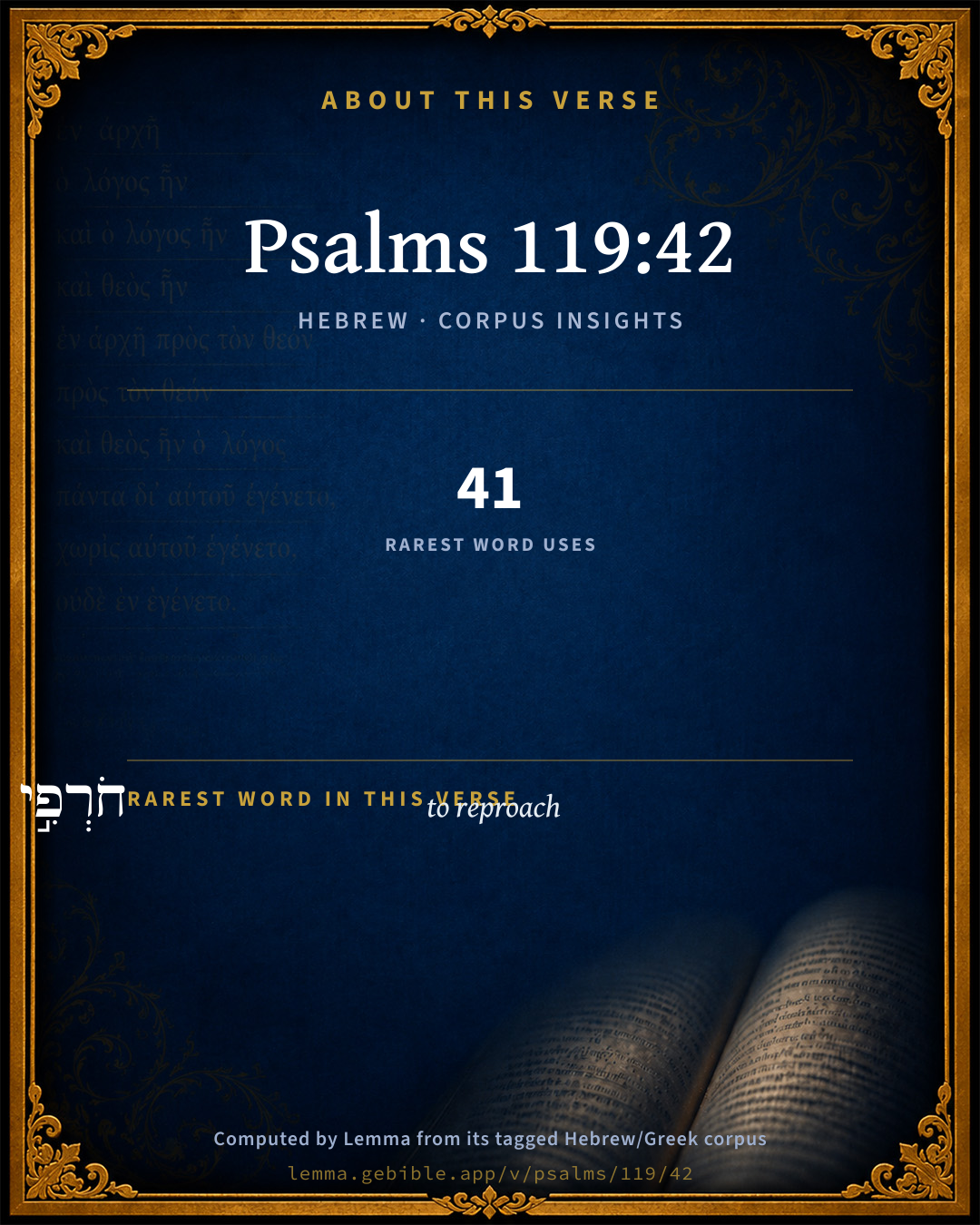
חֹרְפִ֣י to reproach H2778 occurs in 40 verses of the Hebrew Bible. Also found in:

Grammatical profile

  • 3 verbs
  • 2 nouns
  • 1 conjunction

Verb forms

  • וְאֶֽעֱנֶ֣ה Qal · Imperfect
  • חֹרְפִ֣י Qal · Participle Active
  • בָ֝טַחְתִּי Qal · Perfect

Repetition

A word recurs within this verse — often emphatic in Hebrew:

  • דָבָ֑ר word H1697 ×2

Hebrew & Septuagint length

In English translation the verse runs 17 words from the Hebrew and 19 from the Septuagint (LXX English) — closely comparable.

A rough comparison of the two English renderings, which tokenize alike — not a word-level alignment.

Word counts can differ between the Hebrew and the Greek without any difference in meaning — e.g. the Hebrew direct-object marker אֵת has no separate Greek word, and Greek often adds the article ὁ.

Cross-references

18

Topical passages linked to Psalms 119:42 in the Treasury of Scripture Knowledge — connected by theme and wording, ordered by reader-vote popularity; previews shown in the World English Bible.

  • Acts 27:25 Therefore, sirs, cheer up! For I believe God, that it will be just as it has been spoken to me.
  • Proverbs 27:11 Be wise, my son, And bring joy to my heart, Then I can answer my tormentor.
  • Matthew 27:63 saying, "Sir, we remember what that deceiver said while he was still alive: 'After three days I will rise again.'
  • 2 Samuel 16:7–8 Thus said Shimei when he cursed, Be gone, be gone, you man of blood, and base fellow:
  • Psalms 56:10–11 In God, I will praise his word. In Yahweh, I will praise his word.
  • Psalms 119:49 Remember your word to your servant, Because you gave me hope.
  • Psalms 119:74 Those who fear you will see me and be glad, Because I have put my hope in your word.
  • Psalms 119:81 My soul faints for your salvation. I hope in your word.
  • 2 Samuel 7:12–16 When your days are fulfilled, and you shall sleep with your fathers, I will set up your seed after you, who shall proceed out of your bowels, and I will establish his kingdom.
  • 2 Samuel 19:18–20 There went over a ferry-boat to bring over the king's household, and to do what he thought good. Shimei the son of Gera fell down before the king, when he was come over the Jordan.
  • 1 Chronicles 28:3–6 But God said to me, You shall not build a house for my name, because you are a man of war, and have shed blood.
  • Psalms 3:2 Many there are who say of my soul, "There is no help for him in God." Selah.
  • Psalms 42:10 As with a sword in my bones, my adversaries reproach me, While they continually ask me, "Where is your God?"
  • Psalms 56:4 In God, I praise his word. In God, I put my trust. I will not be afraid. What can flesh do to me?
  • Psalms 71:10–11 For my enemies talk about me. Those who watch for my soul conspire together,
  • Psalms 89:19–37 Then you spoke in vision to your saints, And said, "I have bestowed strength on the warrior. I have exalted a young man from the people.
  • Matthew 27:40–43 and saying, "You who destroy the temple, and build it in three days, save yourself! If you are the Son of God, come down from the cross!"
  • Psalms 109:25 I have also become a reproach to them. When they see me, they shake their head.

Cross-references courtesy of OpenBible.info (CC BY 4.0).

Hebrew and Greek witnesses Masoretic Hebrew ↔ Greek Septuagint

The same verse in the two great witnesses to the Old Testament, shown verse-for-verse.

You’re reading Greek Psalm 118 (Hebrew Psalm 119). The Septuagint counts the superscription, so verse numbers can differ from the Hebrew — chapter-level alignment, not verse-by-verse. Numbering follows Rahlfs.

These are two independent witnesses, not word-aligned to each other, and the Septuagint is shown in lemma (dictionary) form.

Hebrew Psalms 119:42 Masoretic · Westminster Leningrad Codex

וְאֶֽעֱנֶ֣ה חֹרְפִ֣י דָבָ֑ר כִּֽי בָ֝טַחְתִּי בִּדְבָרֶֽךָ

So I will have an answer for him who reproaches me, For I trust in your word.

World English Bible · Public Domain

Greek LXX Greek Psalm 118:42 Septuagint · lemma form

καί ἀποκρίνω ὁ ὀνειδίζω ἐγώ λόγος ὅτι ἐλπίζω ἐπί ὁ λόγος σύ

And so I shall render an answer to them that reproach me: for I have trusted in your words.

LXX2012 (modern English Septuagint) · Public Domain

On this verse, Ellicott's Commentary for English Readers discusses the Septuagint’s reading. Read the note in Commentary ↓

Hebrew: Westminster Leningrad Codex (CC BY 4.0). Greek: Septuagint (public domain); English from LXX2012 (modern English Septuagint) (Public Domain). How the Septuagint differs from the Hebrew →

Commentary

Notes on Psalms 119:42 from classic Christian and Jewish commentators (each source and its license shown beneath its notes). The classic Christian expositions comment on the surrounding passage and are grouped to its opening verse, so a note may address several verses; the Jewish commentaries on the Tanakh (Rashi and others) are per-verse, so they appear only where the commentator wrote on this verse.

Lemma curates 59 commentaries, every one of them public domain or Creative Commons licensed, each selected and text-cleaned for this edition rather than reprinted as found. About our sources →

Trapp's Complete Commentary

John Trapp

Psa 119:42 So shall I have wherewith to answer him that reproacheth me: for I trust in thy word.

Ver. 42. So shall I have wherewith to answer] i.e. To stop an open mouth. Verbal apologies are sometimes necessary, but real always; we should, by a pious conversation, put to silence the ignorance of foolish men, who, like Blackamoors, despise beauty; like dogs, bark at the shining of the moon. We are also to beg deliverance of God, for the confutation of such as say we shall never be delivered.

John Trapp, A Commentary or Exposition upon All the Books of the Old and New Testament (1647–1656) — public domain. Text from a community e-Sword module.

The Biblical Illustrator

Joseph S. Exell

Psa_119:42

So shall I have wherewith to answer him that reproacheth me: far I trust in Thy Word.

The reproach answered

His state was this--depending upon, and trusting to that word of promise which the Holy Ghost had applied with power to his conscience; not relying upon the bare letter of truth, but leaning upon the sure word of promise which had been brought home with power to his heart. Being, then, in this state, he only had a greater hungering and thirsting after further food. What he had already received from God had not brought into his soul lasting satisfaction; it had rather enkindled his appetite for more. Fresh wants called urgently for fresh deliverances; new diseases required anew the healing hand. Being in this state, then, he longs after the mercies of God, and hungers after His salvation. He was driven as well as drawn, impelled by urgent necessity as well as allured by Divine encouragements. An enemy was at hand who dogged his steps, an accuser with a heavy bill of charges was waiting at his gate.

I. There are many accusers that reproach a living soul.

1. The law of God reproaches every living soul to which it is spiritually applied, for disobedience to it.

2. Our own heart is continually reproaching us, for our shortcomings in all we desire to perform to Gods glory.

3. Professors of religion are continually casting their reproaches upon us. They treat us as Peninnah treated Hannah.

4. Even the world will sometimes reproach Gods people for covetousness, worldliness, a slanderous tongue, resentment of injuries, levity, frivolity, carelessness, etc.

5. Satan often reproaches the children of God (Rev_12:10).

II. The inability of the creature to answer any of these reproaches. Can he bring forward his good works? No; the sentence of the law is within, and good works, could he perform them, are merely external things. Can he bring forward resolutions, and promises, and vows to do better for the future? No; these promises, resolutions, and vows spring from the flesh, but condemnation is written in his spirit. Shall he answer these reproaches by his own prayers? No; for the condemnation of the law is written in his spiritual conscience, and only so far as prayer is indited by the Spirit, will it go up out of a spiritual heart.

III. The desires and breathings of the soul after such a manifestation of mercy as shall afford a sufficient answer (verse 41). If you will observe, the word mercies is in the plural, there being many mercies; but salvation is in the singular number, there being only one salvation. In what way, then, did he want these mercies? Merely as standing in the letter of the word? Only as recorded in the inspired word of truth?--as things to look at--as objects hung up, as it were, in a picture, merely for the eye to gaze upon? No; he wanted them in his heart, to come to him, to visit him, to be breathed into him, to be made part and parcel of him, to he the life-blood that should circulate in his veins, to be the very Kingdom of God set up with power in his soul. And why did he want internal mercies? Because he had internal reproaches. Why did he need mercies in his soul? because condemnation was in his soul. It was there the sentence of death was written; it was there the sentence of acquittal was to be recorded. It was there that reproach was felt; it was there the answer to the reproach was to be given.

IV. The way in which these answers are communicated. If the law reproaches, salvation in the heart is an answer to its reproach. If our own heart condemns us, to have a sense of Gods salvation in the soul is an answer to every reproach that the heart can bring. If the world condemns us, casts out our names as evil, imputes to us practices which we abhor, tarnishes our fair fame, and throws upon us every base imputation, if we have salvation in our hearts, it is a sufficient answer to all the reproaches that are cast upon us. (J. C. Philpot.)

The Biblical Illustrator, edited by Joseph S. Exell (c. 1880s–1900s) — public domain. Text from a community e-Sword module.

The Treasury of David

Charles H. Spurgeon

Ver. 42. So shall I have wherewith to answer him that reproacheth me. This is an unanswerable answer. When God, by granting us salvation, gives to our prayers an answer of peace, we are ready at once to answer the objections of the infidel, the quibbles of the sceptical, and the sneers of the contemptuous. It is most desirable that revilers should be answered, and hence we may expect the Lord to save his people in order that a weapon may be put into their hands with which to rout his adversaries. When those who reproach us are also reproaching God, we may ask him to help us to silence them by sure proofs of his mercy and faithfulness.

For I trust in thy word. His faith was seen by his being trustful while under trial, and he pleads it as a reason why he should be helped to beat back reproaches by a happy experience. Faith is our argument when we seek mercies and salvation; faith in the Lord who has spoken to us in his word. "I trust in thy word" is a declaration more worth the making than any other; for he who can truly make it has received power to become a child of God, and so to be the heir of unnumbered mercies. God hath more respect to a man's trust than to all else that is in him; for the Lord hath chosen faith to be the hand into which he will place his mercies and his salvation. If any reproach us for trusting in God, we reply to them with arguments the most conclusive when we show that God has kept his promises, heard our prayers, and supplied our needs. Even the most sceptical are forced to bow before the logic of facts.

In this second verse of this eight the Psalmist makes a confession of faith, and a declaration of his belief and experience. Note that he does the same in the corresponding verses of the sections which follow. See Ps 119:50, "Thy word hath quickened me"; Ps 119:58, "I entreated thy favour"; Ps 119:66, "I have believed thy commandments"; Ps 119:74, "I have hoped in thy word." A wise preacher might find in these a series of experimental discourses.

Ver. 42. So shall I have, etc. I shall have something by which I may reply to those who calumniate me. So the Saviour replied to the suggestions of the tempter almost wholly by passages of Scripture (Mt 4:4, 7, 10); and so, in many cases, the best answer that can be given to reproaches on the subject of religion will be found in the very words of Scripture. A man of little learning, except that which he has derived from the Bible, may often thus silence the cavils and reproaches of the learned sceptic; a man of simple hearted, pure piety, with no weapon but the word of God, may often thus be better armed than if he had all the arguments of the schools at his command. Comp. Eph 6:17. Albert Barnes.

Ver. 42. So shall I have wherewith to answer, etc. When the heart realizes assured salvation, it is supplied with abundant answers to those who sneer at the delights of faith. Henry Law.

Ver. 42. So shall I have wherewith to answer, etc. Hugo Cardinalis observeth that there are three sorts of blasphemers of the godly, the devils, heretics, and slanderers. The devil must be answered by the internal word of humility; heretics by the external word of wisdom; slanderers by the active word of a good life. Richard Greenham.

Ver. 42. So shall I have, etc. For I should give them a short answer, and a true one, that I trust in thy word; I put my confidence in thee, who canst make good thy promises, because thou art omnipotent; and wilt, because thou art merciful. William Nicholson.

Ver. 42. So shall I have wherewith to answer, etc. This follows the phrase, "according to thy word." Christians should learn from the example of David what to oppose to the reproaches and false accusations of the enemies of the truth. Nothing is done by railing; but weapons should be taken from the word of God; and these are strong through faith in God for the overturning of both the Devil himself and his instruments. For truly with weapons of this kind the Saviour himself discomfited Satan in the wilderness (Mt 4:1-11); and Paul (Eph 6:10-18) puts on himself, and commends to the Christian soldier, the girdle of Divine truth, the breastplate of righteousness, the shoes of the Gospel, the shield of faith, and the sword of the Spirit, which is the Word of God. Solomon Gessler.

Ver. 42. Wherewith to answer, etc. It is not forbidden to believers, modestly and fully, to answer those that reproach them, and to rebut the lie. See Pr 26:5 27:11. But to be able to answer them is received as a blessing from God. Martin Geier.

Ver. 42-43. In Ps 119:42 there is a play upon the two senses of the term "word, "thus: "and I will answer my revilers a word, for I have trusted in thy word." Having trusted in thy word of promise, I shall have a word of reply to make to them when thou shalt graciously hear this prayer. Take not thy word of truth (i.e., of promise) out of my mouth; let me have it still to speak of before my enemies and to rest upon for my own soul. If God were to fail in fulfilling his word of promise, it would, in the sense here contemplated, be quite taken out of his mouth. Henry Cowles.

Ver. 42. Faith's answer to reproach found in the fact that she trusts God's word.

Ver. 42-43, 47. Faith, hope, and love. "I trust." "I have hoped." "I have loved." Faith warring, hope testifying, love obeying.

Psalms 119:43*

Ver 43. And take not the word of truth utterly out of my mouth. Do not prevent my pleading for thee by leaving me without deliverance; for how could I continue to proclaim thy word if I found it fail me? such would seem to be the run of the meaning. The word of truth cannot be a joy to our mouths unless we have an experience of it in our lives, and it may be wise for us to be silent if We cannot support our testimonies by the verdict of our consciousness. This prayer may also refer to other modes by which we may be disabled from speaking in the name of the Lord: as, for instance, by our falling into open sin, by our becoming depressed and despairing, by our labouring under sickness or mental aberration, by our finding no door of utterance, or meeting with no willing audience. He who has once preached the gospel from his heart is filled with horror at the idea of being put out of the ministry; he will crave to be allowed a little share in the holy testimony, and will reckon his dumb Sabbaths to be days of banishment and punishment.

For I have hoped in thy judgments. He had expected God to appear and vindicate his cause, that so he might speak with confidence concerning his faithfulness. God is the author of our hopes, and we may most fittingly entreat him to fulfil them. The judgments of his providence are the outcome of his word; what he says in the Scriptures he actually performs in his government; we may therefore look for him to show himself strong on the behalf of his own threatenings and promises, and we shall not look in vain.

God's ministers are sometimes silenced through the sins of their people, and it becomes them to plead against such a judgment; better far that they should suffer sickness or poverty than that the candle of the gospel should be put out among them, and that thus they should be left to perish without remedy. The Lord save us, who are his ministers, from being made the instruments of inflicting such a penalty. Let us exhibit a cheerful hopefulness in God, that we may plead it in prayer with him when he threatens to close our lips.

In the close of this verse there is a declaration of what the Psalmist had done in reference to the word of the Lord, and in this the thirds of the octaves are often alike. See Ps 119:35, "therein do I delight"; Ps 119:43, "I have hoped in thy judgments"; Ps 119:51, "yet have I not declined from thy law"; Ps 119:59, "I turned my feet to thy testimonies"; and Ps 119:67, 83, 99, etc. These verses would furnish an admirable series of meditations.

Charles H. Spurgeon's The Treasury of David (1869–1885) — public domain. Psalms only. Text from a community e-Sword/MySword module.

J. A. Alexander on Psalms

Joseph Addison Alexander

42. (Psa 119:42) And (then) I will answer my reviler a word; for I trust in thy word. The best answer to the calumnies and insults of his enemies is that afforded by his manifest experience of God's favour, and the practical vindication thereby afforded. The addition of word, which in our idiom is superfluous, may have some reference to its use in the corresponding clause. As if he had said, Only let thy word be fulfilled, and I shall have a word to say in answer to my enemies.

Joseph Addison Alexander, The Psalms Translated and Explained (1850) — public domain. Text from a community e-Sword module.

Geneva Bible (1599)

Geneva Bible translators

By trusting in God’s word he assureth himself to be able to confute the slanders of his adversaries.

Geneva Bible (1599) marginal notes — public domain. Text via Bolls.life.

Adam Clarke's Commentary

Verse 42. So shall I have wherewith to answer] Many say, "My hope in thy mercy is vain;" but when thou fulfillest thy promises to me, then shall I answer to the confusion of their infidelity.

Adam Clarke's Commentary on the Bible (1810–1826) — public domain. Text from a community e-Sword/MySword module.

Ellicott's Commentary for English Readers

VAU.

(42) So shall I have.—Better literally, as the LXX. and Vulg., and I shall answer my reviler a word, for I trust in Thy word, i.e., when reproached it will be enough to pronounce God’s promise. The repetition of davar here and in Psa_119:43 makes for this explanation in preference to that of the margin.

A Bible Commentary for English Readers, edited by Charles John Ellicott (1878–1897) — public domain. Text from a community e-Sword module.

The Cambridge Bible for Schools and Colleges

gen. ed. J. J. S. Perowne

42. So shall I have an answer for him that reproacheth me (R.V.)] Personal experience of God’s manifold lovingkindness manifested in his deliverance will enable him to return a conclusive answer to those who taunt him with the uselessness of serving God. P.B.V. follows some of the Ancient Versions in reading the plural, my blasphemers.

The Cambridge Bible for Schools and Colleges (gen. ed. J. J. S. Perowne; Cambridge University Press, 1878–1918) — public domain. Text from a community e-Sword module.

John Gill's Exposition

So shall I keep thy law continually,.... Which denotes not the perfection of keeping the law, but the constancy of it: the psalmist was persuaded, that so long as he had the word of truth in his mouth, and the judgments of God in his view, he should be diligent and constant in the discharge of his duty, which these directed and encouraged him unto;

for ever and ever; in this life and that to come; when the law of God will be kept, and his will done perfectly by the saints, as it now is by the angels in heaven; or this may be connected with the law of God; which law is for ever and ever, being of eternal duration and obligation. The whole may be understood of the law of faith, or doctrine of the Gospel, and be rendered, "so shall I observe thy doctrine continually"; contained in the word of truth; which doctrine is for ever and ever, it is the everlasting Gospel.

John Gill's Exposition of the Whole Bible (1746–1763) — public domain (CC PDM 1.0). Text via the HelloAO Bible API.

Albert Barnes' Notes on the Bible

So shall I have wherewith to answer him that reproacheth me - I shall have something by which I may reply to those who calumniate me. So the Saviour replied to the suggestions of the tempter almost wholly by passages of Scripture Mat 4:4, Mat 4:7,Mat 4:10; and so, in many cases, the best answer that can be given to reproaches on the subject of religion will be found in the very words of Scripture. A man of little learning, except that which he has derived from the Bible, may often thus silence the cavils and reproaches of the learned sceptic; a man of simplehearted, pure piety, with no weapon but the word of God, may often thus be better armed than if he had all the arguments of the schools at his command. Compare Eph 6:17.

For I trust in thy word - I believe it; I rely on it; I confide in that, as my only comfort and protection.

Albert Barnes' Notes on the Bible (1834–1885) — public domain. Text from a community e-Sword/MySword module.

Matthew Poole's English Annotations

That reproacheth me; that chargeth me with folly for my piety and trust in thy promises.

For I trust in thy word; or, because I trust, &c. This was the matter of their reproach.

Matthew Poole's English Annotations on the Holy Bible (1683–1685) — public domain. Text from a community e-Sword/MySword module.

The Pulpit Commentary

So shall I have wherewith to answer him that reproacheth me (comp. ver. 22). If God"s favor were manifestly shown him, his enemies would be sufficiently answered. For I trust in thy Word. This is what he looks for, since he has a full trust in God"s promises to his servants.

The Pulpit Commentary (1880–1919), ed. H.D.M. Spence-Jones & Joseph S. Exell — public domain. Text from a community e-Sword module.

Scofield Reference Notes

C. I. Scofield

trust

(See Scofield "Psa 2:12").

The Scofield Reference Bible (1917 edition), notes by C. I. Scofield — public domain. Text from a community e-Sword module.

Lesson kit

Teaching starters — assembled from the data on this page, not authored interpretation. Every prompt links to the verse data it draws on. Edit before teaching.

Psalms, in the Wisdom, opens this verse with 6 words (5 distinct Hebrew lemmas). Its most distinctive word is châraph (“to reproach”). A historical commentator’s framing appears above. Read the whole chapter for the surrounding context.

Discussion questions

  1. The word châraph carries the sense “to reproach.” How does it shape the verse?
  2. How does Leviticus 19:20, which shares the word «to reproach», read alongside this verse?
  3. What does the repetition of “word” (2× in this one verse) do in this verse?
  4. These translations render this verse differently; the difference is in the English rendering, not the original. What questions does that raise?
  5. «וְאֶֽעֱנֶ֣ה» is a Qal Imperfect verb. How does that grammatical form shape the action described?
  6. Compare how Trapp's Complete Commentary and The Biblical Illustrator read this verse. Where do they agree or differ?

Things to notice

Reading settings

Reading text

Shown beneath each verse's original-language words.

Old Testament
Old Testament edition

Read the OT as the Masoretic Hebrew (MT) or the Greek Septuagint (LXX).

English shown for the Greek Septuagint (in the Hebrew ↔ Greek comparison).

Comparing translations? Open the Compare panel on any verse page to stack up to four side by side.