Isaiah 30:12

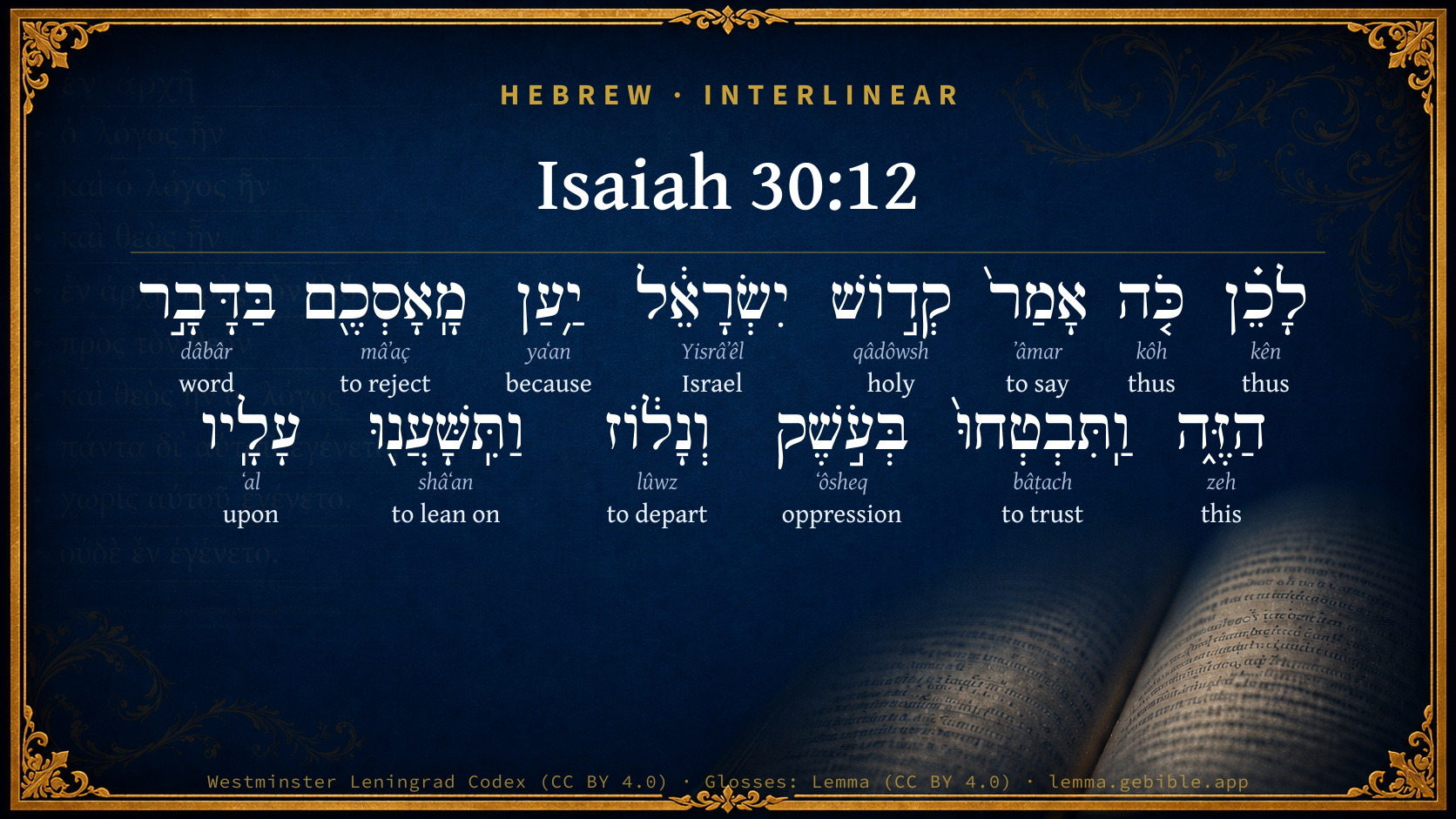
Hebrew (Westminster Leningrad Codex) Isaiah 30:12 appears in the Hebrew Old Testament. The text above is from the Westminster Leningrad Codex. Each word links to its Strong’s number, a concise gloss, and parsing drawn from the Open Scriptures Hebrew Bible morphology. Click any word for its full Brown-Driver-Briggs (BDB) entry.
Download image
Cite this verse

Isaiah 30:12 (World English Bible). Public Domain. Lemma interlinear Bible study tool, https://lemma.gebible.app/v/isaiah/30/12.

Show BibTeX & RIS
BibTeX
RIS
English Translation
Therefore thus says the Holy One of Israel, "Because you despise this word, and trust in oppression and perverseness, and rely thereon;
World English Bible · Public Domain
Download a study sheet

One document with this verse’s original text, its word-by-word gloss line, the meaning frame, cross-references with their text, attributed commentary, and full source and license credits — printable, and it pastes into notes with its structure intact.

This verse Autodidact and up

Study sheet (.html) Plain text (.txt)

A passage Seminary Student

Up to 50 verses in one chapter. A passage sheet keeps up to 6 commentary sources and 12 cross-references per verse, in the order this page ranks them, and says so on the sheet whenever that leaves anything out. Ask for a single verse and you get the Autodidact verse sheet above.

Everything on this page stays free to read, with no account — the sheet is a download of what is already on screen, not access to it.

Want to remove ads? Support Godless Engineer
Compare translations 3

The same verse in 3 English versions, stacked beneath the original-language interlinear above. Click any original word for its lexicon entry.

Each is an independent rendering of the whole verse — the interlinear is not word-aligned to these translations.

Highlighted words mark where these versions differ — a whole-verse word diff, not a word-by-word alignment.

  • World English Bible Public Domain
    Therefore thus says the Holy One of Israel, "Because you despise this word, and trust in oppression and perverseness, and rely thereon;
  • King James Version Public Domain
    Wherefore thus saith the Holy One of Israel, Because ye despise this word, and trust in oppression and perverseness, and stay thereon:
  • unfoldingWord Literal Text CC BY-SA 4.0
    Therefore, thus says the Holy of Israel: “Because you reject this word and you trust in oppression and crookedness and you support yourselves on it,

unfoldingWord Literal Text — © unfoldingWord, licensed CC BY-SA 4.0. Word-aligned USFM3 via Door43 (git.door43.org/unfoldingWord/en_ult).

Versions to compare (up to 4)

3 of 4 selected

Show all 18 translations

Every available English version of this verse, each an independent rendering of the whole verse.

  • World English Bible Public Domain
    Therefore thus says the Holy One of Israel, "Because you despise this word, and trust in oppression and perverseness, and rely thereon;
  • Berean Standard Bible Public Domain
    Therefore this is what the Holy One of Israel says: “Because you have rejected this message, trusting in oppression and relying on deceit,
  • Majority Standard Bible Public Domain
    Therefore this is what the Holy One of Israel says: “Because you have rejected this message, trusting in oppression and relying on deceit,
  • King James Version Public Domain
    Wherefore thus saith the Holy One of Israel, Because ye despise this word, and trust in oppression and perverseness, and stay thereon:
  • American Standard Version (1901) Public Domain
    Wherefore thus saith the Holy One of Israel, Because ye despise this word, and trust in oppression and perverseness, and rely thereon;
  • Revised Version (1885) Public Domain
    Wherefore thus saith the Holy One of Israel, Because ye despise this word, and trust in oppression and perverseness, and stay thereon;
  • Geneva Bible (1599) Public Domain
    Therefoe thus saith the holy one of Israel, Because you haue cast off this worde, and trust in violence, and wickednes, and stay thereupon,
  • Douay-Rheims (1899) Public Domain
    Therefore thus saith the Holy One of Israel: Because you have rejected this word, and have trusted in oppression and tumult, and have leaned upon it:
  • Young's Literal Translation Public Domain
    Therefore, thus said the Holy One of Israel, Because of your kicking against this word, And ye trust in oppression, And perverseness, and rely on it,
  • Literal Standard Version CC BY-SA 4.0
    Therefore, thus said the Holy One of Israel: “Because of your kicking against this word, || And you trust in oppression, || And perverseness, and rely on it,
  • Unlocked Literal Bible CC BY-SA 4.0
    Therefore the Holy One of Israel says, “Because you reject this word and trust in oppression and deceit and lean on it,
  • unfoldingWord Literal Text CC BY-SA 4.0
    Therefore, thus says the Holy of Israel: “Because you reject this word and you trust in oppression and crookedness and you support yourselves on it,
  • Darby Bible Public Domain
    Therefore thus saith the Holy One of Israel: Because ye reject this word, and confide in oppression and wilfulness, and depend thereon,
  • World Messianic Bible Public Domain
    Therefore the Holy One of Israel says, “Because you despise this word, and trust in oppression and perverseness, and rely on it,
  • Webster's Bible Public Domain
    Wherefore thus saith the Holy One of Israel, Because ye despise this word, and trust in oppression and perverseness, and lean upon it:
  • Free Bible Version CC BY-SA 4.0
    So this is how the Holy One of Israel replies, Since you have rejected this message, and since you trust in oppression and believe in dishonesty,
  • Bible in Basic English Public Domain
    For this cause the Holy One of Israel says, Because you will not give ear to this word, and are looking for help in ways of deceit and evil, and are putting your hope in them:
  • JPS Tanakh (1917) Public Domain
    Wherefore thus saith the Holy One of Israel: because ye despise this word, and trust in oppression and perverseness, and stay thereon;

Literal Standard Version (2020), Covenant Press — licensed CC BY-SA 4.0. Text via the HelloAO Bible API (eBible.org). Unlocked Literal Bible (unfoldingWord) — licensed CC BY-SA 4.0. Text via the HelloAO Bible API (eBible.org). unfoldingWord Literal Text — © unfoldingWord, licensed CC BY-SA 4.0. Word-aligned USFM3 via Door43 (git.door43.org/unfoldingWord/en_ult). Free Bible Version, Dr. Jonathan Gallagher — licensed CC BY-SA 4.0. Text via the HelloAO Bible API (eBible.org).

Word by word

More ways to search: Search by grammar → Find every occurrence → Compare this word →

Practice this passage: Drill this verse → Learn its vocabulary →

וְנָל֔וֹז
lûwz
H3868
“and · departing”
Conjunction + Verb, Niphal, Participle Active, Masculine, Singular, Absolute
Part of Speech
Conjunction + Verb
Stem
Niphal
Form
Participle Active
Gender
Masculine
Number
Singular
State
Absolute
Full BDB Definition

Origin: a primitive root

TWOT: 1090

to depart, turn aside - (Qal) to depart - (Niphal) - to go wrong, go crooked - devious, perverse (participle) - (Hiphil) - to be lost from view - to become devious
  1. לָכֵ֗ן kên H3651 “to/for · thus” Preposition + Adverb
  2. כֹּ֤ה kôh H3541 “thus” Adverb
  3. אָמַר֙ ʼâmar H559 “to say” Verb, Qal, Perfect, 3rd Person, Masculine, Singular
  4. קְד֣וֹשׁ qâdôwsh H6918 “holy of” Adjective, Adjective, Masculine, Singular, Construct
  5. יִשְׂרָאֵ֔ל Yisrâʼêl H3478 “Israel” Noun, Proper
  6. יַ֥עַן yaʻan H3282 “because” Conjunction
  7. מָֽאָסְכֶ֖ם mâʼaç H3988 “to reject · you” Verb, Qal, Infinitive Construct + Suffix, Personal, 2nd Person, Masculine, Plural
  8. בַּדָּבָ֣ר dâbâr H1697 “in/at the · word” Preposition, Determined + Noun, Common, Masculine, Singular, Absolute
  9. הַזֶּ֑ה zeh H2088 “the · this” Particle, Definite Article + Pronoun, Demonstrative, Masculine, Singular
  10. וַֽתִּבְטְחוּ֙ bâṭach H982 “and · to trust” Conjunction + Verb, Qal, Sequential Imperfect, 2nd Person, Masculine, Plural
  11. בְּעֹ֣שֶׁק ʻôsheq H6233 “in/at · oppression” Preposition + Noun, Common, Masculine, Singular, Absolute
  12. וַתִּֽשָּׁעֲנ֖וּ shâʻan H8172 “and · to lean on” Conjunction + Verb, Niphal, Sequential Imperfect, 2nd Person, Masculine, Plural
  13. עָלָֽיו ʻal H5921 “upon · him” Preposition + Suffix, Personal, 3rd Person, Masculine, Singular

About this verse

These counts appear in no published source. They are computed here, from the morphology-tagged text and Lemma’s own curated glosses. What Lemma adds →

14
words
14
distinct lemmas
Prophets
section

Notable vocabulary

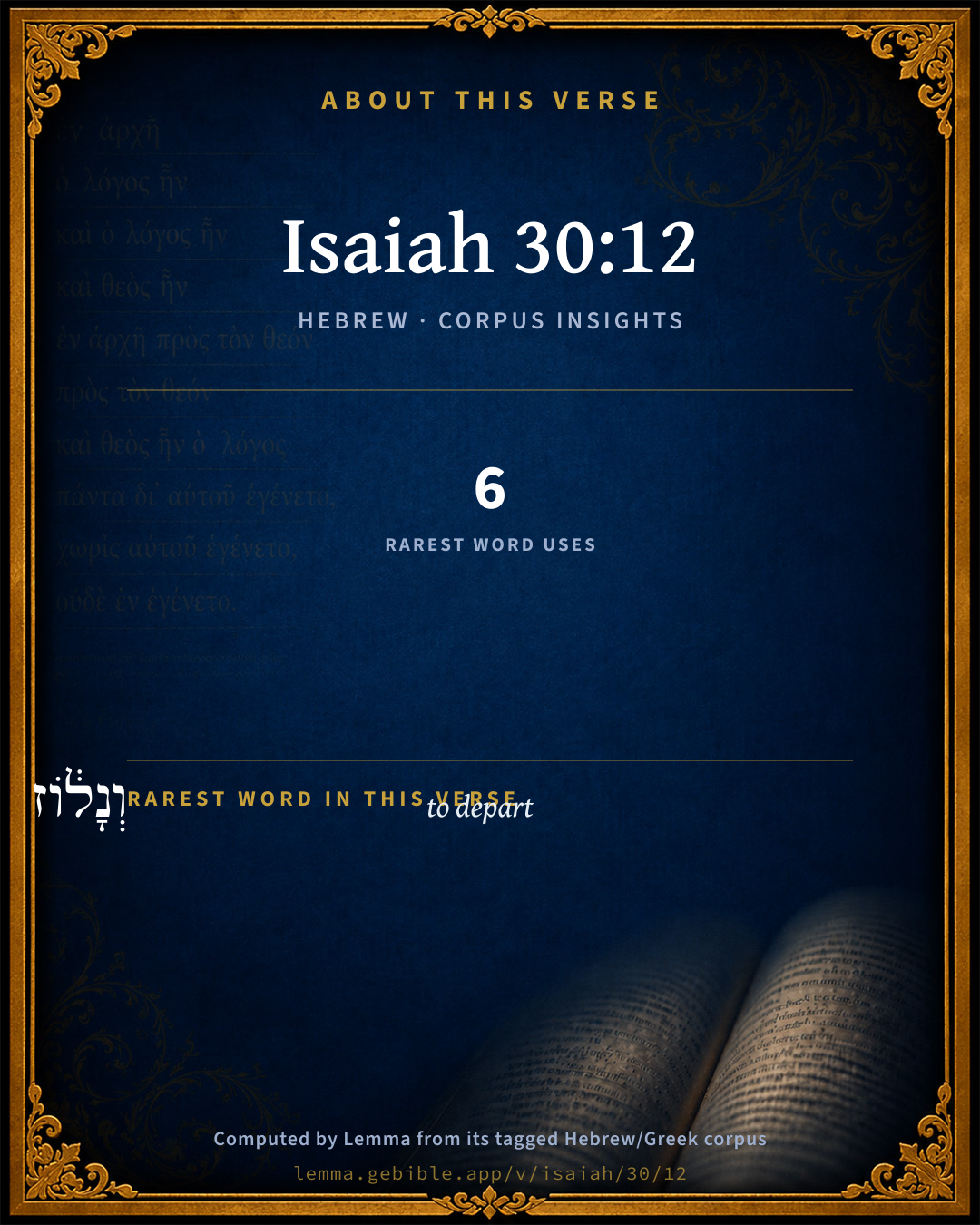
The rarest word here is וְנָל֔וֹז to depart H3868 — appearing just 6 times in the whole Hebrew Bible.

Shared distinctive vocabulary

וְנָל֔וֹז to depart H3868 occurs in 6 verses of the Hebrew Bible. Also found in:

Grammatical profile

  • 5 verbs
  • 3 nouns
  • 1 adjective
  • 1 pronoun
  • 1 preposition
  • 1 conjunction
  • 2 adverbs

Verb forms

  • אָמַר֙ Qal · Perfect
  • מָֽאָסְכֶ֖ם Qal · Infinitive Construct
  • וַֽתִּבְטְחוּ֙ Qal · Sequential Imperfect
  • וְנָל֔וֹז Niphal · Participle Active
  • וַתִּֽשָּׁעֲנ֖וּ Niphal · Sequential Imperfect

Hebrew & Septuagint length

In English translation the verse runs 22 words from the Hebrew and 32 from the Septuagint (LXX English) — the Septuagint runs noticeably longer here. See the side-by-side →

A rough comparison of the two English renderings, which tokenize alike — not a word-level alignment.

Word counts can differ between the Hebrew and the Greek without any difference in meaning — e.g. the Hebrew direct-object marker אֵת has no separate Greek word, and Greek often adds the article ὁ.

Cross-references

15

Topical passages linked to Isaiah 30:12 in the Treasury of Scripture Knowledge — connected by theme and wording, ordered by reader-vote popularity; previews shown in the World English Bible.

  • Isaiah 31:1–3 Woe to those who go down to Egypt for help, and rely on horses, and trust in chariots because they are many, and in horsemen because they are very strong, but they don't look to the Holy One of Israel, neither seek Yahweh!
  • Isaiah 5:24 Therefore as the tongue of fire devours the stubble, And as the dry grass sinks down in the flame, So their root shall be as rottenness, And their blossom shall go up as dust; Because they have rejected the law of Yahweh of Hosts, And despised the word of the Holy One of Israel.
  • Amos 2:4 Thus says Yahweh: "For three transgressions of Judah, yes, for four, I will not turn away its punishment; Because they have rejected Yahweh's law, And have not kept his statutes, And their lies have led them astray, After which their fathers walked;
  • 1 Thessalonians 4:8 Therefore he who rejects doesn't reject man, but God, who has also given his Holy Spirit to you.
  • Isaiah 47:10 For you have trusted in your wickedness; you have said, None sees me; your wisdom and your knowledge, it has perverted you, and you have said in your heart, I am, and there is none else besides me.
  • Luke 10:16 Whoever listens to you listens to me, and whoever rejects you rejects me. Whoever rejects me rejects him who sent me."
  • 2 Samuel 12:9–10 Why have you despised the word of Yahweh, to do that which is evil in his sight? You have struck Uriah the Hittite with the sword, and have taken his wife to be your wife, and have slain him with the sword of the children of Ammon.
  • Psalms 52:7 "Behold, this is the man who didn't make God his strength, But trusted in the abundance of his riches, And strengthened himself in his wickedness."
  • Psalms 62:10 Don't trust in oppression. Don't become vain in robbery. If riches increase, Don't set your heart on them.
  • Isaiah 5:7 For the vineyard of Yahweh of Hosts is the house of Israel, And the men of Judah his pleasant plant: And he looked for justice, but, behold, oppression; For righteousness, but, behold, a cry of distress.
  • Isaiah 28:15 Because you have said, We have made a covenant with death, and with Sheol are we at agreement; when the overflowing scourge shall pass through, it shall not come to us; for we have made lies our refuge, and under falsehood have we hid ourselves:
  • Isaiah 30:1 Woe to the rebellious children, says Yahweh, who take counsel, but not of me; and who make a league, but not of my Spirit, that they may add sin to sin,
  • Isaiah 30:7 For Egypt helps in vain, and to no purpose: therefore have I called her Rahab who sits still.
  • Isaiah 30:15–17 For thus said the Lord Yahweh, the Holy One of Israel, In returning and rest shall you be saved; in quietness and in confidence shall be your strength. You would not:
  • Jeremiah 13:25 This is your lot, the portion measured to you from me, says Yahweh; because you have forgotten me, and trusted in falsehood.

Cross-references courtesy of OpenBible.info (CC BY 4.0).

Hebrew and Greek witnesses Masoretic Hebrew ↔ Greek Septuagint

The same verse in the two great witnesses to the Old Testament, shown verse-for-verse.

Here the Septuagint runs noticeably longer than the Hebrew — LXX2012 (modern English Septuagint) 32 words vs World English Bible 22. A rough length comparison of the two English translations, not a word-level alignment — read both below.

These are two independent witnesses, not word-aligned to each other, and the Septuagint is shown in lemma (dictionary) form.

Hebrew Isaiah 30:12 Masoretic · Westminster Leningrad Codex

לָכֵ֗ן כֹּ֤ה אָמַר֙ קְד֣וֹשׁ יִשְׂרָאֵ֔ל יַ֥עַן מָֽאָסְכֶ֖ם בַּדָּבָ֣ר הַזֶּ֑ה וַֽתִּבְטְחוּ֙ בְּעֹ֣שֶׁק וְנָל֔וֹז וַתִּֽשָּׁעֲנ֖וּ עָלָֽיו

Therefore thus says the Holy One of Israel, "Because you despise this word, and trust in oppression and perverseness, and rely thereon;

World English Bible · Public Domain

Greek LXX Isaiah 30:12 Septuagint · lemma form

διά οὗτος οὕτως λέγω κύριος ὁ ἅγιος ὁ ἰσραήλ ὅτι ἀπειθέω ὁ λόγος οὗτος καί ἐλπίζω ἐπί ψεῦδος καί ὅτι γογγύζω καί πείθω γίγνομαι ἐπί ὁ λόγος οὗτος

Therefore thus says the Holy One of Israel, Because you⌃ have refused to obey these words, and have trusted in falsehood; and because you have murmured, and been confident in this respect:

LXX2012 (modern English Septuagint) · Public Domain

On this verse, Keil & Delitzsch discusses the Septuagint’s reading. Read the note in Commentary ↓

Hebrew: Westminster Leningrad Codex (CC BY 4.0). Greek: Septuagint (public domain); English from LXX2012 (modern English Septuagint) (Public Domain). How the Septuagint differs from the Hebrew →

Targum (Aramaic paraphrase)

1

The Targum is the ancient Jewish Aramaic paraphrase of the Hebrew Scriptures — an interpretive translation, not the Hebrew text itself. Onkelos (literal) and Pseudo-Jonathan (expansive) render the Torah, and Jonathan the Prophets. Coverage is partial: where no permissively-licensed English translation exists for a verse, only the Aramaic is shown. This is verse-level text, not a word-by-word alignment to the Hebrew.

  1. Targum Jonathan Prophets (Joshua–Malachi)
    בְּכֵן כִּדְנַן אָמַר קַדִישָׁא דְיִשְׂרָאֵל חֲלַף דְקַצְתּוּן בְּפִתְגָמָא הָדֵין וְאִתְרַחֵיצְתּוּן בְּשִׁקְרָא וּבְאוּנְסָא וְאִסְתְּמִכְתּוּן עֲלוֹהִי:

    Wherefore thus saith the Holy One of Israel, Because ye have despised this word, and trust in lie and oppression, and stay thereon:

    Targum Jonathan — Aramaic: “Mikraot Gedolot” (public domain). English: “Sefaria Community Translation” (CC0 1.0 (public-domain dedication)); “London "Chaldee Paraphrase," 1871” (public domain). Text via Sefaria.

Commentary

Notes on Isaiah 30:12 from classic Christian and Jewish commentators (each source and its license shown beneath its notes). The classic Christian expositions comment on the surrounding passage and are grouped to its opening verse, so a note may address several verses; the Jewish commentaries on the Tanakh (Rashi and others) are per-verse, so they appear only where the commentator wrote on this verse.

Lemma curates 59 commentaries, every one of them public domain or Creative Commons licensed, each selected and text-cleaned for this edition rather than reprinted as found. About our sources →

Trapp's Complete Commentary

John Trapp

Isa 30:12 Wherefore thus saith the Holy One of Israel, Because ye despise this word, and trust in oppression and perverseness, and stay thereon:

Ver. 12. Wherefore thus saith the Holy One of Israel.] The prophet doth on purpose repeat this title, so much disrelished by them, to cross them. Ministers must not be men pleasers.

John Trapp, A Commentary or Exposition upon All the Books of the Old and New Testament (1647–1656) — public domain. Text from a community e-Sword module.

Joseph Benson's Commentary

Isa 30:12-14. Because ye despise this word, and trust in oppression — In the wealth which you have gotten by oppression, whereby you now think to procure Egyptian succours; and perverseness — In your perverse and rebellious course of sending to Egypt for help. This iniquity shall be to you as a breach, &c. — Like a wall, which is high, and seems to be strong, but, swelling out in some parts, upon the least accident falleth down suddenly to the ground. Such shall be the issue of your high and towering confidence in Egypt. And he shall break it — Namely, God, or the enemy whom God will send against you.

Joseph Benson's Commentary on the Old and New Testaments (1811–1818) — public domain. Text from a community e-Sword module.

Tyndale Open Study Notes

Tyndale Open Resources

30:12-17 Judgment would suddenly overtake the people of Judah because they were content with their fantasy world, and they refused God’s path to rest and quietness.

30:12 The whole society accepted oppression and lies. People reinforced each other’s delusions, so it was considered acceptable to trust that Egypt would protect them from Assyria, even though that was a lie. It was also considered legal and legitimate to oppress the poor by taking their land.

Tyndale Open Study Notes — © Tyndale Open Resources, licensed CC BY-SA 4.0. Text via the HelloAO Bible API.

Geneva Bible (1599)

Geneva Bible translators

Meaning, in their stubbornness against God and the admonitions of his Prophets.

Geneva Bible (1599) marginal notes — public domain. Text via Bolls.life.

Jamieson, Fausset & Brown

Robert Jamieson, A. R. Fausset & David Brown

Holy One--Isaiah so little yields to their wicked prejudices that he repeats the very name and truth which they disliked.

this word--Isaiah's exhortation to reliance on Jehovah.

oppression--whereby they levied the treasures to be sent to conciliate Egypt (Isa 30:6).

perverseness--in relying on Egypt, rather than on Jehovah.

Jamieson, Fausset & Brown — Commentary Critical and Explanatory on the Whole Bible (1871) — public domain (CC PDM 1.0). Text via the HelloAO Bible API.

Adam Clarke's Commentary

Verse 12. In oppression - "In obliquity"] בעקש beakesh, transposing the two last letters of בעשק beoshek, in oppression, which seems not to belong to this place: a very probable conjecture of Houbigant.

Adam Clarke's Commentary on the Bible (1810–1826) — public domain. Text from a community e-Sword/MySword module.

Ellicott's Commentary for English Readers

(12) Because ye despise this word—i.e., the message which Isaiah had delivered against the alliance with Egypt. We note how the prophet enforces it, as coming from that very Holy One of Israel of whom they were tired of hearing.

A Bible Commentary for English Readers, edited by Charles John Ellicott (1878–1897) — public domain. Text from a community e-Sword module.

The Cambridge Bible for Schools and Colleges

gen. ed. J. J. S. Perowne

12. this word] the warnings against the Egyptian alliance.

oppression and perverseness (lit. “crookedness”)] The first word is explained of the oppressive war taxation necessitated by the policy now finally decided on; this is not altogether obvious, and some prefer, by transposing two consonants, to read “perverseness and crookedness.” The same words are conjoined in Pro_2:15.

12–14. The answer of “Israel’s Holy One,” whose revelation is thus challenged.

The Cambridge Bible for Schools and Colleges (gen. ed. J. J. S. Perowne; Cambridge University Press, 1878–1918) — public domain. Text from a community e-Sword module.

John Gill's Exposition

Wherefore thus saith the Holy One of Israel,.... The prophet introduces his message with the phrase they objected to: ministers of the word must not seek to please men, nor should they be deterred from the use of phrases, because disliked by natural men: as, in our days, men do not love to hear the name of Christ so often mentioned, or his Gospel, or the glorious truths of it; but the use of them should not be left off on that account, but rather they should be the more inculcated, as we find this phrase was; see Isa 30:15,

Because ye despise this word; either this name of the Lord, "the Holy One of Israel"; or this prophecy that was delivered unto them, which reproved them for their confidence in Egypt, and exhorted them to sit still at home, and trust in the Lord; but instead of that they trusted in what was very bad, as follows:

but trust in oppression and perverseness, and stay thereon; either in oppressors, and perverse persons, as the Egyptians were; or in their wealth, got by oppression, rapine, and fraud, which they carried to Egypt, and on which they depended for help and relief; and in that perverse disposition of mind, contradicting the Lord speaking by his prophets, resolving to take their own way, not doubting but that they should have success.

John Gill's Exposition of the Whole Bible (1746–1763) — public domain (CC PDM 1.0). Text via the HelloAO Bible API.

Albert Barnes' Notes on the Bible

Wherefore thus saith the Holy One - Yahweh. There may be some reference here to the fact adverted to in Isa 30:11, that they were weary of the name of the Holy One of Israel, and of the perpetual reiteration of his commands. Isaiah, as if to show them how little he was disposed to comply with their prejudices, again makes an appeal to that name, and urges the authority of Yahweh. It is often proper to “repeat” the very doctrine to which sinners object, and which has given them offence. That they are offended, shows that their minds are “awake” to the truth, and gives some indication that their consciences trouble them. Ministers of God should never shrink from their duty because people oppose them; they should never cease to speak in the name and by the authority of the Holy One of Israel, because that name may excite opposition and disgust.

Ye despise this word - That is, the word or message of Yahweh Isa 28:13-14; or perhaps it means the word ‘Holy One of Israel.’ The sense is, that they did not trust in the promise and protection of Yahweh, but relied on human aid.

And trust in oppression - Margin, ‘Fraud.’ The word עשׁק ‛osheq properly denotes oppression, or extortion Ecc 5:7; Eze 22:7, Eze 22:12; then, that which is obtained by extortion, and also by fraud Lev 6:4; Psa 62:11; Ecc 7:7. It may refer here to the fact that they had, by unjust and oppressive exactions, obtained the treasures referred to in Isa 30:6, by which they hoped to conciliate the favor of Egypt; or it may mean that they trusted in their fraudulent purposes toward God, that is, to a false and perfidious course, by which they were unfaithful to him.

Perverseness - A crooked, perverse, rebellious course. They refused submission to Yahweh, and relied on the aid of strangers.

Albert Barnes' Notes on the Bible (1834–1885) — public domain. Text from a community e-Sword/MySword module.

Haydock's Catholic Bible Commentary

Oppression. Literally, "calumny," (Haydock) or rebellion against the Assyrians. This was contrary to the respect due to God’s name, used in the ratification of treaties, how wicked soever those princes might be.

George Leo Haydock (1774–1849), Haydock's Catholic Family Bible and Commentary, 1859 edition — public domain. Excludes Psalms (Douay-Rheims chapter numbering differs from Protestant) and Deuterocanonical books (Catholic canon only).

Matthew Poole's English Annotations

In oppression; in the wealth which you have gotten by oppression, whereby you now think to procure Egyptian succours; of which See Poole "Isa 30:6".

And perverseness; and in your perverse and rebellious course of sending to Egypt for help.

Matthew Poole's English Annotations on the Holy Bible (1683–1685) — public domain. Text from a community e-Sword/MySword module.

Whedon's Commentary on the Bible

Daniel D. Whedon

12-14. Instead of complying with their desires — see above — the prophet again repeats the message from the very holy Name they so much dread to hear. Because they reject this word, “the law” of Jehovah, (Isa_30:9,) the consequence to them is utter ruin; unseen, indeed, in its oncoming, yet rapidly approaching with sudden and crushing disaster.

As a breach… swelling out — The similes are striking, like an unseen “breach” causing a hitherto unnoticed swell in the outward high wall, till suddenly the whole breaks and tumbles into ruin irretrievable; like the poor man’s pot broken with so complete a smash that not a serviceable piece remains for holding a coal of fire or a drop of water in domestic uses. The broken piece of a potter’s vessel is more commonly in our version called a potsherd.

Daniel D. Whedon (gen. ed.), Commentary on the Old and New Testaments (1874–1909) — public domain. Text from a community e-Sword module.

The Pulpit Commentary

Because ye despise this word; rather, because ye reject this word. (see 1Sa_8:7 1Sa_15:23, 26 2Ki_17:15, etc.) The "word" intended is probably the prophecy against trusting in Egypt (vers. 1-7). And trust in oppression; or, extortion. Oppressive measures employed to obtain the rich gifts which had to be sent into Egypt (ver. 6) are probably intended. (setup. 2Ki_15:20) Gratz and Cheyne change the reading from oshek to ikkesh ("perverseness"); but without any necessity. And perverseness; literally, crookedness; i.e. "tortuous policy" (Kay). And stay thereon; rather, lean or stay yourselves thereon.

The Pulpit Commentary (1880–1919), ed. H.D.M. Spence-Jones & Joseph S. Exell — public domain. Text from a community e-Sword module.

John Wesley's Explanatory Notes

And trust - In the wealth which you have gotten by oppression, and in your perverse course of sending to Egypt for help.

John Wesley, Explanatory Notes Upon the Whole Bible (1754–1765) — public domain. Text via the GEBible commentary corpus.

Keil & Delitzsch

C. F. Keil & F. Delitzsch

Thus do they fall out with Jehovah and the bearers of His word. "Therefore thus saith the Holy One of Israel, Because ye dislike this word, and put your trust in force and shufflings, and rely upon this; therefore will this iniquity be to you like a falling breach, bent forwards in a high-towering wall, which falls to ruin suddenly, very suddenly. And He smites it to pieces, as a potter's vessel falls to pieces, when they smash it without sparing, and of which, when it lies smashed to pieces there, you cannot find a sherd to fetch fire with from the hearth, or to take water with out of a cistern." The "word" towards which they cherished me'ōs (read mo'oskhem), was the word of Jehovah through His prophet, which was directed against their untheocratic policy of reckoning upon Egypt. Nâlōz, bent out or twisted, is the term used to denote this very policy, which was ever resorting to bypaths and secret ways; whilst ‛ōsheq denotes the squeezing out of the money required to carry on the war of freedom, and to purchase the help of Egypt (compare Kg2 15:20). The guilt of Judah is compared to the broken and overhanging part of a high wall (nibh‛eh, bent forwards; compare (בּעבּע, a term applied to a diseased swelling). Just as such a broken piece brings down the whole of the injured wall along with it, so would the sinful conduct of Judah immediately ruin the whole of its existing constitution. Israel, which would not recognise itself as the image of Jehovah, even when there was yet time (Isa 29:16), would be like a vessel smashed into the smallest fragments. It is the captivity which is here figuratively threatened by the prophet; for the smashing had regard to Israel as a state. The subject to וּשׁברהּ in Isa 30:14 is Jehovah, who would make use of the hostile power of man to destroy the wall, and break up the kingdom of Judah into such a diaspora of broken sherds. The reading is not ושׁהברהּ (lxx, Targum), but וּשׁברהּ, et franget eam. Kâthōth is an infinitive statement of the mode; the participle kâthūth, which is adopted by the Targum, Kimchi, Norzi, and others, is less suitable. It was necessary to proceed with יחמל לא (without his sparing), simply because the infinitive absolute cannot be connected with לא (Ewald, 350, a). לחשּׂוף (to be written thus with dagesh both here and Hag 2:16) passes from the primary meaning nudare to that of scooping up, as ערה does to that of pouring out.

Keil & Delitzsch — Biblical Commentary on the Old Testament (1861–1891) — public domain (CC PDM 1.0). Text via the HelloAO Bible API. (Old Testament only.)

J. A. Alexander on Isaiah

Joseph Addison Alexander

“Therefore thus saith the Holy One of Israel, Because of your rejecting (or despising) this word, and (because) ye have trusted in oppression and perverseness, and have relied thereon.” The ‘word’ here mentioned is no doubt the law of v. 9, both being common epithets of revelation generally, and of particular divine communications. (See the note on Isa 2:3)

Joseph Addison Alexander, The Prophecies of Isaiah (1846–1847; New York: Scribner, 1870–1878) — public domain. Text from a community e-Sword module.

Scofield Reference Notes

C. I. Scofield

trust

(See Scofield "Psa 2:12")

The Scofield Reference Bible (1917 edition), notes by C. I. Scofield — public domain. Text from a community e-Sword module.

unfoldingWord translationNotes

Door43 World Missions Community

Holy One of Israel

See how you translated this name in Isaiah 1:4.

you reject this word

"you reject this message"

trust in oppression and deceit and lean on it

Possible meanings are 1) the leaders of Judah are trusting in the Egyptian leaders who rule by oppressing and deceiving others or 2) the leaders of Judah have oppressed and deceived their own people in order to take their money and send it to the Egyptians leaders as payment for protection. (See: Metonymy)

lean on it

Here the word "it" refers to "oppression and deceit." AT: "lean on them" (See: First, Second, or Third Person)

lean on

This is an idiom that means to trust or rely on something. (See: Idiom)

so this sin will be to you like a broken part ... in an instant

This simile means that God will destroy the people of Judah suddenly because of their sin. (See: Simile)

like a broken part ready to fall

It is understood that this is a broken part of a wall. AT: "like a broken part of a wall that is ready to fall" (See: Ellipsis)

whose fall will happen suddenly

This can be reworded so that the abstract noun "fall" is expressed as the verb "fall." AT: "that will suddenly fall" (See: Abstract Nouns)

suddenly, in an instant

These mean the same thing and emphasize how quickly the wall will fall. (See: Doublet)

translationWords

Holy One

reject

word

trust

oppress

deceive

sin

unfoldingWord translationNotes — © Distant Shores Media and the Door43 World Missions Community, licensed CC BY-SA 4.0. Source: git.door43.org/Door43/en_tn.

Rashi

Rabbi Shlomo Yitzchaki (Rashi)

this matter the true prophecy.

and a perverse one a disgraceful one and a mocker.

Rashi on the Tanakh — English translations: “The Judaica Press complete Tanach with Rashi, translated by A. J. Rosenberg” (CC BY 4.0); “Pentateuch with Rashi's commentary by M. Rosenbaum and A.M. Silbermann, 1929-1934” (public domain); “The Metsudah Tanach series, Lakewood, N.J” (CC BY 4.0); and “The Book of Joshua, Metsudah Publications, 1997” (CC BY 4.0). Text via Sefaria.

Ibn Ezra

Rabbi Abraham ibn Ezra

Ye despise this word, the prophecy.

בעושק In oppression. In the money wrongly taken from the nation.

ונלוז And a perverse thing. נלוז is an adjective; supply דבר thing. Comp. תועבת ח׳ נלוז the perverse (man or thing) is an abomination to the Lord. נלוז is the opposite of ישר upright.

Ibn Ezra on the Tanakh — English translations: “Sefaria Community Translation” (CC0 1.0 (public-domain dedication)); “Yalkut, Sifsei Chachomim Chumash, Metsudah Publications, 2009” (CC BY 4.0); and “Commentary of Ibn Ezra on Isaiah - trans. by M. Friedlander, 1873” (public domain). Text via Sefaria.

Lesson kit

Teaching starters — assembled from the data on this page, not authored interpretation. Every prompt links to the verse data it draws on. Edit before teaching.

Isaiah, in the Prophets, opens this verse with 14 words (14 distinct Hebrew lemmas). Its most distinctive word is lûwz (“to depart”). The Greek Septuagint runs longer here. A historical commentator’s framing appears above. Read the whole chapter for the surrounding context.

Discussion questions

  1. How does “to depart” (lûwz) shape what this verse is saying?
  2. How does Proverbs 2:15, which shares the word «to depart», read alongside this verse?
  3. The Septuagint runs longer here than the Hebrew. What might account for the difference?
  4. These translations render this verse differently. What is at stake in choosing one wording over another?
  5. «אָמַר֙» is a Qal Perfect verb. How does that grammatical form shape the action described?
  6. Compare how Trapp's Complete Commentary and Joseph Benson's Commentary read this verse. Where do they agree or differ?

Things to notice

Reading settings

Reading text

Shown beneath each verse's original-language words.

Old Testament
Old Testament edition

Read the OT as the Masoretic Hebrew (MT) or the Greek Septuagint (LXX).

English shown for the Greek Septuagint (in the Hebrew ↔ Greek comparison).

Comparing translations? Open the Compare panel on any verse page to stack up to four side by side.