
Proverbs 28:26

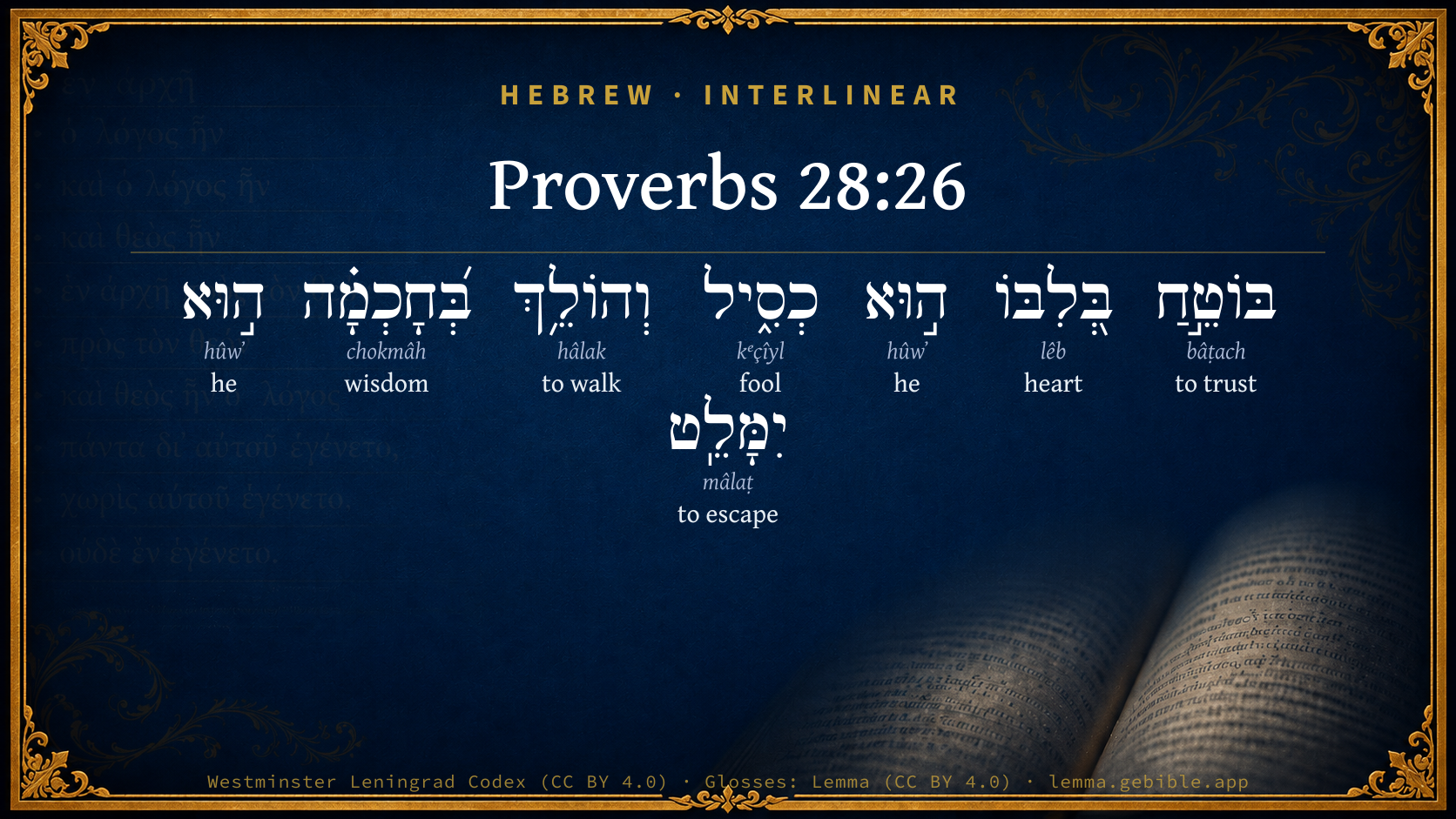
Hebrew (Westminster Leningrad Codex) Proverbs 28:26 appears in the Hebrew Old Testament. The text above is from the Westminster Leningrad Codex. Each word links to its Strong’s number, a concise gloss, and parsing drawn from the Open Scriptures Hebrew Bible morphology. Click any word for its full Brown-Driver-Briggs (BDB) entry.
Download image
Cite this verse

Proverbs 28:26 (World English Bible). Public Domain. Lemma interlinear Bible study tool, https://lemma.gebible.app/v/proverbs/28/26.

Show BibTeX & RIS
BibTeX
RIS
English Translation
One who trusts in himself is a fool; But one who walks in wisdom, he is kept safe.
World English Bible · Public Domain
Download a study sheet

One document with this verse’s original text, its word-by-word gloss line, the meaning frame, cross-references with their text, attributed commentary, and full source and license credits — printable, and it pastes into notes with its structure intact.

This verse Autodidact and up

Study sheet (.html) Plain text (.txt)

A passage Seminary Student

Up to 50 verses in one chapter. A passage sheet keeps up to 6 commentary sources and 12 cross-references per verse, in the order this page ranks them, and says so on the sheet whenever that leaves anything out. Ask for a single verse and you get the Autodidact verse sheet above.

Everything on this page stays free to read, with no account — the sheet is a download of what is already on screen, not access to it.

Want to remove ads? Support Godless Engineer
Compare translations 3

The same verse in 3 English versions, stacked beneath the original-language interlinear above. Click any original word for its lexicon entry.

Each is an independent rendering of the whole verse — the interlinear is not word-aligned to these translations.

Highlighted words mark where these versions differ — a whole-verse word diff, not a word-by-word alignment.

  • World English Bible Public Domain
    One who trusts in himself is a fool; But one who walks in wisdom, he is kept safe.
  • King James Version Public Domain
    He that trusteth in his own heart is a fool: but whoso walketh wisely, he shall be delivered.
  • unfoldingWord Literal Text CC BY-SA 4.0
    One trusting in his heart, he a stupid one, but one walking in wisdom, he himself will flee.

unfoldingWord Literal Text — © unfoldingWord, licensed CC BY-SA 4.0. Word-aligned USFM3 via Door43 (git.door43.org/unfoldingWord/en_ult).

Versions to compare (up to 4)

3 of 4 selected

Show all 18 translations

Every available English version of this verse, each an independent rendering of the whole verse.

  • World English Bible Public Domain
    One who trusts in himself is a fool; But one who walks in wisdom, he is kept safe.
  • Berean Standard Bible Public Domain
    He who trusts in himself is a fool, but one who walks in wisdom will be safe.
  • Majority Standard Bible Public Domain
    He who trusts in himself is a fool, but one who walks in wisdom will be safe.
  • King James Version Public Domain
    He that trusteth in his own heart is a fool: but whoso walketh wisely, he shall be delivered.
  • American Standard Version (1901) Public Domain
    He that trusteth in his own heart is a fool; But whoso walketh wisely, he shall be delivered.
  • Revised Version (1885) Public Domain
    He that trusteth in his own heart is a fool: but whoso walketh wisely, he shall be delivered.
  • Geneva Bible (1599) Public Domain
    Hee that trusteth in his owne heart, is a foole: but he that walketh in wisdome, shall be deliuered.
  • Douay-Rheims (1899) Public Domain
    He that trusteth in his own heart, is a fool: but he that walketh wisely, he shall be saved.
  • Young's Literal Translation Public Domain
    Whoso is trusting in his heart is a fool, And whoso is walking in wisdom is delivered.
  • Literal Standard Version CC BY-SA 4.0
    Whoever is trusting in his heart is a fool, || And whoever is walking in wisdom is delivered.
  • Unlocked Literal Bible CC BY-SA 4.0
    One who trusts in his own heart is a fool, but whoever walks in wisdom will keep away from danger.
  • unfoldingWord Literal Text CC BY-SA 4.0
    One trusting in his heart, he a stupid one, but one walking in wisdom, he himself will flee.
  • Darby Bible Public Domain
    He that confideth in his own heart is a fool; but whoso walketh wisely, he shall be delivered.
  • World Messianic Bible Public Domain
    One who trusts in himself is a fool; but one who walks in wisdom is kept safe.
  • Webster's Bible Public Domain
    He that trusteth in his own heart is a fool: but whoever walketh wisely, he shall be delivered.
  • Free Bible Version CC BY-SA 4.0
    People who trust their own minds are foolish, but those who follow wise ways will be kept safe.
  • Bible in Basic English Public Domain
    He whose faith is in himself is foolish; but everyone walking wisely will be kept safe.
  • JPS Tanakh (1917) Public Domain
    He that trusteth in his own heart is a fool; but whoso walketh wisely, he shall escape.

Literal Standard Version (2020), Covenant Press — licensed CC BY-SA 4.0. Text via the HelloAO Bible API (eBible.org). Unlocked Literal Bible (unfoldingWord) — licensed CC BY-SA 4.0. Text via the HelloAO Bible API (eBible.org). unfoldingWord Literal Text — © unfoldingWord, licensed CC BY-SA 4.0. Word-aligned USFM3 via Door43 (git.door43.org/unfoldingWord/en_ult). Free Bible Version, Dr. Jonathan Gallagher — licensed CC BY-SA 4.0. Text via the HelloAO Bible API (eBible.org).

Word by word

More ways to search: Search by grammar → Find every occurrence → Compare this word →

Practice this passage: Drill this verse → Learn its vocabulary →

About this verse

These counts appear in no published source. They are computed here, from the morphology-tagged text and Lemma’s own curated glosses. What Lemma adds →

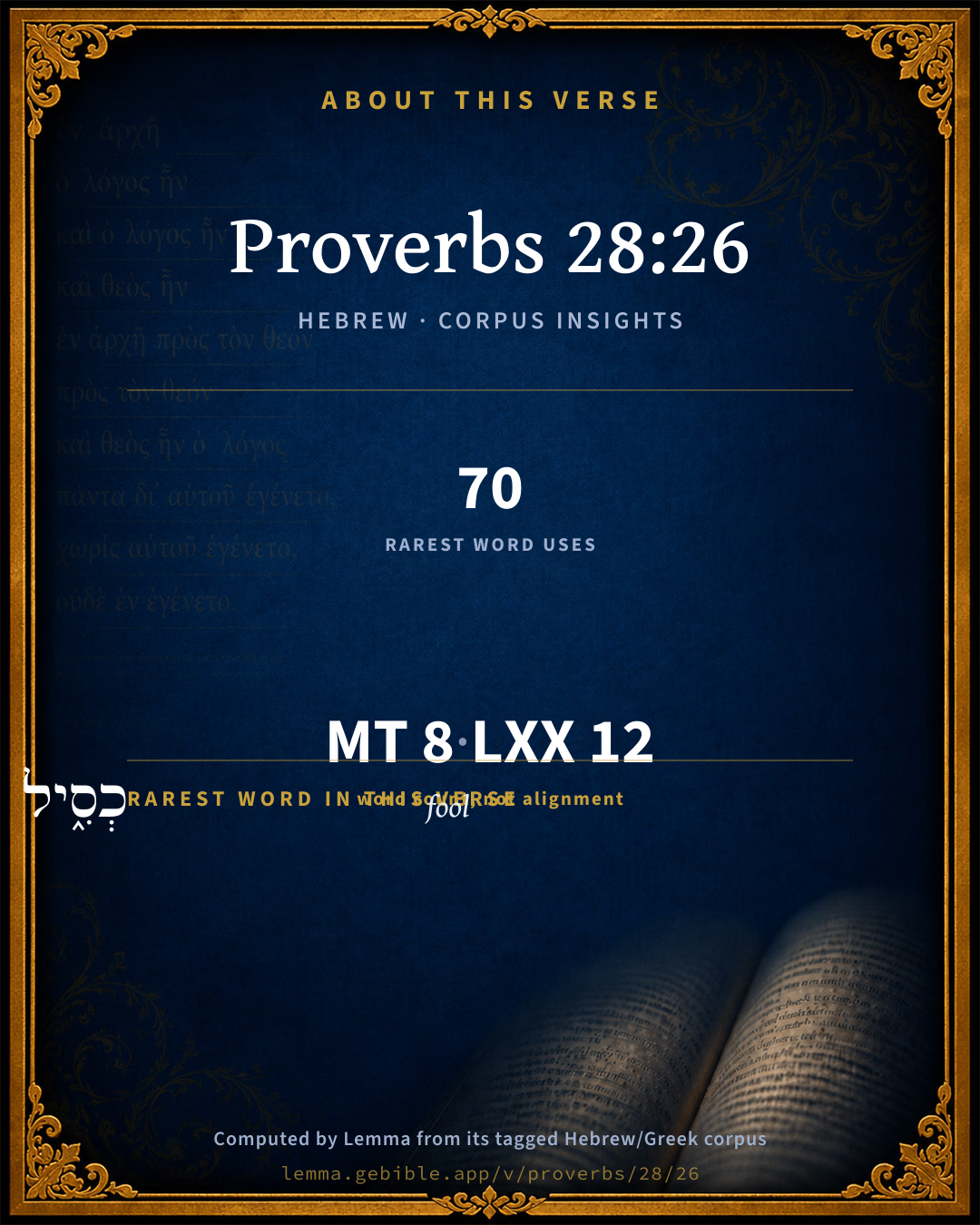
8
words
7
distinct lemmas
Wisdom
section

Grammatical profile

  • 3 verbs
  • 2 nouns
  • 1 adjective
  • 2 pronouns

Verb forms

  • בּוֹטֵ֣חַ Qal · Participle Active
  • וְהוֹלֵ֥ךְ Qal · Participle Active
  • יִמָּלֵֽט Niphal · Imperfect

Repetition

A word recurs within this verse — often emphatic in Hebrew:

  • ה֣וּא he H1931 ×2

Hebrew & Septuagint length

In English translation the verse runs 18 words from the Hebrew and 22 from the Septuagint (LXX English) — closely comparable.

A rough comparison of the two English renderings, which tokenize alike — not a word-level alignment.

Word counts can differ between the Hebrew and the Greek without any difference in meaning — e.g. the Hebrew direct-object marker אֵת has no separate Greek word, and Greek often adds the article ὁ.

In the original languages it is 8 Hebrew tokens and 12 Greek tokens — but the two are counted differently (Hebrew bundles its prefixes and suffixes into one token; the Greek is in lemma form), so that isn’t a like-for-like length.

Cross-references

10

Topical passages linked to Proverbs 28:26 in the Treasury of Scripture Knowledge — connected by theme and wording, ordered by reader-vote popularity; previews shown in the World English Bible.

  • Proverbs 3:5 Trust in Yahweh with all your heart, And don't lean on your own understanding.
  • Jeremiah 17:9 The heart is deceitful above all things, and it is exceedingly corrupt: who can know it?
  • Job 28:28 To man he said, 'Behold, the fear of the Lord, that is wisdom. To depart from evil is understanding.'"
  • Romans 8:7 because the mind of the flesh is hostile towards God; for it is not subject to God's law, neither indeed can it be.
  • James 1:5 But if any of you lacks wisdom, let him ask of God, who gives to all liberally and without reproach; and it will be given to him.
  • Mark 7:21–23 For from within, out of the hearts of men, proceed evil thoughts, adulteries, sexual sins, murders, thefts,
  • 2 Timothy 3:15 From infancy, you have known the sacred writings which are able to make you wise for salvation through faith, which is in Christ Jesus.
  • James 3:13–18 Who is wise and understanding among you? Let him show by his good conduct that his deeds are done in gentleness of wisdom.
  • 2 Kings 8:13 Hazael said, But what is your servant, who is but a dog, that he should do this great thing? Elisha answered, Yahweh has shown me that you shall be king over Syria.
  • Mark 14:27–31 Jesus said to them, "All of you will be made to stumble because of me tonight, for it is written, 'I will strike the shepherd, and the sheep will be scattered.'

Cross-references courtesy of OpenBible.info (CC BY 4.0).

Hebrew and Greek witnesses Masoretic Hebrew ↔ Greek Septuagint

The same verse in the two great witnesses to the Old Testament, shown verse-for-verse.

These are two independent witnesses, not word-aligned to each other, and the Septuagint is shown in lemma (dictionary) form.

Hebrew Proverbs 28:26 Masoretic · Westminster Leningrad Codex

בּוֹטֵ֣חַ בְּ֭לִבּוֹ ה֣וּא כְסִ֑יל וְהוֹלֵ֥ךְ בְּ֝חָכְמָ֗ה ה֣וּא יִמָּלֵֽט

One who trusts in himself is a fool; But one who walks in wisdom, he is kept safe.

World English Bible · Public Domain

Greek LXX Proverbs 28:26 Septuagint · lemma form

ὅς πείθω θρασύς καρδία ὁ τοιοῦτος ἄφρων ὅς δέ πορεύομαι σοφία σώζω

He that trusts to a bold heart, such an one is a fool: but he that walks in wisdom shall be safe.

LXX2012 (modern English Septuagint) · Public Domain

On this verse, The Pulpit Commentary discusses the Septuagint’s reading. Read the note in Commentary ↓

Hebrew: Westminster Leningrad Codex (CC BY 4.0). Greek: Septuagint (public domain); English from LXX2012 (modern English Septuagint) (Public Domain). How the Septuagint differs from the Hebrew →

Commentary

Notes on Proverbs 28:26 from classic Christian and Jewish commentators (each source and its license shown beneath its notes). The classic Christian expositions comment on the surrounding passage and are grouped to its opening verse, so a note may address several verses; the Jewish commentaries on the Tanakh (Rashi and others) are per-verse, so they appear only where the commentator wrote on this verse.

Lemma curates 59 commentaries, every one of them public domain or Creative Commons licensed, each selected and text-cleaned for this edition rather than reprinted as found. About our sources →

Trapp's Complete Commentary

John Trapp

Pro 28:26 He that trusteth in his own heart is a fool: but whoso walketh wisely, he shall be delivered.

Ver. 26. He that trusteth to his own heart is a fool.] He that saith, Consilii satis est in me mihi: I am wise enough to order my own business, and need no advice of others, seek no success from above, - Ajax acknowledged no other God but his sword, Polyphemus but his belly, - this man is a fool, a proud fool, and he shall be sure to be hampered.

But whoso walketh wisely.] Taking others into counsel, and God above all, as David: "I will hearken," saith he, "what the Lord God saith unto me." "He shall be delivered," either from trouble, or in it - either with an outward or an inward deliverance. He shall enjoy a blessed composedness, a sweet sabbath of spirit howsoever, being mediis tranquillus in undis, tranquility in the midist of the waves, as Noah was.

John Trapp, A Commentary or Exposition upon All the Books of the Old and New Testament (1647–1656) — public domain. Text from a community e-Sword module.

The Biblical Illustrator

Joseph S. Exell

Pro_28:26

He that trusteth in his own heart is a fool.

The folly of trusting in our own hearts

I. What is meant by a man trusting his heart. It is--

1. To commit and resign up the entire conduct of his life and actions to the directions of it, as of a guide. A guide should be able to lead and direct him; and a guide should faithfully give the best directions.

II. Wherein the foolishness of it consists. Two things render a trust foolish.

1. The thing which we commit to a trust. We commit three things to the mercy of this trust--the honour of God; our own felicity here; the eternal concernments of our soul hereafter. The honour of God as Creator, Governor, Saviour, and gracious Father; our happiness in this world, both temporal and spiritual. Is the heart worthy of such trust? Nay, it is weak, and so cannot make good a trust. In point of apprehension, it cannot perceive and understand certainly what is good. In point of election, it cannot choose and embrace it. Moreover, it is deceitful, and so will not make good a trust. The delusions of the heart relate to the commission of sin; the performance of duty; a mans conversion or change of his spiritual estate. The heart of man will draw him on to sin by persuading him he can keep it in bounds; by leading him into occasions of sin; by lessening and extenuating it in his esteem. A mans heart will persuade him that a cessation from sin is a plenary conquest and mortification of sin. (R. South.)

Strange self-deception

By what sophistry, what perversity of the understanding, what negligence it is, that the tremendous prospect of eternity and judgment has really so little to do with the formation of our opinions, and the regulation of our conduct. Two propositions may be established by this inquiry.

1. From the deficient practice of those calling themselves Christians, we are by no means justified in the inference that their judgments are not therefore convinced of the truth of the doctrines they profess to believe.

2. If, in defiance of incalculable hopes and terrors of another world, man is still unable to keep that guard over the inclinations of his heart which may secure his innocence, the entire removal of so potent a check could surely have no other tendency than to complete the degradation of his nature, and to dislocate the whole fabric of society.

With regard to the question before us--

1. Although the highest achievement of a course of moral and religious discipline be, to subject our every thought and action to the control of conscience and religion only, yet in every stage short of this highest exaltation of character it is to far inferior impulses that even our most plausible actions owe their birth. In his natural state passion, not principle, forms the mainspring of action. As moral education advances, impulses ripen into knowledge. Where he once only felt, he now reasons. But it will be long ere his original constitution will change its bias. In this intermediate state of moral improvement our conviction may indeed be sincere, but our conduct will still be defective. With the greater part of mankind action almost invariably outruns reflection. If the want of union between reason and appetite be the first source of sin, our amendment must depend upon establishing their connection. One cause of that strange indifference on the subject of religion manifested by many may be traced to that callousness of mind, that apathy arising from satiety, which all of us have felt when our minds for a long period together have been occupied with one predominant idea, however originally interesting. The only remedy we can apply is still the same calculating and systematic counteraction produced by habitual meditation and discipline which we have already recommended. A last inducement to sin is that natural tendency of our constitution, whether intellectual or physical, to adapt itself to the medium in which it is placed, and to vary its own habits and propensities and feelings according to the accidental association of external circumstances. (P. N. Shuttleworth, D.D.)

The height of folly

Let me ask you to look at the closing clause of the previous verse, for it appears to me to have a very immediate relation to our text. He that putteth his trust in the Lord shall be made fat. He that trusteth in his own heart is a fool. On the one hand is Jehovah, all strong, all wise; and on the other ones evilly disposed, vacillating heart. In whom dost thou trust? Those who trust Jehovah become fat and flourishing; He honours their faith, He prospers the work of their hands; but leanness of soul and lack of real blessing must be the result of trusting to ones inner consciousness, or past experience, or anything of self.

I. He that trusteth in his own heart is a fool, because of the divine verdict on the human heart. It is not as though we were left to our own estimate of the natural heart. If we were, since it is natural to us to think well of ourselves, we could hardly be called fools for trusting in these hearts of ours. We have a higher verdict; One who knows, far better than we can, has published the innate character of the human heart. We need not be in ignorance as to what God thinks of us. He is the authority on this matter. He made the heart. True, He did not make it sinful or foolish; He made it pure and holy, prepared for every good word and work. But, knowing as He does how beautiful it was at the outset, He can best judge of the marring of it. He knows, too, that the more beautiful and glorious it was at first, the greater is its wreck and ruin. We are aware of the fact that those things which are most finely constructed, when they do suffer damage suffer very materially. The wreck is all the greater, and repair is more difficult because of the delicacy of construction. Well, God knew how pure the human heart was made, what capabilities it possessed, what possibilities lay latent there. He knows, too, the damage sin has done. God does not look upon the fall as a slight accident which could be easily remedied. What does He say of the human heart as it is, by reason of its sin? He says, Every imagination of the thoughts of his heart was only evil continually. Moreover, God in another place has plainly written, The heart of men is fully set in them to do evil. Have you forgotten that striking word from Jeremiah, The heart is deceitful above all things, and desperately wicked? Well may we say, with the writer of this proverb, He theft trusteth in his own heart is a fool, for he is trusting a deceiver; nay, he is trusting the arch-deceiver, the very chief among the deceivers. Are you going to trust in this heart of yours? Your feelings, your capabilities, your faculties--everything that you like to include in this comprehensive word, are all affected, more or less, by the fall, and yet you are prepared to trust in this rotten reed, this broken staff. When I hear some excuse themselves or their fellows by saying, Oh, well you know, but they are good at heart, I feel like saying, Wherever else they are good, they are not good there, for God Himself declares, There is none righteous, no, not one. So, then, we have got Gods verdict concerning the human heart, and it is so emphatic, and so unflattering, that we say with the author of the proverb, He that trusteth in his own heart is a fool.

II. Secondly, experience warns us in the same direction. We can see for ourselves, if we open our eyes, that those who trust their own hearts are fools. Should we not learn lessons from the falls and follies of others? Let me ask you who have been vigilant, Have you noticed the result of self-confidence in others? Whether it be in business matters, or social affairs, or political questions, or spiritual concerns, to what has unbounded self-confidence led men? They may have run well for awhile. It proved to be only a nine-days wonder. It was as the crackling of thorns under a pot: there was great flare and flame, but it ended in smoke and ashes. I have met with instances, not a few, in which men have thus overrun themselves, and become filled with their own ways. It seems to me as if a Nemesis followed them. God virtually says to them, Well, you believe in yourself; I will leave you to yourself; you trust your own heart, you can do without Me; you ask for independence--you shall have it. These men have not succeeded--they have come to grief; their supposed righteousness and self-merit did not provide them with shelter in the day of storm; it was a refuge of lies. Are you going to follow their example? Are you likely to succeed where they have failed? Such matters are influenced by certain inexorable laws. A Nemesis pursues those who proudly trust their native strength. Besides, you have had some experience of your own, have you not? Is there anybody here who has not had a try at trusting his own heart?

III. I must point out to you that self-trust is quite unnecessary. I can conceive that, if we were shut up to trusting our own hearts, we might be excused for doing it. God knows we must trust somebody or something! Is there not in us all the clinging tendency, a desire to get hold of somebody or something, a craving for sympathy? If there were no outside helper, stronger than ourselves, what else could we rely on but our experiences and our feelings? But there is something else infinitely better to trust to. We have no excuse for such folly as this; we are not shut up to self-confidence; there is an alternative. If I saw one on the shore launching a leaky boat upon a troubled sea, I should say to him, Fool that thou art, to go to sea in such a sieve as that! Well, but, says he, I must go to sea, necessity is laid upon me--and there is no boat but this. In that case I could only pity him: if he must embark, what can the poor fellow do but take his chance in the leaky cockleshell? Ah, but this is not our case at all. You must go to sea, and it is stormy, too, but you need not embark in this leaky craft of your own heart. Gods own lifeboat stands alongside you; nay, it is already launched. You have but to leap into it; it will outride the roughest sea, and weather every storm. I do not know how it is that some people will not trust God till they are obliged to. You who have not yet got rid of sin and of its condemnation, why not trust Jehovah? Why not believe on the Lord Jesus Christ, and be saved? I know you are trusting to your own heart. You say to yourself, I do not think it is so bad after all. Sometimes it is really first-rate. Another says, Well, my heart is not up to the mark, I know, but it is better than it was! Well, really, friend, I am glad to hear that; but when it is at its best it is, by no means, reliable. I pray you do not say, I think it will come all right at last. It is folly thus to talk. Look away to Jesus; trust not your own heart, but in the living God. And you, who have been brought out of darkness into His marvellous light, surely you are not going to play the fool by trusting your own heart. You, you of all men, ought to know better. You are going back to where you were at first, to self-righteousness, and self-trust! Well, I leave this question with you; are you able, despite all the experience you have had, to steer your craft across lifes trackless sea, and how can you hope to outride the breakers of judgment that break upon the further shore? (Thomas Spurgeon.)

Folly of self-confidence

I. The evil the text refers to. The heart here signifies the whole soul. Trusting in it means to rest on its sufficiency; to depend upon it in the various circumstances in which we may be placed. It includes--

1. A reliance upon our own wisdom in the concerns of life.

2. To adopt our own schemes of religion. By affirming the sufficiency of nature and reason. By admitting into his creed nothing but what his imperfect mind can understand. By placing all his hopes on excited feelings and warm emotions. By adding to, or diminishing from, Christs holy doctrines, ordinances, or commands.

3. To confide in the moral goodness of our own hearts. The Christian also trusts in his own heart when--

4. He relies upon his own skill or power in temptation and trouble.

II. The declaration made concerning this evil. Is a fool. This is obvious--

1. If we appeal to reason.

2. To the heart itself.

3. To examples.

4. To our own experience. (J. Burns, D.D.)

Self-sufficiency and godly confidence

I. Self-sufficiency. Seen as pride, and as self-trust. Two things indicated. It is mischievous. It is foolish.

II. Godly confidence. Trust in God implies a knowledge of Him, an appreciation of His transcendent excellences, and a consciousness of His willingness and ability to sustain us. This trust leads to prosperity. (Homilist.)

The folly of self-trust

1. This maxim is justified by the description which Jeremiah gives: The heart is deceitful above all things and desperately wicked; who can know it? For if it be indeed such as it is there represented, assuredly the heart cannot be trustworthy. And that the prophets description is but too correct must appear abundantly evident to all who have ever sincerely and seriously engaged in the difficult task of self-examination. The very difficulty of the task proves how full the heart which is the subject of it must be of treachery and of secret vice.

2. This maxim is also abundantly justified and confirmed by universal experience, and may be illustrated experimentally.

I. One striking proof we have in our proneness to relapse into sins of which we fancied, perhaps, that we had long ago fairly repented. He makes at once his prompt yet firm choice between God and the world. But soon his evil heart of unbelief tempts him again to depart from the living God.

II. Another practical and experimental proof of the wise mans assertion we have in the various turns of the believers struggle with indwelling sin.

III. We pass from the Christians continual struggle with the sin that dwelleth in him to the resolute stand which he is called upon to make against the evil that is in the world. Confessing that our corrupt inclinations still long for certain forbidden indulgences, we yet heedlessly loiter still within sight and within reach of the glittering prize, though we feel our longing becoming daily more intense, and our power to resist it daily giving way.

IV. One other instance of this folly we may mention: our proneness to rely on the amount of our attainments, the sufficiency and the stability of our own conscious and confirmed integrity. We easily forget the imperfection which adheres to our best services and our best qualities, and please ourselves with the idea that some one favourite Christian virtue, at least, is now strong enough for any emergency. And from the very instant in which such an idea begins to prevail between us, that particular virtue may be pronounced the feeblest and most precarious of all that we have. A slight change of circumstances--some very trifling accident, unforeseen and unexpected--a new temptation suddenly assailing us--may lay the proud structure in the dust, and teach us how vain it is to trust in any degree of excellence, in any height of Christian perfection. (R. S. Candlish, D.D.)

Self-deceit

Whosoever trusts his own heart as his light, adviser, and guide, in the complex ways and actings of life, is a fool. Half the wisdom of the wise is in the choice of their advisers. Wise men discern wisdom in others, and call them to council; the wisest man is he who least trusts himself alone. He knows the difficulties of life and its intricacies, and gathers all the lights he can and casts them upon his own case. He must in the end act on his own responsibility; but he seeks all counsellors, the experienced and impartial, sometimes the opposed and unfriendly, that he may be aware on all sides; for in the multitude of counsellors is safety. But it may be asked, Is not the heart Gods creation and Gods gift? Did He not plant eyes in it, and give to it light and discernment to guide our ways? Is it not our truest personal guide, given to each one of us by God Himself? Why must a man who trusts his own heart be a fool?

1. Because our hearts--that is, we ourselves--are ignorant of ourselves. If we knew ourselves, we should not trust ourselves; we do so because we do not know what we are. We are by nature, and still more by personal act, sinners. And sin blinds the heart: so that the more sinful the less it knows its sinfulness; for like death, which is most evidently perceived by the living, not at all by the dead, and by the dying only in the measure in which their living consciousness is still retained, so it is with sin dwelling in us. Where is the worldly man who in matters of honour and dishonour, right and wrong, sin and duty, wisdom and folly, religion and faith, death and judgment, heaven and hell, does not with confident assurance trust his own heart? But in the sight of God such a man is a fool.

2. Not only is the heart ignorant of itself, but it deceives itself. Of course these cannot be altogether separated. Every one who is ignorant is, in one sense, a self-deceiver; and yet it may not be with any laboured illusion. Ignorance is absence of light; self-deceivers have light, and visions in that light; but those visions are illusions. Ignorance is the danger of unawakened minds; self-deceit of the awakened.

(1) What is more common than to see men characteristically marked by one sin which they pointedly censure in others, and from which they believe themselves to be absolutely free? These unsuspected sins are almost universally the faults of childhood and early youth, which have become habitual and unconscious; for instance, personal vanity, selfishness, a difficult and disputatious temper, impatience, resentment, unreality, or the like. And they who have these faults in them by long habit generally excuse themselves by ascribing the same to others on whom they have inflicted them; as if the wind should chide the roughness of the sea for disturbing its repose, all the while believing itself to be at rest.

(2) The same effect which appears in casual temptations is more dangerously produced in deliberate motives and lines of conduct. An early habit of personal vanity, or desire of wealth, sometimes unconsciously governs a persons whole life. The same is true of worse passions, such as jealousy, envy, resentment, etc.

(3) The gravest part still remains; I mean the deceit we practise upon ourselves as to our state before God. The same unconsciousness which conceals from us our habitual sins, such as anger or envy, conceals also the impatience and stiffness of our will towards God, and our want of gratitude and love, our undevotion and sluggishness in the spiritual life. All these, having been upon us from our earliest memory, have become our natural, our normal state. Such a heart becomes, at last swathed in its own self-trust; and we watch it as we do the rash motions of a man who walks blindfold, reeling in the midst of dangers, which might sometimes for a moment provoke our mirth, if it did not always excite alarm.

2. Another reason why to trust our own hearts is a note of folly is because they flatter us. How long have we gone on persuading ourselves that we are meek, poor in spirit, makers of peace, merciful, patient, and the like, because we assent in desire and will to the Beatitudes, and would fain share in their benedictions! How long have we persuaded ourselves that we pray both often and enough, earnestly, and with devotion; that we love God above all, and above all desire so to love Him; that our life is, on the whole, not unlike the great Example of humility; and that we know our own hearts better than any one can tell us! And yet what does this last persuasion show? Why are we so sensitive under a reproof? Why do we accuse ourselves freely of all faults but the one imputed? Why are we never guilty in the point suspected? Why do we wholly guide ourselves, and feel so great security in our own direction? but because we trust our own hearts. Out of this proceeds our visions of devotion, our imaginations of sanctity. It is a forge never cold, always at work, forming and fashioning devices which please us by their fair and shapely forms, and flatter us because they are a homage to ourselves.

Lessons:

1. The greatest security against deceiving ourselves by trusting our own hearts is a careful information of conscience. But this plainly runs beyond the period of our responsibility into the account of those to whom our childhood was subject. Our chief difficulty is in the attempt to analyse the confused and hardened mass of self, neglected for twenty, thirty, half a hundred years; to unravel a world of knots and entanglements; to find the beginning of the clue. Self-examination begun late in life must remand the chief part of its discoveries to the day of judgment.

2. The other security is the only one which remains to those who have never enjoyed the first; and that is to take the judgment of some other persons instead of trusting in themselves. It will be, no doubt, painful and distressing; it will bring shame and burning of face. But is not the stake worth the cost? (Archdeacon Manning.)

.

The Biblical Illustrator, edited by Joseph S. Exell (c. 1880s–1900s) — public domain. Text from a community e-Sword module.

Joseph Benson's Commentary

Pro 28:26. He that trusteth in his own heart — In his own wisdom and counsels, his own strength and sufficiency, his own merit and righteousness, or the good opinion he hath of his own abilities, natural or acquired, neglecting or slighting the advice of others, or the counsel of God; is a fool — And shall receive the reward of his folly, namely, destruction. But whose walketh wisely — Distrusting his own judgment, and seeking the advice of others, and especially of God, as all truly wise men do; he shall be delivered — From those dangers and mischiefs which fools bring upon themselves; whereby he shows himself to be a wise man.

Joseph Benson's Commentary on the Old and New Testaments (1811–1818) — public domain. Text from a community e-Sword module.

Tyndale Open Study Notes

Tyndale Open Resources

28:26 The one who walks in wisdom listens to the advice of others; those who trust their own insight show themselves foolish.

Tyndale Open Study Notes — © Tyndale Open Resources, licensed CC BY-SA 4.0. Text via the HelloAO Bible API.

Matthew Henry's Commentary

Here is, 1. The character of a fool: He trusts to his own heart, to his own wisdom and counsels, his own strength and sufficiency, his own merit and righteousness, and the good opinion he has of himself; he that does so is a fool, for he trusts to that, not only which is deceitful above all things (Jer 17:9), but which has often deceived him. This implies that it is the character of a wise man (as before, Pro 28:25) to put his trust in the Lord, and in his power and promise, and to follow his guidance, Pro 3:5, Pro 3:6. 2. The comfort of a wise man: He that walks wisely, that trusts not to his own heart, but is humble and self-diffident, and goes on in the strength of the Lord God, he shall be delivered; when the fool, that trusts in his own heart, shall be destroyed.

Matthew Henry's Commentary on the Whole Bible (1708–1710) — public domain (CC PDM 1.0). Text via the HelloAO Bible API.

Jamieson, Fausset & Brown

Robert Jamieson, A. R. Fausset & David Brown

(Compare Pro 3:6-8).

walketh wisely--that is, trusting in God (Pro 22:17-19).

Jamieson, Fausset & Brown — Commentary Critical and Explanatory on the Whole Bible (1871) — public domain (CC PDM 1.0). Text via the HelloAO Bible API.

Adam Clarke's Commentary

Verse 26. He that trusteth in his own heart is a fool] For his heart, which is deceitful and desperately wicked, will infallibly deceive him.

Adam Clarke's Commentary on the Bible (1810–1826) — public domain. Text from a community e-Sword/MySword module.

Ellicott's Commentary for English Readers

(26) He that trusteth in his own heart, is confident in his own wisdom (comp. 1Co_3:18, sqq.); he will perish in his folly.

But whoso walketh wisely.—Literally, in wisdom, which begins with the “fear of the Lord” (Pro_9:10), “shall be delivered” from the trouble into which the “fool” is brought by his self-confidence.

A Bible Commentary for English Readers, edited by Charles John Ellicott (1878–1897) — public domain. Text from a community e-Sword module.

John Gill's Exposition

He that trusteth in his own heart is a fool,.... Since the thoughts and imaginations of the thoughts of the heart are only evil, and that continually; they are vain and vague, sinful and corrupt; the affections are inordinate, the conscience defiled, the understanding darkened, and the will perverse; there is no good thing in it, nor any that comes out of it, but all the reverse; it is deceitful and desperately wicked: he must be a fool, and not know the plague of his heart, that trusts in it; and even for a good man to be self-confident, and trust to the sincerity of his heart, as Peter did, or to the good frame of the heart, as many do, is acting a foolish part; and especially such are fools as the Scribes and Pharisees, who trusted in themselves that they were righteous, and despised others, when a man's best righteousness is impure and imperfect, and cannot justify him in the sight of God; it is moreover a weak and foolish part in men to trust to the wisdom and counsel of their heart, to lean to their own understanding, even it, things natural and civil, and not to ask wisdom of God, or take the advice of men, and especially it, things religious and sacred; see Pro 3:5;

but whoso walketh wisely; as he does who walks according to the rule of the divine word; who makes the testimonies of the Lord his counsellors; who consults with his sacred writings, and follows the directions of them; who walks as he has Christ for his pattern and example, and makes the Spirit of God his guide, and walks after him, and not after the flesh; who walks with wise men, and takes their advice in all matters of moment, not trusting to his own wisdom and knowledge; who walks as becomes the Gospel of Christ, and in all the ordinances of it; who walks inoffensively to all men, and so in wisdom towards them that are without, and in love to them who are within; who walks circumspectly, not as fools, but as wise, redeeming the time;

he shall be delivered; he shall be delivered from the snares of his own deceitful heart, which he will not trust; and from the temptations of Satan; and from all afflictions and troubles he meets with in the way; and from a final and total falling away; and from eternal death and destruction: "he shall be saved", as some versions render it, even with an everlasting salvation. The Targum is,

"he shall be protected from evil.''

John Gill's Exposition of the Whole Bible (1746–1763) — public domain (CC PDM 1.0). Text via the HelloAO Bible API.

Albert Barnes' Notes on the Bible

The contrast between the wisdom of him who trusts in the Lord, and the folly of self-trust.

Albert Barnes' Notes on the Bible (1834–1885) — public domain. Text from a community e-Sword/MySword module.

Matthew Poole's English Annotations

He that trusteth in his own heart; who trusts to his own wit, neglecting or slighting the advice of others, and the counsel of God himself.

Is a fool; and shall receive the fruit of his folly, to wit, destruction.

Whoso walketh wisely, distrusting his own judgment, and seeking the advice of others, and especially of God, as all truly wise men do, he shall be delivered from those dangers and mischiefs which fools bring upon themselves; whereby he showeth himself to be a wise man.

Matthew Poole's English Annotations on the Holy Bible (1683–1685) — public domain. Text from a community e-Sword/MySword module.

Whedon's Commentary on the Bible

Daniel D. Whedon

26. He that trusteth — From the apparent lack of antithesis in these two proverbs (25 and 26) one might conjecture that they constituted a quatrain, with the alternate or inverted parallelisms; the continuous sense to be found by reading thus: —

He that is of a haughty spirit, stirreth up contention,

But he that walketh wisely shall escape.

He that trusteth in himself is a fool,

But he that trusteth in Jehovah shall be prosperous.

Daniel D. Whedon (gen. ed.), Commentary on the Old and New Testaments (1874–1909) — public domain. Text from a community e-Sword module.

The Pulpit Commentary

He that trusteth in his own heart is a fool. (see Gen_6:5 Gen_8:21) What is here censured is that presumptuous confidence in one"s own thoughts, plans, and imaginations which leads a man to neglect both God"s inspirations and the counsel of others. (comp. ver. 14; Pro_14:16) "Let him that thinketh he standeth take heed lest he fail". (1Co_10:12) Septuagint, "Whoso trusteth to a bold heart, such a one is a fool." Whoso walketh wisely, he shall be delivered. This man looks outside himself for direction; be trusts in the wisdom which is from above; he walks in the fear of the Lord, and is saved from the dangers to which self-confidence exposes the fool. The best commentary on the gnome is Jer_9:23, Jer_9:24, "Let not the wise man glory in his wisdom, neither let the mighty man glory in his might, let not the rich man glory in his riches: but let him that glorieth glory in this, that he understandeth and knoweth me, that I am the Lord which exercise loving kindness, judgment, and righteousness, in the earth: for in these things I delight, saith the Lord.

The folly Of trusting one"s own heart.

I WHAT IT IS TO TRUST IN ONE"S OWN HEART.

1. It is to trust in one"s own wisdom. The heart here, as throughout the Bible, stands for the intellectual as well as the emotional nature. Therefore we may be said to trust in it when we lean to our own understanding (Pro_3:5) rather than seek counsel from God in prayer and the use of the Scriptures.

2. It is to trust in our own character. We may think highly of our own goodness and moral strength, and so venture into temptation needlessly or rush into difficult enterprises without counting the cost.

3. It is to trust in our own affections. Thus we are led to believe, like Peter, that our love to Christ will not fail. (Mat_26:35)

4. It is to trust in our own energy. Thinking we can do more than we are capable of accomplishing, through over-estimating our mental or spiritual powers we unduly rely on our own resources.

II HOW ONE IS TEMPTED TO TRUST IN ONE"S OWN HEART.

1. Pride tempts. It is humiliating to own weakness. A high opinion of one"s own merits inevitably leads to a dangerous self-confidence.

2. Unbelief tempts. If men had more faith in God they would not be so content to rely on their own poor resources. It is the worldly spirit that leads to the limitation of view to human powers.

3. Self-will tempts. Men naturally desire to have their own will fulfilled. The less they look away from themselves, the more does it appear that they can do as they like. A selfish life tends to be a self-contained life.

III WHY IT IS FOOLISH TO TRUST IN ONE"S OWN HEART.

1. The heart is deceitful. "Deceitful above all things".We (Jer_17:9) do not know our own hearts. There are hidden weaknesses, unsuspected snares, unlooked for limits. Ignorance of our own inner selves makes the self-trust a confidence without foundation.

2. The heart is sinful. "Desperately wicked". (Jer_17:9) Too often he who trusts in his own heart trusts in an evil heart. Therefore he is likely to be led astray by his thoughts and desires. Until the heart is cleansed and renewed, the worst possible course is to trust it. On the contrary, it must be distrusted, resisted, restrained.

3. The heart is frail. Even when it has been freed from the dominion of sin, the heart of man is liable to fall. open to temptation, and in danger of yielding in the moment of trial.

IV IN WHAT WAY ONE CAN AVOID TRUSTING IN HIS OWN HEART. It is not enough to see the danger and folly of this trust, for a man must have something to rest upon, and if the best foundation is unstable he will still build upon it rather than abandon himself to despair. Now, the cure for the tendency to trust in a wrong security is to be found in the possession of a better faith, a faith that is wise and safe. One great mischief of a man"s trusting in his own heart is that he is thus led to forsake God. The remedy is found in returning to the true ground of the soul"s confidence in God. He who thus trusts is wise.

1. God is true. Unlike the fickle heart, he is faithful and can always be trusted.

2. God is good. Therefore we should turn from the sinful heart to the holy and gracious God.

3. God is strong. The frail heart fails; the mighty God is a steadfast Rock.

Folly and wisdom in the personal relation.

I THE PRINCIPLE OF FOLLY IS LIFE IN AND FOR SELF ALONE. The thought that is superior to counsel and comparison with other minds; the feeling which shuts out consideration and sympathy; the will which would act as if it knew no law but its own; these are manifestations of that folly which is at once immoral and irreligious.

II PRACTICAL WISDOM WELL COMPARED TO A WALK. This is the rising in thought towards universal truth. It is governed by the pulse of charity in the soul; it moves towards all worthy Divine and human ends. In folly we advance to perdition, in aiming at our weal, in wisdom, renouncing self, we enter blessedness. J.

The Pulpit Commentary (1880–1919), ed. H.D.M. Spence-Jones & Joseph S. Exell — public domain. Text from a community e-Sword module.

John Wesley's Explanatory Notes

Wisely - Distrusting his own judgment, and seeking the advice of others, and especially of God.

John Wesley, Explanatory Notes Upon the Whole Bible (1754–1765) — public domain. Text via the GEBible commentary corpus.

Keil & Delitzsch

C. F. Keil & F. Delitzsch

The following proverb assumes the בטח of the foregoing:

(Note: We take the opportunity of remarking that the tendency to form together certain proverbs after one catchword is found also in German books of proverbs; vid., Paul, Ueber die urspr. Anord. von Friedanks Bescheidenheit (1870), p. 12.)

26 He that trusteth in his own heart is a fool;

But he that walketh in wisdom shall escape.

From the promise in the second line, Hitzig concludes that a courageous heart is meant, but when by itself לב never bears this meaning. He who trusteth in his own heart is not merely one who is guided solely "by his own inconsiderate, defiant impulse to act" (Zckler). The proverb is directed against a false subjectivity. The heart is that fabricator of thoughts, of which, as of man by nature, nothing good can be said, Gen 6:5; Gen 8:21. But wisdom is a gift from above, and consists in the knowledge of that which is objectively true, that which is normatively godlike. הלך בּחכמה is he who so walks that he has in wisdom a secure authority, and has not then for the first time, when he requires to walk, need to consider, to reckon, to experiment. Thus walking in the way of wisdom, he escapes dangers to which one is exposed who walks in foolish confidence in his own heart and its changeful feelings, thoughts, imaginations, delusions. One who thoughtlessly boasts, who vainly dreams of victory before the time, is such a person; but confidence in one's own heart takes also a hundred other forms. Essentially similar to this proverb are the words of Jer 9:22., for the wisdom meant in 26b is there defined at Jer 9:23.

Keil & Delitzsch — Biblical Commentary on the Old Testament (1861–1891) — public domain (CC PDM 1.0). Text via the HelloAO Bible API. (Old Testament only.)

Bridges on Proverbs

Charles Bridges

Contrast the sound and fruitful confidence just mentioned, with man’s natural trust. Our confidence determines our state. (Mat 7:24-27 .) To trust an impostor, who has deceived us an hundred times, or a traitor, who has proved himself false to our most important interests, is surely to deserve the name of fool. This name therefore the Scriptures — "using great plainness of speech" — give to him that trusteth in his own heart. Well does Bishop Hall call it, ’The great Impostor.’†1 For has it not been practicing a system of deceit upon us from the first moment of consciousness? Yes, verily, the traitor finds his home in our own bosom, prompting, in concert with our deadly enemy, the most elaborate efforts for self-destruction.

The wise man awfully illustrates his own Proverb. It must have been some bitter root of self-confidence, that prostrated his wondrous wisdom in the lowest degradation (1Ki 11:1-8 .) Peter also — how did he befool himself in his trust! Presuming upon "the willingness of the spirit," and forgetting his Lord’s most needful caution against "the weakness of the flesh;" though named a Rock, he fell as a reed before the first breath of temptation. Had not the everlasting arms been underneath, it would have been the fall of Judas into the depths of hell. An instructive lesson to shew us, that all dependence upon feelings, impulse, native strength, sincere purpose or conviction — is vain confidence. Sad experience has convinced us of this. Yet in the blindness of our folly, we are ever ready to trust again, if the Lord prevent not, to our ruin.

Truly, as good Bishop Wilson remarks — ’there is no sin, which a man ought not to fear, or to think himself capable of committing, since we have in our corrupt will the seeds of every sin.’ None of us can safely presume, that his heart may not hurry him into abominations, that he cannot now contemplate without horror. (2Ki 8:13-15 .) If Eve in a state of innocence could believe a serpent before her Maker;†2 if "the saint of the Lord" could worship the golden calf;†3 if "the man after God’s own heart" could wallow in adultery, murder, and deceit;†4 if the wisest of men, and the warm-hearted disciple just referred to, could sink so low — what may not we do? Surely "all men are liars." The best of men, when left to themselves, are mournful spectacles of weakness and instability.

Blessed be our God! our standing is not on the uncertainty of man’s best purpose; but upon the faithful promise, the unchangeable will, the free grace, and almighty power of God; not therefore on ourselves, but on the Rock, on which the Church is immovably built. We value then a deep knowledge of our indwelling weakness and corruption. Painful and humbling as it is, it is establishing to our faith; and grounds us in the gospel far better than walking over the mere surface. This study of the heart strengthens the principle of that holy fear, which enables us to walk wisely, and thus delivers us from the evils of a self-confident state. Indeed in a path, where every step is strewed with snares, and beset with enemies, great need have we of the caution — "Walk circumspectly" — "looking on all sides" — "not as fools, but as wise."†5 A sound confidence is a proof of wisdom. Be willing that the Lord should disappoint us of the most plausible and inviting pleasure, into which we may have been drawn by the dictates of our own heart. Let it be a standing maxim in religion to cultivate self-distrust; never to suppose security, where God warns us of danger, never to trust ourselves with our own keeping. We are too weak needlessly to expose ourselves to hazard. We cannot pray — "Lead us not into temptation" — when we are rushing headlong into it — or — "Deliver us from evil" — when we seem to invite its approach.†6

Footnotes:

†1 Title of Sermon on Jer 17:9 . See Bunyan’s Discourse between Christian and Ignorance.

†2 Gen 3:1-6.

†3 Exo 32:2-5, with Psa 106:16 .

†4 2Sa 11:4, 2Sa 11:17 .

†5 Eph 5:15. Compare Pro 3:5-6 .

†6 Mat 6:13, with Mat 26:41 .

Charles Bridges, An Exposition of the Book of Proverbs (1846) — public domain. Text from a community e-Sword module.

Lesson kit

Teaching starters — assembled from the data on this page, not authored interpretation. Every prompt links to the verse data it draws on. Edit before teaching.

Proverbs, in the Wisdom, opens this verse with 8 words (7 distinct Hebrew lemmas). Its most distinctive word is kᵉçîyl (“fool”). A historical commentator’s framing appears above. Read the whole chapter for the surrounding context.

Discussion questions

  1. What does “fool” (kᵉçîyl) contribute to the verse as a whole?
  2. How does Proverbs 3:5, which shares this passage’s theme, read alongside this verse?
  3. What does the repetition of “he” (2× in this one verse) do in this verse?
  4. These translations render this verse differently. What is at stake in choosing one wording over another?
  5. «בּוֹטֵ֣חַ» is a Qal Participle Active verb. How does that grammatical form shape the action described?
  6. Compare how Trapp's Complete Commentary and The Biblical Illustrator read this verse. Where do they agree or differ?

Things to notice

Reading settings

Reading text

Shown beneath each verse's original-language words.

Old Testament
Old Testament edition

Read the OT as the Masoretic Hebrew (MT) or the Greek Septuagint (LXX).

English shown for the Greek Septuagint (in the Hebrew ↔ Greek comparison).

Comparing translations? Open the Compare panel on any verse page to stack up to four side by side.