Jeremiah 17:5

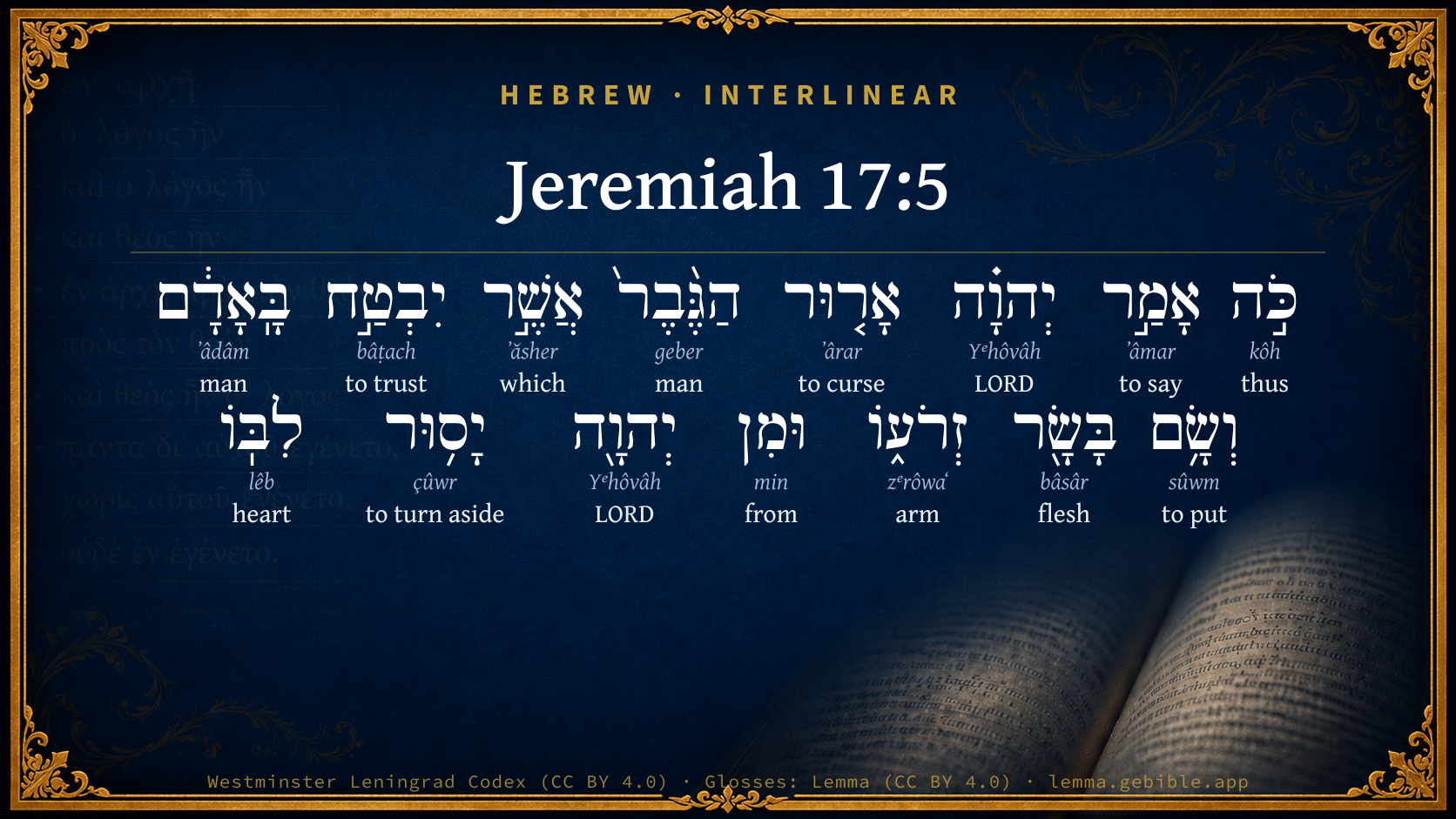
Hebrew (Westminster Leningrad Codex) Jeremiah 17:5 appears in the Hebrew Old Testament. The text above is from the Westminster Leningrad Codex. Each word links to its Strong’s number, a concise gloss, and parsing drawn from the Open Scriptures Hebrew Bible morphology. Click any word for its full Brown-Driver-Briggs (BDB) entry.
Download image
Cite this verse

Jeremiah 17:5 (World English Bible). Public Domain. Lemma interlinear Bible study tool, https://lemma.gebible.app/v/jeremiah/17/5.

Show BibTeX & RIS
BibTeX
RIS
English Translation
Thus says Yahweh: Cursed is the man who trusts in man, and makes flesh his arm, and whose heart departs from Yahweh.
World English Bible · Public Domain
Download a study sheet

One document with this verse’s original text, its word-by-word gloss line, the meaning frame, cross-references with their text, attributed commentary, and full source and license credits — printable, and it pastes into notes with its structure intact.

This verse Autodidact and up

Study sheet (.html) Plain text (.txt)

A passage Seminary Student

Up to 50 verses in one chapter. A passage sheet keeps up to 6 commentary sources and 12 cross-references per verse, in the order this page ranks them, and says so on the sheet whenever that leaves anything out. Ask for a single verse and you get the Autodidact verse sheet above.

Everything on this page stays free to read, with no account — the sheet is a download of what is already on screen, not access to it.

Want to remove ads? Support Godless Engineer
Compare translations 3

The same verse in 3 English versions, stacked beneath the original-language interlinear above. Click any original word for its lexicon entry.

Each is an independent rendering of the whole verse — the interlinear is not word-aligned to these translations.

Highlighted words mark where these versions differ — a whole-verse word diff, not a word-by-word alignment.

  • World English Bible Public Domain
    Thus says Yahweh: Cursed is the man who trusts in man, and makes flesh his arm, and whose heart departs from Yahweh.
  • King James Version Public Domain
    Thus saith the LORD; Cursed be the man that trusteth in man, and maketh flesh his arm, and whose heart departeth from the LORD.
  • unfoldingWord Literal Text CC BY-SA 4.0
    Thus says Yahweh, “Cursed is the man who trusts in mankind; and makes flesh his arm, and turns away his heart from Yahweh.

unfoldingWord Literal Text — © unfoldingWord, licensed CC BY-SA 4.0. Word-aligned USFM3 via Door43 (git.door43.org/unfoldingWord/en_ult).

Versions to compare (up to 4)

3 of 4 selected

Show all 18 translations

Every available English version of this verse, each an independent rendering of the whole verse.

  • World English Bible Public Domain
    Thus says Yahweh: Cursed is the man who trusts in man, and makes flesh his arm, and whose heart departs from Yahweh.
  • Berean Standard Bible Public Domain
    This is what the LORD says: “Cursed is the man who trusts in mankind, who makes the flesh his strength and turns his heart from the LORD.
  • Majority Standard Bible Public Domain
    This is what the LORD says: “Cursed is the man who trusts in mankind, who makes mere flesh his strength and turns his heart from the LORD.
  • King James Version Public Domain
    Thus saith the LORD; Cursed be the man that trusteth in man, and maketh flesh his arm, and whose heart departeth from the LORD.
  • American Standard Version (1901) Public Domain
    Thus saith Jehovah: Cursed is the man that trusteth in man, and maketh flesh his arm, and whose heart departeth from Jehovah.
  • Revised Version (1885) Public Domain
    Thus saith the LORD: Cursed is the man that trusteth in man, and maketh flesh his arm, and whose heart departeth from the LORD.
  • Geneva Bible (1599) Public Domain
    Thus saith the Lord, Cursed be the man that trusteth in man, and maketh flesh his arme, and withdraweth his heart from the Lord.
  • Douay-Rheims (1899) Public Domain
    Thus saith the Lord: Cursed be the man that trusteth in man, and maketh flesh his arm, and whose heart departeth from the Lord.
  • Young's Literal Translation Public Domain
    Thus said Jehovah: Cursed `is' the man who doth trust in man, And hath made flesh his arm, And from Jehovah whose heart turneth.
  • Literal Standard Version CC BY-SA 4.0
    Thus said YHWH: “Cursed [is] the man who trusts in man, || And has made flesh his arm, || And whose heart turns from YHWH.
  • Unlocked Literal Bible CC BY-SA 4.0
    Yahweh says, “The person who trusts in mankind is accursed; he makes flesh his strength but turns his heart away from Yahweh.
  • unfoldingWord Literal Text CC BY-SA 4.0
    Thus says Yahweh, “Cursed is the man who trusts in mankind; and makes flesh his arm, and turns away his heart from Yahweh.
  • Darby Bible Public Domain
    Thus saith Jehovah: Cursed is the man that confideth in man, and maketh flesh his arm, and whose heart departeth from Jehovah.
  • World Messianic Bible Public Domain
    The LORD says: “Cursed is the man who trusts in man, relies on strength of flesh, and whose heart departs from the LORD.
  • Webster's Bible Public Domain
    Thus saith the LORD; Cursed be the man that trusteth in man, and maketh flesh his arm, and whose heart departeth from the LORD.
  • Free Bible Version CC BY-SA 4.0
    This is what the Lord says: Cursed are those who put their confidence in human beings, who trust in human strength and give up relying on the Lord.
  • Bible in Basic English Public Domain
    This is what the Lord has said: Cursed is the man who puts his faith in man, and makes flesh his arm, and whose heart is turned away from the Lord.
  • JPS Tanakh (1917) Public Domain
    Thus saith the LORD: Cursed is the man that trusteth in man, and maketh flesh his arm, and whose heart departeth from the LORD.

Literal Standard Version (2020), Covenant Press — licensed CC BY-SA 4.0. Text via the HelloAO Bible API (eBible.org). Unlocked Literal Bible (unfoldingWord) — licensed CC BY-SA 4.0. Text via the HelloAO Bible API (eBible.org). unfoldingWord Literal Text — © unfoldingWord, licensed CC BY-SA 4.0. Word-aligned USFM3 via Door43 (git.door43.org/unfoldingWord/en_ult). Free Bible Version, Dr. Jonathan Gallagher — licensed CC BY-SA 4.0. Text via the HelloAO Bible API (eBible.org).

Word by word

More ways to search: Search by grammar → Find every occurrence → Compare this word →

Practice this passage: Drill this verse → Learn its vocabulary →

אָר֤וּר
ʼârar
H779
“cursed”
Verb, Qal, Participle Passive, Masculine, Singular, Absolute
Part of Speech
Verb
Stem
Qal
Form
Participle Passive
Gender
Masculine
Number
Singular
State
Absolute
Full BDB Definition

Origin: a primitive root

TWOT: 168

to curse - (Qal) - to curse - cursed be he (participle used pr in curses) - (Niphal) to be cursed, cursed - (Piel) to curse, lay under a curse, put a curse on - (Hophal) to be made a curse, be cursed
  1. כֹּ֣ה kôh H3541 “thus” Adverb
  2. אָמַ֣ר ʼâmar H559 “to say” Verb, Qal, Perfect, 3rd Person, Masculine, Singular
  3. יְהוָ֗ה Yᵉhôvâh H3068 “LORD” Noun, Proper
  4. הַגֶּ֨בֶר֙ geber H1397 “the · man” Particle, Definite Article + Noun, Common, Masculine, Singular, Absolute
  5. אֲשֶׁ֣ר ʼăsher H834 “which” Particle, Relative
  6. יִבְטַ֣ח bâṭach H982 “to trust” Verb, Qal, Imperfect, 3rd Person, Masculine, Singular
  7. בָּֽאָדָ֔ם ʼâdâm H120 “in/at the · man” Preposition, Determined + Noun, Common, Masculine, Singular, Absolute
  8. וְשָׂ֥ם sûwm H7760 “and · to put” Conjunction + Verb, Qal, Sequential Perfect, 3rd Person, Masculine, Singular
  9. בָּשָׂ֖ר bâsâr H1320 “flesh” Noun, Common, Masculine, Singular, Absolute
  10. זְרֹע֑וֹ zᵉrôwaʻ H2220 “arm · his” Noun, Common, Both, Singular, Construct + Suffix, Personal, 3rd Person, Masculine, Singular
  11. וּמִן min H4480 “and · from” Conjunction + Preposition
  12. יְהוָ֖ה Yᵉhôvâh H3068 “LORD” Noun, Proper
  13. יָס֥וּר çûwr H5493 “to turn aside” Verb, Qal, Imperfect, 3rd Person, Masculine, Singular
  14. לִבּֽוֹ lêb H3820 “heart · his” Noun, Common, Masculine, Singular, Construct + Suffix, Personal, 3rd Person, Masculine, Singular

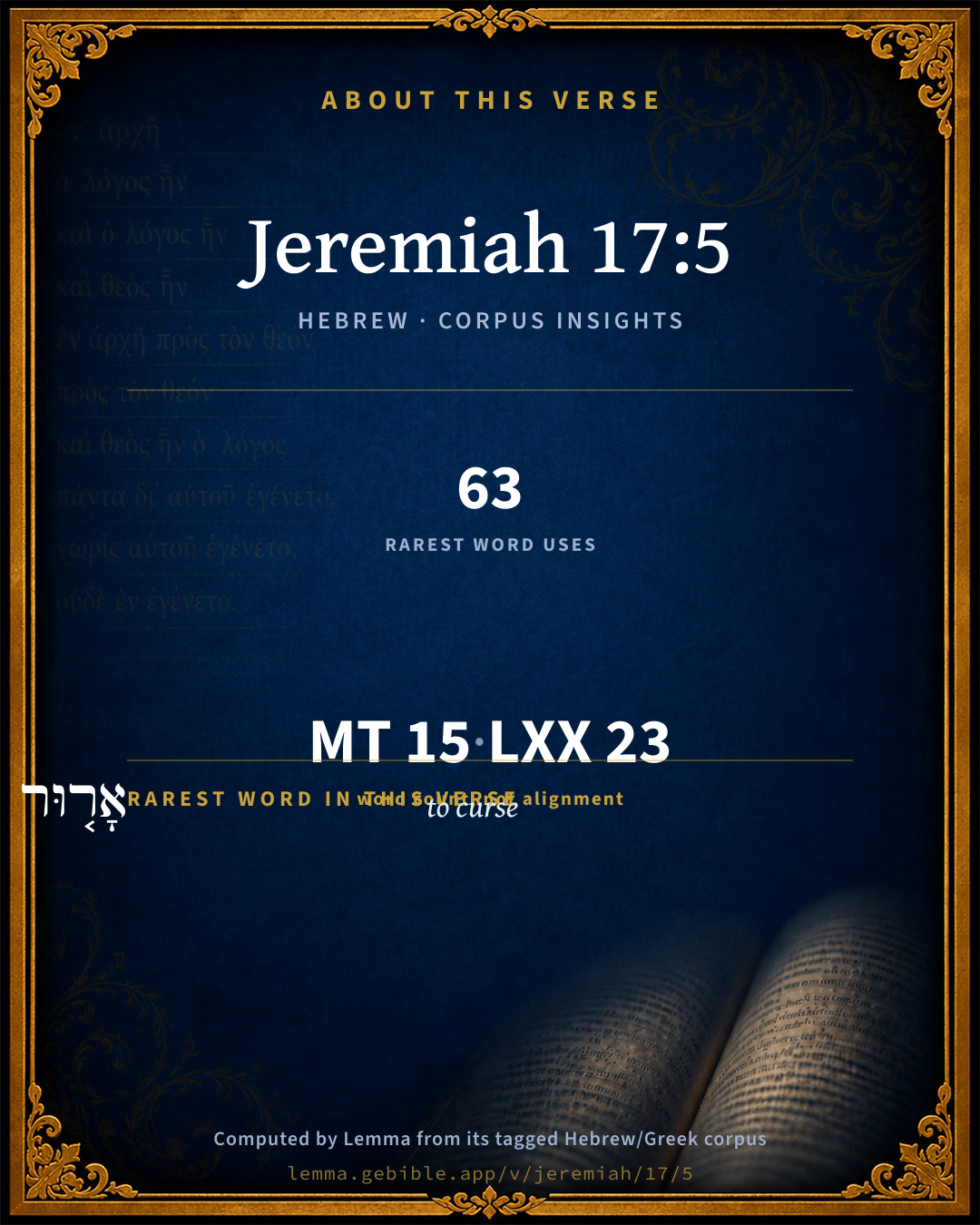
About this verse

These counts appear in no published source. They are computed here, from the morphology-tagged text and Lemma’s own curated glosses. What Lemma adds →

15
words
14
distinct lemmas
Prophets
section

Grammatical profile

  • 5 verbs
  • 7 nouns
  • 1 preposition
  • 1 adverb
  • 1 particle

Verb forms

  • אָמַ֣ר Qal · Perfect
  • אָר֤וּר Qal · Participle Passive
  • יִבְטַ֣ח Qal · Imperfect
  • וְשָׂ֥ם Qal · Sequential Perfect
  • יָס֥וּר Qal · Imperfect

Repetition

A word recurs within this verse — often emphatic in Hebrew:

  • יְהוָ֗ה LORD H3068 ×2

Hebrew & Septuagint length

In the original languages it is 15 Hebrew tokens and 23 Greek tokens — but the two are counted differently (Hebrew bundles its prefixes and suffixes into one token; the Greek is in lemma form), so that isn’t a like-for-like length.

Cross-references

13

Topical passages linked to Jeremiah 17:5 in the Treasury of Scripture Knowledge — connected by theme and wording, ordered by reader-vote popularity; previews shown in the World English Bible.

  • Psalms 118:8–9 It is better to take refuge in Yahweh, Than to put confidence in man.
  • Psalms 146:3–4 Don't put your trust in princes, Each a son of man in whom there is no help.
  • Isaiah 2:22 Stop trusting in man, whose breath is in his nostrils; For of what account is he?
  • 2 Chronicles 32:8 with him is an arm of flesh; but with us is Yahweh our God to help us, and to fight our battles. The people rested themselves on the words of Hezekiah king of Judah.
  • Isaiah 31:1–9 Woe to those who go down to Egypt for help, and rely on horses, and trust in chariots because they are many, and in horsemen because they are very strong, but they don't look to the Holy One of Israel, neither seek Yahweh!
  • Isaiah 30:1–7 Woe to the rebellious children, says Yahweh, who take counsel, but not of me; and who make a league, but not of my Spirit, that they may add sin to sin,
  • Isaiah 36:6 Behold, you trust on the staff of this bruised reed, even on Egypt, whereon if a man lean, it will go into his hand, and pierce it: so is Pharaoh king of Egypt to all who trust on him.
  • Psalms 62:9 Surely men of low degree are just a breath, And men of high degree are a lie. In the balances they will go up. They are together lighter than a breath.
  • Psalms 18:21 For I have kept the ways of Yahweh, And have not wickedly departed from my God.
  • Ezekiel 29:6–7 All the inhabitants of Egypt shall know that I am Yahweh, because they have been a staff of reed to the house of Israel.
  • Ezekiel 6:9 Those of you that escape shall remember me among the nations where they shall be carried captive, how that I have been broken with their lewd heart, which has departed from me, and with they eyes, which play the prostitute after their idols: and they shall loathe themselves in their own sight for the evils which they have committed in all their abominations.
  • Hosea 1:2 When Yahweh spoke at the first by Hosea, Yahweh said to Hosea, "Go, take for yourself a wife of prostitution and children of unfaithfulness; for the land commits great adultery against from Yahweh."
  • Isaiah 59:15 Yes, truth is lacking; and he who departs from evil makes himself a prey. Yahweh saw it, and it displeased him who there was no justice.

Cross-references courtesy of OpenBible.info (CC BY 4.0).

Hebrew and Greek witnesses Masoretic Hebrew ↔ Greek Septuagint

The same verse in the two great witnesses to the Old Testament, shown verse-for-verse.

These are two independent witnesses, not word-aligned to each other, and the Septuagint is shown in lemma (dictionary) form.

Hebrew Jeremiah 17:5 Masoretic · Westminster Leningrad Codex

כֹּ֣ה אָמַ֣ר יְהוָ֗ה אָר֤וּר הַגֶּ֨בֶר֙ אֲשֶׁ֣ר יִבְטַ֣ח בָּֽאָדָ֔ם וְשָׂ֥ם בָּשָׂ֖ר זְרֹע֑וֹ וּמִן יְהוָ֖ה יָס֥וּר לִבּֽוֹ

Thus says Yahweh: Cursed is the man who trusts in man, and makes flesh his arm, and whose heart departs from Yahweh.

World English Bible · Public Domain

Greek LXX Structure differs

In the Septuagint, Jeremiah is about an eighth shorter than the Hebrew and arranges its material differently — the Oracles Against the Nations (Hebrew chapters 46–51) appear in the middle of the Greek book, after 25:13. Because the chapter and verse boundaries do not line up, a verse-for-verse comparison with the Hebrew is not shown.

A verse-for-verse comparison isn’t shown here because the chapters and verses don’t line up. Switch to the LXX edition with the MT / LXX toggle above to read the Greek directly.

On this verse, Keil & Delitzsch discusses the Septuagint’s reading. Read the note in Commentary ↓

Hebrew: Westminster Leningrad Codex (CC BY 4.0). Greek: Septuagint (public domain); English from a public-domain English Septuagint. How the Septuagint differs from the Hebrew →

Targum (Aramaic paraphrase)

1

The Targum is the ancient Jewish Aramaic paraphrase of the Hebrew Scriptures — an interpretive translation, not the Hebrew text itself. Onkelos (literal) and Pseudo-Jonathan (expansive) render the Torah, and Jonathan the Prophets. Coverage is partial: where no permissively-licensed English translation exists for a verse, only the Aramaic is shown. This is verse-level text, not a word-by-word alignment to the Hebrew.

  1. Targum Jonathan Prophets (Joshua–Malachi)
    כִּדְנַן אֲמַר יְיָ לִיט גַבְרָא דְאִתְרְחֵיץ בֶּאֱנָשָׁא וִישַׁוֵי בִשְׂרָא רַחְצָנֵיהּ וּמִן מֵימְרָא דַייָ יֶעְדֵי לִבֵּיהּ:

    (no public-domain English translation for this verse)

    Targum Jonathan — Aramaic: “Mikraot Gedolot” (public domain). English: “Sefaria Community Translation” (CC0 1.0 (public-domain dedication)); “London "Chaldee Paraphrase," 1871” (public domain). Text via Sefaria.

Commentary

Notes on Jeremiah 17:5 from classic Christian and Jewish commentators (each source and its license shown beneath its notes). The classic Christian expositions comment on the surrounding passage and are grouped to its opening verse, so a note may address several verses; the Jewish commentaries on the Tanakh (Rashi and others) are per-verse, so they appear only where the commentator wrote on this verse.

Lemma curates 59 commentaries, every one of them public domain or Creative Commons licensed, each selected and text-cleaned for this edition rather than reprinted as found. About our sources →

Matthew Henry's Commentary

It is excellent doctrine that is preached in these verses, and of general concern and use to us all, and it does not appear to have any particular reference to the present state of Judah and Jerusalem. The prophet's sermons were not all prophetical, but some of them practical; yet this discourse, which probably we have here only the heads of, would be of singular use to them by way of caution not to misplace their confidence in the day of their distress. Let us all learn what we are taught here,

I. Concerning the disappointment and vexation those will certainly meet with who depend upon creatures for success and relief when they are in trouble (Jer 17:5, Jer 17:6): Cursed be the man that trusts in man. God pronounces him cursed for the affront he thereby puts upon him. Or, Cursed (that is, miserable) is the man that does so, for he leans upon a broken reed, which will not only fail him, but will run into his hand and pierce it. Observe, 1. The sin here condemned; it is trusting in man, putting that confidence in the wisdom and power, the kindness and faithfulness, of men, which should be placed in those attributes of God only, making our applications to men and raising our expectations from them as principal agents, whereas they are but instruments in the hand of Providence. It is making flesh the arm we stay upon, the arm we work with and with which we hope to work our point, the arm under which we shelter ourselves and on which we depend for protection. God is his people's arm, Isa 32:2. We must not think to make any creature to be that to us which God has undertaken to be. Man is called flesh, to show the folly of those that make him their confidence; he is flesh, weak and feeble as flesh without bones or sinews, that has no strength at all in it; he is inactive as flesh without spirit, which is a dead thing; he is mortal and dying as flesh, which soon putrefies and corrupts, and is continually wasting. Nay, he is false and sinful, and has lost his integrity; so his being flesh signifies, Gen 6:3. The great malignity there is in this sin; it is the departure of the evil heart of unbelief from the living God. Those that trust in man perhaps draw nigh to God with their mouth and honour him with their lips, they call him their hope and say that they trust in him, but really their heart departs from him; they distrust him, despise him, and decline a correspondence with him. Cleaving to the cistern is leaving the fountain, and is resented accordingly. 3. The fatal consequences of this sin. He that puts a confidence in man puts a cheat upon himself; for (Jer 17:6) he shall be like the heath in the desert, a sorry shrub, the product of barren ground, sapless, useless, and worthless; his comforts shall all fail him and his hopes be blasted; he shall wither, be dejected in himself and trampled on by all about him. When good comes he shall not see it, he shall not share in it; when the times mend they shall not mend with him, but he shall inhabit the parched places in the wilderness; his expectation shall be continually frustrated; when others have a harvest he shall have none. Those that trust to their own righteousness and strength, and think they can do well enough without the merit and grace of Christ, thus make flesh their arm, and their souls cannot prosper in graces or comforts; they can neither produce the fruits of acceptable services to God nor reap the fruits of saving blessings from him; they dwell in a dry land.

II. Concerning the abundant satisfaction which those have, and will have, who make God their confidence, who live by faith in his providence and promise, who refer themselves to him and his guidance at all times and repose themselves in him and his love in the most unquiet times, Jer 17:7, Jer 17:8. Observe, 1. The duty required of us - to trust in the Lord, to do our duty to him and then depend upon him to bear us out in doing it - when creatures and second causes either deceive or threaten us, either are false to us or fierce against us, to commit ourselves to God as all-sufficient both to fill up the place of those who fail us and to protect us from those who set upon us. It is to make the Lord our hope, his favour the good we hope for and his power the strength we hope in. 2. The comfort that attends the doing of this duty. He that does so shall be as a tree planted by the waters, a choice tree, about which great care has been taken to set it in the best soil, so far from being like the heath in the wilderness; he shall be like a tree that spreads out its roots, and thereby is firmly fixed, spreads them out by the rivers, whence it draws abundance of sap, which denotes both the establishment and the comfort which those have who make God their hope; they are easy, they are pleasant, and enjoy a continual security and serenity of mind. A tree thus planted, thus watered, shall not see when heat comes, shall not sustain any damage from the most scorching heats of summer; it is so well moistened from its roots that it shall be sufficiently guarded against drought. Those that make God their hope, (1.) They shall flourish in credit and comfort, like a tree that is always green, whose leaf does not wither; they shall be cheerful to themselves and beautiful in the eyes of others. Those who thus give honour to God by giving him credit God will put honour upon, and make them the ornament and delight of the places where they live, as green trees are. (2.) They shall be fixed in an inward peace and satisfaction: They shall not be careful in a year of drought, when there is want of rain; for, as the tree has seed in itself, so it has its moisture. Those who make God their hope have enough in him to make up the want of all creature-comforts. We need not be solicitous about the breaking of a cistern as long as we have the fountain. (3.) They shall be fruitful in holiness, and in all good works. Those who trust in God, and by faith derive strength and grace from him, shall not cease from yielding fruit; they shall still be enabled to do that which will redound to the glory of God, the benefit of others, and their own account.

III. Concerning the sinfulness of man's heart, and the divine inspection it is always under, Jer 17:9, Jer 17:10. It is folly to trust in man, for he is not only frail, but false and deceitful. We are apt to think that we trust in God, and are entitled to the blessings here promised to those who do so. But this is a thing about which our own hearts deceive us as much as any thing. We think that we trust in God when really we do not, as appears by this, that our hopes and fears rise or fall according as second causes smile or frown.

1. It is true in general. (1.) There is that wickedness in our hearts which we ourselves are not aware of and do not suspect to be there; nay, it is a common mistake among the children of men to think themselves, their own hearts at least, a great deal better than they really are. The heart, the conscience of man, in his corrupt and fallen state, is deceitful above all things. It is subtle and false; it is apt to supplant (so the word properly signifies); it is that from which Jacob had his name, a supplanter. It calls evil good and good evil, puts false colours upon things, and cries peace to those to whom peace does not belong. When men say in their hearts (that is, suffer their hearts to whisper to them) that there is no God, or he does not see, or he will not require, or they shall have peace though they go on; in these, and a thousand similar suggestions the heart is deceitful. It cheats men into their own ruin; and this will be the aggravation of it, that they are self-deceivers, self-destroyers. Herein the heart is desperately wicked; it is deadly, it is desperate. The case is bad indeed, and in a manner deplorable and past relief, if the conscience which should rectify the errors of the other faculties is itself a mother of falsehood and a ring-leader in the delusion. What will become of a man if that in him which should be the candle of the Lord give a false light, if God's deputy in the soul, that is entrusted to support his interests, betrays them? Such is the deceitfulness of the heart that we may truly say, Who can know it? Who can describe how bad the heart is? We cannot know our own hearts, not what they will do in an hour of temptation (Hezekiah did not, Peter did not), not what corrupt dispositions there are in them, nor in how many things they have turned aside; who can understand his errors? Much less can we know the hearts of others, or have any dependence upon them. But, (2.) Whatever wickedness there is in the heart God sees it, and knows it, is perfectly acquainted with it and apprised of it: I the Lord search the heart. This is true of all that is in the heart, all the thoughts of it, the quickest, and those that are most carelessly overlooked by ourselves - all the intents of it, the closest, and those that are most artfully disguised, and industriously concealed from others. Men may be imposed upon, but God cannot. He not only searches the heart with a piercing eye, but he tries the reins, to pass a judgment upon what he discovers, to give every thing its true character and due weight. He tries it, as the gold is tried whether it be standard or no, as the prisoner is tried whether he be guilty or no. And this judgment which he makes of the heart is in order to his passing judgment upon the man; it is to give to every man according to his ways (according to the desert and the tendency of them, life to those that walked in the ways of life, and death to those that persisted in the paths of the destroyer) and according to the fruit of his doings, the effect and influence his doings have had upon others, or according to what is settled by the word of God to be the fruit of men's doings, blessings to the obedient and curses to the disobedient. Note, Therefore God is Judge himself, and he alone, because he, and none besides, knows the hearts of the children of men.

2. It is true especially of all the deceitfulness and wickedness of the heart, all its corrupt devices, desires, and designs. God observes and discerns them; and (which is more than any man can do) he judges of the overt act by the heart. Note, God knows more evil of us than we do of ourselves, which is a good reason why we should not flatter ourselves, but always stand in awe of the judgment of God.

IV. Concerning the curse that attends wealth unjustly gotten. Fraud and violence had been reigning crying sins in Judah and Jerusalem; now the prophet would have those who had been guilty of these sins, and were now stripped of all they had, to read their sin in their punishment (Jer 17:11): He that gets riches and not by right, though he may make them his hope, shall never have joy of them. Observe, It is possible that those who use unlawful means to get wealth may succeed therein and prosper for a time; and it is a temptation to many to defraud and oppress their neighbours when there is money to be got by it. He who has got treasures by vanity and a lying tongue may hug himself in his success, and say, I am rich; nay, and I am innocent too (Hos 12:8), but he shall leave them in the midst of his days; they shall be taken from him, or he from them; God shall cut him off with some surprising stroke then when he says, Soul, take thy ease, thou hast goods laid up for many years, Luk 12:19, Luk 12:20. He shall leave them to he knows not whom, and shall not be able to take any of his riches away with him. It intimates what a great vexation it is to a worldly man at death that he must leave his riches behind him; and justly may it be a terror to those who got them unjustly, for, though the wealth will not follow them to another world, the guilt will, and the torment of an everlasting, Son, remember, Luk 16:25. Thus, at his end, he shall be a fool, a Nabal, whose wealth did him no good, which he had so sordidly hoarded, when his heart became dead as a stone. He was a fool all along; sometimes perhaps his own conscience told him so, but at his end he will appear to be so. Those are fools indeed who are fools in their latter end; and such multitudes will prove who were applauded as wise men, that did well for themselves, Psa 49:13, Psa 49:18. Those that get grace will be wise in the latter end, will have the comfort of it in death and the benefit of it to eternity (Pro 19:20); but those that place their happiness in the wealth of the world, and, right or wrong, will be rich, will rue the folly of it when it is too late to rectify the fatal mistake. This is like the partridge that sits on eggs and hatches them not, but they are broken (as Job 39:15), or stolen (as Isa 10:14), or they become addle: some sort of fowl there was, well known among the Jews, whose case this commonly was. The rich man takes a great deal of pains to get an estate together, and sits brooding upon it, but never has any comfort nor satisfaction in it; his projects to enrich himself by sinful courses miscarry and come to nothing. Let us therefore be wise in time - what we get to get it honestly, and what we have to use it charitably, that we may lay up in store a good foundation and be wise for eternity.

Matthew Henry's Commentary on the Whole Bible (1708–1710) — public domain (CC PDM 1.0). Text via the HelloAO Bible API.

Trapp's Complete Commentary

John Trapp

Jer 17:5 Thus saith the LORD; Cursed [be] the man that trusteth in man, and maketh flesh his arm, and whose heart departeth from the LORD.

Ver. 5. Cursed be the man that trusteth in man.] Disserit hic de summo bono, et de summo malo, saith one. Here the prophet discourseth of the chief good and of the chief evil. This latter he pronounceth to be to depart from God, and to depend upon the creature for help; for such a man, seem he never so manly a man (haggheber), is accursed of God, whom he robbeth of his chief jewel, that which giveth him the sovereignty, and setteth, as it were, the crown upon his head. See Jdg 9:15 Psa 78:22; Psa 52:7.

And maketh flesh his arm,] i.e., His strength; for in brachio est robur. Now three ways, saith a reverend man, {a} we make flesh our arm - (1.) By sitting down in a faithless, sullen discontent and despair when we can see no second causes; (2.) By rising up in a corky, frothy confidence when we see sufficient human help; (3.) When we ascribe the glory of our good to it, "sacrificing to our own net." {Hab 1:16} This is to pull the curse upon our heads with twisted wrath and indignation.

Whose heart departeth from God.] He trusteth not God at all who trusteth him not over all.

{a} Mr Case.

John Trapp, A Commentary or Exposition upon All the Books of the Old and New Testament (1647–1656) — public domain. Text from a community e-Sword module.

The Biblical Illustrator

Joseph S. Exell

Jer_17:5-8

Cursed be the man that trusteth in man.

The difference between trusting in the creature and the Creator

I. The folly and evil of trusting in man. To trust in man, in the sense of our text, is to expect that from creatures which can only come from the Creator: to confide in them, not as mere instruments, but as efficient causes; to look to them so as to look off from God; to cleave to them so as to depart from Him.

1. Idolatrous in its principle.

2. Grovelling in its aim. It looks no higher than present good, and things altogether unworthy of an immortal spirit.

3. Unreasonable in its foundation. It supposes that man can do what God cannot.

4. Destructive in its issue. He shall be like the heath in the desert,--worthless, sapless, fruitless; he shall not see when good cometh,--shall not enjoy it; but he shall inhabit the parched places, etc.

He shall prosper in nothing.

(1) The frustration of his projects and hopes.

(2) The melancholy state of his soul.

(3) The unhappy end of his career.

II. The wisdom and benefit of trusting in the Lord. Jehovah is his hope. He seeks and expects his all from Him. To know, love, and enjoy Him,--behold his chief good,--the object of his hopes,--his highest and ultimate end. Now this conduct is the complete contrast of the other.

1. It is pious in its principles.

2. Elevated in its aim.

3. Rational in its foundation.

4. Glorious in its issue.

Blessed is the man, etc. For he shall be like a tree, etc.

(1) The success of his enterprises.

(2) The settled comfort and satisfaction of his soul.

(3) The loveliness and dignity of his character.

(4) The usefulness of his life.

(5) His eternal felicity.

Application--

1. It is a great mistake to suppose the rich and gay happy; the poor and pious miserable.

2. An entire renunciation of creature confidence, and an unreserved dependence on God, can alone secure the Divine favour and our own felicity. (Sketches of Four Hundred Sermons.)

Trust-right and wrong

I. Man, as a ground of trust.

1. In what consists this dependence upon man for the salvation of the soul?

(1) In being led by the example of others to the commission of sin and neglect of God.

(2) In looking for that rest in the creature which is only to be found in God.

(3) In depending on our own good works, in part, for our justification before God.

(4) In taking our religion from the opinions of men, instead of the Word of God.

(5) In resting in the means of grace.

2. See the consequences of trusting in man. Cursed, etc. He that does so shall be--

(1) Useless as the heath in the desert.

(2) Miserable. Shall not see when good cometh.

(3) Solitary, or forsaken of God. Shall inhabit a salt land not inhabited.

(4) Cursed by Jehovah Himself. Lord, is it I?

II. Jehovah, as a ground of trust.

1. What is meant by trusting Jehovah? With the light of this dispensation, we may safely say it embraces dependence on the atonement of Christ; and implies--

(1) Knowledge of it, as a fact and doctrine of Scripture.

(2) Approval of it, as adapted to our circumstances.

(3) Personal reliance on it for salvation;--a confident venture of our souls upon it.

2. The blessedness of trusting in Jehovah.

(1) Nourishment. Planted by the waters. A Christians source of strength is out of himself.

(2) Stability. Spreadeth out his roots.

(3) Comfort. Shall not see when heat cometh. Shall not be careful in the year of drought.

(4) Adornment. His leaf shall be green. Beauty of the woods in early spring. A Christian is the highest style of man (Tit_2:10; 1Pe_3:4).

(5) Fruitfulness. Neither shall cease from yielding fruit. (Edward Thompson.)

The blessing and the curse

Two contrasted types of experience, or laws of life, are brought before us--the one a life of trust in man, and the other a life of trust in God. These two types of experience are contrasted with each other--not primarily, with respect to their outward moral characteristics. The thought that our attention is first of all called to is, that these two lives stand in a contrasted relation to God. The man who lives the first of the two lives that are described here is represented as assuming and maintaining an attitude of independence of God; and the man who leads the second of these two lives is represented as living in a state of consciously recognised dependence upon God. The one finds his resources in self; the other finds his resources in Deity. Now these two lives are not only contrasted with each other, first of all, as to this their essential characteristic, but they are also contrasted as to their result in respect to the personal happiness and enjoyment which belongs to each. The one is represented as a life lived under a curse, and the other as a life lived under a blessing. Either your experience may be described, in the words of Paul, The life that I live in the flesh I live by the faith of the Son of God, who loved me and gave Himself for me; or else you are living a life of which nothing of the kind can be affirmed, and, therefore, a life in which you are practically cut off from all direct communication with your Maker by sin and unbelief. And if the latter be your condition, you are at this moment, in spite of all your privileges, actually under the ban of Gods curse and the frown of His wrath: one or other of these two cases you may be sure is yours. You will observe that in the first sentence of our text the prophet utters a curse on the man that trusteth in man; and he says this before he goes on to speak of the heart departing from the living God. This trust in man renders it impossible for the man who entertains it to trust in the living God; and it is, I am persuaded, just because, before we can really and honestly trust in the Father through the Son, it is absolutely necessary for us to turn our back upon all other forms of confidence, that so many lose the enjoyment of this blissful life of faith, and make proof in their own miserable experience of the blight and desolation of a life of practical unbelief. We are not prepared to strip ourselves of our false supports and of our fatal self-confidence, and thus we are not in a position to trust ourselves to the living Father through the Son. Consider some of these various forms of false confidence which it is absolutely necessary for us to abandon before we can enter upon the enjoyment of this life of faith. First, if I am to live by faith in God, I must make up my mind to have done with living by faith in the world. If I am to trust God at all, my trust in God must be exclusive of all other confidence. Or, again, it is possible that our confidence is reposed upon human systems--perhaps it may even be religious systems--which, practically, are allowed to take the place that belongs to God in the heart. How many a man one meets with who will tell us that he has opinions of his own. That may be, my brother, but the point is whether those opinions of yours coincide with Gods facts; for opinions of our own may be the cause of mortal injury to us, if it should so happen that those opinions of our own are in direct opposition to facts. Or perhaps it is that we base our confidence on the opinions of other people. Some will tell you that they are earnest Church folks, others will state that they are conscientious Nonconformists; some that they are strong Catholics; some that they are decided Evangelicals. God calls upon us to trust to Himself, and to nothing but Himself; and when we substitute for personal trust in the living God confidence in any kind of system, whatever that system may be, or in any mere doctrine, whatever that doctrine may be, we are cut off by that attitude of heart from the possibilities of the life of faith. Perhaps you will ask, Well, but why should my trust in doctrine, or my trust in ritual, or my trust in churchmanship, preclude me from trusting in God too? Just because these things are not God; and, as I said a few moments ago, you cannot trust God and not-God at the same time. But we must consider yet another and still more frequent ease. There are a large number of persons who are strangers to the life of faith--not so much because they are wedded to any particular system on which they have based their confidence, as because they are reluctant to renounce their confidence in themselves. Now, we never really begin with God till we come to an end of ourselves. A considerable number of persons trust in their own quiet, even respectability. They really cannot see that they do anything to be distressed or alarmed about. What means all this hue and cry--this red-hot excitement or attempt to get up a red-hot excitement--these frequent services going on hour after hour all day long--these after meetings--these invitations to earnest inquirers? What does it all mean? The explanation of it all lies in the fact that you ask for an explanation. Let a man be dissatisfied with himself, let a man have a low opinion of himself, and then he will be ready to receive good from any kind of instrumentality, and a very commonplace sort of instrumentality will probably be used to bring that man to the attainment of that spiritual benefit which his ease requires. But let a man be sunk in the sleep of self-complacency--let a man be going on leading a calm, quiet, easy, regular life; but, observe, a life which is not a life of conscious, personal faith in God, but, on the contrary, a life of self-reliance, and therefore a life of self-complacency; and he is as much under the power of the great deceiver as it is possible for a man to be. And of all the undertakings which lie before the Divine Spirit, it seems to me that the very hardest undertaking which even God Himself can engage in is that of penetrating this impervious armour of self-complacency, and of bringing such an one to feel his need of salvation, and to seek and to find that salvation on Gods own terms. If these, then, are some of the barriers to our leading a bright and happy life of faith, we shall perhaps, by Gods blessing, be the more disposed to avoid or have done with them as we dwell for a little on the contrast offered between these two forms of life. Let us look at these pictures. Blessed is the man that trusteth in the Lord, and whose hope the Lord is; for he shall be like a tree planted by the waterside, that spreadeth out her roots by the river. Observe, the tree is dependent, not upon a chance shower, but upon a perennial supply. The river is always flowing, and the tree has stretched out its roots beside the river, and so is in a position continuously to draw for itself from the river all the sustenance and all the moisture which it requires. Christian, if thou art a real Christian, here is thy picture. Thy roots are struck down into God. Thou art dependent upon no mere casual visitation of Divine mercy. It may be very advisable, from time to time, that extraordinary efforts should be made to reach the careless and to awaken the unconcerned, but thou, true child of God, art not dependent upon these for thy life and health. Thou hast struck down thy roots into the river, and there thou standest--uninjured by prevalent drought, unscathed by the fiery rays of the sun, thy leaf green, thy fruit never failing. Is this your ease! Are you drawing your life supplies from God? There are two ways in which the Christian grows. He grows in personal holiness of life and conversation, but he only grows in outward conduct, because he also grows in the knowledge mad love of God. Upon the depth and reality of his relation with God, his moral and religious character will depend. As God becomes more and more to him a living, bright reality, so his personal life and character become more fully developed, and the beauty of the Lord will be exhibited in his conduct. As the result of the establishment of these relations with God, the supply of all the necessary wants of the soul is insured, and it has nothing to fear from the trials and disappointments of life: the tree planted by the waters shall not see when heat cometh. Observe, the prophet does not say that it shall be exposed to no heat, but that it shall not be injured by it. Let us ask ourselves, Are we growing in the knowledge of God? Are we getting fresh revelations of His character and His ability to meet and satisfy our every spiritual need? Oh, how vast is our spiritual wealth in Him, and how many a fear and misgiving might not be saved, if we would only acquaint ourselves with Him and be at peace. And this leads us on to the second feature mentioned here, it shall not be careful in the year of drought. Happy the Christian man who realises his full privileges in this respect, and lives in the enjoyment of them! Happy the man of business on our own Stock Exchange, who, in the midst of all the vicissitudes of a commercial life, can leave himself calmly in the hands of God, and while the year of drought which has so long been affecting our own and other lands fills others with despair, enjoy a blessed immunity from anxiety, because he knows that he is planted by the waterside. Happy the mother who can cast all the cares of her family upon Him who careth for her, and leave them there, not fretting and fuming when things do not go as she would wish them, not cankered by cares or worried by troubles, but trusting Him in whom she finds the true calm of life to draw her ever the nearer to Himself by all its changeful circumstances! But further, the leaf of such a tree is described as being always green. The leaf of the tree shows the nature of the tree, and just so the profession we make should show what our religious character is. Now, it is a grand thing to have a fresh and green profession, so to speak! Once again we read, Neither shall cease from yielding fruit. The Christian will always be a fruitful tree, because he is planted by the water. There will be no lack of fruitfulness when living in full communion with God. Some of us, perhaps, have had an opportunity of looking at that wonderful and famous vine at Hampton Court. A more beautiful sight you can scarcely see in all England than that vine when it is covered all over with the rich, luscious clusters of the vintage. Report attributes its extraordinary fertility to the fact that the roots, extending for a very considerable distance, have made their way down to the Thames, from whence it draws continuous moisture and nourishment. Such a sight is presented to the eyes of God by the Christian who lives in God, planted by the riverside. The fruits of good works will manifest themselves, not one here and another there, but in a rich and lifelong vintage that will not fail. God Himself reaps a harvest from such a life which redounds to His own glory, and is productive of blessed consequences to mankind. Such is the one picture; now let us glance at the other. Cursed is the man that trusteth in man. We have left the grapes of Eshcol behind us now--we have turned our backs upon the land that flows with milk and honey. We are making our way towards the bare stretch of arid, desert waste. The smile of Gods favour rests no longer upon the miserable being, but the frown of His wrath broods over him; and the thunder of Gods curse is sounding in his ear, Cursed is the man that trusteth in man, and maketh flesh his arm, and whose heart departeth from the Lord. Departeth from God! Ah, it all lies there! As the satisfaction of the saint arises from the closeness of his relations with God, so the want and wretchedness of the sinner arise from his separation from Him. The wilderness begins where conscious fellowship with God ceases. He shall be like the heath in the desert. As you wander over the dreary waste of barren sand, your eye falls upon a poor, miserable-looking, half-withered, half-dead thing, that still struggles to maintain its woe-begone and sickly existence. There it lingers on wretchedly, cut off from all surrounding vegetation, scarcely living and yet not finally dead, but devoid of all the freshness and luxuriance of life, shrivelled and parched and desolate looking in a salt land and not inhabited. Tar away in the distance there you can see the green tree that is planted by the waterside only just in sight; but here there is no kindly river, no kindred forms of vegetation, in solitude and drought it measures out its dreary existence. In this miserable object, man of the world, see a picture of yourself. Solitude and thirst! in those two characteristics of this woeful picture, you have faithfully represented to you the characteristic elements of your own present experience, and the dread foreshadowing of what its end must be. Thirst and solitude, yes, thou knowest something of that even now, for is there not already within thee a desire that nothing earthly can satisfy--a sense of inanity and want? Verily thou dwellest in a parched and salt land. A mighty famine reigns within thy soul, and thou hast begun to be in want. An irrepressible, an urgent desire now goads thee on from one effort to another, if, haply, thou mayest escape from thy own miserable self-consciousness and lose the sense of thy own want amidst the excitements of thy life. But it is there all the time--this inward thirst, and thou canst not escape from it; and remember the salt land which thou now inhabitest is but the way to, and the dread anticipation of, that salt land of doom to which the sinner is to be banished; and the thirst which even now tortures thy agonised heart is but the prelude to the thirst of hell. Thirst and solitude! yes, and thou knowest something of this last also. How solitary and lonesome already is that poor heart of thine. The plain, simple truth is, that in his inner life the man of the world is always alone--the solitude which sin brings with it has already commenced, and already you are shut out from the true enjoyments of social intercourse; you are lonely, even in the very midst of numbers, and desolate even in the very heart of your family. And in that loneliness you have a prelude to the utter loneliness which lies beyond--the desolation, the solitude, the loss of all, when he who has wandered from the love of God is shut out from the world of love, and given over to that dark region where love cannot come; the loneliness of him who leaves the society of heaven behind him, and finds instead only the weeping and the wailing and the gnashing of teeth. (W. Hay Aitken, M. A.)

The sin of trusting in man

I. When we may be charged with this.

1. When we fortify ourselves in sin, by human refuges and supports (Isa_28:15-16; Isa_30:1, etc.; Oba_1:3-4).

2. When we look for that rest in the creature, which is only to be found in God (Jer_9:23-24).

3. When we seek to please men more than God. Not as Moses, Daniel, Peter.

4. When we use unlawful means to rid ourselves of trouble (Jon_1:2-3).

5. When we form our religion by the opinions of men instead of Gods Word (Mat_15:1-9; Gal_2:11-13).

6. When we lean on ourselves instead of Jesus Christ (Php_3:3-7).

II. The wretchedness of such a disposition and conduct.

1. God will take out the enjoyment of what he possesses (Ecc_6:1-2).

2. The object of his hope shall be removed, or turned against him (Psa_41:9).

3. God will leave him to his own corruptions and Satans temptations (Hos_4:17).

4. Guilt shall make him a torment to himself. Judas.

5. When blessings come, he shall not perceive them (Luk_19:41-44; Act_13:38-41).

6. Death shall snatch him from his enjoyments (Luk_12:1, etc.; Act_12:1, etc.) (H. Foster.)

The danger of trusting in man

1. He that trusts in man is cursed in the weakness on which he relies. The strong shall be as tow. In general, God employs weak and inconsiderable ones to break the arm of flesh; thus, the shouts of the Israelites, and the blowing of horns, brought down the walls of Jericho, and reduced it to the dust: the Midianites, and the Amalekites, and the children of the east, lay along the valley of More like grasshoppers for multitude, and yet the sudden display of only three hundred lamps, and the sounding of as many trumpets, put them all to flight: the champion of the Philistines defied the whole army of Israel, yet a shepherd boy overcame him with a sling and stone. So with all earthly strength on which man builds himself up; the moment God speaks the word it melts away.

2. He that maketh flesh his arm is cursed also in the short-lived nature of his ground of confidence. How often does man, in the very noonday of his journey through life, feel his heart sink within him on finding that the distant places, which in the morning of life he had looked forward to as fresh and beautiful, are but as the parched heath or thirsty sand; he thinks of the days of boyhood, when an untried world promised happiness and security, and sighs on learning the hard lesson, that neither is to be had on this side of the grave.

3. Deceitfulness is moreover part of that curse which those may expect to reap, and that abundantly, who trust in man and make flesh their arm. Put God out of the question; let there be no recognition of any other than human obligations, and you have no security in the faithfulness of the nearest or dearest friend.

4. There is a curse also in the bitterness of disappointment. This is what makes the wretched old worldling like the parched heath; friends, or children, or other relatives, have either died or forsaken him, or his riches have slipped out of his hands and flown away; all his worldly plans and schemes have failed; he has no love of God in his heart to bear him up against so many cruel disappointments, and the bitterness of his spirit has therefore increased day by day, till he is completely soured; he feeds on his morose temper, and in turn it preys upon him; the curse eats into his vitals, drying up every little show of better feeling which would have kept his heart still green and salt; he hates and suspects everyone; the world is looked upon by him as one great lie, and of the truth he knows nothing; or the things wherein he foolishly expected to find happiness, have proved incapable of affording it, even while he had them in his possession. (C. O. Pratt, M. A.)

The folly of trusting in any creature

As a traveller overcome by a storm, having sought the shelter of some fair-spread oak, finds relief for some time, till suddenly, the fierce wind tears some strong branch, which, falling, hurts the unsuspecting traveller; so fares it with not a few who run for shelter to the shade of some great man. Had I served my God, said poor Wolsey, as faithfully as I served my king, He would not have forsaken me now.

He shall be like the heath in the desert.

The heath in the desert

I. Against whom this curse is denounced.

1. Those who do not realise their dependence on God for all true happiness, but think it lies in worldly gain.

2. Those who trust in man and make flesh their arm, and neglect to fix all dependence on Father, Son, and Holy Spirit.

3. Those who depend on a form of godliness without the power, and, excepting a little animal sympathy, remain cold as ever.

II. How these resemble the heath in the desert.

1. In barrenness and deformity.

2. In being desolate, forsaken, and unblest.

3. While the holy land is refreshed with dew from heaven, the desert remains parched as before.

4. Showers falling on desert heath only promote the growth of deformed shrubs; and the influence of heaven falling on this class calls forth a more fatal resistance of the Holy Spirit.

5. The heath cannot be made fruitful; and all Gods visitations fall unregarded on many.

6. It is plain that, while many obey the Gospel call, others remain desolate and uncheered by any heavenly influence. (E. Griffin, D. D.)

The heath in the desert and the tree by the river

The prophet puts before us two highly-finished pictures. In the one, the hot desert stretches on all sides. The fierce sunbeams like swords slay every green thing. Here and there a stunted, grey, prickly shrub struggles to live, and just manages not to die. But it has no grace of leaf, nor profitableness of fruit; and it only serves to make the desolation mere desolate. The other carries us to some brimming river, where everything lives because water has come. Dipping their boughs in the sparkling current, and driving their roots through the moist soil, the bordering trees lift aloft their pride of foliage and bear fruits in their season. So, says Jeremiah, the two pictures represent two sets of men; the one, he who diverts from their true object his heart capacities of love and trust, and clings to creatures and to men, making flesh his arm and departing from the living God; the other, a man who leans the whole weight of his needs and cares and sins and sorrows upon God. We can make the choice which shall be the object of our trust, and according as we choose the one or the other, the experience of these vivid pictures will be ours.

I. The one is in the desert; the other by the river. The poor little dusty shrub in the desert, whose very leaves have been modified into prickles, is fit for the desert, and is as much at home there as the willows by the water courses with their rush vegetation in their moist bed. But if a man makes that fatal choice, of shutting out God from his confidence and his love, and squandering these upon earth and upon creatures, he is as fatally out of harmony with the place which he has chosen, and as much away from his natural soil as a tropical plant amongst the snows of Arctic glaciers, or a water lily in the Sahara. You, I, the poorest and humblest of men, will never be right, never feel in native soil, with appropriate surroundings, until we have laid our hearts and our hands on the breast of God, and rested ourselves on Him. Not more surely do gills and fins proclaim that the creature that has them is meant to roam through the boundless ocean, nor the anatomy and wings of the bird witness more surely to its destination to soar in the open heavens, than the make of your spirits testifies that God, none less or lower, is your portion. As well might bees try to get honey from a vase of wax flowers as we to draw what we need from creatures, from ourselves, from visible and material things. Where else will you get love that will never fail nor change nor die? Where else will you find an object for the intellect that will yield inexhaustible material of contemplation and delight? Where else infallible direction for the will? Where else shall weakness find unfailing strength, or sorrow adequate consolation, or hope certain fulfilment, or fear a safe hiding place?

II. The one can take in no real good; the other can fear no evil. (See R.V., verse 8.) He cannot see when good comes. God comes, and I would rather have some more money, or some womans love, or a big business. So I might go the whole round. The man that cannot see good when it is there before his nose, because the false direction of his confidence has blinded his eyes, cannot open his heart to it. You are plunged, as it were, in a sea of possible felicity, which will be yours if your hearts direction is towards God, and the surrounding ocean of blessedness has as little power to fill your heart as the sea to enter some hermetically sealed flask dropped into the middle of the Atlantic. Turn to the other side. He shall not fear when heat cometh, which is evil in these Eastern lands, and shall not be careful in the year of drought. The tree that sends its roots towards a river that never fails does not suffer when all the land is parched. And the man who has driven his roots into God, and is drawing from that deep source what is needful for his life and fertility, has no occasion to dread any evil, nor to gnaw his heart with anxiety as to what he is to do in parched times. Troubles may come, but they do not go deeper than the surface. It may be all cracked and caked and dry, a thirsty land where no water is, and yet deep down there may be moisture and coolness.

III. The one is bare; the other clothed with the beauty of foliage. The word translated heat has a close connection with, if it does not literally mean, naked, or bare. Probably it designates some inconspicuously leaved desert shrub, the particular species not being ascertainable or a matter of any consequence. Leaves, in Scripture, have a recognised symbolical meaning. Nothing but leaves in the story of the fig tree meant only beautiful outward appearance, with no corresponding outcome of goodness of heart, in the shape of fruit. So I venture, here, to draw a distinction between leafage and fruit, and say that the one points rather to a mans character and conduct as being lovely in appearance, and in the other as being morally good and profitable. This is the lesson of these two clauses--Misdirected confidence in creatures strips a man of much beauty of character, and true faith in God adorns soul with a leafy vesture of loveliness. Whatsoever things are lovely, and of good report lack their supreme excellence, the diamond on the top of the royal crown, the glittering gold on the summit of the Campanile, unless there be in them a distinct reference to God.

IV. The one is sterile; the other fruitful. The only works of men worth calling fruit, if regard be had to their capacities, relations, and obligations, are those done as the outcome and consequence of hearts trusting in the Lord. The rest of the mans activities may be busy and multiplied, and, from the point of view of a godless morality, many, may be fair and good; but if we think of him as being destined, as his chief end, to glorify God, and (so) to enjoy Him forever, what correspondence between such a creature and acts that are done without reference to God can there ever be? At the most they are wild grapes. And there comes a time when they will be tested; the axe laid to the root of the trees, and these imperfect deeds will shrivel up and disappear. Trust will certainly be fruitful. There we are upon pure Christian ground which declares that the outcome of faith is conduct in conformity with the will of Him in whom we trust, and that the productive principle of all good in man is confidence in God manifest to us in Jesus Christ. (A. Maclaren, D. D.)

Blessed is the man that trusteth in the Lord.--

The felicity of Divine trustfulness

I. He is blessed with a vital connection with the fountain of life. His soul is rooted in the fountain of life.

1. His intellect is rooted in Gods truths.

2. His sympathy is rooted in Gods character.

3. His activity is rooted in Gods plan.

II. He is blessed with moral freshness at all times. He has permanent beauty. There are two reasons why the most beautiful evergreen tree in nature must fail.

1. Because it is limited in its own essence. No tree has unbounded potentialities; though it live for centuries it will grow itself out, exhaust all its latent force. Not so with the soul. It has unending powers of growth.

2. Because it is limited in its supplies. The river at its roots may dry up; the nutriment in its soil it may exhaust. Not so with the soul; its roots strike into the inexhaustible fountain of life. Its leaf shall be green,--ever green.

III. He is blessed with moral calmness in trying seasons. The position of such a tree is independent; its roots have struck deep into the eternities, and it defies the storms of time.

IV. He is blessed with moral fruitfulness without end (Gal_5:22). A good man is ever useful, an ever productive tree to the hungry, an ever welling fountain to the parched, an ever burning lamp to the benighted. (Homilist.)

The blessedness of trust

I. Look at man as fitted for trust. He is simply the most dependent creature in the world. In a hundred ways man is more dependent than any other animal that lives. Of all creatures he comes into the world the most utterly helpless, as if his weakness should be impressed upon his earliest being. By far the greater part of all other living things are at once able to take their place and care for themselves. See the child in its mothers arms unable to do anything for itself, needing continual care and tenderest pity and constant provision. See, too, how in the case of man this dependence is prolonged immensely beyond that of any other being. The child of three or four years is vastly more helpless than any other creature of three or four months, and for many years after that the child needs to be provided for in a thousand ways. It is not too much to say that of the allotted span of human life one-quarter is spent in complete dependence upon others for food and clothing and shelter and teaching. Again, in the case of every other creature this dependence is quickly forgotten. Nature makes haste to sever the tie that binds the parent to the offspring, but in the case of the man it is prolonged until the reason can perceive it and the memory of it is made imperishable. Why this helplessness? Does it not involve a heavy burden upon the busy and toiling? Where, then, is the compensation? It is this, that out of this dependence grows the Divine relationship of father, mother, and child,--that blessed trinity in unity. So out of his littleness is born his nobility; and he is fashioned in helplessness that he may learn the blessed mystery of trust. Look at a further unfolding of this truth. The dependence of which we have spoken does not end with childhood. Strange as it may seem, yet it would be true to say that the man is more dependent than the child. Increased knowledge brings increased care. Greater strength brings greater need. The dependence of the child becomes the dependence of the man upon his brothers. Contrast man for a moment with the other creatures in his need of organisation, combination, cooperation. What thousands of hands must toil for us that our commonest wants may be met. To how many am I debtor for a crust of bread! And here again, let us ask, What is the purpose of this dependence? Is not man often hampered by it? Does it not open the door for arrogance and pride, for cruel bondage and slavery? But do you not see how by this very dependence man is to learn further the mystery and blessedness of trust? And dependence is to develop the further nobleness that binds men into a brotherhood. But the needs of childhood which are met by the parents, and the needs of man which are met by his fellow man, are not all nor even most of all. Besides these are a thousand wants, deep, mysterious, and pressing more heavily than any others. No other creature has a future. Of all else a present want is the only suffering; a present supply is the satisfaction. But to us the future is ever most of all. The past is gone away behind us; the present is ever slipping from us; the future only seems to be ours. For the very food he eats man is compelled ever to be looking forward. What is reason but a clearer sight of our helplessness? The forward-looking creature, looking whither? Who can help him here? Only man has a sense of death. All roads lead to the grave. Here no parent can help the child: no man can help his neighbour. What then can he make his trust? Again, only man has a consciousness of sin. A whole worlds altars and temples and sacrifices are its doleful confession: we have sinned! Now for these greater needs, is there no remedy,--no rest? What is the good of all else if here the man is to be forsaken?

II. And here is God revealed that He may be trusted. Blessed is the man that trusteth in the Lord. Does trust need power? Here is the Almighty. Lo, He sitteth upon the throne of the universe and all things serve Him. Does trust demand the unchanging, the everlasting? Does trust need wisdom? Here is all that my want can ever desire. But these attributes, whilst trust demands them all and whilst they make trust blessed, do not win my trust. My heart needs more. And blessed be God, a great deal more is given. Trust needs love. And yet one thing more is needful to perfect trust. Trust is born of fear: and fear is born of sin. How can I who have sinned against God draw near to Him? Till that question is answered God is but a terror to me. Love may pity: love may weep: but true love cannot hush up and hide my sin. Behold the Lamb of God which taketh away the sin of the world. My sin is not hidden. It is brought out into the very face of heaven and hell: and there its penalty is met and satisfied. Have you found this blessedness? (M. G. Pearse.)

Trusting in the Lord

I. What it is.

1. The object.

(1) He who always was.

(2) He whose being is in and of Himself (Act_17:25-28).

(3) He who gives being and fulfilment to His Word (Exo_6:1-4; Jer_23:7-8).

(4) He who is our kinsman by incarnation (Jer_23:5-6; Isa_28:16; 1Ti_3:16).

2. The disposition of the heart toward this object. Trusteth Me, i.e.--

(1) Knows.

(2) Approves.

(3) Relies on.

(4) Waits for.

II. The blessedness, or privileges, of such a man.

1. He shall lay faster hold on God and religion.

2. He shall not feel the weight of trials.

3. He shall hold fast his profession when others drop off.

4. He shall be sustained in old age and death.

5. He shall not cease from yielding fruit--

(1) Under trials;

(2) In death;

(3) To eternity. (H. Foster.)

Trust in God

I. Trust in God is an honour we owe to the supremacy of the Divine nature, and it is a degree of idolatry to place it on any other being.

1. This duty implies positively an entire resignation to the wisdom, a dependence on the power, and a firm assurance of the goodness and veracity of God.

2. Negatively this duty implies that we should withdraw our confidence from all inferior beings; and in order to this we must begin at home, put off all trust in ourselves, our parts, abilities or acquisitions, how great or how many soever they may be.

II. Consider when this trust is grounded as it ought to be, or what conditions are required on our part to assure our confidence in the favour and protection of God. The most important qualification for a successful performance of these duties, is a sincere obedience to the laws of God, an unfeigned devotion of the heart to His service, a steady adherence to the faith, and a purity and holiness of life agreeable to the precepts of our religion.

III. The blessedness of him who can thus trust and hope in the Lord. He relies on a wisdom who sees the utmost consequence of things, on a power which nothing can obstruct, on a goodness of infinite affection to his happiness, and who has bound Himself by promise never to fail these who trust in Him. If this God be with us, who or what can be against us? But if He be angry, all our other dependencies will profit us nothing, our strength will be but weakness, and our wisdom folly; every other support will fail under us when we come to lean upon it, and deceive us in the day when we want it most. (John Rogers, D. D.)

On trust in God

I. What is a just confidence in God? This duty implies an humble dependence on Him for that protection and those blessings which His supreme perfections both enable and incline Him to bestow on His creatures; a full conviction of His goodness and mercy; and a steady hope, that that mercy will, on all occasions, in all our dangers and necessities, be extended to us, in such a manner as to His wisdom appears most conducive, if not to our tranquillity in this life, to our everlasting felicity in the next. This duty can hardly be so far misapprehended as to repress the efforts of industry, or be supposed to supersede the necessity of due care and application to the employment and duties of our respective stations. For we have no grounds to expect that God will provide for our interests, if we are improvident ourselves; or that he will, by a particular interposition, favour the idle and the negligent. Let the duty and business of today be our concern; the event of tomorrow we may trust to God.

II. When our confidence in God is well grounded. Our confidence must rise or fall, according to the progress or defects of our obedience. Conscious of right intentions, and approved by our own heart, we may approach the throne of grace with superior assurance. If our heart in some degree condemn us, we may have our intervals of diffidence and apprehension; but, if, unreclaimed, we go on still in wickedness, and persist in determined disobedience; should we then trust in God, it were, in the most literal and criminal sense, to hope against hope. Till we repent, and return to duty, we can have no expectations of favour, no confidence in our Maker; nor can we lift up our eyes to heaven with any hopes of mercy and forgiveness there.

III. The happiness resulting from a well-grounded dependence on God. He whose conscience speaks consolation, and bids him confide in his God, confides in a wisdom which sees the remotest issues of all events, on a power which ordereth all things, and on a goodness which ever consults the well-being of His creatures. And though this gives him no absolute insurance against evils, no privilege of exemption from calamities and afflictions; yet he feels the weight of them much abated by internal consolations. He acquiesces in all the dispensations of heaven, submits with humble resignation to the severities of providence; assured that God alone can know what is best, what is most expedient in his present circumstances, and what most instrumental to his future felicity. In the darkest night of affliction, some light will spring up, some beam of joy dart upon his mind, from this consideration, that the God whom he serves is able to deliver, and in His own good time will deliver him out of all his troubles, or reward him with joys unspeakable in His own blissful presence. (G. Carr.)

Making God our trust

I. The souls right and only trust.

1. We owe it to the supremacy of the Divine nature.

2. Entire resignation to Gods wisdom and will.

3. Entire withdrawal of our trust from all inferior things.

4. Sincere acceptance of Christ as our Saviour.

5. Sincere effort to live a holy and pious life.

II. The blessedness with which godly trust is crowned. This may be seen by contrast with the unbeliever.

1. The objects of the unbelievers trust are uncertain and insignificant; the believers, certain and glorious.

2. The one inadequate and perishing; the other, all-sufficient and abiding.

3. The one bears a burdened conscience and a character ill at ease; the other enjoys peace and rest.

4. The one regards God as his foe, and resembles the inferior objects of his trust; the other regards God as his friend, enjoys His protection and fellowship and resembles Him.

Learn--

1. Not to be deluded by inferior things.

2. Seek this blessing by submission to Gods will in a crucified Saviour. (E. Jerman.)

Shall not God be trusted

Manton says, If a man promise, they reckon much of that; they can tarry upon mans security, but count Gods Word nothing worth. They can trade with a factor beyond seas, and trust all their estate in a mans hands whom they have never seen; and yet the Word of the infallible God is of little regard and respect with them, even then when He is willing to give an earnest of the promised good. It is noteworthy that in ordinary life small matters of business are transacted by sight, and articles valued by pence are paid for over the counter: for larger things we give cheques which are really nothing but pieces of paper made valuable by a mans name; and in the heaviest transactions of all, millions change from hand to hand without a coin being seen, the whole depending upon the honour and worth of those who sign their hands. What then? shall not the Lord be trusted? Ay, with our whole being and destiny. It ought to be the most natural thing in all the world to trust God; and to those who dwell near Him it is so. Where should we trust but in Him who has all power and truth and love within Himself? We commit ourselves into the hands of our faithful Creator and feel ourselves secure. (C. H. Spurgeon.)

The Biblical Illustrator, edited by Joseph S. Exell (c. 1880s–1900s) — public domain. Text from a community e-Sword module.

Joseph Benson's Commentary

Jer 17:5-6. Cursed be the man that trusteth in man — Who places that confidence in the wisdom or power, the kindness or faithfulness of any man or number of men, which ought to be placed in God only; that is, miserable is the man that doth so, for he leans upon a broken reed, which will not only fail him, but will run into his hand and pierce it. It must be observed, however, that the prophet denounces this curse here chiefly with respect to the confidence which the Jews placed in the assistance of the Egyptians and their other allies, when threatened by the Chaldeans. And maketh flesh his arm — Trusts for support or aid in a mere mortal man, termed flesh, to show his weakness and frailty, in opposition to the power of the almighty and immortal God. And whose heart departeth from the Lord — As the hearts of all do who put their trust in man. They may perhaps draw nigh to God with their mouths, and honour him with their lips, but really their hearts are far from him. For he shall be like the heath in the desert — Hebrew, כערערlike the tamarisk, as some render the word, virgultum tenue, humile, fragile, says Buxtorf, a small, low, and weak shrub. Sapless and useless; he shall be barren of solid comfort for the present, and destitute of well grounded hopes for the future. And shall not see when good cometh — Shall not partake of any good; but shall inhabit the parched places in the wilderness — From whence he can derive no profit or consolation; in a salt land, &c. — Barren and unfruitful, Deu 29:23; Jdg 9:45. Observe well, reader, they that trust in their own righteousness and strength, and think they can be saved without the merit and grace of Christ, thus make flesh their arm, and their souls cannot prosper either in graces or comforts; they can neither produce the fruits of acceptable obedience to God, nor reap the fruits of saving blessings from him, but dwell in a dry land.

Joseph Benson's Commentary on the Old and New Testaments (1811–1818) — public domain. Text from a community e-Sword module.

Whedon's Commentary on the Bible

Daniel D. Whedon

THE SOURCES OF RUIN, Jer_17:5 to Jer_13:5. Cursed… the man — What follows is more general, but doubtless has specific reference to Jewish current history. It sets forth the curse of trusting in man; the blessedness of trusting in God; the deceitfulness of the human heart; and contains a prayer of the prophet for deliverance from his enemies.

Daniel D. Whedon (gen. ed.), Commentary on the Old and New Testaments (1874–1909) — public domain. Text from a community e-Sword module.

Keil & Delitzsch

C. F. Keil & F. Delitzsch

Further Confirmation of this Announcement in General Reflections concerning the Sources of Ruin and of well-being. - This portion falls into two halves: a. On the sources of ruin and of well-being (Jer 17:5-18); b. On the way to life (Jer 17:18-27). The reflections of the first half show the curse of confidence in man and the blessings of confidence in God the Lord, Jer 17:5-13; to which is joined, Jer 17:14-18, a prayer of the prophet for deliverance from his enemies.

Jer 17:5-6

"Thus saith Jahveh: Cursed is the man that trusteth in man and maketh flesh his arm, while his heart departeth from Jahveh. Jer 17:6. He shall be as a destitute man in the wilderness, and shall not see that good cometh; he shall inhabit parched places in the desert, a salt land and uninhabited. Jer 17:7. Blessed is the man that trusteth in Jahve, and whose trust Jahveh is. Jer 17:8. He shall be as a tree planted by the water, and shall by the river spread out his roots, and shall not fear when heat cometh; his leaves shall be green, and in the year of drought he shall not have care, neither cease from yielding fruit. Jer 17:9. Deceitful is the heart above all, and corrupt it is, who can know it? Jer 17:10. I Jahveh search the heart and try the reins, even to give every one according to his way, according to the fruit of his doings. Jer 17:11. The partridge hatCheth the egg which it laid not; there is that getteth riches and not by right. In the midst of his days they forsake him, and at his end he shall be a fool. Jer 17:12. Thou throne of glory, loftiness from the beginning, thou place of our sanctuary. Jer 17:13. Thou hope of Israel, Jahveh, all that forsake Thee come to shame. They that depart from me shall be written in the earth, for they have forsaken the fountain of living water, Jahveh."

Trust in man and departure from God brings only mischief (Jer 17:5 and Jer 17:6); trust in the Lord brings blessing only (Jer 17:7, Jer 17:8). These truths are substantiated in Jer 17:9-13, and elucidated by illustrations.

Trust in man is described according to the nature of it in the second clause: he that maketh flesh his arm, i.e., has strength. Flesh, the antithesis to spirit (cf. Isa 31:3), sets forth the vanity and perishableness of man and of all other earthly beings; cf. besides Isa 31:3, also Job 10:4; Psa 56:5. In Jer 17:6 we are shown the curse of this trusting in man. One who so does is as ערער in the steppe. This word, which is found beside only in Psa 102:18, and in the form ערוער Jer 48:6, is rendered by the old translators by means of words which mean desert plants or thorny growths (lxx ἀγριομυρίκη; Jerome, myrice; similarly in Chald. and Syr.); so Ew., arid shrub; Umbr., a bare tree. All these renderings are merely guesses from the context; and the latter, indeed, tells rather against than for a bush or tree, since the following clause, "he shall not see," can be said only of a man. So in Psa 102:18, where we hear of the prayer of the ערער. The word is from ערר, to be naked, made bare, and denotes the destitute man, who lacks all the means of subsistence. It is not the homeless or outcast (Graf, Hitz.). He shall not see, i.e., experience that good comes, i.e., he shall have no prosperity, but shall inhabit "burnt places," tracts in the desert parched by the sun's heat. Salt-land, i.e., quite unfruitful land; cf. Deu 29:22. לא תשׁב is a relative clause: and which is not inhabited = uninhabitable. Dwelling in parched tracts and salt regions is a figure for the total want of the means of life (equivalent to the German: auf keinen grnen Zweig kommen).

Jer 17:7-8

Jer 17:7 and Jer 17:8 show the companion picture, the blessings of trusting in the Lord. "That trusteth in Jahveh" is strengthened by the synonymous "whose trust Jahveh is;" cf. Psa 40:5. The portrayal of the prosperity of him that trusts in the Lord is an extension of the picture in Psa 1:3-4, of the man that hath his delight in the law of the Lord. The form יוּבל is ἁπ. λεγ., equivalent to יבל, water-brook, which, moreover, occurs only in the plural (יבלי), Isa 30:25; Isa 44:4. He spreads forth his roots by the brook, to gain more and more strength for growth. The Chet. ירא is imperf. from ירא, and is to be read ירא. The Keri gives יראה from ראה, corresponding to the יראה in Jer 17:6. The Chet. is unqualifiedly right, and לא ירא correspond to לא ידאג. As to בּצּרת, see on Jer 14:1. He has no fear for the heat in the year of drought, because the brook by which he grows does not dry up.

Jer 17:9

To bring this truth home to the people, the prophet in Jer 17:9 discloses the nature of the human heart, and then shows in Jer 17:10 how God, as the Searcher of hearts, requites man according to his conduct. Trust in man has its seat in the heart, which seeks thereby to secure to itself success and prosperity. But the heart of man is more deceitful, cunning than all else עקב, from the denom. עקב .moned , to deal treacherously). אנוּשׁ, lit., dangerously sick, incurable, cf. Jer 15:18; here, sore wounded by sin, corrupt or depraved. Who can know it? i.e., fathom its nature and corruptness. Therefore a man must not trust the suggestions and illusions of his own heart.

Jer 17:10-11

Only God searches the heart and tries the reins, the seat of the most hidden emotions and feelings, cf. Jer 11:20; Jer 12:3, and deals accordingly, requiting each according to his life and his doings. The ו before לתת, which is wanting in many MSS and is not expressed by the old translators, is not to be objected to. It serves to separate the aim in view from the rest, and to give it the prominence due to an independent thought; cf. Ew. 340, b. As to the truth itself, cf. Jer 32:19. With this is joined the common saying as to the partridge, Jer 17:11. The aim is not to specify greed as another root of the corruption of the heart, or to give another case of false confidence in the earthly (Ng., Graf); but to corroborate by a common saying, whose truth should be obvious to the people, the greater truth, that God, as Searcher of hearts, requites each according to his works. The proverb ran: He that gains riches, and that by wrong, i.e., in an unjust, dishonourable manner, is like a partridge which hatches eggs it has not laid. In the Proverbs we often find comparisons, as here, without the כּ similit.: a gainer of riches is a partridge (Rephuhn, properly Rphuhn from rpen = rufen, to call or cry); a bird yet found in plenty in the tribe of Judah; cf. Robinson, Palestine. All other interpretations are arbitrary. It is true that natural history has not proved the fact of this peculiarity of the partridge, on which the proverb was founded; testimonies as to this habit of the creature are found only in certain Church fathers, and these were probably deduced from this passage (cf. Winer, bibl. R. W., art. Rebhuhn). But the proverb assumes only the fact that such was the widespread popular belief amongst the Israelites, without saying anything as to the correctness of it. "HatCheth and layeth not" are to be taken relatively. דּגר, the Targum word in Job 39:14 for חמּם, fovere, sig. hatch, lit., to hold eggs close together, cover eggs; see on Isa 34:15. ילד, to bring forth, here of laying eggs. As to the Kametz in both words, see Ew. 100, c. The point of the comparison, that the young hatched out of another bird's eggs forsake the mother, is brought out in the application of the proverb. Hence is to be explained "forsake him:" the riches forsake him, instead of: are lost to him, vanish, in the half of his days, i.e., in the midst of life; and at the end of his life he shall be a fool, i.e., the folly of his conduct shall fully appear.

Jer 17:12-13

In Jer 17:12 and Jer 17:13 Jeremiah concludes this meditation with an address to the Lord, which the Lord corroborates by His own word.

Verse 12 is taken by many ancient comm. as a simple statement: a throne of glory, loftiness from the beginning, is the place of our sanctuary. This is grammatically defensible; but the view preferred by almost all moderns, that it is an apostrophe, is more in keeping with the tension of feeling in the discourse. The "place of our sanctuary" is the temple as the spot where God sits throned amidst His people, not the heaven as God's throne: Isa 66:1. This the pronoun our does not befit, since heaven is never spoken of as the sanctuary of Israel. Hence we must refer both the preceding phrases to the earthly throne of God in the temple on Zion. The temple is in Jer 14:21 called throne of the כּבוד יהוה, because in it Jahveh is enthroned above the ark; Exo 25:22; Psa 80:2; Psa 99:1. מראשׁון has here the sig. of מראשׁ, Isa 40:21; Isa 41:4, Isa 41:26; Isa 48:16 : from the beginning onwards, from all time. Heaven as the proper throne of God is often called מרום, loftiness; cf. Isa 57:15; Psa 7:8; but so also is Mount Zion as God's earthly dwelling-place; cf. Eze 17:23; Eze 20:40. Zion is called loftiness from the beginning, i.e., from immemorial time, as having been from eternity chosen to be the abode of God's glory upon earth; cf. Exo 15:17, where in the song of Moses by the Red Sea, Mount Zion is pointed out prophetically as the place of the abode of Jahveh, inasmuch as it had been set apart thereto by the sacrifice of Isaac; see the expos. of Exo 15:17. Nor does מראשׁ always mean the beginning of the world, but in Isa 41:26 and Isa 48:16 it is used of the beginning of the things then under discussion. From the place of Jahveh's throne amongst His people, Jer 17:13, the discourse passes to Him who is there enthroned: Thou hope of Israel, Jahveh (cf. Jer 14:8), through whom Zion and the temple had attained to that eminence. The praise of God's throne prepares only the transition to praise of the Lord, who there makes known His glory. The address to Jahveh: Thou hope of Israel, is not a prayer directed to Him, so as to justify the objection against the vocative acceptation of Jer 17:12, that it were unseemly to address words of prayer to the temple. The juxtaposition of the sanctuary as the throne of God and of Jahveh, the hope of Israel, involves only that the forsaking of the sanctuary on Zion is a forsaking of Jahveh, the hope of Israel. It needs hardly be observed that this adverting to the temple as the seat of Jahve's throne, whence help may come, is not in contradiction to the warning given in Jer 7:4, Jer 7:9. against false confidence in the temple as a power present to protect. That warning is aimed against the idolaters, who believed that God's presence was so bound up with the temple, that the latter was beyond the risk of harm. The Lord is really present in the temple on Zion only to those who draw near Him in the confidence of true faith. All who forsake the Lord come to shame. This word the Lord confirms through the mouth of the prophet in the second part of the verse. יסוּרי, according to the Chet., is a substantive from סוּר, formed like יריב from ריב (cf. Ew. 162, a); the Keri וסוּרי is partic. from סוּר with ו cop. - an uncalled-for conjecture. My departers = those that depart from me, shall be written in the earth, in the loose earth, where writing speedily disappears. ארץ, synonymous with עפר, cf. Job 14:8, suggesting death. The antithesis to this is not the graving in rock, Job 19:24, but being written in the book of life; cf. Dan 12:1 with Exo 32:32. In this direction the grounding clause points: they have forsaken the fountain of living water (Jer 2:13); for without water one must pine and perish. - On this follows directly,

Jer 17:14-16

The prophet's prayer for rescue from his enemies. - Jer 17:14. "Heal me, Jahveh, that I may be healed; help me, that I may be holpen, for Thou art my praise. Jer 17:15. Behold, they say to me, Where is the word of Jahveh? let it come, now. Jer 17:16. I have not withdrawn myself from being a shepherd after Thee, neither wished for the day of trouble, Thou knowest; that which went forth of my lips was open before Thy face. Jer 17:17. Be not to me a confusion, my refuge art Thou in the day of evil. Jer 17:18. Let my persecutors be put to shame, but let not me be put to shame; let them be confounded, but let not me be confounded; bring upon them the day of evil, and break them with a double breach."

The experience Jeremiah had had in his calling seemed to contradict the truth, that trust in the Lord brings blessing (Jer 17:7.); for his preaching of God's word had brought him nothing but persecution and suffering. Therefore he prays the Lord to remove this contradiction and to verify that truth in his case also. The prayer of Jer 17:14, "heal me," reminds one of Psa 6:3; Psa 30:3. Thou art תּהלּתי, the object of my praises; cf. Psa 71:6; Deu 10:21. - The occasion for this prayer is furnished by the attacks of his enemies, who ask in scorn what then has become of that which he proclaims as the word of the Lord, why it does not come to pass. Hence we see that the discourse, of which this complaint is the conclusion, was delivered before the first invasion of Judah by the Chaldeans. So long as his announcements were not fulfilled, the unbelieving were free to persecute him as a false prophet (cf. Deu 18:22), and to give out that his prophecies were inspired by his own spite against his people. He explains, on the contrary, that in his calling he has neither acted of his own accord, nor wished for misfortune to the people, but that he has spoken by the inspiration of God alone. 'לא אצתּי cannot mean: I have not pressed myself forward to follow Thee as shepherd, i.e., pressed myself forward into Thy service in vain and overweening self-conceit (Umbr.). For although this sense would fall very well in with the train of thought, yet it cannot be grammatically justified. אוּץ, press, press oneself on to anything, is construed with ל, cf.Josh. Jer 10:13; with מן it can only mean: press oneself away from a thing. מרעה may stand for מהיות , cf. Jer 48:2, Sa1 15:23; Kg1 15:13 : from being a shepherd after Thee, i.e., I have not withdrawn myself from following after Thee as a shepherd. Against this rendering the fact seems to weigh, that usually it is not the prophets, but only the kings and princes, that are entitled the shepherds of the people; cf. Jer 23:1. For this reason, it would appear, Hitz. and Graf have taken רעה in the sig. to seek after a person or thing, and have translated: I have not pressed myself away from keeping after Thee, or from being one that followed Thee faithfully. For this appeal is made to places like Pro 13:20; Pro 28:7; Psa 37:3, where רעה does mean to seek after a thing, to take pleasure in it. But in this sig. רעה is always construed with the accus. of the thing or person, not with אחרי, as here. Nor does it by any means follow, from the fact of shepherds meaning usually kings or rulers, that the idea of "shepherd" is exhausted in ruling and governing people. According to Psa 23:1, Jahveh is the shepherd of the godly, who feeds them in green pastures and leads them to the refreshing water, who revives their soul, etc. In this sense prophets, too, feed the people, if they, following the Lord as chief shepherd, declare God's word to the people. We cannot in any case abide by Ng.'s rendering, who, taking רעה in its literal sense, puts the meaning thus: I have not pressed myself away from being a shepherd, in order to go after Thee. For the assumption that Jeremiah had, before his call, been, like Amos, a herd of cattle, contradicts Jer 1:1; nor from the fact, that the cities of the priests and of the Levites were provided with grazing fields (מגרשׁים), does it at all follow that the priests themselves tended their flocks. "The day of trouble," the ill, disastrous day, is made out by Ng. to be the day of his entering upon the office of prophet - a view that needs no refutation. It is the day of destruction for Jerusalem and Judah, which Jeremiah had foretold. When Ng. says: "He need not have gone out of his way to affirm that he did not desire the day of disaster for the whole people," he has neglected to notice that Jeremiah is here defending himself against the charges of his enemies, who inferred from his prophecies of evil that he found a pleasure in his people's calamity, and wished for it to come. For the truth of his defence, Jeremiah appeals to the omniscience of God: "Thou knowest it." That which goes from my lips, i.e., the word that came from my lips, was נך פּניך, before or over against thy face, i.e., manifest to Thee.

Jer 17:17-18

On this he founds his entreaty that the Lord will not bring him to confusion and shame by leaving his prophecies as to Judah unfulfilled, and gives his encouragement to pray in the clause: Thou art my refuge in the day of evil, in evil times; cf. Jer 15:11. May God rather put his persecutors to shame and confusion by the accomplishment of the calamity foretold, Jer 17:18. תּהיה pointed with Tsere instead of the abbreviation תּהי, cf. Ew. 224, c. הביא is imperat. instead of הבא, as in Sa1 20:40, where the Masoretes have thus pointed even the הביא. But in the Hiph. the i has in many cases maintained itself against the , so that we are neither justified in regarding the form before us as scriptio plena, nor yet in reading הביאה. - Break them with a double breach, i.e., let the disaster fall on them doubly. "A double breach," pr. something doubled in the way of breaking or demolition. שׁבּרון is not subordinated to משׁנה in stat. constr., but is added as accus. of kind; cf. Ew. 287, h.

Jer 17:19-25

Of the hallowing of the Sabbath. - Jer 17:19. "Thus said Jahveh unto me: Go and stand in the gate of the sons of the people, by which the kings of Judah come in and by which they go out, and in all gates of Jerusalem, Jer 17:20. And say unto them: Hear the word of Jahveh, ye kings of Judah, and all Judah, and all inhabitants of Jerusalem, that go in by these gates: Jer 17:21. Thus hath Jahveh said: Take heed for your souls, and bear no burden on the Sabbath-day, and bring it in by the gates of Jerusalem. Jer 17:22. And carry forth no burden out of your houses on the Sabbath-day, and do no work, and hallow the Sabbath-day, as I commanded your fathers. Jer 17:23. But they hearkened not, neither inclined their ear, and made their neck stiff, that they might not hear nor take instruction. Jer 17:24. But if ye will really hearken unto me, saith Jahveh, to bring in no burden by the gates of the city on the Sabbath-day, and to hallow the Sabbath-day, to do no work thereon, Jer 17:25. Then shall there go through the gates of the city kings and princes, who sit on the throne of David, riding in chariots and on horses, they and their princes, the men of Judah and the inhabitants of Jerusalem, ad this city shall be inhabited for ever. Jer 17:26. And they shall come from the cities of Judah and the outskirts of Jerusalem, from the land of Benjamin and from the lowland, from the hill-country and from the south, that bring burnt-offering and slain-offering, meat-offering and incense, and that bring praise into the house of Jahveh. Jer 17:27. But if ye hearken not to me, to hallow the Sabbath-day, and not to bear a burden, and to come into the gates of Jerusalem on the Sabbath-day, then will I kindle fire in her gates, so that it shall devour the palaces of Jerusalem, and not be quenched."

The introduction, Jer 17:19, shows that this passage has, in point of form, but a loose connection with what precedes. It is, however, not a distinct and independent prophecy; for it wants the heading, "The word of Jahveh which came," etc., proper to all the greater discourses. Besides, in point of subject-matter, it may very well be joined with the preceding general reflections as to the springs of mischief and of well-being; inasmuch as it shows how the way of safety appointed to the people lies in keeping the decalogue, as exemplified in one of its fundamental precepts. - The whole passage contains only God's command to the prophet; but the execution of it, i.e., the proclamation to the people of what was commanded, is involved in the nature of the case. Jeremiah is to proclaim this word of the Lord in all the gates of Jerusalem, that it may be obeyed in them all. The locality of the gate of the sons of the people is obscure and difficult to determine, that by which the kings of Judah go and come. בּני עם seems to stand for בּני העם, as the Keri would have it. In Jer 25:23 and Kg2 23:6, "sons of the people" means the common people as opposed to the rich and the notables; in Ch2 35:5, Ch2 35:7., the people as opposed to the priests and Levites, that is, the laity. The first sig. of the phrase seems here to be excluded by the fact, that the kings come and go by this gate; for there is not the smallest probability that a gate so used could have borne the name of "gate of the common people." But we might well pause to weigh the second sig. of the word, if we could but assume that it was a gate of the temple that was meant. Ng. concludes that it was so, on the ground that we know of no city gate through which only the kings and the dregs of the people were free to go, or the kings and the mass of their subjects, to the exclusion of the priests. But this does not prove his point; for we are not informed as to the temple, that the kings and the laity were permitted to go and come by one gate only, while the others were reserved for priests and Levites. Still it is much more likely that the principal entrance to the outer court of the temple should have obtained the name of "people's gate," or "laymen's gate," than that a city gate should have been so called; and that by that "people's gate" the kings also entered into the court of the temple, while the priests and Levites came and went by side gates which were more at hand for the court of the priests. Certainly Ng. is right when he further remarks, that the name was not one in general use, but must have been used by the priests only. On the other hand, there is nothing to support clearly the surmise that the gate יסוד, Ch2 23:5, was so called; the east gate of the outer court is much more likely. We need not be surprised at the mention of this chief gate of the temple along with the city gates; for certainly there would be always a great multitude of people to be found at this gate, even if what Ng. assumes were not the case, that by the sale and purchase of things used in the temple, this gate was the scene of a Sabbath-breaking trade. But if, with the majority of comm., we are to hold that by "people's gate" a city gate was meant, then we cannot determine which it was. Of the suppositions that it was the Benjamin-gate, or the well-gate, Neh 2:14 (Maur.), or the gate of the midst which led through the northern wall of Zion from the upper city into the lower city (Hitz.), or the water-gate, Neh 3:26 (Graf), each is as unfounded as another. From the plural: the kings of Judah (Jer 17:20), Hitz. infers that more kings than one were then existing alongside one another, and that thus the name must denote the members of the royal family. But his idea has been arbitrarily forced into the text. The gates of the city, as well as of the temple, did not last over the reign of but one king, Jer 17:21. השּׁמר בּנפשׁות, to take heed for the souls, i.e., take care of the souls, so as not to lose life (cf. Mal 2:15), is a more pregnant construction than that with ל, Deu 4:15, although it yields the same sense. Ng. seeks erroneously to explain the phrase according to Sa2 20:10 (נשׁמר בּחרב, take care against the sword) and Deu 24:8, where השּׁׁמר ought not to be joined at all with בּנגע. The bearing of burdens on the Sabbath, both into the city and out of one's house, seems to point most directly at market trade and business, cf. Neh 13:15., but is used only as one instance of the citizens' occupations; hence are appended the very words of the law: to do no work, Exo 12:16; Exo 20:10; Deu 5:14, and: to hallow the Sabbath, namely, by cessation from all labour, cf. Jer 17:24. The remark in Jer 17:23, that the fathers have already transgressed God's law, is neither contrary to the aim in view, as Hitz. fancies, nor superfluous, but serves to characterize the transgression censured as an old and deeply-rooted sin, which God must at length punish unless the people cease therefrom. The description of the fathers' disobedience is a verbal repetition of Jer 7:26. The Chet. שׁומע cannot be a participle, but is a clerical error for שׁמוע (infin. constr. with (scriptio plena), as in Jer 11:10 and Jer 19:15. See a similar error in Jer 2:25 and Jer 8:6. On "nor take instruction," cf. Jer 2:30.

In the next verses the observance of this commandment is enforced by a representation of the blessings which the hallowing of the Sabbath will bring to the people (Jer 17:24-26), and the curse upon its profanation (Jer 2:27). If they keep the Sabbath holy, the glory of the dynasty of David and the prosperity of the people will acquire permanence, and Jerusalem remain continually inhabited, and the people at large will bring thank-offerings to the Lord in His temple. Hitz., Graf, and Ng. take objection to the collocation: kings and princes (Jer 2:25), because princes do not sit on the throne of David, nor can they have other "princes" dependent on them, as we must assume from the "they and their princes." But although the ושׂרים be awanting in the parallel, Jer 22:4, yet this passage cannot be regarded as the standard; for whereas the discourse in Jer 22 is addressed to the king, the present is to the inhabitants of Jerusalem, or rather the people of Judah. The ושׂרים is subordinate to the kings, so that the sitting on the throne of David is to be referred only to the kings, the following ושׂריהם helping further to define them. "Riding" is to be joined both with "in chariots" and "on horses," since רכב means either driving or riding. The driving and riding of the kings and their princes through the gates of Jerusalem is a sign of the undiminished splendour of the rule of David's race.

Jer 17:26

Besides the blessing of the continuance of the Davidic monarchy, Jerusalem will also have to rejoice in the continued spiritual privilege of public worship in the house of the Lord. From the ends of the kingdom the people will come with offerings to the temple, to present thank-offerings for benefits received. The rhetorical enumeration of the various parts of the country appears again in Jer 32:44. The cities of Judah and the outskirts of Jerusalem denote the part of the country which bordered on Jerusalem; then we have the land of Benjamin, the northern province of the kingdom, and three districts into which the tribal domain of Judah was divided: the Shephelah in the west on the Mediterranean Sea, the hill-country, and the southland; see on Jos 15:21, Jos 15:33, and Jos 15:48. The desert of Judah (Jos 15:61) is not mentioned, as being comprehended under the hill-country. The offerings are divided into two classes: bloody, burnt and slain offerings, and unbloody, meat-offerings and frankincense, which was strewed upon the meat-offering (Lev 2:1). The latter is not the incense-offering (Graf), which is not called לבונה, but קטרת, cf. Exo 30:7., although frankincense was one of the ingredients of the incense prepared for burning (Exo 30:34). These offerings they will bring as "praise-offering" into the house of the Lord. תּודה is not here used for זבח תּודה, praise-offering, as one species of slain-offering, but is, as we see from Jer 33:11, a general designation for the praise and thanks which they desire to express by means of the offerings specified.

Jer 17:27

In the event of the continuance of this desecration of the Sabbath, Jerusalem is to be burnt up with fire, cf. Jer 21:14, and, as regards the expressions used, Amo 1:14; Hos 8:14.

Keil & Delitzsch — Biblical Commentary on the Old Testament (1861–1891) — public domain (CC PDM 1.0). Text via the HelloAO Bible API. (Old Testament only.)

Tyndale Open Study Notes

Tyndale Open Resources

17:5-10 This meditation on the folly of trusting in humans is contrasted with the wisdom of trusting in the Lord.

17:5 Trust is the disposition of the heart that results in obedience (cp. 11:4; Deut 27:15-26).

Tyndale Open Study Notes — © Tyndale Open Resources, licensed CC BY-SA 4.0. Text via the HelloAO Bible API.

Geneva Bible (1599)

Geneva Bible translators

The Jews were given to worldly policies, and thought to make themselves strong by the friendship of the Egyptians, Isa. 31:3, and strangers, and in the mean season did not depend on God, and therefore he denounceth God’s plagues against them, showing that they prefer corruptible man to God, which is immortal, Isa. 2:22; Jer. 48:6, 7.

Geneva Bible (1599) marginal notes — public domain. Text via Bolls.life.

Jamieson, Fausset & Brown

Robert Jamieson, A. R. Fausset & David Brown

Referring to the Jews' proneness to rely on Egypt, in its fear of Assyria and Babylon (Isa 31:1, Isa 31:3).

trusteth--This word is emphatic. We may expect help from men, so far as God enables them to help us, but we must rest our trust in God alone (Psa 62:5).

Jamieson, Fausset & Brown — Commentary Critical and Explanatory on the Whole Bible (1871) — public domain (CC PDM 1.0). Text via the HelloAO Bible API.

Adam Clarke's Commentary

Verse 5. Cursed be the man that trusteth in man] This reprehends their vain confidence in trusting in Egypt, which was too feeble itself to help, and, had it been otherwise, too ill disposed towards them to help them heartily. An arm of flesh is put here for a weak and ineffectual support. And he who, in reference to the salvation of his soul, trusts in an arm of flesh - in himself or others, or in any thing he has done or suffered, will inherit a curse instead of a blessing.

Adam Clarke's Commentary on the Bible (1810–1826) — public domain. Text from a community e-Sword/MySword module.

John Calvin's Commentaries

The Prophet, I doubt not, prefixed this sentence to many of his discourses, for it was neccssary often to repeat it, as the Jews were so refractory in their minds. We have already seen how sharply he inveighed against their false confidence: but it was necessary to lay down this truth. He then wrote once for all what he had often said. And this deserves to be especially observed, for we shall not sufficiently understand how needful this truth was, unless we consider the circumstances: the Prophet had often found that the promises as well as the threatenings of God were disregarded, that his doctrine was despised, and that he had to do with a proud people, who, relying on their own defences, not only esteemed as nothing what was brought before them under the authority of God, but also, as it were, avowedly rejected it. This then was the reason why the Prophet not only once, but often exhorted the people to repent, by setting before them this truth, that accursed are they who trust in men.

Flesh here is to be taken for man, as we may easily gather from the context. It was a common thing with the Hebrews to state the same thing twice: In the first clause man is mentioned, and in the second flesh: and arm means power or help. The meaning is, that all are accursed who trust in man. But the word flesh is no doubt added in the second line by way of contempt, according to what is done in Isaiah 31:3, where the Prophet says,

“The Egyptian is man and not God, flesh and not spirit.”

He calls the Egyptians flesh by way of contempt, as though he had said that there was nothing strong or firm in them, and that the aid which the Jews expected from them would be evanescent. So it is in this place, though the Prophet, according to the common usage, repeats in the second clause what he had said in the first, he yet expresses something more, that men are extremely sottish when they place their salvation in a thing of nought; for, as we have said, there is nothing solid or enduring in flesh. As men therefore quickly vanish away, what can be more foolish than to seek safety from them?

But it must be observed that the Prophet had spoken thus, because the Jews, in looking now to the Assyrians and then to the Egyptians, thought to gain sufficient defense against God himself, though they might not have expressly or avowedly despised God: but we shall hereafter see that God cannot be otherwise deemed than of no account, when safety is sought from mortal man. As then this false confidence was an hinderance to the Jews to rely on the favor of God, and to lead them to repentance, the Prophet said Accursed is the man who trusts in man

It seems to be a sentence abruptly introduced; but as we have observed, the doctrine of the Prophet could not have been confirmed, had he not shaken off from his people the presumption through which they were blinded, for they thought the Egyptians would be to them like a thousand gods. We shall thus understand the design of the Prophet, if we bear in mind what was the condition of the Jews, and what were the difficulties the Prophet had to contend with, while he was daily threatening them and labouting to restore them to God. But no progress was made, and why? because all God’s promises were coldly received, for they thought themselves ever safe and secure, while the Egyptians were kind to them and promised them help: his threatenings also were coldly received, because they hesitated not to set up as their shield, and as the strongest fortress, the aid which they expected from the Egyptians. Hence the Prophet was constrained to cry out, not only once, or ten times, but a hundred times, accursed is he who trusts in man and makes flesh his arm

This is however a general truth. We also, at this day, advance general truths, which we apply to individual cases. The spirit then declares here generally, that all are accursed who trust in men. We indeed know that men are in various ways deceived while they trust in men: they begin with themselves, and seek in this and in that thing a ground of security; for every one is inflated with vain and false confidence, either in his own prudence or dexterity or power. There is then no one who does not trust in himself before he trusts in others: I speak even of the most wretched. It is indeed what men ought to be ashamed of; but there is no one so contemptible but that he swells with some secret pride, so that he esteems something in himself, and even ascribes to himself some high dignity. Then they who seem prudent in their own eyes take aids to themselves from every quarter, and in these they acquiesce. But when men look behind and before, they gather help to themselves from all parts of the world: however their goings around are useless, and not only so, but they turn out to their own destruction, for God not only derides in this place the folly of them who trust in flesh, but declares that they are accursed This curse of God ought to strike us with terror; for we hence learn that God is highly displeased with all those who seek their own salvation in the world and in creatures.

It is added, And from Jehovah turned away is his heart. Hypocrites draw this to their own advantage; for there is no one who will not object and say, that he does not so trust in man as to take away or diminish anything from the glory of God. Were all asked, from the least to the greatest, every one would boldly say that he leaves God’s honor entire, and never wishes to take anything from it: this would be the common saying. But yet, when confidence is reposed in the flesh, God is deprived of his own honor. These two things are no less contrary, the one to the other, than light is to darkness. Hence the Prophet intended here to shew that these two things cannot be connected together — to put confidence in the flesh and in God at the same time. When water is blended with fire, both perish; so, when one seeks in part to trust in God and in part to trust in men, it is the same as though he wished to mix heaven and earth together, and to throw all things into confusion. It is, then, to confound the order of nature, when men imagine that they have two objects of trust, and ascribe half of their salvation to God, and the other half to themselves or to other men. This is the meaning of the Prophet.

Let us then know that all those who place the least portion of their hope in men do in part depart from God, and therefore turn aside from him. In short, the Holy Spirit declares, briefly indeed, but very solemnly, that all are apostates and deserters from God who turn to men and fix their hope in them. But if this declaration be true as to the present life, when we treat of eternal life, it is doubtless a twofold madness if we ascribe it, even in the smallest degree, either to our own righteousness or to any other virtues. He who looks for aid from men is pronounced accursed by God, even when he expects from them what belongs to this frail life, which soon vanishes; but when we hope for eternal life and the inheritance of heaven from ourselves or from other creatures, how much more detestable it is? Let us then observe this inference, so that the truth taught here by the Prophet may keep us dependent on God only.

But here a question may be raised, — Are we not to hope for help from those men whom God may employ to assist us, and who are not only the instruments of his favor and aid, but who are also as it were his hands? for whenever men assist us, it is the same as though God stretched forth his hands from heaven. Why, them, should we not look for aid from men whom God has appointed as ministers of his favor to us? But there is great emlphasis in the word trust; for it is indeed lawful to look to men for what is given to them; but we ought to trust in God alone, and to hope for all things from him, as well as to pray for them: and this will hereafter appear more clearly. But we must now only briefly observe, that when we seek from men what is given them by God, we detract nothing from his power, who chooses his ministers as he pleases. But this is a rare thing; for when anything is done to us by men, we forget God, and our thoughts are drawn downwards to men, so that God loses a part of his honor; and when anything, even the least, is taken away from him, he condemns us, as we deserve. We ought especially to observe what he declares here, that turned away from him is the heart of man whenever he places his hope in the flesh.

John Calvin's Commentaries (1540-1563) — public domain. Text from the Calvin Translation Society English edition (1840s-50s) via the Christian Classics Ethereal Library (ccel.org). Calvin's coverage is partial (roughly two-thirds of the Bible); uncommented books and verses are honest gaps, never fabricated. The 19th-century editor's footnotes and remarks are omitted so the notes are faithfully Calvin's own voice.

Ellicott's Commentary for English Readers

(5) Cursed be the man . . .—The words are vehement and abrupt, but they burst from the prophet’s lips as proclaiming the root evil that had eaten into the life of his people. Their trust in an arm of flesh had led them to Egyptian and Assyrian alliances, and these to “departing from the Lord.” The anathema has its counterpart in the beatitude of Jer_17:7. The opening words, Thus saith the Lord, indicate, perhaps, a pause, followed as by a new message, which the prophet feels bound to deliver. It is significant that the prophet uses two words for the English “man.” the first implying strength, and the second weakness.

A Bible Commentary for English Readers, edited by Charles John Ellicott (1878–1897) — public domain. Text from a community e-Sword module.

The Cambridge Bible for Schools and Colleges

gen. ed. J. J. S. Perowne

5–8. See introd. summary to section. The antithesis in these verses is sharply defined, the two courses of human conduct making the men who practise them respectively to fade and to flourish. Cp. Psa_1:3 f. The passage is pretty clearly an insertion, but almost as certainly is to be ascribed to Jeremiah. Co. suggests as the reason for its being placed here that, as Jer_17:4 was held to refer to the exile, “the man, etc.” was thought to be Zedekiah, who, having relied on the fleshly arm of Egypt, and refusing to listen to God’s warnings through Jeremiah, was deprived of his children, blinded, and imprisoned at Babylon, where he was to pine in solitude.

The Cambridge Bible for Schools and Colleges (gen. ed. J. J. S. Perowne; Cambridge University Press, 1878–1918) — public domain. Text from a community e-Sword module.

John Gill's Exposition

Thus saith the Lord,.... Here begins a new discourse, or part of one; or, however, another cause or reason of the ruin and destruction of the Jews is suggested; namely, their trust in man, or confidence in the creature, which is resented and condemned:

cursed be the man that trusteth in man; as the Jews did in the Egyptians and Assyrians; see Jer 2:36, and in Abraham their father, and in being his seed, as they did in Christ's time; and which was trusting in the flesh; and as all such may be said to do who trust in their natural descent from good men, Mat 3:9, they also trusted in Moses, in the law of Moses, and in their having, hearing, and obeying it; which pronounces every man cursed that does not perfectly perform it: they trusted in themselves, and in their own righteousness; despised others, and rejected Christ and his righteousness; and brought an anathema upon them, Joh 5:45 and all such that trust in their own hearts, and in their own works, trust in man, in the creature, in creature acts, and involve themselves in the curse here denounced. The Jews also, to this day, expect the Messiah to come as a mere man, and so trust in him as such; and all those that call themselves Christians, and take Christ to be a mere creature, as the Arians, and a mere man, as the Socinians, may be said to trust in man, and entail a curse upon themselves; though we trust in Christ, yet not as a man, but as he is the true and living God:

and maketh flesh his arm; or his confidence, as the Targum, to lean upon, and be protected by; man is but flesh, feeble, weak and inactive; frail and mortal; sinful and corrupt; and so very unfit to make an arm of, or to depend upon: God, and an arm of flesh, are opposed to each other; as are also rejoicing in Christ Jesus, and having confidence in the flesh, Ch2 32:8,

and whose heart departeth from the Lord: as men's hearts may, under the greatest show of outward religion and righteousness; and as they always do, when they put their trust in such things; every act of unbelief and distrust of the Lord, and every act of trust and confidence in the creature, carry the heart off from God; every such act is a departing from the living God; see Isa 29:13.

John Gill's Exposition of the Whole Bible (1746–1763) — public domain (CC PDM 1.0). Text via the HelloAO Bible API.

Albert Barnes' Notes on the Bible

In the rest of the prophecy Jeremiah dwells upon the moral faults which had led to Judah’s ruin.

Jer 17:6

Like the heath - Or, “like a destitute man” Psa 102:17. The verbs “he shall see” (or fear) and “shall inhabit” plainly show that a man is here meant and not a plant.

Jer 17:8

The river - Or, “water-course” Isa 30:25, made for purposes of irrigation.

Shall not see - Or, “shall not fear Jer 17:6.” God’s people feel trouble as much as other people, but they do not fear it because they know

(1) that it is for their good, and

(2) that God will give them strength to bear it.

Jer 17:9

The train of thought is apparently this: If the man is so blessed Jer 17:7-8 who trusts in Yahweh, what is the reason why men so generally “make flesh their arm”? And the answer is: Because man’s heart is incapable of seeing things in a straightforward manner, but is full of shrewd guile, and ever seeking to overreach others.

Desperately wicked - Rather, mortally sick.

Jer 17:10

The answer to the question, “who can know it?” To himself a man’s heart is an inscrutable mystery: God alone can fathom it.

Ways - Rather, way, his course of life. The “and” must be omitted, for the last clause explains what is meant “by man’s way,” when he comes before God for judgment. It is “the fruit,” the final result “of his doings, i. e., his real character as formed by the acts and habits of his life.

Jer 17:11

Rather, “As the partridge hath gathered eggs which it laid not, so ...” The general sense is: the covetous man is as sure to reap finally disappointment only as is the partridge which piles up eggs not of her own laying, and is unable to hatch them.

A fool - A Nabal. See 1Sa 25:25.

Jer 17:12, Jer 17:13

Or, “Thou throne ... thou place ... thou hope ... Yahweh! All that forsake Thee etc.” The prophet concludes his prediction with the expression of his own trust in Yahweh, and confidence that the divine justice will finally be vindicated by the punishment of the wicked. The “throne of glory” is equivalent to Him who is enthroned in glory.

Jer 17:13

Shall be written in the earth - i. e., their names shall quickly disappear, unlike those graven in the rock forever Job 19:24. A board covered with sand is used in the East to this day in schools for giving lessons in writing: but writing inscribed on such materials is intended to be immediately obliterated. Equally fleeting is the existence of those who forsake God. “All men are written somewhere, the saints in heaven, but sinners upon earth” (Origen).

Jer 17:15

This taunt shows that this prophecy was written before any very signal fulfillment of Jeremiah’s words had taken place, and prior therefore to the capture of Jerusalem at the close of Jehoiakim’s life. “Now” means “I pray,” and is ironical.

Jer 17:16

I have not hastened from - i. e., I have not sought to escape from.

A pastor to follow thee - Rather, “a shepherd after Thee.” “Shepherd” means “ruler, magistrate” (Jer 2:8 note), and belongs to the prophet not as a teacher, but as one invested with authority by God to guide and direct the political course of the nation. So Yahweh guides His people Psa 23:1-2, and the prophet does so “after Him,” following obediently His instructions.

The woeful day - literally, “the day of mortal sickness:” the day on which Jerusalem was to be destroyed, and the temple burned.

Right - Omit the word. What Jeremiah asserts is that he spake as in God’s presence. They were no words of his own, but had the authority of Him before whom he stood. Compare Jer 15:19.

Jer 17:17

A terror - Rather, “a cause of dismay,” or consternation Jer 1:17. By not fulfilling Jeremiah’s prediction God Himself seemed to put him to shame.

Jer 17:18

Confounded - Put to shame.

Destroy them ... - Rather, break them with a double breaking: a twofold punishment, the first their general share in the miseries attendant upon their country’s fall; the second, a special punishment for their sin in persecuting and mocking God’s prophet.

Albert Barnes' Notes on the Bible (1834–1885) — public domain. Text from a community e-Sword/MySword module.

Haydock's Catholic Bible Commentary

Thus. Septuagint continue from the last chapter, "cursed," &c. (Haydock) --- Sedecias had formed alliances with several princes, instead of turning to the Lord, chap. xxvii., and xxxvii. (Calmet) --- Our chief dependence must be on God, not on human policy. (Worthington)

George Leo Haydock (1774–1849), Haydock's Catholic Family Bible and Commentary, 1859 edition — public domain. Excludes Psalms (Douay-Rheims chapter numbering differs from Protestant) and Deuterocanonical books (Catholic canon only).

Matthew Poole's English Annotations

It was the great sin of this people, for which they are often taxed in holy writ, 2Ch 16:7; 28:16,20; Isa 30:1,2; 31:1,2, when any danger threatened them for their sins, to make leagues with and flee to foreign idolatrous nations to help and succour them, and to repose a confidence in them, and so bolster up themselves in their wicked and sinful courses, promising themselves deliverance from the dangers that threatened them by the power of their confederates and allies. This sin the prophet here reflecteth upon, that while their hearts

departed from God, they would yet encourage themselves from the hoped-for help of men. The prophet from God declares that such are and shall be cursed, and mentioned man, under the notion of

flesh, to show his frailty and impotency to help against, the mighty power and wrath of God; withal showing us that God alone is the true object of our faith and confidence, as well for the things of this life as those of another life, and that none

whose heart departeth from God can with any security look for any help from the creature.

Matthew Poole's English Annotations on the Holy Bible (1683–1685) — public domain. Text from a community e-Sword/MySword module.

The Pulpit Commentary

Vers. 5-11. In the higher gnomic or proverbial style. God and man, flesh and spirit, are natural antitheses. (comp. Isa_31:3 Psa_56:4) The prayer of the believer is, "Be thou (O Jehovah) their arm every morning;" not Egypt, not Assyria, not any "arm of flesh.

Vers. 5-8. The desert shrub and the flourishing tree.

I THE DESERT SHRUB EXEMPLIFIES THE CURSE OF WORLDLY CONFIDENCE.

1. Note the character of worldly confidence.

(1) Trust in man. There is a trust in man that is natural and right. The foolish and wrong confidence is when man takes the place of God, when the highest trust is in man, when the power of the prince, the skill of the physician, or the astuteness of the lawyer are thought to be sufficient to secure us against the greatest dangers.

(2) Reliance on the arm of flesh. This illustrates the ultimate ground of such confidence as trust in man. It turns to the flesh rather than to the spirit, i.e. to worldly influences rather than to principles of truth, to the mortal rather than to the Divine, to the man who will perish rather than to the God who is eternal.

(3) The departure of the heart from God. We cannot have a true confidence in God together with a supreme worldly confidence. The one excludes the other. The tree cannot be growing both in the desert and by the water-course. This departure is of the heart. In the heart we trust. Outwardly we may still seem near to God, but if faith has gone the heart has forsaken God.

2. Consider the curse of this worldly confidence. It makes one like a desert shrub.

(1) Dwarfed and stunted in growth a shrub, not a tree a miserable shrub of the desert. Though departure from God does not involve sudden destruction, it lowers the spiritual energies, dwarfs the whole life.

(2) Not even benefited by blessings received. The shrub "shall not see when good cometh." The breath of spring, which brings fresh bloom and growth to other plants, passes over it with no more fruitful effects than the chill blasts of autumn produce. He who has departed from God and lives only in worldly confidence derives no real benefit from the blessings that God still sends him.

(3) Suffering from lack of the chief good. The shrub is in a parched land, is withered for lack of water. (see Jer_2:13)

(4) Lonely. "In a salt land and not inhabited." The soul that is separated from God is essentially solitary, deserted, destitute though immersed in the tumult of worldly society.

II THE FLOURISHING TREE EXEMPLIFIES THE BLESSEDNESS OF TRUST IN GOD.

1. Note the character of trust in God.

(1) It is intelligent. It is trust in God revealed as Jehovah, as supreme, self-existent, eternal, known in the past for merciful helpfulness.

(2) It is whole-hearted. It is a simple trust in God, not divided by partial worldly confidence.

(3) It is hopeful. "Whose hope the Lord is." The strongest faith rises into hope.

2. Consider the blessedness of this trust in God.

(1) Full and flourishing life a tree, not a shrub. He who trusts in God is not only endowed with external blessings, he is enlarged and developed in his own life.

(2) Nourished and refreshed. The tree is planted by the waters, etc. Trust is God brings and plants us near to the "river of life.

(3) Secured against trouble. "And shall not see when heat cometh," etc. While the shrub derives no benefit from the most favorable weather, the tree planted by the water does not suffer from the most trying. Trust in God does not prevent the approach of trouble, but it fortifies us against suffering real harm from it. Hidden sources supply the Christian with spiritual nourishment when outwardly the heavens are as brass and the earth as iron.

(4) Perpetual fruitfulness. "Neither shall cease from yielding fruit." Fruitfulness is a sign of health, perpetual fruitfulness of unbroken health. Fruitfulness is a blessing. The Christian is most blessed in being able to work for good, and to distribute blessings to others as the chief glory of the tree is its fruit-bearing.

HOMILIES BY J. WAITE Vers. 5-8. Trust: human and Divine.

The prophet here presents before us a vivid contrast between two types of human character. He does this by the use of suggestive images drawn from the realm of nature, as one accustomed to see the great lessons of man"s moral life and destiny reflected in visible forms in the sandy desert and sterile places of the wilderness, and in the fertile valleys and woody banks of the flowing river. The imagery is peculiarly Oriental We can all appreciate it in some measure, but those who have seen the scanty, stunted vegetable growths of the desert side by side with the rich foliage that clothes the moist ravines and the borders of the water-courses, can best understand the exquisite truth and fitness of the analogies. Consider these two opposite kinds of trust

(1) trust in man,

(2) trust in the Lord.

I TRUST IN MAN. To "make flesh one"s arm" is suggestive of personal reliance on merely human and earthly resources, in neglect of the spiritual and Divine. It takes the form of undue self-confidence confidence in one"s own wisdom and strength, or confidence in our fellow-creatures, who are as ignorant and weak and fallible as ourselves, or confidence in that which is outward and circumstantial worldly riches, sensible gratifications, material guarantees. The features of such a trust are:

1. Vanity. Its hope is false and delusive. It has no sure foundation. It seeks life in the region of death. As the plant finds nothing to nourish it in the barren sand, so man can never draw the nutriment his being needs from mere human and earthly resources. Unless above himself he can erect himself, How mean a thing is man!

And how can that which is fleshly, and therefore perishable, ever satisfy the necessities of an immortal spirit?

2. Loss: "He shall not see when good cometh." As the influences that come down upon it from the heaven above are lost upon the plant that is rooted in the desert ground, so this earthly trust robs a man of the power to use aright even the opportunities of higher good that are within his reach. Heavenly influences appeal to him in vain. He knows not the richer possibility of good that surrounds him, fails to apprehend it, cannot see when it cometh.

3. Fruitlessness. The "parched places in the wilderness" yield no solid food. Labor bestowed on them is profitless. Such is the "curse" that rests upon the man who makes the "arm of flesh "his trust a vain hope, destitution of the good that might be his, a withered, wasted life.

II TRUST IN THE LORD. Blessed is the man whose whole being is rooted and grounded in God. His is a life fed at the unseen and eternal fountains. "Your hearts shall live that seek God". (Psa_69:32) The image of the "tree planted by the waters" is suggestive of certain important aspects of that life.

1. Growth. As the trees by the mysterious prolific energy with which it is endowed, strikes its roots deeper, and spreads forth its branches over a wider space, so the freshness and force of Divine life in the soul manifests itself in ever-deepening, enlarging, heightening forms of moral and practical goodness. This is a matter both of Divine purpose and of natural organic tendency. Spirit-life, like plant-life, knows no stagnation. Where there is no growth there is decay.

2. Beauty. Of all the fair objects of nature, a well-grown tree is one of the fairest. The symmetry of its proportions, the blending in harmonious negligence of its forms and colors, the play of light and shade among its leaves and branches, all combine to make it the fitting type of moral dignity and loveliness. We cannot wonder at the graceful imagery of Hebrew poets and prophets when we remember how they dwelt in a land of olives and palm trees, of cedars and lime aloes and pomegranates. Godly character is supremely beautiful. The actual forms of religious life that one sometimes meets with are intensely displeasing. But these are caricatures, not just representations. Only as our piety is pleasing and attractive to men is it divinely true. "Whatsoever things are true,.., honest," etc. (Php_4:8)

3. Strength. Here is the idea of a resistive force. The tree, in the vigor of its life, is able to resist the pressure of unfriendly climatic influences. It fears not the scorching heat, or the driving blast, or the rushing torrent. It is as though it "saw " them not. All religious life is a conflict with difficulties. It flourishes just so far as it is able at once to appropriate the good and repel the evil that environs it. Christ gives "the spirit of power" to them that believe in him power to overcome the most oppressive and the most seductive influences of a hostile world. "Where is true faith, all change comes graciously, And neither providential trials nor the assaults of evil can shake the steadfastness of him whose heart is thoroughly "established with grace.

4. Productiveness. "Neither shall cease from yielding fruit". (see also Psa_1:3 Psa_92:14) The fruit of the producing tree is the final development, the end and aim of its life. All religious thought and feeling, and all Divine methods of spiritual culture, point to this as their ultimate issue the production of enduring forms of practical goodness. "Herein is my Father glorified, that ye bear much fruit". (Joh_15:8) If Christ is our living root, there can be no limit to this process. The newborn soul knows no decay of its vital energies, but rather an eternal enlargement. "It gives, but still increases." The more it gives the more it increases. "As the outward man perisheth, the inward man is renewed day by day." And when death comes and cuts the body down and lays it in the dust, it only sets the spirit free to put forth the powers of its sanctified life in new forms of service in a nobler sphere, to bear fruit forever in the paradise of God. W.

The Pulpit Commentary (1880–1919), ed. H.D.M. Spence-Jones & Joseph S. Exell — public domain. Text from a community e-Sword module.

Scofield Reference Notes

C. I. Scofield

trusteth

Psa 2:12 (See Scofield "Psa 2:12").

The Scofield Reference Bible (1917 edition), notes by C. I. Scofield — public domain. Text from a community e-Sword module.

Kretzmann's Popular Commentary

Paul E. Kretzmann

The Depth of the Nation’s Corruption

v. 5. Thus saith the Lord, in rebuking the tendency of Judah to rely upon various heathen allies, Cursed be the man that trusteth in man, as the Jews did in relying upon Egypt, and maketh flesh his arm, in depending upon the strength of men, and whose heart departeth from the Lord, this fact explaining the reason for such foolish trust in man.

v. 6. For he shall be like the heath in the desert, literally, "like a naked one in the wilderness," one destitute of all means of subsistence, and shall not see when good cometh, shall never see good fortune, but shall inhabit the parched places in the wilderness, where the lack of water prevents the maturing of crops, in a salt land, where the soil is impregnated with alkali, and not inhabited. Over against such a person the Lord pictures him who conducts himself in agreement with His will.

v. 7. Blessed is the man that trusteth in the Lord, with the confidence of true faith, and whose hope the Lord Isaiah Cf Psa 1:3-4.

v. 8. For he, utterly unlike the man whose description has just been given, shall be as a tree planted by the waters, where a plentiful supply of moisture insures a luxuriant growth, and that spreadeth out her roots by the river, and shall not see when heat cometh, being unaffected by its fiery breath, but her leaf shall be green, on account of her perpetual supply of life-giving water; and shall not be careful in the year of drought, there being no cause to worry even then, neither shall cease from yielding fruit, because the stream at which it is located will never dry up. In order to bring this truth home with particular emphasis, the Lord describes the human heart as it Isaiah

v. 9. The heart is deceitful above all things, full of perfidy and treachery, and desperately wicked, profoundly corrupt; who can know it? Who can understand and plumb the depths of its wickedness? This alone is reason enough why no man should place confidence in the ideas of his heart.

v. 10. I, the Lord, search the heart, I try the reins, the seat of the innermost desires and feelings, even to give every man according to his ways, as his conduct deserves, and according to the fruit of his doings, in accordance with his deeds, as the expression of his heart’s condition.

v. 11. As the partridge sitteth on eggs and hatcheth them not, or, "a partridge hatching eggs which it has not laid," so he that getteth riches, and not by right, accumulating unjust wealth, ill-gotten gain, shall leave them in the midst of his days, and at his end shall be a tool, the foolishness of his acts appearing at the end of his life.

v. 12. A glorious high throne from the beginning is the place of our Sanctuary, or, in the form of an address directed to the seat of God’s majesty, "Thou throne of glory, loftiness from the beginning, place of our Sanctuary!" Zion, where God revealed Himself to His people, where His glory was enthroned above the lid of the Ark, is here regarded as a person, in order to heighten the effect of the appeal, which now turns directly to God.

v. 13. O Lord, the Hope of Israel! the God of the covenant being the only one in whom the Jews might expect redemption, all that forsake Thee shall be ashamed, and they that depart from Me shall be written in the earth, their names being traced in loose soil or sand, where the writing would soon be obliterated, because they have forsaken the Lord, the Fountain of living waters. Jer 2:13. In connection with this the prophet begs the Lord to grant him deliverance from his enemies.

v. 14. Heal me, O Lord, and I shall be healed, both making him whole in his distress and keeping him so; save me, and I shall be saved, delivered from the enemies who were seeking his soul; for Thou art my Praise, the object of his confident boasting. Cf Psa 71:6; Deu 10:21.

v. 15. Behold, they say unto me, Where is the word of the Lord? How is it that His threats are not fulfilled? Let it come now! The enemies challenge the prophet to produce proofs of the truth which he declared he was proclaiming in the name of the Lord.

v. 16. As for me, I have not hastened from being a pastor to follow Thee, he had not left his duties as shepherd in his home town, in precipitous haste for the sake of being Jehovah’s special minister, or, he had not withdrawn himself hastily from the Lord’s service; neither have I desired the woeful day, Thou knowest, he had not wished that the day of calamity might strike Judah; that which came out of my lips was right before Thee, it was not only known to the Lord, but it was uttered by His express command.

v. 17. Be not a terror unto me, causing consternation to strike him; Thou art my Hope in the day of evil, his Refuge in the time of distress.

v. 18. Let them be confounded that persecute me, so that they will be heaped with disgrace before him, but let not me be confounded, with his simple trust in the Lord; let them be dismayed, but let not me be dismayed. Bring upon them the day of evil, the promised destruction, and destroy them with double destruction, literally, "with a double portion in ruin. " This was not a prayer of vindictiveness, but of zeal for the honor of the Lord, which was at stake in the attacks made upon His servant. A prayer that the Lord would avenge His honor in punishing His enemies is altogether in order to this day.

Paul E. Kretzmann, Popular Commentary of the Bible (1921–1924) — public domain. Text from a community e-Sword module.

unfoldingWord translationNotes

Door43 World Missions Community

The person who trusts in mankind is accursed

This can be stated in active form. AT: "I will curse any person who trusts in mankind" (See: Active or Passive)

he makes flesh his strength

Here the word "flesh" represents humans. AT: "he depends on mere humans for strength" (See: Metonymy)

turns his heart away from Yahweh

Here the word "heart" refers to the thoughts and emotions. AT: "turns his devotion away from Yahweh" (See: Metonymy)

like a small bush

The person who trusts in man instead of Yahweh will be like a plant that struggles to survive in an infertile land. (See: Simile)

the wilderness, barren land without inhabitants

The phrase "barren land without inhabitants" describes and means basically the same thing as "wilderness." AT: "the barren wilderness where no person lives" (See: Doublet)

translationWords

Yahweh

trust

curse

flesh

strength

turn

Arabah

good

desert

barren

unfoldingWord translationNotes — © Distant Shores Media and the Door43 World Missions Community, licensed CC BY-SA 4.0. Source: git.door43.org/Door43/en_tn.

Rashi

Rabbi Shlomo Yitzchaki (Rashi)

who trusts in man In his plowing and his harvest, saying, “I will sow during the seventh year and I will eat.”

his arm Like ‘his help,’ and so did Jonathan render: his trust.

and whose heart turns away from the Lord Who promised him (Lev. 25:21), “And I will command My blessing to you.” This is what I heard.

Rashi on the Tanakh — English translations: “The Judaica Press complete Tanach with Rashi, translated by A. J. Rosenberg” (CC BY 4.0); “Pentateuch with Rashi's commentary by M. Rosenbaum and A.M. Silbermann, 1929-1934” (public domain); “The Metsudah Tanach series, Lakewood, N.J” (CC BY 4.0); and “The Book of Joshua, Metsudah Publications, 1997” (CC BY 4.0). Text via Sefaria.

Lesson kit

Teaching starters — assembled from the data on this page, not authored interpretation. Every prompt links to the verse data it draws on. Edit before teaching.

Jeremiah, in the Prophets, opens this verse with 15 words (14 distinct Hebrew lemmas). Its most distinctive word is ʼârar (“to curse”). A historical commentator’s framing appears above. Read the whole chapter for the surrounding context.

Discussion questions

  1. What does “to curse” (ʼârar) contribute to the verse as a whole?
  2. Psalms 118:8–9 shares this passage’s theme. How do the two illuminate each other?
  3. “LORD” occurs 2× in this one verse. What is the effect of the repetition?
  4. These translations render this verse differently; the difference is in the English rendering, not the original. What questions does that raise?
  5. The verb «אָמַ֣ר» is Qal Perfect. How does its form color the action?
  6. Reading how Matthew Henry's Commentary and Trapp's Complete Commentary read this verse, where do the two commentators agree and where do they part?

Things to notice

Reading settings

Reading text

Shown beneath each verse's original-language words.

Old Testament
Old Testament edition

Read the OT as the Masoretic Hebrew (MT) or the Greek Septuagint (LXX).

English shown for the Greek Septuagint (in the Hebrew ↔ Greek comparison).

Comparing translations? Open the Compare panel on any verse page to stack up to four side by side.