2 Kings 18:20

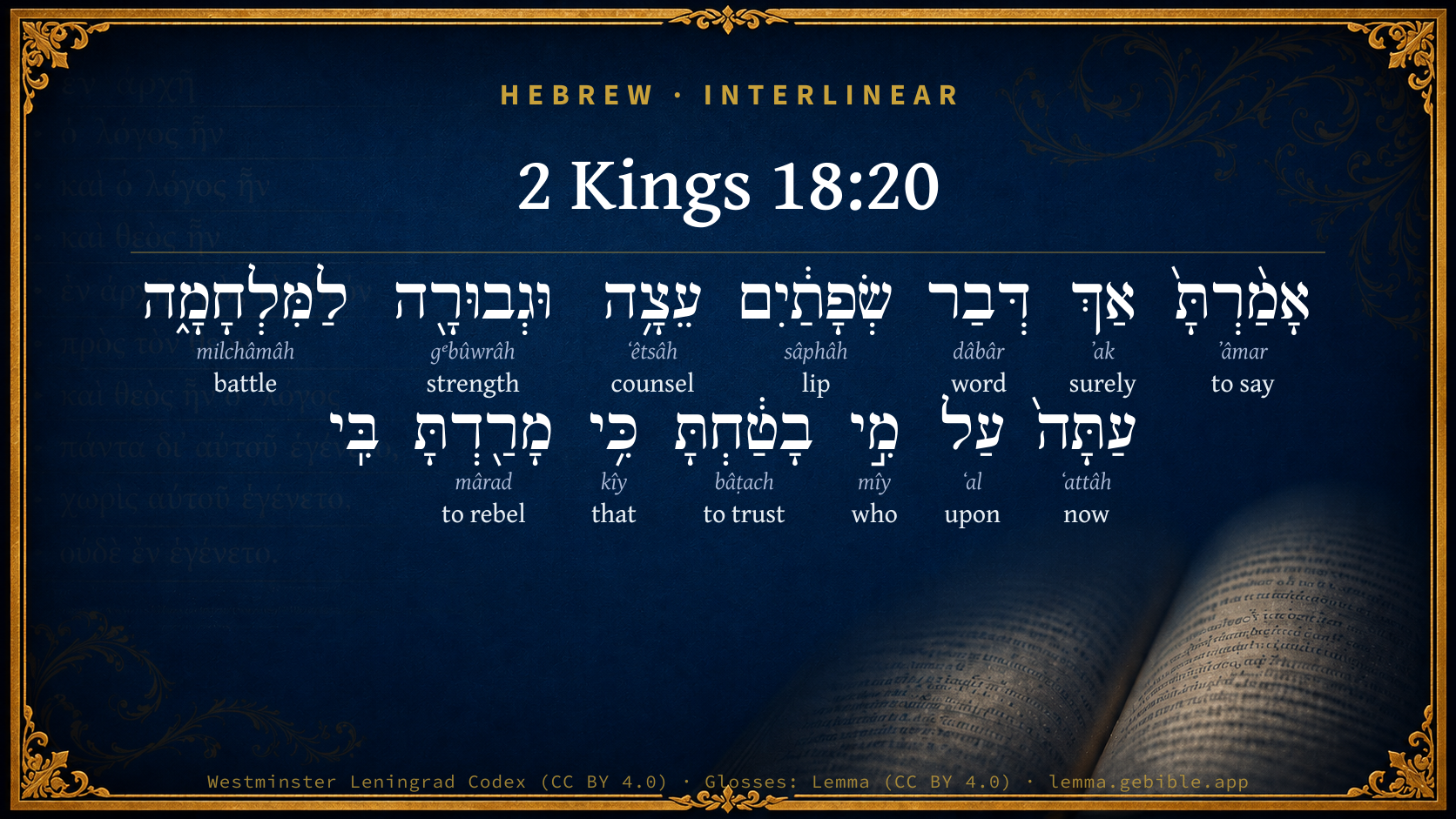
Hebrew (Westminster Leningrad Codex) 2 Kings 18:20 appears in the Hebrew Old Testament. The text above is from the Westminster Leningrad Codex. Each word links to its Strong’s number, a concise gloss, and parsing drawn from the Open Scriptures Hebrew Bible morphology. Click any word for its full Brown-Driver-Briggs (BDB) entry.
Download image
Cite this verse

2 Kings 18:20 (World English Bible). Public Domain. Lemma interlinear Bible study tool, https://lemma.gebible.app/v/2-kings/18/20.

Show BibTeX & RIS
BibTeX
RIS
English Translation
You say (but they are but vain words), [There is] counsel and strength for the war. Now on whom do you trust, that you have rebelled against me?
World English Bible · Public Domain
Download a study sheet

One document with this verse’s original text, its word-by-word gloss line, the meaning frame, cross-references with their text, attributed commentary, and full source and license credits — printable, and it pastes into notes with its structure intact.

This verse Autodidact and up

Study sheet (.html) Plain text (.txt)

A passage Seminary Student

Up to 50 verses in one chapter. A passage sheet keeps up to 6 commentary sources and 12 cross-references per verse, in the order this page ranks them, and says so on the sheet whenever that leaves anything out. Ask for a single verse and you get the Autodidact verse sheet above.

Everything on this page stays free to read, with no account — the sheet is a download of what is already on screen, not access to it.

Want to remove ads? Support Godless Engineer
Compare translations 3

The same verse in 3 English versions, stacked beneath the original-language interlinear above. Click any original word for its lexicon entry.

Each is an independent rendering of the whole verse — the interlinear is not word-aligned to these translations.

Highlighted words mark where these versions differ — a whole-verse word diff, not a word-by-word alignment.

  • World English Bible Public Domain
    You say (but they are but vain words), [There is] counsel and strength for the war. Now on whom do you trust, that you have rebelled against me?
  • King James Version Public Domain
    Thou sayest, (but they are but vain words,) I have counsel and strength for the war. Now on whom dost thou trust, that thou rebellest against me?
  • unfoldingWord Literal Text CC BY-SA 4.0
    You speak only a word of lips, ‘Counsel and might for war.’ Now in whom do you trust, that you rebel against me?

unfoldingWord Literal Text — © unfoldingWord, licensed CC BY-SA 4.0. Word-aligned USFM3 via Door43 (git.door43.org/unfoldingWord/en_ult).

Versions to compare (up to 4)

3 of 4 selected

Show all 18 translations

Every available English version of this verse, each an independent rendering of the whole verse.

  • World English Bible Public Domain
    You say (but they are but vain words), [There is] counsel and strength for the war. Now on whom do you trust, that you have rebelled against me?
  • Berean Standard Bible Public Domain
    You claim to have a strategy and strength for war, but these are empty words. In whom are you now trusting, that you have rebelled against me?
  • Majority Standard Bible Public Domain
    You claim to have a strategy and strength for war, but these are empty words. In whom are you now trusting, that you have rebelled against me?
  • King James Version Public Domain
    Thou sayest, (but they are but vain words,) I have counsel and strength for the war. Now on whom dost thou trust, that thou rebellest against me?
  • American Standard Version (1901) Public Domain
    Thou sayest (but they are but vain words), `There is' counsel and strength for the war. Now on whom dost thou trust, that thou hast rebelled against me?
  • Revised Version (1885) Public Domain
    Thou sayest, but they are but vain words, There is counsel and strength for the war. Now on whom dost thou trust, that thou hast rebelled against me?
  • Geneva Bible (1599) Public Domain
    Thou thinkest, Surely I haue eloquence, but counsell and strength are for the warre. On whom then doest thou trust, that thou rebellest against me?
  • Douay-Rheims (1899) Public Domain
    Perhaps thou hast taken counsel, to prepare thyself for battle. On whom dost thou trust, that thou darest to rebel?
  • Young's Literal Translation Public Domain
    Thou hast said: Only a word of the lips! counsel and might `are' for battle; now, on whom hast thou trusted that thou hast rebelled against me?
  • Literal Standard Version CC BY-SA 4.0
    You have said: Only a word of the lips! Counsel and might [are] for battle; now, on whom have you trusted that you have rebelled against me?
  • Unlocked Literal Bible CC BY-SA 4.0
    You speak only useless words, saying there are allies and strength for war. In whom are you trusting, that you should rebel against me?
  • unfoldingWord Literal Text CC BY-SA 4.0
    You speak only a word of lips, ‘Counsel and might for war.’ Now in whom do you trust, that you rebel against me?
  • Darby Bible Public Domain
    Thou sayest -- but it is a word of the lips -- There is counsel and strength for war. Now on whom dost thou rely, that thou hast revolted against me?
  • World Messianic Bible Public Domain
    You say (but they are but vain words), ‘There is counsel and strength for war.’ Now on whom do you trust, that you have rebelled against me?
  • Webster's Bible Public Domain
    Thou sayest, but they are but vain words, I have counsel and strength for the war. Now in whom dost thou trust, that thou rebellest against me?
  • Free Bible Version CC BY-SA 4.0
    You say you have a strategy and are ready for war, but these are empty words. Who are you relying on, now that you have rebelled against me?
  • Bible in Basic English Public Domain
    You say you have a design, and strength for war, but these are only words. Now to whom are you looking for support, that you have gone against my authority?
  • JPS Tanakh (1917) Public Domain
    Sayest thou that a mere word of the lips is counsel and strength for the war? Now on whom dost thou trust, that thou hast rebelled against me?

Literal Standard Version (2020), Covenant Press — licensed CC BY-SA 4.0. Text via the HelloAO Bible API (eBible.org). Unlocked Literal Bible (unfoldingWord) — licensed CC BY-SA 4.0. Text via the HelloAO Bible API (eBible.org). unfoldingWord Literal Text — © unfoldingWord, licensed CC BY-SA 4.0. Word-aligned USFM3 via Door43 (git.door43.org/unfoldingWord/en_ult). Free Bible Version, Dr. Jonathan Gallagher — licensed CC BY-SA 4.0. Text via the HelloAO Bible API (eBible.org).

Word by word

More ways to search: Search by grammar → Find every occurrence → Compare this word →

Practice this passage: Drill this verse → Learn its vocabulary →

מָרַ֖דְתָּ
mârad
H4775
“to rebel”
Verb, Qal, Perfect, 2nd Person, Masculine, Singular
Part of Speech
Verb
Stem
Qal
Form
Perfect
Person
2nd Person
Gender
Masculine
Number
Singular
Full BDB Definition

Origin: a primitive root

TWOT: 1240

to rebel, revolt, be rebellious - (Qal) to rebel, revolt - against human king - against God - against light (poetic)
  1. אָמַ֨רְתָּ֙ ʼâmar H559 “to say” Verb, Qal, Perfect, 2nd Person, Masculine, Singular
  2. אַךְ ʼak H389 “surely” Particle, Accusative
  3. דְּבַר dâbâr H1697 “word of” Noun, Common, Masculine, Singular, Construct
  4. שְׂפָתַ֔יִם sâphâh H8193 “lips” Noun, Common, Feminine, Dual, Absolute
  5. עֵצָ֥ה ʻêtsâh H6098 “counsel” Noun, Common, Feminine, Singular, Absolute
  6. וּגְבוּרָ֖ה gᵉbûwrâh H1369 “and · strength” Conjunction + Noun, Common, Feminine, Singular, Absolute
  7. לַמִּלְחָמָ֑ה milchâmâh H4421 “to/for the · battle” Preposition, Determined + Noun, Common, Feminine, Singular, Absolute
  8. עַתָּה֙ ʻattâh H6258 “now” Adverb
  9. עַל ʻal H5921 “upon” Preposition
  10. מִ֣י mîy H4310 “who” Particle, Interrogative
  11. בָטַ֔חְתָּ bâṭach H982 “to trust” Verb, Qal, Perfect, 2nd Person, Masculine, Singular
  12. כִּ֥י kîy H3588 “that” Conjunction

About this verse

These counts appear in no published source. They are computed here, from the morphology-tagged text and Lemma’s own curated glosses. What Lemma adds →

14
words
13
distinct lemmas
Historical
section

Notable vocabulary

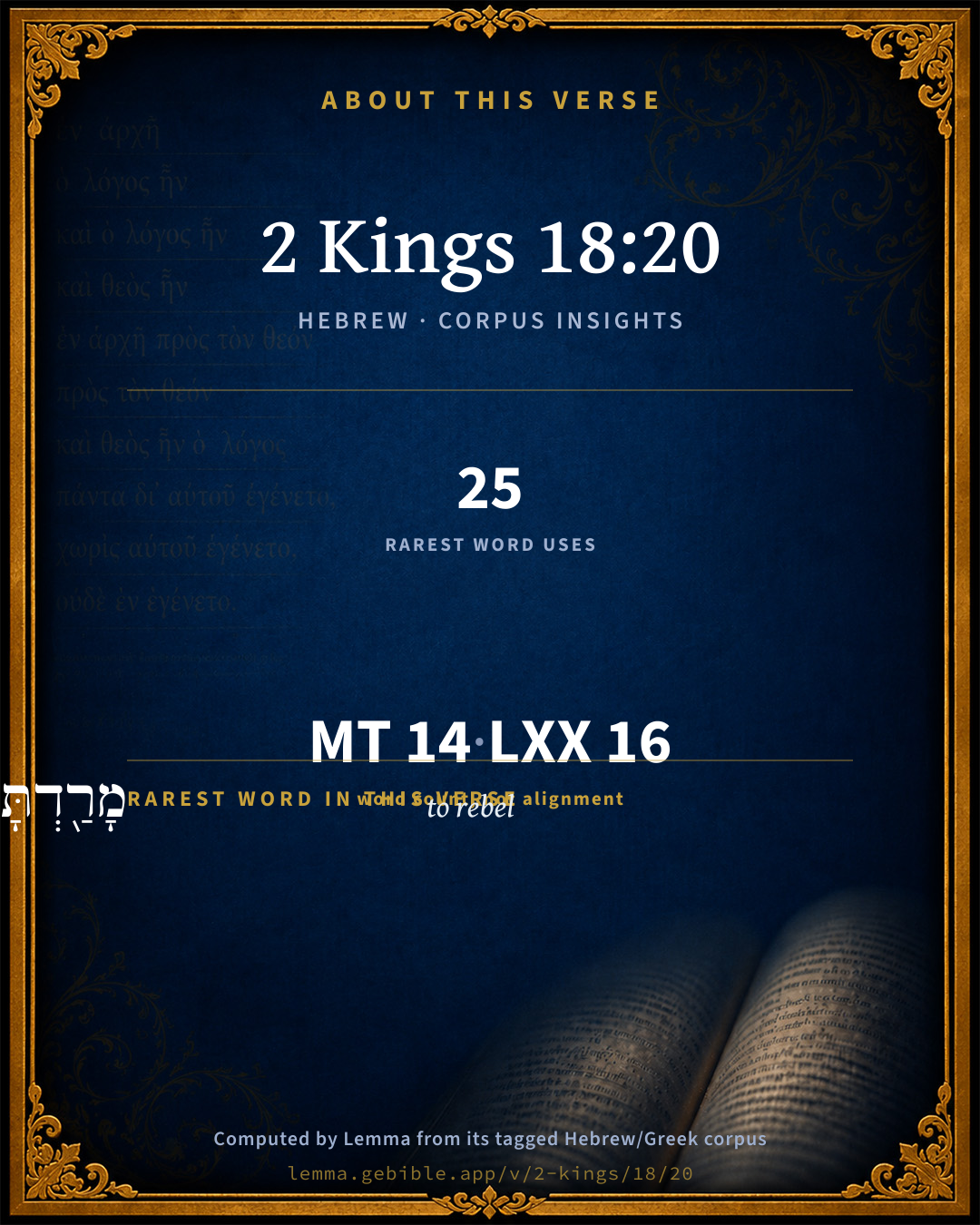
The rarest word here is מָרַ֖דְתָּ to rebel H4775 — appearing just 25 times in the whole Hebrew Bible.

Shared distinctive vocabulary

מָרַ֖דְתָּ to rebel H4775 occurs in 23 verses of the Hebrew Bible. Also found in:

Grammatical profile

  • 3 verbs
  • 5 nouns
  • 2 prepositions
  • 1 conjunction
  • 1 adverb
  • 2 particles

Verb forms

  • אָמַ֨רְתָּ֙ Qal · Perfect
  • בָטַ֔חְתָּ Qal · Perfect
  • מָרַ֖דְתָּ Qal · Perfect

Hebrew & Septuagint length

In English translation the verse runs 28 words from the Hebrew and 28 from the Septuagint (LXX English) — the same length.

A rough comparison of the two English renderings, which tokenize alike — not a word-level alignment.

Word counts can differ between the Hebrew and the Greek without any difference in meaning — e.g. the Hebrew direct-object marker אֵת has no separate Greek word, and Greek often adds the article ὁ.

In the original languages it is 14 Hebrew tokens and 16 Greek tokens — but the two are counted differently (Hebrew bundles its prefixes and suffixes into one token; the Greek is in lemma form), so that isn’t a like-for-like length.

Cross-references

1

Topical passages linked to 2 Kings 18:20 in the Treasury of Scripture Knowledge — connected by theme and wording, ordered by reader-vote popularity; previews shown in the World English Bible.

Cross-references courtesy of OpenBible.info (CC BY 4.0).

Hebrew and Greek witnesses Masoretic Hebrew ↔ Greek Septuagint

The same verse in the two great witnesses to the Old Testament, shown verse-for-verse.

These are two independent witnesses, not word-aligned to each other, and the Septuagint is shown in lemma (dictionary) form.

Hebrew 2 Kings 18:20 Masoretic · Westminster Leningrad Codex

אָמַ֨רְתָּ֙ אַךְ דְּבַר שְׂפָתַ֔יִם עֵצָ֥ה וּגְבוּרָ֖ה לַמִּלְחָמָ֑ה עַתָּה֙ עַל מִ֣י בָטַ֔חְתָּ כִּ֥י מָרַ֖דְתָּ בִּֽי

You say (but they are but vain words), [There is] counsel and strength for the war. Now on whom do you trust, that you have rebelled against me?

World English Bible · Public Domain

Greek LXX 2 Kings 18:20 Septuagint · lemma form

εἶπον πλήν λόγος χεῖλος βουλή καί δύναμις εἰς πόλεμος νῦν οὖν τίς πείθω ἀθετέω ἐν ἐγώ

You have said, (but they are mere words,) I have counsel and strength for war. Now then in whom do you trust, that you have revolted from me?

LXX2012 (modern English Septuagint) · Public Domain

Hebrew: Westminster Leningrad Codex (CC BY 4.0). Greek: Septuagint (public domain); English from LXX2012 (modern English Septuagint) (Public Domain). How the Septuagint differs from the Hebrew →

Targum (Aramaic paraphrase)

1

The Targum is the ancient Jewish Aramaic paraphrase of the Hebrew Scriptures — an interpretive translation, not the Hebrew text itself. Onkelos (literal) and Pseudo-Jonathan (expansive) render the Torah, and Jonathan the Prophets. Coverage is partial: where no permissively-licensed English translation exists for a verse, only the Aramaic is shown. This is verse-level text, not a word-by-word alignment to the Hebrew.

  1. Targum Jonathan Prophets (Joshua–Malachi)
    אֲמַרְתָּ בְּרַם בִּמְלַל סִפְוָן בְּמֵילַךְ וּגְבוּרָה אַעְבֵּיד קְרָבָא כְּעַן עַל מַן אִתְרְחֵיצְתָּא אֲרֵי מְרִידְתָּא בִּי:

    (no public-domain English translation for this verse)

    Targum Jonathan — Aramaic: “Mikraot Gedolot” (public domain). English: “Sefaria Community Translation” (CC0 1.0 (public-domain dedication)); “London "Chaldee Paraphrase," 1871” (public domain). Text via Sefaria.

Commentary

Notes on 2 Kings 18:20 from classic Christian and Jewish commentators (each source and its license shown beneath its notes). The classic Christian expositions comment on the surrounding passage and are grouped to its opening verse, so a note may address several verses; the Jewish commentaries on the Tanakh (Rashi and others) are per-verse, so they appear only where the commentator wrote on this verse.

Lemma curates 59 commentaries, every one of them public domain or Creative Commons licensed, each selected and text-cleaned for this edition rather than reprinted as found. About our sources →

Trapp's Complete Commentary

John Trapp

2Ki 18:20 Thou sayest, (but [they are but] vain words,) [I have] counsel and strength for the war. Now on whom dost thou trust, that thou rebellest against me?

Ver. 20. Thou sayest (but they are but vain words).] Heb., Words of the lips, i.e., frothy and fruitless, forasmuch as thou hast neither counsel nor strength for the war, but dost only word it, as Philip afterwards said the Athenians did. Some read the text not in a parenthesis, and thus paraphrase it: What can Hezekiah say to embolden him? What? I say, saith Hezekiah, I have words of my lips, that is, Prayer, prayer! Saith Rabshakeh: These are empty words, an airy nothing: for counsel and strength are for the war; but of these Hezekiah makes no reckoning, as thinking to do all by prayer, which I hold no better than prittle prattle.

John Trapp, A Commentary or Exposition upon All the Books of the Old and New Testament (1647–1656) — public domain. Text from a community e-Sword module.

Geneva Bible (1599)

Geneva Bible translators

Hebrew, talk of the lips.

Thou thinkest that words will serve to persuade thy people, or to move my master.

Geneva Bible (1599) marginal notes — public domain. Text via Bolls.life.

Ellicott's Commentary for English Readers

(20) Thou sayest (but they are but vain Words).—Literally, thou hast said—a mere lip-word it was—i.e., insincere language, an utterance which thou knewest to be false. (Comp. our expression, “lip-service.”)

I have counsel . . .—The margin is wrong.

A Bible Commentary for English Readers, edited by Charles John Ellicott (1878–1897) — public domain. Text from a community e-Sword module.

The Cambridge Bible for Schools and Colleges

gen. ed. J. J. S. Perowne

20. Thou sayest, (but they are but vain words)] Some have taken the words in the parenthesis as the object of the verb, so that the sense would be ‘Thou speakest only vain words (when thou talkest about) counsel and strength’. But it is better to leave them as a parenthesis, because of the succeeding question Thou speakest of counsel and strength, whence are they to come? The literal meaning of the expression rendered ‘vain words’, i.e. a word of the lips, which is nothing but so much breath, is very forcible and is preserved on the margin both of A.V. and R.V. Instead of the italics ‘I have’ R.V. inserts There is.

The Cambridge Bible for Schools and Colleges (gen. ed. J. J. S. Perowne; Cambridge University Press, 1878–1918) — public domain. Text from a community e-Sword module.

Albert Barnes' Notes on the Bible

Hezekiah no doubt believed that in the “counsel” of Eliakim and Isaiah, and in the “strength” promised him by Egypt, he had resources which justified him in provoking a war.

Vain words - literally, as in margin, i. e., a mere word, to which the facts do not correspond.

Albert Barnes' Notes on the Bible (1834–1885) — public domain. Text from a community e-Sword/MySword module.

Haydock's Catholic Bible Commentary

Counsel. Hebrew, "Thou sayest (but they are but vain words) I have counsel and strength for the war." (Protestants) (Haydock) --- You have vainly boasted. (Calmet) --- Isaias xxvi. 5. (Calmet)

George Leo Haydock (1774–1849), Haydock's Catholic Family Bible and Commentary, 1859 edition — public domain. Excludes Psalms (Douay-Rheims chapter numbering differs from Protestant) and Deuterocanonical books (Catholic canon only).

Matthew Poole's English Annotations

Thou sayest; either to thy people, to encourage them; or rather, within thyself.

But they are but vain words, or, surely, or, only words of the lips, i.e. vain, unprofitable, idle talk, without any effect; or they come not from thy heart; thou speakest this against thy own knowledge.

Counsel and strength for the war; counsel to contrive, strength or courage to execute; which two things are of greatest necessity and use for war. But the words are and may be rendered otherwise; either this, thou speakest surely words of the lips, i.e. thou encouragest thyself and thy people with talk and words; but counsel and strength are for war, are necessary for thy defence; neither of which thou hast within thyself, but must seek them from others; and where wilt thou find them?

on whom (as it follows)

dost thou trust? Or thus, Thou sayest, I have the word of my lips, (either,

1. Words wherewith to pray to God for help; or,

2. Eloquence to encourage my soldiers and people,) counsel and strength for war; i.e. I am furnished with all things necessary for my defence. On whom dost thou trust? seeing it is apparent thou hast not strength of thy own, from whom dost thou expect succours?

Matthew Poole's English Annotations on the Holy Bible (1683–1685) — public domain. Text from a community e-Sword/MySword module.

Whedon's Commentary on the Bible

Daniel D. Whedon

20. But they are but vain words — Rather, only a word of the lips; that is, an idle, inconsiderate saying. Compare Job_2:2; Pro_14:23.

Daniel D. Whedon (gen. ed.), Commentary on the Old and New Testaments (1874–1909) — public domain. Text from a community e-Sword module.

The Pulpit Commentary

Thou sayest (but they are but vain words); literally, words of lips; i.e. words which the lips speak, without the heart having any conviction of their truth. We must suppose that Sennacherib has either heard from his spies that Hezekiah is speaking to the people as he represents him to be speaking, or conjectures what he is likely to say. According to the writer of Chronicles, (2Ch_32:7, 2Ch_32:8) what he did say was very different. He neither boasted of "counsel" nor of material "strength;" but simply said, "There be more with us than with him: with him is an arm of flesh; but with us is the Lord our God to help us and to fight our battles." I have counsel and strength for the war. Sennacherib imagines that Hezekiah"s real trust is in the "fleshly arm" of Egypt, and in the counselors who have advised and brought about the alliance. And perhaps he is not far wrong. Hezekiah, it would seem, "halted between two opinions." He hoped for aid from Egypt; but, if it failed, then he hoped for the Divine help promised by Isaiah. Now on whom dost thou trust, that thou rebellest against me?

Vers. 20, 21. Bruised reeds.

It is astonishing what trust is still placed, by generation after generation of mankind, in "bruised reeds." Whatever may be the case with individuals, mankind, the human race, learns nothing from experience. Men still trust implicitly in such "bruised reeds" as these

I BIG BATTALIONS. They think they are safe if they have sufficient "strength for the war." They go on increasing their military establishments, adding regiment to regiment, and battery to battery, and corps d armee to corps darmee. They count the armies of their neighbors; they reckon up man against man, and gun against gun, and ship against ship; and calculate, and plan, and act, as if the "multitude of a host the number of troops capable of being brought at once into the field was everything. They forget that "it is nothing to the Lord to help, whether with many or with them that have no power". (2Ch_14:11) They forget, or misread, history, and fail to note how often "the race has not been to the swift, nor the battle to the strong". (Ecc_9:11)

II POWERFUL ALLIES. Weak powers have always some "Egypt" to which they look for succor. Strong Powers count on "triple" or "quadruple" alliances to augment their strength, and render them irresistible. They forget how easily alliances are broken up, how sure they are to arouse discontents and jealousies, how little dependence can be placed on the promises of statesmen, or the persistence of a particular mood in a nation, or the view which a state may take of its interests. They forget that the friend of today may be the enemy of to-morrow, and may fail them at the moment of greatest need.

III SAGACIOUS STATESMEN AND GENERALS. It is forgotten, or at any rate not borne steadily in mind, how intellect decays, how mental power lessens, as men grow old; how often under a prolonged strain the strongest intellect suddenly snaps and is no longer of any account. Nor is it generally felt and recognized how limited and imperfect even the greatest intellect always is how incompetent to forecast all possibilities, or to deal with all emergencies. "The weakness of God is stronger than man, and the foolishness of God is wiser than man". (1Co_1:25) Man"s wisdom is at best a poor purblind wisdom, apt to err, apt to fail when most needed a very "bruised reed" to trust in.

IV GOOD LUCK OR A FORTUNATE STAR. The trust of the first Napoleon in his "star" is well known. It is not so well known, but it is sufficiently attested, that the third Napoleon had nearly as implicit a trust. Thousands of persons deem themselves "lucky," and trust in their "good luck," as if it were an actual tangible possession. Otherwise there would be far less gambling than there is. The poor peasants of Italy and Germany would Waste less money in lotteries, and the simpletons of England less in bets upon horses. Persons "luck" is, on the whole, probably about equal, and if a man has been "lucky" hitherto, he should expect to be "unlucky" in the future.

V SOMETHING TURNING UP. The phrase is a vulgar one, but it would need a long periphrasis to express the idea otherwise, and even then we might not make our meaning clear. Men who do not think themselves particularly lucky are still constantly waiting for "something to turn up," looking for it, trusting in it. The trust is made an excuse for idleness, for inaction, for waste of the best years of life, even for dissipated courses for gambling, drinking, frequenting evil company. This "bruised reed" is more rotten even than most of the others. For the idler, the waster of his time, the haunter of smoking saloons, billiard-rooms, and race-courses, nothing ever does "turn up." He offers no temptation to steady businesslike men to employ him. He does not seek work, and work is not very likely to seek him. He is an idler, and will remain an idler to the end of the chapter. There is no help for him, unless he gives up his silly trust, and betakes himself to a better one.

The Pulpit Commentary (1880–1919), ed. H.D.M. Spence-Jones & Joseph S. Exell — public domain. Text from a community e-Sword module.

Rashi

Rabbi Shlomo Yitzchaki (Rashi)

You have said but words of the lips, etc. Until now you have said, ”I will (not) pay tribute to the king of Ashur.” It was but words of the lips, as long as he did not leave his place to march upon you, you did not require counsel and might. But now, that he has left [his place] and marched [upon you], you require counsel and might for this war. Now, tell [me] upon whom you have depended?

Rashi on the Tanakh — English translations: “The Judaica Press complete Tanach with Rashi, translated by A. J. Rosenberg” (CC BY 4.0); “Pentateuch with Rashi's commentary by M. Rosenbaum and A.M. Silbermann, 1929-1934” (public domain); “The Metsudah Tanach series, Lakewood, N.J” (CC BY 4.0); and “The Book of Joshua, Metsudah Publications, 1997” (CC BY 4.0). Text via Sefaria.

Lesson kit

Teaching starters — assembled from the data on this page, not authored interpretation. Every prompt links to the verse data it draws on. Edit before teaching.

2 Kings, in the Historical, opens this verse with 14 words (13 distinct Hebrew lemmas). Its most distinctive word is mârad (“to rebel”). A historical commentator’s framing appears above. Read the whole chapter for the surrounding context.

Discussion questions

  1. What does “to rebel” (mârad) contribute to the verse as a whole?
  2. How does Genesis 14:4, which shares the word «to rebel», read alongside this verse?
  3. These translations render this verse differently; the difference is in the English rendering, not the original. What questions does that raise?
  4. «אָמַ֨רְתָּ֙» is a Qal Perfect verb. How does that grammatical form shape the action described?
  5. Compare how Trapp's Complete Commentary and Geneva Bible (1599) read this verse. Where do they agree or differ?

Things to notice

Reading settings

Reading text

Shown beneath each verse's original-language words.

Old Testament
Old Testament edition

Read the OT as the Masoretic Hebrew (MT) or the Greek Septuagint (LXX).

English shown for the Greek Septuagint (in the Hebrew ↔ Greek comparison).

Comparing translations? Open the Compare panel on any verse page to stack up to four side by side.