
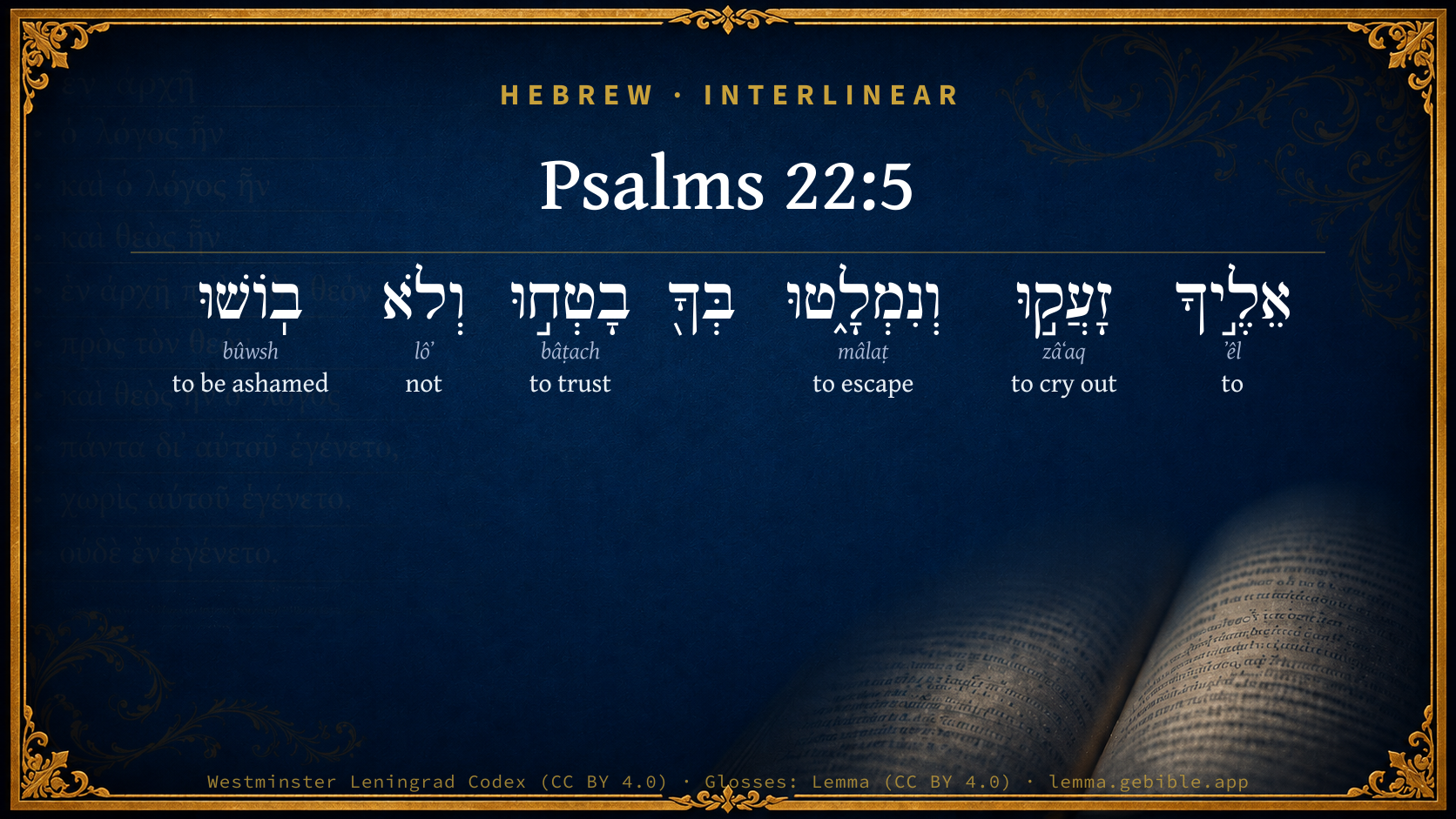
Psalms 22:5

Hebrew (Westminster Leningrad Codex) Psalms 22:5 appears in the Hebrew Old Testament. The text above is from the Westminster Leningrad Codex. Each word links to its Strong’s number, a concise gloss, and parsing drawn from the Open Scriptures Hebrew Bible morphology. Click any word for its full Brown-Driver-Briggs (BDB) entry.
Download image
Cite this verse

Psalms 22:5 (World English Bible). Public Domain. Lemma interlinear Bible study tool, https://lemma.gebible.app/v/psalms/22/5.

Show BibTeX & RIS
BibTeX
RIS
English Translation
They cried to you, and were delivered. They trusted in you, and were not disappointed.
World English Bible · Public Domain
Download a study sheet

One document with this verse’s original text, its word-by-word gloss line, the meaning frame, cross-references with their text, attributed commentary, and full source and license credits — printable, and it pastes into notes with its structure intact.

This verse Autodidact and up

Study sheet (.html) Plain text (.txt)

A passage Seminary Student

Up to 50 verses in one chapter. A passage sheet keeps up to 6 commentary sources and 12 cross-references per verse, in the order this page ranks them, and says so on the sheet whenever that leaves anything out. Ask for a single verse and you get the Autodidact verse sheet above.

Everything on this page stays free to read, with no account — the sheet is a download of what is already on screen, not access to it.

Want to remove ads? Support Godless Engineer
Compare translations 3

The same verse in 3 English versions, stacked beneath the original-language interlinear above. Click any original word for its lexicon entry.

Each is an independent rendering of the whole verse — the interlinear is not word-aligned to these translations.

Highlighted words mark where these versions differ — a whole-verse word diff, not a word-by-word alignment.

  • World English Bible Public Domain
    They cried to you, and were delivered. They trusted in you, and were not disappointed.
  • King James Version Public Domain
    They cried unto thee, and were delivered: they trusted in thee, and were not confounded.
  • unfoldingWord Literal Text CC BY-SA 4.0
    To you they cried and they were rescued. In you they trusted and they were not ashamed.

unfoldingWord Literal Text — © unfoldingWord, licensed CC BY-SA 4.0. Word-aligned USFM3 via Door43 (git.door43.org/unfoldingWord/en_ult).

Versions to compare (up to 4)

3 of 4 selected

Show all 18 translations

Every available English version of this verse, each an independent rendering of the whole verse.

  • World English Bible Public Domain
    They cried to you, and were delivered. They trusted in you, and were not disappointed.
  • Berean Standard Bible Public Domain
    They cried out to You and were set free; they trusted in You and were not disappointed.
  • Majority Standard Bible Public Domain
    They cried out to You and were set free; they trusted in You and were not disappointed.
  • King James Version Public Domain
    They cried unto thee, and were delivered: they trusted in thee, and were not confounded.
  • American Standard Version (1901) Public Domain
    They cried unto thee, and were delivered: They trusted in thee, and were not put to shame.
  • Revised Version (1885) Public Domain
    They cried unto thee, and were delivered: they trusted in thee, and were not ashamed.
  • Geneva Bible (1599) Public Domain
    They called vpon thee, and were deliuered: they trusted in thee, and were not confounded.
  • Douay-Rheims (1899) Public Domain
    In thee have our fathers hoped: they have hoped, and thou hast delivered them.
  • Young's Literal Translation Public Domain
    Unto Thee they cried, and were delivered, In Thee they trusted, and were not ashamed.
  • Literal Standard Version CC BY-SA 4.0
    To You they cried, and were delivered, || In You they trusted, and were not disappointed.
  • Unlocked Literal Bible CC BY-SA 4.0
    They cried to you and they were rescued. They trusted in you and were not disappointed.
  • unfoldingWord Literal Text CC BY-SA 4.0
    To you they cried and they were rescued. In you they trusted and they were not ashamed.
  • Darby Bible Public Domain
    They cried unto thee, and were delivered; they confided in thee, and were not confounded.
  • World Messianic Bible Public Domain
    They cried to you, and were delivered. They trusted in you, and were not disappointed.
  • Webster's Bible Public Domain
    \\22:4\\Our fathers trusted in thee: they trusted, and thou didst deliver them.
  • Free Bible Version CC BY-SA 4.0
    They cried out to you for help, and they were saved. They trusted in you and were not defeated.
  • Bible in Basic English Public Domain
    They sent up their cry to you and were made free: they put their faith in you and were not put to shame.
  • JPS Tanakh (1917) Public Domain
    (22-6) Unto Thee they cried, and escaped; in Thee did they trust, and were not ashamed.

Literal Standard Version (2020), Covenant Press — licensed CC BY-SA 4.0. Text via the HelloAO Bible API (eBible.org). Unlocked Literal Bible (unfoldingWord) — licensed CC BY-SA 4.0. Text via the HelloAO Bible API (eBible.org). unfoldingWord Literal Text — © unfoldingWord, licensed CC BY-SA 4.0. Word-aligned USFM3 via Door43 (git.door43.org/unfoldingWord/en_ult). Free Bible Version, Dr. Jonathan Gallagher — licensed CC BY-SA 4.0. Text via the HelloAO Bible API (eBible.org).

Word by word

More ways to search: Search by grammar → Find every occurrence → Compare this word →

Practice this passage: Drill this verse → Learn its vocabulary →

זָעֲק֣וּ
zâʻaq
H2199
“to cry out”
Verb, Qal, Perfect, 3rd Person, Common, Plural
Part of Speech
Verb
Stem
Qal
Form
Perfect
Person
3rd Person
Gender
Common
Number
Plural
Full BDB Definition

Origin: a primitive root

TWOT: 570

to cry, cry out, call, call for help - (Qal) - to call (to one's aid) - to cry, cry out (in need) - (Niphal) to be assembled, be called together, be joined together - (Hiphil) - to call, call out, call together, summon - to make a crying, proclaim - to have a proclamation made - to call out to, call out at
  1. אֵלֶ֣יךָ ʼêl H413 “to · you” Preposition + Suffix, Personal, 2nd Person, Masculine, Singular
  2. וְנִמְלָ֑טוּ mâlaṭ H4422 “and · to escape” Conjunction + Verb, Niphal, Perfect, 3rd Person, Common, Plural
  3. בָטְח֣וּ bâṭach H982 “to trust” Verb, Qal, Perfect, 3rd Person, Common, Plural
  4. וְלֹא lôʼ H3808 “and · not” Conjunction + Particle, Negative
  5. בֽוֹשׁוּ bûwsh H954 “to be ashamed” Verb, Qal, Perfect, 3rd Person, Common, Plural

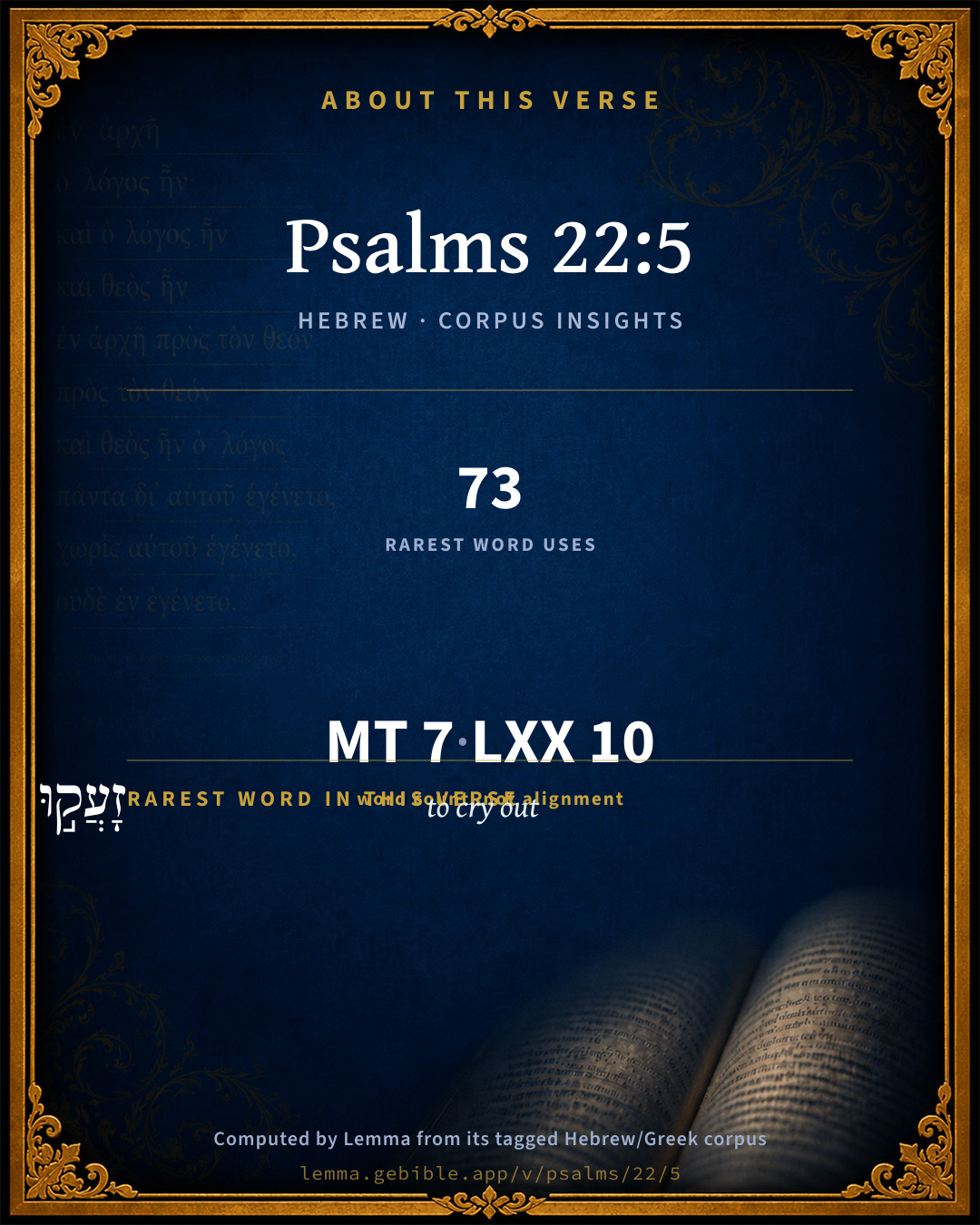
About this verse

These counts appear in no published source. They are computed here, from the morphology-tagged text and Lemma’s own curated glosses. What Lemma adds →

7
words
6
distinct lemmas
Wisdom
section

Grammatical profile

  • 4 verbs
  • 2 prepositions
  • 1 particle

Verb forms

  • זָעֲק֣וּ Qal · Perfect
  • וְנִמְלָ֑טוּ Niphal · Perfect
  • בָטְח֣וּ Qal · Perfect
  • בֽוֹשׁוּ Qal · Perfect

Hebrew & Septuagint length

In English translation the verse runs 15 words from the Hebrew and 15 from the Septuagint (LXX English) — the same length.

A rough comparison of the two English renderings, which tokenize alike — not a word-level alignment.

Word counts can differ between the Hebrew and the Greek without any difference in meaning — e.g. the Hebrew direct-object marker אֵת has no separate Greek word, and Greek often adds the article ὁ.

In the original languages it is 7 Hebrew tokens and 10 Greek tokens — but the two are counted differently (Hebrew bundles its prefixes and suffixes into one token; the Greek is in lemma form), so that isn’t a like-for-like length.

Cross-references

14

Topical passages linked to Psalms 22:5 in the Treasury of Scripture Knowledge — connected by theme and wording, ordered by reader-vote popularity; previews shown in the World English Bible.

  • Romans 10:11 For the Scripture says, "Whoever believes in him will not be disappointed."
  • Isaiah 49:23 Kings shall be your nursing fathers, and their queens your nursing mothers: they shall bow down to you with their faces to the earth, and lick the dust of your feet; and you shall know that I am Yahweh; and those who wait for me shall not be disappointed.
  • Romans 9:33 even as it is written, "Behold, I lay in Zion a stumbling stone and a rock of offense; And no one who believes in him will be disappointed."
  • 1 Peter 2:6 Because it is contained in Scripture, "Behold, I lay in Zion a chief cornerstone, chosen, and precious: He who believes in him will not be disappointed."
  • Isaiah 45:17 [But] Israel shall be saved by Yahweh with an everlasting salvation: you shall not be disappointed nor confounded world without end.
  • Judges 6:6 Israel was brought very low because of Midian; and the children of Israel cried to Yahweh.
  • Judges 10:10–16 The children of Israel cried to Yahweh, saying, We have sinned against you, even because we have forsaken our God, and have served the Baals.
  • Psalms 25:2–3 My God, I have trusted in you, Don't let me be shamed. Don't let my enemies triumph over me.
  • Psalms 31:1 In you, Yahweh, I take refuge. Let me never be disappointed: Deliver me in your righteousness.
  • Psalms 71:1 In you, Yahweh, I take refuge. Never let me be disappointed.
  • Psalms 106:44 Nevertheless he regarded their distress, When he heard their cry.
  • Judges 4:3 The children of Israel cried to Yahweh: for he had nine hundred chariots of iron; and twenty years he mightily oppressed the children of Israel.
  • Psalms 69:6–7 Don't let those who wait for you be shamed through me, Lord Yahweh of Hosts. Don't let those who seek you be brought to dishonor through me, God of Israel.
  • Psalms 99:6–7 Moses and Aaron were among his priests, Samuel among those who call on his name; They called on Yahweh, and he answered them.

Cross-references courtesy of OpenBible.info (CC BY 4.0).

Hebrew and Greek witnesses Masoretic Hebrew ↔ Greek Septuagint

The same verse in the two great witnesses to the Old Testament, shown verse-for-verse.

You’re reading Greek Psalm 21 (Hebrew Psalm 22). The Septuagint counts the superscription, so verse numbers can differ from the Hebrew — chapter-level alignment, not verse-by-verse. Numbering follows Rahlfs.

These are two independent witnesses, not word-aligned to each other, and the Septuagint is shown in lemma (dictionary) form.

Hebrew Psalms 22:5 Masoretic · Westminster Leningrad Codex

אֵלֶ֣יךָ זָעֲק֣וּ וְנִמְלָ֑טוּ בְּךָ֖ בָטְח֣וּ וְלֹא בֽוֹשׁוּ

They cried to you, and were delivered. They trusted in you, and were not disappointed.

World English Bible · Public Domain

Greek LXX Greek Psalm 21:5 Septuagint · lemma form

ἐπί σύ ἐλπίζω ὁ πατήρ ἐγώ ἐλπίζω καί ῥύομαι αὐτός

They cried to you, and were saved: they hoped in you, and were not ashamed.

LXX2012 (modern English Septuagint) · Public Domain

On this verse, The Pulpit Commentary discusses the Septuagint’s reading. Read the note in Commentary ↓

Hebrew: Westminster Leningrad Codex (CC BY 4.0). Greek: Septuagint (public domain); English from LXX2012 (modern English Septuagint) (Public Domain). How the Septuagint differs from the Hebrew →

Commentary

Notes on Psalms 22:5 from classic Christian and Jewish commentators (each source and its license shown beneath its notes). The classic Christian expositions comment on the surrounding passage and are grouped to its opening verse, so a note may address several verses; the Jewish commentaries on the Tanakh (Rashi and others) are per-verse, so they appear only where the commentator wrote on this verse.

Lemma curates 59 commentaries, every one of them public domain or Creative Commons licensed, each selected and text-cleaned for this edition rather than reprinted as found. About our sources →

Trapp's Complete Commentary

John Trapp

Psa 22:5 They cried unto thee, and were delivered: they trusted in thee, and were not confounded.

Ver. 5. They cried unto thee] Having first trusted: it is the prayer of faith that does the deed.

And were not confounded] Deo confisi, nunquam confusi. I trust God and shall never be confounded.

John Trapp, A Commentary or Exposition upon All the Books of the Old and New Testament (1647–1656) — public domain. Text from a community e-Sword module.

J. A. Alexander on Psalms

Joseph Addison Alexander

6. (Psa 22:5.) To thee they cried and were delivered; in thee they trusted, and were not ashamed. This last word is continually used in Scripture for the disappointment and frustration of the hopes. The argument of this verse lies in the tacit contrast between the case referred to and that of the sufferer himself. As if he had said, "How is it then that I cry and am not delivered, I trust and am confounded or ashamed?"

Joseph Addison Alexander, The Psalms Translated and Explained (1850) — public domain. Text from a community e-Sword module.

Adam Clarke's Commentary

Verse 5. They cried unto thee] So do I. THEY were delivered; so may I. THEY trusted in thee; I also trust in thee. And were not confounded; and is it likely that I shall be put to confusion?

Adam Clarke's Commentary on the Bible (1810–1826) — public domain. Text from a community e-Sword/MySword module.

Ellicott's Commentary for English Readers

(5) Confounded—i.e., ashamed.

A Bible Commentary for English Readers, edited by Charles John Ellicott (1878–1897) — public domain. Text from a community e-Sword module.

John Gill's Exposition

They cried unto thee, and were delivered,.... As the Israelites did in Egyptian bondage, and as they in later times did when in distress; see Exo 2:23; &c. The crying is to be understood of prayer to God, and sometimes designs mental prayer, sighing, and groaning, which cannot be uttered, when no voice is heard, as in Moses, Exo 14:15; but oftener vocal prayer, put up in times of distress, and denotes the vehemency of trouble, and eagerness of desire to be heard and relieved; and this cry was from faith, it followed upon and was accompanied with trusting in the Lord; it was the prayer of faith, which is effectual and availeth much, and issued in deliverance;

they trusted in thee, and were not confounded: or ashamed; neither of the object of their trust, the living God, as those who trust in graven images; so Moab was ashamed of Chemosh, Jer 48:13; nor of their hope and trust in him, it being such as makes not ashamed, Psa 119:116, Rom 5:5; nor of the consequences of it; When men trust in anything and it fails them, and they have not what they expect by it, they are filled with shame and confusion, Isa 30:2; but they that trust in the Lord are never confounded, or made ashamed; their expectations do not perish: now Christ mentions this case of his ancestors as a reason of the praises of Israel, which they offered up to God for deliverances, and which he inhabited, Psa 22:3; as also by way of encouragement to himself in his present circumstances, that though the Lord was at a distance from him, and seemed not to regard him and his cries, yet that he would deliver him; and likewise as an argument with God that he would do so, since it had been his wonted way and method with his fathers before; moreover he may take notice of it in order to represent his own forlorn, uncomfortable, and deplorable condition, which was abundantly worse than theirs, and the reverse of it, as it seemed at present.

John Gill's Exposition of the Whole Bible (1746–1763) — public domain (CC PDM 1.0). Text via the HelloAO Bible API.

Albert Barnes' Notes on the Bible

They cried unto thee - They offered earnest prayer and supplication.

And were delivered - From dangers and trials.

They trusted in thee, and were not confounded - They were not disappointed. Literally, “they were not ashamed.” That is, they had not the confusion which those have who are disappointed. The idea in the word is, that when men put their trust in anything and are disappointed, they are conscious of a species of “shame” as if they had been foolish in relying on that which proved to be insufficient to help them; as if they had manifested a want of wisdom in not being more cautious, or in supposing that they could derive help from that which has proved to be fallacious. So in Jer 14:3, “Their nobles have sent their little ones to the waters; they came to the pits, and found no water; they returned with their vessels empty; “they were ashamed and confounded,” and covered their heads.” That is, they felt as if they had acted “foolishly” or “unwisely” in expecting to find water there. Compare the notes at Job 6:20. In the expression here, “they trusted in thee, and were not confounded,” it is meant that men who confide in God are never disappointed, or never have occasion for shame as if herein they had acted foolishly. They are never left to feel that they had put their trust where no help was to be found; that they had confided in one who had deceived them, or that they had reason to be ashamed of their act as an act of foolishness.

Albert Barnes' Notes on the Bible (1834–1885) — public domain. Text from a community e-Sword/MySword module.

Matthew Poole's English Annotations

i.e. Not disappointed of that for which they prayed and hoped.

Matthew Poole's English Annotations on the Holy Bible (1683–1685) — public domain. Text from a community e-Sword/MySword module.

The Treasury of David

Charles H. Spurgeon

Ver. 5. They cried unto thee, and were delivered: they trusted in thee, and were not confounded. As if he had said, "How is it that I am now left without succour in my overwhelming griefs, while all others have been helped?" We may remind the Lord of his former lovingkindnesses to his people, and beseech him to be still the same. This is true wrestling; let us learn the art. Observe, that ancient saints cried and trusted, and that in trouble we must do the same; and the invariable result was that they were not ashamed of their hope, for deliverance came in due time; this same happy portion shall be ours. The prayer of faith can do the deed when nothing else can. Let us wonder when we see Jesus using the same pleas as ourselves, and immersed in griefs far deeper than our own.

Ver. 5. Thou didst deliver them but thou wilt not deliver me; nay, rather thou didst deliver them because thou wilt not deliver me. Gerhohus.

Charles H. Spurgeon's The Treasury of David (1869–1885) — public domain. Psalms only. Text from a community e-Sword/MySword module.

The Pulpit Commentary

They cried unto thee, and were delivered. If they were delivered because they cried, the Sufferer who cries "day and night" (ver. 2) can scarcely remain unheard for ever. They trusted in thee, and were not confounded; or, were not put to shame (ou kathscunyhsan , LXX).

The Pulpit Commentary (1880–1919), ed. H.D.M. Spence-Jones & Joseph S. Exell — public domain. Text from a community e-Sword module.

Radak

Rabbi David Kimhi (Radak)

Our fathers trusted in Thee: They trusted: – for many times did our fathers trust in Thee,

and Thou didst deliver them – from their trouble, and their confidence did not prove false. The repetition of trusted is (intended) to emphasise the (thought of) confidence, for they had confidence in none other but in Thee; and so

Radak on the Tanakh — English translations: “Sefaria Community Translation” (CC0 1.0 (public-domain dedication)); “Eliyahu Munk, HaChut Hameshulash” (CC BY 4.0); “Rabbi Mike Feuer, Jerusalem Anthology” (CC BY 4.0); and “R. David Kimhi on the first book of Psalms, Translated by R.G. Finch, London, 1919” (public domain). Text via Sefaria.

Lesson kit

Teaching starters — assembled from the data on this page, not authored interpretation. Every prompt links to the verse data it draws on. Edit before teaching.

Psalms, in the Wisdom, opens this verse with 7 words (6 distinct Hebrew lemmas). Its most distinctive word is zâʻaq (“to cry out”). A historical commentator’s framing appears above. Read the whole chapter for the surrounding context.

Discussion questions

  1. How does “to cry out” (zâʻaq) shape what this verse is saying?
  2. How does Romans 10:11, which shares this passage’s theme, read alongside this verse?
  3. These translations render this verse differently. What is at stake in choosing one wording over another?
  4. «זָעֲק֣וּ» is a Qal Perfect verb. How does that grammatical form shape the action described?
  5. Compare how Trapp's Complete Commentary and J. A. Alexander on Psalms read this verse. Where do they agree or differ?

Things to notice

Reading settings

Reading text

Shown beneath each verse's original-language words.

Old Testament
Old Testament edition

Read the OT as the Masoretic Hebrew (MT) or the Greek Septuagint (LXX).

English shown for the Greek Septuagint (in the Hebrew ↔ Greek comparison).

Comparing translations? Open the Compare panel on any verse page to stack up to four side by side.